



Abstract
Phubbing is suggested to be a new form of social rejection, yet little is known about how people who are being “phubbed” interpret it within different relationships. Based on the social information processing model and the sociometer theory, this cross-sectional study investigated adolescents’ attribution for parental phubbing and its associations with adolescents’ relationship satisfaction and core self-evaluations. With a survey data from 300 Chinese adolescents, ages 12 to 16, a model linking parental phubbing to adolescents’ core self-evaluations was assessed, in which adolescents’ relationship satisfaction was a mediator and adolescents’ internal attribution for parental phubbing was a moderator. Parental phubbing was found to be associated with lower relationship satisfaction among adolescents who tended to internally attribute for it, which was predictive of their lower core self-evaluations.
Keywords
Phubbing, a portmanteau of the words phone and snubbing, depicts an act of a phubber snubbing a phubbee during a social face-to-face interaction by looking at one’s phone instead of paying attention to the immediate environment (Roberts & David, 2016). Phone addictions, fear of missing out (FoMO), and trait boredom are found to be associated with phubbing (Chotpitayasunondh & Douglas, 2016). And phubbing is related to negative outcomes in the romantic relationship (Chotpitayasunondh & Douglas, 2018; McDaniel & Coyne, 2016; Roberts & David, 2016; Wang, Xie, Wang, Wang, & Lei, 2017).
In China, phubbing is becoming a familiar phenomenon. According to an official report (China Internet Network Information Center [CNNIC], 2020), by March 2020, there are 897 million smartphone-based internet users, 71.8% from towns and cities and 28.2% from rural areas. The average time online per capita is about 30.8 hours a week. Furthermore, 38.4% of these netizens are aged between 30 and 49, many of which are parents of adolescent children. Given the huge numbers of parents who spend a lot of time online, Chinese researchers are particularly interested in parental phubbing, that is, parental behaviors of withdrawing from parent-child interactions and engaging in cell phone use instead. It was found that parental phubbing was correlated positively with depressive symptoms (Wang, Gao, Yang, Zhao, & Wang, 2020; Xie & Xie, 2020) and phone addiction (Xie, Chen, Zhu, & He, 2019) among Chinese adolescents.
The research on phubbing, however, is in its infancy; there is much yet to explore. For example, much less is known about the effects of parental phubbing on youth cognitive and relational well-being. Besides, one important missing piece is how people attribute phubbing within different relationships (Chotpitayasunondh & Douglas, 2018). As primary work to address these gaps, the current study investigated the associations among parental phubbing, adolescents’ attribution for parental phubbing, adolescents’ relationship satisfaction, and adolescents’ core self-evaluations.
Parental Phubbing Linking to Adolescents’ Core Self-Evaluations
Core self-evaluations is a higher-order construct, manifested by four traits: self-esteem, generalized self-efficacy, neuroticism, and locus of control (Judge, Erez, Bono, & Thoresen, 2003). Since these four traits are usually strongly related, to avoid the jangle fallacy (Kelley, 1927), it is justifiable to recognize the common core (Judge, Erez, Bono, & Thoresen, 2002). Overall, the core self-evaluations represent the fundamental assessments that people make about their worthiness, competence, and capabilities. And it is an important positive predictor of life satisfaction and a negative predictor of stress, strain, and depression (Judge et al., 2002).
Parental phubbing is likely detrimental to adolescents’ core self-evaluations. According to the sociometer theory (Leary & Baumeister, 2000), self-evaluations are highly sensitive to cues that connote the possibility of social rejection, that is, being ignored and being excluded from the social interactions of those around you (Williams & Nida, 2011). People with relatively low self-evaluations are those who have had more than their share of cues indicating disinterest, rejection, or ostracism from parents, teachers, peers, or whomever (Leary & Baumeister, 2000). Since phubbing is suggested as a new form of social rejection (Chotpitayasunondh & Douglas, 2018) and there is evidence that parental phubbing was related to perceived parental rejection among teens (Xie & Xie, 2020), it is reasonable to speculate that parental phubbing is potentially detrimental to adolescents’ core self-evaluations. In addition, as negative self-evaluations serve as a defining feature and risk factor of depression (Sowislo & Orth, 2013), the finding that parental phubbing was associated with youth depression (Wang et al., 2020; Xie & Xie, 2020) can back up this speculation.
Mediation by Adolescents’ Satisfaction With the Parent-Adolescent Relationship
Parental phubbing may undermine adolescents’ core self-evaluations by hurting the parent-adolescent relationship. Interpersonal relationships, particularly attachment relationships, are an important source of self-evaluations (Orth, Trzesniewski, & Robins, 2010; Swann & Bosson, 2010). The idea that satisfying and supportive close relationships contribute to promoting self-evaluations has been supported by several studies (e.g., Bulanda & Majumdar, 2009; Fenzel, 2000; Kinnunen, Feldt, Kinnunen, & Pulkkinen, 2008). For example, Bulanda and Majumdar (2009) found that perceptions of parental physical availability, involvement, and quality of parent-child relations positively predicted adolescent self-esteem. And in a longitudinal survey, Fenzel (2000) found that parental support was related positively and prospectively to older children’s global self-worth.
Parental phubbing, however, is likely pernicious to the parent-adolescent relationship. First, phubbing is harmful to the quantity and quality of parent-adolescent interactions, which are essential for a good parent-adolescent relationship. According to the displacement hypothesis (Coyne, Padilla-Walker, Fraser, Fellows, & Day, 2014), the time parents spent on the phone may reduce face-to-face interactions that should or could be taking place in that moment with their adolescent children in proximity. And by reducing eye contact and interrupting the dialogue, phubbing is harmful to the quality of communication (Kildare & Middlemiss, 2017; McDaniel & Radesky, 2018). Second, according to the expectancy violation hypothesis (Abeele & Postma-Nilsenova, 2018), when teens and their parents communicating during face-to-face interactions, they generally expect their parents to convey immediacy behaviors that signal attentiveness, involvement, and psychological availability (Burgoon, 2015); if such expectancy is violated by parents’ frequently dealing with the phone, teens may experience negative emotions and give adverse interpersonal evaluations (Abeele & Postma-Nilsenova, 2018).
Although no study, as far as we know, has checked the effect of parental phubbing on adolescents’ satisfaction with the parent-adolescent relationship, there is evidence that partner phubbing was detrimental to romantic relationship satisfaction (McDaniel & Coyne, 2016; Roberts & David, 2016; Wang et al., 2017). Roberts and David (2016) found that partner phubbing was related positively to phone conflict, a negative predictor of satisfaction with the romantic relationship. In an experimental setting, Chotpitayasunondh and Douglas (2018) found that increased partner phubbing caused depletion of belongingness and positive affect and thereby resulted in decreased relationship satisfaction. These theories and evidence together suggest that parental phubbing may potentially undermine adolescents’ core self-evaluations through its detrimental effect on adolescents’ satisfaction with the parent-adolescent relationship.
Moderation by Adolescents’ Internal Attribution for Parental Phubbing
Adolescents’ internal attribution for parental phubbing is likely to be one kind of interpretation that accounts for the pernicious effects of parental phubbing on youth cognitive and relational well-being. According to the social information processing model (Crick & Dodge, 1994), social cues are interpreted before resulting in behavioral or emotional responses. Locus of causality (Russell, 1982) that refers to whether the cause is something about the attributor (internal: for example, ability, character, emotional state) or outside the attributor (external: for example, others, situation, luck) is one kind of interpretations that influence people’s construction of social reality and reactions.
As for parental phubbing, teens may interpret it in totally divergent ways: A teen may perceive parental phubbing as parental rejection and meanwhile thinks himself or herself as more or less the cause of it (e.g., “my parent gets bored of talking with me” or “my parent doesn’t care what I say”); another teen may perceive it as a neutral event and meanwhile thinks his or her parent, or others, as the cause of it (“phubbing is a strong habit of my parent” or “ my parent has work emergencies to deal with”).
Although no research has examined the associations between internal attribution for parental phubbing and its effects on adolescents’ cognitive and relational well-being, there is ample evidence that attributions that accentuated the negative impact of ambiguous social events were associated with lower relationship satisfaction in the family domain (Fincham, Harold, & Gano-Phillips, 2000; Manusov, 2017) and that the tendency to internally attribute for negative outcomes was associated with low self-evaluations (e.g., Abramson, Metalsky, & Alloy, 1989; Chwalisz, Altmaier, & Russell, 1992; Tennen & Herzberger, 1987; Tolli & Schmidt, 2008).
Current Study and Hypotheses
Based on the sociometer theory (Leary & Baumeister, 2000) and the social information processing model (Crick & Dodge, 1994), the current study explored how parental phubbing was related to adolescents’ core self-evaluations. It was hypothesized that the greater parental phubbing would predict adolescents’ lower core self-evaluations, but this association would be at least partially mediated by adolescents’ decreased satisfaction with the parent-adolescent relationship. We also examined whether the associations between parental phubbing and adolescents’ relationship satisfaction and core self-evaluations were moderated by adolescents’ internal attribution for parental phubbing. Specifically, it was predicted that parental phubbing would be associated with lower relationship satisfaction and lower core self-evaluations among adolescents who tend to internally attribute for it.
Method
Participants and Procedure
According to a power analysis for our model, the sample size needed to detect a small effect (f2 = 0.05) with 85% power and .05 significance was about 275. Then, through the help of a local teacher, we recruited 315 students from a middle school in Yunnan province in the south-west of China to participate as a convenience sample. This teacher also helped to collect data during June 2019. Before data collection, we got approval from the university’s research ethics committee and informed consent from these students separately. Paper-and-pencil surveys were administered in classes. Participants had the entire class time (45 minutes) to complete. Fifteen students did not finish; therefore, 300 students (51% girls) from six classrooms, ages ranging from 12 to 16 years (
Measures
Parental phubbing
The Parental Phubbing Scale (Wang et al., 2020; Xie et al., 2019; Xie & Xie, 2020), a nine-item scale, was adapted from the Partner Phubbing Scale (Roberts & David, 2016). It includes items such as “During a typical mealtime that my parent and I spend together, my parent pulls out and uses his or her cell phone,” and the responses range on 5-point scale (1 = never and 5 = all the time). McDonald’s omega was 0.82 (confidence interval [CI] = [0.78, 0.84]). McDonald’s omega estimates the general factor saturation of a test, which is advocated to be a superior measure of reliability relative to Cronbach’s alpha (Hayes & Coutts, 2020).
Internal attribution
The Internal Attribution Scale, a four-item scale, was adopted from the Causal Dimension Scale (Russell, 1982). The first item asks each teen to think about and write down one major cause of parental phubbing of his or her parents. The second item asks to assess whether the cause written above reflects an aspect of himself or herself, and the response range on a 9-point scale (1 = reflects an aspect of my parent or circumstances and 9 = reflects an aspect of me). The third item asks to assess whether the cause is something inside of him or her (1 = something outside of me and 9 = something inside of me). The fourth item asks to assess whether the cause is something about him or her (1 = something about others and 9 = something about me). The index of internal attribution is calculated by averaging the scores from Item 2 to Item 4. McDonald’s omega was 0.74 (CI = [0.66, 0.79]).
Relationship satisfaction
To assess adolescents’ satisfaction with the parent-adolescent relationship, students completed the Relationship Assessment Scale (RAS-G), a seven-item scale, developed by Hendrick, Dicke, and Hendrick (1998). It includes items such as “How well does your parent meet your needs?” Responses range on a 5-point scale (1 = not well and 5 = very well). McDonald’s omega was 0.83 (CI = [0.80, 0.86]).
Core self-evaluations
The Core Self-Evaluations Scale (CSES), a 12-item scale, developed by Judge et al. (2003), measures assessments teens make about their worthiness, competence, and capabilities. It includes items such as “I am capable of coping with most of my problems.” Responses range on a 5-point scale (1 = never and 5 = all the time). McDonald’s omega was 0.84 (CI = [0.80, 0.87]).
Analytic Plan
First, preliminary analyses, including descriptive statistics and correlations, were done to describe the data and relationships among variables. Second, individual components of the conditional model were tested using the PROCESS macro for SPSS (Hayes, 2017) with the inclusion of covariates (gender and age): (a) the effect of parental phubbing on adolescents’ core self-evaluations, (b) the mediation of adolescents’ relationship satisfaction between parental phubbing and adolescents’ core self-evaluations, and (c) the moderation of adolescents’ internal attribution for parental phubbing on the relations between parental phubbing and adolescents’ relationship satisfaction and adolescents’ core self-evaluations. The indirect effects were estimated by 95% bootstrap CIs (Hayes, 2017) with 5,000 bootstrap samples. Given internal attribution was a continuum, the Johnson-Neyman (JN) technique (Hayes, 2017) was adopted to find the range of the values of internal attribution when the conditional effect of parental phubbing was statistically significant. And the 16th, 50th, and 84th percentiles of the distribution of internal attribution were used as the operationalization of relatively low, moderate, and relatively high. Figure 1 depicts this model.
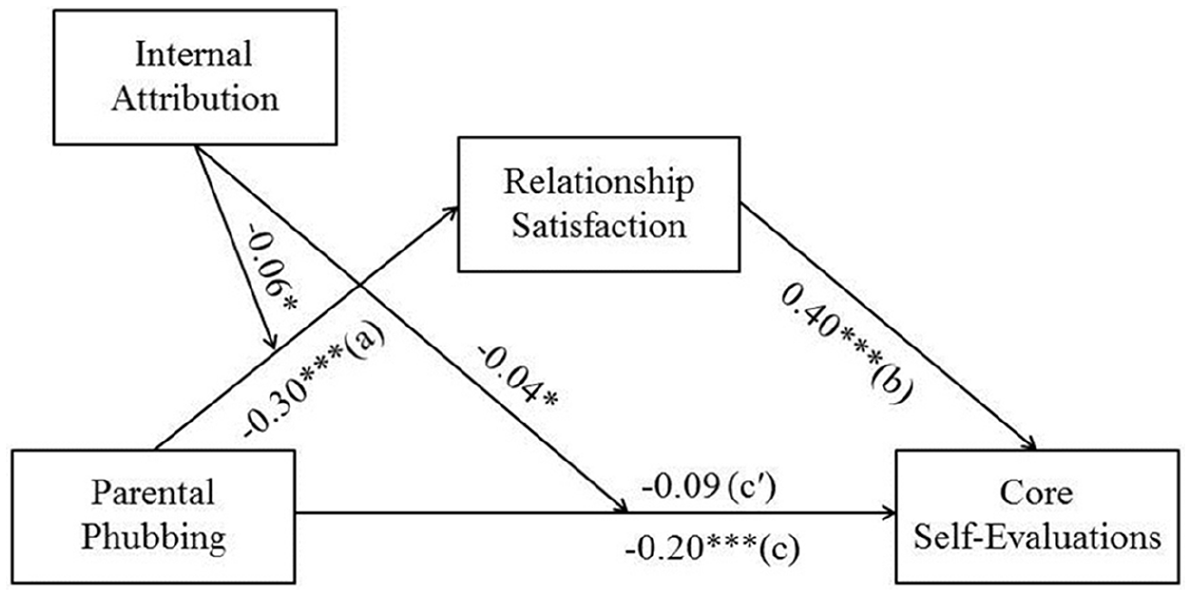
Conditional model of associations between parental phubbing and adolescents’ core self-evaluations.
A total of 29 cases of our sample (9.7%) had item-level missing data. The missing rates for each variable were, respectively, 2% for parental phubbing, 1% for internal attribution, 4% for core self-evaluations, and 2.7% for relationship satisfaction. The results of separate-variance t tests showed the missingness on each variable was not related to the values of other variables. Missing scores were estimated by multiple imputation (MI). This method inputs missing data while acknowledging the uncertainty associated with the imputed values, therefore minimizing the bias in the SE of a parameter estimate derived from a single imputation method (Dong & Peng, 2013).
Results
Bivariate correlations, means, and standard deviations for each variable are presented in Table 1. A series of independent-samples t tests showed there is no significant gender difference.
Means, Standard Deviations, and Correlations (N = 300).

Girl = 0, boy = 1.
p < .05. ***p < .001.
The mediation model supported the hypothesis that adolescents’ satisfaction with the parent-adolescent relationship would mediate the association between parental phubbing and adolescents’ core self-evaluations. Specifically, parental phubbing significantly predicted adolescents’ core self-evaluations (path c), when adolescents’ relationship satisfaction was not included as a mediator, b = −0.20, t(296) = −3.90, p < .001. Nevertheless, once adolescents’ relationship satisfaction entered, the effect of parental phubbing on adolescents’ core self-evaluations (path c′) was not significant, b = −0.09, t(295) = −1.80, p = .073. In more detail, parental phubbing significantly predicted adolescents’ relationship satisfaction (path a), b = −0.30, t(296) = −4.60, p < .001, and adolescents’ relationship satisfaction significantly predicted adolescents’ core self-evaluations (path b), b = 0.40, t(295) = 9.80, p < .001.
The moderated mediation model also supported the hypothesis that the associations between parental phubbing and adolescents’ relationship satisfaction (path a) and adolescents’ core self-evaluations (path b) would be moderated by adolescents’ internal attribution for parental phubbing. A regression on adolescents’ relationship satisfaction revealed a significant effect of the Parental Phubbing × Adolescents’ Internal Attribution interaction, b = −0.06, t(294) = −2.11, p = .036. The results of the JN technique showed that when internal attribution was greater than 3.13 (0.59 SD below the mean), parental phubbing had a statistically significant negative effect on adolescents’ relationship satisfaction. A regression on adolescents’ core self-evaluations also revealed a significant effect of the Parental Phubbing × Adolescents’ Internal Attribution interaction, b = −0.04, t(293) = −2.08, p = .039. The results of JN showed that when internal attribution was greater than 5.06 (0.33 SD above the mean), parental phubbing had a statistically significant negative effect on adolescents’ core self-evaluations. These results indicate that adolescents’ internal attribution moderated the associations between parental phubbing and adolescents’ relationship satisfaction and adolescents’ core self-evaluations. Thus, our hypothesis is supported.
Overall, the conditional direct effects of parental phubbing on adolescents’ core self-evaluations were significant among teens at high levels of internal attribution (effect = −0.16, 95% CI = [−0.283, −0.041]), but not significant among teens at moderate (effect = −0.06, 95% CI = [−0.156, 0.032]) and at low (effect = 0.04, 95% CI = [−0.107, 0.183]) levels of attribution. The conditional indirect effect of parental phubbing on adolescents’ core self-evaluations via adolescents’ relationship satisfaction was significant among teens at moderate (effect = −0.08, 95% BootCI = [−0.134, −0.033]) and at high (effect = −0.13, 95% BootCI = [−0.199, −0.073]) levels of internal attribution, but not significant among teens at low levels of internal attribution (effect = −0.03, BootCI = [−0.111, 0.046]). The index of moderated mediation was −0.02 (95% BootCI = [−0.044, −0.001]).
Discussion
The current study examined whether parental phubbing and adolescents’ attribution for it related to adolescents’ relationship satisfaction and core self-evaluations. Specifically, it was hypothesized that higher levels of parental phubbing would predict lower levels of adolescents’ core self-evaluations and that this association would be largely explained by lower levels of adolescents’ satisfaction with the parent-adolescent relationship. It was further hypothesized that the associations between parental phubbing and adolescent’s relationship satisfaction and core self-evaluations would be strongest among teens high in internal attribution for parental phubbing.
As hypothesized, parental phubbing was associated with lower relationship satisfaction among teens, which then predicted lower core self-evaluations. These results were in line with prior studies that demonstrated the negative effects of technoference on dyadic relationships (e.g., McDaniel & Coyne, 2016; Roberts & David, 2016). Congruous with the rejection theory of phubbing (Chotpitayasunondh & Douglas, 2018) and the sociometer theory (Leary & Baumeister, 2000), these results suggest that parental phubbing has the potential to be a new form of parental rejection, denoting parental disinterest and inaccessibility, and it is negatively related to adolescents’ core self-evaluations. The core self-evaluations serve as a subjective monitor of the degree to which teens are valued and cared about by their parents. When teens experience relational devaluation, including parental phubbing, repeatedly over time, they are likely to develop relatively low self-evaluations.
This study also addressed the moderating role of adolescents’ internal attribution in affecting the associations between parental phubbing and adolescents’ relationship satisfaction and core self-evaluations. Results revealed that parental phubbing was distinctly associated with lower relationship satisfaction and core self-evaluations among teens that tend to internally attribute for it. Consistent with the social information processing model (Crick & Dodge, 1994), these results suggest the qualification of parental phubbing to be parental rejection likely depends on teens’ interpretations, and parental phubbing is particularly harmful to those teens who tend to take it personally.
Limitations and Future Directions
First of all, our study is correlational at its core; experimental and longitudinal studies are needed to thoroughly establish the causation in our model. There is evidence that parents experiencing greater stress, boredom, depression, or loneliness were more likely to engage in parental phubbing (McDaniel, 2019). Furthermore, parenting stress and children’s internalizing and externalizing problems are found to be reciprocal (Stone, Mares, Otten, Engels, & Janssens, 2016). Therefore, parental phubbing, adolescents’ relationship satisfaction, and core self-evaluations are probably related to other attributes of parents, adolescents, or family environment not measured in this study. Besides, the association between attribution and relationship satisfaction is also suggested to be bidirectional (Fincham et al., 2000); therefore, teens who are not satisfied with the parent-adolescent relationship may be more likely to internally attribute for parental phubbing.
Second, our study suffers from several biases. All our findings were built on a convenience sample, so they may not generalize to other populations of youth or other regions or countries. Attitudes and habits of phone use may diverge greatly among social groups. Sociodemographic characteristics, such as socioeconomic status and educational levels, could affect parental phubbing; however, we did not collect these data. Besides, parental phubbing was reported by teens themselves, thus possibly distorted by subjective biases. As parental phubbing is becoming a widespread phenomenon that influences teens around the world, more studies with exquisite design and diverse samples are warranted.
Third, our study only touched the surface of the interpretation of parental phubbing. Attribution involves complex processing of information, driven by both emotional motivations and cognitive rules. Many other individual differences may influence the interpretation of parental phubbing. Attachment prototype, which associates with attribution styles (Greenberger & McLaughlin, 1998), may represent an important factor in this regard. Perceived injunctive norm and internalized norm of phubbing may also be important (Al-Saggaf & MacCulloch, 2019; Chotpitayasunondh & Douglas, 2016). More research is needed to thoroughly explore why and how different teens attribute for parental phubbing in certain ways.
Taken together, despite these methodological limitations, we provide initial evidence that through internal attribution, parental phubbing may negatively relate to adolescents’ relationship satisfaction and core self-evaluations. Thus, the take-home message of our study is that even if parental phubbing may be driven by neutral causes, such as strong habits, device notifications, and work pressures, it can be interpreted by teens negatively, thereby relating to bad outcomes in adolescent well-being.
Footnotes
Authors’ Note
The data that support the findings of this study are available from the corresponding author upon reasonable request. This study was approved by the Renmin University’s research ethics committee. And we got informed consent from all participants.
Author Contributions
K.L. contributed to methodology, data analyzing, and writing – original draft preparation. W.C. contributed to data collecting and reviewing. L.L. contributed to conceptualization and writing – reviewing and editing.
Declaration of Conflicting Interests
The author(s) declared no potential conflicts of interest with respect to the research, authorship, and/or publication of this article.
Funding
The author(s) received no financial support for the research, authorship, and/or publication of this article.
