



Abstract
This study used a cross-lagged panel analysis to explore the effect of impulsivity and academic achievement on the development of suicidal ideation in adolescents using three-time assessments with an interval of 6 months. A total of 211 adolescents (104 boys, 107 girls with a mean age of 13.62 ± 0.68 years in the third assessment) completed the Barratt Impulsivity Scale, the Monthly Exam, and the Suicidal Ideation/Suicidal Attempt Questionnaire to evaluate the level of impulsivity, academic achievement, and suicidal ideation, respectively. Our results showed that impulsivity was a primary risk factor of suicidal ideation in adolescents during their early stage in junior high school, especially for girls, while academic achievement had an increasing effect on suicidal ideation as adolescents progressed to the higher grades in junior high school, suggesting that taking appropriate intervention measures at specific stages might be critical to prevent suicidal ideation in adolescents.
Introduction
Suicide has become a serious problem that threatens the healthy growth of adolescents (Heron, 2017), rising to the fifth main cause of death in China and ranking as the first cause of death in the 15–34 age bracket (Yuan et al., 2006). A suicide incident is not simply the death of one person but also a terrible loss to an entire family and society (Kim et al., 2005a; Kim et al., 2005b). Current intervention and treatment strategies utilized in suicide attempters have brought a heavy financial burden on their families and society (Mcdaid et al., 2010). As an integral part of suicide, suicidal ideation is one of the most concerning factors in the field of suicide research, which refers to a status where the individuals wish to take their own lives but have not yet taken any actions (Beck et al., 1979; Hlezupondo, 2010; Asghari et al., 2013).
Silverman and Berman (2014) elaborated on the relationships between suicidal ideation, suicidal attempt, and suicidal risk. They pointed out that suicidal ideation is a powerful predictor of suicidal attempts and suicidal behaviors. Although people who reported suicidal ideation would not necessarily plan their suicide and rarely attempt it, many individuals who have these suicidal thoughts could subsequently perform unplanned suicidal attempts (e.g., 20.3% of adolescents in the US with suicidal ideation performed planned attempts, while 13.6% did not plan their attempts. See Nock et al. (2013) and Silverman & Berman, 2014). Therefore, suicidal ideation, considered a cognitive stage (or a thought pattern) of suicide, brings about very serious consequences to adolescents who are in a period of dramatic psychological and behavioral changes (Reinherz et al., 2006; Eckhoff et al., 2020). Hence, it is necessary to focus on the risk factors of suicidal ideation and provide intervention and prevention to support the mental health development in adolescents.
Relationships between impulsivity and suicidal ideation
According to the Stress–Diathesis Model of Suicide, suicide results from an interaction between innate traits and acquired environment, establishing a relationship between impulsivity and suicide (Auerbach et al., 2016). Although impulsivity is proven to be robustly associated with suicide attempts in adolescents and young adults (Ghaffari et al., 2011; Chalker et al., 2015), the debate on the relationship between impulsivity and suicidal ideation has lasted for a long time.
Impulsive individuals usually respond quickly, thoughtlessly, and have no plan when responding to internal or external stimuli, not considering whether these reactions would affect themselves or others adversely (Moeller et al., 2001). In addition, these individuals have impaired emotion regulation abilities (Conner et al., 2004), resulting in an increased experience of emotionally painful scenarios compared to non-impulsive individuals, including embarrassment, interpersonal rejection, and other forms of stress (Joiner, 2007; Wang et al., 2019; Witte et al., 2008). Long-term exposure to such painful experiences with those emotions might lead to feelings of isolation and hopelessness, both of which are related to suicidal ideation (Sarkisian et al., 2018). It could be presumed that individuals with high levels of impulsivity tend to develop suicidal ideation when they are exposed to a stressful environment (Mann et al., 1999; Klonsky & May, 2010), but the role of impulsivity on suicidal ideation is still poorly understood, particularly in nonclinical adolescents population. To that end, the influence of impulsivity on suicidal ideation in adolescents across time was examined in the present study to provide reliable evidence for the prevention of suicide in adolescents.
Relationships between academic achievement and suicidal ideation
Students are under heavy pressure to achieve academic success because of their parents’ excessive expectations and the extremely competitive employment situation (Crede et al., 2015). Only children with excellent academic achievement are usually labeled “good children,” further increasing the importance of academic achievement for Chinese children (Bo et al., 2016). It was reported that academic achievement was an increasingly crucial factor associated with the mental health of adolescents (Talawar & Das, 2014; Sayal et al., 2015), which could be a causative factor for suicidal ideation (Zhang et al., 2019).
Numerous studies have confirmed the unfavorable effect of poor academic achievement on suicidal ideation in adolescents. In China, a study showed a significant negative correlation between students’ academic achievement and their reported rate of suicidal ideation and dysfunctional behaviors in middle school (Dong et al., 2014). In a longitudinal study, Sorberg et al. (2018) found that individuals ranking in the lowest quartile of academic achievement were five times more likely to develop suicidal ideation than those ranking in the highest quartile academically. These findings suggest that academic achievement, a readily available index, could be a valuable indicator for suicidal ideation in adolescents, allowing parents and teachers to provide timely assistance when needed (Guo & Cao, 2012).
Impulsivity and academic achievement affect suicidal ideation in adolescents
Previous studies examined the effects of impulsivity and academic achievement on suicidal ideation separately, and cross-sectional research provided a fundamental explanation for these relationships (Richardson et al., 2005; Wang et al., 2019). However, there are limited studies on how impulsivity and academic achievement simultaneously affect adolescents’ suicidal ideation over time. Bronfenbrenner’s “Process-Person-Context-Time Model” (PPCT) provided a comprehensive explanation for the development of individuals (Bronfenbrenner & Ceci, 1994), addressing how individual development is affected by the interaction of individuals’ characteristics and external factors. This model provided a rationale for the current research. Specifically, the term “process” refers to a proximal process in which an individual is frequently involved in an activity over time, relating to the relationship between people and environmental activities. Academic achievement is the “process” factor for adolescents since they take a large number of regular examinations in schools (e.g., a fixed monthly, midterm, and final exam for each semester), and academic achievements established the connection between adolescents and schools. The term “Person” refers to the personal traits of individuals. It is both the driving force and the result of individual development, such as impulsivity in the present study. “Context” refers to the environment consisting of the proximal process and personal traits, which were not considered in the current study; “Time” represents the continuous interaction and influence of the above three features on an individual’s development.
Based on the PPCT model, it is possible to understand how the integrated effect of the trait (impulsivity) and process (academic achievement) produce consequences for the outcome (suicidal ideation). The dynamic, interconnected, and interactive relationship between the three defining features mentioned above could also address the question of whether the outcome (suicidal ideation) impacts the trait (impulsivity) and process (academic achievement). The findings indicated that recurring suicidal ideation with an irrational cognitive function would activate a variety of emotional and behavioral dysfunctions (O’Connor & Noyce, 2008), potentially increasing impulsivity and negatively impacting academic performance in adolescence, forming a vicious circle. Thus, exploring the reciprocal relationships between impulsivity, academic achievement, and suicidal ideation is essential for developing a composite frame of suicidal ideation.
Current study
The significance of academic achievement becomes more prominent as adolescents progress to higher grades (Hoferichter et al., 2020), and suicidal ideation is volatile and mutable, which is especially risky for impulsive individuals, while it is still unclear how these factors interact and how the interaction changes over time. The present study aims to establish a cross-lagged model to identify the correlations between impulsivity, academic achievement, and suicidal ideation over time. Given the indispensable role of gender and age in adolescents’ impulsivity, academic achievement, and suicidal ideation (Chapple & Johnson, 2007; Mars et al., 2018), these two factors were also included as control variables in the current study. Moreover, boys in the Chinese sample have higher impulsivity (Hu & Wang, 2018), lower suicidal ideation (Chang et al., 2013), and worse academic achievement than girls (Qiao et al., 2013) during adolescence, which may contribute to gender differences in the effect of impulsivity and academic achievement on suicidal ideation (Brezo et al., 2006). Therefore, the cross-lagged model of impulsivity and academic achievement on suicidal ideation needs to be further examined separately in boys and girls.
The following were our hypotheses: First, in the cross-lagged analysis, the previous impulsivity and academic achievement would be predictors of subsequent suicidal ideation. Second, we anticipated the bidirectional relationship between impulsivity and suicidal ideation, as well as between academic achievement and suicidal ideation. Meanwhile, the transformation of the impact of impulsivity and academic achievement on suicidal ideation was expected to occur over time as adolescents matured and academic pressure increased. Third, the different effect of impulsivity and academic achievement on suicidal ideation in boys and girls was expected to be found in the present study.
Method
Participants
Details of the participants in each assessment.

Note. Time 1 = first assessment; Time 2 = second assessment (6 months after first assessment); Time 3 = third assessment (12 months after first assessment).
Measures
Impulsivity
Impulsivity was measured by the Barratt Impulsivity Scale, which was revised by the Beijing Center for Psychological Crisis Research and Intervention. A total of 30 items were rated on a four-point Likert scale ranged from 1 (did not occur) to 4 (always happens), with higher scores indicating greater levels of impulsivity. In the revised Chinese version, only 6 items remained unchanged after translation and back translation (i.e., I plan tasks carefully, I do things without thinking, I plan for the future, I save regularly, I say things without thinking, I act on the spur of the moment). It was tested among rural residents, urban residents, as well as college students. Some expressions for items that have a poor correlation with other items were updated, such as “I am self-controlled” was changed to “I cannot control my behavior well.” The Cronbach’s α coefficient and test-retest reliability coefficient of the final version were 0.89 and 0.81, respectively, which indicated that it could be applied to researches in China (Li et al., 2011).
The Barratt Impulsivity Scale has been widely used to evaluate the impulsivity of individuals through three dimensions: motor impulsivity (acting without thinking), attentional impulsivity (the difficulty of concentrating), and non-planning impulsivity (a lack of impulse control and planning for the future) (Li et al., 2011). The collective score of the three dimensions was used to evaluate the level of impulsivity. And the Cronbach’s α coefficient of 0.893, 0.896, and 0.895 for three-time assessments, respectively, which showed good reliability of the evaluation of impulsivity in the present study. Confirmatory factor analyses (CFAs) were conducted using structural equation modeling (SEM) in Mplus 7.0. After correlating items of non-planning impulsivity (item 4 and 28 in assessment 1, item 7 and 25 in assessment 2, item 7 and 10 in assessment 3), the model fit statistics in three-time assessments were all acceptable (Assessment 1: χ 2 (401) = 707.46, p < 0.001, CFI = 0.85, RMSEA = 0.06, SRMR = 0.07; Assessment 2: χ 2 (401) = 829.26, p < 0.001, CFI = 0.83, RMSEA = 0.07, SRMR = 0.08; Assessment 3: χ 2 (401) = 792.68, p < 0.001, CFI = 0.85, RMSEA = 0.07, SRMR = 0.07).
Academic achievement
The most recent monthly test results before each assessment were provided by the school, which comprised the Chinese scores, Mathematics scores, and English scores. The original scores of each subject were 0–120. Given the homogeneity of the exam content, exam time and duration in all three subjects, test scores could be compared across classes. The continuous variables obtained from the standardization of the total scores of the three subjects were used as the academic achievement indicators in the present study (Zhang et al., 2020).
Suicidal ideation
Suicidal ideation was evaluated by the Suicidal Ideation/Suicidal Attempt questionnaire, which focuses on the frequency of suicidal ideation during last week before taking the questionnaire. The question used to measure suicidal ideation frequency is “I’ve seriously thought about ending my life.” It is indexed on a four-point scale (1 = occasionally or none; 2 = sometimes; 3 = frequently; 4 = continuously), with higher scores indicating more frequent suicidal ideation. Although this questionnaire only uses one item to evaluate suicidal ideation, it was widely applied in the study of suicidal ideation (Herba et al., 2008; Kim et al., 2005a; Kim et al., 2005b). Good reliability and validity of this questionnaire was shown in the previous studies (Martin et al., 1995). To improve the authenticity of the responses and reduce the discomfort caused by this suicidal questionnaire, the above item was mixed in the depression questionnaire (Center for Epidemiologic Studies Depression Scale, CES-D). Pearson correlation analysis showed that the suicidal ideation scores were positively correlated with depression scores (r = 0.527, p < 0.001 in the first assessment; r = 0.471, p < 0.001 in the second assessment; r = 0.631, p < 0.001 in the third assessment), suggesting that the validity of this study in evaluating suicidal ideation (Bronisch & Wittchen, 1994; Rockett et al., 2007).
Depression
Given the high co-morbidity of depression and suicidal ideation (Rockett et al., 2007), the Center for Epidemiological Studies Depression Scale (CES-D; Radloff, 1997) was applied to assess participants’ depression for subsequent analyses. The CES-D, applicable to Chinese adolescents, was adapted by Chen et al. (2009), which includes 20 items in four dimensions: depressed affect, positive affect, somatic and retarded activity, as well as interpersonal. The scale was scored from 1 (occasional) to 4 (continuous), with higher scores indicating more severe depression. The total score of the four dimensions was used as an indicator of the participants’ depression in this study. The Cronbach’s α coefficient of 0.880, 0.842, and 0.833 for three-time assessments respectively showed good reliability of CES-D in the present study.
Procedure
Graduate students and teachers in charge of classes received professional training prior to serving as experimenters. The principles of anonymity, confidentiality, independence, and integrity of all results were emphasized, and consent forms were collected prior to the distribution of questionnaires. After completion of the questionnaires, each participant and experimenter was given a gift. The value of the gift increased over the time of the assessments. Specifically, notebooks, bookmarks, and badges from prestigious schools were given upon completion of each of the three-time assessments, respectively.
Statistical analyses
Collected responses from the three-time assessments were recorded using SPSS 24.0 (SPSS, Inc., Chicago, IL, USA). The missing values were processed according to the characteristics of variables. A small number of missing values of impulsivity were replaced by employing average interpolation since they are equidistant data. To ensure the accuracy of the data, data with missing values of suicidal ideation and academic achievement were deletes since it is difficult to determine the specific levels in missing cases. Therefore, data from 204 participants (100 boys, 104 girls; mean age 12.98 ± 1.17, 13.48 ± 1.17, and 13.98 ± 1.17 in the three-time assessments, respectively) were analyzed.
A common method bias analysis and descriptive statistics for variables were conducted, we then established two models to analyze the longitudinal relationship between impulsivity, academic achievement and suicidal ideation. Model 1 explored the impact of risk factors on adverse outcomes (i.e., whether early impulsivity and academic achievement could predict subsequent suicidal ideation), named the “risk-factor-driven model,” in which the free correlation between variables was allowed; Model 2 explored the reciprocal relationships between risk factors and adverse outcomes to determine the direction of its interactions (i.e., whether early impulsivity and academic achievement could predict subsequent suicidal ideation, and vice versa), called the “mutual relationship model,” in which the free correlation between variables was allowed. Gender and age were included as control variables in both models.
Considering that some variables were non-normal distributions (for example, the skewness of suicidal ideation in the second assessment exceeded the thresholds of 2), the maximum likelihood robust estimation (MLR), which provides statistical indicators such as standard error and chi-square value for non-normal distributed data (Muthen & Muthen, 2014; West et al., 1995), was employed in the analysis of both models. The following three criteria were used to evaluate the fitting indices of the models: CFI, RMSEA, and SRMR. The results of CFI
Results
Common method bias analysis
The Harman Single Factor Test was used to examine the extent of the common method bias (Podsakoff et al., 2003). Given that academic achievement was measured by exam grades assigned by teachers following the uniformed standards instead of using a self-reported scale, this factor was not suitable for common method bias analysis. Therefore, only impulsivity and suicidal ideation were analyzed using common method bias. The results indicated that eight factors’ initial eigenvalues were higher than 1 in the first assessment, and a single factor explained 26.08% of the total variance; seven factors’ initial eigenvalues were higher than 1 in the second assessment, and a single factor explained 28.10% of the total variance; in the third assessment, 7 factors’ initial eigenvalues were higher than1, and a single factor explained 28.13% of the total variance. Because all accountable factors’ contribution to the total variance was far below 40%, the data collection was trustworthy and there is no common method bias in this study.
Description and correlation analysis of variables
Trajectories of impulsivity, academic achievement, and suicidal ideation over time
Trajectories of impulsivity, academic achievement, and suicidal ideation over time.

Note. n = 204. IMP, impulsivity; ACA, academic achievement; SI, suicidal ideation; Time 1 = first assessment; Time 2 = second assessment (6 months after first assessment); Time 3 = third assessment (12 months after first assessment).
Gender differences in impulsivity, academic achievement, and suicidal ideation
Gender difference in impulsivity, academic achievement, and suicidal ideation.

Note. n = 204. IMP, impulsivity; ACA, academic achievement; SI, suicidal ideation; Time 1 = first assessment; Time 2 = second assessment (6 months after first assessment); Time 3 = third assessment (12 months after first assessment).
Correlation analysis of variables
Bivariate correlations of study variables in the three assessments.

Note. n = 204. IMP, impulsivity; ACA, academic achievement; SI, suicidal ideation; Time 1 = first assessment; Time 2 = second assessment (6 months after first assessment); Time 3 = third assessment (12 months after first assessment). *p < 0.05, **p < 0.01, ***p < 0.001.
Testing for the cross-lagged model
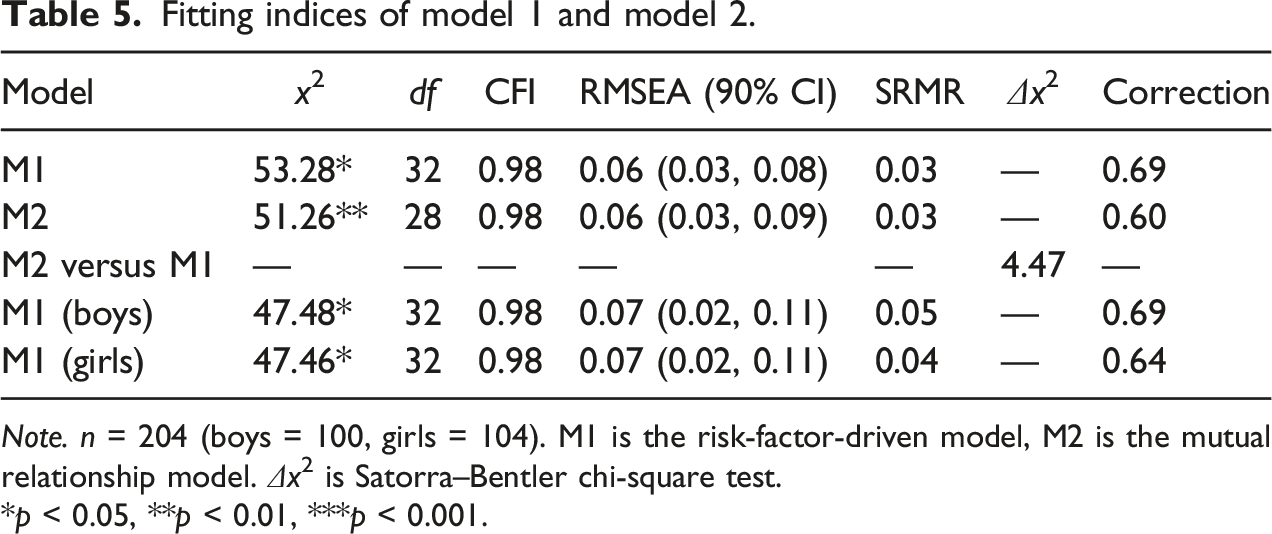
Fitting indices of model 1 and model 2.
Note. n = 204 (boys = 100, girls = 104). M1 is the risk-factor-driven model, M2 is the mutual relationship model. Δx2 is Satorra–Bentler chi-square test.
*p < 0.05, **p < 0.01, ***p < 0.001.

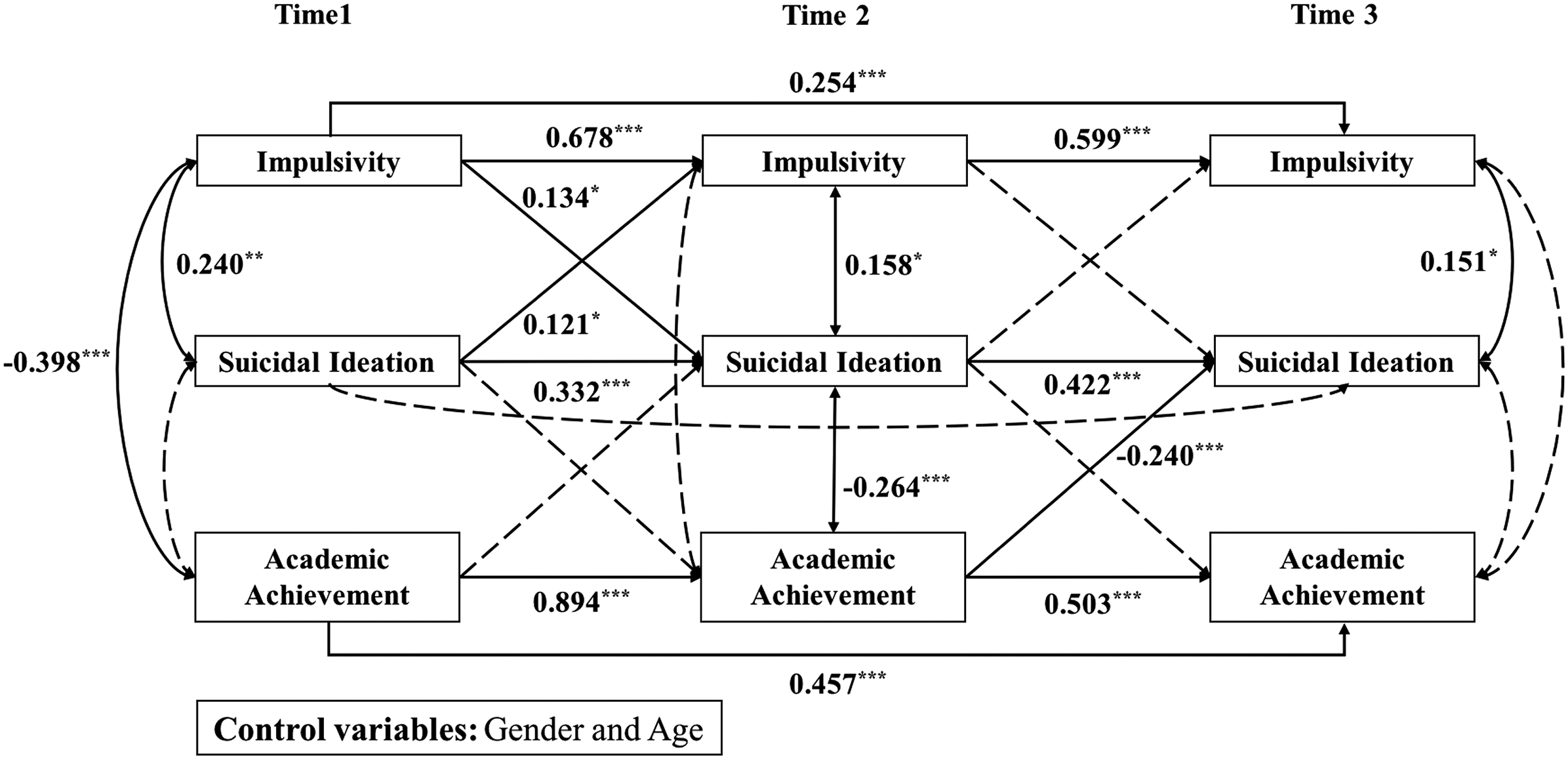
Results of the risk-factor-driven model.
Results of the mutual relationship model.
As shown in Figure 1, impulsivity and academic achievement could predict suicidal ideation 6 months later. The frequency of subsequent suicidal ideation increases with the previous level of impulsivity in the first two assessments, while it decreases with the progressive academic achievement in the last two assessments. The results suggested that the major risk factor for adolescents’ suicidal ideation shifted from impulsivity to academic achievement over the time of the period in the present study.
Since there were significant gender differences in academic achievement across all three-time assessments, Model 1 (risk-factor-driven model) was next tested separately in boys and girls. The results for boys and girls were showed in Table 5, where the fitting indices were acceptable. As shown in Figure 3, impulsivity had no significant effect on suicidal ideation in boys in the three-time assessments, whereas academic achievement exerted significantly predictive effects on suicidal ideation in boys between Time 2 and Time 3 (β = −0.210, p < 0.05). For girls, although only marginal significance was reached (β = 0.153, p = 0.058), impulsivity at Time 1 played a somewhat predictive role for suicidal ideation at Time 2, and academic achievement at Time 2 significantly predicted suicidal ideation at Time 3 (β = −0.231, p < 0.01) (see Figure 4). Results of the risk-factor-driven model for boys. Results of the risk-factor-driven model for girls.

Follow-up analysis
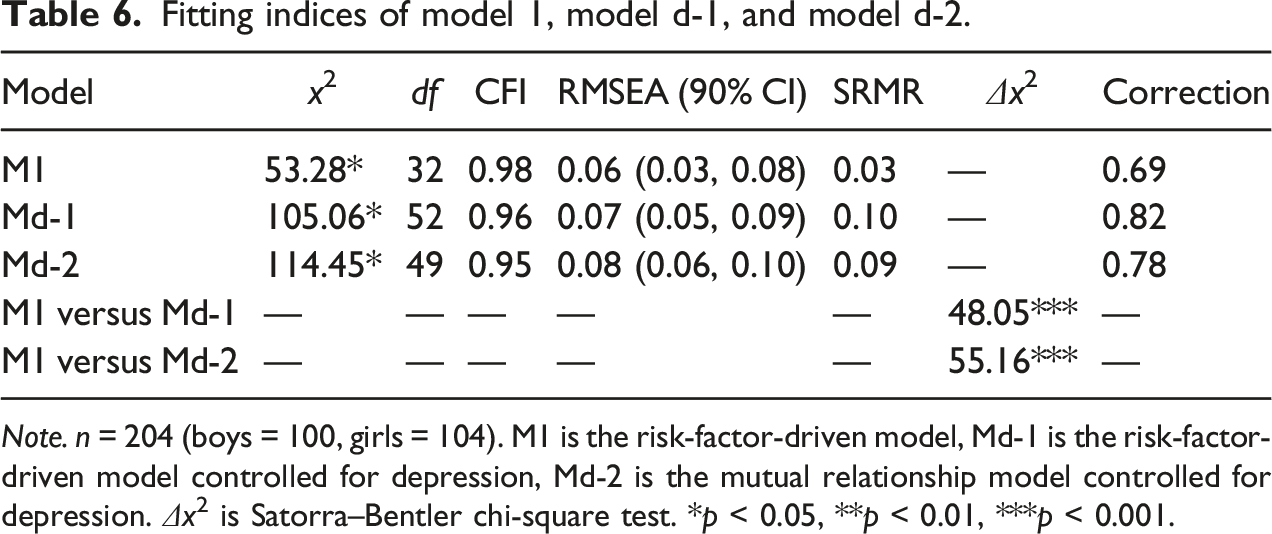
Fitting indices of model 1, model d-1, and model d-2.
Note. n = 204 (boys = 100, girls = 104). M1 is the risk-factor-driven model, Md-1 is the risk-factor-driven model controlled for depression, Md-2 is the mutual relationship model controlled for depression. Δx2 is Satorra–Bentler chi-square test. *p < 0.05, **p < 0.01, ***p < 0.001.
Discussion
Over 12 months, the current study investigated the reciprocal relationship between risk factors (impulsivity and academic achievement) and negative outcomes (suicidal ideation). We found that these three interplaying variables transformed over time, with impulsivity as the diathesis, while personality factor (Sarkisian et al., 2018) and academic achievements were the stress factor and the proximal process, respectively (De Luca et al., 2016). Results showed that impulsivity was the leading risk factor for suicidal ideation in the complete sample at our second assessment. However, it transformed to academic achievement during our third assessment, and their effects on suicidal ideation in adolescents were not confounded by depression, suggesting the risk factors of impulsivity and academic achievement for suicidal ideation were dynamic during the course of measurements in this study. Moreover, there were some differences between the above results for boys and girls.
The effect of impulsivity on suicidal ideation
Although personality traits are relatively stable, they change with the individuals’ psychological growth and physiological maturity. Impulsivity, controlled by the prefrontal area of the brain that administrates self-control, judgment, and attention (Zhang, 1987), shows a downward trend with the development of the brain (Harden & Tuckerdrob, 2011; Ochsner & Gross, 2005). In addition, studies have shown that adolescents’ impulsivity remains high until the age of 14, after which it starts to decline as the prefrontal area matures completely (Harden & Tuckerdrob, 2011). In this study, adolescents recruited from junior high school were all younger than 14 years old, and their average impulsivity showed an increasing trend over the three-time assessments, supporting the findings concerning the immature prefrontal area (Harden & Tuckerdrob, 2011). In terms of the correlation between impulsivity and suicidal ideation among adolescents, suicidal ideation increased with the level of impulsivity 6 months ago. Impulsive adolescents usually face difficulties in orchestrating threatening thoughts and actions, thus exacerbating the negative effects of stressful events and prompting them to expand suicidal ideation to deal with the current situations with an irrational cognitive form. Nevertheless, that interaction declined with age following cognitive development in the last two assessments, indicating that impulsivity was no longer linked with suicidal ideation, even though the impulsivity levels had increased slightly.
The results of this study also found gender differences regarding the effect of impulsivity on suicidal ideation in adolescents. In girls, the effect of impulsivity on suicidal ideation had a modest marginal significance. Individuals with increased impulsivity have difficulty coordinating their cognitive control to respond to a situation at hand and often behave recklessly, leading to adverse consequences that do not resolve the condition they were facing originally, instead instilling negative emotions (Kim & Bahorik, 2015). Girls experience more emotional dysregulation than boys during adolescence (Bender et al., 2012), meaning that those negative emotions brought on by impulsivity may be accompanied by negative effects (Xavier et al., 2017). These negative emotions, if not dealt with properly, may accumulate and increase the risk of suicidal ideation in girls. Although the present study sheds light on the above possibilities, the role of impulsivity-induced negative emotions in adolescent suicidal ideation needs to be considered in future studies.
The effect of academic achievement on suicidal ideation
In the last two assessments, the effect of academic achievement on suicidal ideation gradually increased in the present study, surpassing impulsivity as the critical risk factor for suicidal ideation in both boys and girls. Adolescents in the Chinese educational system typically confront greater pressure with more intense and demanding courses when they proceed to higher grades (i.e., from grade-7 in the first two assessments to grade 8 in the last assessment in the present study). Meanwhile, academic achievement has become increasingly significant and has received growing attention because it is directly related to students’ futures. It is commonly recognized that students with outstanding academic performance have a greater chance of entering prestigious senior high schools, top universities, and well-paying companies and organizations. In contrast, students with poor academic performance will be severely limited in their future career development. Under these circumstances, adolescents might be spurred excessively by their parents and teachers at an increasingly young age, and the impact of academic achievement on mental health problems might become more pronounced in earlier grades (Wentzel et al., 2012). On the other hand, Chinese adolescents are gradually aware of the importance of excellent academic performance as they mature in a competitive environment. The self-pressure of working hard to be ahead of peers as much as possible has become their top priority during this period, which might reasonably explain why academic achievement has gradually become a prominent risk factor for suicidal ideation in adolescents. This finding highlights the importance of schoolwork on the mental health of adolescents. In this respect, rather than focusing simply on academic developments, it is crucial to pay more attention to the mental health of adolescents.
Implications and limitations
The present study used a robust longitudinal approach and contributed to the literature concerning the framework of the reciprocal relationship between impulsivity, academic achievement, and suicidal ideation. Theoretically, this study underpinned the Stress–Diathesis Model proposed for suicide and expanded its applicability in suicidal ideation, illustrating impulsivity as a diathesis that increased the risk of suicide in the early cognitive stage of suicidal ideation. Furthermore, integrating risk factors (impulsivity and academic achievement) and outcomes (suicidal ideation) based on the PPCT model is a dynamic process, and our results emphasized that individuals are constantly changing in their growth and might face different hazards at different stages of life. Besides, our study also highlighted the importance of focusing on the “risk-factor-transformation” pattern and staying one step ahead of risk factors to avoid negative consequences in order to foster healthy adolescence.
The most thought-provoking finding of this study is the pivotal role of academic achievement in generating suicidal ideation in adolescents. In the context of China’s emphasis on academic success, society, schools, and families should pay more attention to adolescents’ mental health. Excellent academic performance does not guarantee a promising future, and poor academic performance does not equate to a hopeless future. Schools and families, being the two main places where adolescents live, should be responsible for making changes and improvements to address this issue. For schools, the first step is to weaken the score-only concept of learning. Moreover, steps should be taken to strengthen each teacher’s ability to provide mental health education to compensate for the lack of resources available to supply full-time mental health teachers in schools. On the family front, parents should set reasonable expectations for their children’s academic achievement. Adolescents should be given the correct guidance to healthy academic development rather than forcing them to achieve perfect academic performance. In addition, parents should supplement their knowledge of mental health to provide first-hand help to their children when necessary.
Nevertheless, our study has some limitations. First, although this study lasted 12 months and utilized three-time assessments, the duration still represents a relatively short period in an adolescent’s academic life, and our results cannot comprehensively reflect the long-term influence of impulsivity and academic achievement on suicidal ideation among adolescents. Second, the participants in this study were limited to a junior high school in Tianjin, and some valuable participants were lost during the course of this study due to house relocation or transfers to other schools, so the results must be generalized with caution. Third, some other aspects associated with suicidal ideation were not considered in the current study, such as family environment (Low, 2021), school bullying (Wright, 2016), and emotion dysregulation (Miller et al., 2018), limiting the ability to investigate the impact factors of suicidal ideation in adolescents from a broader view. Because of the limitations mentioned above, future research should employ a more representative sample, extend the study period, and comprehensively consider other potential factors to provide a more extensive study of suicidal ideation in adolescents.
Conclusion
The present study used a cross-lagged analysis to disentangle the long-term interrelation between impulsivity, academic achievement, and suicidal ideation in adolescents, revealing the dynamic transformations between the impact of these two factors on suicidal ideation over time. The results suggest the following: (1) impulsivity and academic achievement are both risk factors for the development of suicidal ideation in adolescents. Levels of impulsivity and poor academic achievement can predict the presence of suicidal ideation. (2) Impulsivity is the primary risk factor of suicidal ideation at an earlier stage in junior high school, especially for girls, while academic achievement gradually surpasses impulsivity to become the main factor for suicidal ideation in adolescents at a later stage in junior high school.
Footnotes
Declaration of Conflicting Interests
The author(s) declared no potential conflicts of interest with respect to the research, authorship, and/or publication of this article.
Funding
The author(s) disclosed receipt of the following financial support for the research, authorship, and/or publication of this article: The research was supported by the National Natural Science Found of China (NSFC): 31500895.
