




Abstract
Gender-typical characteristics are associated with popularity and acceptance, suggesting that gender typicality is an important component of how adolescents are perceived by peers. The current study addressed the contributions of self- and peer-perceived gender typicality in predicting popularity and liking among same- and other-sex peers. Participants were 131 7th and 8th graders from a rural, midwestern school. Same- and other-sex peer status were measured via peer nominations; gender typicality was measured via both peer nominations and self-report. Hierarchical regressions showed that self-perceived gender typicality was negatively associated with popularity among other-sex peers, and it was not closely tied to liking by same- or other-sex peers. Peer-perceived gender typicality was positively associated with liking by same-sex peers, and strongly associated with popularity among both same- and other-sex peers. The findings also suggest that gender typicality plays a more significant role in reputational, power-based status than it does for being liked.
Introduction
Adolescents vary in the degree to which they conform to socially-prescribed norms for gendered attitudes, behaviors, and appearance (Perry et al., 2019). Youth who do not conform to gender norms are often the targets of harsh treatment by peers and others (e.g., Young & Sweeting, 2004), leading to significant social and emotional distress (Smith et al., 2018). Because gender is such an essential part of human identity and social organization, it can be both construed by the individual as a comparison of the self to others (i.e., self-perceived gender typicality; Egan & Perry, 2001) or construed by others via observation (i.e., peer-perceived gender typicality; Jewell & Brown, 2014). Furthermore, the two perspectives may not always overlap. An individual’s assessment of their similarity to other members of their gender category can include internal attributes that are not available to observers, as well as subjective appraisals that may not be consistent with the perceptions of others. Accordingly, both forms of gender typicality have important implications for how adolescents are perceived and treated by their peers, including for the development of peer status. For example, observable gender-typical characteristics such as athleticism in boys and highly feminine appearance in girls have been associated with peer popularity both in experimental studies (Kleiser & Mayeux, 2021) and in studies using peer rating methods (Jewell & Brown, 2014). Gender conformity in preferred activities, mannerisms, and dress are also associated with peer liking (e.g., Horn, 2007), and self-perceived gender typicality is positively correlated with being liked by peers (Egan & Perry, 2001; Yunger et al., 2004).
Though these findings are informative, studies of the link between self-perceived gender typicality and peer status are still rare, particularly for popularity. In addition, there are no studies testing the role of gender typicality in peers’ liking by, and popularity with, same-versus other-sex peers. The aim of the current study was to address these gaps in the literature. We focused on these associations in early adolescence, a developmental period marked by the increasing salience of peer status and concern with popularity (LaFontana & Cillessen, 2010). Further, this is also the time that peer interactions increasingly occur outside of the classroom (i.e., at school dances and mixed-sex parties), which allows for more frequent and varied interactions between peers (Connolly et al., 2004). These social interactions become especially important during the transition into middle school, as peer group status takes on a dominant role among adolescents (Cillessen & Marks, 2011) and the desire to “fit in” is heightened (Blakemore & Mills, 2014).
Peer Status and Gender Typicality: Theoretical and Empirical Perspectives
Researchers of adolescent peer relations typically distinguish between two distinct forms of peer status. The first is popularity, which is characterized by a high level of social visibility and prestige among peers (Mayeux et al., 2011). Popular youth are heterogeneous, with some showing a profile of generally prosocial behavior and others being described as high in overt and relational aggression (De Bruyn & Cillessen, 2006). The second is social acceptance or liking, which is characterized by overall high levels of liking by peers (Cillessen & Marks, 2011). Adolescents high in social acceptance are generally also high in prosocial behavior and show low levels of aggression (Cillessen & Rose, 2005). Though the two forms of status are moderately positively correlated early in adolescence, popularity and liking become increasingly distinct as youth move through the middle and high school years (Van den Berg et al., 2020).
Gender prototypicality theory argues that popularity will be ascribed disproportionately to adolescents who conform to socially-prescribed gender norms for appearance and behavior (Mayeux & Kleiser, 2020). Situated in developmental context, the theory argues that conformity to gender norms in early adolescence increases visibility to other-sex peers and makes them more desirable romantic partners at a time when romantic development is a salient developmental task, thus raising their overall prestige in the peer group (Collins et al., 2009). Consistent with this theory, popular youth tend to show patterns of gender-conforming behavior and appearance. For example, popular boys are described as highly athletic (Dijkstra et al., 2009), physically attractive (Rose et al., 2011), and tough (Rodkin, Farmer, Thomas, & van Aken, 2000), and are often nominated by peers as physically aggressive (Cillessen & Mayeux, 2004). Popular girls are described as physically attractive (Rose et al., 2011), highly focused on their appearance (Adler et al., 1992), sociable and well-integrated into the peer group (LaFontana & Cillessen, 2002), and high in prosocial behavior (De Bruyn & Cillessen, 2006). Further, experimental evidence suggests that observers rate boys and girls who are gender-typical in appearance (long hair and feminine clothing for girls; short hair and muscular build for boys) as more popular than gender-atypical youth (long hair and smaller build for boys; short hair and masculine clothing for girls; Kleiser & Mayeux, 2021). On the other hand, unpopularity is associated with being seen by peers as low in gender typicality (LaFontana & Cillessen, 2002; Xie et al., 2006). Though these findings are compelling, evidence of a positive correlation between youth’s ratings of their peers’ gender typicality and peer popularity is limited to one study (Jewell & Brown, 2014). One of the goals of the current study is to replicate and extend this finding.
Conformity to socially-prescribed gender norms is also associated with greater peer liking in adolescence, compared to gender atypicality (Horn, 2007). Indeed, adolescents who are gender-atypical, particularly in relation to appearance, are often marginalized and victimized by peers (Smith & Juvonen, 2017). Gender atypicality has been shown to be associated with peer rejection in childhood and adolescence (Lee & Troop-Gordon, 2011; Smith & Leaper, 2006), with having fewer friends (Young & Sweeting, 2004), and with physical and relational victimization (Toomey et al., 2014). The negative effects of gender atypicality are particularly strong for boys (e.g., Horn, 2007; Lee & Troop-Gordon, 2011). Adolescents often justify the exclusion of peers who resist gender norms by arguing that such peers present challenges to group functioning (Mulvey & Killen, 2015). Researchers have argued that adolescents employ the social exclusion of gender-atypical peers as a regulatory mechanism to manage group interactions (e.g., Heinze & Horn, 2014). Interestingly, a small body of research has shown that preadolescents low in self-perceived gender typicality (Pauletti et al., 2014) and adolescent boys high in self-perceived other-gender typicality (Tam et al., 2019) also engage in gender-based harassment. In such cases, the victimization of other gender-atypical peers may serve as attempts to “save face” or minimize the potential ramifications of their own low gender typicality.
Self-Perceptions of Typicality and Peer Relations
Though sometimes related to observable, appearance- and behavior-based aspects of gender expression, self-perceived gender typicality is a distinct dimension of an adolescent’s gender identity that reflects the extent to which one feels like a typical example of one’s gender category (Perry et al., 2019). Zosuls and colleagues (2016) have argued that self-perceived typicality should influence treatment by peers because it reflects both an understanding of socially-prescribed gender norms and an assessment of how much the adolescent sees him- or herself as conforming to those norms. Thus, a child who feels gender-atypical may also behave or appear in nonconforming ways that are observable to peers. Furthermore, their feelings of not fitting in with others of their gender may lead to other behaviors, such as social withdrawal, that are not well-received by peers (Zosuls et al., 2016). Accordingly, high self-perceived gender typicality is associated with less peer exclusion (Zosuls et al., 2016), having more friends (Young & Sweeting, 2004), and less peer victimization (Smith et al., 2018), in addition to higher peer liking (Egan & Perry, 2001; Jewell & Brown, 2014; Yunger et al., 2004).
Though the link between self-perceived typicality and being liked by peers has been relatively well-documented, only one published study has investigated the potential link between self-perceived gender typicality and peer popularity, with null findings (Jewell & Brown, 2014). This finding suggests that the associations of gender-typicality with popularity may not be as straightforward as those with peer liking. If low self-perceived typicality reflects an assessment of oneself as gender nonconforming in observable attributes such as appearance, physical build, and self-presentation, the association with popularity should be negative (Mayeux & Kleiser, 2020). However, adolescents’ self-perceived gender typicality also reflects their assessment of how their attitudes, behaviors, interests, and other personality features compare to those of other members of their gender category (Egan & Perry, 2001), and those things are not always reflected in their observable behavior and appearance. Moreover, research suggests that certain gender-atypical attributes, such as confidence and athletic ability, might boost girls’ social visibility and impact on the peer group (Jewell & Brown, 2014). Thus, low self-perceived gender typicality may be associated with higher peer popularity for girls. For boys, though, the consequences of having gender-atypical attributes are typically much more negative than they are for girls, as boys exhibiting female traits or behaviors are viewed as “moving down the status hierarchy” given the societal power difference between men and women (Mulvey & Killen, 2015, p. 692).
Perceptions of Same- Versus Other-Sex Peers
Peer relations researchers are increasingly measuring liking by, and popularity with, same-versus other-sex peers separately (e.g., Bowker et al., 2016). This may be especially important in the study of popularity. Gender prototypicality theory argues that the rise of social power in the peer group stems from the increased attention that gender-prototypical adolescents receive from the other sex (Mayeux & Kleiser, 2020). Thus, a key feature of popularity should be approval by other-sex peers, measured in terms of liking, ratings of popularity, or other positive evaluations. Accordingly, there is some evidence that popularity is related to distinct patterns of perceptions by same- and other-sex peers. For example, one study of young adolescents found that popularity was more closely related to being liked by other-sex peers than by same-sex peers. This was true for both boys and girls (Dijkstra et al., 2010). Recent studies have also found bidirectional associations between same-sex and other-sex popularity over time (Bowker et al., 2016; Troop-Gordon & Ranney, 2014). Being popular with the other sex may contribute to gains in popularity with same-sex peers because of the increased importance of mixed-sex interactions in early adolescence and the prestige that comes with being seen as cool by potential romantic partners.
Attributes that are consistent with traditional gender norms, such as aggression in boys and attractiveness in girls (e.g., Volk et al., 2012; Zimmer-Gembeck et al., 2004), are tied to heterosexual romantic attraction and thus may be more salient for other-sex peers than for same-sex peers (e.g., Arnocky & Vaillancourt, 2012). Accordingly, the current study addresses the associations between gender typicality and peer status from the perspective of both same- and other-sex peer perceptions. If gender typicality is more closely associated with popularity with, or liking by, other-sex peers compared to same-sex peers, this would provide especially strong evidence for the role of gender prototypicality in the development of popularity in early adolescence.
Gender Norms, The Peer Group, and the Broader Social Ecology
Bronfenbrenner’s bioecological model (e.g., Bronfenbrenner & Morris, 2006) argues that developmental processes are influenced by a network of nested and interconnected social contexts with which individuals interact. In the case of gender norms and stereotypes, adolescents’ perceptions of what is typical versus atypical are influenced by interactions with microsystems such as the peer group, where gender “policing” is common and youth face both direct (i.e., teasing of nonconforming peers) and indirect (i.e., observation of members of a given gender category) socialization pressures to look and act a certain way (Leaper & Bigler, 2011). However, peer group gender norms themselves develop in the context of the broader community (a type of exosystem), as children bring to the peer group the gender-related beliefs and values of their families and other social ecologies in which they interact (e.g., neighborhoods, churches). As a result, gender typicality may be defined differently from peer group to peer group, depending on the characteristics of those more distal ecological influences. The current study took place in a rural community in the Midwestern United States, in a region that tends to promote traditional gender roles, and where gender atypicality (particularly in appearance) is likely to be censured (Scarborough et al., 2019).
Current Study
Adolescent peer interactions and peer status are closely tied to conformity to socially-prescribed gender norms (Martin & Ruble, 2010). Theoretical perspectives and prior research provide a foundation for understanding the roles of gender and gender conformity in the development of peer popularity (e.g., Rose et al., 2011) and peer liking (e.g., Horn, 2007). The current study extends this literature by measuring the associations of both peer-perceived and self-perceived gender typicality with both popularity and liking in the context of the same study. In addition, we measured the association of gender typicality with both same- and other-sex liking and popularity in order to explore the ways in which typicality may be linked to perceptions of same- and other-sex peers. Our specific hypotheses are as follows.
First, we expected peer-perceived gender typicality to be positively correlated with both peer popularity and peer liking. Consistent with gender prototypicality theory, adolescents who are viewed by peers as conforming to gender norms should also garner higher levels of social power and peer approval than adolescents who do not. Second, given the asymmetrical outcomes associated with gender nonconformity for boys and girls (e.g., Lee & Troop-Gordon, 2011), we anticipated that gender would moderate this association, yielding stronger relations between peer-perceived gender typicality and peer status for boys than for girls. Third, we hypothesized that self-perceived gender typicality would be positively associated with peer liking. This was based on evidence from prior studies linking self-perceived gender typicality to peer liking (e.g., Egan & Perry, 2001) as well as theoretical perspectives that high self-perceived gender typicality both reflects higher levels of conformity to gender norms and promotes more socially competent behavior with peers (Zosuls et al., 2016). Fourth, we anticipated that the associations between self-perceived gender typicality and peer popularity would depend on gender. For girls, we expected a negative association, as gender-nonconforming attributes such as assertiveness might bolster social visibility, and thus, popularity (Jewell & Brown, 2014). For boys, we anticipated a positive association between self-perceived gender typicality and popularity. Finally, we hypothesized that peer- and self-perceived gender typicality would be more strongly associated with other-sex liking and popularity, compared to liking or popularity with same-sex peers, and we expected this pattern to be especially strong for boys.
Method
Participants and Procedure
Participants were recruited from the one middle school serving 7th and 8th-graders (roughly corresponding to age 12–14) in a rural, Midwestern community. A total of 131 students participated in data collection (61.5% girls). Fifty-eight of those students were in Grade 7 (64% girls; 38% of the students in the grade) and 72 students were in Grade 8 (60% girls; 44% of the students in the grade). Though data were not collected on race and ethnicity, this middle school serves a diverse student body (52% Hispanic, 30% Nonhispanic White, 7% American Indian, 3% Black, and 8% reporting two or more races; 77% of students qualify for free or reduced-price lunch). Recruitment and parental consent procedures took place at parent-teacher conference events. Parents were informed of the purpose of the study and were provided with information about study procedures before consent was obtained. Data collection took place in the late spring of the school year. Adolescents with parental permission to participate were gathered in two group testing locations (the cafeteria and the school library). Researchers described their rights as research participants, including privacy and confidentiality. The adolescents provided their own written assent before beginning the survey. Several researchers remained with each group to answer questions and facilitate privacy practices. Participants were given small candy bars and new pencils as a token of appreciation for their time.
Measures
Popularity and Liking
Peer status was measured using peer nominations. To facilitate the sociometric assessment, a roster was created for each grade that listed the names of all students in that grade. Names were alphabetized by last name, and each name was preceded by a unique code. Students received only the roster for their own grade. Students were provided with a booklet in which to record their nominations. Each page of the booklet contained one peer nomination item, and students were instructed to nominate the peers whom they felt best fit each description by writing the code numbers of those peers in the spaces provided. Unlimited same- and cross-sex nominations were allowed. Self-nominations were discouraged and were deleted during data processing.
Due to administrator concerns about the potential for harm, negative nomination items were not permitted. Nominations for “kids in your grade who are most popular” were used to measure popularity, and nominations for “kids in your grade who you like the most” were used to assess social liking. Nominations by same-sex and other-sex peers were separated during data processing. Following the procedure used by Coie and colleagues (1982), the number of nominations each student received for each item was counted and then standardized within grade to a z-score with a mean of 0 and standard deviation of 1. Same-sex popularity was measured as the standardized number of “most popular” nominations an adolescent received from same-sex peers; other-sex popularity was measured as the standardized number of “most popular” nominations an adolescent received from peers of the other sex. Same-sex and other-sex liking were measured as the standardized number of “liked most” nominations adolescents received from same-sex and other-sex peers, respectively.
Gender Typicality
Gender typicality was measured via both peer- and self-report. Peer-perceived gender typicality was measured in a similar manner to popularity and social liking, using nominations of “most masculine” for boys and “most feminine” for girls. Participants were asked to nominate only boys for the “most masculine” item, and only girls for the “most feminine” item; nominations that did not comply with this request were deleted during data processing. Unlimited nominations were allowed. For each item, the number of nominations each participant received was counted and then standardized within grade to a z-score with a mean of 0 and standard deviation of 1. Peer-perceived gender typicality scores reflect the nominations of both same- and other-sex peers.
Self-perceived gender typicality was measured using Egan and Perry’s (2001) gender typicality subscale, which is comprised of six gender-specific items (e.g., I feel like I am just like all the other girls/boys my age; I feel like I fit in with other girls/boys). At the request of school administrators, only own-gender typicality was measured. Participants were asked to indicate their level of agreement with each statement on a 7-point Likert scale, ranging from 1 (completely disagree) to 7 (completely agree). A mean self-perceived gender typicality score was calculated for each participant, with higher scores indicating greater feelings of gender typicality. Reliability for the measure was strong (Cronbach’s α = .82 for boys and .88 for girls).
Results
Descriptive Statistics and Correlations Among Study Variables by Gender.
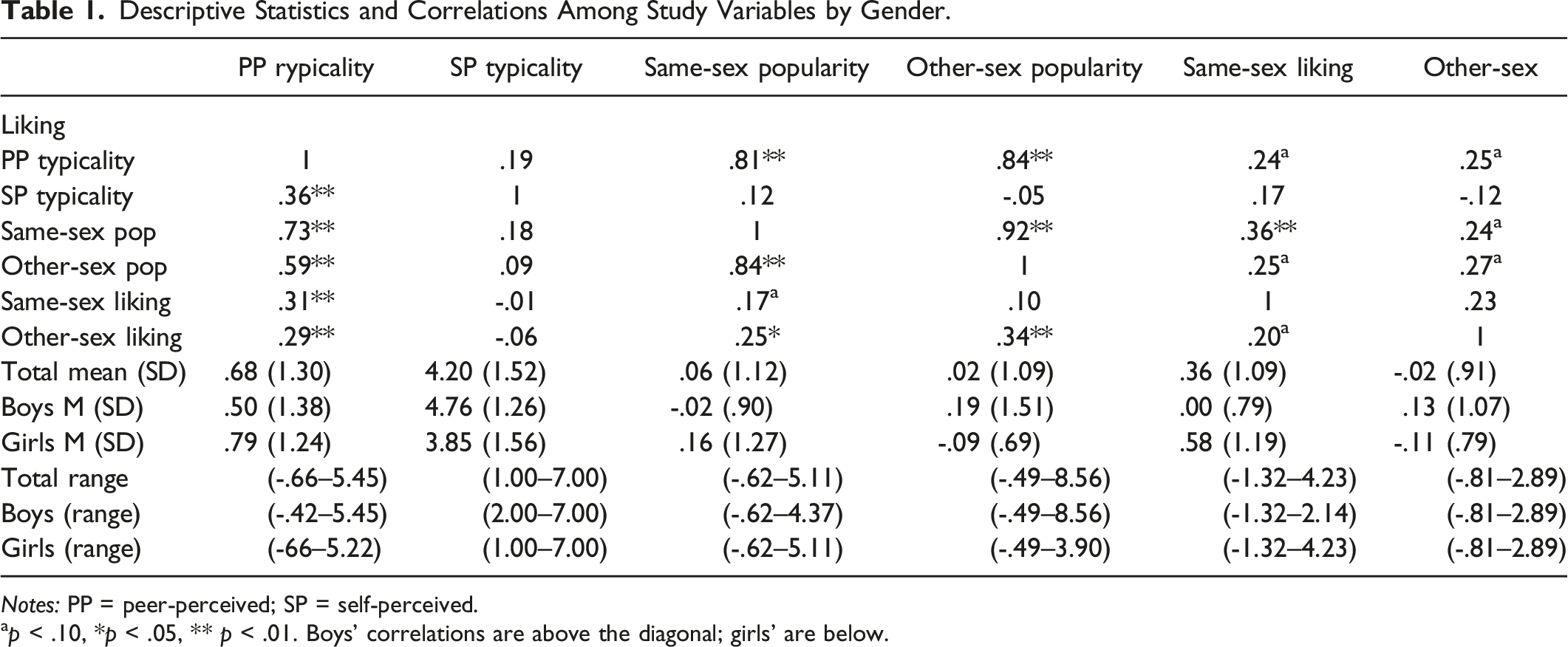
Notes: PP = peer-perceived; SP = self-perceived.
ap < .10, *p < .05, ** p < .01. Boys’ correlations are above the diagonal; girls’ are below.
Hierarchical Regressions Predicting Same- and Other-Peer Status from Self- and Peer-Perceived Gender Typicality.
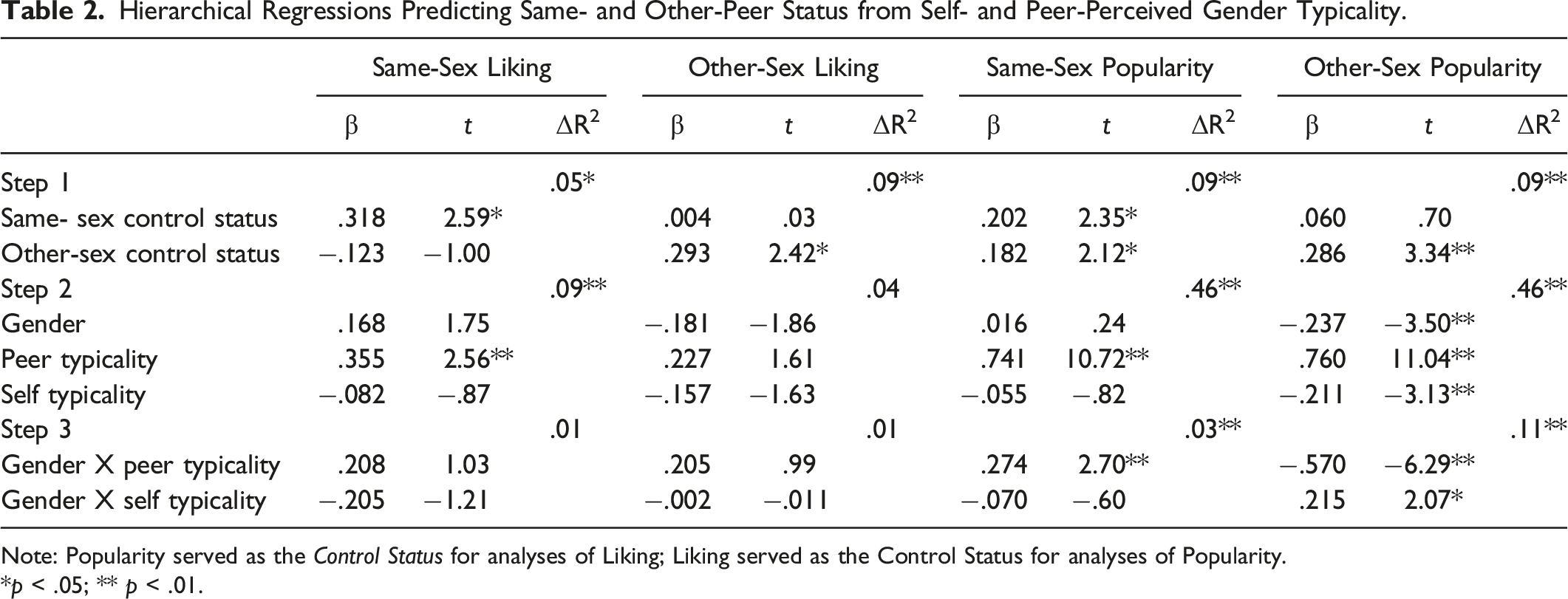
Note: Popularity served as the Control Status for analyses of Liking; Liking served as the Control Status for analyses of Popularity.
*p < .05; ** p < .01.
As seen in Table 2, 55% of the variance in Same-Sex Popularity was explained by the variables in the regression. As predicted, peer-perceived gender typicality was positively associated with popularity (β = .741, p < .001), and gender moderated this association, β = .274, p = .008 (see Figure 1). Prototypical plots revealed a significant positive association between same-sex popularity and peer-perceived gender typicality for both boys (β = .488, t = 5.83, p < .001) and girls (β = .784, t = 11.08, p < .001); contrary to our hypothesis, the slope of the regression line for girls was significantly steeper, indicating a stronger association. Gender moderates the association between peer-perceived gender typicality and popularity with same-sex peers.
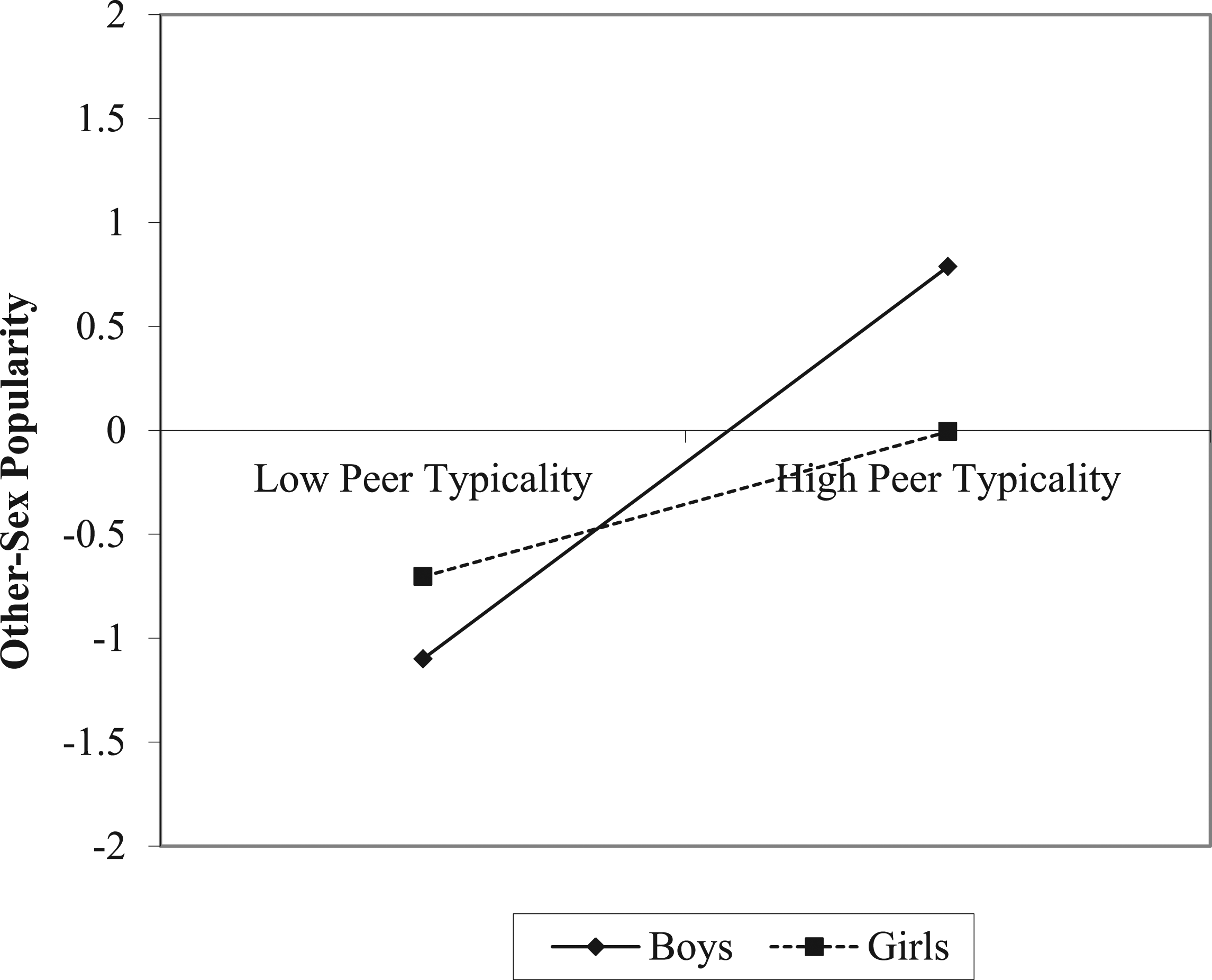
The regression explained 64% of the variance in Other-Sex Popularity (see Table 2). Self-perceived gender typicality had a negative association with other-sex popularity (β = −.211, p = .002), which did not support our hypothesis. However, consistent with our expectations, peer-perceived typicality was positively associated with other-sex popularity (β = .760, p < .001). As expected, gender moderated both of these findings, but in an unexpected way. There was a nonsignificant association between self-perceived typicality and other-sex popularity for girls, but a significant negative association for boys (β = −.248, t = −3.02, p = .002; see Figure 2). The association between peer-perceived typicality and other-sex popularity was significant and positive for both genders, but stronger for boys, as predicted (boys: β = .944, t = 13.35, p < .001; girls: β = .349, t = 5.52, p < .001; see Figure 3). Gender moderates the association between self-perceived gender typicality and popularity with other-sex peers. Gender moderates the association between peer-perceived gender typicality and popularity among other-sex peers.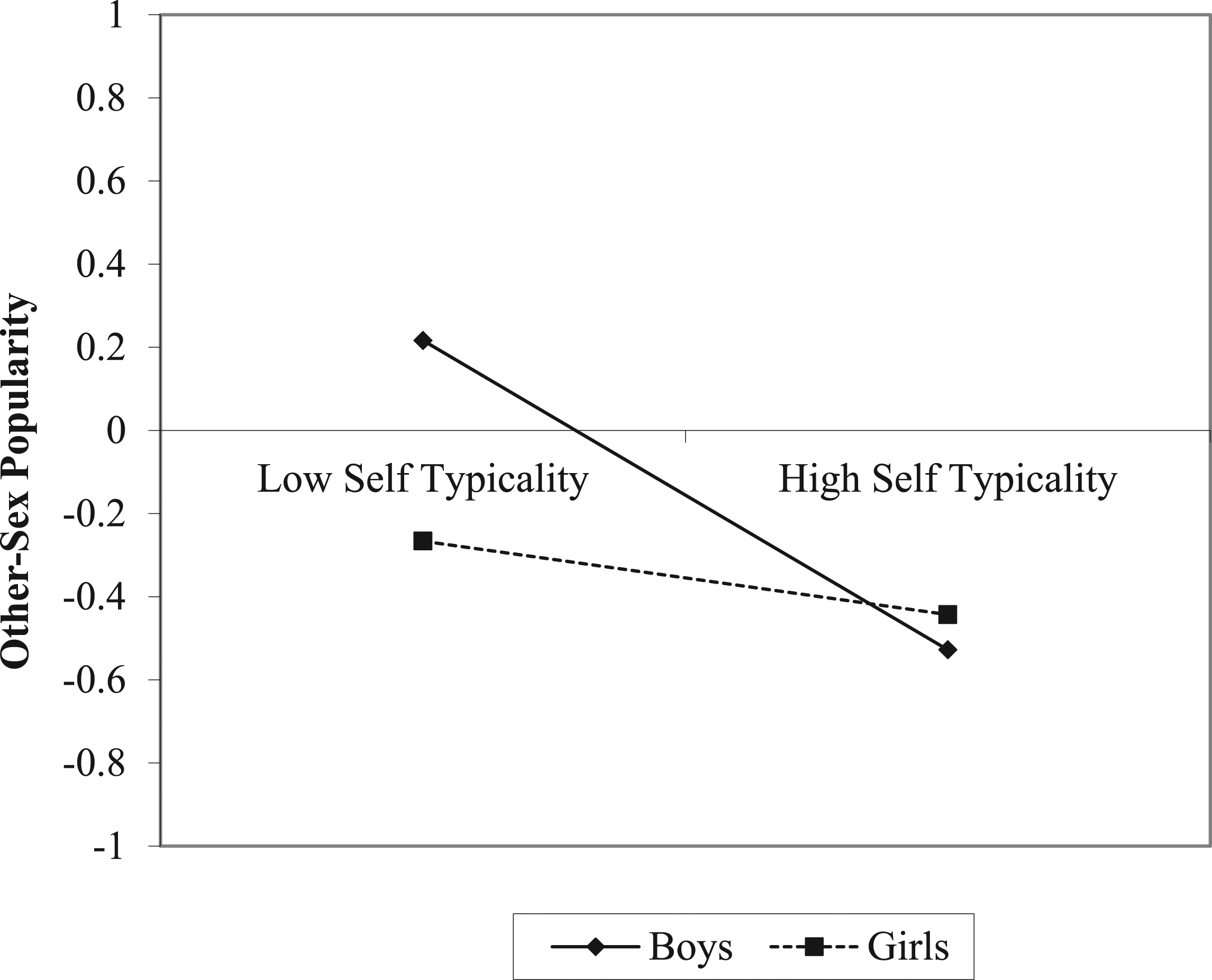
12% of the variance in Same-Sex Liking was explained by the variables in the regression, and the only significant predictor was peer-perceived gender typicality (β = .355, p = .012; see Table 2).
The regression accounted for 9% of the variance in Other-Sex Liking (see Table 2). The only significant variable in the model was other-sex popularity, which had a positive association with other-sex liking (β = .293, p = .050).
Discussion
In this study, we tested the associations of both peer- and self-perceived gender typicality with same- and other-sex peer liking and popularity. Support for our hypotheses was mixed. As predicted, both same- and other-sex peer popularity were positively associated with peer-perceived gender typicality. This finding corroborates and extends the small literature linking peer perceptions of higher gender typicality with higher peer status (e.g., Jewell & Brown, 2014), while also highlighting the fact that gender typicality plays a strong role in peer popularity. The association between peer-perceived gender typicality and peer liking was also positive, but only for liking by same-sex peers. Furthermore, the difference in the proportion of variance in the two forms of status explained by gender typicality (55% and 64% for same- and other-sex popularity, respectively, versus 12% for both same-sex liking and 9% for other-sex liking) was compelling. In particular, peer-perceived gender typicality is clearly more closely tied to power-based peer status than it is to likeability. As predicted, gender moderated the associated between peer-perceived gender typicality and both same- and other-sex popularity. Peer-perceived gender typicality was more strongly linked to same-sex popularity for girls than for boys. However, peers’ views of gender typicality predicted popularity with other-sex peers more strongly for boys compared to girls. This gender difference is intriguing, and suggests that gender typicality is more salient to adolescent girls’ evaluations of who is popular than it is to adolescent boys’. While boys may be more likely to ascribe popularity to peers who are less gender-typical, girls may hold stricter views regarding the importance of gender conformity, at least in terms of who has social power. These views may be the byproduct of proscriptive rules about traditional feminine norms (e.g., Signorella et al., 1993) or a symptom of internalized sexualization, which is the belief that being attractive to males is an important component of the self (McKenney & Bigler, 2016).
The associations we found among gender typicality and peer popularity are consistent with the extant literature (e.g., Rose et al., 2011) and with theoretical perspectives on the role of gender in peer status (Mayeux & Kleiser, 2020). Conformity to gender norms and stereotypes is particularly salient in early adolescence, when mixed-sex social interaction is becoming more frequent (Connolly et al., 2004) and youth are especially sensitive to the social cues of their peers (Blakemore & Mills, 2014). Adolescent boys who are highly masculine and adolescent girls who are very feminine attract the attention of peers, including other-sex peers who may view them as potential romantic partners (e.g., Volk et al., 2012; Zimmer-Gembeck et al., 2004). Popular adolescent girls who are highly gender-typical may also appear more sexualized compared to their less popular peers, which can be a contributing factor in their high status (Stone et al., 2015). Given the salience of romantic development at this age, adolescents who are able to garner the approval of other-sex peers may be seen as enviable and admirable, and achieve the kind of social visibility and prestige that characterize popular status. Indeed, research has shown that adolescents with romantic relationship experience are more likely to be popular than those who do not (Arnocky & Vaillancourt, 2012; Carlson & Rose, 2007).
We also hypothesized that self-perceived typicality would be positively associated with same- and other-sex peer liking, in line with previous research (e.g., Egan & Perry, 2001; Yunger et al., 2004). However, we found no association between self-perceived typicality and peer liking in either our bivariate analyses or the hierarchical regressions. The extant literature itself is inconsistent with regard to this particular association. For example, Egan and Perry (2001) reported a significant positive association between self-perceived typicality and peer liking for girls only, while Jewell and Brown (2014) reported a positive correlation only for boys. Yunger and colleagues (2004) did not report correlations separately by gender, so it is unclear whether the positive association they reported held for both boys and girls. However, they did emphasize that the correlation was only significant concurrently; self-perceived typicality did not predict liking over a one-year period. Thus, the role of gender self-perceptions in peer relations may be strongly influenced by other contextual factors, such as geographic region or even school-specific cultural norms. For example, the rather traditional gender norms prevalent in this rural community might have had an effect on how gender-typical adolescents perceive themselves to be. They may view themselves as low in gender typicality compared to their own strict stereotypes.
Popularity among other-sex peers was negatively associated with self-perceived gender typicality for boys, but not for girls, which ran counter to our expectation. We initially hypothesized that popularity would be linked to lower self-perceived typicality for girls, for whom certain gender-atypical attributes might bolster visibility among peers despite being contrary to female gender stereotypes (Jewell & Brown, 2014). We did not anticipate the negative association between self-perceived typicality and popularity for boys, for whom gender atypicality can be particularly problematic in peer relations (e.g., Lee & Troop-Gordon, 2011). However, certain attributes salient to boys’ own sense of self may feel gender-nonconforming, but do not counteract peers’ perceptions of their overall gender presentation. Characteristics such as time spent on grooming, emotional sensitivity, or having strong peer status goals might be examples of these. They are attributes that might lead adolescent boys to rate themselves as relatively low on self-perceived gender typicality, because they do not fit stereotypical ideas of masculinity. However, these same attributes could actually contribute to their attainment of social visibility, attention, or admiration in the peer group, as prior research has shown (e.g., Dawes & Xie, 2014). In some cases, attributes that feel gender-nonconforming (such as attention to grooming) might even enhance their peers’ perceptions of their typicality because of their outcomes (i.e., well-groomed appearance that attracts attention from others; Closson, 2008).
On the other hand, this finding may highlight that just because adolescents are perceived as gender-typical by peers, does not mean that their behaviors or attributes feel gender-typical to the adolescents themselves. The correspondence between self- and peer-perceived gender typicality was moderately positive for girls, but nonsignificant for boys. The gender prototypes or attributes used to evaluate peers’ typicality (i.e., appearance, behavior) may be quite different than those used by adolescents to rate themselves (personality attributes, goals). Further, for adolescents living in geographical regions characterized by traditional gender norms that shape their opportunities and social success in powerful ways, holding oneself to a much stricter gender “standard” may be an adaptive response (Scarborough et al., 2019).
These findings advance our understanding of the role of gender typicality in peer relations during a developmental period characterized by the intensifying importance of conforming to gender roles (Eder, 1985), being attractive to potential romantic partners (Furman, 2002), and gaining social prestige (LaFontana & Cillessen, 2010). Gender prototypicality theory argues that these three social goals are deeply intertwined; the findings of this study lend support for that argument. This study also emphasizes the unique roles of peer-perceived and self-perceived gender typicality in popularity and peer liking, as well as the importance of considering the roles of same- and other-sex peers as perceivers.
However, the study has important limitations that should be addressed in future research. For example, our data were collected in a rural community in the Midwest, where gender roles are still relatively traditional (Scarborough et al., 2019). Further research is needed to investigate whether these patterns of gender typicality and peer popularity generalize to other geographic regions, particularly those where gender norms are less traditional. Our measurement of peer-perceived gender typicality (masculinity/femininity) was not specific to dress and grooming, behavior, interests, mannerisms, or any other attributes. Thus, it is difficult to know exactly what aspects of gender typicality were driving the correlation with either form of peer status (though observable aspects of appearance have been shown to be more powerful in predicting popularity than behaviors and interests in experimental research; e.g., Kleiser & Mayeux, 2021). We were not able to collect peer nominations of unpopularity or disliking, making it difficult to ascertain how peer- and self-perceived typicality were associated with poor peer relations. Thus, the application of our findings is limited to a discussion of the role of gender typicality in positive peer relations, and cannot speak well to the harassment, victimization, and exclusion that gender-nonconforming youth face.
In addition, in accordance with the wishes of school administrators, we were only able to measure same-gender typicality, and could not include other-gender typicality in either our peer- or self-report measures. Having dual-typicality measures in our study would have provided a more complete understanding of the link between gender typicality and peer status, and future research should address whether these results still hold when measuring both same- and other-gender typicality. Another limitation in our study was the lack of information regarding participant age and their pubertal status. Previous research has shown differences in popular status based on pubertal timing (Teunissen et al., 2012). While we found no significant differences in our findings based on grade level, the roles of participant age (relative to peers) and pubertal status are important factors to consider in future research.
In spite of these limitations, the findings from this study provide evidence that the adolescents who are viewed by their peers as most gender-typical (i.e., most masculine or feminine) are also seen as the most popular. Our findings suggest that adolescents’ perceptions of their peers’ gender typicality have stronger ties to peer status than does adolescents’ self-perceived typicality. The effect size of peer-perceived gender typicality and the variance explained in popularity were substantial, suggesting that gender prototypicality is a crucial component of the development of social power in early adolescence. Gender typicality may enhance the social visibility of adolescents (Mayeux & Kleiser, 2020), which is the hallmark of popularity (Cillessen & Marks, 2011). Popularity is associated with behavioral and health risks, including substance use (e.g., Mayeux et al., 2008). Popular adolescents are stronger sources of peer influence for harmful behaviors than other youth (Teunissen et al., 2012), and adolescents who wish to become more popular, or who simply want to emulate their popular peers’ behavior, are more likely to adopt these risky behaviors (Sandstrom, 2011). For these reasons, understanding the roots of popularity is an important goal.
Footnotes
Declaration of Conflicting Interests
The author(s) declared no potential conflicts of interest with respect to the research, authorship, and/or publication of this article.
Funding
The author(s) received no financial support for the research, authorship, and/or publication of this article.
