




Abstract
Limited research attention has been devoted to disparate vulnerabilities to social-ecological risk factors and how these may explain group differences in bullying by race. To address this gap, the present study used data of early adolescent respondents (Mage = 11.2 years) from 36 public middle schools (N = 2701) to assess the nexus of race, social-ecological risk factors, and bullying perpetration. Multilevel modeling was employed to quantify the racial gap in bullying as well as the race-specific effects of social-ecological risk factors. Data revealed that Black students engaged in the highest levels of bullying perpetration, relative to all other racial/ethnic subgroups. School belonging exerted an amplified protective effect on Black and Hispanic youth, relative to White youth, and diminished the Black-White bullying perpetration gap. The link between exposure to family conflict and bullying perpetration was also race-specific. Findings yielded significant implications for bullying intervention and prevention.
Keywords
Introduction
Youth bullying involvement is major public health problem in the U.S. where it is found 30% of 6th through 10th grade students reported moderate-to-frequent involvement in bullying at school (Espelage et al., 2015). Bullying is defined as the aggressive intentional act by a person (or a group of people) against another person (or a group of people) who cannot easily defend themselves. It typically comprises face-to-face confrontations and physical assault, as well as indirect acts of aggression, such as gossiping and the spreading of rumors (Smith et al., 2008). Bullying during adolescence is best understood within the context of school and family dynamics, given that school and family are key contexts for the social development of adolescents (Williams & Guerra, 2011). Due to the distinct school and family environments White and minority youth are exposed to in the U.S. (Miller & Taylor, 2012; U.S. Census, 2018), a proper understanding of the relation between race and bullying is unlikely to be achieved without examining the school- and family-level risk factors of bullying for White and minority youth.
Broadly speaking, the nature and scale of the relationship between race and bullying involvement is understudied and under-developed. Studies examining the racial and ethnic differences in prevalence of bullying perpetration have yielded inconsistent conclusions, and are complicated by differences across types of bullying and specific racial/ethnic groups distinctions (e.g., White-Latino, or White-Black). Beyond prevalence or frequency, only a small number of studies have examined determinants of racial differences, and among those, relatively few utilize more rigorous multi-level designs or draw from populations that allow for comparisons across multiple racial/ethnic groups. (e.g., Low & Espelage, 2013; Spriggs et al., 2007). Yet, as Census data indicates, programming efforts need to be applicable and responsive to an increasingly racially diverse student body (Frey, 2021), which relies on knowledge of differences in risk factors or vulnerability to risk factors for both minority and majority youth (see Hong et al., 2021). Currently, knowledge remains insufficient, given evidence that White youth and youth in more racially homogeneous schools may disproportionately benefit from bullying prevention efforts (Bauer et al., 2007; Evans et al., 2014).
To address these limitations, studies are needed that move beyond whether we have differences in prevalence, to why these differences exist; particularly studies that examine determinants of bullying in the context of the complex ecosystem in which bullying occurs. Toward this aim, the current study draws upon a social-ecological framework to examine rates of bullying perpetration across a large racial/ethnically diverse sample, and investigates whether school and home microsystem factors are associated with racial/ethnic differences in bullying. Additionally, because we draw upon a diverse population, we investigate whether risk and protective factors in school and family contexts operate similarly for White, Black, Hispanic and Other-race youth.
Differences in Bulling Perpetration on the Basis of Race/Ethnicity
A recent review examined racial/ethnic disparities in prevalence of bullying perpetration, and found overall greater evidence that minority youth engage in higher levels of perpetration than majority youth (Xu et al., 2020). In their review, a greater number of studies were located in which minority adolescents engaged in higher levels of perpetration, as opposed to studies in which the majority group engaged in higher levels or null differences. The authors conclude that there is accruing evidence of greater minority involvement in perpetration, despite one contrary meta-analysis (Vitoroulis & Vaillancourt, 2018) that found small, non-significant differences between immigrants (vs non-immigrants) or visible minority versus majority youth. Importantly, moderator analyses in the meta-analysis by Vitoroulis and Vaillancourt (2018) found that among published studies, Black and Hispanic youth endorsed significantly higher levels of bullying perpetration than White youth.
Numerous empirical studies drawing upon large U.S. based samples have detailed a pattern in which Black and Hispanic youth are subgroups disproportionately involved in bullying as perpetrators (Albdour & Krouse, 2014; Cornell et al., 2015; Goldweber et al., 2013; Nansel et al., 2001; Peskin et al., 2006; Sykes, Piquero & Giavanio, 2017; Wang et al., 2013. For example, Wang et al. (2013) found African American youth were more likely to engage in physical, verbal and relational bullying compared to White youth, though Hispanic youth were also more likely to engage in physical bullying compared to White youth. Peskin et al. (2006) examined perpetration among a low socioeconomic sample of Black and Hispanic youth and found that Black youth engaged in more traditional forms of perpetration (i.e., verbal, physical and relational). Utilizing a latent class approach, Goldweber et al. (2013) examined 10,254 racially diverse middle school youth (62.4% Caucasian, 19.0% African American, and 5.6% Hispanic) and found that, irrespective of urbanicity, African American youth were least likely to be in the low involvement class. Lastly, Sykes, Piquero & Giovanio (2016) found that both Black and Hispanic adolescents were more likely to engage in bullying than White adolescents. Based on the aforementioned studies, we hypothesized Black and Hispanic youth would endorse higher levels of perpetration compared to other racial/ethnic groups.
A Social-Ecological Framework
Bullying involvement has long been studied from a social-ecological perspective, given the complex systems in which bullying seems to originate and be elaborated upon (Hong & Espelage, 2012; Espelage & Swearer, 2004; Swearer & Hymel, 2015). Drawing upon Bronfenbrenner’s model (1979, bullying is understood as a response to a confluence of more proximal and distal social/psychological factors. At the proximal level are individual characteristics, followed by microsystems (daily interactions with family, peers, teachers), to exosystems, which indirectly influence youth via microsystems (i.e., local government, mass media, laws) and macrosystem factors (i.e., socio-cultural norms and ideologies). Scholars have argued that differences in involvement on the basis of race/ethnicity may derive from different sociocultural backgrounds and experiences (Xu et al., 2020), and these differences may interact with bullying experiences in predicting responses and adjustment (Peguero, 2011). Thus, a social-ecological approach is needed to elucidate whether risk and protective factors for bullying perpetration (across these different ecologies) operate similarly for racially/ethnically diverse youth. Drawing upon this framework, we will examine how school and family microsystem factors relate to bullying and explain racial disparities.
Microsystem Factors
Family Conflict
As detailed in a review of risk factors for bullying (Alvarez-Garcia, et al., 2015), several studies have found significant associations between having witnessed or experienced family violence and greater involvement in bullying (Baldry, 2003; Lereya et al., 2013; Low & Espelage, 2013). Much of this relationship could be explained by the documented link between harsh/punitive, or maladaptive parenting and bullying involvement; given these parenting styles often overlap with family violence (Herrenkohl et al., 2008; Osofsky & Osofsky, 2018). However, studies examining the importance of family violence across diverse populations is in a nascent phase. Only one study has examined the role of family conflict and hostility in the context of racial disparities. Low and Espelage (2013) found that family conflict was associated with non-physical bullying for African American and White adolescents (not Hispanic or Asian), though explained through different individual mechanisms (i.e., depression vs hostility for White youth).
School Belonging
Given the majority of bullying happens in the school environment, school climate factors have been extensively studied (see Cornell et al., 2015; Wang et al., 2014). Components of school belonging, including perceived respect from teachers and teacher support, and engagement in school, have been associated with bullying involvement in previous studies (Bacchini et al., 2009; Richard et al., 2011; Young & Sweeting, 2004). Indeed, students are also less likely to report bullying if they perceive their school climate as negative (Unnever & Cornell, 2004), and numerous studies have found that Black and Hispanic students perceive less supportive climates and connectedness with teachers (Bottiani, et al., 2016; Voight et al., 2015). In addition, race may be an important factor in determining the most important dimensions of school climate (see Thapa et al., 1996; 2013 for a review), however, few have examined the role of school belonging across race/ethnicity in relation to bullying.
Teacher Antibullying Involvement
Beyond student-teacher relationships, teacher involvement in bullying prevention efforts, spanning from classroom rules around bullying and teachers’ attitudes toward bullying are veritably important in reducing bullying (Gaffney et al., 2021; Saarento et al., 2015), supporting the notion that teachers play an important role in establishing communities with social control. Middle school students believe that teacher involvement in bullying incidents is helpful, including being able to identify problems and notify parents of incidents (Crothers et al., 2006) However, the degree to which teachers are aware, intervene and hold students accountable for bullying has been less studied, and student perceptions of teachers’ motivation and capabilities of effectively intervening appear to be influenced by one’s own involvement in aggression. For example, Rigby and Bagshaw (2003) found that most students do not believe teachers were interested in intervening, and those who were more involved in bullying incidents were more likely to see teachers’ as unskilled in resolving incidents, and more unfair.
School Social Context
The relation between school context (i.e., predetermined) characteristics and bullying have yielded mixed findings, and contextual features appear to be less determinant of bullying than individual characteristics (for review, see Azeredo et al., 2015). However, given that minority youth are not randomly clustered in schools, it is important to model potential confounds that could inflate risk for bullying involvement among minority youth. Indeed, the racial segregation of schools that stems from segregation, has resulted in a concentration of Black and Hispanic youth in high poverty schools (See Duncan et al., 2014; Fahle et al., 2020). Among school contextual factors, school poverty or socioeconomic disadvantage has more consistently been associated with increased risk for bullying (Bradshaw et al., 2009; Carbone-Lopez, Esbensen, & Brick, 2010; Gregory et al., 2010), as has socioeconomic disparity (Due et al. 2009; Menzer & Torney-Purta, 2012). Other factors, such as school size or the degree of ethnic diversity or ethnic composition in a school (or classroom) has yielded mixed results with regard to effects on bullying (Azeredo et al., 2015; Stefanek et al., 2011; Verkuyten et al., 1996; Vervoot et al., 2010). However, given Black and Hispanic students are disproportionately concentrated in public, high-poverty schools it is important to model them simultaneously so as to reflect their intersection (National Center for Education Statistics, 2020).
A Moderation Framework: How Differential Advantage Can Explain Racial Differences
Studies documenting greater minority involvement in bullying should be contextualized by sociocultural differences that stem from differences in the allocation of stress and disadvantage. African American adolescents face disproportionate disadvantages with regard to financial hardship, exposure to violence, single-parent households, and greater chronic stressors compared to White adolescents (Goodman et al., 2005; Piquero, 2015), and other ethnic groups (Turner & Lloyd, 2003), a trend that continues into adulthood (Gallo & Matthews, 2003). Still others have found that both Black and Hispanic youth face greater disadvantages with regard to family background and high school experiences than White youth (Waslemann et al., 2015). Furthermore, both Hispanic and Black adolescents have greater histories of poly-victimization than White youth (Finklehor, 2011) and evidence markers of disrupted cortisol patterns (DeSantis et al., 2007).
Relevant to a social-ecological framework, stress process theories (Pearlin, 1989) emphasize the interconnected, multi-level nature of stress over the lifecourse, as well as the cascading effect of adversity over time (Eitle & Turner, 2002). This framework suggests that disparities result when race is “coupled” with social and economic stratification in schools and neighborhoods, that produce different levels of exposure to stressors (Brown et al., 2020). In addition to experiencing greater levels of adversity, stress theories propose that historically disadvantaged groups may be more vulnerable to stress or otherwise have a modified, less adaptive stress response (Meyer, 2003; Myers et al., 2015).
Indeed, there are numerous investigations documenting the role of accumulated adversity across multiple contexts and elevated risk for negative mental health and behavioral outcomes among youth, including depression, substance use and violence (Appleyard et al., 2005; Baroni et al., 2020; Gabalda, Thompson & Kaslow, 2010; Klein & Forehand, 2000; Sameroff et al., 1998). Relevant here, at least one study found that cumulative disadvantage was associated with racial differences in bullying among adolescents (Sykes et al., 2016). Because stressors and adversity are not evenly distributed, we adopted a moderation perspective on racial/ethnic differences, and conjecture that accounting for the differences in risk (i.e., family conflict) and protective factors (i.e., school climate) would diminish differences in bullying across race.
Furthermore, we hypothesize race-specific effects of risk and protective factors. Given Hispanic students tend to place more emphasis on moral order and rules (Slaughter-Defoe & Carlson, 1996; Thapa et al., 2013), they may perceive teacher bystander behavior more positively, and similarly to White students. On the other hand, given Black students have less trust in the authorities and policies that are widely found to be biased or color-blind (Johnson, 2008; Meares, 2008), it is possible they may perceive antibullying efforts in school more unfavorably. Furthermore, Black students have lower levels of perceived school safety and school climate compared to other racial/ethnic groups (Jackson, 2015). Thus, we hypothesized that Black students would particularly benefit from more positive school climate variables.
Lastly, we hypothesized Black and Hispanic students would be more vulnerable to family conflict because of differences in exposure to and accumulation of stressors (Finkelhor, 2011). If supported, there are important implications for prevention, insofar as we can identify factors that diminish racial disparities in bullying perpetration and inform more culturally responsive and effective programming.
Methods
Procedures
To test the school and familial environmental factors on student bullying involvement, we utilized data from a study of bullying victimization and perpetration on 2701 middle school students from 36 Midwestern schools in two states (i.e., Illinois and Kansas). All study procedures were reviewed and approved by the University’s Institutional Review Boards. School districts were contacted by the principal investigators in each state to introduce the project and to identify schools that would be interested in participating. For all participating schools, parents of all sixth-grade students were sent letters informing them about the purpose of the study. Several meetings were held to inform parents of the study in each community. An 86% participation rate was achieved in schools using a waiver of active (passive) consent and a 63% participation rate was achieved for schools using an active consent procedure. Students were asked to consent to participate in the study through an assent procedure included on the cover sheet of the survey. During the fall and spring of 6th grade, trained research assistants collected data in the classrooms. The research assistants first informed students about the general nature of the investigation, obtained assent, and students completed the surveys by hand (vs online). It took students approximately 40–45 minutes to complete the survey.
Participants
For details on recruitment and randomization, see (Espelage et al., 2015). In total, 3651 sixth-grade students from the 36 schools in Illinois and Kansas were recruited to participate in the survey. However, some respondents’ surveys had a large number of missing values on survey items due to time constraints. After excluding cases with missing values on the variables of interest in the current study, we finalized a sample of 2701 youth. To consider whether the missing data were random, we ran a series of sensitivity tests comparing the cases included and not included in the analyses. Excluded cases have comparable mean and standard deviation on bullying involvement, age, school and family environment, and other variables used in the study (see Supplement Appendix A). In the finalized sample, participants’ average age was 11.2 (SD = 0.43). About 50% of them were female. Roughly 35% percent of the sample identified their ethnicity as Hispanic, 24% White, and 25% African American. Of the remainder, 2.44% identified themselves as Asian and 11.85% biracial.
Measures
Dependent Variable
Bullying perpetration. We used the six-item Illinois Bully Scale (Espelage & Holt, 2001) to create a behavioral measure of traditional bullying. Students were presented with six statements of physical, verbal and relational bullying: (1) I fought students I could easily beat; (2) I upset other students for the fun of it; (3) In a group I teased other students; (4) I spread rumors about other students; (5) I started (instigated) arguments or conflicts; (6) I helped harass other students. Then they were asked to report how often they engage in these behaviors. Response options for each item ranged from (0) never, (1) 1 or 2 times, (2) 3 or 4 times, (3) 5 or 6 times, or (4) 7 or more times. The items exhibited good internal reliability (Cronbach’s α = .85).
Independent Variables
Student Race and Ethnicity
Students self-reported their race based on one of seven categories in the survey: White; Black/African American; Hispanic; Asian, Pacific Islander; Native American; and Multi-racial. We recoded this variable into a variable with four categories: White, Black, Hispanic and Other. The Other category included Asian, Pacific Islander, Native American and Multi-racial, which were not isolated due to small numbers of respondents in the sample.
Perceived Teacher Antibullying Behavior
We used the following four items from the Olweus Bullying Questionnaire as indicators of the construct students’ perceptions of teachers’ antibullying behavior: “Overall, how often teachers in your school would help out if a student made fun of or teased another student who is obviously weaker?“; “How often teachers in your school would help out if a student spread rumors or lies about another student behind their back?”; “How often teachers in your school would help out if a student told lies or made fun of another student who gets picked on a lot using the Internet or a cell phone (for example, email, instant messaging, text messaging, or websites)?”; and “How often teachers in your school would help out if a student or group of students pushed, shoved, or tried to pick a fight with a weaker student?” Items were rated on a 4-point Likert-type scale ranging from (0) “Never” to (3) “Always.” The construct had satisfying internal reliability (Cronbach’s α = .89).
School Belonging
School belonging was assessed with a revised version of the Psychological Sense of School Membership Scale (Goodenow, 1993). Students were asked how much they agree with the following statements: “I feel proud of belonging to my school,” “I am treated with as much respect as other students are,” “The teachers here respect me,” and “There is at least one teacher or other adult in this school I can talk to if I have a problem.” Response options were on a 4-point Likert scale and ranged from (0) “Strongly disagree,” to (3) “Strongly agree.” The items exhibited good internal reliability (Cronbach’s α = .72).
Family Conflict
The Family Conflict and Hostility Scale (Thornberry et al., 2003) was used to measure perceived levels of family conflict and hostility in the past year. The scale contained three items: (1) “How often is there yelling, quarreling, or arguing in your household?“; (2) “How often do family members lose their temper or blow up for no good reason?“; and (3) “How often are there physical fights in the household, like people hitting, shoving, or throwing things?” Response options range from “Never” (0) through “Always” (3) on a 4-point Likert scale. The construct had sound internal reliability (Cronbach’s α = .81).
Control Variables
School socio-demographic environment. Three sociodemographic variables were used as controls in the model: school racial diversity, enrollment, and percentage of students eligible for free lunch. School racial diversity indicated the percentage of non-White students in each school. School size was a numeric variable representing the number of students enrolled in each school. Student disadvantage was represented by the percentage of students eligible for free or reduced-price lunch.
To obtain robust results of the race-specific effect of risk factors on bullying involvement, two control variables were included in the model: student gender was a binary variable with one indicating male and zero female, and student age was a numeric variable.
Analytic Procedure
This study conducted data analyses in a series of steps. The first step involved preliminary analysis examining the descriptive statistics of the variables of the whole sample as well as a breakdown by race and ethnicity. A correlation matrix of variables was also examined in this step to identify any multicollinearity issues in the model. Second, using multilevel modeling we estimated differences in bullying involvement by race/ethnicity while using random effects to obtain more appropriate estimates of standard errors by treating schools as level two units in which respondents (level one units) are clustered. In total, five models were run. In the first, we estimated effects of race, age and sex on bullying involvement. We then added the three school sociodemographic variables to the multilevel model to test whether they partially or completely explained away the racial gap observed in model one. Then we examined the main effects of teachers’ antibullying behavior and students’ sense of school belonging on bullying perpetration. After that, we introduced family environment into the model to examine whether familial risk factors exerted independent effect on bullying over and beyond predictors from the school domain. Lastly, (model 5) we created interaction terms between race/ethnicity and school and family risk factors to ascertain the race/ethnic-specific effect of risk factors. All multilevel modeling analyses were conducted using the SAS PROC MIXED procedure (Version 9.4, SAS Institute Inc. Cary, NC) and coefficients were obtained by restricted maximum-likelihood (REML, Boedeker, 2017).
Results
Descriptive and Bivariate Statistics
Descriptive Statistics (n = 2701).

Correlation Matrix.
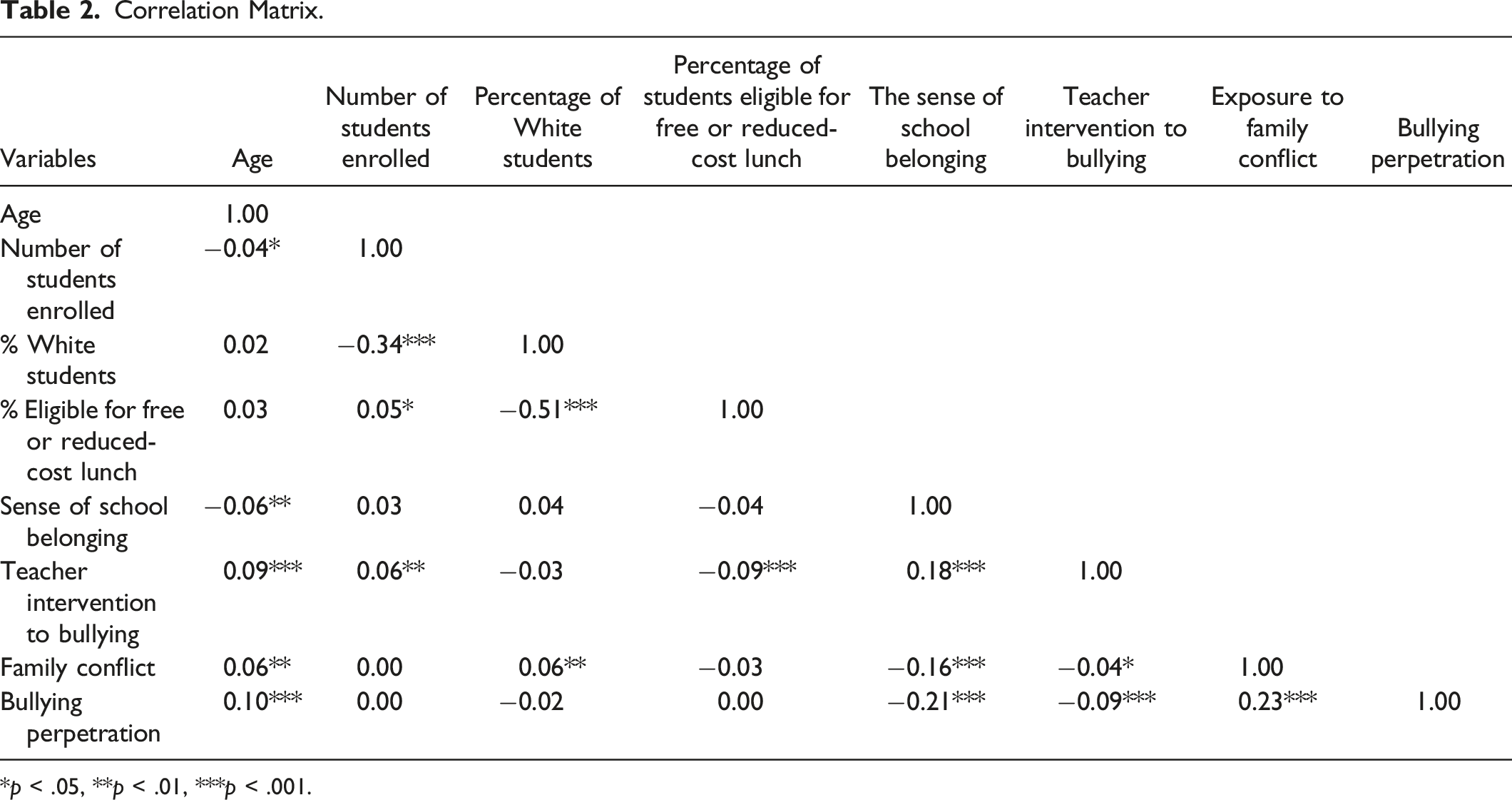
*p < .05, **p < .01, ***p < .001.
Multilevel Model Results
Examining the racial gap in bullying perpetration without school and family indicators
Multilevel Model Results Predicting Bullying Perpetration.
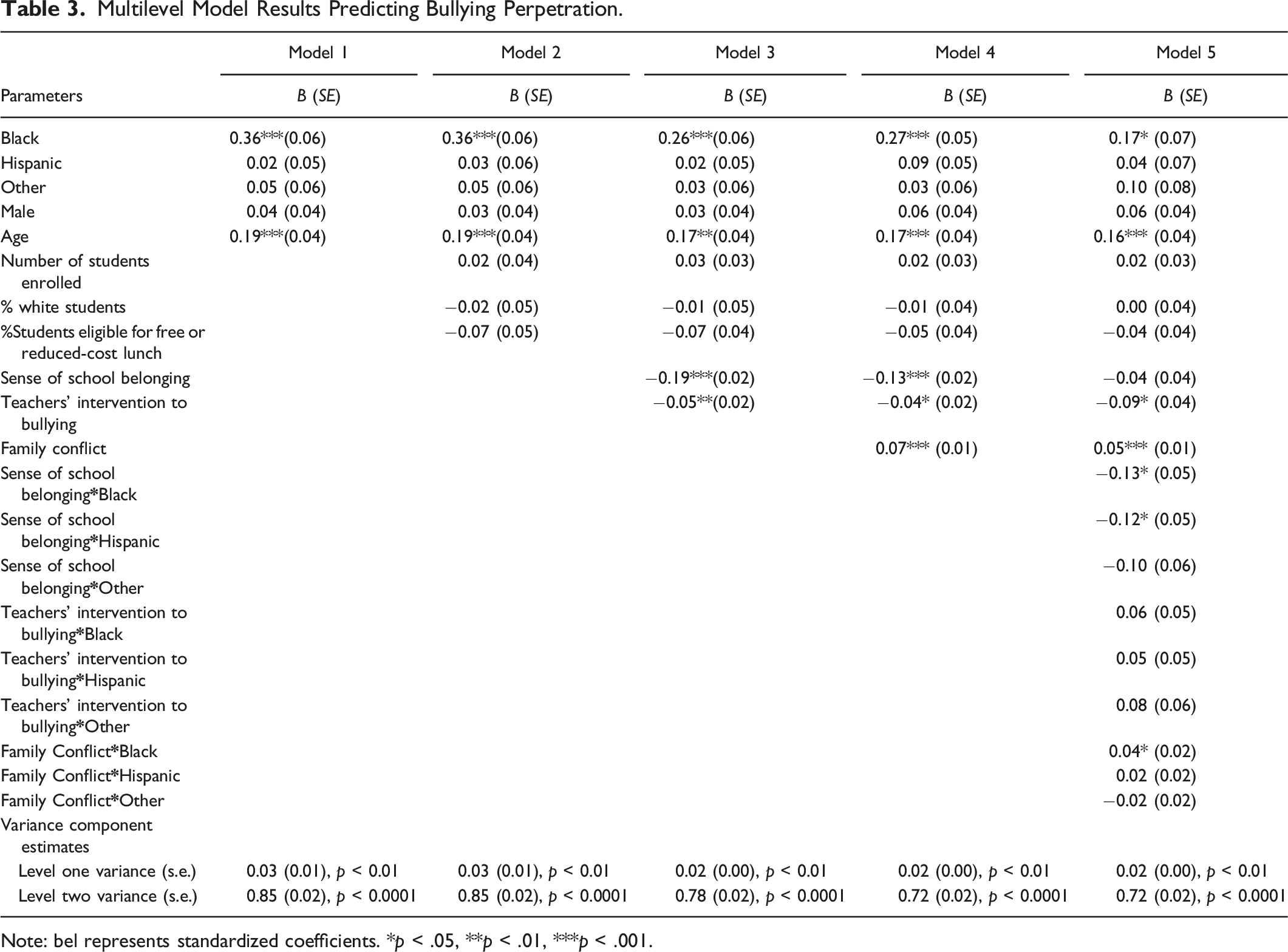
Note: bel represents standardized coefficients. *p < .05, **p < .01, ***p < .001.
Examining The Effect of School Environment on Bullying Involvement
To examine whether the observed racial gap in bullying involvement is related to disparate school environments, we tested a series of nested models (Table 3). In Model 2, we tested the three school sociodemographic variables, and found that none of the three school socioeconomic indicators was significantly associated with individual students’ bullying involvement. The racial gap in Model 2 was largely the same as in Model 1, in which there were no school sociodemographic variables.
In Model 3, we found that both teacher intervention to bullying and the sense of school belonging were significantly and negatively associated with bullying involvement. Specifically, the racial gap in Model 3 was slightly smaller than that in Model 1; the coefficient of Black dropped from .36 (p < .001) in Model 1 to .26 (p < .001) in Model 3, indicating that teacher intervention to bullying and the sense of school belonging partially helped reduce the racial gap between Black and White students by about 25%. We also found that the effect of school belonging was much larger (B = −.19, p < .001) than that of teaching intervention (B = −.05, p < .01), indicating that the sense of school belonging played a larger role in terms of inhibiting bullying behaviors.
Examining The Effect of School and Family Environment Simultaneously
To examine whether familial environment can predict bullying over and beyond school predictors, in Model 4 (Table 3) we introduced exposure to family conflict. We found that with teacher intervention to bullying and the sense of school belonging controlled in the model, exposure to family conflict still achieved significance. A one standard deviation increase in exposure to family conflict was associated with a .07 standard deviation increase in bullying engagement (B = 0.07, p < .01). This indicates that family environment exerted another layer of influence on youth problematic behavior over and beyond school level risk factors. We also noted that the Black-White racial gap in bullying involvement largely stayed the same compared to that in Model 3 (B = 0.27, p < .001). It seems that school environment factors can explain away some effect of race, this is not the case for family environment factors.
Examining the Race-Specific Effect of Risk Factors for Bullying
Lastly, to examine whether risk factors in school and family domain exerted a race-specific effect on bullying, we created nine interaction terms in Model 5 (Table 3). We found a significant interaction effect between student race and school climate factors, such that. Black students received more protective benefits from the sense of school belonging than White students (B = −.09, p < .05). For each standard deviation increase in school belonging, it brought a .09 standard deviation drop in bullying for White students. However, we observed a sharper drop in bullying involvement among Black (B = −.09+ (−.17) = −.26, p < .01) and Hispanic students (B = −.09 + (−.12) = −.21, p < .05) when they experienced one standard deviation increase in school belonging. It seems that Black and Hispanic students experience heightened value from the support they receive from school compared to their White counterparts.
Model 5 also discovered a race-specific effect of family conflict on bullying insofar as Black students were more vulnerable to family conflict. Even among youth with equivalent levels of family conflict, Black students show a higher propensity for bullying perpetration, compared to White students. A one standard deviation increase in the exposure to family conflict corresponded with a .05 standard deviation increase in bullying perpetration for White students (B = .05, p < .05), and a .09 standard deviation increase of bullying perpetration for Black students (B = .05 + .04 = 0.09, p < .01).
Discussion
Despite well-documented differences in bullying involvement by race, there is a veritable dearth of studies examining factors associated with racial differences (Zych et al., 2017). Understanding the how risk and protective factors are linked to disparities by race is an important step in guiding prevention and interventions that are effective for an increasingly diverse population of youth. The current study was an attempt to address this by examining how race/ethnicity relates to bullying involvement in a large middle school sample. Specifically, drawing upon an ecological framework, a series of nested models were tested to assess the role of school and family risk and protective factors on bullying across African American, Hispanic White and Other-race adolescents, controlling for confounding school-level sociodemographic variables.
Given our multiracial/ethnic sample, both main effects and moderation effects were examined to elucidate subgroup differences. The underlying assumption of a moderational relationship between school climate, family conflict and bullying, is instrumental in building knowledge around the relative importance of these factors to bullying perpetration for White and minority adolescents. Our analyses and hypotheses are also consonant with theories that differences in bullying involvement may reflect unequal sociocultural experiences and backgrounds. To the extent this is the case, modeling these factors should help uncouple race and bullying involvement. We also examined race/ethnicity as a moderation variable to investigate whether our selected risk and protective factors have a race-specific relation to bullying, due to differences in levels or sensitivity (Bradshaw et al., 2009; Graham & Juvonen, 2002).
Several major findings emerged from the study. Consistent with prior studies, we found that Black adolescents were significantly more likely to engage in bullying, compared to White students; however, no differences were found between White, Hispanic and Other race students (Goldweber et al., 2013; Peskin et al., 2006). This disparity held even when we controlled for school-level demographics, such as school size, the percentage of students on free/reduced-cost lunch and percent non-White students. Although only a few studies have examined the role of school context, these findings are consistent with reviews that have reported that parent income, neighborhood, city and country-level poverty have little to no relationship to bullying (Azeredo et al., 2015). It is not surprising that school demographics, such as percent White, were not robust predictors, after all, there is likely great variation across schools in the exact ethnic/racial composition. Furthermore, the highest risk group for bullying, Black youth, are rarely the racial majority (Duncan et al., 2014). For example, only 5% of White students attend schools where there is less than 50% White enrollment, whereas one-third of Black students attend schools where the Black enrollment is 25% or less (Duncan et al., 2014). Combined with data showing that Black youth are the most likely to attend schools with peers living in poverty, one can deduce that there may not be enough Black youth stratified in schools with higher social advantage and high majority representation to yield school-level differences. In short, restricted range of variability in school-level SES is an important consideration, as is the reliance on urban public schools.
There is a robust literature documenting racial differences in perceived school climate (Perkins et al., 2006; Thapa et al., 2013). When we accounted for school protective factors, namely, sense of school belonging and teachers’ antibullying behavior, bullying disparities for Black versus White youth did significantly diminish. Moderation analyses showed an enhanced benefit of school belonging for Black and Hispanic students. Specifically, our data showed that Black and Hispanic students reaped more benefit from a sense of school belonging than their peers, but this was most pronounced for Black students (100% greater vs. 30% greater than White students), indicating that school belonging is particularly salient in understanding the Black-White bullying gap.
While teacher antibullying behavior was associated with bullying perpetration, similarly across all youth, the effect size was one-fourth that of school belonging. Teacher behavior may also be a proxy for relationship factors already subsumed by school belonging. Given the wide variability on this scale, future studies should elucidate the developmental relevance of teacher involvement and determine whether the relative importance of teacher behavior wanes over time. It seems Black students are especially likely to benefit from a supportive school environment where they feel a sense of belonging, but given they reported the lowest levels of school belonging across racial subgroups, these findings highlight a troubling juxtaposition. More formal, authoritative intervention may be less well received by Black students, whereas informal relationship building and collaborative problem solving may be viewed as more supportive, and ultimately more effective for this subgroup. Taken together, school climate factors helped significantly reduce the gap between bullying involvement for Black and White students by 25%, but the reduction is driven by the school relational climate versus teacher intervention in bullying.
Family conflict affected youth’s behavior via a more complicated mechanism. Although it did not directly explain (i.e., diminish) the racial gap, the relation with bullying is moderated by race. For White and Black youth who are from families with similar levels of family conflict, Black youth showed an amplified response to exposure, such that exposure to family conflict corresponded with a markedly high increases of bullying involvement among Black youth. Elucidating a race-specific vulnerability to family risky environment in relation to bullying involvement is novel, and points to a greater vulnerability among Black adolescents relative to other racial subgroups when exposed to similar levels of family conflict. This finding is an important extension of prior findings that some negative life events such as arrests and having contact with the juvenile justice system do not impact White youth as heavily as minority youth (McGlynn-Wright et al., 2020; Pager, 2003). It might be that White youth have access to resources and capitol that, even during the occurrence of family conflict, can ameliorate some of their struggles or result in more adaptive coping behaviors (or responses). Future studies should examine whether the availability of formal and informal sources of support to youth who experience family conflict are racialized and how it relates to divergent susceptibility to family conflict across racial groups.
Findings from the current study have several implications for bullying prevention and intervention and policymaking. First, it should be highlighted that the inclusion of school belonging is helpful in explaining the Black-White disparity in bullying-reducing the gap by half. Second, while school belonging has an amplified protective effect on Black and Hispanic youth, school belonging appears to be a greater conduit to bullying for Black adolescents. Otherwise stated, differences in bullying involvement are largely explained by differences in perceived social connection for Black adolescents (Becker & Luthar, 2002). These findings suggest supportive interventions that emphasize cultivating a strong sense of school belonging and fostering supportive/trusting relationships would be particularly beneficial to historically stigmatized minority groups. Such approaches offer an alternative to schools that focus on bullying reduction through disciplinary approaches (including suspension and expulsion) that may only further amplify detachment to school and an escalation of delinquency (Baroni et al., 2020). Integrative instructional approaches to bullying that target peer dynamics and positive interactions may hold promise and warrant further study. For example, collaborative, peer group instruction has demonstrated effects on peer victimization and increased social connectedness, particularly for minority groups (Van Ryzin & Roseth, 2018; Van Ryzin et al., 2020).
Third, secondary school educators, including counselors and teachers, should be made aware of the multi-faceted detriments of bullying engagement that encompasses not only school climate but also family environment. Although school counselors often cannot change the home and community environments in which youth live, they can play an integral part in providing sources of help and bolstering resilience and healthy coping skills (Sullivan et al., 2004). Concededly, several limitations to this study exist. The study relied on self-report bullying engagement, which was measured via behavioral survey questions that used plain words to describe various types of bullying behaviors. The drawback of this method is that it could not gauge the power dynamics between the victim and perpetrator, that one could otherwise incorporate through a provided definition. However, meta-analyses have shown that the provision of a definition did not alter the relation between race and reports of bullying (Vitoroulis & Vaillancourt, 2018). Minority groups tend to show higher endorsement of bullying on surveys, which suggests that this method could be over-attributing group differences, to the extent White youth are under-reporting (Vitoroulis & Vaillancourt, 2018). However, surveys also provide advantages that alternatives like peer nominations cannot-mainly, more detailed information on the type and severity of bullying. It should also be noted that the bullying variable in the study tapped into traditional bullying and cannot extend to cyberbullying. Furthermore, due to data limitations, it is beyond the scope of this study to examine how teacher’s race/ethnicity affected minority students’ school belonging. Previous studies found that minority teachers provide more support to minority students, which contribute to stronger attachment to school (e.g., Griffin & Tackie, 2016). Future studies of bullying prevention can benefit from collecting data of the racial composition of teachers at the school level. Lastly, some potential confounding contextual factors could not be examined by the study. For example, urbanization, neighborhood environment, and family social economic status are confounded with race, and could be associated with bullying, though evidence has been mixed. More research is warranted that integrates family, neighborhood and school risk factors to further our understanding of youth problematic behavior.
Supplemental Material
Supplemental Material - Contribution of School and Family Factors to Racial Disparities in Bullying Involvement
Supplemental Material for Contribution of School and Family Factors to Racial Disparities in Bullying Involvement by Sabina Low, PhD and Lin Liu, PhD in The Journal of Early Adolescence
Footnotes
Declaration of Conflicting Interests
The author(s) declared no potential conflicts of interest with respect to the research, authorship, and/or publication of this article.
Funding
The author(s) disclosed receipt of the following financial support for the research, authorship, and/or publication of this article: This work was supported by Centers for Disease Control and Prevention grant no #1U01/CE001677.

Supplemental Material
Supplementary material for this article is available on the online.
Notes
Author Biographies
References
Supplementary Material
Please find the following supplemental material available below.
For Open Access articles published under a Creative Commons License, all supplemental material carries the same license as the article it is associated with.
For non-Open Access articles published, all supplemental material carries a non-exclusive license, and permission requests for re-use of supplemental material or any part of supplemental material shall be sent directly to the copyright owner as specified in the copyright notice associated with the article.
