



Abstract
The current study examined the development of early adolescents’ social perspective taking (SPT) through collaborative small-group discussions. A total of 250 fifth-graders were assigned to three conditions, Collaborative Social Reasoning (CSR) discussions, Read-Aloud (RA) and Regular Instruction (RI). SPT was assessed before and after the intervention using an action-based argumentation essay task through a theory-driven coding scheme aiming at capturing individuals’ agentic role in SPT and SPT justification strategies. Poisson regressions with Generalized Estimating Equations based on the young adolescents’ essays revealed that CSR peer group members considered more justified perspectives of the issues and provided more justification based on story events and emotional concerns for the perspectives in comparison with fifth graders in the RA and RI groups. Individuals in the RA group generated more emotional justification for their perspectives than RI members. The findings provide insights into the social process of developing SPT under collaborative small-group discussions.
Keywords
Social Perspective Taking (SPT) refers to the ability to make sense of others’ thoughts and feelings. Researchers have suggested that skillful perspective takers are less likely to show prejudice toward others (Galinsky & Moskowitz, 2000), fall prey to stereotypes (Galinsky & Moskowitz, 2000), or engage in maladaptive behaviors (Gleason et al., 2009; Richardson et al., 2008). In addition, SPT is positively associated with cooperative behaviors (e.g., Johnson, 1975), increased social awareness (Lobron & Selman, 2007), effective negotiation strategies (Galinsky et al., 2008), and has been recognized as one of the most important competencies for building and fostering meaningful social relationships in school (Dodge et al., 2003).
Early adolescence is a particularly crucial developmental time where educational support to enhance SPT can be especially resonant, as failure to take into account others’ feelings and perspectives can lead to severe consequences, including social, behavioral, and academic maladaptation. Young adolescents often experience rapid changes of social environments (Ryan & Shim, 2008), facing substantial changes from dramatic shifts in school experiences, academic engagement (Maine & Hofmann, 2016), and social networks with peers (Cheung & Elliott, 2017), leading to high levels of stress (Akos et al., 2015), sharp declines in positive self-concept (Parker, 2009), increased aggression and peer victimization (Williford et al., 2011), and struggles with depression (Goodwin et al., 2012). Higher levels of SPT can help to ameliorate some of these difficulties, or at least dull their hard edges, helping early adolescents in their struggles to adapt to their new roles in society and navigate increasingly complex social ecologies, as well as supporting them in handling complicated social dynamics such as bullying, aggression, and changes in friendships (Batanova & Loukas, 2011; Smith & Rose, 2011).
Despite SPT’s importance for early adolescents’ development, the question about whether and how SPT can be effectively cultivated has been relatively underexplored (Durlak et al., 2011; Gehlbach & Mu, 2022). Some studies (Dugan et al., 2014; Gehlbach & Brinkworth, 2012; Gehlbach, 2017; Walker et al., 2013) suggest engaging individuals in collaborative perspective taking exercises (e.g., small-group discussion) can offer young adolescents multiple advantages, including maintaining positive interpersonal relationships, generating shared hypotheses, counterbalancing biases and opposite opinions, and developing more comprehensive explanations toward complex social issues. The current study aims to examine the development of SPT through a dialectical process of social argumentation involving social problems with recognizable socio-moral implications (e.g., consequences of peer exclusion, individual and group responsibilities in bullying scenarios), and internal consideration of new strategies for testing and re-constituting ideas and perspectives under an action-based intervention. The intervention follows Vygotsky’s (2017) idea that thinking originates on the social plane, in collaboration with adults and/or peers. Learners internalize argumentation, including the need to take the perspective of the other(s) to move towards resolution, and appropriate these processes as part of their thinking processes. The intervention anticipates micro-genetic, dialectically-based processes of argumentation as dialogue moves between the external plane (peer dialogue) and internal plane (attempting to formulate more cohesive and effective responses to complex social dilemmas); as dialogue becomes more complex, internal organization of argumentation skills become more refined/advanced. Critical in understanding these developmental processes and our abilities to advance them, is documenting the ways in which the individuals involved in these dialogues express their newly appropriated tool(s) of perspective taking as a stable tool in the early adolescent’s social arsenal.
Research Background
Conceptualization of SPT
Two important models informing the development of SPT are: (1) the cognitive-representational models and (2) the social-relational models. The cognitive-representational models characterize development of perspective taking abilities as an organic, individual phenomenon. These models are usually based on the work of simulation (Harris, 1994), theories of mind (Gopnik & Wellman, 1994), narrative empathy (Keen, 2007), and executive function (Carlson & Moses, 2001). Cognitive-representational models rely primarily on individual/mentalistic understandings of human development with less attention paid to the roles of social interactions and relationships in the development and enactment of SPT. Social-relational models, on the other hand, attempt to identify the pragmatic functions of SPT when solving complex problems (Diazgranados et al., 2016). Though these two models share some similar origins in constructivist and/or social constructivist perspectives (e.g., Piaget, Vygotsky), they have both struggles in developing a comprehensive understanding of the role SPT plays in individual and social development.
The way forward in understanding SPT may be to combine cognitive and relational models in a wide-ranging approach to the phenomenon. The model pursued in this paper posits SPT as an individual cognitive process where young adolescents consider, discern, and evaluate others’ positions according to their current cognitive representational model (Gehlbach, 2011; Kim et al., 2018), while also recognizing how SPT plays out, and is developed through, its active and dynamic role(s) in everyday social interactions when individuals are challenged to consider differing solutions and possibilities in their search for solutions to shared problems. What is critical is the dialectical relationship between the two models, cognitive-representational and social-relational, in dynamic social settings, leading to development of more complex and nuanced SPT as an increasingly stable tool for navigating social situations.
One way to connect the intrapersonal and interpersonal reasoning is through argumentation, a process in which claims are generated, supported, and evaluated by reasons and evidence (Nussbaum & Edwards, 2011). If individuals engage in an argumentation process to identify and understand others’ perspectives based on available situational clues, social norms, emotions, and other criteria, they are more likely to increase and refine their SPT as a natural part of their social interactions (SPT emerging as part of an organic process rather than a focused intervention) (Kuhn & Udell, 2003; Murphy et al., 2018). This can lead to a dialectic relationship between open ended argumentation and internal cognitive processes as individuals are confronted with the legitimacy of other’s opinions and pushed to reconsider their own positions in order to bring their individual thought processes and their social group interactions back to a state of equilibrium. It is through argumentation that one’s thoughts can be delivered and communicated with validity and credibility. Argumentation brings peers into a common dialogic space where they are pushed to navigate multiple perspectives (Lin et al., 2019; Reznitskaya et al., 2009).
Collaborative Small-Group Discussion and SPT
Social constructivist perspectives based on ideas of the Soviet psychologist Glassman et al., 2022; Vygotsky, 2017) suggest that effective learning (leading to development) tends to involve meaningful dyadic and/or group interactions where individuals expand their thinking by working with others towards individual or collective proximal goals. Collaborative small-group discussion is a social constructivist approach in which, if structured appropriately, various perspectives can be generated to provide multiple entry points for individuals to build shared knowledge (Alexander, 2006; Walton, 1998). Building shared perspectives through dialogue creates learning scenarios that will eventually lead to the development of understanding one’s own and other group members’ perspectives, establishing connections as a well-functioning social group (Gehlbach, 2011; Diazgranados et al., 2016; Mead, 1938). In other words, cultivating multiple perspectives helps individuals understand contentious questions from multiple standpoints, assumptions, and concerns, and thus further transforms their ways of thinking. For example, Clark et al. (2003) analyzed discourse data from Collaborative Reasoning discussions on a story ‘What Should Kelly Do?’. In the story the main character has a picture she would like to enter into a competition. Her friend leaves the painting out in the rain, jeopardizing the main character’s chance of winning a prize. During the collaborative discussion, individuals probed the complex social-moral issues of the situation concentrating on personally relevant issues such as responsibility and friendship. Some of the adolescents focused on the rules of the contest, claiming that each person is responsible for turning their own painting in at a certain time, and deciding it was not the friend’s responsibility to take care of the painting. Some adolescents were more concerned about with the major character’s feelings and emotions after her work was ruined, and argued that the friend, at the very least, should inform the artist that her painting was outside in rain. Complex social-moral issues introduced to such collaborative small-group discussions provided fertile grounds for the adolescents to explore diverse perspectives and develop final potential solutions.
Additionally, small-group discussions provide members opportunities to (re)construct and justify their own ideas, and to engage the viewpoints of others (Mischo, 2005; Wells, 2000). In order to gain a better understanding of others’ perspectives in the process of conflict regulation and eventually group resolution (Darnon et al., 2006; Piaget, 1932; 1985), individuals in small-group discussions are given opportunities to apply complex justification strategies to shared problems, including using text-based evidence (Reznitskaya et al., 2009), incorporating emotional concerns (Oswald, 1996; Polo et al., 2016; Walton, 1992), using analogical thinking (Lin et al., 2015), and exploring moral/value-based judgement (Cognetta & Sprinthall, 1978; Hayden & Pickar, 1981).
Measuring SPT
Given complex conceptualizations of SPT, various measurements of SPT exist, each having their own strengths, but also limitations. One of the most popular approaches for measuring SPT is self-report, which has been widely used with both children and adults (e.g., IRI, see Davis, 1983; Davis & Franzoi, 1991). Self-report measures can suffer from accuracy bias, only capturing beliefs about one’s own SPT ability and motives to understand others’ perspectives in assessing competence in real social settings (Ames & Kammrath, 2004; Hall et al., 2009; Realo et al., 2003). There are a few direct assessments attempting to capture the role of social contexts in the development of SPT. For example, Rel-Q Scale (Schultz et al., 2003) evaluates different integration levels of SPT based on test-takers’ understanding of the context. However, the close-ended options of Rel-Q could potentially lead to oversimplifying one’s SPT.
A later generation of scenario- or situation-based measures allow researchers to examine SPT across multiple scenarios or hypothetical situations (e.g., Gehlbach, 2004; Selman & Feigenberg, 2010; Kim et al., 2018). These measures present multiple scenarios and contexts for analysis and interpretation in textual media, assess SPT through written responses or open-ended questions, and provide rubrics for evaluating SPT acts. Modeled on the linguistic pragmatics of speech acts (Austin, 1955), SPT acts refer to the social-relational effect of an SPT statement (i.e., action(s) of taking the social perspective of other(s)). One example is the Social Perspective-Taking Acts Measure (SPTAM, see Diazgranados et al., 2016), which assesses individuals’ ability to perform SPT acts in response to specific social situations (e.g., school bullying, teasing). The SPTAM coding distinguishes between three types of perspective taking: the least sophisticated type refers to acknowledgement of unique agents or actors; the next refers to explicit articulation of thoughts, beliefs, preferences, and orientations to action; the third type characterizes an agent’s thinking as reflective of a personal position or a general norm, called positioning.
One strong benefit of the SPTAM measure is that it allows researchers to gauge the extent to which individuals consider different perspectives in depth. Building upon SPTAM, Hsin and Snow (2017) captured the extent to which individuals would articulate an acknowledged perspective to enrich their own understanding using Score of Seized Opportunities (SSO). Operationally, SSO is the output of the rate of articulation subtracted from the rate of acknowledgement. As such, the higher the SSO score, the more opportunities of including perspectives that might have been missed. Recently, another assessment was adapted from SPTAM, called Assessment of Social Perspective-taking Performance (ASPP; Kim et al., 2018). Assessment of social perspective-taking performance mainly assessed two major constructs of SPT acts, articulation and positioning, and have also demonstrated good psychometric properties.
One of the limitations of the SPTAM or ASPP is that the assessments directly prompt individuals to take perspectives of all story characters in the scenario, which may restrain individuals from taking a more agentic role in SPT. Additionally, none of these measures assessed individuals’ ability to justify their articulation or positioning. These measures may be able to capture recognition and consideration of multiple perspectives but may not be able to capture whether and how individuals evaluate the validity, credibility, accessibility or reliability of perspectives. Limitations of existing SPT measures can hinder researchers’ capacity to capture SPT justification strategies and evaluate the quality of how individuals justify their SPT.
Informed by both social-relational view of SPTAM and argumentation theories (Reznitskaya et al., 2009), the current study developed and implemented an action-based assessment of SPT. In this assessment, individuals wrote an argumentative essay to address a complex social-moral issue arising from a short story. We focused on social-moral issues in both the SPT assessment as well as in the stories for Collaborative Social Reasoning (CSR) discussions because early adolescents have been found to struggle with difficult social-moral issues such as prejudice, (Degner & Wentura, 2010), social exclusion (Killen et al., 2013), and empathy (Masten et al., 2010) in ways that move beyond heteronomous rule systems. Understanding and reasoning about these issues help early adolescents develop essential human virtues such as intimacy, loyalty, disclosure, and trust (Berndt, 2002; Dunn, 2004) to cope with these issues.
The stories, and the types of SPT they engender are meant to touch on specific life situations, including social and culturally embedded inequalities, if in the case of the current study indirectly. The idea of social exclusion in classrooms can be a very real consequence of educational infrastructure and social histories, and can reflect the pain of simply falling outside of mainstream expectations. In one of the stories an overweight child is made to feel different and unwanted in spite of their valuable skills levels, in another story adolescents must struggle with putting their own social standing at risk in order to fight back against a perceived injustice they know is wrong and destructive – online bullying. The adolescents are asked to struggle with personally difficult choices that have real consequences and justify those choices in ways that bring some social, emotional, and cognitive resolution for the moment. These are the types of situation adolescents might face over again throughout the course of their school and real world lives.
The writing prompt centered on individuals’ actions toward a conflictual situation and did not explicitly ask individuals to take perspectives of others. More importantly, the coding scheme designed to analyze the essays emphasized individuals’ agentic role in SPT and SPT justification strategies. The results of the essay coding revealed individuals’ ability to position themselves as various social beings (e.g., story characters) as well as their abilities to effectively use different SPT justification strategies to justify the feelings, thoughts, and actional orientations of the positioned social character. Apart from capturing SPT when the individual is acting as a free agent in responding to (real world) dilemmas, exploring and evaluating SPT justification helps us understand how they are using SPT as a psychological tool in their reasoning process.
By examining early adolescents’ SPT in the form of argumentative essay writing, we assume that SPT can be appropriated and made a stable internal (reflective) thinking processes through oral discussion. Internalized tools that move beyond immediate dialogue, re-voiced in their writing with a greater sense of agency (Kim et al., 2023; Morris et al., 2018; Reznitskaya et al., 2001, 2009), reflecting Vygotsky’s differentiation between learning and development (Vygotsky, 2017) at a micro-genetic level. The only way we can know whether individuals are developing SPT that they can carry with them and use in varying social situations is if they show capabilities for re-voicing those strategies in response to free-standing social situations. Our working hypothesis is that during small-group discussion, peer-group members learn to position a main point of view, and justify claims from one or more social perspective(s) by providing reasons, assumptions, and/or evidence to support their position(s). As peer-group members use argumentation as a functional tool to advance their SPT in productive small-group discussions, they internalize the advanced SPT, which then enables them to re-voice SPT in their argumentative writing.
The Current Study
The current study examined whether early adolescents’ SPT can be developed through a collaborative small-group discussion approach designed to engage young adolescents in considering multiple perspectives with justification. We examined individuals’ SPT development through a theory-driven, action-based argumentation essay task separated from, but related to, the peer discussion group, with the underlying assumption that SPT used during the dynamic, provocative dialogue would be internalized as a general tool through the process of justification by individuals and re-voiced in individual writing tasks (Reznitskaya et al., 2001, 2009). The effect of the collaborative small-group discussions in SPT development will serve as a way to validate the theory-driven direct assessment of SPT.
Collaborative Social Reasoning (Lin et al., 2019, 2022) is a peer-centered small group dialogic approach informed by the literature on Collaborative Reasoning (Chinn et al., 2001; Reznitskaya et al., 2009). The CSR approach provides an ideal context to examine the links between collaborative dialogue and individuals’ SPT as an internalized ability because it has been found to promote individuals’ positive social experiences and social reasoning (Lin et al., 2019, 2022), both of which are positive correlates of SPT development (Batanova & Loukas, 2011; Kim et al., 2023; Smith & Rose, 2011). The design of CSR involves three theoretical and research-driven features aimed at creating collaborative, reciprocal, and supportive social contexts to facilitate SPT. The three features are (1) collaborative argumentation, (2) positive social norms, and (3) multi-faceted literary text. Collaborative argumentation refers to an argumentation process in which the common goal is to derive the most reasonable and justified solutions to the issues, rather than competing for the ‘best’ stance (Chinn & Clark, 2013). Peer group members are encouraged to justify their own positions with reasons and evidence, consider different perspectives raised by other group members, and resolve disagreements collaboratively. Small groups are formulated based on heterogenous characteristics of members in their gender, achievement, and social skills, with the aim of stimulating multiple perspectives and encouraging social support in the context of shared dialogue (Lin et al., 2019). Collaborative social reasoning is structured to foster positive social norms, including open discussion (Howe, 1990), mutual respect, and equal participation (Boaler, 2008). These positive social norms were chosen to help peer group members gain a greater sense of agency (Morris et al., 2018), safety, and fairness as they argue about provocative issues that are relevant to their everyday life. The multi-faceted story texts in this study were chosen because they integrate different and sometimes competing voices into the narrative (Bakhtin, 1981). Taking a culturally responsive approach, we incorporated these competing voices from culturally and historically underrepresented groups as well as White dominant populations to help adolescents view the historical and cultural events at stake from multiple perspectives. For example, in the story Bat 6 (Wolff, 2015), adolescents traveled back to 1949 (post-WWII) along with the storyline, to learn about the perspective of a Japanese American girl who spent several years in an internment camp, and the perspective of a White girl whose father was killed in Pearl Harbor. In the story The Gold Cadillac (Taylor, 1998), adolescents considered equity and fairness under the context of the pre-civil rights South through the eyes of a Black girl. Readers must navigate multiple perspectives as they move through the story, reflecting on the complexities of their everyday lives, which many early adolescents are just beginning to deal with. As mentioned above, these stories were chosen also because they involved essential social-moral issues that early adolescents battle with in the complex social world.
The study applied a quasi-experimental design that contained the CSR condition and two control-comparison conditions (Read-Aloud (RA) and Regular Instruction (RI), see detailed descriptions in the Method section). To this end, two research questions were examined in this study: [1] Do young adolescents in the CSR condition show a more positive pre-post change in considering multiple perspectives with justifying reasons compared to young adolescents in the RA or RI conditions? [2] Do young adolescents in the CSR condition use more justification strategies to justify perspective taking than young adolescents in the RA or RI conditions? We hypothesized that after controlling for gender, family resources status, and academic performance, the young adolescents in the CSR condition, who were assumed to invest significant effort reaching for different social perspectives during CSR discussions, would generate more justified perspectives using more justification strategies than their counterparts, demonstrating more advanced development of SPT.
Method
Participants
Participants were 250 fifth-graders (Mage = 10.98, Female = 52%; 36% White, 25% Black, 15% Hispanic, 2% Native American, and 19% Multi-racial) from 12 classrooms in two public schools in a large Midwestern city. Among these participants, 37% spoke languages other than English at home (English Language Learners (ELLs)) and 14% of the young adolescent participants received an Individualized Education Program. The six participating teachers in this study consisted of five language art (ELA) teachers and one ESL specialist teacher. All participating teachers were female, with age ranging from 23 to 44 years old (M = 30.40). Years of teaching experience ranged from 1 to 22 years (M = 6.67).
Study Design and Procedure
Summaries of Stories.

The CSR group received a 6-week CSR intervention, in which small groups discussed complex social-moral issues (e.g., social exclusion) embedded in texts. Participants discussed one story per week for six consecutive weeks. Teachers’ roles involved helping participants set goals before the discussion, reminding them of social norms (e.g., mutual respect, equal participation), and facilitating their thinking and engagement during the discussion. Participants read and discussed one story per week for six consecutive weeks. Multi-faceted story texts were adapted from fictions (see Table 1 for the gist of stories) to facilitate open discussion with hypothetical text-based questions. Prior to the CSR intervention, teachers and young adolescent participants learned about group norms through a whole-class discussion after watching and discussing about a video of an exemplar small-group discussion.
Each CSR discussion began with a teacher-led goal setting activity in which teachers involved all group members in developing group goals based on the ground rules that the class generated. During the free-flowing argumentative discussion, young adolescent participants were encouraged to speak freely without raising hands, challenge viewpoints for inquiry rather than winning over others, take multiple perspectives into account, generate reasons and evidence to support their claims, and make affective or personal connections to the stories. At the end of the discussion, each individual shared their final position on the big question.
In the RA condition, teachers introduced the same CSR stories to the young adolescent participants in RA group using a RA method and avoided making personal connections. Teachers read one story to young adolescent participants each week, and they were asked to write a prequel or alternate ending of the story after the teacher RA. In the RI condition, young adolescent participants received teachers’ regular language arts instructions during the intervention period and completed all pre- and post-assessments.
Teacher Training and Fidelity of Implementation
All teachers participating in the CSR condition attended a 2-day workshop at the beginning of the spring semester. The workshop consisted of two parts. First, teachers learned about the theories supporting the principles and curricular design of CSR. Second, teachers learned about how to set goals and frame a discussion following the norms of CSR, including strategies to facilitate argumentation and participation during discussions. Researchers guided the teachers to review CSR materials; the implementation procedure was introduced through group discussions followed by a mock CSR discussion. At the workshop, teachers received all the stories, lesson plans, teacher manuals, and supplemental materials and completed a teacher survey that reported their educational and teaching backgrounds. The teachers were trained to guide reading using open-ended questions that aimed at prompting them to interpret story characters’ thoughts, feeling, and behavior. The teachers who also participated in the RA condition received additional workshop to learn how to deliver the same stories with interactive RA, using pre-designed questions focusing on the author’s intent, narrative structure, and vocabulary definitions.
During the intervention which lasted for 6 weeks, researchers were present in each classroom to assist with teachers’ adherence to the key principles of the CSR intervention and RA practices. Researchers reminded teachers of some important steps, wrote field notes, and recorded videos on every session of the implementation. According to the fidelity check filled out each week by researchers, teachers fully adhered to the CSR procedures in most of the aspects except two parts: teachers spent 79% of the time discussing Read and Think questions in the story and 92% of the suggested time discussing historical context before reading historical fiction stories. Teachers in RA condition also adhered to all the procedures except one part: the vocabulary task was completed only half of the time.
Argumentation Essay Task
The argumentation essay task was adapted from an essay task developed by the Collaborative Reasoning group (Dong et al., 2008; Kim et al., 2011; Zhang et al., 2016). In this task, individuals were asked to write an essay about a social-moral dilemma arising from a short story. All young adolescent participants completed the task before and after the CSR intervention. On average, individuals spent 30–40 minutes to complete the task. Similar essay tasks have been used to assess individuals’ decision making, argumentation, and justification with satisfactory reliability and validity (e.g., Lin et al., 2019; Reznitskaya & Wilkinson, 2019).
In this study, we used two story texts centering on the issues of friendships, peer exclusion, aggression, and victimization. Story order was counterbalanced within classrooms to control for topic effects. “Super-Sized Slugger” was adapted from Super-Sized Slugger (Ripken & Cowherd, 2012). Cody, a new student in school, is teased by his peers for being overweight. He has a talent for baseball but must compete for the third base position in the school baseball league against Dante, a school bully who threatens to hurt Cody if he loses the position to Cody. The writing prompt for the task was “Should Cody tell on Dante?”. The other story, “Private!”, was adapted from Daily Dilemma: The Situation by Denison (2014). This story describes a new student, Lily, who finds that her group of new friends has uploaded mocking photos of a classmate in a private online group. The writing prompt for this story was “Should Lily report the post?” The story texts were adapted such that they contained multiple perspectives and were structurally analogous to the stories used during CSR intervention.
SPT Justification Coding Scheme
Essays were analyzed by trained research assistants based on a theory-informed coding scheme. The Social Perspective Taking Justification (SPTJ) coding scheme was developed based on the social-relational view of SPT (Diazgranados et al., 2016; Hsin & Snow, 2017) and the framework of argumentation representing cognitive processes (Reznitskaya et al., 2009). Social perspective taking justification mainly focuses on two facets: (1) individuals’ ability to position themselves as various social entities (e.g., story character), and (2) individuals’ ability to effectively use text information, prior knowledge (Reznitskaya et al., 2007), and emotional concerns (Selman, 1980) to justify feelings, thoughts, and actional orientations of the positioned social entity. The first author applied the initial coding scheme to 10 essays randomly selected from the sample of 500 essays. The coding results were discussed at a series of research team meetings with two of the co-authors to refine the coding scheme. Using a bottom-up, inductive approach, new categories were added when none of the a priori coding fitted a statement from the essay writing. Redundant categories were merged into other categories or removed from the coding scheme. The coding scheme was finalized when the team reached 100% agreement. The coding process is presented in Figure 1. Essay coding process based on the social perspective taking justification coding scheme.
The first author independently coded all pre-test and post-test essays. Inter-rater reliability was tested between the first author and one of the co-authors who was blind to the information of the essays such as study condition and time points (pre- or post-test). The two researchers independently coded 20% of the essays that were randomly selected from the data set, separated from the 10 essays used for coding revision. The Cohen’s kappa value was satisfactory (κ = .77–.95, see details in Figure 2) for all categories. Perspectives and social perspective taking justification strategies in the social perspective taking justification coding scheme. Note: κ = kappa value, refers to inter-rator reliability.
Figure 2 presents the SPT justification strategies in the SPTJ coding scheme. The first category Perspective refers to social entities mentioned in the essay, including story protagonists (e.g., Lily), social groups (e.g., team), and other characters in the story (e.g., teacher). The perspective code consists of two sub-categories: Recognized perspectives referred to the number of story characters who were distinctively mentioned in the essay. Among the recognized perspectives, if the individual generated justifying reasons for a perspective, the perspective was further coded as Justified. To account for individuals’ efforts for generating justified perspectives, a weighted perspective index was calculated by subtracting unjustified perspectives from the weighted score of justified perspectives (i.e., 2 × Justified perspectives – unjustified perspectives).
The second category is SPT Justification Strategies, which refers to the strategies individuals applied to justify the main argument to the big question. Depending on the extent to which individuals’ justification was elaborated by interpretive tags, SPT Justification Strategies was further classified into four justification sub-categories, Text-based, Emotional, Analogical, and Value-based. Definitions and examples of these sub-categories are displayed in Figure 2.
Post-intervention Interviews
To better understand adolescents’ experience throughout the CSR intervention, we conducted a post-intervention student interview. In the CSR classrooms, a total of 43 students varied by academic achievement (low, middle, high, based on teachers’ recommendation), gender (female = 47%), race/ethnicity (White = 31%) were selected to participate in an interview. Students were asked about their experiences during the CSR intervention and their experiences with peers at school. For the purpose of this study, we analyzed students’ responses to the following questions: ‘Do these small-group discussions change the ways you talk or participate in class?’, and ‘Do you feel comfortable sharing your ideas or thoughts with your group members?’. All the interviews were audio-recorded and transcribed.
Covariates
Family resources
At the end of the study, early adolescent participants were asked to fill out a background questionnaire in which they were asked to report possession of household items (e.g., Desk for study). Twelve items on family resources and leisure activities were developed based on widely validated measures of adolescents’ family affluence (Boyce et al., 2006; Currie et al., 2008; Reynolds & Lee, 1991). On average, early adolescent participants reported owning eight of the 12 items (M = 8.05, SD = 2.04) in their households. The family resources measure was used as a proxy of early adolescent participants’ family resource/socioeconomic status.
Academic achievement
We used early adolescent participants’ fourth-grade standardized language arts scores from the prior study year as an indicator of their academic achievement. On average, they scored 705.94 (SD = 36.29, range = 590–805) in the language arts test, which is below the accelerated level of performance (≥725) that was considered by the state to be adequate for college and career readiness.
Results
Preliminary Analysis
Means and Standard Deviations of SPT scores by Study Condition and Assessment Time.
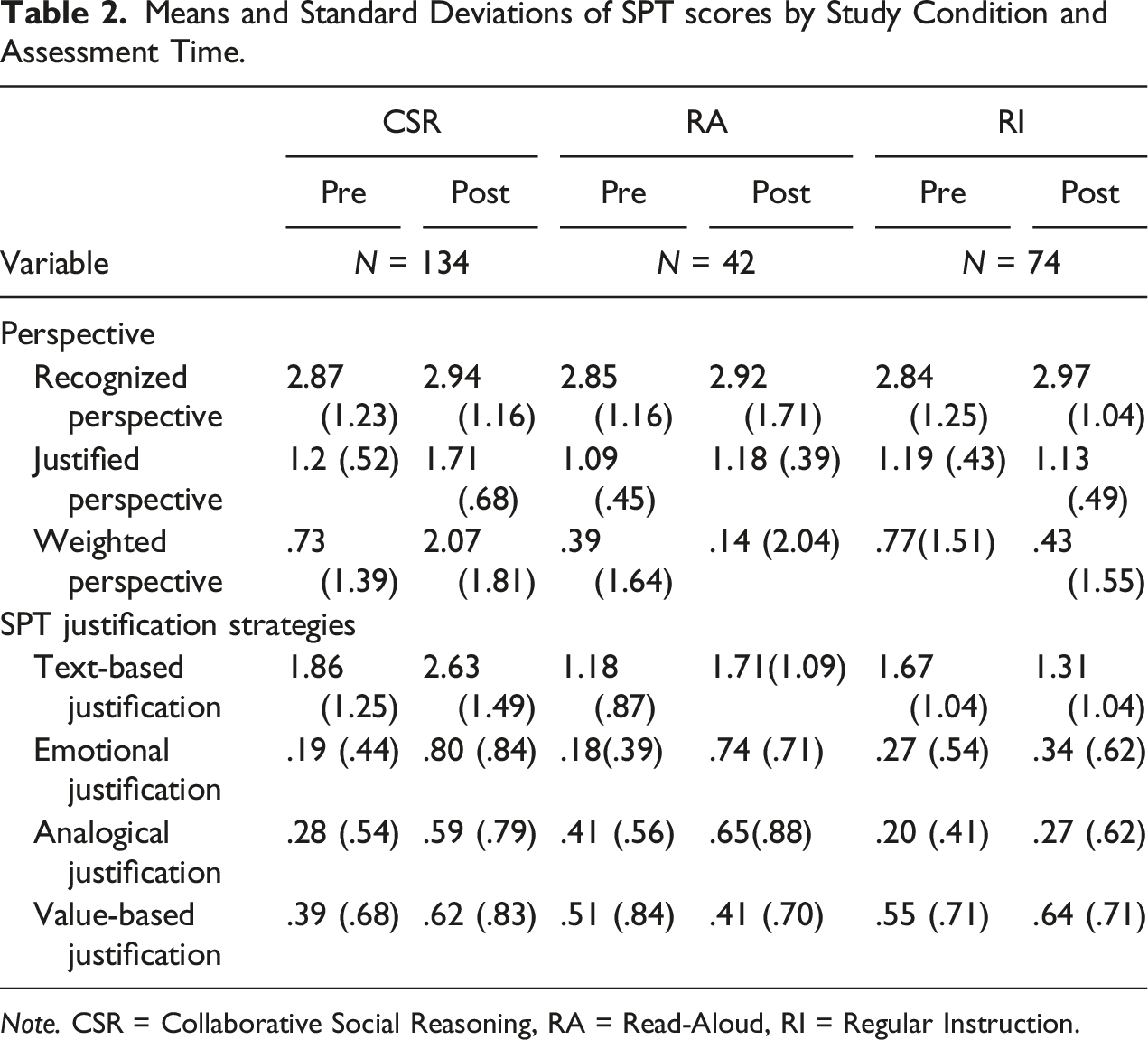
Note. CSR = Collaborative Social Reasoning, RA = Read-Aloud, RI = Regular Instruction.
Recognized, Justified, and Weighted Perspectives
Poisson Linear Models Predicting Number of Perspectives by Study Condition.
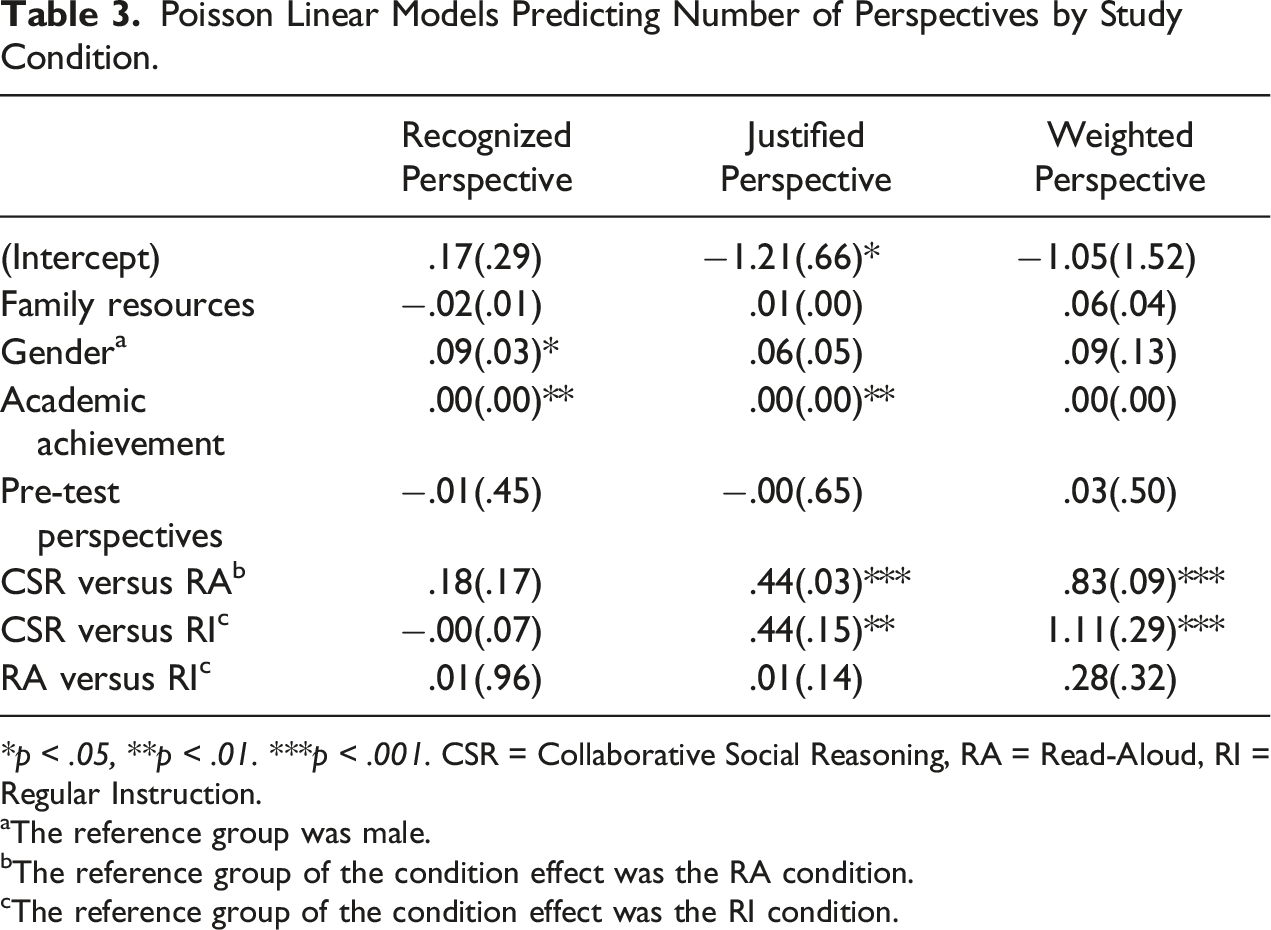
* p < .05, ** p < .01. *** p < .001. CSR = Collaborative Social Reasoning, RA = Read-Aloud, RI = Regular Instruction.
aThe reference group was male.
bThe reference group of the condition effect was the RA condition.
cThe reference group of the condition effect was the RI condition.
Use of Justification Strategies in SPT
Poisson Linear Models Predicting Justification Strategies by Study Condition.
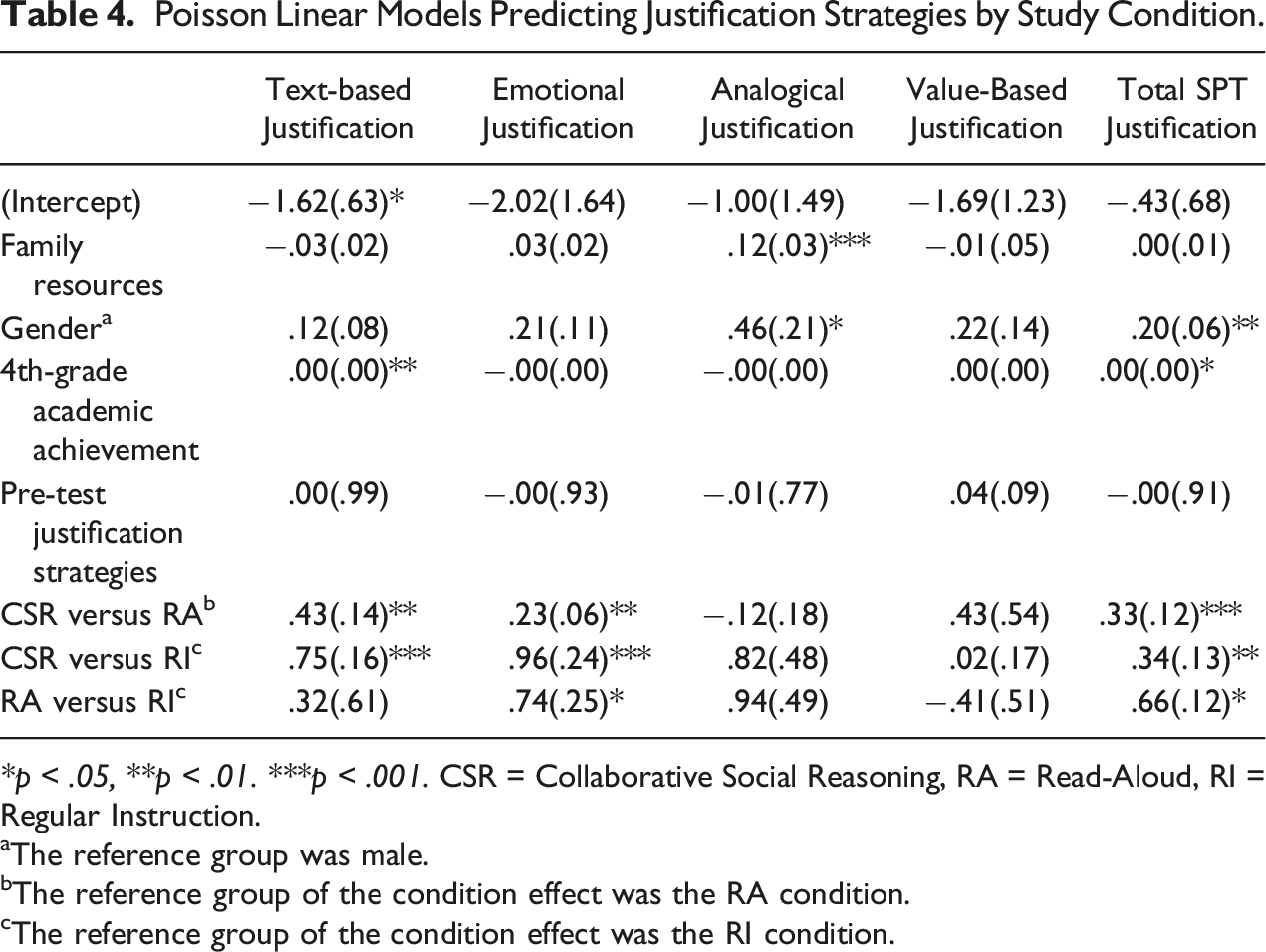
* p < .05, ** p < .01. *** p < .001. CSR = Collaborative Social Reasoning, RA = Read-Aloud, RI = Regular Instruction.
aThe reference group was male.
bThe reference group of the condition effect was the RA condition.
cThe reference group of the condition effect was the RI condition.
Qualitative Evidence from Essays
To supplement main quantitative findings, sample essays were presented to demonstrate how individuals justified multiple perspectives in their essays across the three study conditions. Based on the average post-test scores of SPT across three conditions, three representative essays were drawn from each condition for a qualitative comparison. Each essay received the mean SPT scores from its associated condition. Some misspellings were corrected in the examples below to enhance readability. The recognized perspectives were bolded in the essay, and if those recognized perspectives were justified, they were italicized as justified perspectives. Specific SPT justification strategies were underlined. The coding process is presented on the right column. Both recognized and justified perspectives were marked when they first appeared in the essay.
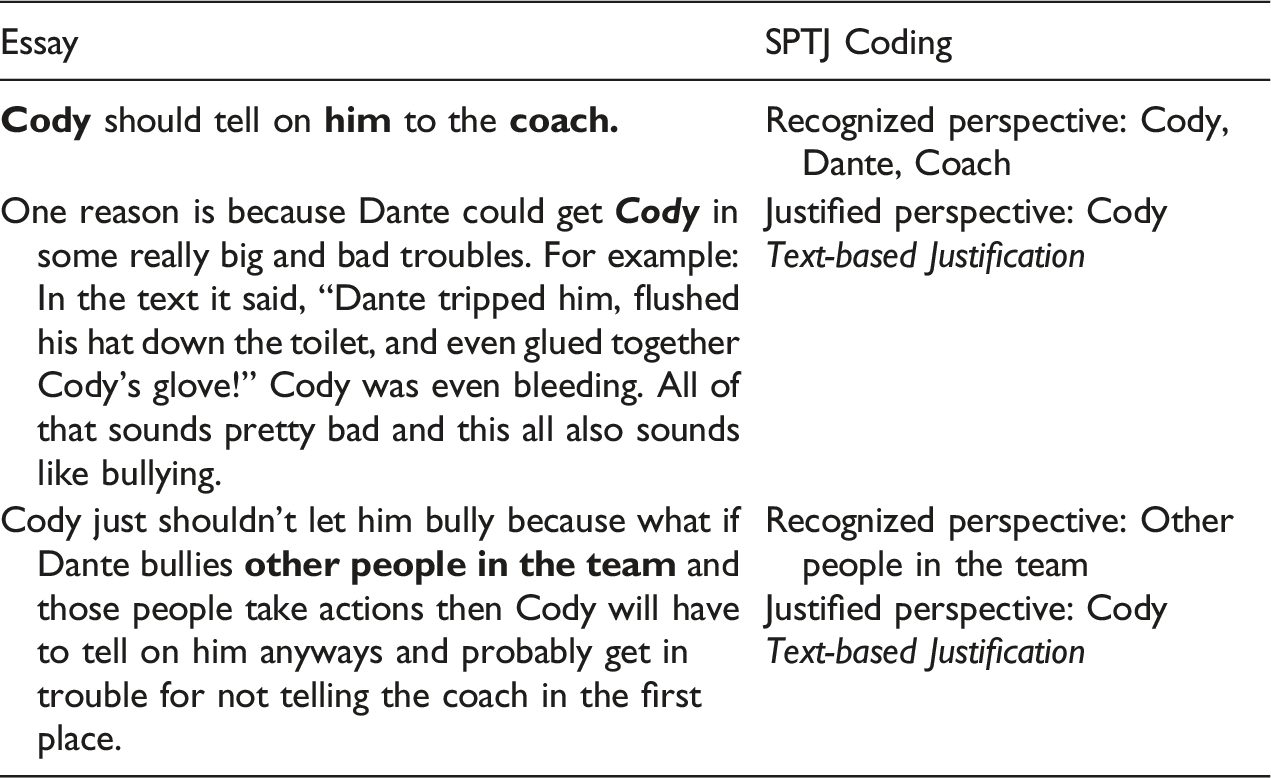
Essay 1 was written by a participant from the RI group. In this essay, the participant was asked to reason about whether and why the main story character (Cody) should or should not report the bully (Dante). Out of four perspectives that the individual recognized, only one perspective (see Cody) was justified. To support the perspective, the text-based justification strategy was mainly applied in the essay. The first text-based justification was based on the story text that supported Cody’s perspective that Dante could get him into big troubles. The second text-based justification referred to the story text and deduced that Cody should report Dante just in case others will be hurt as Cody.
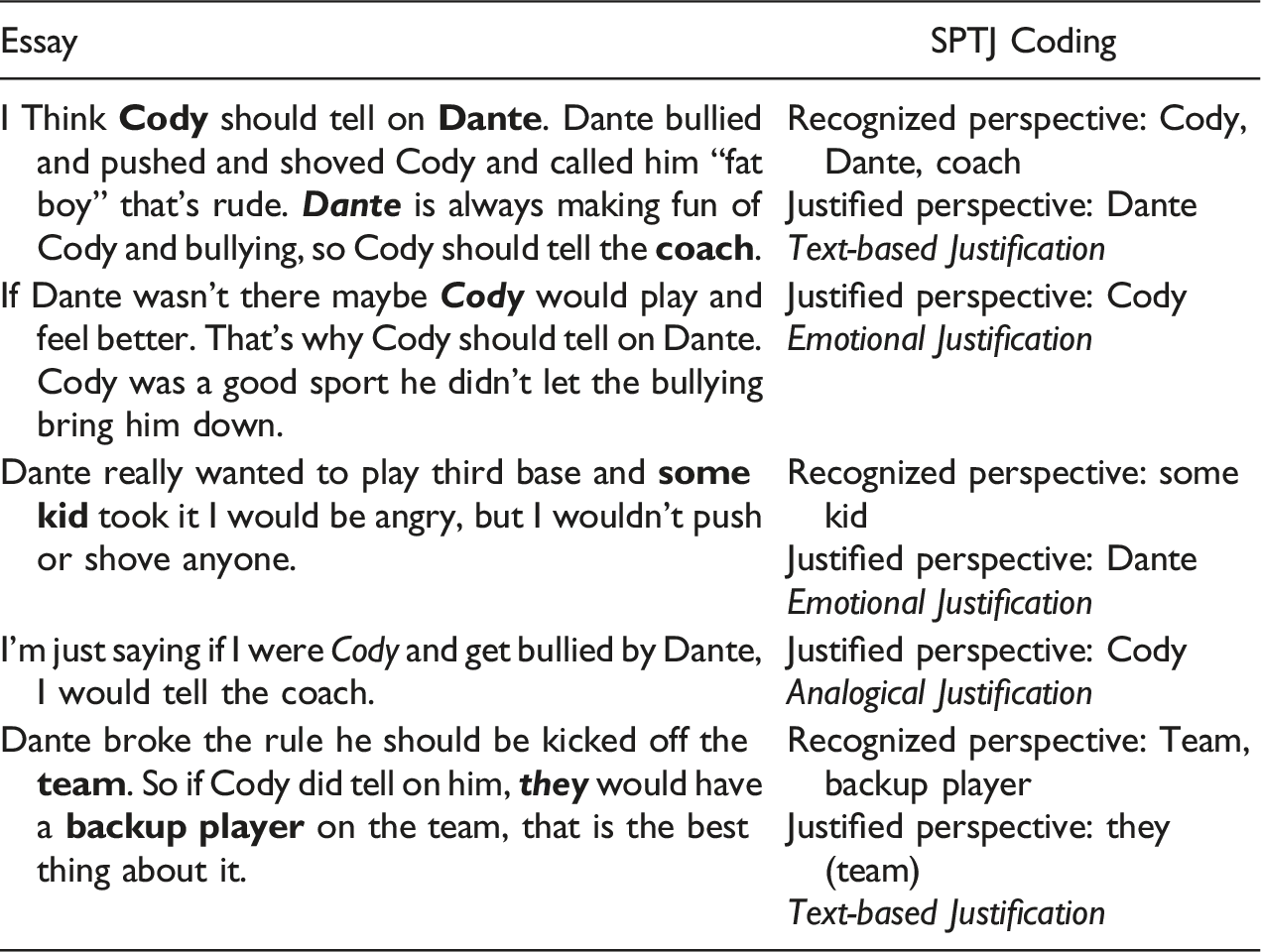
Essay 2 was selected from RA group, there are a total of six recognized perspectives and three of them are justified with reasons. Those reasons were then categorized into three SPT justification strategies, text-based justification, emotional justification, and analogical justification. The essay author first stated the event of Dante bullying Cody, and then supported the stated proposition with a reason. Later on, the author switched the perspective to the bully using an analogical justification strategy. In the end, the team’s perspective was taken and justified by text-based justification. Compared to Essay 1 from the RI group, Essay 2 contained more justified perspectives. Those reasons were then categorized into three SPT justification strategies, text-based justification, emotional justification, and analogical justification. The author who wrote this essay first stated the event of Dante bullying Cody, then supported the stated proposition with a reason. Later on, the author switched the perspective to the bully with an analogical justification strategy. In the end, the team’s perspective was considered and justified using the text-based justification strategy.
Overall, Essays 1 and 2 represent two major differences between the RA and RI groups in terms of SPT. First, compared to the RI group, the RA group were more likely to justify a perspective. This supports the quantitative finding that the Weighted perspective (2 × Justified perspectives – unjustified perspectives) in the RA group (3) was higher than that in the RI group (0). Second, the RA group generated more emotional justification strategies than the RI group, which again is consistent with the findings in statistical analysis.

The third essay was written by a participant from the CSR group. A total of four perspectives were recognized in the essay and all of them were justified with reasons (The number of weighted perspective = 8). Three types of SPT justification strategies were employed to justify recognized perspectives, including text-based justification, analogical justification, and emotional justification. The essay started with the description that Cody was bullied by Dante to justify why Cody was supposed to tell on Dante. Later on, the essay author reasoned about potential outcomes of Dante being told on: Cody might be bullied more, Dante got kicked off the team, Dante’s schooling might be negatively influenced, and the team would lose the game. After listing these possibly negative consequences, the author considered the perspective of the bully victim by describing their personal experiences similar to the story character. The final perspective was supported by emotional justification. Overall, responses in Essay 3 illustrated how the participant in CSR condition reasoned about the situation with multiple perspectives using various justification strategies. Compared to Essay 1 and Essay 2, Essay 3 presented a more integrated SPT justification process, demonstrating a deeper understanding of the scenario.
Qualitative Evidence from Post-Intervention Interviews
About 38 students (88%) who received the interview shared that CSR had changed the way they participated in small-group discussion, especially in terms of exploring multiple perspectives and sharing different feelings. For example, one student said, “Yes. Um, just because we got to see other people’s perspective and how they think. Like, ‘Classroom Wars’ you had different people thinking. And all the stories just made me think how other people feel.” Another student shared positive experience about argumentation during CSR discussions, “I felt confident about my answers, like in the class I felt comfortable about my answers and backing it up with information.” In addition, one student felt safe to share their personal experiences with peers during CSR discussions, “When I started telling about my life and most of the stories, um, most of them felt really bad for me because some of them were really sad, and most of them were really happy, and they were like ‘wow that’s cool’ and stuff.” Similarly, a student felt that sharing their own ideas had enhanced their connections with each other, “I like, um, sharing my thoughts and ideas because that makes others thinking more and makes them wanna know more and make more connections to their life too.”
Discussion
The development of SPT is a key factor in prosocial behavior, psychological wellbeing (Green et al., 2018), and long-term adjustment (Allemand et al., 2015) during the early adolescent period, which is characterized by dynamic changes in the complexity of relational interactions and social behavior. Early adolescence is also marked by heightened awareness of the opinion of others, increased attentiveness to one’s identity in relation to the social world, and development of the social self (Hall et al., 2021). As young adolescents navigate the social world, they might encounter complex situations, issues, or even conflicts that involve multiple social entities which require them to make sense of others’ thoughts and feelings and the reason why people react to things differently. In this sense, SPT serves as a critical psychological tool which enables early adolescents to respond to complicated scenarios, collaborate with others, consider and respect others’ feelings, and figure out the most reasonable solution by coordinating multiple aspects of the issue. Although there is extensive research on SPT, we know less about effective educational practices to support SPT development during early adolescence. The current study examined the micro-development of early adolescents’ SPT through CSR discussions. The application of an argumentation essay task and a unique coding scheme were designed to capture the appropriation of SPT as a tool for justification of perspectives.
After participating in the 6-week CSR intervention, participants in CSR group were observed to generate more justified perspectives using more justification strategies in their written essays in comparison with their pre-intervention performance, with higher level of growth among the CSR participants than the participants who received the RA instruction (RA) or regular language art instruction (RI). The devised SPTJ coding scheme was able to capture individuals’ reasoning and justification processes as independent agents responding to ambiguous social situations. The main finding that participants in CSR group outperformed two comparison groups in SPT development could be attributed to the collaborative dialogic process, in which individuals argue about complex social-moral issues that are introduced in a story from expanded perspectives, with the common goal of deriving the most reasonable and justified solutions to the issues, rather than competing for the ‘best’ stance (Chinn & Clark, 2013). As mentioned earlier, the stories were chosen because of the connections they have to the everyday lives of many early adolescents. Individuals at this age are often confronted with issues of social exclusion and bullying, which are taking on new (and sometimes) powerful meanings and greater resonance in their lives as they attempt to navigate increasingly complex local peer communities. They are beginning to recognize the decision they make may have long term repercussions both for themselves and others. In the context of today’s contentious and often-divided political ideology in a pluralistic, democratic society, introducing complex social-moral issues to appropriately structured small-group discussion shows great potential for spurring social interactions, guiding the group towards purposeful collaborative dialogue involving improved SPT, ethics of caring, empathy, and civic competencies for further societal engagement. CSR supported early adolescents to adopt more complex thinking about social problems, further equipping them with civic skills central to a well-functioning, productive participatory democracy.
Collaborative social reasoning discussions bring peers into a dialectical process encouraging them to take multiple perspectives in dynamic contexts, which involves both intrapersonal and interpersonal reasoning, leading to development of higher levels of SPT justification. The significant increase in the application of both text-based and emotional justification strategies in the CSR group revealed that SPT justification not only involves cold cognition (e.g., text-based evidence) but also hot cognition (e.g., compassion and emotions; Smagorinsky, 2018). Beyond answering the “big question” with a simple yes or no response, or simply quoting from the text in written essays, CSR group members might have generated meaningful interpretations of the story, and carefully considered and justified various text-based evidence and affective reasoning to justify their claims regarding others’ perspectives, such as discerning, embracing, and comprehending thoughts and feelings of others, to justify their proposed perspectives. The dialogic process during CSR discussions enriches each participant’s own SPT. Engaging in argumentation with other group members might have allowed early adolescent participants in CSR group to take more perspectives into consideration and evaluate the validity, credibility, accessibility or reliability of those perspectives. Findings from the current study also support the hypothesis that SPT can be internalized from oral discussion, appropriated as a valuable tool for future social problems/issues. Verbal dialogue, such as interview and peer discussion, can be more dynamic and spontaneous, while the essay task is less susceptible to any type of manipulation, offering a more comprehensive and reliable portrait of individuals’ alternative reasoning strategies.
The current study explored a new action-based coding scheme to evaluate SPT as a psychological tool. Unlike other approaches used for evaluating individuals’ SPT, such as Rel-Q test (Schultz et al., 2003) which captures individuals’ SPT comprehension by assessing individuals’ answers to multiple-choice questions about specific scenarios, and SPTAM (Diazgranados et al., 2016) which focuses on the functions and the levels of integration of individuals’ SPT acts in response to specific social situations, the current measure uniquely contributes to our knowledge of SPT by focusing on the quality of SPT justification. One of the strengths of the current SPT essay coding measures is that it underscores two main constructs of the SPT process. First, it highlights individuals’ competence within a voluntary, organic process of taking and justifying multiple perspectives in responding to ambiguous social scenarios. Second, apart from merely identifying existing social perspectives, our measure tapped into the cognitive and affective effort required to provide justifications of perspective evaluating organic responses. Furthermore, the coding scheme highlights individuals’ use of various strategies for justification.
In the current study, emotional concerns such as sadness, worry, and anger, could be raised when peer group members discussed complex issues during CSR discussions, encouraging them to take the perspectives of story characters by projecting or anchoring themselves as the story character(s) who experienced similar situations. The finding that peer group members from both CSR and RA conditions showed significant increase in the use of emotional justification compared to those in RI condition was notable. In both the CSR and RA conditions, the peer group members were exposed to the same story materials once a week for six consecutive weeks. It is likely that their development in SPT between the pre-to the post-test could be attributed to young adolescents’ reading experiences. Since the six stories chosen for the current study shared the common themes relevant to lived experience of early adolescents such as social exclusion and injustice, consistent exposure to stories involving such provocative social-moral issues may have triggered emotional reactions to the situations of the story characters and increased the likelihood of awareness of affective concerns and empathetic feelings.
Despite the story or topic effects, it is important to note that early adolescent participants in CSR group showed a greater increase in the use of emotional justification than the RA group. This is different from a language focused study (Hsieh et al., 2021) based on the same set of essays that individuals from CSR and RA conditions did not differ in the use of emotional vocabulary such as mad or embarrassed. The contrasting findings from the two groups indicate that despite the comparable levels of emotional justifications, individuals in CSR group might be more apt at applying emotional justification to the deep process of SPT, while individuals in RA group might appeal to emotions at a more surface level.
Limitations and Future Directions
Several issues should be noted when interpreting findings from the current study. The first concerns the impact of stories selected for small-group discussion on SPT measurement. The six stories used for the intervention and the two stories used for the argumentation essay tasks all center on the issues of social exclusion, a prevalent social issue among early adolescents that can potentially be prevented through effective educational practices. However, findings of this study may not be generalized to broader issues, such as social inequality and responsibility. We also cannot completely exclude the possibility that the improvement of SPT was contributed by the recurrent practice of SPT about similar issues over time. However, topic familiarity effects can at least be partially discounted based on the difference in SPT performance (e.g., increase in SPT justification) between the CSR and RA groups who were exposed to the same stories throughout the intervention. That is, the effect of CSR on early adolescents’ improved SPT can still be valid given that individuals in the RA group have learning experiences with the same topics. Additionally, future research can be done to assess individuals’ pre- and post-SPT performance using various topics not limited to what was discussed during the intervention to further test the generalizability of the findings.
Despite the theoretical assumptions, it remains unclear what caused the change of SPT occurred throughout the dialogic process. Another research direction thus is to examine the underlying mechanisms of collaborative small-group discussion on the development of SPT. For example, in an experimental investigation study conducted by Hayashi (2018), it was found that more diverse perspectives will be taken into final decision making process in collaborative problem-solving settings when group members established positive feelings and constructive communication techniques with each other. Additionally, a recent study conducted by Kim et al (2023) found that early adolescents’ use of knowledge justification from societal and personal-relational perspectives during collaborative argumentation in a group served as a learning mechanism that leads to improvement in SPT.
Third, replicating the current high-intensity study in real-world practices would be of higher demand regarding school buy-in, quality of teacher training, and high involvement of researcher support. For example, researchers attended nearly every classroom session and offered ongoing support to teachers. Future research is needed to examine the influence of teacher training and the timing of fade-out for researcher’s support. Additionally, classroom configurations may vary by classrooms and by schools, which made it almost impossible to implement exactly the same study design in each class, increasing the difficulty in generalizing findings. Therefore, this study employed a complicated design to account for practical constraints and situational factors. A preliminary analysis conducted by authors et al. (2022) showed that including the school effect did not change the main findings, which suggested that nested structure had been accounted for final analysis.
Conclusion
The current study provides empirical evidence showing how early adolescents’ SPT can be improved in the context of CSR, using a newly developed essay coding scheme with a particular emphasis on individuals’ ability to justify their reasoning on multiple perspectives. The findings lend support to the sociocultural standpoint that individuals’ capacity to understand others’ views and feelings can be developed through peer interactions through the process of experiencing and exchanging distinct types of justification strategies. Overall, our findings reveal an effective educational approach to promote the development of early adolescents’ SPT, treating them as agentic thinkers who have great potentials to engage in multiple perspectives using cognitive (e.g., text-based reasoning) and affective (e.g., emotional justification) justification strategies.
Footnotes
Acknowledgments
We would like to thank the research team and the many administrators, teachers, and children without whom this study would not have been possible. We especially thank Elizabeth Kraatz, Rebecca Sallade, Narmada Paul, Ming-Yi Hsieh, Alyssa Tonissen, Sangin Shin, and Anna Hippler for assisting in data collection and management.
Declaration of Conflicting Interests
The author(s) declared no potential conflicts of interest with respect to the research, authorship, and/or publication of this article.
Funding
The author(s) disclosed receipt of the following financial support for the research, authorship, and/or publication of this article: This research was supported by the National Academy of Education and Spencer Foundation. The opinions expressed are those of the authors and do not necessarily represent views of the foundation.
