




Abstract
Although women’s representation in STEM fields and occupations has increased, science and math continue to be stereotyped as male domains. This paper links psychological and sociological explanations for gendered disparities in STEM by examining the relationship between the local “micro-situational” female learning environment and the gender gap in academic self-concept in math and science. We applied hybrid models to TIMSS 2015 data comprised of a pseudo-panel of repeated measures for individual student and peer achievement, academic self-concept, utility value, and interest-enjoyment value in math/science (at age 14). We analyzed data from three countries, including a subsample of students who were taught by the same teacher in both math and science, thus eliminating unobserved teacher heterogeneity. Results indicate that female peer climate in the classroom is important for understanding how girls’ self-concept in math/science is formed, even though it was unrelated to the gender gap.
Keywords
Science and math have traditionally been stereotyped as male domains (Correll, 2001; Cvencek et al., 2011; Nowicki & Lopata, 2017; Riegle-Crumb & Humphries, 2012) and continue to be so despite a decline in the gender gap in math and science achievement (Else-Quest et al., 2010; Hyde et al., 2008) as well as increased female representation in math and science fields (Miller et al., 2015). Accordingly, previous studies have shown that girls are less interested in science and math (Skaalvik & Skaalvik, 2004; Wang et al., 2015), less likely to see themselves as future scientists (Archer & DeWitt, 2016; Stake & Nickens, 2005), and display lower levels of confidence in their abilities in these subjects compared to boys of equal ability (Correll, 2001; Parker et al., 2018). Psychological research has suggested that motivational factors, such as students’ perception of their academic abilities, play an especially important role for academic achievement and attainment in general, and for women’s pursuit of and persistence in STEM in particular (Eccles, 1994; Ellis et al., 2016; Trautwein & Möller, 2016). The fact that women have been shown to generally perceive their ability in math and science lower than men is problematic because girls with higher mathematical self-concepts are more likely to enroll in quantitative coursework (Correll, 2004; Nagy et al., 2006), persist in STEM majors (Ellis et al., 2016), and have higher STEM career aspirations (Sikora & Pokropek, 2012). Consequently, self-concept in math and science affects women’s later educational and occupational choices.
Despite the link between self-concept in math and science and female representation in STEM, as documented in many studies, there are still holes in our knowledge regarding the causes of gender gaps in STEM orientations in general and in the self-concept of boys and girls in particular. Sociological research has shown that the school context plays an important role for gender differences in educational performance in general (Legewie & DiPrete, 2012) and STEM outcomes in particular (Legewie & DiPrete, 2014). Moreover, the seminal expectancy-value theory posits that, in addition to being shaped by prior achievement, self-concept is influenced by students’ social and cultural environment (Eccles, 2009; Retelsdorf et al., 2015). In particular, school environments contain norms for what constitutes gender-congruent academic behavior and attitudes—or what Eccles (2009) has termed gender “collective identities” —and thus represent an important aspect of the socialization process. Consequently, gender norms enacted by significant others like peers or teachers (Muntoni et al., 2021; Retelsdorf et al., 2015) play a crucial role in shaping students’ self-concept.
Against this background, the aim of this paper was to investigate how local learning environments in schools shape girls’ perceptions of their ability in math and science. Previous studies have considered how gender differences in course-taking were shaped by peers’ academic achievement (Riegle-Crumb et al., 2006) and course-taking (Frank et al., 2008), as well as by female STEM representation in the local community (Riegle-Crumb & Moore, 2014). These findings support the theoretical notion put forth by Ridgeway and Correll (2004) and Risman (2004) that cultural beliefs and social constructions of gender in local social contexts, such as classrooms, shape differences in outcomes for males and females. Therefore, studying gender disparities in education requires studying variations in the social contexts in which students are embedded, like schools and classrooms. Although being surrounded by academically capable peers is likely to improve educational outcomes for both genders and across a wide range of subject domains, research has shown that high-achieving friends and peers are particularly important for girls’ outcomes in math and science (Frank et al., 2008; Raabe et al., 2019; Riegle-Crumb et al., 2006). These traditionally male-stereotyped subjects are more likely to include an academic climate in which girls “face obstacles to the pursuit of advanced work, including lower academic self-confidence, lower interest, and lower perception of the relevance of the subjects to future career opportunities” (Riegle-Crumb et al., 2006, p. 206). Accordingly, studies have indicated that female peers are particularly important for girls’ attitudes and orientations toward STEM, representing a lens through which girls evaluate themselves in a STEM perspective. Specifically, previous research has shown that the orientation toward STEM domains of female peers and friends affects girls’ interest in these subjects (Raabe et al., 2019) and course selection (Riegle-Crumb et al., 2006). Furthermore, research has argued that female relationships function as counterpoints to common stereotypes about male-dominated subjects (Riegle-Crumb et al., 2006; Schøne et al., 2017) and that peer support in general may be important to counteract negative effects of gender bias on STEM self-concept (Robnett, 2016).
Building on psychological and sociological theories, we extend previous research on the relationship between the school context and gender differences in STEM outcomes by examining whether the local female learning environment is associated with adolescent girls’ academic self-concept in math and science. Accordingly, we argue that girls can be in a more or less “STEM-friendly” learning environment with regard to their female peers, which is likely to impact their orientations towards STEM. The female STEM climate in the classroom expresses the perceived gendered structure of opportunity and plays an important role for educational outcomes because students’ decision to invest in education (to study hard in math/science, which courses/majors to choose) depends on their expectations of whether people like them (girls) can and should pursue STEM fields. Specifically, we expect that being surrounded by female peers who are confident in their math and science ability, who enjoy doing math and science, and who perceive these subjects as important and useful sends girls an important message regarding their suitability for and potential success in STEM subjects and fields.
We analyzed data from 8973 eighth-grade students (M = 14.01 years old, SD = .58) in three countries (Norway, Italy, and Canada) in the Trends in Mathematics and Science Study (TIMSS) 2015, which offered a unique opportunity to measure students’ local schooling environments due to the inclusion of data on all students within a classroom, allowing us to construct a detailed picture of classroom learning environments based on information on (female) peers. By considering the entire classroom (as opposed to close friends), we were able to capture relevant social and educational mechanisms as they occurred in the immediate learning environment that the students were exposed to. Drawing on expectancy-value theory, we defined female peer climate in terms of expectancies for future success and task value in math and science in the local female learning environment. We examined the data on peer climate in two academic subject areas (math and science) and the data on students’ academic self-concept in the same subjects to estimate hybrid models across subjects. Using hybrid models allowed us to estimate the correlations with subject-invariant factors, such as gender, while taking advantage of the panel structure of the data with two observations for each student in different subjects. Furthermore, we used a balanced subsample of the TIMSS 2015 data in which the same teacher taught both math and science classrooms, allowing us to account for unobserved teacher characteristics.
The paper’s main contribution is to expand upon previous research on the relationship between school contexts and the gender gap in STEM orientation by examining how the local “micro-situational” female learning environment is associated with students’ self-concept in general and differences in self-concept between boys and girls in particular. In contrast to previous research, which has typically relied on observational data concerning a handful of students at the school or classroom level, we analyzed entire classrooms and were able to control for unobserved characteristics at the student, classroom, and teacher levels.
The Expectancy-Value Model and Gender Disparities in STEM Self-Concept
Within psychology, gender differences in education and occupation have often been interpreted through an expectancy-value model (Eccles, 1994; Wigfield & Eccles, 2000) in which expectancy of success (ES) (i.e., individuals’ beliefs about their ability to perform current and future tasks) and subjective task value (STV) (e.g., individuals’ interest in or enjoyment of a given subject domain and the value that they assign to this domain) are key predictors of future behavior and educational choices. Eccles and Wigfield (2020) differentiated between ES and individuals’ more stable beliefs about their academic self-concepts (ASC), arguing that there is a theoretical and empirical distinction between the two concepts. Nevertheless, empirical research has found that there is considerable overlap between ES, ASC, and related concepts, such as self-efficacy (e.g., Bong & Skaalvik, 2003; Eccles & Wigfield, 1995). Accordingly, in the context of this study, we do not differentiate and use the term “academic self-concept” to capture students’ beliefs about how well they will perform on a future task. We consider the relationship between utility value and interest-enjoyment value and students’ self-concept at the individual and peer level, as beliefs of socializers, including peers, predict self-concept according to the expectancy-value model (Eccles & Wigfield, 2020). Utility value for a certain task can be defined as how it is perceived to contribute to completing a desired goal, for the subjects of math and science this could be the perceived usefulness for future educational choices. Interest-enjoyment value can be defined as the enjoyment expected in relation to a task, in this case, enjoyment related to math or science (Eccles & Wigfield, 2020). Empirical research building on the expectancy-value model has shown that boys often hold higher math-related self-concepts while girls tend to hold higher language-related self-concepts across both primary an d secondary education (Parker et al., 2018; Retelsdorf et al., 2015). Furthermore, numerous empirical studies have supported the idea that girls generally hold lower self-concepts than their male peers at the same level of ability in math (Goldman & Penner, 2016; Parker et al., 2018; Skaalvik & Skaalvik, 2004) and science (Kurtz-Costes et al., 2008; Rüschenpöhler & Markic, 2019), and that these gender differences hold true across a wide range of STEM subfields (Sax et al., 2015). Furthermore, in studies of upper secondary students, boys tended to overestimate and girls underestimate their future math grades, net of actual ability (Dahlbom et al., 2011; Jakobsson et al., 2013).
Cultural Gender Beliefs and Gender Essentialism
As the present study considers gender differences in academic outcomes across several national contexts it is important to recognize the impact of gender beliefs that vary between cultures. Gender differences in students’ academic self-concept in math and science may be due to a number of factors, such as gender-specific experiences with particular subject domains (Correll, 2001; Robinson & Lubienski, 2011) that may accumulate over time (Hyde et al., 1990; Jacobs et al., 2002). Sociological scholarship has continuously highlighted the role of culturally embedded perceptions of gender or gender essentialism regarding the appropriateness of particular educational and occupational choices for men and women. Math and science are typically considered “male” fields (while reading and language are seen as feminine domains) (e.g., Muntoni et al., 2021; Salikutluk & Heyne, 2017) and, as they grow older, females are more likely than males to endorse normative beliefs about gender (Kurtz-Costes et al., 2014) and internalize notions that math and science are not fields in which they are likely to be successful as a result of their experiences within various institutional contexts (Sax et al., 2015).
Empirical research has provided evidence of cross-national variation in gender differences in STEM-related motivation and behavior (Else-Quest et al., 2013; Hägglund & Leuze, 2021; Penner, 2008). Particularly in highly egalitarian countries, studies have shown that boys and girls express themselves through such cultural gender beliefs (Breda et al., 2020; Charles & Bradley, 2009), potentially reinforcing patterns of gender inequality by shaping gender differences in STEM-related attitudes and motivation. Comparative research on gender disparities in education has proposed two opposing hypotheses regarding the correlation between national contexts and gender differences. The educational stratification hypothesis posits that more gender-equal cultures are associated with smaller gender differences in STEM performance and with higher levels of female representation in STEM choices (Baker & Jones, 1993; Else-Quest et al., 2010). This hypothesis has received mixed support in empirical studies, which is likely due in part to measurement issues associated with different types of indicators of gender culture and stratification (Anghel et al., 2020; Fryer & Levitt, 2010; Guiso et al., 2008; Penner, 2008). While some scholars have argued that paradoxical findings stem from differences in national performance environments that prior research did not account for (Mann & DiPrete, 2016), others developed an alternative hypothesis positing the existence of a gender equality paradox whereby greater social and economic gender equality leads to increased gender differentiation (Bradley, 2000; Stoet & Geary, 2018). Breda et al. (2020) explained this paradox through cross-country differences in gender stereotypes regarding math aptitudes and appropriate occupational choices. Consequently, although prior research has provided evidence of cross-cultural variation in gender stratification in STEM, empirical studies have produced mixed results regarding the role of structural and cultural national characteristics.
Gender and School Contexts
Sociologists have increasingly focused on gender as a multilevel system, not only comprised of cultural beliefs about gender at the macro level and roles and identities at the micro level but also of behavior and interactions among agents at the interactional level (Correll, 2001). While much research has focused on the importance of factors at the micro or macro levels in perpetuating gender differences in orientations towards math and science, this study focused on processes at the interactional classroom level. This focus was motivated by research suggesting that local environments, such as classrooms, might be one of the most important locations for the construction of gender as the everyday interpersonal interactions that occur in these environments are where individuals first encounter other people’s normative expectations (Patall et al., 2018; Riegle-Crumb & Morton, 2017; Risman, 2004). The classroom is an especially apt setting for understanding the development of gender differences in orientations towards STEM since it represents the immediate learning environment in which (female) students form their academic perceptions, attitudes, and experiences. Although the local classroom level is by no means isolated from cultural beliefs at the macro level, gender is not a fixed category. Gender scholars have argued that gender is a social construction and, as such, gender beliefs can change over the life course and across institutional settings (Correll & Ridgeway, 2004; Risman, 2004). Girls’ beliefs about their suitability for math and science, as well as the possibility of success in these fields, arise through a combination of prior gender beliefs and experiences at school. These school experiences differ according to the salience of widely shared gender beliefs in the particular context (Legewie & DiPrete, 2014). Consequently, the ways in social contexts in school activate macro-level cultural beliefs about gender vary, and, accordingly, girls can be in a more or less “science-friendly” local female learning environment, depending on their specific female peers. In their recent update of the expectancy value model, Eccles and Wigfield (2020) described what they termed “situated expectancy-value theory” (SEVT), highlighting the role of contexts such as school environments. This includes, for instance, perceptions of socializers’ beliefs and behaviors, gender perceptions, activities, and activity demands, which, in addition to a wide array of individual characteristics and experiences, can influence individual social gender roles and ES, e.g., academic self-concept (Eccles & Wigfield, 2020). Despite this renewed recognition of the importance of social context, no study to date has investigated the core elements of the expectancy-value model at the peer level. Consequently, we know little about how the ES and STV of socializers, such as parents, teachers, or peers, impact individual students’ outcomes.
Heterogeneous Gender Effects of School Contexts
Empirical research has shown that the school context can have heterogeneous impacts on boys and girls. Girls have been shown to be more responsive to social contexts than boys (van der Vleuten et al., 2019), and particularly to contexts where gender beliefs are salient (Frank et al., 2008) and in STEM fields, where peer support is important for the retention of women (Hilts et al., 2018). Accordingly, gender-normative environments can potentially push girls out of the STEM pipeline (van der Vleuten et al., 2019). In addition, research has shown that certain characteristics of female peers in the school environment can affect girls’ STEM outcomes. For instance, Raabe et al. (2019) found that having other girls in the class who prefer STEM subjects can prevent girls from being discouraged from pursuing these subjects. Similarly, Mann et al. (2015) showed that high-performing girls’ STEM aspirations were positively affected by being in a strong-performing learning environment. Female peers might act as positive role models and provide encouragement within STEM—which is supported by Mouganie and Wang (2020), who showed that exposure to high-performing female peers in mathematics increased the likelihood of women choosing a science track during high school. Similarly, Riegle-Crumb & Morton (2017) found that exposure to a higher percentage of confident female peers in science classrooms positively predicted intentions to pursue a computer science/engineering major. However, peer influence is complex—Archer et al. (2017) found that, as a girl, interest in and engagement with science was sometimes met with peer disapproval if considered gender incongruent, while girls engaged with science needed support from like-minded peers to persist. Consequently, female peers might be expected to influence girls’ STEM outcomes in diverse ways and the impact of peer characteristics on academic self-concept may differ from for the impact on behavior.
The Present Study
The aim of this study was to investigate how female peer climate in the classroom was associated with girls’ academic self-concept across three different country contexts. Drawing on expectancy-value theory, we operationalized the female peer climate in terms of collective expectancies for future success (i.e., peer self-concept) and task value (i.e., peer interest-enjoyment and utility value) in math and science in the local female learning environment. Our study addressed the following research questions: 1) Are there gender differences in students’ academic self-concept in mathematics and science? a. Do boys have a more positive academic self-concept compared to girls’ controlling for academic achievement? b. Do gender differences in students’ subject interest account for gender differences in academic self-concept? c. Do gender differences vary across national contexts? 2) Does the local learning environment moderate the gender gap in students’ academic self-concept in mathematics and science? a. Is the female peer climate in mathematics and science correlated with girls’ academic self-concept in these subjects? b. Are patterns of associations similar or different for boys?
Methods
Data and Participants
We used data from the Trends in Mathematical and Science Study (TIMSS) 2015, which is a large international survey of achievement in mathematics and science conducted by the International Association for the Evaluation of Educational Achievement. TIMSS includes information on fourth and eighth-grade students’ achievement in math and science, student background characteristics, attitudes toward the subjects, as well as teacher characteristics (Martin, Mullis, & Hooper, 2016). We used data from eighth-grade classrooms because previous research has indicated that peer influence increases as students grow older (Crosnoe, 2000). Furthermore, previous research using this dataset found that gender norms were more pronounced in eighth grade than in fourth grade (authors, unpublished manuscript).
Sampling Procedures
In TIMSS 2015, students were sampled through a two-stage stratified cluster design. Within schools, classrooms were randomly selected, and the entire group of students in a classroom and their math and science teachers were surveyed, thus generating a hierarchical dataset of students nested in classrooms (and teachers), schools, and countries (Joncas & Foy, 2012). Data collection was comprised of several elements. First, two tests measured academic achievement, one in math and one in science. Second, a set of questionnaires were conducted among the students: one collecting background information, and two corresponding subject-specific questionnaires for science and math with items measuring student attitudes and experiences in the respective subjects. Finally, a set of questionnaires were administered to the teachers in the two subjects and to school principals. In other words, TIMSS provided separate measures of academic achievement, academic self-concept, interest-enjoyment value, and utility value in science and math for all students in a class. Accordingly, all students appeared in the data twice on the key measures of this study, having completed the survey for both math and science. In addition, each student could also be linked to teacher responses in each subject. Consequently, the data from TIMSS could be approached as a panel of students with repeated measures in the two subjects (instead of across time as in a traditional panel data model). These two features—the sampling of entire classrooms of students and the pseudo-panel structure—were central in our decision to use the TIMSS data. First, contrary to many other surveys of students in schools and classrooms, TIMSS samples complete classrooms, which enabled us to analyze highly detailed learning environments by studying the attributes of the entire peer group in different subjects. Second, the panel structure allowed us to employ a fixed effects approach in which we studied the variations in student attitudes and achievement between the two subjects while keeping constant any factors that did not vary across subjects, such as social background. We elaborate on this data in the section on analytical strategy.
Analytical Sample
Descriptive Statistics by Country and Subject.
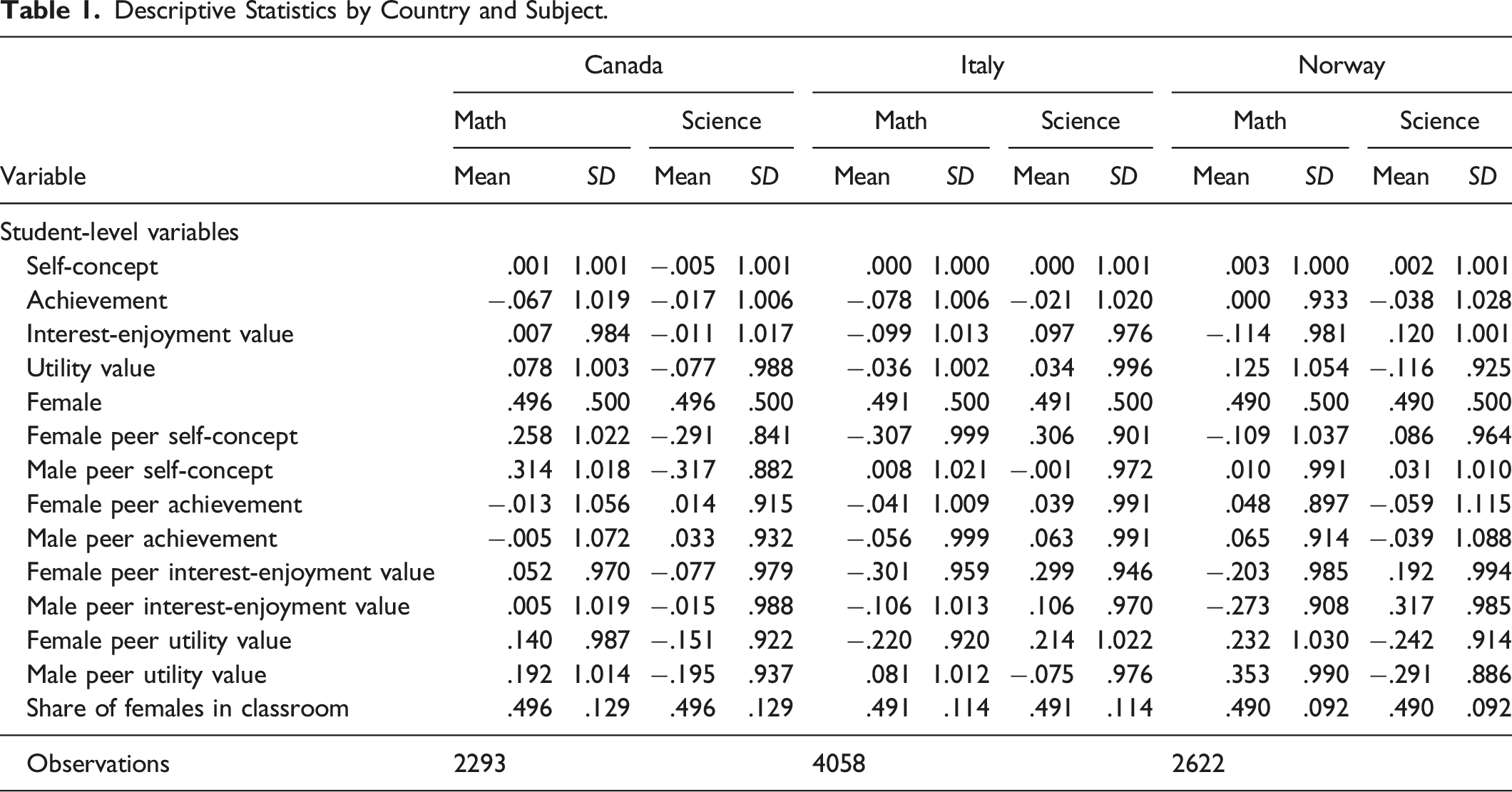
Measures and Covariates
Student-Level Variables
The dependent variable was a scale constructed by TIMSS measuring academic self-concept, based on eight items (e.g., “I usually do well in mathematics/science” and “I learn things quickly in mathematics/science”). The main independent variables included scales measuring (1) students’ interest-enjoyment value in math/science (i.e., students’ perceived interest in or liking of math/science), (2) students’ utility value in math/science (i.e., students’ perceptions regarding the usefulness of math/science), (3) academic achievement in math/science, and (4) student gender. All scales were constructed by TIMSS using the Rasch partial credit model (Martin, Mullis, & Hooper, 2016). The scales were based on similarly worded items across subjects, which were answered on a four-point Likert scale (see Appendix Table A1 for variables included in each scale). Fit indices from the Rasch model, internal reliability indices from principal component analyses, and Cronbach’s alpha all indicated that the scales were at an acceptable level (see Martin, Mullis, & Hooper, 2016).
We measured self-concept net of actual student achievement by controlling for the test scores for math and science as measures of academic achievement. The two test scores in TIMSS each consisted of five so-called plausible values (Foy & Yin, 2016; International Association for the Evaluation of Educational Achievement (IEA), 2013), which is a technique used to reflect measurement uncertainty (Laukaityte & Wiberg, 2017). In the analyses, plausible values were effectively treated as multiply imputed values (Rubin, 1987). We treated missing values on the scales through multiple imputation, thus generating five multiply imputed datasets, matching the number of plausible values.
Female Peer Climate
We used four indicators of female peer climate, which were based on aggregated student-level measures at the classroom level. We included female peer self-concept, interest-enjoyment value, and utility value in math/science, which we measured as the gender-specific means of the three scales within the classroom and subject—excluding student i so as not to include a student in their own peer group. Additionally, we used female peer academic achievement in the subject, measured as mean achievement among female peers at the classroom level. In order to avoid overestimating the size of the female peer coefficients, we controlled for each of the four corresponding male peer variables.
Analytical Strategy
The empirical analysis had three aims. First, it examined if there was a gender gap in students’ academic self-concept. Second, it examined if a positive female peer climate at the classroom level was related to a reduction in the gender gap in self-concept in math and science. Third, it investigated how the female peer climate in the classroom was associated with the self-concept of boys and girls. The panel structure of the data, with repeat measures for each student in both math and science, meant that we could estimate fixed effects using within-student differences across math and science. The fixed effects approach had the advantage that we could reduce bias from omitted variables—under the assumption that any omitted variables did not vary across the two subjects (Andersen & Reimer, 2019; Dee, 2007; Lavy, 2012; Schwerdt & Wuppermann, 2011; Van Klaveren, 2011). However, one major disadvantage was the inability of the fixed effects model to estimate the coefficient of any variable that did not vary within students. With our first aim of examining the gender gap in self-concept, using the fixed effects approach would have prevented us from estimating the coefficient of student gender since this factor does not vary within students. We addressed this by using hybrid models (Allison, 2009; Schunck & Perales, 2017; Schunk, 2013), which were a useful extension of standard fixed effects approaches because they allowed us to estimate the coefficients of subject-invariant factors while taking advantage of the panel structure of the data with two observations for each student in different subjects. Specifically, the hybrid model enabled us to separate within-and between-cluster associations by splitting the within-and between-cluster associations for the level-one covariates:
As shown above (1), the model included both the deviation from the cluster-specific mean
While the advantage of the within part of the hybrid model was that, under certain assumptions, we could account for unobserved heterogeneity at the student level, differences between teachers remained a potential source of endogeneity. Students are typically taught by different teachers in math and science, which meant that we could not rule out that differences in student outcomes between math and science were driven by differences between math and science teachers. We sought to solve this issue by analyzing a subsample of students who were taught by the same teacher in math and science. Under the assumption that the effect of the teachers is invariant across the two subjects, this strategy eliminated bias stemming from teacher influence. Consequently, our empirical strategy allowed us to eliminate unobserved heterogeneity at the teacher level, as well as at the student and classroom levels, under the assumption that all unobserved factors were subject-invariant. Since our primary motivation for analyzing data using a hybrid model was to be able to evaluate the associations with a subject-invariant covariate, student gender, we interpreted results from the hybrid models by assessing the within-student estimates, which were more robust to unobserved heterogeneity than between-student estimates.
In addition to estimating hybrid models to assess the gender gap in students’ self-concept, the second aim of the analysis was to examine heterogeneous associations between the female peer climate in the classroom and the self-concept of boys and girls. Since including interaction terms in hybrid models is not straightforward (Schunk, 2013), we investigated gender heterogeneity by estimating the within part of the model 
In sum, the advantage of our empirical strategy was that it built on a panel of students nested in subjects. This had the benefit that we were able to analyze variation in the micro-situational peer climate between the two subjects while holding all other factors constant. We utilized the fact that each student is taught several different subjects, in this case, math and science, with the same classmates. Even if these classmates are the same across the different subjects, their cognitive and non-cognitive traits may vary. Students have more interest-enjoyment value in some subjects than in others, just as they perceive their academic abilities differently across subjects. In the empirical analysis, we used this variation in female (male) peer traits to examine the association with girls’ academic self-concept in math/science and with the gender gap in math/science. Consequently, our empirical strategy allowed us to investigate how the self-concept of boys and girls was associated with small changes in the female peer climate, without bias from unobserved variables at the student, classroom, and teacher levels.
Given the highly interrelated concepts that were modeled for both female and male peer groups simultaneously, multicollinearity could potentially have been a problem. However, the VIF statistics ranged from 1.09 to 5.24, indicating no severe multicollinearity (O’Brien, 2007). We performed the analysis for each country separately and estimated all models using the xthybrid and xtreg commands in Stata 15 (Schunk, 2013).
Results
We have chosen to present our analytical findings in two sections. First, we examine gender differences in students’ self-concept and how it relates to the local female learning environment. Second, we investigate heterogeneous associations between the female peer climate in the classroom and the self-concept of boys and girls.
Results from Hybrid Models Regressing Students’ Self-Concept in Math/Science on Student and Classroom Factors.

Note. Beta-coefficients with standard errors in parentheses. Prefix “W_” indicates within-student estimates and “B_” indicates between-student estimates.
*p < .05, **p < .01, ***p < .001.
Second, adding student-level variables in model two significantly was associated with a smaller observed gender gap in students’ self-concept confirming that task values account for gender differences in self-concept as posited in research question 1b. In Norway, introducing student interest-enjoyment value and utility value was associated with a fall in the gender gap by almost 50% to β = −.180, p < .001, while in Canada and Italy, the gender gap was no longer statistically significant. In all three countries, students’ interest-enjoyment value had a very large and positive relationship with their self-concept, amounting to approximately half a standard deviation. Accordingly, the more interested and engaged students were in math and science, the greater their academic self-concept in the subject. In Italy and Norway, there was a positive association with student utility value (β = .055, p < .01 for Italy and β = .089, p < .001 for Norway), which indicates that the more value students ascribed math and science, the higher their self-concept. Yet, the association with utility value was small (β = .055, p < .01 for Italy and β = .089, p < .001 for Norway), especially when compared to the substantial association with students’ interest-enjoyment value (β = .645, p < .01 for Canada and β = .533, p < .001 for Norway).
Third, in model 3, measures of female peer climate in the classroom were added. Addressing research question 2, we find that introducing these variables did not alter the gender gap substantially in any of the three countries. Only in Canada did the gender gap change slightly, increasing from β = −.076, p = n.s to β = −.097, p < .05 and becoming significant around the 5% level. In Norway and Italy, the gender gap remained constant both in terms of size and significance. Accordingly, taking into account the female peer climate in the classroom was not associated with a reduction or elimination of the gender gap in students’ self-concept in math and science. However, relating to research question 2a, the female peer climate was significantly associated with the measure of students’ self-concept in Norway and Italy in similar ways. In both these countries, female peer self-concept was positively related to students’ self-concept (β = .112, p < .001 for Norway and β = .087, p < .001 for Italy), while female peer interest-enjoyment value was negatively related to students’ self-concept (β = −.106, p < .001 for Norway and β = −.081, p < .001 for Italy). In addition, there was a negative association with between-female mean achievement in the class. Finally, in Italy, female peer utility value had a small negative relationship with self-concept (β = −.035, p < .05). Accordingly, in Norway and Italy, the female peer climate was associated with students’ academic self-concept; however, the relationships between the outcome and the different measures pointed in different directions. While there was a large and positive relationship with female peer self-concept (and a small relationship with female peer utility value in Italy), female peer interest-enjoyment value, as well as mean female achievement, was negatively associated with students’ self-concept.
In the next section, we address research question 2b we present our findings concerning the heterogeneous associations between female peer climate in the classroom and self-concept for boys and girls. The motivation for this analysis was, first, that an analysis of average relationships (as in Table 2) could conceal important gender-specific mechanisms that were related to differences in academic self-concept in math and science across boys and girls. Second, our hypothesis was that traits of female peers primarily were associated with the self-concept of girls. Although Table 2 revealed that controlling for the female peer climate did not alter the gender gap, non-trivial relationships between female peer characteristics and the self-concept of girls could potentially have an impact on female STEM trajectories later in life.
Results from Student Fixed Effects Models Regressing Female Peer Variables on the Self-Concept of Boys and Girls in Math/Science.
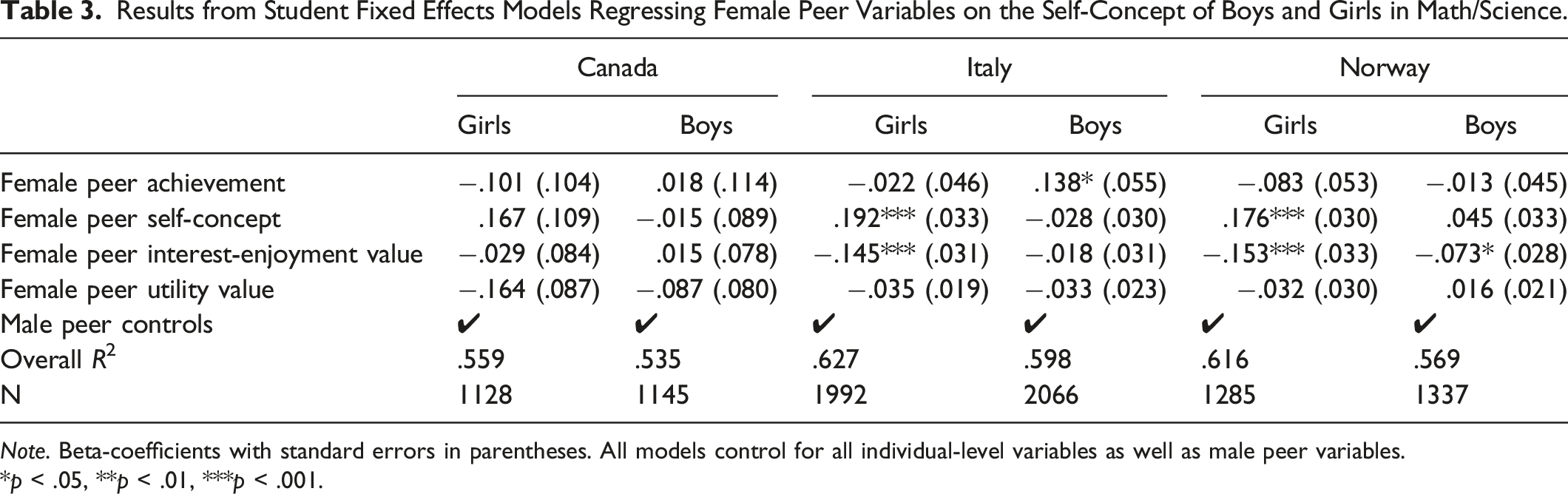
Note. Beta-coefficients with standard errors in parentheses. All models control for all individual-level variables as well as male peer variables.
*p < .05, **p < .01, ***p < .001.
For Italy and Norway, there was a similar pattern. First, female peers’ self-concept and female peers’ interest-enjoyment value showed a relatively large and statistically significant association with the self-concept of girls. However, while female peers’ self-concept was positively related to girls’ self-concept (β = .192, p < .001 for Italy and β = .176, p < .001 for Norway), female peers’ interest-enjoyment value was negatively related (β = −.145, p < .001 for Italy and β = −.153, p < .001 for Norway). Second, for boys, these relationships were very small and/or statistically insignificant. In Canada, there were no statistically significant relationships between female peer climate and students’ self-concept for either boys or girls.
In sum, the results from the empirical analysis showed that while a strong female peer climate generally could account for the consistent gender gap in students’ self-concept, the self-concept and interest-enjoyment value of female peers were strongly associated with girls’ self-concept (but not the self-concept of boys) in two of the three countries analyzed (Italy and Norway). Meanwhile, somewhat surprisingly, these two aspects of female peer climate had opposite associations. While the self-concept of female peers was positively associated with girls’ self-concept (β = .192, p < .001 for Italy and β = .176, p < .001 for Norway), the association with the interest-enjoyment value of female peers was negative (β = −.145, p < .001 for Italy and β = −.153, p < .001 for Norway).
Discussion
This paper has examined the relationship between the female peer climate in classrooms and girls’ academic self-concept in math and science. Our primary goal was to investigate the extent to which the female peer climate in specific math and science learning environments was associated with a lower gender gap in students’ self-concept in these fields. We tested this by analyzing within-student across-subjects TIMSS 2015 data from three countries using hybrid models. Utilizing the fact that all students in a classroom were surveyed in two different subjects, we were able to analyze whether differences in (the same) female peers’ self-concept, interest-enjoyment value, and utility value in math/science induced differences in students’ self-concept in math/science. The results of this analysis showed that, in all three countries, there was a significant gender gap in students’ self-concept in math and science, favoring boys. The observed gender gap was significantly lower when taking into account individual interest-enjoyment value and utility value of boys and girls, but unrelated to the female peer climate in the classroom. Although measures of female peer climate in the classroom did not alter the gender gap in students’ self-concept, gender-specific analyses revealed that girls’ self-concept were significantly associated with their female peers and not their male peers. Accordingly, the self-concept and interest-enjoyment value of female peers was significantly related to the self-concept of females and, to a much lesser extent, of males. These results are in line with the theoretical framework of SEVT, by showing the interrelatedness of task values and self-concept as well as the influence of socializers (e.g., peers) for shaping self-concept, though our results qualify the notion of peer influence by highlighting the importance of same-gender peers. The results are also in line with previous empirical research suggesting that female peers are important for girls’ educational outcomes and can also counteract the negative effects of gender bias on STEM self-concept (Raabe et al., 2019; Robnett, 2016) and pointing to the important role of gender identity and role models in the construction of academic self-concepts (Archer, 2017).
Furthermore, results showed that students’ interest-enjoyment value—i.e., their interest and engagement in the subject—was the single most important factor for their self-concept in math and science, more important even than their actual achievement.
Overall, many of our results are in line with expectancy-value theory but also add to this research in various ways by highlighting the relative importance of task values compared to achievement in understanding students’ academic self-concept. This finding is in line with empirical research on gender inequality in entry to STEM majors, which has shown that gender differences in skills cannot explain the female underrepresentation in physical science and engineering majors (Riegle-Crumb et al., 2012). Consequently, our and previous findings provide evidence that the gender gap in students’ STEM-related outcomes cannot be explained by differences in prior achievement in such subjects and that we need to cultivate girls’ interest in and enjoyment of STEM-related subjects to increase women’s participation in STEM majors and careers (Nagy et al., 2006; Vinni-Laakso et al., 2019; Wang et al., 2015).
Our results also point to a surprising conclusion: despite a direct relationship with girls’ self-concept in math and science, the female peer climate in the classroom was not related to the gender gap in these subjects. In other words, our hypothesis, informed by prior research on female peers serving as role models in STEM subjects (Riegle-Crumb et al., 2006; Schøne et al., 2017), was not confirmed. One potential explanation for null findings is that our empirical design was much more detailed than previous studies, including student and teacher fixed effects and analysis of all (male and female) peers in the classroom. Accordingly, previous research on intra-gender peer effects may have been biased due to crude peer measures and/or unobserved heterogeneity at the student, peer, or teacher level. Another potential explanation could be that, as peer groups have previously been shown to have paradoxical effects on individual educational outcomes (Rosenqvist, 2018), the negative and positive effects of the female peer climate variables may cancel each other out. Indeed, the effect sizes of female peer interest-enjoyment value and self-concept in our study were similar but in opposite directions. So while STEM-oriented female peers may promote girls’ confidence in math/science by serving as role models (Riegle-Crumb et al., 2006), they can simultaneously have a negative impact on girls’ self-concept through a big-fish-little-pond (BFLP) effect (Thijs et al., 2010). Consequently, different mechanisms may be at play and an important avenue for future research is to investigate and disentangle such mechanisms.
Furthermore, our results showed that while the self-concept of female peers was positively associated with girls’ self-concept, the association with the interest-enjoyment value of female peers was negative. One explanation for this finding may be that the academic self-concept of classmates is more salient than their interest-enjoyment value (i.e., their interest and engagement in a subject). While academic self-concept is not necessarily something that students “flash” in the classroom, and in that sense is not directly observable by peers, peers may be more likely to explicitly express their subject interest, thus making it a more external frame of reference. As a result, while peer self-concept might affect students’ self-concept indirectly through the quality of a more able learning environment, peer subject interest might negatively affect students’ self-concept through a social comparison effect (e.g., Festinger, 1954; Suls et al., 2002). Accordingly, in line with BFLP effect (e.g., Marsh & Parker, 1984; Marsh et al., 2008), students may have a more negative perception of their own ability, and thus a lower self-concept, when their peers position themselves as attributing great interest-enjoyment value to a subject. Furthermore, given that our results showed that students’ interest-enjoyment value was highly related to self-concept and controlling for it was associated with a lower gender gap, future research could investigate if peer climate, particularly female peers’ interest-enjoyment value, affects students’ interest-enjoyment value differently than their academic self-concept.
Finally, our results support previous research on cross-national variation in gender differences in STEM-related motivation and behavior (Else-Quest et al., 2013; Hägglund & Leuze, 2021; Penner, 2008). While there was a significant gender gap in academic self-concept in all three countries, it ranged from β = .097, p < .001 for Italy to β = .302, p < .001 for Norway. Furthermore, the female peer climate in the classroom was significantly associated with girls’ self-concept in Norway and Italy, while this was not the case in Canada. This finding could be due to racial diversity in the sample—previous research has shown that students’ race may also shape gendered academic beliefs (Skinner et al., 2021). This is supported by the data in Appendix Table A2 indicating that the sample for Canada included a higher percentage of non-native students compared to the samples for Norway and Italy. While our sample only included three countries, in line with the gender equality paradox (Bradley, 2000; Stoet & Geary, 2018), the results suggested that the gender gap in self-concept was largest in the most gender-equal country in the sample, namely Norway. Meanwhile, the aim of our study was not to carry out a comparative analysis of the association between female peer climate and girls’ self-concept across different countries since our data did not support such an analysis. Instead, we used country variation as an analytical backdrop to test the robustness of our results across countries with different gender cultures. Consequently, although the observed country-level differences in the gender gap suggest that cultural characteristics of countries are influential in shaping gender stratification, more systematic comparative research is needed in order to elaborate on this finding and to determine, for instance, how gender essentialism and equality influence gender gaps in STEM performance and orientations.
The results from this study should be read in light of its limitations. First, while our empirical strategy by design controlled for fixed effects at the school, teacher, classroom, and student levels, unobserved heterogeneity may not have been constant across the two subjects of analysis. Consequently, our results hinge on the assumption of subject invariance. However, we focused on math and science, which we believe measure comparable skills and are thus similar enough to justify this assumption. Second, while the exclusion of students with more than one teacher strengthened the empirical strategy by including teacher fixed effects, it significantly reduced the sample size, potentially limiting the generalizability of our results. Third, although math and science are related subjects, gender differences across the subjects may exist. Previous research found that girls took more biology and chemistry classes, but fewer physics classes. Accordingly, gendered patterns across subjects would be confounded by gender-specific peer measures. We sought to address this issue by controlling for the specific subject (math/science) in the analysis. Including this information did not alter the main results. Fourth, the main variables used in the empirical analysis are all highly interrelated. While the low VIF statistics indicated that there were no problems with multicollinearity, we cannot rule out the possibility of reverse causality due to the general interconnectedness of the measures. This is particularly relevant in terms of the correlation between students’ self-concept and task values since, for example, research drawing on expectancy-value theory tends to assume simultaneous effects on educational behavior. However, reverse causality is only an issue in terms of predictors at the individual level, since it is highly unlikely that individual self-concept influenced peer characteristics. Finally, while the advantage of our empirical analysis is that the entire classroom was included, we were not able to identify friendships within or outside the classroom, which may also have been influential in shaping students’ self-concept. One might speculate that the achievement-related beliefs of a student’s friend group will have a greater effect than the beliefs of other peers. Accordingly, our analysis only provides a snapshot of a particular cohort and we do not know how close a girl is to their female classroom peers. In the future, researchers interested in peer effects should collect longitudinal data that can disentangle peers from friends within and between classrooms.
Despite these limitations, our results suggest that the local female learning environment plays an important role in how girls their academic self-concept in STEM-related subjects and any attempt to increase female participation in STEM must therefore take such factors into account. An important avenue for future research is to investigate other dimensions of the normative peer climate in the classroom, such as the impact of domain-specific gender stereotypes and expectations on students’ academic self-concept in general, and on girls’ (boys’) orientations towards traditionally male- (female-) dominated fields in particular.
Footnotes
Declaration of Conflicting Interests
The author(s) declared no potential conflicts of interest with respect to the research, authorship, and/or publication of this article.
Funding
The author(s) disclosed receipt of the following financial support for the research, authorship, and/or publication of this article: This work was supported by Velux Fonden under grant 00017032.

Note
Appendix
Index Items. Source. Trends in International Mathematics and Science Study, 2015. For more info on scale construction, see (Martin, Mullis, & Hooper, 2016). aIs only posed for mathematics.
Self-Concept
I usually do well in mathematics/science
Mathematics/science is more difficult for me than for many of my classmates
Mathematics/science is not one of my strengths
I learn things quickly in mathematics/science
I am good at working out difficult mathematics/science problems
My teacher tells me I am good at mathematics/science
Mathematics/science is harder for me than any other subject
Mathematics/science makes me confused
Mathematics makes me nervous
a
Interest-enjoyment value
I enjoy learning mathematics/science
I wish I did not have to study mathematics/science
Mathematics/science is boring
I learn interesting many things in mathematics/science
I like mathematics/science
I like any schoolwork that involves numbers/science teaches me how things in the world work
I like to solve mathematics problems/science experiments
I look forward to mathematics lessons/learning science in school
Mathematics/science is my favorite subject
Utility value
I think learning mathematics/science will help me in my daily life
I need mathematics/science to learn other school subjects
I need to do well in mathematics/science to get into the university of my choice
I need to do well in mathematics/science to get the job I want
I would like a job that involves using mathematics/science
It is important to learn about mathematics/science to get ahead in the world
Learning mathematics/science will give me more job opportunities when I am an adult
My parents think that it is important that I do well in mathematics/science
It is important to do well in mathematics/science
Descriptive Statistics for Analytical Sample by Country.
Canada
Italy
Norway
Mean/Percentage
SD
Mean/Percentage
SD
Mean/Percentage
SD
Age (years)
13.842
.362
13.799
.486
14.722
.311
Female
.497
—
.491
—
.495
—
Immigration status
Native
.547
—
.808
—
.737
—
Second generation
.324
—
.123
—
.182
—
First generation
.129
—
.070
—
.081
—
Highest parental education
Less than lower secondary
.010
—
.025
—
.011
—
Lower secondary
.025
—
.193
—
.019
—
Upper secondary
.164
—
.345
—
.077
—
Post-secondary, non-tertiary
.173
—
.108
—
.115
—
Short-cycle tertiary
.153
—
.108
—
.137
—
Bachelor’s or equivalent
.209
—
.129
—
.339
—
Postgraduate degree
.267
—
.093
—
.304
—
Teacher female
.547
—
.789
—
.456
—
Teacher years of experience
14.757
8.617
22.958
11.390
14.940
10.777
Teacher age
Under 25
.010
—
.000
—
.020
—
25–29
.101
—
.000
—
.089
—
30–39
.287
—
.163
—
.306
—
40–49
.354
—
.185
—
.336
—
50–59
.232
—
.377
—
.124
—
60 or older
.017
—
.276
—
.124
—
Teacher holds master’s degree
.218
—
.120
—
.289
—
8th-grade students per school
58.273
30.996
59.212
27.064
68.300
26.218