



Abstract
Research has shown links between emotion regulation strategies and child mental health. However, it is not well known how the characteristics of children may moderate these links. The aim of this study was to explore whether environmental sensitivity—the ability to perceive and process information about the environment—moderates links between emotion regulation strategies (cognitive reappraisal and expressive suppression) and children’s emotional and behavioral problems. The study included 1381 children (Mage = 10.53, 51% girls) who gave information about their emotion regulation and environmental sensitivity, and whose teachers reported on their emotional and behavioral problems. The results showed that suppression predicted a higher amount of problems for girls regardless of their sensitivity level. For boys, environmental sensitivity moderated this link. Among more environmentally sensitive boys, the association between suppression usage and emotional and behavioral problems was stronger than among less sensitive boys. These results show that the effects of suppression may be exacerbated depending on the child’s gender and environmental sensitivity.
Keywords
Introduction
Preadolescence, the period between the ages of 9 and 13, coincides with the beginning of puberty. During this period, many children face changes in their emotional experience and—for some—psychopathological symptoms begin to increase (Costello et al., 2011; Kessler et al., 2005). Emotion regulation processes, which include monitoring and modulating aspects of emotional reactions (Thompson, 1994), may be especially important for children’s well-being during this period. Indeed, strategies used by children to regulate their emotions have been linked to various emotional and behavioral problems (Cavicchioli et al., 2023; Compas et al., 2017; Schäfer et al., 2017). Strategies that predict fewer problems are called adaptive, while those that predict more problems are called maladaptive (Aldao et al., 2010).
Greater use of adaptive and lesser use of maladaptive emotion regulation strategies may be particularly important for the mental health and well-being of children who have high environmental sensitivity. In his meta-framework on environmental sensitivity, which integrates several theoretical perspectives—including sensory processing sensitivity (Aron & Aron, 1997; Aron et al., 2012), differential susceptibility (Belsky, 2013; Belsky et al., 2007; Belsky & Pluess, 2009), and diathesis-stress (Monroe & Simons, 1991)—Pluess (2015) defines environmental sensitivity as the ability to register and process both negative and positive environmental stimuli. The environmental sensitivity theories propose that individuals differ in their sensitivity to environmental influences, with those who are highly sensitive being more affected by negative as well as positive experiences than those who are less sensitive. Growing research evidence shows that children’s environmental sensitivity moderates their responses to both aversive and supportive external influences, such as negative and positive parenting. More specifically, research findings show that highly environmentally sensitive children, in comparison to those who are less environmentally sensitive, fare worse when exposed to negative environments, but better when they grow in supportive environments (e.g., Lionetti et al., 2019; Slagt et al., 2018). However, very little is known about the possible moderating role of environmental sensitivity in relations between internal psychological processes and well-being.
In this study, we examined whether environmental sensitivity moderated associations between two emotion regulation strategies—cognitive reappraisal and expressive suppression—and emotional and behavioral problems in preadolescence. In line with the Sensory Processing Sensitivity theory (Aron & Aron, 1997), which broadly defines the environment to include any salient conditioned or unconditioned internal or external stimuli (Greven et al., 2019), we conceptualized emotion regulation strategies as an important element of the internal context of development. We predicted that expressive suppression—the maladaptive emotion regulation strategy (Aldao et al., 2010) that contributes to a negative internal context—would positively correlate to preadolescents’ emotional and behavioral problems. In contrast, cognitive reappraisal—the adaptive strategy (Aldao et al., 2010) that promotes a positive internal context—might correlate negatively to emotional and behavioral problems. Based on the meta-framework of environmental sensitivity (Pluess, 2015), we expected both correlations to be stronger among highly environmentally sensitive children, who may register inner physiological and psychological stimuli more easily and process them more deeply, than among children with low environmental sensitivity. We also examined the role of gender in these links, as there are known gender differences in the use of different emotion regulation strategies (Gullone & Taffe, 2012) and their links with mental health outcomes (Ogbaselase et al., 2022).
Emotion Regulation Strategies and The Child’s Emotional and Behavioral Problems
Links between emotion regulation and mental health outcomes of children and adults are proposed in various psychopathological models (Aldao et al., 2016; Beauchaine, 2015; Hofmann et al., 2012; Kring & Sloan, 2010; Suveg et al., 2010). In these models, emotion regulation difficulties are processes that contribute to the prolonged experience of negative emotions, which over time gives rise to the development and maintenance of psychopathological problems. Even though these models focus on psychopathology, emotion regulation processes are also associated with emotional and behavioral difficulties measured as internalizing and externalizing problems in the community or non-clinical samples of children and adolescents (e.g., Schäfer et al., 2017; Teuber et al., 2023).
The two emotion regulation strategies examined in the present study—cognitive reappraisal and expressive suppression—have been the subject of frequent research on child and adolescent mental health. Cognitive reappraisal is a strategy that involves changing the interpretation of the situation or self-relevance of the situation in order to modulate the emotional response (Gross, 2015). It has been considered an adaptive strategy due to its efficacy in reducing negative affect (Gross, 2014). Expressive suppression is an emotion regulation strategy that involves concealing outward displays of emotion, and is considered a maladaptive strategy with poor efficacy in reducing negative affect (Gross, 2014).
Cognitive reappraisal and expressive suppression have been generally linked to various emotional and behavioral problems in childhood and adolescence. In cross-sectional studies reappraisal was negatively associated with internalizing (Eastabrook et al., 2014; Sai et al., 2016) and externalizing problems (Lindsey, 2021), whereas suppression was positively associated with internalizing problems (Compas et al., 2017; Eastabrook et al., 2014; Sai et al., 2016). Both strategies were also cross-sectionally linked to overall emotional and behavioral problems measured as a composite of internalizing (e.g. emotional problems) and externalizing (e.g. conduct problems) symptoms. Specifically, reappraisal has been shown to be a negative predictor of adolescents’ emotional and behavioral problems, while suppression is a positive predictor (Teuber et al., 2023; Zhang et al., 2019). However, some studies failed to show concurrent links between reappraisal and externalizing symptoms (Compas et al., 2017) or suppression and externalizing symptoms (Compas et al., 2017; Flouri & Panourgia, 2014).
Longitudinal studies yielded inconsistent results regarding the role of suppression and reappraisal in the prediction of children’s problems. In a two-wave study of adolescents by Flouri and Mavroveli (2013), suppression measured at the second wave was associated with increases in total emotional and behavioral problems over one year. In another study, suppression and reappraisal measured at the first wave mediated links between adverse life experiences and increases and decreases in adolescents’ psychological distress over time (Boyes et al., 2016). In a four-wave study by De France and colleagues (2019), the use of reappraisal predicted a lower level of depressive symptoms only in the final wave of the assessment, indicating that older adolescents may use reappraisal with more efficacy compared to younger ones. However, in other longitudinal studies, emotion regulation strategies did not predict emotional or behavioral problems. Furthermore, two studies showed that adolescents’ depressive symptoms predicted the use of suppression in the following year, and not vice versa (De France et al., 2019; Larsen et al., 2013). Significantly, in both studies, depressive symptoms showed greater cross-lagged stability as compared to suppression, indicating the possibility that they precede the emergence of suppression or that they reflect stable dispositional characteristics, which could be a precursor to a tendency towards suppression.
In short, the current cross-sectional and longitudinal findings have not yet provided a clear picture of the role of emotion regulation strategies in predicting emotional and behavioral problems. The inconsistency of findings may reflect the fact that emotion regulation skills are still emerging during adolescence. It is also plausible that the efficacy of emotion regulation strategies varies depending on different children’s characteristics. One characteristic that has not yet been explored in relation to emotion regulation and children’s problems is environmental sensitivity.
Environmental Sensitivity in Childhood and Adolescence
As noted above, environmental sensitivity is a child and adult trait that reflects sensitivity to various types of both negative and positive sensory and psychological stimuli (Pluess, 2015; Pluess et al., 2018). According to the meta-framework of environmental sensitivity, children with higher sensitivity should have worse outcomes compared to less sensitive children in adverse environments but better outcomes in supportive environments (Pluess, 2015). This pattern of relations reflects the differential susceptibility of some individuals to different types of stimuli.
Studies on children and adolescents support the environmental sensitivity theory, showing that environmental sensitivity moderates the effects of the external environment, which is most frequently operationalized as the quality of parenting (e.g., Lionetti et al., 2019; Slagt et al., 2018). There is less evidence as to whether environmental sensitivity moderates the effects of the internal environment as well. To our knowledge, the only such study with adolescents is that of Iimura et al. (2022), who shows that environmental sensitivity moderated the effects of boys’ pubertal tempo on their depression symptoms—sensitive boys with faster physical maturation experienced a decrease in depressive symptoms over time, while those with slower maturation reported increased depressive symptoms. Two studies with adults yielded similar results, revealing an interaction between measures of environmental sensitivity and emotional processes in predicting anxiety symptoms. In the first study, anxiety was predicted by the interaction between the ease of excitation (an aspect of environmental sensitivity, Smolewska et al., 2006) and difficulty in identifying emotions (Liss et al., 2008). In the second study, anxiety was predicted by the interaction between environmental sensitivity and trait mindfulness and acceptance (Bakker & Moulding, 2012). The current study takes a similar approach, aiming to investigate whether child environmental sensitivity moderates links between processes that take place within the child (i.e., emotion regulation strategies) and their emotional and behavioral problems.
Environmental Sensitivity, Emotion Regulation, and Emotional and Behavioral Problems
During the transition to adolescence, children face many new stressors related to physical changes, changes in school demands, and social relationships. These stressors may be especially burdensome for highly sensitive children with poor emotion regulation skills. Poor emotion regulation skills, reflected in the low use of adaptive strategies such as reappraisal and the frequent use of maladaptive strategies such as expressive suppression, may be a risk factor for emotional and behavioral problems for many children. However, these risks may be greater for highly sensitive children, since they are more likely to respond to both positive and negative stimuli, and are thus more prone to experiencing both negative and positive emotions. Frequent use of an adaptive strategy such as cognitive reappraisal may attenuate negative emotions, which may be especially beneficial to children who are very sensitive. In contrast, children who often use suppression may be at a disadvantage due to the inefficacy of this strategy in reducing negative emotions, which again may be especially harmful to highly sensitive children. Importantly, expressive suppression may be damaging even when used to suppress positive emotions, because concealing positive emotions may hurt positive relations with others and promote emotional problems and feelings of loneliness.
As a self-report measure of environmental sensitivity for children and adolescents has been developed only recently (The Highly Sensitive Child scale, Pluess et al., 2018), no studies have addressed the role of child environmental sensitivity measured directly in links between emotion regulation strategies and emotional and behavioral problems. However, one study with adolescents has shown that the effects of emotion regulation strategies vary depending on emotional reactivity, which may be considered a distal marker of environmental sensitivity. More specifically, emotional reactivity and cognitive reappraisal interacted in predicting adolescents’ depressive symptoms—cognitive reappraisal was negatively associated with depressive symptoms for highly reactive adolescents, while no such association was found for adolescents with lower emotional reactivity (Shapero et al., 2016). Regarding suppression, a study by Richardson (2017) showed that adults who use suppression more often have a lower positive affect on days when their perceived stress was high, as compared to days when their perceived stress was low. The findings of these two studies show that reappraisal may have protective effects on mental health and well-being when paired with other adverse factors, including those that are distal markers of environmental sensitivity, while suppression has detrimental effects.
The Current Study
There is a lack of research on links between environmental sensitivity, emotion regulation, and emotional and behavioral problems in preadolescence. Therefore, the first aim of this study was to fill this gap and test the moderating role of preadolescents’ environmental sensitivity in relations between emotion regulation strategies and emotional and behavioral problems. We expected that cognitive reappraisal would be a negative predictor of emotional and behavioral problems, while expressive suppression would be a positive predictor. Based on prior studies and theoretical assumptions stemming from the environmental sensitivity field (Pluess, 2015), we assumed that links between these regulation strategies and children’s emotional and behavioral problems would be stronger for children who are highly sensitive. Put differently, we hypothesized that the employment of adaptive emotion regulation strategies and avoidance of maladaptive strategies would be more important to the psychological well-being of highly sensitive preadolescents as compared to less sensitive preadolescents.
Regarding the exact shape of expected interactions, there is currently not enough evidence to propose a clear hypothesis. However, based on the propositions of the differential susceptibility model (Belsky, 2013; Belsky et al., 2007; Belsky & Pluess, 2009), we expected that highly sensitive children, as compared to less sensitive ones, would have more emotional and behavioral problems when they use maladaptive emotion regulation strategies often and adaptive strategies less often, but fewer problems when they use maladaptive strategies rarely and adaptive strategies often. More specifically, high environmental sensitivity combined with high expressive suppression would predict high levels of emotional and behavioral problems, whereas high environmental sensitivity in combination with low expressive suppression would predict low levels of emotional and behavioral problems. In addition, high environmental sensitivity combined with high cognitive reappraisal would predict low levels of emotional and behavioral problems, whereas high environmental sensitivity in combination with low cognitive reappraisal would predict high levels of emotional and behavioral problems. We analyzed interaction patterns in more detail following the suggestions by Roisman et al. (2012).
The second aim of this study was to exploratively investigate whether gender moderates the observed correlations. We have no explicit hypothesis regarding gender differences, as there is no clear theoretical guidance or enough research evidence to support a hypothesis in this specific area. However, studies have reported significant differences between boys and girls in the use of emotion regulation strategies and their links with mental health. For example, boys tend to report greater use of suppression than girls (a narrative review by Gross & Cassidy, 2019; Gullone & Taffe, 2012). Furthermore, the effects of expressive suppression on mental health outcomes are moderated by the use of cognitive reappraisal and perceived social stress for boys and men only (Jiang et al., 2022; Rogier et al., 2019; Yeh et al., 2017). Thus, it may be important to explore whether there are different patterns of interactions between emotion regulation strategies and environmental sensitivity in predicting emotional and behavioral problems for boys as opposed to girls.
Method
Participants and Procedure
This study was conducted as part of the project Child Well-being in Family Context (CHILD-WELL), financed by the Croatian Science Foundation. Overall, 1548 children from third to sixth grade in 15 public elementary schools in five Croatian cities took part in the study. Teacher reports on children’s emotional and behavioral problems were available for 1534 children (n = 161 teachers, 88% female, Mage = 45.10, SD = 9.86). As not all children and teacher reports could be reliably matched, the final number of pairs of child and teacher reports amounted to 1436. After the exclusion of participants who were flagged for a potentially unreliable pattern of data entry—those who had more than 50% missing data on environmental sensitivity and emotion regulation scales, and more than 40% missing on SDQ subscales items—1381 children (677 boys, 704 girls, Mage = 10.53, SD = 1.14) and 153 teachers were included in the analyses. The children included in this study are racially homogenous, and most reported living with both parents (80%). Regarding mothers’ education levels, 48% of mothers held a high school diploma, 13% had a vocational education degree, and 35% had a university degree.
The children included in this study attended regular state schools in Croatia. Primary education in Croatia consists of two phases. The first phase includes children in grades 1-4 (ages 7-11), and the second phase includes children in grades 5-8 (ages 11-15). These phases differ in the number of courses and in the level of academic demands; the second phase has more courses and is generally more demanding. During the first phase, children are taught most of their courses by only one teacher, while each course has a different teacher in the second phase. During the second phase, one teacher oversees the general progress of a single class consisting of an average of about 20 students.
Most of the children in the sample (95.5%) attended a regular school program, while a small minority (4.5%, n = 62) attended some sort of individualized or adjusted program. Educational programs in Croatian schools differentiate between regular and adjusted education for children with a wide range of developmental vulnerabilities—most often various types of learning difficulties. The main analyses were conducted with and without the inclusion of children who attended an individualized program.
Teachers were asked to assess each child in their class for whom written parental consent to participate in the study was obtained. All teachers for the second phase students had a minimum of six months of teaching experience with the children they were assessing. Children who had parental consent filled out the questionnaires during school hours. The research design and procedures were approved by the Ethical Research Committee of the Institute of Social Sciences Ivo Pilar.
Measures
The Emotion Regulation Questionnaire for Children and Adolescents (ERQ-CA; Gullone & Taffe, 2012) was used to measure cognitive reappraisal (e.g., “When I want to feel happier, I think about something different”) and expressive suppression (e.g., “I keep my feelings to myself”). This questionnaire was adapted for children and adolescents from the Emotion Regulation Questionnaire (ERQ; Gross & John, 2003). ERQ-CA consists of 10 items (six items for cognitive reappraisal, four items for expressive suppression) with a response type on a scale from 1 (strongly disagree) to 5 (strongly agree). The ERQ-CA questionnaire was translated from English to Croatian by both the first author and another researcher independently; the Croatian translation was then created based on these two translations. The questionnaire was back-translated into English by a third researcher, which revealed no significant differences from the original version. The questionnaire was tested in a smaller pilot study (n = 172), which also included cognitive interviews with children (aged 9-11). In the pilot study, Cronbach’s alpha reliability was .71 for expressive suppression and .77 for cognitive reappraisal. Confirmatory factor analysis was performed to explore the ERQ-CA structure. The questionnaire showed a theoretically expected two-factor structure with all corresponding items loading on their assumed factors (χ2 = 82.347, df = 33, p = .000, CFI= .974, RMSEA = .036, SRMR = .032). In this study, Cronbach’s alpha reliability was .75 for cognitive reappraisal and .66 for expressive suppression.
The Strengths and Difficulties Questionnaire (SDQ; Goodman, 1997) was used to measure children’s emotional and behavioral problems. The Croatian version of the SDQ is available free of charge online (https://www.sdqinfo.org/py/sdqinfo/b0.py; Youth in mind, 2015). The SDQ consists of 25 items divided into five subscales: emotional problems (e.g., “Many worries or often seems worried”), peer problems (e.g., “Rather solitary, tends to play alone”), hyperactivity (e.g., “Restless, overactive, cannot stay still for long”), conduct problems (e.g., “Often loses temper”), and prosocial behavior (e.g., “Considerate of other people’s feelings”). Teachers rated each child in their class who participated in the study on a scale from 1 (not true) to 3 (certainly true). In this study, four problem scales (all except the prosocial subscale) were used to form the total score, which ranged between 20 and 53. Cronbach’s alpha of the total score was .86.
Environmental sensitivity was measured using the Highly Sensitive Child Scale (HSCS, Pluess et al., 2018), which has recently been translated into Croatian (Keresteš et al., 2021). The scale consists of 12 items combined into three subscales: ease of excitation (e.g., “I get nervous when I have to do a lot in little time”), aesthetic sensitivity (e.g., “Some music can make me really happy”), and a low sensory threshold (e.g., “Loud noises make me feel uncomfortable”). Children responded on a scale from 1 (not at all) to 7 (extremely). The scale has shown satisfactory metric characteristics so far in samples of children and adolescents from the UK and Belgium (Pluess et al., 2018; Weyn et al., 2021), as well as Croatia (Keresteš et al., 2021). In this study, only the total score was used. Cronbach’s alpha was .66.
Confounding Variables
We used child gender, age, and educational program as covariates in all analyses where appropriate. The educational program was coded as a binary variable (0-regular program, 1-individualized program).
Data Analysis Plan
Data was analyzed using Mplus 8.10 and SPSS 24. Due to the clustering of teacher reports of children’s emotional and behavioral problems within classes (n = 153), multilevel modeling in Mplus was applied. More specifically, a two-level regression analysis with a random intercept was employed, with teachers/class representing a cluster variable. Intraclass correlations (ICC) were calculated for emotional and behavioral problems, emotion regulation strategies, environmental sensitivity, and covariates. ICC values were .16 for emotional and behavioral problems and .91 for age; for all other variables, they were between .009 (gender) and .055 (cognitive reappraisal). We decided to treat all predictors and covariates except for age as within-cluster variables due to low ICC. All within-cluster variables were grand mean centered, and gender was coded 0-male, 1-female. Age was the only predictor that was treated as both a within- and between-cluster variable due to its high ICC value. A maximum likelihood robust estimator was used in all analyses. In this study, only within-cluster models are interpreted.
To test whether emotion regulation strategies interact with environmental sensitivity in predicting emotional and behavioral problems, and whether this interaction is moderated by a child’s gender, a three-way interaction multilevel model was specified. We probed interactions using simple slope analyses (+/−1SD) and by calculating regions of significance on X (predictor) and M (moderator) according to the instructions of Roisman et al. (2012). Regions of significance on X examine values of a predictor for which there is a significant correlation between moderator and outcome. Regions of significance on M mark values of a moderator for which predictor and outcome are significantly correlated. These indicators help to analyze interaction in greater detail and to examine whether interaction shape corresponds to predictions of differential susceptibility or the diathesis-stress model. According to the diathesis-stress model, highly environmentally sensitive children are expected to respond more strongly to negative experiences (in this study, expressive suppression) than children with low environmental sensitivity, but not to positive experiences (in this study, cognitive reappraisal). If the association between moderator and outcome is significant at both low and high levels of a predictor (between the values of +/−2SD), there is evidence of differential susceptibility (Roisman et al., 2012). In addition to this, we calculated the proportion of interaction (PoI), which indicates the ratio of the “better” effect and the total effect (Roisman et al., 2012). PoI values between .40 and .60 represent patterns that are in line with differential susceptibility (Roisman et al., 2012).
Results
Descriptive Statistics for the Study Variables and T-Tests for Differences Between Boys and Girls.

Note:**p < .01,***p < .001.
Correlation Matrix for Boys (Over Diagonal) and Girls (Below Diagonal).

Note: **p < .01, ***p < .001.
Boys had higher levels of emotional and behavioral problems as well as expressive suppression, while girls had higher environmental sensitivity (Table 1).
For both boys and girls, significant positive correlations were found between emotional and behavioral problems and expressive suppression, as well as between environmental sensitivity and both emotion regulation strategies. For boys only, there was also a positive correlation between cognitive reappraisal and expressive suppression.
Testing Three-Way Interaction in the Whole Sample (N = 1381).

Note: Gender 0-boys, 1-girls; **p < .01, ***p < .001; CV – criterion variable; PV – predictor variable.
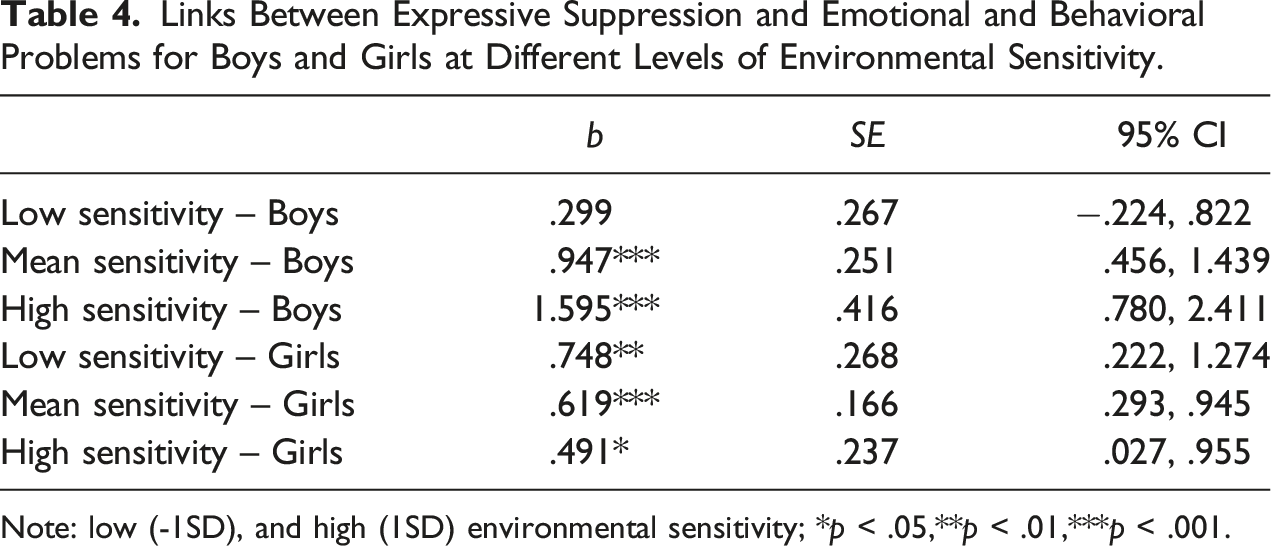
Links Between Expressive Suppression and Emotional and Behavioral Problems for Boys and Girls at Different Levels of Environmental Sensitivity.
Note: low (-1SD), and high (1SD) environmental sensitivity; *p < .05,**p < .01,***p < .001.
In the sample of girls, where no interaction effects were found, expressive suppression (β = .14, SE = .04, CI 95% [.058, .220], p = .001) was a positive predictor of emotional and behavioral problems, while sensitivity was not (β = .03, SE = .04, CI 95% [-.054, .105], p = .533).
The suppression-sensitivity interaction effect was further probed for boys, in accordance with the procedure described in Roisman et al. (2012). First, regions of significance on M (moderator) were probed between observed values of moderator and predictor. Regions of significance with respect to the moderator (sensitivity) showed that the effect of suppression was significant for values of sensitivity higher than 4.2 (as shown in Figure 1). The mean of the moderator (sensitivity) for boys was 4.69 (range 1–7), suggesting a significant positive effect of suppression on emotional and behavioral problems for boys of average and higher sensitivity. Secondly, regions of significance for the effect of sensitivity were probed between observed values of the predictor between +/−2SD. The results showed that there was a significant positive effect of environmental sensitivity for values of suppression higher than the observed value of 3.9 and a negative effect for values lower than 1.81. This means that there was a negative link between environmental sensitivity and emotional and behavioral problems for boys who reported suppression usage below 1.81 in raw scores (which includes –2SD as well). In contrast, for suppression values above 3.9 (an area that includes +2SD), there was a positive link between boys’ environmental sensitivity and their problems. The proportion of interaction was .46. Regions of Significance for the Effect of Suppression on Emotional and Behavioral Problems With Respect to the Observed Value of Environmental Sensitivity Between +/− 2SD for Boys. Note. HSCS – Environmental Sensitivity; +/−2SD corresponds to the observed range between 3.09 and 6.57; outer lines are 95% confidence bands.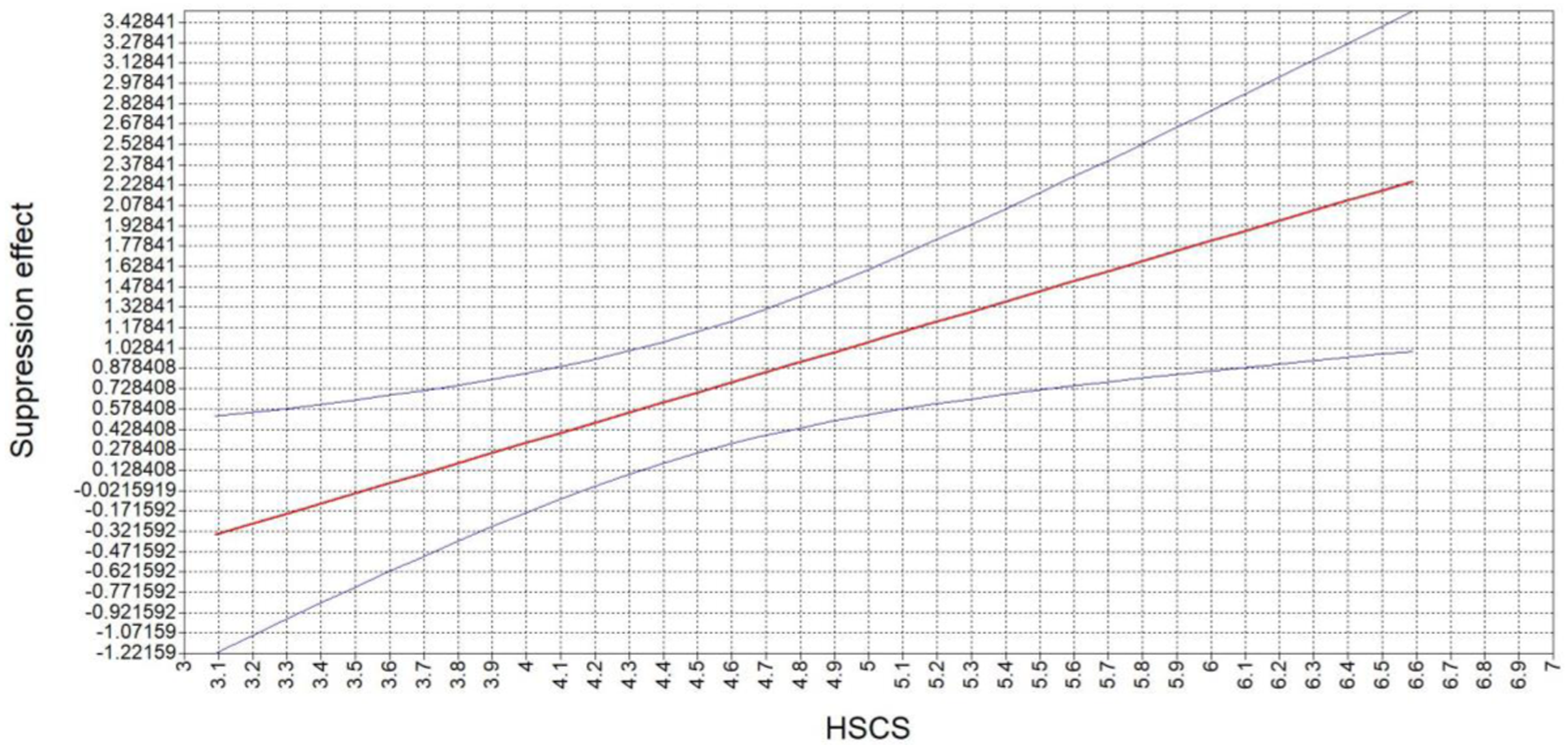
To summarize, these results show that expressive suppression was positively related to emotional and behavioral problems in boys with medium and high levels of sensitivity, while this correlation was not significant among boys with lower levels of sensitivity. The interaction pattern is in line with the differential susceptibility model, since the PoI index is between the values of .40 and .60 (Roisman et al., 2012), and there is a significant effect of sensitivity for both boys who use suppression rarely and those who use suppression often; these two effects have different directions—sensitivity is negatively related to problems in boys who use suppression rarely, whereas it is positively related to problems in boys who use suppression often (Figure 2). This points to greater susceptibility to worse outcomes when sensitivity is paired with higher use of suppression, but also greater susceptibility to better outcomes when sensitivity is paired with lower use of suppression (Figure 3). Regions of Significance for the Effect of Environmental Sensitivity on Emotional and Behavioral Problems With Respect to the Observed Value of Suppression Between +/−2SD for Boys. Note. HSCS – Environmental Sensitivity; +/−2SD corresponds to the observed range between 1.01 and 4.61; outer lines are 95% confidence bands. Simple Slopes for Expressive Suppression Effect on Emotional and Behavioral Problems for low Environmental Sensitivity (−2 SD) and High Environmental Sensitivity (2 SD) for Boys. Note. Expressive Suppression is centered in this graph; values between −1.80 and 1.80 correspond to +/−2 SD values of suppression.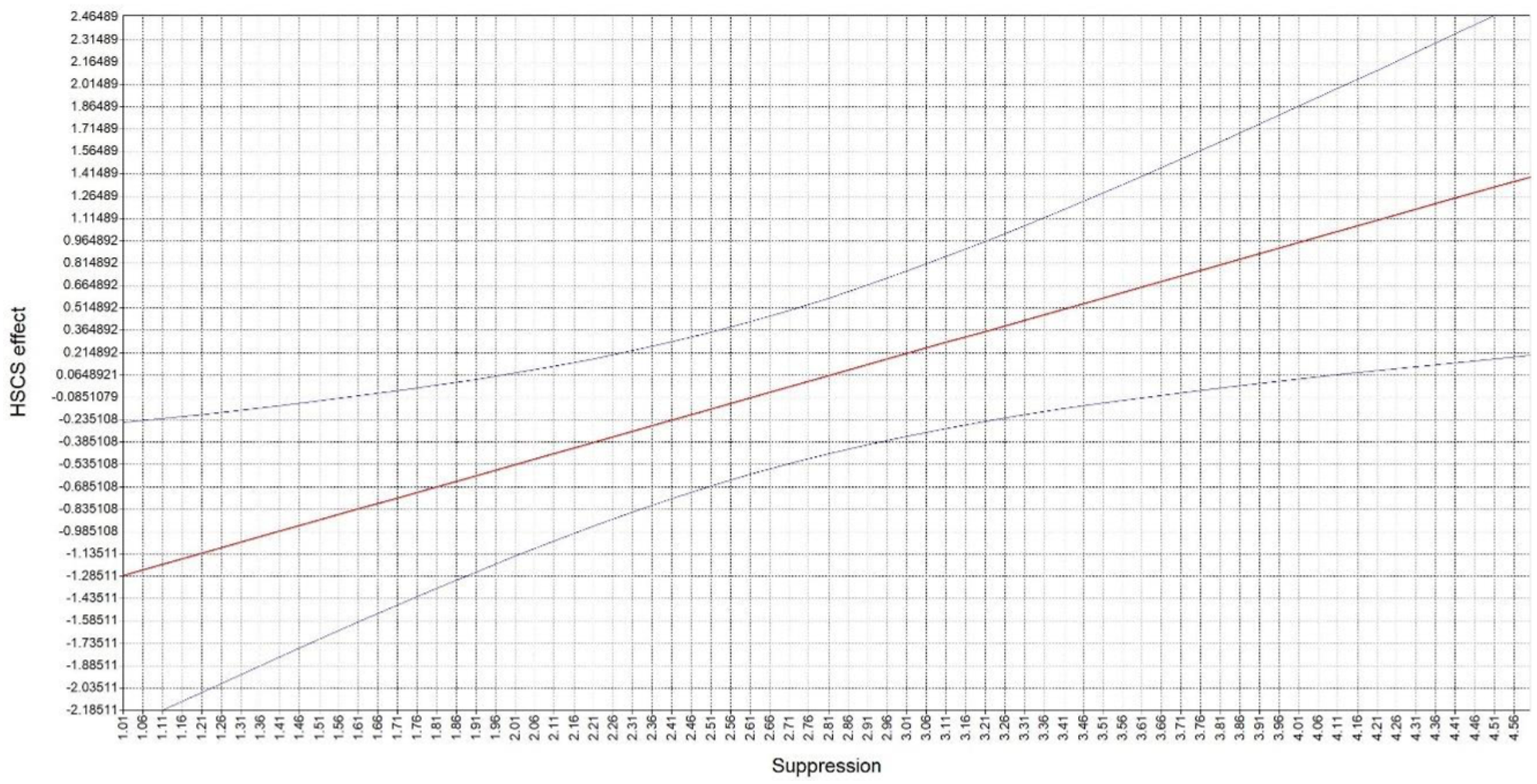

Regarding our confounding variables, gender and educational program were significant predictors of emotional and behavioral problems in all analyses in the entire sample, while age was not a significant predictor on either level. Boys and children who attended adjusted educational programs had more emotional and behavioral problems. Since educational programs consistently predicted emotional and behavioral problems in all analyses, alternative models were analyzed only with children who attended regular programs (n = 1319). All main results regarding interaction effects remained the same in these analyses as the ones reported above.
Discussion
The goal of this study was to investigate whether environmental sensitivity moderates links between two emotion regulation strategies (cognitive reappraisal and expressive suppression) and emotional and behavioral problems in preadolescents. We expected that it may be more important for more sensitive children to use adaptive strategies (reappraisal) more often and maladaptive strategies (suppression) less often. We also explored whether gender moderates these relations.
Expressive suppression was found to interact with environmental sensitivity in the prediction of child emotional and behavioral problems only in the sample of boys. For girls, the interaction between expressive suppression and environmental sensitivity was not significant. Closer inspection of the interaction pattern for boys showed that the link between suppression and emotional and behavioral problems strengthens as their sensitivity increases. For the least sensitive boys, there was no link between suppression and emotional and behavioral problems, indicating that the use of suppression may not be problematic for them. Additionally, when suppression was low, the link between sensitivity and total problems was negative. However, when suppression levels were higher, this pattern changed so that there was a positive link between environmental sensitivity and emotional and behavioral problems. These results support the differential susceptibility model (Belsky, 2013; Belsky et al., 2007; Belsky & Pluess, 2009), showing that highly sensitive boys who use suppression often are at greater risk of emotional and behavioral problems than less sensitive boys, but that those highly sensitive boys who use suppression rarely are at lower risk of emotional and behavioral problems than less sensitive boys who also use suppression rarely.
Our results are in line with the findings of Richardson (2017), which shows that adults who use suppression in combination with other adverse factors (i.e. higher perceived stress) have worse outcomes than those who use suppression in the absence of other adverse factors. In addition, our finding that suppression is not linked to more emotional and behavioral problems in boys with low environmental sensitivity is consistent with prior findings indicating that suppression is not always a damaging strategy for mental health. For instance, Yeh et al. (2017) reported that there were lower negative effects of suppression on mental health outcomes for boys who use reappraisal often as compared to boys who use reappraisal less often. Overall, these findings add to an already complex picture regarding the effects of suppression on mental health outcomes, suggesting that these effects depend on other individual characteristics.
In this study, suppression interacted with environmental sensitivity only in the sample of boys. For girls, while the interaction effect was not significant, suppression was a positive predictor of emotional and behavioral problems. Girls who used suppression more often were rated as having more emotional and behavioral problems by their teachers, and their suppression was consistently linked to more problems no matter what their level of sensitivity was. This is in line with the study by Yeh et al. (2017), in which high reappraisal mitigated links between suppression and negative emotions for boys, but suppression was consistently linked to more negative emotions for girls, irrespective of the level of reappraisal. It is currently not clear why environmental sensitivity moderates suppression effects for boys only. However, two recent studies have also found interaction effects only for boys—environmental sensitivity interacted with intervention effects (Nocentini et al., 2018) and pubertal tempo (Iimura et al., 2022) in predicting internalizing symptoms for boys, but not girls. This may point to the more pronounced vulnerability of highly sensitive boys during the transition to adolescence.
Interaction between cognitive reappraisal and environmental sensitivity was not significant in the whole sample, nor did gender moderate this interaction. Unexpectedly, reappraisal was not a significant predictor of emotional and behavioral problems in this study. This pattern of findings is in line with the results of a meta-analysis by Compas et al. (2017), which failed to find consistent relations between reappraisal and child and adolescent internalizing and externalizing symptoms. It is possible that environmental sensitivity moderates the effects of reappraisal only in the context of stress and adversity. In other words, reappraisal may be the most efficient for those highly sensitive children who experience stress and adversity, protecting them from the development of emotional and behavioral problems, but may be less important for highly sensitive children who are not exposed to stress and adversity (Ford et al., 2014). Additionally, reappraisal may be more efficient when used by older adolescents as compared to early adolescents (De France et al., 2019; Willner et al., 2022). In the current study, reappraisal was not linked to total problems for children younger than 11 (r = −.06, p > .05), nor those older than 11 (r = .05, p > .05). Suppression, on the other hand, had consistent positive links with total problems for both younger (r = .16, p < .001) and older children (r = .13, p < .01).
Another explanation for the absence of the link between reappraisal and emotional and behavioral problems may be the generally lower observed links between adaptive emotion regulation strategies and child psychopathology as compared to maladaptive strategies (Cavicchioli et al., 2023). Additionally, the use of teacher reports of children’s problems may have attenuated the link between self-reported emotion regulation strategies and teacher-reported child problems, as teacher reports reflect the unique teacher’s perspective on the child’s problems. Teachers’ reports may better reflect externalizing problems than internalizing problems, since internalizing problems are harder for them to detect. In support of this, research reveals that parents’ and teachers’ reports of children’s problems generally show greater inter-rater agreement for externalizing than internalizing problems (Cheng et al., 2018). Thus, it is possible that associations between reappraisal and children’s problems in our study, which included both internalizing and externalizing symptoms, were attenuated because teachers assessed internalizing problems with low precision and underreported them due to their hidden nature. This also holds for associations between children’s problems and other predictors examined in our study.
Strengths and Limitations
This study contributes to the field of emotion regulation by showing that the self-reported expressive suppression of children in preadolescence covary with teachers’ assessment of children’s emotional and behavioral problems. The results support the view of emotion regulation as a type of process that is linked with various child problems. Furthermore, the study fills a gap in knowledge on the differential effects of emotion regulation strategies depending on the child’s characteristics, showing that links between suppression and child mental health outcomes vary among boys depending on their environmental sensitivity.
The study’s contributions should be interpreted bearing its methodological limitations in mind. As the findings are based on cross-sectional data, it is not possible to determine causal links between studied constructs, allowing different directions of relations between emotion regulation and children’s emotional and behavioral problems to be proposed. Furthermore, these relations may be confounded by other variables, such as executive functioning (Toh & Yang, 2022), which should be explored in further research. The results reported in this study can be viewed as preliminary because they are based on the first wave of the CHILD-WELL project. As data from other waves becomes available, it will be possible to examine the target links over time. Environmental sensitivity measured via the Highly Sensitive Child Scale had somewhat lower reliability, which is in line with other studies conducted in Belgium and the UK (Weyn et al., 2021) and Japan (Iimura et al., 2022). However, it is desirable to develop measures of environmental sensitivity with better psychometric characteristics. Child emotional and behavioral problems were measured by teacher reports, which may not be the same as using parent or peer reports, child self-reports, or another kind of measure (e.g. psychophysiological measures). Teachers’ assessments of children’s problems are based on behavior they can observe during school hours, which may not include a range of other behaviors and symptoms the child may experience.
Conclusion
In conclusion, this study showed that, for both boys and girls, the higher use of suppression is linked to more emotional and behavioral problems. For boys only, suppression is not linked to emotional and behavioral problems when environmental sensitivity is low, but the link between suppression and emotional and behavioral problems strengthens as sensitivity increases.
Footnotes
Declaration of Conflicting Interests
The author(s) declared no potential conflicts of interest with respect to the research, authorship, and/or publication of this article.
Funding
The work reported here has been fully supported by the Croatian Science Foundation under the project number IP-2019-04-6198 (CHILD-WELL).
