



Abstract
Body image concerns may contribute to school disengagement during late childhood, but this has not been well investigated. This study examined longitudinal associations between different dimensions of body image (body dissatisfaction and weight perception) and school engagement (affective, behavioural, and cognitive) in a sample of 9- to 12-year-old Canadian children (N = 1,070) over 8 months. Results indicated that children’s body dissatisfaction predicted decreases in cognitive engagement only. Also, lower levels of all types of school engagement predicted increases in body dissatisfaction and/or weight perception—suggesting bidirectional influences. Gender analyses indicated that body dissatisfaction predicted lower cognitive engagement among girls only, whereas lower behavioural engagement predicted increased body dissatisfaction among boys only. These findings suggest that body image and school engagement influence one another in gender-specific ways, highlighting the potential value of tailoring early prevention and intervention efforts in these areas to the distinct developmental needs of boys and girls.
Introduction
Body image concerns emerge earlier in development than was once thought, with many children beginning to form stable opinions about their appearance by middle childhood (Tatangelo et al., 2016). Although body image research has traditionally focused on adolescence and eating-related outcomes, growing evidence suggests that body dissatisfaction may also have broader implications for children’s psychosocial and academic functioning. Moreover, during late childhood and early adolescence, school engagement becomes increasingly important for academic adjustment, mental health, and long-term educational outcomes (Fredricks et al., 2004; Pagani et al., 2012). Despite the developmental relevance of both constructs, relatively little is known about whether body image concerns contribute to changes in children’s engagement at school over time. Therefore, the current study examined the longitudinal associations between children’s body image and school engagement, as well as whether these associations differed by gender.
Body Image as a Potential Risk Factor for School Disengagement
School engagement is typically defined using the integrative model proposed by Fredricks and colleagues (2004). In this model, school engagement consists of three components: affective (e.g., valuing school, enjoying school), behavioural (e.g., paying attention, following rules), and cognitive (e.g., using effective strategies to plan and monitor learning). The extent to which children are engaged at school predicts short-term and long-term academic success (Pagani et al., 2012), as well as health promoting behaviours (e.g., balanced diet, adequate physical activity; Carter et al., 2007). Alternatively, children who are less engaged at school tend to struggle with both externalized (e.g., hyperactivity, opposition, defiance) and internalized problems (e.g., anxiety and depression; Olivier et al., 2020). Importantly, the process of becoming disengaged at school is best viewed as a long and gradual one, with certain adverse academic and social experiences in as early as the first grade, predicting eventual high school dropout (Finn, 1989). In other words, children’s experiences in elementary school appear to set them on subsequent school engagement trajectories.
Body image is a multi-dimensional construct comprised of a perceptual component as well as an affective component (Cash & Smolak, 2011). The perceptual component consists of a mental representation of your body that can be accurate or inaccurate (e.g., “I think I am fat”), whereas the affective component refers to your satisfaction with these perceptions (e.g., “I hate that I am fat”). Most children begin forming opinions about their body around the age of 7 or 8 years through comparisons to others (Tatangelo et al., 2016). When these opinions are negative, they tend to involve a distorted perception of their body (e.g., believing they are overweight when they are not) and/or being dissatisfied with their body. In cases where children develop a negative opinion about their body, this can be accompanied by unrealistic expectations for how their body should look (Myers & Crowther, 2009) as well as the development of maladaptive eating behaviors (Davison et al., 2003).
Despite being two distinct constructs, school engagement and body image both broadly impact children’s feelings, thoughts and behaviours. With that said, mechanisms linking body image and school engagement are likely indirect and multifaceted. Children who are dissatisfied with their bodies may become increasingly preoccupied with their appearance, engage in social comparison, or worry about being negatively evaluated by peers. These appearance-related concerns may tax cognitive resources needed for learning and self-regulation or contribute to avoidance-oriented coping strategies in school contexts (e.g., minimizing participation or avoiding attention from peers). In some cases, these processes may be amplified by experiences such as weight- or body-related teasing (Puhl & Luedicke, 2012). This perspective is generally consistent with self-objectification theory, which suggests that habitual monitoring of one’s appearance can interfere with cognitive functioning by diverting limited attentional resources (Fredrickson & Roberts, 1997; Winn & Cornelius, 2020). Importantly, body image concerns likely interact with other salient domains of functioning, such as academic self-concept, peer belonging, and social competence. Thus, body dissatisfaction may function as a psychosocial risk factor that increases vulnerability to disengagement under certain conditions.
Despite the potential interplay between these variables, cross-sectional studies examining the links between body image and school engagement have been scarce, as most research has instead focused on how students with a heavier weight status (i.e., high body mass index; BMI) tend to show poorer behavioural engagement and achievement (e.g., Lv et al., 2020). A common interpretation of this association is that students avoid attending or participating in class due to weight-based bullying and stigma (Finn et al., 2018). While this interpretation is plausible, it ignores the fact that many students experience body dissatisfaction who are not actually overweight (van den Berg et al., 2010). In fact, the link between BMI and school achievement has been shown to be better explained by a student’s weight perception (i.e., whether they view themselves as overweight, rather than being overweight; Florin et al., 2011).
To our knowledge, the only study that has investigated longitudinal associations between body image and school engagement was conducted by Guimond and Laursen (2022). Specifically, they investigated whether children’s body dissatisfaction could predict changes in school engagement over an eight-week period. Results indicated that greater body dissatisfaction predicted lower behavioural engagement (i.e., referred to as “academic” engagement) eight weeks later, and that these associations were strongest among children with emotional problems and children who felt rejected by their peers. Importantly, the link between body dissatisfaction and behavioural engagement still emerged after controlling for variables known to be associated with school engagement, such as school achievement, popularity, and disruptiveness. These findings serve as further evidence that body image may exert an influence on school engagement.
Creating Integrated Models for Predicting School Engagement
The study by Guimond and Laursen (2022) was the first, to our knowledge, to establish temporal precedence in the relationship between body image and school engagement (i.e., that body dissatisfaction predicts subsequent decreases in behavioral school engagement). However, their measures of both school engagement and body image were unidimensional. Specifically, only behavioural engagement and body dissatisfaction were measured. By including measures of affective and cognitive engagement, as well as body perception, we stand to obtain a more thorough understanding of the longitudinal associations between these constructs.
While body perception can be measured in relation to various aspects of one’s appearance (e.g., weight, hair), weight perception (i.e., whether you view your weight as normal, overweight, or underweight) is a commonly measured perceptual component in children (Wang et al., 2018) and has been linked to body dissatisfaction (Dion et al., 2016) and school-related outcomes (Florin et al., 2011). These factors make it a worthwhile addition to a study designed to investigate the associations between body image and school engagement in children. Moreover, although children’s behavioural and cognitive engagement levels tend to be stable across classes, their affective engagement can vary between class subject (e.g., languages, math; Archambault & Vandenbossche-Makombo, 2014), suggesting that a measure of affective engagement should be subject-specific.
Gender and Control Considerations
A potentially important predictor of the development of children’s body image and school engagement is gender. One of the most replicated findings in the body image literature is that girls report a greater drive for thinness and are more preoccupied with their weight than boys. Alternatively, boys tend to report a greater drive for muscularity than girls (Wang et al., 2019). However, these findings typically stem from adolescent or adult samples, and gender differences in rates of child body dissatisfaction appear to be shrinking in recent years (Liu et al., 2019). Regarding school engagement, girls are routinely found to be more affectively and behaviourally engaged than boys (Lam et al., 2012). However, this appears to depend on the subject matter being studied, with girls showing lower affective engagement in science, technology, mathematics, and engineering (STEM) subjects (Prieto-Rodriguez et al., 2020). Despite these gender differences, the presence of body image issues should theoretically lead to similarly negative impacts on school engagement for both boys and girls.
Moreover, there are several negative predictors of school engagement aside from body image. For instance, children with externalized behavioural issues (e.g., aggressive towards peers, impulsive in class) and those exhibiting fewer prosocial behaviours (e.g., poor social skills, uncooperative, unempathetic) are less likely to be engaged at school (Perdue et al., 2009). Also, school engagement tends to decrease with age, such that children become more disengaged as they get older (Goñi et al., 2018). Together, these variables are known risk factors for children to become disengaged at school. By controlling for them, we could examine whether the impact of body image on school engagement exists above and beyond the impact of these other factors.
The Current Study
The current study aimed to examine longitudinal associations between body image and school engagement in pre-adolescent children. Our first objective was to investigate the longitudinal associations between body dissatisfaction and weight perception with the three types of school engagement. We hypothesized that children who were more dissatisfied with their body or who perceived themselves as heavier at the start of the school year would show decreases in affective, behavioural, and cognitive engagement by the end of the school year, even after accounting for children’s age, prosocial behaviour, and externalized behavioural problems. As a secondary objective, we examined whether these longitudinal associations differed by gender. Given evidence that gender differences in body dissatisfaction emerge in nuanced ways during childhood and early adolescence, we treated the moderating role of gender as an exploratory research question rather than advancing a directional hypothesis.
Method
Participants
Our initial sample consisted of 1,400 elementary school students from 9 to 12 years old. After excluding participants who disclosed a diagnosis of a mental disorder or learning disability, our final sample included 1,070 students. In Fall 2021, these participants were recruited from 47 French public schools in semi-urban areas of Montreal, Canada. We collected data at two time points: which included near the beginning (Time 1) and end (Time 2) of the school year. Specifically, our Time 1 data collection occurred between November-December 2021 (n = 1,070 students; boys = 472, girls = 588, not specified = 10; M age = 11.13 years), and our Time 2 data collection occurred between May-June 2022 (n = 707 students; boys = 317, girls = 382, not specified = 8; M age = 11.09 years).
Participants were 78.9% White and 21.1% identified as racialized (2.5% Black, 2.3% Latinx, 1.4% Indigenous, 1.4% West Asian, 1.3% East/Southeast Asian, and 12.2% other). Only 6.5% of children were born outside of Canada. French was the majority language spoken at home (98.6%), followed by English (1.4%). Some children also specified that they spoke other languages at home (5.8%). Most children reported that their mother (77.3%) and father (58.9%) had at least a college or a bachelor’s degree and were employed (93.6% and 96.5%, respectively). As children might be unaware of their household annual income, the Family Affluence Scale (FAS; Boyce et al., 2006) was used to calculate an index of family wealth. The FAS is moderately associated to parental earned income and has been shown to distinguish between low- and high-income households (Corell et al., 2021). Scores are calculated by summing the number of cars, computers, tablets, and cellphones owned, as well as whether the child has their own bedroom. Results suggested that our sample was homogenous in terms of family affluence and consisted of children from relatively high-income households (M total = 14.33, SD = 1.70, range 9–18). Almost all children reported that their family had at least one car (99.9%), a computer (98.1%), a tablet (87.3%), a cellphone (100%), and that they had their own bedroom (89.6%).
Procedure
This study was approved by the research ethics board at the University of Ottawa and at the University of Sherbrooke and was part of a larger longitudinal study on student academic adjustment and outcomes. We initially contacted schoolboards in the province of Quebec, Canada to seek permission to recruit from schools in their respective districts. If we received approval, our request was then forwarded to principals of those schools within each district. If school principals approved our request, we then contacted teachers in those schools about our research project. Finally, if teachers approved of our study, we began our informed consent process with children, their parents, and their teacher. Parents and teachers provided their consent, whereas assent was obtained from all children who participated.
Upon obtaining consent and assent, data collection dates were scheduled with teachers at the various schools. Data collection took place virtually, as surveys at both time points were completed by children on tablets during class time. Surveys took approximately 30–45 min to complete. All measures were administered in French at both time points.
Measures
Body Dissatisfaction
Children’s body dissatisfaction was assessed using the 9-item body image concerns subscale (i.e., “I like clothes that hide my body”, “I spend a lot of time thinking about some defects of my physical appearance”, “I think my life would change significantly if I could correct some of my physical defects”, “I feel I am laughed at because of my appearance”, “I am dissatisfied with my appearance”, “My physical appearance is disappointing compared to my ideal image”, “I can’t stand the idea of living with the appearance I have”, “I am ashamed of my body”) from the Body Uneasiness Test (BUT; Cuzzolaro et al., 2006). This scale was used to assess the affective and evaluative component of body image. Items used a 6-point Likert scale ranging from 1 (never) to 6 (always). Item scores were averaged to create mean scores for each participant (MT1 = 2.16, SD = 1.01; MT2 = 2.24, SD = 1.14).
The BUT was initially validated using a large adolescent sample (N = 3,273) and has demonstrated satisfactory internal consistency (i.e., α > .70), as well as strong test-retest reliability in healthy controls (i.e., one week interval, r = .83) and concurrent reliability (i.e., correlates significantly with other related measures, such as the Eating Disorder Inventory-2 and the Eating Assessment Tool-26; Cuzzolaro et al., 2006). The reliability assessed in our sample demonstrated excellent internal consistency at both time points (α = .91–.93).
Weight Perception
Children’s weight perception was assessed using a single self-report item (“How do you perceive your weight? I think I am…”; Uccula & Nuvoli, 2017). This item was included to assess the perceptual component of body image (i.e., how children perceive their weight), rather than the extent to which they feel positively or negatively about that perception. The item was initially validated in Italian by Monaci and Nuvoli (2002) and was scored on a 5-point scale ranging from 1 (very slim) to 5 (very heavy). Item responses were used in our models at both time points (MT1 = 2.75, SD = .55; MT2 = 2.77, SD = .55).
School Engagement
Children’s school engagement was assessed using child self-report on the 18-item Classroom Engagement Scale (CES; Archambault & Vandenbossche-Makombo, 2014), which consists of four subscales: affective engagement in French, affective engagement in math, behavioural engagement, and cognitive engagement. The affective French and affective math engagement subscales contain three items each that assess students’ feelings and perceptions of French and math class respectively (i.e., French: “I find reading and writing activities boring”, “Reading and writing activities are interesting”, “I like reading and writing”; Math: “I find math activities boring”, “What we are learning in math is interesting”, and “I like math”). The behavioural engagement subscale contains six items that assess students’ conduct and participation in the French and math class (i.e., “I always do my best in math/French, even when the work doesn’t count on my report card”, “I always follow my teacher’s instructions during math/French activities”, and “I listen carefully to the explanations of my teacher during math/French activities”). Finally, the cognitive engagement subscale contains six items and assesses students’ use of strategies to plan and monitor their learning in French and math class (i.e., “I read over my math answers to make sure I did not make mistakes”, “When I don’t understand a math question, I read it again and try to understand”, “When I make a mistake in math, I try to figure out what I don’t understand”, “When I don’t understand a word, I look it up in the dictionary”, “When I make a mistake when reading or writing, I try to figure out what I don’t understand”, and “When I finish my French work, I read it over to make sure I did not make any mistakes”).
For all subscales, items are answered using a 5-point Likert-type scale ranging from 1 (not at all or never) to 5 (a lot or always). Mean scores were computed at each time point for each engagement subscale, including affective French (MT1 = 3.85, SD = 1.12; MT2 = 3.73, SD = 1.14), affective math (MT1 = 4.27, SD = 1.03; MT2 = 4.05, SD = 1.14), behavioural (MT1 = 5.19, SD = .78; MT2 = 5.05, SD = .85), and cognitive (MT1 = 4.72, SD = .94; MT2 = 4.53, SD = .96). A validation study conducted by Archambault and Vandenbossche-Makombo (2014) with elementary school students (i.e., Grade 3-6; MAge = 9.78 years) demonstrated that the predictive validity of the CES appears to be strong, as evidenced by moderate correlations with subsequent school achievement in math and reading. Moreover, the authors reported that each subscale shows adequate internal consistency (i.e., α = .72–.86) and structural equation modelling findings support this four-factor structure for school engagement. In our sample, the internal consistency of the CES subscales was strong at both time points (affective French: α = .80–.83; affective math: α = .81–.87; behavioural: α = .87–.88; cognitive: α = .84–.85).
Sociodemographic and Control Variables
Age and Gender
Children completed a short questionnaire designed to collect information on their age and gender. For gender, children were asked if they identified as a boy, a girl, or as another gender (in which case they were asked to specify).
Prosocial Behaviour
Children’s prosocial behaviour was assessed using the 5-item prosocial qualities subscale from the Strengths and Difficulties Questionnaire (SDQ), which is a screening questionnaire designed to assess positive and negative aspects of child behaviour that has been widely validated for use with children aged 3–16 years (Goodman, 1997). This subscale assesses behaviour that promotes social acceptance and friendship (i.e., “I try to be nice to other people. I care about their feelings”, “I usually share with others”, “I am helpful if someone is hurt or feeling unwell”, “I often volunteer to help others”, “I am kind to younger children”). All items were scored using a three-point scale (i.e., 0 = not true, 1 = somewhat true, 2 = certainly true), and a mean score was calculated at Time 1 (MT1 = 2.69, SD = .33). Though the SDQ can be completed by parents or teachers on behalf of children (Goodman & Goodman, 2012), the responses of 8–13-year-old children correlate moderately with the responses of their teachers (r = .28; Muris et al., 2004). Moreover, when using self-reports of children aged 7-11, the prosocial qualities subscale has shown adequate internal consistency (α = .71) and acceptable test-retest reliability (r = .69) over a two-week period (Mellor, 2004). In our sample, the prosocial behaviour subscale demonstrated adequate internal consistency at Time 1 (α = .78).
Externalized Behavioural Problems
Children’s externalizing behavioural problems were assessed using the 10-item externalized problems subscale from the SDQ. This subscale assesses conduct, hyperactivity, and inattention problems that children may experience (i.e., “I am restless, I cannot stay still for long”, “I get very angry and lose my temper”, “I am constantly fidgeting or squirming”, “I fight a lot. I can make other people do what I want”, “I am often accused of lying or cheating”, “I take things that are not mine from home, school, or elsewhere”, “I usually do as I am told”, “I am easily distracted. I find it difficult to concentrate”, “I think before I do things”, and “I finish the work I am doing. My attention is good”). All items were scored using a three-point scale (i.e., 0 = not true, 1 = somewhat true, 2 = certainly true) and mean scores were calculated (MT1 = 1.46, SD = .33). In samples of children aged 7–11, the externalized problems subscale has shown adequate internal consistency (α = .72) and strong test-retest reliability (r = .79) over a 2-week period (Mellor, 2004). In our sample, the externalizing behavioural problems subscale demonstrated adequate internal consistency at Time 1 (α = .76).
Plan of Analysis
As preliminary analyses, bivariate associations between Time 1 and Time 2 study variables were conducted. These analyses were conducted using generalized estimating equations (GEE), due to some children being in the same class, which violated the assumption of data independence (i.e., children in the same class/school may be more similar than those who are not). To examine concurrent and longitudinal associations between body dissatisfaction, weight perception, and school engagement, path analyses were conducted in a structural equation modeling framework using Mplus (version 8.2), and the COMPLEX function was applied to address potential classroom-level differences in school engagement due to the nested nature of our data.
Our first objective was to investigate the longitudinal associations between body dissatisfaction and weight perception with school engagement. To do so, we created four models—one for each type of school engagement that we measured (i.e., affective French, and affective math, behavioural, and cognitive). Each model included body dissatisfaction, weight perception, and school engagement at both Time 1 and Time 2, as well as three control variables at Time 1 (i.e., age, prosocial behaviours, and externalized behaviour problems). Including each construct at both time points allowed us to estimate autoregressive paths (i.e., stability effects) and cross-lagged paths, such that significant longitudinal associations were interpreted as predicting change in the outcome variable over time after accounting for its prior level. Moreover, by including control variables at Time 1, any significant longitudinal associations between body dissatisfaction, weight perception, and school engagement were interpreted as above and beyond the effects of these other variables.
As a secondary objective, we examined whether the longitudinal associations between body dissatisfaction, weight perception, and each type of school engagement differed by gender. We began by calculating the Sattora-Bentler Chi-Square difference (TRd) for each of our four models. This statistic was calculated by comparing a constrained version of the model (i.e., all paths were set to be equal between boys and girls) to an unconstrained version. A significant TRd suggested that a model had significant gender differences, which we followed up on by comparing the pattern of results of boys and girls and identifying differences in their statistically significant longitudinal paths.
To assess model fit, several standard indices were assessed. This included the Chi-square index (should be non-significant), the root-mean-square error of approximation (RMSEA; should be .06 or lower), as well as the comparative fit index (CFI) and Tucker-Lewis index (TLI; both should exceed 0.95; Kline, 2016). Of the 1,070 children who took the survey at Time 1, 707 took it again at Time 2 (33.93% of attrition). For those who completed the survey at both time points, an average of 2.31% (range = 0%–5%) of the data was missing for the study variables. A Little’s MCAR test indicated that the data were missing completely at random, χ 2 (176) = 191.57, p = .20. Missing data were handled with the full information maximum likelihood (FIML) estimation method.
Results
Preliminary Analyses
Bivariate Associations Among Study Variables: Generalized Estimating Equation Standardized Beta Coefficients
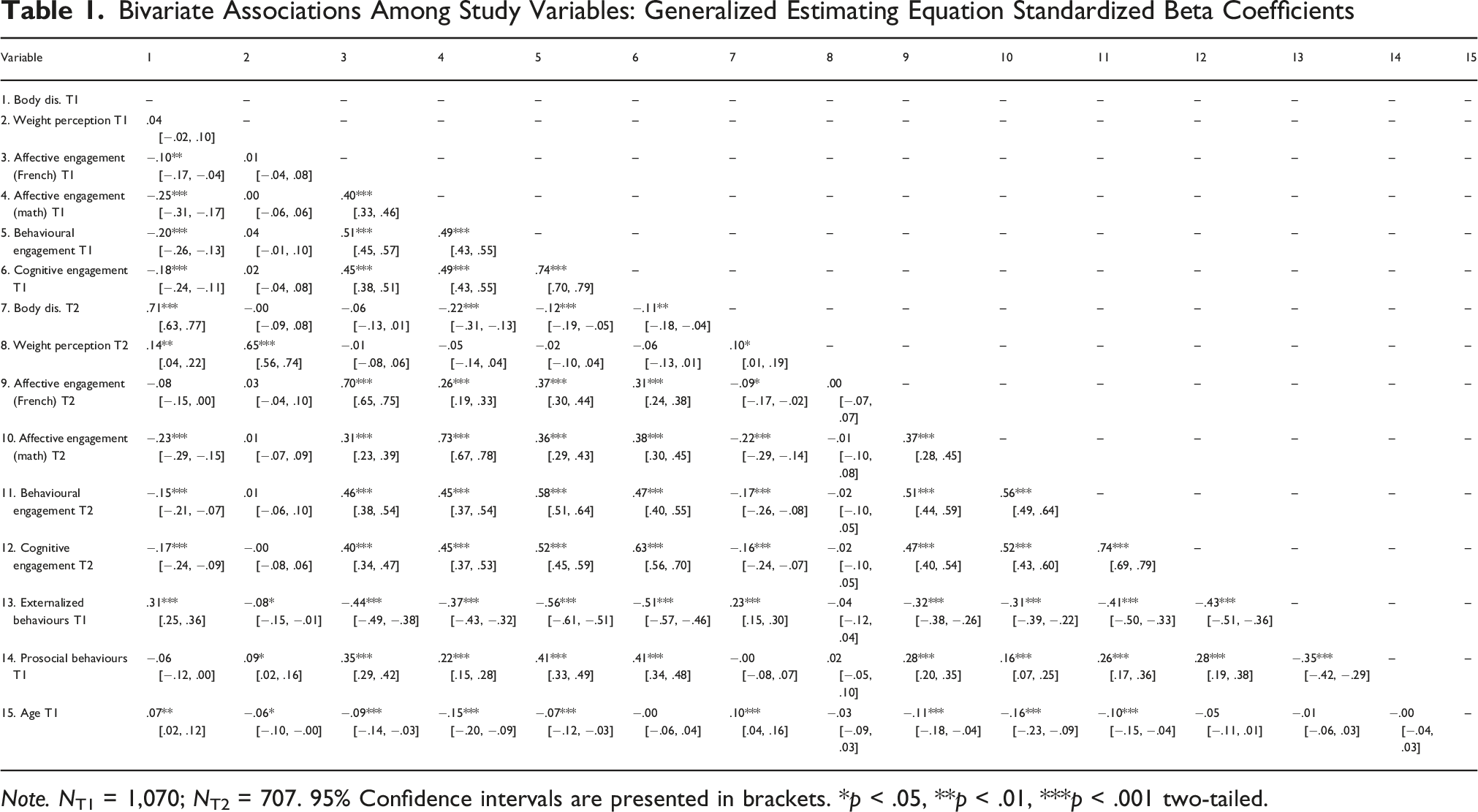
Note. NT1 = 1,070; NT2 = 707. 95% Confidence intervals are presented in brackets. *p < .05, **p < .01, ***p < .001 two-tailed.
Main Analyses
Affective Engagement in French
Fit indices indicated that the affective French engagement model showed good fit (χ2 = 16.56, p = .05, RMSEA = .02, CFI = .99, TLI = .98). There were stability effects between Time 1 and at Time 2 for affective French engagement (b = .70, SE = .02, p < .001), body dissatisfaction (b = .70, SE = .03, p < .001) and weight perception (b = .64, SE = .03, p < .001). In other words, children who were affectively engaged in French at Time 1 reported similar affective French engagement at Time 2. Similarly, children who were more dissatisfied with their body or perceived themselves as heavier at Time 1 reported similar body dissatisfaction and weight perception at Time 2. Contrary to our hypotheses, body dissatisfaction at Time 1 and weight perception at Time 1 were not associated with affective French engagement at Time 2. Similarly, affective French engagement at Time 1 was not a predictor of body dissatisfaction or weight perception at Time 2.
Affective Engagement in Math
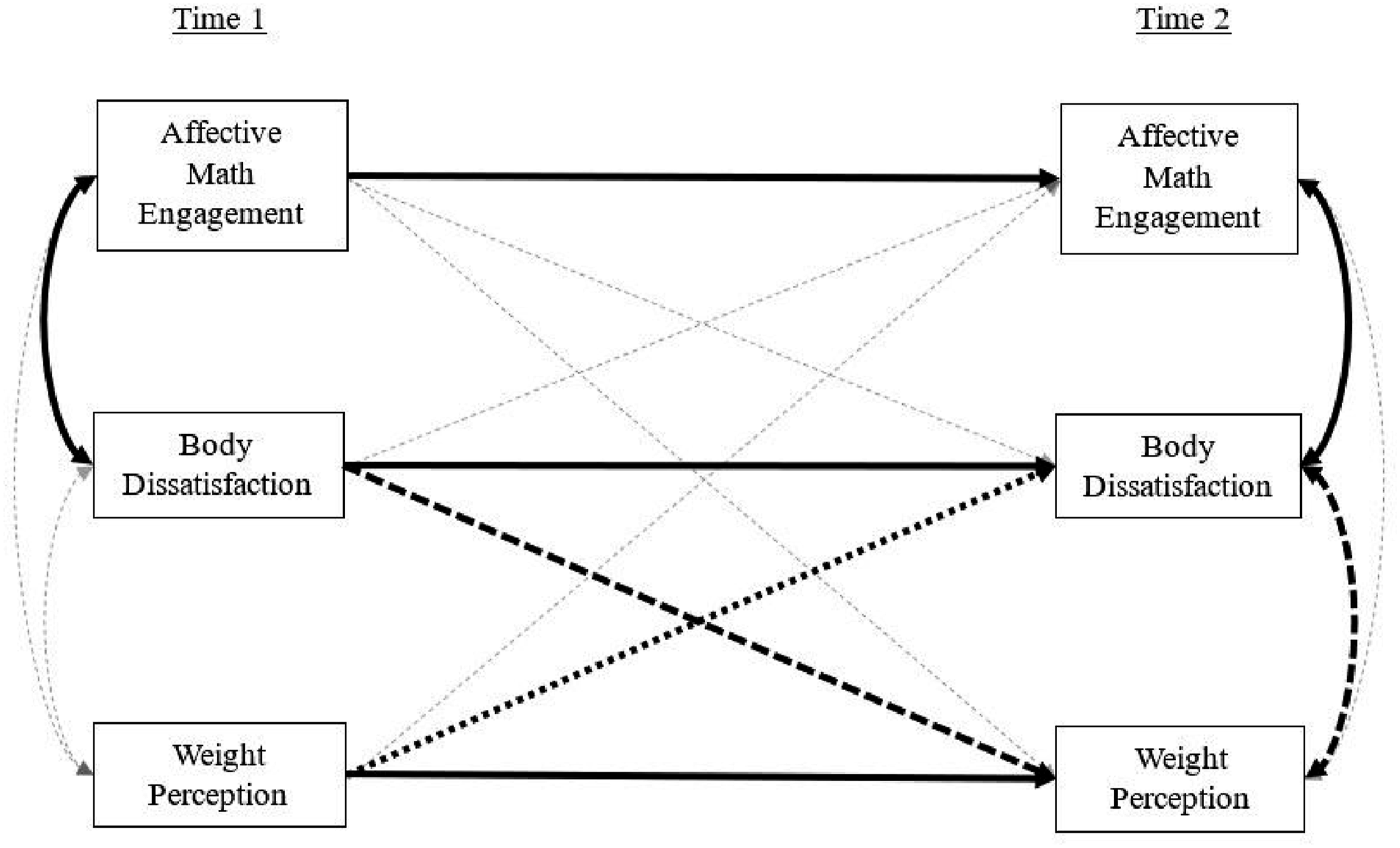
Fit indices indicated that the affective math engagement model showed good fit (χ2 = 20.22, p = .062; RMSEA = .02; CFI = .99; TLI = .98). There were stability effects between Time 1 and Time 2 for affective math engagement (b = .67, SE = .02, p < .001), body dissatisfaction (b = .68, SE = .02, p < .001) and weight perception (b = .59, SE = .03, p < .001). Specifically, children reported similar levels of affective math engagement, body dissatisfaction, and weight perception from Time 1 to Time 2. Contrary to our hypotheses, body dissatisfaction at Time 1 and weight perception at Time 1 were not associated with affective math engagement at Time 2. Similarly, affective math engagement at Time 1 was not a predictor of body dissatisfaction or weight perception at Time 2.
Behavioural Engagement
Despite a significant chi-square, fit indices indicated that the behavioural engagement model showed good fit (χ2 = 18.25, p = .03; RMSEA = .03; CFI = .99; TLI = .97). There were stability effects between Time 1 and Time 2 for behavioural engagement (b = .58, SE = .03, p < .001), body dissatisfaction (b = .70, SE = .02, p < .001) and weight perception (b = .64, SE = .03, p < .001). Specifically, children reported similar levels of behavioural engagement, body dissatisfaction, and weight perception from Time 1 to Time 2. Contrary to our hypotheses, body dissatisfaction and weight perception at Time 1 did not predict behavioural engagement at Time 2. However, there was a negative association between behavioural engagement at Time 1 and weight perception at Time 2 (b = −.07, SE = .03, p = .025), such that children who were less behaviourally engaged at Time 1 perceived themselves as heavier at Time 2. Conversely, behavioural engagement at Time 1 was not a predictor of body dissatisfaction at Time 2.
Cognitive Engagement
Despite a significant chi-square, fit indices indicated that the cognitive engagement model showed good fit (χ2 = 21.25, p = .011; RMSEA = .03; CFI = .99; TLI = .97). There were stability effects between Time 1 and Time 2 for cognitive engagement (b = .62, SE = .02, p < .001), body dissatisfaction (b = .70, SE = .02, p < .001) and weight perception (b = .64, SE = .03, p < .001). Specifically, children reported similar levels of cognitive engagement, body dissatisfaction, and weight perception from Time 1 to Time 2. In line with our hypothesis, there was a negative association between body dissatisfaction at Time 1 and cognitive engagement at Time 2 (b = −.08, SE = .03, p = .005), such that children who were more dissatisfied with their body at Time 1 were less cognitively engaged at Time 2. Conversely, cognitive engagement at Time 1 did not predict body dissatisfaction at Time 2. Contrary to our hypothesis, weight perception at Time 1 did not predict cognitive engagement at Time 2. However, the opposite path indicated a negative association between cognitive engagement at Time 1 and weight perception at Time 2, (b = −.07, SE = .02, p = .010), such that children who were less cognitively engaged at Time 1 perceived themselves as heavier at Time 2.
Gender Differences
The behavioural and cognitive engagement models contained significant gender differences, as evidenced by a significant Sattora-Bentler Chi-Square difference (TRd). Alternatively, the affective engagement models did not contain any significant gender differences in our hypothesized paths (see Figures 1 and 2). Concurrent and longitudinal associations between affective French engagement and body image variables (boys and girls). Note. This figure shows the concurrent and longitudinal paths between our body image variables and affective French engagement for boys and girls. Significant paths are illustrated with solid arrows (solid = overall sample; square dot = boys only; rectangle dot = girls only. Non-significant paths are illustrated with transparent dashed lines. Absent from this figure are three control variables (i.e., age, prosocial behaviours, and externalized behaviours), all of which were controlled for at Time 1 Concurrent and longitudinal associations between affective math engagement and body image variables (boys and girls). Note. This figure shows the concurrent and longitudinal paths between our body image variables and affective math engagement for boys and girls. Significant paths are illustrated with solid arrows (solid = overall sample; square dot = boys only; rectangle dot = girls only). Non-significant paths are illustrated with transparent dashed lines. Absent from this figure are three control variables (i.e., age, prosocial behaviours, and externalized behaviours), all of which were controlled for at Time 1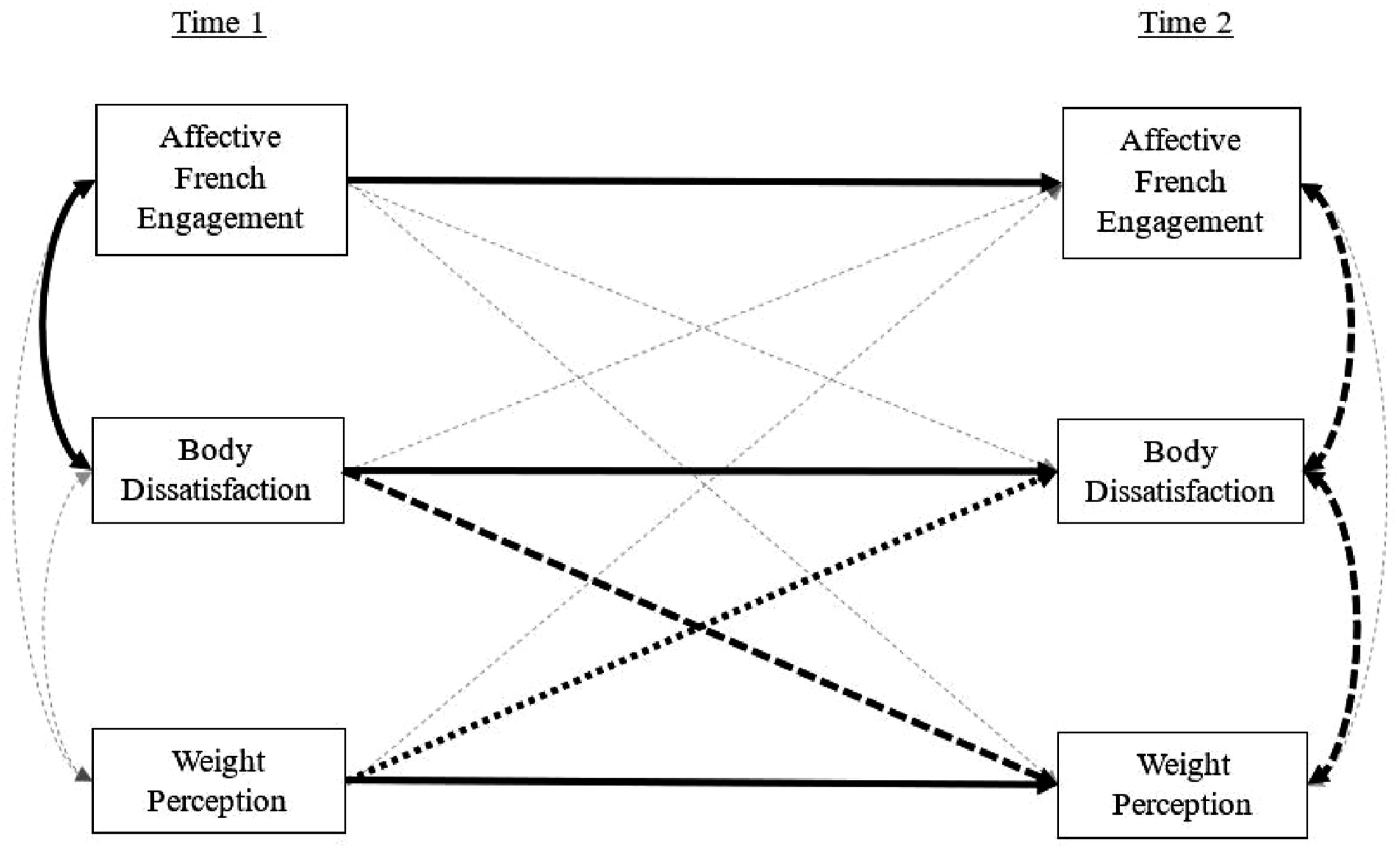
Behavioural Engagement
In our behavioural engagement model (TRd = 55.71, p = .008), there was one notable gender difference. First, boys showed a negative association between behavioural engagement at Time 1 and body dissatisfaction at Time 2 (b = −.08, SE = .05, p = .035), whereas girls did not (b = −.04, SE = .04, p = .289). Specifically, boys who were less behaviourally engaged at Time 1 were more dissatisfied with their body at Time 2. This gender difference is illustrated in Figure 3. Concurrent and longitudinal associations between behavioural engagement and body image variables (boys and girls). Note. This figure shows the concurrent and longitudinal paths between our body image variables and behavioural engagement for boys and girls. Significant paths are illustrated with solid arrows (solid = overall sample; square dot = boys only; rectangle dot = girls only). Non-significant paths are illustrated with transparent dashed lines. Absent from this figure are three control variables (i.e., age, prosocial behaviours, and externalized behaviours), all of which were controlled for at Time 1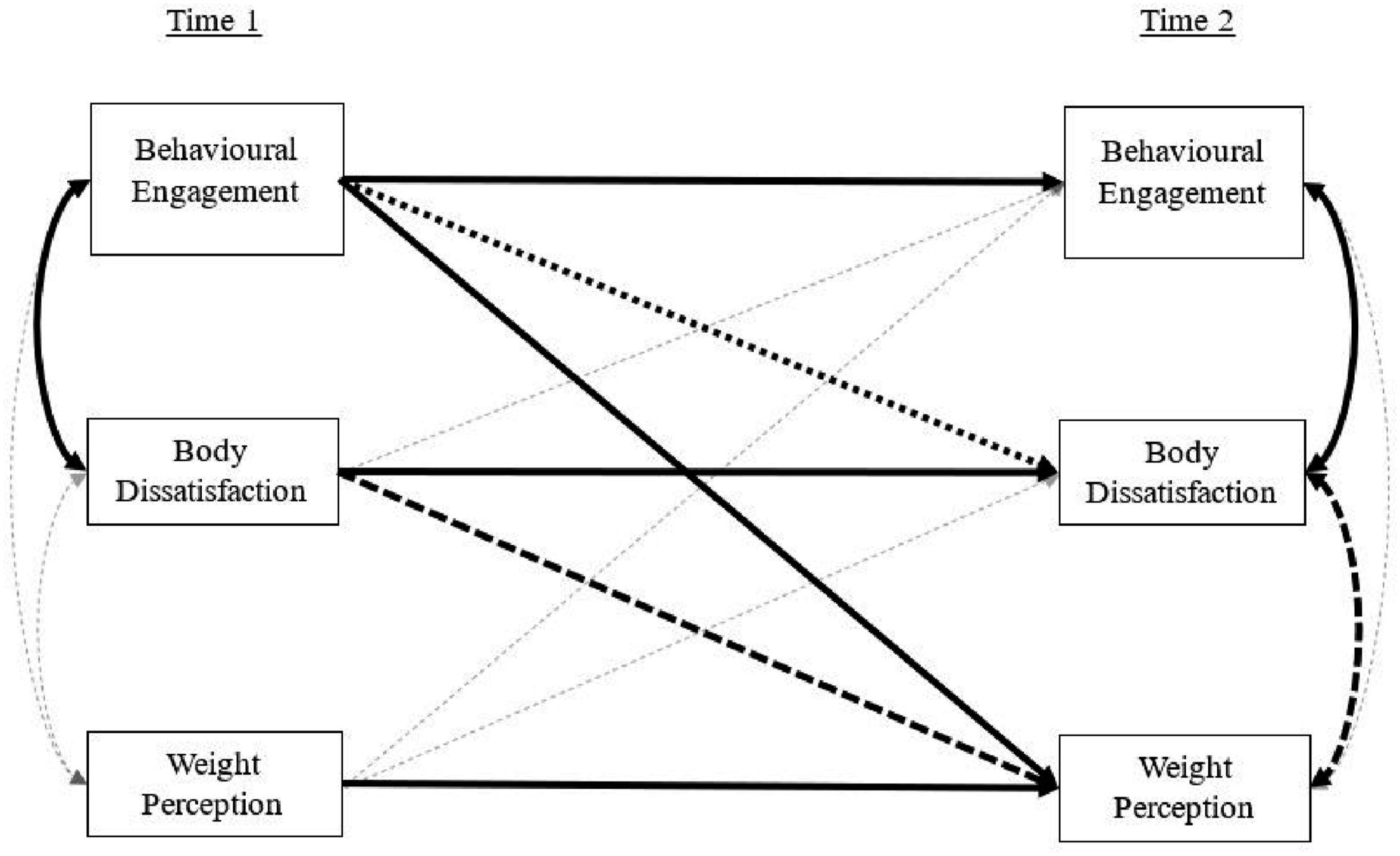
Cognitive Engagement
In our cognitive engagement model (TRd = 55.39, p = .008), two gender differences emerged. First, girls showed a negative association between body dissatisfaction at Time 1 and cognitive engagement at Time 2 (b = −.08, SE = .04, p = .047), whereas boys did not (b = −.08, SE = .06, p = .156). Specifically, girls who were more dissatisfied with their body at Time 1 were less cognitively engaged at Time 2. Second, girls showed a negative association between cognitive engagement at Time 1 and weight perception at Time 2 (b = −.07, SE = .03, p = .031), whereas boys did not (b = −.07, SE = .04, p = .131). Specifically, girls who were less cognitively engaged at Time 1 perceived themselves as heavier at Time 2. These gender differences are illustrated in Figure 4. Significant concurrent and longitudinal associations between cognitive engagement and body image variables (boys and girls). Note. This figure shows the concurrent and longitudinal paths between our body image variables and cognitive engagement for boys and girls. Significant paths are illustrated with solid arrows (solid = overall sample; square dot = boys only; rectangle dot = girls only). Non-significant paths are illustrated with transparent dashed lines. Absent from this figure are three control variables (i.e., age, prosocial behaviours, and externalized behaviours), all of which were controlled for at Time 1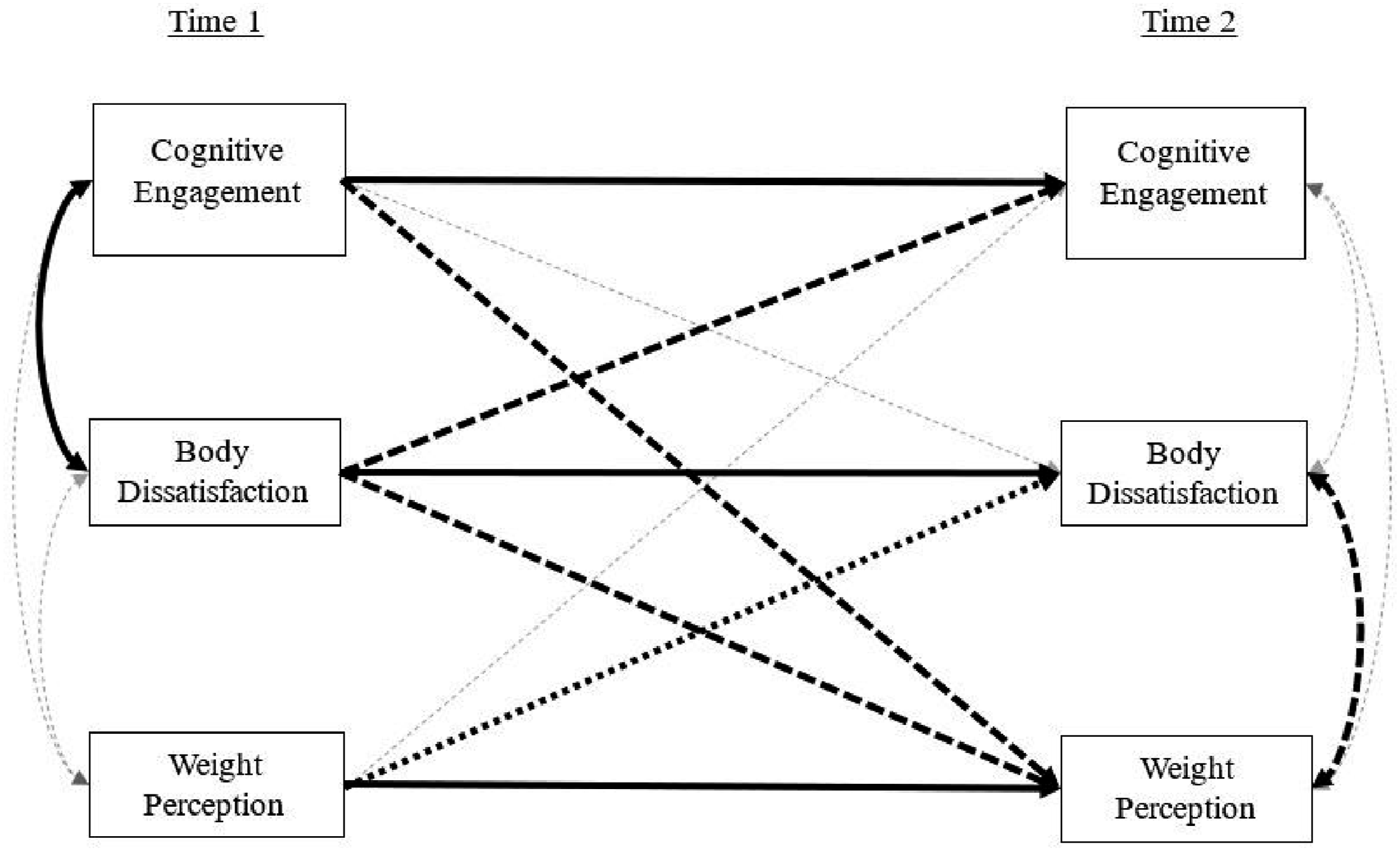
Discussion
The first objective of this study was to examine the longitudinal associations between children’s body dissatisfaction, weight perception, and the four types of engagement (i.e., affective French and math, behavioral, and cognitive). The second objective was to examine potential gender differences in these longitudinal associations.
Body Dissatisfaction and School Engagement
Affective Engagement
Contrary to our hypotheses, body dissatisfaction and weight perception did not predict changes in affective engagement (i.e., French or math) over time. Specifically, how children feel about their bodies and the way they perceive their weight does not appear to lead to changes in their enjoyment or interest in French or math classes. This suggests that affective engagement in elementary school may be shaped by more social or environmental factors, such as the quality of their relationships with peers, their teachers, and the general climate of their learning environment (Rautanen et al., 2020). It is also possible that body image only begins to influence affective engagement when a child’s preoccupations with their body or weight are socially reinforced in the school environment as might be the case with frequent weight-based teasing or bullying (Guardabassi & Tomasetto, 2022). Moreover, our measure of affective engagement specifically tapped into children’s specific enjoyment and interest in math and French learning activities, rather than their broader emotional comfort at school—the latter of which may be more intrinsically linked to body image issues.
Behavioral Engagement
Contrary to our hypothesis, body dissatisfaction at Time 1 was not associated with behavioural engagement at Time 2 in our overall sample (see below for gender differences). This contrasts with the findings of Guimond and Laursen (2022), which were that body dissatisfaction predicted decreases in their measure of academic engagement (i.e., included elements of affective and behavioural engagement) over an 8-week period. It is possible that behavioural engagement is more driven by other factors, such as our control variables (e.g., children’s prosocial behaviours or externalized issues), than it is by body dissatisfaction. Moreover, even if children are dissatisfied with their body, they may behave in a variety of ways to avoid drawing unwanted attention to themselves. This explanation is in line with the bullying literature, which has shown that children who are victims of bullying sometimes engage in social withdrawal as a tactic to avoid future instances of teasing (Coelho & Romão, 2018), whereas other children tend to react aggressively to being victimized (Olweus & Breivik, 2014). In the context of body dissatisfaction and behavioural engagement, children may simply cope differently with concerns about body-related teasing. Whereas some children might follow class rules to help them “blend in” and avoid being teased about their appearance by their peers, others might “act out” and exhibit disruptive classroom behaviours to accomplish the same goal.
Gender Differences
Also contrary to our hypotheses, only boys who were less behaviourally engaged at Time 1 were more dissatisfied with their body at Time 2. The directionality of this effect was the reverse of what we predicted. With that said, this is in line with findings that boys are more at risk of becoming disengaged than girls (Janosz et al., 2008; Martins et al., 2022) and that they are especially at risk of becoming behaviourally disengaged at a young age (Blondal & Adalbjarnardottir, 2012). Moreover, it is worth noting that boys are slightly less likely to become dissatisfied with their body compared to girls (Ferreiro et al., 2014), and as a result, may need more adverse experiences or difficulties (e.g., behavioural disengagement) for their body dissatisfaction to worsen.
This gender difference could also be explained by a third variable, such as self esteem, which has been found to be associated with school engagement (Barragán Martín et al., 2021) and body dissatisfaction (Bos et al., 2010). This would be consistent with the vulnerability model of self esteem (Beck, 1967), which posits that poor self esteem is a long-term risk factor for various forms of psychopathology. Notably, boys and girls with low self esteem differ in their coping strategies, as boys tend to rely more on avoidance coping strategies whereas girls rely more on problem solving strategies and seeking social support (Eschenbeck et al., 2007). Therefore, boys with poorer self esteem may not feel confident about their academic abilities and choose to use avoidant coping strategies to avoid opportunities for disappointment (e.g., purposely not trying at school), which could ultimately lead to behavioural disengagement. On the other hand, girls might respond to poor academic self esteem with more active coping strategies (e.g., working harder to make up for their perceived weaknesses), which could explain why girls tend to report greater behavioural engagement (Janosz et al., 2008). Ultimately, for boys with poor academic self esteem, an overreliance on avoidant strategies may result in their self esteem worsening and spreading to other areas over time, such as body dissatisfaction.
Cognitive Engagement
As hypothesized, greater body dissatisfaction at Time 1 predicted lower cognitive engagement at Time 2 in our overall sample (see below for gender differences). To our knowledge, we are the first to report this finding, and it suggests that body dissatisfaction leads to meaningful interference with how children manage and organize their schoolwork. While the mechanism through which this interference occurs is unclear, it is worth noting that being dissatisfied with one’s body is often marked by preoccupations with body-related thoughts and concerns about being negatively evaluated by others. These tendencies may tax the cognitive resources that children require to adequately employ self-regulating, cognitive, and metacognitive strategies that support learning. This aligns with research on self-objectification (i.e., the tendency to internalize observers’ perspectives on one’s body; Fredrickson & Roberts, 1997) which has been shown to begin in early childhood (Daniels et al., 2020) and subsequently drive body dissatisfaction through habitual self-monitoring (Tiggemann & Lynch, 2001). For instance, greater self-objectification predicts poorer math reasoning in high school students (Fredrickson et al., 1998) as well as poorer cognitive functioning in undergraduates (i.e., processing speed, logical reasoning, and spatial reasoning; Gapinski et al., 2003). Though cognitive functioning is its own distinct construct, cognitive engagement is likely required to perform well on most cognitive tasks.
Gender Differences
Contrary to our hypotheses, only girls who were dissatisfied with their body at Time 1 were less cognitively engaged at Time 2. Our findings suggest that girls’ body dissatisfaction does not lower their affective or behavioural engagement at school (e.g., does not make them enjoy learning less, does not make them follow rules less). However, girls’ cognitive capacity to be organized and efficient with their schoolwork appears to be more negatively impacted by body dissatisfaction than their male peers. This suggests that girls may internalize their body dissatisfaction more than boys, which aligns with cross-cultural research identifying girls as more likely to experience an array of internalized difficulties (e.g., depression and anxiety; Campbell et al., 2021). Notably, girls are more likely than boys to engage in repetitive, self-focused thinking when confronted with stressors or negative emotions (Espinosa et al., 2022). In the context of body dissatisfaction, this tendency to ruminate may lead girls to dwell more extensively on appearance-related concerns and perceived shortcomings. Such repetitive thinking could further tax the cognitive resources required for planning, monitoring, and regulating schoolwork, thereby contributing to lower cognitive engagement over time. On the other hand, boys’ Time 1 body dissatisfaction was not associated with Time 2 engagement in any model. This suggests that boys’ decreasing levels of engagement might be better explained by other factors, such as externalized behavioural issues (Perdue et al., 2009) poor academic performance (Hughes et al., 2008), or a desire to maintain a “cool” and masculine image (Kessels et al., 2014).
Weight Perception and School Engagement
Contrary to our hypotheses, weight perception at Time 1 did not predict engagement at Time 2 in any model. This lack of associations may support the notion that a child’s weight is less related to school engagement than their level of satisfaction with their weight. However, without an objective measure of children’s weight status (i.e., BMI), we are unable to determine whether children’s weight perception is accurate or distorted (i.e., weighing in the normal range but perceiving yourself as overweight), which prevents us from drawing this conclusion. With that said, it did not seem to matter whether children perceived themselves as heavier or slimmer—what mattered more with regards to engagement was the extent to which they were dissatisfied with this perception of their weight. This is contrary to research by Florin and colleagues (2011), who found that children’s academic achievement was predicted by their weight perception (i.e., students who perceived themselves as heavier performed worse at school). Although school achievement and engagement are distinct constructs, they are highly related to one another (Hughes et al., 2008). A possible explanation for this discrepancy in findings is that including more meaningful predictors in our models (i.e., body dissatisfaction, age, prosocial behaviours, and externalized behavioural problems) may make weight perception a nonsignificant predictor of engagement.
Also contrary to our hypotheses, lower behavioural and cognitive engagement at Time 1 predicted heavier weight perception at Time 2 in our overall sample. Again, this finding is difficult to interpret as we were unable to conclude whether children’s weight perception was accurate or distorted. For instance, if children’s weight perception was accurate, this finding could suggest that being less behaviourally and cognitively engaged puts children at risk of becoming overweight. This would align with research that has concurrently linked overweight status with a range of academic difficulties in childhood (Lv et al., 2020) and adolescence (Finn et al., 2018). On the other hand, if children’s weight perception was distorted, this might be best explained by underlying self esteem issues that initially influence engagement before later manifesting as weight-based concerns (i.e., vulnerability model of self-esteem; Beck, 1967).
Strengths, Limitations, and Future Directions
Most notably, our study has identified novel findings regarding the long-term interplay between body image and school engagement in children. In particular, gender differences suggest directionally specific effects, such that boys and girls experience distinct risk factors for becoming dissatisfied with their body and disengaged in school. The primary strengths of our study are its large sample size and longitudinal design—both of which represent marked improvements in comparison to prior research. Moreover, our approach of including multi-dimensional measures of body image and school engagement is a notable improvement compared to prior research that has typically measured only a single dimension of each. Moreover, our inclusion of known predictors of engagement as control variables in our models strengthens our confidence in the findings, as all our significant findings were found to be above and beyond the influence of these well-established risk factors (i.e., prosocial behaviours, externalized behavioural issues, age).
Despite these strengths, there are limitations worth noting when interpreting our findings. First, weight perception was measured using a single item, which prevented us from assessing its internal consistency. Beyond reliability concerns, the primary issue with our measure of weight perception is that, without an objective measure of weight status, we were unable to determine whether children perceived their weight accurately or in a distorted manner (e.g., reporting that they perceive themselves as overweight when they are in the normal range). Ultimately, this makes it difficult to interpret the lack of directional effects from weight status to school engagement. Moreover, although weight perception is commonly assessed as a perceptual dimension of body image in youth research (Wang et al., 2018), body image perceptions can also encompass broader aspects of appearance, such as body shape or specific physical features. Future studies using more comprehensive measures of body perception may reveal stronger or more nuanced associations with school engagement.
Second, while our sample was considerably larger than most prior studies, we did experience notable attrition from Time 1 to Time 2 (i.e., 34%). This sample size reduction led to lower statistical power, which increased our risk of Type II errors—ultimately making it more challenging to detect real effects. While our findings suggest that children’s body image and engagement influence one another over time, additional research is needed to clarify the nature of these associations. For instance, future studies should include an objective measure of children’s weight status (e.g., age- and sex-specific BMI percentile) as this would allow us to tease apart the relative influences of body image (i.e., satisfaction and perception) and weight on engagement. Additionally, although family wealth was measured, our sample was relatively affluent and socioeconomically homogeneous, which limited our ability to meaningfully examine the potential role of socioeconomic factors in these associations. Future studies should replicate these findings in more socioeconomically diverse samples, given that findings suggest that lower socioeconomic status is associated with lower school engagement, likely due to differences in access to educational resources, parental support, and increased exposure to chronic stressors (Martins et al., 2022).
Conclusions
Our findings provide new insights into how children’s body image and school engagement influence each other over time. Should our findings continue to be replicated, this could inform gender-specific intervention approaches to address body image issues and school disengagement in children. Specifically, boys appear to become disengaged prior to becoming dissatisfied with their body, whereas the reverse seems true for girls. This could suggest that young boys may benefit more from preventative interventions designed to promote school engagement, whereas young girls may benefit more from early interventions designed to foster a positive body image.
Footnotes

Ethical Considerations
This study was approved by the research ethics board at the University of Ottawa (approval #H-02-22-7488) on April 3, 2022. This study was part of a larger longitudinal study on student academic adjustment and outcomes that was approved by the research ethics board at the Université de Sherbrooke (approval # 2020-2698) on September 2, 2020.
Consent to Participate
We initially contacted schoolboards in the province of Quebec, Canada to seek permission to recruit from schools in their respective districts. If we received approval, our request was then forwarded to principals of those schools within each district. If school principals approved our request, we then contacted teachers in those schools about our research project. Finally, if teachers approved of our study, we began our informed consent process with children, their parents, and their teacher. Parents and teachers provided their written consent, whereas written assent was obtained from all children who participated. Children who decided not to participate were allowed to instead participate in activities in a separate room.
Author Contributions
Funding
The authors disclosed receipt of the following financial support for the research, authorship, and/or publication of this article: This research was supported by a Social Sciences and Humanities Research Council of Canada (SSHRC) Insight Grant (430-2021-00009).
Declaration of Conflicting Interests
The authors declared no potential conflicts of interest with respect to the research, authorship, and/or publication of this article.
Data Availability Statement
The datasets generated and/or analyzed for the current study are not publicly available in a repository due to the nature of our ethics approval. However, they are available from the corresponding author upon request.