



Abstract
Background
Determine attitude of young people to reproductive health issues can somewhat predict their behavior in this area. This helps us in planning future on reproductive health. The aim of this study was to determine the attitude of reproductive health and related factors among Iranian students in public universities in Iran.
Method
A cross-sectional study was carried out. The tool was developed based on a literature review to find out about reproductive health attitudes and sociodemographic factors associated. The face and content validity of the questionnaire was performed using expert judgment. Cronbach’s coefficient and test–retest were used to determine the reliability. Data were analyzed using the Statistical Package for Social Sciences software by independent t test, ANOVA, and multiple linear regression.
Results
Out of 461 respondents, the majority of students were nonmedical sciences (81.1%). The main sources of information for reproductive health awareness were the media (40%); 54.9% disagreed with having premarital sex in both sexes, while only 36% agreed to postpone sexual activity until marriage in order to prevent sexually transmitted diseases. Moreover, 64% believed that contraception would cause infertility in the future. The majority found the need for reproductive health services and education essential for single youth. Multiple regression showed a poor reproductive health attitude in nonmedical students, families who did not talk about boy–girl relationships, as well as in satellite users and hookah consumers.
Conclusion
The students’ level of attitude on reproductive health was not satisfactory. Intervention programs related to reproductive health taking into account the cultural aspects of Iranian society can protect young people from risky behaviors and unwanted pregnancies by creating a positive attitude.
As a driving force, youth play a key role in the political, social, and cultural development of societies. 1 One of the United Nations human development indicators for assessing countries’ development and well-being is the presence of young population that is considered a serious cause of change, transformation, and development in all dimensions. 2 Countries that have properly managed their young populations have achieved prosperity and development, but countries that were not successful in this regard, young people became a serious challenge to stability and socioeconomic development of communities. 3
Today’s young generation is the largest in history; globally, 1.8 billion people between the ages of 15 and 24 make up a quarter of the world’s population. 4 Estimates of the population of Iran in recent year show that about 24% of the population is young people aged 15 to 29 years. 5 These young people live in diverse sociocultural and economic backgrounds but share their important challenges and opportunities related to sexual health and reproduction. In all countries, increasing access to the media, urbanization, and globalization play a role in changing young people’s sexual values, norms, and behaviors, which are often at odds with traditionally, culturally, and socially conservative attitudes toward premarital sex and gender norms. These factors contribute to significant barriers that limit young people’s access to the information and services they need to transition to adulthood. 6
Youth is the time of the formation of important behavior patterns including sexual and reproductive behaviors. 7 Current information suggests that most young people are entering adulthood when they are not ready to move on. The transition from adolescence to adulthood without accurate knowledge and positive attitudes about reproductive and sexual health information and services may lead to many negative behavioral consequences and problems. 8 In general, a significant proportion of young people are sexually active. In addition, many young girls report forced sex. As a result, young people are exposed to poor outcomes such as premature and unintended pregnancy, unsafe abortion, sexually transmitted infections, and HIV. Poor sexual and reproductive health not only affects the health and well-being of young people, but they also have significant economic and social consequences and affect education, economic participation, and poverty. These negative consequences extend to the families of young people and future generations and can have a cycle of disadvantages forever. 9
Attitude plays an important role in the development of reproductive and sexual health in young people. Rocklage and Fazio 10 describe attitude as a complex state of emotions, desires, beliefs, and prejudices that, due to different experiences in the individual, makes a person ready to behave. Awareness of attitudes relatively enables one to predict the behavior. Negative attitudes toward reproductive health issues can lead to harmful behaviors in young people. Attitude is the first determinant of behavioral intention. Individuals’ attitudes toward different behaviors can predict their tendency to one behavior. The more favorable becomes the individuals’ attitudes toward a specific behavior, the stronger their intentions would be toward performing well in that subject. Therefore, the first step for sexual health of young people is awareness of their attitude toward reproductive health, and then correcting it by appropriate educational interventions. 11
Despite the growing trend of the young population in Iran, their reproductive health needs have been less studied. Although some studies have been conducted in this area,7,12,13 these studies have avoided sensitive issues, such as attitudes toward reproductive health and sexual relationships, prevalence of risky sexual behaviors, and rates of sexually transmitted diseases (STDs), due to cultural sensitivities. Instead, researchers have focused on topics such as girls’ puberty and family planning. Cultural sensitivities may also be a factor affecting the poor youth awareness and attitudes about reproductive health in Iran, as well as limiting educational opportunities for questions and correct misconceptions about youth reproductive health. 14 In Iran, many reproductive health services are currently provided free of charge to married couples, but it is not possible for single young ones to receive such services, and health care providers are often not trained to deal with youth reproductive health issues.15,16 Meanwhile, studies showed that Iranian youth have poor knowledge of reproductive health,13,14 and 8% of them have premarital sex. 7 Therefore, reproductive health in single youth is less known in Iranian society. Few studies on the attitudes and beliefs of young Iranian girls about sexual and reproductive health indicated a lack of information on reproductive health.3,13,15,17
In addition, Indian youth often have serious misconceptions about sexuality and reproduction and are unprepared to make safe, informed decisions. Many hold permissive attitudes on the acceptability of premarital sex. 18 The study of Mitsiwat et al. 19 has shown that students strongly agree the inclination that only females should use reproductive health service. A study among Turkish youth showed the opinion of males about having sexual intercourse before marriage for males was positive, and females were more tolerant about males having this experience before marriage as compared with females having sexual experience before marriage. 20
Empowering young people to have the highest attainable standard of sexual reproductive health is a fundamental human right. In Asian countries, some policies include approaches to create a more supportive environment for young people, increase access to comprehensive sex education, opportunities to reinforce effective attitudes, and improve childbirth through sexual and reproductive health services. 21 However, the coverage and quality of such programs are poor in many countries, including Iran. Social, cultural, national laws and policies are the most important barriers to improving the sexual reproductive health status of youth.
Reproductive health is an important issue of public health and can affect the overall health and quality of life, especially in young people. Therefore, awareness of students’ attitudes toward reproductive health can help us in planning reproductive health education to promote youth health. There is little information available on the attitude of single Iranian youth, especially girls, toward reproductive health. Current study is conducted to investigate single female students’ attitudes toward reproductive health subjects.
Methods
A cross-sectional study was conducted in all public universities of Babol, Iran, with 461 students from November to February 2018. Babol is a city in northern Iran with three public universities. A stratified sampling random method was used to select the samples. The universities were divided into separate strata. Then the sample size of each class was determined by proportional allocation method. Since each university consisted of several faculties, a number of faculties were randomly selected from each university. At the end, samples were selected by simple random sampling from each faculty in the student gathering places at each faculty. Sample size was estimated to determine the relationship between factors affecting reproductive health attitude at 95% confidence level and 80% test power to identify the relationship (r = .15).
Inclusion criteria included willingness to participate in the study, age 18 to 29 years, female, and single at the time of the study. Exclusion criteria included withdrew from further cooperation and incomplete answer to the questionnaires. Before the distribution of questionnaires, the purpose of the study was completely explained to the students. It took about 10 minutes to complete the questionnaire and was collected immediately upon completion. This study was approved by the Ethical Committee of Babol University of Medical Sciences, Iran (IR.MUBABOL.HRI.REC.1397.129). All participants provided an informed written and signed consent form. All questionnaires were anonymous.
At first, the questionnaire was prepared by reviewing resources and articles related to reproductive health. The self-administered questionnaire consisted of three parts: (a) demographic characteristics (age, level of education, place of residence, parents’ education and occupation, family income from individual perspective), (b) life style (religious viewpoint, talking about reproductive health concepts in family, receiving information from parents about the relationship between boys and girls, source of information, living situation with parents, watching satellite, smoking cigarette and hookah and drinking alcohol, and going to parties with their peers), and (c) attitude about reproductive health consisted of 16 questions.
Attitude was determined based on 5-point Likert scale with a maximum score of 5 and minimum score of 1. The scores of 5 to 1 were assigned to questions 1–5, 7, 10–12, and 14–15 from strongly agree to strongly disagree and for questions 6, 8, 9, 13, and 16 from strongly disagree to strongly agree, respectively. The overall score was 0 to 80. To determine the mean score of reproductive health attitude in terms of quartiles, the scores were categorized in the following approach: individuals in the first quartile scored less than 54, second quartile scored 55 to 58, third quartile scored 59 to 63, and fourth quartile scored equal or more than 64.
In this study, after designing the questionnaire, validity including face and content validity as well as Cronbach’s alpha coefficient was used to determine validity and internal consistency, respectively. Qualitative method was used to evaluate face validity, similar to the method used for content validity. Qualitative and quantitative methods were used to assess content validity. For the qualitative method, the experts were asked to write their ideas about grammar, the use of correct words, the questions importance, located questions in proper place, and the time needed to complete the questionnaire. The necessary changes were made to the questionnaire based on the opinions of the experts.
An independent panel (n = 10) was used to ascertain content relevance. They assessed the questionnaire in terms of content clarity (i.e., suitability and cognitive complexity) and its relevance to the concept. After collecting the expert opinions, changes were made to the tool.
For quantitative assessment of content validity, Lawsheis model was used. To confirm that the content selected was the most important and accurate, content validity ratio was used. The content validity index (CVI) was also measured to ensure that the tool questions were optimally designed. The expert opinion was classified as follows: necessary, useful but not necessary, and not necessary. A content validity ratio above 0.59 was accepted. To calculate the CVI, the questionnaire was given to the previous expert panel, and their opinions were collected for each question based on a 4-part spectrum from 0 to 3 (irrelevant, somewhat relevant, relevant, and completely relevant). After validation, three attitude questions, removed and finally, 16 questions remained. The CVI value was 0.82. Cronbach’s alpha was used to control the reliability. For this purpose, a pilot study was carried out, and the questionnaire was completed by 30 students from a university other than the actual study participants’. After confirmation of initial reliability, the study was conducted. The standardized Cronbach’s alpha reliability coefficient was 0.890.
Data Analysis
The data were analyzed using Statistical Package for Social Sciences version 20.0. Comparisons among groups were made using appropriate inferential tests such as t test and ANOVA. Multiple linear regression was used to determine the predictors of reproductive health attitude. We introduced in these models the main explanatory variables that were associated with reproductive health attitude at p < .05 in the bivariate analysis. To estimate the proportion of variance in reproductive health attitude that can be accounted for by sociodemographic and life style factors, multiple linear regression analysis was performed. The level of significance was set at 0.05.
Results
The mean age of the participants was 21.21 ± 2.24 ranged between 18 and 29 years. About 18.9% of samples were students of medical sciences, and the rest were nonmedical; 76.8% were undergraduate, and 23.2% postgraduate or general practitioner students (Table 1). The mean of the reproductive health attitude was 58.34 ± 7.05, ranging from 38 to 80; 29.9% of individuals were in the first quartile (score ≤54), 22.3% in second quartile (score 55–58), 25.8% in third quartile (score 59–63), and 21.9% in fourth quartile (score ≥64). This means that 47.7% of individuals had good reproductive health attitude.
Relationship Between Demographic Characteristics and Reproductive Health Attitude (n = 461).

The main sources of information for reproductive health was the media (40%) including books and magazines, movies, radio, television, and internet and then they referred to friends (21.9%) and family (19.2%). Receiving information from health system, relatives, and teachers were the least used resources (Figure 1).

Frequency Distribution of the Students, by Most Important and Preferred Sources of Information on Reproductive Health.
Regarding the relationship between boys and girls, 58% believed that single boys or girls could have girlfriends or boyfriends, but 54.9% considered having sex for single boys and girls as an inappropriate behavior. In addition, 56% believed that a girl should remain virgin until marriage; besides the majority of students, 83.7% considered premarital sexual relationship to be inappropriate also for boys; 48.4% stated that having premarital sexual relationship is incompatible with their religious beliefs. Regarding STDs, only 36% of students agreed that the best way to prevent STDs and unwanted pregnancies is to delay sexual activity until marriage. Also, 56.4% found it appropriate to teach contraceptive and STDs preventive methods to single youth; 63.6% of the students believed using contraceptive methods may cause infertility in the future. About the reproductive health needs of youth, over 70% of students believed that single youth need reproductive health education. More than 80% of students found it necessary to have access to educational booklets on contraceptive and STDs, to have sex and premarital preparation classes, and to establish reproductive and sexual health clinics for young people (Table 3).
Relationship Between Life Style Factors and Reproductive Health Attitude (n = 461).
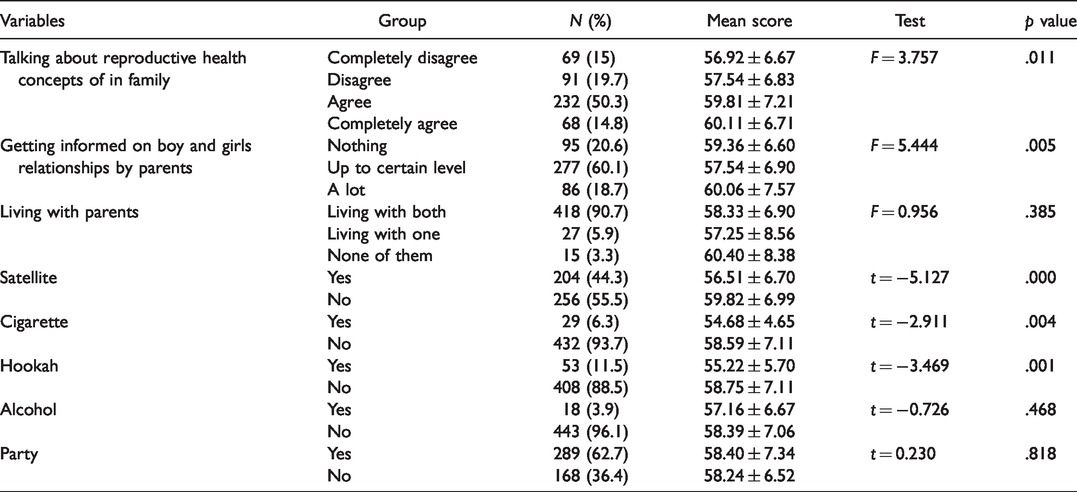
Table 2 shows the results of the bivariate analyses for demographic and life style factors. Medical group students, urban resident, PhD students, with father higher education, and with parents working in government positions had a better attitude toward reproductive health (p < .001, p < .05). Similar results were obtained for students who considered themselves religious and talked to their parents about the concepts of reproductive health and the relationships between girls and boys (p < .001, p < .01), while students who used satellites, cigarettes, and hookahs had a weaker attitude toward reproductive health, compared with others (p < .001).
A standard multiple regression was conducted to estimate the prediction of attitude by sociodemographic and lifestyle factors. Multiple linear regression analysis showed that reproductive health attitude was significantly associated with the type of faculty of the students, whether medical sciences or nonmedical, using satellite and hookah as well as talking with parents about girl–boy relationships (Table 4). The assumptions of normality, linearity, and homoscedasticity of residuals were met. In combination, sociodemographic factors accounted for a significant 11.7% and lifestyle factors for a significant 18.6% of the variability in reproductive health attitude.
Distribution Responses to Statements About Aspects of Reproductive Health Attitude.

Abbreviation: STDs, sexually transmitted diseases.
Multiple Linear Regression Analysis Showing Factors Associated with Reproductive Health Attitude.

aR 2 = 0.117.
bR 2 = 0.186.
cTalking about reproductive health concepts of in family.
dInforming young people about boy-girl relationships by parent.
Discussion
A considerable proportion of the university students did not have a positive attitude toward reproductive health. The lack of a proper attitude on reproductive health was reported in most of the developing countries.18,21,22 Negative health attitude among youths may lead to risky behaviors, unsafe sexual practices, STDs, and unwanted pregnancies.23,24 This finding is consistent with study by Soleymani et al. 25 regarding sexual and reproductive health among university students in Malaysia. On the other hand, Michaud et al. 26 found a completely negative approach to sexual and reproductive health among university students in Europe. This contradiction between attitudes highlights the importance of sociocultural and religious factors over reproductive health education and services widely available in most developing countries.
According to learning theories, attitude is a state of mental and neurotic readiness that is formed through experience and has a direct and dynamic impact on the individual’s response to all subjects and situations affiliated with attitude. Although the increased level of awareness can lead to a positive effect toward reproductive health, but it is not enough for developing a positive attitude and preventing risky sexual behaviors, because sometimes people’s viewpoints and beliefs are formed without prior training. Factors such as economic issues, health policies, and cultural planning are required to access health services and motivate individuals. 27 Attitudes play a very important role in one’s life, thoughts, and personal and social behaviors. Psychologists believe that when we change a person’s attitude, we can change their behavior. Therefore, the more we know about the existing attitudes, the easier it would be to change these behaviors. 11
Recognizing and altering students’ negative attitudes toward sexual and reproductive health concepts is one of the effective ways to improve their performance and to make better decisions in this area. It also has psychological feedback including increased self-esteem and reduced anxiety and stress, which can lead to a positive and helpful attitude toward sexual and reproductive health. 10
The results of present study on boy and girl relationships showed that 58% of youth believed that boys or girls could have partners, and 45.1% were not disagreed about having sexual relationship for single boys and girls. Only 56% of girls believed that girls should remain virgin until marriage, and of course, the majority of the participants (83.7%) considered premarital sex to be inaccurate for boys as well. In Iranian sociocultural context, there is less interaction between girls and boys before marriage, because they are separated from elementary school to university, and any relationship is considered taboo. Also, in Iranian culture, like other traditional societies, 28 it is preferred that the virginity of the girls remains intact until the night of the marriage. Starting a sexual activity only after marriage is very valuable in the Islamic culture of our country, while more than half of young people begin sexual activity as a teenager in many other parts of the world. 8 However, a relatively large percentage of the samples in the present study did not prohibit sex for single youth. The study of Shahhosseini et al. 7 in Iran showed that sexual relationship is common during youth friendship, especially in the form of anal sex or even oral sex to prevent unwanted pregnancy and to remain virginity. Therefore, the authors believe that it is necessary to design and implement sexual and reproductive health education content based on safe contraception methods.
In the present study, the majority of young people were also disagreed on having premarital sexual relationship for boys. This is inconsistent with the results of some available researches. The study of Mohammadi et al. 13 on 15- to 18-year-old males in Tehran showed that although two thirds of respondents were agreed that women should not have sex before marriage, only half of them had the same opinion about men. Gender-based double standards have been similarly addressed in other studies.18,24 Results of several studies have also shown that boys have more premarital sexual relationship than girls. 20 This increases the STDs in men and also transmits it to their spouses after marriage. The available statistics show that the prevalence of STDs in newly married women has increased substantially, 29 and along with increased STDs in women, infertility, and ectopic pregnancies rates have also increased. 30 In this regard, only 36% of our participants believed that the best way to prevent STDs is to delay sexual activity until marriage, while the majority of them were agreed about teaching contraceptives and STDs to single young population. Simbar et al. 12 showed that 8% of Iranian students had started sexual relationship before marriage; the results indicated that reproductive health programs promoting abstinence as the only strategy cannot be always effective, and these programs should have other health messages for those who are sexually active.
Almost two thirds of young people in the present study believed that using contraceptives would lead to future infertility. This view may be the result of their understanding of the experience of young couples who had infertility, while infertility may occur as a result of concurrent STDs in these couples. Training programs for single young people should include this message that “infertility does not happen as a result of using contraceptive methods, but rather, it results from not using contraceptive methods and having STDs.”
The need for reproductive health education programs and services was mentioned by 80% of the participants in the present study. However, some believe that giving information about reproductive health encourages young people to engage in inappropriate sexual behaviors, but based on the results of present study, 80% of students were disagreed with this idea. There is evidence that sex education may prevent risky sexual behaviors and is not associated with increased sexual activity in youth. 25 There is no doubt that a supportive environment is essential to improve the reproductive health programs. Appropriate social, political, and cultural support as well as access to reproductive health information and services for young people is also essential in every community.
The most important source of information for university students about reproductive health was the media (40%) and their friends (21.9%). Only 19.2% of participants mentioned their families as the source of information. These results are consistent with studies in Iran and other countries on university students.13,17,19,25 In contrast, a study on Chinese university students found that mostly they receive information about sexual relationship through magazines and friends. 31 Although parents are important sources of information about sexual behaviors, most students did not mention them as their source of information. A study in Malaysia found that students were less likely to talk with parents about sexual relationships, because they feared that their parents think they had sex. 23 The role of the health system as an information source was minimal in the present study; however, physicians and health personnel are the most reliable sources of information. Therefore, it seems that health professionals, especially physicians, should be involved in sexual education and reproductive health programs in youth.
Multiple regression analysis results showed that medical students had a better attitude toward reproductive health than other students. This finding is consistent with the results of Simbar et al. 12 They showed that students of health sciences had higher sexual and reproductive knowledge than other students. This may be partly due to the college courses including sexual and reproductive health issues. The results were also supported by a study among Malaysian university students. 25 Therefore, providing an educational program on sexual and reproduction health is essential for nonmedical students. It should be noted that the more positive approach of medical students on reproductive health is especially important, because of its impact on the attitudes and behaviors they will show in their professional life.
In the present study, satellite use was associated with a negative approach to reproductive health. Some studies have reported an increased chance of sexual activity with access to satellite TV. 13 It remains unclear to what extent access to satellite television and the internet can affect Iranian youth’s attitudes and behaviors on reproductive and sexual health. In the study of Ayatollahi et al., 6 some Iranian youths expressed concern that internet and satellite TV could significantly expose young people to pornographic content contrary to Iranian cultural and religious norms. A report by the National Youth Organization presented that about one fifth of youth visit pornographic sites during surfing the internet, while three quarters of subjects were male. 32 It should be noted that having personal communications service allows communication between men and women in a way that is not possible in public spaces. Despite the potential of the internet and other technologies to influence attitudes and behaviors, most Iranian families still believe that young people should wait for marriage to begin sexual relationship. This belief seems to be more rigid for girls than boys. However, more researches should be conducted to discover youth norms and attitudes about sex.
The results of the present study showed that those who used hookah had a more negative approach to reproductive health. The study of Mohammadi et al. 13 showed that youth who had permissive attitudes toward sexual relationship and those who drink alcohol or smoke cigarette had a higher chance of having sexual relationship. They suggested two probable explanations in this regard: first, drug abuse and premarital sex may both indicate a general tendency to risky behavior and second, drug abuse affects both the skill and ability to make rational decisions, thus increases the likelihood of sexual contact.
The results of present study showed that young people whose parents informed them about the relationships between boys and girls had a much better attitude than others. The generation gap is a common obstacle to establish friendly relationships between young people and their parents. 7 Parents have an important responsibility to monitor and advice their children in the social contexts of developing countries. 16 Establishing a friendly and trusting relationship between young people and parents, who have adequate knowledge and skills, encourages children to talk to their parents rather than relying on invalid information from peers or searching for information in magazines, pornographic websites, and erotic visual programs. To strengthen the parent–child communication about reproductive and sexual health issues, we can learn from experiences of family reproductive education programs designed and developed in other countries, 33 but it is recommended to adapt such programs to the cultural and social context of each community.
The use of self-administered questionnaires may be considered a limitation of the present study. Sexual issues are sensitive topics regarded taboos by many youths who are reluctant to talk about them. This can also be a limitation of this study. A socially desirable response bias and an information bias were considered in this study. Also data were collected from specified age group of female students and may not be representative of the whole range of sexual reproductive health perceptions among females. The main advantage of this study was the homogeneity of the samples. Samples were all university students, young, single, and female.
It is recommended that cohort studies on reproductive health attitudes be conducted on unmarried, sexually active young people. Findings on comparing reproductive and sexual health attitudes of boys and girls to develop gender-based support programs are also helpful. Among these supportive programs can be paid to impact assessment university-based sex education includes sexual orientation and gender identity to better meet the needs of young people and to address attitudes that lead to discrimination, bullying and harassment.
Conclusion
Students’ attitudes toward reproductive health were moderate, and there are misconceptions about sexual issues. Designing and implementing education in the field of reproductive health and sexual relations, taking into account the cultural aspects of Iranian society, can protect young people from risky behaviors and unwanted pregnancies by creating a positive attitude. Given the role of the media as the largest source of youth information in this study, their role is very important. Education for parents, especially mothers, as well as university teachers, health care providers, and members of religious organizations about how to communicate and provide information to young people should not be ignored.
Footnotes
Acknowledgments
The authors would like to thank all students who participated in this study.
Declaration of Conflicting Interests
The author(s) declared no potential conflicts of interest with respect to the research, authorship, and/or publication of this article.
Ethics Approval and Consent to Participate
The study was approved by the ethics committee of Babol University of Medical Sciences (IR.MUBABOL.HRI.REC.1397.129). All participants provided an informed written and signed consent form.
Funding
The author(s) disclosed receipt of the following financial support for the research, authorship, and/or publication of this article: This study was financially supported by Babol University of Medical Sciences with grant number 9706011. The Research Deputy of Babol University of Medical Sciences financially supported this study.
