



Abstract
Epidural analgesia is widely used as an effective method of pain relief in labor. This study was therefore designed to investigate the awareness and level of utilization of obstetric analgesia in labour among pregnant women in Wesley Guild Hospital Ilesha, Nigeria. The descriptive study involving 110 pregnant women revealed that about half (41.8%) of the respondents had poor knowledge score, 37.3% had fair knowledge, while 20.9% had good knowledge score on obstetric epidural analgesia. Only 10.9% of the respondents had used epidural analgesia and 83.3% were satisfied with the use. There was a significant relationship between knowledge of respondents and the use of obstetric epidural analgesia. Moderate awareness, poor knowledge and low level of utilization of obstetric epidural analgesia were documented. There is a need for adequate awareness programs to enhance the knowledge of epidural analgesia and its utilization among pregnant women in order to reduce the excruciating labour pain.
Labour is seen as an excruciating and most painful event among most Nigerian women and the experience differs from one woman to the other. 1 It is a physiological phenomenon produced by dilation of cervix, stretching of vagina, perineum and pelvic structure. The discomfort associated with labour pain is as a result of ischemia of uterus during contraction, dilatation and thinning of the cervix. 2
Severe pain during labour is not life-threatening for a healthy woman in labour, it may result in the stimulation of the sympathetic nervous system leading to maternal hypertension, oxygen consumption and adversely affecting utero-placenta blood flow, it may contribute to psychological consequences like post-partum depression and post-traumatic stress disorder.3,4 In 2011, the International Association for the study of pain (IASP) was of the opinion that if labour pain is not well managed, it may affect maternal and fetal well-being and progress of labor. Due to the severe and intolerable intensity of the pain, various pharmacological and non-pharmacological methods are utilized to relieve labour pain which act by decreasing maternal hyperventilation and catecholamine secretion.3,5–7 The pharmacological agents include parenteral opioids and inhalational agents such as: nitrous oxide, halogenated agents, meperidine (pethidine), diamorphine and pentazocine while non-pharmacological methods include transcutaneous electrical nerve stimulation and relaxation/breathing techniques, temperature modulation, hypnosis, massage, acupuncture and aromatherapy.
Epidural analgesia is a technique of injecting a combination of local anaesthetic and opioid analgesic into the lumbar epidural space which diffuses into the subarachnoid space where it acts on the spinal nerve roots to block action potential transmission, thus inhibiting pain perception. 6 It also minimizes the labour pain by decreasing blood catecholamine levels, which in turn significantly increases intervillous blood flow in healthy pregnant women. So, it is the only technique capable of relieving labour pains satisfactorily without maternal or fetal sedation and it is the most effective method for restoration of normal uterine activity.6,8 The use of epidural analgesia in high-income countries is about 50%–90%9–11 and this is higher than that of the low-income countries which is about 1.3%–12%.10,12 Despite the availability of effective analgesics, a large population of women still suffer from intense labour pain because of strong beliefs grounded in their culture, ethics and religion that pain is acceptable during labour, lack of knowledge about the availability of analgesia labour services for painless child birth. 13 Therefore, creating awareness by giving proper and full information about epidural analgesia would surely improve the acceptance level among the pregnant women. 8
Despite the effectiveness of epidural analgesia in labour, there are some barriers militating against the utilization of epidural analgesia in Nigeria and they include: Lack of the required skills for the administration of epidural analgesia, ignorance on the part of the pregnant women and the extra cost for providing epidural analgesia in labour, discouragement from family members, cultural and religious beliefs. 10
Previous use of epidural analgesia, high level of socio-economic status, higher educational level, increasing maternal age and patients with private insurance have been associated with the use of epidural analgesia. 14
In developing countries including Nigeria, the awareness and utilization of epidural labour analgesia is very low. Therefore, this study was designed to investigate the awareness and the level of utilization of obstetric epidural analgesia in labour among pregnant women in Wesley Guild Hospital Ilesha, Nigeria (WGH).
Methodology
Study Site
This study was carried out at Wesley Guild Hospital Ilesha, Osun State- a branch of Obafemi Awolowo University Teaching Hospital Ile-Ife.
Study Population
The participants were consenting pregnant women attending ante-natal clinic at least a month prior to the commencement of the study at the Wesley Guild Hospital Ilesha. Pregnant women attending ante-natal clinic at Wesley Guild Hospital less than a month prior to the commencement of the study, those who have had previous caesarian section performed on them and also pregnant women who did not give informed consent were excluded from the study.
Study Design and Sampling Method
This study utilized a descriptive cross-sectional design involving 110 pregnant women who attended ante-natal clinic between November 2019 and December 2019. The participants who gave informed consent were chosen using simple random sampling through balloting without replacement. Sample size was calculated using Cronbach’s formulae.
Instrument for Data Collection
Data was collected using validated, self-administered, questionnaires. Face, content and construct validity was ensured through peer and expert review of the study instrument. The instrument consisted of six (6) sections which elicited information on the socio-demographic variables of the respondents, their level of awareness on epidural analgesia, knowledge on epidural analgesia, level of utilization of epidural analgesia, the perceived barriers of pregnant women in choosing the obstetric analgesia and the factors that can encourage the utilization of analgesia service in labour.
Data Collection, Management and Analysis
Serially numbered self-administered questionnaires were used. After obtaining written informed consent forms from the participants, two trained research assistants were involved in the collection of data from the participants. It was ensured that the questionnaires were completely filled and errors were corrected. The data collected were carefully entered into the statistical software and analyzed using descriptive statistics such as frequency, percentages, mean and inferential statistics such as Chi-square test to measure significant difference between the awareness and utilization of obstetric epidural analgesia among the study population at p < 0.05. IBM Statistical Package for Social Science (SPSS) version 22 was used for data analysis.
A 9-point knowledge scale was used to assess the knowledge of respondents on obstetric epidural analgesia. Knowledge score (KS) of KS ≤3 was rated poor, KS > 3 ≤6 was rated fair, while knowledge score of KS > 6 was rated good knowledge.
Ethical Consideration
Ethical approval was obtained from the Osun State Health Research and Ethics Committee, Ministry of Health, Osogbo, Nigeria to ensure the study met all the principles and National guidelines in research involving human participants.
Results
A total of 110 pregnant women in Wesley Guild Hospital, Ilesha, Osun State Nigeria participated in this study.
Table 1 shows the sociodemographic characteristics of the respondents. The mean respondents’ age was 29.8 ± 4.7. About 40.0% of the respondents were civil servants, 38.2% were traders. Most (82.7%) of the respondents had tertiary education, 15.5% had secondary education, 0.9% had no formal education and 0.9% had primary education.
Sociodemographic Characteristics of Respondents (N = 110).

Mean age = 29.8 ± 4.7.Source: Field Survey.
The respondents’ awareness on obstetric epidural analgesia is presented in Table 2. Majority (53.6%) of the respondents were aware of epidural analgesia for labour pain, while 46.4% were unaware. Only 7.3% of the respondents had ever utilized epidural analgesia. Among those who were aware, 42.4% heard about it in the hospital, 35.6% at the ante-natal clinic and 17.0% from the internet. More so, 52.7% of the respondents were aware that epidural analgesia was provided at Wesley Guild Hospital, Ilesha, 15.5% were not aware while 31.8% had no idea.
Awareness on the Use of Epidural Analgesia (N = 110).

EA = epidural analgesia.
*n is the total number of those who responded to the question as applicable.
Regarding the respondents’ knowledge of obstetric epidural analgesia in labour (Table 3), more than half (61.8%) of the respondent knew epidural analgesia was a drug that helped to reduce and remove all forms of pain in labour, 33.7% did not know epidural analgesia was one of the best forms of pain relief in labour. Also, only 33.6% reported that epidural analgesia when properly administered had little or no complication, 60.0% did not know the side effects of epidural analgesia to include back pain, headache and prolongation of second stage of labour.
Knowledge of Pregnant Women on Obstetric Epidural Analgesia in Labour (N = 110).

*Correct responses.
Figure 1 shows the respondents’ knowledge score. Majority (41.8%) of the respondents had poor knowledge score, 37.3% had fair knowledge while 20.9% had good knowledge score on obstetric epidural analgesia.
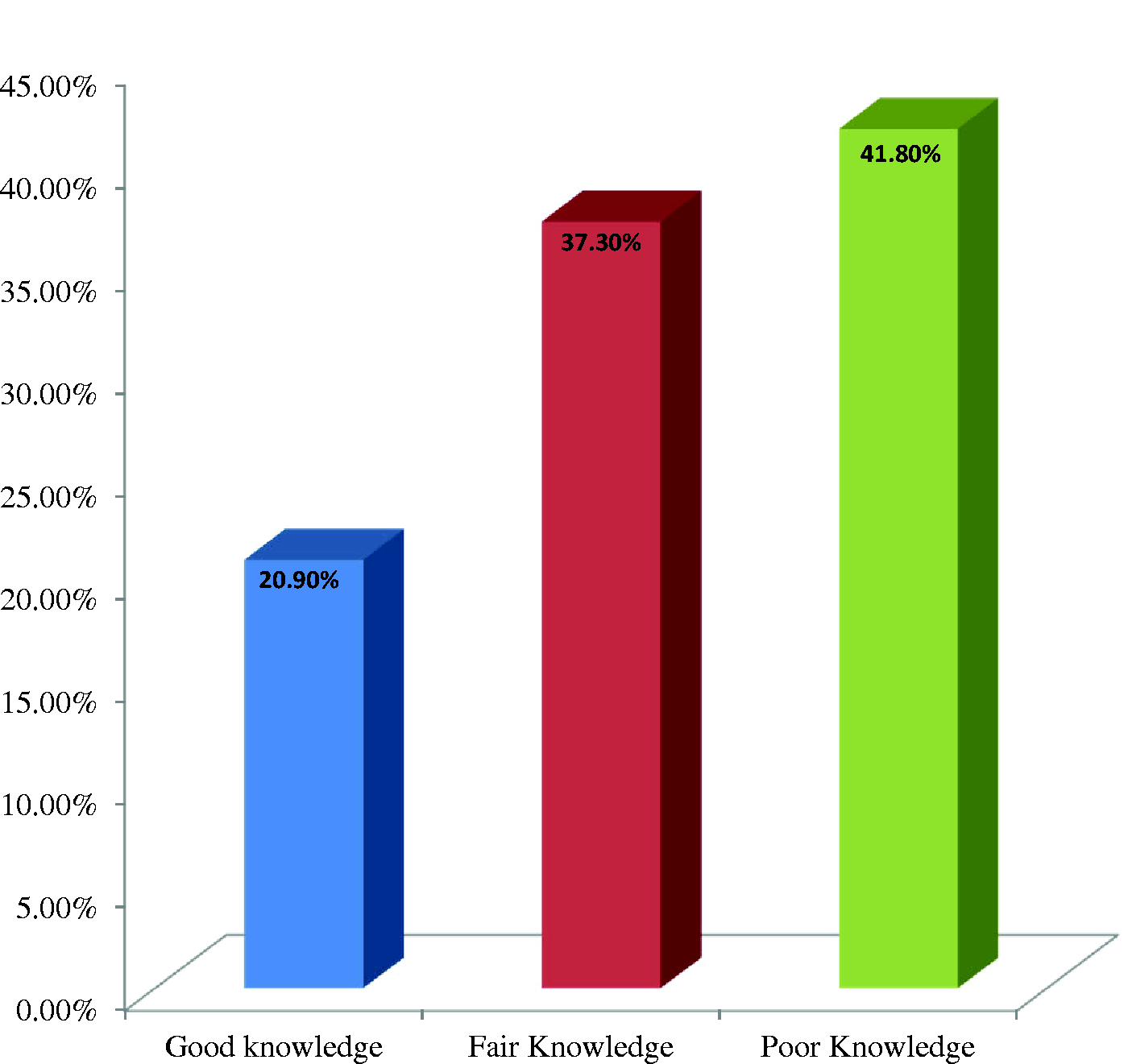
Respondents’ Knowledge on Obstetric Epidural Analgesia.
Table 4 shows the respondents’ level of utilization of epidural analgesia. Most (89.1%) of the respondents had not used epidural analgesia and it can be concluded that there is low level of utilization. Among those who had previously used epidural analgesia, 83.3% were satisfied with the use. Only 30.0% of the respondent reported they had adequate knowledge on epidural analgesia. About 27.3% of the respondent wished to use epidural analgesia and 45.4% were unsure. However, 66.4% reported the need for analgesia to be made available to every woman in labour who desires epidural analgesia. Most (78.2%) of the respondents also reported the need for adequate information on the use and benefits of epidural analgesia in labour.
Level of Utilization of Obstetric Epidural Analgesia (N = 110).

*n is the total number of those who responded to the question as applicable.
Respondents’ perceived barrier on choosing obstetric epidural analgesia is presented in Table 5. Majority (60.0%) agreed that inadequate or lack of information on obstetric epidural analgesia is a barrier, 32.7% reported Healthcare professionals do not provide epidural analgesia for pregnant women, 45.5% reported the feeling that obstetric analgesia had side effects and 32.7% perceived epidural analgesia as too costly and capital intensive.
Perceived Barriers of Pregnant Women in Choosing the Obstetric Epidural Analgesia (N = 110).

The factors that might encourage the use of epidural analgesia in labour are presented in Table 6. These factors include: availability of adequate information on epidural analgesia (93.1%), presence of qualified anesthesiologist (88.1%), support from husband and mother-in-law (82.2%), availability of financial resources (89.1%), reduced fear of effects of complications resulting from administration of epidural analgesia (86.1%).
Factors That Can Encourage the Utilization of Analgesia Service in Labour (N = 110).

*Multiple responses.
Discussion
Various methods could be utilized in the management of labour pain however, epidural analgesia remains the gold standard. Despite the numerous benefits of the epidural analgesia, its use in under-developed and developing countries is still quite low.10,12
This study shows that a simple majority (53.6%) of the respondents were aware of epidural analgesia while only 7.3% had ever used epidural analgesia in labour. This is in consonance with report by Shidhaye et al. 8 and Imarengiaye et al. 12 that epidural analgesia has not been fully accepted and is not routinely practiced in most of the health centres in developing countries despite various benefits of this technique. This report also suggested that patients do not request for it, and obstetricians are not keen to routinely practice it or give education about the use of epidural analgesia to pregnant women. The core reasons as highlighted were, paucity of qualified anesthesiologist, inadequate analgesic service provision, lack of sophisticated equipment/devices and low awareness and demand by pregnant women. 11 This fact is an indication for the need to intensify awareness campaign for epidural analgesia. This is because, epidural analgesia has been found to be the only technique capable of relieving labour pains satisfactorily without maternal or fetal sedation and it is the most effective method for restoration of normal uterine activity.6,8
In this study, it was also discovered that most of the pregnant women had poor knowledge of epidural analgesia. This supports the report by Aksoy et al. 13 and Ogboli-Nwasor and Adaji 15 where they found out that large population of women lacked basic knowledge about the methods of painless child birth including epidural analgesia. A similar study among Indian women by Barakzai et al. 16 found that there was poor general awareness and knowledge of women about the proper role of epidural analgesia during labour, which led to the low patient demand for such analgesic services. This present study hereby points to the need for more health education especially at the ante-natal clinics on the importance of pain relief methods for pregnant women.
In addition, this study clearly showed that majority of the women who had been previously pregnant had never utilized epidural analgesia. This is an indication that the awareness of the respondents did not translate into utilization of the technique. Meanwhile, factors, such as fear of the side effects of the technique, cost, cultural and social beliefs and the lack of adequate information of the techniques were reported by the respondents as barriers militating against the utilization of obstetric epidural analgesia during labour. These facts are supported by the findings of Amnadsun and Aziken 10 where they posited that lack of the requisite skill for the administration of epidural analgesia, ignorance/lack of adequate information on the part of the pregnant women and the extra cost for providing epidural analgesia in labour had contributed to low utilization of this method of labour pain relief, especially in low-resource setting. There is therefore the need for healthcare workers to work on these negatively perceived barriers by giving adequate information/education on the concept of epidural analgesia to pregnant women in order to enable them make an informed choice on the suitable type of obstetric analgesia.
More so, the highlighted factors by the respondents that can encourage the use of analgesia service in labour include; availability of adequate information on epidural analgesia, presence of qualified anesthesiologist, support from husband and mother-in-law, availability of financial resources, reduced fear of effects of complications resulting from administration of epidural analgesia and level of education of pregnant women. In specifics, higher educational level of pregnant women was also reported as an influencing factor for use of epidural analgesia.
14
This shows that education can be an important factor for an individual to make informed choices in life especially on matters relating to health. The finding in this study clearly revealed from the hypotheses testing that there is a significant relationship between the respondents’ knowledge and utilization of obstetric epidural analgesia. Hence, there is the need to increase knowledge of this concept among pregnant women while giving health talks/education during ante-natal clinics because adequate knowledge on this concept has been established to influence utilization.
Footnotes
Declaration of Conflicting Interests
The author(s) declared no potential conflicts of interest with respect to the research, authorship, and/or publication of this article.
Funding
The author(s) received no financial support for the research, authorship, and/or publication of this article.
