



Abstract
Introduction
Traffic accidents are one of the most important health problems that cause many deaths every year. Scientific-practical interventions are needed to prevent traffic accidents. This study aimed to compare the effectiveness of traffic-based and school-based interventions on the safe road crossing in Yazd elementary school students.
Methods
This interventional study was conducted on 132 students (66 males and 66 females) in two groups of school-based and traffic park-based intervention. A questionnaire was used to determine the safe crossing behavior score. Then, an educational intervention was administered to both groups. Two months after the intervention, safe crossing behavior was evaluated in both groups. Finally, the data were analyzed using SPSS software version 22.
Results
In both groups, the score of safe crossing behavior was significantly increased after the intervention. The school-based group had significantly better behaviors compared to the traffic park-based group (P=0.001). There was a significant difference in the mean score of behavior between males and females and the intervention had a greater effect on female students (P=0.017).
Conclusion
Educational interventions and especially school-based intervention can be effective in improving the students' safe crossing behaviors.
Introduction
Pedestrian injuries are a leading cause of death and disability among children under 14 years of age. 1 In 2010 children at the age of fifteen and younger were accounted for 6.8% of the pedestrian fatalities and approximately 22.9% of all pedestrians injured in traffic crashes. 2
At particular risk are children between the ages of 5 and 9 years, for some reasons. 1 Their smaller size causes more visual error for drivers. Children often cannot estimate the distance and speed of a car, accurately. 3 On the other hand, parents may overestimate their children's ability to cross the street. However, many children do not comprehend the traffic signs and how to predict the drivers' movement and derivers get into trouble when they face children. 4
In an attempt to reduce these high injury levels, many educational injury-prevention and road safety programs have been implemented in school and home settings.1,5 Dunbar and Lewis found that education in traffic, especially among elementary school students in most countries of the world, has produced valuable results. 6 Practical training programs have had success in improving pedestrian skills such as elementary school students’ roadside crossing judgments, 7 ability to cross at parked cars and intersections, 8 using designated crossings, 9 identifying roadside dangers, 10 and increasing elementary school students’ awareness of others’ intentions. 11
Traffic Park, which is considered as a common method of traffic education in Iran, is a training complex that is designed and operated by simulating the traffic environment for various theoretical and practical training for elementary school students. 12 However, due to insufficient facilities in the area or the cost of using the traffic park, only a limited number of students have access to the traffic park. School intervention is another educational intervention, i.e. any intervention aiming at children aged 5 to 18 years and mainly in an educational setting such as school. 13
It seems school-based education can be more effective to train students than traffic park-based education, but no study conducted on it. This study aimed to investigate the impact of school-based interventions on safe crossing behavior as a less costly and effective alternative for traffic park-based educations.
Method
Participants
This interventional study was conducted on elementary school students in Yazd city, center of Iran. As shown in Figure 1, using convenience random sampling, four schools were selected from all elementary schools in Yazd city, including two females' schools and two males' schools. Of these 4 schools, two (one male and one female) were randomly assigned to the school-based intervention group, and the other two schools (one male and one female) were placed in the traffic park intervention group. Then, 11 students from each grade were randomly selected in each school (from first, second, and third grade). Finally, 132 students participated in the study. The students included the study if they were six to nine years old and had physical health. The students who used school services, participated in police assistance programs, and had not parent’s willingness to attend educational sessions were excluded from the study
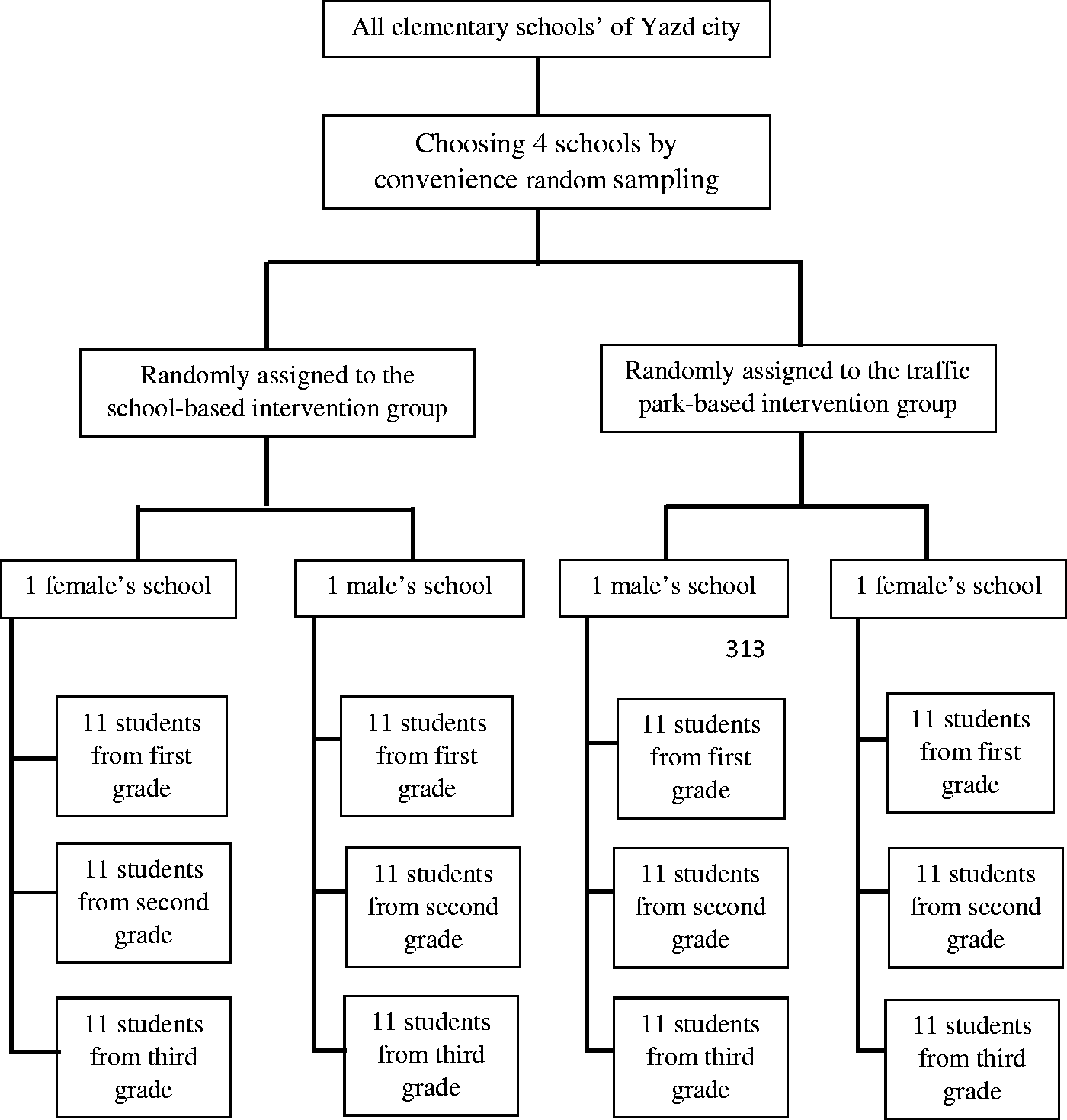
The Participants’ Selection Process.
Measures
The data collection tool was a behavioral checklist designed and validated by Zare et al. 14 The first part included demographic data of the participants (gender, age, parent's job and education, and students' educational background). The second part of the checklist had 12 questions regarding safe crossing behavior including standing and stopping alongside the road, listening to the sound of vehicles, looking at the left, looking at the right, looking at the left again, crossing the pedestrian line, standing in the middle of the street, looking at the right, crossing the pedestrian line, crossing a pedestrian bridge, and avoiding running in the street and diagonally crossing the street. If the student behaved correctly, the relevant item in the checklist would be given a score of one, otherwise a score of zero would be considered. The total number of correct behaviors was considered as the safe crossing behavior score (minimum and maximum scores were 0 and 12, respectively).
Study Procedure
The study procedure was shown in Figure 2. After coordination and consent from students and parents, and obtaining permission from the department of education, the safe crossing behavior of students was assessed by researchers. A pseudo-street was created in the school space and students had to cross that street and the researcher completed the checklist regarding the student's behavior. Students were also asked to explain their street-crossing behavior to the researcher. After the pre-test, the baseline data were analyzed. The traffic park group was sent to the traffic park for training. Two months after the intervention, which is described in more detail below, the safe crossing behavior of the students in both groups was measured similar to the pre-intervention phase.

The Flowchart of the Study Procedure.
Interventions
School-based group: The educational program was presented by the researcher for the school-based group. The outline of the educational content consisted of theoretical and practical parts. The theoretical section included holding lectures and tips on the importance of crossing the street; defining the concepts such as one-way and two-way streets, pedestrian bridges and lines, traffic and pedestrian lights, difference between traffic lights and pedestrian lights, sidewalks and risky behaviors while crossing the street; observing the precedence on streets without pedestrian lights; mentioning the right behaviors and safety tips when crossing the street; and finally using animation videos on how to cross the street correctly.
In the practical part, question and answer sessions with role-playing and practical exercises in the school hall and courtyard were planned to enhance the students' skills. In these sessions, students used a street-like space that had a line, red light replicas, and a pedestrian line.
To avoid monotony and fatigue, there was a competition after the lectures. The competition featured a silent animation showing the consequences of car disregarding, wrong crossing the street, and sudden street entry. After the end of the film, the students were asked to explain their perceptions and misconduct of the cartoon character and correct their behavior. In the end, a prize was given to the best personal impression.
A game was also designed for students. That way, 15 misconducts were written on small cards and put in a box. A tape was attached to the floor of the classroom. One side of the line was about the right behaviors and the other side about wrong behaviors. One student was standing on the line and another student was reading the right and wrong behaviors written on the cards. The student on the line had to go to the correct or incorrect home (depending on whether or not the card was correct). If the answer was correct, the card was received by the student, and eventually, the number of cards received was checked and the students who received the most were rewarded.
To raise the interest and motivation of the students, at all stages, the winners of the games, the winners of the competition, and finally, those who had the most learning and participation were awarded. The duration of each training session varied from 15 minutes to 30 minutes depending on the training topics.
Traffic park-based group: After the pre-test, the traffic park group was sent to traffic park for training. Initially, three animations were shown to students about not talking to cell phones while driving, not playing with gear and hand brakes, and fastening a seat belt. At the end of each animation, the instructor, who was a traffic police officer, asked the students for their results and gave them a gift that included a traffic game. Next, the students went to the “street section” of the park with the police. There, topics such as traffic light colors, the way to cross a one-way street, and the use of pedestrian bridges were explained. In the end, each student was given a notebook containing traffic signs.
Data Analyzing
The data was analyzed using the SPSS software (version 22), and the following statistical tests: t-test was used to compare the mean scores of behavioral tests in the groups before and after the intervention. A Chi-square test was used to examine the associations between the qualitative variables. Covariance analysis was used to eliminate the effect of intervening variables by statistical methods and to obtain more accurate results.
Results
In order to examine the homogeneity of the participants in the groups, the demographic data was analyzed using a chi-square test. The test showed no significant differences in the demographic variables between the groups (Table 1).
Descriptive Data of Participants (n=132).

Based on the findings, before the interventions, the behaviors of the students were weak, and no significant difference was found in the mean scores of behaviors between the two groups (P > 0.05). However, after the intervention, for the school-based group, the mean score of safety traffic behavior was higher than the traffic park-based group with a significant difference. This means that researcher training has been more effective than police training (Table 2).
The Mean and Standard Deviation of Safe Crossing Behavior in the Two Groups Before and After the Intervention.

aStatistically significant by t-test.
It was found that gender significantly affect the crossing behavior (P=0.019). Other demographic variables (age, parent's job and education, and students' educational background) did not show a significant difference with the mean score of safe crossing behavior (P>0.05).
Data on traffic safety behavior variables by traffic and school-based traffic group and gender are presented in Table 3. As seen, before the intervention, there was no significant difference between the safe crossing behavior of females and males. But the effect of education in both interventions on females was significantly greater than males.
Mean and Standard Deviation of Pre-Test and Post-Test of Safe Crossing Behavior in the Two Groups of Traffic Park-Based and School-Based by Gender.

aStatistically significant t-test.
The effect of both interventions in terms of demographic information was measured using analysis of covariance. Findings showed that education did not have a different effect on students regarding age, parent's job and education, and students' educational background and all students were the same in terms of the effect of education. But there was a difference in the mean score of behavior between females and males. The females' scores were better than males', and the intervention had a greater effect on female students (Table 4).
The Effect of Gender on the Safe Crossing Behavior.

Discussion
This study compared the effect of traffic park-based educational intervention and school-based education on the safe crossing behavior in Yazd elementary school students. In general, education (whether at school or in a traffic park) improved students' safe crossing behavior. This finding was in line with those reported by Bart et al., 15 Purcell et al., 16 and Zare et al. 14 that approved the role of practical training on enhancing safe behaviors in children. The results of Lerner and Keltner study conducted on 2,000 schools near the roads, showed that by using in-person training methods, accident and fatality reduced significantly. 17
Researchers all agree with the fact that, if children perceive existing risks on their environment in an accurate manner like education, probably their safety outcomes will be better than those registered in the long term by children who do not recognize some potential hazards, such as (e.g.) lack of signaling, misbehaviors of drivers and adverse conditions to circulate. 18 Practical training programs in both real and simulated environments have had success in improving pedestrian skills. Real traffic environments – as appropriate as they may be – are unpredictable and therefore make it difficult for the researcher to control and test for all the variables and to design a program that ensures a variety of traffic situations. Simulation training, through simulated environments and computer games, seems to provide a solution to these problems. 5
According to the results of the present study, traffic safety behavior significantly improved after training in traffic park group. Qanbarpour et al. showed that after training in traffic-park, the mean score of safe traffic behavior of males and females was significantly improved. 19 An education in which children experience real and objective emotion is more effective and helps to understand risk better. 20
The results of the school-based group also showed a significant increase in the behavioral scores after the intervention. In line with these results, Ebrahimighavam et al. showed that safe pedestrian crossing education was effective through school-based intervention and improved the children's behavioral status. 21 Also, the results of studies suggested that educational packages containing traffic-related contents presented to students can improve their behavioral status. 3 Zare et al., 14 showed the positive effects of an active learning-based educational program in school on promoting safe street-crossing behaviors in 7-year-old children.
However, school-based education had a greater effect on improving safe crossing behavior than traffic park-based traffic education. The reason for the difference in scores could be attributed to the quality of the training provided. How the training package is formulated could be effective in differentiating school-based and traffic-park outcomes because the use of traffic park instructors, who have other jobs, can influence the quality of teaching, compared to the experienced instructors with experience in the schools. Another reason can be related to teaching strategies and methods. In the school-based approach, lecture and simulation techniques were used to provide in-game learning, animations that were well-connected to safe crossing the street, racing and more, whereas in the traffic park method, there were merely animations that included tips on seatbelts and not talking to the driver with a cellphone. Also, bringing children into a new environment with a variety of play equipment will distract them and causes to disregard police training.
The results showed that gender had a significant effect on learning scores. The female’s safe crossing behavior increasing was significantly more than male students. Ebrahimiqavam et al., found that after the intervention (traffic behavior training package), the performance of female students was better than male students. 21 In general, studies have shown that education is usually more effective for females than males because of their greater interest and tendency, more attention, and higher behavioral control.22,23 Young males are more prone to presenting negative attitudes towards traffic rules than females. 24 However, Cordellieri et al. showed interesting results regarding gender differences which suggested that both males and females do not have the same risk perception regarding potentially hazardous situations on the road; females showed, overall, a higher road-risk perception rate. 25 Therefore, this difference between risk perception and concern could explain some differences in the reduction of hazardous behaviors and in the frequency of road causalities. 18
Lack of cooperation of some students during the training, distraction of students due to the traffic park space and reduced attention to the training were the limitations of the study. Another limitation of the study was that a majority of the school teachers and upper-level students did not comply with the traffic rules. For instance, the older children who are seen as role models in the schools, did not have proper street-crossing behaviors. This phenomenon made the process of educating the children and implementing the intervention difficult as the participants were taught about safe street-crossing behaviors without support from the individuals in their environment.
Conclusion
In general, the students' crossing behavior after the school-based intervention was more enhanced than the traffic park-based intervention. Given that education is a process by which community members, especially children, can learn the roles, expectations, rules, and relationships needed for survival, school-based practices can be used to reduce traffic hazards in children. It is recommended that to use this researcher-made package in traffic parks. If there is no access to the traffic park, it is better to use school-based interventions that either include training modules in traffic parks or combined with the school-based intervention of this study.
Footnotes
Acknowledgment
The authors would like to acknowledge the support and assistance provided by all participants.
Declaration of Conflicting Interests
The author(s) declared no potential conflicts of interest with respect to the research, authorship, and/or publication of this article.
Funding
The author(s) disclosed receipt of the following financial support for the research, authorship, and/or publication of this article: This article was extracted from the thesis written by Marzieh Tolide, a M.Sc. student of Health Education and was financially supported by the Yazd Shahid Sadoughi University of Medical Sciences, Yazd, Iran (Grant No. 5243).
