




Abstract
This exploratory study looks at the phenomena of texting in a marketing education context. It outlines the difficulties of multitasking within two metacognitive models of learning and sets the stage for further research on the effects of texting within class. Students in marketing classes in two different universities were surveyed. They received an average of 37 texts per day and initiated about 16. More than 90% of the respondents reported receiving texts while in class and 86% reported texting someone from class. Even though students believed they could follow a lecture and text at the same time, respondents who did text within marketing classes received lower grades. Contrary to other research, texting frequency was generally unrelated to GPA. Implications for both pedagogical issues and research in marketing education are discussed.
Keywords
The motivation for this study began with an incident in class that has become increasingly common. One of the authors noted that several students were looking intently down at their laps and texting while the instructor was engaged in what was believed to be at least an adequate lecture. The instructor stopped and made a number of comments about texting in class, explaining that although it was not against the rules of the course, most professors considered it to be a sign of disrespect for the instructor and the other students. Furthermore, business students should be aware that texting under these conditions would be considered unprofessional. The students appeared to accept the information in an amiable fashion, but within minutes several students had begun texting again. They gave no indication of being defiant or rebellious. It was as if the discussion had never taken place.
The students’ response to texting appears to be different from past disruptive behaviors in class. Students generally observe class rules even if they do not agree with them, but our experience indicates that texting has become so intimately associated with students that they simply text irrespective of circumstances and rules, and they seem to consider it no more important to others than, after conforming to a certain set of social niceties, scratching where it itches. Indeed, a Pew Research poll in the spring of 2010 found that 90% of 18 to 29 year olds even sleep with their cell phone (Rosman, 2010).
A brief survey of the Internet reveals that texting in class appears to be a concern of many instructors, and a number of approaches have been attempted to control this behavior. Some instructors have appealed to logic and good manners (Goodwin, 2012). Other professors have used the incentive of grades (Syllabus 2, 2011), whereas others have resorted to authority (Syllabus 3, 2011). Evidently, these attempts to control texting in class have been largely ineffective (Williams et al., 2011).
The purpose of this study is to investigate the texting phenomena in marketing classes. Nothing could be found in the literature specific to marketing education. We do not know if texting in marketing classes or by marketing students is more of less common than from other disciplines, or what student characteristics are associated with texting and how texting affects grades. We do not know how to control texting for the benefit of students or for the advancement of marketing education. This exploratory study looks at these issues.
Literature Review
Frequency
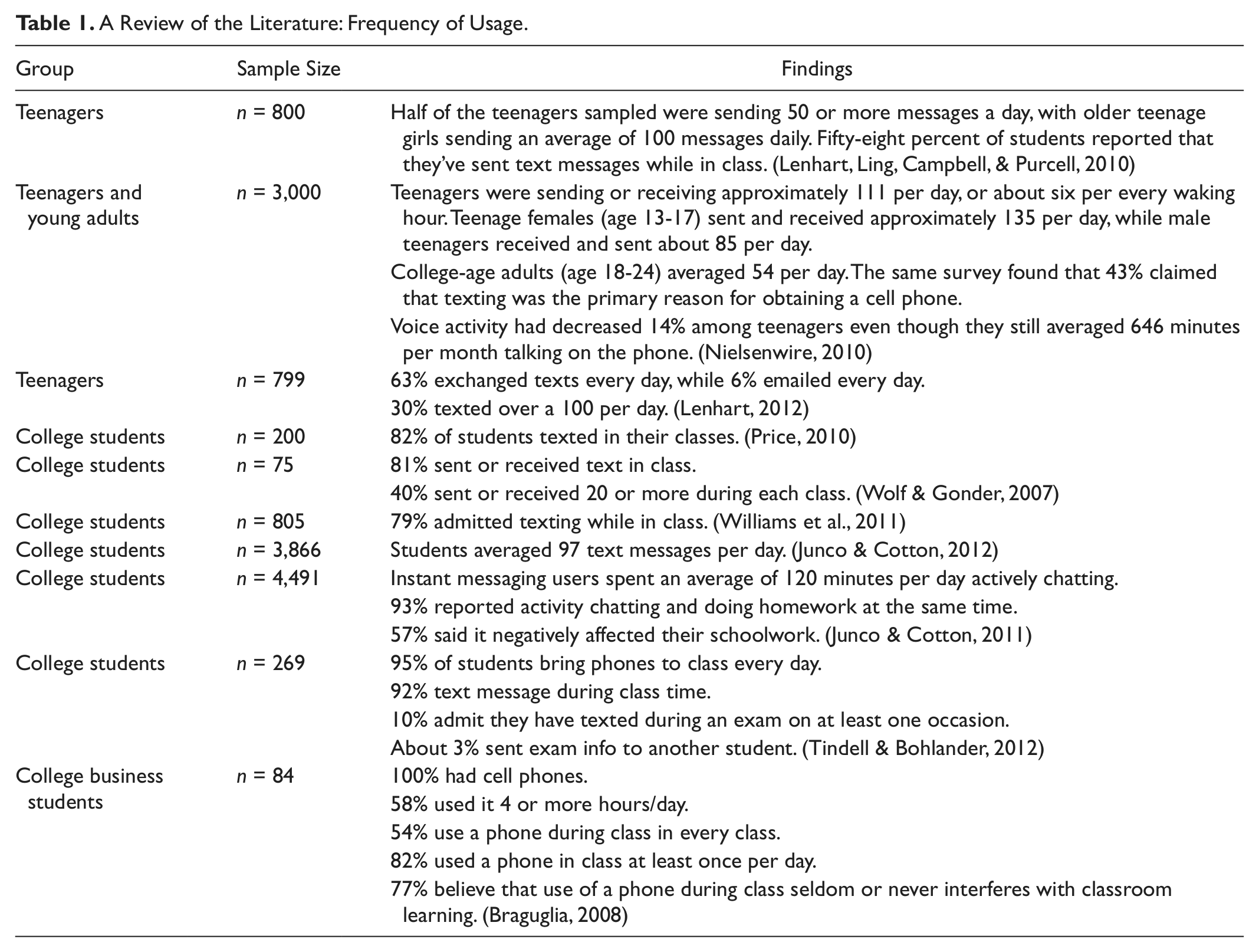
Surveys of young people have found that texting has become so ubiquitous that some are spending 15% of their total waking time engaged in the activity. Between 2006 and 2008, texting increased in America by 450% (Drouin, 2011). Surveys have found that women text more often than men and write longer and more complex messages. Women are also more likely to maintain normal grammar and express a wider range of content (Ling & Pederson, 2005; Vecchione, 2010). There appears to be social class differences. Heavy texters are more likely to be minority females from lower income and less educated backgrounds (Jancin, 2011; Lenhart, 2012). High-frequency texting extends into the classroom. Among high school students, one study found that despite having cell phones banned in class, 58% of students still sent text messages from these classes (Vecchione, 2010). This is complicated by the findings that reading and sending texts are not necessarily motivated by the same factors (Nemme & White, 2010). A summary of the literature findings can be found in Table 1.
A Review of the Literature: Frequency of Usage.
Anxiety
Some researchers have begun to probe into how the use of mobile devices affects people emotionally or socially. Beranuy, Oberst, Carbonell, and Chamarro (2009) reported a correlation between social media use and mental distress, as manifested in deterioration of family and social relationships. Surveys have found that young people like texting because it offers unparalleled freedom to communicate on their own terms, irrespective of place and time. However, this is combined with a corresponding feeling of being trapped by the ability of others to contact them, and the lack of freedom created by the need to respond. As Baron (2008) notes, the ease of communication brought about by cell phone use is a “Janus-faced technology.” A person has instant communication, but they find themselves constantly on call from others, and with the perceived social necessity of always being available to communicate.
Addiction
Our experience seems to indicate that many students appear to compulsively text as if it was an addiction. An addiction is considered to be present when a person becomes habitually or compulsively occupied or involved in something. One of its important characteristics is denial. It has been proposed that interactive media is compatible with the basic impulse to respond to immediate opportunities and threats. The stimulation may even create a change in the dopamine reward system in the brain, which is indicative of addiction, and similar to this stimulation, people feel bored when unable to text (Richtel, 2010). It has been estimated that 20% to 29% of teenagers and young adults feel addicted to cell phone usage (Jancin, 2011; Konijn, Utz, Tanis, & Barnes, 2008). In a large study of teenagers, “hypertexters” were found to have a number of social, adjustment, and psychological issues. A “hyptertexter” was defined as a student who self-reported an average of 120 texts or more times, per day, on school days. They comprised 20% of the sample. Even when controlled for age, gender, race, parental education, and household structure, “hypertexters” were more depressed, twice as likely to have tried alcohol, more likely to be binge drinkers, and were one third more likely to be current users of marijuana. They were more likely to have skipped classes and got lower grades than other students (Jancin, 2011). In other studies, compulsive texting was found to be positively related to aggression, and negatively related to academic adjustment (Lister, 2010), and to be associated with lower GPAs (Ryker, Viosca, Lawrence, & Kleen, 2011). Wang and Tchernev (2012) reported that multitasking behavior is driven by immediate needs, but the behavior also changes needs. The behavior can be self-reinforcing, especially with emotional needs. Ironically, multitasking is driven primarily by cognitive needs, which “are not gratified by the behavior” (p. 509).
As an example of the attraction of texting, a study of education majors found that although 73% thought it was unprofessional to text in class, 79% responded that they did so anyway (Williams et al., 2011).
Metacognitive Models of Multitasking
To help understand the problems with multitasking, we review a metacognitive model similar to one proposed by Mayer and Moreno (2003). It is based on cognitive theory combined with three assumptions. First, multitask learning would require that humans possess separate systems (modalities) for processing different sensory inputs. For reasons that will be outlined later, these can be seen as pictorial and auditory in nature. Second, each channel is limited in the amount of material that can be processed at one time (limited-capacity assumption). Third, meaningful learning involves extensive cognitive processing, including building connections between modalities (active-processing assumption).
The problem inherent with multitasking and learning, as expressed by the model, is starkly rudimentary. Meaningful learning requires substantial cognitive processing, but the learner’s capacity for cognitive processing is severely limited (Mayer & Moreno, 2003).
Sensory modalities
Although neural imaging has suggested a separate channel for haptic information mediated by the frontal cortex (D’Esposito, Ballard, Zarahn, & Aguirre, 2000), the human information-processing system can be thought of as primarily consisting of two separate channels, an auditory/verbal channel for processing auditory input and a visual/pictorial channel for processing visual stimuli. This has become known as the dual-coding theory (Paivio, 1986). Both channels are used to organize information and learning. Initially, the two modalities are separate, but information from each can be integrated at some point to organize material for immediate action, or to be stored in memory. The same process would be used when attempting to recall the stored information.
Limited capacity
The second assumption is that each channel has limited capacity and that bottlenecks in the flow and processing of information can occur at specific points (Chandler & Sweller, 1991; Huitt, 2003). Even though each channel is limited, meaningful learning requires a substantial amount of cognitive processing to take place in both channels.
Cognitive processing and system organization
Attention, organization, and integration occur not only within a functional sequence but also within and between different neural pathways (Shinn-Cunningham, 2008). After exposure to external stimuli, the resulting sensory codes are stored temporarily in sensory memory (Coltheart, 1980; Sperling, 1960). Codes that are not further processed are lost (Mayer & Moreno, 2003). Information, if it passes an attentional filter, can then be processed in working memory and consolidated into long-term memory. These systems are not entirely anatomically distinct but represent a continuum whose functions appear to be mediated by different neural pathways with the prefrontal cortical lobes acting as the executor. The type of input (either externally or internally) and the level of cortical hierarchy that the inputs target determine whether initial processing supports purely sensory or semantic short-term memory or attentional functions (Jääskeläinena et al., 2011). Evidence suggests that there may be a certain amount of competition between memory systems and a fundamental difference in their ability to handle distraction (Foerde, Knowlton, & Poldrack, 2006).
Learners live in a busy world and are bombarded by far more perceptual information than can be effectively processed (Chun, Golomb, & Turk-Browne, 2011). Consequently, an attentional mechanism, sometimes referred to as perceptual defense (a term that appears to be presently out of favor) or perceptual vigilance, determines if material is processed further. Defense and vigilance have little to do with Freudian definitions; instead, their significance lies primarily in the fact that they provide valuable clues about how the mind is functionally organized (Mathews, 1997). Both behavioral studies and cognitive neuroscience conclude that there is not a unitary model of attention. In fact, while some attentional processes are mechanical, some are initiated by prior experience, and higher cortical functions. For example, early studies showed that anxiety-increasing stimuli increases perceptual defense, whereas anxiety-reducing information helps create vigilance (Dulany, 1957). Ironically, the very process of attention limits the system’s capacity. Vigilance requires hard mental work and is stressful (Warm, Parasuraman, & Matthews, 2008). An example can illustrate this point. Visual spatial attention operates much like a “spotlight,” which inhibits attended locations and items. If attention is directed to one location and then redirected to a new location, processing of the original location is inhibited (Mayer & Moreno, 2003). There is also an internal attention that includes cognitive control, which has independent capacities from external attention (Corbetta, Patel, & Shulman, 2008).
The primary work engine of cognitive processing is working or short-term memory. It is a complicated system responsible for performing a number of tasks. Baddeley (1992) postulated that working memory is composed of three “subcomponents,” a central executive that is an attentional-controlling system, a “visuospatial sketch pad,” and a phonological loop. This has implications for three levels or types of processing proposed by Mayer and Moreno. The first, essential processing, refers to cognitive processes that are required for making sense of the presented material. Consider a YouTube video shown in class. There is a spoken narrative, pictures, and perhaps music. At the same time, the student must hold the context of the presentation in mind, not only as to subject matter but also to external factors that could include prior knowledge of the subject and the behavior and intentions of the instructor. All this would require using a great deal of cognitive capacity in selecting, organizing, and integrating both auditory and visual information. However, other things are happening at the same time; the student may be hungry or another student is trying to get her attention. These require incidental processing, which refers to cognitive processes that are not required for making sense of the primary YouTube presentation. Because cognitive processes take time, all this material must be held in working memory long enough to be consolidated, given meaning, and stored, a process called representational holding.
This is complicated by the basic fact that the memory system’s capacity is severely restricted. Early studies indicated that working memory is limited to around seven elements, irrespective of whether the elements were digits, letters, words, or other pieces of information (Miller, 1956). Later research has modified this limit, but only slightly (Cowan, 2001). Yet capacity is essential for learning. It is thought that most information must enter working memory before it can be stored into long-term memory. Consequently, the larger the capacity of working memory for certain stimuli, the faster these materials can be learned (Nikolić & Singer, 2007).
Strong sensory input can “capture” attention. The ability to override that capture differs between individuals and this difference is closely related to their working memory capacity. If the capture is not overridden, then part of the capacity of short-term memory is then allocated to the storage of captured information that cannot then be used in other ways. Although sensory modalities can operate separately, interference between modalities appears to occur at the more central stages of information processing (Chun, Golomb, & Turk-Browne, 2011). Or more simply, low attention equals low working memory, which can lead to restricted long-term memory (Fukuda & Vogel, 2009). Attention then not only helps determine which information is encoded into long-term memory but also how it is retrieved (Chun & Turk-Browne, 2007).
Even after filtering, multiple perceptual tasks may be accepted into working memory at the same time. One will typically be strongly attended and the others will not. Lavie’s (2005) load theory maintains that the amount of capacity that is allocated to the attended task is dependent on how difficult it is to process the task. If the attended target task is easy, then excess resources will be used to process distractors. If the attended task is difficult, then more capacity becomes centered on this stimuli or task, and distractors become less well processed. Concentration on a task increases the system’s load and attending distractors will undergo less processing, which results in less cognitive interference (Lavie, 1995). Increased working memory load that is not specific, however, increases interference from distractors (de Fockert, Rees, Frith, & Lavie, 2001).
Attention, limited channels, and the interactions between channels can cause what has been referred to as a processing bottleneck, which can slow the process down somewhat like a construction project on a busy freeway. This can be seen from common examples in simple behaviors such as the ability to change both perceptual and behavioral focus when a stop signal suddenly appears (Boucher, Palmeri, Logan, & Schall, 2007), or in automated tasks such as Stroop interference, when naming the color of a word is slowed by the difficulty of suppressing the written word when it is the name of a different color. When asked to make two simple responses or choices in succession, the ability to execute the second response is delayed when it appears within half a second of the first. This delay is known as the psychological refractory period. The duration of this delay, as a function of the timing between the first and second task, reveals a central “bottleneck” (Pashler, 1994). Furthermore, respondents are slower to switch from one kind of task to a different task, as compared with simply repeating the same task (Rogers & Monsell, 1995). Different brain circuits are in operation when observers need to redirect to a previously unattended location.
Response and task selection require inhibition of competing options. The source of this inhibition can be traced to the prefrontal cortex, which controls functions associated with future planning, reward, attention, short-term memory tasks, and motivation (Aron, Robbins, & Poldrack, 2004; Junco & Cotton, 2011). In an interesting study using brain imaging, both the right and left frontal lobes were shown to have the capacity of driving tasks separately from each other. In other words, two functions could be processed simultaneously, but seemingly, only two and no more (Koechlin, 2010). There is also a temporal limit in the flexibility of auditory attention (Koch, Lawo, Fels, & Vorlander, 2011). Their findings suggest that auditory switches incur additional interference that needs extra time to be resolved for performing a task.
In addition, cognitive capacity influences how much can be drawn out of long-term memory. If there is a competition for capacity, the process of retrieving one item increases the likelihood of later forgetting other associated information (Corbetta et al., 2008).
Effect on Multitasking
As indicated by this review, chronic multitasking should hinder mental fluidity (Richtel, 2010), and given that capacity is mostly innate, practice should not increase the basic ability to override the negative consequences. This has generally been found in the literature. Ophir, Nass, and Wagner (2009) compared heavy and light media multitaskers. They found that heavy media multitaskers were more susceptible to interference from irrelevant stimuli and memories, and also performed worse on a test of task-switching ability because of reduced ability to filter out interference from the irrelevant tasks. These findings suggest that those engaged the most in texting while in class should be less mentally flexible than the nontexters. Another study found that even if distraction does not decrease the overall level of learning, it can result in learning that can be less flexible in new situations (Foerde et al., 2006). In addition, multitaskers scored lower on memory tasks, the ability to filter out irrelevant information, and the ability to organize their memories (Gorlick, 2009).
In another experiment using recall memory, a high texting group scored significantly lower than a group that texted less often. As an interesting sidelight, the researchers noted that they were required to modify their study conditions because students continued to text even when they were in experiment groups that banned texting (Rosen, Lim, Carrier, & Cheever, 2011). Other experimental findings with students suggest that cognitive load plays an important role in determining how much information is retained when students perform more than one task at a time (Lee, Lina, & Robertson, 2012). Since much of texting consists of abbreviations and symbols that are meant to represent more commonly known symbols (i.e., written language), one group of researchers (Ryker et al., 2011) hypothesized that heavy texting would be associated with increased ability to use mnemonics. Instead, they found the opposite; there was a negative relationship between texting and the ability to use mnemonics in a learning task. In an experiment with accounting students, the texting experimental group had significantly lower scores on a subsequent exam than did nontexters. This was true irrespective of gender or GPA (Ellis, Daniels, & Jauregui, 2110).
Not all findings are negative. It has been found that multitasking did increase the ability of students to look at the breadth of information under conditions of low load interference (Lui & Wong, 2012). Another study found a positive association between the frequency of texting on spelling and reading fluency, but a negative association between the use of “textese” (the abbreviations common in SMS) and reading accuracy (Drouin, 2011).
Given the cognitive and physiological evidence, multitasking should hinder active or deep learning.
Motivation and Self-Regulation Models
Many of the tenets of those advocating motivational and self-regulatory models of learning are compatible with the multitasking learning model and would come to the same negative expectation of multitasking.
More than 50 years ago, a group led by Benjamin Bloom (1956) identified three domains of learning, two of which are cognitive (knowledge) and affective (attitude). These ideas led to a merging of psychology and educational theories that are very compatible with modern cognitive and metacognitive theory. Palincsar and Brown (1984) maintained that the origins or interpretation of motivation are governed by the basic principles of cognitive psychology, which “should be conceived in information-processing terms.” Motivation, in turn, plays a major role in self-regulated learning, in that it helps the learner stay centered on reaching learning goals while avoiding distraction.
A self-regulated student, according to Zimmerman (1990), approaches educational tasks, “with confidence, diligence, and resourcefulness.” Unlike passive students, self-regulated students proactively seek out information and take action to master it. They “view learning as a systematic and controllable process, and accept responsibility for their achievement outcomes” (p. 04). It has been estimated that at least 100 hours of learning and practice is required to acquire any significant cognitive skill to a reasonable degree of proficiency (Anderson, 1982). That requires effort and vigilance and self-regulated motivation. It is assumed by most theorists that students’ efforts to self-regulate their academic learning often require additional cognitive load, including preparation time, vigilance, and effort (Zimmerman & Schunk, 2001). The origin of that effort appears to be internal. Young (2005) showed that with marketing classes, “superficial learning strategies” were linked to extrinsic motivation, whereas intrinsic motivation was related to use of cognitive and metacognitive strategies. A recent study (Wei, Wang, & Klausner, 2012) found that self-regulated learners tend to block out distractors in a learning environment, including texting while believing that they had learned more, and that college students who possess a high level of self-regulation are “less likely to text during class and are more likely to sustain their attention to classroom learning” (p. 198).
Research Questions
Some have affirmed that true multitasking is not only difficult but also may be impossible. Medina (2009) maintains that people cannot multitask because we are biologically incapable of it. Psychiatrist Edward M. Hallowell (2007) has described multitasking as a “mythical activity” in which people believe they can perform two or more tasks simultaneously as effectively as one.
Our own observations and the literature have raised a number of issues and questions, which need a basic understanding of texting behavior to be fully resolved. The cognitive model and theoretical base strongly suggests that extensive texting within a class should inhibit learning, which may be reflected in grades. We have no foundation in marketing education to advance a study of the effects of texting until we know more about its frequency and what student characteristics are associated with texting and its frequency. Consequently, this exploratory survey was designed as a starting point for further research and pedagogical investigation of texting in marketing education by addressing three basic questions:
Research Question 1: What is the frequency of texting by marketing students, and within marketing classes?
Research Question 2: What student demographics are related to texting frequency?
Research Question 3: Does texting behavior influence grades given in marketing classes?
Methodology
Data were gathered during the spring and summer terms of both 2011 and 2012 at two different universities that represent similar student backgrounds, but with different cultural origins within the United States. Respondents in Region 1 were students in an AACSB-accredited business program in the upper Midwest. To look at texting in different types of marketing classes, students filled out a questionnaire about texting and their texting habits for minimal class credit in four semester sections of Consumer Behavior, one summer session of Consumer Behavior, and two sections of Principles of Marketing, both a day and a night class. Respondents in Region 2 were also students in an AACSB-accredited business program, but in a smaller university in the Southwest region that has been characterized as the American Bible Belt. Students in three sections of Principles, one section of Marketing Promotion, and a section of Contemporary Issues in Marketing completed the same questionnaire for minimal credit. Three sections were taught online and one was conducted during the summer term. The surveys in all cases were administered at the end of each term.
The total sample size was 307. Nine surveys were removed before analysis because of illogical and/or contradictory responses, which resulted in a usable data base from 298 individuals. Since this was an exploratory study, the survey instrument was designed to cover a wide range of behaviors and attitudes related to texting. (The questionnaire is available from the first author on request.)
For each student, the grade received in the class was recorded as a percentage of total points available for the course. Students volunteered to be in the study and grades were matched to other student data either by an instructor who was authorized to handle grades, or in the case of combining data sets from the two regions, by a person who could not identify individual students by their data.
Consistent with the literature on texting and multitasking, two variables were created: a measure of general attitudes toward texting and anxiety resulting from texting (Wang & Tchernev, 2012). Each variable was first identified as factors with a factor analysis and then selected variables were averaged to create two summary factors. The details can be found in Table 4.
Validity Implications
A type of convergent validity can be established by looking at the responses that can be compared with known statistics or with relationships that should logically exist. Women comprised a 5-year average of 53% of the graduating class of marketing students in Region 1 and slightly more than 50% in Region 2. The respondents in this survey were 53% female. The average GPA of the institutions was approximately 3.06 compared with the respondents’ self-reported average of 3.12. Women receive higher grades than men, and the women’s self-reported GPA in the study was significantly higher than the men’s self-report, female = 3.20, male = 3.02, t(291) = 3.47, p = .001. The students were asked how motivated they were to get good grades. This measure was significantly associated with reported GPA, r = 0.45, t(287) = 8.54, p < .001, with the expected grade in the class, r = 0.34, t(291) = 6.16, p < .001, and with motivation to be successful, r = 0.29, t(292) = 5.14, p < .001.
As will be indicated in the subsequent discussion, frequency of texting under different conditions was found to be similar to those reported in the literature.
Results
Summary of Findings
A summary of the findings can be found in Table 2. Only 2% of the students had not texted someone during the term of the class, a group too small to make any meaningful statistical comparisons between texters and nontexters. The mean number of texts received per day was 37 and students initiated slightly fewer than 16. Of particular interest in this study was the finding that 94% of all respondents received texts while in a class, and 86% texted while in class. Using the data from Table 1, the weighted average of college texting in prior studies was found to be 82%, which was very close to the value found in this study (86% of the students who do text, and 84% if nontexters are included).
Summary and Highlights of Findings (N = 298).
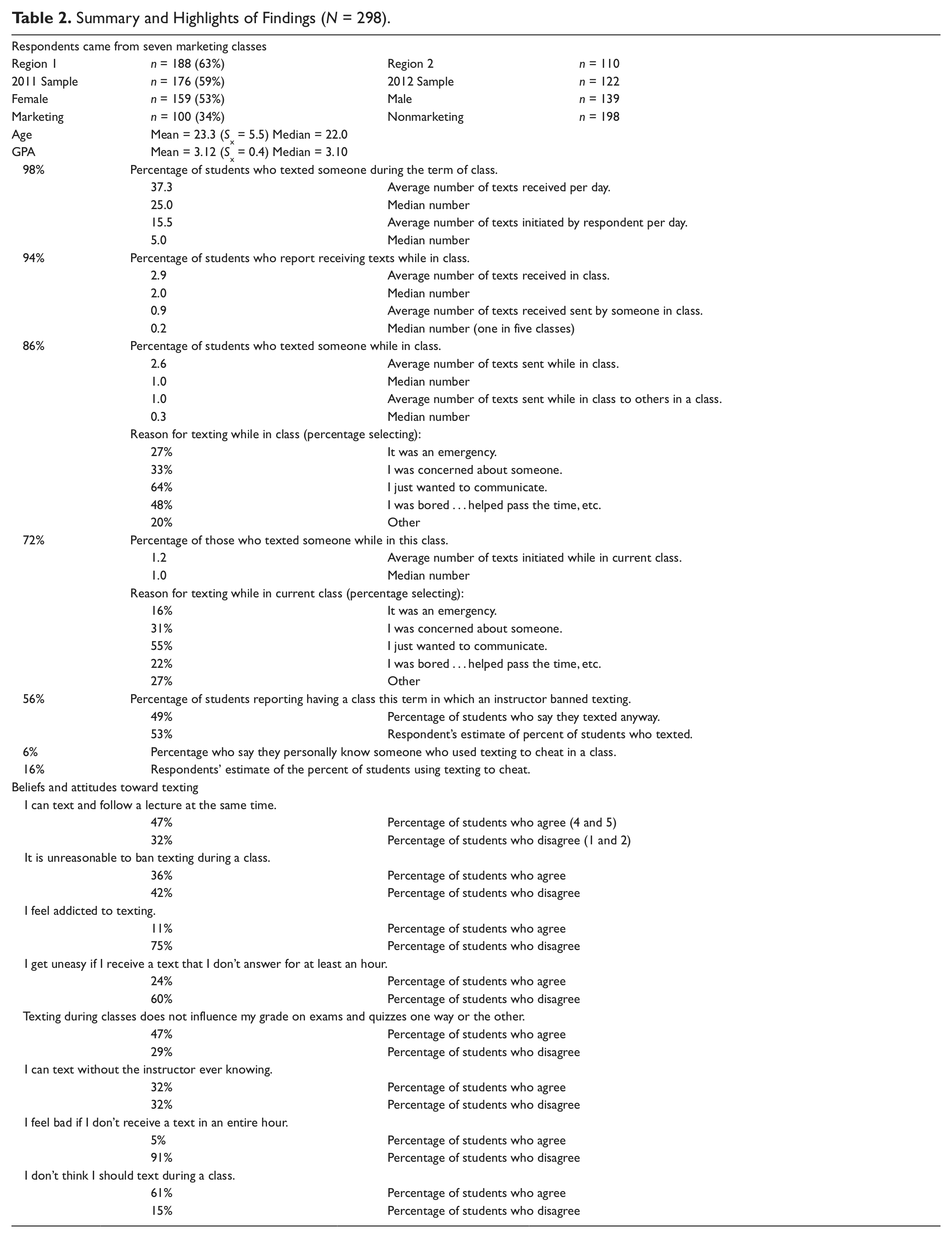
Note that 72% of the students reported texting in the marketing classes evaluated, and they indicated that they sent a mean of 1.2 messages per class. Seventy-seven percent of the marketing majors reported texting in this class, whereas 69% of the nonmarketing majors indicated that they had texted. The difference was not significant at the .05 level (χ2 = 2.52, df = 1, p = .133). The top quartile of student texters in these marketing classes sent a mean of 4.2 texts per class (see Table 5).
The majority of students denied being compulsive about texting. Only 32% doubted that they could text and follow a lecture at the same time, and only 29% thought that texting would influence their grades, but almost half (42%) thought it was reasonable to ban texting in class. There were no significant differences between marketing students and nonmarketing students except for their perception that they could text without the instructor’s knowledge. Marketing students were more likely to agree (marketing majors, 40% agreed; nonmarketing majors, 27% agreed; z = 2.26, p = .012).
First-order associations
The first-order associations and correlations between texting magnitudes are given in Table 3. The magnitude measures of texting are all negatively associated with the class grade. Assuming that the associations are indeed random between frequency of texting and the class grade, and assuming rounding errors, there are two possible outcomes of the correlation (+ and −); a conservative sign test indicates a significant deviation from random (z = 2.67, p = .004). The general attitude about texting, the anxiety associated with texting, and the number of texts received per day were all negatively related to the class grade. Older students texted less, but GPA, gender, and being a marketing major had no consistent pattern of associations with the frequency of texting.
Texting Associations.

Because of high variability and outliers, a log10 transformation was used for texting frequency.
Gender (0 = female; male = 1) and Marketing Student (0 = other; 1 = marketing); associations are point biserial.
p < .05. **p < .01.
Effects of decisions to text
The magnitude differences of the study’s variables by the dichotomous choice to text or not to text are given in Table 4. Although the difference was small, texting in the marketing class resulted in a significant difference in every variable, except GPA. Although GPA was higher for students who did not text in classes, the difference did not generally reach the level of statistical significance. The average grade of those who texted was equivalent to a high C or low B (0.80), whereas the average grade for student who did not text was a B (0.83).
Means of Study Variables by Texting Decisions.
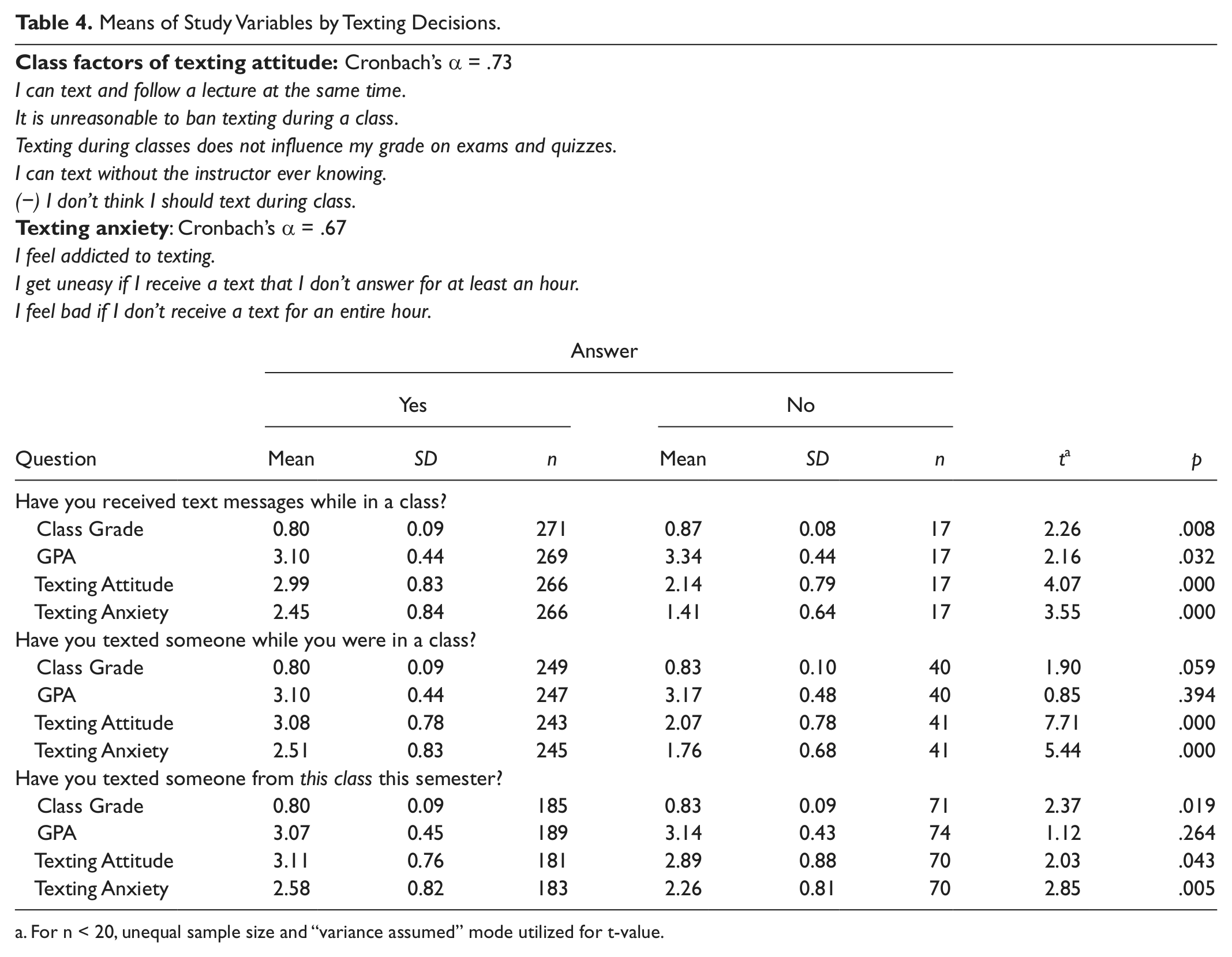
For n < 20, unequal sample size and “variance assumed” mode utilized for t-value.
Magnitude effects of texting
The last analysis sought to control for secondary variables and obtain a measure of the effect of the magnitude of texting on the class grade. Since the variance of the frequency of texting was large, the magnitude scale was reduced to an ordinal quartile scale. The nature of the texting frequency did not always allow for exactly 25% of all subjects to be in each quartile. In such cases, the quartile breakdown was done as closely as the data would allow. The quartiles were then used in a 4 × 2 analysis of covariance with GPA and the number of missed classes used as covariant terms, while Region was used as a co-factor. Preliminary analysis indicated that the regional differences between the two universities created the largest uncontrolled variance in the relationship between texting magnitude and class grade. In this case, controlling for Region also controls for an instructor effect. The relationship between texting, missing class, and grades is potentially complex. All could be related to motivation or to other variables that could influence performance including boredom. Furthermore, although the frequency of missed classes might increase due to the same variables that could influence an increased frequency of texting, increased frequency of missed classes could decrease the effect of texting, or at least reduce the opportunity for texting to influence grades. Consequently, the number of missed classes was added as a covariant term to control for these potential effects. Using Type III sum of squares, the resultant probability levels are equivalent to that which would be found in a linear regression. This method, however, has the advantage of removing the interaction variance between magnitude quartiles and Region. The results are shown in Table 5. Removing differences in GPA, missed classes, Region, and instructors, the number of texts received per day significantly affected the class grade as did the number of texts sent from the marketing class. The more text messages sent and received, the lower the class grade.
Class Grade by Texting Magnitude (Approximate Quartiles).
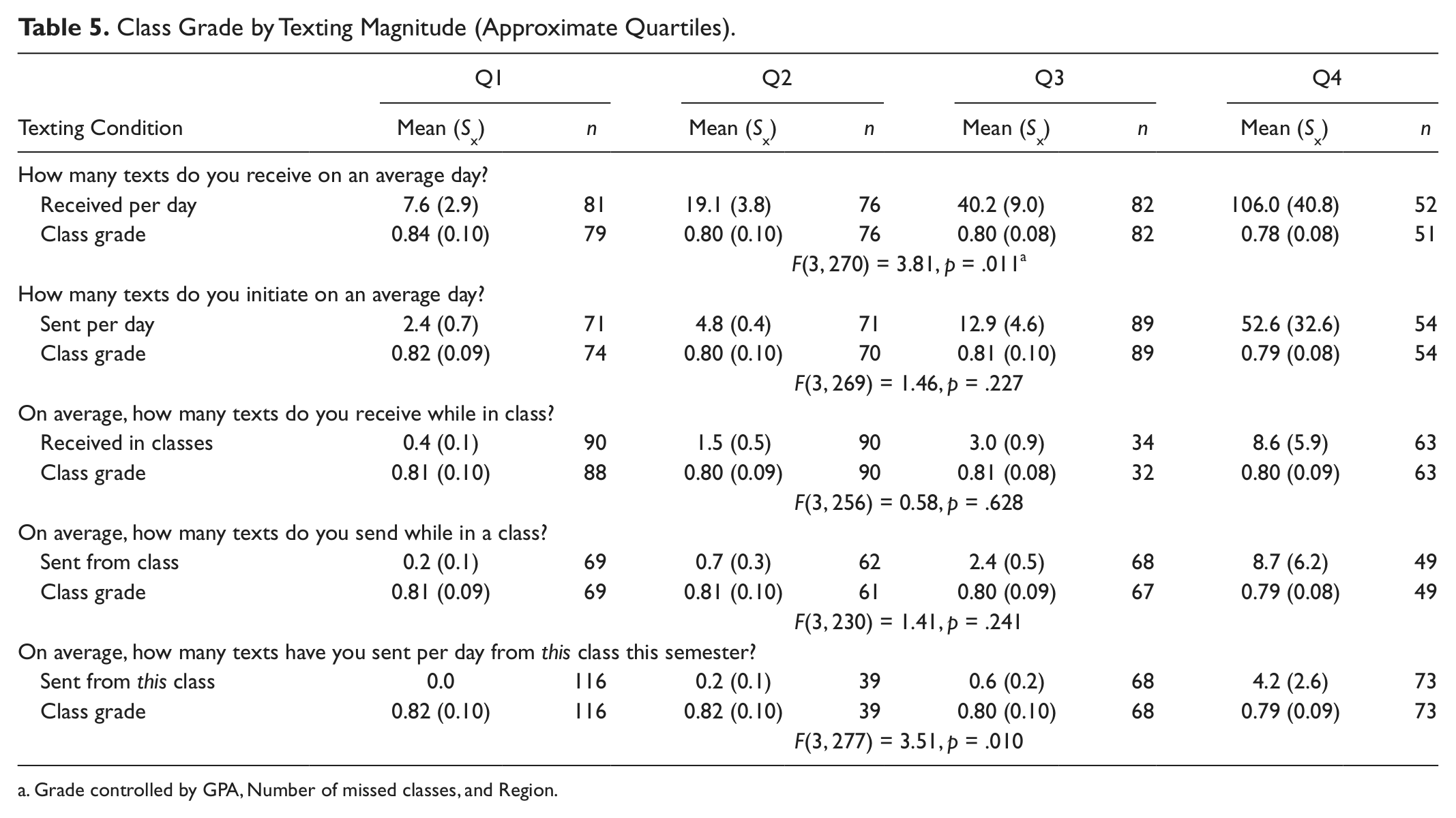
Grade controlled by GPA, Number of missed classes, and Region.
Response to Research Questions
What is the frequency of texting by marketing students, and within marketing classes?
Almost all the students (94%) reported receiving text messages while in class during the term, and 86% said they had texted from a class. In the marketing classes surveyed, 72% of the students indicated that they had texted while in class and sent an average of 1.2 texts per class (median = 1). Twenty-five percent of the students had sent four or more texts per class, and 9% reported sending five or more per class. There were no significant differences between marketing majors and nonmarketing majors. Only 32% of the students believed that they could not text and follow a lecture at the same time, and only 29% thought that texting during class would influence their grades. Yet 42% believed that texting should be banned in classes compared with 36% who thought that it ought not to be banned.
Over half (56%) of the respondents indicated that they had a current class in which texting was banned, but 49% of the students said they continued to text in that class irrespective of the ban.
What student demographics are related to texting frequency?
Texting was unrelated to the students’ gender and generally to GPA. Marketing majors reported higher frequency of texting in all situations, but none of these differences reached the traditional level of significance except that marketing majors had an overall more positive attitude toward texting than other students, t(288) = 2.12, p = .035. The upper Midwest students did report receiving more texts in general than did the students from the Southwest, but there were no other significant differences in the frequency of texting between the two regions. Although the frequency of texting was higher in regular day classes, there were no significant texting frequency differences between class types (day, night, summer, online). Texting frequency was related to the students’ attitude toward texting and texting anxiety. The most frequently stated reason for texting was a desire to communicate followed by concern about someone, and then boredom with the class. Given the diversity of region, class types, gender, and major, the consistency of texting frequency is remarkable.
Does texting behavior influence grades given in marketing classes?
Students who received the most texts in a day did more poorly in the class monitored. Although the first-order association between the number of texts sent during the class measured and the class grade was not significant, r = −0.069, t(293) = 1.18, p = .119, the quartile ordinal difference in grade by the number of texts sent was significantly different even when controlled for GPA, missed classes, and Region (see Table 5). The choice to text or not to text in the class also resulted in a significant difference in class grade.
Limitations
The surveys were conducted in only two universities; findings in other settings may find more or less of the effects reported here. It is possible that the students’ reports may be unique and not representative of other groups of students in marketing classes in other regions. However, the frequency of texting found here is consistent with samples taken from other sources.
There was no convincing relationship found in this study between texting and GPA that was reported in a number of other studies. There are several possibilities related to this finding for external validity.
It could be that the survey is correct. For those in marketing classes, texting is unrelated to GPA.
The sample may be uniquely different on this variable from other populations even though it was consistent on other variables that could be compared.
The students surveyed could have less variability on aspects related to GPA than normal. Faculty have commented at both institutions that the students are remarkably homogeneous in terms of student-related performance.
The GPA may reflect a lowering of faculty expectations corresponding to the students’ adoption of social media. For example, misspelling and incorrect punctuation may be accepted without modification because an assignment was submitted as a text.
Only further research can resolve the GPA discrepancy found in this study.
There were extreme differences in frequency found in the surveys. When asked how many texts they received per day, the reports ranged from 1 to 300. The frequencies chosen most often were 10, followed by 50, then 20 and 25. Obviously, the students were estimating. Attempts were made in the analysis to alleviate problems this could create. The data were transformed to a logarithmic scale to measure associations and was reduced to quartiles for further analysis.
Another potential problem was the measurement of the class grade. The variable was simply the percentage of the total. Although this did control for differences in letter grades, it did not look exclusively at material that was presented only in class, which may have been disrupted by texting. In addition, the nature of this exploratory study does not allow for a causal interpretation of the findings. It only showed that in this combination of marketing classes (both lecture and online, both night and day, and both traditional and summer classes), there was a relationship between grades and texting. It further showed little demographic differences in texting frequency or consequences.
Implications
This study found several inconsistencies that may have some bearing on pedagogy. The students empathically deny that they are addicted to texting or suffer from texting anxiety. Yet almost all the students texted someone while in class, and the average number of texts received in a class is statistically identical to the number of texts sent while in that class. Furthermore, even though the majority of students agreed that they should not text in class, about half did so anyway. In addition, only a minority of the students gave a reason for texting that had to do with emergencies or immediate concerns for others. Some of the given reasons for texting were remarkably trivial, such as the student who remarked that he or she texted in class because “something funny happened,” or statements that seem to suggest that other events in the students’ lives are more important than anything that is happening in class. These findings are not isolated and are very consistent with other surveys (Williams et al., 2011).
Of particular interest was the finding related to GPA. Even though texting was negatively associated with the grade in the respondents’ class, it had no effect on overall GPA. Perhaps it is true that the students’ perception that they can text and follow a lecture at the same time is accurate. With grade inflation, opportunities to obtain points with out-of-class assignments, and the practice of many instructors to make notes available, being distracted in class may not be that much of a problem. In the study reviewed above (Williams et al., 2011), students made comments such as: “I am not learning anyway” (p. 54) and “most of the time I text because I’m bored, so I was not learning to begin with” (p. 55). One student bluntly offered a suggestion, “For me, I only text when I am bored, so if the teacher sees that maybe they can change their teaching styles” (p. 55).
Solutions
With transformations in culture and technology, the norms within modern classrooms have changed as well. It was once common practice, for example, to have dress codes at many institutions, and food or drink was emphatically banned. As culture changed, the classroom became more informal. With the advent of instant communication, perhaps the classroom is now becoming more technologically informal. However, the metacognitive literature offers strong evidence that texting should hinder learning, which is reinforced by research and suggested by the finding of this study that the decision to text in class is negatively related to the class grade. Yet our results and the literature seem to suggest that texting in class cannot be successfully banned using traditional constraints. This leaves a limited number of options for instructors. They could:
Accept texting in class as another manifestation of modern culture, much the same way that bringing drinks and perhaps food into class has become widespread.
Incorporate texting as part of the learning experience. According to Tucker (2006), members of the Millennial cohort share a number of characteristics that influence their approach to learning and that makes them distinct from other generations. They tend to exhibit strong bonds with their parents and are used to being indulged and consulted on matters important to them. They are constantly connected to social and information sources and feel that they are proficient in multitasking. It may be that this cohort should be approached by incorporating texting as another venue for student learning. A number of sources have recommended this (Mandernach, 2010; Ruby & Ruby 2011; Vecchione, 2010), including a number of reports from Europe (i.e., Moustakas, 2011). Some have even recommended software that allows texting to be shared by an entire class (Staino, 2010). A concern, however, and a common theme in these articles, is the lack of reported outcomes. It appears that there has not been enough research conducted to ascertain the effects of incorporating texting on student learning and performance.
Appropriately increase the cognitive load in the classroom. Given the research on multitasking and brain function, the real question is not whether texting in class lowers academic performance, but why does a class not produce enough cognitive load that texting would disrupt it?
As Bacon and Stewart (2006) suggest, sacrifice breadth for depth. Part of this is teaching the student how to learn and what it “feels” like to learn. This requires student–faculty contact, active rather than passive learning, prompt feedback, and the communication of expectations that are constantly reinforced (Chickering & Gamson, 1987). Instead of simply banning texting, students could be taught about the professional expectations of texting and advantages of compliance. All theories of self-regulation assume that students interpret learning outcomes as having tangible or intangible personal implications (Zimmerman, 1990). The problems with texting in a professional context would need to be taught and constantly reemphasized and rewarded. The importance of consistency and persistence is pointed out by Appleton-Knapp and Krentler (2006), when they reminded us that “the best learning strategies are often the least liked by students” (p. 262) and that self-regulation is situation specific (Zimmerman & Schunk, 2001).
Research has shown that marketing students will respond to appropriate calls for cognitive engagement. They are capable and willing to choose their level of engagement based on their underlying educational goals (Taylor, Hunter, Melton, & Goodwin, 2011). Students who are intrinsically motivated will use more deep cognitive and metacognitive strategies while learning than students with extrinsic motivation. When students feel competent and in control of their learning performance, they are more likely to select cognitive strategies that engender deep learning and cognitive load. Young (2005) suggests that
active application-oriented learning experiences delivered by enthusiastic faculty members who provide high personal interaction, along with supportive feedback, clear goals, and expectations emphasizing learning over grades will increase intrinsic motivation and the use of self-regulated learning strategies. (p. 36)
Texting, or other social media, may be here to stay. But educating a student populace on when it is appropriate to text and then reinforcing this with an appropriate level of classroom engagement is likely to lead to better long-term outcomes.
Future Research
More experimental evidence of the effects of texting and multitasking on class performance is needed. For example, does texting, or other multitasking in class, decrease grades because of limited mental capacity, or simply because grades and texting are related to other factors such as boredom, personality (Lieberman & Rosenthal, 2001), or other cognitive differences? This research would be complicated by the complex relationship between learning and grades.
For those who wish to incorporate texting within their teaching, research needs to be conducted on the learning outcomes. A common theme in these articles is the lack of reported results. It appears that there has not been enough research conducted to ascertain the effects of incorporating texting on student learning and performance, or on the instructors’ response to different learning and behavioral patterns inherent in a new communication paradigm. There have been some demographic foundations laid (Baker, Lusk, & Neuhauser, 2012), but details and implications remain lacking.
The results of this study raise another issue. Cognitive theory predicts that students will be handicapped if they attempt to multitask during class. Neural research indicates that our brains do not process heavy cognitive loads simultaneously, but sequentially. Some highway studies have dramatically shown that the effects of someone texting while driving is consistent with driving while drunk (Medina, 2009). It may be some time before academic studies yield such dramatic results, but in the meantime early indications are that multitasking does impact grades. This survey found a decrease in grades in a class in which the students texted, but no relationship between texting and GPA was found. Does this mean that the cognitive models are wrong, or does it imply that marketing classes (or lectures) do not carry enough cognitive load to be disrupted by multitasking? The results of such a study could have dramatic implications not only for the validity of the cognitive model but also for our profession’s basic approach to marketing education.
Footnotes
Declaration of Conflicting Interests
The author(s) declared no potential conflicts of interest with respect to the research, authorship, and/or publication of this article.
Funding
The author(s) received no financial support for the research, authorship, and/or publication of this article.