



Abstract
Group-based teaching and learning is ubiquitous across undergraduate and graduate business curricula, and with any type of group work, free-riding—a form of social loafing in which free-riding group members reap the rewards of nonloafing members without exerting comparable effort—is a concern. This research examines a group assignment method, herein called the flocking method, designed to reduce free-riding by improving students’ motivation and availability to contribute to the group. A quasi-experiment is described in which students were flocked, or matched, according to their schedule availability and willingness to devote time to the course, such that motivated students (i.e., those who planned to devote more time) were grouped with other motivated students with similar schedules, whereas unmotivated students were grouped with other unmotivated students with similar schedules. Compared with self-selected groups, students in flocked groups not only reported less free-riding, they also performed better on group and individual assignments, indicating an actual reduction in free-riding. Additionally, compared with the most prominent methods for reducing free-riding examined in literature, the flocking method of group assignment reduces resource demands on the instructor and students, making it as efficient to implement as it is effective. Limitations and directions for future research are discussed.
Keywords
Group-based teaching and learning is ubiquitous across undergraduate and graduate business curricula (Chapman & Van Auken, 2001; see also, Batra, Walvoord, & Krishnan, 1997; Huff, Cooper, & Jones, 2002), and with any type of group work, free-riding—a form of social loafing in which free-riding group members reap the rewards of nonloafing members without exerting comparable effort (Comer, 1995)—is a concern (McCorkle et al., 1999; Strong & Anderson, 1990). Several methods for reducing free-riding in student groups have been explored (see, Karau & Williams, 1993 for a review). Particular emphasis has been placed on the use of periodic peer evaluations for curbing and sanctioning free-riders (e.g., Aggarwal & O’Brien, 2008; Brooks & Ammons, 2003; Druskat & Wolff, 1999); however, less attention has been given to how group assignment may contribute to free-riding.
The present research examines an instructor-driven method of group assignment, herein called the flocking method, designed to improve both students’ motivation and ability to contribute to the group. In particular, students are flocked, or matched, by the instructor according to their schedule availability and willingness to devote time to the course, such that motivated students (i.e., those who plan to devote more time to the course) are grouped with other motivated students with similar schedules, whereas unmotivated students (i.e., those who plan to devote less time to the course) are grouped with other unmotivated students with similar schedules. Based on a review of the determinants of free-riding, it is proposed that assigning students with similar motivation levels and schedules to the same group will reduce many of the temptations and obstacles commonly associated with free-riding (Hall & Buzwell, 2012), resulting in more equitable contributions across group members. It is also proposed that this reduction in free-riding will, in turn, lead to better student learning outcomes—not only on the group project, but also with regard to students’ individual understanding of the course content on which the group project is based (Slavin, 1990; see also, Kimber, 1996; Webb, 1997).
In the next sections, the literatures on free-riding and social loafing are reviewed, with emphasis placed on the causes of free-riding and corresponding methods of reducing it. Next, the rationale behind the flocking method of group assignment is described, drawing from research on the consequences of free-riding and social loafing for other group members to formulate hypotheses. The results of a quasi-experiment in which flocked groups are compared with self-selected groups in an undergraduate marketing research course are then presented, providing support for the proposition that students in flocked groups perceive less free-riding and enjoy better group and individual learning outcomes. Finally, the contributions and limitations of the research are discussed, including the benefits and drawbacks of the flocking method of group assignment.
Methods for Reducing Free-Riding in Groups
The phenomenon of social loafing, defined as “a decrease in individual effort due to the social presence of other[s]” (Latané, Williams, & Harkins, 1979, p. 823), was first recognized over a century ago when Ringelmann (see, Latané et al., 1979, for a discussion) reported that the collective effort that groups exerted during a rope-pulling exercise was less than the sum of the group members’ individual efforts when pulling the rope alone. Social loafing is particularly problematic when a loafing group member profits from, or free-rides on, the efforts of nonloafing members, thereby “deriving benefits . . . that are disproportionately larger than his or her contributions to the group” (Comer, 1995, p. 649; see also, Albanese & Van Fleet, 1985). Although several causes of free-riding have been identified (see, Comer, 1995; Hall & Buzwell, 2012; Karau & Williams, 1993; Strong & Anderson, 1990, for reviews), most are predictive of a decrease in the free-rider’s motivation to contribute to the group (as opposed to, for example, a decline in intragroup coordination; Ingham, Levinger, Graves, & Peckham, 1974). For instance, people are more likely to free-ride when they believe it will be difficult to identify their individual contributions (George, 1992; Harkins & Jackson, 1985; Jones, 1984; Karau & Williams, 1993; Liden, Wayne, Jaworski, & Bennett, 2004; Price, Harrison, & Gavin, 2006; K. D. Williams, Harkins, & Latané, 1981), when they expect other group members to perform well (Karau & Williams, 1993; K. D. Williams & Karau, 1991), when the group task is of low personal meaningfulness (e.g., not intrinsically interesting or consequential to their personal outcomes; Karau & Williams, 1993; K. D. Williams & Karau, 1991), or when they feel they are dispensable with little to uniquely contribute (Harkins & Petty, 1982; Kerr & Bruun, 1983; Price et al., 2006; Weldon & Mustari, 1988).
Although motivational drivers have received the most attention, free-riding may also be a product of factors that constrain one’s ability to contribute to the group, such as limited scholarly aptitude (real or perceived; Börjesson et al., 2006; Freeman & Greenacre, 2011; Kerr, 1983; March, 1954; see also, Karau & Williams, 1997), differing work styles or time constraints (i.e., availability; Hall & Buzwell, 2012). For instance, Freeman and Greenacre (2011) find that when students with limited scholarly aptitude are perceived to be unwilling to exert comparable effort, they are often ostracized by other group members and effectively blocked from contributing to the group. Likewise, students with schedules that routinely prohibit them from meeting with the group may be willing but, unfortunately, unable to contribute fully (Hall & Buzwell, 2012). Thus, free-riding is not always a consequence of one’s willingness to contribute—it may also be a consequence of one’s ability to contribute.
Several methods for reducing free-riding in groups have been explored, with particular emphasis on the use of periodic peer evaluations for curbing and sanctioning free-riders (Mello, 1993; Strong & Anderson, 1990; D. L. Williams, Beard, & Rymer, 1991). In particular, research shows that multiple peer evaluations (Aggarwal & O’Brien, 2008; Brooks & Ammons, 2003), implemented early and with specific evaluative criteria (Brooks & Ammons, 2003), can reduce free-riding and improve perceived group outcomes (Druskat & Wolff, 1999). Peer evaluations are especially effective at reducing free-riding when used to reward and sanction individual group members through individualized group project grades (Cook, 1981; Kench, Field, Agudera, & Gill, 2009; Jalajas & Sutton, 1984; Maranto & Gresham, 1998; Mello, 1993; D. L. Williams et al., 1991), firing free-riding members (Abernethy & Lett, 2005), and so on. Other methods for reducing free-riding have been identified, including the use of self-evaluations (Harkins & Szymanski, 1988; Szymanski & Harkins, 1987), and the formation of smaller groups (Aggarwal & O’Brien, 2008; Alnuaimi, Robert, & Maruping, 2010; Ingham et al., 1974; Karau & Williams, 1993; Kerr & Bruun, 1981, 1983; Latané et al., 1979; Liden et al., 2004). However, little attention has been given to how group assignment may contribute to free-riding (cf. Bacon, Stewart, & Anderson, 2001; Karau & Hart, 1998; Karau & Williams, 1993, 1997; Liden et al., 2004; Muller, 1989).
The limited research that has considered the role of group assignment generally recommends that students form their own groups. Indeed, self-selection is associated with higher initial cohesion, motivation to resolve interpersonal conflicts and established group norms—factors which are predictive of reduced free-riding (Bacon, Stewart, & Silver, 1999; see also, Mello, 1993; Strong & Anderson, 1990). Furthermore, empirical work has shown that self-selection is predictive of superior group dynamics (Chapman, Meuter, Toy, & Wright, 2006), positive group experiences (Bacon et al., 1999; Chapman et al., 2006; Mahenthiran & Rouse, 2000), and higher grades (Mahenthiran & Rouse, 2000).
However, it is important to note that these advantages are in comparison with randomly-assigned groups; only one article, to the author’s knowledge, has compared self-selected with instructor-assigned groups, and no difference in perceived social loafing was found (Aggarwal & O’Brien, 2008). One reason for this null effect may be that the researchers did not empirically distinguish between groups assigned randomly and those formed on more strategic bases (e.g., skill sets, personality types); thus, the effect of each instructor-assignment method may have nullified the other. Alternately, Aggarwal and O’Brien note that some instructors may have used instructor-assignment and self-selection simultaneously. Regardless, it is unclear why students in self-selected (vs. instructor-assigned) groups did not report a lower incidence of social loafing, as predicted. Furthermore, self-selected groups may suffer from a lack of diversity (Jalajas & Sutton, 1984), critical task-related skills (Blowers, 2003), cohesion due to tight-knit subgroups (Michaelsen & Black, 1994), and task focus during meetings (Chapman et al., 2006), which may impede performance. Thus, the question remains as to whether self-selection is indeed the preferred group assignment method for reducing free-riding or, alternately, if and when instructor-assignment to groups is preferable.
The Flocking Method of Group Assignment
The present research examines the flocking method, an instructor-driven method of group assignment designed to reduce free-riding by improving students’ motivation and ability to contribute to the group. As previously discussed, although there is a robust literature on the motivational antecedents of free-riding and social loafing (Comer, 1995; Karau & Williams, 1993; Strong & Anderson, 1990), free-riding is not always a result of apathy or a deliberate lack of effort—that is, one’s willingness to contribute to the group. Numerous other factors may instead diminish one’s ability to contribute, such as time constraints (see, Hall & Buzwell 2012, for a review). Thus, a group assignment method designed to reduce free-riding would ideally address both variables.
It is postulated that flocking, or matching, students with similar motivation levels (i.e., willingness to contribute) and schedules (i.e., ability to contribute) will reduce many of the temptations and obstacles commonly associated with free-riding (Hall & Buzwell, 2012; Mello, 1993). For instance, it becomes more difficult for a student to willfully free-ride when other group members are similarly unmotivated; likewise, it is easier to avoid unintentionally free-riding when other group members have similar availability to meet. Thus, it is proposed that the flocking method of group assignment will maximize students’ motivation and ability to contribute, resulting in more equitable contributions (i.e., less free-riding) in flocked (vs. self-selected) groups. Specifically, it is hypothesized that
Furthermore, it is proposed that a reduction in free-riding will lead to better group and individual learning outcomes for all students. It is fairly apparent why this may be the case for “low motivation” free-riding students: Those who otherwise would have ridden on the coattails of more motivated group members are not given the chance to do so; thus, they are forced to exert more effort themselves (Karau & Williams, 1993; K. D. Williams & Karau, 1991). It may also be that “low motivation” and “low ability” students (i.e., those who are more likely to free-ride) are better able to contribute to the group because their contributions are no longer blocked by more motivated and/or able group members (Freeman & Greenacre, 2011; see also, Börjesson et al., 2006; Kerr, 1983; March, 1954). This enhanced ability to contribute may, in turn, lead them to become more engaged. In either case, increased effort on the group project is anticipated to translate not only to better group learning outcomes, but also to a better individual understanding of the course content on which the group project is based (Slavin, 1990; see also, Kimber, 1996; Webb, 1997; cf. Bacon, 2005).
It is also anticipated that a reduction in free-riding will improve the learning outcomes of non-free-riding students. This conjecture is based on research on the consequences of free-riding and social loafing for other group members (see, Comer, 1995 for a review). As implied by the definition of free-riding, other group members often pick up free-riders’ slack by increasing their own efforts (Huff et al., 2002; Liden et al., 2004; K. D. Williams & Karau, 1991). This is most likely to occur when free-riding is attributed to a lack of ability on the part of the free-rider (e.g., free-riding members are trying to pull their weight but are unable to because of their limited scholarly aptitude, schedule availability, etc.; Karau & Williams, 1997). However, when free-riding is perceived to stem from an unwillingness to contribute, as is often the case (Hall & Buzwell, 2012), the consequences are often less favorable. In particular, non-free-riders may fall victim to “disheartened” loafing (Comer, 1995)—that is, reducing their own efforts with the belief that, no matter the caliber of their own contributions, they will not be able to pick up the slack of free-riding members. Alternately, they may succumb to “retributive” loafing (aka the sucker effect; Kerr, 1983; see also, Comer, 1995; Jackson & Harkins, 1985)—that is, choosing to reduce their efforts rather than be a “sucker” who picks up the slack of others. In either case, perceptions of free-riding often diminish the motivation of otherwise motivated group members; thus, if perceptions of free-riding were reduced by creating groups in a manner that minimizes the willingness and ability to free-ride, the motivation and efforts of non-free-riding students should remain high. Again, this heightened effort should lead to better performance on the group project and, thus, a better individual understanding of the course content on which the group project is based. Therefore, it is hypothesized that
Method
To test these hypotheses, two group assignment methods (flocking vs. self-selection) are compared using a between-participants, quasi-experimental design. Data were collected over a two-year period in an undergraduate marketing research course with a substantial group work component. In particular, whereas 50% of the total course grade is based on a variety of individual assessments (i.e., four multiple-choice exams, α = .80; 16 true/false quizzes, count top 10, α = .74; two homework assignments with correct/incorrect answers, α = .60), the remaining 50% of the total course grade is based on a semester-long, multideliverable, client-based group research project. The group project consists of five major deliverables: (1) a research request agreement, (2) a research proposal, (3) a research presentation to the class, (4) a research presentation to the client, and (5) a final research report. The research presentation to the client is not graded, per se; rather, students receive full credit once the instructor receives client confirmation that the presentation took place (all groups reported in this research received full credit for the client presentation). In contrast, all other group project deliverables are graded using detailed rubrics (α = .61; see, Web Appendix for rubrics, available online at http://journals.sagepub.com/home/jmd). The purpose of the group project is to enable students to apply the concepts discussed in class in a real-world setting, thereby deepening their understanding of those concepts.
In the first academic year (fall and spring semesters; 2014-2015), students were instructed to form their own groups, which ranged in size from four to six students. Because research shows that the benefits of self-selection for subjective group experiences and other outcomes are strongest when students know each other prior to selecting their own groups (Bacon, Stewart, & Stewart-Belle, 1998), some insight into how well-acquainted students were prior to forming groups is warranted. This research was conducted at a smaller private teaching university with a mostly traditional, full-time undergraduate population. This course is typically taken in one’s senior year, which increases the likelihood that students have already taken one or more upper-level marketing courses together—courses which range in size from 20 to 30 students. Anecdotally, most students appear to know each other on the first day of class and, in the self-selection condition, appear to choose group members with whom they are reasonably familiar. In the subsequent academic year (fall and spring semesters; 2015-2016), students were instead assigned to groups using the flocking method of matching students based on motivation and availability; again, groups ranged in size from four to six students. All other elements of the course—organization, content, assignments, and grading—were identical.
The flocking method was implemented using CATME (www.catme.org), a web-based team management system that facilitates group formation using responses to an online survey (Hrivnak, 2013; see also, Bacon, 2014; Loughry, Ohland, & Woehr, 2014). Survey questions can be customized and their impact on group formation weighted using an 11-point scale (1 = group dissimilar; 6 = ignore; 11 = group similar). Although additional questions were included in the survey, only CATME’s preset questions regarding schedule availability and the number of hours one plans to devote to the course were weighted in the formation of groups. Specifically, students were asked (a) “Please check the times that you are busy and unavailable for group work” (98 one-hour blocks between 8:00 am and 10:00 pm each day, Monday through Sunday; i.e., CATME question titled, “Schedule”) and (b) “In this course, you intend to work how many hours per week outside of class (not counting lectures or labs)?” (1 = 1 hour per week; 2 = 2-4 hours; 3 = 5-7 hours; 4 = 8-10 hours; 5 = whatever it takes; i.e., CATME question titled, “Commitment Lvl”). Weights of 11 and 9 were designated for the availability and motivation questions, respectively, such that students assigned to any given group were similar on these variables. Whereas students were told that the CATME survey would be used to place them into groups with others who shared similar schedules, the motivational component of group assignment was not disclosed.
Perceived free-riding was assessed at the end of each semester using a confidential peer-evaluation form in which students individually reported the relative contributions of each of their group members, including themselves, using a constant-sum scale (100 points). Little variation in the number of points allocated to each member represents a low incidence of perceived free-riding, whereas high variation represents the opposite. Because the number of points representing equitable contribution varies according to the size of the group, a coefficient of variation (σ/µ) was computed by dividing the standard deviation of the set of points allocated by a given student to his or her group members by the mean of that set (Muller, 1989). Thus, the smaller (larger) the coefficient of variation, the more (less) equally students were perceived to contribute to the group, indicating a lower (higher) incidence of free-riding.
Finally, student learning outcomes were assessed by examining group and individual grades, which were collapsed across the various group and individual assignments in the course. Although grades are an imperfect indicator of student learning, the number and variety of assessments used in this course serves to minimize the failure of any particular assessment to satisfactorily reflect student learning. Furthermore, grades are widely regarded in the literature as a valid proxy for actual (vs. perceived) student learning (Sitzmann, Ely, Brown, & Bauer, 2010; see also, Bacon, 2016; Clayson, 2009).
Results
Prior to testing the conjecture that flocking (vs. self-selection) reduces free-riding and, thus, improves student learning outcomes, the two group assignment conditions were compared on four demographic variables: gender, grade point average (GPA), class standing, and number of absences. A series of analyses of variance (ANOVAs) and Pearson chi-square analyses indicated that the conditions are equivalent on all four variables (see, Table 1); nevertheless, all subsequent analyses were conducted using these variables as covariates.
Group Characteristics.

Note. Standard deviations indicated in parentheses; n = 87 students and 16 groups.
Perceived Free-Riding
To determine whether flocking (vs. self-selection) reduces free-riding (Hypothesis 1), individual students’ perceptions of free-riding (i.e., the coefficient of variation) were submitted to a one-way between-participants ANOVA. This analysis yielded a main effect of group assignment, such that free-riding was reduced (i.e., contribution variance was lower) when student groups were flocked (vs. self-selected): M = 0.07 versus 0.15; F(1, 79) = 8.01, p = .01,
Descriptive Statistics for Dependent Variables.

Note. Standard deviations indicated in parentheses; n = 87 students and 16 groups.
Hierarchical Linear Modeling Results.

Note. Standard errors indicated in parentheses; n = 87 students and 16 groups.
p < .10. *p < .05. **p < .01.
First, as shown in M1, group-level factors had a significant impact on perceived free-riding (
Group Learning Outcomes
To determine whether flocking (vs. self-selection) leads to better student learning outcomes (Hypothesis 2), group grades and individual grades were examined in turn. First, a one-way ANOVA assessing the impact of group assignment on group grades revealed that, although the difference was not significant due to the relatively small number of groups (n = 16), students in flocked (vs. self-selected) groups performed directionally better on the group project: M = 88.57 versus 85.72; F(1, 14) = 1.22, p = .29,
Individual Learning Outcomes
Next, to determine whether flocking (vs. self-selection) leads to better individual learning outcomes (Hypothesis 2), individual grades were examined using a one-way ANOVA. As predicted, students in flocked (vs. self-selected) groups performed better on the individual component of their grades: M = 83.59 versus 79.12; F(1, 85) = 7.39, p = .01,
Mediation Analyses
To determine whether perceptions of free-riding mediate the relationship between group assignment and group and individual learning outcomes (Hypothesis 3), mediation models for group grades and individual grades were examined in turn (see, Table 4 for complete path analyses; abbreviated results reported here). A mediation analysis for group grades was conducted first (Hayes, 2013, PROCESS Model 4), with group assignment (1 = flocking; −1 = self-selection) entered into the model as the independent variable, free-riding (i.e., the coefficient of variation; centered) entered as the proposed mediator, and group grade entered as the dependent variable (see, Figure 1; top panel). As predicted, flocking was associated with reduced free-riding (i.e., lower contribution variance) and reduced free-riding was associated with higher group grades. Most important, a bias-corrected, 95% confidence interval (CI) based on 5,000 bootstrap samples revealed that group assignment had an indirect effect on group grade through the proposed mediator, free-riding (indirect effect [ab] = 0.003, standard error [SE] = 0.002, CI [0.001, 0.008]), which indicates that free-riding mediated the effect of group assignment on group grades.
Mediation Model Coefficients.

Note. SE = Standard error.
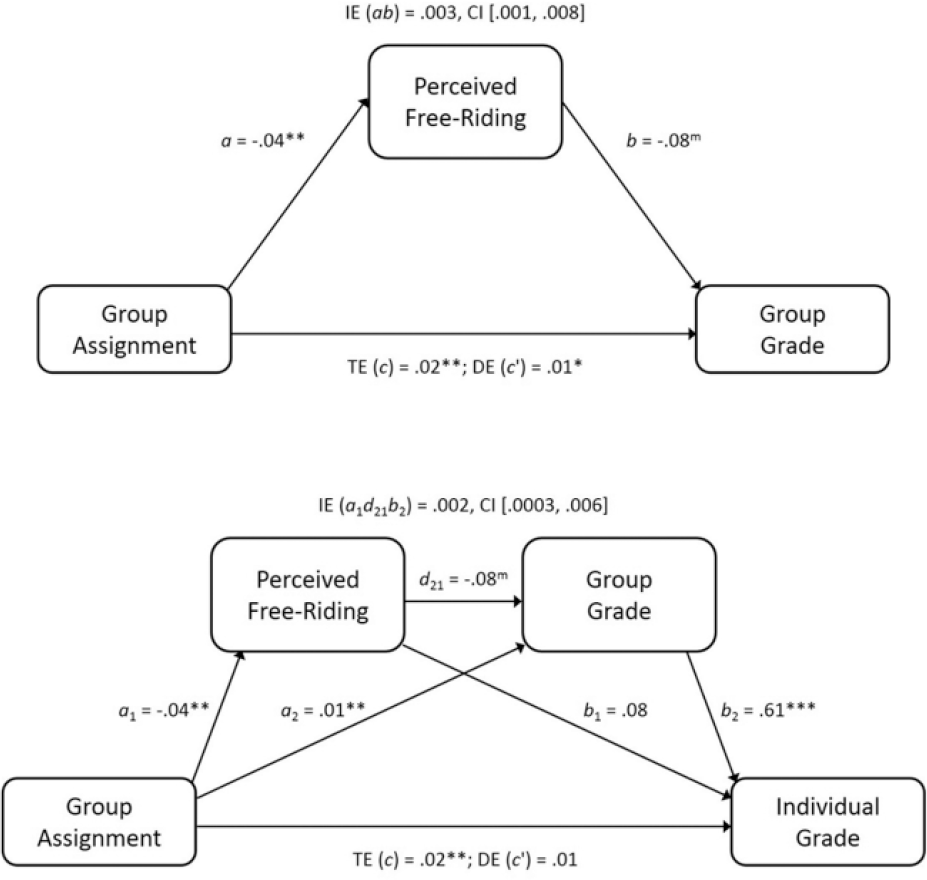
Mediation models for group and individual learning outcomes. IE = indirect effect; TE = total effect; DE = direct effect.
A parallel analysis was conducted for individual grades, which revealed that, although flocking was associated with reduced free-riding and higher individual grades, perceived free-riding alone did not mediate the relationship between group assignment and individual learning outcomes (indirect effect [ab] = −0.001, SE = 0.003, CI [−0.009, 0.004]). However, it was postulated that the effect of free-riding on individual learning may be indirect, such that it is only when students contribute more equally (and, thus, perform better) on the group project that they learn more as individuals. Indeed, a multiple mediator path analysis (Hayes, 2013, PROCESS Model 6) with group assignment entered as the independent variable, free-riding and group grade (centered) entered as serial mediators, and individual grade entered as the dependent variable (see, Figure 1; bottom panel) showed that the benefits of reduced free-riding for group learning extended to individual learning outcomes, such that when students contributed more equally to the group, the increased learning that took place through the applied group project translated to a better individual understanding of the course material on which the project was based (indirect effect [a1d21b2] = 0.002, SE = 0.001, CI [.0003, .006]). Thus, Hypothesis 3 is generally supported.
Discussion
Free-riding is a pervasive issue in courses that include a significant group work component, and although several methods for reducing free-riding have been examined, little empirical insight has been provided as to how group assignment may contribute. The present research examines an instructor-driven method of group assignment, the flocking method, designed to improve students’ motivation and ability to contribute to the group. In particular, students are flocked, or matched, according to their self-reported willingness and availability to contribute, such that unmotivated (motivated) students are grouped with other unmotivated (motivated) students with similar schedules. As predicted, the results reveal that students in flocked (vs. self-selected) groups not only report less free-riding, they also perform better on both group and individual assignments, indicating an actual reduction in free-riding. This latter finding is notable as the preponderance of past metrics for gauging the impact of free-riding in groups have been perceptual (Aggarwal & O’Brien, 2008; Brooks & Ammons, 2003; Liden et al., 2004; Muller, 1989; Price et al., 2006; cf. Asmus & James, 2005; Dommeyer, 2012), which is problematic as meta-analyses have found little to no correlation between actual and perceived learning measures (Sitzmann et al., 2010; see also, Bacon, 2011; Clayson, 2009). Thus, in addition to identifying an effective method for reducing free-riding in groups, this research also addresses the recent call for pedagogical researchers to attend more closely to actual outcomes (Bacon, 2016).
Additionally, compared with the most commonly examined methods for reducing free-riding in groups—periodic peer evaluations and corresponding individualized group project grades (Strong & Anderson, 1990; D. L. Williams et al., 1991)—the flocking method of group assignment reduces resource demands on the instructor and students, making it as efficient to implement as it is effective. In particular, once flocked groups are formed using CATME’s web-based team management system, no further oversight by the instructor or periodic evaluations by students are required. One potential drawback of the flocking method compared with periodic peer evaluations is that it may not serve as an early warning system for free-riding students. However, by grouping students with similar motivation levels and schedules together, the flocking method is designed to reduce many of the temptations and obstacles commonly associated with free-riding (Hall & Buzwell, 2012), thereby better equipping students to avoid free-riding altogether. Nonetheless, it would be interesting to explore whether periodic peer evaluations, which are also facilitated by CATME, might further reduce free-riding when used in combination with the flocking method.
Periodic peer evaluations may also provide more nuanced insight into how the flocking method works, allowing future research to examine, for instance, whether free-riding is reduced in the early stages of a group project or, rather, diminishes over time. Along these lines, it would have been useful to reassess students’ motivation near the end of the group project to ascertain whether motivation levels increased for all students throughout the course of the project, as anticipated. Because controlling for group-level factors did not eliminate the main effect of group assignment on free-riding, it indeed appears that “low motivation” groups experienced the same motivational (and learning outcome) benefits as “high motivation” groups. Nonetheless, a postmeasure of motivation would have strengthened the empirical support for the flocking method.
Although the quasi-experimental methodology used in this research bolsters confidence in the causal claim that the flocking method reduces free-riding, which in turn improves group and individual learning outcomes, the method of group assignment used each semester (i.e., flocking vs. self-selection) was not randomly determined. Thus, although efforts were made to ensure and verify that the treatment and control conditions were comparable (e.g., both conditions included fall and spring semesters; other elements of the course were held constant; no differences in gender, GPA, class standing, or number of absences were found), it is possible that the group assignment conditions differed in ways that were neither anticipated nor detected. An additional limitation of this research is that the bases by which students were flocked, or matched (i.e., their stated motivation and availability to contribute to the group), were not manipulated independently. As a result, the relative impacts of these criteria on perceived free-riding and student learning cannot be distinguished. Because it is possible that one criterion may have been more consequential than the other (or, alternately, that the criteria only work in tandem to reduce free-riding), future research might study these criteria independently using a 2 (motivation: flocked vs. not flocked) × 2 (availability: flocked vs. not flocked) between-participants design.
The flocking method of group assignment advanced in this research raises questions about diversity (Milliken & Martins, 1996), and creativity (Hülsheger, Anderson, & Salgado, 2009) in groups. These constructs are closely linked as creativity and other positive group outcomes are more prevalent in groups that are diversified on task-related variables such as skill sets (Blowers, 2003; Cummings, 2004; Katzenbach & Smith, 1993; Metheny & Metheny, 1997; Michaelsen & Black, 1994; Milliken & Martins, 1996; Price et al., 2006), and educational backgrounds (Beheshtian-Ardekani & Mahmood, 1986; Muller, 1989)—likely because diversity on these variables increases the cognitive diversity of the group (Hoever, Van Knippenberg, Van Ginkel, & Barkema, 2012; Kurtzberg, 2005; Wang, Kim, & Lee, 2016). Therefore, some attention to diversity should be paid in group assignment. One might argue that the flocking method runs counter to this premise; however, this need not be the case. A sophisticated approach to the flocking method might ensure that group members are (a) similar in terms of their motivation and ability to contribute to the group, which serves to safeguard against free-riding, but also (b) diverse in terms of their task-related skills and backgrounds, which serves to foster creativity.
Nevertheless, it would be useful to identify criteria by which flocking (i.e., matching) might have the opposite effect on free-riding. For instance, there is evidence which suggests that assigning groups to include students from a mix of educational backgrounds (Beheshtian-Ardekani & Mahmood, 1986; Muller, 1989), or with a diversity of skill sets (Blowers, 2003; Katzenbach & Smith, 1993; Metheny & Metheny, 1997; Michaelsen & Black, 1994; Price et al., 2006) may reduce feelings of dispensability (Price et al., 2006), which is a motivational antecedent of free-riding (Harkins & Petty, 1982; Karau & Williams, 1993; Kerr & Bruun, 1983; Price et al., 2006; Weldon & Mustari, 1988). Thus, although flocking students with similar others may not be universally effective at reducing free-riding, doing so strategically on variables related to students’ motivation and ability to contribute to the group can have a positive effect on student participation and learning—desirable outcomes that are likely to be augmented on group projects that are heavily weighted in students’ grades (Aggarwal & O’Brien, 2008; Bacon et al., 1999).
Footnotes
Acknowledgements
The author wishes to thank the reviewing team, D. Lee Warren and Joe F. Alexander for their valuable comments.
Declaration of Conflicting Interests
The author declared no potential conflicts of interest with respect to the research, authorship, and/or publication of this article.
Funding
The author received no financial support for the research, authorship, and/or publication of this article.