



Abstract
We provide an overview of ways to involve undergraduate business and retailing students in faculty research projects and discuss advantages of these student–faculty collaborations. We use Kolb’s experiential learning cycle to provide a framework for creating an effective and engaging undergraduate research experience and use it to classify types of projects in which our undergraduate students have participated. These types of projects include (a) theory building and testing, (b) empirical research using primary or secondary data collection, (c) practitioner-oriented projects, and (d) creative projects. We provide specific examples of each type of project and then apply Kolb’s experiential learning cycle roles to a variety of undergraduate research projects. We conclude with a discussion of the benefits of involving undergraduate students in research projects.
Today, many universities recognize that undergraduate research is an integral part of the research activities on a university campus. Research has shown that undergraduate research increased in all majors and types of institutions from 1999 to 2004 (Hu, Kuh, & Gayles, 2007). Many universities are including language in their mission statements and strategic plans that discusses the importance of undergraduate research. For example, the University of Tennessee’s (2015) Office of Undergraduate Research Strategic Priorities 2015–2020 lists as a goal “to ensure all students are provided the opportunity for academic engagement through research-based experiences” (p. 1). According to a report by the Association of American Colleges and Universities (2002), undergraduate research should be included as part of a student’s plan of study and contribute to the student becoming an empowered learner.
Involving undergraduate students in faculty research projects provides an opportunity for discovery and problem solving for both faculty and students. One study found that social science students who participated in collaborative undergraduate research with faculty early in their college program reported significant gains in their ability to (a) think analytically and logically, (b) put ideas together, and (c) learn on their own (Ishiyama, 2002). In addition, a major 1995 study of education at research universities, which was conducted by the Boyer Commission and sponsored by the Carnegie Foundation for the Advancement of Teaching, also found discovery to be an important aspect of students’ education (Boyer Commission on Educating Undergraduates in the Research University, 1998). In particular, the Commission’s report stressed the importance of using an inquiry-based approach to teaching focusing on turning the undergraduate culture of receivers into a culture of inquirers where faculty, graduate students, and undergraduates share in an adventure of discovery (Boyer Commission on Educating Undergraduates in the Research University, 1998).
While students from all majors can gain from participation in undergraduate research projects, the focus of our article is on students studying retailing. The goal of this article is to provide examples of a variety of retail focused undergraduate research opportunities that are framed by Kolb’s experiential learning cycle. For the purpose of this article, we use the following definition of undergraduate research: An inquiry or investigation conducted by an undergraduate student that makes an original intellectual or creative contribution to the discipline (Council on Undergraduate Research, n.d.). The blueprint for this type of learning by discovery, Kohl’s experiential learning cycle is the basis for the undergraduate research activities discussed in this article. We discuss this framework in the next section.
Kolb’s Experiential Learning Cycle
D. Kolb (1984) drew on the work of other 20th-century scholars (e.g., Dewey, Lewin, and Piaget) who posited that experience had a central role in human learning, to propose a four-stage model of the experiential learning process. Experiential learning theory (ELT) defines learning as “the process whereby knowledge is created through the transformation of experience. Knowledge results from the combination of grasping and transforming experience” (D. Kolb, 1984, p. 41). Based on this definition, we recognize undergraduate research as a form of experiential learning.
The modes of grasping and transforming experience form the basis of four learning roles proposed in ELT. Two of these roles are opposing modes of grasping experience, Concrete Experience (CE) and Abstract Conceptualization (AC), while the other two are opposing modes of transformation of experience, Reflective Observation (RO) and Active Experimentation (AE; A. Y. Kolb & Kolb, 2005; see Figure 1). These roles work together to form a holistic learning experience. CE involves sensory and emotional engagement in some activity (Petkus, 2000). AC draws connections between the observations and reflections from the RO stage (Akella, 2010) and includes the integration of theories and concepts into the consideration process (Akella, 2010; Petkus, 2000). RO requires contemplation about the CE by watching, listening to, and discussing the experience (Akella, 2010; Petkus, 2000). AE, is the trial-and-error process in which the accumulation of sensory experience is used.

Kolb’s experiential learning cycle.
When forming an experiential learning environment, it is expected there will be “creative tension” among these four modes (CE, AC, RO, and AE) that will vary based on the situation (A. Y. Kolb & Kolb, 2005). D. Kolb’s (1984) experiential learning cycle transforms the four learning roles into a loop that allows the learning to “touch all the bases” (A. Y. Kolb & Kolb, 2005). This loop represents an “idealized learning cycle” where a learner repeatedly engages in “experiencing, reflecting, thinking, and acting” (A. Y. Kolb & Kolb, 2005, p. 194). This cycle is responsive to the context of the learning situation. Learners use CEs to frame their observations and reflections (RO). The ROs that emerge from the CE then help the learner to shape abstract concepts (AC), which in turn can then be tested (AE) and used to draw conclusions (A. Y. Kolb & Kolb, 2005). In other words, learning takes place when students complete all four stages (Akella, 2010).
In the next paragraphs, we outline two examples of how other educators have applied Kolb’s learning theory in undergraduate research experiences and discuss how the four learning stages are represented in each. The first example involves a chemical engineering context in which Abdulwahed and Nagy (2009) used Kolb’s learning theory to test the pedagogical value of students participating in a “virtual” lab experience that covered key concepts prior to the actual process lab experience. In the second example, Petkus (2000) drew on Kolb’s learning theory in a service learning consumer behavior course in a marketing department. Students in this example worked with various nonprofit clients (e.g., Girl Scouts) on a variety of service projects.
In the chemical engineering setting, remote experimentation and a prelab test of material were the CEs that students were exposed to, prior to participating in the hands-on session (Abdulwahed & Nagy, 2009). Several opportunities, including prelab and postlab tests, hands-on sessions, and a virtual lab, were used to elicit RO (Abdulwahed & Nagy, 2009). AC was also present in several learning activities. Activities such as remote experimentation, prelab and postlab tests and the hands-on session were instrumental in bringing about this third learning role (Abdulwahed & Nagy, 2009). AE took place during the actual lab and was enhanced by the transference of knowledge via a virtual lab (Abdulwahed & Nagy, 2009). Specifically, the students demonstrated more in-depth learning and more interest in the hands-on session in the process lab (Abdulwahed & Nagy, 2009).
In the second example, Petkus (2000) cited face-to-face meetings with clients of a nonprofit organization as the basis for the marketing students’ CEs. RO consisted of reflecting on and discussing service provision, human resource needs, and consumption activities of a nonprofit organization (Petkus, 2000). AC occurred when the students were required to develop interview questions and a marketing communication plan which integrated strategic marketing concepts with those used by the nonprofit (Petkus, 2000). Students then displayed AE by applying marketing mix concepts to improve functions of a nonprofit and to solicit donations and sponsorships (Petkus, 2000). In the next section, we provide definitions of several types of retailing focused research projects that demonstrate application of the ELT.
Retail Research Projects
Based on the examples cited previously, we propose that research projects that include the four learning roles described above will have a greater chance for student success because learning is enhanced when students engage in a variety of learning stages (Stice, 1987). Now, we discuss student research projects in which our students have participated. As there are a variety of research projects, we classified these into the following categories: (a) theory building and testing, (b) empirical research using primary or secondary data collection, (c) practitioner-oriented projects, and (d) creative projects. We briefly explain each project category.
Theory Building
Theory building begins with the literature relevant to the issue to be examined. From the literature, specific concepts are linked together to explain a phenomenon. There are four basic criteria for theory: conceptual definitions, domain limitations, relationship building, and predictions (Wacker, 1998). We build theory to generate an analytical framework that helps researchers advance their field of knowledge and study real-world problems (Wacker, 1998).
Empirical Research
Empirical research using primary data collection involves the framing of research questions (or hypotheses) by the student (or faculty mentor); data collection, either by survey, focus group, or personal interview; data analysis; and drawing conclusions. Similarly, empirical research using secondary data follows similar steps to primary data collection (framing questions, data analysis, and conclusions). The difference is that secondary data are collected by using publicly available sources (e.g., annual reports, Hoover’s Company Records) to compile a data set that can be used to answer a specific research question.
Practitioner Oriented
Practitioner-oriented projects are designed for students to be connected with industry partners and develop solutions to issues that industry professionals face in their retail environment. The projects include a new perspective as well as knowledge from the viewpoint of a student, both of which could be helpful to the practitioners. This type of project contributes to students’ professional development.
Creative Projects
Creative projects focus on showing the ability to make new things or think of new ideas. These projects generate ideas, alternatives, or possibilities that may be useful in solving problems and/or communicating with others. They can involve entertaining ourselves or others. The newness and the freshness of the creative project is not based on analysis of statistical data, but the envisioning of a new idea.
Application of Kolb’s Learning Cycle Theory to Retailing Research Projects
This section includes examples of various research projects our students have participated in, as well as a discussion of how Kolb’s learning theory applies to each. See Table 1 for a summary of the information included in this section.
Application of Kolb’s Experiential Learning Cycle to Undergraduate Experiences.
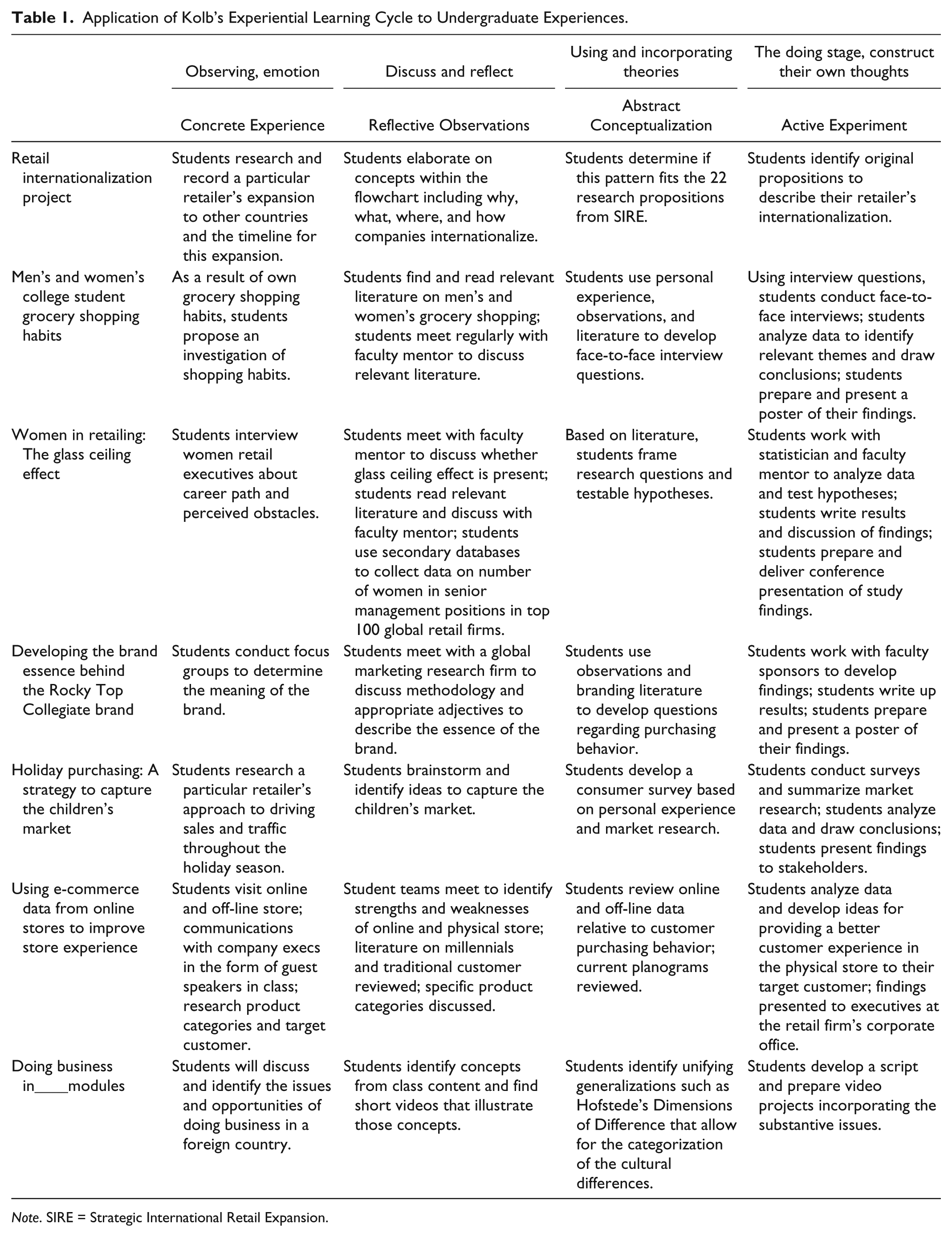
Note. SIRE = Strategic International Retail Expansion.
Theory Building and Testing
Internationalization of Retailing
This project has been used as a group project in a required undergraduate class and as an individual undergraduate honor’s project. The research in this project focuses on explaining how, when, where, and why retailers internationalize. In this project, students learn to gather, organize, and analyze data. These data are then used to support or refute research propositions.
The Retailer Internationalization assignment requires students to select a retailer that has internationalized. They then create a flowchart of the international expansion, including dates and countries where they have expanded. Using this flowchart they answer three major questions, The three major questions are as follows:
Is the retailer classified as a global retailer or a multinational retailer? Explain its pattern of expansion. What expansion strategy did/is the retailer use/using?
Based on Dunning’s eclectic theory, how do ownership, locational, and internalization factors play in your retailer’s international expansion?
What roles do cultural proximity and geographical proximity play in the retailer’s international moves?
They then determine if their retailer’s international expansion fits with 22 research propositions (Sternquist, 2011a). Finally, they are asked if they can predict the retailer’s future international expansion. They are asked to propose some original propositions that fit the retailer’s international expansion.
Students were aware that really outstanding cases would be selected for publication in an upcoming book (Sternquist, 2011b). Knowing that they would be authors of a book chapter motivated them to exceed normal expectations. Many students commented that authoring a book chapter was instrumental in getting their first job.
For this project, Kolb’s learning roles are applied in the following ways. The CE is the recording of the expansion pattern for a retailer. RO includes considering a retailer’s expansion pattern without making an assessment of theoretical implications. For example, students could be asked to reflect on the early expansion pattern of Walmart to Mexico and Canada, two countries that are geographically and culturally close to Walmart’s home market. An undergraduate student without any knowledge of theories that explain retail internationalization would be able to come to a reflective generalization that cultural and geographic proximity to the home market would make them attractive targets for expansion. AC occurs when students understand which of the 22 research propositions from the Strategic International Retail Expansion model are applicable and discard those that do not apply. AE applies when students develop unique propositions that describe the retailer’s internationalization.
Empirical Research Using Primary or Secondary Data Collection
Men’s and Women’s College Student Grocery Shopping Habits
For this faculty-led research project, empirical research provided students with an opportunity to pose a research question and then collect data that will provide an answer to the research question. The grocery shopping project involved three students over a 2-year period. The purpose of this empirical primary data collection project was to yield insights into college students’ grocery shopping and eating habits, marketing influences prior to and during the shopping trip, social (e.g., parents, friends) influences on food choices, and budgetary constraints. To implement this project, a qualitative approach, using face-to-face interviews, was used. The undergraduate researchers worked with the faculty mentor to develop their research questions, complete a review of relevant literature on the topic, and create an interview protocol. The undergraduate researchers took part in institutional review board (IRB) training, worked with the faculty mentor to secure IRB approval for this project, recruited student participants, conducted the interviews, and, after data transcription, analyzed the data to elicit relevant themes. The culminating experiences for this project were three poster presentations at the annual undergraduate research forum at a large Midwestern university.
For this project, Kolb’s learning roles are applied in the following ways. The CE role of the grocery shopping project is represented in several activities. First, the student researchers examined their personal grocery shopping habits, participated in IRB training, recruited student participants, conducted the face-to-face interviews, and presented a poster of their findings to students and faculty. The RO dimension encompassed reading and integrating relevant empirical literature on student grocery shopping habits and discussion of this literature with the faculty mentor and other student researchers. The literature review discussion informed the inclusion/exclusion of study participants. AC occurred when the students used their RO of the relevant literature, combined with their CE experience of their own grocery shopping habits to develop the face-to-face interview protocol and follow-up questions during the interview. The AE stage was exemplified by the data analysis to identify relevant themes and then apply the analysis to answer their research questions and develop content for the poster presentation.
Women in Retailing: The Glass Ceiling Effect
This faculty-led empirical project used secondary data collection to investigate the extent to which women had made inroads into senior management executive positions in retail firms. Prior to data collection, the undergraduate researcher reviewed relevant literature, both popular press and empirical studies, to determine the current status of women in executive positions in the retail industry. Then, the undergraduate researcher and faculty mentor investigated the senior management of the top 250 global retail companies. Using Deloitte’s annual report, Global Powers of Retailing, Hoovers Company Records, company annual reports, and information from company websites, we compiled a database of 248/250 retailers including company sales, profits, country of origin, operating formats, countries of operation, number of women executives, number of total executives, and executive positions held by women.
The undergraduate researcher worked with the faculty mentor to learn the fundamentals of the Statistical Package for the Social Sciences. They analyzed the data to compute a percentage of women executives in each company and a total percentage of females in each position. They compared percentages of women executives across different companies and analyzed potential effects of their country of origin or operating formats. The culminating experiences for this project were submission and presentation of this paper to the American Collegiate Retailing Association Conference (Hammer & Huddleston, 2011) and a poster presentation at the annual undergraduate research forum at a large Midwestern university.
In many aspects, the Glass Ceiling project application of Kolb’s learning roles is similar to the grocery shopping study. The CE dimension included interviews of women retail executive about their career path, entering data from the Global Powers of Retailing into a database, Statistical Package for the Social Sciences statistical training and presenting a poster of findings to students and faculty. The RO dimension encompassed reading and integrating relevant empirical literature on the glass ceiling effect in the retail industry and discussion of this literature with the faculty mentor and other student researchers. AC occurred when the student used her RO of the relevant literature, combined with their CE experience of the executive interviews to frame testable hypotheses. The AE stage was exemplified by the data analysis to test the hypotheses and then using the analysis draw conclusions about the extent to which the glass ceiling effect was present in the retail industry.
Practitioner-Oriented Undergraduate Research
Developing the Brand Essence Behind the Rocky Top Collegiate Brand
This class project involved working with a local retail organization to examine the brand essence of a top collegiate brand within the store’s inventory. To determine the meaning of the brand from a consumer’s perspective, student researchers conducted focus groups to develop word groupings describing the brand. A global marketing research firm worked with students to identify appropriate methodologies to identify purchasing behavior. Students collected data through qualitative methods such as consumer journals and interviews and prepared results in a written report form and a poster presentation. The outcome of this research was a presentation to the merchandising department at a Southeastern university book store and a poster presentation at a university advisory board meeting.
Kolb’s learning theory can be applied to this project as follows: The CE role involved recruiting consumers to participate in the project, conducting focus groups, and examining their own ideas of the brand’s meaning. RO included discussions with a global marketing research firm, faculty mentor, and class members on brand image and development. Branding literature was also reviewed. RO helped AC occur in the development of a questionnaire focusing on purchase behavior of the brand being studied. AE occurred when the students applied the findings from CE and RO to identify words that represented the essence of the brand and purchasing behavior. Development of the content for dissemination of findings through poster presentations occurred at this step as well as the presentation of the findings.
Holiday Purchasing: A Strategy to Capture the Children’s Market
Another practitioner-oriented undergraduate research project was sponsored by a retail firm. The company requested that students conduct research on holiday purchasing in the children’s market. Students began by analyzing the sponsoring retailer’s approach to driving sales and traffic throughout the holiday season. To gather the necessary data, students developed a survey that was disseminated to a regional sample. Students then analyzed the data and drew conclusions related to strategic initiatives to engage the customer. Students used their critical thinking skills to create unique activities that the retail firm could use to increase sales in children’s merchandise, especially in the toy department, the highest sales generator during the holiday season. The students presented their ideas at a regional meeting of the sponsoring retailer that included such stakeholders as a regional director, store managers, merchandise planners, and department team leaders.
Using Kolb’s theory, CE was derived from direct interaction with stakeholders from the retail store, store observations, and competitor observations. RO involved brainstorming and reflecting on the observations from CE. Students demonstrated AC through the development of a consumer survey and the identification of viable ideas to explore from RO.
For this project, AE was achieved when the student applied the results of the consumer survey to provide solutions related to the project objective of driving sales. Findings were presented in a written report and oral presentation to the company stakeholders.
Using E-Commerce Data to Improve In-Store Experience
This project, generated by a major retail firm, was conducted in a retail merchandising class. Students were asked to examine data collected from the retailer’s website and make suggestions for in-store changes in product mix, product location in store, size of planogram and point of purchase materials. Students began with an online and physical store visit to familiarize themselves with the company. Research was also completed on the merchandise mix and target customer. Student groups met to discuss strengths and weaknesses of the company relative to the problem described. Online and off-line store data were examined along with current planograms. The retail firm asked the students to be creative, think out of the box, and conceptualize new ideas. Students created a presentation that included conclusions made from examining the data relative to providing a better customer experience in the physical store. The findings were presented to a group of executives at the retail firm’s corporate office.
The CE dimension of Kolb’s learning theory was included in store visits, interviews with company executives, and research relative to product categories and target customers. RO involved student meetings to discuss findings from online and off-line store observations and relevant literature on product categories and target customers. AC occurred when students reviewed purchasing behavior data and planograms. The AE stage was exemplified through data analysis and conclusions presented to 50 corporate executives at the retail firm’s corporate office.
Creative Research Projects
Doing Business in ____ Modules
This class project has also been used as an individual undergraduate Honor’s College option. These modules, used in an undergraduate international business class, are intended to present students with an overview of the issues and opportunities of doing business in a foreign country/region. Students meet as a team weekly to share resources and recommendations for applying theoretical concepts to the study of doing business in a foreign country.
Students begin the project by reviewing materials on globaledge.msu.edu about doing business in a foreign country. globalEDGE is a repository of information about international business. One segment includes information about doing business in individual countries (a globalEDGE example for doing business in Japan, for instance, can be found at http://globaledge.msu.edu/content/onlinecoursemodules/3/doing-business-in-japan/player.html). The objective is not to duplicate the globalEDGE material but to have a concrete beginning point. Students then look more broadly for current information about doing business in the country and develop an outline of the material. The next step is to identify very high quality, short videos that illustrate important points from class and from the information they have gathered. Students identify unifying generalizations that allow the categorization of cultural elements. Students then prepare scripts for a video by incorporating important issues and searching for unanswered questions. The students who develop the videos are credited as creative content developers and encouraged to include the videos on their resume.
For this project, Kolb’s learning roles are applied in the following ways. Reviewing the examples from globalEDGE is an example of CE. RO is practiced when the students identify appropriate videos, and AO is used when the students identify the unifying generalizations for categorization. Finally, AE is seen when the students prepare scripts and develop the videos.
Conclusions
Undergraduate research provides an opportunity for faculty to extend existing curriculum and intellectually engage students. Undergraduate research is a mechanism by which students can be engaged in experiential learning initiatives. Three important benefits of experiential learning are ensuring deep learning, engagement, and development of employable skills (Canhoto & Murphy, 2016). Deep learning happens with undergraduate research because students go beyond CEs and participate in RO, AC, and AE. As highlighted throughout our article, using D. Kolb’s ELT (1984) facilitate this deep learning process by creating an opportunity for a holistic learning experience. In the next sections, we discuss benefits of involving undergraduate students in research.
Benefits to the Student
Empirical studies have highlighted benefits of participation in undergraduate research. Early participation in collaborative research was of particular benefit for first-generation college students (Ishiyama, 2002) and for underrepresented student groups; for example, Nagda, Gregerman, Jonides, von Hippel, and Lerner (1998) reported that students who participated in undergraduate research experiences had higher grades, retention, and graduation rates. Those with an undergraduate research experience, when compared with those with no research experience, reported greater enhancement of important cognitive and personal skills (Bauer & Bennett, 2003). They also had higher satisfaction with their undergraduate education and were more likely to pursue graduate school (Bauer & Bennett, 2003). According to the National Survey of Student Engagement (2007), undergraduate research is a high-impact practice that is especially beneficial to underrepresented students. Benefits to students include student learning enhanced by mentoring relationships with faculty, development of critical thinking and problem-solving skills, and intellectual independence (Council on Undergraduate Research, n.d.).
Based on our own experiences and the literature, participation provides students with the opportunity for an “inside look” at how studies are conceptualized and carried out. Students gain confidence in their ability to work as research team members (Lown, 1993; Madan & Teitge, 2013); practice in conceptualizing research problems, specific skill development (e.g., participant recruitment, using equipment, coding, etc.; Madan & Teitge, 2013); and development of writing, presentation and critical thinking skills (Robinson, 2013). According to one undergraduate student: “working in a research lab has taught me how to think critically in a way that I could never learn from a lecture in a classroom. . . . I also learned that research is a collaborative process” (Cox, 2015, p. 2).
The benefits of undergraduate research can also apply to career development, as gaining research skills and competencies needed in certain fields can be directly related to securing employment (Lown, 1993), enhancing professional credentials (Robinson, 2013), and securing letters of recommendation (Lown, 1993). By becoming involved in faculty research, students gain a closer working relationship with faculty members (Robinson, 2013).
The undergraduate research experiences can be designed to provide a tangible takeaway that goes beyond the project participation. Students may gain experiences they can add to their resumes, such as a conference or corporate presentation (Robinson, 2013), a book chapter, article (Cox, 2015) or video project. This type of recognition goes beyond the classroom and is highly motivational.
Benefits vary somewhat with the different types of projects. For example, benefits are similar for the four types of undergraduate research projects explored in this article, but for the practitioner-oriented project an added benefit could be presentations at a corporate or regional office to a wide variety of individuals within the organization such as a buyer, planner, and/or general manager. This would contribute to students’ development as a professional in the retail environment. Theory building and empirical research projects may benefit students who have aspirations to attend graduate school. These types of undergraduate research projects would be similar to research conducted in graduate school. Creative projects benefit students who enjoy thinking outside of the box and generating new perspectives and ideas that might not be appropriate in other types of projects that rely on hard data for solutions.
Benefits to Faculty
Faculty members benefit from working with undergraduates on their research projects. Including undergraduates as part of a research team can increase the speed of recruitment, data collection, coding, and analysis. Undergraduate research assistants with good writing skills can also assist with manuscript preparation. Undergraduate participation in research sets the stage for recruitment into graduate programs (Robinson, 2013). We have found that top-notch undergraduate students are intellectually equivalent to those students who choose to pursue graduate degrees. Many universities recognize the importance of undergraduate research and provide a separate pool of money dedicated to this endeavor. This could be an untapped resource for many faculty.
Most successful undergraduate research projects involve a close working relationship between faculty and student. In this article, we have described a variety of retail focused undergraduate research projects; some were situated in a class setting, while others were conducted on an individual basis (e.g., empirical research projects). With careful planning and organization, the empirical research projects could be adapted to a classroom setting. The instructor could begin by introducing an area of research that she or he has been involved with in the past (e.g., factors affecting store loyalty). Student teams can be formed to devise a list of research questions to investigate and then the class can select the most interesting or compelling question to focus on. Then each team could gather and summarize literature related to that topic, posting the summaries to a Google Docs or course management LISTSERV. The instructor could work with each team to categorize and synthesize the literature and develop the literature review that would inform the hypotheses. Prior to the data collection phase, students might participate in IRB training, if the results are to be publicly disseminated. Each team could propose a data collection plan, with the class selecting the best proposal. Once the data collection plan was finalized, the instructor would prepare an IRB application for the proposed study. Working together, the various teams would collect the data and work with the instructor on data entry (if necessary) and data analysis. The analysis for each hypothesis/research would be shared with the class and each team would write the analysis and conclusions.
Last, undergraduate research projects help develop skills that are valued by employers, such as interpersonal and critical thinking skills. Enhancing the aforementioned skill sets was acknowledged by one undergraduate researcher to his faculty mentor after he was hired by a software company, developed a rebranding plan, created mockups of applications in design software, and networked with local tech firms at meetings. In a personal communication to his faculty mentor he said, “I also wanted to thank you again for letting me be an undergraduate research assistant. It gave me so much experience and was a very big talking point in my interview” (P. T. Huddleston, personal communication, 2016). Involving undergraduate students in research projects that apply the learning role of Kolb’s experiential learning cycle creates long-term benefits to students and faculty.
Implications for Marketing Educators
Structured mentoring, as demonstrated in faculty–student research, supports the benefits of engagement. Undergraduate retail research provides an opportunity for faculty to extend existing curriculum and intellectually engage students in a holistic learning experience. Undergraduate research is a mechanism by which students can be engaged in experiential learning initiatives. Many universities set experiential learning as part of a quality enhancement plan for undergraduate education and as a result provide a separate pool of money dedicated to this endeavor. This could be an untapped resource for many faculty.
Three important implications for incorporating experiential learning into classroom and individual research projects are deep learning, engagement, and development of employable skills (Canhoto & Murphy, 2016). Deep learning, engagement, and development of employable skills happen with undergraduate research because students go beyond CEs and participate in RO, AC, and AE (D. Kolb, 1984; A. Y. Kolb & Kolb, 2005). Last, undergraduate retail research fosters knowledge discovery and has a motivating effect on the undergraduate student.
Footnotes
Declaration of Conflicting Interests
The author(s) declared no potential conflicts of interest with respect to the research, authorship, and/or publication of this article.
Funding
The author(s) received no financial support for the research, authorship, and/or publication of this article.