



Abstract
Universities increasingly make their sales curriculum available for groups other than dedicated sales students. This study investigates engineering students’ drivers that predict interest in sales certification, as well as drivers that predict actual choice for a sales curriculum. We focus on engineering students (n = 204) and contrast our findings with business students (n = 179). Based on social cognitive theory, we investigate how personality (Big Five personality factors and Trait Competitiveness), ability (ACT, GPA, and Academic Self-Efficacy), and social factors (role models, and perception of salespersons) affect interest and choice. Our results indicate that although the regression models explain a reasonable amount of variance, models that work for business students do not work equally well for engineering students. Also, our analysis reveals that factors that explain interest do not explain actual choice, and vice versa. In addition, we uncover subtle gender difference when it comes to actual choice for a sales curriculum. Finally, the benefits that engineering students perceive of sales certification differ primarily based on whether students are taking sales classes, and not on degree sought.
Keywords
Nearly a century ago, Moore (1921) was interested in understanding which engineers would go on to be salesmen, designers, or executives of production, especially since they all “receive essentially the same technical training” (p. 5). A lot has changed since then. Unlike 100 years ago, some of today’s engineers are presented opportunities to study sales in college. But which engineering students take advantage of these new opportunities and become those 21st-century salespeople?
Extant research into drivers for the choice for sales education typically compares what motivates students from different business majors (e.g., Sojka et al. 2000). Some have also investigated the perceptions of nonbusiness students (e.g., Bumblauskas et al., 2017; Inks & Avila, 2018; Spillan et al. 2011), but these investigations have not included choice for a sales curriculum for nonbusiness college students, or have focused on a single sales class. That is surprising considering current salespersons’ educational backgrounds. The U.S. Census Bureau (2014) reports that of all college educated salespeople, 39% hold a business degree. At the same time, more than 18% graduated from a Science, Technology, Engineering, or Math (STEM) program. Some universities have started offering programs focusing on these STEM students, but the literature does not address how these nonbusiness sales students are different from the traditional business sales student.
In the current study, we address this gap by using a framework based on Bandura’s (1986) social cognitive theory to study the drivers of interest in and choice for a sales curriculum for engineering students. To contrast our findings, we compare between four groups of students at a U.S. public university: engineering students, engineering students who decide to take sales classes, business students, and business students who decide to take sales classes.
The Importance of Sales Training
The benefits of sales training for business students are well-known (Bolander et al., 2014; Leasher & Moberg, 2008) and include improved job prospects and better performance after graduation. It is likely that similar benefits apply to students of engineering. Employers of engineers have long complained about the lack of communication, teamwork, and business skills of recent graduates (Felder, 2012), areas that are frequently covered in collegiate sales education. From a corporate perspective, making sales curricula available for nonbusiness students who will work in sales roles makes sense. Formal sales education in college has the effect of lowering turnover and improving performance relative to nonsales educated peers (Bolander et al. 2014; Fogel et al., 2012). Moreover, it typically reduces the costs of initial training and helps reduce potential conflict between nonsales and sales functions (V. Shaw & Shaw, 1998).
From a student perspective, sales training can be equally beneficial. Many students, including those outside the field of marketing, believe they will work in a sales position at some point during their career (Karakaya et al. 2011). Moreover, to stay competitive, engineers need to be equipped with skills that include critical thinking, creativity, and entrepreneurship (Felder, 2006), competencies that are integrated and practiced in most sales education programs. Formal sales training in college may also serve as a low-risk exploration of options outside the field of engineering for those students who are considering an educational career switch. According to the National Center for Education Statistics (2014), 48% of freshmen engineering students will not graduate with an engineering degree.
And even for educators interested in addressing the negative stereotypes about sales and salespeople that still prevail today (Inks & Avila, 2018; Lee et al., 2007), sales education in itself is important, as it reduces such negative stereotypes directly (Sojka et al., 2000).
Given these benefits, it is no surprise that the offering of sales curricula has grown tremendously in recent decades (Bolander et al. 2014). The most recent trend in collegiate-level sales education is the offering of more concise certificate programs or concentrations in sales. The University Sales Center Alliance (2019) reports that 44 of their 53 member schools now offer certificate or similar programs, up from only 22 schools one year earlier. A small but increasing number of these programs are open to, or even specially geared toward engineering students. 1
Conceptual Framework
The framework for this study is based in Bandura’s (1986, 1991) social cognitive theory, which describes the interaction of the person, their external social context, and their response to stimuli in the environment. This framework has been extensively used to explain career interest and choice (Lent et al., 1994). Moreover, the framework is consistent with other work that suggest that abilities, interests, and personality develop interdependently (Ackerman & Heggestad, 1997).
In our approach, we focus on two person factors: personality and ability, as well as one environmental factor: social influence, in order to investigate engineering students’ and business students’ response to the availability of sales classes. We particularly focus on how these factors translate into stated interest in taking sales classes, and actual taking of sales classes (Figure 1).
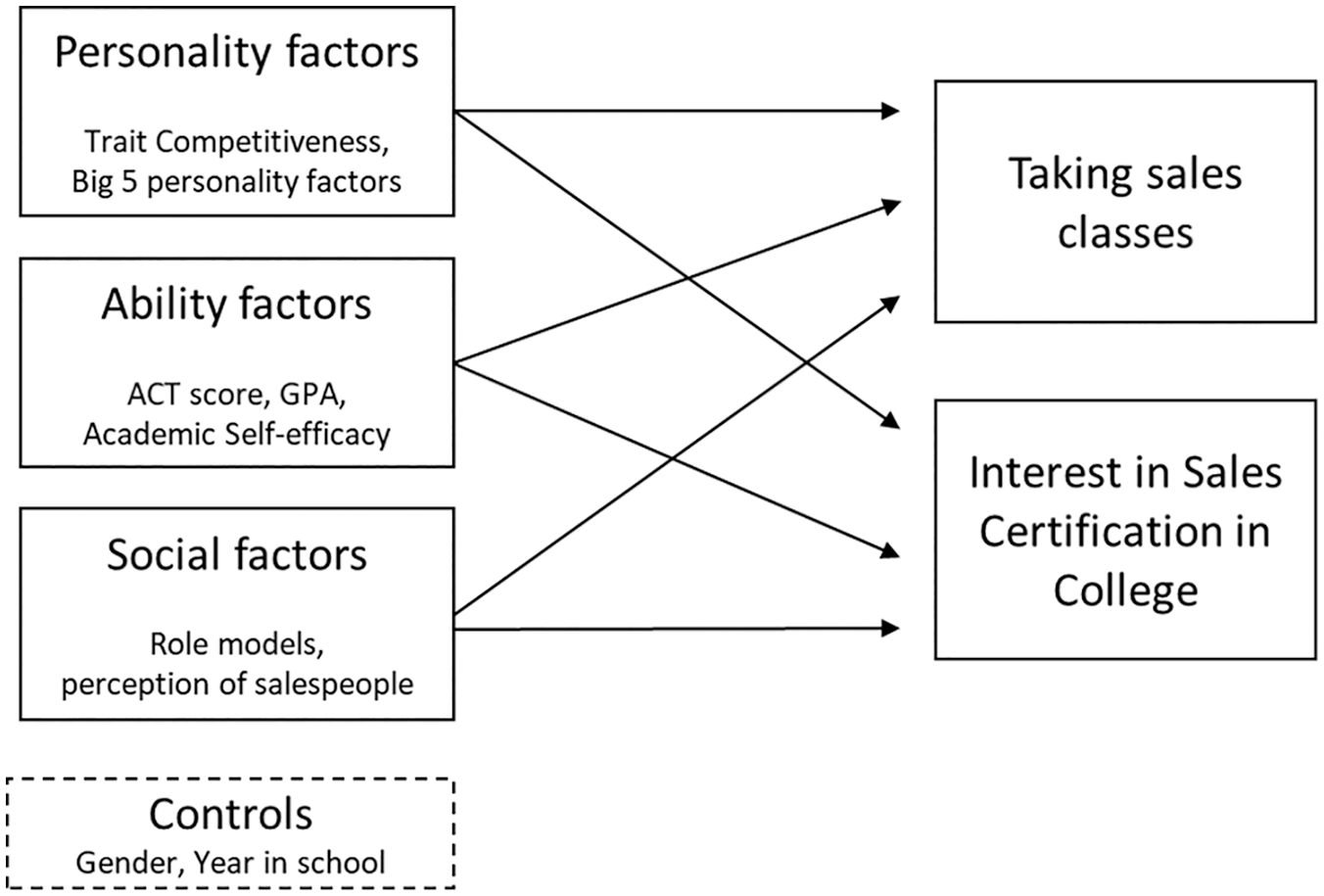
Conceptual model.
Hypotheses Development
In line with our conceptual framework, we develop the hypotheses in three sections. Hypothesis 1 deals with personality factors, Hypothesis 2 with ability factors, and Hypothesis 3 with social factors. Based on the framework, the formation and elaboration of career-relevant interests is a first step toward the actual selection of academic choice options (Lent et al. 1994). Most students will point out they selected their major because it interests them, but drivers of this interest are less frequently articulated (Allen et al., 2014). In addition, Swenson et al. (1993) point out that student perceptions and attitudes toward personal selling as a career have received substantially more academic attention than understanding the actual choice for a sales career. More recent work is addressing this gap (e.g., Peltier et al. 2014), but the focus remains on intent and stated interest. For example, a rich stream of work is linking classroom experiences with the stated intent to pursue a sales career (e.g., Cummins et al., 2015; Nielson & Cummins 2019; Peltier et al. 2014). One contribution of our study is that we investigate stated interest and actual choice for sales classes concurrently. In addition, because most research so far has been conducted into sales education for business students (Allen et al. 2014; Cummins et al. 2013), this article’s hypotheses will focus on the much less explored area of sales education for engineering students.
The Influence of Personality
Prior research has demonstrated a sizable relationship between student personality traits and their preference for a major (Lakhal et al., 2012). The Big Five personality traits framework, sometimes referred to as the five-factor model, is frequently used for personality research and has also been successfully deployed in the study of sales performance throughout different career stages (Thoresen et al., 2004). As such, it is a logical instrument to investigate the role of personality not only on different stages of one’s sales career but also on the choice for such a career in the first place.
Noël et al. (2003) find that the matchup between business majors and personality traits mostly follows stereotypes. In their research, more socially skilled and extraverted individuals prefer marketing and sales as an educational career path. Similarly, Lee et al. (2007) also link stereotypical personality characteristics, particularly extraversion, to a preference for a sales career. The question is whether this focus on extraversion translates to engineering students with an interest in sales. In terms of Mount et al. (2005), typical engineering students prefer to interact with things, whereas typical sales students prefer to interact with people. In turn, the work of Digman (1997) in conjunction with Mount et al. (2005) suggests that the high-level “things” versus “people” dichotomy can be associated with Big Five personality characteristics. The “things” preference of typical engineering students would be associated with higher levels of conscientiousness, emotional stability, and agreeableness, whereas the “people” preference of typical sales students would be associated with higher levels of Extraversion as well as higher levels of Openness to Experience (Digman, 1997; Mount et al. 2005). We hypothesize that the personality profile of engineering students who are taking sales classes or are interested in doing so, is more like the profile of sales students with a focus on Extraversion and Openness to Experience. We therefore hypothesize the following:
In addition to the “people” versus “things” argument aforementioned, Thoresen et al. (2004) suggest that Openness to Experience is a particular useful trait for salespeople. Highly open individuals are more open to experiment with new ways of doing things (Costa & McCrae, 1992). Not only does that allow salespeople to approach new products and customers easier, it is also associated with more rapid performance improvements and slower performance delay over a salesperson’s career (Thoresen et al. 2004). For engineering students, being more open to new experiences may also facilitate them to expand on their standard engineering curriculum and explore areas of study outside of their own college. Hence, we hypothesize the following:
Although Big Five personality traits are often seen as the cornerstone for personality research (O’Connor, 2002), specific contexts can see additional variance explained by looking beyond the Big Five traits alone (Paunonen & Ashton 2001). An important characteristic that is germane to the sales context is Trait Competitiveness (Plouffe et al. 2013). Trait Competitiveness reflects a person’s enjoyment of interpersonal competition and their desire to be “number one” (Brown et al., 1998). As sales is often regarded as a highly competitive field, Trait Competitiveness is linked to better performance (Schrock et al., 2016; Wang & Netemeyer, 2002). Specifically, Trait Competitiveness is seen as a positive attribute for salespeople to possess by both academics (Plouffe et al. 2013; Plouffe et al. 2017) and practitioners (e.g., Marsh, 2013; McGirl, 2014). Even in more popular references, salespeople are often stereotypically depicted as highly competitive (Iannarino, 2018). Therefore, based on the stereotype matchup argument of Noël et al. (2003) that predicts that students select their major in part based on their stereotypical understanding of the match between their self-perceived personality types and stereotypical views of what success in a given educational field requires, we hypothesize the following:
The Influence of (Self-Perceived) Ability
Both perceived and actual abilities influence the career choice of students (Allen et al. 2014). Aggarwal et al. (2007) note that students and academic advisors believe that marketing and sales curricula are among the least challenging of an undergraduate business degree. Moreover, a critical examination of the quality of incoming undergraduate marketing students based on high school grades and standardized college entry test scores, as well as their level of preparedness for continuing education at graduation supports that view (Aggarwal et al. 2007). One effect of these beliefs can be that engineering students with a low GPA seek out sales classes because they are perceived to be easier, to boost their overall GPA. Such a strategy appears to be supported by the exploratory focus group comments collected by Mobley et al. (2009).
Second, engineers, particularly R&D engineers, consider sales engineers to be the lower echelons of the professional engineering hierarchy (Darr, 2000). Engineering students are known to quickly internalize the career beliefs of employed engineers when it comes to perceptions of different engineering specialties (Shivy & Sullivan, 2005). Lower ability engineering students may therefore see sales classes as easier and be more open to such nonengineering course work, in part because they may struggle with the typical engineering coursework. They may also believe that because of their real or perceived lower ability, it will be less likely for them to become an archetypical R&D engineer, and they may more likely become employed as a sales engineer. We are particularly interested in two measures of academic ability. First, we investigate the score that students obtained for the American College Testing (ACT) test when they applied for college, as it provides a standardized test taken by students regardless of the academic career path they aspire to. Second, we focus on the GPA students obtained while in college. This measure of ability is contingent on the classes taken, but serves as a good proxy for how well a student is doing in their academic pursuit. Hence, we therefore hypothesize the following:
The role of (academic) self-efficacy is central to the social cognitive theory framework (Bandura, 1991). Self-efficacy is defined as a person’s confidence in their ability to pursue courses of action required for a specific task, especially if the task is new or unfamiliar (Krishnan et al., 2002; Pajares, 1996). Academic Self-Efficacy is the context-specific form of general self-efficacy, and specifically points toward students’ beliefs about their efficacy to regulate their own learning and academic performance (Bandura et al., 1996). Engineering students who doubt their academic ability will be more likely to investigate educational alternatives (E. J. Shaw & Barbuti, 2010) and may be interested in broadening their skill set to compensate for their perceived lower academic ability.
Although a strong correlation between ACT scores, GPA, and Academic Self-Efficacy is expected, these three factors are not identical. For example, the archetypical late bloomer may have a lower ACT score, but higher GPAs and Academic Self-Efficacy. Similarly, the self-doubting diligent student may score high on ACT scores and GPA, but not on Academic Self-Efficacy. And last, the calculating student who purposely picks the “easy-A classes,” may not have been a high ACT-performer, nor hold a very high degree of Academic Self-Efficacy. For these reasons, we hypothesize that Academic Self-Efficacy will have an independent effect on engineering students’ interest in obtaining sales certification:
The Influence of Social Factors
Social factors are the third component in our conceptual model predicting engineering students’ interest and choice for sales education. An important source of information about the opportunities of a sales career comes from close exposure to salespersons. Waldeck et al. (2010) suggest that having family and friends with relevant sales work experience influences student perceptions about salespeople and the sales role. However, the empirical evidence about having a role model on career interest and choice is mixed. Sojka et al. (2000) find that having family members who work in sales does not affect perceptions of a sales career. Similarly, Spillan et al. (2007) find no difference in desire to work in sales for students regardless of their family members’ employment in sales. However, in a very similar study, Spillan et al. (2011) find that for African Americans, having family members working in sales is associated with a greater desire of the student to work in sales. A possible explanation for these inconsistencies comes from Ballestra et al. (2017) who find that when explaining sales career intentions, having a role model plays no significant role above “feelings toward selling.” In other words, simply knowing someone who dislikes their sales job or having a relative who holds a stereotypical dead-end retail sales job is unlikely to increase the student’s interest in pursuing a sales career by taking sales classes. Given these nuances, we believe that having a close role model working in a sales position will in fact improve student’s perception of sales as a career and consequently increase their interest in taking sales classes during college. We therefore hypothesize the following:
Many students, especially those without a close role model have been exposed to only a limited range of sales roles (Inks & Avila, 2018). This limited exposure to professional salespeople increases the likelihood of holding negative perceptions about salespeople (Bahhouth et al., 2014). As consumers, students are primarily exposed to business-to-consumer salespeople who specialize in less complex sales, as well as to stereotypical, often negative depictions of salespersons in the media (Lee et al. 2007). In fact, Waldeck et al. (2010) suggest that greater media use will lead to a more negative Perception of Salespeople and the sales role. The “social image” of a field of study and its students is an important influencer for the choice of a major in college (Allen et al., 2014; Kumar & Kumar, 2013). Given this, it is concerning that students often regard a career in sales as less than desirable (Ballestra et al., 2017; Inks & Avila, 2018; Karakaya et al., 2011) and that most stereotypes about salespeople are negative (Lee et al. 2007). Not surprisingly, Inks and Avila (2018) report that high school students who hold negative perceptions of salespeople are more likely to choose a college career other than sales. Honeycutt et al. (1999) and Karakaya et al. (2011) find that the link between perceptions of salespeople and intentions to pursue a career in sales exist across different national and cultural contexts. In addition, despite changes in the sales role over time, Ballestra et al. (2017) uncover that the generally negative student perception of a sales career has remained relatively stable. Having such a persistent image problem among students (Peltier et al., 2014) is not without consequences. It likely affects the willingness of students to pursue a curriculum that would lead to such a career (Ballestra et al., 2017; Bristow et al. 2006; Karakaya et al. 2011; Lee et al. 2007). Consistent with this body of evidence, we hypothesize the following:
When it comes to actual choice for a sales curriculum, a causal relationship is much less clear. Did students of sales choose their major because they already had more positive perceptions of salespeople and the sales role, or did their perception become more positive after they started taking sales classes? Cross-sectional research such as this study is not ideal to answer questions about causation. Nevertheless, several authors do find a relationship between exposure to sales courses and perception. For example, Bristow et al. (2006) find that student perceptions differ between those students who completed personal selling courses and students who had not. Similarly, Sojka et al. (2000) find that students having taken two or more sales classes have a more positive view of a career in sales, and Honeycutt et al. (1999) find in their U.S. sample a correlation between having completed a sales course or having actual sales experience and the appeal of a sales career. More recent work by Cummins et al. (2015) and Nielson and Cummins (2019) show that even small interventions in a principle of marketing class can positively affect students’ Perception of Salespeople and sales as a career. We therefore expect that there is a positive effect of sales education on the Perception of Salespeople, and that this effect will be stronger for students that have been exposed to more sales classes. We therefore hypothesize the following:
Finally, we investigate the motives why engineering students take sales classes. We focus on perceived benefits of adding a sales certificate, as students are primarily driven by positive factors of the new study than by negative factors of their original field of study (Malgwi et al., 2005). However, as the literature is sparse on the stated motivations of nonbusiness students to take sales classes in college, we first invited engineering students to two separate short focus groups. Each was moderated by the first author, video recorded, and later transcribed. The emphasis of these focus groups was on uncovering reasons for engineering students to take sales classes. Each focus group lasted approximately a half hour. About 90% of the participants were male. This proportion was deemed high, but not necessarily too high given our ex-ante perception that both engineering and sales programs are most popular among male students. Six motives to take sales classes were uncovered during these focus groups: Sales classes offer engineers a break from engineering coursework, an opportunity to meet new people, a potential differentiation in the job market, the expectation of a higher starting salary, an immediate GPA boost, and an opportunity to improve soft skills.
We anticipate that engineering students who take sales classes toward a sales certificate perceive the benefits of doing so more positively than engineering students who do not take sales classes. For example, meeting new people could be seen as a positive factor, or be perceived as threatening to the most introvert of engineering students (Mount et al. 2005). Likewise, improving one’s GPA through taking classes outside the college of engineering may not be desirable for those engineers who already perceive their current GPA as adequate. Hence, we hypothesize the following:
Sample
The sample population consists of all students in the College of Engineering and the College of Business of a U.S. public university. Students were invited to an online survey by the dean’s offices of each college. The school’s institutional review board approved the protocol for the study, and the Dean’s office of one of the colleges required that students would remain anonymous and thus no incentives were offered. Of the 2,405 invited engineering students, 204 usable responses were obtained (8.5%). Of the 1,637 invited business students, 179 usable responses were obtained (11%). In addition, nine students from the school of communication also participated in the survey, as they were taking sales elective classes and learned about the survey that way. In total, the sample comprised 392 students, of which 383 were members of the two colleges of interest. In line with the gender make up of each of these colleges, 55% of business respondents were female, whereas only 38% of engineering respondents were female. The proportion of freshman, sophomore, juniors, and seniors was comparable for both colleges. See Table 1 for more details.
Demographics of Respondents.

For the purpose of the Gender control variable, we have eliminated these two individuals from our analysis.
Measures
Several previously established independent variables were collected. For the measures relating to personality factors, we assess the Big Five personality traits with the 10-item short version of the Big Five Inventory (BFI-10) developed by Rammstedt and John (2007). This shortened version typically performs slightly worse than the full 44-item Big Five Inventory (BFI-44) but has the benefit of using less than a quarter of the items. Typically, the BFI-10 scale captures 70% of the variance present in the BFI-44 inventory, and retains 85% of the test–retest reliability. Discriminant and structural validity are essentially the same for the BFI-10 and BFI-44 instruments (Rammstedt & John, 2007). Given the online nature of our survey instrument and the lack of incentives we could provide participants, we opted for this trade-off between instrument length and psychometric advantages. We further assessed student’s Trait Competitiveness (Brown et al. 1998) with items developed by Spence and Helmreich (1983).
For the measures relating to student ability, we captured self-reported ACT score at acceptance into university, the grade point average at university, and Self-efficacy for Academic Achievement (Zimmerman et al. 1992) based on three items by Bandura (1997). Even though these ability measures are self-reported, the anonymous nature of the survey makes social desirable reporting less likely. Moreover, none of the ability items were forced responses, allowing students to leave them blank, for example, in case they did not feel comfortable disclosing.
For measures relating to social factors we evaluated the Perception of Salespeople with three items from the Intent to Pursue Sales Career scale: “Salespeople are perceived favorably by others,” “Salespeople are respected by others,” and “Salespeople are admired by others.” This measure was chosen over the sales profession measure that is also part of the Intent to Pursue Sales Career scale because of the smaller number of items, and the fact that no university specific differences were reported, as is the case for the sales profession measure (Peltier et al., 2014). Our measure for exposure to a Role model working in engineering or sales is measured with a single yes-or-no item each (“Do you have an immediate role model [e.g., parent, close friend, other close relative] who is a salesperson”), see Table 2.
Averages Per Group.

We collected two key dependent variables. First, we focus on Interest in obtaining a sales certificate, and second, whether Students are taking sales classes. The first variable is assessed with two items: one 5-point Likert-type scale asking if the student is interested, and another reverse-coded item asking how much of a scholarship the student would have to receive in order to consider taking sales classes. Options ranged from “I’m already interested without a scholarship” to “Yes, but only a $2,000 or more scholarship would influence my decision-making,” in $500 increments. See Table 3 for a correlation between these measures.
Correlation Table.
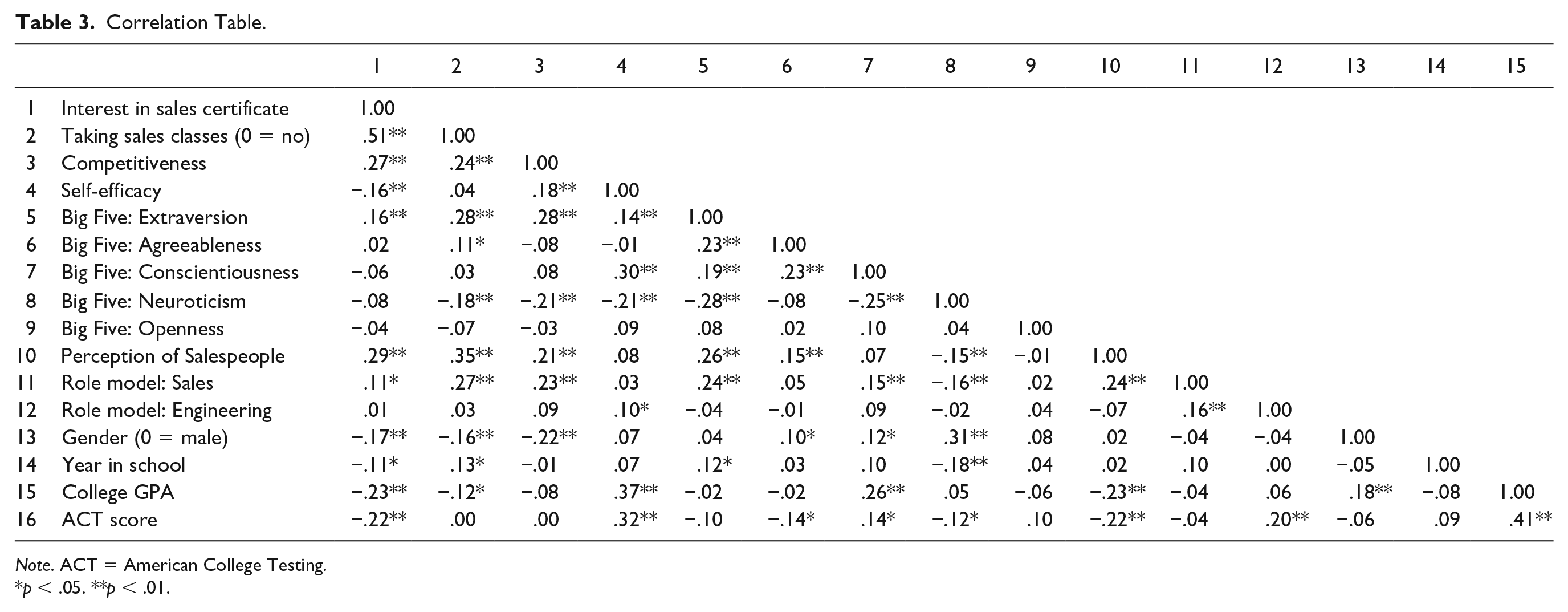
Note. ACT = American College Testing.
p < .05. **p < .01.
Finally, we collected six perceived benefits of obtaining a sales certificate. These items are generated for this study as the result of the two focus groups described previously in which engineering students discussed their motives for taking sales classes. Control variables are gender and year in school. On average, respondents took 6.3 minutes to complete the survey.
Results
Hypotheses 1 through 3b were simultaneously tested. First, a multiple linear regression is conducted to predict interest in obtaining sales certification for those students who currently are not taking any sales classes. The model investigates the effects of personality factors, ability factors, and social factors, while also controlling for gender and the year in college. The multiple regression model significantly predicts interest for nonsales engineering students as well as nonsales business students, F(14, 120) = 2.48, p < .01 and F(14, 93) = 4.73, p < .01, respectively. However, the portion of variance in interest explained is 13% for engineering students, whereas it is 33% for business students, see Table 4.
Multiple Linear Regression for Interest in Sales Certification.

Note. ACT = American College Testing.
p < .10. *p < .05. **p < .01.
Extraversion and Openness to Experience were both predicted to influence interest in obtaining a sales certificate but fail to do so for both engineering and business students. Trait Competitiveness is positively related to an interest in sales certification for engineering and business students, t = 2.27, p < .03 and t = 2.75, p = .01, respectively. Having a positive Perception of Salespeople approaches significance for the full sample, t = 1.88, p = .06, but is not significant in either of the subgroups. There is some indication that lower ACT scores lead to higher interest in sales classes for engineering students, t = −1.94, p = .06, but the effect is most evident for business students, where both ACT scores and Academic Self-Efficacy are negatively related to interest in sales certification, t = −1.94, p = .05. Finally, the further engineering and business students are in their academic careers, the less interested they are in obtaining a sales certificate, t = −2.18, p = .03 and t = −2.81, p = .01, respectively.
Second, a binomial logistic regression was performed to ascertain the effects of personality factors, ability factors, and social factors on the likelihood of being a sales student, while controlling for gender and year in college. Logistic regression is warranted in this case as the dependent variable is dichotomous (yes or no). The regression model is statistically significant for both engineering and business students, χ2(14) = 52.3, p < .01 and 51.4, p < .01, respectively. It explains almost 42.5% of the variance (Nagelkerke R2) in choice for a sales curriculum for engineering students. Moreover, it correctly classifies 83% of cases.
For engineering students, Extraversion is associated with an increased likelihood of taking sales classes, odds ratio (OR) = 1.36, 95% confidence interval [CI: 1.02, 1.81], p = .04. However, Openness to Experience fails to predict actual choice for sales classes. Similarly, Trait Competitiveness does not influence engineering students’ likelihood of taking sales classes, OR = 0.99, 95% CI [0.86, 1.13], p = .84. When evaluating the influence of social factors, we find that engineering students who have a close role model working in sales are 2.87 times more likely to take sales classes, 95% CI [1.06, 7.78], p = .04. Similarly, having a positive Perception of Salespeople is associated with a 1.5 times higher likelihood of studying sales, 95% CI [1.18, 1.92], p < .01. Interestingly, with an OR = 0.59, female engineering students appear more than a third less likely to be a sales student, but this number fails to be significant, see Table 5.
Binomial Logistic Regression for Likelihood of Taking Sales Classes.

Note. ACT = American College Testing.
p < .10. *p < .05. **p < .01.
When we repeat the analysis for business students and the combined sample, similar patterns are uncovered, with three noticeable differences. First, as originally hypothesized for engineers, Trait Competitiveness is in fact a significant predictor of taking sales classes for business students, OR = 1.39, 95% CI [1.08, 1.78], p = .01, whereas it was not a factor for engineering students at all. Second, Extraversion is a predictor in both the full sample model, OR = 1.35, 95% CI [1.09, 1.67], p = .01, as well as the engineering students model, but the larger standard error and slightly smaller effect size make it insignificant as a predictor for business students, OR = 1.32, 95% CI [0.93, 1.87], p = .13. Third, for business students, we do not find a significant effect of having a sales role model on the likelihood of taking sales classes, OR = 1.17, 95% CI [0.31, 4.46], p = .82, notwithstanding the fact that the four groups differ significantly in the percentage of students with a role model. However, after controlling for the effect of the other variables in our model, it is clear that having a role model in itself is insufficient to explain differences in likelihood of taking sales classes for business students.
To test Hypothesis 3c, we conducted another multiple linear regression analysis to further investigate the drivers of the Perception of Salespeople for current sales students. We use the same independent and control variables as in the previous two regression analyses: Big Five personality traits, Trait Competitiveness, Role models (Engineering and Sales), GPA, ACT, Academic Self-Efficacy, Gender, and Year in School. Given the number of independent variables and our sample size, we can only run the analysis for business and engineering students combined. The model significantly predicts students’ Perception of Salespeople, F(13, 44) = 3.35, p < .01, and explains 35% of the variance in the perception score. Surprisingly, sales students with higher GPAs hold a more negative Perception of Salespeople, β = −.67, t = −4.61, p < .01. On the other hand, Big Five Conscientiousness and “having a sales role model” are positively related to Perception of Salespeople, β = .45, t = 3.31, p < .01 and β = .23, t = 2.00, p = .05, respectively. Taking all these other variables into account, the effect of Year in School is positive, but not significant, β = .21, t = 1.62, p = .11. We therefore find no support for Hypothesis 3c.
Table 6 summarizes how these results relate to our first three stated hypotheses.
Summary of Hypotheses 1a to 3b.
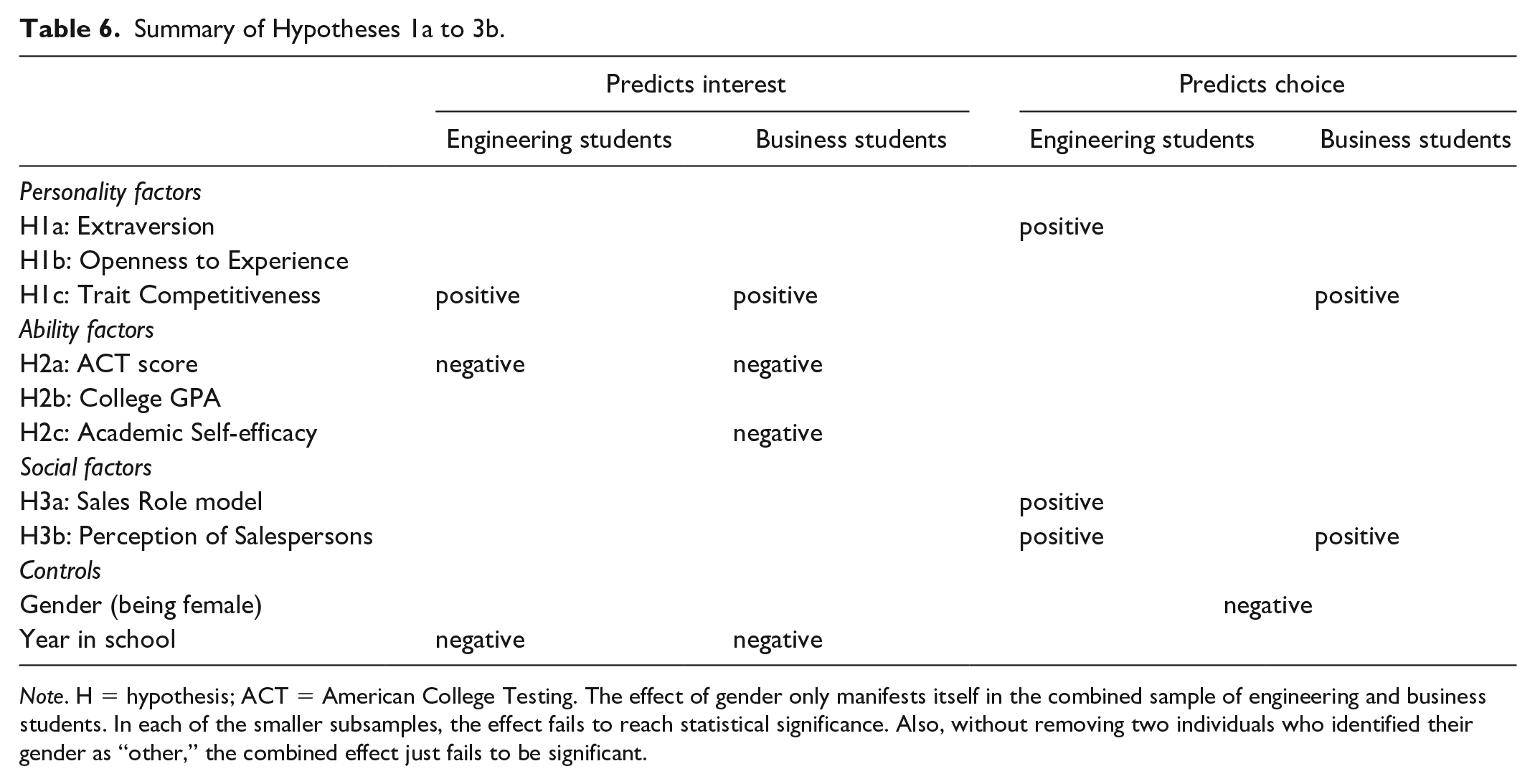
Note. H = hypothesis; ACT = American College Testing. The effect of gender only manifests itself in the combined sample of engineering and business students. In each of the smaller subsamples, the effect fails to reach statistical significance. Also, without removing two individuals who identified their gender as “other,” the combined effect just fails to be significant.
Finally, to further investigate the motivation of students to take sales classes, we investigated what engineering students would consider benefits of sales certification. Based on six analyses of variance, we find that engineering students with and without sales classes and business students with and without sales classes differ significantly on all six motivation items, with the F(3, 365)-statistic ranging between 6.87 and 14.99, p < .01 and medium effect-sizes, with η2 ranging from .05 to .11 (Cohen, 1988). The mean values for each group are reported in Table 7. Consistent with our hypothesis, the difference primarily occurs between students taking sales classes and those not taking sales classes, regardless whether an engineering or business degree is sought. In fact, the nonsales taking student population was homogenous in their perception of the benefits of obtaining a sales certification. There are two benefits that are particularly perceived by engineering students who take sales classes: the benefit of the anticipated GPA boost, and the break from other coursework that taking sales classes would offer. All other students perceived these factors as less beneficial. In sum, we consider Hypothesis 4 supported.
Perceived Benefits of Pursuing a Sales Certificate.

Note. Answers ranged from 1 = not a benefit for me at all to 3 = substantial benefit for me. Analysis of variance test results indicate significant differences between the groups on perceived benefits of pursuing a sales certificate. Bold values are significantly different from the other values at the p < .01 level based on Tukey HSD (honestly significant difference) post hoc tests.
Discussion
Our results indicate that although the regression models explain a reasonable amount of variance, models that work for business students may not work equally well for engineering students. Also, our analysis reveals that factors that explain interest do not explain actual choice, and vice versa. For example, where Trait Competitiveness is the strongest driver of interest for engineering and business students combined, it plays no role in explaining the actual choice for engineering students. Conversely, Extraversion plays a key role in explaining actual choice for a sales curriculum, but does not explain interest.
Controlling for personality and other factors, we find only partial support for the role model theory. There is a positive effect of having a sales role model on the likelihood of taking sales classes, but only for engineers. For these students, having a close role model working in sales is an important predictor of taking sales classes, even when controlling for the effect of a positive perception of the sales role. For business students, the effect of having a role model appears to be more closely related to the perception of the sales role, in line with Ballestra et al.’s (2017) findings. Moreover, our test of Hypothesis 3c investigating the drivers of students’ Perception of Salespeople also suggests that personality, specifically conscientiousness, may have indirect effects, in addition to the direct effects for Extraversion, Neuroticism, and Competitiveness observed in the regression analyses of interest and actual choice.
When it comes to ability factors, we find a negative relation between ACT score and Academic Self-Efficacy, but only when it comes to interest, suggesting lower ability students are more interested in a career in sales. However, the effect is not present with the actual choice of taking sales classes. It is important to note that these effects are observed only in ACT scores, and not GPA. The latter indicator may in fact be endogenous to the decision for a specific major.
One surprising finding related to our test of Hypothesis 3c is that after controlling for all other variables in our model, sales students with higher GPAs tend to hold more negative perceptions of salespeople. Our study does not provide an adequate explanation for this finding. It could be that those students with the highest GPAs are disappointed by the performance of their lower GPA sales classmates, and project that onto (future) salespeople. It should also be noted that even for sales majors, their GPA only depends for a small portion on sales classes, typically less than 30 credits on a full bachelor’s degree of 120 credit hours or more. The GPA reported in our survey therefore reflects mostly grades earned outside of sales classes.
Finally, when it comes to our control variables, it is no surprise that more advanced students are less interested in adding a sales certificate to their degree, as doing so may not be feasible without delaying graduation. Allen et al. (2014) note that there is a shortage of studies that look at the effect of exposing students early or later in their career to sales education. Although our current study does not explicitly answer the question of a differential effect of academic career timing, additional descriptive questions in our survey instrument indicate that engineering students and nonsales business students alike believe that it is best to start a sales certificate between their sophomore and junior year.
Our models further reveal that gender does play a subtle role. Women in our sample are equally interested in, but less likely to enroll in sales classes. However, the effect is directional for each of the subgroups, and only reaches significance in the full sample. On the surface, this appears in line with Ballestra et al.’s (2017) findings that there is no effect of gender on the interest into a sales career, but at the same time, it suggests that the interest-leads-to-action mechanism that underlies the social cognitive theory operates differently based on gender.
The effect of gender that we find for actual choice is in line with Allen et al. (2014), Cook and Hartman (1986), Karakaya et al. (2011), and Spillan et al. (2007) who collectively find that women tend to be approximately half to one third less likely to choose sales education. Sojka et al. (2000) suggest that the limited gender differences in perception of the sales role are because of more nuanced differences. Men and women hold different views of sales, but these differences are not necessarily related to a more or less favorable overall perception. For example, in Sojka et al.’s (2000) study, men saw sales as a high risk, high reward career, whereas women saw sales as a relationship-oriented, higher job security career.
Conclusions and Implications for Education
Our study sheds light on the sometimes inconsistent findings when it comes to predicting the choice for sales classes. The drivers that we identified based on our conceptual model and the literature appear to be context specific, that is, they operate differently for engineering student and business students, as well as explain interest and actual choice differently. This means that findings obtained for teaching marketing and sales classes to business students may not translate directly to a context where nonbusiness students take these same classes.
Other actionable insights come from the background of students. Although women are equally interested in obtaining a sales certificate, we find that this does not equally translate into taking sales classes. Further research is necessary to investigate what causes this blockage from interest to action for female students. However, for educators and sales program administrators, it may be necessary to approach women differently, with an approach that encourages taking a first class in sales as opposed to signing up immediately for a concentration or certificate. If there is a blockage between interest and action, requiring a lower initial commitment may perhaps pave the way for a more in-depth exposure to sales education down the road. We also find that having a close role model who works in sales is an important driver for engineering students. Interestingly, the same role model effect is not observed for business students. In approaching engineering students, it is important to realize that although the effect of role models is substantial, a substantial portion of students do not have access to them. Of the engineering students who do not take sales classes, 71% reports not having a close role model who works in a sales role. Conversely, of the engineering students who do take sales classes, 64% reports having a close role model who works in sales. For sales educators, providing access to such role models may be beneficial when informing engineering students about the opportunity to participate in sales education. However, it should be noted that engineering students identify more with sales engineers, and less with pure salespeople (Darr, 2000). In fact, there is evidence that sales engineers do not see themselves as salespeople and define their professional identity differently from those working exclusively in sales (Darr, 2000). Taking this nuance into account while designing promotion tactics for sales classes geared toward engineering students may be necessary, as work with business students has shown that the quality of in-class presentations greatly affects its effectiveness (Nielson & Cummins, 2019).
Another noteworthy insight is that business and engineering students who take sales classes perceive the benefits of sales certification very differently from business and engineering students who do not take sales classes. The most notable differences between engineering sales students and business sales students are regarding the perceived break of other coursework, and the GPA boost. It may be advisable to emphasize these anticipated benefits in communications with engineering students who could be interested in pursuing a sales certificate.
Last, when communicating with nonsales students, timing is important. We controlled our findings for the “year in school” and find a strong negative effect for this control variable on interest in taking sales classes. This is no surprise; closer to graduation, the interest of adding extra courses that could delay graduation may be diminished. Therefore, connecting with students and informing them about benefits of adding sales classes should be done earlier in their undergraduate career. Obviously, this requires a balance as some of the perceived benefits of sales classes that students reported may not be as salient to these younger students yet: a break from coursework when you are just getting started, or meeting new people, when you have just been introduced to hundreds of new faces may not be as appealing to freshmen students as it would be to students more advanced in their collegiate career. It may therefore make most sense to concentrate student outreach efforts in the middle, sophomores or early juniors.
Limitations
The study has some limitations that can be addressed in future research. First, our sample was collected at a single university. It is impossible to tell how much of our findings were influenced by that. Another important limitation relates to the measures we used. Because of the online nature of the survey instrument and the lack of incentives we could offer, it was necessary to keep the survey instrument as short as possible. This meant that we used the reduced version of the Big Five Inventory instrument, and only one of the antecedents of the Intent to Pursue a Sales Career scale. Last, or measure of role models could have benefited from understanding whether the role model had a complex or relatively straightforward sales role, and how satisfied the role model was with that role. Collecting the full versions of these instruments and constructs may uncover more nuanced relationships between interest and choice for a sales curriculum on the one hand, and personality, ability, and the student’s social environment on the other hand. Another potential limitation is that the focus groups used to inform our work on reasons to pursue sales education for engineering students showed a strong gender bias. At the start of our research, we did not know how many female engineers are taking sales classes. Our focus groups with engineers were for 90% attended by male students. Ex-post, it is clear that in our population about 30% of the engineering students who take sales classes are female. A female-only focus group could potentially uncover additional motivations for taking sales classes.
Footnotes
Acknowledgements
This work is based on the honors project of the first author. The authors would like to thank Dr. Hanlon and Dr. Shiban for providing access to business students, and Dr. Carletta and Ms. Schindewolf for their assistance with obtaining access to engineering students.
Declaration of Conflicting Interests
The author(s) declared no potential conflicts of interest with respect to the research, authorship, and/or publication of this article.
Funding
The author(s) received no financial support for the research, authorship, and/or publication of this article.
