



Abstract
This article examines whether educators’ use of selling activities (selling-to-teach) based on the seminal sales process can improve perceived and actual learning. By viewing the teaching interaction as a sales situation, the authors suggest professors can help students realize their need for learning just as a salesperson helps a prospect realize a need for a product or service. Leveraging the theoretical communication commonalities in teaching and selling, we posit that selling-to-teach will positively affect perceived and actual learning. Using a mixed-methods approach through two studies, we find qualitative and quantitative (n=616) support for selling-to-teach. Instead of examining pedagogy in sales, we suggest that sales is a pedagogy to be used across disciplines. This fuller examination unveils the sales process as a pedagogical tool to empower instructors and to maximize the student learning experience through different selling steps used as teaching method.
“Marketing educators should be intentional about carefully explaining (even selling) [italics added] the merits of their pedagogical choices as helping prepare students for their futures.”
While there have been increased publications centering on sales pedagogy, the marketing pedagogical literature is still lacking in sales contributions (Cummins et al., 2013; Gray et al., 2012). Many of the recent articles focus on teaching innovations (Jelinek, 2018; Magnotta, 2018; Pelletier & Hopkins, 2018; Rodriguez & Boyer, 2018; Spiller, 2018), sales training (Benson & Chau, 2017; Billups & Poddar, 2018; Delpechitre & Baker, 2017; Herlache et al., 2018), and attracting students to sales careers (Ballestra et al., 2017; Deeter-Schmelz et al., 2018; Inks & Avila, 2018; Nielson & Cummins, 2019). Missing from these worthwhile examinations is the idea of using sales to improve the collective teaching experience.
Improving teaching is vital due to the challenges of reaching today’s students. For example, a recent survey reported professors’ struggle with distracted students (87%), unprepared students (69%), and nonattentive students (51%; Top Hat, 2018). Supporting these trends are reports of diminished effort and passive learning, with some linking the consumeristic mind-set of students as a contributing factor to these deficiencies (Harrison & Risler, 2015; Naidoo et al., 2011; Vedder, 2019). Evidence of higher education furthering a student consumeristic mind-set can be seen through students financing their education (Costa et al., 2015), customer service measures used for evaluation of teaching (Baglione & Tucci, 2019); colleges attracting students with redesigned dorms, updated eateries, and novel extracurricular activities (Chory & Offstein, 2016; Helgesen, 2008; Singleton-Jackson et al., 2010). Consequently, using marketing techniques in higher education brings a consumer orientation into the classroom that shifts the responsibility of learning to the professor, reinforces unrealistic expectations that high grades come with little effort, and misaligns learning as a quick process with immediate rewards (Arboleda & Alonso, 2017; Gocken, 2014; Singleton-Jackson et al., 2010). Students struggle with the transition from consumers who have purchased an education as a commodity to the more traditional roles of students who earn grades based on fulfillment of faculty/class expectations (Arboleda & Alonso, 2017; Singleton-Jackson et al., 2010). “Professors do not see education as a commodity or service they are selling. We want to teach scholars, not shoppers” (Singleton-Jackson et al., 2010, p. 354).
To help attend the upheaval in education between students who see themselves as consumers and professors who do not view themselves as salespeople, this article is built on the premise that teaching and selling, although seemingly different, share considerable overlap when viewed from a communication perspective. We highlight the common groundings of teaching and selling, which both rely on the same communication foundation (Burns & Golen, 1983; Duncan & Moriarty, 1998; Rasmussen, 2001). In selling, salespeople use a customer-centric approach to engage potential prospects and convince them of a value proposition (Dixon & Tanner, 2012; Dubinsky, 1981). Similarly, in teaching, educators use a learner-centered approach to engage students with a value proposition (Blumberg, 2016). To be clear, we are not suggesting that professors become salespeople, but they are frontline service providers (Vander Schee, 2010) with an opportunity to affect student success, motivation, and involvement (Chickering & Gamson, 1987; DeAngelo et al., 2016; Weidman, 2006).
Responding to recent calls from researchers to look to other fields to explain instructional communication techniques (Conley & Ah Yun, 2017; Preiss & Wheeless, 2014), we extend the literature by empirically connecting selling to teaching. Suggesting the compatibility of teaching and selling is controversial because connecting the two concepts evokes the polarizing issue of the student-as-customer, which is vigorously debated in higher education (Bay & Daniel, 2001; Clayson & Haley, 2005; McMillan & Cheney, 1996). We bring a fresh perspective to the debate by suggesting how instructors can respond to students’ consumeristic attitude with selling techniques. This fuller examination unveils the sales process as a pedagogical tool to empower instructors. This approach is novel because instead of examining pedagogy in sales, we suggest sales is a pedagogy to be used across disciplines.
We contribute to the paucity of studies applying communication theory to the marketing pedagogy literature (Burns & Golen, 1983). We also enhance the literature on applying marketing techniques utilized in higher education (Ghosh et al., 2008; Helgesen, 2008; Ng & Forbes, 2009; Vander Schee, 2010; Voon, 2008) proposing that instructors use the sales process when teaching. We further contribute to gaps within the intent to pursue a career in sales stream of literature. Specifically, Cummins et al. (2015) highlight the importance of exposing students to the sales process, and similarly, Peltier et al. (2014) suggest enhancing student interest in sales through educational activities. We answer these calls by extending students’ exposure to sales through instructor use of the sales process while teaching.
The article begins with an overview of communication theory that connects sales and teaching, thus serving as a conceptual backdrop for the article. We then present a literature review on the sales process and propose how it can be connected to selling-to-teach. Next, we share exploratory qualitative Study 1, where students comment on various selling-to-teach scenarios suggesting the occurrence of perceived learning during various steps of the selling-to-teach sales process. Based on the results of Study 1, we propose a series of hypotheses in Study 2 testing the techniques of presentation, handling objections, and follow-up in both online and face-to-face classes. Specifically, using a control group, we conduct a field experiment with 616 students to increase the realism and robustness of the findings. The research methodology for the second study is then presented, after which the findings are discussed. The final sections of the article present the discussion with teaching implications, theoretical implications, and limitations with areas for future research.
Theoretical Overview
Following Burns and Golen (1983), we use communication as a theoretical basis for this work since “education involves the process of communication from one party to another” (Burns & Golen, 1983, p. 14). The “communication dynamics of teaching and learning, relative to the exchange of meanings between, and among teachers and students, situated in any context or setting, about any subject matter, of any field” (Conley & Ah Yun, 2017, p. 452) is known as instructional communication. Conley and Ah Yun (2017) suggest that “since communication is an inherent part of teaching and learning” (p. 465), other disciplines (we propose personal selling) may explain the phenomenon. Similarly, communication is an inherent part of teaching and personal selling.
Communication is defined as “an instrument for conveying knowledge, expressing feelings, changing attitudes or directing action” (Friedrich, 1983, p. 1). Although teaching and selling may seem different, there is considerable interdisciplinary convergence when considering them from a communication perspective. In fact, earlier work on learning and teaching by John Dewey (1910) asserts that teaching and selling are “corresponding processes” (p. 29). In both domains, communication is essential for information sharing, message customization, application to the current situation, engagement, and relationship building (Agnihotri et al., 2009; Blumberg, 2016; Fitzmaurice, 2010; Mostrom & Blumberg, 2012; Ramsey & Sohi, 1997; Weitz & Bradford, 1999). Their compatibility is demonstrated through suggestions such as “good salespeople do a lot of teaching and good teachers do a lot of selling” (Malcolm, 2016, para. 1).
In teaching, communication aids the understanding and construction of knowledge between the student and the teacher (Rasmussen, 2001). In personal selling, communication facilitates understanding of product knowledge through an active communication process between a prospect and a salesperson (Agnihotri et al., 2009). Communication is crucial to personal selling because of its unique ability, out of all the marketing functions, to enable synchronous, two-way interactions (Duncan & Moriarty, 1998). Similarly, student interactions are also enabled in teaching and play a role in quality education (DeAngelo et al., 2016). Selling is often used as a communication tool to guide consumer behavior by matching the selling process to the consumer buying process, often through a customer-centered approach (Dubinsky, 1981; Viio & Grönroos, 2016). Similarly, teaching can be employed through a learner-centered approach whereby “faculty help students to appreciate the value of studying the content by discussing applications to the real world and how students can use the content in their personal lives or future careers” (Blumberg, 2016, p. 313). Employed as a theoretical framework for sales training, the sales process is a systematic approach for guiding a potential customer through the sale (Dubinsky, 1981; Ingram, 1990; Moncrief & Marshall, 2005) in order to communicate value which is essential to sales (Dixon & Tanner, 2012) and education (Blumberg, 2016). The next section of the article describes the personal selling process emphasizing its relevance to teaching.
Overview of the Sales Process
“Teachers ought to realize that there are strong parallels between the selling-buying process and the teaching-learning process” (Wallfisch & Wallfisch, 1979, p. 52). While Wallfisch and Wallfisch (1979) conceptually considered commonalities, the application and empirical testing of personal selling and teaching have been virtually ignored.
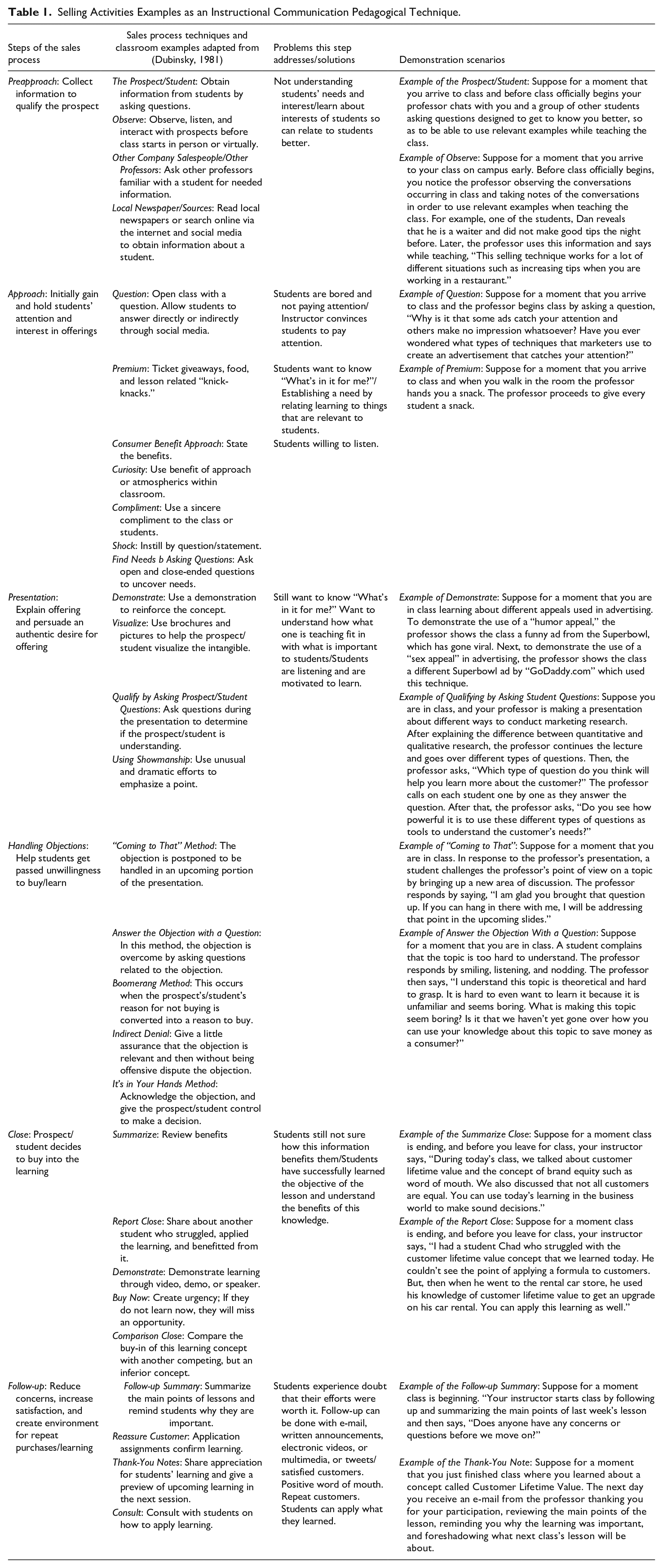
Selling activities are often organized around the sales process—a vital part of sales research and training (Borg & Young, 2014; Moncrief & Marshall, 2005; Plouffe et al., 2013; Shannahan et al., 2013). The seven-step selling process includes the following steps: (a) locate and find prospects, (b) preapproach, (c) approach the prospect, (d) present the offering, (e) handle objections, (f) close the sale, and (g) follow-up after the sale is completed. Some scholars suggest revised versions of the sales process such as a developed, nonsequential approach (Moncrief & Marshall, 2005), a multilevel process (Borg & Young, 2014), an enhanced downstream deal-level selling process (Plouffe et al., 2013), and a sense-making process (Shannahan et al., 2013). Because of its wide acceptance (Moncrief & Marshall, 2005), common application within sales practice, and ease of use in nonsales contexts (e.g., Rippé & Campbell, 2017; Rippé & Dubinsky, 2018), Dubinsky’s (1981) seminal study was selected. Within each step of the process, different techniques are used depending on the offering and customer. In his seminal work, Dubinsky (1981) identified 84 selling techniques associated with each step of the sales process. In order to apply to a teaching context, we summarize each sales step, describe the problem the step solves, and apply an appropriate application of Dubinsky’s techniques through the scenarios depicted in Table 1. These scenarios serve as examples of selling-to-teach and were used in Study 1. Due to space limitations, selling-to-teach examples are provided for each step of the sales process, but not explained in detail in the upcoming sections. It should be noted that the first step, prospecting, is not included, because most professors rely on the registration process and do not actively recruit students (Rippé et al., 2018).
Selling Activities Examples as an Instructional Communication Pedagogical Technique.
Conceptual Model
Figure 1 depicts the conceptual model of the educational exchange between a professor using selling-to-teach and a student. The model begins with the professor’s communication strategy, which we propose will be inspired and implemented through the steps of the sales process. The professor will carry out the sales process through the communication modes, which are the different ways instructors and students interact. For example, video conferencing via Zoom or using a Learning Management System such as Canvas/Blackboard/D2L or in-class lecture. The student will receive the professor’s teaching communication and will respond with actual and perceived learning. Actual learning will be expressed to the professor via direct assessment from scoring on rubrics, cases, exams, and other graded assessments, while perceived learning will be shared by indirect assessments such as respondent data measuring perceived learning (Bacon, 2016; Elbeck & Bacon, 2015). The items listed under perceived and actual learning are not an exhaustive list and only serve as an illustration. These examples will be further explained in Study 2.
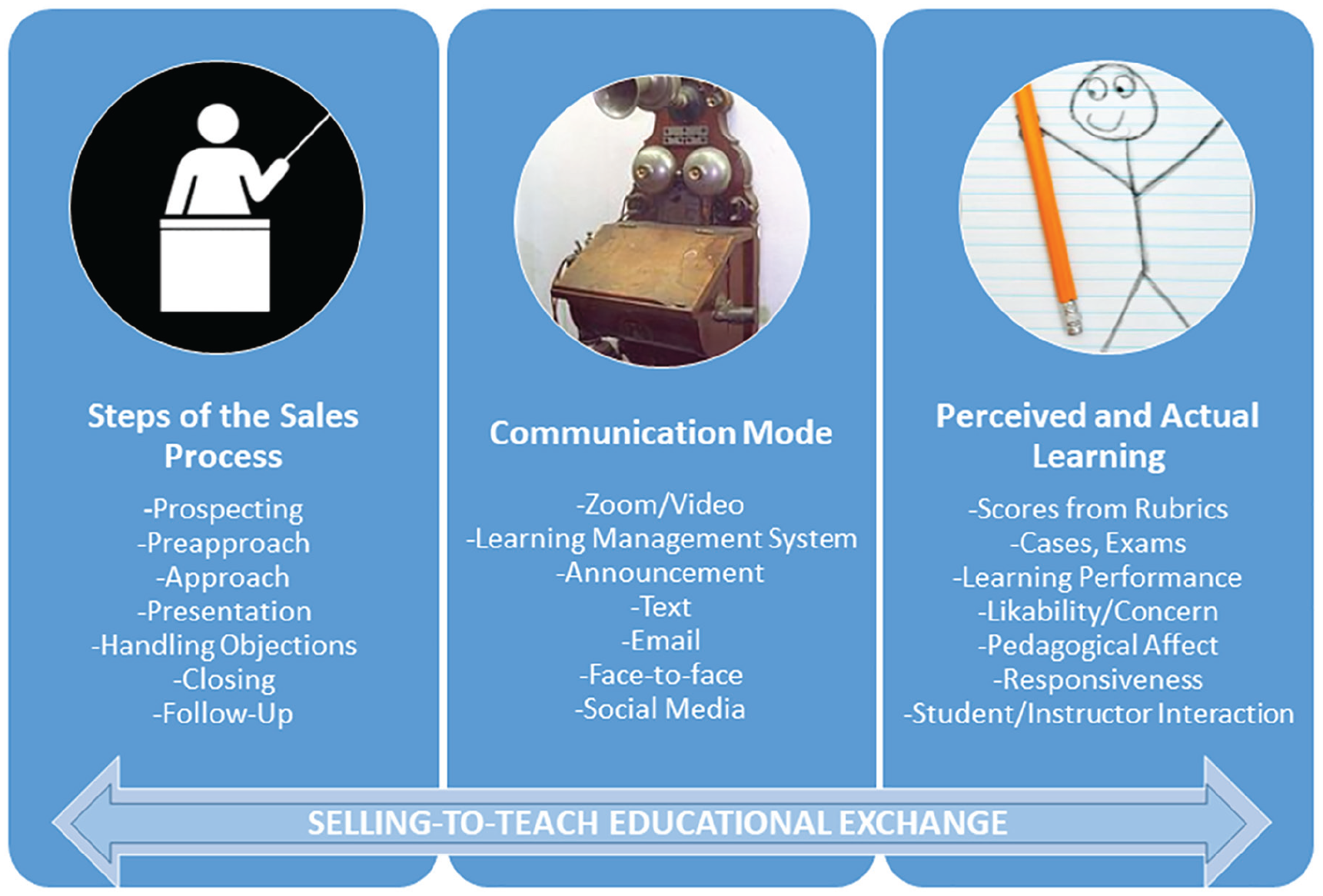
Conceptual model: Selling-to-teach educational exchange.
Preapproach
In the preapproach step, the salesperson formulates a strategy on the best way to connect with the prospect. Dubinsky (1981) suggests information approaches such as observance, asking questions, and listening for answers in order to best tailor an approach to reach the prospect. In selling-to-teach, a professor could use the prospect’s observe technique by simply observing students before class, thereby potentially gaining a better understanding of an individual’s interests and needs. Another option would be to use the prospect/student technique, whereby the professor asks direct questions to students who provide answers. The scenarios in Table 1 provide specific examples to clarify these techniques.
Approach
The approach step is used to create a favorable impression to build rapport with the customer by gaining and maintaining the prospect’s attention and interest in what the salesperson is offering (Dubinsky, 1981, p. 27). This step is where an instructor convinces students why they need to pay attention in class and shows them the relevance of course outcomes (what is in it for them). Dubinsky (1981) suggests several ways to approach prospects: (a) nonproduct related approaches (referral), (b) piquing interest approaches (consumer benefit approach, curiosity), (c) consumer-directed approaches (question, survey, compliment), and (d) product-related approaches (give the prospect the product). While Table 1 details these more fully, a professor could use the question approach to engage students. The professor could then allow students to either directly answer the questions in-class or indirectly answer by using social media to create a hashtag and share replies.
Presentation
During the presentation, “the salesperson presents the product-offering, demonstrates its strengths, and explains what it will do for the customer. Also, the salesperson attempts to arouse the prospect’s desire and conviction for the product” (Dubinsky, 1981, p. 27). There are three main categories: (a) presentation type, (b) visual display techniques, and (c) nonvisual clarification (Dubinsky, 1981). For selling-to-teach, also exemplified in Table 1, the demonstrate technique reinforces a concept by providing relevant examples, while the showmanship technique emphasizes the point by using dramatic efforts.
Handling Objections
In sales, prospects often resist the sale via objections that delay its closure. Therefore, salespeople have to overcome objections to move prospects through their unwillingness to buy. In selling-to-teach, buying refers to a student’s willingness to buy into a concept or a learning objective. Dubinsky (1981) suggest four main categories for handling objections: (a) techniques that create strife, (b) offset the objection, (c) clarify the objection, and (d) miscellaneous techniques. In selling-to-teach, objections can arise when a student is struggling with a concept or not in agreement with teaching based on personal experiences. Product knowledge is essential to handle objections successfully, and this is true for the teaching as well (Schempp et al., 1998), but objection handling techniques such as the examples in Table 1 can offer help. For instance, the coming to that method occurs when a professor tells the student that the student’s concern will be answered later on in the presentation.
Close
The close is the step where the prospect decides to purchase. In selling-to-teach, the purchase is not an economic exchange, but an exchange of knowledge. According to Dubinsky (1981), closing techniques include the following: clarification, psychologically oriented, straightforward, and concessions. Using the report close, a professor provides an example of someone else who struggled with the material but benefitted from learning the information. Another option would be using the summarize close, whereby the professor reviews the benefits of the learning. Table 1 more clearly outlines these examples.
Follow-up
Follow-up is the final step of the sales process, whereby the salesperson reassures the customer that the purchase was a wise one. Additionally, “the salesperson tries to reduce the customer’s postpurchase concerns, thereby developing a satisfied customer and increasing the chances of future repeat sales” (Dubinsky & Rudelius, 1980, p. 66). According to Dubinsky (1981), follow-up is categorized as activities involving customer service, customer satisfaction, and customer referral. In selling-to-teach, follow-up is the last step occurring after the other steps and tying together all of selling process steps. One example related to selling-to-teach is the follow-up summary occurring when the professor summarizes the lesson and reminds students why it was important, as shown in the Table 1 example.
Study 1
Given the exploratory nature of this study, Study 1 examines students’ perceptions of a selling-to-teach pedagogy to inform the selling-to-teach approach in Study 2 (Creswell & Poth, 2016). We conducted a pilot study with 252 students who read selling-to-teach scenarios shown in Table 1 and were asked: “Suppose you had a teacher who used the techniques you just read. Please describe in your own words your overall impression of that teacher.” An inductive approach following Gioia et al. (2013) was used to code all responses using ATLAS.ti (ATLAS.ti Scientific Software Development, 2018). We utilized three coders to rigorously organize the data into themes. The responses were retained verbatim for analysis.
Repeatedly reading and reviewing responses led to identifying similar ideas or common content that describe and provide insight into students’ reactions and impressions of the selling-to-teach techniques used by the hypothetical instructor. A comparison of the classifications was completed, and any discrepancy was resolved through mutual discussion resulting in suitable interrater reliability of 0.95 based on the proportional reduction in loss approach (Rust & Cooil, 1994). This analysis resulted in two key themes providing interesting insight and preliminary support into student perceptions of selling-to-teach techniques.
Study 1 Results
Theme 1: Selling-to-Teach Inspires Perceived Learning
From the student’s perspective, based on their affect, perceived learning indirectly assesses learning (Bacon, 2016; Elbeck & Bacon, 2015) and is imperative for student engagement (Karns, 2005; Vander Schee, 2012). Perceived learning includes constructs such as student interest (motivation to explore/learn), instructor likability/concern (caring nature), and learning performance (knowledge gained) (Abrantes et al., 2007). Selling-to-teach motivated student interest, as shown by this comment: “I would think she is a creative teacher who looks for different ways to not just help her students but to interest them, and help them in the real world.” Importantly, students perceive that the professor who uses these techniques respects and shows interest in the student, which led to reciprocity of interest. When students sensed the professor was interested in and cared about them, they then became interested in the professor and the course: “I believe that a majority of students would feel more engaged and cared for, in return these students would be more likely to participate in class activities and want to learn the course material.” Students further elaborated on how instructor interest would motivate them to learn, which affects their learning performance (Young et al., 2003). “My impression of that teacher would be that they are very engaging with their students and are genuinely interested in helping each student to fully understand the material of the course. I would be eager to learn from an instructor like that.”
Students like the instructor who uses these techniques and associates the instructor’s likability/concern with a perceived enjoyment of class that would facilitate learning performance: “I would really like having the teacher because I would enjoy learning the class . . . and gain the knowledge needed.” Students also perceive this instructor as entertaining and fun: “I think students will like this type of professor more because classes are fun, so students will actually attend and pay attention.” The instructor who uses selling-to-teach is perceived as a caring individual, which contributes to their likability/concern: “Most of these techniques show that professors care for the students . . . I believe the professor has a positive impression on the students.” Overall, students perceive the selling-to-teach instructor as knowledgeable, passionate, and student-centered: “My overall impression of the teacher is very knowledgeable and has a great passion for teaching. . . . Also wants to be there to assist the students to be successful.” Students positively perceive selling-to-teach and believe it will help their learning performance: “My overall impression of that teacher is that he/she is very effective when teaching and he/she will challenge my thinking.” As shown in the examples above, the overall analysis highlights a theme of perceived learning connected to student interest, instructor likability/concern, and learning performance.
Theme 2: Selling Steps Appreciated by Students: Presentation, Objections, and Follow-up
Certain steps stood out to the students as particularly memorable and favorable and were the most cited selling-to-teach steps in the data. The presentation step created a unique impression: “This presentation was very unique and memorable. . . . More teachers should do something like this to keep students engaged and entertained.” Students appear to appreciate the real-world and hands-on component of the presentation step: “It is very hands-on and makes the learning process easier” and “The teacher who presents in this way better bridges the gap between theory and practice and therefore, generally create more value in the learning objectives of the course.”
An interesting phenomenon was observed when it came to the techniques for handling objections. Many students cited feelings of being valued based on how the professor handled their questions and concerns: I believe any teacher that welcomes concerns from their students and make them feel valued has the power to reach those students. I personally feel a lot better about going to a class where I know the teacher engages in our feedback as much as we do theirs.
Other students noted that handling objections properly can lead to student success: If I had a teacher that used these techniques, I would feel successful in the class. When you do not get questions answered in a timely manner or not at all, then your chances for success diminish. Everyone learns differently, and teachers need to accommodate all the different learning styles.
Follow-up resonated with students as an effective and appreciated technique that differentiated the teacher and helped them learn the material: “This technique was helpful because it gave me validation as to what I read and learned. By providing a summary and informing us how the material can be applied in everyday life was helpful” and “The instructor going over the last class before giving new information I know helps me” suggest an appreciation of the follow-up summary method. Other students linked the use of follow-up to being a great and caring instructor: “The e-mails and letters are a way of showing a student you really care if they succeed.” Similarly, the thank you note follow-up method resulted in positive feelings for the student: “A teacher who e-mails and thanks a student for participating in class would be amazing to me. For a student to feel good, appreciated, and acknowledged for their hard work is the best feeling.” Analysis of these comments from the hypothetical selling-to-teach scenarios highlighted presentation, objections, and follow-up as steps appreciated by students.
Study 2
Based on the qualitative results in Study 1, we wanted to increase the realism and robustness of our findings through a field experiment, using a control group and testing the techniques in actual face-to-face and online teaching settings (Morales et al., 2017). Because Theme 2 of Study 1 revealed the importance of the presentation, handling objections, and follow-up steps, we used those steps for our hypotheses, which are presented next. The proposed statistical model is located in Figure 2. In the model, we suggest that presentation, handling objections, and follow-up steps of selling will positively affect the impact of likability/concern, learning performance, and student interest on perceived learning. These constructs were chosen based on the comments shared in Theme 1 of Study 1.
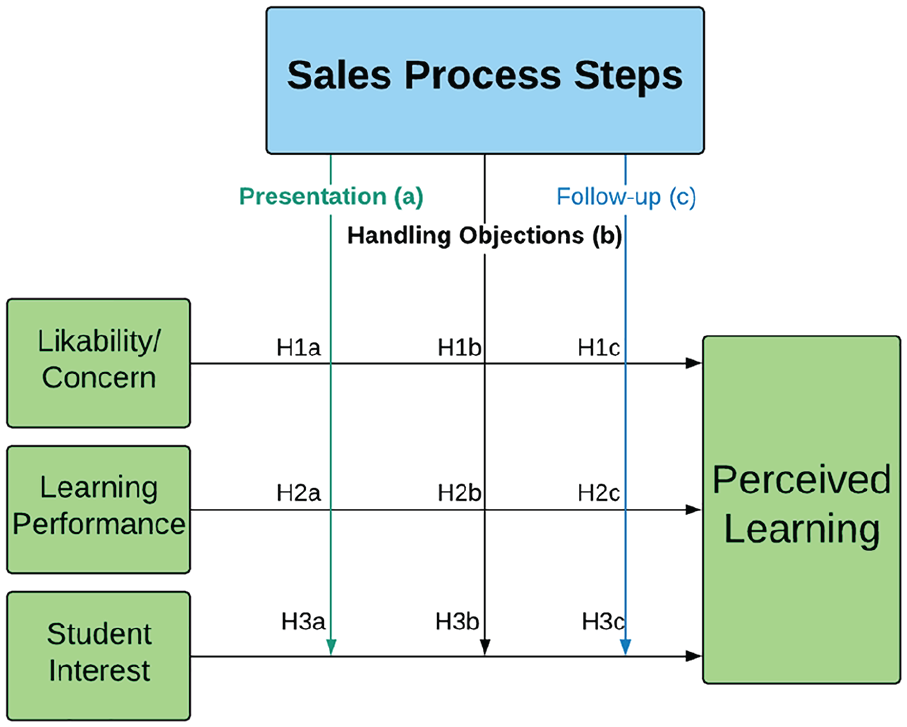
Statistical model for Study 2.
Study 2 Hypothesis Development
Perceived Learning
Learning is defined as “gains in the knowledge or skills that a student possesses” (Bacon, 2016, p. 3) and is often classified as perceived and actual. Actual learning, measured by direct measures such as exams or rubrics from different types of assessments, is “a change in knowledge identified by a rigorous measurement of learning” (Bacon, 2016, p. 3). Perceived learning is an indirect assessment of learning often measured from a student’s self-reporting data (Bacon, 2016; Elbeck & Bacon, 2015). Although not a measure of actual learning (Clayson, 2009), perceived learning is essential in engaging students in the learning process (Karns, 2005; Vander Schee, 2012). Perceived learning is more reflective of affect while actual learning is more representative of cognition (Sitzmann et al., 2010). Due to the significance of perceived learning in the student’s ability to learn and because instructional methods influence perceived learning (Abrantes et al., 2007), perceived learning is the dependent variable in the model. Additionally, perceived learning has direct connections with the measured constructs discussed in the hypotheses below.
Instructor Likability/Concern
In the sales literature, “likeability is defined as the perception of the buyer that the salesperson is pleasant and enjoyable to be around” (Ahearne et al., 1999, p. 273). Salesperson likability leads to trust (Wood et al., 2008). Likability/concern leads to seamlessly executed efforts (Jayanti & Whipple, 2008), which help in inspiring a student’s desire for the offering (presentation), offsetting a student’s concern about learning (handling objections), and increasing satisfaction (follow-up). In the academic literature, likability/concern “refers to the teacher’s emotional qualities, his or her caring disposition” (Abrantes et al., 2007, p. 961). Instructor concern has a strong association with students’ evaluations of instructors (Clayson, 2009). Emotional qualities are often communicated through teacher warmth, which is connected to relatedness and leads to engaged students (E. Skinner et al., 2008). Similarly, caring, relationship rapport, and empathy continually arise as qualities for excellent teachers (Gruber et al., 2010; Smart et al., 2003). In a qualitative study where themes revealed students’ perceptions of an excellent professor, the highest percentage of recurring themes revolved around congeniality and caring toward students (Faranda & Clarke, 2004). These findings led the authors to conclude “student emphases on empathy, relationships, caring, and understanding underscore the need for marketing educators to maintain personal interactions with students” (Faranda & Clarke, 2004, p. 280). Based on established pedagogical models, instructor likability/concern positively affects perceived learning (Abrantes et al., 2007; Feistauer & Richter, 2018). Indeed, in order for actual learning to occur, students have to feel cared for by the instructor. Since people buy from people they like, the steps of the sales process facilitate the prospect’s likability of the salesperson and similarly will strengthen the effect of likability/concern on perceived learning, which in turn leads to actual learning (Alexander & Murphy, 1998; Feistauer & Richter, 2018). Therefore, we propose:
Learning Performance
In sales, both learning (from product knowledge and sales skills) and high activity effort lead to sales performance (Silver et al., 2006). In education, learning performance is defined as “students’ self-assessment of their overall knowledge gained, their skills and abilities developed, and the effort they expended in a particular class relative to other classes” (Young et al., 2003, p. 131). When a teacher is perceived as competent, this positively affects learning performance (Costa et al., 2015; Nguyen & Nguyen, 2010). Instructor competency includes communication and organization (Nguyen & Nguyen, 2010), which are built into the selling-to-teach proposed methods. Salespeople who follow the sales process have an organized method for communicating their competencies that lead to selling success (Plouffe et al., 2013). Additionally, learning performance positively affects perceived learning and academic achievement (Abrantes et al., 2007; Cardoso et al., 2011). We suggest that an instructor following the selling-to-teach process via the presentation, objections, and follow-up techniques will positively affect the effect that learning performance has on perceived learning. Therefore, we posit:
Student Interest
Student interest is an emotion that motivates learning and exploration (Finn & Schrodt, 2016). It is defined as “affective-evaluative orientation toward certain subject areas” (Schiefele, 2009, p. 198). Students’ disinterest can be expressed through a declining desire to attend classes leading to disengagement, dropping a course, withdrawal, and course failures (Babad et al., 2008; E. Skinner et al., 2008). Contrariwise, students with higher interest experience better teaching (Fryer & Bovee, 2020). Student interest is directly affected by teacher involvement. Specifically, when a teacher shows interest in a student, the student becomes more interested (E. Skinner et al., 2008; E. A. Skinner & Belmont, 1993). Additionally, a teacher’s enthusiasm and authentic passion can spur student interest (Schiefele, 2009). Similarly, a salesperson’s enthusiasm is an influence tactic and spurs buyer interest (Hartmann et al., 2020; McFarland et al., 2006). Prior research shows that student interest consistently affects perceived learning (Abedin et al., 2012; Abrantes et al., 2007) and academic achievement. We propose that using the selling-to-teach methods will spur the effect of student interest on perceived learning through presentation, handling objections, and follow-up. Therefore, we hypothesize:
Study 2 Methodology
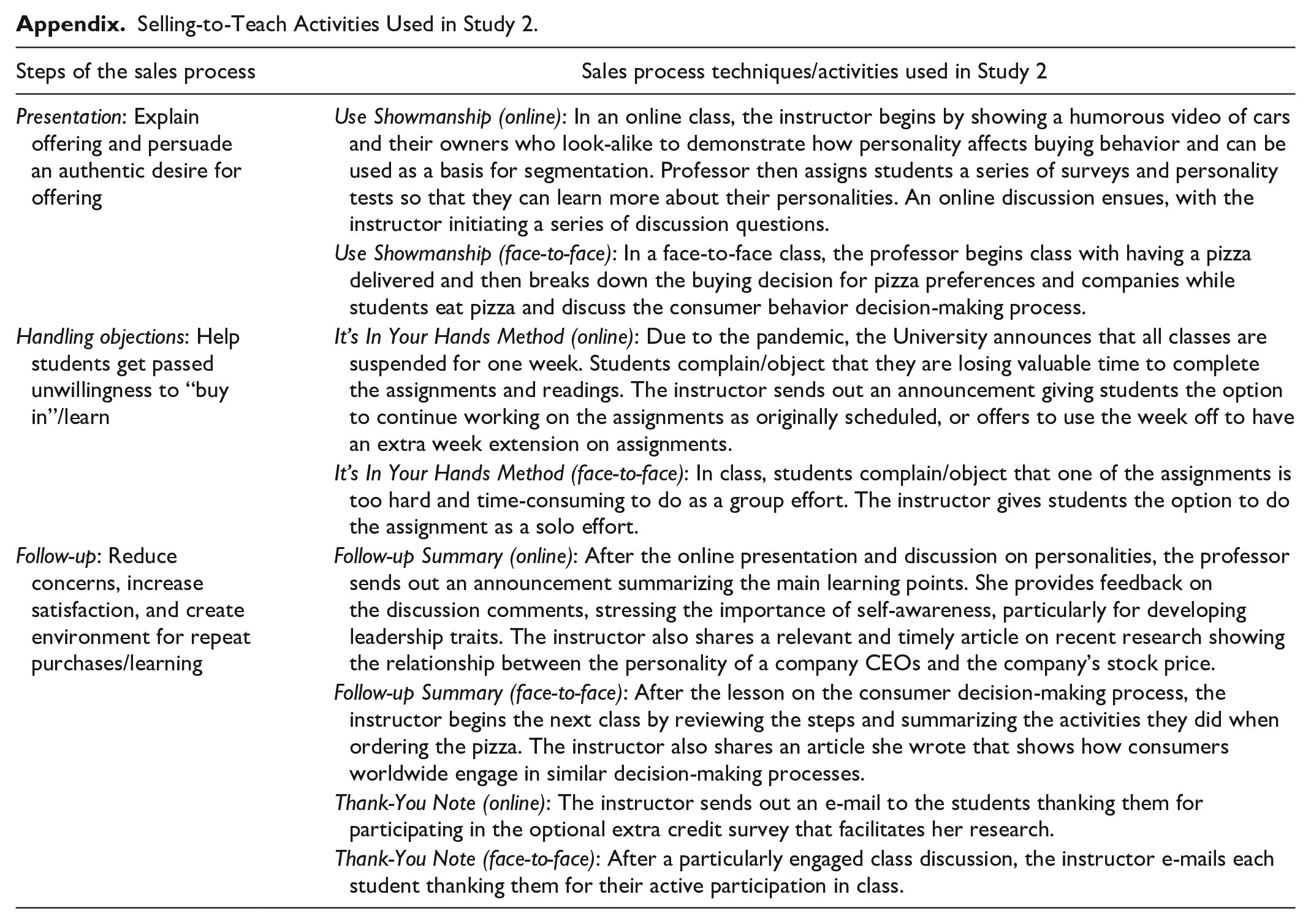
Among the selling steps of presentation, handling objections, and follow-up, we choose specific techniques from Dubinsky (1981) based on our ability to implement while teaching. In order to ensure the techniques, we selected represented the sales techniques from Dubinsky (1981), the instructor’s selling-to-teach activities were pretested with five sales scholars whose feedback confirmed the validity of the “selling approach” in a classroom setting. For the presentation step, we tested showmanship, defined by using dramatic efforts to emphasize a point. For the handling objections step, we empowered students with control by using the it’s in your hands method. For the follow-up step, two follow-up techniques were selected. One technique, follow-up summary, occurs when one summarizes the main points and reminds students why they are important and is often used by educators, even when they are not employing selling-to-teach. We also wanted to test follow-up with a different technique not often used when teaching and selected sharing appreciation for students with the thank-you note. Please see the appendix for the activities used.
Each technique was demonstrated in both online and face-to-face sections of the course, and the intervention type (face-to-face vs. online) was included as a control variable. For the online sections of each course, the professor posted an announcement(s) demonstrating a technique (online intervention). For the face-to-face classes, the instructor used a technique during class (face-to-face intervention). Within two days after selling-to-teach activities were demonstrated, the students completed the online survey. Students in the control group were not exposed to the selling-to-teach technique; they were asked to recall the current week’s topic and completed the survey at the same time as the students in the intervention groups.
Data were collected from students attending two major universities in the southeast of the United States. A total of 616 responses from students in six marketing courses were exposed to different steps of the selling process during two semesters: control (n = 114); handling objections (n = 154); presentation (n = 111); follow-up/thank-you (n = 118); follow-up/summarize (n = 119). As presented in the appendix, each technique was demonstrated in both online and face-to-face sections of each course. No significant differences were found based on course modality type, perhaps due to extensive use of digital learning platforms (D2L, Blackboard, Canvas, etc.), reducing the distinction between online and ground modalities, so the student responses for each technique were pooled together. Class sizes ranged from 35 to 60 students. The demographic distribution of the five subsamples was similar. About 59% of respondents were female students with an average age of 25.4 years old, taking mostly face-to-face classes (64%). Face-to-face students (n = 393) took an average of 8.6 face-to-face courses in the previous year. Age, gender, student modality type (face-to-face vs. online), technique intervention type (face-to-face vs. online), and university type (private vs. public) were used as control variables. To control for varying learners’ attitude toward teaching style of individual instructors participating in the study, pedagogical affect was included as a control variable.
Previously validated instruments (presented in Table 2) were used to measure the student learning latent constructs (Abrantes et al., 2007). Partial least squares (PLS) path modeling using Addinsoft (2012) XLSTAT was chosen for model estimation and assessment. We selected PLS path modeling as an estimation method for our model. First, the measurement model for each selling step was assessed, and reliability and validity were confirmed. Factor loadings of the reflective variables were examined to ensure that items loaded on their respective constructs did not cross-load with dissimilar constructs, thus establishing construct validity. One item of Student Interest (“I have become more competent in the area”) and two items of Learning Performance (“I desire to learn more about this subject” and “I understand this subject”) were substantially cross-loading and, thus were dropped. The loadings of the remaining individual scale items at each selling step exceeded the conventional 0.70 threshold (Hulland, 1999), suggesting adequate item reliability of the latent constructs at various selling step subsamples. Each construct explained more than 50% of the average variance extracted (AVE), demonstrating convergent validity (Gefen & Straub, 2005). Furthermore, the AVE of each latent variable exceeded the squared correlations between constructs. Thus, the condition for satisfactory discriminant validity was met (Chin, 1998; Fornell & Larcker, 1981). Additionally, a multigroup PLS test with 5,000 permutations (Chin & Dibbern, 2010) was conducted to examine pair-wise differences in item weights, latent variables communality (AVE), redundancy, and other model quality statistics with no significant differences among five subsamples found. Thus, the measurement model invariance across five subsamples was established. The measurement model estimates and model quality statistics for the combined sample (n = 616) are reported in Tables 2 and 3.
Measurement Model. Study 2.
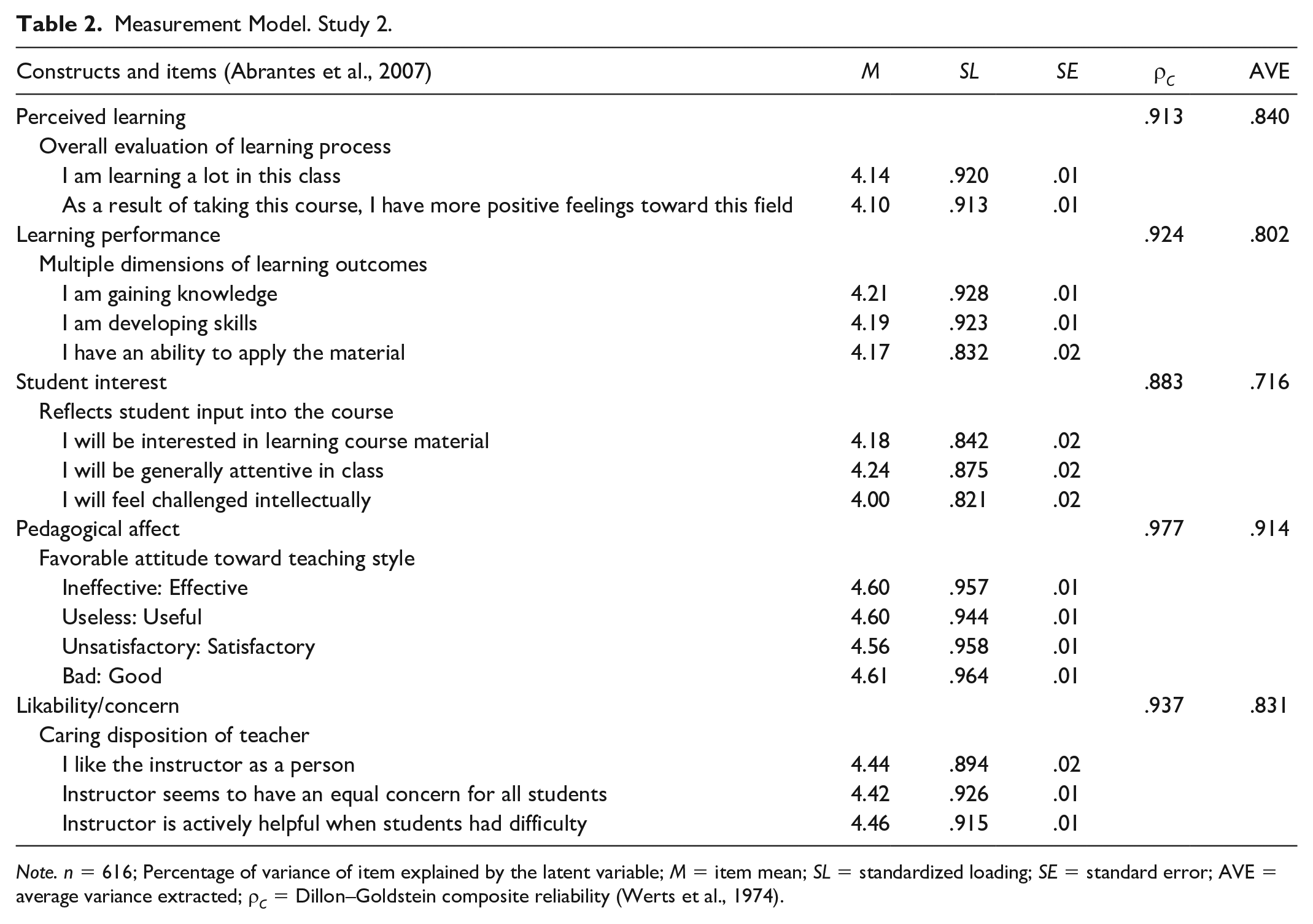
Note. n = 616; Percentage of variance of item explained by the latent variable; M = item mean; SL = standardized loading; SE = standard error; AVE = average variance extracted; ρ C = Dillon–Goldstein composite reliability (Werts et al., 1974).
Means, Standard Deviations, Correlations, and Discriminant Validity of Latent Constructs.
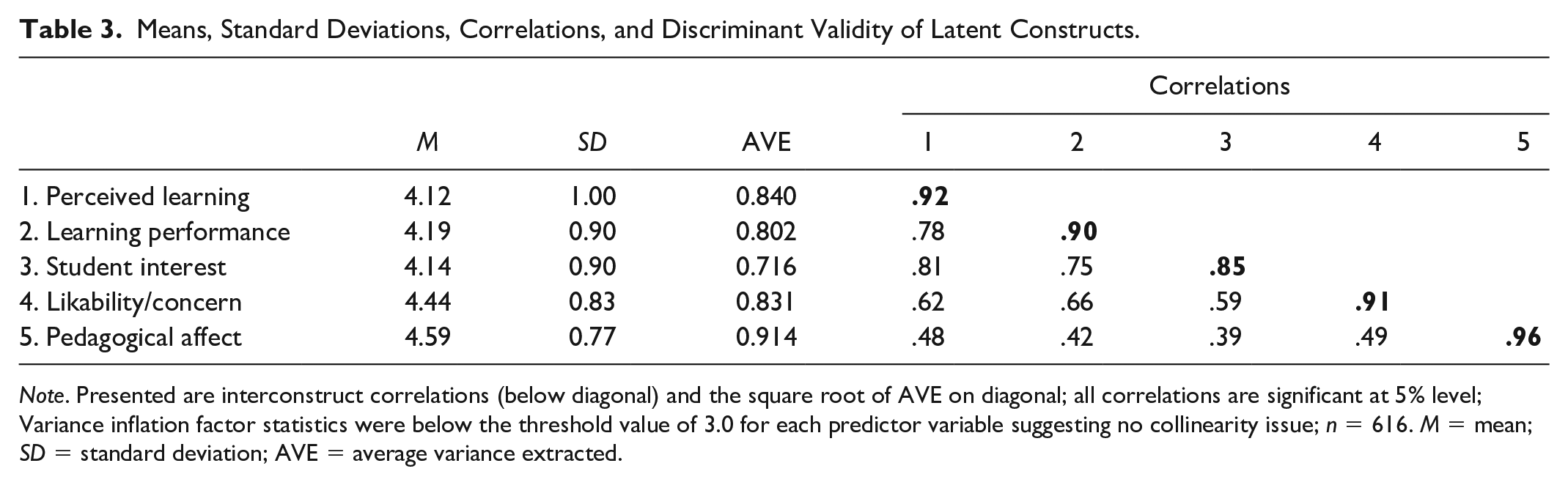
Note. Presented are interconstruct correlations (below diagonal) and the square root of AVE on diagonal; all correlations are significant at 5% level; Variance inflation factor statistics were below the threshold value of 3.0 for each predictor variable suggesting no collinearity issue; n = 616. M = mean; SD = standard deviation; AVE = average variance extracted.
Study 2 Results
The proposed model was estimated for each individual subsample, and estimation results are presented in Table 4. The model fit for each selling technique was gauged via goodness-of-fit indicators (overall model fit) and by accessing the measurement and structural models (local model fit). The overall model fit was assessed using standardized root mean square residual (Hu & Bentler, 1999). This fit criterion measures the discrepancy between the model-implied and the empirical correlation matrix and is the only overall model fit indicator currently available for PLS path modeling. From Table 4, the model standardized root mean square residual ranged from 0.051 to .076, and these values are below the recommended threshold values of 0.06 and 0.08 (Henseler et al., 2009; Hu & Bentler, 1999). Therefore, the overall model fit is acceptable. We also report the values for the goodness-of-fit indicator proposed by Tenenhaus et al. (2004), which exceeded the suggested threshold of 0.25 for (Wetzels et al., 2009) absolute goodness of fit in medium-size samples and 0.70 for the relative goodness of fit (Vinzi et al., 2010). Finally, the dependent variables have sizable R-squared values suggesting sufficient explanatory and predictive power of the model and satisfactory local model fit.
Structural Models of Perceived Learning. Study 2.
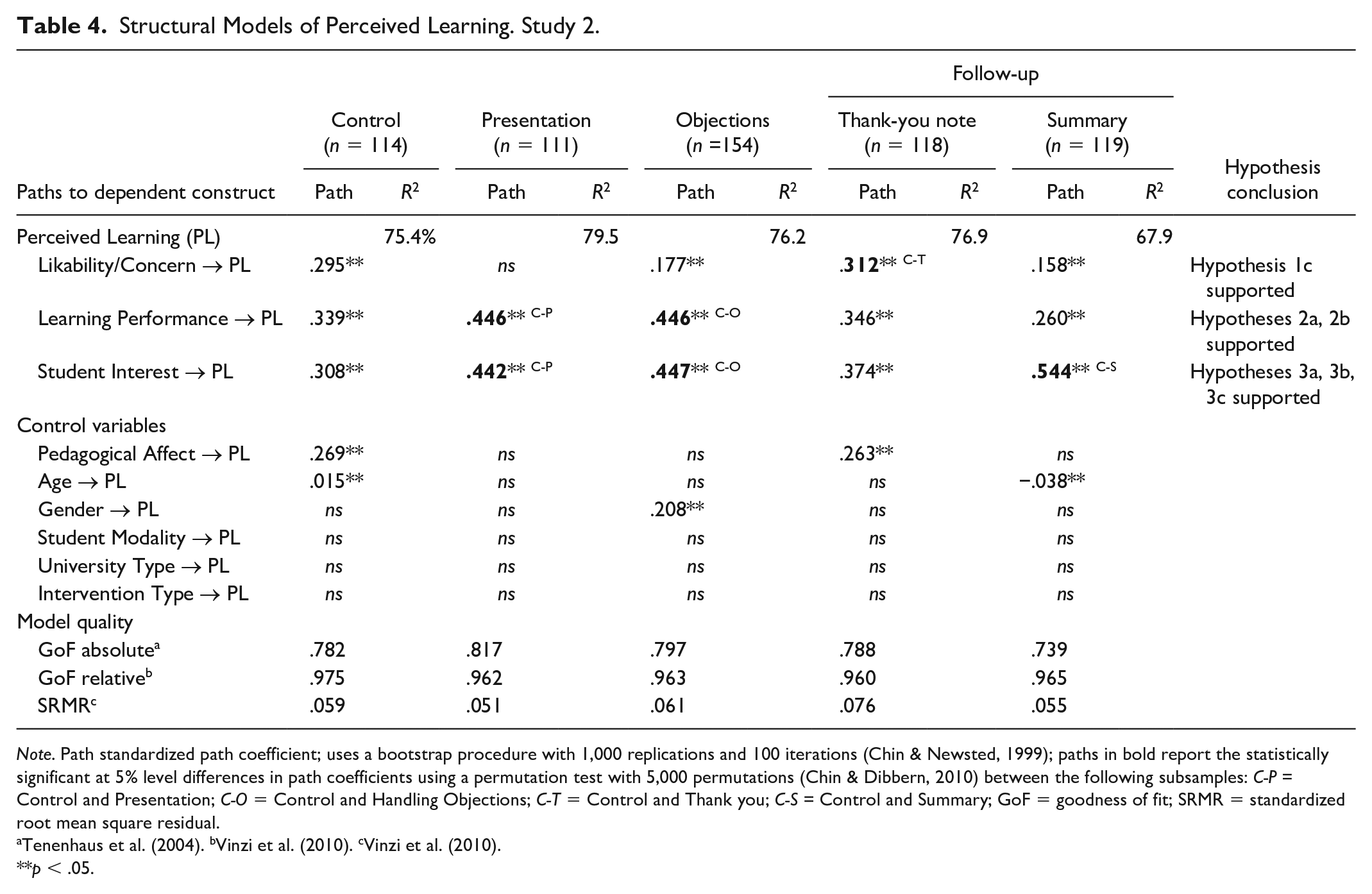
Note. Path standardized path coefficient; uses a bootstrap procedure with 1,000 replications and 100 iterations (Chin & Newsted, 1999); paths in bold report the statistically significant at 5% level differences in path coefficients using a permutation test with 5,000 permutations (Chin & Dibbern, 2010) between the following subsamples: C-P = Control and Presentation; C-O = Control and Handling Objections; C-T = Control and Thank you; C-S = Control and Summary; GoF = goodness of fit; SRMR = standardized root mean square residual.
p < .05.
To test the proposed hypotheses, the pair-wise differences between standardized path coefficients at each selling step and those of the control group were examined using multigroup PLS and tested with 5,000 permutations (Chin & Dibbern, 2010). Compared with the control group, the impact of the instructor’s likability/concern on perceived learning was significantly higher with the thank-you note (Hypothesis 1c is supported). In contrast, its impact significantly decreased when handling objections, presentation, and follow-up summary were applied, suggesting unique potential of instructor use of thank you notes. Presentation and handling objections significantly intensified the effect of student learning performance on perceived learning, supporting Hypotheses 2a and 2b. Compared with the control group, student interest facilitated perceived learning significantly more after each selling technique was applied, supporting Hypotheses 3a and 3b (see Table 4 and Figure 3). Presentation and handling objections significantly intensify the effect of student interest on perceived learning, and this impact is further strengthened when follow-up summary is used. Figure 3 depicts how the size of the effect of the perceived learning predictors changes when different selling-to-teach techniques were used.
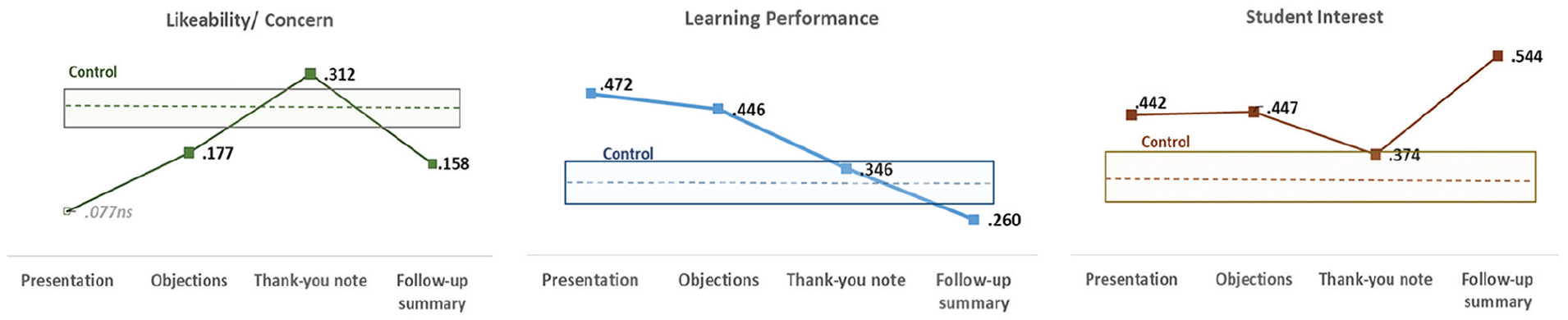
Impact of perceived learning predictors. Study 2.
We also examined student responses to one open-ended question at the end of the survey about their impressions of the teacher and learning that occurred. Although Study 1 asked a similar question, it was based on hypothetical selling-to-teach activities and instructors. This study questioned students about their actual experiences after they experienced selling-to-teach. Following Vander Schee (2012), in Figure 4, the proportion of students whose comments cited each perceived learning theme established in Study 1 and their sample comments are organized by selling technique and the theme. For the presentation step, 71% of students cited a perceived increase in their learning performance, such as having a better understanding of the material, gaining knowledge or a new skillset, and becoming more competent based on this technique. Student interest also had the most comments in the presentation step. Almost a third of the students wrote how this technique facilitated their interest and involvement in the topic. Instructor likability/concern was cited the most frequently for the other three selling-to-teach techniques (follow-up summary, follow-up thank you note, and handling objections). Students wrote of a considerate, kind, and likable instructor whose selling-to-teach techniques communicated that they were cared for and valued. The follow-up thank you technique had 70% of students citing a likable instructor, suggesting that this technique may be particularly conducive for fostering positive affect to the instructor. In comparison, in the control sample, the instructor was perceived as likable by approximately 31%, indicating that instructors can be perceived as likable without using selling-to-teach, but using it may potentially increase student perceptions of likability/concern. The increased proportion of positive comments (compared with the control group) signify that the students who experienced selling-to-teach techniques experienced more perceived learning.
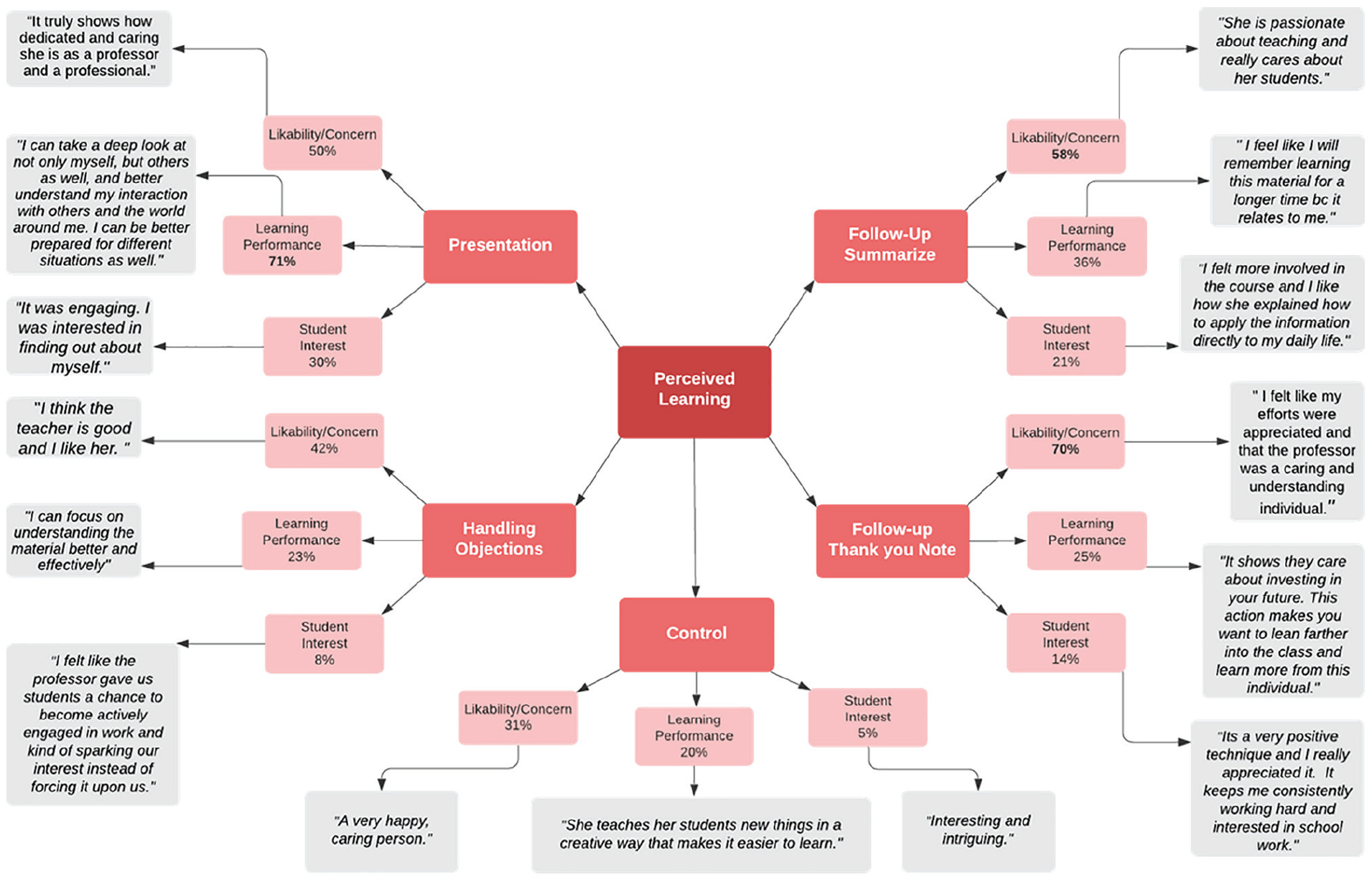
Study 2 qualitative data.
In addition to examining perceived learning, following the conceptual model, we investigated whether selling pedagogy affects actual learning (Bacon, 2016; Elbeck & Bacon, 2015). The assessment was performed in three different marketing courses offered in two universities. For each course, two sections with identical assignment structure and similar student characteristics (number, age, modality) were selected. Students in one section were exposed to selling to-teach techniques throughout the course, while the other section of the same course served as a control group. To ensure interrater reliability, the sections were taught by the same instructors/graders. Grades of 16 written assignments and four exams completed by 229 students were compared. Two nonparametric tests (Monte Carlo simulation and Mann–Whitney) were used as the grade distributions exhibited significant departures from normality. Table 5 reports the tests’ results.
Grades Comparison. Study 2.
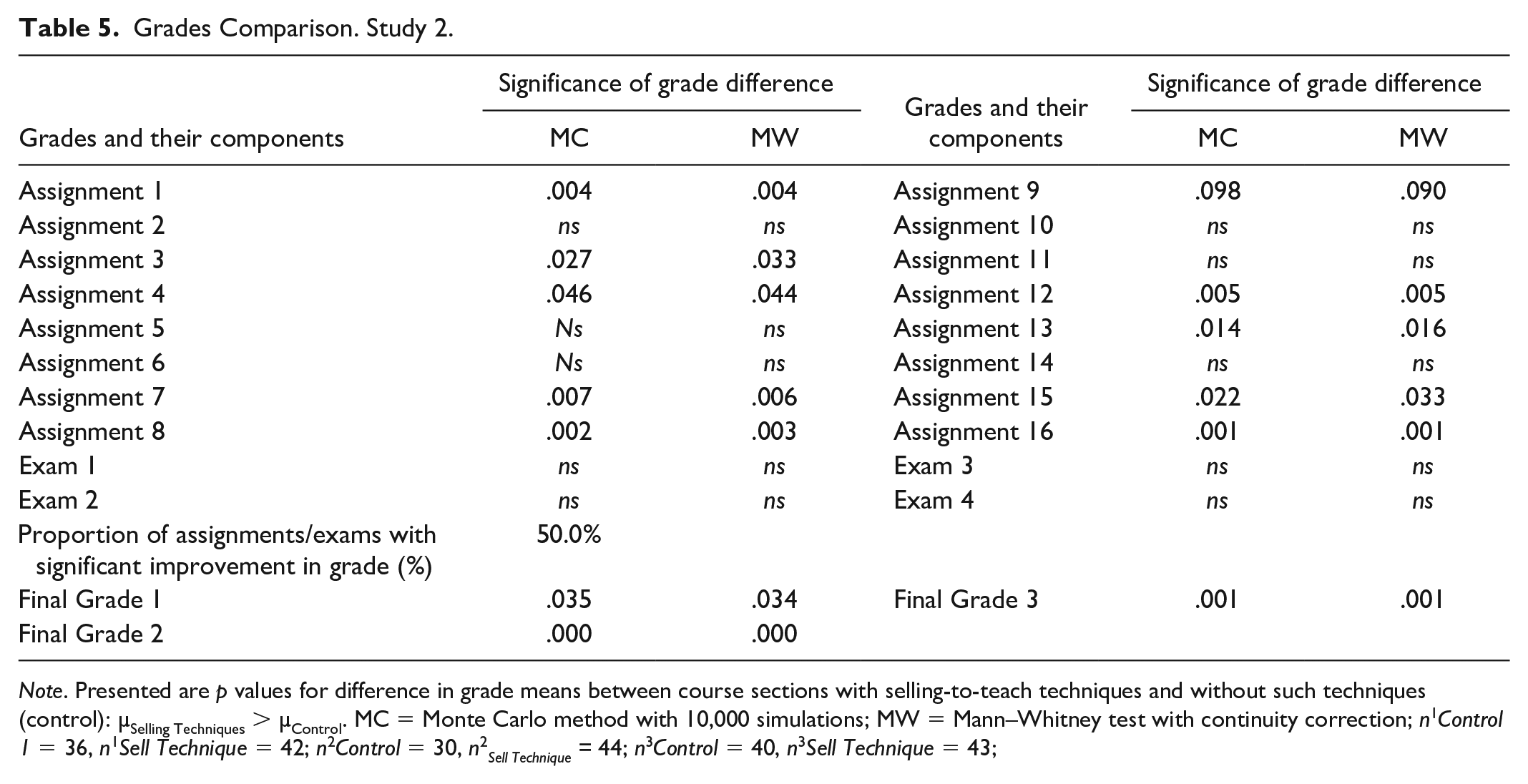
Note. Presented are p values for difference in grade means between course sections with selling-to-teach techniques and without such techniques (control): µSelling Techniques > µControl. MC = Monte Carlo method with 10,000 simulations; MW = Mann–Whitney test with continuity correction; n1 Control 1 = 36, n1 Sell Technique = 42; n2 Control = 30, n2Sell Technique = 44; n3 Control = 40, n3 Sell Technique = 43;
Students exposed to selling-to-teach techniques performed substantially better and scored significantly higher than students in the control group in about half of the assignments resulting in overall higher final grades in all three courses (see Table 5). This finding enhances our understanding and offers preliminary support of selling-to-teach affecting direct learning.
Discussion
In a series of two studies, the present research proposes and empirically supports selling-to-teach with important implications for marketing pedagogical policy to reach today’s students. Given that components of perceived learning initiate actual learning (Karns, 2005; Vander Schee, 2012), it is important for instructors to positively influence drivers of perceived learning. Selling-to-teach substantially increases the effect of instructor likability/concern, student interest, and learning performance on perceived learning. Students responded positively to the instructor who, like a good salesperson, paid attention to their concerns, motivated learning with an interesting presentation, and showed follow-up. Indeed, our findings support the notion that “good teachers do a lot of selling” (Malcolm, 2016, para. 1).
Our research shows that educators can use small modifications in the form of the selling process to frame their teaching. For example, using the sales technique of showmanship when presenting positively affects the effect of learning performance (Hypothesis 2a) and student interest (Hypothesis 3a) on perceived learning, but not on instructor likability/concern (Hypothesis 1a). This finding suggests that educators should plan an engaging presentation focused on content that will inspire student interest while staying connected to related dimensions of learning outcomes and skill development, but instructor likability should not necessarily be a major focus during this step. While this may seem overwhelming, it need not be. We ordered a pizza during class teaching and used it to talk about consumer behavior preferences. In another class, we utilized a funny commercial to attract attention to teach market segmentation. These were easy to implement and took minimal time to prepare. All teachers present when they teach a class, and planning for dramatic flair can improve perceived learning.
Educators have to deal with students’ objections and complaints (Lala & Priluck, 2011). Our research shows that when it comes to handling students’ objections, sales techniques positively affect the effect of student learning performance (Hypothesis 2b) and student interest (Hypothesis 3b) on perceived learning. Many feel defensive when they hear an objection. Since likability was not significantly different from the control group at this step (Hypothesis 1b), our findings highlight the importance of handling students concerns even if a professor does not care if students like them. A simple acknowledgment of a student’s concern will bolster student interest and learning performance, therefore student concerns should not be ignored. This technique can be implemented verbally or orally as our results show support across modalities. Some professors may be quick to dismiss students’ concerns, but our findings show this would be a mistake because it could affect learning performance and student interest.
Most professors understand that effective learning comes from repetition, review, and reflection (Peltier et al., 2005; Saber & Johnson, 2008). Our research extends our understanding of why this technique is so effective—follow-up summary is positively connected to the effects of student interest on perceived learning (Hypothesis 3c). Furthermore, we tested another type of follow-up not often used by educators, sending a thank-you note and found additional compelling support (Hypothesis 1c). Similarly, according to the qualitative data, 70% of students who received a thank you note from their professor perceived the professor as likable. Although educational research has not found consistent support for strong relationships between likability/concern ratings and student learning achievements (Delucchi, 2000; Paswan & Young, 2002), our study challenges this assumption and instead demonstrates that the instructor’s genuine concern positively affects perceived learning, especially for thank you follow-up techniques. The only exception was that follow-up did not significantly affect perceived learning performance compared with the control group (Hypothesis 2c), but it appears to have affected actual learning as discussed below.
When considering actual learning measured directly via grades/scores/rubrics, students exposed to selling-to-teach performed better in about half of the assignments and earned higher final grades in this study sample. Interestingly, the exam scores in our sample were not affected by the selling-to-teach techniques. This suggests a limitation to the perceived learning model. The likability/concern of the instructor and student interest may motivate students to actively participate in the discussion topics and written assignments, rendering a potential explanation for the increase in those grades. Conversely, these variables may not influence the graded outcome on assignments given under more “stressful” conditions, such as timed exams or those requiring specific skills, such as oral presentations. Overall, the direct measures complement the results of Study 1 and Study 2 and support selling-to-teach, while also highlighting delimitations.
While some have a negative connotation of salespeople (Hammond, 2020; Powers et al., 1987) and will be opposed to professors utilizing selling techniques, viewing such notions as inappropriate, our research strongly suggests that they reconsider these views. Study 1 and Study 2 findings support the notion that the employment of selling techniques while teaching has the potential to enhance student comprehension of learning objectives, intensify student application of learning, and increase student satisfaction with the learning experience.
Theoretical Contributions
We make four main theoretical contributions. Although selling and teaching have been suggested in the literature (Wallfisch & Wallfisch, 1979), this work is an inaugural attempt to empirically connect the concepts and ground them in theory. We link teaching and selling, two different theoretical areas with connections that can enhance both. We highlight the common groundings of teaching and selling, which both rely on the same communication foundation (Burns & Golen, 1983; Duncan & Moriarty, 1998; Rasmussen, 2001). From a theoretical standpoint, the focus on the commonalities of these two fields provides an application for teaching and answers calls from researchers to look to other fields to explain instructional communication techniques (e.g., Conley & Ah Yun, 2017; Preiss & Wheeless, 2014).
Additionally, by theoretically connecting the communication commonalities of selling and teaching, our work enhances the literature on communication theory in marketing—an area sparsely researched in the marketing pedagogy literature (Burns & Golen, 1983). Second, while other articles examine pedagogy in sales, we suggest sales is a pedagogy and can be used across disciplines. Third, we enhance the literature on the application of marketing techniques utilized in higher education (e.g., Ghosh et al., 2008; Helgesen, 2008; Ng & Forbes, 2009; Vander Schee, 2010; Voon, 2008). In applying marketing to the classroom, Adrian (2015) found that sales-based relationship-building activities improved course ratings. Rippé et al. (2018) discovered that the use of prospecting and follow-up by instructors positively affected students’ likelihood to enroll in another class by the same professor. This work enhances this literature with a fuller examination of the sales function in marketing as a pedagogical tool and also facilitates students’ exposure to sales through instructor use of the sales process while teaching, answering calls to expose students to sales and enhance their interest in sales (Cummins et al., 2015; Peltier et al., 2014).
Finally, this research has implications regarding effective pedagogical processes, reaching students to maximize each component of perceived learning at different selling stages of the student experience. Indeed, this effort aligns with the current shift from studying consumeristic students in higher education generally to more specifically researching their impact on pedagogy (Bolat & O’Sullivan, 2017). Thus, helping educators utilize techniques to “sell” to students who come to class with a consumeristic attitude.
Limitations and Directions for Future Research
This research has several limitations, but also provides future research opportunities. Given that this is the first time selling-to-teach has been suggested, more empirical work is needed, including all the sales process steps and using more of the 84 selling techniques Dubinsky (1981) identified. To deepen our understanding of the selling-to-teach benefits and challenges, a larger field study, employing more direct measures and other indirect perceived learning measures such as student/teacher interaction and organization (Abrantes et al., 2007) should be used. Additional qualitative research using in-depth interviews or focus groups would provide meaningful insights. In addition to a control group, manipulation checks for each condition and pretests/posttests of a regular lecture can also be insightful. While we controlled for pedagogical affect, other potential confounds such as teacher enthusiasm and social desirability should be controlled for in future studies. Finally, future research should examine a selling-to-teach approach in disciplines outside of marketing, since we believe that the results of this research have important implications for educational pedagogical practices across disciplines to reach today’s student. This article invites academia into the world of selling. It is a world where professors communicate with students by understanding their needs, influence students by presenting subject matter with their interests in mind and increase learning performance through selling-to-teach techniques.
Footnotes
Appendix
Selling-to-Teach Activities Used in Study 2.
| Steps of the sales process | Sales process techniques/activities used in Study 2 |
|---|---|
| Presentation: Explain offering and persuade an authentic desire for offering | Use Showmanship (online): In an online class, the instructor begins by showing a humorous video of cars and their owners who look-alike to demonstrate how personality affects buying behavior and can be used as a basis for segmentation. Professor then assigns students a series of surveys and personality tests so that they can learn more about their personalities. An online discussion ensues, with the instructor initiating a series of discussion questions. |
| Use Showmanship (face-to-face): In a face-to-face class, the professor begins class with having a pizza delivered and then breaks down the buying decision for pizza preferences and companies while students eat pizza and discuss the consumer behavior decision-making process. | |
| Handling objections: Help students get passed unwillingness to “buy in”/learn | It’s In Your Hands Method (online): Due to the pandemic, the University announces that all classes are suspended for one week. Students complain/object that they are losing valuable time to complete the assignments and readings. The instructor sends out an announcement giving students the option to continue working on the assignments as originally scheduled, or offers to use the week off to have an extra week extension on assignments. |
| It’s In Your Hands Method (face-to-face): In class, students complain/object that one of the assignments is too hard and time-consuming to do as a group effort. The instructor gives students the option to do the assignment as a solo effort. | |
| Follow-up: Reduce concerns, increase satisfaction, and create environment for repeat purchases/learning | Follow-up Summary (online): After the online presentation and discussion on personalities, the professor sends out an announcement summarizing the main learning points. She provides feedback on the discussion comments, stressing the importance of self-awareness, particularly for developing leadership traits. The instructor also shares a relevant and timely article on recent research showing the relationship between the personality of a company CEOs and the company’s stock price. |
| Follow-up Summary (face-to-face): After the lesson on the consumer decision-making process, the instructor begins the next class by reviewing the steps and summarizing the activities they did when ordering the pizza. The instructor also shares an article she wrote that shows how consumers worldwide engage in similar decision-making processes. | |
| Thank-You Note (online): The instructor sends out an e-mail to the students thanking them for participating in the optional extra credit survey that facilitates her research. | |
| Thank-You Note (face-to-face): After a particularly engaged class discussion, the instructor e-mails each student thanking them for their active participation in class. |
Acknowledgements
The authors offer specials thanks to Dr. Alan J. Dubinsky and Dr. Charles-Clemens Rüling for their help in developing this article. We also would like to thank the editors and reviewers for their valuable feedback.
Declaration of Conflicting Interests
The author(s) declared no potential conflicts of interest with respect to the research, authorship, and/or publication of this article.
Funding
The author(s) received no financial support for the research, authorship, and/or publication of this article.
