



Abstract
The online classroom is self-directed, where students decide when and how often they access their course material. Even in the traditional classroom, students have shown a propensity to shift their time allocation to the last minute, so it is not clear what happens when they have full control over their learning schedules. Our interest is whether this self-directed learning environment produces similar harmful binge behavior as observed with online television, where memory and satisfaction with the experience decrease over time. With access to clickstream data from an online e-educator, we found 62% of the sample binged their learning by concentrating their studies within the semester rather than distributing their online activity throughout. Two types of binge learning emerged as significant: Front-bingers, who accessed the majority of their education early, performed more similarly over time to those who spaced their learning activities. Back-bingers, who accessed the majority of their material late in the semester, did not perform as well. To help us better understand these findings, we used a relatively new measure of behavior called “clumpiness” to summarize their overall online activity. We discuss our findings and their implications for online education and marketing course design.
Netflix CEO Reed Hastings: “My first binge was calculus—I got to college, I hadn’t had much calculus, and the college I went to had a self-paced program. . . . I loved it. It was tremendously engaging in the same way that binge entertainment is—you’re in control.” (Garling, 2014). The Netflix of education is coming. And when it arrives, “it is going to be incredibly disruptive. . . . I expect the majority of universities in America to be bankrupt in the next decade or two.”
The on-demand flexibility of digital streaming services such as Netflix, Amazon, and Hulu, has created a new viewing behavior where consumers watch multiple episodes of a show in one sitting. Binge-watching, as it is called, has now become part of our culture, with a recent Huffington Post calling it “the new date night” (Dourado, 2013). This behavior became part of the vernacular, with the Oxford dictionary adding “binge” to describe this type of viewing in 2014. A 2016 survey found that media and social acceptance of binge-watching were significant predictors of self-reported binge-watching (Karmakar & Kruger, 2016).
Prior research in marketing education has found that online material can enhance the classroom experience (Dowell & Small, 2011; Northey et al., 2015). Research has also shown no difference in learning outcomes between online and traditional classrooms when the material is delivered synchronously (Francescucci & Rohani, 2019). However, a key aspect for most online programs is the student’s ability to self-direct their learning process, which requires learners to manage their learning process from beginning to end (Boyer et al., 2014). Bad time management and procrastination were listed as the primary reasons for failure or withdrawal from an online class (Doherty, 2006). In addition to the self-regulation processes of studying, the self-directed online learner is making decisions about when to learn, how to pace the learning, and what additional online resources they may use in the learning process (Song & Hill, 2007).
The asynchronous and flexible access to online educational materials has allowed for a different type of learning behavior to emerge, which we term “binge-learning.” While this label is new to the academic literature, this concept has been introduced in other spheres. The Urban Dictionary (n.d.) defines it as “a tendency to partake in bouts of knowledge-seeking” and “has some similarities to binge-watching.” Meanwhile, Macmillan Dictionary (n.d.) defines it as more similar to procrastination: “when you learn a lot shortly before an exam and forget it soon after.”
We define binge-learning as a student’s propensity to partake in a period of concentrated learning of online educational material rather than distributing that learning over time. It can happen at any point during the semester since online content is immediately available, whereas in traditional or synchronous online classes, students must wait for the delivery of lectures and assignments throughout the semester. We believe this is different from behaviors observed in brick-and-mortar settings where students procrastinate, cramming their studies close to an exam.
We further define binge learning by observing when the student is accessing online materials. Based on the availability of these materials, we could observe when in the semester students accessed course materials (early/late). More generally, we could observe how they distributed their learning across the semester by utilizing a measure called “clumpiness,” which is a new measurement term for the educational context that researchers have demonstrated impacts other types of behavior (Zhang et al., 2015).
We begin our inquiry with a comparison of the traditional and online learning classroom design and cover the problematic effects of procrastination and cramming as observed in the conventional classroom setting for a marketing course (Ackerman & Gross, 2005; McIntyre & Munson, 2008). We then focus on how and when students access their online learning material and how that impacts their learning and satisfaction in an asynchronous environment. The hypotheses on students’ scheduling of online learning and its impact on memory and satisfaction, were based on research in educational and cognitive psychology on time management, and more recent work on media binge behavior.
In our first study, we gain access to clickstream data from an e-educator provider for three, online semester-long classes. We assess whether students spread out or “binge” their online learning activity and compare how those different learning schedules impact students’ initial performance (grade). In a follow-up survey, we assess how students remember and feel about their online learning experience. Such satisfaction measures are especially critical because educators view learning as a lifelong experience subject to many potential repurchases (Appleton-Knapp & Krentler, 2006; Michinov et al., 2011).
Our second study considers both learning and satisfaction with an online data analytics class. One way online educators have addressed their retention problem has been to introduce shorter classes. We investigate whether this format leads to less bingeing of material as well as how scheduling affects their net promoter status, the current manner in which the online provider measures satisfaction. In both Studies 1 and 2, we find that those who spaced their learning throughout the semester or learning period had higher grades than those who binged, and overall, they were more satisfied with their online education experience. However, those who binged early (Front-bingers) were different from those who binged later (Back-bingers), with Front-bingers more similar in their behavior and attitudes to those who spaced their learning.
Our research has implications for online education, particularly in terms of how online material is scheduled over a semester. Our field data provided a reliable test for binge behavior as those students paid money and were motivated, so that we might expect even higher binge behavior in free Massive Open Online Classroom (MOOC) and other methods of online learning. We discuss how and when e-providers should assess their students’ experience online, provide suggestions for designing online marketing classes, and consider the limitations and future research opportunities.
Literature Review
Traditional Versus Online Classroom Design
The traditional “campus-based education systems are constructed around physical buildings that afford meeting and lecture spaces for teachers and groups of students” (Anderson, 2008, p. 67). Lectures are primarily synchronous face-to-face interactions where students are expected to respond to questions and contribute to discussions. This in-person accountability helps keep students on track and gives the educator an opportunity to remind them of upcoming assignments, projects, and tests.
On the other hand, online learning allows learners to pursue their studies while fulfilling other roles such as full-time workers or parents. The asynchronous availability enables the student to access content, the instructor, and other learners at will. The positive benefits of online learning depend on the student taking responsibility, self-directing their learning, and applying proper time management skills.
Not every student profits from this self-driven environment (Cerezo et al., 2016; Dynarski, 2018), but it is not clear what type of online behavior most benefits learners which makes it difficult to identify students experiencing problems. Some researchers have suggested that the overall amount of time online the student spends is important (Macfadyen & Dawson, 2010); but others have found that time is not a predictor of final grades, rather the number of sessions one accesses is more critical (Heffner & Cohen, 2005). While some researchers have begun to segment students based on their learning patterns, this has primarily been focused on identifying students who procrastinate or utilize time in certain activities more so than others (i.e., discussions vs. quizzes).
The Benefits of Spaced Learning
The temporal sequence of events within a class has important consequences for downstream effects such as student engagement and performance. Whether intentional or not, the traditional setting where classes meet once or twice a week over a roughly 15-week semester is optimal for learning to occur. Psychologists refer to this type of design as “spaced learning,” and have found that information presented at different points in time, rather than presented in a massed format, yields better learning outcomes (Cepeda et al., 2008; Dempster,1989; Noel & Vallen, 2009). When information is spaced, each piece has its own set of unique associations during encoding. When the second piece of information is related to earlier information, the student uses it to reconstruct or refresh that earlier memory, resulting in a stronger memory trace (Noel & LaTour, 2011).
The time between learning intervals allows the student to make associations and strengthen the learned material in memory (Glenberg, 1976) and allows consolidation of those memory traces during sleep (Stickgold, 2005). Spacing material has been associated with deeper learning (Kapler, et al., 2014) and spacing effects occur at all levels of education, including elementary school (Rea & Modigliani, 1987; Sobel et al., 2011; Vlach, 2014), middle school (Carpenter et al., 2009), college (Balch, 2006), and in adult education (Bird, 2010).
Time Management Concerns in the Traditional Classroom: Procrastination and Cramming
Procrastination is the intentional delay in carrying out tasks to the degree that one feels discomfort as the deadline looms near (Ackerman & Gross, 2005). Studies show that 95% of college students report having procrastinated at some point in their careers (Ellis & Knaus, 1977), with the concern being that procrastination has been linked to poor academic performance as well as psychological problems emanating from stress caused by the procrastinating itself (Hussain & Sultan, 2010). Some researchers believe that motivation can overcome procrastination (Dweck, 1986), while others are less optimistic, believing that procrastination is a trait variable, and certain people tend to delay tasks regardless of context (Steele, 2007).
Researchers studying cramming, that is, last-minute study before a final marketing exam, have found that this strategy can be useful in the short-term performance (McIntyre & Munson, 2008). Those researchers compared “crammers” to “methodical students” and found that methodical students performed better than last-minute crammers over time. This result is consistent with research on the spacing effect (Son & Simon, 2012). In the short term, recall is influenced by the recent context of information presented, so there is a benefit to the short lags between information due to similarity in context between encoding and retrieval. However, the lag between the information leads to stronger connections resulting in better memory for spaced material (Glenberg, 1976; Singh et al., 1994).
Binge-Learning and Clumpiness
Psychologists have defined bingeing as “consuming an excessive amount in a short time” (Heatherton & Baumeister, 1991), and this has typically been associated with overindulging in food or drink. Schweidel and Moe (2016) extended the concept of bingeing to television viewing, saying that consumers get into a “flow state,” which leads them to binge-watch. They lose awareness of their behavior and the passage of time. Steele (2007) calls procrastination a “quintessential failure of self-regulation,” which implies that not keeping track of learning activities can also fall under this category. Once learners access online material, they may extend their learning sessions because it is easier and more convenient than accessing the material later. Researchers have found that students prefer massed presentations of information (Son & Simon, 2012), and others propose that bingeing can benefit online learning because, somewhat similar to television viewing, consumers derive enjoyment by experiencing a fluency and flow to their learning (Lu et al., 2018). However, consumers are not good predictors of their learning (Vesonder & Voss, 1985), so highlighting the flexibility of online education may inadvertently facilitate binge learning, which could lead to poor study outcomes.
Clumpiness refers to irregular clusters of activity gathered together in time (Zhang et al., 2015). Clumpiness has been used to assess criminal behavior, seismic activity, and financial activity. It has recently been applied to marketing, where technology has allowed fast and repeated consumption of material. Temporal bursts of “clumped” online chatter have also been analyzed to predict behavior (Gelper et al., 2018). In general, the construct has been positively correlated with marketing outcomes such as customer lifetime value (Zhang et al., 2015).
The original formulation of the clumpiness measure involved analysis of streamed entertainment viewing from Hulu, where researchers found that a significant number of customers exhibited clumpiness in their viewing behavior (Zhang et al., 2013). As Kumar and Srinivasan (2015, p. 210) note, “we might consider binge-watchers to be those who are more clumpy, whereas those who space out their viewings of episodes across weeks are less clumpy.”
Fluency Versus Learning
While there are similarities between streaming online entertainment and education, there are significant differences. Education requires a more active participant that will later be evaluated on class performance, whereas entertainment is more passive, and long-term retention is not necessarily the goal. Unfortunately, the binge mind-set leads to more passive absorption of the material regardless of content. Bingeing can be seen as a sort of processing fluency, a mental state in which an operation is performed with relative ease (Reber & Greifeneder, 2017). High fluency environments are positively affectively charged (Winkielman et al., 2003).
One of the benefits of bingeing entertainment shows for consumers is increased flow and enjoyment. More than 79% of Netflix viewers said bingeing made the experience more enjoyable, increased the dramatic intensity, and made it easier to spot connections/motifs across episodes and keep track of complex characters and plot lines (Crouch, 2013). The weakness of bingeing is that the show has a shorter life span, occupying the consumer mind for roughly 3 days versus 13 weeks so the consumer forgets characters and the show almost immediately as they do not dwell on or think about the show between episodes (Crouch, 2013). The parallel to online education is that rather than having the traditional sustained learning across 15 weeks, the online experience could be much shorter and concentrated.
Horvath et al. (2017) is the only academic study to investigate the memory for binged television watching. They found that the bingers’ memory of the show to be high 24 hours after viewing the last episode, but in 120 days, the bingers’ memory decreased substantially. In contrast, those who had watched the show in a more traditional format had more long-lasting memories of the content (not as high initially but not as low over time). The researchers also found that binge-consumers reported enjoying the show less than the traditional viewers (Brown, 2017).
One of the key thoughts in learning is that the environment should create “desirable difficulties” (Bjork & Bjork, 2011), in other words the learning process must challenge the student to some extent. High fluency environments may lead to students processing material at a superficial level. Spacing information leads to a low fluent environment because the student needs to reactivate prior learning because of the delay between learning sessions (Carpenter et al., 2012). A student perceiving a low fluent environment may feel they need to invest more effort. There needs to be a balance so that the student perceives they need to exert effort to learn, but the environment is not so challenging, so they decide to delay and procrastinate (Johnstone, 1991). High fluency experienced while bingeing may make students feel a positive affect during their learning experience and lead them to overestimate their learning, resulting in poor performance (Nelson & Leonesio, 1988). Therefore, any positive affect created during bingeing might be overtaken by the negative feelings of stress when they realize how little they actually learned. While there has been research on bingeing and later memory and satisfaction with media, there has yet to be research on this topic within the context of online education.
Online Education: High Demand, But Room for Improvement
Business education is the most in-demand field for online learners, at both the undergraduate and graduate levels (Statista, 2020). In fact, last year, the University of Illinois announced that all its MBA programs would only be offered online (Marek, 2019). Plus, online education is gaining in value with nearly three-quarters of CEOs and small business owners stating that they believe an online education to be on par with traditional degree programs (Dumbauld, 2014). Online education will continue to be an essential part of university educational offerings even after the pandemic (Deming, 2020). This is due to consumers’ intrinsic interest in “lifelong learning,” as well as the rapidly changing job market that requires continual upskilling (Clinefelter et al., 2019).
Among the institutions offering online courses during 2006-2007, 92% reported that they offered courses using an asynchronous format (National Center for Educational Statistics, 2008). More recent research finds that asynchronous learning options continue to increase (Research and Markets, 2020) This is because students seek flexibility to design their own learning experiences, which some have called “DIY” learning (Pearson Education, 2018). Unfortunately, the high failure rate of students performing in MOOCs suggests that DIY scheduling may not be effective (Lederman, 2019).
Hypothesis Development
Much of the time management research of online learning has followed the traditional classroom work on procrastination. Educators agree that procrastination has adverse effects on online learning (Tuckman, 2005). Researchers from Harvard Business School’s online platform HBX found that students who consumed the majority of content within the last 36 hours of a 2-week class, which we call Back-bingers, received lower grades (Anand, 2018).
The evidence for those who front-binge their learning is less developed. There has only been one study to our knowledge that considered different patterns of online engagement within an entire semester (Gola et al., 2015). It found that procrastinators did poorly, but that “early birds” performed well. Most research has compared the timing of when material is initially accessed or turned in. McElroy and Lubich (2013) looked at students who engaged early versus late in an online class and found that early engagers had higher grades. Rotenstein et al. (2009) also found that “early birds” who submitted their assignments before the due date received higher grades than those who submitted “just-in-time.” However, because this research stream is not as well developed as that on procrastination, there are some mixed results. For example, researchers find that “precrastination” where consumers complete projects early because they are hurrying to cross it off a mental checklist may hurt consumption in the long-run because they are not fully engaged in the activity (Rosenbaum et al., 2014). Gola et al. (2015) identified a segment called “easy quitters” that engaged early and then decreased their activity level.
Within the context of binge-watching, early bingeing is common, and releasing program material all at once can increase binge behavior (D’Souza, 2020). In the educational context, some research suggests that releasing material at the beginning of the semester can lead to Front-bingeing behavior (Lu et al., 2018). Large MOOCs require posting all material at the start of class to accommodate all students, but this is also standard practice in many online programs that tout flexibility in learning, such as the online classroom which is the context of our studies.
While the spacing effect research does not consider the timing of mass presentation per se, that work does suggest that information that is encoded earlier would be refreshed over the course and lead to an early advantage in memory (Cepeda et al., 2008). Front-loading learning may be viewed as a positive time management strategy as it alleviates the need for latter cramming. Macan et al. (1990) found students with higher time management scores reported not only higher GPAs but also higher self-perceptions of performance and general satisfaction with life. In the binge-viewing context, bingers have reported enjoying their experience less than traditional viewers, and the procrastination literature finds that procrastination leads to negative feelings of stress. Learners who space their learning may avoid these negative feelings and feel more secure in their knowledge, leading them to be more satisfied with the course (Wu et al., 2015).
Based on what we have reviewed in the educational and cognitive psychology research on time management and procrastination, coupled with new findings from the binge-watching literature, we propose the following:
Those who binge early, or Front-bingers, will benefit from reinforcement of the course material and will, over time, exhibit similar learning outcomes (grades) to those who space their learning; Those who procrastinate, or Back-bingers, will show high performance initially in terms of their grade, but their knowledge will decrease faster than other types of learners.
Study 1: Online Education Clickstream
Data Summary
An Ivy-league online provider of courses for professional and master students granted us access to its clickstream data for nine classes. Students paid $3000 to take each course. The data used in this study spans 3 years from 2015 to 2018 and students were enrolled in one of 3 Hotel Asset Management classes, 3 Microeconomics classes and/or 3 Data Analytics/Statistics classes. All courses lasted a full semester, with the length varying from 100 days for Hotel Asset Management and Microeconomics to 88 days for Data Analytics classes. Students were given composite numeric grades rather than pass/fail measures at the end of each semester.
The courses were designed according to “best practices,” such as utilizing outcome-based design, and including video clips, peer interaction activities, assignments, and quizzes. While the classes had assignments that were due throughout the semester, the classes offered and promoted learning at one’s own pace with all videos and course content available to students throughout the semester. The Hotel Asset Management class was the most conceptual, and the Data Analytics the most applied. On average, the classes have a 90% completion rate, so they are much more successful with retention than the MOOCs described earlier.
To obtain the clickstream data, the Learning Management System gives each student a unique identifier decoupled from any personal data. Each time a student logs into the system, a virtual footprint is recorded. The system indicates the beginning and end time of the session, and the materials that were accessed during that time. “Session,” is defined as representing continuous online activity by the student rather than just checking grades or notifications. A session thus represents a period in which the student was engaged in learning.
The provider converted the Learning Management System information into a spreadsheet form. There was a total of 241,233 lines of data, with a minimum of three lines per student and a maximum of 1,243 lines per student, with a mean of 386 lines. Each line provides data for a session during the semester. The mean number of sessions per student was 35, with a low of 1 and a high of 114. We were interested in students who started and completed the class during the semester, therefore, we omitted 27 students from the analysis who had fewer than ten sessions throughout the semester. Our final data set consisted of the remaining 588 students. Within this set, 289 students took one class, and 150 took two classes. Just one student was repeating the same class and was dropped from the analysis so that the data represents students who were all taking the target class for the first time. 1
Measures
Because of the complexity of measuring online educational activity, it is important to have multiple measures as well as downstream outcomes (Bacon, 2003). Bingeing was measured in two ways: first, through the clumpiness measure that assesses overall online activity. Lower clumpiness means that the student spread out (spaced) their learning activity; a higher score indicates that activity was more concentrated.
A clumpiness measure was computed for each student by creating a list of sessions (0, 1 values) for each of the days within the semester offering. From there, the IETs (# of days between sessions) and the clumpiness value was computed according to the formula:

where n = number of incidents, from https://faculty.wharton.upenn.edu/wp-content/uploads/2013/10/Bradlow—Clumpiness.xlsx
We also coded the quartile of session activity, so we could consider those who primarily focused their activity at one point in the semester. A Binger was defined as someone who spent 40% or more of their online sessions in one quartile. A Spacer was defined as someone who spent no more than 40% of their time in one quartile and no less than 10% of their time in another quartile. 2
For downstream outcome measures, we included the final course grade. In a postsurvey, we consider the impact of a student’s online learning activity on satisfaction, memory, and integration of the material.
Results
We first consider the relationship between clumpiness on course performance. We regressed clumpiness on students’ course grade and found an overall effect, F(1, 585) = 32.86, p < .0001. The correlation between clumpiness and final grade was negative, r = −.231 (significant at p = .01), showing that the more students clump their studies, the lower their overall grade. There was also a negative correlation between clumpiness and the number of sessions the student participated in online, r = −.270 (significant at p = .01). However, there was no correlation between the number of sessions and final grade, r = .054 (p = .19), indicating that the clumpiness measure is more meaningful than just knowing the amount of activity a student partakes in during the semester.
Of the 588 respondents in our sample, 191 fit our definition of Spacers, 363 were identified as Bingers, and 34 did not fit either definition. While theoretically a student could have binged in more than one quartile, that was not common, with 38 bingeing in two quartiles (26 binged in both the second and third quartiles, and 12 binged in both the third and fourth quartiles). We found binge activity across all four quartiles; see Figure 1 for the distribution. This is supportive of Hypothesis 1, where bingeing was found across all time periods in the courses. There was no overlap between those who binged in the first and fourth quartiles and high overlap between the middle quartiles. The solid black column identifies those who binged in the first quartile, which we call Front-bingers, while the striped black column identifies the Back-bingers who binged in the last quartile, N = 81, with 12 of those who also binged in the third quartile.
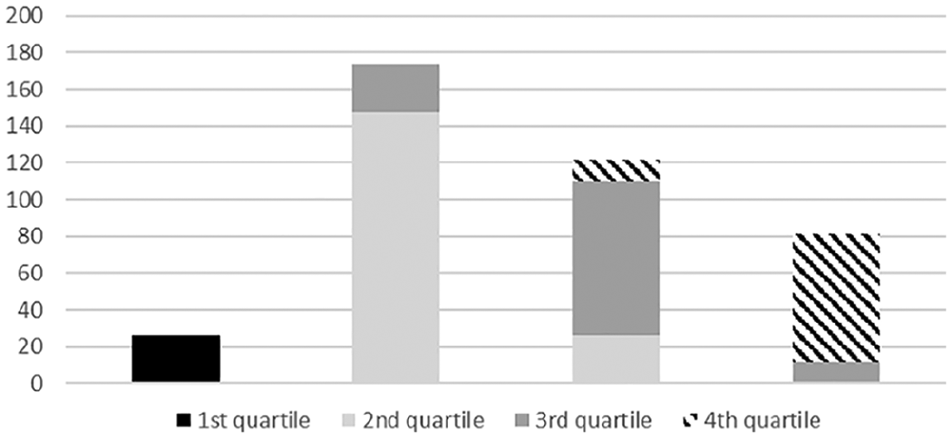
Distribution of binge learners.
Due to the high crossover between the second and third quartile bingers, we combined those as a “Middle” binge group. Overall, those who spaced had lower clumpiness and higher grades than those who binged. Consistent with Hypothesis 2a, the Front-bingers were more like the Spacers (not significantly different) in terms of clumpiness. At the same time, the other two groups were significantly more clumpy than both Spacers and Front-bingers, providing evidence for Hypothesis 2b. The number of sessions in which students participated could not explain these results, as it was the Middle-bingers that had the most activity overall. See Table 1 for the group means and the statistics.
Study 1: Mean Outcomes.
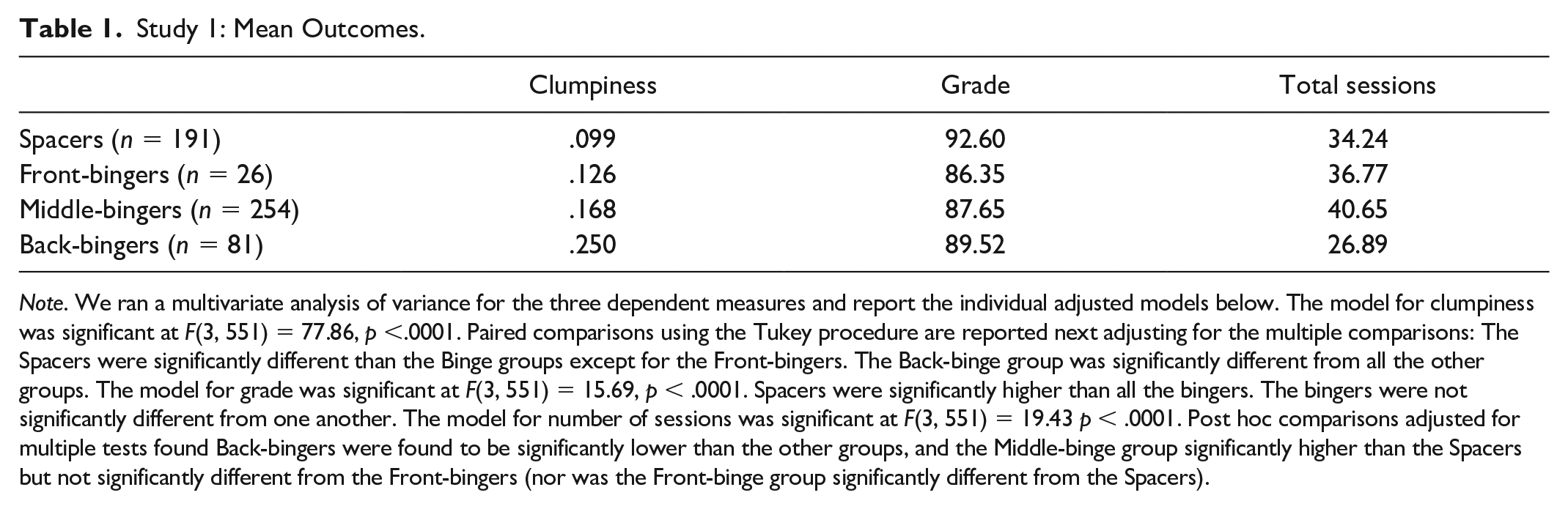
Note. We ran a multivariate analysis of variance for the three dependent measures and report the individual adjusted models below. The model for clumpiness was significant at F(3, 551) = 77.86, p <.0001. Paired comparisons using the Tukey procedure are reported next adjusting for the multiple comparisons: The Spacers were significantly different than the Binge groups except for the Front-bingers. The Back-binge group was significantly different from all the other groups. The model for grade was significant at F(3, 551) = 15.69, p < .0001. Spacers were significantly higher than all the bingers. The bingers were not significantly different from one another. The model for number of sessions was significant at F(3, 551) = 19.43 p < .0001. Post hoc comparisons adjusted for multiple tests found Back-bingers were found to be significantly lower than the other groups, and the Middle-binge group significantly higher than the Spacers but not significantly different from the Front-bingers (nor was the Front-binge group significantly different from the Spacers).
Differences Between Courses
Because there were differences in the type of material covered in the courses, we were interested in seeing if there would be a difference in measures of clumpiness, and this was found to be the case, F(2, 586) = 49.81 p < .0001; post hoc tests at Tukey (p = .05) finding all groups significantly different from each other. The Data Analytics class was the most clumpy = .18, Hotel Asset Management the least = .097, and Microeconomics was in the middle = .158. However, the length of the Hotel Asset Management and Microeconomics classes had slightly longer semesters, so it is important to consider additional measures.
We found more Spacers in the Hotel Asset Management class, 70.47%, compared with 24.4% in Microeconomics, and 17.0% in Data Analytics, significantly different at χ2 2, (N = 587) = 133.35, p < .0001. There were more Bingers in the Data Analytics class, 74.5%, than the Hotel Asset Management class, 27.7%, and the Microeconomics class, 71.2%, . χ2 2, (N = 587) = 99.00, p < .0001. In both cases, the Hotel Asset Management class differed from the more quantitative Microeconomics and Data Analytics classes (and those quantitative classes did not differ significantly from one another).
The Data Analytics and Microeconomics classes were more difficult, with both having on average lower overall grades than the Hotel Asset Management class: Microeconomics = 88.8, Data Analytics = 87.1, Hotel Asset Management = 94.3. These grades were significantly different, F(2, 584) = 40.92, p < .0001, with post hoc comparisons using Tukey (p = .05) finding the Hotel Asset Management class grades to be significantly higher than the other two classes (and those classes not significantly different from one another).
Individual Differences
Indeed, 149 students took both the Microeconomics and Data Analytics classes. The students’ clumpiness was significantly correlated between classes at r = .624 (significant at p = .01); the grade was also correlated r = .215 (significant at p = .01).
However, 93 or 62% of the students exhibited the same type of behavior in both classes: 83% binged in both classes, 17% spaced in both classes. If one were a binger in one class, that was significantly related to bingeing in the other class, r = .193 (significant at p = .05). If one were a Spacer in one class, that was significantly related to spacing in the other class, r = .257 (significant at p =.01). If one were a Back-binger in one class, that was significantly likely to Back-binge in the other class, r = .215 (significant at p = .01). If one were Front-binger in one class, they were likely to be one in the other class, r = .215 (significant at p = .02). These findings suggest there is some individual consistency as to the type of learning activity one demonstrates as they study online. 3
Follow-Up Survey
While the clickstream analysis and the grade analysis demonstrate how a student’s organization of time impacts them in the short term, we were interested in what happens to these online students over time. Would the bingers rate their experience higher because they experienced learning on their own schedule? Or would those who had spaced their learning be more appreciative and supportive of their online learning experience?
We received permission from the online e-educator to send emails to the students who enlisted in the online classes. We sent an email introduction and survey link to the students over three successive waves beginning in February 2019; the first wave yielded 34 participants; the second wave an additional 31; and the third wave another 14, resulting in 75 completed surveys. However, 534 emails were sent, and 12 emails bounced back, resulting in a 14% response rate. Given that students had taken the online class between 2 to 4 years earlier, we were satisfied with the sample. There was no significant difference between those who reported on the survey in terms of clumpiness in their previous online activity, t(586) = 1.85 p = .07, MSurvey = .136, MNo = .156.
Survey Measures
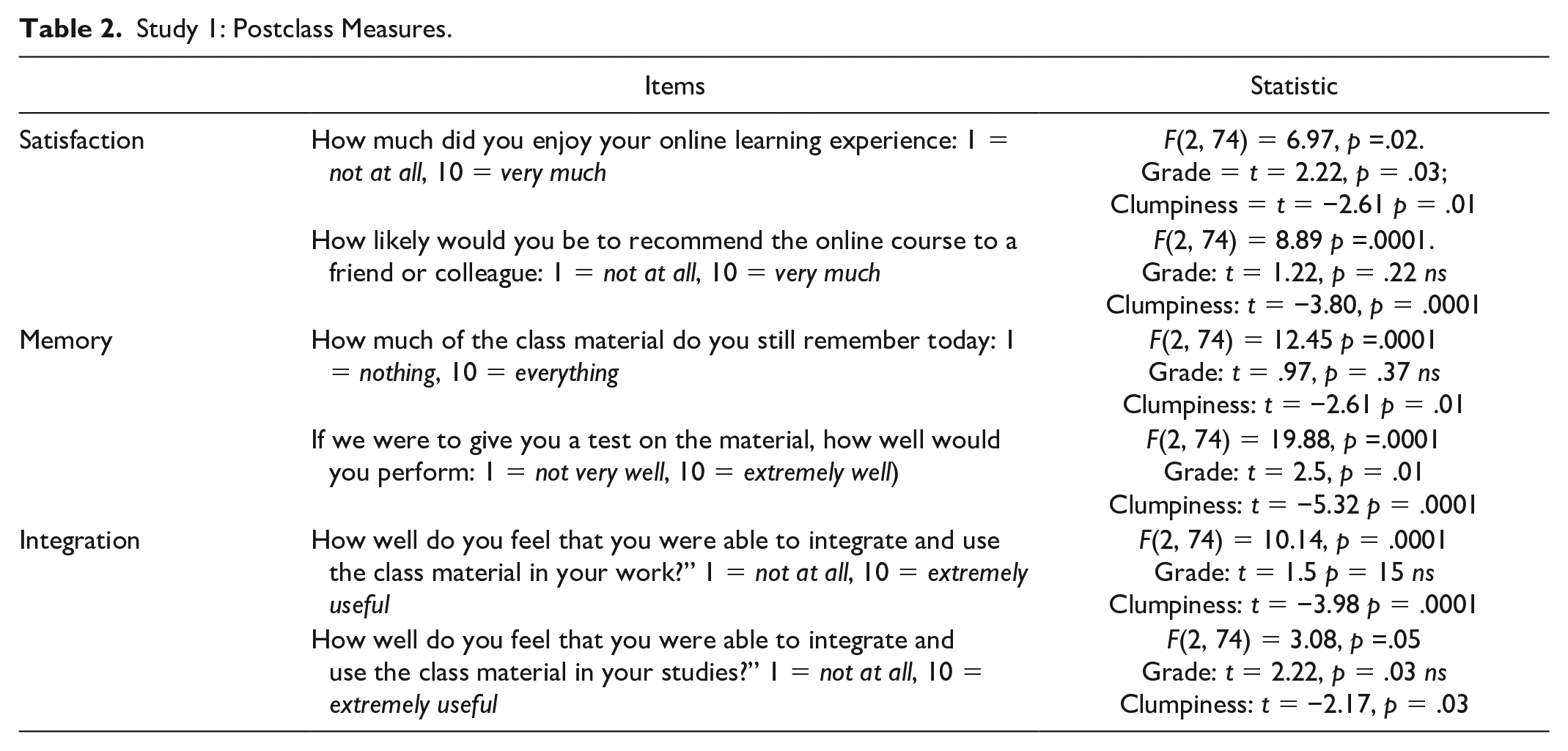
The online survey was developed to assess how the students felt about their online educational experience after time had passed. Each student received an email specific to the class they had enrolled in (such as Hotel Asset Management) and were instructed to answer the survey based on the experience in that online class. Our survey consisted of measures to assess satisfaction, memory, and integration of course material, see Table 2. We also included some open-ended questions at the end of the survey about online learning and binge behavior.
Study 1: Postclass Measures.
Assessing Long-Term Impact
We were able to link the students’ survey responses to their original clickstream data. Our specific interest was whether their clumpiness (or lack of spacing) influenced their long-term satisfaction with the online course, their memory of the course material, and how much they felt they integrated the material into their work/lives. We also included their course grade in the analysis.
Regressions were run with Grade and Clumpiness as independent variables and the Satisfaction, Memory, and Integration Items as dependent variables (see Table 2). Clumpiness was significant and negatively related to Satisfaction, Memory, and Integration measures. The satisfaction and recommendation measures are typical in online education. Our finding is consistent with the limited research on television binge behavior, where there was less liking of the material over time when binged, Hypothesis 3. For the memory measures, this result is also consistent with findings of binge television viewing where memory fades more quickly if information had been binged, Hypothesis 2b. For the integration of material, those who spaced found more ways to integrate and use the material in their work and lives.
The survey’s open-ended responses were quite revealing about how students felt about time organization in online learning. One participant wrote, Bingeing is effective when retention is not important. You can binge a show and forget it instantly, fall asleep during the show, and so on. Classes require attention and retention. Bingeing a class to pass a test is a surefire way to make online education specifically about passing tests and not at all about actually learning.
Discussion
We found that students binged their online classes during all quartiles of the semester, not just at the last minute, as observed in the traditional classroom settings that have focused on procrastination. Back-bingers are procrastinators (similar to what has been studied before). This Front-binge behavior has not been observed previously in online education. Still their more positive outcome behavior is consistent with research in the traditional classroom setting, where it has been found that setting expectations early to encourage engagement in the class material to be important (Appleton-Knapp & Krentler, 2006).
Front-bingers had significantly lower clumpiness scores than the Back-bingers, making them more similar to the clumpiness of Spacers, consistent with Hypothesis 2a. We found the timing of binge behavior might not necessarily hurt grades in the short-term. However, since the Front-bingers are actively involved in the class from the onset, they likely benefit from the repeated references of the course material throughout the semester (while Back-bingers only learn the material immediately before the last exam with no opportunity to refresh learning).
Admittedly, the long interval between the online class and our postsurvey captured students’ overall gist of their experience rather than more specific details. Gist and attitude are highly correlated and influence decision making (Brainerd & Reyna, 2005), so having such a delay is not necessarily a detriment when probing overall feelings about an experience. In our follow-up survey, we found that our measure of binge learning, clumpiness, was associated with lower satisfaction, less retention of the course material, and a reduced likelihood for students to see the material’s usefulness for their work/lives. The sample was too small to segment out the different types of bingers in the survey. The survey did yield some insights into how students view binge learning and aspects that online educators might consider when assessing their online classroom behavior.
As found in the procrastination literature, it appears bingeing (or spacing) can be viewed as a trait: if one binges in one class, he or she is likely to binge in another (Steele, 2007). Additionally, we found some course material was more likely to lead to binge behavior: the more difficult and quantitative courses led to greater bingeing and clumpy behavior. Researchers have found that students are more likely to delay and put-off material they view as difficult which then leads to procrastination and lower grades (Kljajic & Gaudreau, 2018). The opportunity to self-regulate online may lead to Back-bingeing in especially difficult classes.
The e-provider explained that students have had great difficulty in the more binged classes, particularly Data Analytics. As the class is required for the online degree and a prerequisite for other classes, the e-provider decided to reduce the class length and make it complete/noncomplete rather than a numeric grade in subsequent years. The essential material from the semester-length class was included in the shorter semester class, which we cover in Study 2.
Study 2: Modulated Online Class
One method online educators have adopted to reduce attrition is to offer shorter, more concentrated sessions. Might these modulated learning sessions help reduce the potential negative consequences of binge behavior? Or does the binge behavior exist regardless of the boundaries set by the educators? What insights does the much-used net promoter survey offer about the binge versus spaced online learning experience?
Data Summary
The e-provider used in Study 1 began employing postclass net promoter surveys in 2018 as well as converting many of its semester-long classes to shorter for-credit classes. The data used in this study covers Fall 2018 and Spring 2019. Eight introductory Data Analytics classes covered roughly the same material as the Data Analytics classes covered in Study 1, but in a much shorter, 2-week session. Ninety-nine students were included in the analysis (12 had fewer than four sessions of activity). A clumpiness measure was computed for each student.
A quartile would be 3.5 days, and for analysis purposes, we had to select a full day for our partition analysis, and we selected 3 rather than 4 days to err on the conservative side (and be closer to the 36-hour mark studied at HBX). In Study 2, we define Back-bingers as those who consume more than 40% of the content in the last three days, and Front-bingers as those who consume more than 40% of the course within the first three days, and Spacers who consumed no more than 40% and no less than 10% in each period.
Results
Overall in Study 2, we had 36 Spacers, 28 Back-bingers, and 18 Front-bingers. As in Study 1, the Spacers had the lowest clumpiness MSpacer = .061, with the Front-bingers higher at MFront = .114 and the Back-bingers highest at MBack = .162, significantly different at F(2, 81) = 12.54 p < .0001. Only the Spacers and Back-bingers were significantly different in post hoc tests using the Tukey procedure.
Because the course was based on completion rather than a grade, one might comment that the high percentage of Back-bingers completing shows that this type of strategy can work. On the other hand, the postcourse evaluations might show that these different types of students had different opinions about the course.
Postclass Results
The provider sent students an email survey 2 weeks after completion of the class. Fifty-four students completed this survey, resulting in a 54% response rate. There was no difference in clumpiness between those who completed and did not complete the survey, MComplete= .111 versus MNotComplete =.108 t(107) = .97 p = .18.
As in Study 1, there was a negative correlation between clumpiness and postclass evaluation, r = −.398 (significant at p = .01). Of those who completed the survey, 19 were Back-bingers, 9 were Front-bingers, and 19 were Spacers. We found that the Front-bingers had the most positive evaluations of the course (M = 8.77), followed by the Spacers (M = 8.52), and then Back-bingers (M = 7.12). Only the Front-binge and Back-binge groups were significantly different from each other, F(2, 44) = 5.21 p = .0095.
The provider classified students as “Promoter,” “Passive,” or “Detractor” based on students’ feedback on the provider’s proprietary measures. “Promoters” rated the class on the high end of the scale and were thought to be loyal and enthusiastic customers; “Passives” rated their experience on the middle of the scale, and while satisfied, they were less enthusiastic than Promoters; “Detractors” are those who rated their experience at the very low end of the scale and did not like their experience at all.
Indeed, 11% of Front-bingers, 23.5% of Back-bingers, and 11% of Spacers were Detractors. However, 52% of Spacers, 77% of Front-bingers, and 36% of Back-bingers were Promoters. There was no significant difference between Spacers and Front-bingers in terms of number of Promoters or Detractors; χ2(n = 28) = 0.0022, p = .96 for Detractors; χ2 = (n = 28) = 1.62 p = .20 for Promoters. Comparing Front- and Back-bingers, they were significantly different on Promoter status, χ2(n = 26) = 4.25, p =.03; but not significantly different on Detractor status, χ2(n = 26) = .58, p = .44.
Comparison Between Studies
In Study 2, we had 36 Spacers, 28 Back-bingers, and 18 Front-bingers in the Data Analytics class; in Study 1 in the Data Analytics classes, 49 Spacers, 53 Back, and 3 Front-bingers. In Study 2, there were significantly more Front-bingers, 18.18% versus 1.06%, significantly different at χ2(n = 383) = 41.54 p < .0001; more Spacers, 36.36% versus 17.25%, significantly different at χ2(n = 383) = 15.52 p < .0001; and more Back-bingers, 28.28% versus 18.66%, significantly different at χ2(n = 383) = 4.07 p =. 04. How is it possible that reducing the length resulted in both more Spacers, Front-bingers, and Back-bingers than in Study 1? Recall in Study 1, many students binged in the middle (n = 155 or 59%), so it appears that reducing the course length primarily resulted in fewer students that might have opted for that strategy.
Discussion
The shorter semester did not reduce binge behavior. Instead, those who may have binged in the middle of the longer semester adjusted their activity either in the front- or the back-end of class. While both types of bingers completed the class successfully, over time, the Front-bingers and Spacers were more positive than Back-bingers about their experience, supporting Hypothesis 3.
General Discussion
Netflix and other online entertainment providers made binge-watching an everyday household activity. It is not surprising then that “binge-learning” has captured the interest of the highly competitive online education market seeking to garner more consumer interest and engagement. Kahn Academy, Coursera, and Aquent Gymnasium have started to explore the online binge learning potential with their e-learning platforms (Thompson, 2014). Netflix CEO, Reed Hastings, has indicated that he would like his company to enter the online education space (Garling, 2014). During the pandemic, Netflix partnered with the BBC on releasing documentaries and offering educational material free to students and teachers (Forster, 2020). Google has been more intentional in disrupting higher education by offering online education, training and internship opportunities for students in areas such as the Data Analytics courses covered in our studies (Bariso, 2020).
The flexibility of self-guided learning, pacing at one’s schedule, is the main benefit touted by online education providers. However, the industry might not be aware of how this flexibility impacts long-term learning and satisfaction. Our interest was whether this self-directed learning environment would produce similar harmful binge behavior observed with online TV, where memory and satisfaction with their experience decreased over time. We found that students do binge their online learning, and this behavior was not favorable for long-term learning and satisfaction.
Our research has implications for online education, particularly in terms of how online material is scheduled over a semester. We discuss how marketing educators should consider these results in terms of how they design their individual classes, as well as more broadly how they design the flow and access of course material across a marketing student’s education. Additionally, our research has implications for when course evaluations are administered. We also discuss the limitations of our research and future areas for investigation.
The Asynchronous Versus Synchronous Versus Traditional Classroom
While in the past, there was a clear divide between asynchronous and synchronous learning and online and in-classroom learning, the COVID-19 pandemic led to their necessary blending. Some instructors initially chose to continue to teach online in a synchronous manner, but due to time-zone differences for international students, many have opted to supplement with asynchronous material. Instructors therefore need to consider how best to deliver material for their students regardless of the modality.
Time management became even more critical to both faculty and students during the pandemic. Some students reported sticking to a schedule helped them stay abreast of their online classes, but the unstructured environment has made it more difficult for them to navigate (Carlson, 2020). Faculty can assist by providing students some structure so that they can benefit from spaced versus binged learning. For instance, researchers have looked at making an assignment due each day (Dawar & Murphy, 2020), and some have looked at having students schedule their online lectures (Baker et al., 2019). Other researchers have begun using data analytics to identify potential procrastinators so that they can intervene early (Abidi et al., 2020). Our research suggests that encouraging early access and use of the online material, even if binged, can result in greater learning and satisfaction.
The participants from the follow-up survey in Study 1 shared the sentiment faced by students during the pandemic, one noting, “I had a harder time staying focused without a formal classroom environment around me, so it was too easy to lose focus and become disinterested.” But there were also positive aspects of the online environment compared with the traditional classroom. As noted by another student: “I really enjoyed the fact that you can watch a particular class more than once, pause, go back. It helps a lot.” Another participant noted that the online education provider could use the clickstream data to better manage the student experience: Streaming giants such as Netflix rely on interpreting the usage of their platform. If you can interpret the behavior of students for online classes, you can enhance their learning. that is, in Lecture 5, at 05:20 minutes, 30% of students stopped the video to rewind. This could mean that something in the lecture is confusing or should be addressed in the classroom.
The e-provider we worked with has begun using its clickstream data to identify students with time management issues and content that might lead to students’ becoming bored.
Implications for Course Design
Because students are not aware of methods that best result in long-term retention of material (Vesonder & Voss, 1985), it is up to the marketing instructor to educate students about successful time management. There is some evidence that educating students regarding the detriments of bingeing can change behavior. Balch (2006) conducted a spacing/mass learning experiment where his students experienced a spacing effect firsthand. He conducted a pre/post comparison of his students’ self-reported studying behavior and found a slightly lower likelihood of cramming after that demonstration. It is suggested that marketing educators inform students about the benefits of spacing their studies at the start of the semester, perhaps through a demonstration similar to the above, or just citing research regarding the benefits of spacing.
It might be naïve to believe that students will adjust their learning behavior because the online education industry informs them that spacing leads to better retention. Our culture has become a binge society, and one of the reasons for the demand for online education has been the control of scheduling. Due to the benefits of Front-bingeing, marketing educators should make their material accessible online at the start of the semester. Having short quizzes distributed throughout the semester can keep the student on track with their learning. Additionally, adding a refresher of the material before the next session can strengthen the earlier learned material. Knowing that students might be more likely to delay or binge more difficult analytic material, instructors can break that material into smaller segments with deadlines where feedback is offered.
Marketing educators can also create online classes that are more difficult to binge. Netflix has begun researching ways to interrupt bingers by adding elements that make the consumers pause and get out of their flow state. Online classes could limit the number of sessions a student participates in at the same time or present a block between sessions that makes the student aware of their behavior. Another consideration might be to increase the number of partitions to the online learning material, which could slow down student consumption (Cheema & Soman, 2008).
Implications for Marketing Curricula Design and Evaluation
There are ways that marketing educators can design their offerings to create more effective learners. First, because of the benefits of Front-bingeing on deep learning, educators ought to have the class begin when the student is ready/and has time. Many courses contain the material already produced; the only component that might need to be adjusted would be student interactions and engagement on Class Q&A boards and Live Session chats.
Our results also suggest that educators consider class offerings more holistically such as changing the sequence of courses to establish less back-bingeing behavior. We found that quantitative courses resulted in greater bingeing behavior. Additionally, if a student were to binge in one course, this was positively correlated to bingeing in other courses. Therefore, instituting measures to reduce initial binge behavior could lead to less overall bingeing. In a Marketing specialization, this could mean scheduling courses with greater quantitative content later on in a student’s course of studies—such as Statistics and Marketing Research. This is especially important because online programs tend to experience enrollment of older students who have been out of the higher education system for several years. These students must now relearn effective study habits. At the University of Illinois, the average age of students in its four online iMBA cohorts is 37 years. In fact, students over 40 make up an average of 35% across these cohorts (MacArthur, 2017). Appropriate scheduling of courses could help these students develop study habits that could enhance their chances of success.
Another consideration might be for the educator to provide access to the material once the class has ended. This would provide the opportunity for students to refresh their memory and skills so that the material is retained long after the class has ended. Many classes build on prior class material, and because learning can diminish over time, having such mechanisms to help students retain information would be useful. In the clickstream data, we found that some students had revisited the class many months after the class had ended, so making that a more formal part of the educational experience could be a potential selling point. This would be especially beneficial to the many Back-bingers, so they have the opportunity to retard forgetting by refreshing their memory (Conway et al., 1992). Research finds that students who attain moderate or advanced learning levels show high levels of retention with very little forgetting, whereas students who attain only lower levels of learning show steady forgetting. These long-lasting effects of education may be related to the types of learning schedules followed during acquisition, where spaced learning results in the creation of stronger memory schemas.
Another implication of our work relates to how and when educators have students evaluate their online experience. The e-provider we worked with began implementing a one-item net promoter score the year after the classes in Study 1 ended. We reported the results of the net promoter scores in Study 2. Like many in other fields, the net promoter was requested immediately after the online class experience had ended. We suggest that students be contacted immediately after their class and over time, as students apply and integrate their material into their work/other studies and see the value of their online education. This later measure of enhanced retrospective satisfaction could lead to positive referrals and more generous alumni giving to the institution.
Limitations and Future Research
In Studies 1 and 2, we had access to students’ online behavior only, and there could have been offline studying occurring. In an ideal world, we would have liked to have measured the actual memory of the course material in the postsurvey rather than have self-report measures. However, we were limited by the number of questions we were able to ask. Researchers might consider comparing online classes where students are in full control of their schedule to ones where the instructor sets the schedule. Additionally, researchers might study whether adult learners are more/less likely to binge than traditional college-aged students.
Future research might consider what types of online content create the most or least binge behavior. As edutainment infiltrates online education, one might expect that courses/programs to be rated on their binge worthiness, so investigating how that influences student learning should be addressed. See Figure 2 showing this this is already occurring. Because of the many distractions involved in learning online, research might address how best to focus student attention to enhance the learning experience.
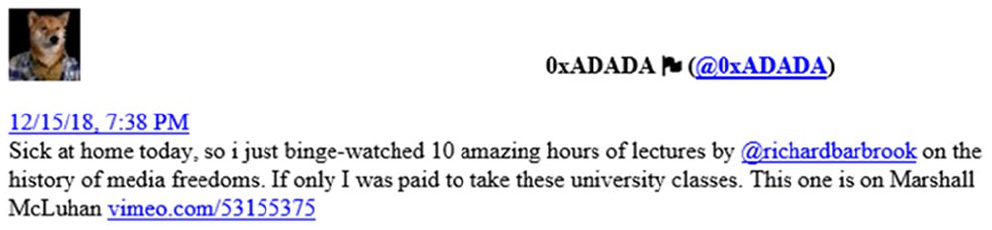
Student tweet about bingeing education.
Footnotes
Acknowledgements
They would like to thank the team at e-Cornell for their insights and access to data.
Declaration of Conflicting Interests
The author(s) declared no potential conflicts of interest with respect to the research, authorship, and/or publication of this article.
Funding
The author(s) received no financial support for the research, authorship, and/or publication of this article.
