




Abstract
Using data on the adoption of e-government, reinventing government, and strategic practices, and the Nelson and Svara (2010) typology of municipal government form, the authors investigate the characteristics of municipal governments that are related to the implementation of innovative practices. The authors find that higher innovation rates are associated with council-manager governments—both with and without an elected mayor, higher population, greater growth, lower unemployment, sunbelt location, and higher population density. Controlling for all other variables, form of government (and variations within form) account for the greatest explanation of the adoption of innovative practices in municipalities. The authors conclude that form of government remains an important variable to consider when investigating local government management and performance.
Keywords
The United States is unique among Western countries in the widespread use of two major forms of government based on different constitutional principles (Svara & Watson, 2010 form of government, innovation). There is implicit competition between the forms and citizens and leaders of municipalities frequently question whether their form of government is best or how it might be improved, and periods of economic decline may spur the debate. 1 Although there is a great deal of anecdotal support for one form over another, the research findings on governmental performance and structure are inconsistent. In addition, the findings are incomplete. Although cities make adjustments within their form such as electing the mayor in a council-manager city or adding a chief administrative officer (CAO) to the mayor-council form, no studies examine what differences these changes make in performance. Complicating matters further is a lack of agreement on how to classify municipal forms of government or how adjustments affect how a city is classified.
The council-manager and mayor-council forms of government are the two most common municipal forms in the United States. While there are a number of structural elements that are associated with each model, the primary feature that distinguishes one from the other is the separation or unification of legislative and executive authority. Mayor-council governments assign legislative authority to the council and executive authority to the mayor, creating a separation of powers similar to the federal government. In the council-manager form, the council and mayor (as a member of council) hold both executive and legislative authority and the council delegates executive authority to an appointed manager who is responsible to the council as a whole. The council-manager form was part of a larger “reform model” that included at-large and nonpartisan elections for members of council and selection of mayor by the council in contrast to the traditional model of mayor-council form that included district and partisan elections, and direct election of the mayor.
Some scholars have concluded that there has been a merger, “adaptation” or “hybridization” of forms at the local level (Carr & Karuppusamy, 2008; Ehrenhalt, 2006; Frederickson, Johnson, & Wood, 2004) even though the structural characteristics used to support this conclusion go beyond those that determine form, for example, using an election feature that does not match the model. 2 While municipal governments have mixed elements of the standard reform and traditional models, it is not clear whether there is a mixture of the essential features of the forms themselves. These studies could lead to the inference that forms of government are indistinguishable and that form is not an important consideration when investigating local government performance. 3
We disagree with these points. In an earlier article, we devised a new typology of municipal form that distinguishes between the major forms and identifies three variations within the council-manager form and four variations within the mayor-council form (Nelson & Svara, 2010). This seven-category form of government variable is the primary measure of form of government in this research, and it will be compared with other measures of form used in previous research. The aspect of governmental performance that is examined is the extent to which innovations are adopted by the local government.
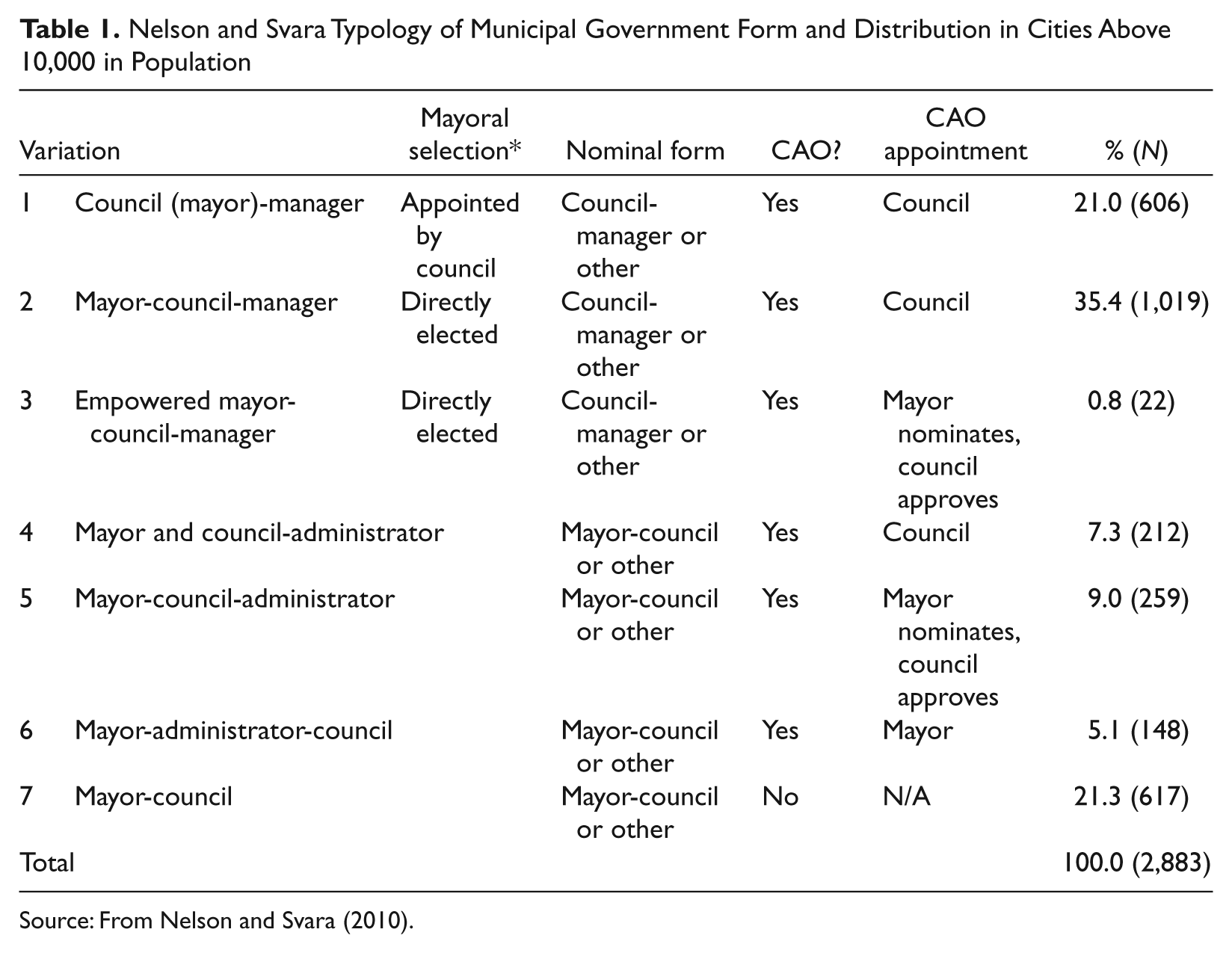
The new typology distinguishes local government form by a few, easily determined features—stated form, method of selection for the mayor, presence or absence of a chief administrative officer, and identification of the official(s) who appoints the CAO, when present (see Table 1). The classification reflects the increasing extent to which the mayor is distinguished from the council and the decreasing status and independence of the CAO in determining methods and scope of responsibilities.
Nelson and Svara Typology of Municipal Government Form and Distribution in Cities Above 10,000 in Population
Source: From Nelson and Svara (2010).
The central question in this research is what affect does form of government in its various manifestations have on innovation? Previous studies have provided only partial answers, and ones that are difficult to match with actual characteristics of form used in cities. Moon and deLeon (2001) and Damanpour and Schneider (2009) use form of government in their analysis of reinventing government adoptions. Moon and deLeon (2001) found that a council-manager municipality was more likely to promote reinvention practices than was a mayor-council municipality. Damanpour and Schneider (2009), who included form of government as a control variable only, presumably measured as a dichotomous variable although they labeled it mayor/no mayor. 4 They found that the mayor variable was significantly negatively related to innovation in all of their models. West and Berman (1997) using a three-part category—council-manager, mayor-council, or other—found that form of government was not significantly related to the use of productivity improvement strategies. Krebs and Pelissero (2010) find that the “stronger” the mayor, the lower the likelihood of innovation, but their approach to measuring structure makes it difficult to interpret which form of government is associated with mayoral power except at the extreme values of their index. In a study on the introduction of e-government that measures form as a binary variable indicating whether the municipal government is mayor−council or council−manager, Moon and Norris (2005) found no relationship between form of government and e-government provisions. Thus, four previous studies have used a dichotomous variable with two finding a relationship between form and innovation, and one has used a continuous variable that does not necessarily identify what form is present in the city. For this study, we used the seven-category typology of municipal form and a set of control variables drawn from the literature on innovation to assess the factors that influence the adoption of a wide range of innovative management practices.
Form of Government
Municipal governments in the United States can generally be placed in one of four broad categories, namely, council-manager, mayor-council, commission, or town meeting forms. However, the two most widely used forms are the council-manager and mayor-council types. The council-manager form, part of a reform model of structures developed in the early 20th century, is based on the concept of unified powers—all governmental authority rests in the hands of the city council that delegates executive to a city manager it selects. Mayor-council governments use a system similar to the U.S. federal system, with separation of executive (mayor) and legislative powers (council). The mayor-council form is part of a traditional model of structures, although the form itself has been revised in most cities to increase the power of the mayor’s office over the executive branch.
Researchers have investigated the different features within each of the two major forms to attempt to determine what affect these may have on management or fiscal performance (Coate & Knight, 2009; Feiock & Kim, 2001; Liebert, 1974; Lineberry & Fowler, 1967; MacDonald, 2008; Morgan & Pelissero, 1980; Nunn, 1996; Reschenthaler & Thompson, 1996). Studies have determined that form of government influences process and policy outcomes in municipal government. Lineberry and Fowler (1967) argue that council-manager governments appear “to minimize the impact of social cleavages on political decision-making” (p. 716). More than 30 years later, Svara (1999) made similar conclusions finding lower levels of conflict and higher levels of cooperation in council-manager governments rather than mayor-council governments.
Findings related to fiscal outcomes are mixed. Nunn (1996) found that council-manager cities have higher per-capita infrastructure spending, and Coate and Knight (2009) also found public spending was higher in council-manager governments. Liebert (1974) and Morgan and Pelissero (1980) found no difference in government form on spending. Carr and Karuppusamy (2010) came to the same conclusion using an expanded typology of form of government.
A weakness in earlier studies is that most using form of government as an independent variable have operationalized it as a simple dichotomy—Carr and Karuppusamy (2010) is an exception—even though there may be differences within each form that affect performance. To accurately measure government form and its impact on performance, these differences must be accounted for.
Classifications
Another research stream has attempted to identify a method for classifying local government form to incorporate some of those essential differences. Some examine more features of the governmental structure to distinguish between “strong” and “weak” mayors. DeSantis and Renner (2002) and MacManus and Bullock (2003) use measures of budget and appointment authority as well as self-identified form, presence of a chief administrative officer, and method for selecting the mayor. Because of missing data on the budgeting and appointment authority variables, both analyses left a significant number of cities unclassified. In the DeSantis and Renner typology, 22% of the mayor-council cities, and in the MacManus and Bullock article, 37% of council-manager cities and 58% of the mayor-council cities were not classified. A central problem with these approaches stems from the use of variables that are associated with a traditional model of government but are not characteristics of form of government such as mayoral veto power. As noted, the classification approaches of Frederickson et al. (2004) and Carr and Karuppusamy (2010) compare models of institutions and add variables that are not indicators of form.
The Seven-Category Typology of Form
In our seven-category form of government typology, we argue that there are a few essential characteristics of form that provide a clear basis for classifying cities by form and variation within form without encountering serious data collection problems (Nelson & Svara 2010). These characteristics also should make a difference when evaluating policy outcomes and management performance because they shape the nature of leadership and relationships within form and each variation. As shown in Table 1, the only variables used to distinguish form in the new typology were the self-identified form of government, method of mayoral selection, and authority for appointing the CAO or the absence of a CAO. Council-manager cities can be distinguished by whether the mayor is selected by the council or directly elected and whether the mayor has a distinct role in the manager’s selection. The council appoints the city manager, and the manager is responsible to the council as a whole in the council-manager form. These characteristics are present whether the manager nominates the manager to the council. In mayor-council cities, the mayor has at least some executive authority and variations are defined by whether the CAO is appointed by the council, by the mayor with approval of the council, or by the mayor alone. A mayor-council city without a CAO is the final variation. Only a small proportion of municipalities in the U.S. can be considered possible hybrids of the two major forms (variations 3 and 4 in their typology).
Across the seven variations, there are two features that covary—(a) the extent to which the mayor is distinguished from the council and (b) the professional status of the CAO based on the range of elected officials to which the CAO is accountable and the CAO’s autonomy in determining scope of responsibilities. With each variation in the scale, the mayor is more differentiated from the council and/or the city manager/CAO is subject to control that is more concentrated. Like Krebs and Pelissero (2009), the approach recognizes that the political leadership of the mayor expands, but it varies within a nonexecutive position in the council-manager form and within an executive position in the mayor-council form. These variations in turn shape the top administrator’s position. City managers are executives who interact with the council as a whole, the council and the elected mayor (who may have a separate agenda from the council), and the council and the mayor who singled out the manager in the selection process. 5 CAOs in mayor-council cities are not the executive, but they may work for the council as a whole, the council and mayor, or the mayor. In the final mayor-council variation, there is no CAO. Thus, the form with variations measure can be treated as an ordinal variable in analysis.
We reject the idea that it is necessary to include a large number of variables when classifying form of government. Although the election methods for council members, the mayor’s role on council, veto power, and other features may affect “the political and administrative characteristics of a city, they do not in themselves or in combination change the form of government” (Nelson & Svara 2010, p. 547).
The more complex multicategory classification schemes have not been tested to determine whether they help explain important governmental outputs. Although some earlier innovation studies considered form of government as an independent variable, it was either classified as a dichotomy—council-manager or other (Moon & deLeon, 2001) or mayor/no mayor (Damanpour & Schneider, 2009)—or a three-part category—council-manager, mayor-council, or other (West & Berman, 1997).
Accepting the merging of forms thesis, Krebs and Pelissero (2009) develop an index for the power of the mayor rather than examining form per se. Rather than classifying structures on the single dimension of mayoral power that depends on indicators that are difficult to measure accurately and interpret, 6 We use three characteristics that are more easily and reliably measured to evaluate the effect of form on the adoption of innovative management practices at the local level.
Innovation in Local Government
Early research on innovation in government identifies factors that contribute to higher levels of adoption. Bingham (1976) examined the adoption of technological innovations in local governments—housing authorities, school districts, libraries, and cities. He hypothesized that four categories of factors would influence innovation adoption—the community environment (socioeconomic characteristics), demand/need, the organizational environment (form of government, proximity to other innovation-adopting cities, resources), and organizational characteristics (organizational size, decision-making structure, civil service). In the city sample, Bingham found race, demand, population size, per capita revenues, and department size to be statistically significant indicators of technological innovation adoption.
At the state level, Berry and Berry (1990) studied state lottery adoptions using Mohr’s (1969) theory of organizational innovation. Mohr posits that the probability of an organization to innovate is directly related to its motivation to innovate, inversely related to the strength of innovation obstacles, and directly related to the level of resources available to overcome these obstacles. Berry and Berry’s findings are consistent with Mohr’s theory and confirm their hypothesis.
There have been a number of recent studies that explored the factors that influence adoption of innovations in local government (Boyne, Gould-Williams, Law, & Walker, 2005; Damanpour & Schneider, 2009; Gabris, Golembiewski, & Ihrke, 2001; Kearney, Feldman, & Scavo, 2000; Krebs & Pelissero, 2010; Kwon, Berry, & Feiock, 2009; Walker, 2008; West & Berman, 1997). The studies vary according to the operationalization of innovation and the factors tested as contributors to the adoption of innovation. Surveys used to measure innovation in these studies rarely use the term innovation. Instead, the surveys use the adoption of best-practices types of policies, programs, and practices as the indicator of innovation. This is consistent with the definition of innovation as practices that are new to the situation in which they are applied.
West and Berman (1997) asked survey respondents to report how often they had engaged in a set of strategies labeled by the authors as productivity improvements in the 2 months preceding the survey. They hypothesized that administrative creativity, defined as “group processes through which new ideas are generated and accepted by organizations” (p. 456), would predict the adoption of these innovative activities. The authors created a set of four constructs that they believed were necessary to generate administrative creativity—knowledge generation, consensus building, planning for success, and implementation activities. Using linear regression, West and Berman conclude that productivity improvement is positively associated with administrative creativity, revitalized organizational cultures, and city size.
Strategies related to the concept of reinventing government have often been used to indicate innovative practices. Reinventing government is a public sector reform movement based on Osborne and Gaebler’s (1992) book by the same name. Osborne and Gaebler argue that it is possible for government leaders to transform the way they operate by instilling a customer-focused, results-oriented perspective.
At least six innovation studies based their analysis of findings, at least in part, from the 1998 International City/County Management Association’s (ICMA) reinventing government survey (Damanpour & Schneider, 2006, 2009; Kearney et al., 2000; Krebs & Pelissero, 2009; Moon & deLeon, 2001; Rivera, Streib, & Willoughby, 2000). Although the studies used the same data set, the selection of variables to operationalize reinvention (the focus of innovation) varied. The scholars also differed in their choices of independent and control variables, though there was some overlap.
Kearney et al. (2000) determined that city managers’ willingness to recommend the adoption of reinventing government strategies differed according to the characteristics of the manager and a number of environmental variables. Tenure in the position and the manager’s attitudes about reinventing government influenced the propensity for the manager to recommend the council adopt reinventing government activities. ICMA membership is also related although the effect of form of government is not examined. Environmental factors that influenced whether the manager recommended action included the region (sunbelt or frostbelt) and the number of full-time employees per 10,000 population. They found no relationship between adoption and population, per capita income, population change, manager’s education level, the taxable value of land in the community, urbanization, or the percentage of workforce unionized. In a follow-up study based on a 2003 survey, Kearney (2005) obtained similar results.
Using the same data set but different methods, Moon and deLeon (2001) sought to determine which factors affect the adoption of reinventing government techniques. Whereas Kearney et al. (2000) studied the manager’s propensity to recommend adoption of reinvention techniques to council during the budget process, Moon and deLeon extended their analysis by studying both the factors that relate to the intention (operationalized by whether there was a budget recommendation to council) and implementation of those techniques. They found that a manager’s reinvention values, a municipality’s population and economic condition, and the use of the council-manager form of government were related to the adoption of innovative practices.
Damanpour and Schneider (2006) distinguish between environmental (urbanization, community wealth, population growth, unemployment rate, complexity), organizational (size, economic health, unions, external communication), managerial background (age, gender, education, tenure in position, tenure in management), and managerial values (favoring competition, entrepreneurial) as determinants that affect the extent of innovation. The factors related to innovation are environmental factors (urbanization, community wealth, population growth, unemployment rate, complexity); organizational (size); economic health; the absence of unions; and the extent of external communications. In addition, certain manager characteristics are associated with higher adoption rates: managerial tenure, managerial background (age, gender, education), and positive values regarding reinventing government.
Damanpour and Schneider (2009) merged the reinventing government data and a data set on alternative service delivery from a survey in 1997 to develop an innovation adoption index. Their study was primarily concerned with the effect of the complexity and cost of innovations on their adoption. Unlike earlier studies, they also considered the indirect effects of the control variables. Damanpour and Schneider determined that organization size, respondent’s perception of economic health of the community, and urbanization were significantly related to adoption of innovative practices.
Studying strategic economic development policy adoption, Kwon et al. (2009) determined that form of government was related to the early adoption of several economic development strategies. Specifically, the authors found that cities with the council-manager form were more likely in 1999 to have adopted these techniques whereas mayor-council cities were more likely than council-manager cities to be late adopters or nonadopters based on survey responses from 2004.
Krebs and Pelissero (2010) found that mayoral power was negatively related to the reinventing government proposals by the top administrator. They did not use form of government as a variable; in its place, they created an index of mayoral power that included veto power, whether the mayor was directly elected, budgetary preparation authority, power to appoint department heads, and whether the mayor’s position was full-time. The authors tested three models; in all cases, mayoral power was negatively related to managers’ reinventing government proposals. Krebs and Pelissero also found that two environmental characteristics influenced reinventing government proposals—higher population and nonpartisan elections were both linked to higher numbers of proposals.
Another set of studies of local governments and innovation examines local authorities in the United Kingdom (Boyne et al., 2005; Walker, 2008). Though not directly comparable to American municipal governments, these studies are valuable due to the wide range of variables tested to determine their relationships with adoption of innovation. The scholars found that population (Walker, 2008); diversity (Walker, 2008); deprivation—an index of income, employment, and health (Walker, 2008); urbanization (Boyne et al., 2005); implementation approach (Boyne et al., 2005); and population density (Boyne et al., 2005) were related to adoption of innovations. In addition, Walker (2006) found that other external factors such as public pressure, government or service provider competition, and coercion from auditors and inspectors promoted higher adoptions.
Our study seeks to improve on the findings from earlier studies by expanding the measurement of innovation, considering different variables, and providing an expanded indicator of form of government. Using Bingham’s theory as our baseline combined with findings from other research, we consider the influence of both environmental and organizational characteristics on the adoption of innovation. As Bingham operationalized demand differently for each innovation, we cannot use that measure in our analysis. However, environmental characteristics such as unemployment and education level encompass the concept of community need, so we will include those as a proxy for demand.
Our research is distinct from earlier work for a number of reasons. First, we use a richer set of data to operationalize innovative practices. In place of a single data set that gathers information on a single type of innovative practice, we used three separate data sets to encompass a broader range of innovative ideas. We include reinventing government—the most studied area of innovation—along with innovations related to e-government and strategic practices. Second, we use measures of government form that are more detailed than those used before along with significant variables identified in earlier studies to build a new model of innovation adoption. A new classification of form of government makes it possible to give greater attention to the impact of government form and variations within form as a variable in the adoption of innovative practices.
Method
Data Collection
Four data sets were combined for this research. 7 Three nationwide surveys of U.S. municipalities conducted by the International City/County Management Association (ICMA) contained the data on innovative practices in three areas: reinventing government (2003), electronic government (2004), and professional practices (2006). The fourth data set, created by the authors, includes variables on the form and structure of municipal governments for all U.S. municipalities with populations of at least 10,000 according to the 2000 census. To be included in the analysis, the municipality needed to respond to each of the surveys. Since the respondents for each data set are not identical, the number of municipalities in the merged data set is 490.
Variables
The combined data set was used to generate separate 10-item indices for reinventing government, e-government, and strategic practices innovations. The items included in each index are listed in the appendix. Reinventing government has been used a number of times in earlier studies to evaluate innovation (Damanpour & Schneider, 2009; Moon & deLeon, 2001). Moon and Norris (2005) used both reinventing government and e-government variables as indicators of innovation. As with reinventing government and e-government policies, implementation of strategic practices demonstrates effort by administration to improve organizational performance. Although these surveys emphasize management practices, there are a number of practices with more political content. These practices include changes in the political process (citizen engagement), policy framework (creating a strategic plan for the city), incorporation of citizen views (citizen surveys and online communication with elected officials), new services (GIS), and regulation of elected officials (code of ethics). Ideally, we would like to examine politically driven and policy innovations in more depth. However, given that earlier studies used just one of the data sets we are analyzing—either reinventing government or the e-government survey—our study gives greater insight into a broader range of innovations that affect both the administrative and political realm. 8
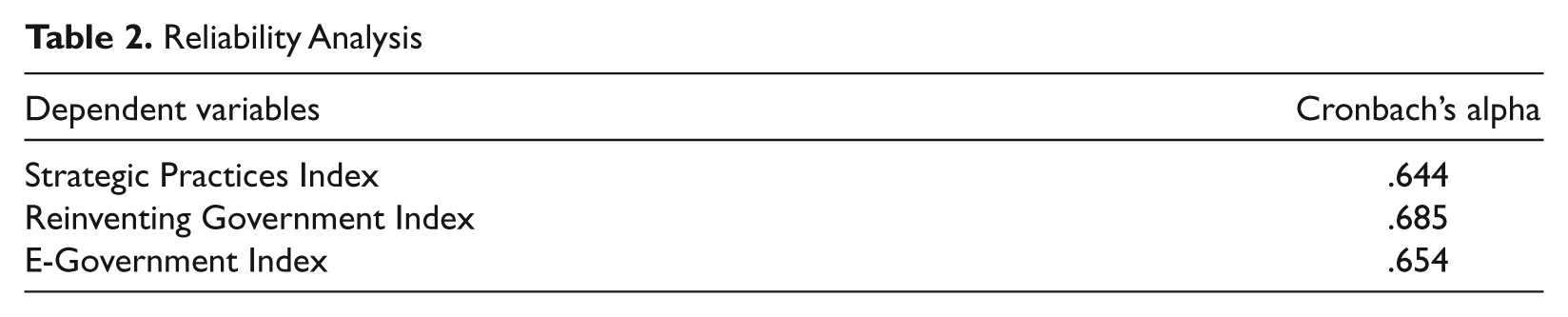
The three indices can be analyzed separately or summed to create a composite innovation index—our primary dependent variable in the study. Although it is possible that some items in the index have greater importance when measuring innovation, attempts to weight the individual items in the index would be largely arbitrary. The reliability analysis (Table 2) for each of the components of the composite index indicates that we have adequate internal consistency in each of the scales.
Reliability Analysis
Pearson’s correlation coefficients were statistically significant for reinventing government and strategic practices as well as for e-government and strategic practices (both at the .01 level). The reinventing government and e-government indices were not correlated at a statistically significant level.
Even in states where Dillon’s Rule reigns, states typically grant local governments the freedom to decide how they will govern themselves and what policies and management practices they will choose to adopt. As a consequence, innovation is an option for local governments. They choose to what extent and in what ways they wish to introduce new approaches and practices. As in the study of diffusion of innovation generally, there is a variation in the relative proportions of actors who will be pioneers, early adopters, later adopters, and laggards (Rogers, 2003). For local governments at any given point in time, this variation will be reflected in the number of adoptions a government has accepted. The adoption rate for the Composite Innovation Index used in this study varies in a way that would be expected, as indicated in Figure 1.
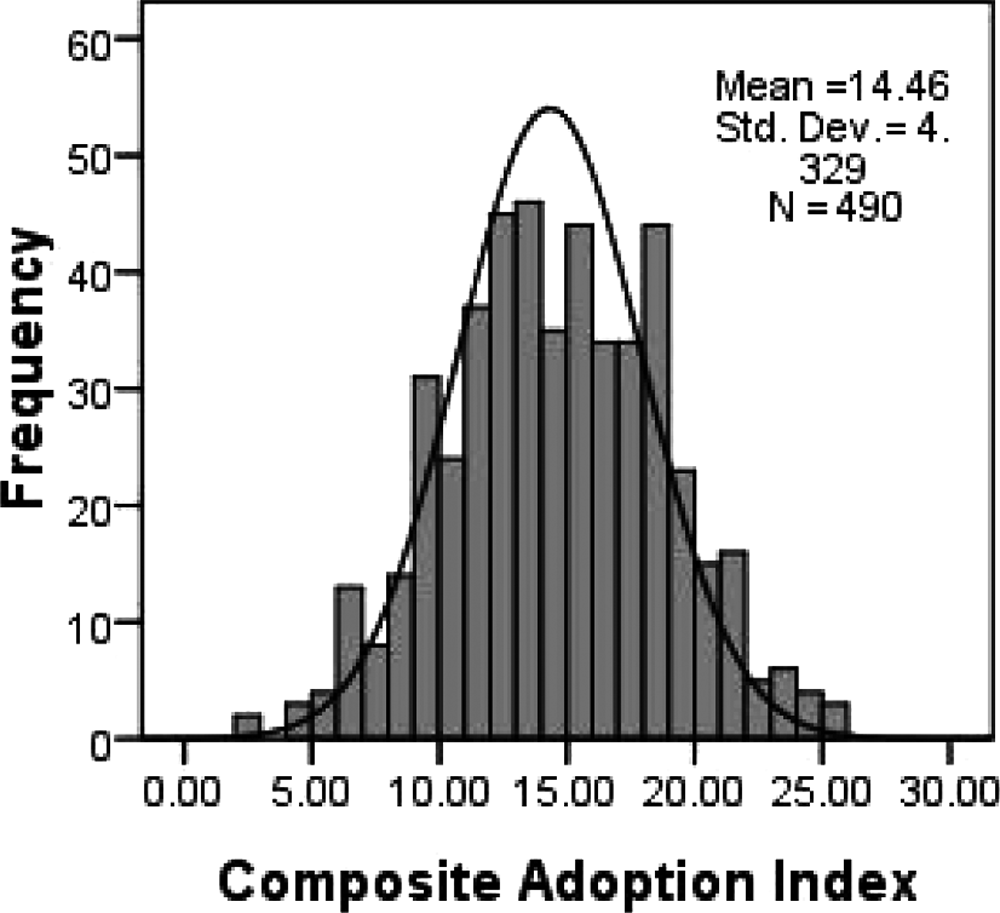
Variation in Composite Adoption Index
Adoption rates represent a bell-shaped curve or normal distribution, with small numbers of governments that have very high and very low levels of adoption and a bulge of governments with middling rates. The question in the innovation research is what factors explain variation.
The primary independent variable for this study is the seven-variation form of government variable described earlier. The seven categories can be used as a nominal scale to compare the level of adoption for each variation. The form of government variable also has ordinal properties allowing for more sophisticated types of analyses.
Some might argue that differences in form of government mask underlying characteristics that differentiate the kinds of cities that choose one form over another. Consequently, it is important to examine the effect of control variables on the relationship of form and innovation. The variables for this study have been selected based on significant findings in earlier studies of adoption of innovation. We are concerned specifically with isolating the effects of form on innovation. Form of government may be distinguished from other structural features, such as methods of electing the council. The control variables used in this study are population, growth rate, unemployment rate, economic health of the municipality, urbanization, and region.
Population, used to measure city size or city government size in earlier studies, was significantly related to innovation adoption in a number of studies (Moon & deLeon, 2001; Walker, 2008; West & Berman, 1997). This study uses 2000 population figures from the U.S. Census Bureau.
Although population growth is consistently used as a control variable, only one study found a significant relationship between growth and innovation (Walker, 2008). However, the Walker study was the only one that used a continuous level of measurement for population growth; other studies used a categorical variable to represent growth (Damanpour & Schneider, 2009; Kearney et al., 2000). In this study, growth is operationalized as the percentage change in population from 1990 to 2000.
Deprivation is also found to be a significant variable related to innovation adoption; however, it is operationalized differently in the various studies—unemployment rate (Boyne et al., 2005), per capita income (Damanpour & Schneider, 2009; Rivera et al., 2000), and a deprivation index (Walker, 2008). We use the unemployment rate for 2007 reported by the U.S. Bureau of Labor Statistics.
Many scholars have attempted to find a link between the economic health of the city and innovation (Damanpour & Schneider, 2009; Kearney et al., 2000; Moon & deLeon, 2001; Rivera et al., 2000). Two studies found a statistically significant relationship between the respondents’ assessments of the economic health of the municipality and the rate of innovation adoption (Damanpour & Schneider, 2009; Moon & deLeon, 2001). We chose to use education levels for the municipal population as our indicator of economic health (percentage of the population with high school degrees or above for the year 2000).
Urbanization has been studied as either a two- or three-category variable (Damanpour & Schneider, 2009; Kearney et al., 2000; Rivera et al., 2000) and as a continuous variable—average population density (Boyne et al., 2005). For this study, we have chosen a different approach. We use a five-item scale to assess population density and locational characteristics—urban/central city, high-density/first-ring suburb, low-density suburb, central city—but not in an urbanized corridor or rural (as reported by the survey respondents).
The final control variable is region. Previously, region was operationalized in one of three ways—a dichotomy (New England and Mid-Atlantic or other/sunbelt or frostbelt) or as a four-category dummy variable. Only in the case of the sunbelt/frostbelt dichotomy was there a finding of statistical significance (Kearney et al., 2000). We have chosen to use the same dichotomy in this study with 0 = frostbelt and 1 = sunbelt.
The relationships between the variables are presented as an operational model in Figure 2. Form of government is measured as an ordinal variable. Across the seven variations of form of government, there are two features that covary—the increasing extent to which the mayor is distinguished from the council, and the decreasing professional status of the CAO based on the range of elected officials to whom the CAO is accountable and the CAO’s autonomy in determining scope of responsibilities. With each variation, the mayor is more differentiated from the council and/or the city manager is subject to more control that is more concentrated, culminating in the elimination of the CAO position. To indicate the “direction” of the variable, the seven-category form of government variable is labeled the Political Executive Scale.

Operational model of municipal innovation
From the literature on form of government and innovation adoption, we developed two hypotheses—one based on variations in form and a second with five components covering other structural features—and propose six additional hypotheses related to control variables.
Hypothesis 1: Governments are less likely to adopt innovative policies and practices as the political executive scale increases, that is, the city uses forms and variations that more greatly distinguish the mayor from the council and reduce the professional stature of the chief administrative officer.
Hypothesis 2a: Council-manager governments are more likely to adopt innovative policies and practices than are mayor-council governments.
Hypothesis 2b: Council-manager governments that choose the mayor from within the council are more likely to adopt innovative policies and practices than are council-manager governments that elect the mayor. 9
Hypothesis 2c: Mayor-council governments with chief administrators are more likely to adopt innovative policies and practices than are mayor-council governments without CAOs.
Hypothesis 2d: Partisan elections in council-manager governments will be negatively related to innovation adoption.
Hypothesis 2e: Percentage council members elected by district will be negatively related to innovation adoption.
Hypothesis 3: Population size will be positively related to innovation adoption.
Hypothesis 4: Population growth rate will be positively related to innovation adoption.
Hypothesis 5: Unemployment rate will be negatively related to innovation adoption.
Hypothesis 6: Higher education levels will be positively related to innovation adoption.
Hypothesis 7: Municipalities that are more urbanized will have a higher rate of innovation adoption.
Hypothesis 8: Municipalities located in the sunbelt region will have a higher rate of innovation adoption than those located in other regions.
Findings
Description of the Sample
There are 490 municipalities in the sample that responded to all three ICMA surveys on different types of innovations. Although it might seem likely that the cities that return surveys consistently would be different in their propensity to innovate compared with those that respond selectively, the separate index scores are similar for the cities that returned all three surveys and the average score for all cities that returned each separate survey. 10 Distribution according to the values for the independent and control variables (Table 3) is good. There is nearly an even division between the regional variable—frostbelt versus sunbelt. Population ranges from 10,000 to 540,828 with most municipalities on the lower end of the scale; only four municipalities in the sample have at least 250,000 residents.
Description of Sample Characteristics

Most respondents (95%) operate with a city manager or chief administrator. More than 70% are self-identified council-manager municipalities. Since the surveys on innovations are administered by the ICMA, a group advocating professional local government management, the overrepresentation of cases that have professional administration is expected.
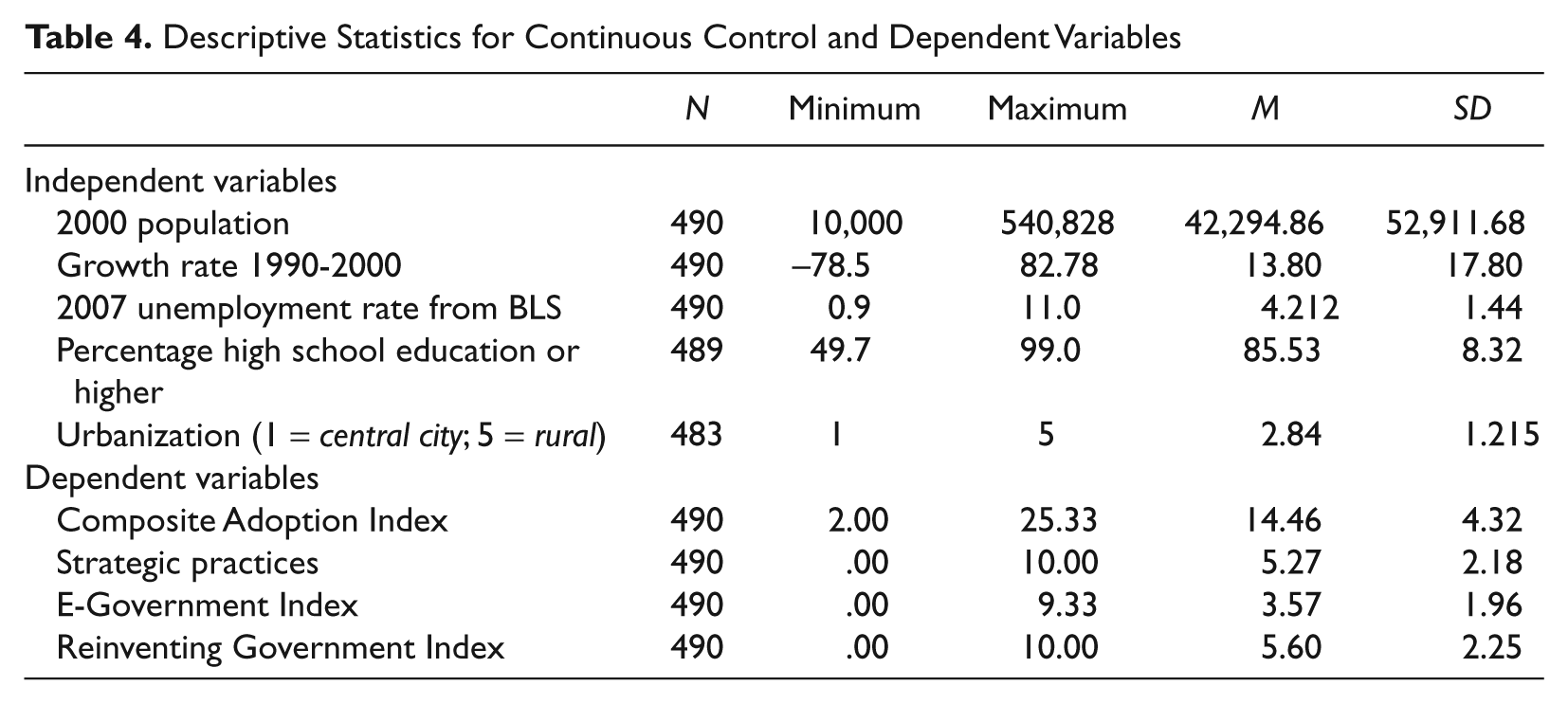
Descriptive data for each of the continuous control variables and the dependent variables (Table 4) used for the regression analysis indicate that the sample municipalities vary according to demographic measures and on measures of innovation adoption. Some of the independent and control variables are correlated with one another. For example, previous research indicates that municipalities in the south and west are more likely to use council-manager form than are those in the north and east (Dye, 1991). However, using the sunbelt versus not sunbelt regional variable, the presence of council-manager governments was nearly an even split, with 170 found outside the sunbelt and 183 found within the sunbelt. As a further check, we ran multicollinearity diagnostics and found no indications that it was present. 11
Descriptive Statistics for Continuous Control and Dependent Variables
Comparison of Innovation Rates Across Forms and Variations
The level of innovation in each type of city can be evaluated by comparing the average rate of adoption. A comparison of mean adoption rates for each innovation measure across the variations in form of government is presented in Table 5. Examining the Composite Innovation Adoption Index, there is a clear progression of higher scores according to form of government. Lowest scores on the Innovation Composite Index are in the mayor-council forms of government. The mayor-council governments without a chief administrator had a mean score of 9.33, the lowest score overall. The same results were found for the three separate measures of innovation as well. There is greater variation in the number of innovations in e-Government and Strategic Practices than there is in Reinventing Government. The analysis of variance results indicate that the differences between the group means is significantly significant (p < .001) for the four indices.
Comparison of Means—Variation by Innovation
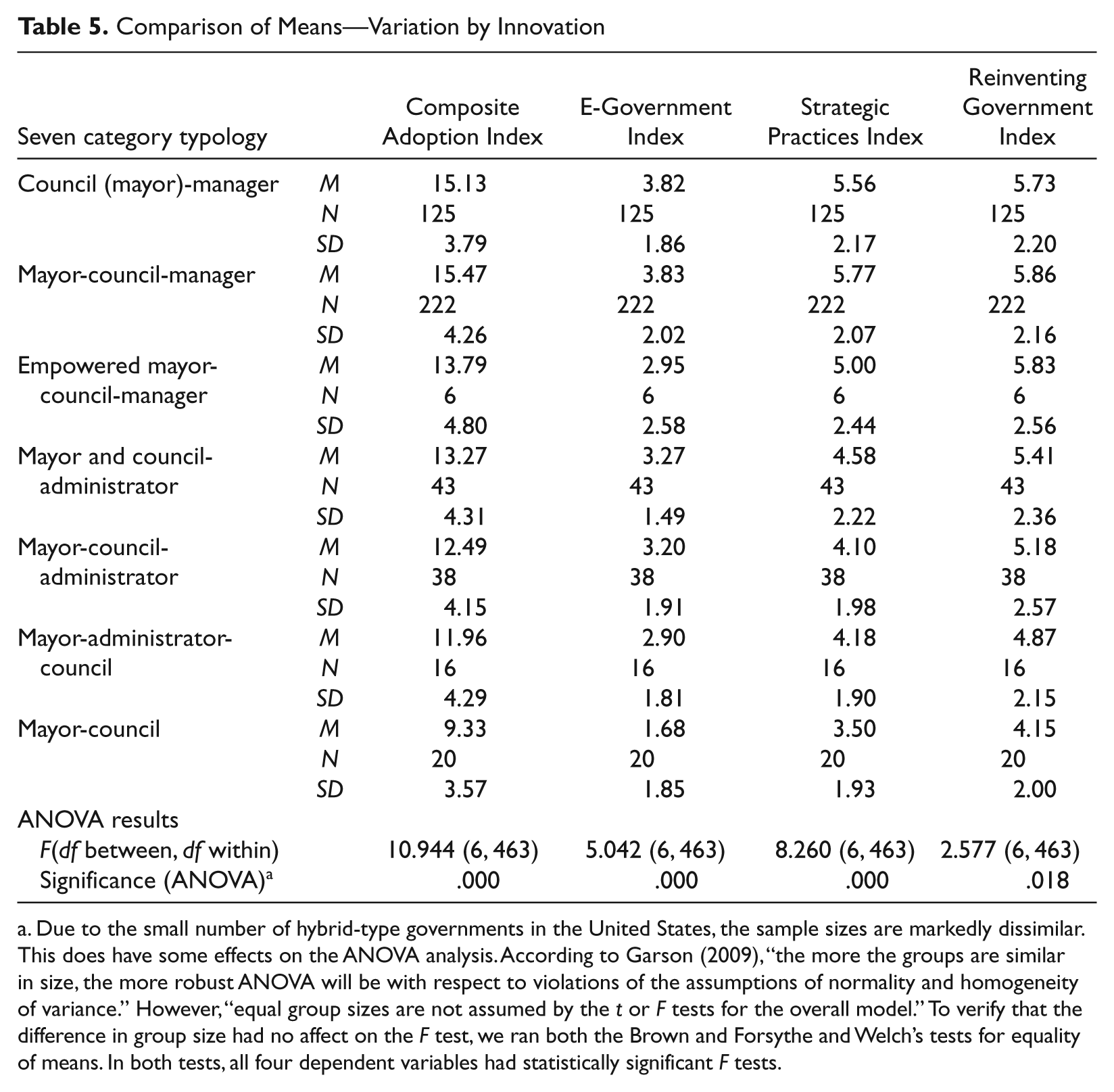
Due to the small number of hybrid-type governments in the United States, the sample sizes are markedly dissimilar. This does have some effects on the ANOVA analysis. According to Garson (2009), “the more the groups are similar in size, the more robust ANOVA will be with respect to violations of the assumptions of normality and homogeneity of variance.” However, “equal group sizes are not assumed by the t or F tests for the overall model.” To verify that the difference in group size had no affect on the F test, we ran both the Brown and Forsythe and Welch’s tests for equality of means. In both tests, all four dependent variables had statistically significant F tests.
These findings support our argument that form of government is an important consideration in innovation research. The presence of a city manager promotes innovative practices. Communities with a chief administrator also have a higher likelihood to innovate, whereas a municipality with the mayor-council form and no professional administrator is the least likely to initiate innovative practices.
Among council-manager cities, if there is an expectation that the variation with the greatest emphasis on shared political leadership—with the mayor selected by the council and the clearest professional independence for the city manager—would be the most inclined to adopt innovations, 12 the results in Table 5 are not supportive. Also, the presence of a mayor who has been empowered to exert greater leadership relative to council and the city manager does not translate into greater receptivity to innovation. The differences are slight among the council-manager variations and favor the elected mayor-council-manager variation over the other two. The council-manager form with a mayor elected at-large (M = 15.47) has a higher composite innovation score than the council (mayor)-manager form with a mayor selected by council (M = 15.13). This pattern was repeated for each of the three individual measures of innovation.
Among the mayor-council cities, the stronger the mayor’s separate role and the less sharing between the mayor and council in selecting the CAO, the lower is the rate of innovation in the city, findings consistent with those of Krebs and Pelissero (2009) but only in mayor-council cities. When the mayor and council select the CAO together, the level of innovation is highest overall and in each of the component areas. With only one exception, there are more adoptions when the council approves the CAO appointed by the mayor than when the mayor appoints the CAO alone. Furthermore, cities with CAOs, regardless of how they are selected, are more innovative than mayor-council cities without this position. Strengthening the mayor and tying the CAO more closely to the elected executive tends to reduce innovation, and cities without a CAO have the lowest innovation of all types of cities.
Multivariate Analysis
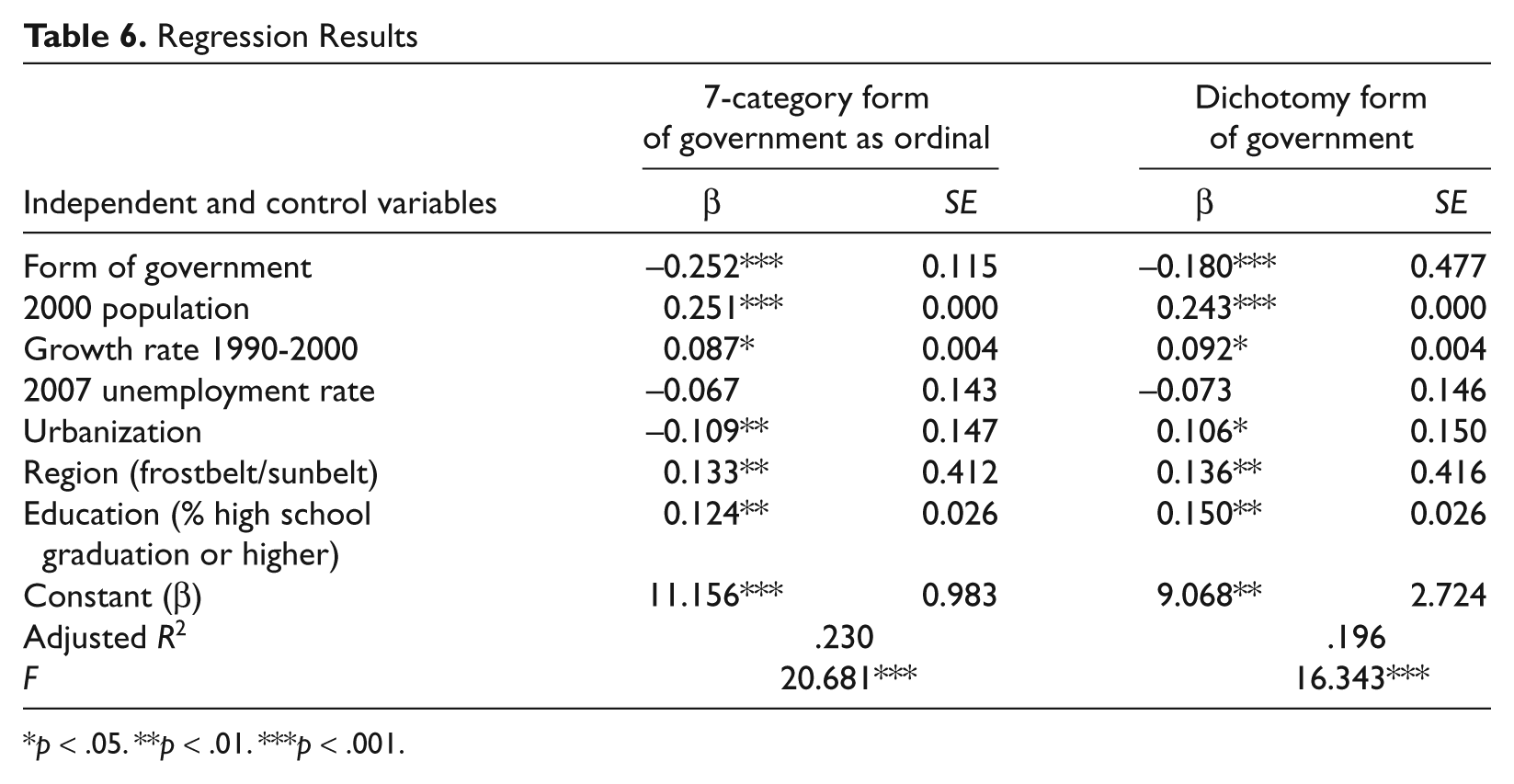
Comparing the means on the innovation indices to government form indicates that form of government is an important variable, but is the relationship statistically significant when control variables are considered? We ran a linear regression model 13 to test our hypothesis that council-manager governments are more likely to adopt innovative practices than governments with the mayor-council form; we used both the seven-category variation for form of government and a simple dichotomy of mayor-council to council-manager (Table 6). In the analysis, all of the variables except for the respondents’ perceptions of economic health were statistically significant. The overall model had an adjusted R-squared value of .239. The directions of the relationships were consistent with our hypotheses.
Regression Results
p < .05. **p < .01. ***p < .001.
Form of Government, Veto, and Elections
The seven-category form of government variable had a negative correlation (p < .001) with the Composite Innovation Index, indicating that when moving up the scale of form toward greater mayoral differentiation and lower managerial stature, innovation adoption declines (see Table 6). In this case, the highest number on the scale represents the mayor-council government without a CAO, meaning that innovation declines as one moves toward a local government form that concentrates more power in the mayor’s office and that is less professionalized, confirming Hypothesis 1. While the dichotomous measure of form also showed a negative correlation with the composite innovation score, the seven-category measure is a slightly stronger variable, and the model including it is stronger overall.
We ran four additional regression models with the composite innovation measure to compare the results when measuring form in different ways (Table 7), using the same control variables as in the initial model. In Hypothesis 2c, we argued that mayor-council governments with chief administrators are more likely to act innovatively than are mayor-council governments that do not have CAOs. However, although the overall model was significant, the form of government variable was not. We ran an independent samples t test to analyze this result further. The results show a statistically significant difference in the means between the two mayor-council categories (p = .002). In the regression model, the control variables mitigate this significance.
Linear Regression Results for Composite Index Using Form of Government Dichotomies

p < .05. **p < .01. ***p < .001.
Another model, that examined only council-manager governments, used a dichotomous variable for form—council-manager with elected mayor and council-manager with a mayor appointed by council. Hypothesis 2b, that council-manager governments with an appointed mayor are more likely to innovate relative to council-manager governments with elected mayors, was not confirmed because the results were not statistically significant for the form variable. Even without control variables, there was no statistically significant difference in levels of innovation between council-manager governments that elect mayors and those that appoint the mayor.
We also considered election methods and the potential relationship that they may have with innovation adoption. We hypothesized that partisan elections and higher numbers of council members elected by district would have a negative relationships with rates of innovation adoption (Hypotheses 2d and 2e). When we included those variables in the model, they were not significantly related to innovation, with or without the inclusion of the control variables.
Although we do not consider mayoral veto power as a variable that distinguishes governmental form, a number of other studies have argued its significance. For that reason, we also analyzed mayor-council and council-manager governments independently, comparing those with mayoral veto to those without. More than two thirds of the mayor-council municipalities in the sample accord veto power to the mayor (n = 63). However, only about 11% of council-manager governments give the mayor the power to veto. Both models were significant overall, but the veto variable was not significant for either the council-manager or mayor-council forms.
Control Variables
Referring again to Table 6, higher population and growth rate are both positively associated with adoption of innovative practices, supporting Hypotheses 3 and 4. Interpreting this finding leads to the conclusion that the greater the population and the faster growing the community, the greater the probability that the municipality would adopt innovative practices. There are pressures from an expanding and larger population to do things better and presumably enhanced resources to support new approaches. It is likely that more opportunities are available to experiment with new approaches when the city is larger and programs and services are expanding.
Unemployment rate and lower urbanization are both negatively associated with the Composite Innovation Index. Higher unemployment rates—a measure of deprivation used in earlier studies—was related to a lower propensity to initiate innovative activities; however, the results were not statistically significant. Education level, operationalized as the percentage of high school graduates or above in the community, was significantly related to rates of innovation adoption—the higher the education level, the greater the rate of innovation adoption. Since central cities were coded as 1 and rural areas were coded 5, the urbanization finding indicates that the more rural communities are less likely to innovate. This finding is consistent with Hypothesis 7 that states that more urbanized municipalities will have higher rates of innovation.
Region was related to innovation as predicted in Hypothesis 8. It was positively correlated with the use of innovative practices. Given frostbelt municipalities were coded 0 and sunbelt communities were coded 1, the finding indicates that sunbelt communities are more likely to try innovative practices than are frostbelt communities.
Although earlier studies found higher innovation rates in council-manager cities are partly explained by their higher population, greater growth, lower unemployment, higher educational levels, sunbelt location, and greater density and locational centrality in regions, stronger than any of them is the effect of form of government and variations within form. 14 Controlling for social and economic conditions, form makes a difference in the innovation performance of city governments. Furthermore, taking into account variations within form that measure the increasing extent of organizing the government around a political executive enhances the explanation of likelihood to adopt innovations. Differentiating the mayor from the council and diminishing the professional stature of the CAO generally reduces innovation.
Conclusion
When examining the adoption of innovations for a wider range of practices than in previous research, the same results emerge in many respects. The level of innovation is shaped by the characteristics of the community and the resources available to the government. These same characteristics are related to the likelihood of using the council-manager form as well, but innovation covaries with form of government even when these factors are controlled. To a greater extent than in previous studies, it is evident that the structure of the government makes an important difference in the likelihood of innovation as well.
The results also illuminate the current debate over what is happening with forms of government in American cities. There is a pervasive sense that structure is less important in local government or that cities are becoming similar as they deviate from “pure” models of structural features. Some variations may be closer to others across forms than they are to cities that share the same form, for example, all cities with CAOs or elected mayors (Frederickson et al., 2004, pp. 100-101).
This analysis shows, however, that there are clear distinctions related to form but not necessarily distinctions related to variations within form. The presence of an elected mayor in council-manager cities does not produce the same kind of adoption behavior found in mayor-council cities with a CAO. In fact, council-manager cities with and without a directly elected mayor have nearly the same rate of innovation contrary to the adapted cities expectation. Furthermore, it is misleading to substitute a measure of the mayor’s power for form of government. As Krebs and Pelissero found, the “weakest” mayors are associated with more innovation than the “strongest” because of the underlying difference in the forms where each is found. In the council-manager cities, however, with elected mayors who rate higher on their power index than nonelected mayors, the adoption rates are higher than in cities with a “weaker” mayor. Only in mayor-council cities is there a clear drop in innovation as the mayor’s powers are concentrated. Council-manager cities generally perform better than mayor-council cities with regard to adopting innovations. The variations in the council-manager cities make little difference in adoption rate, although the lower rate in the small number of “empowered” mayor-council-manager cities suggests that impact of this variation should continue to be examined. The presence of a CAO in mayor-council cities is linked to greater adoptions, and this effect is enhanced when the mayor and council are both involved in the selection of the CAO.
There are limitations to this study that should be noted. First, the study is limited in the number of responses from nonadministrator cities. The disproportionate number of responses from CAO versus non-CAO cities indicates that caution should be exercised in making generalizations about mayor-council cities without CAOs. The results clearly indicate, however, that this is a variable that should be examined further in future studies with more representative samples.
Second, this study focuses primarily on administrative and management innovations rather than policy innovations. It is known that the election of a new mayor in a mayor-council city is associated with a higher level of change in policy (Wolman, Strate, & Melchior, 1996), but these changes are not necessarily innovative. For example, they may represent the reversion to policy options tried and abandoned by previous mayors. A classification of cities above 10,000 in population that have signed the U.S. Conference of Mayors Climate Protection Agreement does not support the expectation that executive mayors are more innovative in policy. Despite the ties between the Conference of Mayors and mayor-council cities and the focus on mayoral initiative, council-manager mayors are slightly more likely proportionately to have signed the agreement than mayor-council mayors. 15 Furthermore, Kwon et al. (2009) found greater early adoption of new economic development strategies in council-manager cities. Future studies that examine a wide range of change, both administrative and political, would be beneficial.
Third, unlike in some discussions of innovation (Watson, 1997) and previous empirical studies, there was no examination of manager attitudes and values. Given the importance of form and the higher innovation in variations that include city managers and CAOs, it is clear that the orientation of the administrators who occupy these positions will be important as found by Kearney et al. (2000). Moon and Norris (2005), who find no relationship between e-government measures and form, suggest that other variables such as the innovation orientation of the top administrator may be related to form of government and dilute the effect of governmental form on innovation.
The results indicate that it is important not to lose sight of form of government in any of three possible ways. First, one should not presume governments that have changed some features of a pure reform or traditional model are essentially alike. The governmental structure of cities that use the same form can vary in terms of specific features but still differ from cities that use a different form because of the distinct dynamics and values associated with major forms of government.
Second, one should not assume that form is unimportant because the cities that use each major form are basically different in their conditions. According to this view, it is those conditions rather than form per se that produces differences in outcomes. The generalization that council-manager governments are predominantly small, suburban, and homogeneously White and middle class (Alford & Scoble, 1965; Banfield & Wilson, 1963) had validity 50 years ago, but these features have not characterized council-manager cities for some time. The council-manager form contributes to innovation in cities of widely varying characteristics even when controlling for size, growth, unemployment, region, and urbanization.
Third, using a measure for structure other than form obscures the explanation of results and creates confusion about the characteristics of different forms of government. To express the difference between forms of governments as the presence or absence of a mayor suggests that council-manager governments do not have mayors and ignores the evidence that they make a difference depending on how they fill the position. It is not only strength of the mayor but also the role of council, relationship of elected officials to each other and to administrators, and the presence and independence of a top administrator that differentiates city government structures. Characterizing the variation in forms of government as an increasing reliance on a political executive captures both the shifting role of the mayor and the extent to which the council shares the policy authorizing role with the mayor, on one hand, and the extent to which an administrator is able to perform executive functions with independence and professionalism, on the other.
It is important to use form in research and recognize variations within form. The researcher who wishes to simplify data preparation can reasonably divide cities into council-manager cities that select their mayors within the council and those that directly elect them, and mayor-council cities with a CAO and mayor-council cities without a CAO. Although method of choosing the mayor does not make a big difference in the innovation rates of council-manager cities, it can make a difference in other characteristics, such as the greater likelihood that an elected mayor is a visionary leader (Svara, 2008). More nuanced measurement of variations is supported by the seven-category classification used here. Little is known about the differences among mayor-council cities that choose the CAO in the three ways that are widely used. Officials and residents of cities are making choices that tailor their form of government to local preferences regarding leadership, governing style, and professionalism. They should have more information about these options and their impact on the performance of local government. Form makes a difference, and variations within form may have an effect as well.