




Abstract
This article analyzes trust in public institutions. In both theoretical literature and empirical research, a link between social trust and institutional trust has been established. Our aim is to cast additional light on this relationship. In particular, we test whether institutional trust is dependent on citizens’ perceptions of how well institutions live up to normative expectations held by the public. The focus on such normative expectations, such as incorruptibility and honesty, is different from much of the previous empirical work which often predominantly focuses on policy outputs, such as economic performance, as a determinant of political support. Two main hypotheses derived from the theoretical discussion are tested in the analysis: Generalized social trust is positively associated with institutional trust (Hypothesis 1) and Institutional trust depends on people’s perceptions of the extent to which institutions live up to such normative expectations as incorruptibility and honesty (Hypothesis 2). Using data from the European Social Survey, the analyses are first carried out at a country level and later at an individual level. Even though the hypotheses are verified to a large extent, the most powerful determinant of institutional trust proves to be satisfaction with policy outputs. Institutional trust is associated with social trust as well as with the perception that public officials act honestly, and the pattern is similar regarding trust in both parliament and the legal system. Furthermore, the analysis suggests that the societies’ average levels of social trust and corruption do not affect the causal mechanisms of institutional trust at the individual level.
Keywords
Introduction
Typically, the concept of trust is understood as depicting interpersonal relationships. It has also become commonplace to distinguish between particularized and generalized social trust. These concepts concern how broadly an individual perceives his or her “moral community” (Uslaner, 2001, p. 574). Generalized interpersonal trust embraces the concept that most people, including strangers, can be trusted. This type of trust is captured by questions posed in survey research about whether an individual generally trusts other people. Particularized trust, however, is based on the concept that only individuals belonging to a certain reference group, such as their family or a religious or ethnic group, are trustworthy (Uslaner, 2002, p. 26).
If trust is first and foremost viewed as depicting interpersonal relationships, it is not necessarily sensible to talk about trust in institutions. For example, Offe (1996, pp. 44-45) argues that the term confidence, not trust, should be used when talking about institutions. At the same time, many surveys measure people’s trust in different institutions such as the police, judiciary, or parliament. Also many theorists have discussed the idea of institutional trust; for example, Warren (1999a, pp. 3-4) argues that modern, complicated political systems rely very much on citizens’ trust in governmental organization and bodies. Even those theorists who use the term institutional trust rather than confidence seem to stress the fundamental differences between interpersonal and institutional trust. In this article, we rely on Warren’s conceptualization of institutional trust, and therefore we use the term trust also when discussing institutions.
The present article depicts institutional trust and its determinants. At the beginning of the article, the concepts of interpersonal trust and institutional trust are discussed. At the same time, different theoretical models of the relationship between these two are presented. Furthermore, we pay attention to Warren’s claim (1999b) that institutional trust depends on the extent to which institutions live up to people’s normative expectations and Rothstein’s (2005) argument that public institutions are expected to treat people impartially. After the theoretical discussion, institutional trust is analyzed empirically. This article seeks above all to find answers to the following questions: What connections exist between social and institutional trust? What is the relationship between corruption and institutional trust? Can trust in institutions be explained by the realization of people’s normative expectations?
Theories of Social Trust and Institutional Trust
It is sometimes argued that interpersonal trust depends on people’s experiences from interactions with other people. In his work The Moral Foundations of Trust, Eric Uslaner (2002, p. 17) calls “strategic” the form of trust which is based on experience. According to this view, trust is based on a kind of inductive reasoning (see, for example, Hardin, 1999, p. 30). Through their own experiences, individuals learn to be either trusting or distrusting in certain types of interactive situations. Interaction between trusting individuals creates expectations of cooperation, which further reinforce cooperation and the development of interpersonal trust in new contacts.
Uslaner (2002, pp. 17-26), however, emphasizes the “moral” character of trust, that is, the fact that trust does not typically depend on people’s experiences. According to Uslaner, people’s attitudes toward other people are quite permanent, and experiences received from interactions hardly affect them. Trusting people have an optimistic view of their lives, whereas distrust is connected with pessimism. Pessimistic and optimistic individuals interpret their experiences in different ways, and, such being the case, people’s basic attitudes toward other people probably stay quite stable throughout their lives regardless of their experiences. Uslaner argues, however, that these basic attitudes may reinforce themselves. Trusting people are, for example, more likely to get involved in different kinds of associational activity.
Uslaner does not, however, argue that trust is completely centered on individuals, so that it would in no way depend on context. In fact, international surveys show that the level of trust varies clearly between societies. Particularly noticeable is the high level of generalized interpersonal trust in the Nordic countries (Norris, 2002, pp. 150-151). One factor explaining high levels of trust in these societies is the even distribution of economic well-being and a well-developed welfare state. According to Uslaner (2002, pp. 104-105), the welfare state gives a large share of a population the belief that they have the chance to succeed in life. This is connected to the optimistic view of life which is associated with trust.
Also Bo Rothstein has emphasized the role of the welfare state as a cause of interpersonal trust. Rothstein (2005, pp. 71-91) argues further that universal welfare institutions that treat people impartially also explain generalized trust. He has, however, criticized the “moral” concept of trust presented by Uslaner. According to Rothstein, generalized trust cannot be primarily explained by individual factors (cf. della Porta, 2000). Based on his view, generalized interpersonal trust is context bound, and the level of trust varies between societies. 1 According to Rothstein (2005, pp. 1-25, 112), generalized trust is best explained by the impartial and efficient performance by public institutions, above all institutions that implement laws, such as the police and the judiciary (see below).
According to Rothstein (2005, pp. 12-21, 209-211), generalized trust can be regarded as a collectively held system of belief, a kind of self-fulfilling prophecy or a “myth.” In terms of rational choice theory, generalized trust can be seen as a solution to the problems of collective action. Moreover, generalized trust can be considered as a game–theoretical equilibrium, as a result of which people believe that certain norms of cooperation are followed by others, which in turn gives people incentives to follow the norms themselves. Rothstein (2005, pp. 22-25) sees the collective belief system behind trust as often being quite slow to change. The function of public authorities is to guarantee that certain key norms of cooperation are followed in society and, consequently, generalized trust as a collective belief system is maintained. Only authorities who treat all individuals impartially and implement laws efficiently can reinforce generalized interpersonal trust, and the corruption of authorities is bound to weaken it. 2
The above summarizes theoretical models explaining interpersonal trust, but how should trust in public institutions be understood? Generalized interpersonal trust and institutional trust are typically viewed as interconnected. For example, according to Putnam (1993, pp. 82-120), bridging social capital, that is, generalized trust and cooperation networks, leads to the kind of political attitudes and activity which help to keep public institutions efficient and responsive. However, Uslaner (2002, pp. 217-219) claims that the connection between generalized interpersonal trust and the work of public institutions may be more direct than Putnam suggests. According to Uslaner, generalized trust may explain trust in public institutions for the simple reason that individuals who trust other people also take a trusting stance toward public officials functioning within institutions. Furthermore, generalized trust enhances institutional performance, because, as a result of it, individuals functioning within public institutions are more prepared to engage in cooperation with people representing different social groups. All in all, Putnam and Uslaner would thus seem to suggest a causal relationship between social trust and institutional performance that differs somewhat from the model put forward by Rothstein who suggests that impartial and efficient institutions implementing laws explain the development of social trust.
However, trust in public institutions cannot depend only on the extent to which people take a trusting stance toward individuals acting within their context. For example, Uslaner (2002, p. 153) also claims that institutional trust differs from interpersonal trust in that it is more clearly strategic in nature. This kind of idea of institutional trust has also been put forward by Hardin (1999), according to whom people’s confidence in institutions depends on the extent to which an institution is considered to operate in their interest. Hardin argues further that institutional trust depends on people’s belief that institutional actors have sufficient incentives to act in their interest. Hardin also points out that governmental institutions are often too distant for people and that, for this reason, the conditions of trust, most notably knowledge of the motivations of the trusted, are not met (Hardin, 1999; Warren, 1999c, p. 348).
The above-mentioned idea of trust may be too narrow, especially when it comes to the definition of the objectives and principles according to which institutions are expected to function. Mark Warren (1999b) has put forward a somewhat broader definition of institutional trust. According to him, institutional trust is based on the shared recognition and the acceptance of the principles guiding the operation of an institution as well as the view that the institution actually performs according to these principles. Warren (1999c) summarizes this view as follows: “Thus, to ‘trust an institution’ means that the truster knows the normative idea of the institution, and has some confidence in the sanctions that provide additional motivation for officials to behave according to this idea” (p. 349).
Warren’s term of the normative idea refers to people’s expectations of both how institutions should treat people and what kinds of outputs institutions should deliver. Institutional trust is based on a view that public institutions actually operate according to these normative expectations (see also Hetherington, 1998, p. 791). Following this view, trust in institutional actors, such as individual police officers or judges, in turn, depends on the extent to which they fulfill these expectations. Obviously, normative expectations vary across institutions; citizens have different views with respect to how, for example, the legal system or police should function.
Normative ideas concerning different institutions also vary across different societies and different periods of time. For example, the expectation of how the legal system should deal with certain types of crimes has varied considerably over time and societies. In relation to this, the institutions of representative democracy have a key role to play, because they are crucial in transmitting citizens’ views on the norms and goals that guide public institutions and also help to monitor how these institutions actually function (see, for example, Warren, 1999c, p. 350). It could thus be assumed that trust in public institutions is higher in established and well-functioning democracies compared with nondemocracies because in democratic systems, public institutions are more responsive to people’s expectations. The empirical testing of this assumption may, however, be difficult, because reliable information concerning institutional trust is not necessarily available in nondemocracies.
Although there seems to be some variation with respect to people’s expectations of different institutions in different societies, for example, Rothstein (2003, pp. 198-201) and Rothstein and Teorell (2008) have argued that all public institutions are expected to treat people impartially when implementing laws. In a certain way, impartiality is the most general and the most universally acceptable of all normative expectations directed at public institutions involved in the implementation of laws. Also in Rothstein’s and Teorell’s (2008) definition, “the quality of government” means, first and foremost, impartiality of public institutions (for a similar view, compare Levi, 1998, p. 87). Corruption is likely to reduce trust in institutions because it is contradictory to the idea of impartiality. Corrupt institutions and public officials do not treat citizens impartially. Instead, they do it unequally on the basis of how able and willing citizens are to perform personal reciprocal favors. In addition to corruption, impartiality also excludes such phenomena as clientilism, nepotism, and discrimination (Lambsdorff, 2007, pp. 16-18; Rothstein & Teorell, 2008).
As argued above, institutions implementing laws and other public decisions are expected to treat people impartially. So what kind of normative expectations do people have with respect to legislative institutions, such as parliaments, in the context of representative democracies? Certainly, normative expectations concerning representative institutions are partly along the same lines as those of the judiciary and the police. As with institutions involved with the implementation of laws, dishonesty and corruption are likely to weaken trust in representative institutions. However, normative expectations targeted at representative institutions and individual politicians do not seem as unambiguous as impartiality expected of implementing institutions. For example, should a member of parliament work for the benefit of his or her constituents or the country as a whole? One could argue that everybody wants elected representatives to act for the “common good” when they are making public decisions. The content of this concept is, however, contested, and democratic politics is characterized by differences in opinions concerning the definition of “the common good” (see, for example, Warren, 1999b, pp. 315-316). It can be argued, further, that because normative expectations toward representative institutions are vague or contradictory, people are likely to trust representatative institutions less than institutions primarily responsible for implementing laws (Grönlund & Setälä, 2007).
It is also often argued that representative democracy as a form of government calls for a certain level of distrust with respect to the elected representatives and their actions (see, for example, Levi, 1998, p. 96; Warren, 1996). The institutions of representative democracy are based on the existence of different control mechanisms. Members of parliament are expected to judge and control the work of the government. The key mechanisms of parliamentarianism, such as parliamentary questions and interpellations, offer such opportunities for control. The principles of transparency and publicity in parliamentary procedures as well as the electoral accountability of representatives, in turn, enable citizens to evaluate and to some extent control the work of the members of parliament. Therefore, citizens are not expected to completely trust their elected representatives in a well-functioning democracy. Rather, the representatives should be viewed critically (see, for example, Warren, 1999b, p. 310). The idea of democratic distrust is widely discussed in democratic theory. Empirically, however, it is difficult to distinguish “healthy” distrust from cynicism stemming from political alienation (see, for example, Grönlund & Setälä, 2007).
Based on the discussion above, it is possible to formulate the following hypotheses concerning the determinants of institutional trust.
Hypothesis 1: Generalized social trust is positively associated with institutional trust.
Hypothesis 2: Institutional trust depends on people’s perceptions of the extent to which institutions live up to such normative expectations as incorruptibility and honesty.
Moreover, we assume that Hypothesis 2 holds universally, regardless of the overall level of corruption in the society. The hypotheses will be tested in the context of representative democracies using data on people’s trust both in legislative institutions and in institutions implementing laws (cf. Rothstein, 2005, pp. 114-115).
The Determinants of Institutional Trust: An Empirical Analysis
To test the hypotheses empirically, we use the second round of the European Social Survey (ESS Round 2: European Social Survey Round 2 Data, 2004). This high-quality comparative survey was carried out in the winter of 2004-2005 through face-to-face interviews. With the exceptions of Italy and Turkey, all countries in the ESS are included in our analysis; this corresponds to some 45,600 respondents from 24 different countries. 3 The second round of the ESS is most suitable for our purposes because it includes a rotating module, “economic morality,” where questions pertaining to corruption and honesty of public officials were asked. We have chosen not to include Turkey in the analysis for the following reasons. First, Turkey is the only non-European country in the second round of the ESS. Second, and more important, Turkey is not a totally free democratic country according to Freedom House classifications (Freedom House, 2010). 4
To proceed with the empirical analysis, we first operationalize the dependent variable, institutional trust. In the ESS, trust in seven institutions and institutional actors is measured through the following question: “. . . (P)lease tell me on a score of 0-10 how much you personally trust each of the institutions I read out. 0 means you do not trust an institution at all, and 10 means you have complete trust.” 5 We chose to analyze trust in the national parliament and in the legal system—the parliament, as it is the most important legislative institution in European representative democracies which can be typically characterized as parliamentary or in some cases semipresidential systems; the judiciary, as it is a central institution in interpreting and implementing laws. It may be pointed out that the results that are presented here have been confirmed in additional analyses using trust in the police and trust in politicians as dependent variables. These analyses are not presented in the form of scatter diagrams or regression tables because their results confirm the patterns observed with trust in parliament and trust in the legal system as dependent variables.
In general, implementing institutions are trusted more than institutions of representative democracy. Throughout Europe (i.e., in the ESS countries), the arithmetic averages of trust are at the following levels: the police 5.6, the legal system 4.8, the parliament 4.3, politicians 3.4, and political parties 3.4. 6 In all ESS countries, the legal system is trusted more than political parties. With the exception of Ukraine, in all countries, the police are trusted more than the parliament and political parties. Trust in the legal system is greater than trust in the parliament in all countries except for Spain, Slovenia, and Ukraine. This observation seems to support the view that a certain level of distrust is an essential element in representative democracy. It can also be interpreted to support the claim put forward by Warren (1999b, pp. 315-316), according to which normative expectations directed at institutions of representantative democracy are ambiguous. Therefore, these institutions are bound to be trusted less than implementing institutions.
The empirical analysis is carried out in two major steps. Initially, we conduct an aggregated analysis at a country level to find macropatterns between social and institutional trust on one hand and the level of corruption and institutional trust on the other. At this stage, we also establish how widely the expectation of the incorruptibility of public officials is held in different countries. In the second part of the analysis, the determinants of institutional trust are sought at the individual level. We also want to test whether the determinants of institutional trust at the individual level vary according to the overall level of social trust and corruption within societies. Therefore, regression analyses are carried out both within the whole sample and within three contexts, based on the level of social trust and corruption in each country. 7
Macro-Level Patterns of Institutional Trust
With the help of scatter diagrams, we first examine how social trust is connected to institutional trust at a country level. In the ESS, generalized interpersonal trust was measured using the “standard” question: “Generally speaking, would you say that most people can be trusted, or that you can’t be too careful in dealing with people? Please tell me on a score of 0 to 10, where 0 means you can’t be too careful and 10 means that most people can be trusted.” Throughout the ESS area, social trust has an average of 4.8, but large differences exist between countries as the scatter diagrams in Figures 1 and 2 show. Figure 1 shows the connection between generalized social trust and trust in parliament in each country. In Figure 2, the relationship between aggregated social trust and trust in the legal system is demonstrated in the same way.
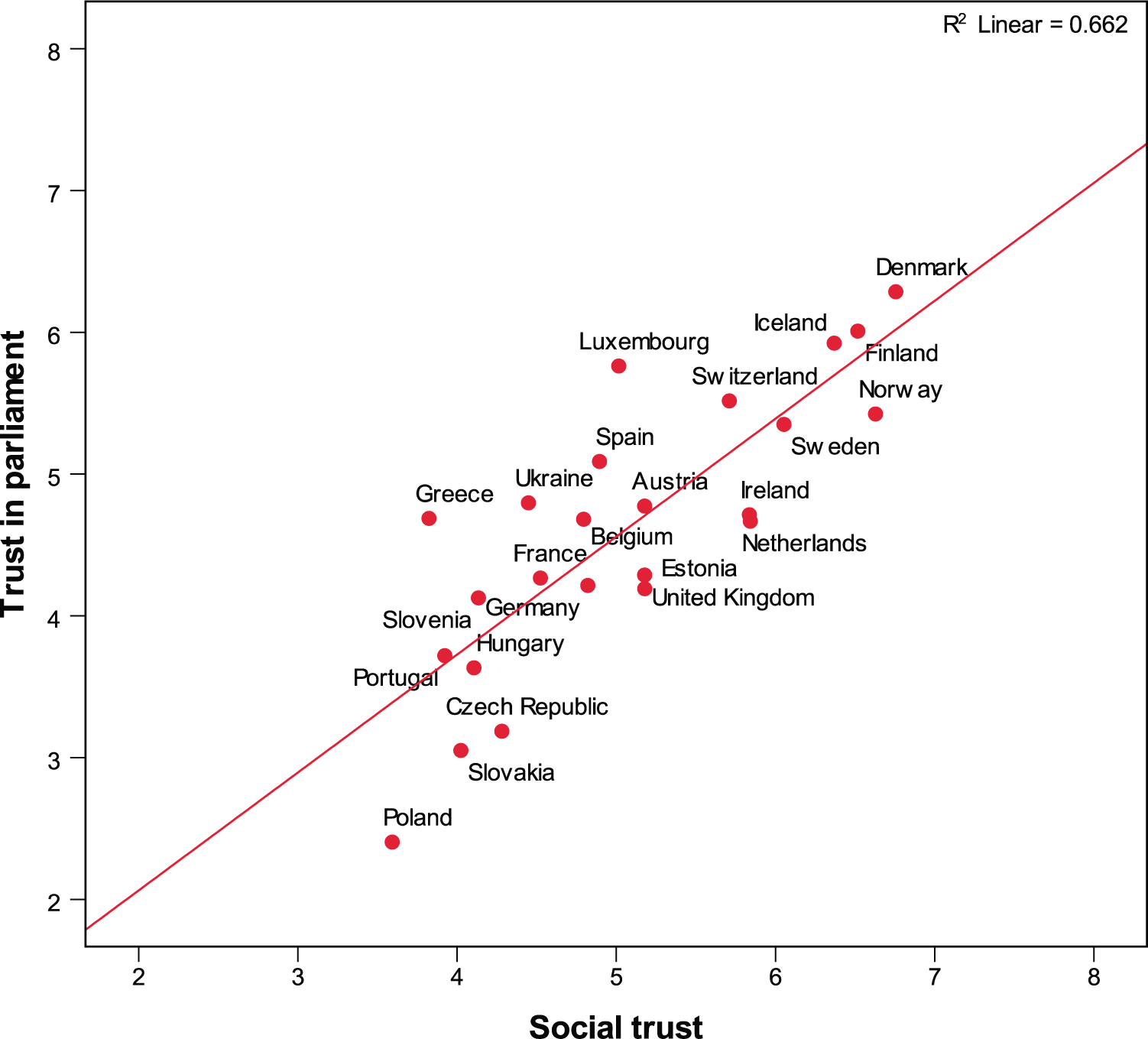
Aggregated association between social trust and trust in the parliament
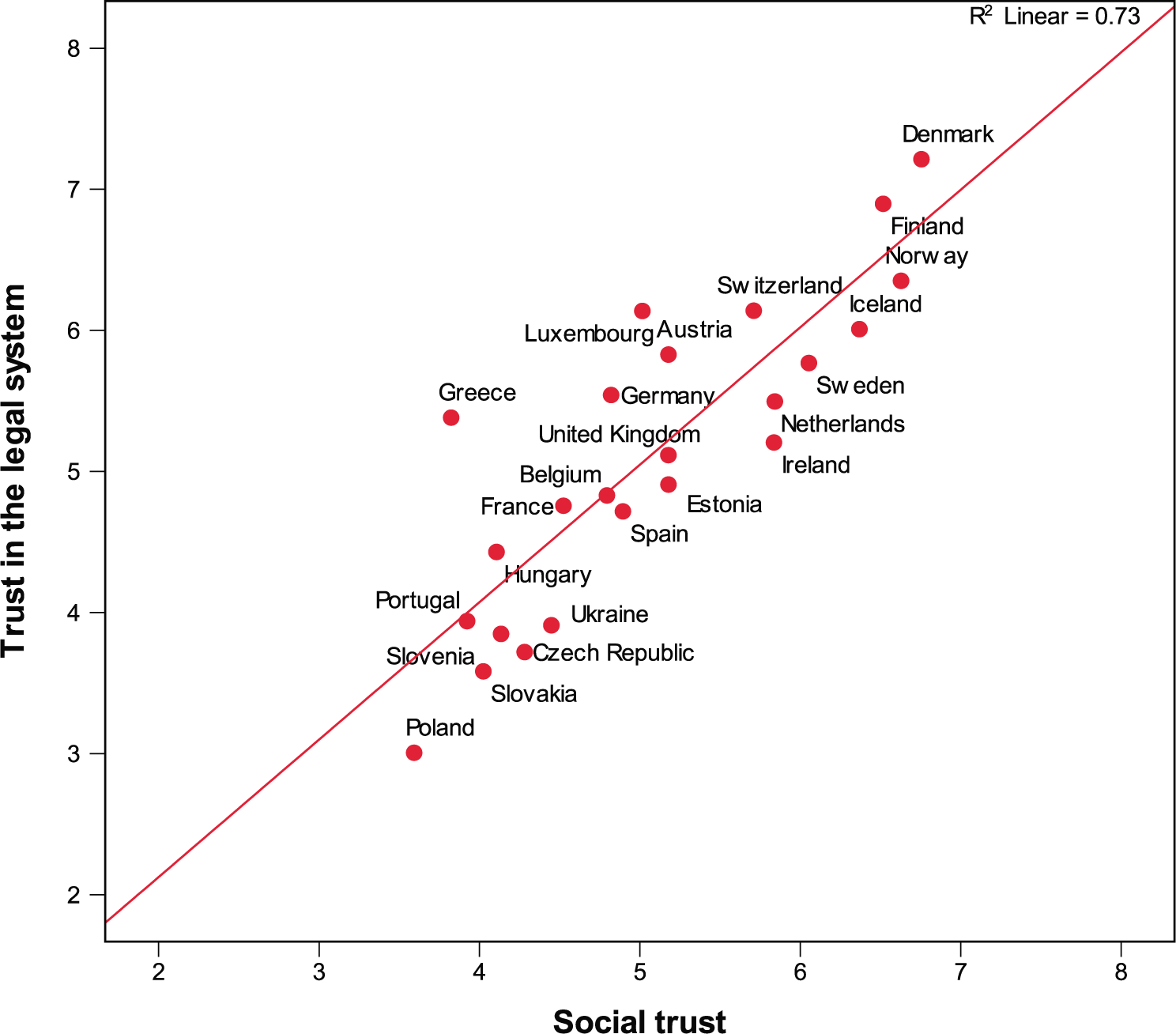
Aggregated association between social trust and trust in the legal system
Based on Figures 1 and 2, it can be stated that social trust is clearly connected with trust in central public institutions at a national level. This is the case for both trust in parliament and trust in the legal system. The overall linear association is slightly stronger between social trust and trust in the legal system (R2 = .73, rxy = .85) than between social trust and trust in parliament (R2 = .66, rxy = .81). Most countries are scattered quite nicely along the linear prediction line. In Luxembourg and Greece, however, institutional trust is higher than predicted based on the aggregated level of social trust, whereas the opposite can be found for the Polish case. In fact, Poland is characterized by low levels of all kinds of trust. Among the more mature democracies, institutional trust in Ireland is somewhat lower than predicted by the level of social trust.
Thus far, the visual observations suggest that people who live in countries where social trust is high also tend to have trust in the parliament and the legal system. Hypothesis 1 about the positive relationship between social trust and institutional trust is supported. Furthermore, in a country-level analysis, the connections between social and institutional trust seem to be similar irrespective of whether the object of trust is an institution concerned with legislation or implementation of laws. 8
What about the other variable of interest, the normative expectation of incorruptibility? The Corruption Perceptions Index (CPI) by Transparency International uses data from various sources but is mainly compiled through assessments by business people and academic experts (Transparency International & Lambsdorff, 2006). It has been published annually since 1995 (Lambsdorff, 2007, pp. 20-23). Even though no objective comparable hard data on corruption exists, the CPI, which is based on expert perceptions, is often seen as the most reliable source for country-to-country comparisons. In fact, the CPI and people’s perceptions of the level of corruption seem to coincide quite well. In a comparison between the CPI 2002 and aggregated results from the Comparative Study of Electoral Systems 2001-2003 (Question: “How widespread do you think corruption such as bribe taking is amongst politicians in . . . [country]?”), Spearman’s correlation coefficient was above .8 (Holmberg, 2009).
In the following, we use the CPI 2005 to measure the level of corruption in each country. The CPI assesses corruption on a scale from 0 to 10. The values of the index are interpreted so that the closer a country is to the value of 10, the less corrupt its public institutions and officials are, and the closer it is to 0, the more corrupt it is. Figures 3 and 4 examine the relationship between corruption and trust in the parliament and the legal system in each country.

Association between noncorruption and aggregated trust in the parliament

Association between noncorruption and aggregated trust in the legal system
The macropatterns between incorruptibility and institutional trust are similar to those of social trust and trust in institutions. In other words, also Hypothesis 2 gains support at the macro-level analysis. The associations are, however, slightly weaker than in Figures 1 and 2. This is the case especially in the relationship between the CPI and trust in parliament where R2 = .55 (r xy = .74). Ukraine and Greece are the clearest outliers. In Greece, both trust in the parliament and especially trust in the legal system deviate upward from the prediction line.
In Ukraine, there is more trust in the legal system and especially in the parliament than the CPI predicts. This might have been an effect of the Orange Revolution which occurred at the same time as the second round of the ESS was gathered. This might have caused a more optimistic view in relation to the parliament at that time. This explanation is supported by the fact that trust in parliament has dropped in Ukraine drastically since 2004. In the fourth round of the ESS, gathered in 2008, the arithmetic mean of trust in parliament in Ukraine is merely 1.61. This corresponds to a drop of 2.8 points on the 11-point scale. A similar pattern can be found in Poland, where trust in parliament after the transition in the beginning of 1990s was higher than in established democracies (Newton, 2001, p. 209). Nowadays, as can be seen in the figures above, institutional trust is quite low in Poland. In newly democratized countries, people seem to have quite a lot of trust in their new democratically elected representative institutions. This kind of trust can also drop easily if these institutions fail to live up to high and sometimes unrealistic expectations. Another possible explanation to the fact that institutional trust declines in newly democratized countries could be that people learn to become more distrusting of democratic institutions as the system consolidates. 9
From Macro Toward Micro
So far, we have been able to establish quite clear connections between social and institutional trust as well as incorruptibility and institutional trust at the macro level. As pointed out earlier, we are also interested in the mechanisms of institutional trust at the individual level. First, we want to map how universal the normative expectation of incorruptibility is across countries. For this purpose, we use the following question from the ESS: “How wrong is it for public officials to ask for favors or bribes in return for their services?” 10 It is notable that there is a large overall agreement with the view that it is wrong for public officials to accept bribes. In the whole ESS sample, 69.4% of the respondents think that asking for bribes is seriously wrong, and 26.5% think that it is wrong. Even though there seems to be rather a unanimous view on corruption, we also produce a scatter diagram where the level of corruption (CPI) is compared with the arithmetic mean for the question in each country.
As can be seen in Figure 5, a positive correlation does exist between the CPI and the average disapproval of asking for bribes (R2 = .25, rxy = .50). In countries like Ukraine, Slovakia, and France, asking for bribes is slightly more accepted than in other European countries. The association between corruption and the approval of it should not, however, be exaggerated. Regardless of the level of corruption, corrupt practices are almost unanimously condemned by the general public; the aggregated means vary between 3.4 and 3.8. Therefore, corruption can be considered a violation toward an almost universally held normative view.

Association between noncorruption and aggregated views of how wrong corruption is
Before moving on to the analyses at the individual level, we form macro contexts within which the individual level analyses will be conducted. To do this, we check how the average level of generalized trust is associated with (the lack of) corruption at a national level. In Figure 6, the CPI is depicted on the x-axis and interpersonal trust on the y-axis. A clear association at an aggregate level seems to exist between corruption and social trust; the CPI and generalized social trust have a strong mutual correlation (R2 = .68, r xy = .83). This finding supports Rothstein’s claim of a relationship between the lack of corruption and generalized interpersonal trust.
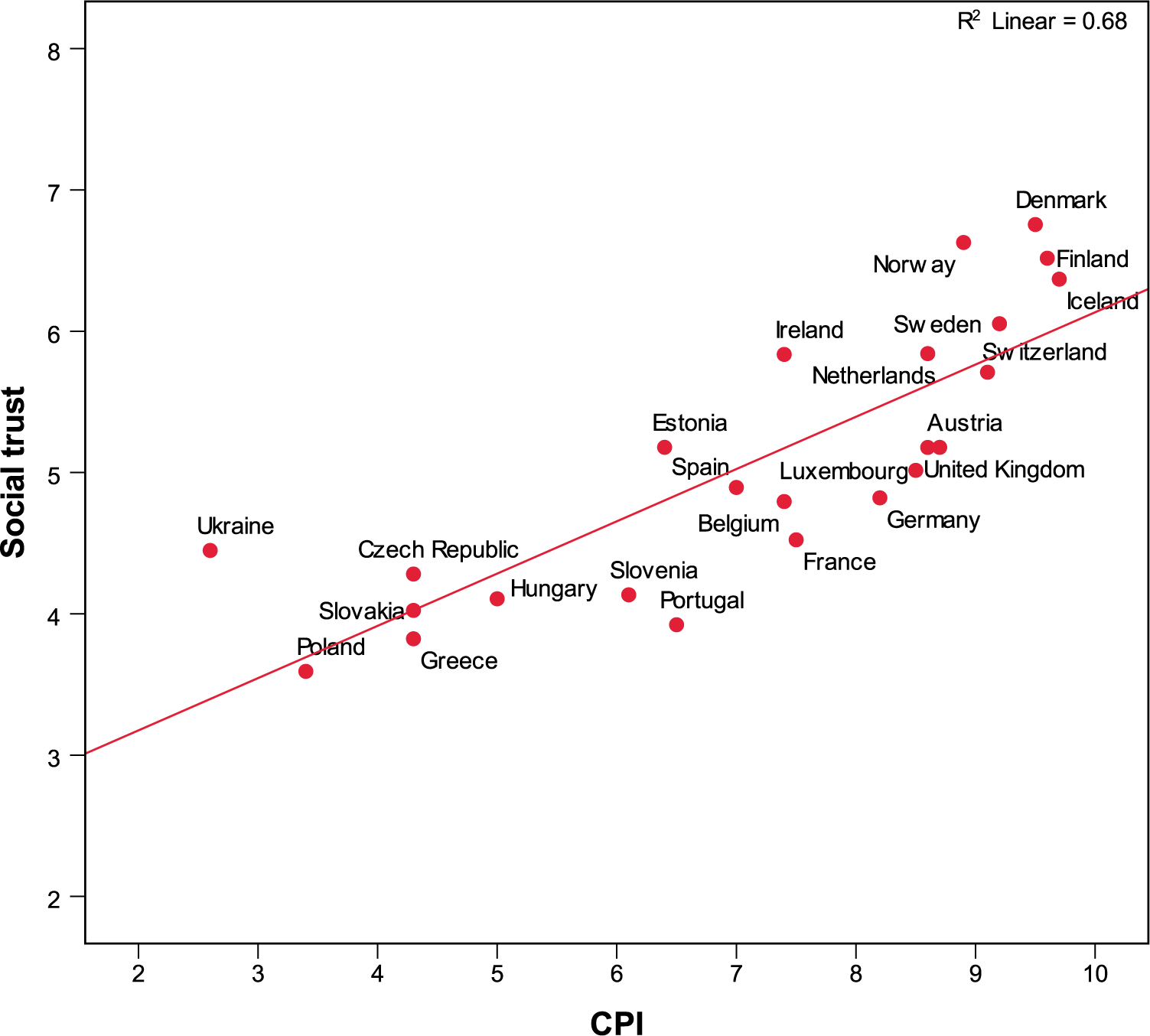
Association between noncorruption and aggregated social trust
Based on Figure 6, three groups of countries can be formed. First, there are countries with low corruption and high social trust. Second, there are countries where both corruption and social trust are rather low. Third, we have a group of countries where social trust is low and the corruption is, in a European comparison, rather high. Also a fourth group of countries would be possible. The combination of high social trust and high corruption is not common, however. This is hardly a surprising finding, considering the positive linkage between the two variables. In fact, Estonia comes closest to this group. The rather high generalized social trust in combination with a rather high corruption level makes Estonia an exceptional case.
Based on the figure, the five Nordic countries of Denmark, Finland, Iceland, Norway, and Sweden form a low-corruption, high-social trust group. Also the Netherlands, Switzerland, and, to a certain extent, Ireland can be included in this group. Low-corruption and low-social trust countries include Austria, the United Kingdom, Luxemburg, Germany, France, Belgium, and Spain. Typical of these countries, in particular France and Germany, is a lower level of social trust than could be assumed based on the low level of corruption. Estonia is visually closer to Western Europe than to other former communist countries. The level of corruption is higher in Estonia than in Spain, the country which is closest to it in the scatter diagram. Social trust, however, is higher in Estonia than in many Western European countries. Therefore, we have allocated Estonia into the second and not into the third group.
A third group shown in the scatter diagram contains countries with relatively high corruption and low social trust. These not only include in particular Poland, Greece, Slovakia but also the Czech Republic, Hungary, Slovenia, and Portugal. Ukraine appears to be an outlier in this group because interpersonal trust is higher than might be assumed on the basis of the high level of corruption.
It is noteworthy that all countries with low social trust and a relatively high level of corruption are either former communist countries or countries that have become democracies in recent decades (Greece and Portugal). Stable democratic development seems to be an important starting point for both the weeding out of corruption and the reinforcement of social trust (compare, for example, Inglehart, 1999; Uslaner, 1999).
Individual-Level Analyses
Analyses made thus far have been between two variables, and they have been conducted at a country level. In this final section, the level of analysis is the individual. In earlier research, the assumption of a positive association between social trust and confidence in institutions has not been conclusive. Dalton (2004, pp. 74-78) uses World Values Surveys 1995-1998 and finds that both social trust and membership in voluntary groups are positively connected with political support for parliament and other public institutions in eight Western democracies. In many studies, however, the individual-level correlation between social and institutional trust has in fact been rather weak (Newton, 1999; Newton & Norris, 2000). Indeed, Newton (2001) has concluded, “A relationship exists, as social capital and civil society theory predicts, but not at the individual level, and only in a complicated and indirect manner at the system level” (p. 211, emphasis added).
Some newer evidence, however, suggests a stronger association between social and institutional trust (Zmerli & Newton, 2008; Zmerli, Newton, & Montero, 2007). Zmerli and Newton (2008) show that many earlier findings of a weak association between social and institutional trust might have to do with the way trust has been measured. In many surveys, trust is measured through a 4-point Likert-type scale, whereas, for example, the ESS (the data Zmerli and Newton use) uses an 11-point rating scale. Zmerli and Newton demonstrate that reducing the scale to 4 points produces much weaker associations, which is an interesting finding because it raises questions about the validity of earlier results showing no connection between social and institutional trust. Our data are almost identical to the data used by Zmerli and Newton, with the exception that we use the second round of the ESS, whereas theirs was from the first round.
We also want to test whether people’s perceptions of the propensity of public officials to act honestly affect insitutional trust. Earlier, it was pointed out that citizens’ perceptions of the level of corruption coincide well with the CPI (Holmberg, 2009). Because the ESS does not entail a direct question on corruption like the CSES, we use the following question as a proxy for the perception of the level of corruption in analyses at the individual level: “How much would you trust the following groups to deal honestly with people like you? . . . Public officials.” 11 When answers to this question are aggregated at the country level and compared with the CPI 2005, Spearman’s rho reaches .63. The somewhat lower result, compared with Holmberg’s finding, might reflect the fact that the ESS question wording implies honesty rather than incorruptibility.
Nevertheless, we have chosen to use this question to trace how perceptions of the conduct of public officials might affect people’s trust in public institutions. The variable shows considerable variation between individuals also within countries, making it a meaningful independent variable. As social trust and the CPI are quite closely connected at the macro level (Figure 6), we also checked for possible collinearity between social trust and the perception of honesty of public officials. The two variables do not correlate strongly at the individual level (rxy = .181). Therefore, both generalized interpersonal trust and the perception of the honesty of public officials can be included as independent variables in regression analyses.
The analysis is initially performed using data from the whole ESS sample and then within three groups of countries which were described above. By doing so, we want to check whether the individual-level associations of institutional trust are similar, irrespective of whether a country is corrupt or noncorrupt and whether it is characterized by high or low social trust. 12 Furthermore, the individual-level analyses are conducted separately for trust in parliament and trust in the legal system. Trust in these institutions is examined controlling for other possible variables through multivariate regression. These variables include both sociodemographic characteristics such as gender, age, and education, and variables related to political interest, internal efficacy, party identification, and ideological orientation.
We also control for satisfaction with economy, education, and health services because, to some extent, Warren’s idea of normative expectations also refers to the performance and, consequently, the outputs of institutions. 13 We did not want to choose variables that directly measure how satisfied people are with the present government or the way democracy works in their country, as these come very close to the dependent variable, especially when it comes to trust in parliament. 14
Table 1 examines trust in national parliaments through ordinary least squares (OLS) regression. 15 The first regression model, within the whole sample, explains almost 30% of trust in the national parliament. The most important explanatory variable is satisfaction with policy outputs, followed by social trust and perception of the honesty of public officials. A person with maximum levels of generalized trust and belief in the honesty of public officials trusts parliament by at least 3 units more (on a scale from 0 to 10) than a person who scores low on the two independent variables. However, the sum variable of satisfaction with economy, education, and health services has on its own more effect than the combined effect of social trust and perception of honesty. This indicates that trust in parliament is to a large extent also dependent on policy outputs. All control variables are statistically significant, although only political interest and party identity have a notable positive effect on trust in parliament. Also internal efficacy, right-wing ideology, and education increase trust slightly, whereas men and older people have somewhat less trust in parliament than women and young people.
The Determinants of Trust in the National Parliament at the Individual Level (OLS Regression)

Note: Country Group 1: high social trust, low corruption; Denmark, Finland, Ireland, Iceland, Netherlands, Norway, Sweden, Switzerland. Country Group 2: low social trust, low corruption; Austria, Belgium, Estonia, France, Germany, Luxembourg, Spain, United Kingdom. Country Group 3: low social trust, rather high corruption; Czech Republic, Greece, Hungary, Poland, Portugal, Slovakia, Slovenia, Ukraine. All regressions coefficients are unstandardized B coefficents. All variables have been recoded into a scale from 0 to 1. Gender and party identification are dummies. Both social trust and ideology have 11 values. Trust in the honesty of public officials has 5 values. Education is an ordinal scale with 7 values. Also GB is included via recodings from the national data file. Political interest has 4 values (not at all interested to very interested). Internal political efficacy consists of 5 values (Reverse coding of the statement: “How often does politics seem so complicated that you can’t really understand what is going on?”).
significant at .05 level. **significant at .01 level. ***significant at .001 level (two-tailed).
We move on to investigate the same regression model within the three country groups. First, it should be noted that the main features of the mechanisms are identical, irrespective of context. Social trust and the perception of honesty of officials affect trust in parliament irrespective of whether the society is corrupt and whether its level of generalized interpersonal trust is high or low. In the same way, the most important independent variable in all country groups is satisfaction with policy outputs.
There are also small differences. Perception of the honesty of officials is a slightly more important determinant than social trust in the high-trust and low-corruption Country Group 1, whereas in the other two country groups, social trust is more important. The level of explained variance is lowest in Country Group 3, where 18% of trust in parliament is explained by our model. In the two other groups, the model performs better, and the adjusted R2 reaches .27.
In Table 2, the analysis continues with trust in the legal system as a dependent variable. As could be expected based on the aggregated analysis earlier, also at the individual level, the determinants of institutional trust are to a large extent identical. In the first analysis, where the whole ESS sample is included at once, perception of the honesty of officials is equally important as social trust as a determinant of trust in the judiciary. Also here satisfaction with policy outputs possesses the highest explanatory power. The control variables are statistically significant and show similar patterns as in Table 1. The adjusted R2 of the model is .28.
The Determinants of Trust in the Legal System at the Individual Level (OLS Regression)
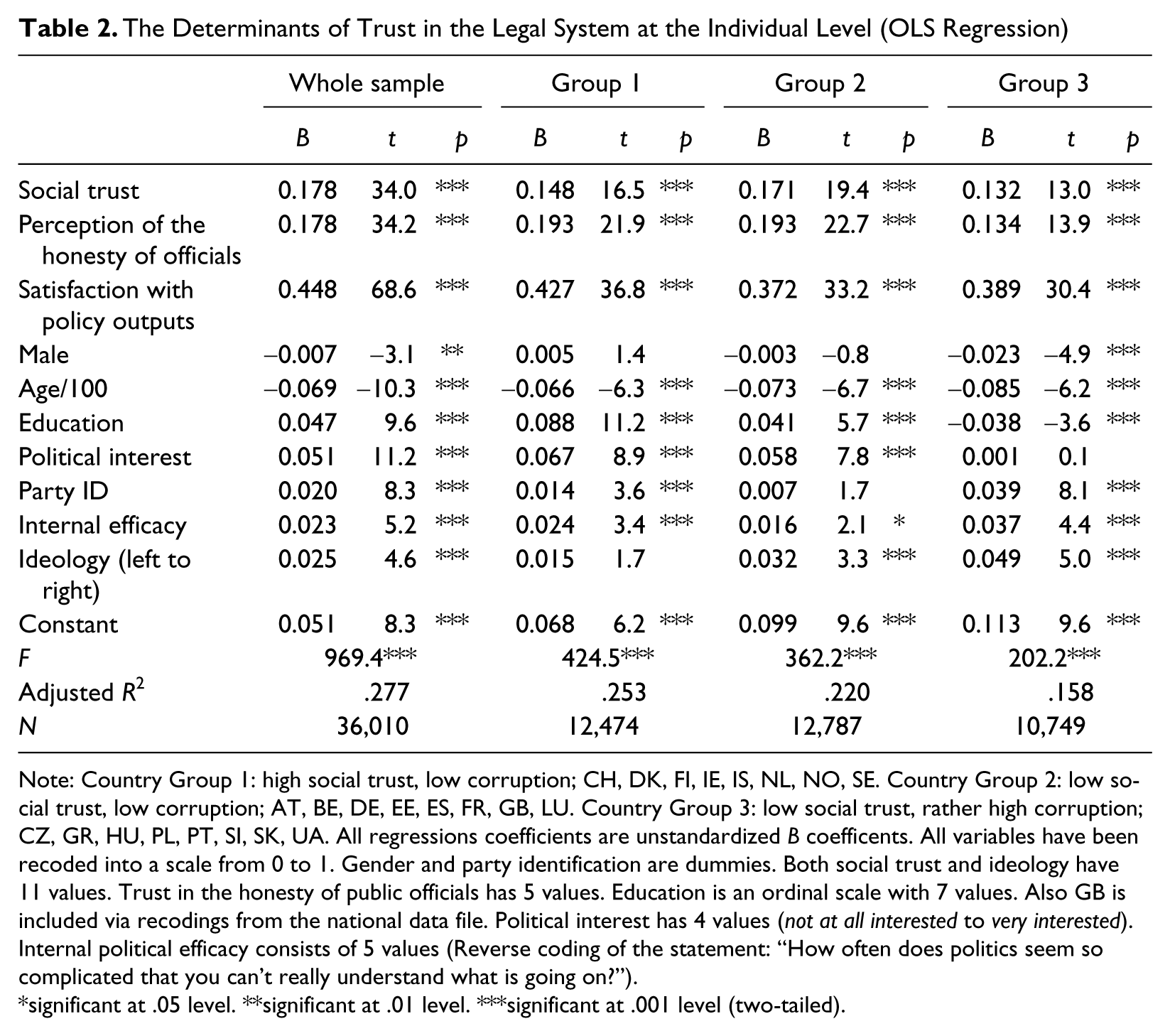
Note: Country Group 1: high social trust, low corruption; CH, DK, FI, IE, IS, NL, NO, SE. Country Group 2: low social trust, low corruption; AT, BE, DE, EE, ES, FR, GB, LU. Country Group 3: low social trust, rather high corruption; CZ, GR, HU, PL, PT, SI, SK, UA. All regressions coefficients are unstandardized B coefficents. All variables have been recoded into a scale from 0 to 1. Gender and party identification are dummies. Both social trust and ideology have 11 values. Trust in the honesty of public officials has 5 values. Education is an ordinal scale with 7 values. Also GB is included via recodings from the national data file. Political interest has 4 values (not at all interested to very interested). Internal political efficacy consists of 5 values (Reverse coding of the statement: “How often does politics seem so complicated that you can’t really understand what is going on?”).
significant at .05 level. **significant at .01 level. ***significant at .001 level (two-tailed).
Again, the differences between the country groups are small. The model performs better in the first two contexts, whereas in countries with low social trust and rather high corruption (Group 3), the model explains only 16% of trust in the legal system. However, in countries where social trust is high and corruption low (Group 1), the model explains again 27% of institutional trust. Political interest increases slightly trust in the legal system in countries belonging to Groups 1 and 2, but not in Group 3, where party identification has a positive impact. In countries with low corruption, a high level of education increases trust in the legal system. In the third country group, in fact, education is slightly negatively associated with trust in the legal system and trust in parliament. This indicates that education somewhat decreases trust in public institutions in countries where corruption is high.
To verify the results presented in Tables 1 and 2, we also conducted regression analyses within each country separately. We used the same independent variables as in Tables 1 and 2. In all 24 countries, social trust and the perception of honesty of public officials was positively connected (significant at the .001 level) with institutional trust in the national parliament and the legal system. There was only one exception—in Portugal social trust had no impact on trust in the legal system. 16
Our analyses show that, even at an individual level, institutional trust is positively associated with both social trust and trust in the honesty of public officials. Both variables proved to be statistically significant, irrespective of what the overall degree of corruption is in a society. The more people trust other people and the more honest they find the civil servants of their country, the more they trust public institutions.
In countries with a low level of corruption and high social trust, an individual’s perception of the honesty of officials is slightly more significant than generalized social trust in explaining institutional trust. If the citizens’ belief in the honesty of public officials falters for some reason in contexts where honesty and impartiality is clearly expected, citizens seem to lose their trust both in parliament and implementing institutions. Even though our hypotheses could be verified, it is clear that insitutional trust is also influenced by how citizens evaluate policies. As it turned out, the control variable which was formed of questions measuring how satisfied the respondents were with the economy, education, and health services was more powerful than our main independent variables. Institutional trust in both institutions of representative democracy and institutions implementing laws seems to be sensitive to satisfaction with policy outputs.
Conclusions
Our analyses at the macro level showed that social trust is positively associated with institutional trust—and this connection concerns both trust in parliament and trust in the legal system. Generally speaking, people have less trust for institutions of representative democracy than in implementing institutions. This observation seems to support the view that a certain level of distrust is essential for representative democracy; it also appears to confirm Warren’s claim that normative expectations directed at representative institutions are ambigious and, as a result of this, they are trusted less than implementing institutions. Based on our country-level analysis, the lack of corruption has a clear connection to generalized interpersonal trust, which would seem to support Rothstein’s thesis of the connection between the impartiality of implementing institutions and social trust. We were also able to demonstrate that the expectation of incorruptibility of public officials is held as good as universally. Regardless of the level of corruption in their country, people value the honesty and impartiality of their civil servants.
The regression analyses at the individual level showed that institutional trust is positively associated with social trust and a belief in the honesty of officials. However, the most powerful independent variable was satisfaction with policy outputs which proves that institutional trust is also contingent on the perception of what public institutions deliver (cf. Keele, 2007). Although satisfaction with outputs was not hypothesized to explain institutional trust, this finding is not against our theoretical point of departure. Indeed, it seems to support Warren’s idea that institutional trust is explained by the extent to which institutions live up to people’s normative expectations, in other words, by perceptions of how institutions treat people and what kinds of outputs they deliver.
People’s perception of the honesty of officials is positively associated with both trust in parliament and trust in the legal system. Although there are conflicting and contradictory expectations toward representative institutions, the perception that public officials act according to such fundamental cooperative norms such as honesty explains trust in parliament. Furthermore, such perceptions seem to explain institutional trust irrespective of whether a country is corrupt. Also in countries with more corruption, institutional trust is dependent on whether an individual finds that public officials act honestly. However, in countries with a low level of corruption, the perception of the honesty of officials has even more explanatory power, which indicates the importance of such expectations, especially in contexts where incorruptibility is the predominant behavior.
Put in another way, our results imply that citizens appreciate the “quality of government” as defined by Rothstein and Teorell (2008). In the present article, the importance of the quality of government is highlighted through two findings. First, by the fact that an urge for noncorrupt public officials is almost universal in the ESS sample and, second, by the positive association between institutional trust and the perception that public officials deal honestly with ordinary citizens (“people like me”). The importance of satisfaction with policy outputs is often emphasized when the aim is to craft trust in public institutions. This article suggests that, although output satisfaction is the most important variable explaining institutional trust, institutional trust also depends on the perception of impartiality and honesty of officials. Therefore, governments may focus on the maximization of output satisfaction, but this should not happen at the expense of the quality of government.
To conclude, our hypotheses were rather convincingly verified. Social trust goes hand in hand with institutional trust (Hypothesis 1). It concerns both trust in representative institutions and implementing institutions. Incorruptibility and honesty of public officials are also positively associated with institutional trust, and that pertains both to trust in parliament and trust in the legal system (Hypothesis 2). We also found that the mechanisms of institutional trust are to a large extent similar regardless of the macro context where the individual lives. Our analyses conducted within three contexts and within each of the 24 analyzed countries show that the overall levels of social trust and corruption in each country do not affect the basic patterns behind institutional trust.
Footnotes
Declaration of Conflicting Interests
The author(s) declared no potential conflicts of interest with respect to the research, authorship, and/or publication of this article.
Funding
The author(s) disclosed that they received the following support for their research and/or authorship of this article: This work was supported by the Åbo Akademi University Centre of Excellence “Democracy-A Citizen Perspective” and the Academy of Finland, award number 218276.