




Abstract
American counties are emerging as leaders in local governance. As such, they are being called on to provide a wide array of new services to an ever-growing population. County managers acting as top-level administrators are known to play a critical role in the provision of these services. County managers, however, are affected by a multitude of factors that contribute to abridged tenures; a scenario that can have harmful effects on organizational performance. Identifying and understanding these factors, and the negative consequences they have on county managers, can benefit both practitioners and scholars. Past research on local government administrator turnover broadly categorizes factors that affect shortened tenures of administrators into two areas. The first, push-induced factors, generally consists of organizational or community characteristics that precipitate an elected board to dismiss the administrator, or encourage him to seek employment elsewhere. The second, pull-induced factors, refers to conditions that facilitate administrator’s departure due to career advancement. This study focuses on push-induced factors and their effect on county manager turnover. Data was collected from large American counties—populations greater than 500,000—functioning with a council-manager form of government over an 18-year period (1992-2009). The analysis reveals that measures of political conflict precipitate push-induced county manager turnover. Increases in measures of fiscal stress—although significant—provided somewhat conflicting results. Measures of jurisdictional adversity, that is, a county’s unemployment and poverty rate, were found to have no significant impact on involuntary county manager departures.
The emergence of American counties as leaders in local-regional governance is extensively documented in scholarly literature (Benton, 2002a, 2002b). That is, in addition to their traditional service delivery areas, counties are quickly moving into other fields once considered the domain of municipal governments, (e.g., administration of programs related to economic development, employment and training, planning and zoning, and water/air quality).
Tekniepe and Stream (2010) have suggested that county managers—acting as top-level administrators—play a critical role in leading a county’s efforts in providing these “new” services. Their added efforts, however, do have an associated cost. That is, decisions regarding newly acquired operational challenges, disagreement amongst political factions as to the proper course of action, and attempts to reallocate limited fiscal resources to new service areas all weigh heavily on a county manager’s ability to achieve long-lasting tenures at any one county. This scenario can detrimentally affect a county’s short- and long-term performance. On one hand, county managers are dismissed or asked to leave due to disagreements with members of the elected board on policy direction or allocation of fiscal resources. On the other, county managers may voluntarily seek and accept positions of authority in other organizations for professional, financial, or personal advancement. Researchers who investigate the career movement of top-level administrators commonly term these events as either push-induced or pull-induced departures. For the purposes of this study we limit our analysis on county manager push-induced departures.
The tenure and turnover patterns of city managers, functioning within a council-manager form of government, provide us with the framework to examine the push factors of county managers in jurisdictions with an identical statutory form of government. Because of their similarities, it is argued that county manager turnover is influenced by similar factors as those that affect city managers.
Our research approach was principally quantitative. That is, the study relied on a model that examined the outcome of key measures representing political conflict, fiscal stress, and jurisdictional adversity on county manager push-induced turnover. The analysis included a pooled, cross-sectional panel of 32 U.S. counties—population of 500,000 or greater—with a “functioning” council-manager form of government and includes observations spanning 18 years (1992-2009). Other counties governed by a commission or commission-executive form of government were considered but not selected because these counties were either void of a professional manager or the manager was elected through popular vote in lieu of being appointed by the elected board. We chose this approach so as to focus on the traditional county manager position and its role in county governance.
Career Movement: Applying Push Motivation Theory
In the literature, career movement is a way of describing how individuals move from one position to another. Arthur, Hall, and Lawrence (1989) described career as being the unfolding sequence of events of an individual’s work experience over the course of time. Traditionally, career movement has been viewed as vertical. That is, individuals generally aspire to climb up an organization’s hierarchy. Career movement has also been examined from a time dimension perspective, where individuals develop their skills and become more competitive over time; and from a geographical and physical dimension standpoint where individuals move from one organization to another or from one position to another within the existing organization (Olsson, 2003). Arthur and Rousseau (1996) termed the geographical dimension as boundaryless careers because they viewed individuals moving across boundaries of separate employers.
Career movement research in the public sector suggests that city/county manager turnover is affected by what are called push and pull factors. Push factors are generally recognized by researchers as those characteristics that force managers from their current position. Such factors may include conflict with council leadership or membership, negative perception of the manager’s ability to adequately manage fiscal affairs, or being blamed for the economic failures of the jurisdiction. Pull factors, on the other hand, are those that position the manager in a favorable light, therefore facilitating their opportunities for professional, financial, or personal advancement into other positions or organizations.
Several researchers have successfully applied both push and pull motivation theory to the career movement of top executives in the private sector (Hall, 1989; Helmich, 1974; Lundberg, 1986). Similar attempts in the public sector, however, have been met with limited—and sometimes differing—results (Murdaugh, 2005; Orosz, 1991; Wechsler & Rainey, 1988). With the exception of two studies that examine career movement of county managers (see Tekniepe & Stream, 2010; Tekniepe, Stream, & Ansson, 2009), career movement research in the public sector has principally focused on city managers (see Clingermayer, Feiock, & Stream, 2003; DeHoog & Whitaker, 1990; DeSantis & Renner, 1993; Feiock, Clingermayer, Stream, McCabe, & Ahmed, 2001; Feiock & Stream, 2002; McCabe, Feiock, Clingermayer, & Stream, 2008; Watson & Hassett, 2004).
Council-Manager Form of Government: City-County Resemblance
Throughout the United States, the council-manager form of government has grown in popularity as cities and counties attempt to run more like businesses. In 2009, nearly 58% of U.S. cities and 34% of U.S. counties—with populations exceeding 100,000—operated under a council-manager form of government (International City/County Manager Association [ICMA], 2009, 2010). Desantis and Renner (1993) suggest that the council-manager form of government used outside of municipal governments is simply a carbon copy of the city manager plan. Benton (2002a) echoed this view by stating in the council-appointed county manager paradigm, the county manager possesses powers equivalent to their city manager counterparts (e.g., legislative agenda setting, budget preparation, senior staff appointment, and general oversight of jurisdictional operations).
Counties unquestionably differ from cities in some respects, though many county managers view cities as models for their county service provision (Morgan & Kickham, 1999). As such, some researchers conclude that contemporary county managers consider their roles as more than mere agents of state government (Marando & Thomas, 1977), rather aligning their administrative, fiscal, and service delivery responsibilities to those of city managers (Benton, 2002a). This may be due, in part, to counties moving into service delivery domains handled traditionally at the city level. Services include the administration of programs related to regional planning and zoning, consumer protection, employment and training, parks and recreation, as well as environmental protection, to name just a few. As Benton in (2002a) explains, the migration of city populous to unincorporated areas has placed counties in the position of functioning more like broad-based regional governments by providing city-type services to all citizens residing in both the incorporated and unincorporated areas. With much of the current literature focusing on the similarities of city and county service delivery, it becomes apparent that differences between cities and counties are less pronounced than ever before. Coupled with the fact that counties have emerged as the fastest growing general-purpose government in the United States, they are being looked on more and more as a promoter of local economic development and provider of public services.
While literature is rich with research regarding the similarities of cities and counties, we know very little about the possible analogous nature of city manager and county manager turnover. A major theme in the study of city managers—unlike their county counterparts—is that certain factors contribute to shortened tenures and turnover. This study contends that city managers and county managers in jurisdictions that incorporate a council-manager form of government are today more often alike than different. County managers, like their city manager counterparts in council-manager forms of government, act as chief executive officers of their jurisdictions. Both are part of the same profession, and both belong to the same professional organization—International City/County Manager Association (ICMA). As such, they may frequently move back and forth between top-level city and county executive positions.
County Managers: Tenure and Turnover
In a review of literature there is a dearth of research on county manager turnover. This may be due to counties being viewed as the forgotten governments; mostly disregarded by researchers as units of analysis (Marando & Thomas, 1977). This may also be due, in part, to the absence of an easily defined theoretically driven research agenda (Schneider & Park, 1989). On the other hand, literature on city manager turnover is quite fertile. Due to the functional and operational similarities of cities and counties, this study argues that abridged tenures of city and county managers are influenced by similar push-related factors. This likeness forms the underlying basis for applying past research on city manager turnover to the analysis of county manager turnover.
Past research suggests that city managers leave their positions for various reasons. For example, in some cases internal conflict with council leadership or membership may force managers to “either resign or be fired” (Feiock et al., 2001, p. 102). Feiock et al. (2001) suggest managers may simply “leave voluntarily . . . to pursue new career opportunities.” To a large extent, research on city managers has substantiated the relationship between political conflict and city manager turnover (Clingermayer et al., 2003; DeHoog & Whitaker, 1990; DeSantis & Renner, 1993; Feiock & Stream, 1998, 2002; McCabe et al., 2008; Renner, 1990; Whitaker & DeHoog, 1991). Similar relationships have been proposed between the fiscal conditions of a jurisdiction, factors of community instability—commonly referred to as cleavages—and city manager turnover. In a pioneering study by Tekniepe and Stream (2010), the same linkages were discovered between measures of political uncertainty, fiscal performance, community instability, and county manager turnover. Tekniepe and Stream (2010), however, did not explore in their analysis the reasons for turnover (i.e., “push” factors that force a county manager to leave their position). As such, our goal in this investigation is to determine whether measures of political conflict, fiscal performance, and jurisdictional adversity influence push-induced county manager turnover.
Political Conflict, Fiscal Performance, and Jurisdictional Adversity: Effects on County Manager Turnover
Over the past 20 years, most research that examines city manager turnover has utilized push and pull motivation theory. However, we have chosen to focus exclusively on the push factors frequently employed in previous studies (see Boynton & DeSantis, 1990; Clingermayer et al., 2003; DeHoog & Whitaker, 1990; Feiock & Stream, 1998, 2002; DeSantis & Renner, 1993; McCabe et al., 2008). That is, we explore the effects of measures thought to be accurate reflections of political conflict, fiscal performance, and jurisdictional adversity, and their ability to be used as viable predictors of push-induced county manager turnover.
Governing Electoral Body
Political conflict, as a predictor of city manager turnover, has been a topic of research for nearly two decades (Klase & Song, 2000). DeHoog and Whitaker (1990) suggest that disagreements between elected board members and city managers directly influence manager turnover. DeSantis and Newell (1996) solidified this view by estimating that roughly one half of all city manager turnovers are attributed to political conflict. This was especially the case when there was a shift in the political makeup of the majority on a governing board (Svara, 1999). Kaatz (1996) suggests that excessive board member turnover may be a sign of an underlying political controversy that ultimately draws a city manager into the disagreement. Kaatz, French, and Prentiss-Cooper (1999) point out disagreements may be attributed to role conflict between board members and city managers, or simply a dislike on the part of the board to a particular managerial style or behavior. As a general rule, the electoral body is responsible for establishing jurisdictional missions and policies; city managers are responsible for carrying them out (Ihrke & Niederjohn, 2005). As Ihrke and Niederjohn (2005) suggest, any deviation from this model such as the board meddling in operational aspects of the jurisdiction may lead to increased conflict between board members and city managers.
Recent research on county manager turnover suggests that they may be subject to the same influences of political conflict as city managers, and measures of political conflict can be used as accurate predictors of county manager turnover (Tekniepe & Stream, 2010). To be precise, a change in board leadership (appointed board chairperson), or a substantial change in the makeup of board membership (nonchairpersons), increases the odds of county manager turnover. These findings mirror recent research on city manager turnover (see Francis, Feiock, & Kassekert, 2009; McCabe et al., 2008; Thurmond, 2009) where turnover in elected office signals electoral controversy that often pits politicians and city managers against one another. Or, at the very least, turnover creates uncertainty about what is expected of a city manager.
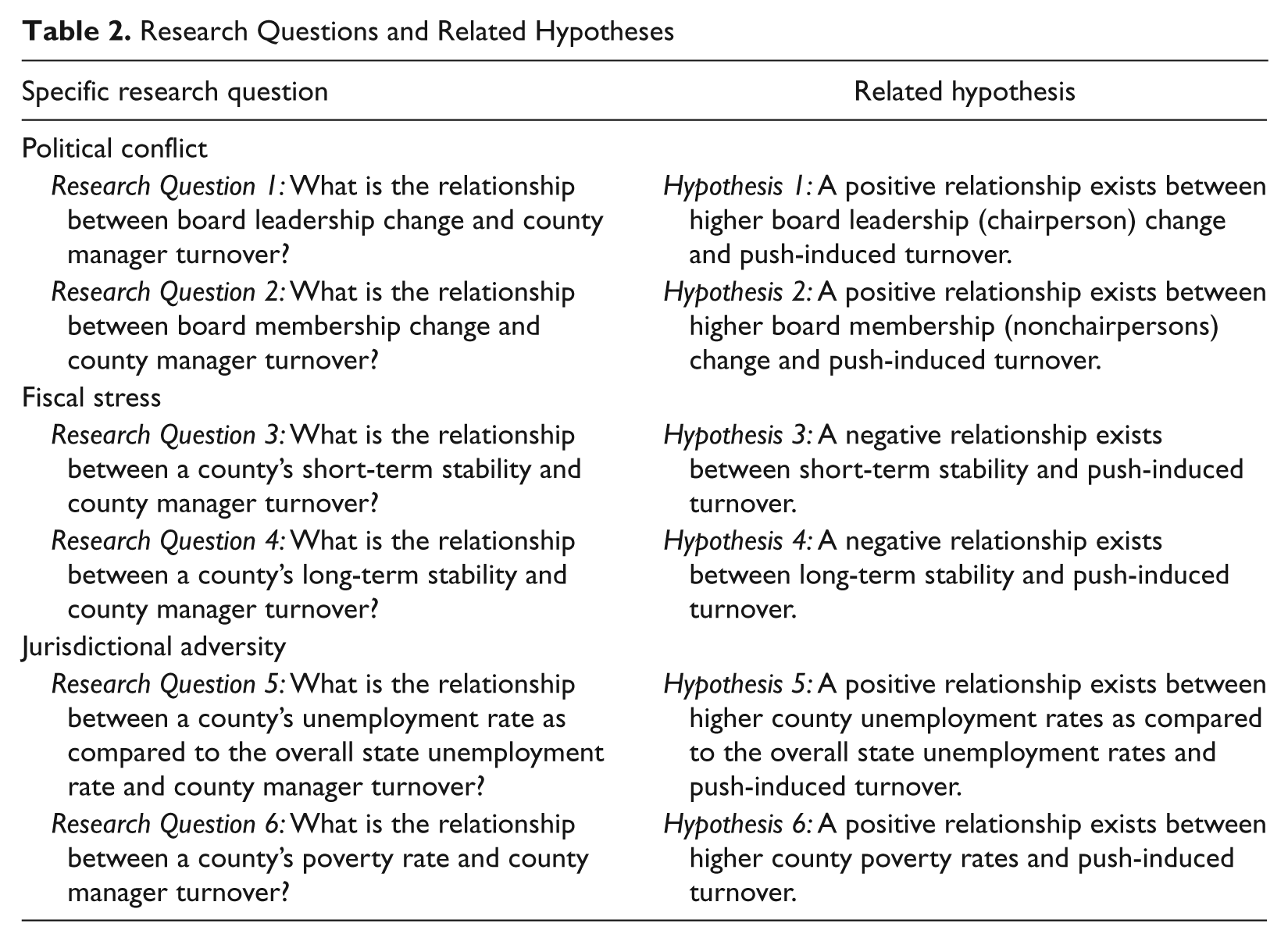
In this study, we measure political conflict utilizing two indicators (i.e., board leadership change and the annual percentage change of board membership). It is hypothesized that counties experiencing frequent board leadership change and greater annual percentage change of board members to have a higher incidence of push-induced county manager turnover.
Organizational Fiscal Performance
Researchers have only recently begun to investigate the connection between organizational fiscal performance and city manager turnover (Feiock et al., 2001; Feiock & Stream, 2002; Greenberg & Hiller, 1995; McCabe et al., 2008). The premise of this inquiry focuses on measures of fiscal stress and their use as predictors of push-induced city manager turnover. Sokolow (1998), a pioneer in organizational fiscal performance, suggests fiscal stress can be gauged by comparing—over time—the change in real revenues and expenditures. Chapman (1998) proposed that when revenues fall without a corresponding decrease in expenses, a condition of fiscal stress occurs. As Chapman (1998) points out, this condition may signal the long-term inability of a jurisdiction to meet its financial responsibilities in the provision of public services. Similarly, research by Greenberg and Hiller (1995) suggests that decreasing levels of income growth, due to lower tax revenues, reduces the flexibility that city managers have to respond to new financial demands. This condition may result in a negative perception of the city manager’s ability to adequately manage fiscal mandates, ultimately setting the stage for a push-induced departure.
Recent studies suggest only a modest link between fiscal stress and city manager turnover. For example, Feiock et al. (2001) found that increased tax burdens—measured in per capita property tax revenue—had no significant impact on city manager turnover. McCabe et al. (2008) found a similar insignificant connection between jurisdictional debt levels, property tax, and city manager turnover, while Feiock and Stream (2002) uncovered only modest effects between differing levels of taxing, spending, borrowing, and turnover.
In our attempt to understand the consequences of a county’s fiscal performance on county manager turnover, measures of both short-term and long-term fiscal stability were included in the analysis; (i.e., annual percentage change in county total expenditures and the uninsured general obligation bond issuance rating). It is anticipated that counties experiencing decreasing expenditures and lower bond ratings will have a higher incidence of push-induced county manager turnover. This hypothesis differs from the previous findings of city manager turnover (see Feiock et al., 2001). While financial stress is external or often outside of the county manager’s control, it is hypothesized that political pressures based on board leadership during times of financial stress contribute to a higher incidence of push-induced county manager turnover.
Jurisdictional Adversity and Economic Performance
Literature also suggests that measures of jurisdictional instability can be used to accurately predict city manager turnover (Arnold, 1990; Feiock et al., 2001; McCabe et al., 2008), with a major emphasis being placed on economic conditions or well-being of a jurisdiction. Recently, McCabe et al. (2008) proposed that by concentrating on measures of economic success and/or failure of a jurisdiction, it might be possible to predict not only the magnitude but the degree of turnover. The reasoning for this viewpoint is that while city managers are able to convincingly take credit for the economic successes of their jurisdictions, in turn, they could be blamed for its economic failures. (McCabe et al., 2008)
Past research on economic growth and city manager turnover, however, has not always supported this correlation. Watson and Hassett (2003), for example, determined that economic growth had no effect on city manager turnover. This may be due, in part, to the difficulty of defining measurable parameters to determine the influence city managers exert on economic well-being. Given these difficulties, researchers have attempted to use measures of jurisdictional adversity to simulate city manager performance with reasonable proxy. In their attempt to explain tenure of city managers, Feiock and Stream (1998) determined that lower jurisdictional poverty levels were associated with lower turnover patterns. Simmons and Simmons (2002, p. 376) supported this notion by postulating that lower rates of unemployment stabilize a jurisdiction’s “politico-cultural base” producing fewer demands for city manager change. Similarly, McCabe et al. (2008) discovered a connection between increased per capita income in cities and city manager retention.
It is hypothesized that measures of jurisdictional adversity can be used as an accurate predictor of push-induced county manager turnover. Jurisdictional adversity is measured with two indicators (i.e., ratio of county to state unemployment rates, and annualized total households living below the federal poverty level). It is thought that counties experiencing greater unemployment rates (as compared to their respective state unemployment rates), and higher poverty levels will have a higher incidence of push-induced county manager turnover.
Research Design
County managers in large counties, populations of 500,000 or greater, with a council-manager form of government who experienced push-induced turnover, are the focus of the study. Using 1990 U.S. Bureau of the Census data, the 51 largest counties with a council-manager form of government were identified. These counties became the target population of the study. Of the 51 counties, 32 were included in the sample (see Table 1). The sampling limitation of using 32 counties was due to the fact that accurate data on the remaining 19 counties—similar to counties with mid- and small-sized populations—were sparse and not easily obtainable for the study period, that is, 1992 to 2009. Furthermore, it was thought that using unreliable data from these other counties could have a negative impact on the validity of this research study.
32 Largest U.S. Counties (1990) With a Council-Manager Form of Government

Source: U.S. Census Bureau, Population Division.
Note: (✓) 25 counties included in study.
Of the 32 counties, we found that four did not experience any county manager departures while three experienced voluntary retirements of their county managers (individuals who were not facing an imminent dismissal at the time of their announced retirement). As such, these seven counties were excluded from our study. The remaining 25 counties becomes the basis of our final analysis and provides us with a 95% confidence level [confidence interval = 14] for inferring the study results to the target population, or large American counties.
Of the 50 county manager departures identified in our analysis, 44% (n = 22) were attributed to push-induced departures with multiple departures occurring in 19 of the 25 counties. Push-induced departures are operationalized as individuals who were dismissed due to elected board agenda item action, or those who resigned because of impending dismissal. The remaining 28 departures, or 56%, represent career advancement departures. That is, county managers secured a similar position at a larger jurisdiction, thereby achieving a higher stature.
The model in our study examines the results of six measures thought to represent political conflict, fiscal stress, and jurisdictional adversity on push-induced turnover of county managers. Since the data set consists of time-to-event data, estimates of these effects are obtained using a Cox proportional hazards regression model that incorporates fixed (non-time-dependent) covariates. Cox modeling was chosen for the analyses because of its relative risk-type measure of association, the nonneed for parametric assumptions, use of the partial likelihood function, and its ability to create survival function estimates.
Survival time is defined as the length of the interval between “start” and “end” events. The “start” event is the 1st year an individual enters an organization as county manager. The “end” event is the year an individual departs. The dependent variable is a trichotomous measure indicating whether there was a push or pull-induced departure, or no departure (0 = no, 1 = push, 2 = pull). Since our analysis focuses on push-induced departures, the “end” event is represented by a “1” coding.
Data pertaining to the dependent variable were principally obtained through secondary sources such as board agenda items, county press releases, and local newsprints. Data were cross-verified from more than two sources to ensure the credibility and validity of the departure type. When conflicting information was uncovered, validation as to the true value of the data was obtained by personal contact with those individuals.
The covariates include measures of (a) turnover in the governing electoral leadership and council, (b) county fiscal performance, and (c) jurisdictional adversity due to poor economic performance. Data pertaining to the covariates were principally obtained through primary sources such as government documents containing census data, demographic statistics, and annual financial results. Table 2 summarizes the specific research questions and related hypotheses for the six covariates in the study model; two in each of the three domains.
Research Questions and Related Hypotheses
Results: Accounting for Push-Induced County Manager Turnover
Our analysis indicates that board leadership change occurs 54% of the time for any given year. Change in board membership averages 12% per year. Many counties experienced no change in board membership during the election cycle while others such as San Diego County, CA (1995), experienced a 66.7% change.
We also found that county expenditures—a measurement of a county’s short-term stability—increased at an average annual rate of 4.6%. The largest decrease in annual expenditures, or −28.8%, occurred in Hillsborough County, FL (1992), while the largest increase, 29.6%, occurred in Orange County, Fl (1992). The average county bond rating—a measurement of a county’s long-term stability—was found to be Aa3-Aa2 with six counties having a top rating of Aaa; one county had the lowest rating or Caa.
The average unemployment rate for the 25 counties in our analysis was 5.9% over the study time period, with Fairfax County, VA (1998-2000) having the lowest unemployment rate of 1.6% and Kern County, CA (1993) having the highest unemployment rate of 15%. The mean ratio of all county to state unemployment rates—a measurement of jurisdictional adversity—was for the most part 1:1 (0.99). The largest ratio of county to state unemployment (2.42) occurred 1999 when Fresno, CA incurred a 12.6 unemployment rate while the overall state unemployment rate was 5.2%. The smallest ratio (0.50) took place in 1997 when Fairfax, VA had an unemployment rate of 2% while the statewide unemployment rate was 4%. Another measurement of jurisdictional adversity—number of county households living below the federal poverty level—averaged 13.5%. Fairfax County, VA had the lowest poverty rate of 4.1% in 2000, while Fresno County, CA had the highest poverty rate, or 28.1% in 1993. Table 3 recaps key descriptive statistics for measures of push-induced county manager turnover.
Descriptive Statistics for Measures of Push-Induced County Manager Turnover

Note: 50 subjects (22 push-induced turnover, 28 pull-induced turnover); 25 counties over 18 years (1992-2009).
Proportional Hazards Analysis of Push-Induced County Manager Turnover
The proportional hazard analysis is stratified by year with standard errors adjusted for clustering by counties. Positive coefficient estimates indicate an increase in the odds of a push-induced departure; negative coefficient estimates indicate a decrease in the odds of a push-induced departure. Similarly, hazard ratios greater than 1.0 indicate that a covariate increases the odds of a push-induced departure; hazard ratios less than 1.0 decrease the odds of a push-induced departure. Table 4 summarizes the estimation results. 1
Proportional Hazards—Predictors of Push-Induced County Manager Turnover
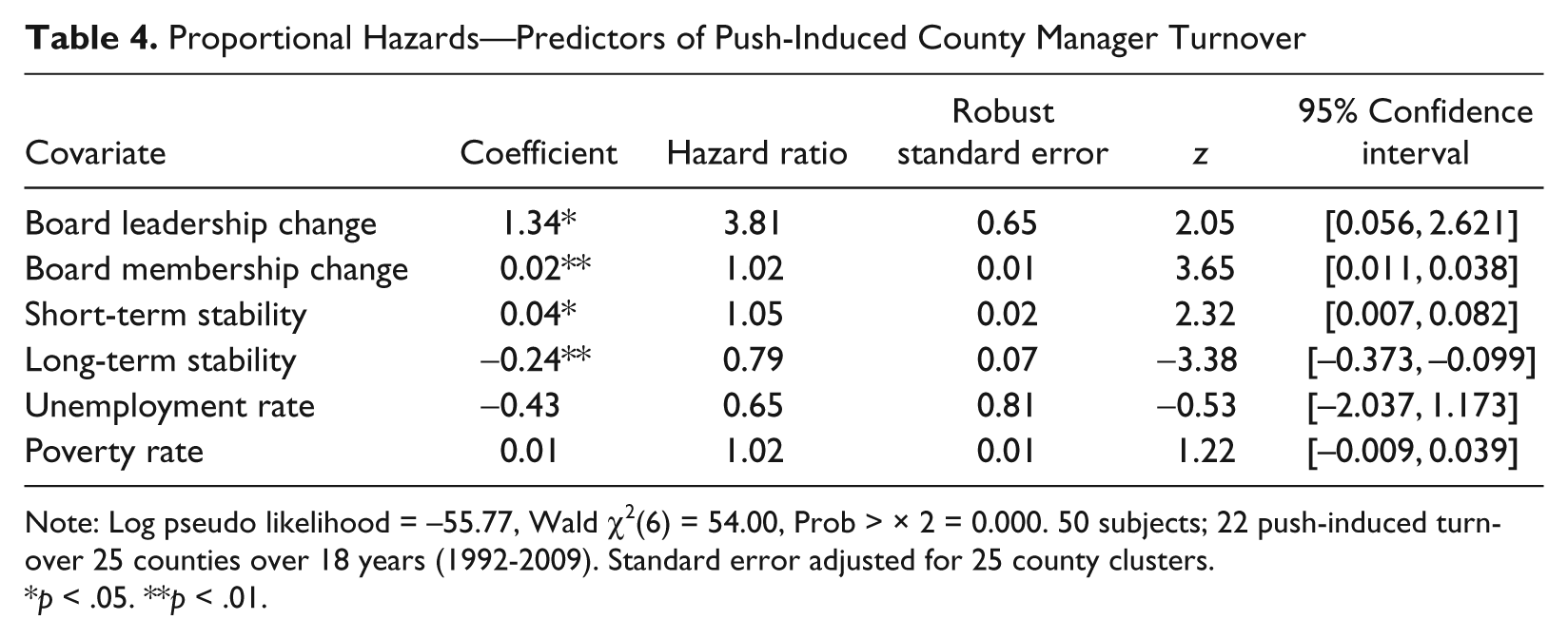
Note: Log pseudo likelihood = −55.77, Wald χ2(6) = 54.00, Prob > × 2 = 0.000. 50 subjects; 22 push-induced turnover 25 counties over 18 years (1992-2009). Standard error adjusted for 25 county clusters.
p < .05. **p < .01.
Coefficient estimates for both measures of political conflict were found to have a significant effect on push-induced turnover (i.e., board leadership change p value < .05 [coefficient: 1.34], and 1-year board membership change p value < .01 [coefficient: 0.02]). The hazard ratio of 3.81 for board leadership change indicates there is a 281% increase in the rate of push-induced turnover for each unit increase in the measure. The hazard ratio of 1.02 for 1-year board membership change indicates there is a 2% increase in the rate of push-induced turnover for each unit increase in the measure. The results for both measures were found to be consistent with Hypotheses 1 and 2 (H1 and H2). That is, changes in board leadership and board membership leads to push-induced turnover. These effects may be due to the fact that county managers are appointed by the elected board—with influence from board leadership—who would likely want to choose their own chief administrator on assuming office.
Coefficient estimates for both measures of fiscal performance also had a significant effect on push-induced turnover (i.e., short-term stability p value < .05 [coefficient: 0.04], and long-term stability p value < .01 [coefficient: −0.24]). The hazard ratio of 1.05 for short-term stability indicates there is a 5% increase in the rate of push-induced turnover for each unit increase in the measure. The hazard ratio of 0.79 for long-term stability indicates there is a 21% decrease in the rate of push-induced turnover for each unit increase in the measure. The directional effect of short-term stability on push-induced departures, however, is inconsistent with Hypothesis 3 (H3). Some researchers have suggested that county managers are susceptible to short-term swings in a county’s fiscal performance, but no evidence was found for this view. The relationship between long-term fiscal stability and turnover was consistent with Hypothesis 4 (H4) which, not surprisingly, supports previous research on city and county manager turnover.
Unexpectedly, the analysis does not support our Hypotheses 5 and 6 (H5 and H6) linking increases in the ratio of county to state unemployment rates and increases in county poverty rates to increased push-induced turnover (p value = .60 [coefficient: −0.43] and p value = .22 [coefficient: 0.01], respectively). This may suggest that short-term swings in jurisdictional adversity have no influence on push-induced departures, and that county managers may be more prone to effects of long-term adversity.
Conclusion
As large American counties take on greater policy leadership roles in local-regional governance, the significance of understanding county manager turnover—and its effect on organizational performance—becomes increasingly important. Our research therefore examined various push predictors and their influences on county manager turnover. Our findings were generally consistent with results of previous studies of city-county manager turnover, that is, measures of political conflict have a significant effect.
While the outcomes of our study are interesting in terms of research and literature, the results have larger implications for the management of large counties and connect more broadly to the practice of public administration; county managers should recognize that an adversarial mindset in some elected officials toward managerial leadership can precipitate an elected board to dismiss the manager or encourage him or her to seek employment elsewhere.
One way for county managers to protect themselves from political conflict is in learning to interpret and predict the political landscape. They can protect themselves from potential fallout by seeking out another position of equal or greater stature with a different employer to evade the “perceived political turmoil on the horizon” (Feiock et al., 2001, p. 102). Another is to develop stronger employment contracts that provide insulation from board member turnover and strife (Feiock & Stream, 1998); one example would be to negotiate longer guaranteed employment provisions. From an organizational standpoint, successfully completing strategic long-term ventures can become problematic (in some cases, impossible) without a certain degree of stability and consistency in leadership and direction. In some ways, this might account for the lack of progress typical of local governments: the potential consequences of political conflict leave county managers fearful to take risks that could lead to long-term success (Feiock & Stream, 1998).
The research and analysis in this article answers many questions and raises avenues for future investigation. One such avenue is the impact of generational diversity on future county manager turnover. Given the behaviors and trends exhibited by the Millennial (“Generation Y”) workforce, that is, high turnover and a focus on goal achievement (personally and professionally), it would be interesting to examine this generation’s effect on push-induced factors as its members rise to managerial positions in local government.
Another possibility for future research would be to examine the impact of government stability on the attraction and retention of county managers. Local governments have long been viewed as one of the few stable, long-term employers left in America, a factor that attracted employees to careers in public service despite the low wages compared to the private sector. In the current political and economic climate, that stability no longer appears to exist. Research could address how the current instability of public-sector employment has affected practices to attract, retain, and promote employees (e.g., succession planning). Last, future research could examine counties where managers stayed longer than the standard tenure and what factors influenced this phenomenon.
Today, there is so much volatility and uncertainty around county manager employment that the issue of tenure has even greater bearing on government policy. For anyone interested in a career as a public sector manager, the notion of certainty in the position is a key attraction of the job, and it can often increase a manager’s success. Such certainty can be good news or bad, but knowing the news allows a manager to plan appropriate situational responses. In the current climate, however, the uncertainty surrounding local political environments makes it difficult for a manager to project exactly what can or cannot work. As our analysis implies, the outcome of a single vote or an entire election can significantly alter the policy environment, leading even the most successful manager toward a confusion that can lead to uncertainty. Government policy becomes hard to predict in this setting, and its impact is felt community-wide.
Footnotes
Declaration of Conflicting Interests
The author(s) declared no potential conflicts of interest with respect to the research, authorship, and/or publication of this article.
Funding
The author(s) received no financial support for the research, authorship, and/or publication of this article.