



Abstract
This article investigates gender representation in the public bureaucracy in the context of South Korea and its substantial effects on governmental performance. The past decades have seen a growing body of research on the theory of representative bureaucracy, yet the conceptual linkages remains unclear. This study, first, identifies three missing links existing in the theory of the representative bureaucracy. Second, we investigate whether the presence of women in the bureaucracy affects on the consequences of governmental activities. Using an unbalanced time-series data set for 25 years with gaps including 1978, 1983, 1986 to 2008, the investigation is conducted in terms of the media attention on women’s issues, social welfare budget, and the legislative success of the executive branch measured by the number of passed bills submitted to the National Assembly. The result of the autoregressive integrated moving average time series analysis (ARIMA) suggests that a representative bureaucracy influences substantive consequences on governmental performance.
The importance of public bureaucracy in the modern state cannot be overstated. Public bureaucrats as direct and indirect participants in the policy-making process have substantial power to shape a great deal of our society (Krislov, 1974; Riccucci, 1995; Rosenbloom & Kravchuk, 2005). Civil service reforms continuously attempt to make bureaucracy more effective, responsive, and legitimate in the complex and unstable environment. Representativeness and diversity is one of the key issues in civil service practice as well as in the field of public management.
Although a bureaucracy is not considered a representative institution, the concept of representative bureaucracy gained its practical and theoretical significance in ensuring responsibility and equal access to public employment. One of the challenging issues of governing public organizations is the balance between political control and managerial autonomy, and between responsiveness to public opinion and respect for professional conscience. The theory of representative bureaucracy is a product of scholarly work to reconcile these conflicting values.
A representative bureaucracy as a microcosm of a society is likely to be opened to a greater spectrum of opinions and preferences (Kingsley, 1944; Kranz, 1976; Mosher, 1982), involves a symbolic commitment to fairness and equal access to power (Gallas, 1985; Meier, 1993b; Meier & Nigro, 1976; Mosher, 1982), and improves legitimacy of government institutions (Caiden & Caiden, 2001; Golembiewski, 1995; Pitkin, 1967; Stivers, 2002). With a spillover effect into other parts of society (Boyne, Jenkins, & Poole, 1999), greater diversity in the civil service is expected to have a positive impact on society.
However, many questions remain about the effect of diversity and representation on the performance of public sector organizations (Pitts, 2005), especially the executive branch (Dolan, 2002). Research about the effect of diversity in race, ethnicity, and gender on the organizational performance in the public sector shows somewhat mixed results. Moreover, the research seems to be more focused on race and ethnicity rather than on gender because the issue of racial/ ethnical diversity has higher salience in the United States (Meier, 1993b). The effect of gender representation in the public bureaucracy is unclear, especially with regard to organizational performance (e.g., Keiser, Wilkins, Meier, & Holland, 2002).
This article investigates gender representation of the public bureaucracy and its substantial effect on governmental performance in the context of South Korea. Due to the homogeneous ethnicity in South Korea, discussions on representativeness were relatively centered on gender as a form of diversity. The government continuously supports an increase in the number and ratio of female officials; however, this effort has not improved the social status of women. 1 The research on gender representation in Korea has focused more on the legislation of hiring and advancement of females rather than on the effect of the representation itself.
Therefore, this article seeks to evaluate the degree to which an effective government is a product of diversity in civil service. First, we review the literature on the theory of representative bureaucracy, focusing on the conceptual foundation and the missing links of the issue. Yet the inner mechanism of the theoretical linkage between values and behaviors would be beyond the scope of the present discussion. In the next section, the hypotheses, variables, and measures will be identified. After exploring the trends of a representation in Korea, we test the hypotheses using time series models and then discuss the findings. The article concludes with implications for future research.
Representative Bureaucracy and Missing Links
Despite the attractiveness of the argument, the theory of representative bureaucracy is susceptible to the criticism of vague definition of key concepts and flawed conceptual foundation (Lim, 2006; Meier & Nigro, 1976). The past decades have seen a growing body of research in the literature, yet the conceptual linkages still remain unclear. Before developing and examining the hypotheses, we identify three missing links that need to be clarified in the logic of the representative bureaucracy.
Representativeness and Responsiveness
The theory of representative bureaucracy assumes that the interest of the public will be more effectively represented if the bureaucracy matches the composition of the general population (Andrews, Boyne, Meier, O’Toole, & Walker, 2005; Mosher, 1982). Nevertheless, it has always been questionable whether bureaucratic representativeness of the population leads to responsiveness to the public whom they serve. This is the first missing link.
Representation in the population, or passive representation, refers to similarities in demographic characteristics such as race, sex, age, social class, and religion between bureaucrats and client populations (Meier & Bohte 2001). Substantive or active representation, however, assumes that “the representative acts in the interests of the represented” (Meier & O’Toole, 2006, p. 71). Thus, a representative bureaucracy is likely to make decisions that are responsive to the group of people they represent, assuming that active representation occurs.
This argument draws attention to the mechanism of responsiveness, which assumes the linkage between the key concepts: ascribed characteristics, values or attitudes, behaviors or actions, and policy choices (Saltzstein, 1979). If the socialization process is stronger than social identity, gender makes little difference in the governmental activities or outcomes (Meier & Nigro, 1976). In contrast, if ascribed characteristics are stronger than the socialization, gender plays an essential role to shape the values and preferences as a prerequisite for active representation (Dolan, 2002; Wilkins, 2006).
Many studies argue that passive representation is a necessary condition for active representation; however, there is no guarantee that passive representation can produce policies that benefit minorities or women (Lim, 2006; Riccucci & Meyers, 2004). Empirical studies reveal that passive representation can sometimes lead to active representation (Dolan, 2000; Swers, 2002; Thompson, 1976), but not always (Bradbury & Kellough, 2007; Cornwell & Kellough, 1994; Hindera, 1993; Meier, 1993a; Meier & Nigro, 1976; Selden, Brudney, & Kellough, 1998).
Since passive representation does not secure active representation, research has attempted to identify factors and institutional contexts that bridge the link between passive and active representation. Whether active representation occurs in an organization depends on the institutional context and policy areas (Keiser et al., 2002; Lovenduski, 2005; Saidel & Loscocco, 2005; Wilkins & Keiser, 2004) and the relative strength of social background and socialization (Dolan, 2002; Meier & Nigro, 1976). The passive-active linkage exists when bureaucrats have policy discretion over a specific area that is directly related to their values (Hindera, 1993; Keiser et al., 2002; Meier, 1993a; Selden, 1997; Sowa & Selden, 2003) and when minority bureaucrats take up a critical mass in that organization (Kanter, 1977b; Meier, 1993a; Thompson, 1976). 2
This questionable linkage opens up another issue, which has largely been neglected, regarding the conceptual conflict with representative democracy. In the classical view, bureaucratic responsibility has been developed in two ways. On one hand, public executives should be responsible to the elected officials who hold democratic legitimacy. Bureaucrats as the agents of credible commitment remain “civil servants of the elected politicians, turning their political programs into reality” (Klijn & Skelcher, 2007, p. 604). On the other hand, they should act on behalf of the public (Saltzstein, 1985).
The process of representation through administrative channels complements the deficiencies of legislative representation (Long, 1952) and weaknesses of external political control (Meier & Nigro, 1976). However, the concept of a representative bureaucracy is “highly unpopular” among elected officials and often raises conflict with other values such as efficiency and effectiveness (Meier & O’Toole, 2006). Although Weber’s bureaucracy appeared to rule out discrimination, it took no account of the issue of representation (Caiden & Caiden, 2001). Strictly speaking, the concept of active representation is counter to the ideal type of bureaucracy assuming public officials as unbiased and impersonalized civil servants.
Representativeness and Performance
The second missing link exists between active representation and bureaucratic performance. Since it is assumed that preferences of the general public are aggregated through the legislative process (Jones & Baumgartner, 2005; Meier & O’Toole, 2006), the aggregated preferences should be revealed in the representative bureaucracy. Nevertheless, even if the passive-active linkage exists, whether or not it may produce expected outcomes is unclear (Andrews et al., 2005; Pitts, 2005).
The representative bureaucracy does not always secure positive and desirable consequences. It poses a threat to democratic government by engaging bureaucratic partiality and favoritism (Lim, 2006; Thompson, 1976). For example, female bureaucrats who act like lobbyists for women, so called “femocrats,” have negative connotations as advocates for “special interests” in the bureaucracy (Geller-Schwartz, 1995). In this case, the active representation could be neither democratic nor accountable. Furthermore, responsiveness that is not based on knowledge and expertise may have serious repercussions for performance.
The antipathy and skepticism over quotas or affirmative action make situations even worse. Affirmative Action as a tool for achieving representative bureaucracy can lead to equity over efficiency, consequently raising many ethical concerns including the debate of reverse discrimination (Adams, 1997). In addition, protecting minorities will lead to internal conflicts because it is inevitable to differentiate or stereotype individuals as protected categories (Caiden & Caiden, 2001).
The third and the most interesting link lies between passive representation and organizational performance. As management has become increasingly important in demographically diverse settings, representative bureaucracy has recently been discussed with diversity management (Pitts, 2009; Wise & Tshirhart, 2000). The concept of diversity embraces the concept of passive representation, not of active representation, especially in ethnicity.
However, the current empirical research investigating the effect of diversity on organizational performance is quite limited (Boyne & Walker, 2005; Curtis & Dreachslin, 2008) and shows mixed results (Andrews et al., 2005; Choi, 2009; Jehn, Northcraft, & Neale, 1999; Naff & Kellough, 2003; Pitts, 2005, 2009). Diversity may generate negative outcomes, such as low job satisfaction, emotional conflict, and miscommunication among members (Tsui, Egan, & O’Reilly, 1992); in contrast, it can also lead to positive outcomes when an organizational task requires creativity and innovations (Jehn et al., 1999; Watson, Kumar, & Michaelson, 1993).
For gender representation, there is still no consensus among gender-and-management scholars on the link between gender and organizational performance. There are two issues here. The first issue is whether women managers manage differently than men. The argument that gender difference brings different leadership styles is supported by several studies (Golembiewski, 1995; Jacobson, Palus, & Bowling, 2009; Meier, O’Toole, & Goerdel, 2006; Stivers, 2002; Wilkins, 2006), while some studies do not support it (Kanter, 1977a; Powell, 1993). The second issue is whether the different managerial style between men and women makes a difference in organizational outcome. Although recent literature reports positive effects of female leadership on organizational performance (Brudney, Hebert, & Wright, 2000; Jacobson et al., 2009; Wilkins, 2006), diversity does not necessarily improve organizational performance. It must be properly managed to produce desirable outcomes (Andrews et al., 2005; Boyne & Walker, 2005; Riccucci, 2002).
Hypotheses
In this section, we present three hypotheses exploring the substantive effect of gender representation on governmental performance. Governmental performance of professionalized bureaucracy is the key to good governance and development of society. However, it is challenging to measure this multidimensional and multilevel concept, because each dimension of the measure has its own conceptual meaning (Andrews et al., 2005; Walker et al., 2010).
Considering the role of public bureaucrats as moderators and facilitators (Long, 1952; Stivers, 1994), governmental performance is contingent on its influence on the society through decision making and resource allocation by drafting and interpreting laws (i.e., Riccucci, 1995). Since the effect of gender representation on governmental performance is not tangible and less clear (Riccucci & Meyers, 2004), we assess the effect in terms of the influence and capacity of the central bureaucracy. 3 Our hypotheses capture the three aspects of governmental performance, which are related to the research question.
Media Coverage on Women’s Issues
The first aspect of performance deals with the influence of bureaucracy on public attention and interest. Governmental influence is closely related to the public support through the agenda-setting process (Mintzberg, 1983; Rainey, 2003). Since public opinion is one of the salient sources of getting support from the public (Meier, 2000; Moynihan & Pandey, 2004), influential public bureaucracy carefully manages the process of detection, translation, and construction of public opinion (Jones & Baumgartner, 2005). Accordingly, the allocation of public attention constitutes an essential part of governmental performance.
As the media affects public perception on social issues (Cook et al., 1983), the media attention frames the collective definition of social problems as well as acts as an important source of public interest (Gamson & Modigliani, 1989; McCombs & Shaw, 1972). Nevertheless, myriads of factors can affect the media attention. It is subject to the influence of policy entrepreneurs who try to manipulate it according to their interests as well as the biases of journalists and editors. However, it is argued that the media attention and coverage does not wholly depend on them (Baumgartner & Jones, 2009) because media coverage is selected through a highly competitive process based on a shared understanding of social issues (Hilgartner & Bosk, 1988).
According to gender research, there are significant differences between men and women in policy priorities. Women are more concerned with policies regarding women (Saidel & Loscocco, 2005; Stivers, 2002) and they intentionally pursue agendas concerning women that can make a difference in policy outcomes (Carroll, 1994; Saidel & Loscocco, 2005). Nevertheless, “women’s issues” are widely considered as underrepresented or invisible in the media coverage (Bell, 1991; Gidengil & Everitt, 1999). 4
Since gender representation affects the politics of attention by substantially voicing the needs of a minority (Jones & Baumgartner, 2005), the media coverage on women’s issues reflects the influence of gender representation of public bureaucracy. Thus we expect that the increase of female executives in policy-making positions affects public opinion by promoting women-friendly, family-oriented policies (Stivers, 2002; Swers, 2002). If this hypothesis is supported, we should find evidence of media articles covering women’s issues.
Hypothesis 1: Public bureaucracy with higher levels of gender representation will have a positive impact on the media coverage on women’s issues.
Government Spending on Welfare
The second hypothesis explores how the presence of women affects the composition of government spending. As Meier and Nigro (1976) argue, the level of spending in a specific policy area could be a measure for the priority change of government. It reflects the decision for the allocation of financial resources of government (Gupta, Verhoeven, & Tiongson, 2002) as well as the preference of each sex in specific areas (Dolan, 2002).
Numerous studies emphasize that women have distinct perspectives on social assistance and welfare programs that benefit the socially disadvantaged or minorities (Dolan, 2002; Keiser et al., 2002; Riccucci & Meyers, 2004; Shapiro & Mahajan, 1986; Thomas & Welch, 1991). As the life of minorities is more vulnerable to social spending, social welfare has been regarded as a “gendered” and “racialized” policy domain (Riccucci & Meyers, 2004). According to the “maternalist” explanation, women are socialized to be more compassionate and caring, which might be strengthened by the child care experience (Andersen, 1999).
Over the past few decades, there has been a great deal of discussion about the relationship between gender and the welfare state (e.g., Andrew, 1984; Skocpol, 1992). In the fast changing, aging, and bipolarizing society, the demand for social welfare is likely to grow continuously. The proportion of the social welfare budget, however, is still lingering on a low level compared to the growing social demand. Although it is hard to figure out the appropriate amount of welfare budget, it seems that the budget is severely affected by the national economy.
Despite the increasing trend, the proportion of social welfare budget to the GDP in South Korea is at the bottom when compared with that of the OECD countries (Organisation for Economic Co-operation and Development [OECD], 2008). This is partly due to the fact that the vast majority of the total budget has been occupied by national defense spending in a special military condition of the Korean peninsula as well as the fact that the priority of this country is economic development rather than social welfare. Thus the increasing proportion of budget devoted to social welfare in South Korea can be regarded as a positive change of governmental activities.
We test whether this change is driven by the increase of female officials in the public bureaucracy. Many factors might be involved in the budgetary process. Considering that the public bureaucrats actually draft budget proposals to be submitted to the National Assembly, it is reasonable to expect that the increase of passive gender representation would influence the expansion of government spending on social welfare programs.
Hypothesis 2: Public bureaucracy with higher levels of gender representation will have a positive impact on the government spending on social welfare.
Rule-making Capacity of Government
The final hypothesis deals with government capacity in the new administrative state, which conveys the spread of government and its greater control power over our lives (Kettl & Fesler 2005; Stivers 2002). Government capacity is understood as the potential to change society by making rules with extensive information and expertise. Since the 1980s, the role of government has been changed from rowing to steering, focusing more on rule making than direct intervention (Majone, 1997; Rubin, 1989). Rules do not necessarily make a society better off (Bardach & Kagan, 1982); rather, modern government is expected to fulfill this new role to manage the public service provision (Salamon, 2002).
Therefore, governmental performance is closely related to the legislative success of public bureaucrats. Although the legislature has the legislative powers under the Separation of Powers clause, the legislative power is shared by the President, government departments, and independent regulatory committees (Edley, 1992). Public bureaucrats in the administrative state have to deal with complex problems of society and attempt to achieve their goals through substantial reliance on administrative laws (Rosenbloom & Kravchuk, 2005). They can make a difference either by drafting executive bills or by interpreting and enforcing laws once they have been approved by the legislature (Riccucci, 1995).
Although gender difference in the legislative branch and its impact has been one of the main concerns (Dodson, 2006; Swers, 2002), we hardly find studies that specifically address the influence of gender representation in the executive branch. According to a few works attempting to examine the effect of the proportion of legislative seats on public policy, women legislators are as successful as men in the passage of legislation (Bratton & Haynie, 1999), and they are more likely than men to act as advocates for bills focusing on women’s issues (Bratton, 2005; Carroll, 2004; Saint-Germain, 1989; Thomas, 1991; Thomas & Welch, 1991).
This line of reasoning leads to our expectation that the increase of female bureaucrats may also make a difference in the legislation by the executive branch. Laws should be enacted and passed by the National Assembly; however, bills can be submitted either by the legislative branch or by the executive branch in the political system of South Korea. Legislation by the executive branch is a form of governmental decision making by the mobilization capacity (Rubin, 1989).
This article considers the number of passed bills submitted by the government as the legislative success although it can be measured by agenda-setting, voting, bill introduction, and bill passage (Bretton & Heynie, 1999). The increasing number of executive bills can be interpreted as being a result of the expansion of government functions (Kim & Jung, 2006) and interactions with the President, congressional leaders, interest groups, and other participants (Riccucci, 1995).
Hypothesis 3: Public bureaucracy with higher levels of gender representation will have a positive impact on the legislative success of the executive branch.
Data and Method
This study is conducted on the central bureaucracy in the executive branch in South Korea, during 30 years from 1978, 1983, 1986 to 2008. 5 The association between the independent variables and governmental performance is assessed with autoregressive integrated moving average time series analysis (ARIMA), the so-called Box-Jenkins methodology (Box, Jenkins, & Reinsel, 2008; Gujarati, 2005).
Dependent Variables
This article uses archival data from various sources rather than relying on subjective measures from surveys. We know from other studies that perception measures are not only crucial in a democracy (Andrew et al., 2005; Krislov, 1974) but also correlated with objective measures in performance (Boyne & Walker, 2005; Pitts, 2009). Much of the literature is based on the perception of respondents (e.g., Dolan, 2000; Riccucci & Meyers, 2004; Saidel & Loscocco, 2005; Sowa & Selden, 2003; Wilkins, 2006). Nevertheless, self-reported performance measures are susceptible to bias (Van Slyke & Alexander, 2006; Walker et al., 2010). We attempt to develop objective performance measures by adopting multiple measurement strategies.
The first dependent variable is the media coverage on the women’s issues. Governmental performance is often thought of as bureaucratic success on issues of importance to the public, which is itself highly driven by media coverage. To measure the concern for women in the media, the number of articles favorable to women’s issues is counted with keywords such as women, welfare, and family policy that are positively communicated. The data is collected through the Korean Integrated News Database System (KINDS), produced by the Korea Press Foundation since 1990.
In the second hypothesis, the substantial effect of gender representation on social development is measured by the ratio of the social welfare budget to the GDP. The social welfare budget includes social security for the basic livelihood of the underprivileged, public pension, labor, child care, family, women, the aged, and the youth. The budget data is electronically accessible from the Annual Budget Report of Ministry of Planning and Finance.
The third dependent variable is measured by the number of passed bills submitted by the executive branch. It is included as one of the government capacity measures of the South Korean government. As this country is on its way to make a favorable circumstance for minorities, especially since democratization in 1987, we assume that the executive bills are not detrimental to the interests of women although we did not conduct content analysis on the bills concerned. 6 The number of passed bills was obtained through the Integrated Legislation Knowledge Management System (ILKMS) provided by the National Assembly of Korea.
Independent Variables
There are measurement issues concerning the concept of representativeness, as it considers different positions with different levels of discretion (Greene et al., 2000; Riccucci & Saidel, 1997; Selden, 1997). In this article, the independent variables reflecting gender representation in bureaucracy are measured in three ways: first, the proportion of female bureaucrats in total; second, the proportion of female bureaucrats over Grade 5; and third, the proportion of high-level female bureaucrats to the total employees of the executive branch.
The proportion of female bureaucrats to the total public employees determines the overall passive representation of gender in the executive branch. The female bureaucrats above Grade 5 are of specific importance in a sense that they have the potential to make a difference in governmental activities. Grade 5 in the civil service system is the entrance level to the high-level administrative positions through an open competitive exam. The high-level bureaucrats, approximately above Grade 3, include senior career officials as well as political appointees such as ministers and vice ministers who are responsible for shaping the vision and direction of the government. Those at the top may influence the overall process of policy decision and implementation, which might lead to governmental performance.
As of the publication date of the White Papers and Statistical Year Book of the government, the independent variables of the previous year data were denoted by t as the current year data. 7 The sources for this data are published by the Ministry of Public Administration and Safety (MOPAS), the Ministry of Gender Equality, and the Civil Service Commission, which was integrated into MOPAS in 2008.
Control Variables
We include characteristics for socioeconomic conditions and the legislative branch as control variables. The macroeconomic controls attempt to capture the vitality of the national economy and social demand for the gender roles, measured by the unemployment rate and the economic activity rate of women. To some degree, the growth of female officials is enabled by the improvement of socioeconomic conditions for women (Park & Kim, 2007; Whitford, Wilkins, & Ball, 2007). These variables are obtained by the Economic Statistics Systems (ECOS) of the Bank of Korea and the Korean Statistical Information System (KOSIS).
The second group of control variables is intended to reflect attributes of the legislative branch. First, the proportion of female members of the National Assembly is included to find out whether the female legislators make a difference in the governmental performance as a whole. The proportion of female congresswomen was almost negligible until the mid 1990s. Although the percentage grew exponentially after 1995 and hovered around 13% to 14% after 2004, gender representation in the legislative branch is still limited compared to other OECD countries. 8
In addition, the proportion of presidential party members in the National Assembly is included as the control proxy for divided government. Researchers in the field of political science posit that divided government influences the efficiency of the executive branch (Epstein & O’Halloran, 1996; Rosenbloom, 1993; Wood & Bohte, 2004). When the president comes from a minority party within the Assembly, the congressional control over the executive branch could be more effective, while executive power is under serious challenge (Kim & Jung, 2006; Rosenbloom, 1993). Although the variable can be measured in various ways, this article uses the ratio of the seats of presidential party members to that of total members of the Assembly, which shows the relative influence between legislative-executive branches. 9 These are obtained and calculated from the Progress Report of the Secretariat Office of the National Assembly. Table 1 lists measures of the variables and data sources.
Data and Measures.

Note: All the data reflect annual data at the end of each year (1978, 1983, 1986-2008). However, as of the publication date, the data of independent variables of the previous year (t-1) were treated as the current year’s data.
Findings and Discussion
Representative Bureaucracy in Korea
The Korean government attempted to build a career civil service system based on the merit principle, as it was in need of able public servants for state development. Although it remains a controversial issue, it is partially true that the professional public bureaucracy has been the driving force behind the dramatic economic development throughout the 1960s and 1970s.
The civil service system in Korea is comprised of nine Grades. As holding a public office is highly regarded, there exists quite a fierce competition for entering the government through national exams for Grades 5, 7, and 9 (Grade 1 is the highest position). Anyone who passes the exam for Grade 5 can start their career as a professional bureaucrat who is in charge of mapping out the basic line of administrative work. The trends and scatter charts between the dependent variables and the percentage of female bureaucrats above Grade 5 are provided in Appendices.
In 1989, in response to the growing demand for special consideration for minorities, a first attempt was made to target women as a minority group in public bureaucracy by abolishing the limits on the number of female bureaucrats in employment. To encourage the participation of women in bureaucracy, Affirmative Action in the entrance of Grade 5 was first introduced in 1996; the scope and target of application was expanded twice, in 1999 and 2003. Moreover, in the entrance exam for Grades 7 and 9, the special benefits for those who served in the military were removed in 1999, and a Ministry of Gender Equality was established to address gender issues in 2001.
Benefited by these efforts, the proportion of female bureaucrats has continuously increased, albeit with considerable variation across Grades. As shown in Figure 1, the proportion of females to total bureaucrats amounts to 30% on the whole but less than 10% during the 1980s. In the case of Grade 9, however, the percentage reflects socioeconomic and institutional changes. Most notably, the ratio of females in Grade 9 dropped right after the relief fund from the IMF in 1998, which was partly due to the attempt to reduce the size of government. This also reflects the fact that women are more vulnerable to the economic recession.
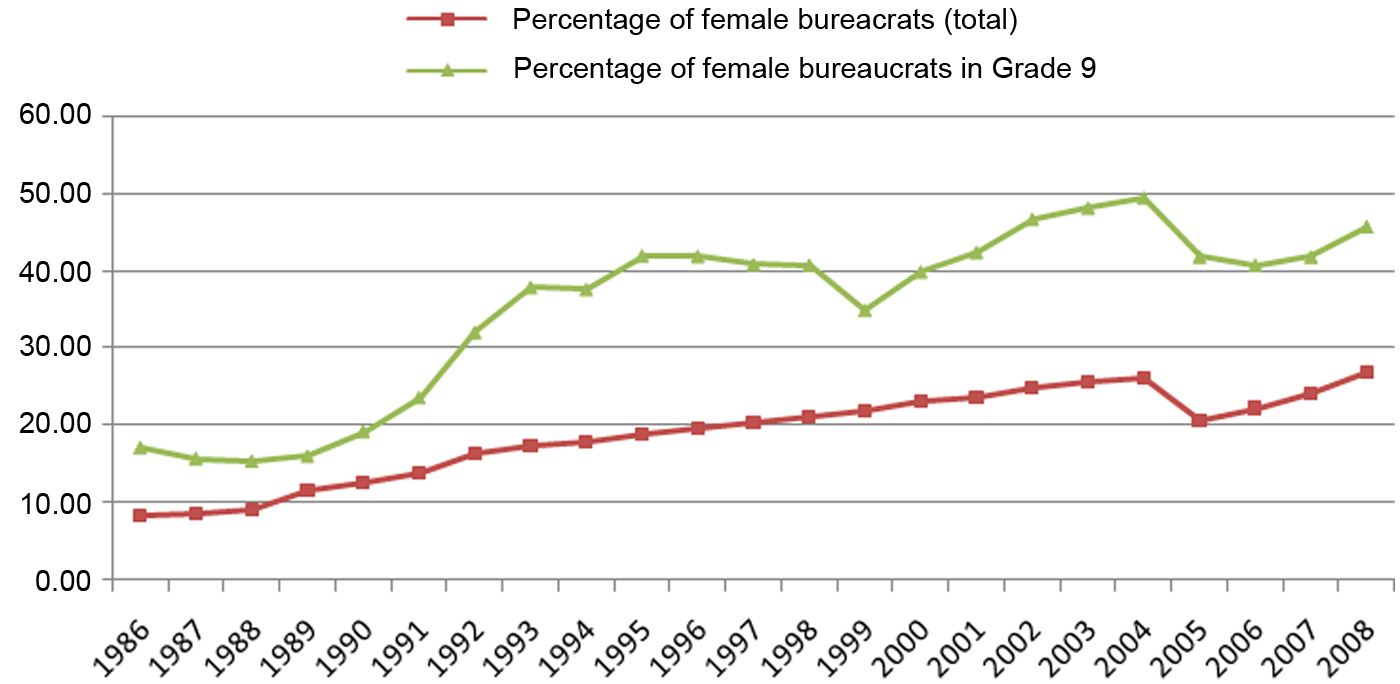
Percentage of female bureaucrats (total and Grade 9).
Meanwhile, it should be noted where female officials are located within the bureaucracy. Gender representation is achieved when female bureaucrats are substantially integrated into the bureaucracy and advanced to a high position (Page, 1994). Minorities and women tend to be concentrated at lower levels and are underrepresented at higher levels. As shown in Figure 2, the proportion of female bureaucrats above Grade 5 to the total employees was almost up to 10% in 2008. Affirmative Action for Grade 5, first introduced in 1996, led to controversies over adverse discrimination; however, the beneficiaries of the Affirmative Action were diminished to nearly zero within a few years.
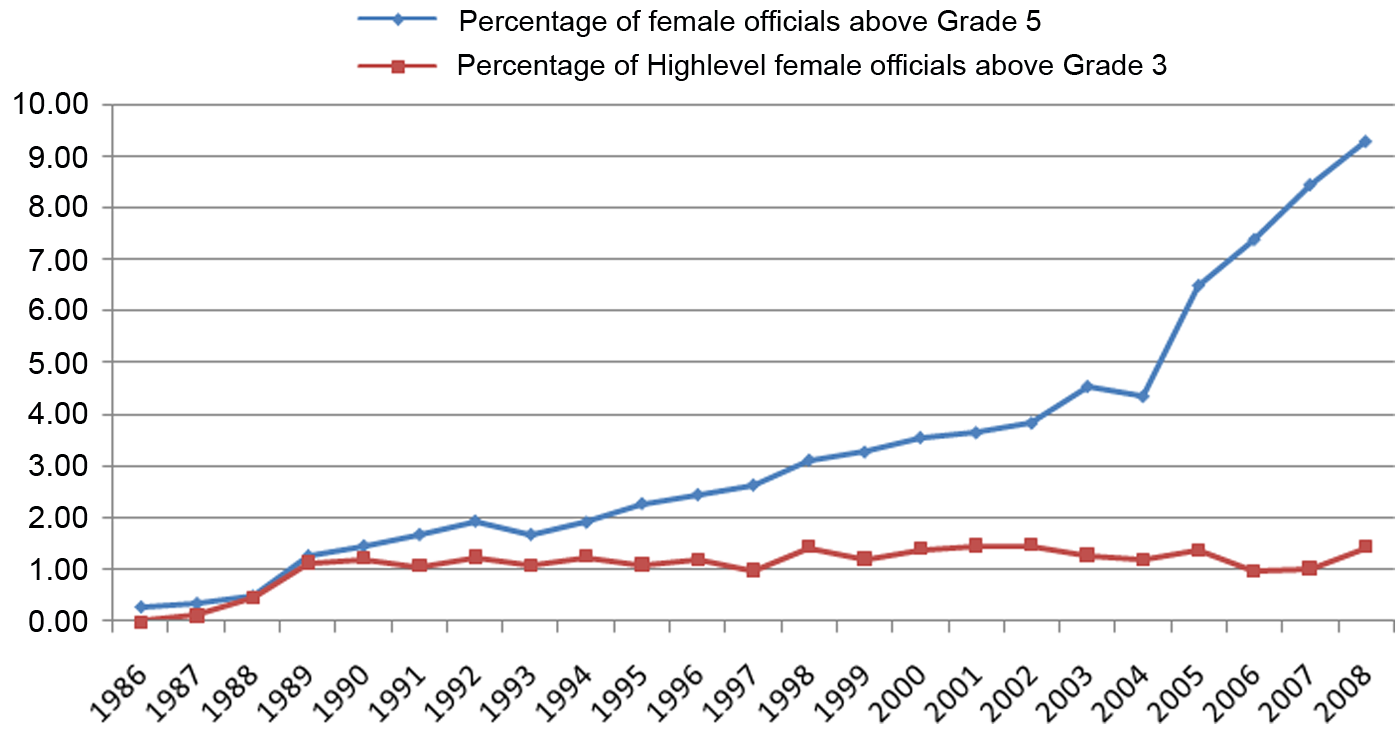
Percentage of female bureaucrats (high-level and Grade 5).
Despite the sharp increase in the percentage of females above Grade 5, it seems that very few reach the level of decision-making power. Women still tend to be concentrated around the entry level and may have problems in promotions to the top of the pyramid. The proportion of female bureaucrats at high positions is still insignificant and consistently represents around 1% to 1.5 % over the 20 years. This implies that overt discrimination against women may disappear, but it is hard for women facing invisible barriers to advance to high positions in the managerial hierarchies (Bullard & Wright, 1993; Stivers, 2002).
The descriptive data presentation allows us to understand the overall trend of gender representation in the Korean bureaucracy. It is fair to say that gender representation in Korea has improved; however, whether its contribution to governmental performance has worked out as expected remains to be empirically proven. In the next section, the relationship between gender representation and the outcome of government activities will be tested in the context of Korean bureaucracy over 30 years.
Gender Representation and Governmental Performance
Descriptive statistics and correlations among the study variables are presented in Tables 2 and 3.
Descriptive Statistics.

Correlations Among Variables.

Note: All the coefficients, except coefficients marked by superscript “a,” are statistically significant at the .05 level.
Since the analysis was based on time series data, ordinary least square regression may have led to bias because of autocorrelations among error terms. 10 In this study, we adopted a frequently used method of modeling stationary time series: ARIMA (p, d, q), in which p denotes the number of autoregressive (AR) terms, d the number of times the series has to be differenced before it becomes stationary, and q the number of moving average (MA) terms. 11 The autoregressive term refers to the period of autocorrelation. As the unit of analysis is 1 year in this data set, an AR(1) indicates that the model takes into account the yearly mean measured a year earlier (Yt = θ1Yt-1 + ϵt ). An MR(1) means that a moving average process is simply a linear combination of white noise error terms (Yt = ϵt + θ1ϵt-1). The AR and MR terms in each model were identified by comparing the autocorrelation and partial correlation graphs.
Table 4 gives the statistical results of time series regression of the models, which are highly robust to the addition or removal of variables. We examined three different categories: the percentage of total female bureaucrats (Model 1), the ratio of female bureaucrats above Grade 5 (Model 2), and the ratio of high-level female bureaucrats (Model 3). Although our model covers 30 years from 1978 to 2008, the number of observations of the models is 25 in time series data with gaps including 1978, 1983, and 1986 to 2008. The results support the overall hypotheses that gender representation is positively associated with bureaucratic performance.
Results of Time Series Regression Explaining Bureaucratic Performance.
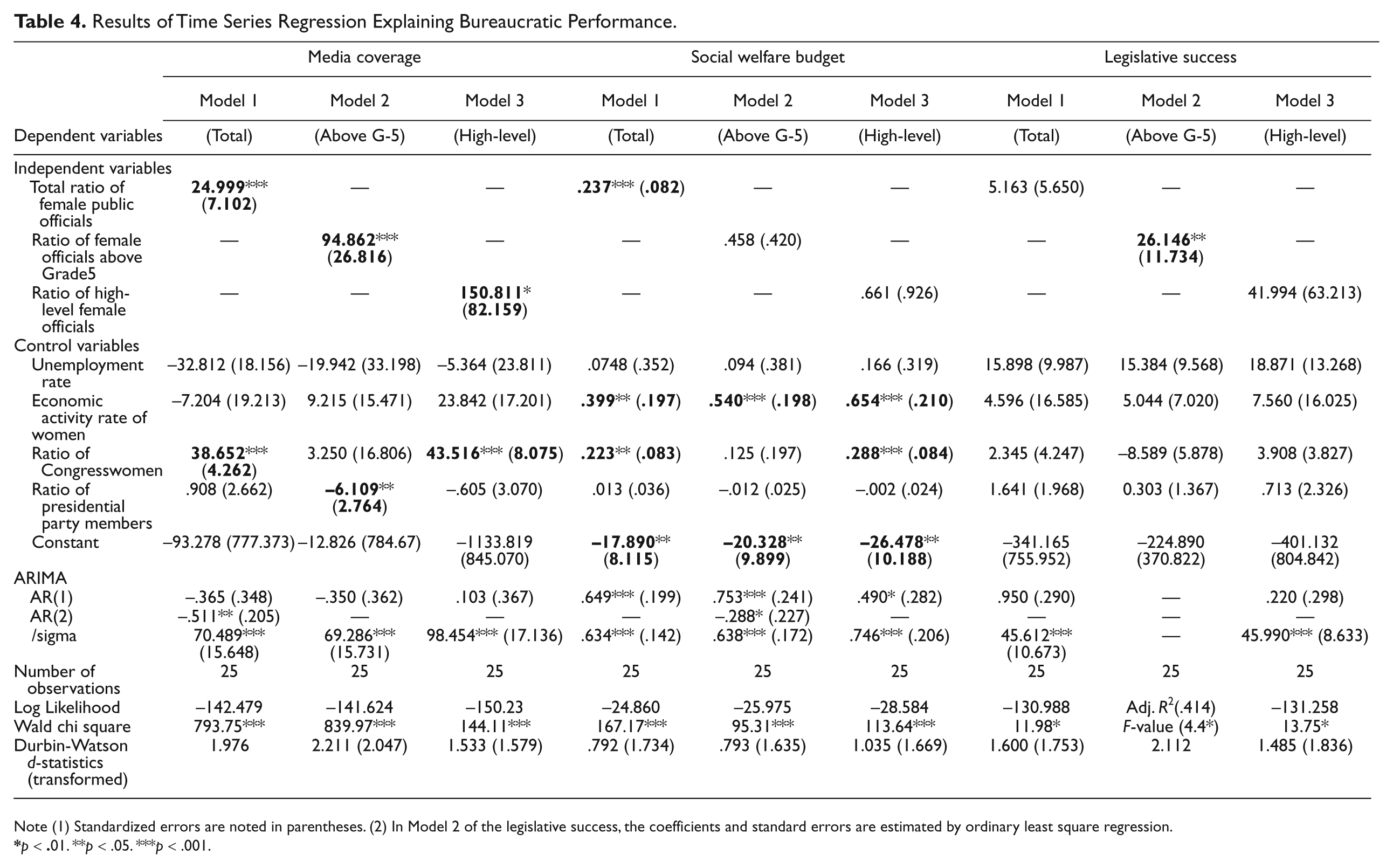
Note (1) Standardized errors are noted in parentheses. (2) In Model 2 of the legislative success, the coefficients and standard errors are estimated by ordinary least square regression.
p < .01. **p < .05. ***p < .001.
The first set of analyses considered the public interest in the women’s issues expressed in the media articles. All coefficients for the independent variables in each model were positive and statistically significant when estimating with ARIMA (2, 0, 0) and ARIMA (1, 0, 0). This result indicates that passive gender representation in the executive branch affects the media coverage on women’s issues. In the three models with different independent variables, the coefficients increased with the Grade of female bureaucrats, meaning that the effect of gender representation at higher levels would be more substantial. The coefficient pattern was consistent with the theoretical expectation that the higher the position, the stronger the impact of gender representation on governmental performance.
In the meanwhile, the proportion of female members in the National Assembly affects the dependent variable (media interest) in Model 1 and Model 3. In Model 1 with the independent variable of the total ratio of female bureaucrats, the coefficient of the control variable (38.652) was larger than that of the independent variable (24.999), indicating that the gender representation in the legislative branch may be even more crucial in arousing media interests in women’s issues than the gender representation in the executive branch. For every 1% increase in the total ratio of female bureaucrats, the number of articles concerning women increased by approximately 25, while the number increased by 39 for every 1% increase in the ratio of congresswomen.
This result can be interpreted in terms of the importance of gender representation in the legislative branch. Partly due to the high visibility, the impact of the gender representation in the legislature on media coverage seems to be more intense than that of the gender representation in bureaucracy. Considering the symbolic and substantive consequences, many countries adopt voluntary and mandatory quotas for women in Congress.
To investigate the second hypothesis, regression models with the dependent variable of the proportion of social welfare budget were conducted. Model 1 with the percentage of total female bureaucrats showed statistically significant results in the hypothesized positive direction. The evidence for the importance of the economic variable for the changes of the social welfare budget was particularly strong and reliable. This is not surprising given the significance of the economic environment to the yearly budget. Moreover, the economic activity rate of women reflects the overall social demand for equal opportunity as well as more sensitivity of female employment to the economic downturn.
The ratio of the social welfare budget changed systematically with the percentage of female members of the National Assembly in Model 1 and Model 3. The coefficients were equivalent to that of the independent variable with the degree of gender representation in the executive branch. For every 1% increase in total ratio of female officials, the proportion of the social welfare budget increased 0.237 percentage points, and for every 1% increase in the ratio of congresswomen, it showed an increase of 0.223 percentage points. This is also understandable, considering the fact that the budget is ratified by the National Assembly.
The third model was developed to explore the legislative success and rule-making power of the executive branch. The dependent variable is the number of passed bills submitted by the government. As expected in Hypothesis 3, the positive impact of the ratio of female bureaucrats over Grade 5 on the dependent variable was found. Although the ratio of total and high-level female bureaucrats failed to achieve statistical significance, it is meaningful in the sense that it is the Grade 5 who draft and introduce executive bills to the Assembly and they have been rapidly increasing since early 2000. As the percentage of female bureaucrats above Grade 5 increased, the number of passed bills submitted by the government increased by 26.
Nevertheless, the other control variables including the proportion of female congress members were not significant in the third set of models, which is in line with the result of the previous research on the bill passage of women legislators. This is partly because women and men are similar in their legislative activities though having different priorities (Saint-German, 1989; Thomas & Welch, 1991). Or women legislators may be hesitant to introduce bills in their interest because of the high visibility of the behavior as tokens (Carroll, 1994; Kanter, 1977b; Kanthak & Krause, 2010; Thomas & Welch, 1991).
Furthermore, the ratio of the presidential party of the National Assembly was not found to be significant, except for the one model for media interest. This requires more explanation. Specifically, it is noteworthy that the two characteristics of the legislative branch were found to have no significant effect on the rule-making power of the executive branch. Part of the reason can be found in the long-standing legislative–executive relationship through the democratization in 1987; under the authoritarian government, the National Assembly had worked largely as a rubber stamp in the hands of the presidents. In addition, unlike the legislative bills that are driven by the incentive of the congress members seeking public recognition, the executive bills based on the bureaucratic expertise are relatively more refined and well organized. This leaves little room for the legislature to reject the executive bills.
This article finds evidence that gender representation does matter to the governmental performance. It contributes to the significant changes of governmental influence and capacity measured by the media coverage, the social welfare budget, and the legislative success in the executive branch. Equally interesting is that gender representation in the legislative branch gained statistical significance, showing the importance of top political leadership.
Conclusion
How does gender representation in the public bureaucracy make a difference in governmental performance? Is the representative bureaucracy associated with higher levels of performance, or at least with changes of governmental activities? This study is an effort to address this question by employing empirical models.
The current trend of gender representation in Korea confirms that the glass ceiling against women in the public bureaucracy is still present, despite an unarguable improvement. This implies that there remains a long way to achieve gender representation in Korean bureaucracy. A clear pattern of gender representation shown in the descriptive statistics and figures raises intriguing questions whether or not the gender representation in various grade levels can make a substantial difference on bureaucratic performance in a comparative perspective.
Taken together, this article extended previous research on the representative bureaucracy by identifying missing links among key concepts and examined the impact of gender representation in the public bureaucracy on performance with a long-term view by employing empirical models. There are few studies attempting to assess the consequences of diversity over time (Watson et al., 1993). Since representation and diversity in the public bureaucracy cannot be easily achieved in a short time, longitudinal research is important to fully understand diversity management and its effect (Wise & Tschirhart, 2000).
Findings of this study support the contention that a representative bureaucracy influences substantive consequences on governmental performance. Passive representation of women not only affects policies in specific areas (Wilkins & Keiser, 2004) but also affects overall governmental influence and competence, which is fundamental to effective government providing high quality service. Although we know little about the inner mechanism of effective representation and responsiveness, this suggests that the increased proportion of women in the executive branch leads to higher government performance.
The positively significant impact of the media coverage on women’s issues was directly correlated with the level position in the hierarchical system of bureaucracy. The ratio of the social welfare budget was positively associated with the total ratio of female bureaucrats. What is noteworthy is that a change in the percentage of total female bureaucrats as well as congresswomen brings a corresponding change in the percentage of the social welfare budget. The relationship between the increase of female bureaucrats and the executive bills was partly confirmed in Model 2 with the ratio of female bureaucrats above Grade 5. However, the passage of executive bills was not significantly related to the ratio of female congress members.
While the increase of females in the legislative branch has a different effect on each performance measure, we know from previous research that some proportion of women with some degree of discretion should be secured to make a difference in decision making and policy implementation (Kanter, 1977b; Keiser et al., 2005; Thompson, 1976). More notably, however, the finding implies that passive representation in gender is important in itself. The possibility of active representation or passive-active link is a matter that can be addressed after achieving demographic representation.
In that sense, the results of this study have important policy implications that encourage the attempt to introduce and institutionalize gender mainstreaming strategies by the government. Although there remains deeply rooted pessimism, fatigue, and ethical issues involving these measures, more proactive efforts for promoting women’s participation in decision making are still worth pursuing. Since 2002, there have been legal measures to correct the inequality in gender such as gender impact assessment, gender responsive budgeting, and affirmative action in the high-level positions in public bureaucracy and the legislature. Even though these legal measures are not effective enough, they could be a strong signal for a supportive environment for women. In addition, strong commitment of top political leadership plays a momentous role in breaking the sources of prejudices and discrimination against minorities (Caiden & Caiden, 2001). Not as tokens but as agents of change, we expect that female officials in the leadership position positively affect governmental performance. Nevertheless, the study has some issues to be addressed in future research. Since this research focused on central bureaucracy, it is impossible to compare the impact on performance with other different types of organizations in various policy areas.
Although the impact of gender representation on performance turned out as predicted in the existing literature, there are many intervening factors that could affect government performance. It was almost impossible to control all the variables that other studies found to interact or intervene in the relationship. The results indicate the complex ways in which gender representation affect governmental activities leading to bureaucratic performance. Another issue is that of the measurement of the government performance dimension. Although there is no single way to measure performance, the dependent variables chosen in this study may raise concerns and debates.
Footnotes
Appendix
Acknowledgements
The author would like to thank Professor Gerald E. Caiden at the USC Sol Price School of Public Policy for the insightful comments and suggestions. I am also indebted to my colleagues, Felicity Hwee-Hwa Chan and Noah Dormady for providing helpful comments and encouragement.
Declaration of Conflicting Interests
The author declared no potential conflicts of interest with respect to the research, authorship, and/or publication of this article.
Funding
The author received no financial support for the research, authorship, and/or publication of this article.