



Abstract
This article investigates competing visions of how regional organizations influence cooperation among individual local governments within a metropolitan area. As network brokers among local governments, regional organizations can reduce the transaction costs of self-governing solutions to regional problems through bargaining and contracting among local units, but their centralized activities might also crowd out interlocal exchanges. Florida Regional Planning Councils are examined to test competing hypotheses based on these two visions, identifying the influence of regional organizations’ governance and activities on interlocal revenue transfers among municipal governments. Evidence that regional organizations can complement as well as substitute for interlocal cooperation is reported. In conclusion we discuss these findings in the context of vertical and horizontal federalism and theories of institutional collective action.
Fragmented jurisdictional authority produces collective action dilemmas, such as overexploitation of common pool resources and decision externalities of overlapping jurisdictions. While scholarly attention to these problems goes back several decades (e.g., Studenski, 1960; Zimmerman, 1974), more recent work explores the institutional arrangements designed to resolve institutional collective action (ICA) problems in metropolitan governance ranging from decentralized agreements to centralized authority (Feiock & Scholz, 2010; Miller, 2002; Walker, 1987). Metropolitan regions in the United States have been a primary arena for the study of ICA dilemmas. Rapid population growth in metropolitan areas contributes to localized externality problems and dilemmas of creating and maintaining institutions to effectively address those problems. 1
Two contrasting mechanisms to address regional institutional collective action dilemmas have been examined: collective governance through decision bodies representing all local governments in a region or individualistic agreements and exchanges among local governments. Metropolitan or regional governance bodies with adequate authority can effectively mitigate ICA dilemmas in metropolitan areas (DeHoog, Lowery, & Lyons, 1990; Downs, 1994). In this approach, scholars promote regional districts as the most efficacious mechanisms to address regional and interjurisdictional issues (Lowery, 2000).
A second approach emphasizes horizontal contracting among individual governments through self-organizing relationships (Feiock, 2004; Feiock & Scholz, 2010). This approach builds on a regional governance perspective, which assumes that diverse actors voluntarily pursue common goals when transaction costs are low. In this approach, local governments develop consensual and flexible relationships with other units to address joint problems. This view emphasizes the virtues of voluntary interlocal cooperation where each government is believed to best serve the collective preferences of its citizens for public services (Savitch & Vogel, 2000).
There are advantages to each approach. Self-organizing systems facilitate voluntary exchange and are flexible and adaptive to specific circumstances, but centralized collective mechanisms are better able to act authoritatively and address collective problems where goal conflicts among actors produce risks of defection from collective agreements. Thus voluntary exchange is advantageous for coordination activities, but central authority is superior and entails less transaction costs for higher risk cooperation.
The literature has tended to study collective decision bodies and interlocal exchanges in isolation. Instead, this article investigates how the roles that regional organizations play in regional governance influence interlocal revenue exchange through the lens of the institutional collective action framework (Feiock & Scholz, 2010). Although many scholars have addressed the importance of regional governance for solving regional problems (Gulick, 1957; Stephens & Wikstrom, 2000; Walker, 1987; Wikstrom, 1977), we lack research on the mechanisms by which those regional level institutions affect interlocal relations. Many questions of how and to what extent contractual collaboration among individual governments is influenced by regional organizations remain unanswered.
This research examines the influence of regional organizations on interlocal cooperation in solving problems of fragmented authority in metropolitan areas. On one hand, regional organizations are posited to reduce the transaction costs of solving regional problems by facilitating bargaining and contracting among local government units. On the other hand, regional organizations might also crowd out or substitute for voluntary cooperation through their centralized activities. Much of extant research accepts the first view as correct and has not seriously addressed the second view or examined these two competing perspectives together. In contrast, this research seeks to provide an integrated view of regional organizations’ effects on interlocal cooperation among their members by examining how they might both stimulate or impede collaborative resource exchange among individual governments.
Interlocal Service Cooperation Through Fiscal Transfers
Horizontal cooperation has been extensively studied in collective action among local governments for common pool resources (Lubell, Henry, & McCoy, 2010a, 2010b; Lubell, Schneider, Scholz, & Mete, 2002; Mullin, 2007, 2008; Ostrom, 1990; Schneider, Scholz, Lubell, Mindruta, & Edwardsen, 2003). Several scholars have also studied the influence of interlocal cooperation on economic development policy (Feiock, Lee, & Park, 2012; Lee, Feiock, & Lee, 2012; Lee, Lee, & Feiock, 2012; Olberding, 2002).
Examining intergovernmental revenue transfers provides important insights into service collaboration (Bickers & Stein, 2004; Campbell & Glynn, 1990; Krueger, 2006; Krueger & Bernick, 2010; LeRoux & Pandey, 2011; Stein, 1990). The magnitude of fiscal transfers among governments can reflect mutual trust between jurisdictions (Kwon & Feiock, 2010; Sherstha & Feiock, 2011) and the level of service cooperation (Krueger, 2006; Krueger & Bernick, 2010; LeRoux & Pandey, 2011). Local government units operate under pressure to provide public services with less funds and improve fiscal efficiency to address possible budget shortfalls. In this situation, those local governments can produce scale economies and obtain efficiency gains by jointly producing or contracting services with neighbor governments. Thus interlocal service agreements can play an important role for local government management as increased efficiency in the use of fiscal resources helps officials to pursue career goals such as reelection or administrative career advancement (Bickers, Post, & Stein, 2010; Stein, 1990).
Regional Organization Influence on Individualistic Exchanges among Local Governments
Several scholars have focused on the importance of network relations among local officials for successful interlocal cooperative efforts (Andrew, 2006; Feiock, 2004, 2007). One limitation of these efforts is their omission of regional organizations in interlocal network relations as regional level organizations may play a significant role to facilitate interlocal horizontal cooperation (LeRoux, 2008; LeRoux, Brandenburger, & Pandey, 2010; Lubell et al., 2002).
Regional organizations provide a promising arena in which we can investigate collective versus individual mechanisms to mitigate institutional collective action dilemmas in fragmented federal systems. Regional organizations can take multiple forms such as partnerships, regional councils (or councils of government), metropolitan planning organizations, and special purpose districts. Thus regional organizations can combine elements of both vertical control and horizontal self-organizing to resolve ICA dilemmas, more common in metropolitan areas, depending on their structures and functions and governance.
For instance, regional councils can be the product of collective action among decentralized local government units as “creatures of local governments.” Alternatively, regional organizations can be mandated through consolidations or creation of regional districts by higher level governments. In this case, they are regarded as “creatures of the state” and have broad obligations that are at least partially imposed by central authorities (Feiock & Scholz, 2010, p. 17). In general, regional organizations incorporate both features of centralization and decentralization in their relations with local governments. Either or both may be efficacious, depending on the situation. Decentralized relations may complement self-organizing efforts among local governments for solving common problems, but more centralized structures and solutions sometime substitute for or crowd out voluntary cooperation efforts (Brooks, 2000; Scholz & Lubell, 2001).
This research examines interlocal collaboration focusing on the roles that regional councils play for the local governments contained within their boundaries. Although the responsibilities of many regional organizations may be confined to one specific purpose such as economic development, transportation, and preservation of water resources, regional councils are multipurpose regional entities and thus provide an excellent test bed to investigate how local governments’ collaborative resource transfers are influenced by the regional organizations within which they are embedded.
Florida’s Regional Planning Councils (RPCs) are examples of entities for which both collective policy action and individual agreements among participant governments can be alternative mechanisms for regional action. In Florida there are 11 RPCs that operate as regional council with various policy goals. These councils are mandated by state law, and the statutory purpose of these organizations is to address interjurisdictional regional problems. The regional planning council is recognized as “Florida’s only multipurpose regional entity that is in a position to plan for and coordinate intergovernmental solutions to growth-related problems on greater-than-local issues, provide technical assistance to local governments, and meet other needs of the communities in each entity” (186.502(4), Florida Statutes). Each RPC’s governing board is composed of around 30 members including local elected officials, who are major members, officials appointed by the Governor, and ex officio nonvoting members appointed by the Governor. While RPCs cover all counties in Florida geographically, the number of counties serviced by RPCs varies from 3 in South Florida RPC to 11 in North Central Florida RPC. RPCs’ revenue is derived from federal and state governments as well as local member governments. As multipurpose regional organizations, RPCs implement several common programs including regional planning, regional transportation, economic development, emergency management, and information services such as geographic information system. However, some programs are found in only specific RPCs. One example is housing assistance (West, North Central, Northeast, East Central, and South Florida RPCs). Table 1 provides specific information on Florida RPCs.
Summary of 11 Regional Planning Councils in Florida (2002).

Source: 2002 Annual Reports of Regional Planning Councils; 2003 Florida Statistical Abstract.
Recent work has distinguished collective institutional mechanisms such as regional governments, special districts, and other regional organizations that make binding or nonbinding decisions that apply to all jurisdictions within its territory and individualistic mechanisms that involve exchanges and agreements that a single organization enters into with one or more other local governments, such as interlocal service agreements (Andrew, 2009; Feiock, 2009). Nevertheless, individual collaborative agreements between individual local governments are often formed within the boundaries of a regional collective institution. Thus it is important to understand how the degree to which an actor participates in the regional organization and the level of activity of the regional organization influences the likelihood that these individual-level collaborative exchanges occur among member governments. The hypotheses developed below are applied to all metropolitan cities, not just those participating in regional organizations’ governing board.
Complementary Influence of Regional Organizations
Regional organizations might complement and support self-organizing mechanisms by providing critical resources such as information, administrative resources, and social capital that reduce the transaction costs in interlocal cooperation for regional issues (LeRoux et al., 2010). Regional organizations bring leaders together in a venue that facilitates interaction (Feiock & Scholz, 2010) and can encourage exchanges among them by playing a “network broker” role (Provan & Milward, 2001). For example, Lubell et al. (2002) found higher levels of interlocal cooperation among actors in watersheds that were in the National Estuary Program.
Participation in regional organization’s governing board provides participants access to common information and opportunity for face-to-face interactions with other governments to identify common issues and problems. In addition, regional organizations with more staff and financial resources may be better able to engage in network brokerage activities by increasing information and social capital among local governments in a given region. Administrative resources are important because they provide the capability for local governments to engage in continuous communications and have regular meetings. As Axelord (1984) and Ostrom (1990, 1998) argue, the stable and repeated interactions develop shared norms among the actors and improve mutual trust and reciprocity in the process of collective action for regional issues. The brokerage role of regional governance organizations helps local authorities reduce transaction costs and uncertainty in contracting and making a collective decision with another government. In addition to a regional organization’s overall amount of resources, the portion of its resources derived from intergovernmental grants needs to be considered separately. Although grants are typically allocated for resolving interjurisdictional problems, the design and purpose of the funds reflects regional goals perceived at the state and federal levels. Where regional organizations are able to channel more grant information and resources from higher level governments to communities, they can provide more opportunities for interlocal collaboration and reduce transaction costs. Thus this vision yields the following hypotheses:
Hypothesis 1a: City participation on the governing board of regional governance organizations will increase the likelihood and amount of collaborative resource exchange with other local governments.
Hypothesis 1b: Greater administrative resources available through regional organizations will increase the likelihood and amount of collaborative resource exchange with other local governments.
Hypothesis 1c: Greater intergovernmental resources in regional organizations will increase the likelihood and amount of collaborative resource exchange with other local governments.
Substitutive Influence of Regional Organizations
While certain characteristics of regional organizations can improve horizontal regionalism and thus facilitate resource exchange among their members, certain other activities of the organizations might impede this activity. Even when they function as a pass-through for federal and state grant funds on to local governments, they operate as a gate keeper. Previous research has not paid sufficient attention to the potentially divergent roles of regional organizations on self-organizing collaboration. Extant empirical analyses do not identify if and when regional organizations might stimulate or impede individual self-organized exchanges. The limited research to date suggests tradeoffs between centralized and decentralized activities in solving multijurisdictional problems (Lubell et al., 2010a, 2010b; Mullin, 2009).
For example, Mullin’s (2009) work reports that water districts substitute, rather than complement, interlocal contracting for water supply. She examines whether a special district that functions across multiple jurisdictions to address collective action problems with flexible boundaries complements or substitutes for ad hoc voluntary interlocal water policy agreements. Her results show that districts with the ability to expand boundaries reduce the occurrence of voluntary agreements among local governments. Mullin suggests that a proactive institutional entity in a region may crowd out potential cooperation network relations among local general governments.
Regional organizations often implement programs imposed by higher level authorities such as the state government in a top-down manner. Regional organizations may also seek to inculcate regional norms that reflect the state’s centralized vision of regionalism, rather than helping local governments cooperate with each other to individually solve collective problems on their own. Membership on the governing board of a regional organization can reinforce these regional or state norms. The resources of a regional organization may support activities that decrease the perceived need for interlocal cooperation. Greater staff and financial resources may enable regional organizations to play a more proactive centralizing role that could potentially crowd out or substitute for horizontal agreements and contracting among local governments.
This substitutive influence may be especially salient when regional programs are accompanied by large grants from federal and state governments. Regional organizations that secure higher levels of federal and state funding have the leverage needed to infuse values supporting standardized and centralized solutions. Activities for implementing federal and state goals might also then crowd out self-organizing efforts among individual governments to craft solutions for joint problems. Thus this vision of regional organization hypothesizes an inverse relationship with interlocal collaboration:
Hypothesis 2a: City participation on the governing board of regional governance organizations will decrease the likelihood and amount of collaborative resource exchange with other local governments.
Hypothesis 2b: Greater administrative resources available through regional organizations will decrease the likelihood and amount of collaborative resource exchange with other local governments.
Hypothesis 2c: Greater intergovernmental resources in regional organizations will decrease the likelihood and amount of collaborative resource exchange with other local governments.
Additional Influences on Interlocal Cooperation
We test these competing hypotheses regarding the influence of regional organizations on interlocal revenue exchange and control for the additional factors that have been linked to collaboration and interlocal fiscal transfers. The institutional collective action framework identifies several factors that motivate local governments to enter into cooperative efforts to solve collective problems. At the individual level, collective action is intendedly rational and goal directed, so collective action is more likely to be achieved in small groups because the actors can easily recognize and reduce their transaction costs of cooperation (Olson, 1965). However, explaining institutional collective action is more complex since multiple factors influence the transaction costs of interlocal cooperation (Feiock, 2007; Post, 2004).
Economic and demographic conditions create needs and stimulate demands for interlocal cooperation. Cost savings are often a primary reason why local authorities cooperate with each other (Post, 2004). The value of economic efficiency can become more important when a local government is under economic stress (Carr, LeRoux, & Shrestha, 2009). While there are some studies that report no significant impact of economic conditions on interlocal cooperation (e.g., Chen & Thurmaier, 2009; Morgan & Hirlinger, 1991), the preponderance of research suggests that when local governments lack sufficient fiscal resources for service provision, they may take advantage of other local governments by contracting with them for local services (Agranoff & McGuire, 2003; Bickers et al., 2010; Carr et al., 2009; Ferris, 1986; Krueger & Bernick, 2010; LeRoux & Pandey, 2011; Sonenblum, Kirlin, & Ries, 1977; Stein, 1990; Wood, 2006).
Demands for interlocal cooperation in specific service areas are also influenced by population changes. Local governments that experience slow growth or population losses face a shrinking tax base with less local government resources and diseconomies of scale in public service provision. Thus we expect that local governments experiencing economic and population challenges are more likely to cooperate with other local governments.
Even if local governments are motivated to work collaboratively with each other, implementation of cooperative relationships is difficult because several barriers obstruct voluntary cooperative efforts. The extant literature on interlocal cooperation links these barriers to differences in policy preferences among citizens (Feiock, 2004; Post, 2004; Steinacker, 2004). Homogeneity reveals potential common policy goals and service preferences. Divergent preferences within and between communities often deter efforts to engage in cooperation with neighboring communities (Feiock, 2007).
Community diversity can be best captured by the degree of demographic heterogeneity. Homogeneous communities may experience less asymmetries of political and economic power among residents. Compared to a homogeneous community, a highly heterogeneous local government may generate difficulties for negotiating fair distribution of cooperative gains among diverse interests. The negotiation process is linked to high transaction costs that deter or delay the decision to enter into interlocal cooperation. Heterogeneity increases agency costs for local officials in aggregating diverse values and preferences within their communities. In addition, dissimilarity between jurisdictions also makes negotiating for interlocal cooperation more difficult. Accordingly, interlocal cooperation is likely to be more successful among local governments that have demographically homogeneous characteristics.
It is important to separate out the influence of regional organizations from effects due primarily to geographic proximity. As the geographic borders of local governments are fixed, local governments are limited in finding cooperative partners and often cooperate with other governments in close geographic proximity (Post, 2004). This institutional setting is especially important in metropolitan areas because local governments not only share problems and interests but they also have more potential partners to cooperate with. Thus cooperation is more likely if local governments can obtain information on each other’s fiscal and service needs through repeated interactions.
However, the presence of a larger number of local governments in a metropolitan area might also create difficulties in collecting reliable information on preferences and resources of potential cooperation partners, because each local government expends time and resources in identifying its best options for collaboration partners. Information costs resulting from a large number of potential partners might then impede cooperation with other local governments (Kwon & Feiock, 2010). With insufficient information, a local government is less likely to engage in fiscal cooperation activities.
Local political institutions are also identified as salient because the incentives that motivate the actions of public officials who participate in these decisions are shaped by the institution structures at the local level (Clingermayer & Feiock, 2001; Zhang & Feiock, 2010). Many scholars study the influence of selective interests and incentives on the policy decision making and the design of public agencies based on a transaction cost theory (Burns, 1994; Dixit, 1996; Epstein & O’Halloran, 1999; Feiock, Jeong, & Kim, 2003; Frant, 1996; Miller, 2000). Both executive and legislative institutions are linked to interlocal cooperation. Understanding the consequences of different institutions has been a major theme in this literature (Feiock, Steinacker, & Park, 2009; Frederickson, Johnson, & Wood, 2004a, 2004b). Council-manager government systems are typically viewed as conducive to cooperative service relationships (Feiock et al., 2012; Matkin & Frederickson, 2005). This may reflect fewer high power political incentives (Clingermayer & Feiock, 2001; Feiock et al., 2003; Frant, 1996) as well as the career paths of professional city administrators that lead them to be interested in more efficient service provision through interlocal cooperation.
Rather than treating form of government as dichotomous, Frederickson and his colleagues detail how over time communities incrementally adapt their charter provisions to existing conditions (Frederickson et al., 2004a, 2004b; Frederickson & Johnson, 2001). One prominent change is the creation of a chief administrative officer (CAO) position within a mayor-council government structure (Ammons, 2008; Frederickson et al., 2004a; Keene, Nalbandian, O’Neill, Portillo, & Svara, 2007). In cities with the mayor-council form of government a CAO position is one way to bring professional management to local government administration without changing the form of government (Ammons, 2008). By authorizing the CAO position, non-council-manager governments can take advantage of administrative professionalism that was originally designed in the city manager system and expect that CAOs’ functions are equivalent to those of city managers (Svara, 1999).
Many studies examine executive institutions, but neglect legislative institutions. Policy decisions are likely to be different in cities with at-large election and cities with ward-based election systems since council members are assumed to have different interests and incentives depending on how they are elected (Morgan, England, & Pelissero, 2007). A council elected at large tends to be less encumbered by geographically specific interests and thus is more likely to share the executive’s citywide interests. However, council members elected by districts will advocate the interests of the district specific constituencies they represent and thus may pay less attention to at-large preferences that differ from those of their constituents.
Research Design
The empirical analysis examines interlocal financial cooperation within Florida Metropolitan Statistical Areas (MSAs). The information on MSAs in Florida, including Regional Planning Councils that cover the MSAs and the number of cities and population in each MSA, is shown in Table 2. We examine how RPC characteristics and local governments’ involvement in RPCs influence the amount of intergovernmental revenue that communities received from other local governments. 2 The units of analysis are cities and the dependent variable is measured by coloration through interlocal revenue transfers as a percentage of the cities’ total revenue. 3 While the actual amount of the transfers indicate individual city’s commitment to cooperation, taking the percentage rather than actual dollar amount allows us to control for differences in city size and budget. Local governments receive intergovernmental revenue from other local governments for multiple purposes, including performing specific local service delivery functions, general financial assistance, service contracting, and tax sharing. 4 Thus, while the purposes can be specific or general, the fiscal resources from other local government are used as a tool for cooperation that assists the recipient governments to better address their services needs. Government finance data were extracted from the 2002 Census of Governments.
Florida Metropolitan Statistical Areas and Regional Planning Councils (2002).

Source: 2003 Florida Statistical Abstract.
Note: In 2002, there were 67 counties, 405 municipalities, and 16,674,608 residents in Florida.
Although some collaboration is nonfinancial, we measure financial collaboration because it strongly correlates with other types of collaboration and it reflects resource commitments. Systematic data are not available on formal agreements in Florida, but, even when written agreements are present, they may be primarily symbolic, in that they involve no resource commitments (LeRoux et al., 2010). Interlocal revenue-based measures have the advantage of capturing only agreements that involved resource exchange through revenue transfers. In addition, it allows us to capture the magnitude of exchanges since revenue transfers are measured in dollars. We examine interlocal revenues rather than expenditures since revenues can better measure interlocal cooperation dynamics as interlocal expenditures are observed in only a small number of cities. 5 In addition, we analyze the total amount of interlocal revenues rather than separating the revenues among specific service areas for two reasons. First, it is more common that cities receive interlocal revenues for general purposes under the “general local government support” category and spend funds with their own discretion. Second, the U.S. Bureau of Census classifies the “other” category by summing up the amount for local aid for specific purposes that do not have separate codes. Thus only a small number of cases are observed for specific service contracting. 6
For each municipality we identify representation on the Regional Planning Council governing board. If a city was a governing board member for its RPC, it has the value of 1, otherwise 0. This directly captures a city’s engagement in its RPC as a superior alternative to measures used in previous studies, such as the local officials’ perception of participation (LeRoux et al., 2010).
The regional planning council level data includes both personnel and budget resources, and revenue from federal and state grants. RPC staff and budget sizes are measured by RPC staff per 100,000 residents and budgeted funds per resident, respectively. Because the measures are highly correlated (.902), we include only administrative staff resources in the model. 7 RPC revenue from federal and state grants represents federal and state grants as a percentage of their total revenue. These data are gathered from several types of documents for each RPC: annual reports, governing board meeting minutes, and financial reports.
Several additional explanatory variables are included in the analysis. Density of governments is measured as the number of municipal governments per county reported in the 2003 Florida Statistical Abstracts. 8 Information on government forms and representation systems were collected by searching each municipality’s website and conducting e-mail survey of the local governments. Although most municipal governments in Florida have council-manager form of government, a substantial minority, including some of the largest population areas, has mayor-council form. The form of government is classified with two dummy variables indicating council-manager structure, and non-council-manager governments that include a chief-appointed administrator position. While it is only in place in about 10% of Florida cities, the latter form is analyzed separately from council-manager form to isolate the impact of the conventional council-manager plan form. To capture representational differences we include a dummy variable indicating at-large council election system.
Racial homogeneity is measured by the percentage of the population that is non-Hispanic White, and the racial difference between city and county is measured by the absolute value of differences in non-Hispanic White percentages between a city and a county where the city is located as reported in the 2000 Population Census. Demands and need for interlocal cooperation are measured by two variables. First, fiscal position is measured as the percentage of own revenue source from total revenue, which indicates a city’s fiscal capacity that increases or decreases the demand for interlocal revenues. Although it is possible that cities with high level of own revenue source can seek more grants from other governments, cities that do not have sufficient internal available resources have more fiscal problems and will more likely to receive fiscal resources from neighboring local governments. This variable is obtained from 2002 Government Census. Second, population change is included to show whether the general demand for local services is increasing or decreasing. Cities with high population growth have a need to provide more services and will be likely to receive more transfers from other local governments. This variable is drawn from 2000 Population Census and 2003 Florida Statistical Statistics. Three control variables are added into our analysis. City population and median household income are derived from 2000 Population Census. We also include a dummy variable indicating if a city is the central city in the metropolitan area since central cities may be the principal target of revenue exchanges. This information was obtained from the Office of Management and Budget (1999). The descriptive statistics and measures for the variables are reported in Table 3.
Variable Measure and Descriptive Statistics.
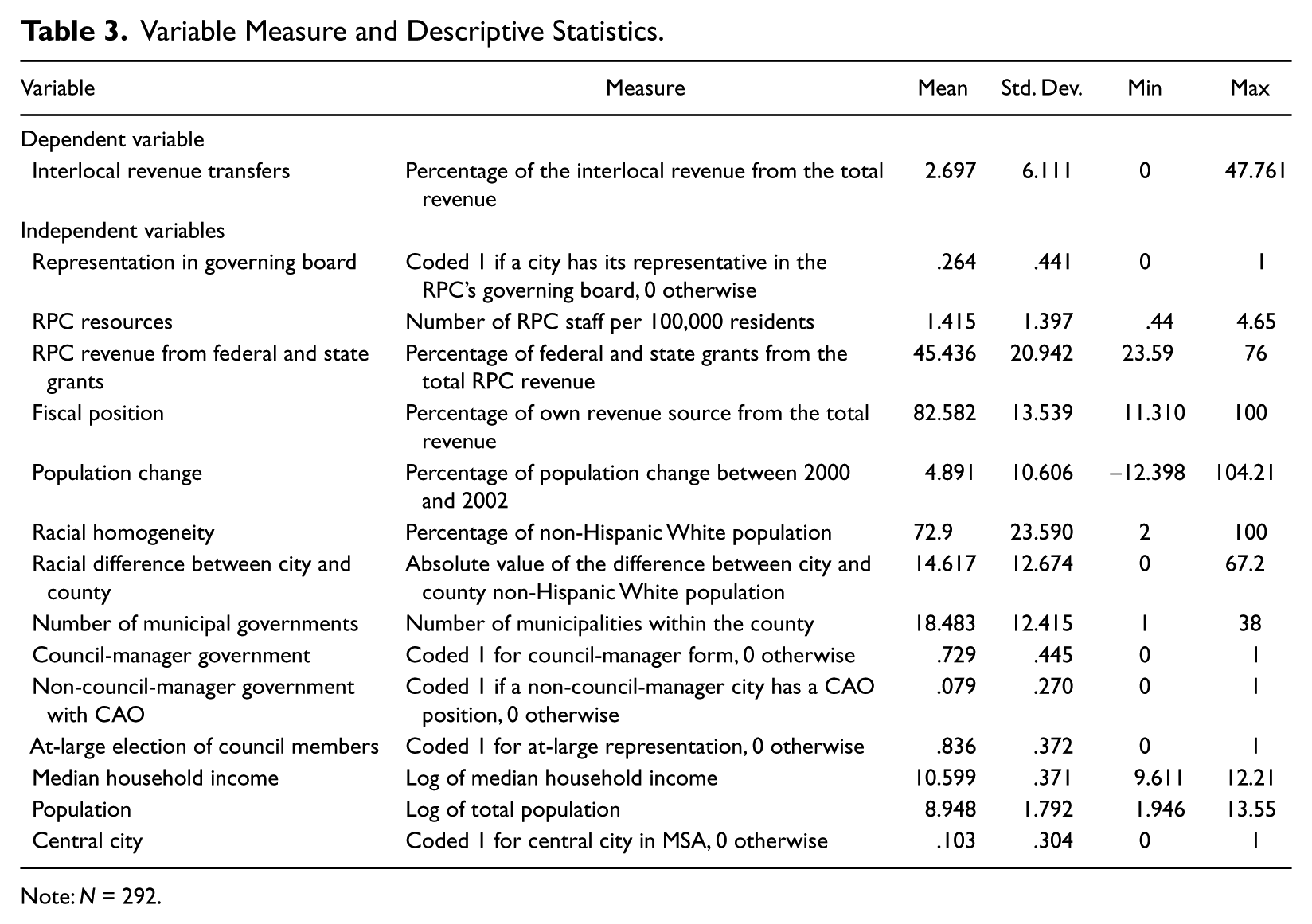
Note: N = 292.
A selection model is employed to estimate the two-stages of the decision process on resource exchange among municipalities. A selection model is commonly used to correct a nonrandom selection bias in a sample. This selection problem occurs when the dependent variable is observed only in the systematically chosen, or nonrandomly selected, sample (Heckman, 1976, 1979). In our case, this selection model is a better method than OLS if interlocal revenues are observed only in a sample that is not randomly chosen. In other words, municipalities first decide whether or not they will cooperate with other local governments through interlocal exchanges, and only those municipalities that are recipients of interlocal revenues will vary in the amount of the resource exchange. The data structure also suggests that a Heckman selection model fits the analysis of interlocal fiscal cooperation as about 30% of metropolitan municipalities have 0 values for the amount of interlocal revenue transfers. 9
While both stages examine revenue received from other governments, Stage 1 estimates whether there was any transfer, and Stage 2 estimates the amount of the transfer each city receives. At the selection stage, the likelihood of receiving interlocal revenue is anticipated to increase or decrease in response to regional organizations. Cities’ needs and the barriers they face also exert influence at this stage of the cooperation decision. The likelihood may also be shaped by political institutions, particularly if council-manager systems’ orientation toward administrative efficiency focuses attention on opportunities for collaboration. With more potential partners, local governments are more likely to consider the use of fiscal cooperation. Median household income and city population are included to control for internal economies. A central city indicator is added in this selection stage and 11 regional dummies are included in the selection equation to control for certain shared characteristics among municipalities in the same region.
Once a municipality decides to enter a collaborative resource exchange, the outcome stage decision of the actual amount of intergovernmental revenues that each municipality receives from other local governments is expected to be influenced by a somewhat different set of factors. Regional organizations and needs and demands are expected to have an important simulative influence on revenue transfers. Homogeneity between city and county is anticipated to be more important in the outcome stage of decision making. Extant work argues that political institutions variables, council-manager and mayor-CAO forms of government and at-large council election, are crucial in the outcome stage because the cooperation levels are influenced by the local officials’ perception of interests and incentives of policy actors (Lubell, Feiock, & Ramirez de la Cruz, 2009). While these variables are included in the selection stage, they are expected to play a more prominent role in the second stage decision. On the other hand, we anticipate that basic community characteristics, including city homogeneity, number of municipal governments in the county, population, and median household income, will be less important factors in decisions on the actual amount of interlocal resource exchange. Regional dummy variables are not included in the outcome equation as we assume that once each local government decides to use interlocal revenue transfers, the government’s decision on the actual amount of interlocal revenue is less influenced by geographically common characteristics among local governments in the region. A central city variable is also included in this stage.
The coefficients for the regional planning council variables capture their net impacts on interlocal exchange. A positive coefficient means that the magnitude of the stimulative effect more than offsets any substitutive effect. A negative coefficient indicates that the substitution effect is significantly greater than any complementary effect.
Results of Analysis
The results of our Heckman selection model are reported in Table 4. The selection model includes 292 out of all 305 municipalities located in Florida metropolitan statistical areas, and 86 of these cities are censored as interlocal revenues are not observed for these municipalities. The model Wald χ2 test is significant as the null that all coefficients in the regression model are 0 is rejected. The result of χ2 test of independent equations justifies our use of the selection model: the null hypothesis that rho (correlation between error terms in two equations) equals 0 is rejected, meaning that there is nonrandom selection bias between the two stages.
Heckman Selection Analysis of Interlocal Resource Exchange.

Note: Coefficients and standard errors for regional dummy variables in the selection equation are not reported.
p < .1. **p < .05. ***p < .01.
The selection equation results show that a municipality’s representation on the regional planning council’s governing board does not influence the likelihood of interlocal revenue transfers. This indicates that local governments’ participation in the governance of regional organization produces neither complementary nor substitutive impacts on collaboration.
A significant negative coefficient is reported for RPC resource levels indicating higher levels of organizational resources might substitute for or crowd out voluntary interlocal fiscal cooperation. In this instance, RPCs may reduce the likelihood that cities in the region cooperate through interlocal exchange mechanisms.
The one result consistent with the vision of regional organizations complementing self-organizing interlocal relationships is the positive influence of federal and state grants on interlocal revenue transfers. Thus regional organizations’ use of federal and state grants can facilitate self-organizing efforts. Although regional organizations spend the grants in a top-down way, those organizations are limited in executing their discretion as the grants have specific designated policy purposes. Unlike other RPC activities, grants may provide opportunities for local government officials to meet and communicate with each other on specific projects and perhaps identify additional opportunities for collaboration. This result is consistent with Bickers and Stein’s (2004) finding that interlocal agreements have a positive impact on federal grants amounts at the metropolitan level. Another possibility is that local governments are systematically advantaged in the grant process by cooperation, thus creating incentives for interlocal collaborations. Regional organizations as grant distribution agencies may stimulate interlocal cooperative efforts if cooperation with other local authorities is a criterion for grant awards.
Three other variables are statistically significant in the selection equation. First, municipal government fiscal position is inversely related to collaborative exchange. Although there are mixed findings on this issue, most previous studies suggest collaboration is seen as a mechanism for reducing costs in response to weak fiscal situations. This result supports LeRoux and Pandey’s (2011) finding of a positive relationship between per capita debt and the amount of interlocal revenue transfers of municipalities. Second, racial homogeneity has a positive impact on the likelihood of collaboration. This confirms the arguments that more homogeneous communities, that have lower barriers to interlocal cooperation, have less opposition from citizens and consider cooperation in a proactive way. Last, city population has a significant positive effect suggesting that larger municipalities are attractive partners for collaboration because of their ability to attain economies of scale in service production.
While interlocal cooperation is influenced by a variety of variables in the selection equation, the amount of these transfers in the outcome equation depends primarily on city fiscal position and form of government. While we can interpret the outcome equation as we do for OLS models, the marginal effects of those significant variables on the amount of interlocal revenues are different than the coefficients reported in this table as they are included in both selection and outcome equations. 10 Consistent with prior work, a weak revenue position stimulates reliance on cooperative agreements. The marginal effect of own revenue source is –.372, suggesting that 1% increase in the percentage of own revenue source reduces interlocal collaborative transfers by .37%. The positive relationship between the levels of resources exchanged in interlocal transfers and council-manager form of government suggests that the administrative career incentives for managers in a council manager system may induce higher levels of cooperation. The marginal effect of council-manager form is 2.34. Cities with this form of government receive 2.3% more interlocal revenue than their non-council-manager counterparts. Managers’ efficiency-seeking behaviors through interlocal fiscal cooperation may reflect selective incentives for individual advancement to management positions in larger cities or more prestigious positions (Bickers et al., 2010; Stein, 1990).
The result also suggests that regional organizations do not significantly influence the actual amount of resources directed to cooperation. Once the municipalities engage in collaborative exchanges with other local governments, the second stage decision on the amount is the direct outcome of internal factors.
Cities’ participation on their regional organization’s board has neither complementary nor substitutive effects on interlocal cooperation. This result is consistent with LeRoux’s (2008) study although she focused on local governments’ membership in their regional councils, whereas our research tests their participation in regional councils’ governing board.
While having both complementary and substitutive effects on interlocal cooperation in the selection stage, regional planning councils’ resources and the percentage of state and federal funds are not statistically significant in the second outcome stage. Each city’s decision on the level of cooperation, measured by the amount of interlocal revenue exchanged, is more influenced by internal economic and political factors.
Conclusion
Building on the institutional collective action framework, we seek to better understand how interlocal collective efforts are created, how community characteristics create demands for or obstacles to interlocal cooperation, and how self-organizing cooperative relationships are influenced by regional organizations and their network relations with local governments. This article takes some initial steps to answer these questions. By focusing on Regional Planning Councils and municipalities in metropolitan areas in Florida, we are able to investigate two different paths of potential influence of regional organizations on self-organized interlocal cooperation.
The results reveal evidence that regional organizations do have the potential to inform self-organizing interlocal cooperation efforts. When RPC resources are greater, collaborative exchange is less frequent. In this case, the proactive roles of regional organizations may substitute for voluntary cooperation relations among jurisdictions that otherwise may occur. However, the RPC revenue from federal and state governments has a complementary influence on interlocal cooperation. In the process of distributing federal and state grants directed to specific designated purposes, regional organizations favor cooperative efforts. Regional organizations may encourage joint projects that target state or federal grants that pass though the regional organization.
Evidence for the impact of the network brokerage role of regional organizations through local governments’ participation in governing regional organizations was negligible. One possible explanation is that participation on the governing board of their RPC may not sufficiently capture the ways local governments participate in regional governance. The results suggest pathways for future inquiry.
While this study focuses on the role of regional organizations, the results also indicate that interlocal cooperation is influenced by other factors. Cooperative efforts are motivated by the governments’ needs and demands for horizontal cooperation that are created by the weak fiscal situations. This is an important finding in that the literature is unsettled on this point. The influence of barriers to interlocal cooperation is also important. A highly homogeneous municipality lessens agency costs for local officials to aggregate diverse preferences among residents within their communities. Finally council-manager government was found to be an important factor for self-organizing efforts to address regional problems. This lends credence to arguments that selective career incentives of city managers may be a source of local governments’ cooperation efforts.
Thus this work has both practical and theoretical implications. Policy makers grappling with regional issues need to balance calls for regional efforts with an acknowledgement that centralized regionalism may sometimes constrain self-organizing alternative solutions. Regional organizations may have both complementary and substitutive effects on horizontal cooperation for regional problems depending on their organizational structures and functions in the relations with local entities. The empirical evidence demonstrates that the capacity of regional organizations to address regional problems may at times crowd out local problem solving through interlocal cooperation. When regional organizations play a centralized role in addressing metropolitan regional problems through greater administrative resources, their activities leave less room for voluntary horizontal cooperation.
This research can also contribute to a theory of regional governance. This study suggests that we need to examine together configurations of regional coordination mechanisms. Regional organizations have a diverse range of types and activities. We need to better understand the consequence of these differences. For the development of regional governance theory, we need more research that examines how and to what extent those organizations influence interlocal self-organizing efforts in the process of linking between upper level policy goals and fragmented local authorities.
Future work should more directly examine cooperation relationships between individual cities in each metropolitan area using noncensus data. Future work can address the limitations described here by applying stochastic social network analysis techniques to investigate exchange at a dyadic level. Analytical case studies will also be valuable to explore those specific processes and mechanisms that account for regional cooperation and the relationships among collaborative institutions.
Footnotes
Declaration of Conflicting Interests
The author(s) declared no potential conflicts of interest with respect to the research, authorship, and/or publication of this article.
Funding
The author(s) received no financial support for the research, authorship, and/or publication of this article.