



Abstract
Despite their common roots in the early theories of organization, public administration and organization studies have evolved separately. This article explores the conditions that favor and initiate the cross-boundary exchange of knowledge between these two fields. The study applies bibliometric methodology and advances standard methods of science-mapping by combining different levels of analysis in a two-mode network, drawing on citation data from 16 European and North American top journals in organization studies and public administration, spanning the period 2000 to 2010. None of the 18 clusters of current research extracted from these data can be traced in both organization studies and public administration, however closer analysis reveals two strong links between these fields and indicates that the boundaries between them are semipermeable, allowing the unidirectional, rather than bidirectional, transfer of knowledge from organization studies to public administration. This study argues for greater rapprochement between these two fields and suggests ways in which this could be achieved.
Keywords
Public organization and organizing have played a significant role in shaping organization studies as a scientific discipline. Many seminal contributions that paved the way for contemporary research in the field focused on bureaucratic organizations in the public sector. This applies to important parts of Max Weber’s (1921/1978) groundbreaking work and to subsequent theories of bureaucracy by Peter M. Blau (1955), Michel Crozier (1964), Anthony Downs (1967), Robert K. Merton (1952), William A. Niskanen (1971), Phillip Selznick (1943), and many others. Two of the most eminent current theories in the field have evolved from studies on public administration: the behavioral theory of the firm was paved the way by Herbert A. Simon, whose first book was on administrative decision-making (Simon, 1947), while John W. Meyer, Richard W. Scott, and their colleagues (1983) co-founded new institutionalism with their work on public organizations in the education sector. Indeed, the wealth of salient works by these and other authors shows that public organization and organizing is essential to organization studies.
The pioneers of public administration did not define their field exclusively with regard to a specific kind of organization but instead stressed the many similarities between public administration and business administration. The emphasis was on “organization” rather than on “public.” Woodrow Wilson (1887) encouraged scholars to study administration as “a field of business,” while Henri Fayol (1917), as well as Luther Gulick and Lyndall Urwick (1937), compiled their principles of administration so that they could be applied both to public and private organizations. As a result of these shared roots, undergraduate students of business administration and public administration read partly the same classics when they are introduced to the history of their fields.
As early as the 1960s, and certainly since the 1980s, however, organization studies and public administration began to diverge. Despite occasional attempts to maintain the connection (Davis, 1996; Denhardt, 2004; Harmon & Mayer, 1986; Sapru, 2008), public organizations currently play only a minor role as subjects of theoretical or empirical research in organization studies. The rise of business schools in the course of the last three decades has dramatically shifted the incentives of organizational scholars toward the study of private organizations and organizing, although many of the generic research questions in their field do not depend on the purpose of an organization and thus could be equally applicable to organizations in the public sector. At the same time, the much smaller community of scholars who remained committed to the study of public organization and organizing has been increasingly stressing the ways and the degree in which public organizations differ from private ones, thereby undermining the field’s unity. The flourishing field of comparative studies on the similarities and differences between public and private organizations has further perpetuated the public-private distinction (Perry & Rainey, 1988). The emphasis has shifted from “organization” to “public,” as is perhaps best reflected in the much-cited phrase that public and private management are “fundamentally alike in all unimportant respects” (Sayre, as cited in Allison, 1983). The new public management (NPM) movement of the 1990s, which was launched mainly by politicians, managers, consultants and think tanks, has further aggravated the divide because the simplistic transfer of business-like practices to public organizations gave critical scholars the opportunity to stress the conflicting logics of public and private organizations (e.g., Pollitt, 1993).
As a result, there is little cross-fertilization, in the form of an exchange of theoretical frameworks, methodological approaches, and empirical results, to the disadvantage of both communities. For many commentators, the field of public administration, compared to organization studies, suffers from a lack of theoretical and methodological rigor. As Kelman (2007) notes, public administration too often relies on prescriptions derived from conceptual frameworks that emphasize practical relevance rather than theoretical rigor. Much of the research is characterized by an overly narrative style, which is indicated by the excessive use of case studies on best practices and by a lack of sophisticated statistical methods. In Bozeman’s (1993) terms, there is too much “ordinary knowledge” based on anecdotal evidence and conventional wisdom and too little “theory-seeking literature” that promotes analytical knowledge, in accordance with accepted scholarly standards. For Lynn (1996), studies on the executive function of government compose a “provincial” field, which still has to “develop [the] habits of reasoning, intellectual exchange, and criticism appropriate to a scholarly field” (pp. 3 and 7).
Another point is that the field of organization studies runs the risk of losing much of its empirical relevance if research on public organization and organizing is ignored. Public organizations have always been—and remain—important objects of investigation in organization studies primarily because they tend to be very large, account for a significant portion of the GDP, and deal with important societal issues such as national security, social welfare, and environmental protection (Kelman, 2003, 2007). What is new, however, is the increasing embeddedness of public organizations into networks that transcend the institutional boundaries of the public and private sector (Agranoff & McGuire, 2003; Kettl, 1993). To reflect these shifting modes of governance adequately, it is imperative for organizational scholars to consider different types of organizations interdependently rather than independently (Mahoney, McGahan, & Pitelis, 2009). Studies that focus exclusively on either public or private organizations and organizing fail to account comprehensively for the mixed governance of contemporary economy and society.
For these reasons, it is of mutual interest to organization studies and studies in public administration to break down their disciplinary boundaries and their knowledge silos. The purpose of this article is to explore the starting points of the exchange of knowledge between the two fields and the conditions that trigger such an exchange. More specifically, this study will pose the questions: What are the current priorities (i.e., topics, theories, methods) of organization studies and public administration? In which respects do their agendas of research converge or diverge? To what extent do synergies spring from research in the two fields? In which areas is there potential for a greater degree of mutual engagement in future research? To address these questions, the article takes an empirical approach to priorities in, and relationships between, the fields of organization studies and public administration. The results indicate that there is indeed a degree of separation between the two fields, but also reveal strong links, as well as certain general differences between European and North American scholarship.
The remainder of this article is organized as follows: the next section introduces the data and methods used in the empirical analysis. The study applies bibliometric methodology and uses citation data extracted from leading North American and European journals in organization studies and public administration. Subsequently, the results are presented and discussed in two steps: first, the fields of organization studies and public administration are integrated in a single map that shows the current topography of the relevant research. The method developed in this article addresses some of the shortcomings of standard bibliometric applications by combining different levels of analysis in a two-mode network. In the second step, the interrelations of public administration and organization studies are analyzed in order to determine the direction and magnitude of intellectual exchange between these fields. In the course of the analysis, the theoretical, methodological, and empirical bridges as well as the gaps between public administration and organization studies are identified. In the conclusion, the results are put in perspective through a brief discussion of the opportunities and challenges of bringing public organization and organizing back into organization studies.
Bibliometric Analysis: Data and Methods
Bibliometrics is the statistical analysis of scholarly communication through publications (for a review, see Verbeek, Debackere, Luwel, & Zimmermann, 2002). More specifically, bibliometric applications are based on the aggregation and reorganization of citation data gathered from scholarly journals. On the whole, citation patterns portray a research field on the basis of all those who publish in it. Citation retrieval is especially useful when there is a lack of clarity on the segmentation, boundaries, and interrelations of scholarly subfields, as is the case in organization studies and public administration. The separation of these fields, which started in the 1960s, was triggered and accompanied by a significant growth in publications. As a result, it becomes increasingly difficult to keep track of the overwhelming amount of information available from new articles, books, and other material. Citation analyses provide a structured approach to examining extensive bodies of literature, whose complexity they reduce to emerging patterns of communication. However, a general shortcoming of bibliometric methods is that they cannot reveal what motivates an author to refer to certain works and exclude others (Bornmann & Daniel, 2008). Thus, those who apply such methods still need to complement them with well-informed interpretations.
Journal Sample
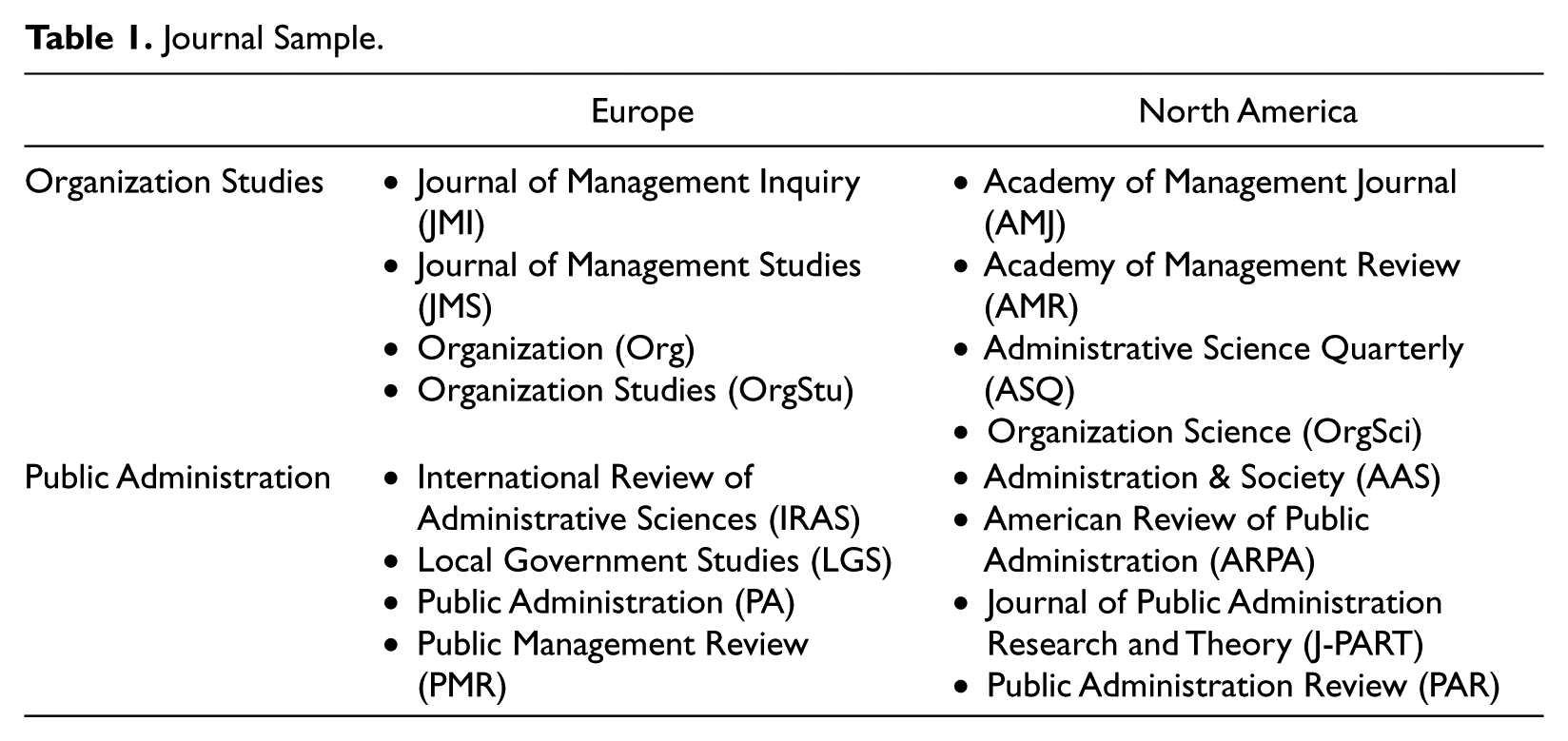
The present bibliometric study focuses on a set of top journals in the fields of organization studies and public administration. Peer-reviewed journals play a pivotal role in the diffusion of scientific knowledge, the exercise of reputational control, the acknowledgement of intellectual property, and in building group membership and identity (Whitley, 1984). The sociology of science furthermore suggests that a significant proportion of publications in a scientific field appear in a few “core” journals, while the rest are widely scattered among a large number of more peripheral outlets (Crane, 1972). Only core journals that represent leading scholarship in organization studies and public administration were selected in the compilation of the journal sample. For this purpose, the Journal Citation Reports by Thomson Reuters were reviewed in the subject categories of “management” and “business,” on one hand, and “public administration,” on the other, in order to identify high-ranking journals on the basis of their impact factors. Journals whose coverage was beyond the scope of this study were excluded from further analysis. For example, some journals in the “public administration” category primarily covered political science, while several “management” journals had a narrow focus on specific managerial functions such as marketing or operations research. A more technical restriction was the availability of data from citation indices. Only journals that the Social Science Citation Index (SSCI) covered throughout the entire period of investigation (i.e., 2000 to 2010) were taken into account. The selection process was also determined by the need to balance the sample with regard to the journals’ geographical origin. North America and Europe have different scholarly traditions, which are reflected also in publication channels (Battilana, Anteby, & Sengul, 2010; Grey, 2010; Meyer & Boxenbaum, 2010; Üsdiken, 2010). Therefore, four high-ranking journals in organization studies and another four in public administration were selected from both sides of the Atlantic, resulting in a total of 16 journals (see Table 1). The selection of this journal sample was verified in discussions with experts in both fields.
Journal Sample.
Data
The dataset was gathered from the SSCI and spanned the period from the turn of the millennium to the most recent volume that had been completed at the time when the study was conducted (i.e., 2000 to 2010). The aggregation of citations over the period of 11 years yields data that can be processed with standard bibliometric methods. At the same time, however, these data reveal patterns of which scholars involved in such research can only be partly aware. The identification of such patterns is possible because the present empirical study takes advantage of the complexity-reducing potential of bibliometrics.
In sum, the database comprised 170 volumes of the selected journals (see Appendix A). For articles, reviews, and proceedings papers that appeared in the period of investigation (excluding editorial material, book reviews, notes, corrections, letters, etc.), citation data were extracted from the SSCI and thoroughly filtered. The main purpose of this “scrubbing” was to take into account typing errors, adjust different spellings, and harmonize different editions of cited references. If more than one edition of the same work was cited, the respective references were either assigned to the most frequently cited edition or, when there were equal numbers of citations, to the earliest of the cited editions. The final database of the bibliometric study consisted of 6,864 documents with 411,863 references to 202,570 sources (see Figure 1 and Appendix A).
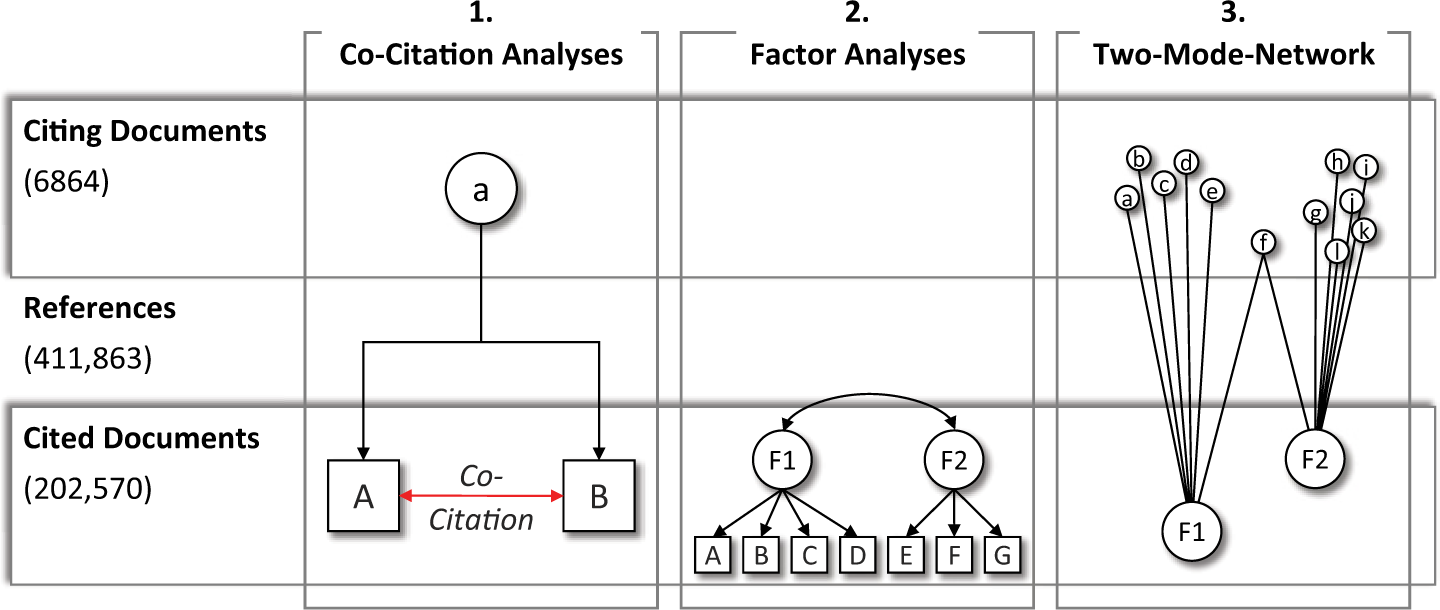
Procedure of the Bibliometric Analysis.
Method
The citation data were processed in three steps (see Figure 1). The first two steps were run separately for each of the journal groups, thus repeated four times. In the final step, these intermediary results were integrated into a single network. While co-citation and factor analysis accord with standard procedures of bibliometrics, the creation of a two-mode network addresses the shortcomings of conventional methods in an innovative way.
Co-citation analyses
First, a co-citation analysis was conducted for each of the four journal groups. Co-citation analysis is an established technique in bibliometrics (for overviews, see Gmur, 2003; McCain, 1990) and has been successfully applied to organization studies (e.g., Gmur, 2003; Üsdiken & Pasadeos, 1995). A “co-citation is the frequency with which two items of earlier literature are cited together by the later literature” (Small, 1973, p. 265). The strength of a co-citation between two cited documents, therefore, is determined by the number of new documents that cite both earlier documents. For example, if the author of Paper “a” refers, inter alia, to the Documents “A” and “B,” then the latter documents are co-cited (see Figure 1). This implies that the level of co-citation analysis is that of cited documents, as opposed to the comparable yet different method of bibliographic coupling, which analyzes links between citing documents (Kessler, 1963). As cited documents are older than the documents that cite them, co-citation analysis is suitable for detecting the “classics” of a field, many of which are likely to have established new traditions of research since their publication.
Co-citation analysis focuses on the intertextual relationships that are established among scientific publications by the referencing behavior of authors. The basic assumption underlying this method is that the inclusion of different documents in the same bibliography reflects a certain textual similarity that scholars perceive to exist between these documents. From this perspective, the inclusion or exclusion of research publications in the same bibliography reflects the degree to which a population of authors assesses these publications, whether consciously or unconsciously, as similar or dissimilar. This assumption could be wrong in individual cases but is highly likely to be correct on large-scale databases. As a result, frequently co-cited documents compose clusters that are relatively homogenous in terms of content and thus representative of a common view shared by scholars working in the same research area.
Technically speaking, co-citation analysis transforms a large number of bibliographies into a square symmetrical matrix with all cited documents as column and row headers and the co-citation frequencies of all document pairs as values in the cells of the matrix. In the present case, this procedure would result in four very large matrices, as the number of cited documents in each journal group is considerably large. To reduce the amount of data, two thresholds were introduced, in line with standard applications of co-citation analysis (Gmur, 2003; McCain, 1990): First, the analyses were restricted to documents that had received at least a certain number of citations in the period of observation. Second, only documents that were co-cited a certain number of times with at least one other document were considered. This procedure reduced the data to frequently co-cited documents that are central to the two fields examined here, while more peripheral works were eliminated.
Factor analyses
The first step of analysis resulted in four matrices, one for each journal group, containing the co-citation frequencies of documents that were cited in the selected journals in the period under review. In the second step, these raw data were further processed by means of factor analyses, so that clusters of frequently co-cited documents could be detected (see Figure 1). Previous research has shown that measures of relative document proximity are more suitable for this purpose than raw frequency counts (Gmur, 2003; McCain, 1990). Therefore, the co-citation matrices were converted to correlation matrices based on Pearson’s coefficient. For example, the co-occurrences of the Documents “A” and “B” with one another and with all other cited documents are contained in two columns, or rows, of a symmetrical co-citation matrix. If these co-citation frequencies are used as attributes of “A” and “B,” then a correlation between these documents can be calculated on the basis of these attributes. By repeating this procedure for all document pairs, the frequency counts in the four co-citation matrices were replaced by correlation coefficients. High correlations linked documents that were frequently cited together and low correlations linked infrequently co-cited documents. The advantage of this conversion is that it considers the co-citation “profiles” of these documents, rather than their absolute co-occurrence (McCain, 1990). Furthermore, the correlation coefficient evens out differences between highly cited documents and documents with a similar profile but a lower citation rate. The main diagonals of the matrices were regarded as missing values.
The subsequent factor analyses did not differ from applications of this method in other research settings. The inputs to these analyses were the four correlation matrices resulting from the previous step. As these matrices are symmetrical, they can be processed either column-wise or row-wise. The factor extraction by means of principal component analyses and scree tests was followed by Varimax rotation with Kaiser normalization. An orthogonal rotation method was preferred over oblique rotation because the latter conflicts with the basic assumption of factor analysis that the extracted factors are independent of each other. Documents were assigned to the factor on which they loaded highest. Subsequently, the extracted factors were interpreted and labeled. For this purpose, the author reviewed the clusters thoroughly, made a judgment about their substantive content, and labeled them with a self-explanatory title. This process was primarily guided by the highest loading documents in each cluster, which are the most representative of that cluster. For example, the five documents with the highest loadings on the second factor extracted for European journals in organization studies were DiMaggio and Powell (1983), Meyer and Rowan (1977), Oliver (1992), Greenwood and Hinings (1996), and Beckert (1999). Since these publications are groundbreaking works in new institutional theory, this cluster was given the label of New Institutionalism. All extracted factors are listed in Appendix B.
Two-mode network
In the first steps, described above, the analysis complied with standard applications of bibliometrics. A major disadvantage of this procedure is that co-citation analysis focuses on citing documents. As a result, past trends in research are emphasized disproportionately, overshadowing current research. To avoid this bias, in the third step of analysis, the level of citing documents was reintegrated through a two-mode network for visual data-mining (Figure 1). Two-mode networks offer the possibility of simultaneously exploring two levels of analysis and their relationship to each other. In the present case, the first set of nodes comprised clusters of co-cited works that emerged from the factor analyses and represented the level of cited documents. The second type of nodes comprised journal articles, which represented the level of citing documents. The network was created on the basis of the aggregated references from the citing journal articles to works in the co-citation clusters. For example, if Article “a” referred to Document “A,” and if this latter document was assigned to the cluster “F1,” then “a” was tied to “F1” (see Figure 1). As the number of citing documents was high, only articles that referred to a certain number of articles in at least one cluster were considered. This reduced the density of the network, improving its clarity and its presentation. By varying these thresholds within a broad range, it was possible to adjust the resolution of the method in order to minimize the network’s complexity without being too reductive. While the size of the network varied when different thresholds were applied, the structure of the network did not change significantly. Thus, the final solution presents the research topography of organization studies and public administration by displaying the network core (i.e., the most interrelated publications in these two fields). The network diagram was created on the basis of the spring embedder algorithm provided by the software package UCINET by Borgatti, Everett, and Freeman (2002). It can be regarded as a research map, unconsciously drawn by scholars published in leading journals of organization studies and public administration in the course of the last decade.
Mapping Organization Studies and Public Administration
Table 2 specifies the documents that were most frequently cited in organization studies and public administration in the period from 2000 to 2010. The ranking indicates the degree of separation between these two fields. Excepting the most frequently cited document both in North America and Europe, an inaugural paper in institutional theory by DiMaggio and Powell (1983), none of the top 20 cited references in organization studies appears among the most seminal works in public administration. Similarly, high-ranking documents and authors in public administration are hardly cited in organization studies (see also Kelman, 2007). Despite the common heritage of these two fields, there is very little overlap between the bodies of literature that form their respective foundations of current research.
Most Cited References in Organization Studies and Public Administration.
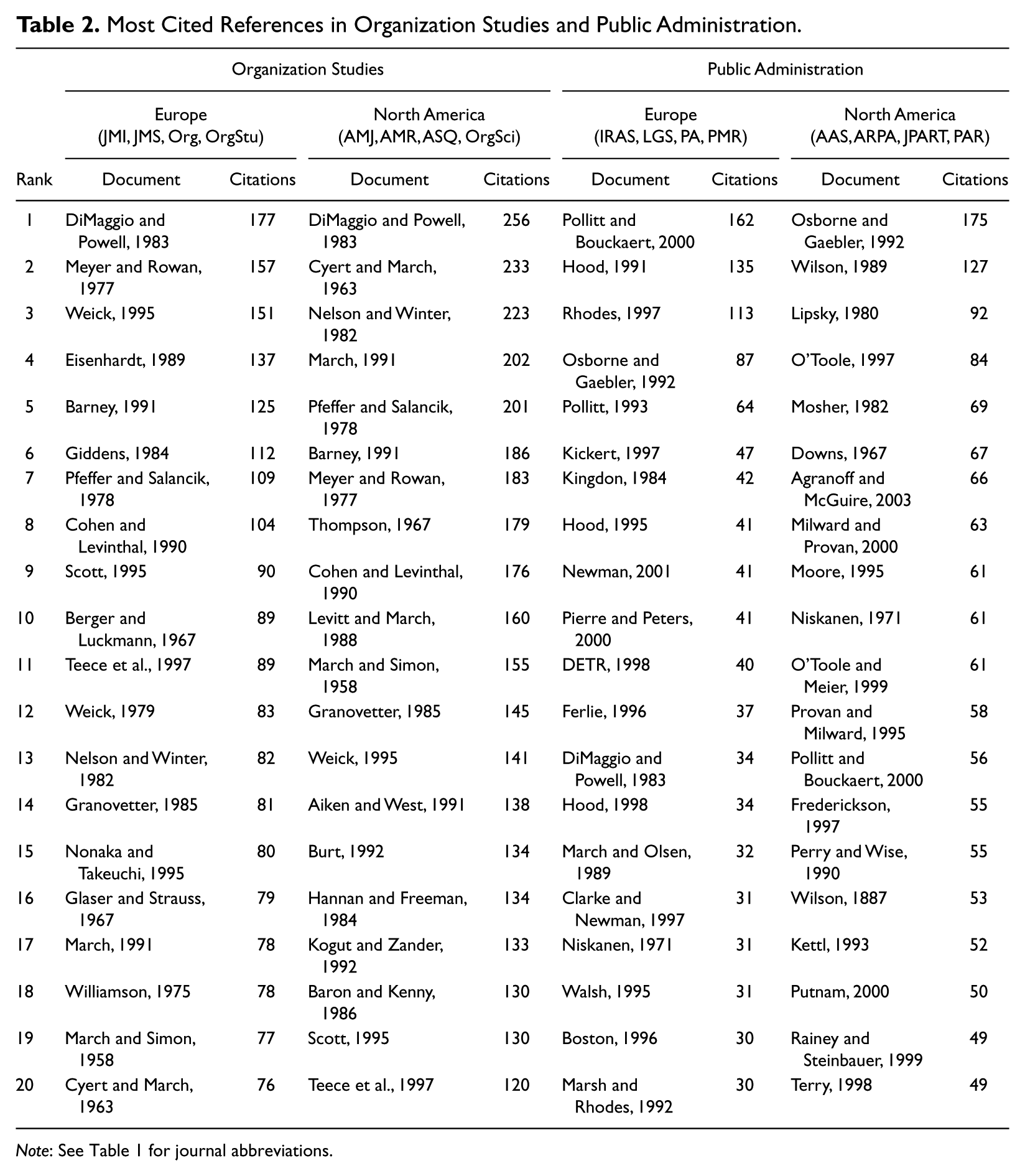
Note: See Table 1 for journal abbreviations.
The divide between organization studies and public administration is visually apparent when both fields are integrated into a single map that displays the priorities and interrelations of current research. Figure 2 shows the bibliographic two-mode network. As outlined above, the big nodes in the network are clusters of frequently co-cited works with main loadings on the same factor, while the small nodes are articles published in the analyzed journals over the period of observation (see Figure 1 and Appendix B). The separation between organization studies and public administration is signified by the bipolar structure of the network. While the research field is densely populated on both sides of the divide, only a few nodes bridge the large gap in the center. The presence of centrifugal forces can be detected in the fact that none of the co-citation clusters can be traced both in organization studies and public administration (see Appendix B).
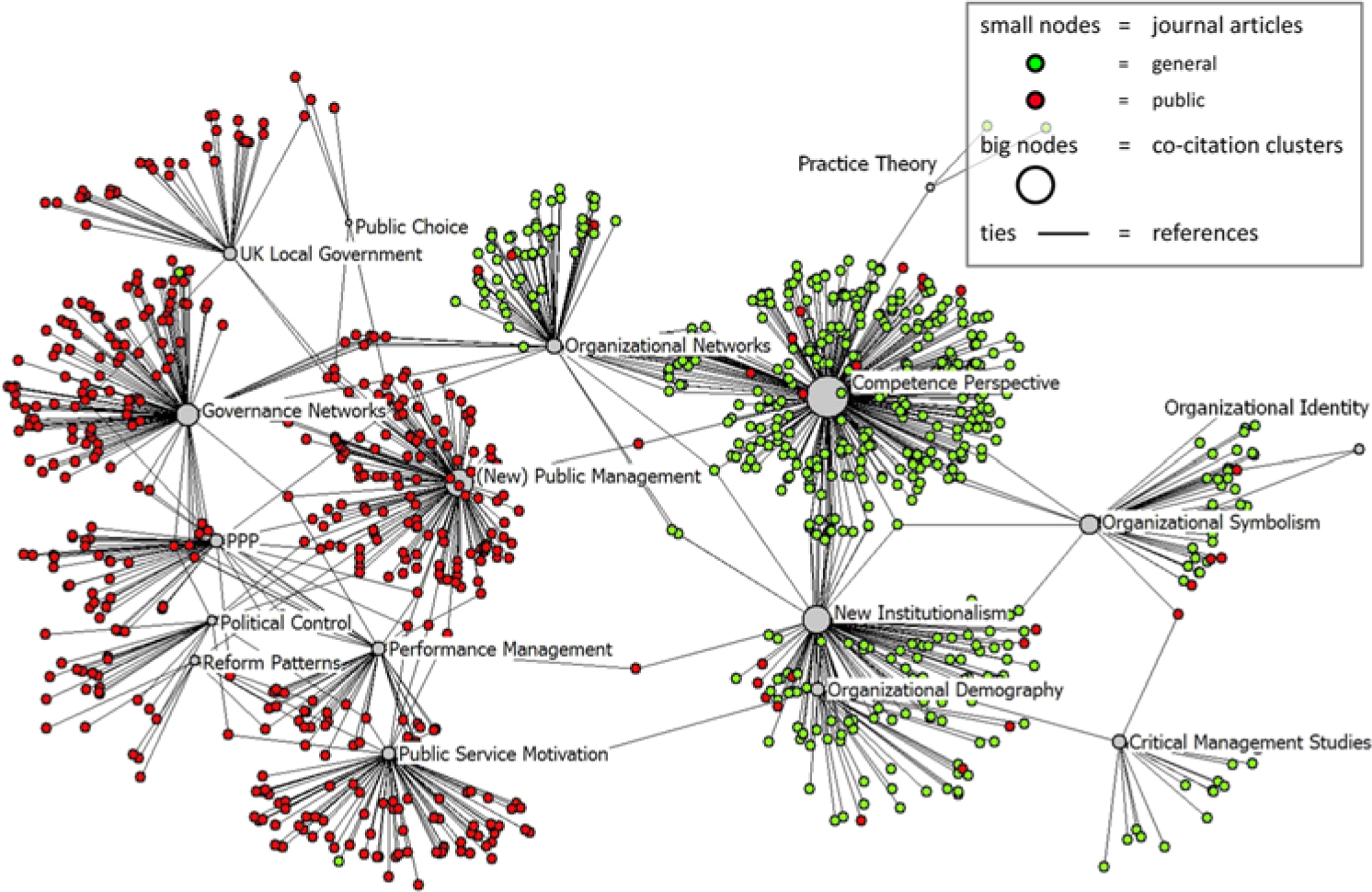
Bibliographic Two-Mode Network of Organization Studies and Public Administration by Field, 2000 to 2010.
Research in organization studies is currently differentiated into eight distinct yet interdependent subfields (see Figure 2). More than half of all documents in the co-citation analysis were assigned to either of the two most explicative factors on the basis of their main loadings (see Appendix B). The largest subfield represents the Competence Perspective in organization studies, which arose from the “knowledge movement” (Foss, 2007) and focuses on organizational capabilities that foster the creation, absorption, retention, and sharing of knowledge. This research area focuses and expands on the resource-based view (e.g., Barney, 1986; Conner, 1991) and encompasses the evolutionary theory of the firm (e.g., Nelson & Winter, 1982), the knowledge-based view (e.g., Kogut & Zander, 1992; Spender, 1996), related theorizing on core competences (e.g., Leonard-Barton, 1992), and dynamic capabilities (e.g., Eisenhardt & Martin, 2000; Teece, Pisano, & Shuen, 1997), as well as the literature on organizational learning (e.g., Argyris & Schön 1978; March, 1991). The other core cluster in the field is New Institutionalism. Almost all groundbreaking works that have directed scholarly attention to institutional environments and organizational responses are among the most characteristic references of this cluster (e.g., DiMaggio & Powell, 1983; Meyer & Rowan, 1977; Scott, 1995). Linked articles primarily address institutional change and organizational transformation, thus shifting the emphasis toward issues of interest and agency. This becomes most apparent in field-level studies on how institutions change and in the emerging bodies of literature on institutional entrepreneurship and on institutional work.
The remaining publications in organization studies are dispersed over four medium-sized and two peripheral clusters (see Figure 2 and Appendix B). The label Organizational Symbolism reflects the preeminence of sense-making (e.g., Weick, 1979), organizational culture (e.g., Pettigrew, 1979), and social phenomenology (e.g., Berger & Luckmann, 1967) among the references, with significant loadings on the respective factors. Many of the works included here focus particularly on interpretive methodologies that employ qualitative approaches in case-study designs (e.g., Glaser & Strauss, 1967; Miles & Huberman, 1994). Organizational Networks covers an extensive body of research on hybrid organizational forms that emerged from interfirm cooperation, such as strategic alliances and networks (e.g., Powell, 1990; Rowely, Behrens, & Krackhardt, 2000). Besides a distinct repertoire of analytical techniques for empirical studies, this cluster provides theoretical perspectives on network evolution, structural embeddedness, social capital, and related issues (e.g., Burt, 2000; Coleman, 1988; Granovetter, 1985). Organizational Demography refers to a cluster of works that relate the demographic characteristics of employees, particularly the composition of top management teams, to dependent variables such as firm performance, strategic change, turnover intentions, and so forth. Works assigned to this cluster predominantly employ quantitative methodologies and contribute to the strategic management literature (e.g., Schneider, 1987; Wiersema & Bantel, 1992). In contrast, the works comprised in Critical Management Studies emphatically oppose orthodox perspectives in organization theory and call for emancipation from bureaucratic coercion and hegemony. The most prevalent topics in this cluster are power-related issues such as interest, agency, and gender (e.g., Barley & Kunda, 1992; Knights & Willmott, 1989; Kunda, 1992). The research agenda of organization studies is completed by small clusters on Organizational Identity (e.g., Dutton, Dukerich, & Harquail, 1994; Gioia, Schultz, & Corley, 2000) and Practice Theory (e.g., Barley, 1996; Orlikowski, 2002) on the periphery of the bibliographic network.
Public administration is also dominated by two large topics that account for roughly half of all mapped publications, while the other half are scattered among several considerably smaller clusters (see Figure 2 and Appendix B). Besides this structural similarity to organization studies, however, the two fields have little in common. The largest cluster in public administration is (New) Public Management (abbreviated to NPM). Works in this cluster continue the discussion on the transfer of business-like practices from the private to the public sector, which started in the 1980s and 1990s (e.g., Aucoin, 1990; Barzelay, 1992; Pollitt, 1993). However, more recent publications address NPM in a much more critical fashion and stress the unintended consequences of the underlying market model. By addressing issues such as citizen involvement and bureaucratic responsiveness in the process of government, works in this subfield seek to recover the value and ethos of democracy in public administration. The other large subfield, Governance Networks, forms a distinct cluster comprising works that are closely related to the movement just described. These works focus on governance networks that are composed of interdependent actors who collaboratively pursue public interests (e.g., Agranoff & McGuire, 2003; Kickert, 1997; O’Toole, 1997). A main topic here is the shift from government to governance or from vertical to horizontal coordination within and across societal sectors and national settings. Among many other issues, the formation, management, and performance of networks figure prominently on the research agenda of this approach to collaborative public management.
Further research in public administration cuts into one peripheral and seven medium-sized clusters (see Figure 2 and Appendix B). Public Service Motivation is a subfield that primarily emerges in North American scholarship. The cluster encompasses studies on the specific behavioral orientations of public employees and servants (e.g., Buchanan, 1975; Perry, 2000; Perry & Wise, 1990) that are embedded in more general comparisons of public and private management (e.g., Rainey, 1983). Research on Performance Management takes up a key topic of NPM by drawing attention to management by results. Works assigned to this cluster, many of which share references to the economic theory of bureaucracy (Downs, 1967; Niskanen, 1971; Tullock, 1965), focus either on the determinants and measurement of performance in the public sector or on the evaluation of according reforms (e.g., Berry, 1994; Boyne, 2003).
The works assigned to the subfield designated here as Public-Private Partnership (PPP) share an economic background that is rooted in agency theory in particular. Largely drawing on the literature on privatization (e.g., Donahue, 1989; Savas, 2000; Sclar, 2000), these works address the benefits and challenges of contracting out public services in decentralized systems of governance. By contrast, research under the umbrella of Political Control makes strong references to political science by addressing the institutional separation of power between legislative and executive institutions. The scholarly community represented by this cluster is primarily interested in the influence of the external political environment on public administration and thus in the degree to which public administration is autonomous (e.g., Carpenter, 2001; McCubbins, Noll, & Weingast, 1989; Wood & Waterman, 1991). Publications on Local Government mostly appear in Europe and deal with administrative reforms introduced by local authorities in the United Kingdom (Newman, 2001; Stoker, 2004). At the heart of this discussion is the politics of administration by New Labour, particularly the “best value” framework championed by the Audit Commission (2001). In contrast to this localized interest, research on Reform Patterns elucidates and compares the main trajectories of administrative reforms in an international context. This subfield is dominated by Scandinavian scholarship (e.g., Brunsson & Olsen, 1993; Christensen & Lægreid, 2001) and draws extensively on organization theories in the behavioral tradition (e.g., March & Olsen, 1989; Selznick, 1957). The field of public administration is completed by a small subfield comprising works on Public Choice that were extracted from European journals and including many publications that are part of the Performance Management cluster in North America (e.g., Downs, 1967; Niskanen, 1971).
A comparison between North American and European scholarship reveals further differences between organization studies and public administration. While in organization studies the majority of high-ranking works are widely cited on both sides of the Atlantic, only three works in public administration are among the 20 most cited publications both in North America and Europe (see Table 2): a classic in the economic theory of bureaucracy (Niskanen, 1971), a management bestseller on NPM (Osborne & Gaebler, 1992), and a comparative analysis of administrative reforms (Pollitt & Bouckaert, 2000). This suggests that the consensus on the field’s foundations is higher in organization studies than in public administration. However, a closer analysis reveals some transatlantic differences both in public administration and in organization studies. Figure 3 displays the two-mode network with different node colors for North America and Europe according to the origin of the journals in which the citing documents appeared (see also Table 1). While the dominant clusters feature on both sides of the Atlantic, and thus have a high centrality in the network, the smaller and more peripheral clusters tend to be specific to either North American or European scholarship. For example, symbolist and critical perspectives in organization studies are almost exclusively represented in European journals. This may reflect a preference for theoretical diversity, as European scholars often call on researchers to deviate from mainstream theories (Grey, 2010; Meyer & Boxenbaum, 2010; Üsdiken, 2010). On the contrary, the clusters in public administration often focus on specific objects of study or sets of problems in the empirical world of public organization and organizing. This is reflected in the publications they comprise, which are concerned with a specific type of organization, as well as in many high-ranking works that focus on design issues in the public sector. This emphasis stems from the predominant concern of such works with organizational change in the course of administrative reforms (Hood, 1991; Osborne & Gaebler, 1992; Pollitt, 1993; Pollitt & Bouckaert, 2000). As a consequence of this object specificity and orientation to design, the differences between the managerialist tradition of North America and the etatist tradition of continental Europe is also reflected in the divergent scholarship on public administration. For example, the more porous borders between the public and the private sector in North America may have triggered a greater interest in PPPs (see PPP cluster). Further variations may arise from different levels of methodological maturity. Compared to research in public administration carried out in Europe, North American scholarship is often said to be more driven by quantitative methods. This may explain why articles on Public Service Motivation are predominantly published in North American journals, as research in this subfield is often conducted by means of advanced psychometric methods adapted from social psychology.
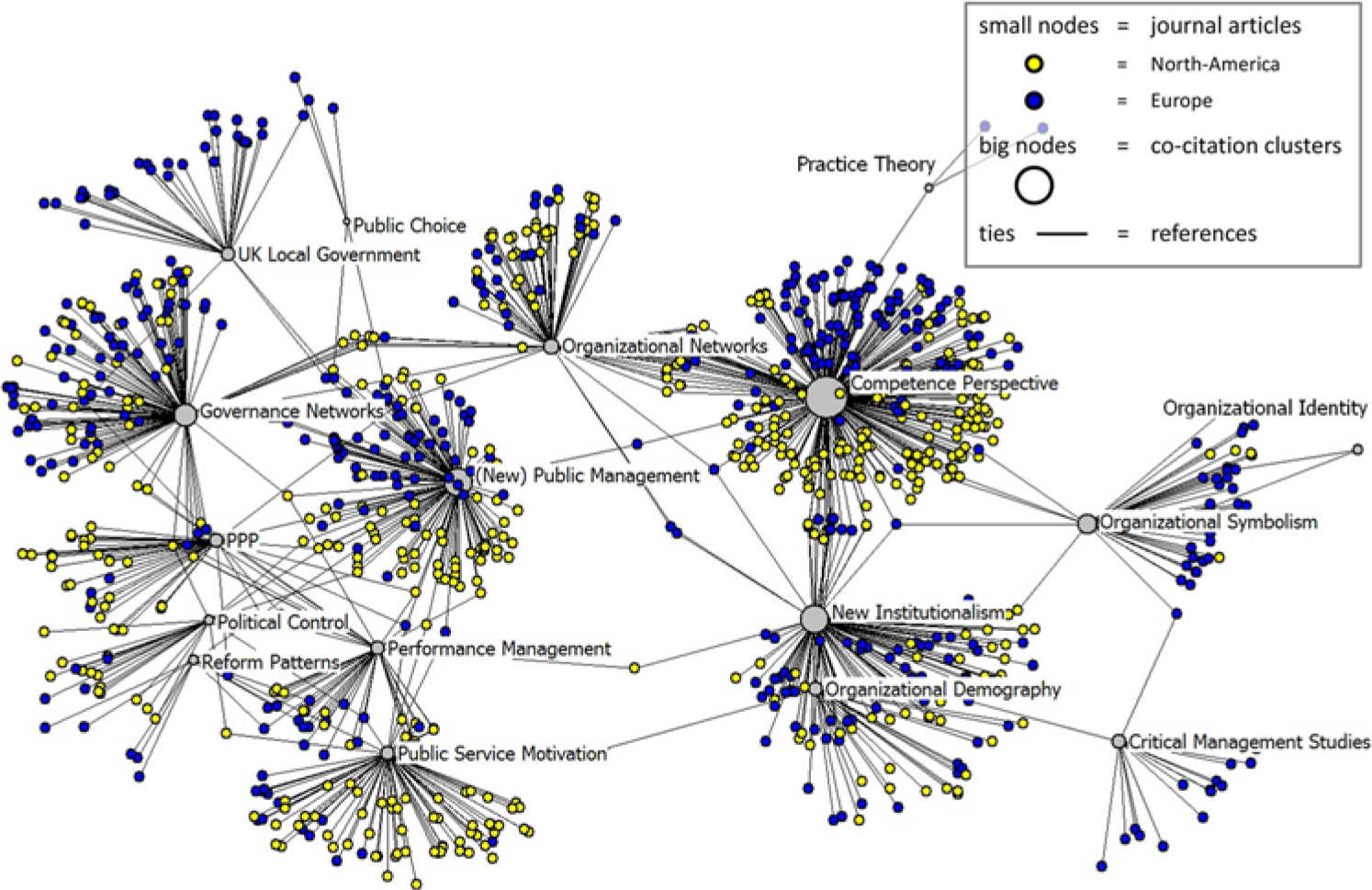
Bibliographic Two-Mode Network of Organization Studies and Public Administration by Journal Origin, 2000 to 2010.
Links Between Organization Studies and Public Administration
The citation ranking, visual data-mining, and factor interpretation reported in the previous section suggest that organization studies and public administration adhere to different agendas of research and thus represent distinct provinces of scholarship. However, the separation of scientific fields is always gradual rather than categorical. This applies all the more in the case of “fragmented adhocracies” (Whitley, 1984), such as organization studies and public administration, which are characterized by high uncertainty, variability, and ambiguity of research that lead to shifting and blurred boundaries within and between these scientific fields. As Figure 2 indicates, several articles that appeared in public administration journals are assigned to co-citation clusters in organization studies. Thus, the scholarly discourse in public administration considers to some extent topics, theories, and methods that are more familiar to organization studies. By contrast, only very few articles published in organizational journals are tied to co-citation clusters in public administration. This does not mean that public organization and organizing are never discussed in organization studies. As Kelman (2007) exemplarily shows for Administrative Science Quarterly, some research in the field is devoted to governmental organizations, although the proportion of such papers among all articles has dropped under 10% since the 1990s. However, the authors of these publications discuss public organization and organizing on the basis of theories and methods that are specific to organization studies, while they neglect the foundations of public administration to a large extent. This suggests that the boundaries between the analyzed fields are semipermeable, allowing for the transfer of knowledge primarily from organization studies to public administration, but less so in the opposite direction.
When the extent to which organization studies and public administration are receptive to each other is analyzed in greater detail, some remarkable differences between their various subfields of research emerge. The diagram in Figure 4 shows the distribution of outgoing references either to organization studies or to public administration. “Outgoing references” means that these references link citing documents in one field to cited documents in the other field (i.e., cross-boundary references). The citing documents were first clustered according to the co-citation cluster to which they were most strongly linked. Then, all references—the ties in the two-mode network (see Figure 2)—were analyzed on the basis of whether they are confined within either public administration or organization studies or whether they cross the boundaries of their field. For example, 90% of all references from documents that are linked to (New) Public Management target this or other co-citation clusters in public administration, while only 10% refer to works in the co-citation clusters of organization studies. This exemplifies a general tendency because the vast majority of references in all subfields concern publications within the category in which the citing articles were published, while references that cross that boundary only account for a minor proportion of the bibliographies. In other words, scholars in both organization studies and public administration refer preferentially to works that are characteristic of the field in which they publish. However, this does not apply to all subfields to the same extent. The subfields of public administration Local Government, Political Control, and Public Choice focus most exclusively on topics that are highly specific to the public sector. Similarly, in organization studies, Practice Theory, Organizational Demography, and Organizational Identity are least open to foundational works from beyond their field’s boundaries, although, in principle, public organization and organizing are not irrelevant to scholarship in these subfields (see, e.g., Choi, 2009).
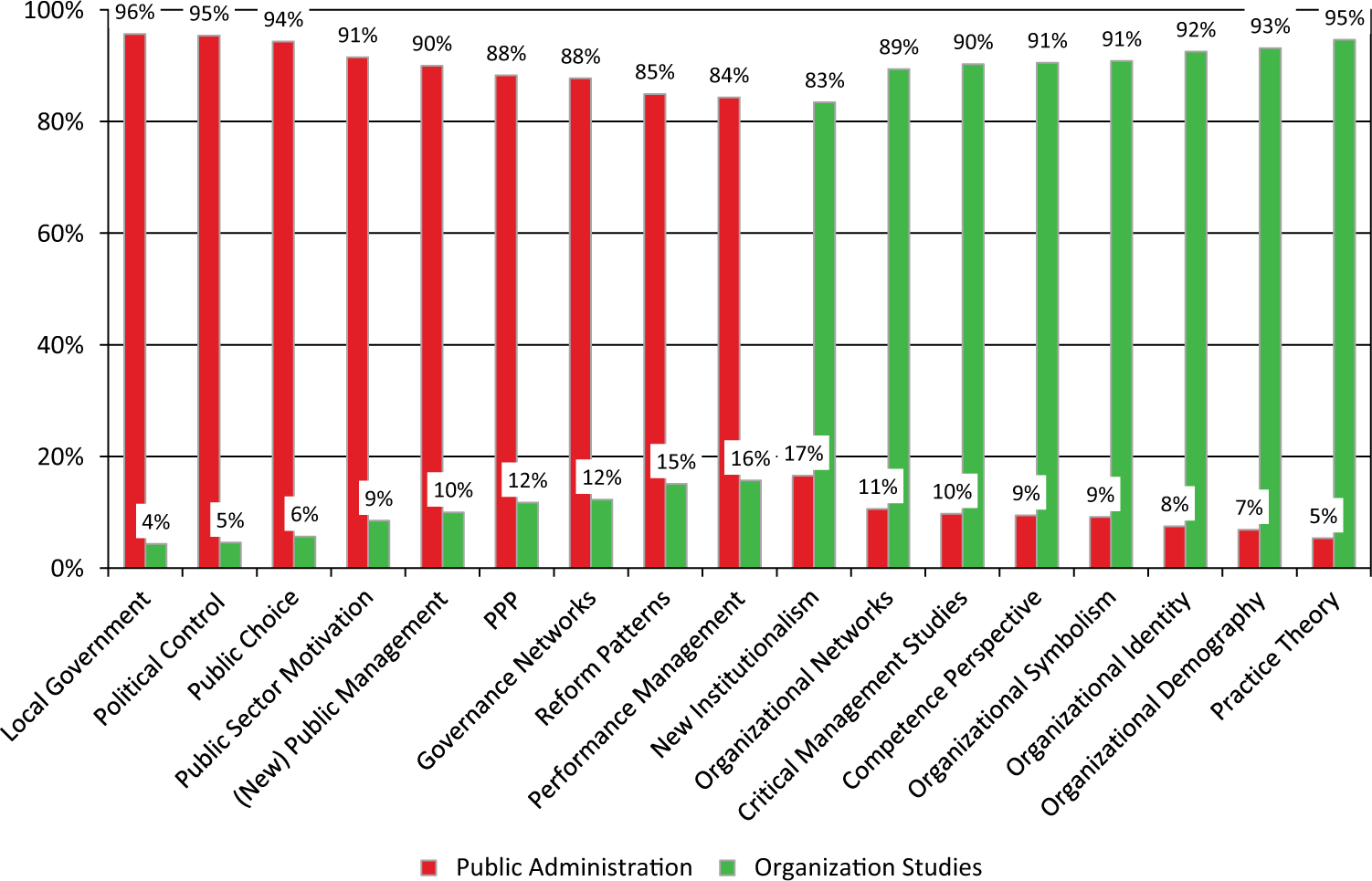
Outgoing References From Clustered Articles to Organization Studies vs. Public Administration.
To explore current and future synergies of research, it is of particular interest to identify which clusters in organization studies show a greater degree of proximity to public administration and vice versa. In public administration, Performance Management, Reform Patterns, and Governance Networks have the highest shares of cross-references to organization studies (see Figure 4). The link of Performance Management to organization studies is primarily subject-driven, as the questions of what determines performance and how performance can be measured are long-standing and widely discussed topics in many general works on organization and management control (e.g., Merchant & Van der Stede, 2012). In contrast, the connection between Reform Patterns and organization studies is based mainly on theory, as scholars engaged in this subfield frequently refer to some of the most preeminent approaches in organization theory, particularly to institutional theory (e.g., DiMaggio & Powell, 1983; Meyer & Rowan, 1977) and behavioral theory (e.g., March & Olsen, 1989; March & Simon, 1958). The relation of Governance Networks to organization studies, on the other hand, is mainly methodological, as social network analysis provides many analytical instruments that are also used by scholars in public administration.
In organization studies, most of the cross-references to public administration are contained in the clusters New Institutionalism, Organizational Networks, and Critical Management Studies (see Figure 4). All of these boundary-spanning links derive primarily from an interest in the public sector, although public administration is relevant to each of the three subfields for different reasons. The works comprised in New Institutionalism and Critical Management Studies are concerned with administrative reforms that are guided by the principles of NPM. While research in the former cluster examines in an explicative fashion how reforms are initiated and spread (e.g., Brunsson & Olsen, 1993; Brunsson & Sahlin-Andersson, 2000), research in the latter cluster looks at this process more critically, highlighting resistance to excessive managerialization and privatization in the public sector (Anderson, 2008; Thomas & Davies, 2005). Organizational Networks is thematically interrelated with public administration, as interorganizational networks increasingly include public organizations that collaborate with business and not-for-profit organizations (e.g., Agranoff & McGuire, 2003; Kickert, 1997; O’Toole, 1997).
The interrelationships between organization studies and public administration can be further disaggregated by means of network analysis. Table 3 shows the 10 most central citing articles in the bibliographic network in terms of their betweenness. In network analysis, betweenness is a standard measure of the centrality of nodes (Wasserman & Faust, 1994). It indicates the number of shortest paths from all edges to all others edges that pass through a node. A node with a high shortest path betweenness centrality is a “broker” between the main constituencies of the network, although it may only have a small number of direct ties to other nodes. In the present case, betweenness is a proxy for the extent to which a citing article bridges the divide between public administration and organization studies by referring to both fields. The measures were calculated on the basis of the network data for the bibliographic map in Figure 2. The results strongly confirm the finding that the boundaries between the two fields are semi-permeable, since all boundary-spanning articles included in the ranking were published in public administration. Journals in this field seem to be much more open to works that bridge the gap to organization studies than publication outlets beyond the divide. However, as many of the brokerage articles were authored or co-authored by members of management departments and business schools (e.g., Carmeli, 2006; Ridder, Bruns, & Spier, 2006), the gap is bridged not exclusively by scholars in public administration who draw on general organizational research but also by organizational scholars who export their theories and methods to public administration by publishing in relevant journals.
Brokerage Articles Between Organization Studies and Public Administration.
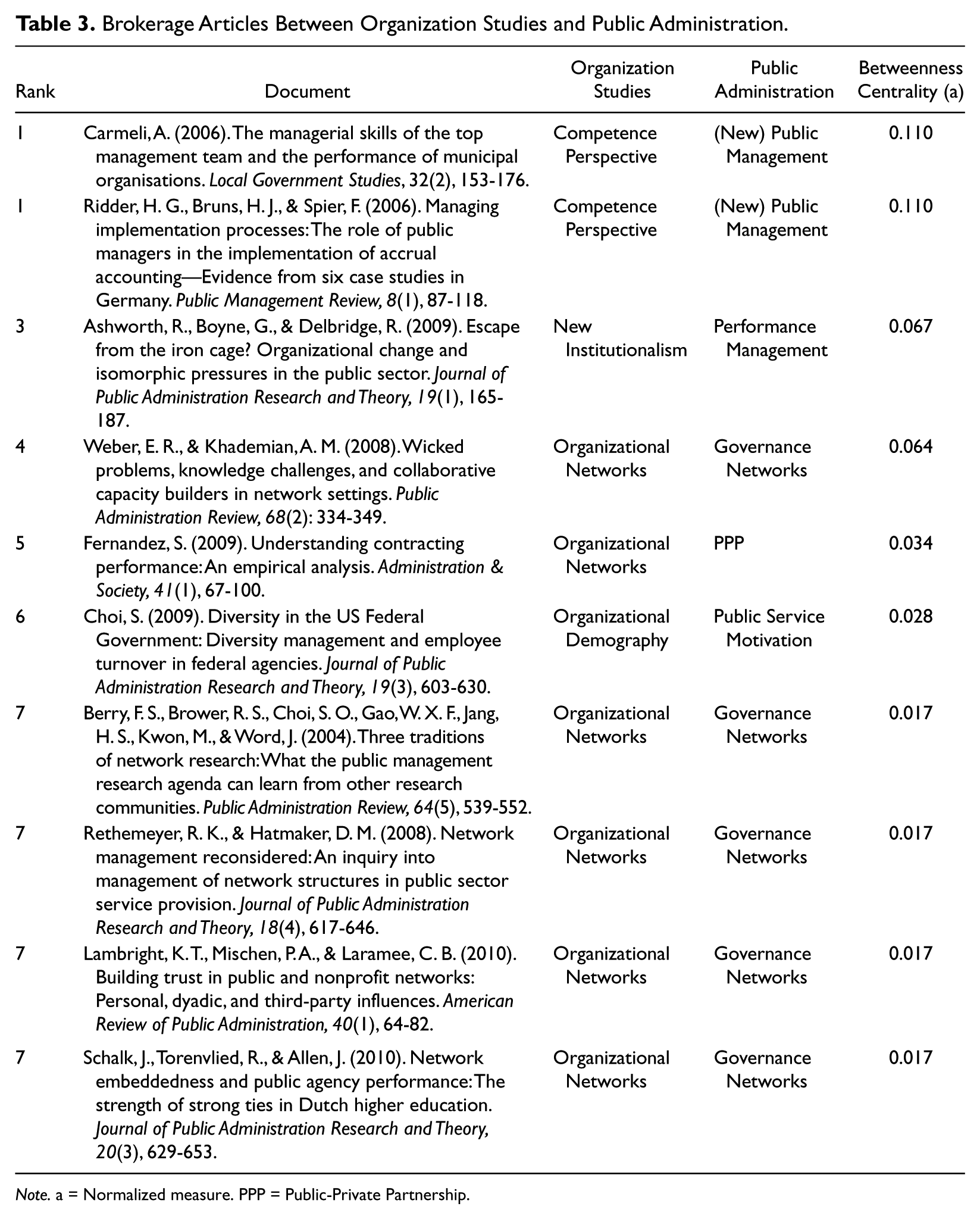
Note. a = Normalized measure. PPP = Public-Private Partnership.
Although the ranked articles deal with a broad range of topics, the analysis reveals two strong links between organization studies and public administration. The first link is established through organization theories. This interface is rather broad and general, as it encompasses various theoretical approaches. More specifically, brokerage articles refer to institutional theory (e.g., Ashworth, & Delbridge, 2009), as well as to behavioral and evolutionary theory, which tend to merge in the resource-based and capability-based perspectives (e.g., Carmeli, 2006; Ridder et al., 2006). This stream of research is primarily (though not exclusively) pursued in Europe and builds primarily on the vivid interest of certain Scandinavian scholars in organization theories, which is fostered by their long-lasting collaboration with Stanford University (Brunsson & Olsen, 1993; Brunsson & Sahlin-Andersson, 2000; Christensen & Lægreid, 2001). The second link between the two fields stems from network analysis. This is a narrower connection, established through a particular set of theories and methods. Scholars who share an interest in this field mainly explore the management of networks in the collaborative provision of public services (e.g., Berry et al., 2004; Lambright, Mischen, & Laramee, 2010; Rethemeyer & Hatmaker, 2008; Schalk, Torenvlied, & Allen, 2010; Weber & Khademian, 2008) and most (though not all) have institutional affiliations to North America.
Limitations
Despite the merits of a structured approach to the literature, the empirical approach of this study is not without limitations. First, and most fundamentally, bibliometric methods consider the products rather than the process of written communication in science and thus do not provide qualitative information on why authors refer to certain works while they ignore others. However, in large-scale databases, deviations from the major motives that determine citing behavior play a marginal role in shaping the citation network. Bibliometric maps thus provide a useful bird’s-eye view on the priorities in, and interrelations between, scientific fields, if they are created on a highly aggregated level. Second, although top journals play a crucial role in the formation and evolution of scientific fields, the selected media are not fully representative of organization studies and public administration. A further limitation is that the sample of this study only includes journals from North America and Europe but no publication channels from other regions of the world. Clearly, a larger sample would result in more comprehensive maps, so future research could examine more diverse sets of journals, as well as other outlets, such as monographs and edited books, which still account for an important part of scholarly communication in the social sciences (Hargens, 2000). Third, the resolution of the applied methods depends not only on the observation periods and journal sample but also on the thresholds defined in the course of data reduction and factor extraction. Which clusters are extracted and which remain invisible because they are below a certain visibility threshold in the data partly depends on technical decisions that the researcher is required to make. In spite of these general limitations, this study benefits from the advanced bibliomentric methods it applies and contributes to these by suggesting a new technique of science mapping: The two-mode networks used here account for different levels of analysis and horizons of time and thus compensate for the shortcomings of conventional methods.
Concluding Remarks
The present study has explored the conditions that trigger and promote the cross-boundary exchange of knowledge between organization studies and public administration. The bibliometric analysis of leading journals signifies a high degree of separation between the two fields, as the foundations and priorities of current research are largely divergent. However, closer analysis has also revealed strong links between organization studies and public administration, established particularly through organization theories and network analysis. In their turn, these intersections reflect certain general differences between European and North American scholarship: The former places greater emphasis on theoretical diversity, while the latter is more concerned with methodological rigor (Battilana et al., 2010; Grey, 2010; Meyer & Boxenbaum, 2010; Üsdiken, 2010). Both interfaces are characterized by a unidirectional, rather than a bi-directional, exchange of topics, theories, concepts, and methods. Overall, these results indicate that public administration is much more receptive to organization studies than the other way around. Although the subject of public organization and organizing is not entirely absent from the scholarly discourse of organization studies, wherever it is discussed only few cross-references are made to public administration. The few boundary-spanning authors in organization studies who do consider research from beyond the field’s border prefer not to publish in their “home” journals but in the “foreign” outlets of public administration.
For the present study, network analysis also provides an interesting perspective on the future development of organization studies and public administration. It has been argued and empirically proven that innovation in networks requires both cohesion and connectivity, otherwise known as “closure” and “brokerage” (Burt, 2008). Cohesion, or closure, fosters incremental innovation because a high density within partial networks enables efficient communication and cumulative growth. By contrast, connectivity, or brokerage, gives rise to radical innovation, because a lot of linkages across partial networks promote unusual thinking and disruptive change. Both radical and incremental innovation are necessary for scientific fields to prosper (Kuhn, 1970). As Crane (1972) puts it, “some degree of closure is necessary in order to permit scientific knowledge to become cumulative and grow, while their ability to assimilate knowledge from other research areas prevents the activities of scientific communities from becoming completely subjective and dogmatic” (p. 114). As organization studies and public administration are highly cohesive but poorly connective, they would benefit from more brokering articles that bridge the gap between the two fields. This, in turn, requires changes both on the supply and on the demand side of research.
On the supply side of research, public administration scholars should strive for greater recognition among the community of organizational scholars and aim to publish their findings on public sector research in general journals outside the field of public administration. The fact that top journals in organization studies are often considered more prestigious than high-ranking journals in public administration offers an incentive to public administration scholars to contribute to the field of organization studies. Compared to organization studies, object specificity and design orientation in public administration research are strong, so such contributions could enhance the much-debated practical relevance of management and organization studies (e.g., Cummings, 2007; Huff, Tranfield, & van Aken, 2006; Jarzabkowski, Mohrman, & Scherer, 2010; Rousseau, 2006; Rynes & Shapiro, 2005; Shapiro, Kirkman, & Courtney, 2007; Starkey & Madan, 2001; Walsh, Tushman, Kimberly, Starbuck, & Ashford, 2007). However, as long as organizational scholars consider the work of their public administration colleagues to be of lower quality, because the latter’s findings rely too much on ordinary knowledge and best practices (Bozeman, 1993; Kelman, 2007; Lynn, 1996), things are unlikely to change. In order to appeal more to organizational scholars, public administration research must aim to meet high standards in theory and methodology. Indeed, much has improved in this regard; nevertheless, in some subfields, there still remains a lot to be done until public administration is on a par with organization studies in terms of scientific rigor. A greater degree of cross-boundary exchange would allow public administration to become theoretically and methodologically more robust and thus to mature as a field of scholarship.
On the demand side of research, organization studies should become more responsive to scholarship in public administration in order to account for public organization and organizing according to its preeminent role in the governance of contemporary societies. Organizational scholars often implicitly contend that their theories also cover the area of public organization and organizing, because they can be applied across different organizational types. However, organization theory is increasingly criticized for pursuing general applicability at the expense of examining in-depth different kinds of organization. As Miller, Greenwood, and Prakash (2009) point out, organizational analysis is often conducted “at such a level of abstraction and with such conceptual simplicity that it abuses the complexity of contemporary organizations” (p. 273). To counter such criticism, organization research should pay greater attention to the specific logics that characterize different types of organizations and the competing logics in cross-sectoral collaborations (Saz-Carranza & Longo, 2012). The growing literature on governance networks has already taken important steps in this direction.
Last but not least, the rapprochement of public administration and organization studies also depends on editorial policies, which often prove less interdisciplinary than many such journals’ mission statements suggest. Including more scholars from the field of public administration in the editorial boards of organizational journals, publishing special issues on public organization and organizing, and generally encouraging more submissions to journals of organization studies from the field of public administration would help strengthen the ties between these two fields.
Footnotes
Appendix
Factor Extraction
| Variance Explained |
|||||
|---|---|---|---|---|---|
| Factor | Label | Number of Documents | Eigenvalue | (%) | (Cum. %) |
| Organization Studies—Europe (JMI,JMS, Org, OrgStu) | |||||
| 1.1 | Competence Perspective (a, b) | 106 | 105.358 | 31.264 | 31.264 |
| 1.2 | New Institutionalism | 79 | 65.928 | 19.563 | 50.827 |
| 1.3 | Critical Management Studies | 46 | 27.881 | 8.273 | 59.100 |
| 1.4 | Organizational Symbolism | 49 | 26.204 | 7.776 | 66.876 |
| 1.5 | Organizational Identity | 28 | 25.479 | 7.560 | 74.436 |
| 1.6 | Practice Theory | 17 | 19.664 | 5.835 | 80.271 |
| Organization Studies—North America (AMJ, AMR, ASQ, OrgSci) | |||||
| 2.1 | Competence Perspective (a) | 70 | 66.775 | 21.065 | 21.065 |
| 2.2 | New Institutionalism | 58 | 56.112 | 17.701 | 38.765 |
| 2.3 | Organizational Networks | 55 | 50.283 | 15.862 | 54.627 |
| 2.4 | Competence Perspective (b) | 51 | 48.706 | 15.365 | 69.992 |
| 2.5 | Organizational Demography | 41 | 28.756 | 9.07I | 79.063 |
| 2.6 | Organizational Symbolism | 28 | 20.687 | 6.526 | 85.589 |
| Public Administration—Europe (IRAS, LGS, PA, PMR) | |||||
| 3.I | New Public Management | 53 | 43.573 | I9.628 | I9.628 |
| 3.2 | Governance Networks | 50 | 40.442 | I8.2I7 | 37.845 |
| 3.3 | Local Government | 42 | 28.470 | I2.824 | 50.669 |
| 3.4 | Reform Patterns | 30 | 24.209 | I0.905 | 6I.574 |
| 3.5 | Public Choice | II | 7.737 | 3.485 | 73.080 |
| Public Administration—North America (AAS, ARPA, JPART, PAR) | |||||
| 4.I | New Public Management | 67 | 49.697 | I7.437 | I7.437 |
| 4.2 | Public Service Motivation | 45 | 40.430 | I4.I86 | 3I.623 |
| 4.3 | Governance Networks | 44 | 37.965 | I3.32I | 44.944 |
| 4.4 | Performance Management | 44 | 33.564 | II.777 | 56.72I |
| 4.5 | PPP | 35 | 32.934 | II.556 | 68.277 |
| 4.6 | Political Control | 25 | 22.026 | 7.729 | 76.006 |

Note: a = Resource-based view, evolutionary theory of the firm, knowledge-based view, core competences, dynamic capabilities; b = organizational learning. See Table I for journal abbreviations.
Declaration of Conflicting Interests
The author declared no potential conflicts of interest with respect to the research, authorship, and/or publication of this article.
Funding
The author received no financial support for the research, authorship, and/or publication of this article.