



Abstract
This article evaluates the utilization of workforce planning by municipalities across the United States with data derived from a survey of local government human resource professionals. The research demonstrates that certain aspects of workforce planning such as assessments of employee retirement, long-term recruitment and retention, and training and development have been integrated into the human resource functions of several municipalities. The authors also find that local governments that recognize the importance of training and development, information management, managing diversity, unions, and council–manager forms of government are more progressive in their implementation of workforce planning initiatives. However, many local governments still fail to recognize the opportunities that comprehensive workforce planning presents in developing and achieving the strategic goals of their organizations and managing human capital, especially given the political and economic climates.
Public sector human resource management (HRM) has encountered numerous opportunities and challenges in managing employees in contemporary organizations. Changes in public sector employment—civil service reform, labor relations, information technology, social media, privatization, and outsourcing—have transformed traditional public human resource management practices and procedures. Also, shifts in workforce demographics, competition from the private sector, and the overall perception of individuals regarding public service employment have compelled both scholars and practitioners to focus on both the supervisory and strategic roles that HRM plays in the overall success of the public organization. While thinking strategically about human resources is not new to management and economics scholars (Becker, 1975), its incorporation into public human resources management practices has increased dramatically since the late 1990s. As human resource activities are integrated fully into the public organization’s long-term strategy, the importance of workforce and succession planning are evident. The information provided by these managerial tools allow the organization to anticipate its current and future staffing needs for meeting the demands of the external environment and also implement human resource activities, policies, practices, and changes that are needed to support or improve overall operational and strategic objectives for the organization (Pynes, 2004). How is workforce planning used at the local level? What is the extent of its use? What factors influence workforce planning at the local government level?
The purpose of this article is to discuss and analyze original survey data concerning factors that influence workforce planning at the local government level in the United States. We begin with a review of the literature and the formulation of hypotheses followed by a discussion of the survey and its methods. Results of the data analyses are presented, and we conclude with implications for the field of public sector human resource management and suggestions for future research.
The Perfect Storm
One of the most critical issues facing local governments over the next decade will be an aging workforce, retirements in key management positions, (Government Finance Officers Association [GFOA], 2010; Kiyonaga, 2004; Pynes, 2009; Wilkerson, 2007) and “obtaining and optimizing human capital investments” (Society for Human Resource Management, 2010). This workforce gap looms large for an employment sector that has traditionally filled its managerial ranks from within. However, there is some level of uncertainty regarding how many will choose to retire due to the economic uncertainties over the past several years. Also of concern is the fact that many workers in the upcoming workforce do not have the experience to fill crucial leadership roles (Center for State and Local Government Excellence, 2009; GFOA, 2010). To make matters more difficult, local government employment has seen a double digit increase among its ranks since the late 1990s. In 1997, there were 12 million local government employees; by 2007 this number increased by 18% to 14.1 million (U.S. Census, 2011).
For the past decade some in the public human resource community have sounded the alarm of the impending retirements of baby boomers in the public sector (Kiyonaga, 2004; Pynes, 2009; Wilkerson, 2007). That aging workforce is more pronounced in the public sector than it is in the private sector, and the public sector must compete for employees with the nonprofit sector and a private sector that has traditionally offered more lucrative short-term opportunities (U.S. Bureau of Labor Statistics, 2011). A human resources impasse is expected to occur as large numbers of government workers retire and an unquantifiable amount of knowledge and expertise becomes unavailable. Additional challenges in recruiting and retaining talented employees and promoting and supporting employee success have emerged in the ongoing efforts of public organizations to overcome these staffing shortages (Henderson, 2008).
Personnel-related expenditures account for large portions of a local governments’ budget; yet, few localities develop a detailed written strategic plan addressing their human capital projects for the next 5 or 10 years (Henderson, 2008). Henderson (2008) argues that a number of forces are gathering to create a “perfect storm” for the public sector workforce. These forces include a workforce that expanded in the 1960s and 1970s; downsizing in the late 1980s and early 1990s; the “brain drain” created by early retirement programs; the declining appeal of public service; competition with the public and nonprofit sectors; lax retirement programs; prohibitions against phased retirement; increased opposition to continued work for government after retirement; and cuts in training and development budgets (Henderson, 2008).
Workforce Planning
Workforce planning is one tool that allows human resource (HR) managers to assist organizations with their future human capital needs (Jacobson, 2009; Selden, 2009). Research has shown that few local governments have workforce plans in place (Choudhury, 2007; Jacobson, 2009; Johnson & Brown, 2004; Selden, Ingram, & Jacobson, 2001; Selden & Jacobson, 2007). In 2004, Nancy Kiyonaga (2004, p. 361) declared, “Today is the tomorrow you worried about yesterday.” If workforce planning was dire in 2004, how more so is it today? Studies concerning workforce planning at the local government level are lacking, and much of the research surrounding public human resource workforce management in general is normative and prescriptive.
The incorporation of workforce planning into strategic HRM assists HR professionals especially when facing potentially crippling turnover and the loss of institutional knowledge and vital skills. Specifically, workforce planning helps municipalities “perform strategically” and therefore, should be part of the larger strategic public human resource planning process (Jacobson, 2009, p. 179; Selden, 2009). Workforce planning becomes imperative during and following economic downturns. As local governments manage layoffs and furloughs during financially difficult times, organizations need to prioritize their missions and manage human capital to be able to fill new and revised missions.
Workforce planning includes five strategic areas for a complete usable plan. These areas include staffing, infrastructure, organizational design, organizational culture, and risk management (State of Washington, 2008). A goal of workforce planning is to identify the gap between those needs and the available labor supply for government to continue providing quality services and fulfill its mission (Jacobson, 2009; Kiyonaga, 2004; & Selden, 2009). Succession planning, on the other hand, focuses on leadership continuity and critical positions within an organization (Selden, 2009).
Workforce planning for local governments is important since much of what this level of government requires is formal training and education rather than work experience (Drucker, 1998; National Academy of Public Administration [NAPA], 1996). Unfortunately workforce planning is not widely utilized, especially at the local government level (Johnson & Brown, 2004; Selden & Jacobson, 2007). A 1999 Government Performance Project (GPP) survey indicated that only 20% of the cities polled had a formal workforce plan. In fact, a large majority (72%) of local governments surveyed for GPP did not view workforce planning as a need in their city (Selden & Jacobson, 2007,p. 87). Similarly, a 2003 survey indicated that only 22% of the respondents’ organizations had a workforce plan, 19% were in process of developing a plan, 27% were planning on developing a plan, and nearly a third (31%) had no immediate plans to develop a plan (Johnson & Brown, 2004, p. 380). Some have argued that local government workforce planning takes place, but it is more informal than formal, especially in small local governments (Choudhury, 2007). Several reasons have been given for not developing formal plans including budget restrictions, low or nonprioritization by city managers and/or city councils, the time commitment needed for a workforce plan, focus on short-term activities, crisis management mentality, and current recruitment mechanisms expected to accomplish workforce planning issues (Johnson & Brown, 2004). Local government HR directors expect workforce planning and succession planning to increase in importance by the end of the decade (French & Goodman, 2011, 2012).
Case studies have shown that local governments can successfully implement elements of workforce and succession planning. The City of Palo Alto, California began a review of its retirement profile in 2005 and discovered a potential retirement rate of 35% over the next 5 years in its existing workforce (Government Finance Review, 2010). To address this impending crisis, the city integrated several key components in their succession planning efforts including formation of a leadership development team, redesign of its management academy, implementation of an informal mentoring program and exploration of alternative staffing arrangements with key retirees (Government Finance Review, 2010). The State of Pennsylvania also developed several successful approaches to workforce planning over the past two decades. In addition to a succession model, state officials developed a retirement projection tool, an enhanced employment mobility program, and an annual workforce and succession management plan template (Helton & Jackson, 2007). These tools have provided valuable information to state agencies and a foundation from which the Commonwealth has implemented a variety of leadership development initiatives including specific departmental training programs, the Pennsylvania Management Associate Program, and the Leadership Development Institute for Women in State Government (Helton & Jackson, 2007). With these successful anecdotes in mind, what factors influence workforce planning at the local government level?
Hypotheses
The literature is rife with normative recommendations and methods to properly implement workforce planning (Jacobson, 2009; Selden, 2009). Knowledge-based workers are an important component to the public sector workforce. According to Peter Drucker (2009), knowledge work . . . is not experience-based, as all manual work has always been. It is learning-based [emphasis in original] which requires formal education or at least formal training. Displaced industrial workers thus cannot simply move into knowledge work or service work. At the very least they have to make a major change in their basic attitudes, values, and beliefs. (p. 227)
A larger percentage of knowledge-based individuals are employed by the public sector as compared to the private sector and replacing them will “require specialized training and education that [will] enable them to fill roles such as health care worker, legal professional, natural scientist, engineer, educator, and manager” (Jacobson, 2009, p. 183; NAPA, 1996). If agencies are to compete successfully with the private and nonprofit sectors they “must develop strategies to maximize their human capabilities. Training and development must be integrated into the core HRM functions” [emphasis added] (Pynes, 2009, p. 101). Training and development include, among other things, executive development, mentoring, cross-training, job sharing, job rotation, and professional development (Johnson & Brown, 2004; Pynes, 2009; Ross, 2008; Wilkerson, 2007). These training methods are vital to successful workforce and succession planning and ensuring continuity of services and mission implementation. As such the first hypothesis states,
Hypothesis 1: There is a positive relationship between municipalities that place higher importance on training and development and comprehensive workforce planning.
Beginning in the 1960s, personnel systems began using computers to store employment records and analyze those records to comply with new federal and state compliance laws. As computing technology became more accessible through the 1980s and 1990s the role of HRM began shifting from a being primarily concerned with “transactional and traditional HR activities to dealing with more transformational ones” (Thite, Kavanagh, & Johnson, 2012, p. 7). 1 Human resource information systems (HRIS) allow HR managers to generate reports that enable organizations to “translate” their “strategic plans to operational decisions” (Thite et al., 2012, p. 15).
Thite et al. (2012) relate that HRIS is used to support varying organizational levels from operational to managerial and executive processes. At the operational level HRIS helps reduce transaction costs and increases efficiency. For example, HRIS can be used for payroll processing, tracking time and attendance, and creating and disseminating online applications. At the managerial level HRIS is used to produce reports, calculate merit increases, and help with recruiting decisions. At the executive level HRIS are used in workforce planning to provide data for reporting and evaluation such as balanced scorecards. HRIS are also used across boundaries. They help with staffing needs assessments, labor market analysis, employee skill matching, training, scheduling, and so forth. In sum, adequate human resource information systems are imperative for workforce planning and improving organizational productivity (CedarCrestone, 2011; Johns & Kavangh, 2012).
In reality, cities are the least likely type of government to operate integrated HRISs (Selden & Jacobson, 2007). Regardless, integrated information management is a key component to effective workforce planning, allowing HR managers to better access data needed for workforce analyses and forecasting (Selden, 2009; Selden & Jacobson, 2007). Government organizations, especially at the local government level, are not likely to possess the skills needed to employ sophisticated scientifically based analysis of human resource trends (Selden, 2009). The second hypothesis says,
Hypothesis 2: There is a positive relationship between municipalities that place more importance on HR information technology uses and comprehensive workforce planning.
Local governments continue to encounter a number of obstacles in the management of their workforce related to the limited supply of skilled workers and the ongoing need to improve efficiency and effectiveness. Incorporating diversity management into the workforce is an important part of contemporary public management. Incorporating “diversity considerations” is one of the most important practices for human resource planning (Schreiber, Price, & Morrison, 1993, p. 53). Effective diversity programs can have “positive spillover effect[s] in the workplace” (Gilbert, Stead, & Ivanevich, 1999, p. 64). In addition, governmental regulations regarding the hiring of female and minority workers have heightened the need for planning that addresses diversity in the entity’s workforce (West & Berman, 1993). Diversity management becomes increasingly important due to the changes evidenced in the government workforce at all levels and due to the increasingly diverse communities that public administrators serve. The implications of this diversity are important considerations for public administrators at the local government level as they develop their organizations missions, strategic plans, and leadership training programs (Soni, 2004). The third hypothesis reasons,
Hypothesis 3: There is a positive relationship between importance HR directors place on diversity management and comprehensive managers workforce planning.
Past research has shown the negative relationships between the presence of unions and HR reforms (Kellough & Selden, 2003). Unions generally oppose any type of reform that is seen to increase managerial flexibility (Chandler & Feuille, 1991; Donahue, Selden, & Ingraham, 2000; Ingraham, Selden, & Moynihan, 2000; Teske & Schneider, 1994). In the past, unionization is negatively related to many aspects of a city’s HR management capacity. Unions are more likely to “constrain managerial autonomy” and “promote standardized rules and agreements rather than flexibility and managerial discretion” (Donahue et al., 2000, pp. 401-402). We expect similar results with this study. We hypothesize,
Hypothesis 4: There is a negative relationship between union presence in the city and comprehensive workforce planning.
The council–manager form emerged as one strategy of the urban reform movement aimed at enhancing the values of efficiency and managerial competence in all processes of the local government organization by providing knowledgeable, technical experts who would oversee the day-to-day operations of their municipalities. Thus the structure of government provides an important context for the interaction of executive interest in numerous processes at this level, especially regarding the management of employees. There is a direct relationship between cities with professional managers (i.e., Council–manager form of government) and HRM capacity (Donahue et al., 2000). Also, executives who have a professional orientation to city administration typically base their policy and service strategies on needs rather than demands, emphasizing the long-term interests of the organization (Folz & French, 2005). As such, we hypothesize,
Hypothesis 5: There is a positive relationship between cities with a council–manager form of government and comprehensive workforce planning.
Method
A survey of local government HR managers is used to test the hypotheses. The survey data are supplemented by census data. In 2007, the U.S. Census Bureau (2007) reported 1,663 municipalities with populations of 20,000 or more in the United States. Gleaning information from Hays and Kearney (2001), Kellough and Selden (2003), and Selden, Jacobson, Ammar, and Wright (2000) a survey instrument was developed by the authors and distributed in a three-wave mailing to each human resource director from the top 50 populated cities in the United States and 506 human resource directors derived from a random sample of all cities with populations equal to or greater than 20,000. The survey was mailed in the spring and summer of 2009. A total response rate of 33% was attained as 184 usable surveys were received after the three mailings. The response rate is “typical” for “this particular professional community” (Hays & Kearney 2001, p. 589). Human resource managers from 14 of the top 50 populated cities responded (28%); while 170 survey responses were provided by individuals from cities with populations equal to or greater than 20,000 (34%).
Responses were received from all regions of the country. Regional responses were highest from the south (38.6%) and were the lowest from the northeast (23.3%). Response rates from the Midwest and West are 32.7% and 31.1%, respectively. The regional sampling was within 2 percentage points of their population representation. For example northeastern cities account for 11.4% of the all cities above 25,000 and were 10.8% of the survey sample. While the sampling was within 2 percentage points of a region’s respective population, the response rates from northeastern states were underrepresented and were overrepresented in the south.
Fifty-seven percent of survey respondents are employed under a council–manager form of government. An additional 38% work in municipalities with the mayor–council form of government. Human resource professionals from other forms of government comprise the remaining 5%. Those are close to the national average of 63% of municipalities 25,000 and above having a council–manager form of government (International City/County Management Association [ICMA], 2009). Our responses for each city grouping are close to the national average with the exception of cities 250,000 to 499,999. Fourteen percent of the survey respondents from this class were from council–manager systems compared to the national average of 44% (ICMA, 2009). The data are weighted in the statistical models to compensate for regional responses and council–manager forms of government.
Approximately 77% of respondents classify their cities as urban municipalities, and the mean population for municipalities in this study is 145,590. The majority of survey respondents are females (70%), and most participants (67%) are between 45 and 64 years of age. Also, survey respondents are highly educated as 5% have a doctorate or law degree, 43% have a master’s degree and another 39% have at least a bachelor’s degree. More than a third (37%) have worked in HR for more than 20 years. Most survey respondents (82%) have prior HR experience with about half (48%) working in the private sector at one time. The HR directors’ education and experience in the field qualify them to respond to the survey with a high degree of expertise.
The local government HRM practices and reforms survey was divided into 6 sections. Section 1 solicited information on municipal characteristics. Section 2 collected information on the importance of HR functions and activities, Section 3 assessed who had responsibilities for various HR functions, Section 4 sought information on outsourcing, and section 5 gathered information about workforce planning. The final section 6 solicited information regarding the respondents’ personal demographics. Questions related to workforce planning were gleaned and adapted from the literature (Kellough & Selden, 2003; Selden et al., 2000). Before returning to the formal hypotheses, we report summary statistics for workforce planning in local governments.
Summary Findings
The survey defined the workforce planning process “as strategy and set of procedures by which the city’s future personnel needs are assessed, thus enabling agencies to ascertain their need for and availability of human resources to meet their objectives.” Table 1 summarizes the findings from survey items asking HR managers about workforce planning in their cities. Only 11% of cities surveyed engage in comprehensive workforce planning. Another 43% perform some workforce planning, while 31% and 16% report doing little to no workforce planning, respectively. These figures are consistent with other findings of lack of comprehensive workforce planning, especially at the local government level (Johnson & Brown, 2004; Selden & Jacobson, 2007). Table 1 also reports that only 11% of municipalities in this study have a centralized, formal workforce plan. A majority (60%) of the cities have an informal workforce plan, while approximately 29% indicate they have no workforce plan.
Formalized Workforce Planning.
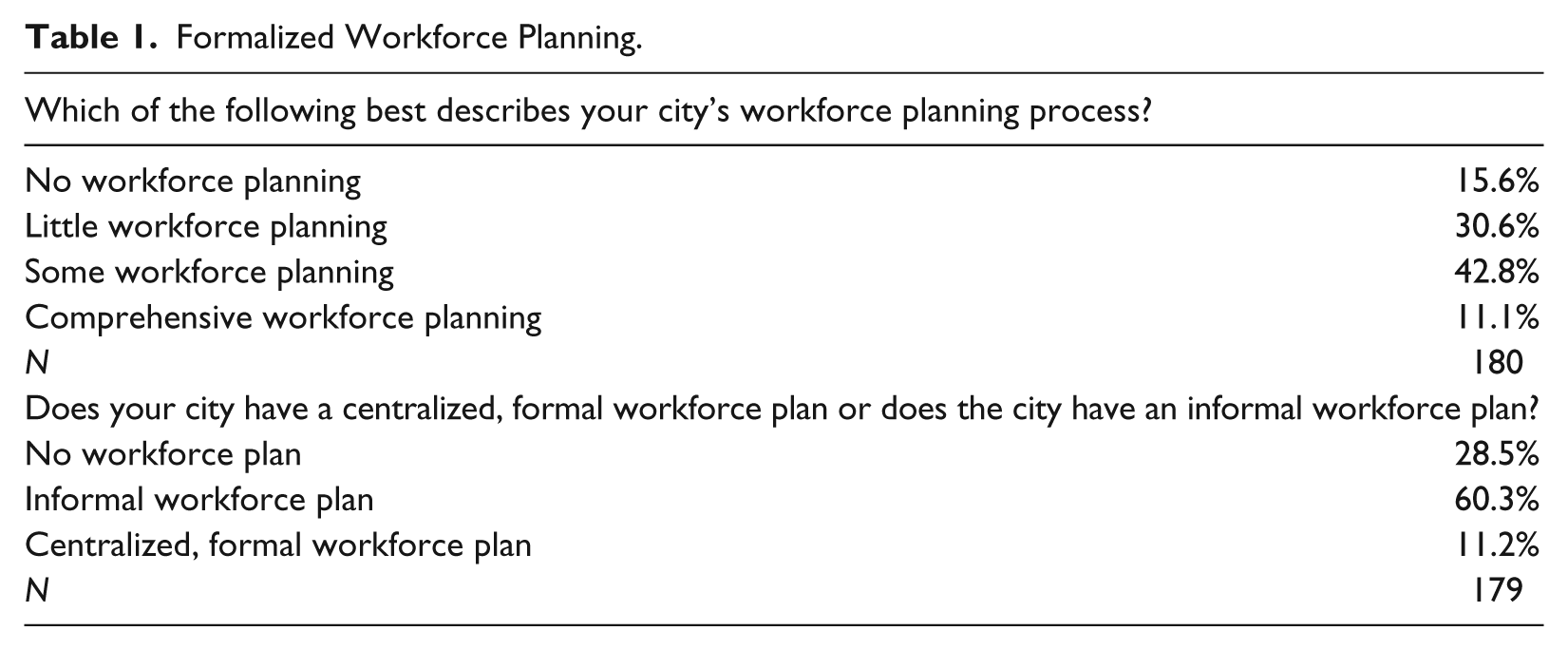
Table 2 presents the planning activities included in workforce planning according to survey respondents. The table reports percentages for those cities that have a formal workforce plan and for all survey respondents. The results are ranked from highest to lowest. Most cities report they assess retirement, training and development, and critical hiring areas in their workforce plans. Long-term hiring and staffing assessments are included more than short-term hiring and staffing needs, but short-term recruiting slightly edges long-term recruiting. Cities also assess other turnover but at a much lower rate than retirement. Downsizing and labor market supply assessments are at the bottom of the list. Given the timing of the survey (late 2009) it is intriguing that local governments are not better utilizing workforce planning, especially when many are employing reductions in workforce mechanisms.
Activities Included in Workforce Plans (Ranked).

Variables, Regression Models, and Findings
Dependent Variables
Two dependent variables are used to test our hypotheses. For the first dependent variable that assesses the characteristics of local government workforce planning preparedness, we employ responses to the degree of workforce planning captured in Table 1 (no workforce planning to comprehensive workforce planning). Since the dependent variable used in this for analysis in the first model is a categorical (ordinal) variable and thus lacks the continuous normal distribution assumed for ordinary least squares regression (OLS), ordered logistic regression is utilized along with the appropriate diagnostic techniques. 2 Employing approximate likelihood ratio tests and Brant tests as diagnostic techniques ensures accurate specification of the model (Brant, 1990).
In addition to the categorical variable discussed above, we created an additive index to more fully capture the extent of workforce planning. Survey items reported in Tables 1 and 2 are summed together to create the dependent variable, Comprehensive Workforce Planning (CWP) (Kellough & Selden, 2003). The CWP index measures the extent to which a city’s HR department implements workforce planning. The CWP index ranges from 0 to 20 with a mean of 9.857. Cronbach’s α of .9060 indicates the index has a high degree of internal reliability.
Independent Variables
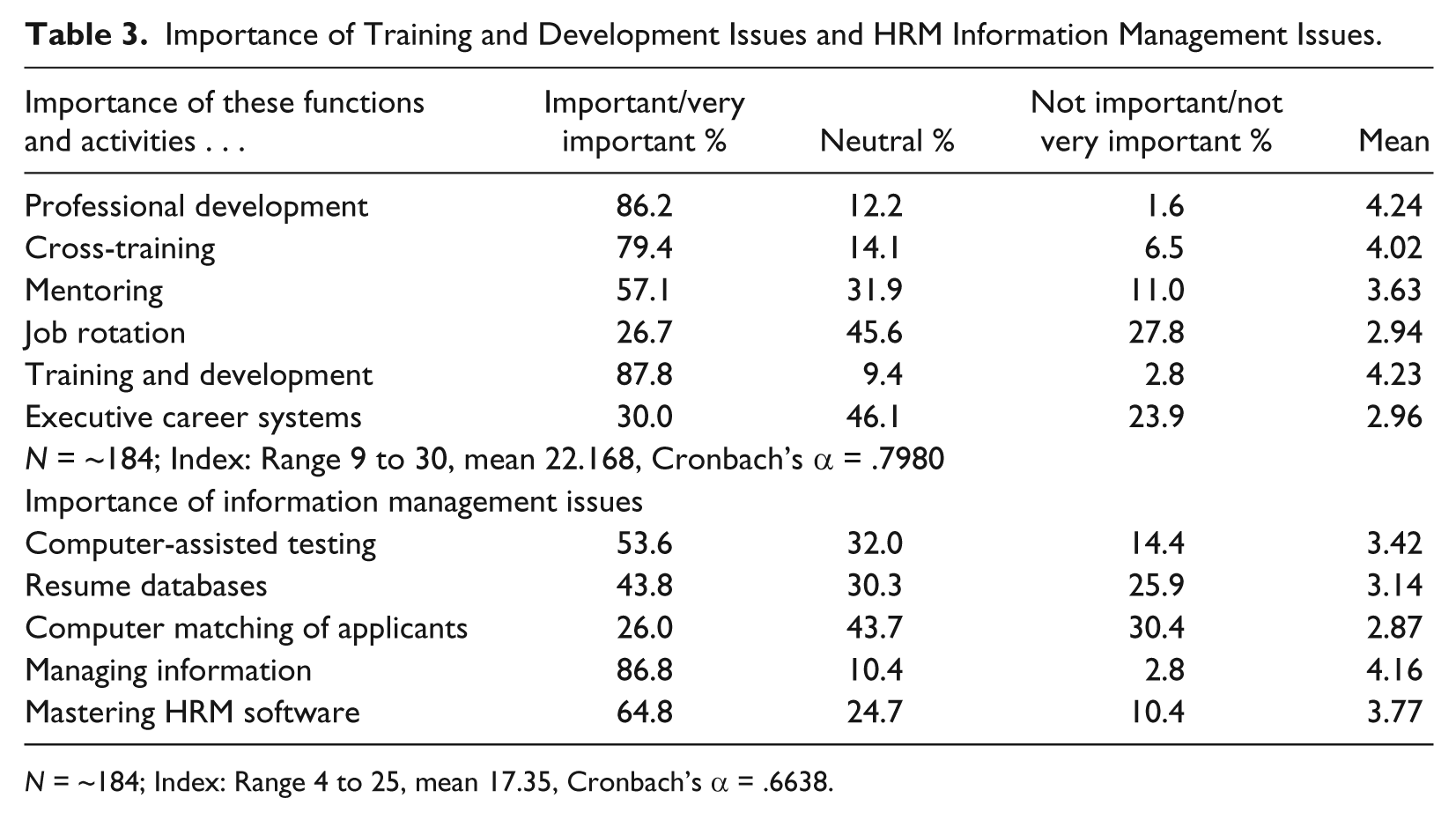
The first hypothesis we test focuses on training and development and their influence on workforce planning. The first hypothesis says, there is a positive relationship between municipalities that place higher importance on training and development and comprehensive workforce planning. To measure training and development, we construct an index that captures the importance of training and development related items to local government HR directors. Table 3 reports six survey items measuring training and development issues. Large percentages of respondents indicate that training and development (87.8%), professional development (86.2%), cross-training (79.4%), and mentoring (57.1%) are important or very important function to HRM today. Smaller percentages believe executive career systems (30.0%) and job rotation (26.7) are important or very important to contemporary HRM. These last two items are particularly important to a good human capital or talent management program (Johns & Kavanaugh, 2012). To measure the importance of workforce training and development, we created an index by summing together the six survey items reported in the top portion of Table 4 to create a training and development index. The index ranges from 9 to 30 and has a mean of 22.17. The Cronbach’s α of .7980 indicates that the index has a high degree of internal reliability.
Importance of Training and Development Issues and HRM Information Management Issues.
N = ~184; Index: Range 4 to 25, mean 17.35, Cronbach’s α = .6638.
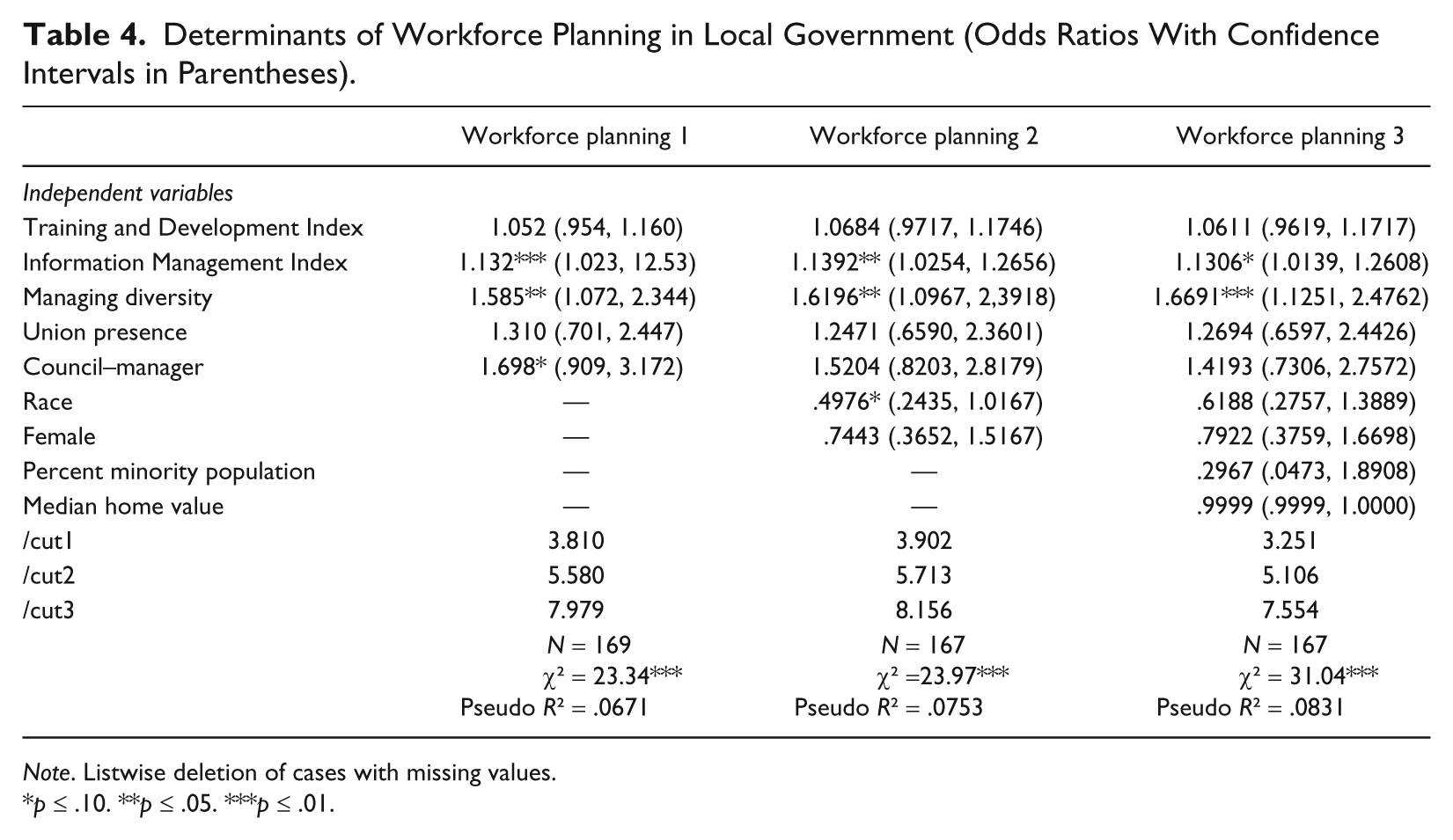
Determinants of Workforce Planning in Local Government (Odds Ratios With Confidence Intervals in Parentheses).
Note. Listwise deletion of cases with missing values.
p ≤ .10. **p ≤ .05. ***p ≤ .01.
Human resource information systems and the subsequent automation are important tools in a human capital management. The second hypothesis points to the relationship between human resource information systems (technology) and workforce planning. The second hypothesis states, there is a positive relationship between municipalities that place more importance on HR information technology uses and comprehensive workforce planning. To test this hypothesis, we construct an index to measure human resource information systems/technology. The bottom portion of Table 3 reports survey responses to questions dealing with the importance of various information management applications commonly used by HR departments. The table reports that 86.8% of local government HR managers believe managing information is an important or very important aspect of their job. Similarly, 64.8% believe it is important or very important to master HRM software. About half of the survey respondents reported that computer-assisted testing was important or very important to today’s HRM. However, resume databases (43.8%) and computer-matching of applications were not seen as important as other HR information technology applications. As mentioned above, we developed a variable to act as a proxy for integrated IT systems by summing together the 5 survey items reported in bottom half of Table 4 to form the HR information systems (HRIS) index. The HRIS index ranges from 4 to 25 with a mean of 17.35. Cronbach’s α is .6638 representing a moderate degree of internal reliability.
The third hypothesis tested says, there is a positive relationship between importance HR managers place on diversity management and comprehensive workforce planning. The survey asked local government HR managers to rate the importance of managing diversity to HR management today. The survey item was measured with a Likert-type response ranging from Not very important (coded 1) to Very important (coded 5). Responses range from 1 to 5 with a mean response of 4.08. A large majority (79.12%) indicated that managing diversity was an important or very important part of modern HRM.
The fourth hypothesis argues that there is a negative relationship between union presence and comprehensive workforce planning. Union presence is measured from a survey item that asked local government HR managers to report the percentage of their workforce that belonged to a union. We transformed that variable to a dummy variable coded 1 for union presence in the city and 0 if no union presence. For those surveys that did not report union presence we were able to collect that information from the city’s website. Sixty-three percent of the cities surveyed indicated a presence of employee unions in the city. According to the survey, unions cover roughly 45.93% of full-time and 26.56% of part-time employees for cities in this study.
The final hypothesis says, there is a positive relationship between cities with a council–manager form of government and comprehensive workforce planning. A dummy variable is used to represent cities with a council–manager form of government as indicated by the survey (1 = Yes, 0 = No). Most survey respondents (57%) work in cities with a council–manager form of government.
Demographic variables can have rich explanatory powers in HRM research (Edgar & Geare, 2004). For example, evidence points to differences in attitudes and behaviors between males and females in HRM with females and minorities having more favorable opinions toward diversity than men (Konrad & Hartmann, 2002; Mor Barak, Cherin, & Berkman, 1998). Many HRM policies specifically target employees of protected classes such as race and gender. As women and minorities take on larger roles in organizations they can actively represent issues that are important to underrepresented groups (Selden, 1997). An aspect of workforce planning encompasses diversity planning. HR managers can use workforce planning to target specific groups to ensure a diverse workforce (Anderson, 2004; Johnson & Brown, 2004). As in other policy and administrative areas in public administration, women HR managers can influence workforce planning from their prospective (Bowling, Kelleher, Jones, & Wright, 2006; Selden, 1997). A dummy variable is used to control for the gender of the survey respondent (coded 1 for female and 0 for male). We expect a positive relationship between gender and CWP.
We employ two race-related variables. The first variable, race, is used as a control variable in our model (coded 1 for minority and 0 for nonminority) for the survey respondent. The second race related variable measures the percentage of the municipality that is minority. This information was retrieved from the U.S. Census Bureau (2012). Recent research has highlighted the importance of including diversity and race in assessing reforms to public human resource management (Battaglio, 2010). For the reasons stated in the above discussion on gender, we hypothesize a positive relationship between race and CWP.
Finally, we employ a variable to control for fiscal capacity. Socioeconomic indicators have long played a role in comparative policy studies as conditions for program success (Donahue et al., 2000). As local government’s fiscal capacity becomes tight, local governments look for ways to cut expenditures. Workforce planning can be costly and time consuming. Local governments that lack resources are less likely to employ sophisticated or formal workforce planning. Instead they are more likely to use workforce planning informally as opposed to more affluent jurisdictions (Choudhury, 2007). There are a many economic indicators that can be used to control for the fiscal capacity of local governments. One such variable is the median home value. For the variable we use the median home value for each city as reported by the U.S. Census Bureau (2012). Median home values are a 5-year average (2006-2010 data for this analysis). We therefore expect a positive relationship between per capita income and workforce planning.
Results and Discussion
Table 4 presents the findings from ordered logistic regression for three models. The likelihood ratios (χ2) indicate that the model as a whole is statistically significant illustrating that it is extremely unlikely that these results are due to chance. Table 4 reports the odds ratios and confidence intervals for the independent variables, giving us an appreciation for the magnitude of their impact. 3 The odds ratio can be interpreted as the extent to which a particular variable increases or decreases the likelihood of comprehensive workforce planning. An odds ratio greater than 1 indicates a more comprehensive approach to workforce planning is likely, while odds less than 1 indicate comprehensive workforce planning is less likely. 4
Two variables report statistical significance for all 3 models: Information Management Index and Managing Diversity. For the information management index, the odds ratio indicates that for a one-unit increase in the information management index the odds of comprehensive planning is 1.132, 1.392, and 1.131 times more likely from Models 1 to 3, respectively, when the other variables are held constant. Thus, as hypothesized, respondents indicating a greater emphasis on information management systems are more likely to embrace comprehensive workforce planning. Diversity management is also a significant predictor of comprehensive workforce planning. The odds ratio for the diversity management variable indicates that for a one-unit increase in the diversity management measure in the respondent’s jurisdiction, the odds of comprehensive workforce planning versus the other categories are 1.585, 1.620, and 1.669 times more likely for Models 1 to 3, respectively, when the other variables are held constant. Thus, as proposed, HR professionals who espouse diversity management are more likely to adopt comprehensive workforce planning.
The variable representing cities with a council–manager form of government are 1.698 times more likely to embrace comprehensive workforce planning. The council–manager form of government is no longer statistically significant when adding other variables to the model. The variable representing minority survey respondents is statistically significant in the second model; however, the direction of the relationship is negative. Minority survey respondents are half as likely (.498) to report comprehensive workforce planning in their cities.
While not significant, the results for training and development, union presence, and female, minority population, and median home values variables are nonetheless interesting. With respect to training and development, the results are in the expected direction but not a significant predictor of workforce planning. The union presence, females, percent minority, and median home value variables are in the opposite direction than expected. Though not statistically significant, the variable representing union presence is positive, and the variables representing female survey respondents and median home value are negative.
The results for median home value respective of the jurisdictions surveyed are interesting. The results indicate a negative relationship with the dependent variable for comprehensive workforce planning. The odds ratio indicates that HR professionals working in affluent jurisdictions are less likely embrace comprehensive workforce planning. The lack of fiscal stress may indicate a lackadaisical approach to workforce planning. These findings are contrary to findings elsewhere, which suggest that jurisdictions with improved economic conditions and greater financial assets are more likely to take a comprehensive approach to human resource management practices (Kellough & Selden, 2003). Perhaps respondents in resource-munificent jurisdictions may be less concerned about planning for the future workforce, emphasizing aesthetic pursuits instead.
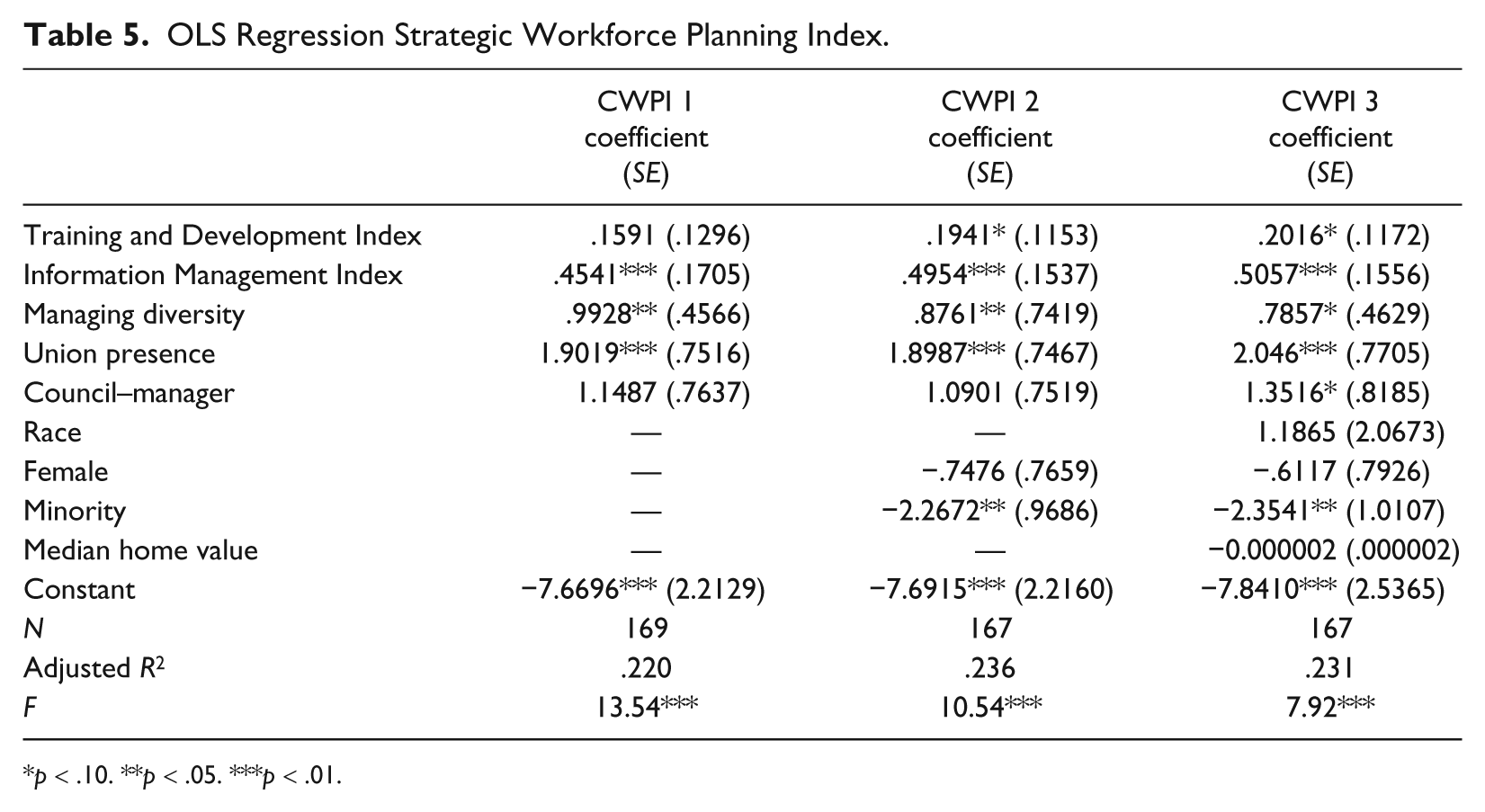
Table 5 reports the results of OLS regression for three Comprehensive Workforce Planning models (CWP). The models are significant with adjusted R2s of .220, .236, and .231, respectively. The models explain 22%, 24%, and 23% of the variance respectively. Since most of the variables were statistically significant in at least one model, we will explain each variable separately. The Training and development (TM) index is statistically significant in the CWP Models 2 and 3 but not the first model. The relationship is in the direction as hypothesized. Cities that place importance on training and development issues are utilizing workforce planning. For every 1-point increase in the TD index, there is a corresponding .194 and .202 increase in the dependent variable. Training and development were not significant in the ordered regression model, but the sign was in the predicted direction. When the more encompassing dependent variable is regressed against training and development, the variable becomes significant. In sum, as training and development become more important then workforce planning becomes more comprehensive. 5
OLS Regression Strategic Workforce Planning Index.
p < .10. **p < .05. ***p < .01.
The HRIS index, Managing diversity, and Union presence are all statistically significant in each of the models. The IM index is in the hypothesized, positive direction. HR managers who place more importance on automation and HRIS also report higher levels of comprehensive workforce planning. Information systems provide the tools needed for managers to analyze workforce trends and employ workforce planning. Every 1-point increase in the Information Management index results in a corresponding .454, .495, and .506 increase in the CWP indexes 1 to 3, respectively.
The importance placed on managing for diversity also results in a strong positive relationship with each of the CWP models. Every 1-point increase in the importance placed on managing for diversity results in a .993, .876, and .786 increase in the CPWI Models 1 to 3, respectively. Managing for diversity and workforce planning are two 21st-century management necessities. The two complement each other. On the other hand, minority HR managers have a negative relationship to comprehensive workforce planning in the two models that included the variable. There is a −2.267 and −2.354 reduction in the dependent variable for CWP Models 2 and 3, respectively, for minority survey respondents. With the sign in the opposite direction, negative perceptions of minorities toward other recent reform efforts suggest that current public HRM reforms represent a move in the wrong direction regarding diversity. In some instances, such reforms are viewed as a tool for “discrimination-induced job dismissals,” giving managers the upper hand in HR decisions (Wilson, 2006, p. 178). It is plausible that minority HR professionals may have the same reaction to comprehensive workforce planning, especially in jurisdictions that have a history of discrimination in employment (see Sims, 2009). Performance-oriented tools, such as workforce planning, are often placed in the hands of managers to utilize at their own discretion (Donahue et al., 2000). Cities with minority HR directors have a higher minority population (about 42%) than cities without a minority HR director (about 26%). Also, minority HR directors work in larger cities (population mean = 273,159) than nonminority HR directors (population mean = 102,884).
The variable representing union presence was statistically significant in each of the three models. Surprisingly, the variable is in the opposite direction than expected. There is a positive relationship between union presence and comprehensive workforce management. A union presence in the city results in a corresponding 1.902, 1.899, and 2.046 increase in the CWP index for Models 1 to 3, respectively. In recent years as the economy has stumbled, unions have become critical players in HR workforce planning as decisions are made about staffing levels, furloughs, retirement incentives, and so forth.
The CPW Model 3 also reported a positive statistical significance for the Council–Manager variable. It nears significance in Models 1 (p = .13) and 2 (p = .15). Cities with a council–manager form of government increase the CPWI by 1.352. When controlling for race, gender, and fiscal capacity, cities with a city manager makes a difference for workforce planning. The other variables in the model, females, race, and median home value are not statistically significant in the model.
Conclusion
Much of the literature on public sector workforce planning is normative and suggestive on how to implement workforce planning as part of strategic management. The paucity of empirical research is striking given the importance of workforce planning in assessing future employment needs of public sector agencies. Such a tool is crucial for the provision of sufficient levels of services to fulfill the missions the public has come to expect from government (Selden, 2009). This article provides much needed empirical analysis to test hypotheses of factors that influence the proclivity for workforce planning at the local government level.
To return to our original research questions asked at the outset of this article. The first two research questions asked, how is workforce planning used at the local level and what is the extent of local governments’ use of workforce planning. Very few local governments make use of comprehensive, formal workforce plans. The human capital crisis that looms for local governments due to the number of employees who will be eligible for retirement or early retirement in the near future offers significant opportunity for the use of workforce planning to help with forecasting the labor pool and fine tuning recruitment efforts. Likewise, the state of a less than stellar economy, new challenges in recruiting and retaining talented employees have emerged. Local governments have more difficulty than states and the federal governments retaining quality employees (Crewson, 1997). Workforce planning is an important tool for HR managers in strategically managing a city’s human capacity. The private sector sees the importance of workforce planning in economic slowdowns. In fact, many have stepped up workforce planning in recent years (Watson Wyatt, 2008). With the state of the economy in recent years compounded by looming retirements, local governments need to be more proactive in workforce planning and succession planning.
This research demonstrates that the majority of local government human resource management professionals surveyed have integrated certain aspects of workforce planning into their human resource functions. Local governments are more informal with their workforce plans. Assessments of employee retirement; long-term recruitment, hiring, retention, and promotion; and training and development are utilized in their human resource planning processes. However, the potential of workforce planning to enhance the organization’s ability to meet long-term objectives and to cope with change remains somewhat untapped in our opinion. Forty-seven percent of human resource management professionals in this survey reported engaging in little or no workforce planning for their municipalities and only 11% reported their municipalities have a centralized, formal workforce plan. Future research needs to explore why this is the case. Why do local governments not utilize the tools necessary to ensure their ability to compete for quality employees, especially in the current political and economic climates?
The final question asked what factors influence workforce planning at the local government level? The models presented in this article provide empirical evidence for the importance of variables stressed in normative analyses of workforce planning and tell us how workforce planning is used at the local government level. Training and development is an important tool that local governments must take seriously if they expect to continue to provide services in the future as more and more employees retire. Paradoxically, training and development tend to be the first budget items cut during economic uncertainty regardless of how vital training and development are to secure a talented workforce. Cities that see training and development as important and utilize workforce planning are well on their way to successful succession planning. An HRIS is a must for adequate workforce planning. HRIS allow for easier analysis of future needs and help HR managers plan accordingly. This variable is significant in all of the models tested in this research.
Managers who realize the importance of a diverse workforce and manage their workforce to reflect that importance see the need for comprehensive workforce planning. Interestingly, the models show a negative relationship between minority HR directors and workforce planning. More research is needed to better understand why this is the case. Another important finding is the significance of cities with council–manager forms of government—professional management matters. In the comprehensive model cities with the council–manager form of government increase their likelihood of comprehensive workforce planning. Also unexpected was the positive relationship between union presence and workforce planning. It appears that unions are partners in workforce planning rather than a hindrance. This finding warrants further research to confirm these findings. Finally, socioeconomic conditions are not important predictors of CWP.
To recap, we find that an increased emphasis on training and development, information technology, and diversity management is essential as local government human resource management continues its quest to become a strategic partner in city governance rather than a reactive agency with little perceived value. Leadership among city government executives can help with workforce planning and smoothing the transition from one generation of worker to the next generation of worker.
Future research needs to analyze and test HR performance indicators as dependent variables and workforce planning as an independent variable. Research can also expand this work by analyzing the relationship between workforce planning and its major subcomponent succession planning. Also, how does workforce planning relate to recruiting and retention of quality employees?
Strategic human resource management is a core component in today’s efforts to improve public sector organizations by tying HR activities to missions rather than reacting to traditional HR needs. Human resource strategies focusing on strategic staffing, information management, executive succession, and development planning are imperative if local governments intend to attract knowledgeable, diverse, and highly skilled employees who are needed to meet the demands of the citizenry that has exhibited a renewed interest regarding financial, policy, and performance concerns. Both scholars and practitioners must continue to reframe modern human resource management into a profession that strategically partners with other functions and departments to complement the public organization’s mission and operational goals.
Footnotes
Declaration of Conflicting Interests
The author(s) declared no potential conflicts of interest with respect to the research, authorship, and/or publication of this article.
Funding
The author(s) received no financial support for the research, authorship, and/or publication of this article.