



Abstract
Performance management, despite its popularity as a strategy to improve the quality of public services, has had mixed results. One reason is that successful performance management reform depends not just on changes in formal systems but also on changes in organizational values. This article analyzes a large urban school district to measure the role that external incentives and organizational climate play in the development of performance management values. In contrast with prior research, it finds that organizational incentives have only a small effect on the espousal of performance values and have a negative and significant impact on the adoption of performance management behavior. By contrast, organizational climate has a strong and positive impact on performance values. These findings raise serious questions about the efficacy of high-stakes accountability reforms, and highlight the need for policymakers to consider alternate approaches that foster organizational trust and build up a capacity for reform.
In recent decades, policymakers and researchers have turned to performance management reform as a mechanism to improve the quality and efficiency of public organizations. Intended to improve government service through the publication of performance data and a realignment of incentives around organizational outcomes, such reforms have gained traction in a wide range of policy domains, from public health and international development to local government services.
Despite their popularity, recent studies suggest that even high-profile reforms often result in few changes in practice or outcomes on the front lines (Heinrich, 2007; Moynihan, 2008; Radin, 2006). A key reason is that performance reforms demand not just changes in formal oversight systems (e.g., data collection and strategic planning mechanisms and formal outcome-based accountability systems) but also changes in norms and values on the front lines (Coburn, 2001; Hartmann & Khademian, 2010; Honig, 2006; Moynihan & Pandey, 2010; Moynihan, Pandey, & Wright, 2012). Analyses of performance management reform therefore would benefit from explicit attention to the dynamics of organizational culture change.
This article examines the conditions under which performance management reform is most likely to change frontline values and norms. Using data from a large urban school district, New York City, which undertook a dramatic performance management reform starting in 2007, it presents and tests two theories of organizational change: one rooted in external incentives and performance pressure and one that sees values change as largely a product of internal organizational capacity and climate. Specifically, it asks,
How do external incentives and organizational climate affect the espousal of performance management values and the adoption of performance values on the front lines?
By looking at both espoused values (stated organizational beliefs) and values-in-use (beliefs as revealed through organizational behavior), this article examines the conditions under which frontline workers not only explicitly value innovation and high performance standards but also put those values into practice through data-based decision making and continuous improvement processes.
This essay fills gaps in the literature on performance management and administrative reform in two ways. First, by measuring the impact of external incentives and organizational climate side by side, it provides a test of two dominant theories of organizational change. This approach helps us to understand not only whether, but also under what conditions, performance management reform is likely to change organizational behavior. Second, by measuring both self-reported organizational values and organizational values as revealed through observable behavior, this article enriches our understanding of organizational culture and avoids measurement problems that have plagued previous research.
Performance Management Reform and Its Discontents
I define performance management reform as a set of policies that require the collection, analysis, and dissemination of performance information and hold organizations formally accountable for performance. This reflects the working definition of the National Performance Management Advisory Commission, which describes performance management as “an ongoing, systematic approach to improving results through evidence-based decision making, continuous organizational learning, and a focus on accountability for performance” (National Performance Management Advisory Commission, 2010, p. 3). Performance management reform has taken root in a variety of settings, including public health, prison administration, human services, and international development (Christensen, Lægreid, & Stigen, 2006; Hatton & Schroeder, 2007; McBeath & Meezan, 2009; Moynihan, 2008). At the same time, evidence of performance management’s efficacy is mixed. While proponents (e.g., Behn, 2003; Hatry, 1997) suggest that a focus on performance data can align organizational incentives and facilitate outcome-oriented organizational decision making, critics point to symbolic or strategic implementation, often in response to reforms driven by political expediency (Moynihan & Pandey, 2010; Radin, 2006). For example, when policymakers enact performance management reform to battle “wasteful bureaucracies,” they often fail to track and analyze the data that performance systems produce or adjust policy on the basis of that analysis (Moynihan, 2008; Radin, 2006). Without any follow-through, midlevel managers then respond superficially or tweak performance measures without regard to overall organization performance, such as by narrowing their focus to “teach to the test” or by focusing on “bubble” clients—those near passing thresholds and thus most likely to affect overall ratings (Corcoran, Jennings, & Beveridge, 2010; Heinrich, 2007; Heinrich & Marschke, 2010; Jacob, 2005; Jennings & Haist, 2004). The mixed nature of these findings point to the need to go beyond questions of whether performance management reform works to the more nuanced questions of how and under what conditions performance management reform is most likely to change frontline practice (Childress, Higgins, Ishimaru, & Takahashi, 2011; Khademian, 2009; Moynihan, 2008).
The extant literature suggests that frontline responses to performance management reform reflect formal policy features and informal organizational characteristics. Formal features—the level of managerial discretion, valid and reliable performance information, accountability for performance, and presence of learning forums—influence organizational responses to performance mandates, as Moynihan (2008) has shown. However, formal change is insufficient in contexts where performance management reform runs counter to preexisting organizational norms and values. Kerchner et al. (2008a), for example, contrast traditional public sector values and assumptions, premised in a “logic of confidence” in apolitical experts, with recent performance-oriented reforms, which operate according to a logic of “consequences,” where one’s discretion or status is contingent on one’s results (Boyd, Kerchner, & Blyth, 2008). Unless middle managers and frontline workers can reorient their decisions around this new logic, Kerschner et al. suggest, reform implementation will be incomplete.
Moynihan has begun to measure the relationship between organizational values and performance management reform. With Pandey (Moynihan & Pandey, 2010), for example, he finds that public managers in organizations that possess a “developmental culture”—one that emphasizes risk-taking and innovation—make more use of performance data. In subsequent work, he frames culture as a tool, suggesting that transformative leaders work through it to encourage performance information use (Moynihan et al., 2012). Others have looked at the impact of organizational climate and values further downstream. For example, Childress et al.’s (2011) study of New York City schools finds that both “psychological safety” (organizational trust and support) and an “accountability culture” correspond to improved student achievement.
These studies affirm the importance of values and culture to performance management and suggest directions for future research. The Childress and Higgins study, for example, acknowledges outright the need to consider both how an accountability culture shapes organizational outcomes and how such a culture emerges. At the same time, these studies, which rely heavily on self-report measures, present a methodological challenge. Self-reports capture espoused values, but may not reflect deeper, tacit assumptions and the realities of organizational practice (Schein, 2006). Moreover, recent scholarship has raised concerns about relying heavily on a single survey for both dependent and independent variables, arguing that this practice, while common, may contribute to severe common source bias (Meier & O’Toole, 2011). This article builds on the work of both Moynihan and Childress in two ways. First, it exploits third-party accountability data to document a richer and more accurate picture of organizational behavior. Second, it articulates and empirically tests two theories of how and under what conditions performance management reform changes values and practice on the front lines.
Conceptual Framework: Competing Paths to Values Change
If successful performance management reform depends on the development of organizational values aligned with the reform, then how do such values emerge in the first place? Institutional and organizational theories suggest two paths: external incentives and internal dynamics (climate).
The relationship between incentives and organizational culture and behavior is well established in prior literature (Eisenhardt, 1989; Moe, 1991; Pratt & Zeckhauser, 1985). From this perspective, organizations respond and adapt to external signals and, particularly, changes in the external environment. Changes in outside demand or in the external authorizing environment lead to changes in organizational values and practice. Hartmann and Khademian (2010), for example, conceptualize organizational culture as a set of commitments, which “depends on the incentives people face for action, and the consequences of those actions over time” (p. 849). These incentives can be positive—for example, the awarding of recognition or bonuses for exceptional outcomes—or they can be negative—penalties for low performance. Negative sanctions, in particular, may prompt “survival anxiety,” a perceived risk to organizational health or well-being (Schein, 2006). Survival anxiety motivates change by revealing a misalignment between organizational culture and the external environment (Hannan & Freeman, 1984; Parsons, 1956) and presenting a “burning platform” that demands an organizational response (see also Kotter, 1996).
Organizations do not experience survival anxiety uniformly in response to external reforms. In the case of performance management reform, two features matter: organizational performance and stakeholder support. Because performance management systems typically award sanctions or rewards tied to performance, low-performing organizations will experience greater survival anxiety, even if performance outcomes are outside their direct control. 1 Stakeholder support is also important. Loyal and active clients may shield valued organizations from sanctions, especially if their assessments of organizational performance exceed formal performance ratings (Figlio & Kenny, 2009; Kowal & Hassel, 2008). Organizations that lack stakeholder support, therefore, would face greater survival anxiety, all else equal.
The incentive perspective suggests that increased survival anxiety will contribute to greater organizational change. This leads to the following hypothesis:
Not all theories of organizational change prioritize external incentives, however. Prior research on organizational change (e.g., Sandfort, 1999) highlights the difficulty of changing deeply engrained practices. Even if individuals within an organization support a reform or perceive a need for change, inertial forces can impede substantive change (Hannan & Freeman, 1984). From this vantage point, what matters is not external pressure but instead, the extent to which an organization is, all else equal, more “ready for change” (Hou, Moynihan, & Ingraham, 2003; O’Toole & Meier, 2009). Capacity, moreover, depends on a supportive organizational climate: a work environment characterized by psychological safety, perceptions of support, and norms of open and honest dialogue (Austin & Ciaassen, 2008; Fernandez & Moldogaziev, 2011). From this perspective, the prospects of organizational culture change increase when individuals are able to experiment and openly share differences. Norms of open and honest dialogue help organizations to make sense of new information (Childress et al., 2011; Moynihan & Pandey, 2010; Schein, 2006). Psychological safety and trust (Childress et al., 2011; Park, 2012; Schein, 2006; Senge, 1990; Smylie & Evans, 2006) help frontline workers unlearn old habits and develop new ones. In sum, climate facilitates change by surfacing preexisting assumptions and inconsistencies in organizational values-in-use (Argyris & Schön, 1974, 1978; Coburn, 2001; Schein, 2006; Senge, 1990). In the absence of such features, Meyer and Rowan have argued, organizations are likely to respond to new mandates by decoupling formal systems from informal practices, using new formal systems as a tool to maintain broader legitimacy while leaving deeper organizational practices unchanged (Meyer & Rowan, 1977). This leads to a second hypothesis:
Although presented as competing organizational theories, these two hypotheses need not be mutually exclusive. It is possible that external incentives and organizational climate both matter, or that one matters more in the presence of the other. For example, organizations with high survival anxiety but poor organizational climate may lack the capacity to respond to external pressure, while those with positive organizational climates but little survival anxiety may lack the pressure to change. For that reason, I also include an interaction effect to test the third hypothesis:
In the sections that follow, I present the empirical case and my research methods. Next, I present findings. Finally, I discuss broader implications and conclude with lessons for research and managerial practice.
School Reform as a Context for Studying Performance Management Reform
This article uses public education to test the predictive power of survival anxiety and organizational climate on organizational values. This approach has theoretical and methodological advantages.
First, performance management reform is both new and normatively challenging to public education. While performance management reform emerged in other sectors approximately 20 years ago, it came relatively late to education, in part because of difficulties measuring complex educational outcomes and isolating the influence of any one factor (e.g., a particular teacher). To date, few school systems have adopted full performance management systems. This gives researchers the opportunity to study a performance management reform from its inception.
Moreover, such reforms pose normative challenges because they are fundamentally different from the status quo in two critical ways. School systems have strong formal traditions of central control, with curricular and managerial decisions made by an elite housed in central offices (Kerchner, Menefee-Libey, & Mulfinger, 2008a; Tyack, 1974). At the same time, school systems are “loosely-coupled,” affording schools substantial tacit autonomy (Weick, 1976). School leaders and teachers themselves frequently make decisions that deviate from the mandates of formal policy (Lortie, 1975; Meyer & Rowan, 1977). Formal hierarchy and informal discretion each run counter to performance management reform’s emphasis on formal discretion and outcome accountability. For that reason, some scholars have suggested that, for public education, the turn to performance management reform reflects an institutional shift (Boyd et al., 2008; Kerchner, Menefee-Libey, & Mulfinger, 2008b).
Finally, the size and structure of American school districts offers a methodological advantage. As multiple schools operate under a single authority, researchers can study divergent organizational outcomes within a single political, geographical, and policy context, something less possible in other domains. This, in turn, increases the likelihood of drawing causal conclusions.
Performance Management Reform in New York City
Within public education, New York City presents for performance management what Gerring (2007) has labeled a “pathway” case: one where we can control for a confounding variable (in this case, formal policy features) to understand the mechanism by which a second variable (informal institutions) shapes organizational behavior. In 2002, newly elected Mayor Michael Bloomberg dismantled the elected school board and initiated dramatic structural changes. Together with Joel Klein, his appointed Chancellor, Bloomberg transformed a once-hierarchical school district into what scholars in education (e.g., Bulkley, Henig & Levine 2010; Hill et al., 2012) have labeled a “portfolio school district”—characterized by parental choice, decentralization of decision making to the school level, the tracking of performance data and accountability for results—including the closure of chronically failing schools.
Under the new regime, established in 2007, principals became the “CEOs” of their schools, with enhanced budgetary, hiring, and, to a lesser extent, curricular authority. Schools also face greater accountability for performance. New York City’s Department of Education (DOE) has instituted a comprehensive rating system based on quantitative measures of student outcomes and qualitative measures of organizational practice drawn from regular school inspections. 2 These ratings have real consequences; the Mayor and his Chancellors have aggressively closed schools they perceived as failing, even in the face of substantial community opposition. 3
New York City’s portfolio reform presents the purest instance of performance management reform of all school districts in the country. In contrast to other school systems, which have adopted some elements of performance management reform but not others, or applied performance management principles to some schools but not others, New York City’s leaders have altered the formal institutions of oversight for all of its thousand schools. Importantly, the system’s reform codifies four elements of performance management reform highlighted by Moynihan (2008) as critical to successful reform: managerial discretion, valid and reliable performance data, accountability for results, and learning forums. Even critics (e.g. Ravitch 2014) acknowledge that this is no symbolic reform. This suggests that if reforms can spur values change in any public schools, they are most likely to do so in New York.
Data and Method
This article uses learning environment surveys of teachers and parents in 2007, 2010, and 2011 and school accountability reports, all administered by the New York City DOE, to measure the relationship between organizational climate and survival anxiety and the adoption of performance values. Following the work of Argyris and Schön (1974, 1978) and of Schein (2006), it captures two levels of organizational values:
More specifically, this article examines the adoption of performance management values—those aligned with the underlying “logic of consequences” or incentive-based decision making on which performance management reform is based (Kerchner et al., 2008a). Drawing from the work of Kerchner et al., and from the broader literature on performance management (e.g., Hatry, 1997; Osborne & Plastrik, 1997), I construct two variables:
Espoused Performance Management Values Priority placed on high learning standards for all students
4
; Satisfaction with the governing regime; Belief in innovation and autonomy.
Performance Management Values-in-Use Organizational strategizing and goal-setting; Attention to performance data; Engagement in continuous improvement processes.
In doing so, I assess not only whether frontline workers espouse the values of performance management reform but also whether they put those values into practice by engaging in data-based decision making and continuous improvement processes.
Espoused values and values-in-use each represent composites of multiple indicators, which I list in Appendix A. Espoused value measures come from teacher responses (aggregated to the school level) on the annual learning environment survey (response rate 82% in 2011). 5 Measures of performance values-in-use come from the DOE’s Quality Review inspections. Quality Reviews, which are conducted annually for the lowest performing schools and every 2 to 3 years for higher performing schools, rate schools in five categories: organizational and instructional coherence, data gathering and analysis, planning and goal-setting, capacity-building alignment, and monitoring/revision structures. They provide a third-party assessment of performance values-in-use. 6 I construct both dependent variables using factor analysis; each loads on a single factor. 7
Table 1 presents the full descriptive statistics. Following the framework detailed above, I estimate an organization’s likelihood of espousing performance management values or adopting performance management values with the following equation:

Descriptive Statistics.
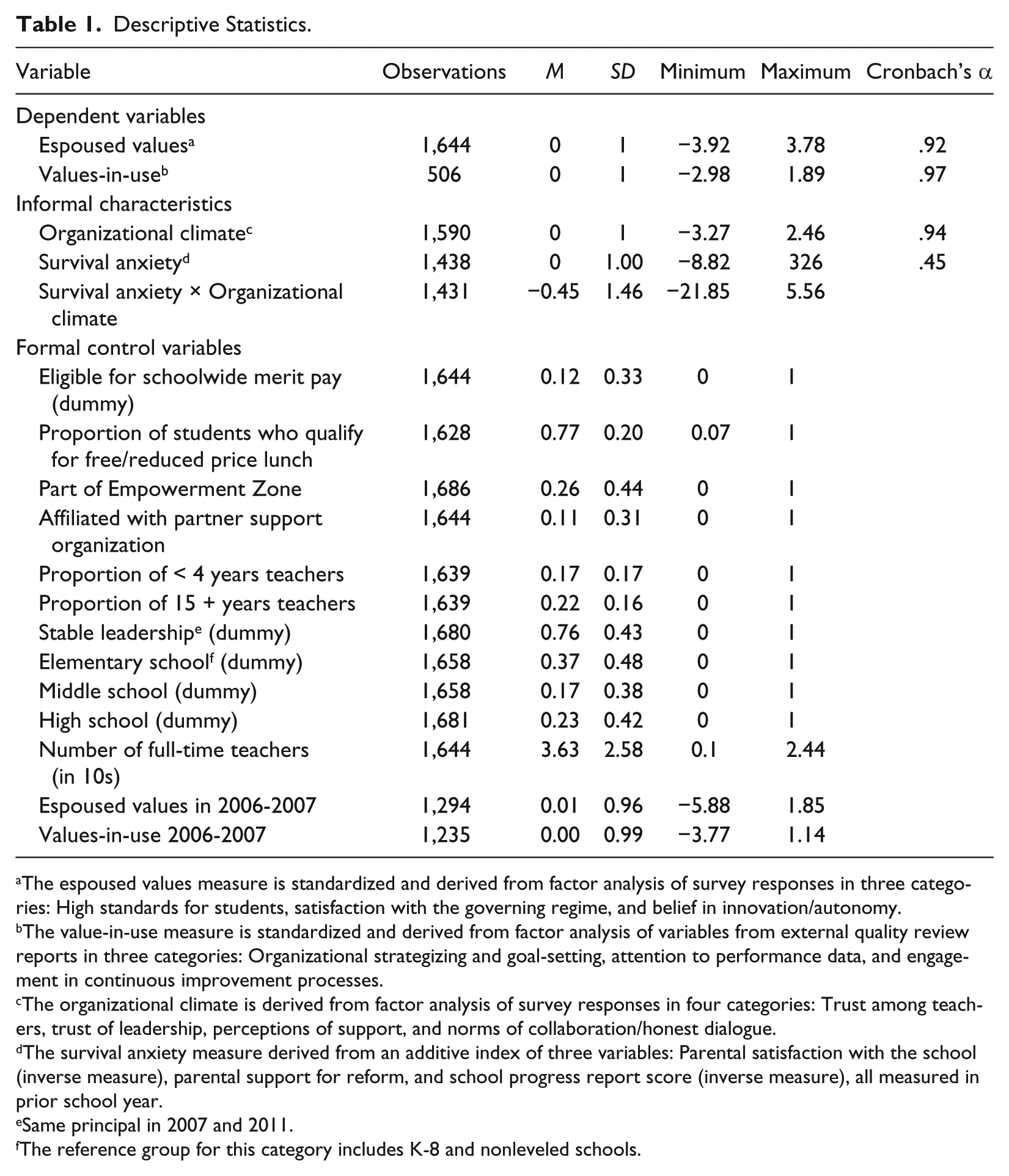
The espoused values measure is standardized and derived from factor analysis of survey responses in three categories: High standards for students, satisfaction with the governing regime, and belief in innovation/autonomy.
The value-in-use measure is standardized and derived from factor analysis of variables from external quality review reports in three categories: Organizational strategizing and goal-setting, attention to performance data, and engagement in continuous improvement processes.
The organizational climate is derived from factor analysis of survey responses in four categories: Trust among teachers, trust of leadership, perceptions of support, and norms of collaboration/honest dialogue.
The survival anxiety measure derived from an additive index of three variables: Parental satisfaction with the school (inverse measure), parental support for reform, and school progress report score (inverse measure), all measured in prior school year.
Same principal in 2007 and 2011.
The reference group for this category includes K-8 and nonleveled schools.
where PV (performance values) is the outcome for a school s in year t. A represents survival anxiety, C represents organizational climate, and F is a vector of formal school and leadership characteristics. I also control for the school’s values in 2007 at the start of the performance management reform. As noted above, this analysis enables me to estimate both the independent influence of survival anxiety and organizational climate and their joint impact, captured with an interaction term.
I conceptualize school-level survival anxiety as the composite of three characteristics:
School quality—as measured by DOE metrics for performance and progress (inverse indicator);
Parental perceptions of school quality (inverse indicator);
Parental support for reform.
The survival anxiety variable is an additive index of standardized variables, drawn from DOE’s annual Progress Report and Parent Survey. 8 The Cronbach’s alpha for this variable, 0.43, raises concerns about internal consistency and reliability. However, researchers in public health and psychology have argued that high alpha scores are less important in contexts such as this one, where the index consists of “causal indicators” rather than “effect indicators” (Fayers, Hand, Bjordal, & Groenvold, 1997; Streiner, 2003). In other words, because parent satisfaction and school ratings cause differences in survival anxiety, rather than result from differences in survival anxiety, it is not surprising that organizations would differ in indicator values.
I retain the composite variable both because of its theoretical justification in the conceptual framework and the methodological justification offered above. Nonetheless, I also report findings from models with different anxiety measures, using these to test the overall robustness of my results.
I define a school’s organizational climate as a composite of three components:
Psychological safety—the extent to which teachers trust one another and school leaders;
Perceptions of support—the extent to which teachers feel respected by stakeholders (parents and students) and respected and materially supported by district leaders;
Norms of collaboration and open dialogue—the extent to which teachers work with one another and feel comfortable airing disagreements.
I capture each organizational climate subcomponent with multiple indicators from the teacher survey, combining the indicators using factor analysis (eigenvalue = 12.01). 9
In addition to organizational climate and survival anxiety, I control for a number of school-level characteristics and/or demographic controls. These are listed in Table 1. I expect five—eligibility for merit pay, prior participation in a voluntary performance management system (the “Empowerment Zone”), the proportion of less-experienced (<4 years) teachers, affiliation with a partner support organization, and 2007 performance management values—to be positively correlated with the adoption of performance management values. A sixth—the proportion of highly experienced (15+ years) teachers—is likely to have a negative correlation with performance values. Four variables have ambiguous or unknown relationships: the proportion of students who quality for free and/or reduced price lunch (commonly used in the education literature as proxy for student demographics), school level (dummy variables for high, middle, and elementary schools), 10 stable school leadership between 2007 and 2010, and the number of full-time teachers (a control for school size). The stable leadership variable’s ambiguity stems from conflicting findings in research and theory. Although the absence of new voices may slow the development of new values (Coburn, 2001), prior research on schools (Branch, Hanushek, & Rivkin, 2009; Clark, Martorell, & Rockoff, 2009; White & Bowers, 2011) associates stable leadership positively with school improvement.
One cannot rule out the possibility of endogeneity in the model. For example, schools may improve their performance (and lower their survival anxiety) as a result of adopting performance management values. In that case, we would see a negative, but spurious, correlation between survival anxiety and performance values. Given New York City’s performance management emphasis, moreover, schools with low performance values may see their organizational climate decline. In other words, organizational climate may reflect not just internal dynamics but also the alignment (or misalignment) between a school’s internal values and external pressures. To reduce the risk of endogeneity, I measure both survival anxiety and organizational climate in the year prior to the measurement of performance values. Doing so also allows me to account for the often-deliberate pace of organizational change.
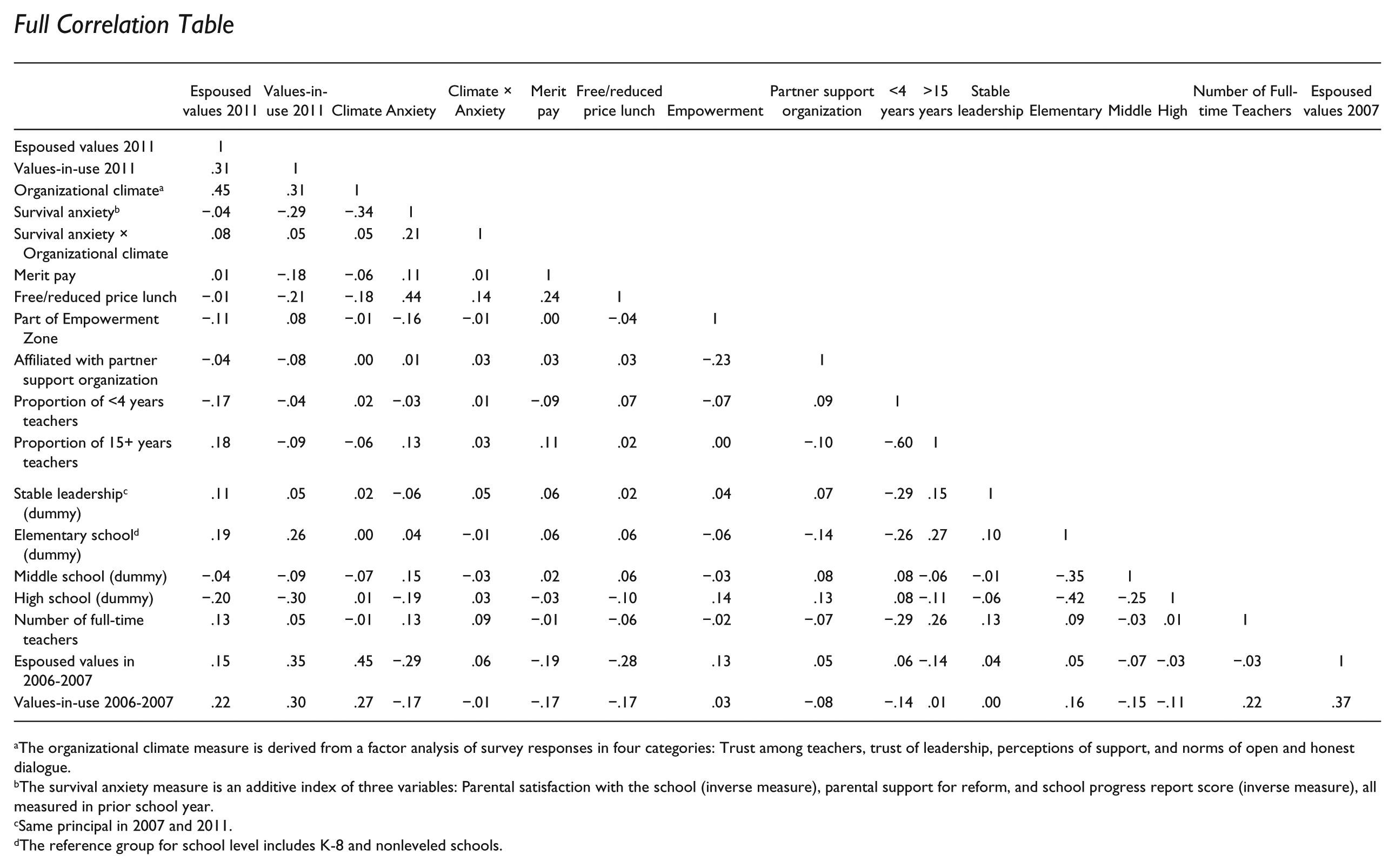
A second challenge stems from the limits of self-reports and a finite number of sources. As noted above, analyses that rely heavily on self-report data can be invalid or biased. Espoused values do not always reflect deeper organizational values, and using multiple perceptual measures from a single survey can bring about common source bias (Meier & O’Toole, 2011; Schein, 2006). The risk of common source bias is greatest for espoused performance values, which are measured using teacher survey responses. By measuring organizational climate and espoused values in different years, I substantially reduce that risk. 11 The correlation between a school’s 2010 organizational climate and 2011 espoused values is 0.45, indicating moderately low correlation. 12
Findings
In this section, I report study findings for the predictors of espoused performance management values and performance values-in-use. In doing so, I look at two populations of interest: The full population of New York City schools, and a subpopulation of schools that, in 2007, exhibited low performance management values. This group is particularly interesting because it represents organizations especially targeted by performance management reform—schools that did not engage in data-based planning or decision making (and therefore, those whose frontline behavior the reformers intended to change).
Analysis 1: Espousal of Performance Values
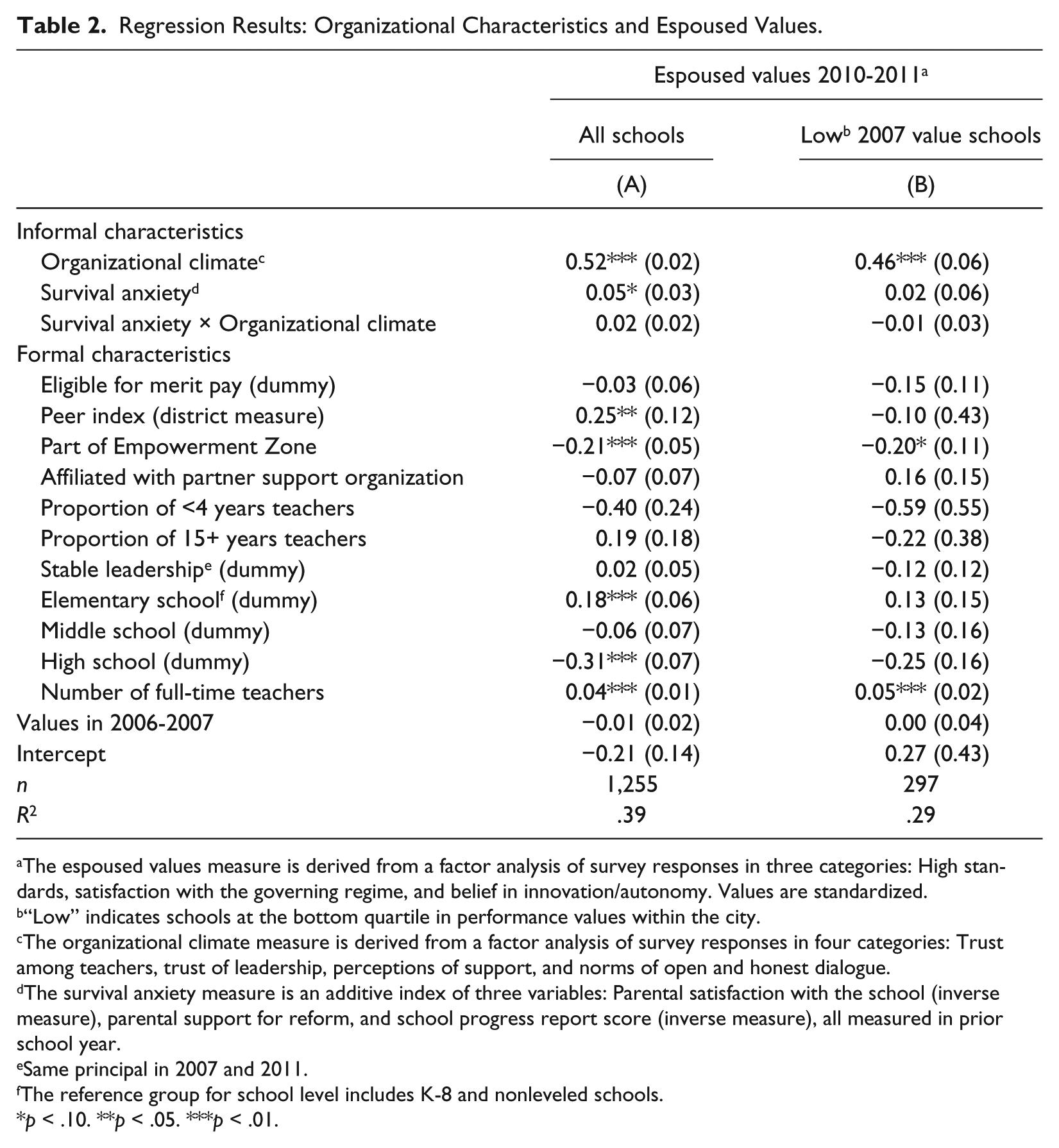
Results from the first analysis can be found in Table 2. They show negligible differences between the full population of schools and those with low espoused values at the start of the reform.
Regression Results: Organizational Characteristics and Espoused Values.
The espoused values measure is derived from a factor analysis of survey responses in three categories: High standards, satisfaction with the governing regime, and belief in innovation/autonomy. Values are standardized.
“Low” indicates schools at the bottom quartile in performance values within the city.
The organizational climate measure is derived from a factor analysis of survey responses in four categories: Trust among teachers, trust of leadership, perceptions of support, and norms of open and honest dialogue.
The survival anxiety measure is an additive index of three variables: Parental satisfaction with the school (inverse measure), parental support for reform, and school progress report score (inverse measure), all measured in prior school year.
Same principal in 2007 and 2011.
The reference group for school level includes K-8 and nonleveled schools.
p < .10. **p < .05. ***p < .01.
The analysis provides strong support for the internal dynamic hypothesis (H1) and only weak support for the external incentive analysis (H2). As both column A and column B show, this analysis finds organizational climate to be a very strong predictor of espoused performance management values. For a school that did not espouse performance values in 2007, a 1 standard deviation increase in a school’s organizational climate corresponds to an increase in that school’s espousal of performance values by 0.46 standard deviations. The survival anxiety variable is comparably weak and only significant for the full population of school at the 0.10 level; for schools that did not espouse performance values at the start of the reform, a 1 standard deviation increase in survival anxiety increases the espousal of performance values by approximately 0.02 standard deviations. Moreover, there is no evidence for the joint-impact hypothesis (H3)—The interaction effect in every specification is both small and insignificant.
Few of schools’ formal characteristics have a significant relationship to the espousal of performance values. 13 This suggests that organizational climate and survival anxiety are more influential than are structural features in predicting the espousal of performance values. Nonetheless, there are some surprising findings. For example, schools affiliated with the Empowerment Zone—a voluntary performance management system that preceded systemwide reform—were less likely to espouse performance values. Moreover, merit pay schools, which qualified for schoolwide salary bonuses if they exceeded performance targets, were also less likely to espouse performance management values (though this finding is statistically insignificant). One explanation for the former finding is that organizational change in empowerment schools preceded the systemwide reform. In other words, empowerment schools that had not developed a performance culture by 2007 were less likely to do so than were schools encountering performance management reform for the first time. The second finding may reflect dissatisfaction with the merit pay system, which was suspended in 2011. An independent evaluation of the merit pay system found no evidence that it improved student outcomes or changed organizational behavior (Marsh, Springer, McCaffrey, Yuan, & Epstein, 2011).
As noted previously, while important as a first take, espoused values may offer a superficial and even inaccurate picture of the core beliefs within an organization. Following Meyer and Rowan’s (1977) logic, espoused values changes may reflect less a substantively altered organizational understanding and more a decoupling and legitimizing strategy—Frontline managers and workers talk the talk of the reform while leaving core practices and assumptions unaltered. For that reason, it is also important to measure organizational values as revealed in practice: organizational value-in-use.
Analysis 2: Adoption of Performance Values-in-Use
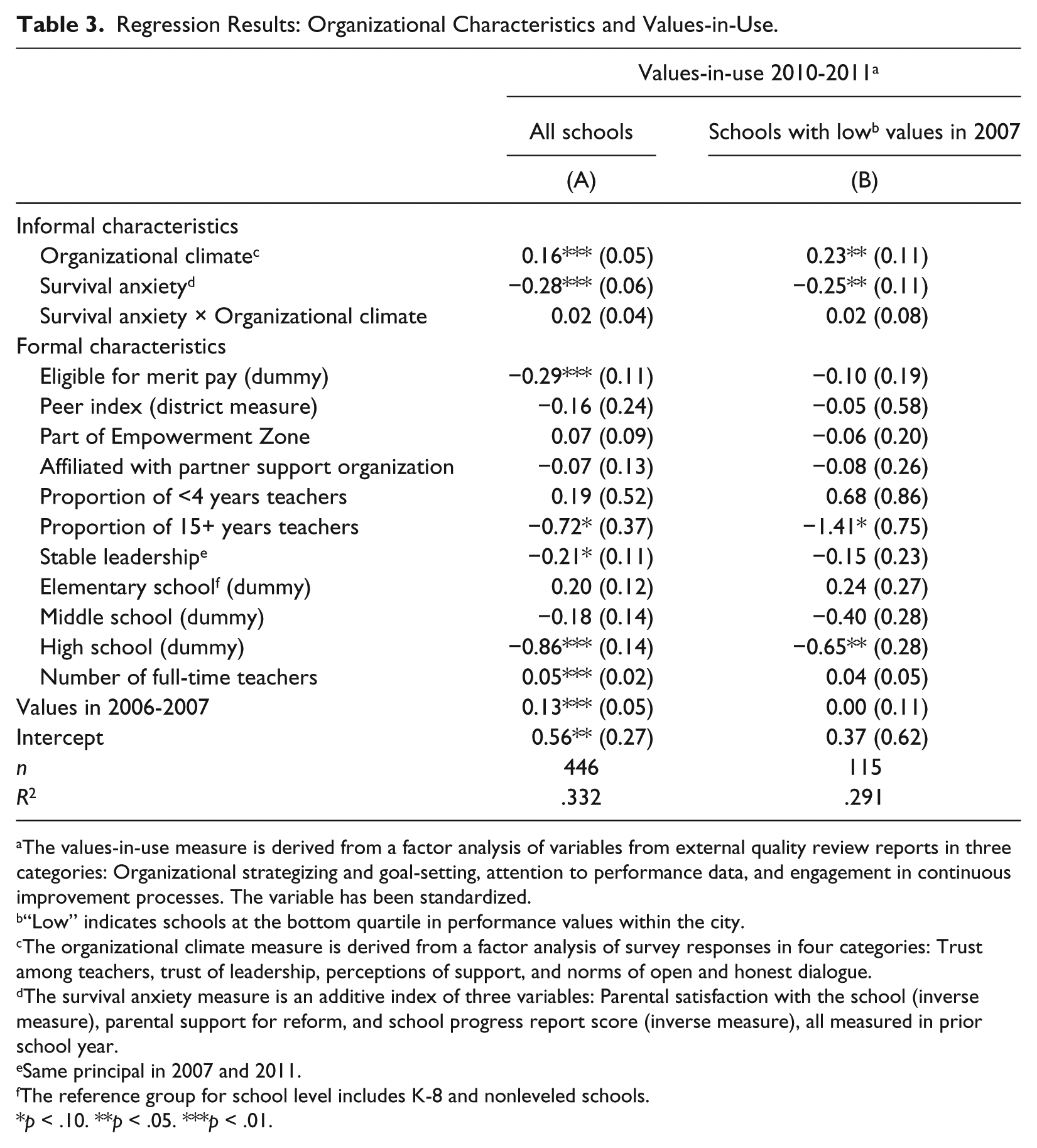
Table 3 reports findings from the analysis of organizational climate and survival anxiety’s impact on performance management values-in-use. The findings are striking. As in the prior model, this analysis provides strong support for H1, the internal dynamics hypothesis. A 1 standard deviation increase in organizational climate corresponds with a 0.16 to 0.23 increase in the adoption of performance management values. However, this analysis not only fails to support H2 but also provides strong evidence to refute it. The survival anxiety variable is both negative and significant, with a 1 standard deviation increase in survival anxiety leading to a 0.25 to 0.28 decrease in the adoption of performance values-in-use. This suggests that performance pressure impedes, rather than encourages, the adoption of performance values. Finally, there is no evidence for the joint-impact hypothesis (H3)—As in the first model, the interaction effect is small and insignificant.
Regression Results: Organizational Characteristics and Values-in-Use.
The values-in-use measure is derived from a factor analysis of variables from external quality review reports in three categories: Organizational strategizing and goal-setting, attention to performance data, and engagement in continuous improvement processes. The variable has been standardized.
“Low” indicates schools at the bottom quartile in performance values within the city.
The organizational climate measure is derived from a factor analysis of survey responses in four categories: Trust among teachers, trust of leadership, perceptions of support, and norms of open and honest dialogue.
The survival anxiety measure is an additive index of three variables: Parental satisfaction with the school (inverse measure), parental support for reform, and school progress report score (inverse measure), all measured in prior school year.
Same principal in 2007 and 2011.
The reference group for school level includes K-8 and nonleveled schools.
p < .10. **p < .05. ***p < .01.
Few of the control variables have a statistically significant impact. This reflects, in part, low sample size, and in part, perhaps, the fact that formal factors shape performance management behavior through organizational culture as a mediating variable (for more on this theory, see Moynihan et al., 2012). As in the first model, merit pay has a negative, and in the full sample, statistically significant association with the adoption of performance values. Stable leadership and the proportion of veteran teachers also have negative coefficients, suggesting that new blood may facilitate organizational culture change; however, this variable is only statistically significant at the .1 level (and, for leadership, is insignificant among the subset of schools with low values-in-use at the start of the reform). 14
Tests of Robustness
As noted in the “Data and Method” section, the low Cronbach’s alpha raises concerns about the consistency of the additive index used to measure survival anxiety. Although, as noted in the previous section, some scholars have downplayed the importance of Cronbach’s alpha, it is possible that the weak coefficients found in Analysis 1 (espousal of performance management values) reflect measurement error rather than a muted impact of survival anxiety itself.
The main analysis of this article retains the additive index for survival anxiety for two reasons. First, as noted before, prior research on organizational risk and school closure have highlighted the importance of both objective or standardized measures and stakeholder perceptions (Figlio & Kenny, 2009; Kowal & Hassel, 2008). Moreover, these factors may not be perfectly correlated with one another because parents appear to value attributes of school performance that are distinct from those captured by formal performance ratings (Favero & Meier, 2013; Figlio & Kenny, 2009). The disconnect between parent perceptions and formal ratings may be particularly high in New York City, where the DOE’s efforts to control for student demographics are not widely understood. In sum, the low reliability of the survival anxiety coefficient may reflect complex nuances of survival anxiety rather than poor variable construction per se (Fayers et al., 1997; Streiner, 2003). Second, given that the survival anxiety coefficient for values-in-use is negative and statistically significant, these findings are unlikely to stem from measurement error alone.
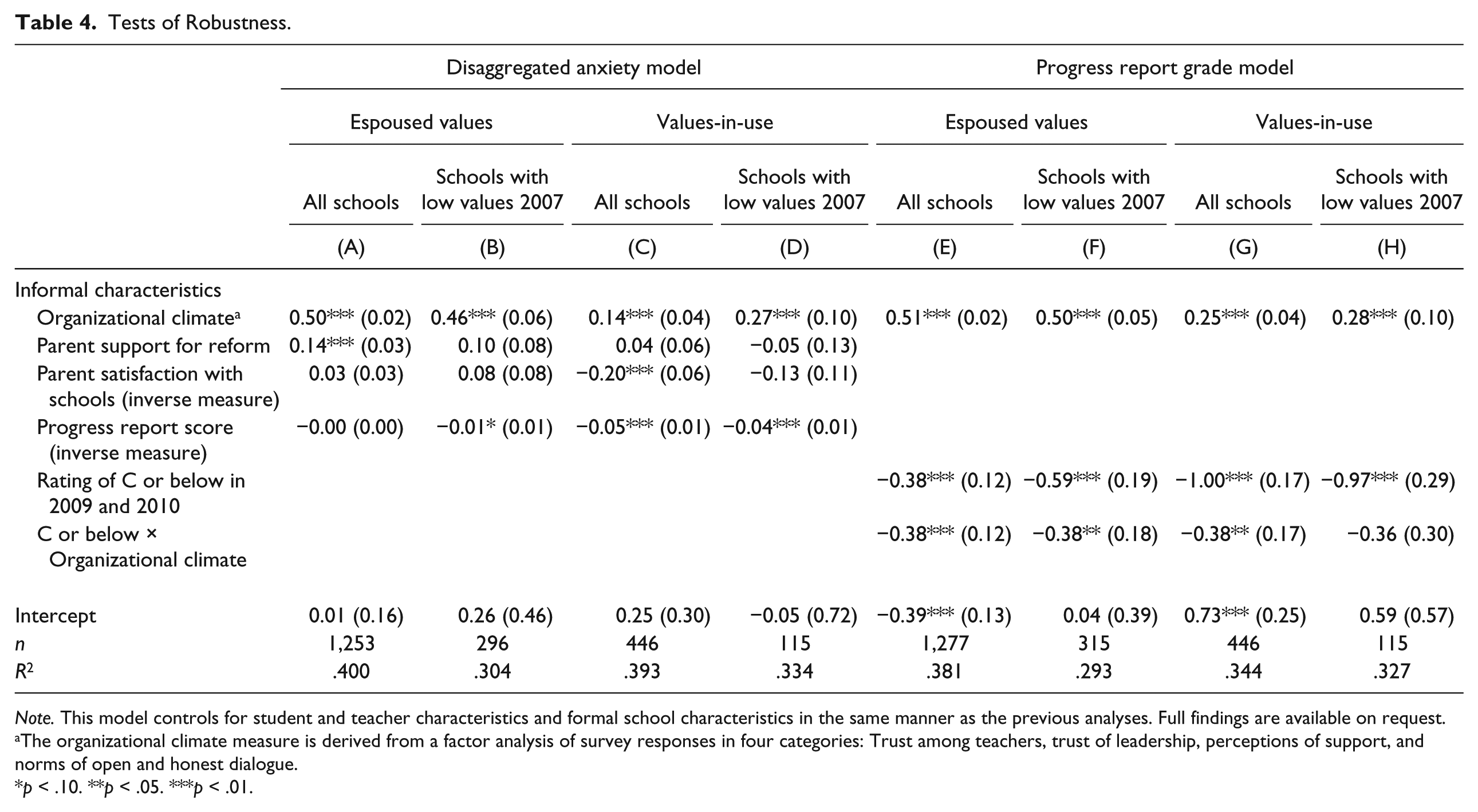
Nonetheless, Table 4 presents findings from two tests of robustness that use alternate survival anxiety constructs. My first approach was to disaggregate the survival anxiety measure, replacing a single construct with three subcomponents: parental dissatisfaction, parental support for the reform effort, and measured performance. 15 Findings for this analysis can be found in columns A to D. These results generally support the conclusion of the initial analysis though they are not, in all cases, statistically significant. Parental support for reform has a positive and significant (for the full population of schools) relationship with espoused performance management values. However, the coefficient drops substantially for performance values-in-use (and is negative for schools that had low performance values in 2007), supporting the general conclusion that survival anxiety has a stronger impact on what teachers “say” than what teachers “do.” Both parental dissatisfaction and the inverse of measured performance have negative coefficients for performance values-in-use, supporting the theory that increased survival anxiety impedes the adoption of performance values. These results are statistically significant in all specifications for measured performance problems, and in the full sample of schools for parental dissatisfaction.
Tests of Robustness.
Note. This model controls for student and teacher characteristics and formal school characteristics in the same manner as the previous analyses. Full findings are available on request.
The organizational climate measure is derived from a factor analysis of survey responses in four categories: Trust among teachers, trust of leadership, perceptions of support, and norms of open and honest dialogue.
p < .10. **p < .05. ***p < .01.
Parental perceptions may be difficult for teachers and principals to gauge, however, and the nuances of numerical performance scores may be less important than the more cut-and-dry progress report grades. For that reason, I also ran the analysis using a simpler and more-direct measure of survival anxiety—a dummy variable indicating whether a school had earned overall progress report ratings of C or lower in both 2009 and 2010. 16 Here, the findings provide even stronger evidence that survival anxiety does not prompt changes in organizational values. Schools that had low scores in both 2009 and 2010 were 0.38 to 0.59 standard deviations less likely to espouse performance values, and a full standard deviation less likely to adopt performance values-in-use; each coefficient is statistically significant at the .01 level. Surprisingly, in this model, the interaction effect is significant but negative, suggesting that schools with a positive organizational climate were even less likely to respond to survival anxiety cues by adopting performance values. This suggests that, for the poorest performing schools, at least in the short term, organizational climate buffers outside pressure, rather than facilitating organizational change. It is worth noting, however, that the interaction effect is not statistically significant for schools that had low performance values-in-use in 2007.
In sum, the tests of robustness confirm the findings presented in the main analysis. While organizational climate is a strong predictor of performance management values, survival anxiety has a negligible relationship to espoused performance values and a negative relationship to values-in-use.
Discussion
This article began with the question of how external incentives and internal dynamics facilitate and impede organizational culture change. Taken together, the findings lend strong support to the internal dynamics theory and cast doubt on the external incentive perspective.
My analysis finds organizational climate to be a strong and significant predictor of the espousal and adoption of performance values. Environments characterized by psychological safety and organizational trust and where frontline workers felt supported by their school leaders, fellow teachers, and members of the community, were more likely to exhibit performance values.
In contrast, survival anxiety, which reflects performance pressure and incentives, has only a small positive impact on espoused values, and a negative impact on performance values-in-use. These findings suggest that incentives alone are not likely to catalyze change in frontline behavior. To the contrary, this study found that organizations with the greatest incentive to improve were less likely to change their deeper organizational values-in-use, either because schools were unwilling to change their practice in the face of existential threat or because they lacked the capacity to do so. The negative impact of survival anxiety is robust across multiple specifications. 17
New York City Schools’ performance management reform relies primarily on negative sanctions, rather than performance rewards or other positive incentives. Its highest profile reward system—a schoolwide merit pay system that targeted schools with a history of low performance—was discontinued in 2011. This leaves open the possibility that a system with more positive rewards would be a stronger motivator. However, my analysis finds little evidence to support such a conclusion. Schools eligible for merit pay (a form of positive incentive) were no more likely to espouse performance values or adopt performance values-in-use, a finding that concurs with a comprehensive evaluation of the city’s merit pay system (Marsh et al., 2011). Taken together, these findings suggest even positive incentive systems have muted results.
These results should be interpreted with caution, given the methodological challenges discussed above and the fact that they cover one policy domain in one city over a limited period of time. Yet, to the extent that they hold true across other political and policy contexts, they can help to explain why performance management reforms across policy domains have failed to achieve their desired effects. On a theoretical level they also raise serious questions about the role negative incentives play in individual and organizational change. It is important to consider further both why climate appears to matter so much and why performance pressure appears to matter so little.
One reason why organizational climate matters is that organizational change is difficult. Moynihan (2008), for example, argues that organizational learning is a necessary intermediate step for performance management reform to lead to improved organizational outcomes. This point is supported by the broader literature on organizational culture and change. Both Senge (1990) and Schein (2006), following Lewin and Lewin (1948), argue that the adoption of new organizational behaviors depends on not just learning new behaviors but also on unlearning old behaviors. This unlearning is both particularly important and particularly challenging in contexts, like education where preexisting professional norms run counter to the mandates of a reform (Maynard-Moody & Musheno, 2003; Sandfort, 1999). Given the newness of high-stakes assessments and data analysis tools more generally, few teachers in the New York City School System received training on data-based decision making as part of their preservice training. Moreover, for many teachers, education is an art rather than an exact science; this can make the focus on hard indicators off-putting and even alienating. This suggests the learning anxiety associated with the development of a performance management culture would be high.
In the face of high learning anxiety, as Schein (2006) notes, survival anxiety is unlikely to have the intended effect. Rather than spurring organizational change, it may lead to a panicked response, perhaps followed by symbolic or superficial changes in organizational behavior. For example, schools may espouse performance values but fail to adopt performance values-in-use, thus decoupling formal and easily observable school policies from informal practices that are harder or less desirable to change (Meyer & Rowan, 1977). Attention to learning anxiety also suggests that performance metrics on their own may be insufficient guides to organizational learning, particularly for the lowest performing schools (Moynihan, 2008). For while low scores may signal performance problems, they do not show teacher or school leaders how to improve.
By contrast, organizational climate may be a prerequisite to overcome learning anxiety. Intraorganizational trust helps individuals rethink existing assumptions and try out new modes of practice (Coburn, 2001; Schein, 2006; Senge, 1990). Moreover, stakeholder support can increase a school’s overall sense of efficacy, giving it greater confidence to take on new practices demanded by performance management reform.
The findings around survival anxiety and organizational climate have significant implications for policy practice. In particular, they suggest that policymakers and organizational leaders should focus less on perfecting formal incentive systems and more on building the informal and formal institutions necessary to build organizational capacity and trust. All too often, formal mechanisms designed to heighten incentives and spur a rapid response—such as repeated performance reviews—force an unrealistic timeline for change. Unrealistic expectations, in turn, breed cynicism about performance management reform and a superficial response on the ground, as frontline workers and managers seek out quick fixes and blame one another for organizational failures. The end result is a performance management reform that brings about few changes in behavior in the organizations that may need change the most.
Moreover, the findings in this article, which emphasize relatively short-term responses to performance accountability, may in fact underestimate the negative consequences of a sanction-focused performance management system. There exists a significant body of literature in psychology suggesting that external incentives “crowd out” internal motivation, in part by reducing individuals’ locus of control over key organizational outcomes (Deci, Koestner, & Ryan, 1999, 2001). To the extent that a crowding-out effect holds true in performance management contexts, the long-term effects of sanctions may be even more deleterious. Thus, this article suggests that, instead of focusing on tangible rewards and sanctions, policymakers develop collaborative approaches that engage the frontline workers responsible for implementing reforms, reinforce their internal motivation and help them develop the internal capacity to improve.
Conclusion
This article affirms Moynihan’s (2008) and Radin’s (2006) prior findings that performance management is not the clean route to improved organizational performance advocated by its strongest proponents. Drawing from multiple sources of specific data about organizational behavior in a large urban school district, it also helps to explain why. In contrast to much of prior theory and practice, this article finds that successful performance management reform depends not on clear organizational incentives but instead on a set of softer organizational indicators: psychological safety, perceptions of support, and norms of open dialogue. This finding raises serious questions about the role of incentives in organizational behavior and highlights the need for researchers to consider more deeply both the reasons why formal incentives have not had their intended effects and the strategies that policymakers and organizational leaders alike can use to foster positive organizational climates that can facilitate cultural change.
One should be careful about overgeneralizing from these findings, which come from a study of a single policy domain (education) and a single political environment (New York City). Nonetheless, these findings have considerable implications for research, theory, and practice. As noted above, they suggest that negative incentives or performance pressure alone may fail to have the desired impact on organizational impact, and that, in fact, performance management systems will have a particularly limited impact on the lowest performing organizations that are of great interest to reformers.
Further research is needed to examine why survival anxiety is not a better catalyst of organizational culture change. Given the overwhelming importance of organizational climate, it is also worth examining the behaviors of public leaders more carefully to consider what strategies are most likely to contribute to psychological safety and perceptions of support. This will require, first, qualitative inquiry to track organizational change on the ground and, second, quantitative or mixed-method studies to test alternate theories. Finally, as suggested above, further research should examine this framework in other policy domains and other geographic locations to determine whether survival anxiety impedes organizational culture change in other contexts. To the extent that it does, these findings suggest a need to rethink our current emphasis on incentives in existing organizational and institutional theory, bringing greater attention to organizational capacity and climate as prequisitives to reform.
Footnotes
Appendix A
Appendix B
Full Correlation Table
| Espoused values 2011 | Values-in-use 2011 | Climate | Anxiety | Climate × Anxiety | Merit pay | Free/reduced price lunch | Empowerment | Partner support organization | <4 years | >15 years | Stable leadership | Elementary | Middle | High | Number of Full-time Teachers | Espoused values 2007 | |
|---|---|---|---|---|---|---|---|---|---|---|---|---|---|---|---|---|---|
| Espoused values 2011 | 1 | ||||||||||||||||
| Values-in-use 2011 | .31 | 1 | |||||||||||||||
| Organizational climate a | .45 | .31 | 1 | ||||||||||||||
| Survival anxiety b | −.04 | −.29 | −.34 | 1 | |||||||||||||
| Survival anxiety × Organizational climate | .08 | .05 | .05 | .21 | 1 | ||||||||||||
| Merit pay | .01 | −.18 | −.06 | .11 | .01 | 1 | |||||||||||
| Free/reduced price lunch | −.01 | −.21 | −.18 | .44 | .14 | .24 | 1 | ||||||||||
| Part of Empowerment Zone | −.11 | .08 | −.01 | −.16 | −.01 | .00 | −.04 | 1 | |||||||||
| Affiliated with partner support organization | −.04 | −.08 | .00 | .01 | .03 | .03 | .03 | −.23 | 1 | ||||||||
| Proportion of <4 years teachers | −.17 | −.04 | .02 | −.03 | .01 | −.09 | .07 | −.07 | .09 | 1 | |||||||
| Proportion of 15+ years teachers | .18 | −.09 | −.06 | .13 | .03 | .11 | .02 | .00 | −.10 | −.60 | 1 | ||||||
| Stable leadership c (dummy) | .11 | .05 | .02 | −.06 | .05 | .06 | .02 | .04 | .07 | −.29 | .15 | 1 | |||||
| Elementary school d (dummy) | .19 | .26 | .00 | .04 | −.01 | .06 | .06 | −.06 | −.14 | −.26 | .27 | .10 | 1 | ||||
| Middle school (dummy) | −.04 | −.09 | −.07 | .15 | −.03 | .02 | .06 | −.03 | .08 | .08 | −.06 | −.01 | −.35 | 1 | |||
| High school (dummy) | −.20 | −.30 | .01 | −.19 | .03 | −.03 | −.10 | .14 | .13 | .08 | −.11 | −.06 | −.42 | −.25 | 1 | ||
| Number of full-time teachers | .13 | .05 | −.01 | .13 | .09 | −.01 | −.06 | −.02 | −.07 | −.29 | .26 | .13 | .09 | −.03 | .01 | 1 | |
| Espoused values in 2006-2007 | .15 | .35 | .45 | −.29 | .06 | −.19 | −.28 | .13 | .05 | .06 | −.14 | .04 | .05 | −.07 | −.03 | −.03 | 1 |
| Values-in-use 2006-2007 | .22 | .30 | .27 | −.17 | −.01 | −.17 | −.17 | .03 | −.08 | −.14 | .01 | .00 | .16 | −.15 | −.11 | .22 | .37 |
The organizational climate measure is derived from a factor analysis of survey responses in four categories: Trust among teachers, trust of leadership, perceptions of support, and norms of open and honest dialogue.
The survival anxiety measure is an additive index of three variables: Parental satisfaction with the school (inverse measure), parental support for reform, and school progress report score (inverse measure), all measured in prior school year.
Same principal in 2007 and 2011.
The reference group for school level includes K-8 and nonleveled schools.
Acknowledgements
I thank the reviewers for their helpful comments. I am indepted to Stephen Page, Craig Thomas, Peter May for their advice and guidance. Meredith Honig, William Zumeta, Michael Knapp also provided useful critiques at various stages of the research, as did seminar participants from the University of Washington’s Collaborative Research in Education Sciences Training (CREST) program. Don Moynihan and Ken Meier provided valuable feedback at earlier stages of this research.
Declaration of Conflicting Interests
The author(s) declared no potential conflicts of interest with respect to the research, authorship, and/or publication of this article.
Funding
The author(s) disclosed receipt of the following financial support for the research, authorship, and/or publication of this article: This study was supported by the U.S. Department of Education Institute of Education Sciences (R305B090012).