



Abstract
The study of Public Service Motivation (PSM) has achieved considerable academic momentum with increasingly subtle research appearing each year. It is now opportune to look back at decades of work to see whether the concerns that initiated this area of study have been addressed. This article uses seminal articles that have shaped the field to find three main topics of interest: a concern about the way that theories of public choice characterized human nature, an ambition to crystallize and measure long-held understandings about a public service ethos, and a wish to promote a practical basis for incentivizing staff in the public sector. The application of PSM to these goals is examined, with the conclusion that PSM studies have made little progress in addressing any of those concerns. The implications of that conclusion are briefly considered.
Introduction
Public service motivation (PSM) is a construct that was conceived (Rainey, 1982), defined (Perry & Wise, 1990), and assembled (Perry, 1996) to address some concerns about administration in government agencies. Partly, it was an intellectual response to public choice theory. Partly, it reflected a desire to formalize a widely held understanding about the significance of a public service ethos. And partly, it was a reaction to the use in government of private sector management techniques, especially monetary incentives.
Since that beginning, after lively theoretical debate and ongoing issues of technical specification, the impressive and increasingly sophisticated analysis of PSM scholars is showing results. Most published PSM reports suggest that PSM is a factor influencing behavior, particularly showing that altruistic motives assist in explaining effort, especially in caring or personal-service activities.
But if some clarity is emerging from the technical analysis, this seems a useful time to look back to see whether decades of effort has addressed the underlying purposes that drove the study of PSM. This article identifies some basic concerns that stimulated the development of the PSM concept to see whether PSM research has been successful in addressing its goals. The article seeks to answer three questions:
Does PSM refute assumptions about human nature as found in public choice theory and the associated findings and prescriptions of that approach?
Does PSM formalize understandings about the public service ethos?
Does PSM provide a practical basis for incentivizing staff in public employment?
This article is not about the existence or importance of other-regarding or altruistic sentiments; their existence is accepted and they have real significance in public sector activities. Similarly, this article does not aim to assess the success of PSM research in establishing and measuring PSM as a distinct motivation (for that, see Bozeman & Su, 2014). Instead, the questions focus on whether PSM studies are achieving the goals that launched the field.
The questions may seem to miss a basic point. Perhaps academic debate about theories, ethos, and incentives was never the real issue; the real problem was the drastic reforms of the Reagan/Thatcher period, and a need to reaffirm the value of public service as a central element in society. Affirmation of the value of public service is not decried here, but that is not a sufficient basis for academic enquiry. PSM theory has been put forward as an analytical concept, not just an ideological proposition; its success is therefore considered here in terms of its analytical underpinnings, rather than any consideration of whether PSM has been effective in swaying opinion about the management of government.
This article has four main sections. First, the article briefly traverses the development of PSM to identify significant debates and to derive the three basic questions underlying PSM literature. These questions are not always stated explicitly in the original sources, but it is possible to derive questions about intellectual debates (especially with public choice theorists), broader connections to ongoing themes of public administration (especially public service ethos), and practical matters (especially in people management). There is always room for debate about whether an exercise like this one has specified other researchers’ goals correctly; this article attempts to present those goals fairly, by sticking closely to the original texts. The subsequent three sections consider the success of PSM in addressing each of those areas. Finally a brief conclusion draws out the implications of this essay.
In this article, the term public service is used with the same ambiguity that is common in PSM literature; it may apply to services provided for members of the public or to the institutions supporting various levels of government. The terms public sector and public manager are applied with reference to various levels and agencies of government. When referring to details of PSM, this article accepts Kim et al. (2013; see Table 1 below) as the current authority on the dimensions of PSM.
Dimensions and Items of Public Service Motivation.
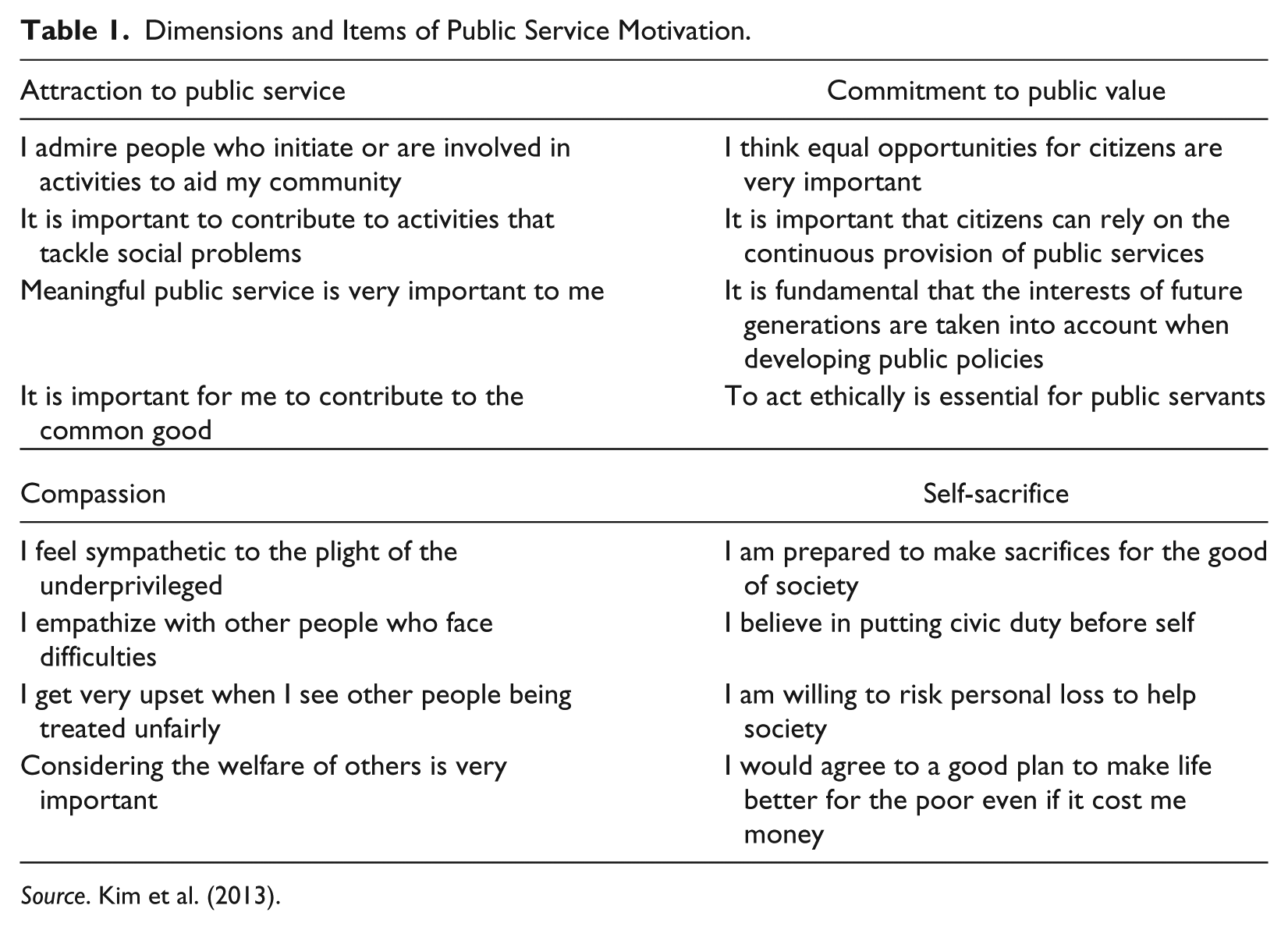
Source. Kim et al. (2013).
Evolution of PSM
This section briefly reports major empirical results before identifying the questions that have driven PSM research. Following that, there is a discussion of the main debates that have featured in PSM scholarship to give a context for the later discussion of the effectiveness with which PSM studies have addressed the aims of the field.
The basic ideas of PSM theory are simple: “public employees differ from their private sector counterparts with respect to orientation towards helping other citizens and serving the interests of the relevant community” (Kjeldsen, 2012, p. 58) and unlike (or more so than) those who work in the private sector, public sector workers have “a primary interest in helping to realize [the] common good” (Perry, 2000, p. 484). Those ideas have generated a rising tide of studies exploring the existence and effects of PSM.
Initially, researchers looked for a direct relationship between PSM and behavior in the workplace and there were some disappointingly ambiguous results (Alonso & Lewis, 2001). However, PSM may not have a direct effect on behavior; instead, it may be channeled and modified by institutional context and individual identity (Perry & Vandenabeele, 2008). For example, positive relationships from PSM to behavior have been found to be mediated or modified by person–organization fit (Bright, 2007; Kim, 2012; Steijn, 2008; Wright & Pandey, 2008); mission or mission valence (Caillier, 2014; Pandey, Wright, & Moynihan, 2008; Wright & Pandey, 2011); organization logic (van Loon, Leisink, & Vandenabeele, 2013); professionalism (Andersen & Pedersen, 2012); occupation (Kjeldsen, 2014); hierarchical position (Desmarais & Gamassou, 2014); gender, age, and managerial position (Bright, 2005); transformational leadership (Caillier, 2013; Park & Rainey, 2008); work stress (Liu, Yang, & Yu, 2014); or by various combinations of factors (Christensen & Wright, 2011; Liu, Tang, & Yang, 2013; Wright, Moynihan, & Pandey, 2012).
Not every result has been positive. Giauque, Ritz, Varone, and Anderfuhren-Biget (2012) found a negative relationship between PSM (and red tape) and job satisfaction in a large survey in Switzerland. In Belgium, Buelens and Van den Broeck (2007) found that job content explained more of the difference in PSM levels than sector and that work–life choices were a major explanation for working in the public sector. And when Petrovsky and Ritz (2013) controlled for common-method bias in a large study in Switzerland, they found no correlation between PSM and organization performance. But, despite the occasional contradictory result, the consensus among PSM scholars is that PSM exists and is common among public employees (Wright, 2008). With some more doubt about cause and effect (Wright & Grant, 2010), most would also suggest that PSM appears to assist performance (see Petrovsky & Ritz, 2013, p. 23, for a list of articles supporting this assertion).
But if technical results are promising, does that mean that the research is meeting its goals? Unfortunately, much PSM literature is of little help in considering underlying goals of research because most recent articles refer to previous studies to explain how the authors hope to fill a gap in the analysis rather than addressing the basics. However, PSM is still sufficiently unified as a field of scholarship that it is possible to identify the seminal articles that clarify the debates. Those key contributions include the definition of PSM (Perry & Wise, 1990), its assembly as a measurable construct (Perry, 1996), modification of that construct to address international differences (Vandenabeele, 2008a, 2008b), the introduction to the first major volume in the field (Perry & Hondeghem, 2008b), an initial attempt to draw management lessons (Paarlberg, Perry, & Hondeghem, 2008), a retrospective review of the field (Perry, Hondeghem, & Wise, 2010), and the latest codification of the construct (Kim et al., 2013). Those are the main sources that have been used to identify three underlying issues that drive PSM research.
The first issue arose from an intellectual debate as academics responded to public choice theory and its assumptions about people; in the words of Perry and Hondeghem (2008b), PSM “speaks directly to classic assumptions and debates about human nature” (p. 8). In particular, Perry and Wise (1990) said that public choice theory “is predicated on a model of human behavior that assumes that people are motivated primarily by self interest” (p. 367). This was said to question the strength of a public choice ethic “ . . . because [if] self interest is at the root of human behavior, incentives, organizations, and institutions must be designed to recognize and to take advantage of such motivations” (Perry & Wise, 1990, p. 367). Later, Perry and Hondeghem (2008b) amplified this concern about public choice, saying,
. . . bureaucrats were painted quite consistently as rational and self-interested. Given those assumptions, scenarios about bureaucratic behavior depicted bureaucrats as budget maximising, self-aggrandizers incapable of discerning and pursuing the public will. (p. 7, emphasis in original)
The disagreement with public choice stems from the presumption of self-interest, and the effects of that presumption, but sometimes the concern seems to shift to focus on rationality; for example, Perry and Hondeghem (2008b) refer to “rational versus other-regarding actors” (p. 7) and Perry (2000) refers to a goal to develop a theory “as an alternative to the rational choice theories” (p. 472). However, elsewhere the literature acknowledges rationality as being among the factors making up PSM, so the issue does not appear to be about rationality per se.
The fact that the debate is about self-interest is confirmed as PSM supporters assert their alternative view. For example, according to Perry and Hondeghem (2008c), “people are selfish and altruistic, and organisations need to use intrinsic as well as extrinsic incentives to motivate employees” (p. viii, preface, emphasis in original). And, rather than needing to incentivize self-interested workers or protect against their self-interest, “if public servants are general altruists, then we will be inclined to rely on them to do good at all times” (Perry & Hondeghem, 2008b, p. 8).
So, if public choice and self-interest are the impetus, the first question for this article to consider is as follows:
Does PSM refute assumptions about human nature as found in public choice theory and the associated findings and prescriptions of that approach?
The second issue relates to the ethos of public service. As well as addressing reductionist assertions about human nature, PSM seeks to reaffirm and formalize long-held understandings about a public service ethos; specifically, Perry (1996) states that PSM as developed in that article is “the public service ethic . . . defined more formally.”
Unlike the urge to respond to public choice and the wish to contribute to debates on personnel management, where the goals of research were explicit from the outset, it is questionable whether linking to earlier work on ethos was a defining initial goal of PSM study. But by 2008, contributions from Perry and Hondeghem (2008b) and Vandenabeele (2008a, 2008b, 2009) made this goal explicit. Given the influence of these authors in the evolution of PSM research, this is accepted as one of the three drivers of the field.
It is in the nature of an ethos—the characteristic spirit or belief of a community—that formality and clarity are elusive, but writing on PSM shows determined attempts to reflect a tradition of thought. Perry and Wise (1990) refer to the careers and opinions of many former senior public servants as they locate their ideas. Perry (1996) refers to Mosher’s (1982) classic on the public service as a source on the concept of public duty, and Perry and Hondeghem (2008b) refer to Charles Goodsell’s (1983) polemic as they construct a positive picture of the work of public servants.
The goal seems not just to formalize a traditional understanding of the public service ethos but also to link the concept of PSM into scholarly debate at the heart of public administration. This means that PSM has set itself a higher test than debating competing ideas, or offering suggestions for managers. In addition, the goal is to crystallize a long-understood public service ethos in a way that allows empirical examination. Accordingly, the second question for this article is as follows:
Does PSM formalize understandings about the public service ethos?
The third aim of PSM is more applied, as PSM is put forward as a practical basis for incentivizing staff in public employment and a superior option to using material incentive schemes. This objective, which appeared as an explicit goal in Perry and Wise (1990), was reiterated in Perry and Hondeghem (2008b) and reaffirmed in Perry et al. (2010).
Perry and Wise (1990) point to “the growing popularity of monetary incentive systems, especially at top organizational levels . . . [which] stand in opposition to the view that public service motives energize and direct the behavior of civil servants” (p. 367). This specific concern with incentive payments is generalized later in the article to a contrast between private and public sector management techniques: “The great risk in the current trend of treating the public service like private enterprise is that it fails to acknowledge unique motives underlying public sector employment” (p. 371). According to Perry and Hondeghem (2008b), maintaining the right mix of incentives is “daunting” and they hope to assist public managers to be “more intentional about [their] choices” (p. 8). Therefore, the third question this article addresses is as follows:
Does PSM provide a practical basis for incentivizing staff in public employment?
The order of the questions does not reflect how they were raised in PSM writings; arguably, Questions 1 and 3 were the initial issues that launched the field, whereas Question 2 is less explicit and emerged later. However, the later three sections of this article will take them in the order described here because they run from the abstract (public choice) to the practical (incentive systems), with a discussion of ethos in between because that is an abstract matter in which practitioners regularly dabble.
But before moving to assess the success of researchers in addressing these questions, it is necessary first to acknowledge some debates about the nature of PSM. Though the underlying idea of PSM is simple and many results are promising, that does not mean that the concepts behind PSM are settled. On the contrary, there is debate about several areas including (a) the definition (and incidence) of PSM, (b) the dimensions and measurement of PSM, and (c) the nature of PSM as an individual or institutional concept. These debates are sometimes set aside in a spirit of “construct complementarity” (Perry & Hondeghem, 2008a, p. 6), which suggests that ambiguity about definition, measurement, or conceptual coherence can be tolerated. Some tolerance of ambiguity is not at issue, but it could be problematic here. That is because it could be argued that the concerns raised in this article misunderstand the alternative approaches to PSM. Therefore, though these issues are not central to this article, they are each briefly addressed to explain how they are handled.
First, the definition of PSM has evolved over time (for a listing of the definitions that are found in the literature, see the appendix). Perry and Wise (1990) described a broad concept involving rational, norm-based, and affective influences. Good policy making, public duty, and concern for others were all captured within their definition of PSM as “an individual’s predisposition to respond to motives grounded primarily or uniquely in public institutions and organizations” (Perry & Wise, 1990, p. 368). However, later definitions either omitted reference to the public sector or emphasized other-regarding aspects of PSM so that in 2008 Perry and Hondeghem (2008c) described PSM as “an individual’s orientation to delivering services to people with a purpose to do good for others and society” (p. vii, preface). Table A1 (in the appendix) shows that of 36 articles that included a definition of PSM, only half use a definition that relates to the public sector.
In the face of that variety, this article generally follows the approach proposed by Perry et al. (2010) who suggested PSM “is grounded in the tasks of public service provision, and is more prevalent in government than other sectors” (p. 682). The public sector is included in the definition used here because all three of the questions that PSM first set out to address were related to public administration, and adopting an approach that ignores the public sector would not be a fair basis for assessing effectiveness in addressing those questions.
Second, scholars have used varying constructs to measure PSM. Perry (1996) went to the literature to find some attitudes that had previously been asserted to be important. He then tested these on a sample drawn from students and staff in various public and private institutions to develop a 24-item measure of PSM involving four dimensions: attraction to public policy making, commitment to the public interest, compassion, and self-sacrifice. However, as PSM was explored in different countries, including Australia (Taylor, 2008, 2010), Belgium (Vandenabeele, 2009), China (Liu & Tang, 2011; Liu, Tang, & Zhu, 2008), Denmark (Andersen & Serritzlew, 2012), Italy (Bellé, 2013), Korea (Kim, 2012), Netherlands (Steijn, 2008), Britain, and Germany (Vandenabeele, Scheepers, & Hondeghem, 2006) or in broader comparisons (Houston, 2011; Vandenabeele & Van de Walle, 2008), the various dimensions and measures proved difficult to translate into different cultures. Researchers addressed these problems in different ways; of the 43 empirical articles reviewed in the appendix (Table A2), 17 represent PSM as a one-dimensional construct, and 20 used fewer than 10 items to measure PSM. These technical differences led to a major international collaboration (Kim et al., 2013), which has produced a new 16-item measure with four dimensions: attraction to public service, commitment to public value, compassion, and self-sacrifice. That measure is used in this article when referring to aspects of PSM because it seems to be the best reflection of an international consensus (see Table 1).
Third, the nature of PSM is sufficiently opaque that some authors suggest it encompasses mutually exclusive aspects. For example, Liu et al. (2014) said,
PSM is a relatively enduring individual predisposition that responds to motives grounded primarily or uniquely in public institutions and organizations . . . PSM is also a temporary psychological state that causes individuals to perform acts that contribute to the public good as a way of satisfying their personal needs. (pp. 5-6)
This neatly encapsulates a debate about whether PSM is a stable characteristic that attaches to an individual or a changing characteristic that can be influenced by institutional practices. For Perry (1997), PSM is an individual and stable characteristic arising from “parental, religious and professional socialization” (p. 192). But Bellé (2013) showed that PSM displays “significant within-person variability” (p. 150), and Ward (2014) used a longitudinal study to demonstrate that PSM can change over time. These approaches imply different perspectives on motivation with different implications for practice. Perhaps the ideal would involve some integration of these perspectives, but whatever approach is followed clarity on this matter is “necessary to properly assess and guide management practice” (Wright & Grant, 2010, p. 692). In the absence of compelling evidence (and unless otherwise specified), the assumption used here is that PSM is a stable characteristic pertaining to individuals, as introduced by Perry (1996). Stability is assumed because key aspects of the management advice reviewed later in the article implicitly assume stability and adopting an assumption that is inconsistent with that advice would not be a fair basis of assessing the effectiveness of that advice.
The following three sections enquire into whether PSM scholars have succeeded in addressing the issues that motivated their study.
Question 1: Public Choice and Self-Interest
The first question has two components: First, does PSM address the understanding of people that is embodied in public choice theory and, second, does it challenge the findings and prescriptions offered by those theories?
Turning first to the understanding of people and their motives, Perry and Wise (1990) claim that public choice theory places self-interest “at the root of human behavior” (p. 367), but cite nothing to justify that assertion. This begs the question, “Do public choice theorists believe self-interest is the sole driver of behavior?”
Perry and Hondeghem (2008b) move beyond general comments about public choice; citing Downs (1967) and Niskanen (1971) as their sources, they say that public choice paints bureaucrats “quite consistently as rational and self-interested” (p. 7, emphasis in original). It is easy to show that that claim misrepresents both authors.
Downs (1967) includes an extensive discussion of the motives driving bureaucratic behavior. He does describe bureaucrats (and anyone else) as utility maximizers, but explains that for officials this involves “both self-interested and altruistic goals” (Downs, 1967, p. 85).
Niskanen (1971) refers to a range of personal factors that might incentivize a bureaucrat such as salary, perquisites of office, and power but he also includes others that are not personal including the “output of the bureau” (p. 38). Specifically, he says, “Some bureaucrats, by either predisposition or indoctrination, undoubtedly try to serve (their perception of) the public interest” (p. 39).
So, if Downs and Niskanen admit of a range of motivations, is the charge of focusing on self-interest reasonable when applied to public choice in general? Perhaps public choice scholars only allude to altruistic motives for rhetorical effect. For example, though Downs acknowledges the concept of the statesman personality, it tends to be the self-interested personalities that dominate his analysis. And public choice theorists tend to adopt self-interest as a methodological assumption. A leading chronicler of public choice says “The basic behavioral postulate of public choice, as for economics, is that man is an egoistic, rational, utility maximizer” (Mueller, 2003, pp. 1-2). However, that does not mean that public choice theorists claim officials are only motivated by self-interest. The classic that launched the field includes in its opening section, “The representative individual in our models may be egoist or altruist or any combination thereof” (Buchanan & Tullock, 1962, p. 4). Similarly, when writing about bureaucrats Tullock (1965) says “behavior may be basically altruistic, or basically selfish” (p. 29). This recognition of a wide range of motivations persists in more recent public choice writing (Schram, 2000). Overall, the claim that public choice theorists see self-interest as “the root of human behavior” is not substantiated.
On the face of it, the first part of the question is answered; it seems that PSM has not reflected and therefore has not addressed the understanding of human nature as shown in public choice. On the contrary, leading sources in public choice acknowledge altruistic motivations.
However, even if it acknowledges altruism, public choice tends to use self-interest as an analytical assumption and the analyses may be biased by that assumption. This raises the second part of the question above: Does the adoption of PSM refute conclusions of public choice analysis that are based on self-interest? Perry and Hondeghem (2008b) have framed the issue more precisely: They say that the assumption of self-interest leads to the conclusion that bureaucrats are “budget-maximizing, self-aggrandizers incapable of discerning and pursuing the public will” (p. 7). The question for this article is “Does the analytical assumption of self-interest (as found in public choice) account for behaviors like budget maximization or neglecting the will of the public?” Would an alternative assumption such as PSM lead to a different result?
That question can be addressed by examining public choice analysis. The simplest example is Niskanen’s (1971) model of a budget-maximizing bureaucrat. That model is selected because several PSM articles have cited it (Perry & Hondeghem, 2008b; Perry & Wise, 1990; Wise, 2004) and no other public choice models are commonly cited in PSM literature. But it is also useful because it is a simple and stark approach; if PSM makes a difference in that model, it should make a difference in all public choice analyses.
The heart of Niskanen’s model is a confrontation between officials and legislators in which bureaucrats use their control of information to extract the largest possible budget. However, budget maximization is not the result of the model; it is the central assumption of the model. That is because the drivers of the model are not motivation, but lack of information and heterogeneous interests.
Niskanen points out that nobody, including any official, can know what is in the best interest of the public. That is hardly a contentious conclusion; it is supported by Arrow (1950) and Sen (2009). It follows that if the public good is unknowable, there is likely to be disagreement about what is in the public interest. That too seems uncontroversial; it is at the heart of all democratic discourse.
Faced with information problems and disagreement, Niskanen (1971) concludes, “It is impossible for any one bureaucrat to act in the public interest, because of the limits on his information and the conflicting interests of others, regardless of his personal motivations” (p. 39, emphasis in original). Faced with the impossibility of pursuing a general concept of the public good, “even the most selfless bureaucrat” (Niskanen, 1971, p. 39) tends to pursue something feasible in a particular field. In time, such altruists become dedicated to their causes “and it is understandable that many bureaucrats identify this dedication with the public interest” (Niskanen, 1971, p. 39). In Niskanen’s model, the ability to achieve anything is dependent on the level of the budget, so the well-meaning bureaucrat always seeks the highest possible budget.
Niskanen’s model is unsatisfyingly stark, but inserting PSM makes no difference because his model already involves “the most selfless bureaucrat.” The solution does not lie in motivation, but in specifying more plausible ranges of participants, institutions, and information flows. That is where public choice theory has gone, with many more subtle conclusions than those found by Niskanen. For example, Horn (1995) describes a complex interaction between legislators, bureau heads, other bureaucrats, lobbyists, and voters; in that process, budget maximization becomes an improbable outcome as many interests are balanced.
The contrast between PSM on one hand and public choice on the other can be seen in two comments from leading supporters of each field. Niskanen (1971) says that “there is nothing inherent in the nature of bureaus and our political institutions that leads public officials to know, seek out, or act on the public interest” (p. vi, preface). Perry and Hondeghem (2008b) say that “if public servants are general altruists, then we will be inclined to rely on them to do good at all times” (p. 8).
Perry and Hondeghem do not explain how bureaucrats know what is good. The answer must be either that officials are peculiarly endowed with insight (thus solving the information problem) or that everyone knows what is good (thus removing heterogeneity). Both explanations seem to be inconsistent with reality. It is nugatory to appeal to “general altruism”; altruism comes in many flavors. Some seek to save whales, some care about children, and others promote culture for the masses.
Heterogeneity and information are at the heart of the matter. This is demonstrated by a critical reading of François (2000); that article has been cited by PSM scholars as demonstrating that when PSM exists, government bureaucracies can be more efficient than profit-maximizing firms (Perry et al., 2010). In fact, François’s result depends not only on altruism but also on assumptions that services can be “perfectly and costlessly measured and observed” (p. 279) and that “all agents are identical in preferences” (p. 280). The result is obvious: Efficiency is axiomatic in an altruistic world of perfect information, where everyone shares the same goals. The surprising thing in such a world is that government would appear at all, whereas in a world of heterogeneity and limited information government and its rules are critical.
The message of public choice is that “the rules of the game do affect the outcomes of the game. Institutions matter” (Mueller, 2003, p. 532, emphasis in original). That is, information issues and heterogeneity require careful attention to design of institutions so that efforts are channeled in preferred directions (generally as specified by elected leaders). The institutional proposals from public choice theorists may not always be correct, but PSM does not overturn the basic message that institutional design matters.
PSM and public choice are theories about different things; public choice is a theory of government but PSM is a theory about people in government (and other public services). Neither can be fully right; full rightness is not a characteristic of any theory. But similarly, neither can be said to address the other. The answer to the first question is, therefore, no; PSM does not address the understanding of people that is embodied in public choice theory and nor does it challenge the findings and prescriptions offered by public choice.
Question 2: Ethos and the Public Administration Canon
The second question is whether PSM has been successful in formalizing understandings about the public service ethos. This issue is independent of the previous question. Even if PSM theorists have misunderstood public choice theory, that has no implications for discourse about the ethos and spirit of public administration.
At one level, debate about whether PSM has formalized the public service ethos cannot be resolved because that depends on one’s view of what the ethos includes. Rayner, Williams, Lawton, and Allinson (2011) even argue that PSM and ethos are incompatible concepts. They see a distinction between the psychological concept of PSM and the institutional and ideological basis for a public service ethos. But even if that complication is ignored, it is difficult to nail down a description of the public service ethos. Horton (2006) shows that even when limited to one country the concept changes over time. So it is not possible to disprove or prove a claim that PSM represents an ethos of public service, especially across many countries.
Rather than attempting a definitive statement of ethos, this section of the article considers the approach taken by PSM theorists as they developed their statements of PSM, to see whether those statements can be seen as a formalization of an ethos. Any such formalization must be drawn from either a field study of the culture and behavior of public service workers, a philosophical statement of the principles that ought to guide public servants, a synthesis of previous studies and statements of an ethos, or some combination of those.
Some PSM writing has reviewed the evolution of a public service ethos (Horton, 2008), but none of the articles that propose a construct of PSM is built from a field study of a public service culture or cultures. Likewise, no statement of PSM has been constructed from a first-principles philosophical exploration of appropriate behavior. Instead, authors have referred to accepted authorities on public administration as the basis for their formalizations of the public service ethos.
In that case, the method of assessing whether PSM constructs have a basis in an understanding of a public service ethos is to check the sources that PSM scholars have used to develop their ideas (and the references cited in those sources) to see whether PSM reflects the thinking of the earlier scholars on whom PSM apparently depends. In the subsequent paragraphs, citations are restricted to references that PSM researchers have depended on, to see whether the PSM construct reflects those earlier sources. As PSM is not built from field work or from philosophical enquiry, if the origins of PSM cannot be found in those earlier writings it is hard to see how PSM could be seen to be a formalization of an understanding.
Perry and Wise (1990) acknowledge many examples of dedicated public service and quote a former comptroller general who said that public service implies “a sense of duty—yes, even a sense of public morality” (Staats, 1988, p. 601). PSM, as defined by Kim et al. (2013), seems to capture Staats’s vision with ideas of serving the community and public service for the common good. However, though PSM shows a connection to a broadly accepted ethos, there are issues raised by the way PSM has reexpressed that ethos. In particular, where are the origins of the ideas that (a) public service workers do good, (b) public service involves compassion, and (c) public service workers have a distinct outlook and motivation?
First, do public servants do good? Perry (1996, 1997) and Perry and Hondeghem (2008a) refer to Mosher (1982) as arguing “that the public service ethic involves a unique sense of civic duty” (Perry, 1996, p. 7, emphasis in original). However, Mosher did more than focus on public duty and PSM overlooks other aspects of Mosher’s concerns. Mosher’s repeated theme (echoed later by public choice theorists) was the need to align the behavior of officials with the goals of elected leaders. “How can we be assured that a highly differentiated body of public employees will act in the interest of all the people, will be an instrument of all the people?” (Mosher, 1982, p. 5).
Similarly, Van Riper (1958, cited by Perry & Hondeghem, 2008b, p. 1) did not support the proposition that good civil servants can be relied on to do good; on the contrary, a defining issue was “If the civil service must be, how can it be kept under control?” (p. 549). And the history of reform, which assumed that if “good men” were brought in “all would be well again” was confounded because “what goodness was to consist of in term of political action was however, obscure” (p. 539).
In particular, Mosher (1982) was very doubtful that professionals could be trusted to set aside their professional values to meet public priorities, as voiced by elected leaders, because “Politics is to the professions as ambiguity to truth, expediency to rightness, heresy to true belief” (Mosher, 1982, p. 119).
Not only did Mosher not subscribe to the PSM-belief that well-intentioned officials could be relied on to do good, he referred to Bailey (1965) and Appleby (1965) to demonstrate the point that, far from officials knowing what is good, nobody can know what is good. Bailey (1965) neatly summed up the impossibility of determining optimal public policy in a world of limited information, even with the benefit of hindsight:
Government in a free society is the authoritative allocator of values in terms of partly ineffable standards of justice and the common weal. It requires the approximation of moving targets partly camouflaged by the shadows of an unknowable future. The success or failure of policies bravely conceived to meet particular social evils is more frequently obscured than clarified by the passage of time. (p. 296)
That is, good intentions may lead to hell because “Virtue without understanding can be quite as disastrous as understanding without virtue” (Bailey, 1965, p. 285).
PSM’s claim that altruistic officials can be “relied on to do good” is not derived from literature.
Second, does public service imply compassion? Perry (1996, p. 7) refers to Frederickson and Hart’s (1985) “patriotism of benevolence” as the source for the inclusion of “compassion” in PSM. This has evolved so that Kim et al. (2013) now include the “plight of the underprivileged,” “people who face difficulties” and “a better life for the poor” (p. 92) among the items of their PSM construct. But while the patriotism of benevolence meant that bureaucrats owed a duty of love to all citizens, that duty was not particularly to the poor or underprivileged; rather the aim was to defend “all of the basic rights granted to [citizens] by the enabling documents” (Frederickson & Hart, 1985, p. 549). To substantiate the patriotism of benevolence, Frederickson and Hart quote Adam Smith who suggested that every good citizen is concerned “to promote, by every means in his power, the welfare of the whole society of his fellow citizens” (Smith, 1759/2009, p. 273), but neither Frederickson and Hart nor Smith can be used as a source to claim that officials have a responsibility to care for particular individuals or groups.
Being compassionate toward particular people or groups is clearly a form of doing good, but whether such compassion is part of the role of a public official is not so clear, partly because compassion by a public official involves providing services for one person at the expense of another. The question of whether public compassion is in the public good is a specific case of the broader difficulty of determining what is in the public good. Though redistribution is now widely accepted as a role for the state, who should get what is the stuff of political debate. Appleby (1965) summed up the issue neatly:
In a democracy, everybody’s business quite properly takes precedence over anybody’s business. This is confusing, because anybody knows anybody’s business and nobody can really understand everybody’s business. Democratic government gives consideration to anybody, but defers to everybody. (p. 337, emphasis in original)
Other sources ignore compassion. Van Riper (1958), for example, refers to neutrality, economy and efficiency, loyalty, and “ . . . at least a modest acceptance of pluralism, pragmatism and compromise” (p. 559), but not compassion. Similarly, Wilson (1887, cited by Perry & Hondeghem, 2008b) in his idealized account of the separation of administration from politics never touches on compassion; instead, he defines good behavior as “Steady, hearty allegiance to the policy of the government they serve” (p. 216). Even Horton’s (2008) review, which places PSM in the historical context of evolving understandings of ethos, makes no reference to compassion.
That is, PSM has not accounted for how compassion has displaced dispassion (“the courage to be impersonal and disinterested,” Bailey, 1965, p. 296) in the role of public officials; the shift is not explained by reference to the earlier sources that PSM has relied on.
Third, “Are public servants different to (and more altruistic than) others?” Perry and Hondeghem (2008b, p. 7) refer to Goodsell (1983) as a source for “a positive view of bureaucratic contributions to US society.” Like Perry and Wise (1990), Goodsell wrote in reaction to negative stereotypes of bureaucrats. He was offended by descriptions of bureaucrats as “lazy or snarling . . . bungling or inhumane . . . [and] bureaucracy . . . as over-staffed inflexible, unresponsive, and power-hungry” (Goodsell, 1983, p. 2).
Goodsell certainly offers a positive view of bureaucrats, but whether he can be used to support the case for PSM is less clear. PSM is variously described as “unique to public institutions” (Perry & Hondeghem, 2008b, p. 5), “grounded in public institutions” (Perry & Hondeghem, 2008a, p. 4), “higher in the public sector” (Perry & Hondeghem, 2008a, p. 7), and “more prevalent in government than other sectors” (Perry et al., 2010, p. 682); that is, one way or another, PSM asserts there is something different about the people who work in public service. Goodsell rejected that view.
Far from claiming any special motivation for bureaucrats, Goodsell’s (1983) aim was “to demonstrate how these men and women are ordinary people . . . on a fairly ordinary and non-awesome plane” (pp. 82-83). He went on, “These men and women do almost everything, which means that even at face value generalizations about their nature or behavior are strongly suspect” (Goodsell, 1983, p. 83).
Van Riper (1958) was also concerned at setting bureaucrats apart; in his view, the preferred approach was to develop a representative bureaucracy “which . . . is broadly representative of the society in which it functions, and . . . in social ideals is as close as possible to the grass roots of the nation” (p. 552).
Oddly, one person who sees bureaucrats as a group apart is someone that PSM seeks to refute. Niskanen (1971) said, “Bureaucrats are not ‘just folks’ any more than ball players, businessmen and bishops are ‘just folks’” (p. 23). But Niskanen does not use that argument to make a case for or against PSM. Instead, he attributes any differences to the work bureaucrats do, not their basic characteristics: “As individuals bureaucrats are neither inherently superior nor inferior” (Niskanen, 1971, p. 23). That is, neither the sources PSM relies on nor those PSM opposes give support to the idea of public service workers as a distinct group with more altruism than others.
But if PSM has not established a basis for the assertions that public servants can be relied on to do good, that compassion is intrinsic to the public service ethos, or that public servants should be seen as a distinct group, that does not mean that PSM bears no relation to earlier understandings of a public service ethos. Items listed under PSM dimensions such as attraction to public service and commitment to public value link closely to ideas of public duty that resonate through the earlier writings that are cited above. The issue is that, in the absence of more thorough field studies or philosophical enquiry, the emergence of compassion as a driving component or PSM has the hallmarks of “ethos-creep.”
In the final analysis, public service ethos is a slippery concept, so it cannot be determined whether or not PSM scholars have succeeded in formalizing an ethos. Statements evocative of public duty are hard to refute (and who would want to?). But on the test used here, whether PSM scholars have formalized an understanding of the public service ethos (through field work, philosophical enquiry, or mining the literature), the results are weak, especially in relation to compassion. That is, the answer to the second question is, no, PSM does not accurately reflect the sources that have been cited to establish a connection between PSM and previous understandings of a public service ethos.
Question 3: Practical Guidance for Public Managers
The third question is whether PSM provides practical guidance for public managers on how to incentivize their staff. As above, this issue is independent of the previous questions. Debates about public choice or ethos do not affect the question of whether research into PSM is identifying a pattern of motivation and so pointing to improved management practice.
Many aspects of government demand approaches to personnel management that may differ from commercial practices (Perry, Engbers, & Jun, 2009). That is not disputed. For example, public accountability can limit the freedom for managers to reward effort based on their observation of performance, political input from worker representatives can thwart managerial initiatives, and the nature of public service tasks means that performance is often too ambiguous for use as a basis for immediate incentives (Weibel, Rost, & Osterloh, 2010).
But PSM asserts that there is also something in the nature of public service workers that requires management practices that are unique to the public sector. This section considers the basis for that assertion. After a short discussion of the management implications of PSM, the main focus is on whether PSM has yet been the source of distinct or useful management advice. The section concludes with a brief discussion about whether PSM offers a sound basis for management advice.
PSM theorists base their approach in psychology, using self-determination theory (Deci & Ryan, 2004) to formalize their intuition that “fulfilment of service motives is or should be one of the important rewards for public service” (Rainey, 1982, p. 289). In self-determination theory, three basic needs—competence, relatedness, and autonomy—are considered “universal, innate, and essential for well-being” (Deci & Ryan, 2000, p. 232). In effect, PSM theory suggests that public service workers have strong needs (especially for relatedness) and that allowing those needs to be met can be more effective than incentive payment schemes. However, it is a long step from theory to providing practical advice for public managers.
Making that step has been hampered by the lack of strong evidence of a link between PSM and performance (Brewer, 2008; Petrovsky & Ritz, 2013). And while several studies suggest that public service workers on average are motivated differently from others, averages can hide a lot of variance, especially in large populations. Even if public service workers are more motivated by PSM on average, a large minority may be less motivated by PSM than non–public service workers, so PSM-based management may not be successful for all.
Recent results focusing on professional workers (Andersen, 2009; Andersen & Pedersen, 2012; Johnson, 2012; Moynihan & Pandey, 2007), level of seniority and job content (Buelens & Van den Broeck, 2007), type and role of organization (van Loon et al., 2013), or occupation group (Houston, 2011) demonstrate that variations in motivation may relate more to jobs and levels than they do to public service. And if the nature of the role or activity is the issue, then the application of PSM to the public sector is ambiguous; “The point is simply that bureaucrats don’t ‘bur’—there is no common occupational activity they all perform” (Goodsell, 1983, p. 83, emphasis in original).
Another issue is that PSM is multidimensional. It is not just about altruism. Even the simplified 16-item list reflects four dimensions and includes matters like “continuous provision of public services”; “equal opportunities”; “meaningful public service”; and “the common good” (Kim et al., 2013, p. 92). Some results show various dimensions of PSM pulling some public service workers in different directions (Andersen & Pedersen, 2012; Desmarais & Gamassou, 2014; Giauque et al., 2012; Johnson, 2012; Kjeldsen, 2014; Ritz, 2009; Vandenabeele, 2009).
Faced with that complexity, several recent articles have acknowledged that PSM still needs further development before it has findings that are directly applicable in practice (Hondeghem & Perry, 2009; Perry, 2011; Perry et al., 2010; Wright & Grant, 2010). That caution is commendable, and it parallels a widespread restraint among PSM researchers who are generally careful to limit the reach of their findings. However, three sources have offered preliminary advice on how PSM should influence management in the public sector (Lavigna, 2012; Paarlberg & Lavigna, 2010; Paarlberg et al., 2008). That advice can be examined to see whether PSM offers practical guidance for managers. In that process, the test is not only whether the advice is practical but also whether the advice is dependent on the presence of PSM.
Not surprisingly, given the overlap of authors, there is much agreement between the three articles offering PSM-based advice. For example, all prescribe practices associated with transformational leadership (Bass, 1985) and structuring jobs in ways that provide greater satisfaction for employees while providing constructive feedback (Hackman, Oldham, Janson, & Purdy, 1975). Those ideas were largely developed in corporate contexts and predate PSM, but are based on similar understandings that people have some level of prosocial motivation. PSM provides evidence that those practices can also be useful in the public sector, but PSM may not be a necessary concept to arrive at that conclusion. There have been several articles testing and endorsing public sector applications of management practices that take account of prosocial motivations, but the results do not rely on PSM (Ko & Hur, 2014; Vigoda-Gadot, Eldor, & Schohat, 2013; Vigoda-Gadot & Meiri, 2008). And in a very useful review of managing performance in the public sector, Perry, Mesch, and Paarlberg (2006) cover financial incentives, job design, participation, and goal setting with only a passing reference to PSM. In those areas, it is not obvious that PSM is contributing new advice.
There is one piece of PSM-based advice that does depend on the presence of PSM: “Use public service motivation as a selection criterion for entry into public service employment” (Paarlberg et al., 2008, p. 270; Paarlberg & Lavigna, 2010, make the same suggestion at p. 713). The logic behind this proposal is simple: If PSM motivates employees to do the work that is wanted, and if they fit with their jobs and the organization, then they will improve the performance of the organization. In short, employees who are high in PSM can be relied on “to do good at all times” (Perry & Hondeghem, 2008b, p. 8). But though PSM may assist in the delivery of public services, does it lead to well-managed public organizations? There are three issues: (a) whether PSM levels are sustained over time, (b) whether PSM reliably leads to preferred results, and (c) whether it might introduce a bias among the workforce.
The first issue relates to the question of whether PSM is stable or dynamic. If PSM reflects basic psychological needs, those with high measured levels of PSM could be expected to continue to show high PSM in the future, so selection on PSM would be reliable. A couple of results cast some doubt on that. In an experimental context, Bellé (2013) was able to induce significant variations over time in measured PSM in the same subject; she concluded that PSM is a “dynamic state” (p. 150). And Ward (2014) used a longitudinal study of AmeriCorps volunteers to explore change in PSM levels. Just after their period of service, the volunteers showed significantly higher PSM than a control group. After 7 years, however, PSM levels in both groups had deteriorated with PSM among AmeriCorps group dropping faster than the control group. Those results suggest selection on the basis of PSM at a certain time may be misleading.
On the second issue, achieving preferred results, Perry and Wise (1990) acknowledge that “individuals motivated by public service may carry their commitment beyond reasonable boundaries. Extreme commitment could lead to fanatical behavior, suspension of individual judgment, and the like” (p. 371). Wise (2004) generalizes this, saying outcomes can be negative when PSM “challenges other interests and legitimate procedures . . . [or when] individuals ignore efficiencies in the pursuit of public service motives” (p. 676). This is not just a theoretical point; Heclo (1977) describes how “higher loyalty” (p. 224) can lead to active sabotage. However, despite those warnings, the advice offered is to recruit people who are high in PSM without reflecting the challenges involved in managing zealots.
The third issue, possible bias, is significant. Motivational alignment and efficiency are not the only concerns when recruiting officials; accountability, responsiveness to political direction, and public acceptability are equally important. That means that if PSM is to be a basis for recruitment, its content matters. Kim et al. (2013) include the following among the items to measure for PSM: “the plight of the underprivileged”; “a better life for the poor”; “the continuous provision of public services”; or “the interests of future generations” (p. 92). All those items are laudable, but they do not enjoy universal support; much of politics is defined by debate over where to draw the line on these matters and moral foundation theory suggests that selecting on PSM could introduce a political bias into public sector organizations.
Graham, Haidt, and Nosek (2009) have demonstrated that ideological differences between conservatives and liberals (in U.S. terminology) derive from intuitions that are built on different moral foundations. According to moral foundation theory, there are (at least) five moral foundations, including “Harm/Care, Fairness/Reciprocity, Ingroup/Loyalty, Authority/Respect, and Purity/Sanctity”(Graham et al., 2011, p. 360). There is insufficient space to do justice to moral foundation theory (Haidt, 2012, offers a useful introduction), but a central point is that notions of harm (to people) and fairness relate to how individuals are treated by society, while loyalty, authority, and purity are the “binding foundations” that emphasize “group-binding loyalty, duty, and self-control” (Graham et al., 2009, p. 1031).
A direct match between the five foundations of moral foundation theory and the four dimensions of PSM is difficult but, though PSM includes some aspects of duty, the dimensions of PSM are clearly more dominated by the foundations of avoiding harm to individuals (compassion, tackling social problems, and the life of the poor) and fairness (equal opportunity and acting ethically) rather than the three “binding” foundations. That is significant, because a series of tests involving thousands of people have shown that liberals derive their moral intuitions from avoiding harm and maintaining fairness (like PSM), but conservatives derive their intuitions from all five moral foundations including the binding foundations (Graham et al., 2009). Therefore, recruitment on the basis of PSM could tend to exclude conservatives from public organizations. It may be that many public employees are already inclined to favor one side of the political spectrum, but that does not justify recruitment that could promote bias. Until further work is done to refute that risk, it seems premature to advocate recruitment on the basis of PSM.
An associated issue is that part of the reason for developing PSM has been to contribute to political debates about public sector management (Perry & Hondeghem, 2008b). For example, Perry (2000) aimed to “change a stereotype of public employees” (p. 485) and Lavigna (2012) directly links the need to argue for management by PSM with “the silly season of the presidential campaign” (p. 216). In that context, the practicality of PSM in public management depends on more than the quality of its analysis or data; it also depends on whether the concept is likely to sway political debate, and that may be problematic.
It would be a challenge to explain to skeptical legislators that public management should be based on an understanding that public officials are different from other people, and especially difficult to make the case that officials are not just different but more altruistic (more virtuous) than the voters on whom those legislators depend. Before resorting to that argument, many public managers may have more success making arguments about the limits of performance pay (Perry et al., 2009), the need for public management to take account of the nature of government (Perry et al., 2006), or that the nature of the tasks that people undertake in public service work are particularly inappropriate for short-term performance pay systems (Weibel et al., 2010). If those arguments don’t work, suggesting that public service workers are morally superior probably won’t work either, and workability is at the heart of practical advice for public managers.
But the question of whether PSM offers practical guidance to managers does not relate only to specific advice offered to date. The main managerial message of PSM is that people are not just selfish, they are also altruistic, and management systems need to take that into account. This is good advice, but it is advice that does not need PSM. The more particular message of PSM is that public servants are different from and more altruistic than others, and they require different management. The wisdom of that advice depends on whether the assumption that public servants are different is justified.
A series of studies have explored what makes public servants different from others, without first investigating whether there is a difference. Wise (2004) pointed out, “If we look only for evidence to support the existence of public service motives . . . we cannot obtain a picture of the complexity of human behavior in a given organization” (p. 670). Any process that constructs a concept like PSM and then checks to see if it is applicable suffers the risk of confirmation bias (Wason, 1960). It would be more appropriate to study the behavior of officials and others (perhaps in experimental settings) to see if there is evidence of any difference before setting out to explain the motivational reasons for a difference that may be illusory. Without that work, there are two risks: First, apparent differences between public service workers and others may be overstated, and second, there may be excessive emphasis on the aspects in which people supposedly differ (altruism) with too little regard for other aspects that may be ubiquitous (self-interest).
On the first issue, though PSM studies report heightened levels of PSM among public service workers, they do not demonstrate an absence of altruism in the private sector. Cases of extreme altruism, even heroism, are not confined to public sector emergency workers. Krakauer (1999) reports on Rob Hall, an owner–manager of an international travel firm who gave his life for a client. Deshpandé and Raina (2011) discuss 11 workers who gave their lives for customers. Perhaps Hall’s case is explained by the norms of his profession (as with PSM) because he was a mountain guide. But the 11 workers that Deshpandé and Raina discuss were among kitchen hands, waiters, and telephone operators who formed human shields to protect guests when the Taj Mumbai came under terrorist attack in November 2008. Altruism is real and it breaks out everywhere, not just among public service workers, and therefore management techniques that work among many private sector workers may be equally applicable among public servants.
On the second issue, the presence of self-interest, PSM scholars are careful to acknowledge that people are “selfish and altruistic” (Perry & Hondeghem, 2008c, p. viii, emphasis in original). But the implications of that selfishness are nowhere explored in PSM literature. Just as public choice theorists can be accused of using empty rhetoric when they acknowledge that people are altruistic as well as self-centered, the same criticism can be applied to PSM scholars who acknowledge that people are self-interested. The prescriptions that have been offered in the name of PSM suggest means to avoid crowding out the motivation of other-regarding actors but tend to say little about the selfish side of public servant behavior.
A more complete but simpler prescription is offered by Le Grand (2010) who explains that knaves (those driven by self-interest) are best managed by incentives and choice (for users of public services), and knights (those driven by altruism) are best managed by targets and voice (so users can say what they want). And because it is hard to tell in advance who is a knight and who is a knave, the best approach is to have a “robust” system, combining a balance of incentives, targets, voice, and choice. Le Grand has not gone into the detail that PSM has offered, but he has demonstrated that it is possible to capture the essence of the issue without resort to PSM.
PSM has captured some important insights about people, and it provides an alternative perspective to suggestions that self-interest is the sole driver of behavior, but it is less clear that PSM theorists have made a case that PSM justifies particular management techniques for use in the public sector. It seems, therefore, the answer to the third question is also no, PSM does not provide new insights that offer practical guidance to public managers.
Conclusion
Nothing in this article has refuted the idea that people working in public services are driven by psychological needs, or that PSM is a measure of the motivation generated by those needs. Similarly, the importance of prosocial motivation is acknowledged as a significant influence on behavior. Nor does this article assess the impact of PSM on management practice in the public sector. Accordingly, the conclusions of this article do not go to the heart of PSM; that would require a different analysis. But if PSM is to be assessed for its contribution to scholarship, how important is the suggestion that PSM research is not addressing the aims underlying the field?
A finding that PSM was launched partly because of a misunderstanding about public choice theory says nothing about the value of PSM (or about public choice). Perhaps it simply shows that public choice attracts little interest among public administration scholars, and that is why the misunderstanding of public choice has remained in the literature for over two decades. If so, that is unfortunate. Economics can seem irritatingly hegemonic but that does not mean that it has nothing to offer to an interdisciplinary field like public administration. Both PSM and public choice look at the behavior of individuals in an attempt to better understand the effectiveness of government. They are not as opposed as earlier writing has suggested. Interdisciplinary work offers the possibility of achieving a richer understanding, but if public choice is ignored (or misrepresented), that opportunity is lost.
The conclusion that PSM writings have not reflected the earlier public administration literature that those writings relied on may also not be fatal; if PSM studies are capturing a newly emergent understanding about public service work, then PSM would be making an important contribution. However, if PSM is promoted as a reflection of some new prevailing view, then its supporters need to explain the basis on which PSM should be accepted as a formalization of a public service ethic for the 21st century. PSM may be a positive description of a currently prevailing ethos (in which case where is the field work?) or it may be a normative proposition about how practitioners ought to behave (in which case where is the philosophy?). Neither case has been made, but the flow of literature about PSM is creating an impression that PSM represents prevailing views of accepted or even proper public service attitudes. For example, Yung (2014) has recently compared PSM with Confucian philosophy. But the role of the Confucian scholar-official is found in an integrated Confucian world view of obligations to family, ancestors, and society. PSM may reflect an unstated set of understandings about society and particularly the role of the government, but until those understandings are spelled out, PSM lacks coherence.
And the fact that PSM has not yet generated new practical insights for public managers may also be overcome in time, but the test is hard. First, the question of whether PSM is a stable individual characteristic, a dynamic result of institutional context, or some combination of the two needs to be resolved. Second, there needs to be consistent results showing a positive correlation between PSM and outcomes. Third, methods to nurture the positive effects of PSM need to be developed; if those methods are to be effective in the hands of busy public managers, they must be straightforward and robust. Fourth, the problems of overenthusiastic or misplaced PSM must be addressed because relying on altruistic public servants to do good is inadequate. Fifth, questions about possible bias as a result of encouraging PSM need to be explored. And sixth, the philosophical underpinnings of PSM and its link to a theory of government (as in the previous paragraph) need to be spelled out; until that happens, PSM-based management is not necessarily any more valid in public administration than techniques drawn from the corporate sector.
PSM has become a significant field of public administration research, characterized by increasingly technical and subtle examination of data. Alongside red tape research, PSM “is perhaps the only public administration empirical research dominated by public administration researchers” (Bozeman & Feeney, 2011, p. 13). However, despite those achievements, it seems that PSM work is not addressing its aims. Wise (2004) suggests one explanation: perhaps PSM is too narrow. Rather than either PSM or its competitors (Weberian, representative or public choice), we ought to assume “that bureaucrats vary in their attitudes, policy preferences, and postures” (p. 677).
A further explanation is that the questions that PSM was intended to address relate to the nature of government, but PSM is not a theory of government. Public choice is a theory about difficulties of collective decision making, the public service ethos is about maintaining trust in government and its various agencies, and public sector incentives involve ambiguous outputs and political acceptability. PSM has little to say about any of those. There is very little in PSM research that directly addresses issues of government such as the use of public authority, the demands of public accountability, or the complications of democratic control through elected representatives. These are the matters that occupy the attention of senior officials and set them apart from managers in other sectors (Dargie, 1998); these are what make the public sector different.
Instead, PSM is a theory about people in government or, more precisely, a theory about some of the people in government and some other public service workers. According to PSM theory, the people who work in public service jobs are (part of) what makes public service (and the public sector) different. But if the people in the public sector are different to others that may be a reflection of the work they do, not who they are. Perhaps research to check whether public service workers behave differently to others when placed in similar circumstances is needed before undertaking further complex studies of PSM.
Footnotes
Appendix
Acknowledgements
I am grateful to John Yeabsley, Bill Ryan, Jas McKenzie, and Richard Norman for reading and commenting on earlier drafts of this article.
Declaration of Conflicting Interests
The author(s) declared no potential conflicts of interest with respect to the research, authorship, and/or publication of this article.
Funding
The author(s) disclosed receipt of the following financial support for the research and/or authorship of this article: This article has been produced as part of a program at the Institute of Governance and Policy at Victoria University of Wellington and is supported by a grant from the research program of the Australia and New Zealand School of Government.