




Abstract
Day-to-day political life for the most senior national politicians can be very pressurized and exposed. How they as individuals cope with constant challenges and make the most of opportunities for leadership is an underresearched area. This is addressed in this interpretive study of the personal accounts of a small group of prominent U.K. politicians as they reflect, soon after leaving office, on their experiences as national ministers. The article connects generic leadership theory around practice and purpose with political leadership studies as a basis for a thematic analysis of ministers’ experiences across three key prominent arenas of ministerial life: relationships with the Prime Minister’s office, within their departments, and with their constituencies. Analysis of findings leads to a proposed analytical framework of active leadership in their everyday experience. The article concludes that active leadership practice is difficult but possible for leading national politicians.
Introduction
On both sides of the Atlantic, viewers have been fascinated by the dynamics, frustrations, and hard won successes of everyday national political life portrayed in dramas and comedies such as “The West Wing” and “Yes, Minister.” What really takes place in these settings is usually kept tightly confidential, so offers an interesting and rare topic of academic study. “Yes, Minister,” the British political comedy, focuses mainly on the leadership tensions between a prominent government Minister, also an elected politician, and a senior civil servant, who is a government employee, with the civil servant usually gaining the upper hand. In reality, life for U.K. government ministers is even more complex and demanding as they attempt to juggle and shape relationships in a variety of different arenas simultaneously. The extent to which they have the scope, energy, and insight to lead people and events in these arenas is the focus of this study.
Surprisingly, this topic falls between two literatures and is not fully dealt with by either. Leadership theory is treated with some ambivalence by political science and the rapidly expanding generic leadership literature is either almost entirely based on managerial organizational research or else disguises its political origins, such as the use of Burns (1978) in the managerial leadership literature. So how can we develop understanding of what actually happens when national ministers attempt to lead, not only within a formal hierarchy of institutional roles with varying degrees of authority but also in messy, overlapping arenas with multiple stakeholders? This article addresses this challenge through a study that examines political ministerial experience through the lens of leadership, particularly the everyday practice of leading, so offering the opportunity to understand better how prominent politicians tackle complex challenges across many different arenas on a pressured and daily basis. It taps into a bank of national political experience, gained over 13 years by the national politicians who led the U.K. government. The study was undertaken soon after a national election brought about a change in political control and more than 100 ministers lost their jobs overnight.
As well as aiming to build understanding of this dynamic political leadership challenge, it addresses a gap in the leadership literature. Much of the generic leadership literature largely ignores political leadership, apart from the study of prominent presidents or prime ministers (PMs) such as Mandela or Thatcher (as noted by Hartley & Benington, 2011), so the everyday leadership dilemmas and achievements of politicians in ministerial roles are largely underresearched.
By way of contrast, political science has produced numerous personality-based studies of presidents, PMs, or other prominent politicians (Greenstein, 2000), and role typologies of ministerial life (Headey, 1974; Marsh, Richards, & Smith, 2000), yet it is a recognized phenomenon that political theorists feel uneasy about the concept of leadership (Blondel, 1987; Foley, 2013; Ruscio, 2004). Perhaps this is in part because leadership is such an ambiguous and contradictory concept that needs to be better understood in the context where it is enacted (Porter & McLaughlin, 2006) rather than solely through the more analytical framework of formal roles and hierarchical convention.
Emerging theories about the practices and purposes of leadership are revealing as they advocate the study of day-to-day practices “that put beliefs into action” (Drath et al., 2008, p. 642) while addressing the complexities of studying how “social purpose is developed and articulated” in everyday leadership settings (Kempster, Jackson, & Conroy, 2011, p. 328). So examining everyday ministerial leadership helps build understanding of what is involved in driving purposeful intention through a complex network of roles, arenas, and relationships.
The Research Question
This study addresses the key question, How do politicians in prominent and demanding roles lead across multiple arenas?
It does this through examining how leadership at this level involves direct involvement in brokering relationships, personal drive, and determination to change policy and the juggling of often conflicting pressures coming from various arenas of ministerial roles (Hartley, 2012) to achieve results.
It illustrates how national politicians try to be active players in the multiactor settings of contemporary governance by capturing the practices of a number of former U.K. government ministers as reported by them soon after they left office. It focuses on aspects of their experiences of leadership highlighted through personal accounts of what they as individuals were able to achieve and how, as well as the challenges, constraints, and collaborations that were an integral part of political leadership for those carrying ministerial responsibility in U.K. national government, with reflections on implications for wider political leadership practices.
This article proceeds with a review of the most relevant literatures and definition of key concepts before outlining the research method and strategy, examining the data gathered and summarizing the analysis that leads to the presentation of a preliminary framework of leadership practices. It concludes with discussion of the main findings and implications for future research.
Literature Review: Generic Leadership
This study is grounded in three key literatures: namely, leadership, both generic and political, and arenas. It is widely acknowledged that in the generic leadership literature, despite the massive and rapidly expanding volume of research and theory linked to it (Grint, 2005; Yukl, 2010), leadership remains a slippery, complex, and elusive concept (Yukl, 2010). Burns’s (1978) statement that leadership is “one of the most observed and least understood phenomena on earth” (p. 2) is as true today as it was more than 30 years ago.
Early theorizing about leadership had a political slant and questions about its nature were raised through early studies of the characters of “great men,” most of whom were prominent political leaders (Carlyle, 1888). Burns (1978), best known for sparking the debate around the distinctive differences between transactional and transformational leadership, acknowledged its dynamism, involving social and multifaceted dimensions, in defining it as “collectively purposeful causation” (p. 434). He advocated the study of leadership rather than individual leaders and generated the definition of leadership as a dynamic social force, capable of “mobilizing institutional, political psychological and other resources so as to arouse, engage and satisfy” others’ motives (Burns, 1978, p. 18).
Since 1978, academic study of generic leadership has broadened considerably and the early interest in political leadership is less evident in recent summary assessments of the field (Bass, 2008; Yukl, 2010) and most of the data gathered for the myriad studies of generic leadership come from managerial organizational settings (Alvesson & Sveningsson, 2003; Hartley & Benington, 2011).
Fresh areas of study in the leadership field have particularly favored social and relational elements which, as yet, are barely reflected in the study of political leadership. These elements include the emergence of theory about collective (Denis, Lamothe, & Langley, 2001) and relational leadership (Uhl-Bien & Ospina, 2012). Reflecting this interest in the social and dynamic nature of leadership, Denis, Langley, and Rouleau (2005), in their critique of the limitations of conventional views of leadership in public organizations, expand on the need for a dynamic “entrepreneurial” model rather than a more static “stewardship” view, which favors the study of “isolated individuals in formal leadership positions” (p. 452). They advocate the need to understand that public organizations “operate through a complex and often contradictory web of rules, procedures and safeguards,” so leadership “depends on the creativity and dynamism of strong leaders who do not feel constrained by the weight of tradition or formal rules” (Denis et al., 2005, p. 453) and who understand “the complex emergent activity which is dispersed throughout the whole political and administrative context” (p. 452).
Also of relevance to this study is an evolving interest in leadership practice emphasizing the need to study “the more mundane aspects of managerial work and leadership” (Alvesson & Sveningsson, 2003, p. 1436) as they can carry more meaning and significance than great acts (Alvesson & Sveningsson, 2003). Kempster, Jackson, and Conroy (2011) link this interest in the day-to-day practice of leadership to a consideration of “the notion of purpose” (Kempster et al., 2011, p. 318), drawing on the Aristotelian concept of telos to signify the combination of personal and societal purpose, resulting in a “person’s greater sense of fulfilment and purposeful achievement” in the everyday practices of leadership (Kempster et al., 2011, p. 322). Drath et al. (2008) advocate the need for “collective beliefs” that essentially underpin their proposed new leadership ontology of “direction, alignment and commitment” (p. 645). Although drawn from the generic leadership theory, these concepts are of value in building our understanding of the social and practice aspects of political leadership in everyday settings such as those examined in this study.
To provide a working definition of generic leadership for this study, I draw on common characteristics of leadership as defined by Burns (1978) as “collectively purposeful causation” (p. 434) overlaid with those of Stogdill (Ohio State University Personnel Research Board & Stogdill,1953) that it is “the process of influencing the activities of an organised group in its efforts to goal setting and goal achievement” (p. 41). These definitions depict the dynamic relationship between three key elements of everyday political leadership practice: influence, the agreement to a common purpose, and the collective achievement of goals.
Political Leadership
Political science, despite a relatively recent resurgence of interest (Foley, 2013; Rhodes & t’Hart, 2014) in the study of political leadership, has mainly focused on prime ministerial and presidential traits and roles or the evolution of institutional conventions. The uneasiness felt by political scientists about leadership (Blondel, 1987; Ruscio, 2004) has been attributed to various factors including an acknowledgment that democratic institutions, such as parliamentary systems, have been created to counter the risk of politicians assuming too much individual power (Blondel, 1987). Foley (2013) echoes this argument, contextualizing it particularly in the United Kingdom as he reflects that despite the recognition that “contemporary [political] leaders both generate and receive exaggerated forms of public attention” (p. 9), “the conventional ethos of British governance leaves very little room either for the idea, or for the practice, of leadership” as its “intuitive” constitutional traditions generate a “culture of collective self-restraint” (p. 12). There have been moves to reposition the concept of democratic political leadership more positively as “an ongoing process of mutual influence” that “rightly understood mediates the tension in a democracy” between strong individual leaders and “deeply held values” (Wren, 2007, p. 1). However, there is still currently only a small literature to draw on (Couto, 2010; Hartley, 2010; Rhodes & t’Hart, 2014).
In attempting to analyze political leadership, a range of style typologies have emerged, particularly in relation to the classification of PMs or presidents (Greenstein, 2000; Theakston, 2011). On a much smaller scale, this approach has been applied to government ministers but tends to emphasize and classify the generic aspects of their role, for instance, by delineating differences between policy, political, cabinet, public relations, and executive functions (Heady, 1974; Marsh et al., 2000). Although these studies usefully illustrate the myriad roles of ministers and how these have changed over time and help explain why they need to juggle sometimes conflicting demands (Marsh et al., 2000), they do not necessarily offer insight into how individual ministers actually do this. In other words, what are their behaviors or their practices? A typology approach examines how roles are balanced and prioritized over time rather than elucidating the rapidly changing dynamics of the everyday practice of leadership across multiple arenas. Leadership is essentially a dynamic process, as Wren (2007) indicates in his definition of it as, “an influence relation . . . that facilitates the accomplishment of group or societal objectives,” (p. 1) that is also capable of mediating democratic tensions.
In the more immediate sphere of parliamentary studies, there is an acknowledged gap in empirical studies of ministerial life (Drabble, 2011; Rhodes, 2004), especially those that are actually based on gathering and analyzing ministers’ own views (Shaw & Eichbaum, 2014) as well as calls to undertake more interpretive studies of roles and relationships (Bevir & Rhodes, 2006). The main body of parliamentary research continues to be predominantly focused on the gradual evolution of formal roles or institutions and so everyday leadership dilemmas can be overlooked. In the limited number of studies where empirical data on firsthand experience of ministerial life have been gathered, this has been predominantly through interviews (Heady, 1974; Marsh et al., 2000; Rhodes, 2011; Theakston, 1987), as survey approaches are often blocked by ministerial support teams and even interview approaches are carefully filtered. Access to this elite group of politicians for researchers is challenging and problematic (Drabble, 2011). The majority of ministerial studies have generated typologies of evolving and multiple roles (Heady, 1974; Marsh et al., 2000); however, these do not necessarily help to conceptualize the pressures, movement between arenas, and juggling of priorities necessary to achieve a realization of ambitions, policy change, or implementation.
Arenas
The term arena has been used in both the leadership and political science literatures but the meanings it carries have been applied differently by a range of authors. It has sometimes been used to depict formal structures, such as the “settings in which policy decisions are made and implemented” and “where political leadership is crucial” (Bryson & Crosby, 1992, p. 266) or more generally to describe the specific site where politics is an activity (Leftwich, 2004). Various other metaphors have been used to describe the multifaceted nature of parliamentary life and the range of settings where ministers work. These too carry a predominantly spatial connotation, as is the case with Rhodes’s (2011) description of the “departmental court” (p. 138) within the “web” of the governmental setting (p. 21).
Adopting a different slant, Mintzberg (1985), in his description of the organization as a political arena, emphasized the social and dynamic rather than the spatial aspects, concentrating on defining a range of types of conflict as inherent in all four types of arena. This match was explored further by Mouffe (2005) in her agonistic model of democracy when she supported the necessity of partisan conflict within “an arena where differences can be confronted” so they do not spill out in a detrimental way more broadly into society. Her political arena is a single broad one, that of “the democratic process” that “should provide that arena” (Mouffe, 2005, p. 6) as a setting in which a “conflictual consensus” (p. 121) can be brokered and agreed.
Hartley and Benington (2011) introduce the concept of multiple arenas, whose demands and agendas potentially conflict with each other, as settings for polycentric political leadership. The inherent leadership challenge is recognized, in that “the reality of constructing a degree of consensus in a diverse and pluralistic society across a range of arenas is a formidable task” (Hartley & Benington, 2011, p. 210).
For the purpose of this article, the definition of “arena” is infused with a social rather than a spatial sense that better reflects the sense of dynamism and potential conflict inherent in everyday political leadership, so Hartley and Benington’s (2011) conceptualization of arenas as “not only about physical spaces” but about “social process of mutual influence between a variety of stakeholders . . . as spaces and flows of people, ideas, problems, legitimacy and resources” (p. 211), is the one applied.
Hartley’s (2012) model of the arenas of ministerial life is immediately relevant to this study as the model was devised in relation to a set of nine arenas where the work of ministers of state takes place ((Hartley, 2012, p. 102).
The majority of arenas of ministerial life are primarily internally focused on formal and central political structures (sometimes called “Westminster”). These five are the minister’s own department, relationships with the PM and his teams in number 10 Downing Street, cabinet, parliamentary life in both houses, and the parliamentary political party. Two more span Westminster and the wider country: the stakeholders connected to the minister’s portfolio and the media. Only the final two—the electorate and the constituency party—are principally external to Westminster. This study confirms that ministers make frequent references to very similar sets of arenas of social influence and differentiate between the demands emanating from each of them. The only real difference was that interviewees consistently referred to their constituency but in a broader sense than their local political party connections, so for the purpose of this study that arena has been renamed as “constituency.” I have therefore adapted Hartley’s (2012) model slightly to illustrate the nine arenas covered in this study and present it as Figure 1.

The Multiple Arenas of Ministerial Life.
In summary, the generic leadership literature offers useful insights into the nature of social and relational practices of leadership that are not currently covered in the small literature on political leadership. Within this literature, there are very few studies of the leadership practices of prominent senior politicians below the level of PM or president. Examining everyday leadership through the lens of multiple social arenas opens up a fresh route to addressing a current gap in knowledge about leadership practices in political settings.
Research Design and Methodology
This is a qualitative study with an inductive purpose, drawing on the experiences of national government ministers as key informants to explore personal accounts of enacting ministerial roles and assessing how far and in what circumstances these involve collaboration to lead across the multiple arenas of ministerial life and to develop a preliminary framework from this inductive research. It is based on the United Kingdom, which has a “Westminster” system of Parliamentary government (Rush, 2005). Some contextual details of this system are explained below.
In this U.K. setting, the largest collective bank of experience of enacting ministerial roles (from those who are no longer in the role), and the scope for leadership within them, at the time of this study was carried by the group of politicians who held ministerial office under the last Labour Government. The series of interviews in this study took place a year after the May 2010 U.K. general election when the government changed hands. The logic was to interview those who had played active ministerial roles in the final stages of the previous government before the most vivid memories of their time in office faded and before crafted narratives of their contribution to government had become established. As such, their nuanced accounts and narratives of ministerial political leadership are captured at a unique point when they had recently left office, had had some opportunity for reflection but were not as constrained by protocol or media attention as they had been while still in office.
The purpose of the study is to explore the leadership experiences and challenges of former ministers during their time in office. The focus of the semistructured interviews spanned three main areas of enquiry. These were the formative experiences that influenced personal motivation and ambitions, their perceptions of the role of minister and how they acted in various arenas, and finally, their views of their own most significant achievements and what they had learnt from these.
This study involved a sample from the recent but not current ministerial population, which for this study was the total number of individuals holding ministerial posts within the national government between June 2006 and May 2010. All three levels of ministerial post in the government were sampled, including those given ministerial (including Cabinet) positions following reshuffles during that time. The researcher calculated from parliamentary and other records that there were about 163 ministers 1 who had held a formal ministerial position between the defined dates.
The stratified sampling strategy drew respondents from within each of the three ministerial ranks, concentrating on ministers who had held a position for at least a year and worked in two or more departments. The design included the full range of ranks of ministerial posts, that is, Secretaries of State (SoSs), Ministers of State, and Parliamentary Under-Secretaries (described here in descending order of seniority and responsibility) and focused more on membership of the House of Commons than the House of Lords, reflecting the proportions from each House of the Parliament. The challenges of obtaining access to this elite group of politicians are widely acknowledged (Drabble, 2011; Rhodes, 2011). Of the 15 ministers approached by letter and email, 9 agreed to be interviewed. Those who declined the invitation cited diary pressures, competing research requests, and fears about confidentiality.
This provided a sample group of five men and four women with a wide range of experience across 18 departments. Two had experience in the House of Lords and eight in the House of Commons. Four had the most senior (Secretary of State [SoS]) experience, spanning seven different roles in six departments. Seven brought junior ministerial experience, spanning 25 different roles in 14 departments. All had experience of working in more than one ministerial role and of working in different departments. Between them, they had served a total of 121 years in ministerial office, resulting in an average of 7 years individual ministerial experience throughout the 13 years of the Labour administration. While the sample was selected from 2006 to 2010, as interviewees had held a number of ministerial posts, they drew examples of their experience from 1997 onwards, often to illustrate patterns and trends, so covered the whole of the Labour era.
Data were collected through a series of semistructured interviews, 2 which took place between April and July 2011 on the basis of an agreed ethical code to preserve confidentiality. Each interview lasted between 1 and 2 hr and was undertaken by a pair of researchers (including the author), using an interview protocol designed by the author. Interviewees were encouraged to recall and reflect on specific events during their time in office rather than generalize about the experience. The interview content was digitally recorded and fully transcribed.
After transcription, both researchers independently completed a preliminary thematic analysis of content (Braun & Clarke, 2006), using themes generated by a combination of the original research questions and those recurrent themes emerging from the data itself. A common coding scheme was generated before both researchers independently undertook a further stage of independent detailed coding of the whole data set under the main themes of Formative experience and roles, Arenas, Achievements, Activities of leadership practice, Challenges, and Learning. Not all of these themes are analyzed for the current article nor are specific issues referred to in detail so as to respect individual confidentiality.
The research design is based on a three-stage iterative thematic analysis of interview data (Boyatzis, 1998; Braun & Clarke, 2006), adopting Boyatzis’s (1998) definition of a theme as “a pattern found in the interpretation that at minimum describes and organises possible observations or at maximum interprets aspects of this phenomenon” (p. vii). The analytical purpose is that of ensuring that the “data should speak for themselves” by identifying fresh themes from a range of sources (Grbich, 2007, p. 31). The thematic coding across the two researchers was compared, discrepancies discussed, and adjustments made by agreement.
Context of the Research
The importance of grounding leadership studies in the specific context of the research site is increasingly acknowledged (Bryman, Stephens, & a Campo, 1996; Fairhurst, 2009; Porter & McLaughlin, 2006). In this case, the bounded nature of the U.K. parliamentary and ministerial context and the depth of tradition, customs, and conventions associated with a ministerial role have been extensively covered (Marsh et al., 2000; Rhodes, 2011). A short outline may aid those more familiar with presidential systems of national government.
Unlike those who are appointed to serve in the top-level cabinet positions in the U.S. senate, those individuals chosen by the U.K. PM to sit in their cabinet or hold more junior ministerial office have already been elected as Members of Parliament (MPs) by their local constituency to serve within the party leading the government of the day. Even those appointed to the most senior ministerial roles such as Foreign Secretary or Deputy PM continue to serve as Members of the House of Commons, sitting in the House during debates and remaining accountable to their local constituency for their seat. Throughout their time in office, they remain aware that they will have to defend that seat at the ballot box when the next general election takes place, in a 5-year cycle (Wicks, 2012). Although 5 years might appear a relatively long time at the start of a new government, particularly toward the end of that term all ministers remain mindful of the need to maintain a strong profile locally through regular contact, awareness of local issues or concerns, and being seen by their constituents to be exerting influence through parliament to stand a good chance of reelection.
Any MP with a ministerial position has been personally selected by the PM to serve as a minister so carries the confidence and responsibility of his or her political party, personally led by the PM, to achieve its policy ambitions, at least at the point when he or she is appointed. The PM also engages in reshaping the ministerial cohort by “reshuffling” ministerial posts on a regular basis, effectively sacking certain ministers or moving them into different roles so as to promote others or appoint fresh recruits from the backbenches to take their place. Through the era of government being studied, reshuffles were a frequent occurrence, occurring on roughly an annual basis and resulting in ministers often staying a very short time in particular positions and seldom being offered a clear rationale for moves or demotions (Seldon & Kavanagh, 2005; Rhodes, 2011; Theakston, Gill, & Atkins, 2014).
Another relevant pattern that emerged early on was an enhancement of the size of the policy, communications and advice teams working directly with the PM in number 10 Downing Street, and the emergence of a close circle of trusted colleagues clustered immediately around the PM (Rhodes, 2011; Seldon & Kavanagh, 2005). Alongside the growing intelligence about the way ministerial roles were viewed centrally, the formal ministerial code was revised and appeared to encourage ministers to take on an increasingly managerial role in implementing internal changes in their own departments. All of these factors contributed to some ministers feeling increasingly detached from the central policy drivers in their party in parliament.
The core ethos of ministerial work throughout the Labour Government and beyond was one of collaboration, expressed as “collective responsibility” for all government policy decisions through the cabinet structure, across the whole of government. The strong emphasis on collaboration was linked to growing awareness of the value and necessity of working through partnerships or networks; however, the pressures experienced by ministers in the Blair and Brown era were often reflected as individual ones and the ministerial climate seen by many as essentially individualistic and competitive (Bevir & Rhodes, 2006; Rhodes, 2011; Seldon & Kavanagh, 2005).
From the outset, the principle of collective governance was firmly prioritized within the Ministerial Code (Cabinet Office, 1997). Despite this, friction and contest were common between departments and individual ministers in the period under scrutiny, often triggered or exacerbated by the pressures coming from the PM and his team, in what he saw as “critical battles” to reform a range of public services (Blair, 2010, p. 480) through driving the “delivery agenda” by exacting performance management within and beyond Westminster and Whitehall (Rhodes, 2011, p. 27).
One aspect that is barely reflected within previous studies of the nature of U.K. ministerial roles (Marsh et al., 2000; Theakston et al., 2014) and the parliamentary institutional context is the dilemma of how far it is possible for ministers to shape and influence this context and how far they can juggle pressures to create a dynamic relationship within and between arenas, in other words, how far they were able to exercise leadership. Perhaps one of the biggest challenges that any similarly motivated politician faces is how to work through the internal arenas to realize at least some aspects of the large-scale social ambitions they often bring to their ministerial role.
Findings
The analysis of findings examined whether there was scope for leadership in ministerial roles or whether the ministers experienced too much constraint from the institutional conventions and arrangements. So the article draws on the thematic analysis in relation to the relevant aspects of the following themes: Formative experience and roles, Arenas, Achievements, and Activities of leadership practice. Leadership in this context meaning that ministers had scope to shape the complex social dynamic in which they operated, recognizing the range of arenas and the need to juggle pressures within and between them, so as to exert sufficient influence to realize some of their ambitions and bring about policy or practical change. Overall, evidence suggested there was scope for some leadership but that this was not unfettered, as will be explored below.
Prior Experience of Leadership and Drive to Achieve
All interviewees brought strong political conviction and a range of relevant prior experience, most of it involving political roles, to ministerial office. This prior experience included leadership roles in trade unions or local government or running small organizations. For some, political motivation was attributed to parental role models and experience: My father was involved in a lot of local politics all the time I was a child. He would say to my brother and I, not that we should be involved in politics, but that we had a responsibility in public life. He would say, I don’t care what you do but you have to be involved. A deeply political family through the trade union movement . . . and through the Labour movement. I’ve always thought it has been relevant for me. I put it down to competent people stuck in the class system for generation after generation. My family were leaders . . . strong people within their communities.
The driving ambitions articulated within this group of ministers were predominantly high level and socially oriented, linking their political drive to large-scale social change and expressed in such ways as, “I realized I wanted to change the world” or “the desire to make the world a better place.” A number articulated a sense that they personally could and would help bring this change about. This was expressed as “my desire was to have a say in the way the world turned around,” or “you always want to be the person who is there if you have the ambition and drive and leadership in politics,” or “I believe in things very strongly and passionately and, in some cases, very controversially.”
They reported consciously applying their prior experience to political roles, generally and particularly: . . . I think experience of life and of management is incredibly useful because politics, somebody once said, is the art of compromise.
Those who had played prominent and demanding political roles in trade unions or local government so were particularly used to dealing with contentious issues: I had led many strikes before I came in. I used to say I have been in more strikes than you so don’t start lecturing me about bloody strikes. I used to deal with deep vested interests as a local councillor [in local government]. You have the most articulate electorate . . . both those who are for things and those who are against things. Having led a council [local government] for 7 years in the teeth of very difficult issues, I mean I had to make difficult decisions in those years and having really had 30 years of public experience did stand you in good stead really in terms of staying ice cool.
Another, again in close collaboration with political colleagues, had successfully led initiatives through hostile arenas outside Westminster: Three of us decided we should have the most radical . . . policy in the country and we literally, collectively pushed it through and that was about sheer tenacity and determination to push something where all the forces were against. The officers of the council had never heard anything like it and just said “oh this is just impossible.”
So political leadership experience prior to being elected as a MP had already involved tough challenges from forces of opposition but their sense of purpose and responsibility had fueled the energy and determination to work across arenas to achieve their immediate goals.
Frustrations and Pressures of Ministerial Office
Once elected and appointed to ministerial office, most felt a stark contrast between their ambition and their immediate experience of ministerial office. The scope to achieve any of their high social ambition appeared very limited when faced with the day-to-day reality of ministerial life, particularly as a junior minister self-deprecatingly described by one interviewee as “the lowest form of life.” Another former junior minister felt even their achievements were “often quite negative. It’s the awful things that you stop . . . because you see something and think my god that will be a disaster so stop it happening.”
Junior ministers (who work to the most senior minister) often referred to the limitations of exercising leadership because of the challenge of determining their own priorities rather than being overwhelmed by the workload as “you get vast volumes of work, two or three [ministerial] boxes a night was normal” and sheer tedium of much of what it was proposed they should do, such as giving poorly researched prewritten speeches or attending meetings that the SoS had delegated to them. It had been dangerous to assume that a very full diary meant time was spent productively.
For those in the most senior ministerial roles, the shift was uncompromising, with a transition into post that is far more immediate and dramatic than taking up even a very demanding post in a business environment: That’s the trouble you know, there’s no other job like it. Any other big job . . . you’re interviewed . . . they take some time to think about whether they are going to offer you the job, you work 3 months notice and then you start the job. I got the job on Friday, I was doing interviews on Saturday. I knew it would be like that but I wasn’t prepared for it and I just think it is a bad system. The American system is much better whereby they elections are in November and they start their term of office in the January. It’s a much better system.
Many described the challenges of surviving the constant and unrelenting pressure on their time 7 days a week throughout their time in office, and how it was sometimes necessary to negotiate small windows of personal time to try to achieve a more reasonable work–life balance.
If you are going to do an 80 hour week you need to do the laundry on a Monday morning or go out—well go to the doctor’s occasionally. The system doesn’t allow you the space to think. I have an out-of-town constituency. I do 6 advice surgeries a month. I go up as a minimum twice a month, but usually 3 or 4 times a month. I drive . . . but it is a 5 hour drive each way. I do 18 hour days on Friday. I work on Saturdays. I try to keep Sundays to myself, but that would be myself plus 3 or 4 boxes so that is 5, 6, 7 hours work.
Losing office had enabled some to begin to reflect on aspects of their role that hadn’t been clear to them while they were ministers, such as the nature and destructive effects of the constant pressure and the cumulative effect it had on them physically and socially: I didn’t cope 100% with the pressures. I began to change as a person under the pressure, to be harsher, to be less connected with my family and friends, to be obsessed by just work really. But whatever it was, I just had to do it so I would force myself to turn up when I didn’t want to at advice surgeries and things of this sort, and I would just be exhausted. You’re supposed to come back on a Monday morning refreshed, I’d come back still exhausted. So it was at a terrible price.
Strategies to Make the Most of Ministerial Leadership Opportunities
It was widely recognized that as ministers they had needed to be active in managing their own remit, or arena of social influence, and particularly their relationship with the SoS to gain their trust and consequently some level of freedom to shape their own priorities and exert influence directly: It is different from being a back bench MP as you have to start taking responsibility for things for a start. You can’t just ask questions, you have to answer questions and it’s harder answering them than asking them. There is huge variation in the junior ministerial jobs and if you have a SoS who is willing to delegate and some defined responsibilities that can be very satisfying too . . . I was in charge and left to get on with it so it all depends how lucky you are with your SoS. I worked out, as long as [the SoS] felt you knew the politics of what you were doing and you took account of the politics of what you were doing and you talked to him about that, you would be fine. So if ever I was doing anything I knew would be politically dodgy, I would talk to him. And I didn’t do that every other day. I never let him be sidelined by somebody else on a difficult issue that was coming up in the department or in the Labour Group . . . I would always make sure he was sighted. But he knew I understood what the politics were, and he largely left me to myself.
The findings suggest, while ministers spoke of having realistic expectations of their role, there was a fundamental mismatch between the broad outward-focused social ambitions that had drawn most of them into politics and the everyday internal pressures and reality of a ministerial life that was mainly spent in “Westminster village.” Some interviewees described how they had shaped the context in which they worked to exert leadership, reporting that they had had to retain a broad view of their role and remit as well as realistic expectations of what was possible to achieve. Then they had actively led, communicated, and developed connections across perspectives and arenas: I was always interested in what you did individually with people but that was for me not the whole of it. It was about how you understood policies more widely and how they impacted on people and what you needed to do. Have a clear idea about what you want to achieve. It’s got to be realistic. It depends where you are in the pecking order, before you get there. If you are a junior minister, focus on the 3-4 areas where you can make a difference. It was this ministerial group that had the idea of what eventually became local strategic partnerships, which . . . included other stakeholders, the voluntary sector, the health sector and so on. We were looking for mechanisms that would make that real, that wouldn’t then become hugely bureaucratic.
One of the biggest challenges that ministers faced was how to influence and shape policy priorities within internal arenas, in this case in the department, to realize at least some aspects of the large-scale social ambitions they brought to their ministerial role. They had often addressed this challenge through making and articulating connections across arenas, between their local knowledge, prior experiences, and what they felt was the relatively detached perspective of civil servants based in Westminster: The civil service used to say to me, we are finding it really difficult to advise ministers because they know more about this than we do. Ministers would see things in their surgeries, they would have experience of that from their past life or their activities in the constituency and so they came with a drive and a determination. That is why most of us were in . . . politics, so we could tackle these sorts of issues.
Leadership in the Different Arenas of Ministerial Life
In relating and reflecting on significant events, critical incidents, and how they had accomplished the main achievements of their ministerial careers, interviewees made frequent references to all the nine arenas (Hartley, 2012) where they had tried to exert influence. Some reported on the ways in which they did or did not manage to influence priorities within each arena and strengthen the interrelationship between them. The ministers said that their memorable experiences and everyday dilemmas were predominantly Westminster-focused and frequently involved managing the conflicting demands of political and personal priorities around their departmental arena. A major challenge for these ministers wanting to realize some of their political ambitions, to “change the world” or even make a slight difference was ensuring that work in the internal arenas was relevant and useful to the external ones.
There is not the scope in this article to cover the interrelationships between all nine arenas, so I will illustrate some of the tensions, interrelationships, and challenges involved in juggling the demands of three principal arenas: number 10 (i.e., the PM’s office, including his advisory teams), their ministerial department, and finally, their constituency. This combination mirrors the central dilemma of how ministers worked and led through the internal Westminster arenas to build connections with the external constituency arena, to realize at least some aspects of the large-scale social ambitions they had brought to their ministerial role. Although most of their time was spent in the internal parliamentary London-based arenas, ministers reflected that they were always conscious of the need to make sure they stayed in touch with their local constituency, having a regular and valued presence there, and ensuring that parliamentary political work had a local impact.
Arena 1: 10 Downing Street, the PM and His Support Teams
One arena that some ministers found particularly challenging was that of number 10 Downing Street, that is, the relationship with the PM and his weighty teams of policy, performance, and communications advisors. Policy development, delivery support, and progress evaluation could take place simultaneously in both the departmental and number 10 arenas, with sometimes little communication between the two. For some ministers, the most effective tactic was to try to retain some autonomy to exercise influence within their department by keeping their head down, as illustrated by this interviewee’s experience: I did my best stuff in the early days in departments, before no 10 found out what I was up to.
Others ensured they guarded their territory and monitored the flow of information by setting rules for departmental officials: I used to my instruct civil servants “do not allow number 10 people to come into my territory unless you let me know . . . I do not want number 10’s spies coming into my department.”
As a means of actively managing the interface between number 10 and the department, one minister developed strong personal contacts within the PM’s advisory team: I worked very closely with R . . . who then became the number 10 person so R and I knew what the agenda was. We knew where we wanted to go and that meant I never ever had to go to number 10 to clear anything really. They knew what was going on. We never had any bother from there.
For a SoS, there was an acknowledgment of the need to be able to manage high-level personal relationships with the PM and other influential Cabinet colleagues, particularly the Chancellor of the Exchequer, who is effectively the Finance Minister so controls overall budget allocation and resides next door to the PM at number 11 Downing Street. These relationships involved challenge when necessary, sometimes personally and directly, as reflected by this long-standing minister: And being able to stand up to [Prime Minister], it helped that I’d been in government for years because although [Prime Minister] was incredibly good . . . and publicly as ever presented himself with aplomb, he was being pushed by people into saying things like should we just pull out of the European court [of human rights] . . . and I’d say look [Prime Minister] that isn’t the issue you know, we really don’t need to do that. That wouldn’t be a good idea.
Even when ministers recognized the need to manage relationships with the PM and his teams, they didn’t always feel able to lead, sustain and stay ahead of developments in that arena: What happens with the politics is partly where you position yourself with the other Cabinet departments and a part of that is keeping onside with number 10 and number 11 . . . it’s a completely different set of relationships.
Sometimes reflection had brought greater analytical clarity about where they crucially had failed to lead through neglecting a key relationship: With Downing Street politics I just . . . didn’t like and never mastered at all . . . and not for lack of trying. I just couldn’t do it . . . I ignored it, that’s the truth. I thought it will look after itself . . . and you can’t be a Secretary of State and do that.
Despite regular workshops and briefings in the early years of the Labour government, most junior ministers had had little opportunity to shape the interface between arenas, had scant contact with number 10, and some of that limited contact was brutal: I was sacked on a mobile phone. I was just about to make a speech so it wasn’t the best day of my life but there is life afterwards.
Opportunities for engagement in collaborative governance in this climate had sometimes been very limited.
Arena 2: Within the Department
Within the minister’s own department, the relationships with civil service officials
3
had been a common preoccupation and interviewees were mostly positive about collaborative working around realizing their ministerial priorities: If you can build a private office who are 150% committed to you, motivated to not just to do your bidding but to look out for your back and are enthused by the fact that they are playing a part in bringing about real change and making a difference, then you’ve cracked it. In the . . . department you had a very effective ministerial and advisor team, so it was a collective effort not just an individual effort.
There was also a high level of frustration expressed about when political policy ambitions were felt to be blocked, often as expertise or political awareness was perceived by ministers to be lacking in civil servants: The civil service was a bit diffident about what they could see and couldn’t see. All of that used to drive me mad, but we actually just managed it . . . I was always working out how far I could go in the civil service without them feeling I was breaking the rules too much. . . . shows vividly where ministers are blamed for things which are entirely down to the civil service and the civil service resent enormously when ministers blame them for things that they’ve cocked up on. And you get into that blame game. That’s the other thing I learnt from them. Don’t rely on the civil service for expertise. The civil service is a fund of conventional wisdom not expertise. They are two very different things. Civil servants, they’re not interested in the politics . . . the minute you start talking about politics, apart from the senior ones, they get a bit nervous. They don’t really care whether you win the next election but they do care whether you deliver the goods in terms of . . . policy.
Some interviewees were very clear about the need to exert influence within the internal arenas to realize their ambitions for large-scale social change and changed the shape or composition of the department, for instance, where there was a lack of specialist support available from officials. This had led some to expand their advisory sources through drawing in outside expertise or creating specialist networks, the best of which helped build and retain a wider external focus.
It is clear from the following commentary that ministers found differing ways to lead development of a collaborative contextual arena and create the scope to realize their ambitions: I had a sufficiently good network of external people to bring that together. I just had a great group of people who had enough edge about them to cause rows, but it was really productive. So I always had, as well as the advice coming from civil servants, I had this other group. I had 6 directors of the . . . programme in 8 years. That is no way to run a market stall. Every time I got a half-decent one they were poached to go and do something else. To acquire expertise in this vital area I had to acquire it myself personally. I travelled the world visiting countries with [the right expertise in this area] . . . We were putting together a team of people with combined skills in leadership AND a delivery mechanism at the same time.
Arena 3: The Constituency
The necessity of having a presence in their constituency drew ministers out of Westminster on a regular weekly basis in their role as MPs, as well as in their ministerial roles, into contact with local people who were experiencing the impact of government policies at firsthand. The ministers were then able to feed these experiences back into their policy-making discussions with public officials and used them to challenge more Westminster-focused views of what was happening in local neighborhoods and the relative impact of particular policies. The politicians were then juggling differing perceptions, from the constituency and the department, to inform, shape, and lead the type of policy development that would help them realize their social ambitions: I was responsible as a junior minister for a range of things which included regeneration policies in particular areas. My constituency had an example of almost all of the different programmes that they ran and I remember very vividly talking to . . . people who had all sorts of different views about how these programmes were working on the ground, which were totally at odds with my experience. And so I could say actually this particular thing hasn’t quite worked out like that on the ground. Maybe it is working in some areas like that but not on my patch. I think that London politics [Westminster] doesn’t understand . . . the London political class doesn’t understand that going home to that constituency really does give you that slightly different perspective.
While recognizing the importance of remaining connected to the voters, on whose mandate they depended for their seat, one interviewee commented that addressing constituency issues “is the most satisfying area of an MP’s job” and some spoke of the way their constituency role provided a healthy balance to the sometimes rarefied atmosphere of Westminster: If you forget you are someone’s local MP you make a really bad Cabinet Minister. I did five advice bureaus a month and you sit there and anyone could come in and you could talk about anything. People think we are remote but I think that connection to your constituency is really good for rooting you in communities. The person that comes to you because they haven’t got their benefit sorted out or they have got mental health problem and they can’t cope . . . To them they’re probably just as important as the big ones you’ve been discussing during the week. And your mind has to sharpen a bit and focus on those.
All were clear that it was up to them as individual ministers to constantly juggle and build these connections between sharply contrasting perspectives and arenas to actively drive the policies they felt would make a difference to their constituents’ lives, finding a range of ways of succeeding in doing this. For one, it was the conscious use of accessible language: It gives you a language that still is in touch with the public . . . My language in my working life has been with the public and not with politicians and I think that serves me well. I think it brings you up against people who have struggled because of the sort of world we live in. I think it gave me understanding . . . It did give me resilience, it gave me patience.
What Makes the Difference?
A number of ministers described in more detail what had been involved in leading major change, feeling that they had had to create considerable momentum across arenas to overcome resistance, shape the context for change, and make things happen. One interviewee was clear about the four essential elements: clarity, momentum through mobilization, taking difficult decisions, and building collaboration across arenas: The first was . . . clarity about what it was we wanted to do; the second was knowing that we would have to have the momentum and set in train the delivery mechanisms to make things happen. And the third was the preparedness to take difficult decisions and see them through. Underpinning that, was the need to build alliances and build relationships and build a team—not just a ministerial team but a team of senior civil servants who were prepared to go along with this and were very enthusiastic and committed to it.
Others described particular aspects of this combination of elements, emphasizing particularly the need to be active personally in developing collaborative mechanisms across Westminster arenas, sometimes even across the traditional political party barriers to create resilient long-term changes: There was big individual effort and a piece of work needed to produce the scheme, which was a huge undertaking. But it wouldn’t have been worth undertaking at all if there wasn’t collective support for it and not just collective support actually in that case within the government but also within the opposition as well.
Collaboration in the form of alliance and team building was also frequently identified as one of the main mechanisms that made things happen externally. Again, individual ministers were personally involved in building collaboration to implement policy changes: Only through the machinery and as part of a team. I had to learn to use the local authorities, police, water boards—all the stakeholders. I had to do it holistically with them.
It was also seen as necessary to bring considerable energy and commitment to the ministerial role. It was repeatedly emphasized that to make real connections across arenas, they needed strong drive to see changes through. This drive was seen to be fueled by conviction: If somebody doesn’t champion believing and have real fire in their belly about what they want to do then they’ll never get through the bureaucracy and the absolute mud field that you have to tread through to make anything happen at all.
Combined with this energy, ministers were seen to need fierce determination, generally described as persistence, to lead changes through implementation and into sustainable action, so they really do have an impact on people’s lives: The key thing is persistence. Government moves along so fast and subjects keep changing. What is of public interest one moment isn’t the next day. So those who tend to get progress are those who persist . . . Persistence and an interest in outcomes rather than process. it is persistence, it is dog relentless persistence . . .
So overall, within the bounded institutional context of ministerial life and despite the considerable work pressures many experienced, ministers felt there had been scope to lead and all reflected on some successful achievements during their time in office.
Discussion and Conclusion
So, how can we interpret whether and how political leadership played out in practice for those who undertook the roles of ministers? As the findings indicate, clearly their experience varied, particularly between junior ministers and SoSs, depending on their status, confidence, and proximity to the PM and his office. However, even within the bounded institutional context of parliamentary tradition, the ministerial code, and civil service protocols, all interviewees felt there had been the scope to lead in some circumstances during their time in office.
What do the findings reveal about how they led? Even taking the detailed focus in this article on only three arenas, it appears that politicians needed to recognize and seize opportunities to shape the context in which they operated if they wanted to lead people and events. Driven by broad social ambition, which often developed prior to being elected to parliament, politicians in this study had a strong sense of purpose, as depicted in the generic leadership literature by Kempster and colleagues (2011). This sense of purpose fueled their energy and “fire in the belly” so they were able to shape teams, take the initiative, and build enthusiasm and a sense of “collectively purposeful causation” (Burns, 1978) that sometimes resulted in policy development in their ministerial department or even positive changes for people in their local constituencies. This was by no means the norm for their policies and initiatives. When they succeeded in taking the lead in areas they felt were important and capable of change, they reported feeling a sense of personal success and satisfaction.
The findings of this study lead to a tentative framework, included as Figure 2, depicting a way of capturing the leadership practices of political leadership, as reported by a group of U.K. ministers. At the top of the triangle is the clarity of overall ambition, described by one interviewee as “fire in the belly.” It could also be depicted as purpose expressed through practices (Kempster et al., 2011) fueled by momentum and persistence to see these ambitions translated into effective deliverable policies. Success in this element of leadership depends, or for the purpose of the diagram rests, on finely tuned relationships within the three ministerial arenas illustrated here: covering your back through staying in close communication with the PM and his or her teams in number 10, ensuring you build your own teams of civil servants or external advisors within your department, and finally, ensuring your internal Westminster relationships are well grounded in an understanding of those of local people in your constituency.
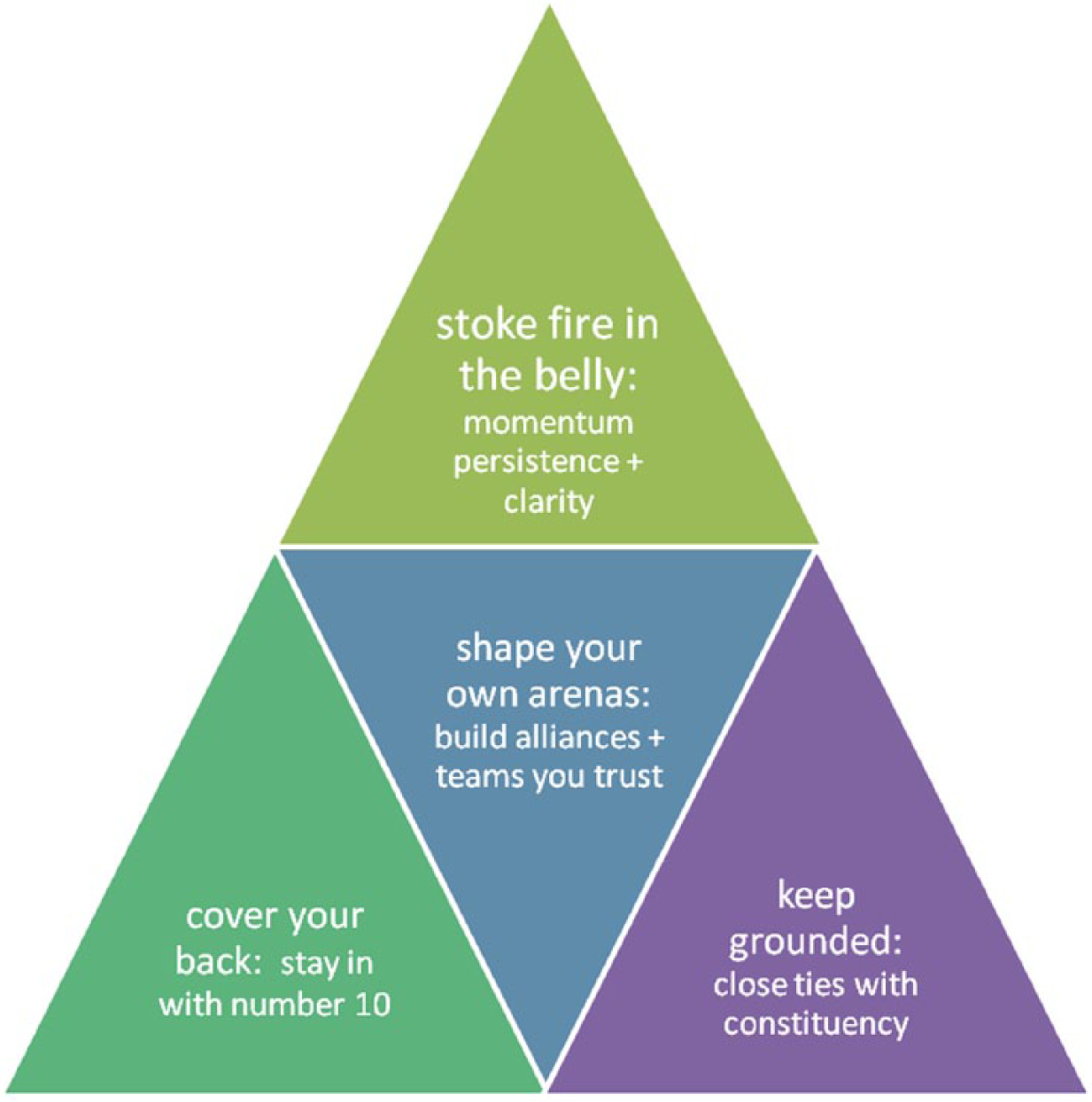
Leadership Practices of Political Leadership, as Reported by a Group of UK Government Ministers.
Through setting their own agendas and achieving a balance of social influence across arenas, some ministers displayed the creative and dynamic characteristics of the “strong leaders who do not feel constrained by the weight of tradition or formal rules” heralded by Denis et al. (2005, p. 453) as what public organizations need. Ironically, Denis is referring to strong leaders coming from the managerial rather than political cohort in a complex public governance setting. This study tentatively suggests an approach and a wider gene pool in that it may be applicable to elected politicians as well as managers.
The findings also indicate that some ministers were able to find spaces for leadership within and beyond their constrained roles and that these spaces were primarily social, as in the building of teams and stakeholder alliances, so as to enable the “flows of people, ideas, problems, legitimacy and resources” (Hartley, 2012). Depicting these spaces and flows as separate but interconnected arenas helps to analyze the myriad differing pressures and complexities of ministers’ everyday experiences. This study has begun to tease out the interrelationships between three arenas: the department, the prime ministerial hub, and the constituency, and this concept of arenas has helped to depict patterns and anomalies in leadership behavior and opportunity. It also confirmed that ministers themselves identified more readily with the concept of social rather than physical spaces, reinforcing the work of Mouffe (2005) and Hartley and Benington (2011) and suggesting this might be a fruitful framework for future studies of U.K. ministers and potentially, with different contextual framing, of U.S. secretaries.
The findings also suggest some of the complexities of a collaborative governance context even for very senior politicians who in theory carry the democratic mandate to enact policy change, leaving others to implement their policies. While they clearly do have some individual scope to shape that context, the findings of this study suggest that is seldom a straightforward task. Also, despite the official collaborative ethos of cabinet government in the United Kingdom, leading politicians in exposed positions were acutely aware of the personal risks to their continuance in role if they failed to manage relationships in influential arenas, such as number 10 because the PM hires and fires them as ministers (though not as MPs) or in their constituencies where their relationships are tested at the ballot box every 5 years. Ministers reflected on the value and necessity of collaboration but were also articulate about the competing claims on their attention, priorities, allegiances, and perspectives.
This study is small-scale and dependent on recent ex-ministers’ own reported accounts of their experience rather than triangulated data. Self-report has its limitations, particularly in relation to attribution and self-presentation (Alvesson, 2011). On the contrary, many studies of political leadership use this approach as one of the ways to understand the complexities of the role as seen by the key protagonist. Furthermore, privileged access of this nature is rare in elite government settings and this study has obtained rich data from a range of different personalities who occupied various roles and ranks of minister.
Although small-scale, given its rare privileged access and the considerable bank of political experience it drew on, this study does have some valuable practical implications. First, for politicians who find themselves suddenly appointed to ministerial roles, findings suggest they should recognize and manage relationships in the multiple arenas in which they need to operate through keeping in mind the four key pieces of advice: stoke fire in the belly, shape your own arenas, cover your back, and keep grounded. Through trusting their motivational instincts to shape priorities, building teams around them and forging ahead to lead the changes they want to effect, they stand the strongest chance of making the kind of difference many entered parliament to achieve. Second, this study has practical implications for U.K. civil servants and other salaried employees whose main role is to advise and support leading politicians. For them, the lessons are that they need to give politicians the space and scope to lead directly through shaping their own agendas, relationships, and operational contexts where it really matters. This might well be in areas with complex, crosscutting challenges where the politicians’ own experience, constituency relationships, and political nous are needed to bring momentum, purpose, and instinct to leadership challenges.
Third, applying the perspective of arenas could help future researchers build and communicate greater understanding of the nature of the everyday dilemmas and challenges of prominent national politicians. Future researchers might also consider gathering and analyzing more detailed case study data that would open up opportunities to triangulate politicians’ own accounts of how, when, and where they are personally drawn to lead major policies across multiple arenas so they result in significant changes in local communities and constituencies. While the ministerial roles studied here are peculiar to the U.K. Westminster parliamentary system, similar senior political roles in other liberal democratic systems of government potentially risk being similarly bound by convention, tradition, and relentless diary pressures so that, for prominent politicians, exercising everyday practices of leadership can present challenges. Similar studies of prominent national politicians from other countries would offer a rich seam of comparative analysis and opportunities to elucidate how a model based on arenas can develop fuller understanding by those within political systems and those studying them of if, how, and when leadership is possible.
The overall conclusion of this study is that leadership for ministers is possible, but difficult and that U.K. ministers exercise leadership in at least three major arenas on occasions. Findings from this small-scale study indicate that where ministers do succeed in aligning their practices and purpose across multiple arenas, they actively lead policy change, ideally alongside civil servants in their departments. Greater awareness by all involved could help support effective leadership. Their clarity of purpose fuels “fire in the belly” but the drive and excitement needs to be combined with more mundane leadership practices, such as dogged persistence to ensure that this clarity illuminates all relevant arenas. Too much leadership research is silent about where and how leadership takes place. This work emphasizes that leadership may take place with many different stakeholders in a wide range of settings and circumstances and that even very senior politicians are actively involved in dynamic practices of leadership on a day-to-day basis.
Footnotes
Declaration of Conflicting Interests
The author(s) declared no potential conflicts of interest with respect to the research, authorship, and/or publication of this article.
Funding
The author(s) received no financial support for the research, authorship, and/or publication of this article.