



Abstract
Using confirmatory factor analysis (CFA), we create a valid 15-item public service motivation (PSM) construct for Jamaica. We find high PSM among surveyed Jamaican civil servants and students. While our article supports the potentially universal nature of PSM, Jamaica is a less developed and less transparent country than the Organisation for Economic Co-Operation and Development (OECD) studies that dominate PSM scholarship. Survey respondents perceive corrupt and unethical behaviors among Jamaica’s civil servants, politicians, and with selected state services. We use historical-institutionalism to explain the coexistence of high PSM in an unfavorable ethical climate. Institutional and cultural histories explain why substantive PSM values are not instrumentally implemented. Respondents feared job loss or lost promotions if they tell on colleagues who act inappropriately. The presence of monitoring institutions has not guaranteed effectiveness. An “informer culture” and societal distrust limit prosocial behaviors. The intertwining of institutional weaknesses and an informer culture limit PSM value enactment in Jamaica.
Most public service motivation (PSM) scholarship focuses on developed countries. Among Organisation for Economic Co-Operation and Development (OECD) countries, the United States and multiple Western European countries are frequent case studies. Other OECD countries with published PSM scholarship include South Korea (e.g., Kim, 2005, 2009b) and Australia (e.g., Taylor, 2007, 2010). Our study responds to a call for non-OECD PSM scholarship (Kim & Vandenabeele, 2010). Excluding prior China-focused surveys (e.g., Liu, 2009; Liu, Tang, & Zhu, 2008) and a cross-national survey of 38 countries (of which 8 were developing countries; Vandenabeele & Van de Walle, 2008), few PSM studies consider developing countries.
Our study finds high PSM among surveyed Jamaican respondents. With a 2012 gross domestic product (GDP) per capita of US$5,440 in Jamaica, we suggest high PSM is not exclusive to the developed world. We add evidence to claims that PSM may be a “universal concept” (Vandenabeele & Van de Walle, 2008, p. 236). If we consider PSM one of public administration’s “big questions” (Behn, 1995), then we cannot claim full knowledge if surveys are limited to OECD countries, the world’s most important developing country (China), and countries with transparent governance environments.
If we hope that PSM scholarship might one day help “construct administrative systems that not only reduce prospects for bad behavior, but also increase the likelihood for public service-oriented, prosocial, altruistic behaviors” (Perry, 2011, p. 146), then our lack of developing country PSM scholarship is problematic. There are important differences between developed and developing countries. This includes higher levels of perceived corruption and lower system accountabilities in developing countries. 1 Economic growth and high country income is correlated with lower levels of perceived corruption (Gupta, Davoodi, & Alonso-Terme, 1998; Mauro, 1995). Neither the 38-country effort nor the China-focused studies linked high PSMs to environments known as less transparent than OECD countries. Yet in Jamaica we found a high PSM in a context plagued by unethical or corrupt behaviors.
This article proceeds as follows. We define PSM and describe our historical-institutionalist framework. We provide Jamaica-specific background before reporting our methods and confirmatory factor analysis (CFA) results. The article’s second half delves into our research puzzle: How does a high PSM coexist with perceived corrupt and other unethical behaviors? We discuss respondent perspectives on civil servants, politicians, system transparency, and fears associated with reporting misbehavior. We find disempowered institutional mechanisms interacting with an “informer culture” to weaken PSM enactment. We revisit the PSM construct before offering new avenues of research.
In Brief: Public Service Motivation
PSM is “an individual’s predisposition to respond to motives grounded primarily or uniquely in public institutions” and has three bases of logic: affective, rational, and normative (Perry & Wise, 1990, p. 368). The affective base is derived from a civil servant’s ability to identify with the disadvantaged, those less equal, and those who require state assistance for a “leg up.” The rational base is an understanding in the instrumental process of public service. The normative base derives pleasure from accomplishing his or her goals in “compliance with values and norms” (Andersen, Jorgenson, Kjeldsen, Pedersen, & Vrangbaek, 2013, p. 295).
Public sector employees with high PSMs may be more committed to the public organization (Crewson, 1997), have a greater interest in civil affairs (Brewer, 2003), and be more willing to trade higher private sector pay for public policy influence (Gailmard, 2010). While scholars have debated the linkages between PSM and job performance (Alonso & Lewis, 2001; Naff & Crum, 1999; Ritz, 2009), recent experimental work suggests that if motivated civil servants are exposed to the beneficiaries of their work, civil servant job performance may increase (Bellé, 2012).
An overarching PSM research question is whether civil servants (and the students who study to become public employees, public officials, or nonprofit actors) are motivated to serve the “public good” (Perry, 1996; Perry, Brudney, Coursey, & Littlepage, 2008). The most common response is “yes.” When compared with private sector workers, public sector employees differentially rank their internal motivations and expectations. Both groups are capable of altruism but public sector workers are more likely to register higher PSMs (Brehm & Gates, 1997; Crewson, 1997; Pandey & Stazyk, 2008; Rainey, 1982).
Antecedents to PSM may include civil servant demographic characteristics and professional socialization. Organizational factors like tenure, hierarchy, and red tape may influence the instrumental value (and enactment success) of high PSMs (Moynihan & Pandey, 2007; Pandey & Stazyk, 2008; Perry, 1997). Although affective commitment may influence job performance and discourage turnover and absenteeism (Nyhan, 1999), most developing country civil service reform literature focuses on calculative commitment. Calculative commitments are the “extrinsic rewards such as pay, status, promotion, and benefits” (Nyhan, 1999, p. 99). An oft-suggested belief is that high civil servant pay creates a less corrupt and more ethical public service (e.g., Van Rijckeghema & Weder, 2001).
But civil servants may have heterogeneous preferences. Given the difficulty of ascertaining accurate “countable output,” empirical uncertainty about links between pay and performance (Langbein, 2010, p. 21), and developing country inability to offer high civil servant pay, we must be cautious. Paying for affective commitment or an instrumentation of PSM may not work. As developed country civil servants often earn less than their private sector colleagues and coexist with transparent and noncorrupt institutional contexts, other noncalculative factors may be more important. Public sector values and institutional environments shape civil service decisions (T. L. Brown, Potoski, & Van Slyke, 2006). The holding of values need not imply that civil servants are “exerting effort to fulfill it” (Andersen et al., 2013; Rainey, Koehler, & Jung, 2008, p. 10). If effort is not exerted, then we must explain why. We explain this Jamaican outcome within the context of its political-institutional histories.
Framing Jamaica: Historical-Institutionalism
Value expression is intimately linked to historical context. As noted by Leonard White (1955) and repeated by Donald Moynihan (2009), we cannot understand administration and its values “without some knowledge of what it has been, and how it came to be what it is” (Moynihan, 2009, p. 814). The coexistence of high PSM within a corrupt environment requires understanding institutional history and societal culture interactions. An historical-institutionalist perspective sheds light on how institutions are embedded across time and context. Societal and institutional paths are dependent on prior structures, functions, and histories. Substantive reform often requires an alteration of societal and institutional incentives (Hall & Taylor, 1996; Thelen, 1999).
Historical-institutionalism contains calculus and cultural components. The former suggests “institutions persist because they embody something like a Nash equilibrium: Individuals adhere to these patterns of behavior because deviation will make the individual worse off than will adherence . . .” while the cultural component “ . . . explains the persistence of institutions by noting that many of the conventions associated with social institutions cannot readily become explicit objects of individual choice” (Hall & Taylor, 1996, p. 18). Neither component is mutually exclusive. By choosing to not report a misbehaving colleague, civil servants may employ a calculus approach as not reporting might preserve one’s job given other institutional weaknesses. The cultural component interacts with the calculus component by suggesting “good” Jamaicans will not inform.
Each approach explains what at first appears contradictory: High PSM within a country known to suffer from corruption. Institutional weaknesses and an “informer culture” may prohibit the active implementation of one’s passive PSM values. Given predictions that PSM may be a “universal concept” even if “the distinct ‘public’ character vary regionally” (Vandenabeele & Van de Walle, 2008, p. 236), then historical-institutionalism allows us to discover public character differences. Path dependencies help us understand why individuals may relay behaviors or create rules that infrequently deviate from their “binding agent” or institutional order (Dopfer, 1991). This approach helps us discover how Jamaica’s historical paths have created high PSM civil servants unable to instrumentally implement PSM values.
Understanding Jamaica: Postindependence History
Prior to its 1962 independence, Jamaica was a British-led and slave-fuelled plantation economy. The newly independent Jamaican state faced two challenges: (a) to respond to its poor, historically wronged disenfranchised citizens; and (b) to consolidate and legitimize itself as integral to the development effort (e.g., Manley, 1975; Stone, 1986). The paternalistic state chose redistribution to correct prior injustices. Jamaica’s civil service was a tool for ensuring state legitimization. But this state-led development came at the price of market-led practice. Donors focused on economic growth desired liberalization and civil service reform. A Westminster–Whitehall democracy since independence, Jamaica’s vote-conscious politicians and influential public sector unions rarely create the political will market-oriented reform required (World Bank, 2007).
Early political elites made other key decisions. In Jamaica’s postindependence rural-to-urban internal migration, migrants were often gathered into garrisons. A garrison is a
political stronghold, a veritable fortress completely controlled by a party. Any significant social, political, economic or cultural development within the garrison can only take place with the tacit approval of the leadership (whether local or national) of the political party. (Figueroa & Sives, 2004, p. 65)
Housing was allocated via party affiliation and strengthened by clientelism, elite linkages, class-based politics, and redistributed benefits. Garrisons did not serve the state but a political party and its leadership. The political outcome is a Jamaican “political hybrid with democratic and authoritarian elements existing in an uneasy relationship” (Gray, 1991, p. 10).
Garrison-fuelled political violence increased throughout the mid-to-late 1970s. Violence deepened in the 1980s via emergent drug-and gunrunning networks (Gray, 2004b). This don-led space or “rogue leadership in the civil sphere” altered state power (Johnson & Soeters, 2008, p. 166). Politician success and garrison support are interlinked. This “inventive form of power” occurs when one “weds structures of clientelism and democratic institutions to extra-legal processes associated with criminal and political underworlds” (Gray, 2004a, p. 14). By 2010, Jamaica had one of the world’s highest homicide rates per capita (United Nations Office on Drugs and Crime, 2011).
Jamaica’s informer culture intertwines with this history. If the social cohesion benefits of this culture had been arguably necessary among slaves, its continued purpose (altered for modernity) is unclear. This informer culture or informer phobia (IP) can be explained as
Operating in like fashion to the Italian Mafia’s “omertà,” IP is a less visible but most potent governing tool in the arsenal of the Jamaican don. Informer phobia is a fear of providing or being perceived as providing information to state authority, particularly the police and increasingly to journalists. Extra-legal activities often go unreported because community members fear the consequences which include being “burned out” of their homes or death. Aided by the cultural censure of the act of “informing,” embodied in the lyrical output of many Jamaican entertainers, informer phobia covers conversing with a police officer or visiting a police station as well as the very act of “getting involved” in the legal system. (Johnson & Soeters, 2008, p. 178)
Even if dons may not formally sit within public service spaces, one understands that to inform is to fear, at worst, or to be culturally inappropriate, at best. Jamaica’s garrison politics showcase realities whereby when one political party has control, the government favors its party-affiliated citizens. When the other party has control, priorities shift. When combined with an informer culture, such politician-don-citizen agreements may prohibit the serious political disagreements capable of encouraging change (Peters, Pierre, & King, 2005).
According to the World Bank’s 2010 Governance Indicators, Jamaica’s Control of Corruption put Jamaica at the 45th percentile among 200+ countries with a score of −0.36 where −2.5 implies less control over corruption and +2.5 implies greater control. In 2012, Transparency International’s (TI) Corruption Perception Index ranked Jamaica 83rd among 176 countries with a 38/100 score where 0 equals corrupt and 100 equals clean. 2
High intrasocietal distrust plagues societal relations. In a 2006 United States Agency for International Development–University of the West Indies (USAID-UWI) social capital survey, just 14.1% of surveyed Jamaicans felt they could trust another Jamaican (Powell, Bourne, & Waller, 2006). When considering confidence in 22 public institutions, less than 20% had a “lot of confidence” in trade unions, private sector, “government,” and each individually named political party. Less than 10% had similar confidence in the judiciary, parliament, police, “political parties” (in general), and local government councils. In other words, nearly every key societal institution was distrusted. The three most trusted institutions (with nearly 50% or more of respondents answering a “lot of confidence”) were families, schools, and universities (Powell et al., 2006).
Jamaica’s postindependence economy has fared little better. Between 1990 and 2005, Jamaica grew an average of 1.3% per year (Thomas & Serju, 2009). 3 Jamaica’s nondiversified economy is dependent on imports, remittances, and receipts from bauxite and tourism. Civil servants work within 190+ government agencies, statutory bodies, government boards, and state-owned enterprises. In 2004, the Government of Jamaica (GOJ) employed nearly 97,500 civil servants of whom ~28% worked in education (United Nations, 2004). With International Monetary Fund (IMF) loans (2010 and 2013) prioritizing wage bill concerns, recent estimates suggest Jamaica has 110,000+ civil servants with one-third working in education and another quarter employed by nonministerial public bodies. In 2011, government debts equaled 141.5% of GDP with the majority owed to domestic and foreign commercial banks (IMF, 2013).
Economic underperformance coexists with oft-created but infrequently concluded public service reform efforts. Between 1962 and 2003, Jamaica underwent at least seven different public sector reforms (Tindigarukayo, 2004). Many of the latter were linked to a new public management wave that overtook the developing world, including Jamaica, in the late 1990s and early 2000s. One output was the creation of several executive-level agencies (Bissessar, 2002; Carribean Policy Research Institute, 2011; Isaacs, 2002). An eighth phase began with the creation of a Public Sector Transformation Unit in November 2009. The Unit was asked to review the public sector and suggest reform. Its report was released in 2011 (GOJ, 2011). Most reforms remain unimplemented.
Method: Survey and Cofirmatory Factor Analysis
The original PSM construct includes 40 indicators split across six latent variables: attraction to policy making, compassion, self-sacrifice, commitment to the public interest, social justice, and civic duty. The opportunity sampling of the original PSM survey (Perry, 1996) is currently unachievable in Jamaica. There are no public surveys of GOJ employees. Government-wide civil servant surveys must be approved by the cabinet secretary. The cabinet secretary sits in service to the prime minister. This is a more strenuous hurdle than other countries. An inability to access sitting civil servants should not preclude researchers from exploring other avenues. Theorization is hampered if we only explore the “easy” cases. The next-best option was to survey students enrolled in the BSc (MSc) in public sector management or the MSc in governance at the UWI in Kingston Jamaica. UWI is the Caribbean’s premier tertiary-level university. UWI offers the only public sector management or governance degrees in Jamaica.
Before administering the survey, two BSc students, one MSc student, and three local academics reviewed the survey for (a) applicability to Jamaica and (b) student understandability. This reflects cross-cultural survey concerns. Concern is raised
even when similar wordings of an item are used, cultural meaning and connotations can distort comparative findings. Therefore, it is necessary, apart from the usual care that must be taken when translating items, to evaluate items for their cultural sensitivity, possibly by involving local public administration experts in the evaluation of the items. (Kim & Vandenabeele, 2010, p. 706)
This review led to word shifts in two questions and the deletion of two civic duty questions. 4 Our final survey instrument had 38 items.
Course lecturers were contacted for permission to enter the classroom. Lecturers were present during project introduction and were free to watch survey administration. Students were reminded of the survey’s voluntary nature and of their right to not answer questions. This reflects best practice and prior Jamaican surveys, which found high intrasocietal distrust. To reduce environment-influenced central tendency biases, a six-item scale was utilized where 1 = disagree strongly and 6 = agree strongly. Prior developing country PSM surveys made similar corrections (e.g., Liu, 2009).
There were 186 unique students registered for a public sector management or governance course in September 2010 and January 2011. 5 The cross-sectional survey was offered via a single-stage sampling procedure (Creswell, 2009). Respondent anonymity was maintained by neither identifying nonattending students nor asking them to later submit a survey. Of the 162 surveys collected, five were excluded. 6 Our final “n” was 157 for a response rate of 84.4%.
Reflecting trends suggestive of Jamaican male educational underachievement (Figueroa, 2004), 76.2% of surveyed students were female. One third (33.8%) of the respondents were less than 24 years old. Another third (34.5%) were between 25 and 34 years, 20% were between 35 and 44 years, and 11.7% were 45 years or older. A BSc is not a minimum GOJ civil service requirement. For civil servants desiring a promotion, a BSc may help. As such, 66.2% of surveyed students were current or former GOJ civil servants. Among this group, nearly 44% had 7 or fewer years of GOJ experience, 38% had 8 to 15 years, and almost 19% had 16+ years. Our sample follows prior PSM surveys of students enrolled in public affairs programs (e.g., Clerkin, Paynter, & Taylor, 2009; Ko & Han, 2013; Vandenabeele, Hondeghem, & Steen, 2004) and studies that mix civil servants and students (Perry, 1996, 1997). 7
Data were reverse-coded as appropriate. The first column of Table 1 is the survey question-order. The second column links our question-order to the Perry (1996) labels. We conducted an item-total correlation test to check if any item in the set of tests was inconsistent with the averaged behavior of the others. We dropped 12 items (PSM 3, 7, 11, 14, 15, 20, 22, 24, 27, 32, 37, and 40) with correlations between −.041 to .231, well below the average for other items.
DWLS Estimates and Variables (N = 157).

Note. PSM = public service motivation; DWLS = diagonally weighted least squares.
We followed the CFA of the initial PSM survey (Perry, 1996). CFA is hypothesis-driven and helps test hypotheses about a particular factor structure (T. A. Brown, 2006). We estimated the CFA using LISREL 9.1 (Albright & Park, 2009). Our raw data matrix included several missing observations. We addressed missing data via the Full Information Maximum Likelihood (FIML) estimation. FIML makes maximal use of all data available from every subject in our sample. The confirmatory factor model equation
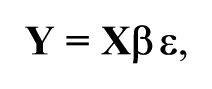
where
Our M0 specification included (a) six dimensions with each dimension correlated with the other dimensions; (b) 26 indicators, each loading on only one latent dimension; and (c) uncorrelated error terms. The χ2 is 9,207.11 with 284 degrees of freedom (p = .00), implying a poor model fit. Given disconfirmation of the initial model, we estimated a M1. We discarded indicators associated with multiple dimensions as this violated our goal of having each observed indicator load only on a single latent factor. The modification indices showed that because PSM 1, 6, 9, 12, 19, 23, 34, and 39 loaded on another dimension (attraction to policy making), they were deleted. PSM 29 was also deleted because it loaded on three dimensions (compassion, self-sacrifice, social justice).
After removing the nine variables, the correlation between two latent variables (commitment to the public interest and compassion) exceeded .93. We combined both measures. This combination led to social justice becoming newly correlated to the combined measure (commitment to the public interest and compassion). As the two dimensions were not unique, they were combined. With four factors and 17 indicators, we ran the CFA. Our final maximum-likelihood estimation (MLE) model had four latent variables: attraction to policy making, civic duty, self-sacrifice, and a combined commitment to the public interest/compassion/social justice. The t values of the parameter estimates are significant at the .05 level. The factor loadings range from 0.20 to 0.81. The coefficients explain how well they measure the latent factor. All standard errors are significant. This implies our observed indicators are valid measures of the dimensions. The R2 is a measure of reliability that indicates how consistently the observed variable measures the latent dimension. The
To improve our model, we used a diagonally weighted least squares (DWLS) procedure. 8 This technique is useful for ordinal-level variables. The DWLS procedure produces more accurate results if models have 10 to 15 indicators and minimum “n” of 100 to 200 (T. A. Brown, 2006). Others suggest a “sample size of 150 for models with three or more indicators per factor” (Anderson & Gerbing, 1984, p. 171). Our first MLE model (M1) had 17 indicators. Our initial goodness of fit (0.88) and adjusted goodness of fit (0.89) were less than an “acceptable fit” of 0.90.
To improve DWLS fit, we reviewed Coursey and Pandey’s (2007) technique for reducing the 24-item scale to 10 indicators. We cannot replicate their technique of initiating a “peer-reviewed on request” of “several prominent public management researchers familiar with the PSM literature” (Coursey & Pandey, 2007, p. 550). Certainly being familiar with the PSM literature is important but so is scholar familiarity to Jamaica and its civil service. Another option was to collect another 3 or 4 years of data (via single sampling of approximately 30-40 new PSM and governance students per year) until our “n” was sufficiently large. However multiyear single sampling may overlook societal shifts between first and last samples. Longitudinal surveys are also impossible, given student transiency and anonymity concerns. The sample sizes available in large states should not preclude high-quality research from small states. We accepted our “n” of 157.
The final step was to reduce our indicators to ≤15. This was accomplished in two stages. The first stage determined whether any latent variable had less than three indicators. Three indicators is a minimum for good reliability. We deleted PSM 31 because it was the only indicator for the attraction to policy making dimension. The second stage considered indicator language among the three remaining latent variables. We concluded that PSM 16 indicator language differed significantly from the other indicators within its combined latent variable. In particular, the word “community” in PSM 16 differs from emotive words like underprivileged (PSM 2), patriotism (PSM 8), welfare (PSM 10), “causes” and “championing” (PSM 18), just (PSM 33), and “rights of others” (PSM 38). As noted in our Jamaican history section, the word “community” is often linked to “garrison.” The “community” word may not create as similarly positive emotions among Jamaican respondents as Perry’s (1996) American sample. Using DWLS, our final model (M3) for Jamaica has three latent variables (civil duty, self-sacrifice, and a combined compassion/social justice) and 15 indicators (see Table 1; see Figure 1). 9 Our GIF and AGIF improved to 0.90 and 0.91, respectively.
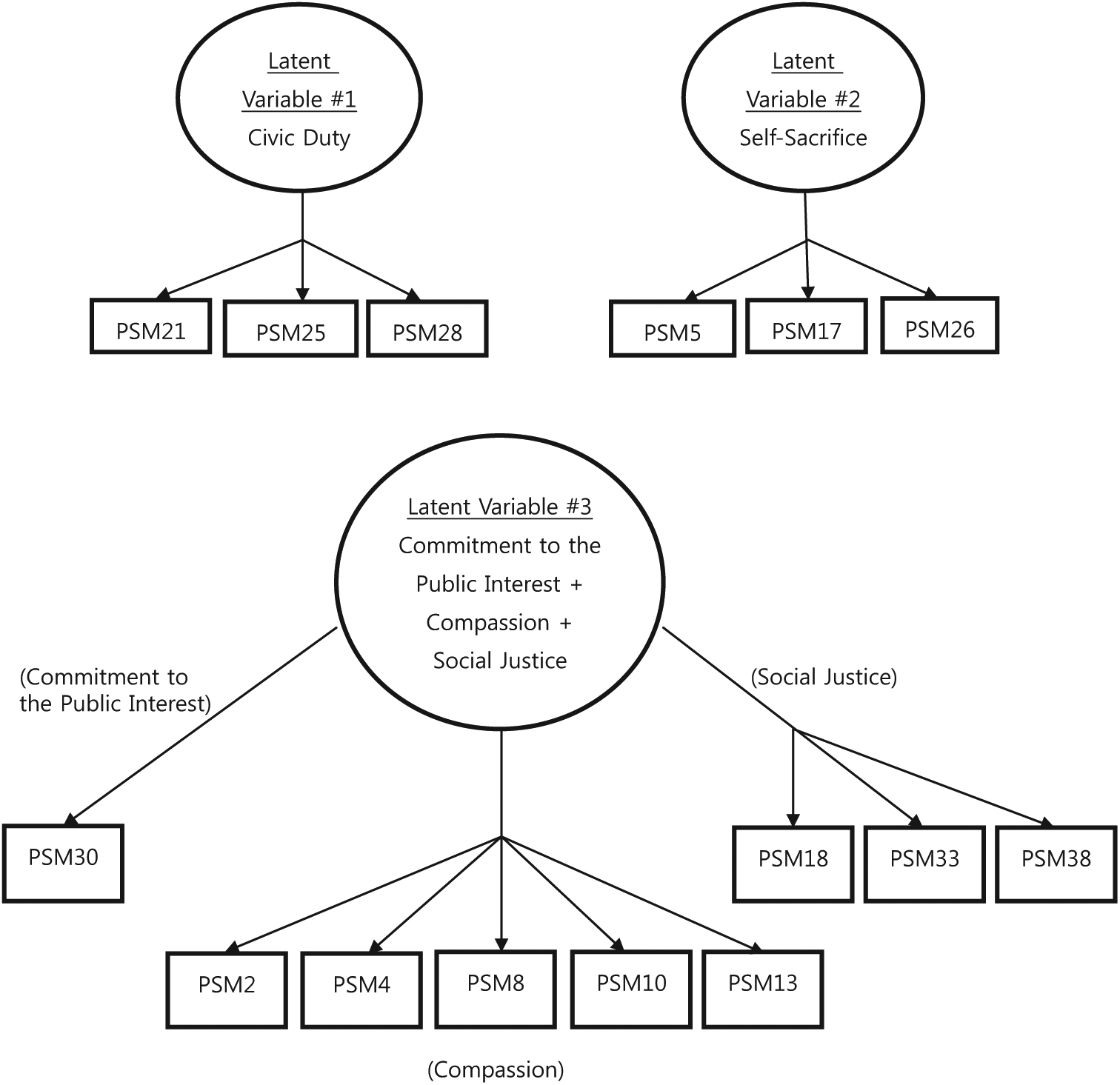
Jamaica’s 15-Indicator (3 Latent Variables) DWLS Model.
Linking PSM and Respondent Perceptions of Corrupt or Unethical Behaviors
We found high PSM among our Jamaican respondents. While few developed country PSM scholars explicitly link high PSM to country transparency, we cannot escape this link in Jamaica. Given hopes that PSM might inform a more ethical and prosocial service, we must explain high PSM within an altogether different ethical climate. As the majority of world citizens and their civil services exist in environments that lack Western transparencies, the second half of this article explores this link.
Civil service reform and anticorruption efforts have long institutional histories among developing country public sector reform efforts (Nunberg & Nellis, 1990; Wolfensohn, 1996; World Bank, 1997, 2007). The World Bank and IMF acknowledge limited developing country civil service reform progress. Reasons include unfocused and contradictory donor objectives, insufficient focus on political or institutional barriers, and insufficient data collection and analysis (World Bank, 2002). The links among low economic growth, increased poverty, and corruption are clear (Mauro, 1995) and we know that corruption can permeate state services (Campos & Pradhan, 2007). 10 It is arguable that societal culture influences administrative outputs (e.g., Islam, 2004) even if we have overlooked specific, ministry-level, office-level, and individual-level civil servant motivations. Prescribed reforms reflect aggregate data and cursory reviews. Individual civil servant motivations and civil servant perceptions are frequently overlooked. Disciplinary hesitance to deeply explore non-OECD contexts (Gulrajani & Moloney, 2012) further hampers civil servant analyses.
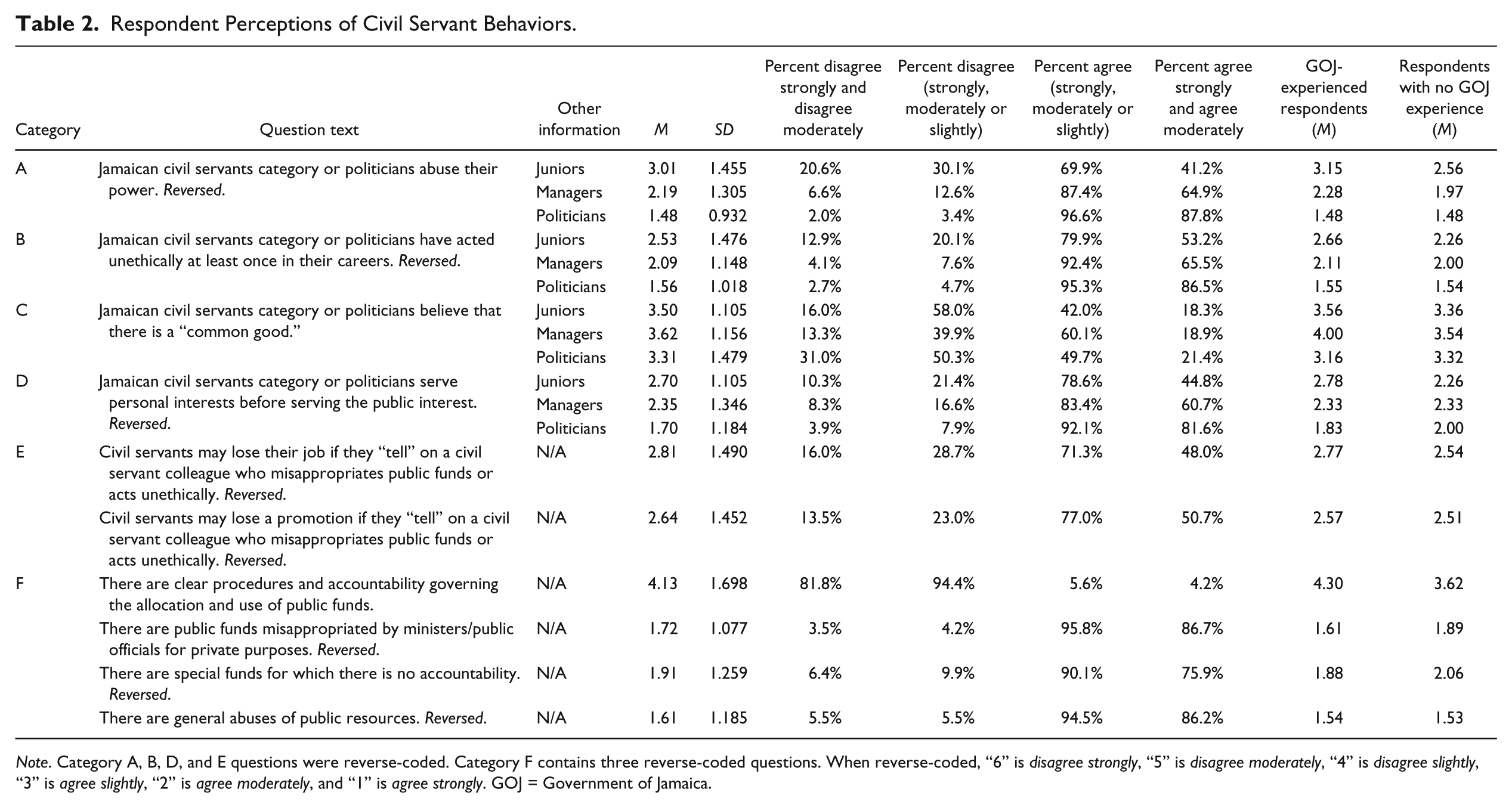
To explore links between PSM and Jamaica’s ethical climate, our survey included an additional five question categories (see Table 2). Unless otherwise specified, each question had a 6-point Likert-type scale. While a few questions drew on the Corruption Perception Index, most questions reflected prior Jamaican scholarship and current events. The first category targeted respondent perceptions of junior civil servants, public sector managers, and politicians. 11 We asked whether civil servants (junior staff) abuse their power, act unethically, believe in a common good, and serve their own personal interests before serving the public interest. Other questions substituted junior civil servants for “public sector managers (top public executives, middle managers, lower managers)” and politicians. Two questions were extensions of the public sector ethos scholarship (Raynor, Williams, Lawton, & Allinson, 2010). 12 In reference to a common corruption definition, questions also asked whether actors will “serve their own personal interest before serving the public interest” (World Bank, 2007).
Respondent Perceptions of Civil Servant Behaviors.
Note. Category A, B, D, and E questions were reverse-coded. Category F contains three reverse-coded questions. When reverse-coded, “6” is disagree strongly, “5” is disagree moderately, “4” is disagree slightly, “3” is agree slightly, “2” is agree moderately, and “1” is agree strongly. GOJ = Government of Jamaica.
The more senior the civil servant, the more likely respondents felt the civil servant abused his or her power, acted unethically, and served his or her personal interest before the public interest. No less than 69% of respondents believed junior civil servants abused their power, acted unethically at least once, and/or put personal interests before the public interest. This percentage increased for public sector managers. When considering politicians, 92.1% of respondents agreed that politicians cannot be trusted to act reasonably. Our findings mesh with Jamaica’s 2006 social capital survey. The survey found that Jamaica’s major political and government institutions were distrusted by more than 85% of respondents. The distrusted institutions included political parties, local government, the police, the parliament, and the judiciary (Powell et al., 2006).
Responses were mixed on whether junior civil servants (42%), public sector managers (60.1%), and politicians (49.7%) believed in a “common good.” Similarly, we found that junior civil servants (60.4% and 66.4%, respectively), public sector managers (57.7%; 69.7%), and politicians (57.1%; 68.9%) were perceived as interested in their communities and Jamaica. This can be interpreted in multiple ways. First, perhaps it is a matter of perspective. If approximately half were interested in their communities or Jamaica, then another half were not. Second, respondents perceived junior civil servants and politicians less favorably than senior civil servants. As respondents are more likely to interact with junior civil servants at the “street level” (Lipsky, 1980), respondents may be less experienced with senior civil servants. Similarly, as Jamaica has a small population (2.9 million; 63 elected members of parliament [MPs]), politician prominence among and within communities (and news reports about politician activities) will inform respondent perceptions. Third, given prior definitional concerns about the word “community,” respondents may equate “community” to “garrison” and choose negative responses while others may envision “community” as a hopeful term and choose differently. A fourth possibility is that partial beliefs in the “common” good may be punctuated by occasional lapses in behavior. The rational, affective, and normative bases on which PSM is built may exist within respondents but struggle to be enacted. The importance of social justice and civic duty (and nonimportance of attraction to policy making) in our construct reflects base Jamaican motivations. Notions of “good” are not divorced from desires to overcome legacies. There may be conflicts between a rational desire to provide service framed by normative values and the institutional and cultural patterns that temper PSM value enactment. Additional question categories explore the latter concern.
The second category included two questions that asked whether civil servants will lose their job or a promotion if they “tell” on civil servants who have misappropriated funds or acted unethically. Each question reflects concerns about Jamaica’s informer culture. A strong majority felt they may lose their job (71.3%) or a promotion (77%). On dividing our sample into respondents with current or prior GOJ experience and those with no prior GOJ experience, our experienced GOJ respondents were slightly more likely to believe they may lose their job or a promotion. The relative similarity across both respondent groups indicates neither group felt they must answer in a socially desirable manner. Despite Jamaica’s multiple reporting mechanisms, respondents may observe institutions that are unable to encourage “telling” acts. In a country with few successful high-profile (or even low-profile) corruption prosecutions, respondents have learned that extrinsic values are unequally implemented. If respondents operate within a nondynamic employment environment or a disassociated social environment, it may be perversely rational to not “rat out” poor behavior if such actions preserve your job. In a country unremoved from a pervasive “informer fi dead” (“if you inform, you are dead”) motto or informer culture, one might wonder whether it is worth making a fuss. To reporting a misdeed is to inform.
The third category reflected respondent perspectives on whether public resources are abused and if clear accountabilities exist. Questions expanded on motivations within two of the surveys underlying the Corruption Perception Index. 13 More than 94% of respondents believed there are unclear procedures and accountabilities governing public fund allocation and use. Respondents believed public funds are misappropriated by ministers or public officials for private purposes (95.8%), there are special funds for which there is no accountability (90.1%), and there are general abuses of public resources (94.5%). Current or former GOJ respondents were more likely than their inexperienced student-colleagues to agree that there are few clear procedures or accountabilities in public fund allocation and use.
A fourth category asked whether identified government services are likely to accept “undocumented extra payments or bribes.” 14 A majority considered it common for civil servants and their managers to receive “undocumented extra payments or bribes.” Approximately 90% or more respondents agreed such undocumented behavior occurs in the awarding of contracts and licenses, business permits, imports and exports, and in the obtaining of a blind eye from the police. More than three quarters of respondents added regulator decisions, central or local government policy decisions, and annual tax payments. On splitting our respondents into current or former GOJ employees and those with no GOJ experience, we found few differences in the first five categories. However, our GOJ-experienced respondents were more likely to disagree that an extra payment or bribes will obtain favorable policy decisions from local or central government and/or annual tax or public utility payments. Nonetheless, both groups agreed such payments may occur “occasionally” or “very frequently.”
Unlike the prior four categories, five of the final category’s six questions were “I” questions. Each question had a yes/no response option. The nature of each question may create an underreporting bias. One question asked respondents whether they have personally witnessed others misappropriate funds or act unethically. Just under a quarter (22.2%) of the respondents had personally witnessed a politician “misappropriate public funds or act unethically.” Approximately 40.1% of the respondents knew of a family member, friend, or colleague who had witnessed a politician misappropriate public funds or act unethically. 15 Just more than half of respondents (55.7%) had personally witnessed a civil servant act inappropriately.
Another question asked whether respondents would “look the other way” if they observed a family member, friend, or colleague misappropriate public funds or act unethically. Just below one quarter of respondents (22.4%) said they would look away. Among current or former civil servants, 18.4% would look away. We must be cautious in our interpretation. Despite a relatively low “look away” percentage, it may not be a good sign if one-in-five are still willing to look away. When cross-tabulated with perceptions about promotion or job loss and a willingness to tell, a strong majority felt a promotion (78%) or job (64%) loss might occur. Our findings provide comparative evidence of the altruistic and prosocial values that comprise the PSM construct. Those willing to tell are not unaware of the potentially negative consequences. Importantly, however, our questions do not ask how a civil servant will tell. Is acting simply a polite and informal “talking to” or something more assertive? Given respondent fears they might lose a promotion or their job if they tell on a misbehaving colleague, telling behaviors may not involve putting the observer in danger (employment or otherwise).
Two questions asked whether respondents had helped friends or family obtain a civil servant job by “bending the rules” (5.9% said “yes”) and whether the respondent had personally misappropriated funds, accepted a bribe, and/or acted in a corrupt behavior (5.9% said “yes”). The percentages decreased to 3.9% and increased to 6.7% when selecting for current and former GOJ respondents. Given the nature of each question (with implications of respondent participation in unethical or illegal acts), we likely have underreporting biases. Nonetheless, a surprising number of respondents indicated they have personally abused the system. At least 1-in-15 respondent civil servants may have acted inappropriately. We caution that there is no magical number for how many unethical or corrupt acts are required before civil services are labeled corrupt. The “why” could be as simple as greed or a desire to “get what is mine” in light of perceived slights. Given Jamaica’s sociocultural concerns, the decision to not report misbehavior may be one’s safest route.
Discussion: Distrust, Weak Institutions, and an Informer Culture
Many of Jamaica’s 15-item construct reflect affective logic. In countries like Jamaica, the rational logic is about more than public service delivery. It is also an ability, given institutional and cultural constraints, to deliver. The normative pleasure one might obtain from service delivery is lost when “compliance with values and norms” (Andersen et al., 2013, p. 295) are weak, distorted, and unenforced. If the state is unable to protect its citizens from violence, citizens will distrust state motivations. If civil servants are aware of unprosecuted corruption or alleged interactions between government and criminal networks, distrust is natural. As noted by Jamaica’s premier criminologist, “[t]he ineffectiveness of the system and the prevalence of negative perceptions of it have meant that the structures and methods of operation of these institutions (not the idea of such institutions) have few overt defenders” (Harriot, 2004, p. 3, emphasis in original). Respondents may feel unable to either uphold PSM values or implement the values necessary for institutional effectiveness.
Social capital is a necessary component of an ethical civil service (Gregory, 1999). Civil servants and their managers should trust each other. Both actors should trust societal institutions if we are to achieve appropriate public service performance (Behn, 1995). Yet in Jamaica, trust is low. As noted in a 2006 social capital survey, those hired to uphold the public trust are themselves distrusted. Our survey confirms this trend. Jamaica’s ethical climate may not support civil servants who wish to enact PSM values. This distrust is deeply embedded into Jamaica’s institutions and its culture.
Civil servants are also citizens. They read the press, talk to neighbors, and may be aware via remittances, travel abroad, and/or education that other developing countries have achieved futures far different than Jamaica. Resentment combined with perceptions that individuals cannot change the system likely encourages further despair and for many, migration. It is unsurprising that a 2007 Planning Institute of Jamaica study found just 23.4% of Jamaica’s tertiary-educated graduates between 2001 and 2005 had not migrated (Planning Institute of Jamaica, 2007).
Citizens and civil servants learn prior state (in)action. Lessons are heard, understood, and in some cases, directly experienced. When presented with abuse, civil servants may hesitate to report if they learn that inaction and/or reporter punishment is possible. When presented with an ethical dilemma, civil servants may fear to be good. In a nondynamic employment environment with uncertain legal oversight, personal survival may trump societal service. In a country with few employment options, the active decision to be “good” (as opposed to a passive carrying of such traits) requires risk calculations foreign to OECD-country civil servants with other options. We cannot conclude that Jamaica’s civil servants lack a moral compass. Instead, they may lack a sufficient enabling environment that encourages the enactment of propublic activities.
It is not as if Jamaica has no transparency-inducing institutions. They do. Institutions include the auditor-general, the contractor-general, and the accountant-general. There is an electoral commission, a political ombudsman, and ministries often have comment boxes. The civil service has a Code of Conduct even if the Code remains weak and unclear (see GOJ, 2004). Nonetheless, creating an institution need not imply its empowerment. The auditor-general can encourage agency compliance but not enforce. The contractor-general can investigate a breach but not prosecute. The decision of political leaders to make noise but then not quickly investigate, arraign, and prosecute wears on the most hopeful. If government did prosecute, success may be hampered without witnesses unafraid to testify. Judges may be well trained but if there is witness intimidation, a slow judicial process, or poor policing, progress slows. Jamaica also has multiple nongovernmental organizations (NGOs). Two stand out: National Integrity Action and Jamaicans for Justice. Nonetheless, research has shown how a postindependence GOJ infrequently collaborates with civil society (Moloney, 2013).
Even if the civil service updated its ethics code or the judicial pace was quickened, will Jamaicans suddenly “inform?” The answer may be “no.” In the American circumstance, high PSM civil servants may encourage prosocial whistle-blowing behaviors (Brewer & Selden, 1998). In Jamaica, prior path dependencies may not be easily overcome. In 2011, Jamaica passed its first whistle-blowing law. In 2012, Jamaica identified which authority accepts disclosures if civil servants felt otherwise unable to disclose to identified officers. It is too soon to evaluate law impact. But as noted by a former contractor-general, the law is imperfect. This includes worries about informant protection and whether disclosing civil servants may be prosecuted for their disclosure. As “just about every public officer of any importance is required to sign a [Official Secrets Act] declaration,” disclosure may produce unintended consequences (McKoy, 2012, p. 11).
The PSM exercise cannot be isolated from reflections about a country’s ethical climate. Effective whistle-blowing requires faith that Jamaica’s political, legal, and police structures will protect whistle-blowers. Institutions must be trusted and the culture must encourage such behaviors. At present, Jamaica’s key institutions are not trusted and its culture does little to calm the fearful. It goes too far to suggest that the “dead” portion of Jamaica’s infamous “informer fi dead” phrase is a daily reality even if perceptions about the phrase, its cautionary message, and poor clarity over why persons are or are not harmed, may influence civil servant actions.
Even if the GOJ screened civil servant hires for high PSMs, civil servants may feel instrumentally unable to implement its values. Real-world conditioning and life experience frame possibilities. This is not schizophrenia. It is a rational (albeit troubling) response to disorder. Distrust interacts with weak monitoring institutions and an “informer culture” to create an ethical climate unable to encourage PSM value enactment. If the civil service (and the society in which it rests) does not uphold meritocracy and safe whistle-blowing or if the system punishes those who attempt to notify others of abuse or does not prosecute and convict those who commit crimes, then substantive PSM values are disassociated from their instrumental impact. Civil servant survival may not encourage outlier (i.e., reporting/informing) behaviors. Perceptions of unprosecuted mismanagement, misbehavior, or corruption among civil servants and politicians may discourage intrinsically motivated respondents to be proactive in the presence of abuse.
Furthering Links Among PSM, Ethics, and Corruption
In one of the few studies to formally link PSM and ethical conduct, Choi (2004) argued that when faced with an ethical dilemma, a civil servant’s individual PSM and gender, education, age, and work experience influence civil servant actions (Perry, 2000). Although our study did not link demographics, PSM, and ethics, we have no reason to disagree. But where Perry (2000) and Choi focus on individual sociohistorical contexts, we focus upon societal contexts. They are complementary approaches. Future research requires a closer study of assumed high PSMs (if PSM is universal) and corruption. Comparative efforts are strongly encouraged. We suggest four ways forward: (a) explicit contextualizing, where appropriate; (b) context-determined latent variable additions or subtractions; (c) increased clarity between PSM’s substantive and instrumental purpose; and (d) efforts toward dilemma-focused studies.
PSM studies are largely undertaken in wealthy, democratic, and fairly transparent legal-administrative contexts with sufficient judicial oversight. The Judeo-Christian values that influence the Perry (1996) scale should also predict high Jamaican PSMs. Jamaica is a democratic country with a melting pot of identities and a largely Christian outlook. But Jamaica is neither wealthy nor transparent. PSM predictability will increase with more comparative studies (Vandenabeele & Van de Walle, 2008). We march closer to PSM concept universality if others also find high PSM in environments otherwise considered corrupt. This requires more than administering PSM surveys in a corrupt country. It requires studies that isolate common latent variables across cultures, explore differences, and propose concept modifications. This should include whether institutional, cultural, and other societal traits influence PSM instrumentation. 16
Second, our utilized PSM construct may not include all potentially relevant latent variables. The Perry (1996) construct reflected U.S.-specific public sector theory. We should not confuse cross-national PSM construct validity with assumptions that all latent variables or questions were included. Whether focused on America, Jamaica, or another country, researchers may wish to add or subtract variables, as appropriate. Our encouragement of comparative PSM research in corrupt contexts may create new latent variables.
One new variable might address prosocial ethical behavior. Only one question from the original 40-item survey asks whether respondents are motivated to act ethically. 17 We know that PSM has “an ethical content” even if ideas like “the ethics of decision-making and organizational aspects . . . are not specifically included in the public service motivation concept” (Steen & Rutgers, 2011, p. 345). Scholars assume high PSM creates a prosocial ethical response. It may not. New questions might envision different environments: where transparency is high and/or where the civil servant knows their boss is politically or criminally connected. A second latent variable might ask whether the civil service should act altruistically or if sector-specific exceptions exist (e.g., policing, defense, foreign affairs). Questions may include whether prosocial behavior depends on effective institutional mechanisms. Additional questions may adapt corporate-focused ethical climate surveys for the public sector. A third latent variable might ask if high PSM civil servants must observe procedural justice, successful prosecution, and effective ethics codes before prosocial or altruistic action. Each latent variable addition, if reflected from a calculus and cultural approach, may strengthen construct validity and reliability across OECD and non-OECD countries.
Third, the PSM construct is a substantive measure often placed in the dependent variable position. The construct measures civil servant values and motivations. However, we learned it is possible to have high PSM within an ethical climate, that discourages construct enactment. It is one task to ask whether respondents believe they harbor prosocial values and quite another to move PSM into an independent variable position and ask if they (a) implement those values, (b) personally know others (or have directly observed others) who have not implemented such values, and (c) perceive others as implementing altruistic and prosocial behaviors. Our survey focused on PSM and respondent perceptions of Jamaica’s ethical climate. We did not ask whether respondents will (or can) implement those values. We did ask whether respondents are aware of others who struggled with PSM enactment and what might happen if one informs, but more work is required. We agree that PSM is both a dependent variable (substantive) and independent variable (instrumental). If passive (or intrinsic) motivations do not translate to active enactment, then we must ask why. This is a significant new research agenda with anticorruption research implications.
Fourth, Jamaica’s civil servants may not exclusively require moral agency, more sticks, or more carrots (e.g., Dobel, 1990; Finer, 1941; Friedrich, 1940). In our rush to prescribe, we often fail to understand developing country civil servants, their motivations, and the dilemmas (calculus) they face. We neglect, as development practitioners, to validate the civil servant experience as useful. Instead, we must understand “the nature of the dilemmas that public administrators face and how they respond to them takes precedence over establishing appropriate ethical standards and strategies for their implementation” (O’Kelly & Dubnick, 2005, p. 395). Applying scholarship that measures public value dimensions (especially “balancing interests”) may provide additional insights (Andersen et al., 2013). Even so, the “balancing interests” variable does not tell us how civil servants balance interests nor can this variable delineate when interests are “balanced.” A limited focus on civil servant dilemmas risks civil servants (and donors) creating a mechanism or institution, which insufficiently reflects local contexts or lacks responsiveness to citizen concerns. We agree that more longitudinal and experimental approaches might highlight key civil servant trade-offs (Moynihan, 2010). Problem-driven and iterative processes may offer paths forward (e.g., Andrews, Pritchet, & Woolcock, 2012) if combined with semistructured interviews or focus groups. As theory deepens and comparison increases, we might ask whether PSM is the key explanatory variable predicting ethical behavior or if institutional factors matter more. Other variables like civil servant pay, promotion opportunity, societal trust, procedural fairness, government effectiveness, degree of meritocracy, whether the civil service is representative, and whether the civil service is politicized might also matter. At this stage, data availability rather than PSM theory limits such analyses.
Conclusion
Jamaica’s misery is united by an
absence of consensus, the contentiousness, the disregard for the law, and the negation of the civil. Jamaica is careening on the edge of an abyss. There is gridlock on the roads, in the economy, in the political sphere and in the hearts of men and women. (Meeks, 2000, p. 149)
By exploring PSM within Jamaica’s context, we suggest an “abyss” widened by poor instrumentation of a high substantive PSM. Instrumentation is hampered by “informer” pressures, interpersonal and societal distrust, and a societal failure to hold unethical and corrupt actors to account.
We stand on the shoulders of a broad and substantive PSM literature. As more than three quarters of our world population does not live in developed administrative states with noncorrupt civil services, we used PSM to explore a developing country, to showcase PSM instrumentation, and to suggest when and where PSM values are enacted. We discourage scholars from declaring high PSM, affirming construct validity for their circumstance, and moving on. Our comparative efforts must consider latent variable relevance and, where possible, add indicators or variables that reflect societal circumstance. We must use history and institutional context to understand PSMs (Moynihan, Vandenabeele, & Blom-Hansen, 2013). We deepen PSM scholarship by suggesting why substantive PSM values may not be instrumentally enacted. The (dis)enactment reasons reflect unique administrative histories. If we desire transparent, reflective, and noncorrupt civil services, we should increase our study of the intersection among PSM, ethics, and corruption.
Once lost, trust is hard to rebuild. Transforming Jamaica’s future requires understanding its calculus and culture. Technocratic solutions that improve the Ethics Code will lack effectiveness if improvements are disassociated from Jamaican institutions and culture. Jamaican discussions about whether its respected contractor-generals should investigate and prosecute may undermine separations of power while outright public prosecutor removals undermine constitutional guarantees. Auditor-general effectiveness is lessened when parliamentarians delink poor accounting with budgetary appropriations. New government consultation processes (GOJ, 2005) may not lead to citizen-centered approaches (Moloney, 2013). Jamaica requires both symbolic shifts and the prosecution (and effective criminalization) of current and prior sins. Such changes require redefinitions of what it means to be Jamaican, a remembrance of Jamaica’s preindependence contestation successes, and a decision to no longer accept weakness, corruption, and an individual’s inability to affect change as fait accompli.
Footnotes
Appendix
Acknowledgements
We thank Evan Berman and M. Jae Moon for comments on an earlier version.
Author’s Note
Any errors are our own.
Declaration of Conflicting Interests
The author(s) declared no potential conflicts of interest with respect to the research, authorship, and/or publication of this article.
Funding
The author(s) received no financial support for the research, authorship, and/or publication of this article.