




Abstract
This study analyzes the effects of decoupling of telework on job satisfaction using the 2013 Federal Employee Viewpoint Survey. The research divides telework programs for public employees by two criteria: (a) whether or not federal agencies have officially adopted the program, and (b) whether or not public employees actually participate in the program. We find that both organizational adoption and employee participation in telework have a positive relationship with job satisfaction, and these results support the social exchange theory. We also observe that the effects of decoupling of telework on job satisfaction are more significant for female public employees than for male public employees. The results imply that female employees have the lowest levels of job satisfaction when agencies officially adopt telework but employees cannot utilize the program. However, male employees have the lowest levels of job satisfaction when they are unable to utilize a nonexistent telework program.
Introduction
With the rapid increase of dual-income employees and female workers in the U.S. workforce, organizations are facing increasing pressure to adopt family friendly policies that facilitate balance between work and life (Thompson, Jahn, Kopelman, & Prottas, 2004). Teleworking, also known as working remotely, is one such policy that is being widely adopted by organizations that seek to increase organizational performance, recruit applicants with long commutes, and maintain a high retention rate (Durst, 1999). Under these circumstances, the U.S. federal government is promoting telework programs among organizations in both public and private sectors (Facer & Wadsworth, 2008). For example, the Telework Enhancement Act was enacted to mandate telework programs within government agencies (Green & Roberts, 2010). Accordingly, the number of government employees who have participated in telework has increased by 24% since the signing of the Telework Enhancement Act of 2010 (U.S. Office of Personnel Management [OPM], 2013b).
With this upward trend, there have been concerns as to the effectiveness of telework. Scholars and practitioners have studied the effects of teleworking on organizational performance, turnover rate, motivation, work–life balance, personnel recruitment, job satisfaction, and retention, but with mixed results (e.g., Caillier, 2012, 2013; Lee & Hong, 2011; Saltzstein, Ting, & Saltzstein, 2001; Taskin & Edwards, 2007). Several research regarding telework state that telework has a positive influence on employee attitude, behavior, and organizational performance (Major, Verive, & Joice, 2008; Martínez-Sánchez, Pérez-Pérez, De-Luis-Carnicer, & Vela-Jiménez, 2007). Other studies mention that telework has a negative effect on satisfaction with work–family balance and organizational performance (Lee & Hong, 2011; Newman & Mathews, 1999; Perry-Smith & Blum, 2000).
Recent studies have begun to consider whether telework programs are actually being implemented in the workplace, that is, the different effects of the official adoption and actual implementation of telework on organizational performance (Caillier, 2013; Yang & Zheng, 2011). The 2013 Federal Employee Viewpoint Survey (FEVS) shows that although many federal agencies have formally adopted telework programs, some employees have not been able to actually implement the programs within their organizations. Neo-institutionalists call this condition “decoupling,” an isomorphism between institutional environment and internal circumstances (Meyer & Rowan, 1977; Oliver, 1991). Decoupling would appear when organizations officially adopt policies to meet the expectations of their institutional environment, but they do not actually implement the programs due to internal conflict or lack of resources. The literature on the effects of decoupling falls into two perspectives. The first perspective supports the assumption that organizations use decoupling to protect their resources (Westphal & Zajac, 2001). Organizations can concurrently gain legitimacy and reduce the cost of decreasing productivity. The other perspective holds that decoupling has a negative effect on productivity because adopting telework positively affects organizational performance (Clifton & Shepard, 2004; Lee & Hong, 2011; Perry-Smith & Blum, 2000).
Yang and Zheng (2011) analyze the association between decoupling of flexible work and employee productivity in the private sector. To further expand this line of research, we move the focus to the public sector to examine the relationship between decoupling of telework programs and employee job satisfaction. Furthermore, we also analyze the different effects of decoupling of telework by gender. Previous literature has found that telecommuting is more attractive to females than males because it relieves work–family conflict (Parasuraman & Simmers, 2001; Tingey, Kiger, & Riley, 1996). Accordingly, we compare the effects of decoupling of telework on job satisfaction between female and male employees by conducting subsample analyses.
Theoretical Background and Literature Review
Telework Program
Telework in particular is one of the most widely implemented types of family friendly policies. It is defined as “periodically, regularly, or exclusively performing work for their employers from home or another remote location that is equipped with the appropriate computer-based technology to transfer work to the central organization” (Hunton & Norman, 2010, p. 67). Since the enactment of the Telework Enhancement Act of 2010, the number of employees in federal agencies deemed eligible to telework has increased by 49%, and the number of employees with a telework agreement has grown by 84% (U.S. OPM, 2013b). Telework is useful for balancing work and family life because it allows employees more time to attend to family needs (Maruyama, Hopkinson, & James, 2009).
The OPM also defines telework as “work arrangement in which an employee regularly performs officially assigned duties at home or other worksites geographically convenient to the residence of the employee” (U.S. OPM, 2013a). Scholars and practitioners mention the benefits of teleworking, which include a higher quality of life (Baruch, 2001; Major et al., 2008; Maruyama et al., 2009), decrease in organizational costs (Bailey & Kurland, 2002; Martínez-Sánchez et al., 2007), the ability to gain more recruiting applicants outside the geographical area (Crandall & Gao, 2005), and less traffic congestion and dependence on gas (Harpaz, 2002; Mello, 2007). Although previous studies determine the advantages to the implementation of teleworking, the relationship between teleworking and employees’ job satisfaction is not yet clear. This research, therefore, looks into more detail on this relationship.
Social Exchange Theory
One perspective for examining the relationship between telework and job satisfaction is social exchange theory (Blau, 1964). This theory posits that “people should help those who have helped them” and “people should not injure those who have helped them” (Gouldner, 1960, p. 171). According to social exchange theory, employees feel motivated to reciprocate after receiving benefits such as training and development programs, empowerment, or managerial support from their organization (Gould-Williams & Davies, 2005; Haas & Deseran, 1981). In organizations that invest in employee training programs, employees tend to show increased positive behavior toward their organization (Moorman, Blakely, & Niehoff, 1998; Wayne, Shore, & Liden, 1997). Similarly, when employees benefit from telework programs implemented by their organization, they feel encouraged to reciprocate, a behavior that is in accordance with social exchange theory.
Research to date shows diverse effects of telework on organizational performance, turnover rate, motivation, work–life balance, personnel recruitment, job satisfaction, and retention (Caillier, 2012, 2013; Lee & Hong, 2011; Saltzstein et al., 2001; Taskin & Edwards, 2007). Saltzstein et al. (2001) mention that teleworking may have both advantages and disadvantages according to the nature of the home working environment. The research states that teleworking exerts a negative effect on satisfaction with work–family balance but positively influences job satisfaction. Among employees who telework, those with children are found to have higher stress levels than employees without children due to frequent interruptions during work. Older male employees who take advantage of telework have higher levels of job satisfaction than others. Lee and Hong (2011) examine the effects of teleworking on performance of agencies and their turnover rate. They expected public employee satisfaction with telework to correlate positively with agency performance and negatively with turnover rate. The authors, however, find that teleworking has a negative association with agency performance. The reason for this may be because teleworking requires greater demand for household care and maintenance (Saltzstein et al., 2001). Also, when agencies adopt a telework program, supervisors are unable to watch over their employees (Newman & Mathews, 1999; Perry-Smith & Blum, 2000). This may lead to moral hazard, which in turn will result in a negative association with organizational performance.
Other extant studies find affirmative effects of telework on organizational commitment and turnover intention. Major et al. (2008) find positive effects of teleworking on organizational performance, and Martínez-Sánchez et al. (2007) mention that CEOs and human resource managers believe that teleworking increases productivity. Using the 2010 FEVS, Caillier (2012) finds that satisfaction with teleworking has a positive effect on organizational commitment but does not have a significant relationship with job involvement. These results imply that employees are likely to have higher levels of organizational commitment when they are satisfied with their teleworking program. We also classify teleworking for public employees by whether federal agencies have or have not officially adopted programs as well as by whether public employees are actually able to participate in those programs. The article examines both the effects of organizational adoption of telework on job satisfaction and the effects of public employee participation in telework on job satisfaction.
Neo-Institutional Theory
Neo-institutionalists argue that organizations adopt certain programs or policies to gain legitimacy by facing pressure from their institutional environment (Edelman, 1990, 1992). Meyer and Rowan (1977) state that “incorporating externally legitimated formal structures increase the commitment of internal participants and external constituents” (p. 349). In other words, when an organization does not meet the expectations of its institutional environment, it is viewed as illegitimate or deviant, and incurs organizational costs. Therefore, organizations may officially act to meet the demands of the institutional environment, but may not actually implement certain formal structures or programs due to a lack of resources or internal conflict. Oliver (1991) determines these conditions as isomorphism between the institutional environment and internal circumstances. He defines isomorphism as decoupling, which “establishes elaborate plans and procedures in response to institutional requirements in order to disguise the fact that it does not intend to implement them” (Oliver, 1991, p. 154). For example, an educational institution may officially adopt procedures to adhere to government policies and community needs, but may not actually implement these policies and instead continue their ongoing routines of teaching and administration (Meyer & Rowan, 1977). Westphal and Zajac (1994, 2001) find that some corporations formally adopt long-term incentive plans or stock repurchase programs in response to pressure from their shareholders but decouple them, leaving them more symbolic than substantive. Decoupling is likely to occur when high costs will be incurred by implementing policies or programs with high symbolic gain (Scott, 2008). Moreover, when newly adopted programs threaten the discretion of organizations, discretion is often preserved by distinguishing symbolic responses and substantive activities (Oliver, 1991). These aspects also apply to decoupling of telework programs.
The case is similar with family friendly policies. Although federal agencies have officially adopted family friendly policies since the implementation of the Federal Employees Family Friendly Leave Act in 1994, decoupling is prevalent in some agencies due to internal conflict, lack of resources, and lack of technological development. According to the U.S. General Accounting Office (2003), despite officially adopting a telework program, some federal agencies are reluctant to implement their programs in part because managers in federal agencies prefer to supervise their employees through observation rather than through performance. The U.S. OPM (2013b) also observes that management resistance is the most frequently reported barrier to telework. In particular, telework has been impeded in several agencies that require face-to-face contact with customers. Other agencies reported that some employees are reluctant to telework because they feel working face-to-face is essential to their career development. Furthermore, to adopt a telework program, employees need to be ensured that the data are secure. Therefore, the ability and willingness to bear the costs for acquiring a telework friendly technological environment are vital elements for the implementation of a telework program.
Many scholars and practitioners have analyzed the effects of decoupling of telework on organizational performance. Previous studies find the effects of decoupling in several ways. The first perspective holds that organizations decouple as a strategy to protect their resources and systems (Meyer & Rowan, 1977; Oliver, 1991; Westphal & Zajac, 2001). An organization officially adopts legitimate policies to protect the foundation of its organization from uncertainty in the institutional environment. Its legitimated policies, however, could be decoupled from access at the worker level. Therefore, an organization can simultaneously gain legitimacy and reduce the uncertainty of decreasing productivity by symbolically adopting legitimate policies. The second camp holds that decoupling decreases productivity because not implementing an officially adopted policy is considered a pathological phenomenon. Scholars who find an inverse relationship between decoupling and productivity state that the adoption or implementation of legitimate policies positively affects organizational performance, job satisfaction, and organizational commitment (Bae & Goodman, 2014; Caillier, 2012, 2013; Clifton & Shepard, 2004; Lee & Hong, 2011; Perry-Smith & Blum, 2000). This study will develop the discussion based on the latter argument, which argues that decoupling negatively affects organizational performance.
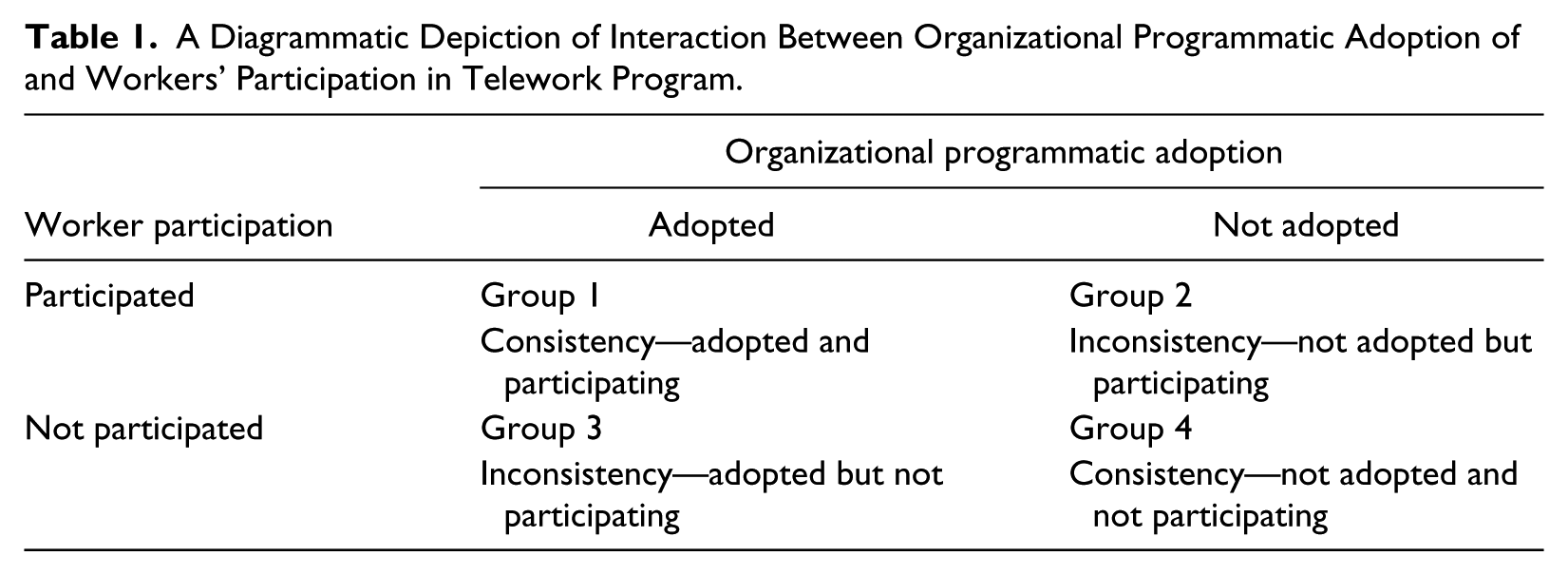
We use data from the FEVS to investigate whether employees of federal agencies are actually able to implement their officially adopted telework programs. Table 1 shows four possible scenarios between adoption of a telework program and public employee participation. Group 1 refers to the situation in which agencies have officially adopted a telework program and its employees also utilize the program. Group 4 denotes the situation in which agencies have not adopted a telework program and its employees do not participate in the program. Groups 1 and 4 in Table 1 demonstrate consistency between agencies’ adoption and employees’ utilization. Group 2 denotes the situation in which employees can telework despite nonexistence of a formal telework program. Group 3 suggests that agencies have officially adopted a telework program, but employees do not participate. Groups 2 and 3 indicate inconsistency or decoupling between symbolic implementation and substantive participation. Our research focuses mainly on comparing Group 3 and Group 4.
A Diagrammatic Depiction of Interaction Between Organizational Programmatic Adoption of and Workers’ Participation in Telework Program.
Former studies that examine the effects of telework on organizational performance and job satisfaction focus on whether or not telework policies are implemented. A few exceptions are those that analyze different effects of telework by dividing employees by their organizations’ official adoption of telework programs as well as by employees’ participation in such programs. Caillier (2013) finds that employees who do not participate in telework despite their agencies officially adopting the program have higher turnover intention than frequent teleworkers. When public employees are denied the opportunity to use an existing telework program, they have higher turnover intention than frequent teleworkers and infrequent teleworkers, as well as those who do not telework. Yang and Zheng (2011) examine how decoupling of flexible work affects employee productivity. They suggest that employees, who are able to participate in a flextime program that does not officially exist, are more likely to actualize productivity potential than those who are unable to participate in an officially existing flextime program. The results show that workers who are unable to participate in an existing flextime program have the least productivity potential. This article looks into the relationship between teleworking and job satisfaction considering the disjuncture between organizational adoption and employee participation. We expect that employees who are unable to use an existing telework program (Group 3) have lower levels of job satisfaction than those who are unable to use a nonexistent telework program (Group 4).
Teleworking motivations are likely to differ by gender (Eby, Casper, Lockwood, Bordeaux, & Brinley, 2005). Some studies suggest that telecommuting would be more attractive to women than men (Mokhtarian & Salomon, 1996; Scandura & Lankau, 1997; Staines & Pleck, 1986), whereas others indicate that working women tend to take on more household chores and child care responsibilities than their male counterparts, and this uneven distribution leads to increase in stress levels (e.g., Bielby & Bielby, 1988; Kossek, 1990; Parasuraman & Simmers, 2001; Tingey et al., 1996). This suggests that female employees would be more likely than male employees to view telecommuting as a solution to relieve stress. Extant research also mentions that female workers are also motivated by factors such as work flexibility, convenience, and autonomy through teleworking (Chapman, Sheehy, Heywood, Dooley, & Collins, 1995; Di Martino & Wirth, 1990).
Mokhtarian and Salomon (1996) find that female employees are significantly more likely to want to telecommute from home than male employees. Women also utilize work schedule flexibility more often than men and receive greater benefits from the program (Scandura & Lankau, 1997; Staines & Pleck, 1986). These differences according to gender may explain why work–life balance enhances commitment for women uniformly, but enhances commitment for men only when informal organizational support is high (Butts, Ng, Vandenberg, Dejoy, & Wilson, 2007). Accordingly, we expect work–life balance to affect female employees more strongly than male employees.
In line with the above studies, female employees are more likely to have a favorable attitude toward teleworking because they are able to work without leaving home. This means they will be able to work during the hours of their convenience and have the liberty to balance time between work and family tasks. However, when female employees are unable to telework, they feel more dissatisfied than male employees. Particularly, when female employees are unable to utilize an existing telework program, they have lower levels of job satisfaction than their male peers. Based on these arguments, we postulate that female employees are more affected by decoupling of teleworking than male employees.
Data and Method
Federal Employee Viewpoint Survey
Using the 2013 FEVS conducted by the OPM, we examine how decoupling of telework affects workers’ job satisfaction. The U.S. OPM surveyed full-time, permanent employees of more than 80 agencies, both department/large agencies and small/independent agencies (U.S. OPM, 2013a). Of the 781,047 employees who received the survey, 376,577 responded, a response rate of approximately 48.2%. Data were weighted to produce survey estimates that correctly represent all federal employees by demographic characteristics. This article focuses on 219,450 respondents across 19 federal agencies based on data used in Kim and Wiggins (2011).
Variables
Dependent variable
This study uses the dependent variable as job satisfaction. Following the method used by Choi and Rainey (2014), we use a single-item scale to measure job satisfaction based on the question, “Considering everything, how satisfied are you with your job?” Respondents answered the question on a 5-point Likert-type scale (5 = strongly agree to 1 = strongly disagree). Whereas previous research tends to use multiple items to measure job satisfaction, there has been no clear indication that a multiple-item measure is always better than a single-item scale (Podsakoff & Organ, 1986).
Independent variables
The main independent variables are derived from two dummy variables, one indicating whether an organization has adopted the telework program, and the other indicating employee participation in the program. The 2013 FEVS measures organizational adoption of teleworking with the following question: “Have you been notified that you are eligible to telework? Teleworking means working at a location other than your normal work site during your regular work hours (excludes travel).” Respondents answered yes or no, and the variable is coded as a dichotomous variable; yes is coded as 1, and no as 0. Employee participation in telework is measured through the following question: “Please select the response below that best describes your current teleworking situation.” Employees responded to one of the following: “Telework,” “I do not telework because I am not able to telework,” and “I do not telework because I choose not to telework.” We drop the third response, “I do not telework because I choose not to telework,” to focus on organizations that allow employees to participate in teleworking. We dichotomize the responses into participating (1 = telework) and not participating (0 = I do not telework because I am not able to telework).
To examine the effects of decoupling between organizational adoption and employee participation, we include the interaction term of these two dummy variables in a regression analysis. Thus, a conventional model includes organization adoption, worker participation, and a combination of the interaction terms. In other words, this study substitutes two variables and the interaction term with four dummy variables. As mentioned in Table 1, we derive four groups: “Group 1: adopted and participating,” “Group 2: not adopted but participating,” “Group 3: adopted but not participating,” and “Group 4: not adopted and not participating.” This article defines Group 4 as the reference group and is not included in the regression model.
Control variables
We include control variables that influence job satisfaction in addition to several demographic variables. Previous studies regarding family friendly policies and telework have also included several demographic variables and the variables related to job satisfaction (Caillier, 2012, 2013; Kim & Wiggins, 2011; Lee & Hong, 2011). The variables related to job satisfaction are physical condition satisfaction, training satisfaction, and employees’ satisfaction with their pay. Questions regarding the control variables are, “Physical conditions (e.g., noise level, temperature, lighting, cleanliness in the workplace) allow employees to perform their job well,” “How satisfied are you with the training you receive for your present job?” and “Considering everything, how satisfied are you with your pay?” Demographic variables including gender, minority, and supervisory status are recorded as dichotomous variables. Female is a dichotomous variable, which is recorded as “0” for male respondents and “1” for female respondents. The minority variable is 0 if the respondent is a non-minority and 1 if the respondent is a minority. The supervisory status variable is 0 if the respondent is a non-supervisor or team leader and 1 if the respondent is a supervisor, manager, or executive. Age is an ordinal variable, and is categorized into under 40 years, 40 to 49 years, and 50 to 59 years or above. Payment is an ordinal variable, which is categorized into General Schedule (GS) 7-12, GS 13-15, and other. We also include agency experience, indicating the number of years for which a respondent has worked in government, and is categorized into five or fewer years, 6 to 14 years, and 15 or more years.
Results
Table 2 provides the descriptive statistics for the sample.
Descriptive Statistics for Variables.
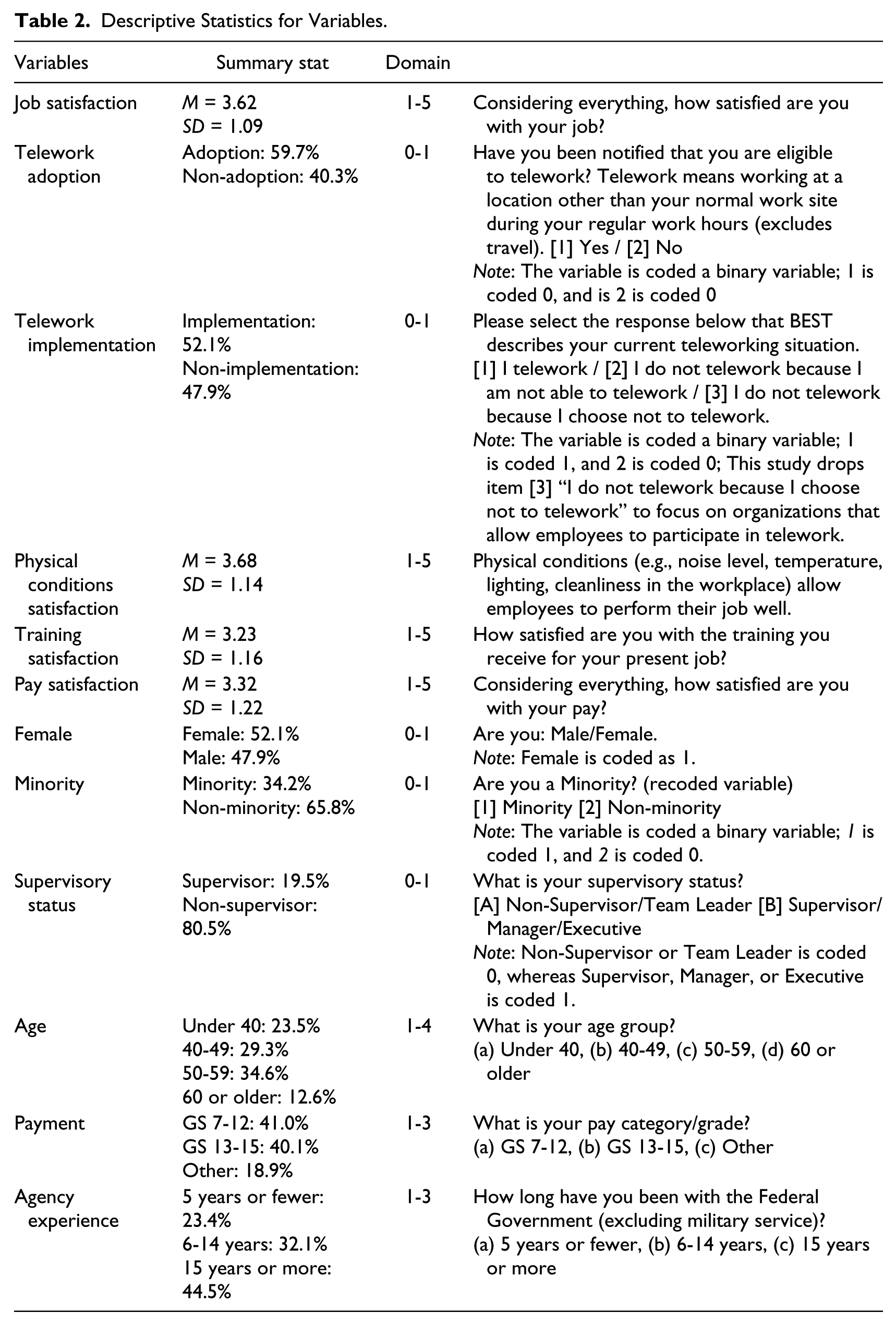
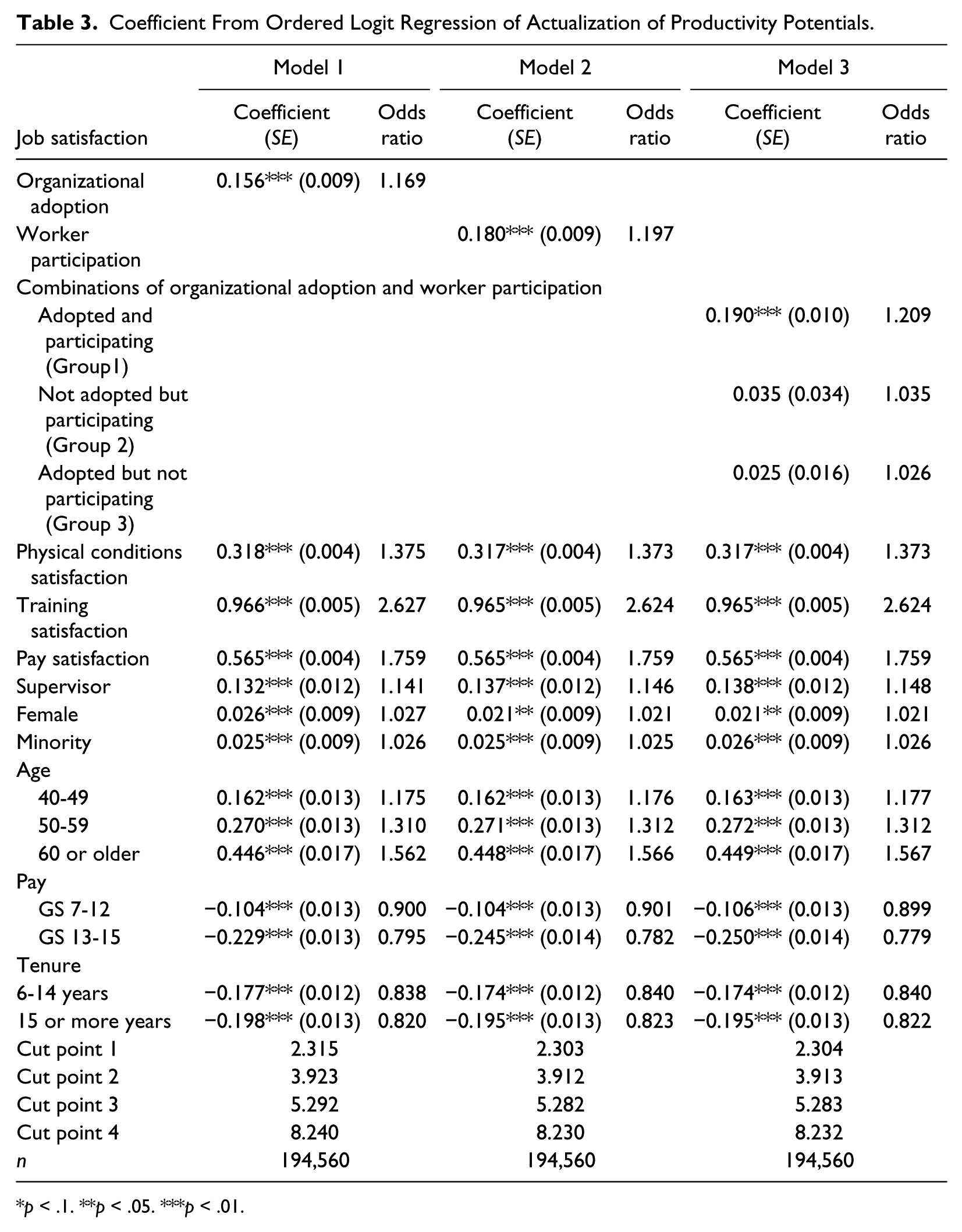
Table 3 represents the results of our models, which use a series of ordered logistic regressions to examine the relationship between telework adoption and implementation and job satisfaction. Model 1 in Table 4 shows that organizational adoption of telework positively affects employees’ job satisfaction, which supports Hypothesis 1. The results in Model 2 are also consistent with Hypothesis 2—employees’ participation of telework has a positive association with public employees’ job satisfaction. These results explain the importance of both organizational adoption and participation in teleworking on organizational performance. Long and Freese (2006) interpret the odds ratio as “for a one unit increase in the predictor variable, the odds for cases in a group that is greater than k versus less than or equal to k are the proportional odds times larger.” The proportion odds ratio of organizational adoption in Model 1 is 1.169, which means that for a one-unit increase in organizational adoption, the odds of high job satisfaction versus the combined middle and low job satisfaction categories are 1.169 times greater, given the other variables are held constant. Model 2 shows that the odds ratio of worker participation is 1.197. This indicates that for a one-unit increase in worker participation, the odds of high job satisfaction versus the combined middle and low job satisfaction categories are 1.197 times greater, given the other variables are held constant.
Coefficient From Ordered Logit Regression of Actualization of Productivity Potentials.
p < .1. **p < .05. ***p < .01.
Coefficient From Ordered Logit Regression of Actualization of Productivity Potentials.

p < .1. **p < .05. ***p < .01.
Model 3 in Table 3 examines how interaction of organizational adoption and worker participation affects organizational satisfaction of public employees. In Model 3, the regression utilizes Group 4—agencies do not adopt telework and public employees are unable to participate—as the reference category. We compare this with the other three groups: agencies that adopt telework and public employees participate (Group 1), agencies that do not adopt telework but public employees participate (Group 2), and agencies that adopt telework but public employees do not participate (Group 3). The regression results from Model 3 in Table 3 do not support our third hypothesis that public employees who are unable to participate in officially existing telework programs (Group 3) are likely to have lower levels of job satisfaction than public employees who are unable to utilize a nonexistent telework program (Group 4).
Subsample analyses are also conducted to examine the diverse effects of decoupling of telework on job satisfaction. We divide public employees into female and male groups, and analyze different effects of interaction of organizational adoption and worker participation on the two groups. For both the female and male subsamples, regression results in Table 4 show that public employees who utilize officially existing telework programs (Group 1) are likely to have higher job satisfaction levels than public employees who are unable to utilize nonexistent telework programs (Group 4). This indicates that the findings of both female and male groups support the social exchange theory. The female subsample analysis shows that public employees who are unable to participate in an officially existing telework program (Group 3) are likely to have lower levels of job satisfaction than public employees who are unable to utilize a nonexistent telework program (Group 4). However, the male subsample analysis shows that Group 1, Group 2, and Group 3 are likely to have higher levels of job satisfaction than Group 4. The regression results from Table 4 do support our fourth hypothesis that the effect of decoupling of telework on job satisfaction is more significant in female employees than male employees in public agencies.
Discussion and Conclusion
This research analyzes the effects of decoupling of telework on organizational satisfaction using the 2013 FEVS. It classifies teleworking for public employees into whether federal agencies have or have not officially adopted a telework program and whether or not public employees actually participate in the program. We predict that both organizational adoption and employee participation in teleworking would have a positive relationship with job satisfaction. We utilize the relationship between teleworking and job satisfaction considering the disjuncture between organizational adoption and employee participation. Neo-institutionalists mention that this phenomenon is an isomorphism between institutional environment and internal circumstances. Our findings do not provide evidence to support the neo-institutional theory, which assumes that workers who are unable to utilize an existing telework program are likely to have lower levels of job satisfaction than employees who are unable to utilize a nonexistent telework program. However, motivation to utilize telework differs by gender. We predict that the effects of decoupling of telework on job satisfaction are more significant in female public employees than male employees. These findings provide several contributions to previous literature.
First, the results show a positive relationship between organizational adoption of telework and employees’ job satisfaction. Furthermore, employees’ participation in telework has a positive association with organizational job satisfaction. This is consistent with Caillier (2012) who finds that satisfaction with telework has a positive effect on organizational commitment. Research to date focuses on the impact of telework on organizational performance and job satisfaction. Few studies distinguish between telework being officially adopted and actually implemented. We support the idea that both organizational adoption and employee implementation positively affect job satisfaction.
Second, we do not find significant effects of decoupling of telework on job satisfaction. Results reveal that employees who are unable to utilize an existing telework program do not have lower levels of job satisfaction than those who are unable to use a nonexistent teleworking program. Our results are not consistent with Yang and Zheng (2011) who observe that employees who can participate in a nonexistent flextime program are more likely to actualize productivity potential than those who are unable to participate in an officially existing flextime program. Workers who are unable to implement existing flextime have the least productivity potential.
Third, our observations reveal that the decoupling effects of telework on job satisfaction are more significant in female public employees than male employees. The results imply that female employees have the lowest levels of job satisfaction when agencies officially adopt telework but employees cannot utilize the program. However, male employees have the lowest levels of job satisfaction when they are unable to utilize a nonexistent telework program. Studies have found that telecommuting is more attractive to women than men. Thus, female workers have higher expectations for a telework program and benefit more from these programs than male employees. Accordingly, female employees may be more dissatisfied than male employees regarding the isomorphism between an officially adopted telework and the actual implementation of the program. Female employees, therefore, have lower levels of job satisfaction than male employees as a result of decoupling.
Theoretical Implications
Our findings have several theoretical implications. First, social exchange theory suggests that workers are motivated to reciprocate benefits received from their organizations. Previous studies based on social exchange theory have found that family friendly policies, that is, flexible work, child care subsides, alternative schedule, and telecommuting, have both positive and negative relationships with organizational performance and work motivation (Bae & Goodman, 2014; Caillier, 2012, 2013; Lee & Hong, 2011; Saltzstein et al., 2001). The results of our study show similar results with literature that has found a positive relationship between family friendly policies and work motivation. This study supports social exchange theory, which has been used to examine the association between telework and work motivation in the sense that when organizations provide telework to employees, reciprocity plays a role.
Second, the findings of this article are relevant to neo-institutional theory in that organizations adopt certain programs or policies to gain legitimacy by facing pressure from institutional environments. If an organization does not meet the expectations of the institutional environment, it is viewed as illegitimate and such deviations incur organizational costs. Therefore, organizations officially act to meet the demands of the institutional environment, but may not actually implement certain formal structures or programs due to the lack of resources or internal conflicts (Meyer & Rowan, 1977). The effects of decoupling are a subject of discussion among scholars. Research mentions the positive impact of decoupling for organizations, especially when used as a strategy to protect their resources and systems. However, others find that decoupling decreases organizational performance because not implementing the officially adopted policies is considered a pathological phenomenon (Lee & Hong, 2011). Our results do not support the perspective that decoupling of telework has a negative association with organizational satisfaction.
Third, current research shows that female workers are likely to have a more favorable attitude toward teleworking than their male counterparts. Female employees are able to relieve stress from household and child care responsibilities by adopting telework. Furthermore, telework has provided female employees with work flexibility, convenience, and autonomy. Contrary to this, when female workers are unable to participate in an existing telework program, they feel more dissatisfied than male employees. Accordingly, we find that female employees are more affected by decoupling than male employees.
Practical Implications
Based on our findings, we derive several practical implications. First, both adoption and implementation of telework programs are positively related to job satisfaction. However, we find that implementation of telework has a greater effect on job satisfaction than its adoption after comparing the value of odds ratios between individual adoption and organizational implementation of telework. If an organization wants to increase job satisfaction for its employees, managers should focus on both adoption and implementation of their telework programs.
Next, although the results of the total sample in this study did not show a negative effect on job satisfaction, managers and practitioners should still consider whether teleworking is actually implemented as well as officially adopted because the total sample does not take into account the different effects of decoupling by gender group.
Third, the results of this study suggest that when telework programs are implemented, managers should attend to the female group because they are more influenced by decoupling than male employees. Female-oriented agencies should look into whether their existing benefit programs have actually been implemented or not rather than extending the number of benefit programs or the scope of application.
Limitations
There are several limitations despite the robustness of the analysis. First, the sample size of each group is not evenly distributed. For example, Group 1 is composed of 51% of the total sample, whereas Groups 2 and 3 comprise 2% and 10%, respectively. The unbalanced sample distribution can produce potential problems when determining the effects of decoupling on job satisfaction. However, not adopted but participating and adopted but not participating groups are realistically smaller than adopted and participating and not adopted and not participating groups. To overcome this limitation, future research needs to use longitudinal data or multiple data sources.
Second, the cross-sectional data set we use prevents the determination of direction of causality between decoupling of telework and job satisfaction. Our results cannot determine whether the decline in job satisfaction of the decoupling group is the result of the increase in other groups, or whether both processes are occurring simultaneously. Future studies that utilize longitudinal data or analyze with experimental design may be able to enable the determination of a causal relationship between decoupling of telework and job satisfaction. Furthermore, future research needs to incorporate a more in-depth interview to investigate the reasons to why public employees respond the way they do to the decoupling of telework.
Footnotes
Declaration of Conflicting Interests
The author(s) declared no potential conflicts of interest with respect to the research, authorship, and/or publication of this article.
Funding
The author(s) received no financial support for the research, authorship, and/or publication of this article.