




Abstract
Although a large volume of literature has documented the role of public service motivation (PSM) as altruistic work values, few studies directly examine PSM’s impact on job choice. Using longitudinal data, this article examines the factors that affect people’s career choices, specifically the extent to which individuals with different work values choose different sectors when considering job characteristics and person–job (P-J) fit. The analysis reveals that people are more likely to choose jobs in the private sector than jobs in the public or non-profit sector when they have opportunities to satisfy their altruistic work values through relational jobs. The findings speak to the importance of P-J fit when people choose their initial jobs. Contributions to existing literature and implications are discussed.
The United States has suffered from a workforce crisis in the government sector since the mid-1990s (Light, 2000; Soni, 2004). The Office of Personnel Management estimates that almost one third of federal workers are expected to retire in the near future. This concern about a “quiet crisis” was underpinned by a report of the National Commission on Public Service, which warned that increasing competition with private firms for qualified people has made this crisis worse (National Commission on Public Service, 2003). The non-profit sector is experiencing similar challenges. It is expected that non-profit organizations in the United States will need more than 80,000 managers each year (Corporation for National & Community Service, 2008; Tierney, 2006). In addition to the imminent crisis involving public service careers, recruiting and retaining highly qualified employees has long been a fundamental concern for any organization. Given this situation, it is important to examine who is attracted to public service careers and what characteristics make them choose these careers (Lewis & Frank, 2002).
This article investigates the factors that affect people’s career choices, specifically, the extent to which individuals with different work values choose different sectors when considering job characteristics. This article provides evidence about this important question using the National Education Longitudinal Study of 1988/2000 (NELS88), which is a single-cohort longitudinal survey conducted by the National Center for Educational Statistics (NCES).
Two main aspects of this article contribute to the existing line of inquiry. First, this article attempts to avoid potential endogeneity problems by using panel data in the analysis of the relationship between work values and sector employment. Public administration scholars have devoted much attention to public service motivation (PSM) as altruistic work values primarily embedded in the public institutions and organizations (Perry & Wise, 1990). Whereas one key assumption of PSM theory is that PSM affects an individual’s choice of employment sector, previous empirical studies have shown mixed findings (Wright, Hassan, & Christensen, 2015). Most research uses cross-sectional survey data of individuals; thus, it is unclear whether individuals with higher PSM are attracted to jobs in the public sector (attraction-selection effect) or whether such individuals come to have a higher PSM by working in the public sector (socialization effect) (Kjeldsen & Jacobsen, 2013; Moynihan & Pandey, 2007; Perry, Hondeghem, & Wise, 2010).
Only a few recent studies have directly tested the relationship between PSM and sector employment. They take advantage of panel data structure, which attempts to avoid confounding the effects of attraction-selection and socialization (e.g., Georgellis, Iossa, & Tabvuma, 2011; Kjeldsen & Jacobsen, 2013; Wright & Christensen, 2010). Consistent with the studies relying on longitudinal data measuring PSM before individuals select their employment, this article adds direct evidence on the causal relationship between PSM and sector employment with considering job characteristics. Moreover, this article differs from most previous studies in that this study uses actual job choices that were made by individuals in reality, not using hypothetical job choices. In addition, this study uses the two separate samples with different levels of education (high school graduates and people with higher than BA degree holders) and thus examines different impacts of work values on sector choice.
Second, based on person–organization (P-O) fit theory, traditional PSM studies argue that people with higher PSM are more likely to choose careers in the public-sector organizations because they believe their orientation toward altruistic values are well matched with work environment in the public sector (Kjeldsen, 2014). However, a growing body of research demonstrates that people are attracted not only to the sector’s unique features but also to a job’s characteristics (Christensen & Wright, 2011; Vandenabeele, 2008). In a sense, this article investigates whether the impact of work values are substantially significant in choosing sector employment even after controlling for job characteristics. In addition, it examines whether relational jobs moderate the relationship between work values and sector employment (person–job fit). This study differs from previous studies as it includes many different occupations. This study covers a wide array of jobs that makes conduct the analysis within an occupation along with the different types of jobs. To do so, this study utilizes a longitudinal sample of full-time employees in the public, private, and non-profit sectors.
The rest of the article is organized as follows. The “Work Values and Job Choice” section develops a theoretical framework of sector choice. The “Data and Method” section describes the data and methodology of the current study. Finally, results and implications are discussed.
Work Values and Job Choice
Work values can be defined as “the end states people desire and feel they ought to be able to realize through working” (Nord, Brief, Atieh, & Doherty, 1990, p. 21). In the literature, work values appear to predict career fit (Beutell & Brenner, 1986) and are constructed by individuals “as they make meaning of the experience of work in their lives” (Patton, 2000, p. 72). Work values provide criteria for selecting jobs and job-related behaviors (Leidtka, 1989; Lyons, Duxbury, & Higgins, 2006) and give rise to preferences for the type of work or work environments that individuals place importance on in their job decisions (Dose, 1997). A substantial body of conceptual evidence has emphasized the importance of work values in career choices (Ben-Shem & Avi-Itzhak, 1991; Brown, 1996; Dawis & Lofquist, 1984; Super, 1957; Vigoda-Gadot & Grimland, 2008).
The underlying logic of the relationship between work values and job choices is that individuals seek occupations that are compatible with their work values (Holland, 1992; Judge & Bretz, 1992; Kristof-Brown, Zimmerman, & Johnson, 2005; Lyons et al., 2006). Individuals are attracted to organizations that “they view as having values and situational norms they deem important” (Chatman, 1989; Turban & Keon, 1993, p. 184). In Judge and Bretz’s (1992) empirical study, the findings indicated “individuals were more likely to choose jobs whose value content was similar to their own value orientation” (p. 261). This expectation implies both that individuals have different priorities for types of work values and that there are distinct sets of work values embedded in each sector and organization (Judge & Bretz, 1992). This section discusses possible differences in work values across sectors and jobs.
Differences in Work Values Across Sectors and Jobs
Individuals prefer to work for the sector and job that reward their existing work values. 1 In other words, people are drawn to a sector, job, or organization on the basis of their work values (Lyons et al., 2006). One must then ask what specific work values are preferred in employees’ sectors or jobs. A considerable amount of research has compared structural and employment characteristics across sectors and organizations (e.g., Baarspul & Wilderom, 2011; Boyne, 2002; Crewson, 1997; Gabris & Simo, 1995; Mirvis, 1992).
PSM
It has been argued that public employees have special motives and distinct work attitudes regarding the public interest (Frederickson & Hart, 1985; Kelman, 1987; Rainey & Bozeman, 2000; Staats, 1988). This proposition has been historically reflected in the public administration literature (Gabris & Simo, 1995; Perry, 2000). Perry and Wise (1990) proposed the theory of PSM, “An individual’s predisposition to respond to motives grounded primarily or uniquely in public institutions and organizations” (p. 368). They have argued that there is a positive relationship between PSM and public-sector employment. Individuals who place a greater importance on helping others and being useful to society seek public service careers. Individuals with higher levels of PSM are more likely to work in public-sector organizations because such organizations provide opportunities for meaningful public service (Wright & Grant, 2010). This argument can be interpreted using a person–environment fit framework. 2 From the perspective of P-O fit, people with higher PSM are more likely to choose careers in the public sector because organizations’ values, missions, and goals in the public sector match individuals’ own values and goals and attract them to the sector. To measure P-O fit, value congruence has been widely accepted (Kristof-Brown et al., 2005). Following the argument of Christensen and Wright (2011) that “employment sector can serve as a proxy for organizational values,” (p. 726) the high level of P-O fit can be defined either when individuals who place greater emphasis on altruistic values work in the public sector or when individuals who place emphasis on monetary values work in the private sector. This implies that individuals’ values are well matched with organizations when people who place greater emphasis on altruistic values (or wages) work in the public sector (or private sector). This approach is consistent with recent findings that employees with higher PSM have higher P-O fit in the public sector (Gould-Williams, Mostafa, & Bottomley, 2015). For example, Vandenabeele (2008) considered that there is better P-O fit when people with high PSM work in public organizations than when such people work in private organizations.
Public administration scholars have consistently associated PSM with altruism (Perry & Hondeghem, 2008), although many studies agree that PSM consists of several elements, such as a strong desire to formulate good public policy and a commitment to serve the public interest and social justice (Buelens & Van den Broeck, 2007). For example, Rainey and Steinbauer (1999) related altruism in their definition of PSM as a “general, altruistic motivation to serve the interests of a community of people, a state, a nation or humankind” (p. 20). Bright (2008) characterized PSM as “altruistic intentions that motivate individuals to serve the public interest” (p. 151). To better understand the PSM concept, researchers have paid attention to PSM-related concepts such as altruism or prosocial motivation. Altruism is defined as “feelings and behavior that show a desire to help other people and a lack of selfishness” (Webster’s dictionary) and prosocial motivation is defined as “the desire to benefit other people” (Grant, 2008). Perry and colleagues (2010, p. 682) synthesized PSM and related concepts discussed in other studies and arrived at the following conclusion: Although PSM and related constructs have in common an emphasis on other orientation, PSM is a “particular form of altruism or prosocial motivation that is animated by specific disposition and values arising from public institutions and missions.”
Considering altruism as the essence of the non-profit sector, the PSM idea can be extended to the non-profit organizations as well (Gabris & Simo, 1995; Lyons et al., 2006; Wittmer, 1991). Non-profit employees seem to have high public motivation needs. They are believed to be the nation’s most dedicated workforce. Light’s (2004) survey of federal government, business, and non-profit employees supported this belief. According to the survey results, non-profit employees take their jobs to help other people rather than for their salary and benefits. Surveys of large national samples of working adults in the United States confirmed the finding that non-profit sector employees give high ratings to non-monetary orientations and social values (Mirvis, 1992; Mirvis & Hackett, 1983). Thus, the following hypothesis is proposed:
Many studies focusing on P-O fit have provided much evidence on the impact of PSM on job choice. As discussed, this approach assumes that the missions of public-sector organizations match with individuals’ public-service values. However, scholars have recently started to distinguish two characteristics of work environments, namely, which are the characteristics of organizations (P-O fit) and the characteristics of jobs (P-J fit) (Christensen & Wright, 2011; Lauver & Kristof-Brown, 2001). They argue that when people with high PSM make their career choice decisions, their decisions depend on not only organizational attributes but also job attributes because not all jobs in public organizations are identical (Christensen & Wright, 2011; Moynihan & Pandey, 2007; Steijn, 2008; van Loon, Leisink, & Vandenabeele, 2013; van Loon, Vandenabeele, & Leisink, 2015). For example, people with higher PSM chose jobs with a higher degree of publicness in the public sector, for example, jobs related to education and social welfare (Antonsen & Jørgensen, 1997; Vandenabeele, 2008). Moreover, jobs in public organizations do not always meet public employees’ altruistic work values. For example, IT specialists or administrative jobs in the public sector are hardly expected to observe the link between PSM and jobs. In contrast, some jobs in private organizations provide opportunities to fulfill peoples’ altruistic values (e.g., physicians and teachers). In other words, the effects of PSM on individual career choice are related not only to the fact that individuals are attracted to an organization’s mission and goals (P-O fit) but also to the fact that jobs in such organizations provide the opportunity to satisfy individuals’ PSM needs (P-J fit).
Because its importance has been emphasized for recruitment and selection, a growing number of empirical studies pursue a P-J fit perspective, which is defined as “the compatibility between a person’s characteristics and those of the job or tasks that are performed at work” (Sekiguchi, 2007, p. 119). In this context, recent studies not only have argued that job characteristics should be considered when we examine employees’ job choice decisions but also have attempted to identify specific types of jobs (Christensen & Wright, 2011; Steijn, 2008). In particular, recent literature finds evidence to support the notion that relational job design features provide employees the opportunity to fulfill their PSM by connecting employees to the impact of their actions on other people (Christensen & Wright, 2011; Grant, 2007, 2008). Similarly, van Loon and colleagues (2015) emphasized a societal impact potential as a job characteristic to explain the relationship between PSM and work outcomes.
Grant (2007, 2008) introduced the relational characteristics of jobs to foster prosocial behavior, which is relevant to PSM. He defined relational jobs as the jobs designed with relational architecture that connects employees to the impact of their actions on other people (Grant, 2007). Relational architecture has two components: (a) impact on beneficiaries and (b) contact with beneficiaries (Grant, 2007). Contacts with beneficiaries allow employees not only to identify how their actions can make a positive difference in other peoples’ lives but also to strengthen their awareness of the impacts of their jobs (Grant, 2008). In other words, relational jobs provide employees with opportunities to fulfill their altruistic values by contacting with service beneficiaries and recognizing their positive impact on their beneficiaries. The P-O fit framework assumes that people with higher PSM are more likely to choose careers in public-sector organizations. This relationship will be stronger when people with higher PSM have relational types of jobs because those jobs provide them with better opportunities to fulfill their PSM. In other words, this study expects the relational jobs moderate the relationship between PSM and public sector choice.
As Christensen and Wright (2011) indicated, however, contact with beneficiaries does not always make employees aware of their positive impact on beneficiaries. Other literature, such as Lipsky’s (1980) street-level bureaucrats, has indicated that interaction with service beneficiaries can give employees negative feedback and generate tensions (Grant, 2008; Taylor, 2014). Regarding this, Christensen and Wright (2011) suggested that “the motivational impact of contact with beneficiaries may be stronger when those interactions are more favorable or, alternatively, when they involve individuals just beginning their careers as they may have less experience with such negative feedback” (p. 727). This explanation is plausible considering the negative relationship between organizational tenure and the level of PSM (Moynihan & Pandey, 2007). In view of the previous discussion, the following hypothesis is suggested:
Wage
It is generally known that the wages offered in the private sector are higher than those of other sectors. Recent studies have shown that wage comparisons across sectors considerably differ based on the methods used to estimate (Llorens, 2015). There are two methodological approaches to estimating the sector-based wage comparisons (Condrey, Facer, & Llorens, 2012). The first approach compares the pay rates of equivalent occupations in the public and private sectors. Lewis and Frank (2002) cited the results of U.S. Bureau of Labor Statistics surveys indicating that “federal pay is over 25 percent lower than private sector pay for similar jobs” (p. 396). Preston (1989) found that non-profits have lower wages (between 7% and 30% lower) than their private counterparts. The second approach compares the pay rates for individuals across sectors with similar human capital characteristics, including age, education, gender, and marital status. Although the results of this approach are the opposite of those attached using the occupation-based approach, one consistent finding is that “federal employees working in higher-graded positions requiring advanced education and training typically earn considerably less than their private sector counterparts” (Condrey et al., 2012, p. 784). That leads to an assumption that individuals who value high wages will choose private-sector employment instead of non–profit sector or public-sector employment.
Most studies of work values and the motives of public- and private-sector employees have consistently revealed that private-sector employees place a higher value on wages (Buelens & Van den Broeck, 2007; Crewson, 1995; Leete, 2001; Wittmer, 1991). Early research by Mirvis and Hackett (1983) using the Quality of Employment Survey reported that as compensation for good performance, employees in the private sector are more likely to receive monetary rewards, whereas non-profit employees are less likely to receive monetary rewards. Although some studies arrived at different results—that is, that there was no difference between the public and private sectors in terms of preferences for high salaries (e.g., Gabris & Simo, 1995; Jurkiewicz, Massy, & Brown, 1998), these results arise out of different sampling opportunities and measurement validities (Rainey & Bozeman, 2000). Taking studies using surveys of national probability samples into account, the above conclusions about the different preferences for monetary rewards are generally compatible. Taken together, these findings suggest the following hypothesis:
Job security
Job security is an advantage that might attract people to government jobs. Government agencies provide civil service protections and downsize less frequently than private or non-profit organizations (Lewis & Frank, 2002). These factors make government jobs more stable and secure. Lewis and Frank (2002, p. 402) suggested that “job security in the United States is a more important selling point of public sector employment than public service motives.” It is a stereotypical perception that public-sector employees strongly value job security (Wittmer, 1991). That is, people who seek work in the public sector are more motivated by job security, compared with people who want to work for the non-profit or private sector.
Many previous findings have supported this perspective, but empirical studies showed either no significant differences between sectors or that private-sector employees assessed the value of job security as higher than employees in other sectors, in contrast to our conventional perception (Frank & Lewis, 2004; Karl & Sutton, 1998; Khojasteh, 1993; Lewis & Frank, 2002; Mirvis & Hackett, 1983; Rainey, 1982; Rawls, Ullrich, & Nelson, 1975). Karl and Sutton (1998) argued that these conflicting findings concerning the importance of job security among sectors resulted from different labor markets and economic conditions when the studies were conducted. Compared with the 1970s, today’s public workforce has encountered the threat of massive layoffs; thus, employees in both sectors have a strong desire for job security (Karl & Sutton, 1998). The recent trend toward at-will employment affects the impact of security on public-sector choice (Battaglio, 2010). Despite these mixed findings, the following hypothesis is proposed to hold true.
Data and Method
This study uses a single-cohort longitudinal survey conducted by the NCES in the United States. The NELS88 surveyed respondents in the base year (1988, when they are in the eighth grade, age = 14), with a first follow-up (1990, when they are in the 10th grade, age = 16), a second follow-up (1992, when they are in the 12th grade, age = 18), a third follow-up (1994, when they are 20 years old), and a fourth follow-up (2000, when they are 26 years old). In the base year of NELS88, 24,599 eigth graders (age = 14) were interviewed as a stratified, nationally representative sample. Among them, 12,144 students were tracked from the base year (1988) and in the following years: 1990, 1992, 1994, and 2000. To test models, this study used the first through fourth follow-up survey results because the base year survey lacks questions relevant to this study.
To examine the impact of work values on employee-sector choice, this study estimated the models using two separate samples based on education level: (a) people having higher than a BA degree and (b) people having only a high school degree. The main reason for separating the sample is that this study investigates the attraction effects of work values on job choice by isolating socialization effects. To do so, this study focused on the effects of work values on the initial job choice of people who are beginning their careers.
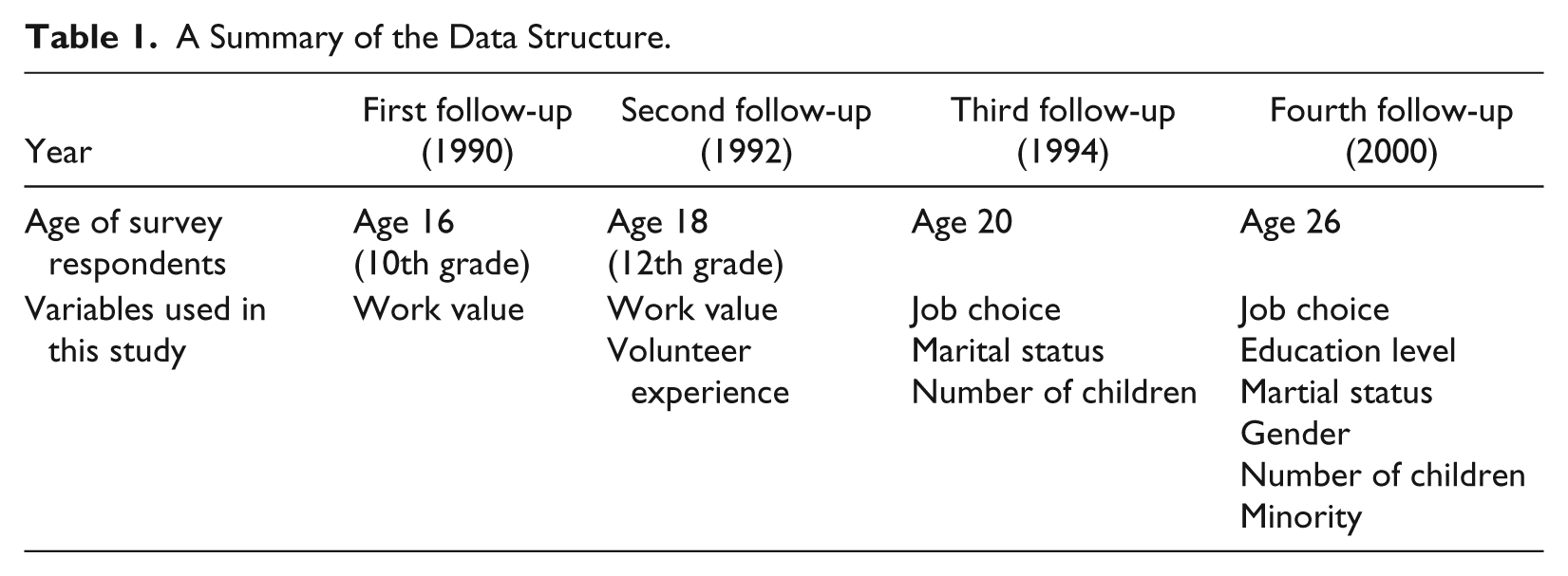
The NELS includes a job choice question in the third (age = 20) and fourth (age = 26) follow-up surveys. This study used job choice data at age 26 for people having higher than a BA degree. For example, some people who did not complete a 4-year college degree responded to the question relating to their second or third job, which might be affected by their previous job experience (Wright & Christensen, 2010), thus failing to isolate the socialization effects of work values. Using the same rationale, this study used the job choice question at age 20 for those with only a high school diploma. Separating the samples by education level would capture the first job choice for each sample. The final sample size used in this study is 3,844 for those with higher than a BA degree and 3,450 for those with only a high school diploma. The jobs considered in this study are full-time, paid jobs. Multi (or bi-) nominal logistic regression analyses were conducted to test the hypotheses in this study. Table 1 explains the panel data structure used in this article. Table 1 reflects when each measure is employed in the longitudinal survey. Work values are measured when the respondents are 16 and 18 years old. Then, the information about job choice is collected in age 20 for high school diploma holders and age 26 for BA holders. Table 2 presents the descriptive statistics and the distribution of outcome categories in the model for two separate samples: more than a BA degree and high school only.
A Summary of the Data Structure.
Descriptive Statistics for Two Separate Samples.

Note. The descriptive statistics is based on the sample with the initial job choice.
The empirical specification is as follows.
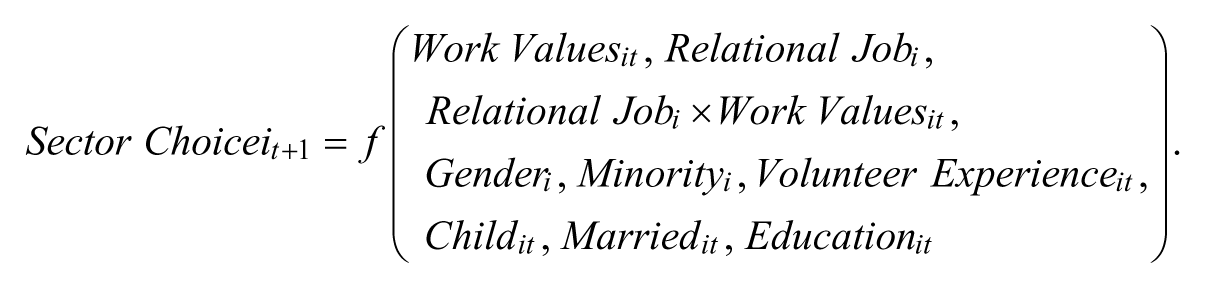
Despite its use of a longitudinal survey, this study does not estimate the model with any fixed effects at the individual level. One of the reasons is that the focus of the variable is the individual’s choice of sector after obtaining a high school degree or college degree (one-time decision). Second, work values are collinear with individual-level fixed effects, which can remove any effects of work values on sector choice.
Dependent Variables
Job choice
In 2000, an individual’s sector choice was measured with the following question in the fourth follow-up: “What type of company employs you? Is it a (a) private, for-profit, company, (b) non-profit (or not-for-profit) company, (c) local government, (d) state government, or (e) federal government?” For the purpose of this study, this article considers (c), (d), and (e) public-sector organizations.
Independent Variables
Work values
The measures of work values are constructed using four questions about values that are important in life. In the first and the second follow-ups, respondents are asked about the importance of “having lots of money,” “being able to find steady work,” “helping other people in my community,” and “working to correct social and economic inequalities.” The response options are evaluated on a 3-point scale: not important (1), somewhat important (2), and very important (3).
The analysis uses the average of work values for the first and second follow-ups. Testing Hypotheses 1 through 3 is to identify the attraction effects of work values on job choice with panel structure of data in an empirical setting. Having the measures of individual PSM prior to entry into the labor market isolates the organizational socialization effects of PSM. In the primary empirical specification, each respondent’s work value for the first and second follow-ups (ages 16 and 18) before they entered the labor market together was averaged. 3 The first item was used to measure monetary value and the second measures job security, respectively. The last two items measure altruistic work value (PSM), the main variable of interest. Perry and Wise (1990) identified three motivational bases of PSM: rational, norm-based, and affective motives. The two questions used in this study represent their norm-based motives, which are grounded in a desire to pursue the common good (including desire to serve the public interest, loyalty to duty and to government, and devotion to social equity) most relevant to the altruistic values of the public sector (Coursey, Yang, & Pandey, 2012).
Existing PSM research has shown various conceptualizations and measurements of PSM (Wright, 2008). Perry and colleagues (2010) observed four approaches that have been used to measure PSM in the literature: (a) single survey item, (b) unidimensional scale, (c) multidimensional scale, and (d) behavioral proxies (e.g., whistle-blowing). Much of researchers’ current knowledge of PSM is based on empirical studies using either a single-item measure (e.g., the desire to help others) or a unidimensional measure using several items from Perry’s (1996) scale, thus reflecting the altruistic content of PSM (Kjeldsen & Jacobsen, 2013; Wright & Christensen, 2010; Wright, Christensen, & Pandey, 2013). These general (or global) measures are commonly used to make a precise evaluation of the general level of PSM, despite the growing number of studies using multidimensional PSM measures (Kim et al., 2013; Wright et al., 2013).
Although the wording of questions is not exactly the same as those used in Perry’s (1996) scale, the questions used in this study directly ask about the value preferences used by many empirical studies of PSM. Whereas using more items may generate a more reliable overall scale, a single-item or unidimensional scale is often expected to capture the concept more accurately (Wright et al., 2013). Because the PSM concept is a reflective construct, reduced items may be less likely to endanger measurement validity than a formative item (Coursey et al., 2012).
Relational jobs
Grant (2007, 2008) had introduced the relational job design concept to explain how jobs can influence employees’ opportunities to do good. The main point of relational job design is that a job influences employees’ motivations to care about making a positive difference (i.e., the desire to help or benefit others). In other words, relational job characteristics motivate employees to help others. Grant (2007) proposed two components of relational architecture: (a) impact on beneficiaries and (b) contact with beneficiaries. The degree of relational architecture depends on the combination of these two components. This implies that jobs can be categorized into four cases in a 2 × 2 matrix based on the degree of two components of relational architecture (Grant, 2008). The four cases are strong impact and frequent contact, weak impact and frequent contact, strong impact and low level of contact, and weak impact and low level of contact. Prior studies on relational job architecture have taken some typical examples of specific jobs that belong to one of four cases in a 2 × 2 matrix (DeVaro, 2010; Grant, 2007, 2008). For example, although a physician and social worker have extensive impact on and contact with beneficiaries, some jobs (such as a bank teller) provide for frequent contact with and little impact on people with whom one interacts. It seems the job examples shown in the previous studies focused on the magnitude of job impact and the frequency of contact. 4 Grant (2007) further explained, using firefighters as an example, that jobs that involve frequent contact with and strong impact on beneficiaries also involve enriched relational architecture.
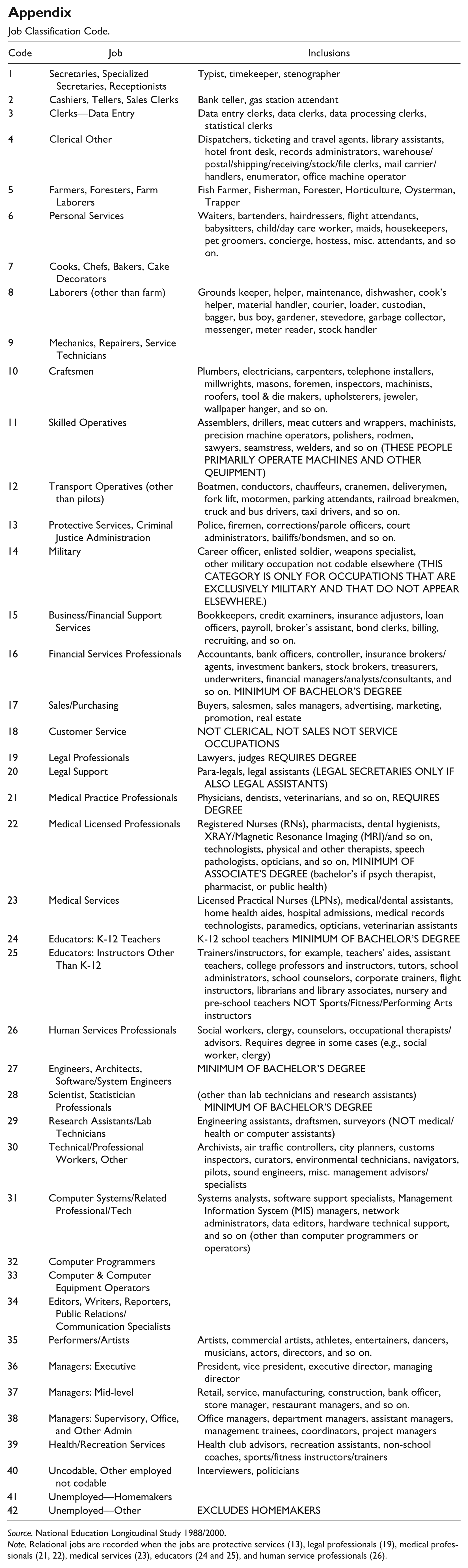
NELS 1988/2000 provides specific job codes and detailed descriptors (please see the appendix). Among those job codes, relational jobs were measured as a dichotomous variable based on Grant’s (2007) conceptualization. Occupations satisfying both relational job characteristics were assigned a value of 1 for this variable, and all others were assigned a value of 0. Examples of occupational titles classified as relational jobs are protective services/criminal justice administration (e.g., police, firemen, and corrections/parole officers), legal professionals (e.g., lawyers), medical practice professionals (e.g., physicians, dentists), licensed medical professionals (e.g., pharmacists, dental hygienists), medical services (e.g., licensed practical nurses, home health aides), educators (e.g., K-12 teachers, school counselors, nursery and pre-school teachers), and human service professionals (e.g., social workers, occupational therapists, and clergy). These occupations were coded as 1.
Control Variables
The following variables that may affect job choice are controlled for this study: volunteer experience, education level, minority status, gender, marital status, and existence of child. Volunteer experience is controlled because research suggests that volunteer experience affects career choice decision (Corporation for National & Community Service, 2008; Sagawa, Connolly, & Chao, 2008). Those studies found that through voluntary experiences serving the public, individuals can be introduced to new career opportunities in the non-profit and government sectors that they might not have considered otherwise. The survey respondents are asked about the frequency and the amount of volunteer or community service time, the reason for unpaid volunteer service, and the types of organizations in which they have been involved in unpaid volunteer or community service work. This study measured the volunteer experience variable as a dichotomous variable denoting whether individuals have volunteer experience before their career decision.
The level of education was categorized as having a bachelor’s, master’s, and doctoral degree. Minority status (White = 0, non-White = 1) and gender (male = 0, female = 1) are measured with a dummy variable. Marital status and existence of children were included as proxies for capturing employee’s need for work–life balance (Wright & Christensen, 2010). They are measured as a dichotomous variable denoting whether they are married and whether they have a child. In addition, age or approximate tenure can be controlled because the sample tracks the single cohorts across time, meaning that they are similar in terms of age and tenure. This gives an advantage for controlling external factors such as general labor market condition outside the scope of the individual’s job choice.
Results
This section presents the results of testing the hypotheses discussed in the previous section. Tables 3 and 4 provide the descriptive statistics about work values for the sample with more than bachelor’s degree holders and high school diploma holders, respectively. Based on the sector that respondents chose at age 26, this study first conducted an ANOVA test on whether there are any differences in work values across public, private, and non-profit sector employees. Money, helping others, and equality work values are different across different type of sector employees. With a focus on the high school diploma holders, money and equality is different across public and private employees. These results reflect previous studies examining the difference in work values across the sector.
Descriptive Statistics in Work Values for People Having Higher Than a BA Degree.

Note. Sector employment is based on type of sectors where respondents are employed at age 26. ANOVA test is conducted across sector regarding each work value at different age, the average work value, and the sum of work value.
p < .05. ***p < .001.
Descriptive Statistics in Work Values for People Only Having a High School Degree.
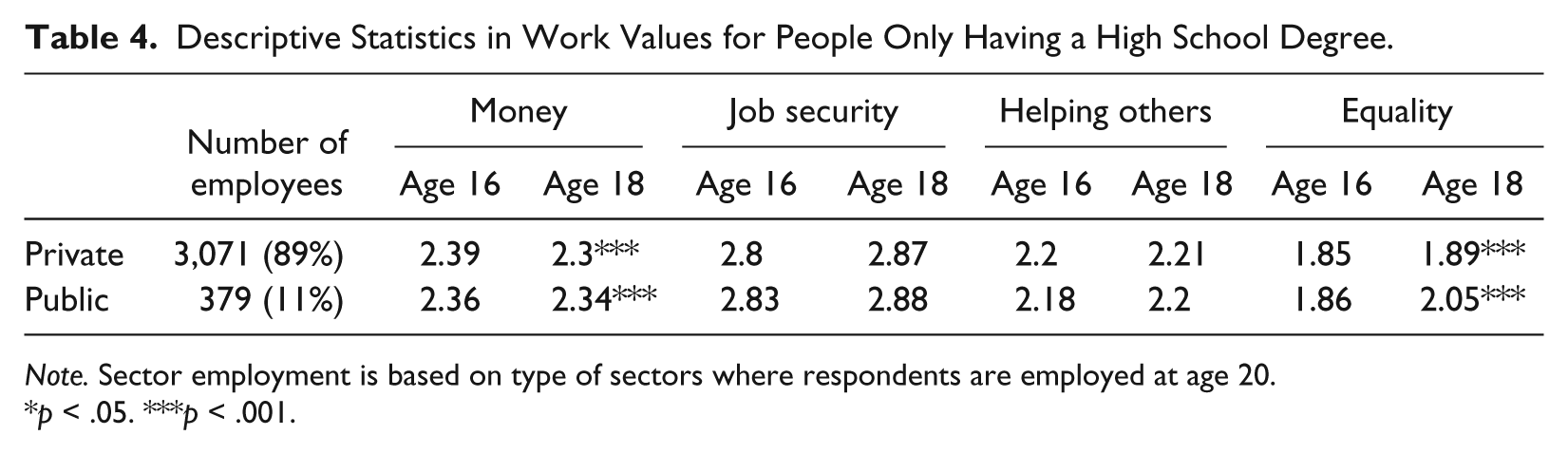
Note. Sector employment is based on type of sectors where respondents are employed at age 20.
p < .05. ***p < .001.
The next part explains the determinants of sector choice in the public/non-profit/private sector using multi-nominal analysis. The present study tested the impacts of work values on initial sector choice after controlling for job characteristics, using two separate samples based on education level. Table 5 uses the sample of employees with more a bachelor’s degree, and Table 6 uses the sample of high school graduates. Let us first explain the regression results using a sample of employees with more than a bachelor’s degree. Table 5 shows the results of the multi-nominal logit model when job choice as a dependent variable is categorized into private-, public-, and non–profit sector employment. 5 The model is estimated with a cluster standard error at each job category, which can control for heteroscedasticity and serial correlation (Wooldridge, 2013). The outputs from multi-nominal logistic regression models are divided into two columns under Model 1 with only the main effects and Model 2 with both the main and the interaction effects. The key to understanding this result is that job choice in the private sector is the base outcome. Thus, each coefficient of the model in this table should be interpreted as how the independent variables affect the log of odds ratio of choosing non-profit or public-sector organizations compared with private-sector organizations. 6
Results of Multi-Nominal Logit Model: Impact of Work Values on Employment Sector Choice at Age 26 (Sample: People Having Higher Than a BA Degree).
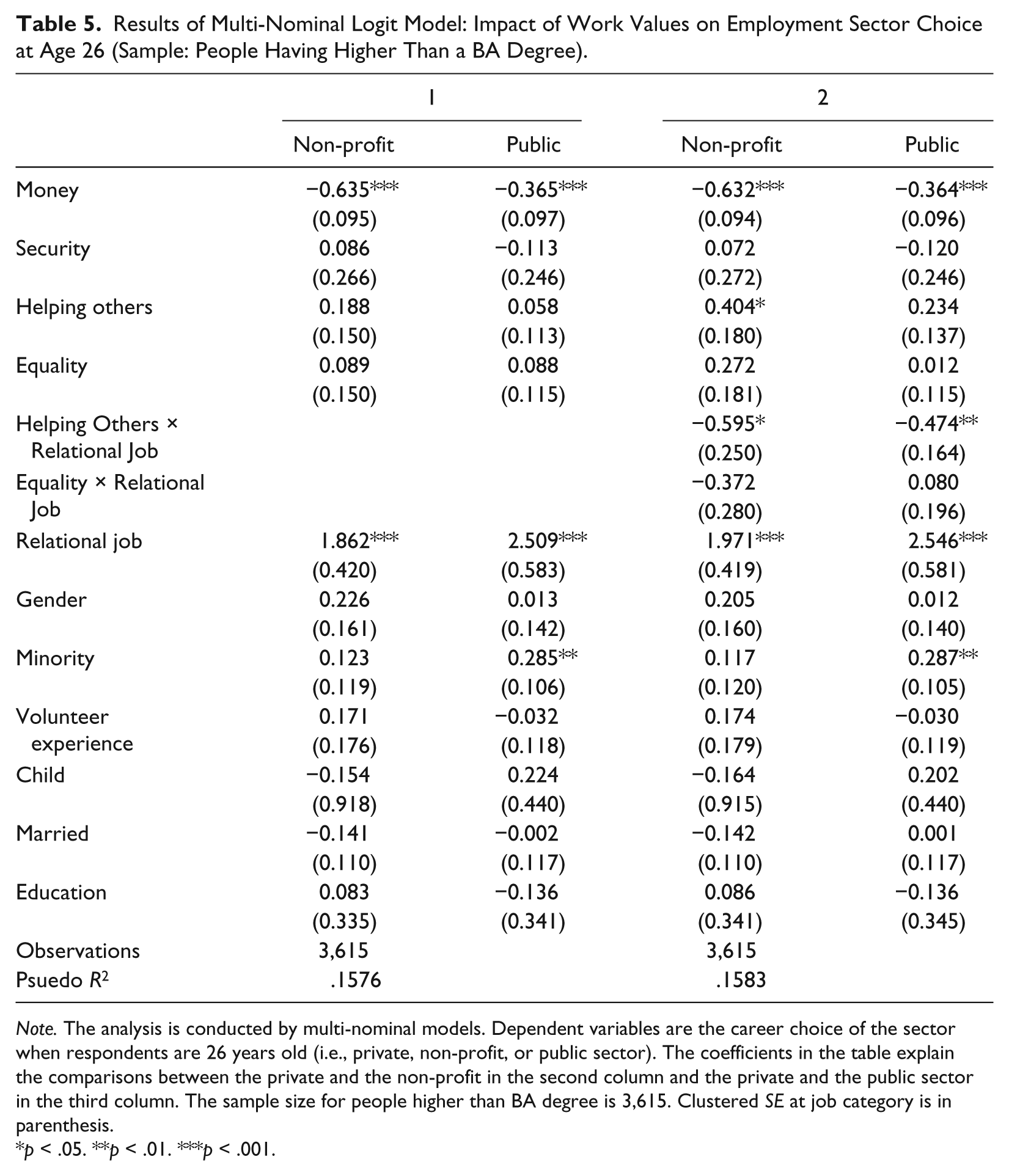
Note. The analysis is conducted by multi-nominal models. Dependent variables are the career choice of the sector when respondents are 26 years old (i.e., private, non-profit, or public sector). The coefficients in the table explain the comparisons between the private and the non-profit in the second column and the private and the public sector in the third column. The sample size for people higher than BA degree is 3,615. Clustered SE at job category is in parenthesis.
p < .05. **p < .01. ***p < .001.
Results of Logit Model: Impact of Work Values on Employment Sector Choice (Sample: High School Graduates).
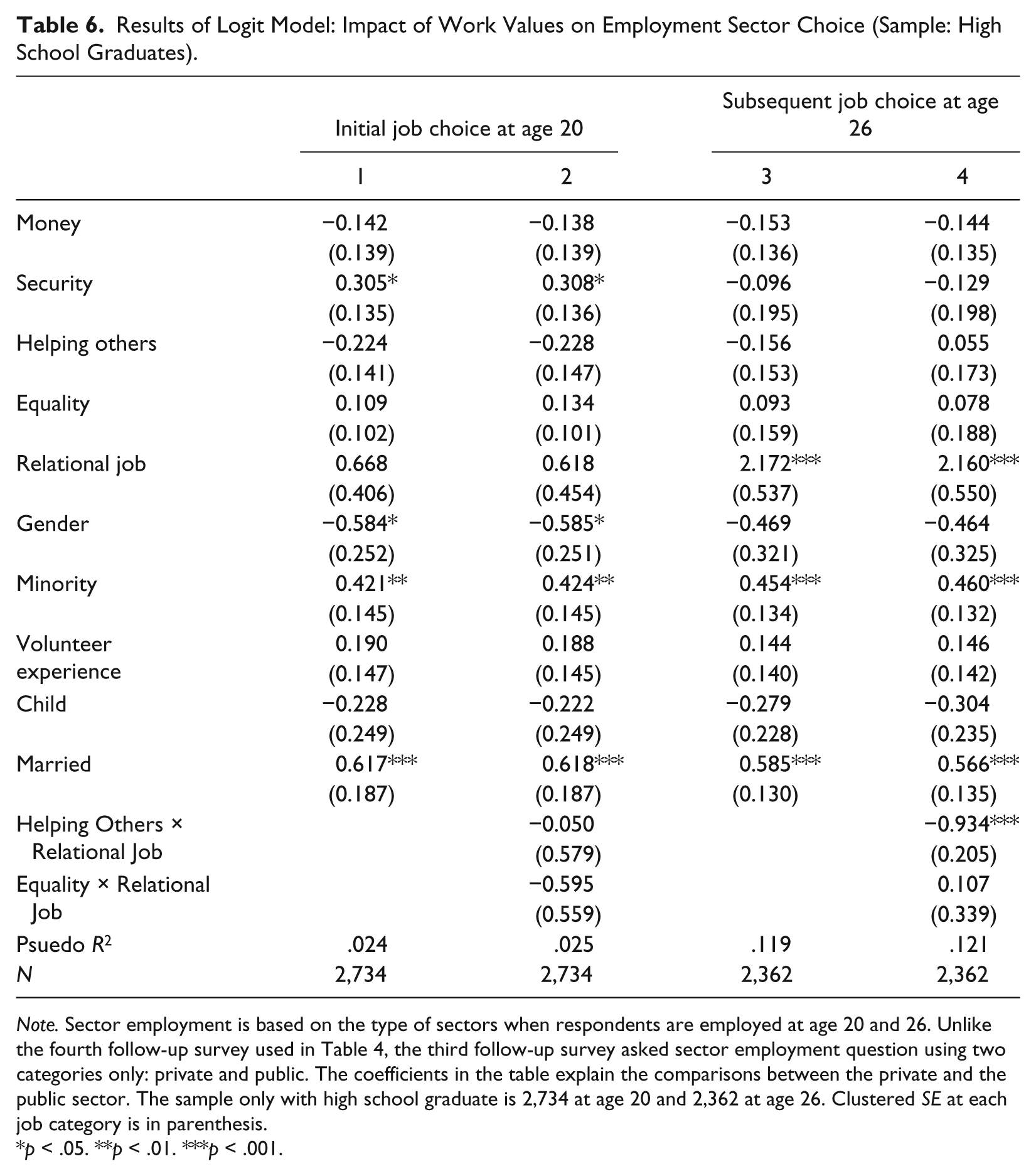
Note. Sector employment is based on the type of sectors when respondents are employed at age 20 and 26. Unlike the fourth follow-up survey used in Table 4, the third follow-up survey asked sector employment question using two categories only: private and public. The coefficients in the table explain the comparisons between the private and the public sector. The sample only with high school graduate is 2,734 at age 20 and 2,362 at age 26. Clustered SE at each job category is in parenthesis.
p < .05. **p < .01. ***p < .001.
Model 1 in Table 5 tests Hypothesis 1a, which predicted a positive impact of PSM as altruistic values on the choice of the public or non-profit sector. As stated above, PSM was measured with two items: helping others and social equity. The helping others variable captures whether people emphasizing helping others are more likely to choose a job in the non-profit or public sector, but it is statistically insignificant (b = 0.188, p > .1 for the non-profit sector; b = 0.058, p > .1 for the public sector). Although this result contradicts prior studies based on cross-sectional studies (Lewis & Frank, 2002; Steijn, 2008; Tschirhart, Reed, Freeman, & Anker, 2008), it is consistent with the findings of recent studies that control for job characteristics using panel data. Those studies found that higher PSM does not predict initial employment in the public or non-profit sector after controlling for job characteristics (Christensen & Wright, 2011; Kjeldsen & Jacobsen, 2013; Wright & Christensen, 2010).
Social equality as another item to measure PSM showed a positive association with sector choice (b = 0.089 for the non-profit sector; b = 0.088 for the public sector), meaning that people who stress working for social equality are more likely to obtain jobs in the public or non-profit sector than in the private sector. However, that association was found to be statistically insignificant. Taken together, Hypothesis 1a was not supported.
Hypothesis 2 predicted the impact of money on job choice. People placing more emphasis on monetary rewards are less likely to choose a job in the non-profit or public sector, a result that is statistically significant. This effect is much stronger for those choosing a job in the non-profit sector than in the public sector compared with the private sector (b = −0.635, p < .001, for the non-profit sector and b = −0.365, p < .001, for the public sector). This result provides supportive evidence for Hypothesis 2. Previous studies showed mixed results about whether the preference for financial rewards affects sector choice; for example, some studies found supporting evidence of a positive relation (Houston, 2000; Rainey, 1982), whereas other found little evidence (Christensen & Wright, 2011; Lewis & Frank, 2002; Tschirhart et al., 2008; Wright & Christensen, 2010). These varying results could be largely driven by the previous studies’ type of research design, data structure, and sample. 7 Considering the distinct feature of this study as panel data structure, the findings in the present study can be understood by comparing them with other panel studies. Contrary to this finding, other panel studies provide little evidence of financial reward (e.g., Christensen & Wright, 2011; Kjeldsen & Jacobsen, 2013). This result can be attributed to several factors. Perhaps this result is partially caused by this article’s coverage of a wide range of jobs available in the data, whereas other studies restricted their samples to a single occupation such as lawyers (Christensen & Wright, 2011) or physiotherapists (Kjeldsen & Jacobsen, 2013). In those studies, there is almost no variation in salaries between the sectors.
Hypothesis 3 posited the positive impact of job security on job choice in the public or non-profit sector compared with job choice in the private sector. Contradicting theoretical expectation (Lewis & Frank, 2002), security variables are negative in choosing the public sector over the private sector and positive in selecting the non-profit sector over the private sector, which is statistically insignificant. The results lend no evidence to Hypothesis 3. Recent trends toward at-will employment in the public sector may explain this result on job security (Battaglio, 2010).
With respect to other control variables that reflect the respondents’ characteristics, minority people and women are more likely to get a job in a public organization than in the private sector. Whereas the minority status variable is the only statistically significant control variable for the public sector in the model, this result is in line with Blank’s (1985) argument that “protected groups” prefer public-sector employment. Volunteering experience was positive but statistically insignificant in choosing non–profit sector jobs. The level of education is negatively related with job choice in the public sector but has a positive relation with the non-profit sector.
As discussed, traditional PSM theory highlights that employees with higher PSM will be more likely to choose organizations in the public sector because organizations’ values and missions match PSM well (P-O fit). However, recent literature on the impact of PSM on sector employment further argues that employment decisions should not be studied without including the job characteristic itself (Christensen & Wright, 2011; Kjeldsen & Jacobsen, 2013). In other words, we need to disentangle the effect of P-O fit from P-J fit. Model 2 in Table 5 tests Hypothesis 1b, which predicted that P-J fit will have a moderating effect on the relationship between PSM and job choice decision. The interaction terms between PSM (i.e., helping others and equality) and relational jobs in Model 2 test this hypothesis.
The result showed that the interaction term between helping others and relational jobs was statistically significant but had a negative direction (b = −0.595, p < .05, for non-profit and b = −0.474, p < .01, for public sector). The negative sign in the interaction term implies that the effect of helping others on choosing the public sector (or non-profit sector) compared with the private sector is reduced with relational types of jobs. This implies that those who place more importance on helping others are less likely to choose the public (or non-profit sector) compared with private-sector jobs when working in relational jobs. The interaction term between equality and relational jobs is statistically insignificant. Thus, Hypothesis 1b was partially supported.
For better understating of the interaction effect between helping others and relational job, the following graph explains the differential effect of work values on sector choice according to the type of job. The graph is constructed based on average probabilities for each selected variable (e.g., helping others and job) while holding other variables at the mean value. The first graph (Figure 1) shows that when people place more emphasis on helping others as work values, they are more likely to choose the non-profit sector with non-relational types of jobs (3.8%, 5.4%, and 7.7%). However, the graph shows that the opposite is true for relational types of jobs. With more emphasis on helping others, people are less likely to choose the non-profit sector (30.6%, 29.9%, and 28.8%). This pattern is apparent in the selection of public-sector jobs in Figure 2.
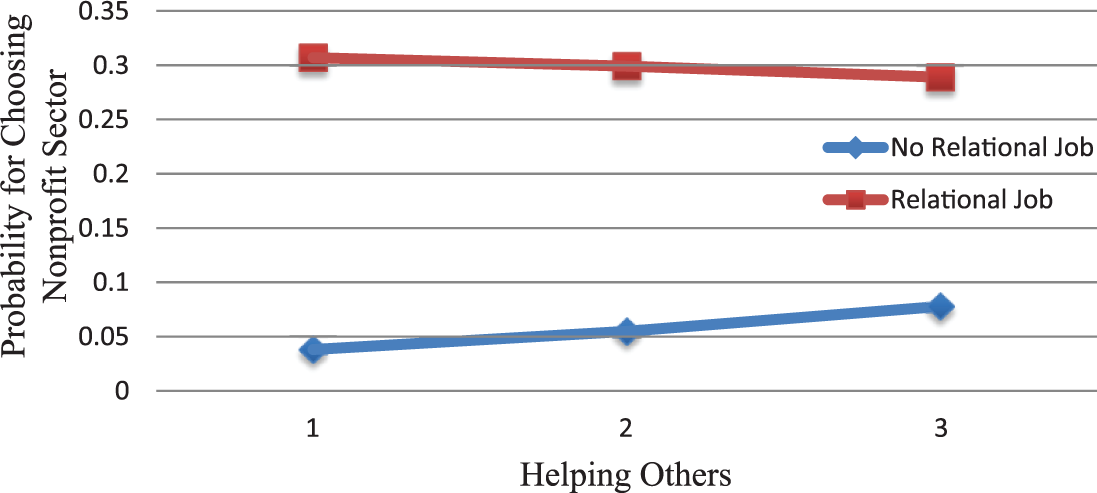
Interaction term between relational job and work values for non-profit sector.
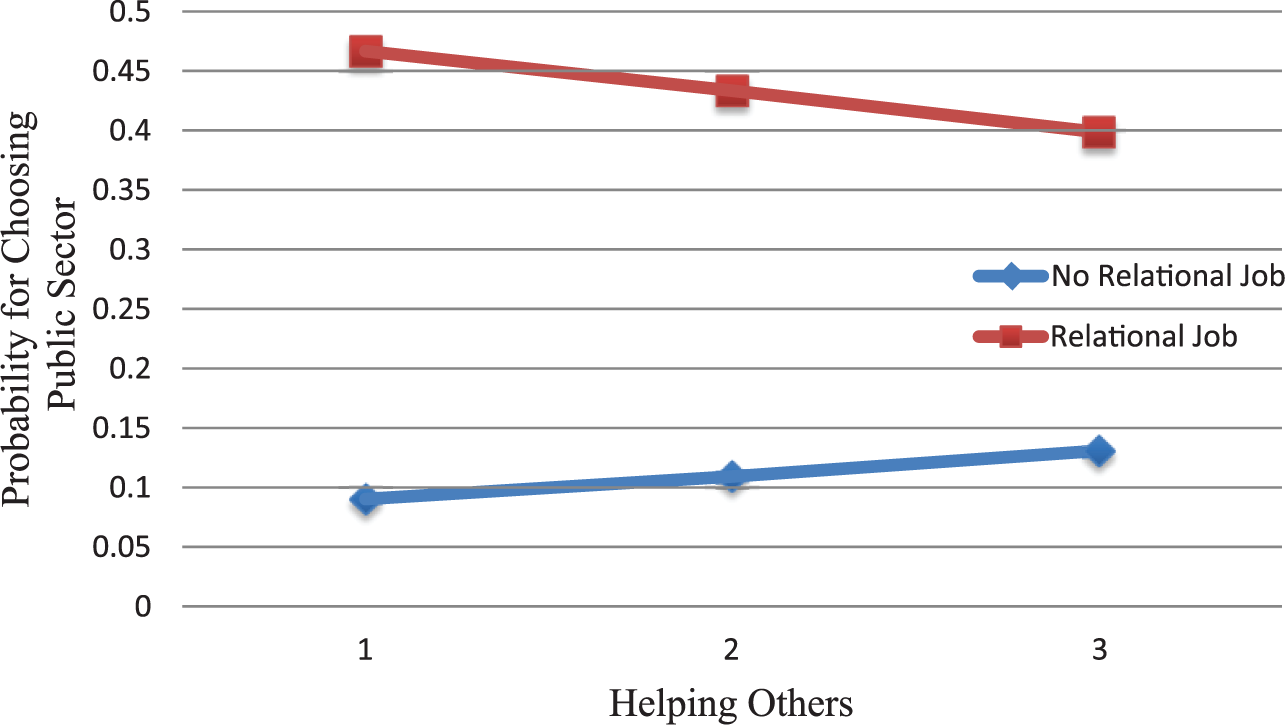
Interaction term between relational job and work values for public sector.
This finding speaks to the importance of P-J fit when people choose their initial jobs. Very interestingly, when people have an opportunity to fulfill their PSM through relational jobs, they are more likely to choose jobs in the private sector rather than jobs in the public or non-profit sectors. This finding contradicts to the results of a previous study, which found that law school students with higher PSM are more likely to accept an offer from the public sector when the job is relational (Christensen & Wright, 2011). Although Christensen and Wright (2011) tested the hypothesis using hypothetical job choice scenarios with a focus on the choices within each sector instead of choices between sectors, the empirical specification in this study tested the real job choices across different sectors. When facing sector choice with similar job characteristics, that provide the opportunity to fulfill PSM, people are more likely to choose the job in the private sector with better salary or working conditions. This result indicates that the preferred job choice could differ from actual job choice. This result is in line with previous studies indicating that people with higher PSM are more likely to desire to work for the government, but not to actually work for the government (Lewis & Frank, 2002).
Table 6 draws attention to the sample of high school graduates only. Models 1 and 2 look at the initial job choice at age 20, and Models 3 and 4 test the impact of PSM on subsequent job choice at age 26. The results showed a different pattern of sector choice from people with higher than a bachelor’s degree. With respect to the work value variables, job security is the only statistically significant variable across all models, which is also effective only for initial job choice at age 20 (b = 0.305, p < .05). This could reflect the different job market conditions by education level. Higher education might help people choose jobs among a wide set of options based on their work values, whereas people with only a high school diploma might have limited options among available jobs. Minorities are also more likely to choose the public sector in all models, which is consistent with the results from the sample of bachelor’s graduates in Table 5. However, females are less likely to work for public organizations (b = −0.584, p < .5) than for private organizations.
Many prior studies on the relationship between PSM and sector choice have been focused on employees with higher education levels, such as people with Juris Doctor (JD) degrees (Christensen & Wright, 2011; Wright & Christensen, 2010) and master’s students (Tschirhart et al., 2008; Vandenabeele, 2008). Thus, it is meaningful to analyze the sample with lower educational levels using panel data. Cross-sectional studies take advantage of the education level testing the differential impact on sector choice. For instance, using a sample of Dutch employees, Steijn (2008) found that employees with lower levels of education are more interested in working for the public sector. Lewis and Frank (2002) also found that education level is negatively associated with preference to work for the government, but positively related with actually working for the government. They found different impacts of work values on sector choice for college graduates and non-graduates. In their article, there was a stronger relationship between PSM and sector employment for college graduates. This result is similar to that of the current study.
In addition, Table 6 provides evidence of the relationship between work values and sector choice during multiple time periods (at age 20 and 26). Although it is unclear whether this results from socialization or attraction-selection effects, the results indicate that PSM might affect neither an individual’s initial nor his or her subsequent job choice for people with only a high school diploma. This was different result from prior research focusing on one profession, such as lawyers.
Discussion and Conclusion
This research makes several contributions to the existing literature. First, by emphasizing PSM and other work values such as monetary and job security, this article takes advantage of panel data, potentially avoiding the socialization bias in individuals’ career decisions and conducting a time-wise analysis because it utilizes information about respondents’ work values in 1990 and 1992, before their initial career choices. The perspective of value priorities discussed in the previous section assumes “individuals are motivated by their important personal values and act accordingly” (Vigoda-Gadot & Grimland, p. 336). In investigating the influence of work values on job choice, most of the previous findings have been based on cross-sectional settings using retrospective surveys immediately or shortly after job acceptance, thus raising questions about potential biases such as reverse causation and common method variance (Andersen, Heinesen, & Pedersen, 2014; Carless, 2005; Wright & Grant, 2010). For instance, a question might be raised about whether work value differences among sectors are the result of socialization and rationalization after respondents get a job, instead of the results of the formation of work values before an occupational choice is made (Judge & Bretz, 1992; Lyons et al., 2006). Thus, this study found stronger evidence on the impact of PSM and other work values on sector choice compared with previous studies.
The evidence in this study did not support the argument that individuals with higher PSM are more likely to choose jobs in the public sector. The results also showed that people who place greater emphasis on monetary incentives are more likely to choose jobs in the private sector. The research findings might be helpful for the recruiting process in the public and non-profit sectors because figuring out what types of people are attracted to public service and which characteristics of each sector make them appealing is a necessary task in human resource management. Considering that government recruitment targets college graduates and young people (Lewis & Frank, 2002), the results of this study would be useful because the survey participants’ job choices are measured at age 20 (for high school diploma holders) and 26 (for people with more than a bachelor’s degree).
Second, recent studies on the effects of PSM on sector employment found that PSM is strongly associated with the characteristics of jobs and with the sector itself (Christensen & Wright, 2011; Kjeldsen & Jacobsen, 2013). Most prior studies on PSM have—either implicitly or explicitly—used a P-O fit perspective; however, P-J fit, which is another important domain of fit relevant to PSM, has been used less often (Leisink & Steijn, 2008). Consistent with previous findings, this study also provides supportive evidence that relational types of jobs are important to individuals who are choosing organizations for work.
More specifically, one interesting finding is that when people have opportunities to satisfy their PSM through relational jobs, they are more likely to choose private-sector organizations than public or non-profit organizations. Christensen and Wright (2011) found that P-J fit strengthens the positive relationship between PSM and public-sector employment. In other words, P-J fit supplements P-O fit for individual sector choice. However, the findings of this study show that P-J fit can substitute P-O fit. This suggests that we might need to change recruiting strategies to attract high-quality talent, especially for relational jobs in the public sector, if comparable jobs exist in the private sector. Thus, the job’s advantages, along with the opportunity to help others, can be clearly demonstrated to potential candidates. For example, job flexibility, which is greater in public service than in most private organizations, can be emphasized.
Third, a considerable number of studies have used hypothetical job offers to assess the determinants of workers’ career choices of workers (e.g., Ben-Shem & Avi-Itzhak, 1991; Christensen & Wright, 2011; Judge & Bretz, 1992; Lanfranchi, Narcy, & Larguem, 2009). For example, using the General Social Survey (GSS), Lewis and Frank (2002) identified people’s job preferences by asking a hypothetical question: “Suppose you were working and could choose between different kinds of jobs. Which of the following would you personally choose: . . . Working in a private business or working for the government or civil service?” As those authors acknowledged, the respondents in their study were not actually employees in the various sectors. The current study may provide results that are more precise by using data on actual workers across sectors.
Fourth, as discussed in the previous section, job characteristics should be controlled to test attraction to sector employment (Kjeldsen & Jacobsen, 2013). This study elaborates job characteristic using Grant’s (2007) relational architectures. Although this study does not include all the dimensions of relational architecture (e.g., Taylor, 2014), it advances by categorizing existing occupation categories based on the concept of relational jobs. In addition, compared with studies focusing on one profession, this study increases external validity by extending from the case of one occupation to broader categories of jobs.
Despite making these contributions to the existing literature, this study has a few limitations. Given the nature of secondary data, this study uses two questions to measure PSM. As discussed in the previous section, although there are different ways to measure PSM, using only two items may not be sufficient to cover the entire concept of PSM. Thus, future studies may want not only to capture the complicated aspects of PSM as suggested by Kim et al. (2013) and Kim and Vandenabeele (2010) but also to examine the effects of PSM on sector employment and individual outcome variables.
Compared with previous studies focusing on PSM, this study includes more factors influencing job or sector choice, including monetary rewards, job security, and job characteristics, and it enables a determination of the relative importance of PSM compared with other factors attracting employees to public-sector jobs. However, more research is needed to include other factors such as career opportunities, fringe benefits, and so on.
Next, although this study provides the effects of work values—which are measured before the job choice decision—on sector choice, it does not offer any evidence about changes in work values after employment by tracking their socialization. This study encourages research aimed at investigating information about work values both before and after employment, thus, providing important managerial implications to motivate public-sector employees. Finally, from an international perspective, there is a limitation on generalizing the results to other countries because the focus of this study is limited to the U.S. context.
Footnotes
Appendix
Job Classification Code.
| Code | Job | Inclusions |
|---|---|---|
| 1 | Secretaries, Specialized Secretaries, Receptionists | Typist, timekeeper, stenographer |
| 2 | Cashiers, Tellers, Sales Clerks | Bank teller, gas station attendant |
| 3 | Clerks—Data Entry | Data entry clerks, data clerks, data processing clerks, statistical clerks |
| 4 | Clerical Other | Dispatchers, ticketing and travel agents, library assistants, hotel front desk, records administrators, warehouse/postal/shipping/receiving/stock/file clerks, mail carrier/handlers, enumerator, office machine operator |
| 5 | Farmers, Foresters, Farm Laborers | Fish Farmer, Fisherman, Forester, Horticulture, Oysterman, Trapper |
| 6 | Personal Services | Waiters, bartenders, hairdressers, flight attendants, babysitters, child/day care worker, maids, housekeepers, pet groomers, concierge, hostess, misc. attendants, and so on. |
| 7 | Cooks, Chefs, Bakers, Cake Decorators | |
| 8 | Laborers (other than farm) | Grounds keeper, helper, maintenance, dishwasher, cook’s helper, material handler, courier, loader, custodian, bagger, bus boy, gardener, stevedore, garbage collector, messenger, meter reader, stock handler |
| 9 | Mechanics, Repairers, Service Technicians | |
| 10 | Craftsmen | Plumbers, electricians, carpenters, telephone installers, millwrights, masons, foremen, inspectors, machinists, roofers, tool & die makers, upholsterers, jeweler, wallpaper hanger, and so on. |
| 11 | Skilled Operatives | Assemblers, drillers, meat cutters and wrappers, machinists, precision machine operators, polishers, rodmen, sawyers, seamstress, welders, and so on (THESE PEOPLE PRIMARILY OPERATE MACHINES AND OTHER QEUIPMENT) |
| 12 | Transport Operatives (other than pilots) | Boatmen, conductors, chauffeurs, cranemen, deliverymen, fork lift, motormen, parking attendants, railroad breakmen, truck and bus drivers, taxi drivers, and so on. |
| 13 | Protective Services, Criminal Justice Administration | Police, firemen, corrections/parole officers, court administrators, bailiffs/bondsmen, and so on. |
| 14 | Military | Career officer, enlisted soldier, weapons specialist, other military occupation not codable elsewhere (THIS CATEGORY IS ONLY FOR OCCUPATIONS THAT ARE EXCLUSIVELY MILITARY AND THAT DO NOT APPEAR ELSEWHERE.) |
| 15 | Business/Financial Support Services | Bookkeepers, credit examiners, insurance adjustors, loan officers, payroll, broker’s assistant, bond clerks, billing, recruiting, and so on. |
| 16 | Financial Services Professionals | Accountants, bank officers, controller, insurance brokers/agents, investment bankers, stock brokers, treasurers, underwriters, financial managers/analysts/consultants, and so on. MINIMUM OF BACHELOR’S DEGREE |
| 17 | Sales/Purchasing | Buyers, salesmen, sales managers, advertising, marketing, promotion, real estate |
| 18 | Customer Service | NOT CLERICAL, NOT SALES NOT SERVICE OCCUPATIONS |
| 19 | Legal Professionals | Lawyers, judges REQUIRES DEGREE |
| 20 | Legal Support | Para-legals, legal assistants (LEGAL SECRETARIES ONLY IF ALSO LEGAL ASSISTANTS) |
| 21 | Medical Practice Professionals | Physicians, dentists, veterinarians, and so on, REQUIRES DEGREE |
| 22 | Medical Licensed Professionals | Registered Nurses (RNs), pharmacists, dental hygienists, XRAY/Magnetic Resonance Imaging (MRI)/and so on, technologists, physical and other therapists, speech pathologists, opticians, and so on, MINIMUM OF ASSOCIATE’S DEGREE (bachelor’s if psych therapist, pharmacist, or public health) |
| 23 | Medical Services | Licensed Practical Nurses (LPNs), medical/dental assistants, home health aides, hospital admissions, medical records technologists, paramedics, opticians, veterinarian assistants |
| 24 | Educators: K-12 Teachers | K-12 school teachers MINIMUM OF BACHELOR’S DEGREE |
| 25 | Educators: Instructors Other Than K-12 | Trainers/instructors, for example, teachers’ aides, assistant teachers, college professors and instructors, tutors, school administrators, school counselors, corporate trainers, flight instructors, librarians and library associates, nursery and pre-school teachers NOT Sports/Fitness/Performing Arts instructors |
| 26 | Human Services Professionals | Social workers, clergy, counselors, occupational therapists/advisors. Requires degree in some cases (e.g., social worker, clergy) |
| 27 | Engineers, Architects, Software/System Engineers | MINIMUM OF BACHELOR’S DEGREE |
| 28 | Scientist, Statistician Professionals | (other than lab technicians and research assistants) MINIMUM OF BACHELOR’S DEGREE |
| 29 | Research Assistants/Lab Technicians | Engineering assistants, draftsmen, surveyors (NOT medical/health or computer assistants) |
| 30 | Technical/Professional Workers, Other | Archivists, air traffic controllers, city planners, customs inspectors, curators, environmental technicians, navigators, pilots, sound engineers, misc. management advisors/specialists |
| 31 | Computer Systems/Related Professional/Tech | Systems analysts, software support specialists, Management Information System (MIS) managers, network administrators, data editors, hardware technical support, and so on (other than computer programmers or operators) |
| 32 | Computer Programmers | |
| 33 | Computer & Computer Equipment Operators | |
| 34 | Editors, Writers, Reporters, Public Relations/Communication Specialists | |
| 35 | Performers/Artists | Artists, commercial artists, athletes, entertainers, dancers, musicians, actors, directors, and so on. |
| 36 | Managers: Executive | President, vice president, executive director, managing director |
| 37 | Managers: Mid-level | Retail, service, manufacturing, construction, bank officer, store manager, restaurant managers, and so on. |
| 38 | Managers: Supervisory, Office, and Other Admin | Office managers, department managers, assistant managers, management trainees, coordinators, project managers |
| 39 | Health/Recreation Services | Health club advisors, recreation assistants, non-school coaches, sports/fitness instructors/trainers |
| 40 | Uncodable, Other employed not codable | Interviewers, politicians |
| 41 | Unemployed—Homemakers | |
| 42 | Unemployed—Other | EXCLUDES HOMEMAKERS |
Source. National Education Longitudinal Study 1988/2000.
Note. Relational jobs are recorded when the jobs are protective services (13), legal professionals (19), medical professionals (21, 22), medical services (23), educators (24 and 25), and human service professionals (26).
Declaration of Conflicting Interests
The author(s) declared no potential conflicts of interest with respect to the research, authorship, and/or publication of this article.
Funding
The author(s) received no financial support for the research, authorship, and/or publication of this article.