




Abstract
The governance of major metropolitan areas is often associated with a “fragmented” and “uncoordinated” multi-government apparatus, frequently sculpted from years of particularistic ad hoc administrative reforms. This image of dysfunctional structure gains high salience when the metropolitan context is accentuated by complexity and fluidity, especially where intense paradoxical forces of economic development and ecological sustainability are present. The most visible “solutions” for such a state often come from bureaucrats seeking to “streamline” government according to norms of standardization and hierarchy. But, calls for reform may also come from scholars of polycentric government, who see the problem as a misalignment of administrative structure with the metropolitan context. This article adopts the latter, less-appreciated perspective that argues such dysfunctions in a metropolitan multi-government network are essentially problems of adaptive organizational design. Different than the bureaucratic model, treatises on new public management or group-behavior theory, it emphasizes the contextual nature of public administration by employing the holistic framework of “organizational systems.” It illustrates the logic by introducing a toolbox for multi-government design that speaks to the adaptive qualities of government networks in whole metropolitan areas. Its purpose is to reinvigorate this holistic approach in thinking about the way we look at multi-government networks in major metropolitan areas.
Keywords
Introduction
Although not universally endorsed, several perspectives in public administration argue that governance should be shaped by situational context, and reflect the social-ecological domain over which public policy extends. In the words of Dahl (1947), “We cannot ignore the relationship between public administration and its social setting” (p. 7). This proposition, however, takes on a challenging complexity when stepped up from the single bureaucracy and applied to policy making in a multi-leveled polycentric network (e.g., Klijn & Koppenjan, 2015).
In this network application, polycentric administration often seems remote, fragmented, and chronically out of sync with the plethora of societal and environmental interactions making up the contemporary American political economy. Moreover, such incongruities are often attributed to a mismatch of multi-government structure with situational context, involving both faulty distribution of authority and incompatible integration of jurisdictions within the network (e.g., Brenner, 2002; Commission on Local Governance, 2000; Hendrick, 2015) . From an organizational systems perspective, the problem is one of contextual adaptation by structural design.
The problem is made more acute and complex for multi-government networks operating in the context of major metropolitan areas (MMAs). Defined here as having metropolitan statistical area (MSA) populations greater than 500,000, it is these places which “produce the lion’s share of our nation’s growth” (A. Liu, 2016), and where most Americans reside; most local, state, and federal authorities overlap; most social-ecological interactions occur; and globalization has made the paradox between development and sustainability the most difficult for policy making (Batty, 2008; Bina, 2013; Boschken, 2013; Glaeser & Gottlieb, 2006; Wigginton, Fahrenkamp-Uppenbrink, Wible, & Malakoff, 2016).
As an analytical focus, however, MMAs are seldom accorded prominence in research concerning alignments between the structure of multi-government networks and the MMA’s social-ecological context. Nevertheless, given the centrality of MMAs in the American polity, an organizational systems perspective obviates three public administration concerns: (a) the effectiveness of a multi-government network’s structural arrangements in fostering metropolitan-wide collective policy making, (b) the questionable alignment of policy making with metropolitan context often attendant to this polycentric form, and (c) the consequent effects misalignments pose for dealing simultaneously with urban economic activity and ecological sustainability.
Many reasons exist to be interested in how these concerns are dealt with and how they affect governance in metropolitan settings. For example, there are numerous contextual “wicked problems” (Head & Alford, 2015) created by a plethora of factors uniquely concentrated in MMAs that are exceedingly complex for policymakers to grasp, even when collective scanning processes and multiple perspectives are used. Many are systemic with holistic impacts.
Symptoms of misalignment often appear as policy outcomes inconsistent with situational issues or as impediments to achieving balanced collaborative outcomes. Some symptoms materialize as general administrative malaises, while others are visible in specific dysfunctional ways, like “structural holes” in information processing (Wang, Rodan, Fruin, & Xu, 2014), obscured distinctions in relating jurisdictional roles and agency scope, and in confusing political perspectives with evidence-based analysis, collective learning, systemic awareness, and consensus-building.
Although institutional research into environmental settings has examined network governance in bureaucracy (e.g., Aylett, 2015) and collaboration at a micro or group-process level (e.g., Ansell & Gash, 2007; Scott, 2015), very little system-oriented work regarding metropolitan areas has addressed collective policy making across numerous agency silos acting as integrated parts of a whole intergovernmental system (for partial exceptions, see Miller, 2002; Bramwell, 2015). Moreover, most of the research is either about settings other than metropolitan areas (e.g., river delta management, wilderness restoration, global issues) or about individual service delivery programs (e.g., health care, social services, safety and security, waste management), representing isolated fragments of metropolitan governance.
In contrast, this article adopts an underappreciated framework in public administration, where polycentric government is the unit of analysis and treated as an organizational system for governing MMAs. In so doing, its purpose is to demonstrate the applicability of organizational systems for analyzing the governance of MMAs by multi-government networks. It begins by joining two separate theoretical fronts as one. The first involves the lens of Social-Ecological Systems (SES) as it applies to the contextual complexities of MMAs. The second front distills down Organizational Systems Theory (OST) to a level of specificity relevant to structuring multi-government networks having jurisdiction in MMAs. The resulting conjoint framework provides a prism for discerning the adaptation of the governance network to metropolitan dynamics through structural design.
This discourse is followed with a distillation of contributing factors associated with administrative fragmentation and misalignments in network structure with SES context. To illustrate OST application to MMA governance, the article concludes by introducing a toolbox of structural components that addresses misalignments and fragmentation by providing a “raw material” for tailoring metropolitan multi-government to a MMA’s social-ecological setting.
SES and Organization Design
Making sense of the situational context of MMAs often varies according to an analyst’s frame of reference, information, disciplinary alliance, and/or ideology. Among the most promising of rival frameworks, however, is the SES model (e.g., McGinnis & Ostrom, 2014; E. Ostrom, 2009), whose application is brought to bear on governance through “institutional analysis” (Anderies & Janssen, 2013; E. Ostrom, 2011). Either explicitly or implicitly, many scholars (e.g., Marshall, 2005; McGinnis & Ostrom, 2014; National Research Council [NRC], 2014; Turner, Subak, & Adger, 1996) use the SES framework to associate governance and policy choices with the plethora of relationships and interactions making up the substantive external context (jurisdictional domain) of a governmental network.
Social-ecological systems are described as multi-leveled in scope and scale, and composed of highly interwoven subsystems and interactions between human and ecological units. For example, E. Ostrom (2009) identified SES as an arena of interactions between “first tier” variables that include (a) multiple interlaced ecological subsystems (regional terrestrial, atmospheric, and coastal ecologies), (b) natural resource units consisting of finite environmental services and materials of value to human consumption (e.g., raw materials, esthetic beauty, clean air and water), (c) resource-user units (both producers and consumers), and (d) a governance subsystem (in MMAs, a metropolitan governance network). At various levels, balancing multiple sustainable outcomes (dynamic equilibrium) is maintained or lost through the interaction of these four identities, where governance involves a policy-making process for mediating conflicts among subsystem interdependencies and steering competing interests toward mutual adjustment.
For purposes of contextualizing a SES governance subsystem, a metropolitan area may be defined as a bounded, geographically specific unit of analysis, which constitutes a system of interacting, interdependent variables of human activity and ecological conditions and processes (e.g., Miller, 2002). Metropolitan boundary is arbitrarily determined by political and economic consideration, but is empirically supported by higher levels of socio-economic exchanges within the metropolitan area compared with those exogenous factors spanning over and beyond the metropolitan boundary. It consequently determines only an inexact overlay of human activity on geologic and ecological boundaries. Furthermore, as an open SES with an imperfect fit in subsystems, the MMA’s boundaries are permeable both to cross-boundary flows of natural resources and to human transactional activities on a global scale. As difficult as SES is to comprehend, Brookings (A. Liu, 2016) nevertheless contends “there is an incredible demand for this holistic view of cities.”
The overlays of SES subsystems in an MMA can be illustrated by the case of Metropolitan New York. This MSA covers parts of four states (6,720 square miles) containing multiple ecological and resource-unit subsystems, 2,000 quasi-independent governments, and a 2015 population of more than 20 million with a density of 3,000 persons per square mile. It produces a GDP of US$1.56 trillion (US$78,000 per capita vs. US$53,000 per capita for U.S. GDP). Regarding ecological subsystems, the MMA has numerous urban forests and open space (including Central Park), containing rich habitats for living organisms, and is surrounded by both fresh water (e.g., Hudson Valley watershed) and the maritime ecology of coastal Atlantic.
With respect to human demands, the New York MSA’s ecological subsystems provide numerous environmental services that include land, pastoral places for leisure and recreation, fresh water, pollution-cleansing processes, fishery resources, and means for moderating climate change. On the human side, the metropolitan resource-user subsystems exist at different spatial and temporal scales, involving SES interactions aimed at development and consumption of housing, infrastructure, transportation, energy, education, world-class entertainment, global business services, other enterprises, public social services, and more.
For MMAs, like New York, many interacting variables pose multiple challenges often characterized within a development-sustainability paradox. As a systemic problem, the paradox is caused by human consumption demands and the limits of resources availability and capacities. In an SES context, an essential role of governance is to address the paradox by mediating subsystem interactions, anticipating and arbitrating competing forces, and managing risks of adverse outcomes (McGinnis & Ostrom, 2014). For MMAs, the paradox challenges are magnified by scale and a substantial lack of self-sustainability, including reliance on massive cross-boundary transactional flows and collateral activities of globalization, and dependency on hinterland ecologies to support resource needs and assimilate exurban wastes (Boschken, 2013).
Given SES’s systemic nature, executing the governance role requires many administrative attributes, including trained specialists operating in different relevant disciplines, and their ability to collaborate effectively across many disciplines and governmental jurisdictions. According to SES, the organization of these attributes is determined by a “second-tier” variable called “network structure” (McGinnis & Ostrom, 2014), which is subsequently subdivided into a “third tier” of dimensions identified as “centrality, modularity, connectivity, and number of [government] levels” (p. 40). Hence, it is through network structure where the OST framework locks in with and takes on critical meaning and value for designing the governance subsystem according to SES contextual forces and interactions.
As a paradigm in macro-organization studies, OST contrasts with bureaucratic theory, especially regarding the latter’s failure to recognize the contextual and systemic properties of organizations (e.g., Galbraith, 1984; Lawrence & Lorsch, 1969; Thompson, 1967). Moreover, applicability of OST has been heavily influenced by an awareness of increasing information uncertainties due principally to complexity, non-parametric variability, and dynamic change in the external environments of organizations. As a result, many OST scholars identified a need to consider “information processing” capacity as a core consideration in organizational design (e.g., Galbraith, 1984; Tushman & Nadler, 1978).
For achieving institutional performance, both the bureaucratic and OST models focus on macro-organization structure, rather than on a micro scale of group behaviors. But, where bureaucratic theory argues that a single ideal structure assured highest performance (especially efficiency) across all situations, OST envisions a toolbox of alternative components in designing an organization’s structure tailored to the “contingencies” posed by the external “task environment” (Thompson, 1967). In governing MMAs, this term refers to the systemic interactions among SES subsystems of ecologies, environmental services, and user demands.
In recent years, the unit of analysis for OST has been extended out from the single bounded organization (e.g., a corporation, a government bureaucracy) to include the study of multi-organization networks, especially non-centralized agglomerations engaged in information processing and policy making (e.g., Bryson, Crosby, & Stone, 2006; Klijn & Koppenjan, 2015; Wang et al., 2014). This shift in focus is significant for studying MMAs in the United States because governance across a SES field involves a collective of overlapping but quasi-independent authorities having different jurisdictional scope at local, regional, state, and federal levels.
The shift from a focus on single organizations to network analysis was pioneered by many. For example, Benson (1975) was among the first to introduce the “network of organizations” as a “macrostructure” unit of analysis. He described this from a “political economy perspective” as involving authority and resources to configure interorganizational linkages. Pfeffer and Salancik’s (1978) “resource-dependency perspective” went further to offer a basis for seeing the formation of networks as a need for “managing mutual interdependence” and “coordinating interorganizational behavior.” Coincident with this need, Aldrich and Herker (1977) introduced “boundary spanning” as an essential component of organization structure.
Agranoff and McGuire (2001); Provan, Fish, and Sydow (2007); and Koliba, Meek, and Zia (2010) enlarged on the multi-government perspective in reviews of the literature on “whole networks” specifically tailored to the public sector. Going further, O’Toole and Meier (2004) focused on “the structural network” and “intergovernmental management,” and asked about “what managers do when they work across governmental boundaries” (p. 470). More recently, Wang et al. (2014) and Becker (2007) reemphasized the centrality of information processing by applying network structure to collaboratively creating, sharing, and analyzing information across administrative silos.
With few exceptions (e.g., Boschken, 1976; Miller, 2002), however, there is little comparable work within the OST literature applied to public administration that speaks to multi-government networks in the governance of whole metropolitan areas. Such oversight misses a fertile area of major consequence to American government research, where OST could offer insight into aligning policy making with situational context. In its association with context, structure is therefore referenced as an instrument to promote the holistic alignment of multi-government policy making with a systemic metropolitan SES.
Its specific contribution lies in describing structural network arrangements that (a) promote perceptual sensitivity and responsiveness toward the variety of distinguishable SES interdependencies and (b) facilitate intergovernmental integration of perspectives and specializations across multiple silos. It further suggests that for optimizing information-processing capacities, OST offers valuable constructs for structuring network authority to improve scanning, rule-making, and regulatory capacities in the wakes of uncertainty in available information and the complexity of metropolitan context.
To the extent OST’s contribution lies in principles about using network structure to align multi-government behavior with situational context, the paradigm identifies two principal components that hold pivotal distinctions in their respective roles and purpose for structural design:
Jurisdictional differentiation identifies “differences in cognitive and emotional orientation” among segmented organizational units (Lawrence & Lorsch, 1969, p. 9). It is operationalized by making distinctions among silos in the dimensions of formal authority, administrative tasks, specialized knowledge, public interest representation, attitude, time horizons, and interpersonal orientation (Koliba et al., 2010; Lawrence & Lorsch, 1969). In its “third tier” of structural sub-variables, the SES framework adds two more operational dimensions of differentiation: “modularity” and “number of [governmental] levels” (McGinnis & Ostrom, 2014, p. 40). In combination, these dimensions serve to differentiate one silo from another by defining a “scanning-radius” responsibility for individual network participants specific to particular SES subsystem characteristics or interactions. Hence, from OST, it can be deduced for MMAs that
Jurisdictional integration refers to “processes” and “devices” that address “the quality of collaboration that exists among organizational units to achieve unity of effort [required] by demands of the environment” (Lawrence & Lorsch, 1969, p. 11). The SES framework provides two attributes of network integration: “centrality” and “connectivity” (McGinnis & Ostrom, 2014, p. 40), both of which pertain to inter-silo configurations of connectivity, agglomeration and interaction. In a polycentric network of semi-autonomous authorities, integration techniques are those that facilitate incremental or evolving decisional processes, and mutual adjustment (Lindblom, 1965; V. Ostrom, 1989). This facilitation of multilateral relationships likely excludes center-peripheral arrangements of networks having a dominant agent. Hence, for polycentric governance of MMAs, it can be deduced from OST that
However, in pursuing these dual aspects of structural design, relationships between differentiation and integration may contain inherent conflicts, where adoption of a particular device of one may be counterproductive to adoption of the other. A noted example of this conflict is found in the deployment of hierarchical coordination devices (e.g., center-peripheral integration in a network) to harness a diverse set of semi-autonomous jurisdictions (V. Ostrom, 1989). Such combination tends to promote streamlining of the process at the expense of stifling opportunities for collaboration involving multiple, semi-autonomous jurisdictions promoting different (often competing) perspectives.
Insensitivity to such inter-component compatibility issues are a common source of intergovernmental fragmentation, and a frequent cause of discord over appropriate policy alignments with the SES environment. Lawrence and Lorsch (1969) suggested seeking compatibility resolution of a “conflict episode” by first asking, “how can integration be facilitated without sacrificing the needed differentiation?” (p. 13). The discord is seldom resolved without making trade-offs that leave both differentiation and integration less optimal in their respective role and purpose in structural design.
Inter-component compatibility issues are further complicated by a need to consider arraying administrative silos at multiple levels. Structural “rescaling” (Savich, 2010) involves adjusting differentiation in an existing network both horizontally and vertically to match issue scale with jurisdictional authority, and to be inclusive of more SES complexity. In a case where aspects of a metropolitan area’s scanning or monitoring of systemic interdependencies falls under no authority or distinct collective, the “level” problem may extend both to the need for new authorities (a differentiation issue) and where to functionally embed those additions in the larger network (an integration issue).
Together, differentiation and integration techniques comprise an organizational toolbox of structural components around which whole multi-government networks may be designed to align policy-making processes with the SES context in an MMA. Nevertheless, there are different interpretations and emphases in organizational systems that vary from this framework. It is beyond the scope of this article to compare them, but one framework that shares significant overlap here is often referred to as “collaborative governance.” The term actually is an umbrella for several perspectives ranging in scope and focus from group processes, to advocacy coalitions, to network structure considerations, and more.
Within this kaleidoscope, the closest conceptual overlay with this article are those of Emerson and Nabatchi (2015) and Agranoff and McGuire (2003), both of which identify the whole multi-government network as a unit of analysis. They differ significantly, however, from the above OST framework in one key respect: Differentiation is underrepresented as an essential component of collaborative structural design. Their concerns rightfully speak to impediments to intergovernmental coordination within multi-government networks, but without differentiation, they come up short in dealing with the scope of administrative alignment considerations apropos to the SES context.
For example, collaboration efforts may be sub-optimized by ill-defined agency constructs (e.g., in defining specialized skills, scanning radius, advocacy, or level of authority) that poorly fit the SES interaction or particular set of factors assigned to individual agencies. Ill-defined differentiation also may make integration techniques problematic for aligning whole-network functioning with the MMA, transforming localized mismatches into holistic fragmentation.
To re-emphasize, contextualized network collaboration depends on using (a) appropriate specialized administrative units that are aligned with particular SES subsystem interactions (differentiation), and (b) specific coordination techniques for fitting together overlapping jurisdictions of a polycentric network (integration). From the OST perspective, both differentiation and integration issues should be considered equally central to addressing collaboration impediments in organization design.
Factors Contributing to Fragmentation and Structure-SES Misalignment
Socio-economic pressures on ecological sustainability are both local and global in scale, but most metropolitan government authorities are limited in jurisdictional domain to a local or regional focus. In addition to this mismatch, the fluid SES context of metropolitan areas has proven much more elusive, dynamic, and complex than expected, making knowledge requirements difficult to anticipate. Policymakers, for example, collectively find themselves having to simultaneously (a) account for multi-leveled developmental determinants (often beyond their jurisdictional boundaries), and (b) comprehend sustainability in terms of a plethora of socio-economic and environmental considerations, along with their systemic web of dynamic and often synergistic interdependencies.
To confront these challenges, non-centralized multi-government networks have a long American tradition of intellectual support over bureaucracy because of the ability of their polycentric processes to identify a broader set of public issues, perpetuate iterative searches, and reduce fact and judgment errors (e.g., Bendor, 2015; V. Ostrom, 1989; Romzek & Dubnick, 1987). To these ends, U.S. metropolitan areas are typically governed by a highly balkanized and departmentalized array of authorities made up of general-function city and county governments, special districts, and regional planning, development, and regulatory agencies. Overlapping this local array are numerous state and federal agencies with specialized authorities of their own.
However, with such organizational complexity in overlapping jurisdictions, managing the systemic development-sustainability paradox through a polycentric structure also has been problematic, often resulting in fragmented policy making (Norgaard & Baer, 2005). Multi-governmental structure is implicated when (a) difficulties occur in differentiating individual agency domains in a collective network, and (b) intergovernmental integration fails to account for or correspond with jurisdictional overlaps and systemic interdependencies. From an OST perspective, such shortcomings are traceable to conditions existing in both the SES setting of MMAs and the polycentric configuration of multi-government networks. Specific factors contributing to this challenging situation include the following.
The Probabilistic Nature of Evidence and Its Use in Policy Making
“Data” are used for many analytical purposes, including identifying and measuring social-ecological variables, tracking and predicting changing relationships among them, and justifying policy interventions and mitigation measures (Collen & Nicholson, 2014; NRC, 2011, p. 21). A common assumption for all of these purposes is that policy information can be made “scientific,” and its interpretation and use conforms to procedures of the scientific method.
Scientific procedure and policy-making application, however, do not easily coincide, often leaving a misconception and blurred distinction between the two. Sometimes referred to as the “two communities dilemma” (NRC, 2012), scientific procedure and policy making are driven by different aims—the first interested in discovery and verification, the latter more interested in pragmatic prescription. When scientists speak of “policy,” they often are in reference to applied conclusions allowed by a theory or algorithm. When non-scientists (public policymakers) use the term, they are more likely to be in reference to outcomes involving trade-offs and the distribution of costs and benefits across different political interests negotiated through mutual adjustment.
These different aims may share some overlap but are often incompatible when represented together in multi-government policy processes, raising the potential for a disconnect between participants. As the NRC (2012) noted, “science . . . shares the [policy] table with an array of nonscientific reasons for making a policy choice [including] personal and political beliefs and values . . .” (p. 3). This mixing of motives in a policy arena further blurs the role of scientists (Steel, List, Lach, & Shindler, 2004), raising questions about neutrality, communication with non-scientists (National Academy of Science [NAS], 2014), and intended limits on data interpretation (Schneider, 2001).
Multiple Sources of Imprecise Data
Even with deployment of scientists in evidence-based policy making, the quality of information is conditioned by impreciseness and ambiguity caused by several contextual and methodological factors. Some of these include uncertainty (Simon, 1961), systemic SES interconnectedness (NRC, 2013), multiple scales and levels in problem identity (E. Ostrom, 2009), paradigmatic interpretation (Kuhn, 1962), arbitrary or inexact commodification of ecological services (Norgaard & Jin, 2008), and calculating intergenerational present-value benefits and costs of policy interventions (Arrow et al., 2013). As a result, evidence is a matter of estimating reality according to various probabilities, angles, and perspectives, all of which are aggravated by size and context in MMAs.
Public Policy Methods Often Fall Short
The models and protocols used for estimating variables have analytical bias and empirical limitations. Indeed, the costs and benefits calculated for systemic relationships, mutual (often synergistic) impacts, and the assessment of policy alternatives may give a hue of objectivity but are subject to the same evidentiary limitations mentioned above. For example, multiple-government networks are similar in many ways to corporate networks, but the diagnostic and rule-making capacities of government differ in their access to market calculations (Bish & Nourse, 1975; V. Ostrom, 1989). Lacking such exactness, government networks have few empirical methods for estimating value and what is important for policy consideration. Moreover, the inapt penchant for statistical prowess in policy making often shrouds this empirical inexactness and further contributes to “the hollowing out” of public administration’s “pillars” of multi-disciplinary social science (Durant & Rosenbloom, 2016).
The “Silo Effect”
With origins in group-identity motivation, the silo effect causes an administrative parochialism within agencies in their search and recognition of policy-relevant evidence. As loosely coupled authorities in a metropolitan multi-government network, policy silos may tend to operate and interact more like a confederation of governmental actors than a federation. Such isolation poses a quintessential problem for collaboration and greater risk on policy coherence, especially when policymakers navigate in uncharted areas (as in the case of a development-ecological sustainability paradox in MMAs).
The silo effect is seen in two lights. First, silos breed partitioning of research and policy analysis according to organizationally designated roles, responsibilities, and agency programs (NRC, 2013). While partitioning is a natural inclination of differentiation to provide professional knowledge with depth and meet specialized legal/organic mandates, it tends to diminish interest in collaborative cross-silo engagement. In the extreme, it may encourage policymakers to maintain the integrity of their “disciplines” in the face of alternative perspectives and contrary evidence (Katz, Muro, & Bradley, 2009).
Second, the silo effect has a tendency to reinforce a reductionist approach to problem solving (J. Liu et al., 2015; Norgaard, 2008). Although specialization has the advantage of bringing depth of knowledge and experience to a problem, paradigmatic rigidities often carry a risk of overlooking essential considerations outside of the agency’s domain, especially “critical interactions across system components” (J. Liu et al., 2015, p. 964). Some of these tendencies may even cause “payoff externalities” (Lubell, 2013, p. 546), where one agency’s policy decision purposely precludes another network agency from achieving its policy objectives.
Influences and Impacts Beyond Metropolitan Boundaries
Most systemic interdependencies might be suitably addressed when contextual issues and their impacts are confined primarily within a well-demarcated metropolitan area. But, when globalization influences (e.g., CO2 sources) and the ecology (especially air and water resources) extend beyond the scope and reach of urban jurisdictions, the mismatch in scale diminishes the ability to comprehensively address complex and dynamic systemic webs. The NRC (2013) directed this point to the context of “urban systems,” saying the problem is attributable to an absence of “governance linkages” that need to be coupled with “the connections across social-ecological systems” (p. 3).
Bureaucratic Myopia
Aggravated by very large and highly diversified MMAs, this impediment is often described as discounting, eliminating, or subjugating alternative perspectives and information that appear contentious or counterproductive to the interests of a dominant network member. Myopic behavior is common where multi-government authorities are arranged around the command of a single dominant participant or dominant oligarchy. The effect is to reduce policy-making resilience and collective capacity to solve problems dealing with contextual complexity, uniqueness, and dynamic change.
In the American intergovernmental system where bureaucratic “streamlining” can supersede accountability and the balancing of decision costs with social costs (Buchanan & Tullock, 1965), some have identified a “command and control pathology” (e.g., Anderies & Janssen, 2013, p. 518; Holling & Meffe, 1996; E. Ostrom, 1990). The enduring MMA example is the multi-government structure of Metropolitan New York (e.g., Doig, 2001) which exhibits a center-peripheral pattern of integration, dominated by the New York City bureaucracy and the giant Port Authority of New York and New Jersey (a regional public enterprise which operates the metropolitan area’s seaports, airports, major bridges, and most of the regional transit system).
Disproportionally Powerful Advocacy Groups
A major distorting influence to policy-making deliberations and outcomes is the disproportional and often dichotomous persuasions about the purpose and procedures of the process (Anderies & Janssen, 2013; Ansell & Gash, 2007). In contrast to intentions for the process to foster collaboration and consensus-building, some participants use the process for advocacy politics, power plays, and coalition-building. Dominance by the advocacy approach has the consequence of creating unreliable information, and is especially problematic in assessing extensive and complex SES interdependencies. This is compounded by the presence of powerful resource-rich advocacy groups, who enjoy preferential access to multi-governmental policy-making processes and are often able to distort policy choices. Their typical tactics include seeking special treatment, disguising political interests in evidence-based assessments, and use of judicial redress as a combat instrument (Weible, Patterson, & Sabatier, 2010).
These disproportionally powerful influences are especially pronounced in MMAs, where agglomerations of multi-national corporations, world-trade organizations, national labor unions, and global NGOs are concentrated in continuous competition for position and status in the global economy (e.g., Taylor, 2004). Some, of course, may be advocates of ecological sustainability, but generally the more powerful ones, have agendas that feed the paradox by placing disproportional emphasis on urban economic development benefits.
Operationalizing the Theory: An Organizational Systems Toolbox
Many of these contributing factors to misalignment were compounded by successions of disjointed ad hoc reforms that resulted in incomplete structural designs. As programs and agencies over time were added, consolidated, or deleted, metropolitan governmental networks evolved de facto arrangements to accommodate immediate program-specific needs along the way. Cumulatively, the result suggests the absence of a conscious effort to step back from the immediate situation to ask about polycentric metropolitan government as if it were an interactive and adaptive organizational system, having focus on information processing.
The consequent overall systemic effects of this shortsightedness act as obstacles both (a) to the appropriate differentiation of individual jurisdictions in aligning with individual SES contextual components, and (b) to suitable non-centralized integration techniques in facilitating collaborative behavior at multiple levels and across network silos. In the past, this shortsightedness perhaps seemed less important, but growing awareness of SES interactions, along with improvements in environmental and social scanning techniques, have raised a realization that MMAs are more fluid, complex, and systemic than previously thought (Wigginton et al., 2016).
Seeing the above seven factors as contributors to misalignment in polycentric design raises at least three pragmatic concerns for MMAs: (a) how to collectively make evidence-based policy under uncertainty, systemic complexity, and dynamic change, (b) how to deal with the “silo effect” on intergovernmental collaboration, and (c) how to achieve policy consensus forged from a multiple-perspectives governmental system?
In response to these operational concerns, Figure 1 presents a suite of structural tools intended as a raw material to construct a whole multi-government network within a metropolitan SES context. The list does not presume a “boilerplate” for assembling components into particular arrangements. In fact, if context matters in the OST framework, it cannot be assumed all toolbox items would be incorporated (or used in the same way) to solve the particular needs of individual MMAs. Nevertheless, they are parts of a comprehensive design scheme, representing organizational devices and techniques categorized as differentiation and integration options.
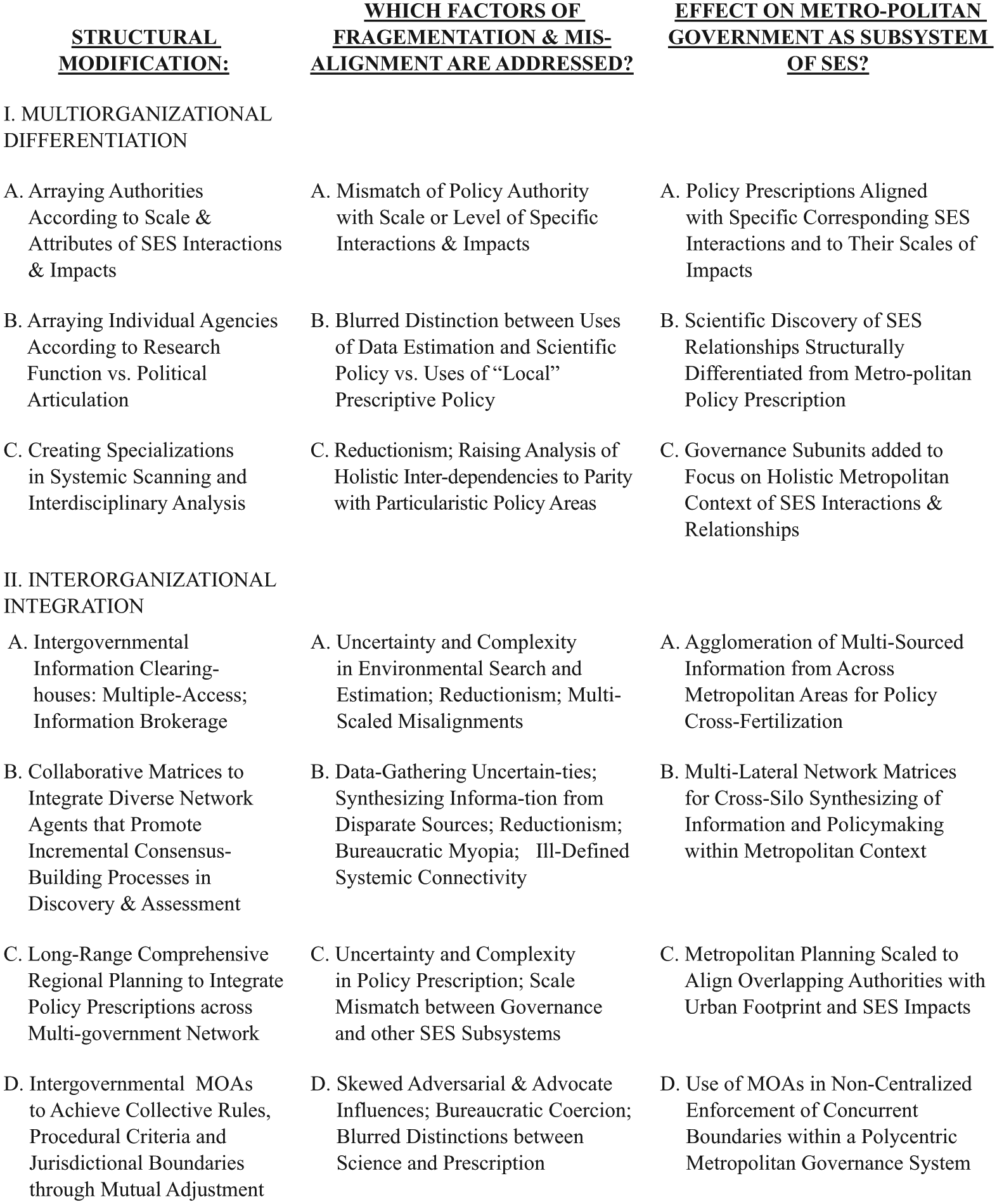
Designing network structure: Aligning metropolitan multi-government with social-ecological context.
Structural Differentiation Techniques
Structural differentiation techniques apply to all types of jurisdictions in a metropolitan multi-government network. In the case of general cities, differentiation may refer to how cities vary among themselves with respect to a broad spectrum of constituency resource demands and public service delivery economics (Bish & Nourse, 1975; Boschken, 1976). In a MMA, cities may appear as a common core for general service delivery, but individually serve different constituencies, hold different skill sets, have different time horizons, and exercise different domains of authority. In contrast to general cities, differentiation of jurisdictions for regional special districts, and state and federal agencies is based on narrower spectrums of authority (mostly focused on transportation, employment development, environmental services, and specific SES resource subsystems like air and water). In the diverse, highly interdependent MMA, conflict in overlap of authority, is inevitable among jurisdictions, making differentiation an especially challenging aspect of collaborative network design. To address the overlap issue, at least three designs of differentiation in MMAs are found in practice:
Matching different governmental authorities to the scale and characteristics of SES subsystem interactions
Designed to correspond with specific ecological processes, production characteristics, and consumption patterns, the differentiation of authorities may be of three types. One of these involves enabling an entirely new authority for an existing agency to address SES interactions specific to the development/sustainability paradox.
A metropolitan example is land-use policy regarding development in urban wildfire areas. For many years, concerns have been that cities, especially along the metropolitan periphery where development pressures are often greatest, do not possess the skill sets or inclination to regulate development in wildfire-prone areas deemed as “indefensible.” Independent local fire districts along the metropolitan periphery are often the agencies responsible for fire fighting, and follow a general statewide policy that places priority on preventing loss of private structures over containment of the fire perimeter when resources are limited. However, land-use authority to prohibit development in such areas typically rests with the general city or county, not the fire district.
An alternative to this mismatch with SES interactions involves the creation of a new land-use authority for fire districts that grants them separate but concurrent authority to designate indefensible areas and prohibit construction in such areas. For example, California legislation (California Legislature, 2012) recently took an essential first step in this direction in prevention by requiring local housing elements to contain an analysis and designation of “very high fire hazard severity zones.” It fell short, however, in not carving out a separate land-use authority for independent fire districts to designate indefensible areas as off limits to development.
As a multi-agency alignment strategy, the granting of separate but concurrent authority over indefensible areas speaks to the specific SES interaction involving environmental services provided by forest resources, the production and consumption of those resources, and the larger systemic impacts associated with fire-prone areas (e.g., habitat losses, erosion, CO2 emissions, regional air, and water quality). Authority realignment would recognize a more equal footing for ecological sustainability attendant with the pressures of metropolitan development.
A second type of new authority is the adoption of systemic specializations that serve to offset reductionist dysfunctions. In this case, differentiation refers to a transfer of authority from one policy-making body to another, either at the same or different level of government. The plight of Metropolitan Planning Organizations (MPOs) is a typical example where they have area-wide planning authority but little or no implementation or enforcement authority to regulate land uses having significant metropolitan-wide impacts. As land-use authority lies principally with individual cities and no plan implementation authority exists on the scale of a whole metropolitan area (or its footprint beyond in the hinterland), a fragmentation and discord of outcomes frequently occur.
As a remedy consistent with organizational differentiation, a more cohesive area-wide pattern of plan implementation would occur if such land-use authority was transferred to MPOs (similar to the shift in Metro Toronto). Although “disenfranchising” some local prerogatives, such transfer of authority to the metropolitan level would provide a more inclusive scale and alignment with SES interactions that remain substantially unaccounted for. Air pollution from traffic congestion, resulting from sub-area (local cities) land-use decisions, is a typical example of such area-wide externalities.
As a third way, tailored differentiation may involve matching specialized authorities with particular SES interdependencies by creating new agencies with concurrent authority covering policy issues not previously designated. This is often adopted when large areas of systemic interdependencies fail to be accounted for in policy prescriptions and in regulating production and consumption impacts. Such was the case for the San Francisco Bay Conservation and Development Commission (BCDC, a metropolitan-wide body) and, later, the bi-level California Coastal Commission. In 1970, Proposition 20 (a statewide initiative based on the BCDC model) established a bi-level authority to focus on ecological sustainability of the state’s coastal zone (Boschken, 1978). It was structured to have concurrent authority with local governments, most of whom had track records of approving unrestricted permits to developers.
The new set of agencies were scaled according to definable ecological identities within the coastal zone and made concurrent with an existing city’s development permitting authority. Significant change in outcomes resulted from the commissions’ specific coastal authority to study, make rules, and impose constraints based on ecological sustainability. Partly due to these successes, however, pro-development interests were able to prevail in 1976 legislation stripping the commissions of their original regulatory authorities and making them subordinate to the state’s resources bureaucracy. Nevertheless, this short experience serves as an example of how policy outcomes can differ between (a) authorities aligned with SES factors of development and sustainability, and (b) authorities mismatched with the environment in scale and substance.
Differentiating authorities according to the scientific function of discovery and the political function of prescription
In the scientific community, policy making is focused on forging a consensus about discovery, where “assessment was meant to be policy relevant but not prescriptive” (Norgaard, 2008, p. 863). In the political community, emphasis is on policy outcomes as those impact different constituencies. However, most existing policy-making bodies subdue this distinction, creating a blurred basis for judging the quality of information, and sorting out scientific policy from policy prescription. Rather than confounding these two roles in a single authority, the two communities might be better housed in different authorities where synchronizing their disparate policy roles is dealt with through structural integration of different concurrent authorities.
Although difficult to tease out, separating the roles according to different authority footings would improve accountability and transparency in role distinctions for both scientific data analysis and policy prescription. These distinctions would also need to be aligned separately with SES resources subsystems and production/consumer subsystems. They may need to be differentiated along a vertical dimension as well. Hence, similar to the federal Environmental Protection Agency’s bi-level differentiation, one might imagine (a) a “scientific discovery authority” of relevance to urban policy at a national level covering SES interdependencies most common in major U.S. metropolitan areas, and (b) “scientific-translation” counterparts at the metropolitan level holding authority for region-wide policy prescription. Until the Reagan administration, the Advisory Commission on Intergovernmental Relations (ACIR) served as a partial example of such differentiation in level when it focused much of its research capacity on metropolitan issues, but left most of the prescriptive policy role to metropolitan government.
Creating specializations in holistic scanning, interdisciplinary analysis, and systemic planning
A metropolitan multi-government network typically divides authority according to particularistic issues (i.e., health, air pollution, infrastructure, transportation) and seldom includes holistic analysis or systemic prescriptions in policy making. However, with availability of “big data,” vertical separation for monitoring multiple scales of SES interaction is now feasible, especially regarding systemic interdependencies with the exogenous influences of globalization and resources ecology (both of which typically span the boundaries of metropolitan areas).
Carving out a separate region-wide authority alongside MPOs might be a suitable place to sort out scientific issues of the development/sustainability paradox across the MMA. Horizontal separation of discovery and prescription may already occur in metropolitan networks, but the discovery role is often assigned outside of government to environmental impact and project-development consultants, few of whom are independent scientists, sometimes share a dubious history of partiality, and are not generally subject to scientific transparency or political accountability.
Structural Integration Techniques
Structural integration techniques are directed at coordinating collective policy making rather than making distinctions among overlapping authorities. As shown in Figure 1, integration is typically found in practice as four different designs in a polycentric network. All are non-centralized and facilitate collaborative engagement across silos at multiple scales of deliberation. Consistent with the OST framework, several integration tools may exist simultaneously in a multi-government network, but individually contribute to an overall network integration scheme. Inconsistent with SES complexity, center-periphery integration is not considered because of impediments it poses for multiple-perspective collaboration and mutual adjustment.
The information clearinghouse
This integration device is particularly useful for managing large amounts of data generated from multiple sources and differing perspectives. In the multi-government network, clearinghouse functions are often designed as “centralized repositories with curation, analytics, and quality control [to] enhance the value of the data” (Contreras & Reichman, 2015, p. 1312). As an integration tool, it serves as an interactive, random-access portal linking differentiated governmental units by promoting or augmenting information exchanges across the multi-government network. More than a simple repository for random access, the clearinghouse is both a common-pool resource for intergovernmental exchange and an active player engaging in information assembly, cataloging and maintenance.
Examples of this integration tool include both formal intergovernmental clearinghouses and “knowledge brokerage” activities. Clearinghouses have existed at all levels of the federalist system, but the most illustrative for metropolitan-wide integration is the ACIR, where its role was to provide a research forum and information exchange for the three-leveled U.S. intergovernmental system. It had a decidedly sub-national and metropolitan focus (Kincaid, 2011; Reeves, 1984), and encouraged multilateral participation of policymakers.
Knowledge brokerage, however, is critical to managing “structural holes” (Wang et al., 2014) in information, where failure occurs in connecting a critical knowledge silo with others to which it is central. A principal example of knowledge brokerage is found in public health and applied medical research where a formal activity is established to cobble together ideas and research from a pool of loosely coupled disciplines to discover unrealized treatment options in one or more unaffiliated specialties lacking suitable treatment protocols.
Interorganizational matrices
Being useful in maintaining cross-disciplinary relations and simultaneous multi-level deliberations, matrix integration is especially designed to address high complexity in SES settings like MMAs. To do this, the technique is configured to connect sets of SES focal tasks (“projects”) and agencies (disciplinary and functional specialties) to create multiple “cells” of policy-making discretion without resorting to a “one boss” hierarchy or sequential processing (Daft, 2008, pp. 110-115; Davis & Lawrence, 1977; Galbraith, 1971). For complex, dynamic contextual settings, the matrix advantage lies in being “a coordinative structural device” (Ford & Randolph, 1992, p. 269) which promotes collaborative “synergistic relationships” (Wall, 1984, p. 30) across policy silos.
Applicable to both scientific discovery and policy prescription, this technique optimizes network agility to share information and collaborate in evolving combinations of expertise involved in parallel or simultaneous decision making (Bendor, 2015; Wang et al., 2014). It is fundamentally different in structure from the formation of interdisciplinary groups, like those advocated by Scott (2015) and others. The matrix structure is costly to administer but may be the only integration mechanism capable of orchestrating collective policy making under extreme conditions of information uncertainty, competing perspectives, and transformational change (e.g., as found in the causes and impacts of CO2 emissions associated with MMA sustainability).
Matrix integration is distinctive in its facilitation of continuous reconsideration of information (aka, incremental decision making), and the mutual willingness of actors to recalibrate policy considerations as warranted due to evolving states of knowledge and context. Moreover, matrix structure leans heavily on mutual desire for “a shared learning process,” where participants from multiple disciplines “bring different values and understanding into a deliberative process” to achieve an evolving consensus (Norgaard, 2008, p. 868). It requires participants to have ongoing collaborative experience and to exhibit trust (Daley, 2008), but has distinct advantages for emerging and complex problems that are best addressed by continuous orchestration and re-evaluation by multiple perspectives (Baber & Bartlett, 2005; Bendor, 2015).
Matrix examples are more numerous in business than in the public sector. Nevertheless, one notable government example is National Aeronautics and Space Administration (NASA)’s organization during its formative years of manned-spaceflight to the moon. Matrix management was originally deployed because of spaceflight unknowns, multiple-project complexity, and need for a multiple-perspective information-processing system. Years later, its unique policy-making value was demonstrated in contrast to hierarchy when NASA’s matrix integration was functionally compromised by bureaucratic intervention, which was attributed as a primary cause of the Challenger disaster (Romzek & Dubnick, 1987).
An example of a multi-government matrix employed for integrating SES issues is the intergovernmental Millennium Ecosystem Assessment, where participant agencies “learned how to deliberate together, combine their separate disciplinary frameworks, and form a collective analytical ability that was more than the sum of their individual contributions” (Norgaard, 2008, p. 863). Although imperfect and evolving, this matrix has also been seen in other SES policy arenas, such as the UN’s Intergovernmental Panel on Climate Change (IPCC) and CALFED (the joint federal-State of California collaboration studying the San Francisco Bay-Sacramento Delta ecosystems).
“Coordination by plan.”
Formal network planning in metropolitan areas is sometimes handled by the designation of a joint-powers agency (March & Simon, 1958; Thompson, 1967). This method typically assumes an anticipatory posture for region-wide issues involving both mitigation and adaptation in the SES framework. It often takes the form of a joint regional council, consisting of local government representation and charged with coordinating the planning interests of its member governments.
Examples of a joint-powers planning agency in metropolitan areas are regional councils of government (COGs), such as San Francisco’s Association of Bay Area Governments and Los Angeles’s Southern California Association of Government, and transportation-focused MPOs, such as the NY Metropolitan Planning Council. Both types, however, have limited integration roles beyond long-range planning and no real authority for policy implementation. Their integration powers also fall short without state and federal agency inclusion that enlarge the collaborative scope to include systemic SES interdependencies extending beyond metropolitan boundaries (e.g., external globalization forces, exogenous ecological subsystems).
Memorandums of agreement
MOAs are multilateral devices, often used by overlapping agencies who seek mutually beneficial rules of engagement and domains of policy discretion where two or more agencies intersect (Dougherty, 2001; Thompson, 1967). To collaboratively sort out specific distinctions in role, authority, and SES focus among a set of agencies, those agencies may be especially motivated to avoid preemptive actions of one agency that would exclude options of other network functionaries. MOAs provide the opportunity to mutually sort out and distribute policy-making roles according to discrete SES subsystem interfaces.
Toolbox Application
Compiling a list of structural raw materials for the toolbox is the purpose of Figure 1, but assembling a particular mix of compatible tools is contingent upon the specific SES context of each MMA. Moreover, a pointed argument of OST, as a contingency model, is that there is no boilerplate rubric that applies uniform structural design criteria across all contextual situations (unlike the bureaucratic model’s rubric for a “one-best-way”).
Despite being generally similar in size and other dimensions, MMAs vary within their peer group according to a range and mix of contextual dimensions (Boschken, 2008). Some of these include a MMA’s global centrality and connectivity, its systemic subsystem interactions (with implications for information uncertainty), socio-economic mix, cultural resources, impacts of technological change, and more. Multiple variances, therefore, raise unique implementation issues about how to apply the alignment tools of Figure 1 to particular metropolitan networks, and whether the tools of differentiation and integration are all equally operational across MMAs.
In the absence of quantitative dichotomous guidelines, OST offers an adaptive framework through which designers interpolate relevant factors of structural alignment. To be successful, the contingency nature of OST in providing an open-systems rationale requires considerable discretion and seasoned insight about SES realities and network dynamics. The resultant design process is incremental and iterative, leaving network designers to make OST-informed decisions.
In making such decisions, the alternatives speak to purpose. Some techniques, like clearinghouses, may apply more to a holistic focus on MMAs generally and to opportunities for cross-fertilization. Others, like collaborative matrices (not to be confused with micro-level “policy groups”), may better serve the needs for synthesizing information about particular SES context and policy alternatives. Still others may address mismatches in dealing with SES interactions having multiple scales and/or jurisdictions having overlapping authorities at multiple levels.
Conclusion
Scholars have sought to identify, explain, and solve the performance problems of governing metropolitan areas in the United States for well over a 100 years. Their many approaches, however, are often testaments to the partial and sometimes improvised outcomes, which cumulatively resulted in a scattered and often uncoordinated tangle of multi-government relationships mismatched to their individual metropolitan contexts (e.g., Commission on Local Governance, 2000). This dysfunctional outcome is especially found in MMAs that vary widely in human-ecological interactions and are remarkably interdependent across multiple scales.
But, the structural alignment issue is also brought on by the absence of a larger, multi-disciplinary administrative theory. Unlike the past, we now possess advanced awareness of SES systemic complexity and better heuristic models for co-evolutionary designs. In this sense, the article’s purpose has been to argue for and demonstrate the applicability of SES and OST as a conjoint framework to more holistically design multi-government networks in the governance of MMAs. As such, it offers three takeaways about contextualized structural design.
First, the organizational systems approach is adaptive by design to a multi-leveled and metropolitan-wide context. By concentrating on the alignment of multi-government structure with the metropolitan SES, it provides an organizational gestalt for MMA governance. This gestalt is heuristically distinct from and more encompassing than models focused narrowly either on bureaucratic streamlining, statistical protocol, or a group-level programmatic process. The approach is not intended to be mutually exclusive of these alternatives and, by its interdisciplinary nature, allows for cross-bred combination in suitable situations. In this sense, it is compliant with Durant and Rosenbloom’s (2016) concern over “hollowing out” the field by “decontextualizing” public administration theory.
Second, as a framework for structural evolution and adaptation to variable conditions, it promotes three essential benefits of functional incrementalism (Lindblom, 1959). As a rejection of synoptic policy making, its dynamic suite of tools for differentiation and integration specifically provide the structural arrangements that (a) allow for “local search capabilities,” (b) facilitate “iterative adaptation,” and (c) optimize “the distributed intelligence of multiple minds” (Bendor, 2015). As with incrementalism, the OST framework is more usefully seen “as a toolkit of heuristics that can be deployed separately and combined in various ways” (Bendor, 2015, p. 202). In this sense, the task of multi-government reform need not follow a “demolish and rebuild” strategy, but should involve a concept-driven realignment, where systems’ design becomes the force replacing ad hoc expediency.
Third, the ongoing organizational design problem identified here as structural misalignment is not about fragmented or parochial micro-solutions per se, but that, taken individually, such solutions contribute little to the structural integrity of the whole multi-government system. Some of the structural tools included in Figure 1, for example, originated as stand-alone or local ad hoc solutions, but some gain appropriateness to systematic governance when used in conjunction with other components of the larger organizational scheme. The organizational systems problem, therefore, is about arranging different but interacting parts into an administrative structure specific to the conditions and interactions of the governance context.
Footnotes
Acknowledgements
Special gratitude is expressed to the many colleagues who have provided valuable feedback on earlier drafts of this article, but especially to Robert Durant (American University), Robert Warren (Delaware), Robert Bish (University of Victoria), Richard Norgaard (U.C., Berkeley), Jameson Doig (Princeton), and Daniel Nohrstedt (Uppsala Universitet). Appreciation is also expressed to the journal’s three anonymous reviewers for their insightful suggestions.
Author’s Note
An earlier draft of this article was presented as a paper at the 10th Transatlantic Dialogue (ASPA-EGPA), Lugano, Switzerland, June 5-7, 2014.
Declaration of Conflicting Interests
The author(s) declared no potential conflicts of interest with respect to the research, authorship, and/or publication of this article.
Funding
The author(s) received no financial support for the research, authorship, and/or publication of this article.