



Abstract
With heightened bureaucratic bashing and the planned reorganization of the U.S. federal bureaucracy, hiring is going to be difficult, but what could make those already in the service satisfied and willing to stay in their jobs? How could flexible work systems have an impact on worker job satisfaction and turnover intention? Using hierarchical linear modeling, we explore the impact of alternative work systems on employee job satisfaction and turnover intention in the context of values underlying managerial reforms. Flexible work systems are found to have a positive impact moderated by the kind of values promoted by particular reforms. A discussion on the main findings, research, and practical implications for public human resource management theory and practice is provided.
Keywords
Introduction
The U.S. civil service is on the cusp of conservative reforms in 2017, potentially affecting worker satisfaction with human resource management (HRM) policies. Every incoming administration espouses a managerial agenda to carry out campaign promises. The dominant reform wave of the 1990s, New Public Management (NPM), emphasized performance measures, managerial initiatives, and a service orientation. Later on, so-called post-NPM reforms promoted organizational humanism, social equity, and democratization (Denhardt & Catlaw, 2014; Wise, 2002). We make an assumption that higher level values embedded in executive reforms interact with an agency’s human resource policies to influence job-related outcomes. In this article, we examine the moderating impact of such reform values in exploring employee satisfaction with flexible working policies.
In the first section, we discuss the role of flexible work systems in maintaining work–life balance. We then discuss two waves of U.S. management reforms and how flexible human resource work systems might reflect some of the values of those reforms. That discussion incorporates the presentation of six hypotheses regarding the effect of those work systems and reform values on federal employee job satisfaction and turnover intention. This is followed by the methodology we used, the results derived from hierarchical linear modeling, and their limitations. Finally, we suggest a limited number of ways of regarding the findings in light of current efforts to downsize the bureaucracy.
Worker Disaffection at the Dawn of the Trump Presidency
Hiring in the U.S. civil service confronts the typical challenges of lengthy procedures and unattractive pay relative to the private sector, but at the federal level, the challenges are compounded by perennial bureaucratic bashing and the reform mandates accompanying each new administration. Reforms, especially when laced with privatization initiatives, have a way of inducing panic and demoralization among federal employees (Joaquin, 2009). Among millennials entering the workforce, the human capital challenges are palpable: There is a yearning for the “respect and worthiness of public service,” and for some practical changes to occur, such as quicker hiring procedures (The PA Times, 2016, p. 4). Instead, as the year 2017 begins, a hiring freeze has taken effect, leaving agencies worried about attrition and losing their most capable workers (Ogrysko, 2017). Amid the exodus of career bureaucrats who declared they wanted no part in the Donald Trump administration (Graham, 2017; Terkel, 2016), the times recall to mind “exit, voice, and loyalty,” Albert O. Hirschman’s (1970) treatise on the options that are open to employees dissatisfied with their lot, in the face of the administration’s hiring freeze, hard stance against holdovers from the previous administration, exaggerated accusations of waste (C. Ingraham, 2017), abnormal procedures for staffing key positions (Lerer & Bykowicz, 2017), planned cuts in federal health and retirement benefits (Katz, 2017), and belittling of agencies whose missions are opposed by conservatives (New York Times Editorial Board, 2017; Shane, 2016).
With the “silver tsunami” of retirement occurring and a bruising election that has made young people rethink a career in government (Byman, 2016), changes need to be made to encourage the brightest to join, and remain, in the federal government. Yet, efforts might have to be made to prevent the current complement from thinning out. In 2015, a quarter of federal employees overall, and as much as 40% among those with Democratic leanings, reportedly would consider leaving their jobs if candidate Donald Trump were to win (Katz, 2016). Trump did win, but, as of this writing he has yet to roll out a fully formed Presidential Management Agenda similar to the ones by George Bush and Barack Obama; instead, his Executive Agenda contains his priorities for the first 100 days, with regulatory rollbacks and downsizing underlying it. This climate has seen federal employees become disheartened, and reports of civil servants quitting are constantly in the news early in 2017.
Bureau-political dynamics are not the focus of this article, but we speculate regarding two human resource programs that might make federal employees more inclined to stay. At the dawn of the Trump administration, we explore the question of whether nonpolitical, intrinsic factors, such as flexible work systems play a role in keeping workers satisfied with, and remaining, in their jobs. Yet because such policies operate in a political environment, we explore whether values perceived to accompany executive reform agendas have any influence on what we expect to be the positive effects from flexible work systems.
Flexible Work Systems and Their Effects: Some Hypotheses
In the past few decades, work–life balance policies have sought to mitigate undesirable employee behavior—tardiness, absenteeism, and work interruptions—and enhance organizational performance and job satisfaction. The U.S. Office of Personnel Management (OPM), Work and Family Program Center recommends programs to agencies with the goal of facilitating flexible work schedules (U.S. Merit Systems Protection Board, 1993). 1 The Telework Enhancement Act of 2010 expanded telework eligibility and participation, leading telework eligibility to jump from 35% of federal employees in 2011 to 45% in 2013 (U.S. OPM, 2013). From 2005 to 2011, the number of teleworkers increased by 424.4% in the federal government, 114% in state governments, 66.9% in local governments, 85% in nonprofit organizations, and 62.6% in general companies (McGuire, Kenney, & Brashler, 2010). 2
Telework is one of the most widely implemented types of flexible work programs. As work management, telework allows employees to perform organizational duties regularly at home or other locations (e.g., satellite work sites) geographically convenient for the employee (Newman & Mathews, 1999). Telework is defined as a “work flexibility arrangement under which an employee performs the duties and responsibilities of such employee’s position, and other authorized activities, from an approved worksite other than the location from which the employee would otherwise work” (U.S. Congress, 2010, p. 2).
Alternative work schedules refer to flexible and compressed work schedules. For example, the employee may free a day or two per week by working more than 8 hr a day, Monday through Friday, to work a total of 160 hr each month. Some studies have mentioned that alternative work schedules or telework have a negative effect on organizational performance (Lee & Hong, 2011) and job satisfaction (Saltzstein, Ting, & Saltzstein, 2001) as flexible work systems have not been well-implemented in public agencies (Su, Li, & Curry, 2016). However, the literature also confirms alternative work schedules’ positive aspects: It has been found to have a positive effect on productivity and cost (Apgar, 1997), job performance (Hill, Hawkins, Ferris, & Weitzman, 2001), job satisfaction (Facer & Wadsworth, 2008), and employee morale (Baltes, Briggs, Huff, Wright, & Neuman, 1999). However, with the aim of enhancing organizational productivity and raising employees’ morale, flexible work systems provide employees with the right to adjust their workplace, work hours, and work system based on their personal circumstances. In general, employees seem more satisfied when they are granted with more rights to self-control (Liechty & Anderson, 2007).
Among the theories that highlight the importance of flexible work systems to organizational outcomes, the spillover theory assumes that the emotions and behaviors that occur in a single area develop in other areas despite physical, mental, and temporal borders (Grzywacz & Butler, 2005). Conflicts at home could spread into the workplace and vice versa. Second, the work–family conflict theory suggests that excessive mental burdens and role ambiguity can occur owing to the role conflict that occurs when an individual is required to cope with contradictory roles at the same time. These conflicts can, in turn, cause additional problems such as increased turnover rates and decreased productivity. Third, the border theory suggests monitoring how well the border between the two domains (work and life) is managed and coordinated with an optimal balance. Nippert-Eng (1996) stated that people search for compromise between the two domains when considering current restrictions rather than appealing to extremes (either integrating or separating the two domains). Finally, self-determination theory also suggests that autonomy is a key factor in motivating employees and satisfying their needs. Hence, workplace flexibility is positively linked to lower turnover intention and greater job satisfaction (Su et al., 2016). Overall, those theoretical viewpoints suggest that balancing work–family issues, managing work conflict, and increasing work motivation within an organization would heavily depend on how managers effectively use flexible working systems and to what extent employees perceive them as positive.
The literature could benefit from further exploration of the effects of these programs: There are more studies finding positive effects, but contrary results have been found elsewhere. Some scholars found that flextime and compressed workweeks are positively related to job satisfaction. For example, Hayman (2010) found a positive relationship between flexible work practices and job satisfaction among employees working at an Australian university. In a study among employed working adults, McNall, Masuda, and Nicklin (2009) found a positive link between flexible work arrangements and work-to-family enrichment, which in turn is associated with job satisfaction, performance, and employee behavior. Moreover, in their study of federal employees, Major, Verive, and Joice (2008) found that telework is positively related to employee retention (Harker Martin, & MacDonnell, 2012) and organizational performance (Facer & Wadsworth, 2008). However, other studies (see, for example, Caillier, 2012; Saltzstein et al., 2001) found varying impacts on organizational performance and employee behavior. For example, Lee and Hong (2011) discovered that although there is an agency’s average satisfaction with telework, it is negatively related to organizational performance—the extent to which an organization succeeds in achieving its organizational goals.
Following such studies that establish telework’s positive effects on job commitment and work efficiency, the following hypotheses are proposed:
Managerial Reform Values
The effects of flexible working programs on organizational outcomes may depend on agency context and the type of values that employees perceive inside their agencies. For example, in an overwhelmingly competitive or overly rigid organization, employees who take advantage of flexible working policies may be unfairly treated in the performance appraisal process. Employees may imagine detrimental side effects derived from such policies (Hayman, 2009). Certain values could affect how management policies are perceived and translated into organizational outcomes. In this article, we focus on NPM and post-NPM reforms, and then discuss how the high-performance work systems framework helps to show how reform values might interact with HR program satisfaction.
In the 1990s, NPM reform values emphasized performance, initiative, and service orientation characteristics. Others called it marketism, decentralization, and performance orientation (Bhatta, 2003). The administrations of Bill Clinton and George W. Bush embodied NPM in the reforms they carried out in the 16 years they presided over the executive branch. In the latter stages of NPM, post-NPM reform accentuated normative and humanistic values of organizational humanism—social equity and democratization (Denhardt & Catlaw, 2014; Wise, 2002).
In their study of reform, the themes of which are carried over here, Park and Joaquin (2012) suggested that NPM values could be distilled into three major sets, namely, (a) performance and results-oriented values, with an emphasis on managerialism and de-bureaucratization; (b) market and customer-oriented values, emphasizing downsizing, privatization, and decentralization; and (c) goal and strategy-oriented values, with an emphasis on strategic and workforce planning management. In U.S. federal agencies, these values were more prominent in 2002 at the height of the movement to reinvent government.
Some critics, however, pointed out that NPM reform agendas failed to deliver what were promised as great many benefits (Nigro, Nigro, & Kellough, 2012). These NPM reforms were also said to have ignored democratic and constitutional values as well as the public ethos of civil service (Thompson, 2001). Nonetheless, NPM reform values do not appear to have vanished; while they started to wane, they are still important pillars of current and future public management reform philosophies (Park & Joaquin, 2012).
The rational, public-choice, and managerialism approaches of NPM do not capture complex and emerging phenomena and its consequences that involve the public (Denhardt & Denhardt, 2003). Similarly, the market-based, efficient management and discourse of instrumental rationality propounded in the NPM philosophy have seemingly failed to integrate dimensions that are relevant in public administration, such as “social justice, democratic governance, public good, ethics, and other value-laden topics” (Jun, 2009, p. 162). Post-NPM reform emphasized social equity, democratization, and humanization, and open and participatory styles of management (Denhardt & Catlaw, 2014), thus raising expectations for a better quality of work life (P. W. Ingraham & Jones, 1999) as well as empowerment, equality, cooperative management practices, and participation (Box, 2002; Wise, 2002). In response to the discussion on the deficiencies of NPM, scholars focused on these newer values (Denhardt & Catlaw, 2014; Denhardt & Denhardt, 2003; Frederickson & Smith, 2003). Park and Joaquin (2012) found that post-NPM reform values—social equity, democratization, knowledge management, and work–life balance—began to gain momentum after 2002 as NPM-based values showed a declining trend in U.S. agencies.
Some empirical attempts at understanding the so-called waves of reform (see Light & Light, 1998; Park & Joaquin, 2012; Wise, 2002) found predominance among the agencies of certain NPM and post-NPM reform value clusters. Reforms may be seen as a process that involves layering or sedimenting reform elements (Streeck & Thelen, 2005), blending values (Park & Joaquin, 2012), or producing a hybrid administrative system (Christensen, 2012) rather than alternation or replacement (Park & Joaquin, 2012). Among federal agencies, reforms have shown patterns of value sedimentation between rational or mechanistic (NPM) and humanistic or organic (post-NPM) management styles and instruments. The popularity of NPM values might have been widespread, but some federal agencies held what may be regarded as competing values side by side: a “layering” of reform values occurs as the strongest values are held intact when newer philosophies are introduced (Park & Joaquin, 2012, p. 521).
Public management reforms provided opportunities to enforce strategic and flexible human resource policies to improve organizational performance (Bach, 2000; Stanton & Manning, 2013). Organizational reform values sanctioned managerial discretion in the management of employees and emphasized the need for high-performance and quality organizational outcomes (Kessler & Purcell, 1996). This study assumes that NPM and post-NPM reform values oriented toward high organizational performance and positive job outcomes may uncover the boundary conditions for flexible work programs’ impact on job satisfaction and turnover intention. The underlying assumption is that reform values are put into practice through clusters of managerial or HRM practices that complement each other and interact positively with employers’ flexible work systems policies (see also Appelbaum, Bailey, Berj, & Kallerberg, 2000).
Where employee satisfaction is concerned, the interaction of managerial reform values with flexible work systems policies may be understood in the context of high-performance work systems, defined as an interplay of a broad set of managerial or HRM practices to achieve organizational goals, enhance organizational effectiveness, and bolster organizational competitiveness (Macky & Boxall, 2007). Such practices are also referred to as high-commitment HRM practices (Gould-Williams & Davies, 2005; Whitener, 2001), high organizational involvement (Guest, 2011), and high-performance work organizations (Godard & Delaney, 2000). Pfeffer and Veiga (1999) posited that “high commitment” human resource practices lead to better organizational performance. High-performance work systems seek to increase employee empowerment, enhance their knowledge and skills, and elicit high organizational commitment and involvement so that individuals may maximize empowerment and improve upon their self-regulated behaviors (Macky & Boxall, 2007). While there are no universal organizational components or practices, empirical research in this field suggests that extensive training and development, performance-based pay, equitable reward systems, employee empowerment, careful staffing, and other related practices may comprise high-performance work systems (Macky & Boxall, 2007; Wright, Gardner, & Moynihan, 2003). NPM and post-NPM reform values identified by Park and Joaquin (2012), such as strategy-oriented, performance-oriented, and knowledge management–based reform values, are strongly linked with high-performance work systems practices and are popular in U.S. federal agencies.
High-performance work systems and NPM employ practices that largely originated in the private sector. For example, the strategy-oriented reforms in U.S. federal agencies seek to encourage communication, collaboration, and the monitoring and evaluation of progress in achieving organizational goals. Consistent with high-performance work systems, the literature in this field emphasizes practices that encourage attitudinal and behavioral alignment or “psychological links” between employees and the organization’s strategic goals (Gould-Williams, 2003). The majority of work in high-performance work systems has identified managerial and human resource practices that accentuate performance-based reward systems, careful recruitment and selection approaches, and training and development (Wright et al., 2003). These practices are closely related to the performance-oriented and knowledge management reform values identified as prevailing among U.S. federal agencies (Park & Joaquin, 2012). Performance-oriented reform values give impetus to developmental performance evaluations and fair and equitable reward systems; knowledge management reform values focus on extensive human resource training and development.
While high-performance work systems significantly enhance organizational performance, they may have unintended consequences that influence individual workplace behavior. For instance, the high-performance and productivity goals of these systems may lead to work intensification (Macky & Boxall, 2007), and increase stress, burnout, and work–life family conflict. The layering of NPM and post-NPM reform values may complement or supplement each other and maximize benefits to the organization. Likewise, literature on high-performance work systems recognizes other practices that may stimulate high organizational commitment and involvement, such as social equity and humanistic and democratic values (e.g., equal employment opportunity [EEO] and diversity management). Ramsay, Scholarios, and Harley’s (2000) study included EEO and diversity management as critical high-performance work system practices that have strong links to organizational commitment, measured according to the existence of EEO policy, workplace equality, and other related practices. Furthermore, Wood and Menezes (2007) found that the combination of high-involvement work practices and EEO reduces turnover rate. Therefore, we may argue that normative organizational and managerial practices (e.g., social equity values) may encourage high organizational commitment. The following sections discuss two sets of reform values (NPM and post-NPM) that we analyze for their interaction with flexible works systems’ impacts.
Strategic and Performance-Oriented Reform Values (NPM)
To Manu and Sriram (1996), strategic orientation is defined as how an organization uses “strategy to adapt and/or change aspects of its environment for a more favorable alignment” (p. 79). Organizations’ strategic orientations reflect the direction of tactical organizational implementation toward continuous superior performance (Narver & Slater, 1990 cited in Gatignon & Xuereb, 1997). Rainey (2009) insisted that this strategy should be viewed from a long-term perspective, referring to the difficulty of defining a strategy in the public sector, where diverse goals should be considered with the number of participants in mind, and further explained the necessity of examining internal and external factors to achieve organizational goals. According to this perspective, the organization’s view of its employees changes as it becomes a more critical success factor, shifting from a personnel management system that views employees from a short-term perspective to a long-term, strategic HRM perspective.
This study views strategy-oriented reform values as those that encompass organizational goals and purposes while seriously taking into account the related strategic behavior. In addition, these strategic reform values can provide an environment in which it is easier to introduce flexible work systems by facilitating a goal-oriented culture and mutual efforts between individuals and organizations. The following are hypothesized:
Generally, public organizations have a nonflexible organizational structure in which decisions are made hierarchically. Furthermore, the threshold of performance is vaguely defined as being in the name of “public interest.” Hierarchical and seniority-oriented systems have long persisted and, as a result, there were limitations to improving the entire sector through enhancing performance and personnel management. NPM emphasized efforts to transform agencies into performance-oriented entities. The U.S. Government Performance and Results Act of 1993 guaranteed autonomy to federal government organizations to enhance performance. Performance-based compensation motivates employees to work harder while maintaining fairness in compensation. However, reckless differentiation could have a negative effect on performance orientation. Therefore, employees’ mutual consensus on goals and motivations is necessary for performance orientation, rather than simply changing the personnel system. It is necessary to establish a framework that enables rather than controls employees to achieve higher goals.
Performance-oriented reform values can be viewed as those that grant autonomy to employees, improve their performance through differentiation, and individually manage them based on capability and performance. Performance-oriented values align with flexible work systems. Furthermore, it is assumed that the flexible work systems will be more effective in an organization with strong reform values.
Knowledge Management and Social Equity Reform Values (Post-NPM)
Knowledge management, which Beckman (1997) defined as “the examination of mechanisms that facilitate critical organizational processes, the measurement of their performance and the development of practical solutions,” aims to enhance productivity through knowledge (p. 258). Furthermore, Hwang (2003) suggests that knowledge management is an approach to building the learning organization. In addition, knowledge management can be understood as “human management” based on organizational theory and sociological, psychological, and philosophical perspectives (Sveiby, 1997).
As HRM becomes more important, knowledge management–based reform values have drawn a great deal of attention. There has been an attempt to develop and operate a more diverse and effective set of education programs by concentrating on long-term competency analyses rather than focusing on short-term training. Such attempts capitalize on human resources to help organizations remain competitive. Government authorities have been active in adopting new IT technologies. As a result of knowledge management, new concepts and technologies are predominant in HRM.
Finally, social equity presents another potentially influential value interacting with human resource programs and workers’ satisfaction with them. According to Frederickson (1980), social equity has ethical aspects representing fair or decent treatment. Representative bureaucracy has been mentioned as a way to secure social equity as policies enacted to prevent minorities from discrimination, such as Affirmative Action and EEO have shown. Total equity can be considered by securing diversity after establishing the makeup of human resources in proportion to the demographic characteristics, and then allowing employees to represent their group’s interest.
This kind of social equity offers reference points for a fair society. Although social equity is important in public administration, it has not been considered under the goal of “growth.” Still, discrimination is prevalent against disadvantaged minorities. Social equity reform values reveal in what direction policy from diverse management perspectives should aim to guarantee the rights, welfare, and quality of life of disadvantaged people, including women, the handicapped, and remote commuters. Therefore, social equity values may play a moderating role in enhancing the effectiveness of the flexible work systems.
Research Design and Method
Few studies have examined the potential impact of layering reform values in the analysis of flexible working policies. This study seeks to determine whether and how reform values in the U.S. federal agencies interact with workplace flexibilities to influence job-related outcomes.
As units of analysis, federal employees are nested, creating a hierarchical data structure with two levels of random variation: variation among employees within agencies (Level 1), and variation among the agencies (Level 2). The variables for telework and alternative work schedules satisfaction, as well as individual factors, are included at Level 1. The outcome variables are also included at Level 1, while variables for reform values are included at Level 2. In this analysis, Level 2 variables were aggregated into agency-based scores (see Figure 1). A series of hypotheses were tested using hierarchical linear modeling to explain nested data and estimate effects of factors at different levels (see Park, Park, & Ryu, 2013). 3

Conceptual framework.
This study includes eight control or employee characteristic variables, which are considered control variables because of their potential relationship with dependent variables: position, gender, minority, age, length of service, education, disability, and retirement.
Both telework and alternative work schedules, the antecedent factors in this research, were measured using a 5-point Likert-type scale asking respondents to indicate their satisfaction with telework and alternative work schedules.
Job Satisfaction
Locke (1976) defined job satisfaction as “a pleasurable or positive emotional state resulting from the appraisal of one’s job or job experiences” (p. 1300). Job satisfaction has been used as the major indicator of work effectiveness and has been one of the key determinants of the quality of work and life (Argyle, 2001). Based on this definition, we used four Federal Employee Viewpoint Survey (FEVS) items to measure job satisfaction. Each item was measured using a 5-point Likert-type scale asking respondents about their emotional state regarding their job or job experience.
Turnover Intention
Turnover intention refers to an employee’s intention to leave his or her current job when dissatisfied with various factors, such as duties, wages, and job position (Lawler, 1983). Turnover intention is one of the most suitable predictors for actual turnover (Vandenberg & Nelson, 1999). To measure turnover intention, we used one item asking respondents whether they intend to leave their organization within the next year. This intent to leave involved another federal job or an outside job.
Latent Antecedent and Moderating Variables: Reform Values
As previously discussed, a variety of reform values have existed in public organizations over time. The major NPM and post-NPM rules include a diverse array of reform values. Park and Joaquin (2012) proposed that NPM reform values are categorized into three sets: (a) performance and results-oriented values, (b) market and customer-oriented values, and (c) goal and strategy-oriented values. Furthermore, Park and Joaquin (2012) also categorized post-NPM reform values into three sets: (a) social equity reform values, (b) humanization reform values, and (c) democratization reform values. Adopting this typology, the current research attempted to measure NPM and post-NPM values using exploratory factor analysis and confirmatory factor analysis. As a result, this study revealed and confirmed the four types of NPM values and post-NPM values. This research then specifically named four variables based on a previous study: (a) strategy-oriented reform value, (b) performance-oriented value, (c) knowledge-based management reform value, and (d) social equity value (see Figure 2).
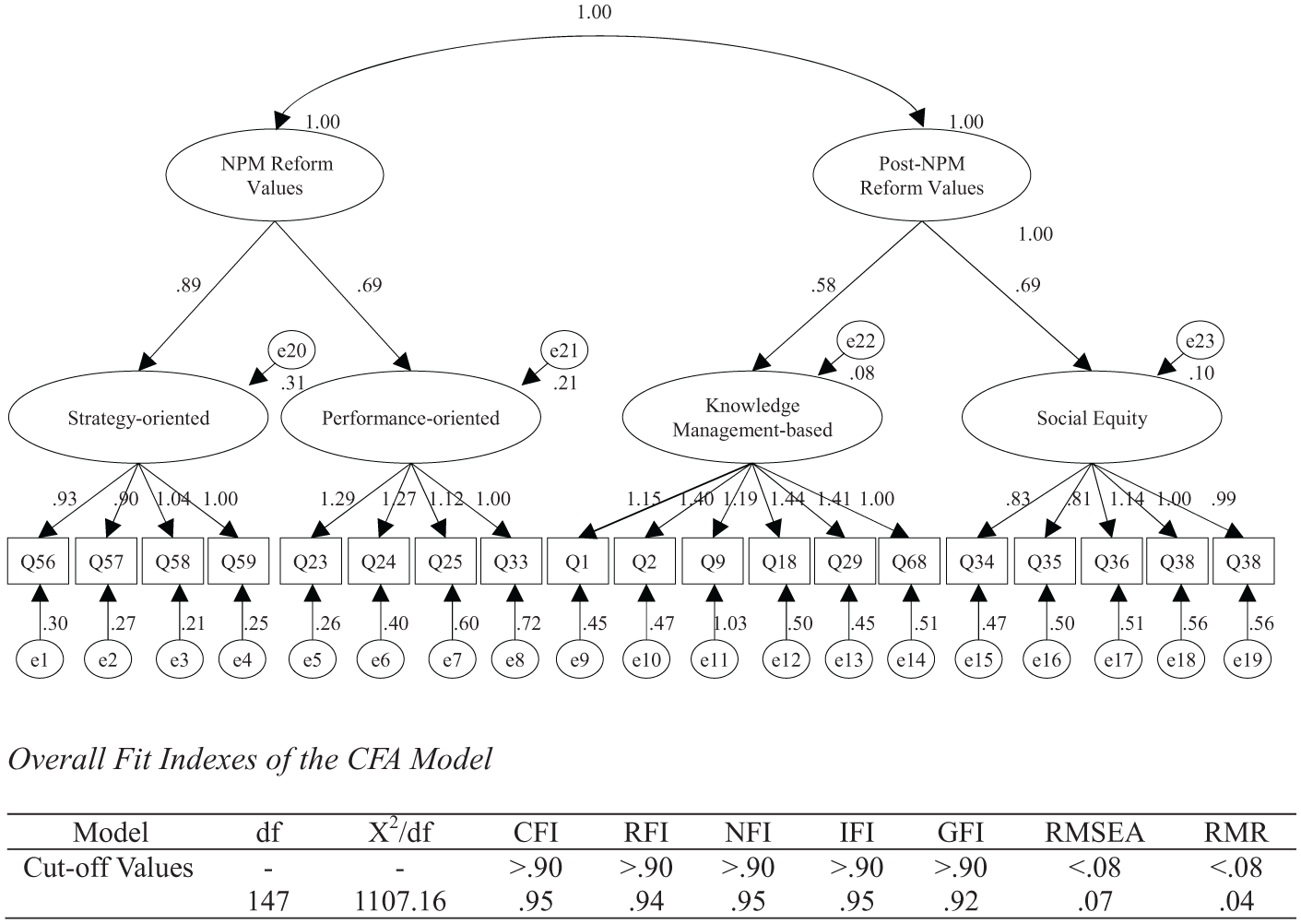
Selected survey items and results of reform values factor analysis.
Method
This study utilizes the 2015 FEVS administered to full- and part-time permanent executive branch employees. The survey was completed by 421,748 federal workers. The survey instrument measured public sector employees’ perceptions about organizational issues, agency location, and individual employee information.
Eight variables were used as controls to measure employees’ personal and job characteristics: position, gender, minority, age, length of service, education, disability status, and retirement. Two variables were used as measures of both individual status and satisfaction: telework satisfaction and alternative work schedules satisfaction. Together, these variables compose Level 1.
The Level 2 predictors were measured using the average scores for the variables of respondents from each agency. That is, Level 2 data are tallied by individual data. The main rationale for aggregating individual data into Level 2 is that reform usually occurs within an organizational context. As it was necessary to analyze reform values from an organizational perspective, this study examined Level 1 and Level 2 variables separately (despite the fact that all of the variables are individual-level measures) and aggregated the individual-level data at the organizational level. Then, reliability, construct validity, and the dimensionality of the four types of organizational reform values were checked. The items used to measure the four constructs and the results of the principal axis factoring with an oblique rotation are presented in Figure 2. The results are reasonable to accept based on common statistical indexes such as comparative fit index (CFI), normed fit index (NIF), root mean square error of approximation (RMSEA), root mean square residual (RMR), and so on (see Figure 2). Based on these empirical tools, strategy-oriented, performance-oriented, knowledge-based management, and social equity reform values were developed from the relevant survey items. To confirm the additive and interactive effects between the two types of satisfaction (Level 1) and four types of reform values (Level 2), eight interaction terms were measured to incorporate the joint and multiplicative effects of each on job satisfaction and turnover intention.
The first outcome variable, job satisfaction, was measured using factor analysis. Responses from the survey were collapsed into three items, and all items converged onto one factor (Cronbach’s α = .83). The second, turnover intention, used one item from the survey that asked whether participants intended to leave their agency within 1 year.
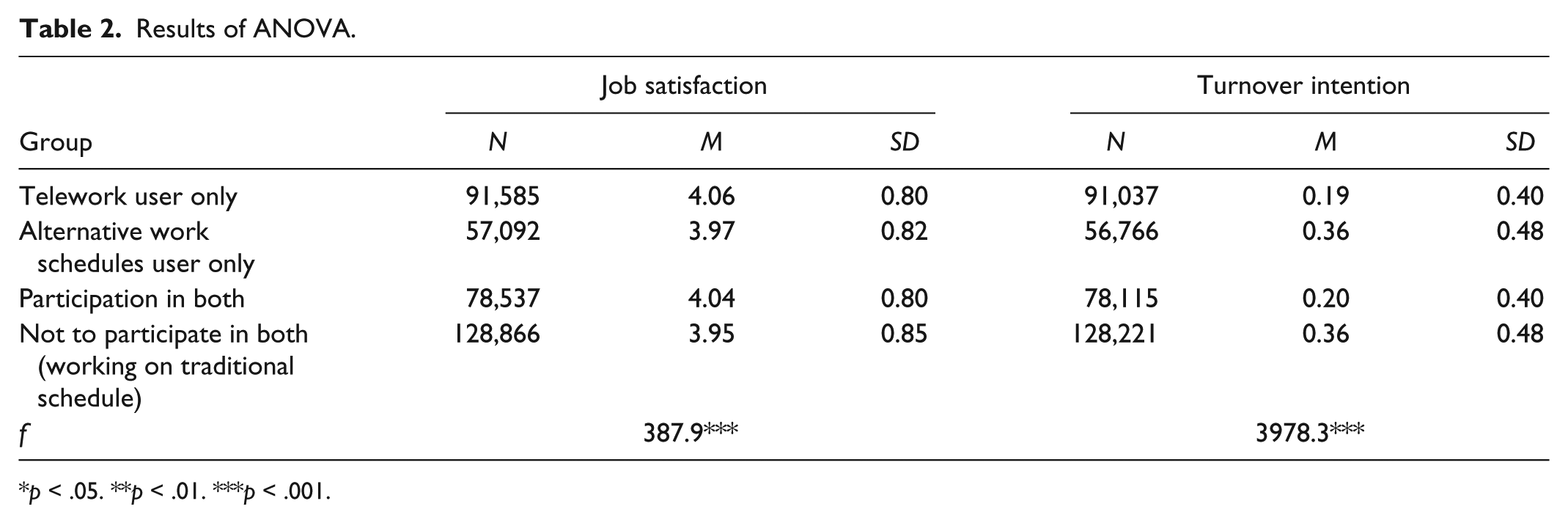
To compare the difference between groups regarding job satisfaction and turnover intention, descriptive statistics of variables (see Table 1) and the ANOVA (see Table 2) were checked.
Descriptive Statistics Among Study Variables.
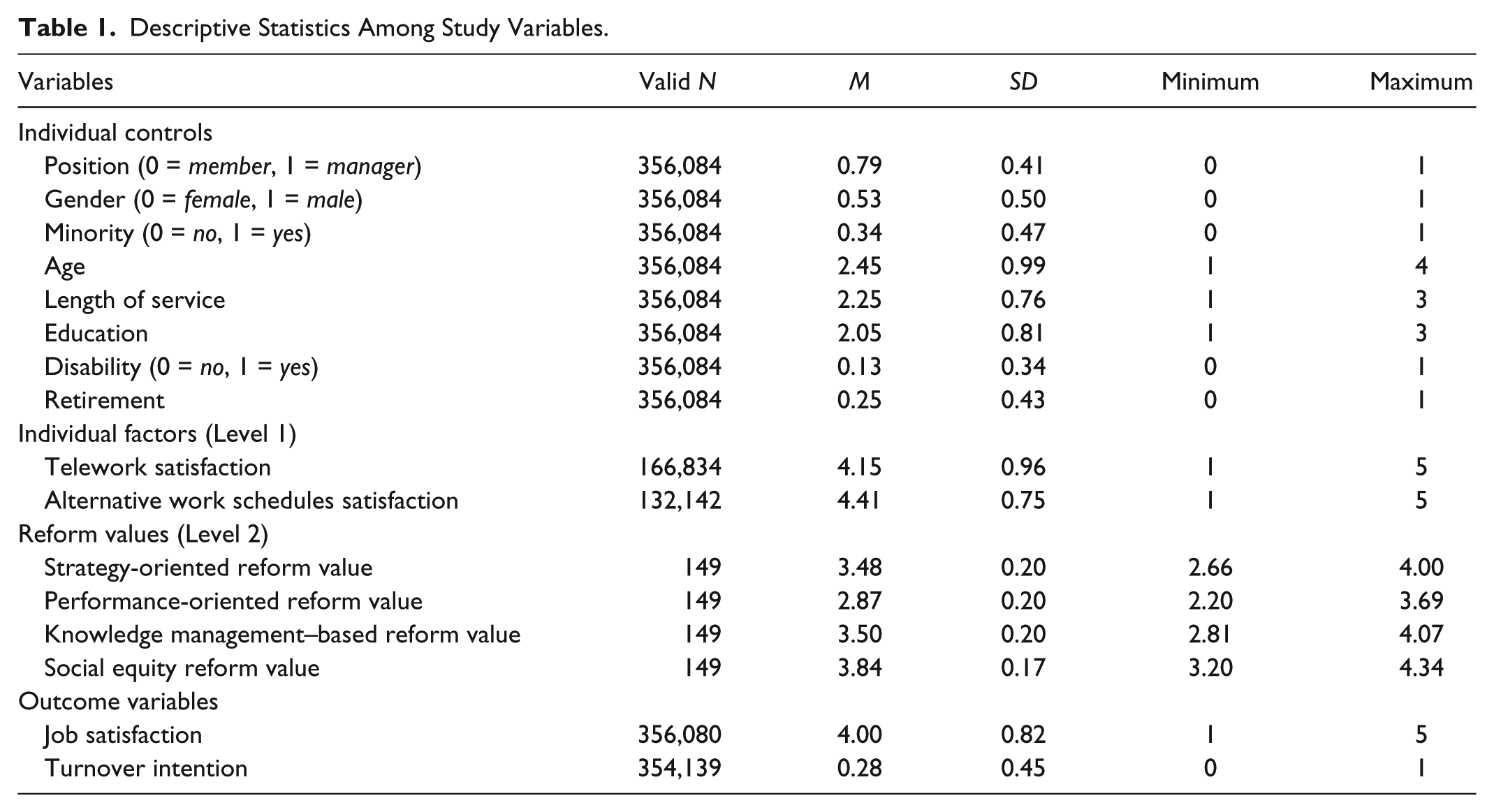
Results of ANOVA.
p < .05. **p < .01. ***p < .001.
Results
Hierarchical Linear Modeling Results
The Level 1 model: One-way ANCOVA model
For the individual-level model, a one-way ANCOVA model was employed to incorporate several covariates and determine how the Level 1 predictors would affect outcome variables. Each slope of the covariate is assumed to have the same effect on each level of the factor. Each predictor was sequentially added to the model, and only one variable was retained when it showed a reliability greater than .05 and had a statistically significant random effect. Based on the results, nine predictors were retained at the individual level. The nine covariates were included as fixed effects: (a) position, (b) gender, (c) minority, (d) age, (e) length of service, (f) education, (g) disability, (h) retirement, and (i) satisfaction with the two types of work schedules.
In the four ANCOVA models, all reliability estimates are greater than .05. The conditional ICC indicates that according to the job satisfaction of the teleworker model, teleworkers’ job satisfaction varies by approximately 2.8% across agencies. Similarly, according to the job satisfaction of the alternative work schedules user model, alternative work schedules users’ job satisfaction varies by approximately 2.1% across agencies.
Fixed and random effects
ANCOVA covariates would statistically adjust for the initial advantage. ANCOVA can control for adjustments in the influence of the covariate and the variance term on the intercept, especially when the covariates are grand-mean centered.
As shown in Table 3, position, minority, age, length of service, education, disability, retirement, and telework satisfaction are statistically significant factors in the job satisfaction of federal telework users, whereas position, gender, minority, age, length of service, education, disability, and retirement are statistically significant factors in the turnover intention of telework users.
Results of HLM for Teleworkers.

Note. (a) Individual level, n = 165,896 federal employees; (b) Organizational level, n = 149 federal agencies.
p < .05. **p < .01. ***p < .001. HLM = hierarchical linear modeling.
As shown in Table 4, position, minority, age, length of service, education, disability, retirement, and alternative work schedules satisfaction are statistically significant factors in the job satisfaction of federal alternative work schedules users, whereas position, gender, minority, age, length of service, education, disability, and retirement, and alternative work schedules satisfaction are statistically significant factors in the turnover intentions of alternative work schedule (AWS) users.
Results of HLM for Alternative Work Schedule (AWS) Users.
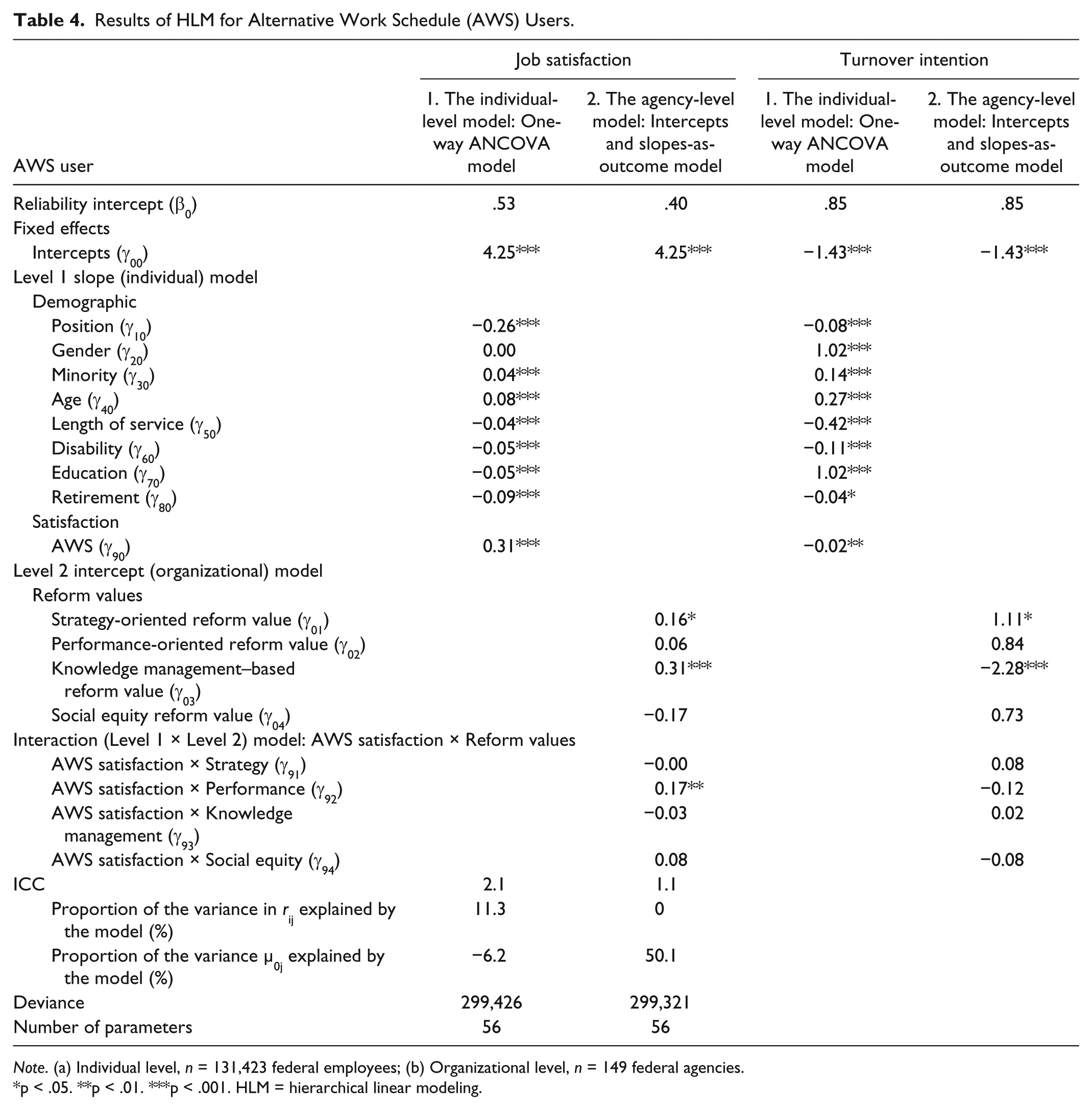
Note. (a) Individual level, n = 131,423 federal employees; (b) Organizational level, n = 149 federal agencies.
p < .05. **p < .01. ***p < .001. HLM = hierarchical linear modeling.
The Level 2 Model: Intercepts and Slopes-as-Outcome Model
An intercepts and slopes-as-outcome model, which assumes that the intercept and slope have random effects, was used in the organization-level model. Level 2 predictors in the intercepts and slopes-as-outcome model are included. In this model, a grand-mean centering option was used, and variables were added one at a time for model building while examining their coefficients for significance and reliability. Level 2 reform value predictors, as discussed earlier, were (a) strategy-oriented reform value (γ01), (b) performance-oriented reform value (γ02), (c) knowledge management–based reform value (γ03), and (d) social equity reform value (γ04).
Level 1 and Level 2 variances were included as random effects. In addition, to examine the cross-level interaction effects between reform values within an organization and satisfaction of the different work types, four interaction terms were included. In the cross-level interaction model, an interaction refers to when the association between Level 1 predictors and the outcome variables depends on the level of Level 2 predictors. The cross-level interaction will be the differences between Level 1 random effects and Level 2 predictors in the slope-as-outcomes model. The final intercepts and slope-as-outcomes model is shown below:
Level 1 model: Yij (Job satisfaction, Turnover intention) = β0j + β1j (Position) + β2j (Gender) + β3j (Minority) + β4j (Age) + β5j (Length of service) + β6j (Education) + β7j (Disability) + β8j (Retirement) + β9j (Alternative work schedules satisfaction, Telework satisfaction) + ϵij
Level 2 model: Intercept: β0 = Y00 + Y01 (Strategy-oriented reform value) + Y02 (Performance-oriented reform value) + Y03 (Knowledge management–based reform value) + Y03 (Social equity reform value) + u0j
Slope 1: β9j (Alternative work schedules satisfaction, Telework satisfaction) = Y00 + Y01 (Strategy-oriented reform value) + Y02 (Performance-oriented reform value) + Y03 (Knowledge management–based reform value) + Y03 (Social equity reform value) + u0j
Other slopes: β1j = Y10, β2j = Y20, β3j = Y30, β4j = Y40, β5j = Y50, β6j = Y60, β7j = Y70, β8j = Y80
In the four intercepts and slopes-as-outcome models, all reliability estimates (β0) are greater than .05. The conditional ICC indicates that in the job satisfaction of the telework users’ model, telework users’ job satisfaction varies by approximately 1.6% across agencies. Similarly, in the job satisfaction of alternative work schedules user model, alternative work schedules users’ job satisfaction varies by approximately 1.1% across agencies.
Fixed and Random Effects
The results of the statistical analysis indicate that the strategy-oriented reform value (0.25**), knowledge management–based reform value (0.25**), and social equity reform value (–0.24**) effects are significantly associated with teleworkers’ job satisfaction.
The knowledge management–based reform value (–1.78**) effect is significantly associated with teleworkers’ turnover intention.
The strategy-oriented reform value (0.16*) and knowledge management–based reform value (.31**) effects are significantly associated with the alternative work schedules users’ job satisfaction.
The strategy-oriented reform value (1.11*) and knowledge management–based reform value (–2.28***) effects are significantly associated with the alternative work schedules users’ turnover intention.
Cross-Level Interaction Effects
Regarding the cross-level interaction effects, the performance-oriented reform values result in a strong relationship between telework satisfaction and job satisfaction (0.16***), and between alternative work schedules satisfaction and job satisfaction (0.17**).
Discussion
Contemporary organizations understand the necessity of adopting workplace flexibility (Halpern, 2005), giving employees leeway to choose the place, time, and duration to engage in work-related activities (Hill et al., 2001). Flexible work policies were well established for decades before 2017, including the Telework Enhancement Act of 2010 and the 2014 Presidential Memorandum—Enhancing Workplace Flexibilities and Work-Life Program, and even the Clean Air Act was in favor of flexible work arrangements, specifically through telecommuting to ease commuter congestion (Karnowski & White, 2002). In this study, we chose two types of flexible work systems and explored their dynamics using survey data from 2015.
These findings suggest that certain types of reform values positively affect employees’ job satisfaction when employees are satisfied with the utilization of alternative work schedules. That is, certain institutional and cultural conditions could act as factors for enhancing positive organizational outcomes.
The results confirm that satisfaction with the two types of flexible work systems has a positive effect on job satisfaction and turnover intention. Satisfaction with telework and alternative work schedules intensifies the job satisfaction. In addition, the satisfaction with telework and alternative work schedules mitigates turnover intention. These confirm Hypotheses 1a, 1b, and 2a.
It is also of note that only performance-oriented reform values have a moderating effect on the relationship between satisfaction with alternative work schedules and job satisfaction. This confirms Hypothesis 4a.
To reiterate from Figure 2, this reform value was represented in the survey data by statements focusing on management communication with different work units, evaluation of progress toward meeting organizational goals, and supporting collaboration across work units to accomplish objectives.
An unexpected finding was that the flexible work systems’ participant’s level of job satisfaction and turnover intention is similar to that of employees working a traditional schedule.
Implications
As 2017 begins, employee disaffection in the federal bureaucracy is increasing with the conservative agenda emanating from the Trump White House. Without knowing which reform values might accompany a potential Trump Presidential Management Agenda, this study may be able to speak to HR program enhancements to help prevent employees from exiting the civil service.
Previous research has for the most part investigated whether employees participate in flexible work systems. This study contributes by testing the effects of participation and satisfaction with flexible work systems on job satisfaction and turnover intention. The results suggest a few implications for the effective implementation of flexible work systems in federal agencies. First, as the results of the study reveal, participation in flexible work systems is not enough to have a significant, positive influence on job satisfaction and turnover intention. Positive effects occur when employees are satisfied with flexible work systems’ utilization.
Managers should exert great efforts to create environments that help foster effective flexible work systems. For example, employees may have negative experiences with flexible work systems when they cannot cooperate or communicate well with others because they do not share the same working hours or time zone (Nollen, 1981). Managers should implement flexible work systems with care as imbalanced application or too much flexibility without consideration of organizational contexts or job characteristics may lead to additional problems.
Second, it is useful to wrap performance-oriented reform values around flexible work systems. To effectively enhance organizational performance through flexible work systems, compensation based on performance evaluation should be executed fairly with due process. If employees receive a partial reward because of their utilization of flexible work systems, they may experience negative feelings toward utilizing flexible work systems. In addition, this may negatively affect individuals’ promotions or careers because the use of flexible work systems reduces communication among employees. Maxwell and McDougall (2004) reported that financial incentives have been encouraged in the U.K. public sector, and that employee consultation and effective communications are necessary to develop and implement work–life balance practices. Considering the budget limitations in the public sector, the implementation of flexible work systems with impartial rewards can be an effective strategy to recruit and retain talent.
The findings suggest a rethinking of organizational outcomes through the mutual effects of reform values and flexible work systems. Individual employee attributes are not the sole factors associated with employee satisfaction and turnover intention. The greater context of governmental reform can affect their perceptions of their job and choices. This study shows that flexible work systems are more positively and significantly moderated by NPM performance-oriented reform values than by post-NPM values of knowledge management–based and social equity reform values. Does this imply some kind of imbalance? Quinn (1988) suggested that organizations are effective when values are balanced rather than when a certain value is dominant in an organization, owing to the fact that different values can create a synergistic effect when these operate harmoniously rather than in conflict. That performance-oriented values positively moderate flexible work systems’ impact on employee satisfaction may not be surprising however, if workers’ satisfaction with telework and alternative work schedules derived from productivity are, for example, rewarded by performance appraisal systems.
With a new conservative management agenda looming, the market-laden values of NPM might stage a resurgence and swing the pendulum away from the post-NPM philosophies of the early 2000s. Our article examined only the performance-oriented aspect of NPM, among others aspects, and does not speak to NPM’s more market-oriented themes, such as the use of privatization, loosening of hiring and firing controls, and the emphasis on business customer orientation, which might easily be reintroduced in the federal bureaucracy. This latter set of NPM values could bear upon the redesign and execution of flexible working systems under President Trump, and influence workers’ satisfaction with their jobs and the civil service. It is possible that the administration’s promise in 2017 to downsize the bureaucracy and scale down federal benefits will be matched by an increasing use of alternative work systems. Imagining the direction in reverse, civil servants’ dissatisfaction and intention to leave the service because of the perceived conservative values of impending Trump era reforms could compel the administration to look toward greater use of privatization and alternative work systems. Downsizing would open up a host of human capital concerns, as attrition and the lack of succession planning in the public sector are already denting bureaucracy’s capacity to adapt to its challenges. Our study is quite limited with regard to these issues, but it may provide a small window into the state of the civil service as a new era begins.
Notes for Future Research
What we did in this study was to nest an HRM policy’s potential effects on federal employees’ job satisfaction within a larger construct, the perception of the values accompanying executive management reforms in federal agencies. This study has some limitations. First, we did not classify flexible work systems any further and investigate their effect on job satisfaction and turnover intention. Alternative work schedules can be divided into many types including flexible, compressed work schedules. Telework also has many types depending on frequency of use. As individual subprograms have different features, we exclusively used telework and alternative work schedules without consideration of a subdimension. A second limitation that future studies could address is that this research used one dummy variable to measure turnover intention owing to the fact that there is one variable related to turnover intention in the FEVS data set. When the dependent variable was a dummy, hierarchical linear modeling did not provide detailed information concerning model fit. Hence, the model fit in the hierarchical linear modeling could not be checked because the turnover intention involved dependent variables.
Footnotes
Declaration of Conflicting Interests
The author(s) declared no potential conflicts of interest with respect to the research, authorship, and/or publication of this article.
Funding
The author(s) disclosed receipt of the following financial support for the research, authorship, and/or publication of this article: This work was supported by the Ministry of Education of the Republic of Korea and the National Resaerch Foundation of Korea (NRF-2016S1A3A2924832).