




Abstract
“Public use” is a constitutional limitation on the governmental authority to take private property using eminent domain. This study finds that it is irrelevant, an artifact of the federal constitution, in state reforms enacted in the last decade. Expansive language permitting economic development and private development have rendered public use to be merely symbolic. Forty-six states enacted takings reforms following Kelo v. New London, a landmark U.S. Supreme Court decision in 2005; approximately 80% of those states allow economic or private takings while also invoking the public use. This mixed-method analysis and normative theoretical grounding explain stark contradictions in the prevailing reforms nationwide, resulting in substantive implementation challenges that may be mitigated by sensitivity to regime values, one of which is property.
Eminent domain is the constitutional right to take private property for public use, provided that property owners are paid just compensation. Governments are empowered through the Takings Clause of the Fifth Amendment to the U.S. Constitution: “Nor shall private property be taken for public use, without just compensation.” The Takings Clause, therefore, provides two constitutional limitations on the governmental use of eminent domain: public use and just compensation. Because the U.S. Supreme Court has ruled that just compensation means fair market value of the home, business, or land being taken by eminent domain, the public use requirement is the only normative constitutional limitation on governmental power and authority. Grounding our understanding of the Takings Clause in the theory of regime value of property (Rohr, 1989) helps mitigate takings implementation challenges revolving around public use as an actionable constitutional principle. This research seeks to answer the following question: What is the context of contemporary takings reforms regarding economic and private development takings?—Using the regime values approach, is public use still relevant for implementing eminent domain policies? This comprehensive study is important to the field of public administration because it explains a high-stakes, complex policy environment. It is relevant to practicing managers charged with making decisions about takings and those interested in community development. Scholars should find value in advancing the normative understanding of how regime values can still apply in our constitutional republic.
As a limitation on governmental action, however, the Court has consistently expanded public use to include economic and private development over the last 60 years, paving the way for an increase in takings. Moreover, contrary to public perception, public use has never been interpreted by the Court as requiring an actual use by the public; just the opposite has been the law since its first ruling in 1896. In the decade since the landmark Kelo v. New London (2005) decision, states passed takings reforms en masse that explicitly permitted economic and private development takings and relegated the status of the public use limitation to being a symbolic artifact of the U.S. Constitution. The implementation problem presented for the field is that these reforms also require the economic and private development takings to be in the public use, which has lost all substantive meaning, as these findings show.
Rohr (1989) argues that administrators should use Court decisions, holistically beyond the majority opinion, for reflecting on their discretionary power to implement public policy, in large part because they are critical arguments on constitutional problems. Using the law as Rohr suggests uncovers the values of the people, the regime values—one of which is property. The Court’s takings rulings are not a departure from precedent, but what has changed rapidly is the use of takings in practice post-Kelo. By igniting debates on the interpretation of public use, the decision brought to the forefront economic, and especially private, development takings that were not as prevalent pre-Kelo. At the Court’s urging to enact stricter reforms, states responded with an expanse of these types of eminent domain, while also requiring the taking to be for public use, conflicting the values of public use, private property, and economic and private development in theory and practice. “Not all values are equal,” writes Rohr (1989), and under the regime values method, property is a “principle held for several generations by the overwhelming majority of the American people” (pp. 63, 74). A central tenet of the regime values argument is administrators using their discretion to take the opportunity to do better by advancing or impeding the eminent domain process, the high road, rather than using it to stay out of trouble, the low road. Public use is a symbol of property in the Constitution that should be restored through administrators’ discretionary authority in the implementation process via deliberate thoughtfulness of normative regime values.
This research examines the practical relevance of public use in implementing eminent domain by way of recent reforms to explore the economic and private development takings environment. Empirically studying all state reforms passed in the decade following Kelo v. New London facilitates analysis through the normative framework of the regime value of property and contemporary takings uses of economic and private development. An analysis of all 46 states’ reforms shows that the constitutional public use requirement for eminent domain is being undermined by provisions allowing for economic and private development takings because they simultaneously invoke public use. Economic development takings include increased jobs and tax growth, and private development takings involve transferring property between individuals, often including developers. Historically, pre-Kelo, the Court ruled that economic and private development takings are constitutional; the 2005 Kelo decision was not a new constitutional question. The policy outcomes were, however, because of the resulting reforms that diminish the regime value of property to status as a constitutional artifact, rather than a principle.
From a policy-design-implementation perspective, the dichotomous nature of the post-Kelo eminent domain environment challenges practitioners’ ability to implement takings effectively and responsibly in their localities. Accountability, autonomy, and flexibility are all questioned when eminent domain is put on the table. How are takings to be in the public use while serving direct private gain? This normative conflict creates an opportunity to elevate and restore public use via the regime value of property. In an era of grassroots activism, interest groups’ scrutinizing governmental takings, and fiduciary responsibilities to prudence in paying just compensation, administrators charged with implementing eminent domain operate in an environment more complex than ever before. Including Rohr’s (1989) regime values approach complicates implementation, to be sure, but in a manner consistent with the constitutional rights at stake in the Takings Clause of the Fifth Amendment—individual private property rights and the governmental right to use eminent domain.
To show the gradual erosion of public use as a constitutional limitation in practice, the next section begins with a brief description of eminent domain, followed by an overview of landmark U.S. Supreme Court takings precedents and the current constitutional guide, Kelo v. New London. An examination of the post-Kelo environment shows how takings are practiced post-Kelo, as well as the analysis of state eminent domain reforms. Scholarship brings forth implementation challenges for those studying and working in the field, pointing to regime values as a theoretical grounding that can restore practicality to public use. Implications for research and practice apply the regime values approach to the study’s findings. This work improves constitutional discourse in public administration because it focuses on the challenges that result when constitutional principles conflict with policy design and policy implementation.
Economic and Private Development Takings
Eminent domain for economic and private development is constitutional, per the U.S. Supreme Court’s decisions from the first case on the issue in 1896 through the most recent case, Kelo v. New London, in 2005. The following analysis of takings scholarship cultivates a fundamental understanding of technical aspects of economic and private takings. Han (2008) argues that there is a distinction between economic development and urban revitalization (i.e., blight removal), the latter of which he maintains ties more closely with the public use requirement. Cohen (2006) advances this, noting that economic development takings should be prohibited, absent a direct public use. Boudreaux (2005) holds a similar stance on private development, or eminent domain involving a private gain. Given the climate of governments being required to do more with less, quasi-public organizations and public-private partnerships involving developers are increasing as a means to producing tax revenue or bring jobs to the community. Some scholars (Farjad, 2007; Salkin & Lucero, 2005) support eminent domain for economic development involving arrangements for increased taxes and jobs.
Once the government initiates takings proceedings, the process moves forward via the court, despite property owners wishing to holdout. Governments often negotiate with property owners prior to invoking takings, called “friendly takings.” Once condemnation proceedings begin, holdouts are unable to stop the process (Garnett, 2006; Mihaly, 2007). Both Benson (2005) and Kelly (2006) aptly note that one of the reasons governments initiate takings is because of property owners slowing the process, costing money to taxpayers. Takings are a last resort to mitigate delays. Research counters that litigation and other transaction costs may limit governments’ use of takings in favor of alternatives, such as friendly takings or revising the development plan (Cypher & Forgey, 2003; Esposto, 1996; Niemann & Shapiro, 2008).
Uselessness of Public Use
Three unanimous U.S. Supreme Court precedents led to 2005’s Kelo v. New London, the 5-4 decision and current constitutional guide for studying and implementing eminent domain. Public use as a constitutional limitation on takings has been gradually eroded; Kelo was not asking the Court to decide on a new constitutional question, and it was not an outlier in a constitutional sense—public use was long ago eroded to a broader public purpose. It was, however, widely considered an outlier from a policy perspective, resulting in 46 states passing reforms in the last decade because the Court invited them to do so; the language of their decision seems to suggest that their intention was to pass stricter reforms: “We emphasize that nothing in our opinion precludes any state from placing further restrictions on its exercise of the takings power” (p. 489). Justice Stevens, delivering the Kelo majority opinion, stated shortly after that it was correct as a matter of law but incorrect as a matter of public policy (Dorf, 2005). This speaks to the disconnect between policy design and implementation that plagues the takings landscape. Justice O’Connor, who delivered the majority opinion in the immediate precedent, authored the Kelo dissent, the thrust of which is that context matters, citing concerns over replacing private property with that which could be more economically beneficial.
Per the U.S. Supreme Court, public use was never interpreted to mean an actual use by the public. Dating back to 1896, it has been broadly interpreted as a more encompassing public purpose. This “public use as public purpose doctrine” filtered down in both theory, through the academy, and in practice, through state and municipal action. “Public use” language persists in mainstream interpretations by the public, resulting in a disconnect between how the public perceives private property protections and how the government interprets its takings power. 1 These precedents include an element of economic and private development, culminating in Kelo.
In Fallbrook Irrigation District v. Bradley (164 U.S. 112 [1896]), the public use question centered around a California statute creating artificial irrigation districts to be managed by private entities that would levy a tax on property owners in the district. Here, the Court asserts, “It is not essential that the entire community or even any considerable portion thereof should directly enjoy or participate in an improvement to constitute a public use . . . . The water is intended for the use of those who will have occasion to use it on their lands” (pp. 161-162). The Fallbrook Court begins expanding public use to public purpose, shifting the meaning of “the public” from the entire public to the relevant public; some portion of the public had access.
In Berman v. Parker (348 U.S. 26 [1954]), the Court ruled that eminent domain was among the government’s police powers to regulate “public safety, public health, morality, peace and quiet, [and] law and order” and that “the power of eminent domain is merely the means to the end” (p. 32). The Washington, D.C., case questioned whether blight removal constitutes a public use. Per the Court, it did meet the requirement, and the Court noted that not all private properties must be individually blighted to implement a taking. Berman greatly expanded use to purpose.
Hawaii Housing Authority v. Midkiff (467 U.S. 229 [1984]) substantially expanded public use in the interpretation of a state statute permitting renters to have the property condemned, after which time they could purchase the property to diversify land ownership. The Court explained that eminent domain is a constitutional right, coterminous with its police power, stating, “What in its immediate aspect is only a private transaction may be raised by its class or character to a public affair” (p. 244). Further, the Court held, “It is only the taking’s purpose, and not its mechanics, that must pass scrutiny under the Public Use Clause” (p. 244). Justice O’Connor authored the Midkiff opinion.
Kelo v. New London
All cases were precedent for 2005’s Kelo v. New London (545 U.S. 469); they were unanimous, but Kelo was sharply divided 5-4 with four opinions (majority, concurring, and two dissenting). Increased taxes and job growth in the city’s redevelopment plan presented the constitutional question surrounding public use. This creates implementation challenges because of a conflict between the constitutional principle of public use, which encompasses economic development, and post-Kelo policy design that purports to protect the regime value of property from such takings. The Court held, “Without exception, our cases have defined that concept broadly . . . Because that plan unquestionably serves a public purpose, the takings challenged here satisfy the public use requirement of the Fifth Amendment” (pp. 480, 484). Through the city’s redevelopment plan, private properties taken were to be turned into a conference hotel, restaurants, new residences, retail space, a marina, and parking.
Justice Stevens delivered the opinion of the Court in Kelo. His distinction between it being correct law but incorrect policy is of critical importance. When the rule of law and public policy conflict, how are practitioners to implement effectively and responsibly? Ambiguous statues expand bureaucratic discretionary authority, but what affect does that contradiction have? It challenges practitioners and scholars to think about takings in new ways.
The Court’s invitation for “further restrictions” resulted in a significant challenge for public administration. State reforms were enacted in a direct response to the post-Kelo political fallout, but critical links between policy design and implementation were neglected by way of the interpretation of administrators exercising discretion in the takings implementation process. Language permitting economic and private takings abound across the majority of states. As a result, any remaining self-regulatory practical utility of public use as a constitutional limitation on governmental power and authority to implement eminent domain was lost. The decade post-Kelo has rendered public use merely a symbolic artifact of the U.S. Constitution.
Eminent Domain in Practice
Context matters, as Justice O’Connor argued vigorously in her Kelo dissent. She authored the majority opinion in the immediate precedent. In 2005, however, she wrote that decision-makers must consider the evolving context of takings. As a policy domain, research on takings is interdisciplinary, inclusive of law reviews, urban studies and planning, economics, and public policy and administration. This section examines scholarship on post-Kelo reforms.
Eminent Domain Reform Studies
As quickly as states enacted post-Kelo reforms, the academy began analyzing them. Calfee’s (2006) quote summarizes the tone at the time: “The petitioners in Kelo may have lost the battle, but they may win the war” (p. 581). Lopez and Totah (2007) asserted that governments restricted post-Kelo takings, arguing that legislatures were in the midst of an institutional shift toward stronger property protections. Such is not the case, however, as this study shows.
Initially following Kelo, scholars debated the most appropriate institution to regulate takings. Serkin (2007) and Calfee (2006) support local government flexibility and autonomy in determining property protections. Knapp (2008) agrees, with an increase in accountability, as does Han (2008) through including the property owner’s perspective into the equation. Some researchers maintain that a means-ends test by the judiciary provides heightened accountability (Garnett, 2006), while others call for procedural reforms to the process (Farjad, 2007). Debates in Kelo’s aftermath struggled with high-level implementation questions.
With the virtue of time passing, research on post-Kelo reforms became more nuanced, studying the merits of all reforms holistically and with an eye toward practice. Hudson (2010), Mihaly and Smith (2011), Morriss (2009), and Somin (2009) approach their analyses from a legal perspective, and Olejarski (2011) studies the reforms via public policy implementation.
Hudson (2010, p. 1285) categorizes states’ due process protections (pre- and post-Kelo) with regard to whether pre-condemnation hearings and notifications are required; his research finds that 12 states provide the “panoply” of protections, 21 states lack due process protections, and 17 states’ protections are “procedurally deficient.” Mihaly and Smith (2011) note that Kelo’s effects are not fully visible yet, as the many exceptions have not been tested by the courts. Morriss (2009) finds that states with growing economies were more likely to pass substantive post-Kelo legislation due to the costs associated with the reform. Somin (2009) finds that Kelo’s backlash and poor reforms were a result of the public’s “political ignorance” (p. 2170). Olejarski’s (2011) findings call for administrators to incorporate the “principle of tangibility,” requiring tangible public use, when implementing takings to overcome vague statutory language (p. 336). From differing perspectives, scholars conclude that the reforms are problematic.
Normative Foundations
Implementing constitutional principles begins as a normative endeavor and must transform into practice through reflection. Studying and implementing eminent domain policy interface dynamically when we consider the rule of law and how to implement a legal case, given the role of discretionary authority and mindfulness of the regime values approach. Policy failures in which design and implementation lack congruence presents challenges and opportunities to our field’s scholars and practitioners working within the post-Kelo takings environment that teems with conflict and controversy.
Implementing Constitutional Principles
In the context of eminent domain policy implementation, the U.S. Constitution’s Takings Clause tells us that private property shall only be taken for public use; the Court ruled that an actual use by the public is not required since Fallbrook in 1896. The 2005’s Kelo decision was the tipping point for interpreting public use as a broader public purpose, however. Evidence of this is twofold: pre-Kelo decisions were all unanimous, but Kelo was a 5-4 split with majority, concurring, and dissenting opinions; further, Justice O’Connor shifted from authoring the majority opinion in the last decision to forcefully dissenting in Kelo, citing shifting context.
Constitutional principles may be learned from Court decisions, guiding the actions of administrators implementing eminent domain, as Rohr (1989) taught us with his regime values method, one of which is property. In Newbold’s (2010) discourse advocating for a Constitutional School in public administration, she relies on the “practical value of the Constitution to the American administrative state” (p. 538). The Takings Clause is only 12 words, public use is only two; to property owners and practitioners charged with implementing takings, these words possess great power and authority. Through the actions of the Court, the constitutional limitation of public use has been undermined, losing the practical value for which Newbold calls. In practice, as Rosenbloom (2013) explains, the administrative state involves a blending of implementing and policymaking. Property is a normative value, Rohr (1989) maintains, because it is a value of the people; simply because reforms permit greater latitude for economic and private takings in a post-Kelo environment does not mean that administrators must make full use of it by expanding the practice of eminent domain. Their discretionary authority, when exercised in a reflexive, prudent manner during implementation, can restore practical value to public use while advancing states’ takings. Applying the regime values approach to implementing eminent domain shifts the dialogue into one grounded in normative public administration—due attention to the value of property should guide implementation from idea inception to property condemnation.
Implementing Regime Values
Implementing a legal case requires administrators to harness expertise and discretion to interpret a court decision and subsequent state and municipal reforms. Such a process involves balancing statutory/ordinance compliance with professional, ethical judgment to garner support and trust during the implementation process (Eubanks, 2004; Garofalo, 2008). A mindfulness of the population likely to be affected, beyond the target population, as well as the ripple effect of implementation may require more technical training (Hunter, 2004; Mawdsley, 2000). Practitioners implementing takings must make responsible, difficult policy decisions (Krislov, 1974), or what Newswander (2015) calls “governing is ugly” (p. 868). Gooden (2004) and Meier and Bohte (2006) both write about some degree of active responsiveness in the problem-solving process. The thrust of Bamberger’s (2008) piece is central here because he calls for balance between constitutional norms and regulatory goals during a deliberative process.
A regime values approach to the implementation process should involve the values of the community faced with the eminent domain decision. 2 State and municipal actors’ decisions should seek to include the perspectives of property owners with land potentially being taken, community and neighboring parcels whose property values and businesses will be effected, taxpayers who will be required to pay the just compensation via their taxes, community members and others who want to be involved, public officials seeking re-election, and administrators leading and supporting the implementation process (deLeon & deLeon, 2002). This is why discretionary authority becomes essential to studying and implementing eminent domain policy; on the road to condemnation, administrators must remember the constitutional values underlying the takings power as they make decisions (Rohr, 1989).
Discretion is soft power, or how administrators interpret what an ordinance or statute means in practice, based on expertise, training, reflection, and moral reasoning. Rohr (1989) describes it as a process of responsibility to “advise, report, respond, initiate, inform, question, caution, complain, applaud, encourage, rebuke, promote, retard, and mediate” (pp. 36-37). Administrators should be mindful of their expertise and training, Cook’s (1998) constitutive role, when they use discretionary authority to implement policies, and their instrumental role, so they are effective and responsible. Through discretion, practitioners make policy every day.
Implementing Eminent Domain Policy
Administrators do not make public policy in a vacuum, however. Politics and agenda-setting affect the policy process, as is the case with eminent domain, often resulting in front-page controversies about takings uses and abuses. Eminent domain was in the forefront of the 2016 presidential campaign for one candidate’s almost-collaboration with a municipal government using the takings power for a casino. The policy problem for those studying and managing takings is one of design-implementation failure: The U.S. Constitution requires a public use limitation, and the Court has eroded that limitation to an irrelevant artifact. A majority of state reforms, however, require eminent domain for economic or private development to meet this merely symbolic public use burden.
Implementing takings policy is a classic example of Lindblom’s (1959) incrementalism, or muddling through. Here, the test of a good policy is that most people agree on the policy without agreeing that it is the best policy. This brings forth the challenge of implementing conflicting constitutional principles via administrative discretion, absent the nexus between policy design and implementation. Moreover, the act of initiating proceedings occurs because it is a last resort, after pre-condemnation and negotiation strategies failed. Initiating a taking triggers judicial proceedings involving property assessments for the just compensation requirement; public use is generally noncontestable due to statutory language (Olejarski, 2013). This means that the connection between takings design and implementation is exacerbated by limiting discretionary authority in interpreting the language.
Given the policy environment of implementing takings, the normative reliance on property as a regime value becomes even more important for those studying and practicing takings. This requires vigilance in developing our understanding of the high-stakes nature of private property rights and how they complement community values (Rohr, 1989; Rosenbloom, 2013). State takings reforms created a complex implementation challenge whereby eminent domain is often required to be in the public use, even for private development. For Pressman and Wildavsky (1984), this scenario is what they call “the rub” of policy design-implementation: “The separation of policy design from implementation is fatal” (p. 164). O’Toole (2000) echoes this sentiment, arguing that implementation has been neglected in favor of design, as is the case with takings. Yet states continuing to revise policies during the implementation process, as Pressman and Wildavsky describe the rub, does provide the opportunity for administrators to restore Newbold’s (2010) practical value to the public use requirement. Applying a regime values approach that incorporates normative decision-making into the equation elevates public use to being more than a symbolic constitutional artifact. This is the essence of implementing a legal case.
From a macro perspective post-Kelo, reforms are characteristic of Matland’s (1995) symbolic policy implementation, rife with political conflict and ambiguous policy goals that allow flexibility for normative considerations. Successful policy goals are extraneous considerations: governments do not lose the takings power if a project is unsuccessful or fails to materialize (see the Kelo takings). Governments may build substantial goodwill within the community if the process is implemented “well” in the context of the locality, inclusive of producing results. As deLeon and deLeon (2002) describe, implementation should include all interests through citizen participation and a responsive administration, often through formal statutory public hearings. As Court decisions trickle down to state reforms and to municipal ordinances, Exworthy and Powell (2004) call these “big windows” and “little windows” that should be given attention during implementation.
Analysis of State Eminent Domain Reforms
In the immediate wake of Kelo, the academy was optimistic that states were accepting the Court’s invitation toward stronger private property protections (Calfee, 2006; Lopez & Totah, 2007). Recall the Kelo (2005) Court’s quote: “We emphasize that nothing in our opinion precludes any state from placing further restrictions on its exercise of the takings power” (p. 489). Forty-six states responded to the Court, ostensibly to restrict takings. This research examines the practical relevance of public use in implementing eminent domain, given the conflict between constitutional principles and policy design and implementation.
Method
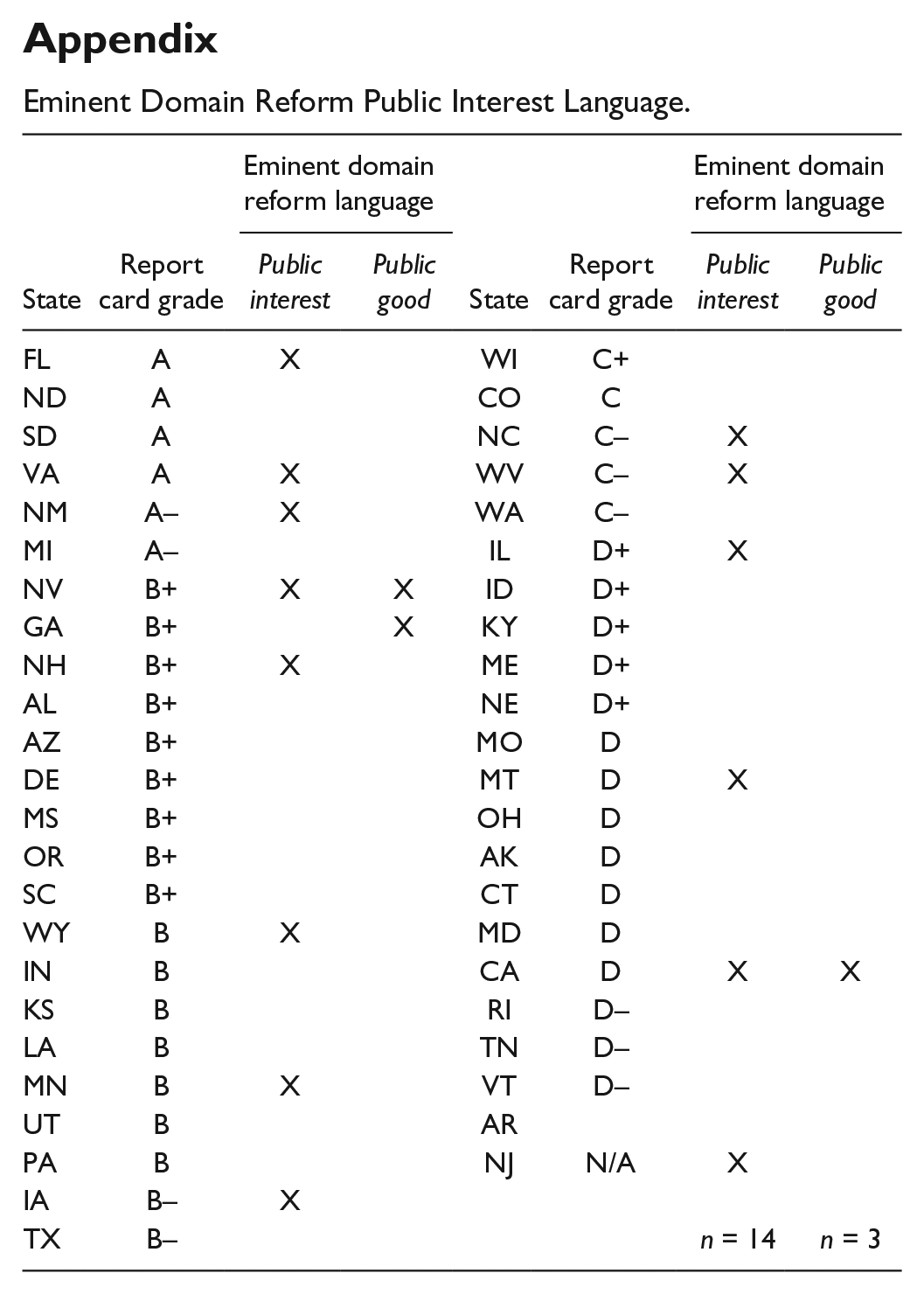
Using a mixed-method approach, this research design comprehensively analyzes all 46 states’ eminent domain reforms post-Kelo. The purpose of this research project is to discern the relevance of public use as a valuable construct in implementing eminent domain and to explore the thrust of the economic and private takings landscape in light of the regime values approach. Accordingly, employing the regime values approach here lends itself to an emphasis on actionable constitutional principles, or linkages between takings theories and implementation challenges. In other words, using regime values facilitates a robust discussion surrounding administrative discretion and a reflection on constitutional challenges in takings. Initial public-use-centric, data-collection for this study required conducting a content analysis of all post-Kelo reforms (statutes, constitutional amendments, citizen initiatives, etc.) across the 46 states, searching for the phrases “public use,” “public purpose,” “public interest,” and “public good.” These data were organized by state, as some states passed multiple reforms, all of which were analyzed. Data were organized in the forthcoming tables according to a letter grading scale created by the Castle Coalition, the legislative arm of the law firm that represented the petitioners in Kelo. This scale is widely cited in the takings scholarship, so it is included here, except for two states that passed reforms after the organization’s analysis. The scale, however, is not considered as a primary source in the analysis of post-Kelo reforms because it lacks the scope and nuance of the present study. Distinctions that the Castle Coalition uses among the letter grades are subjective, absent robust criteria; thus, these grades are used here to maintain consistency with relevant scholarship. The goal was to collect quantitative data on the number of states, out of 46, that include public use and public purpose provisions in the eminent domain reforms (shown in Table 1; appendix includes ancillary data on public interest and public good).
Eminent Domain Reform Public Use Language.
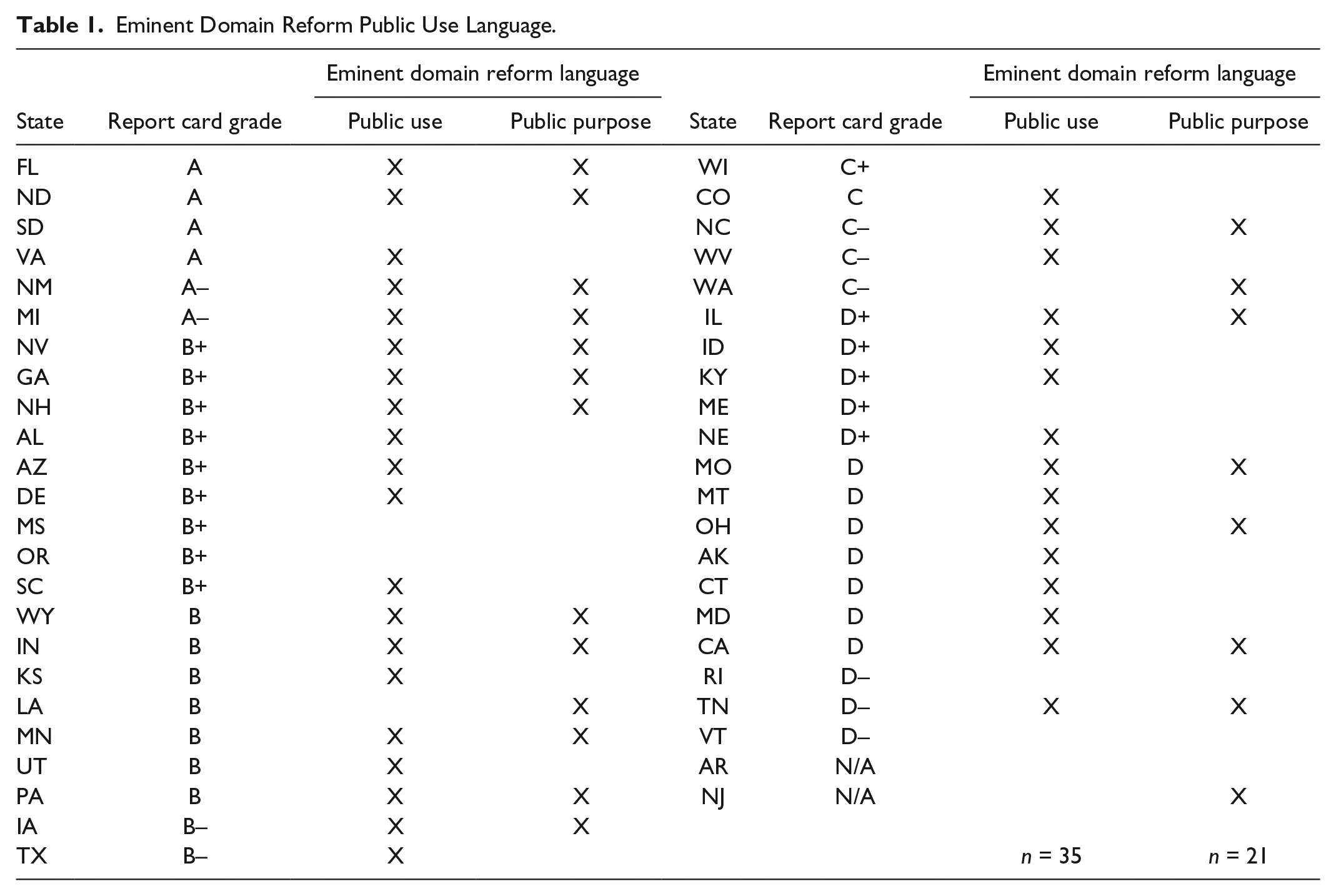
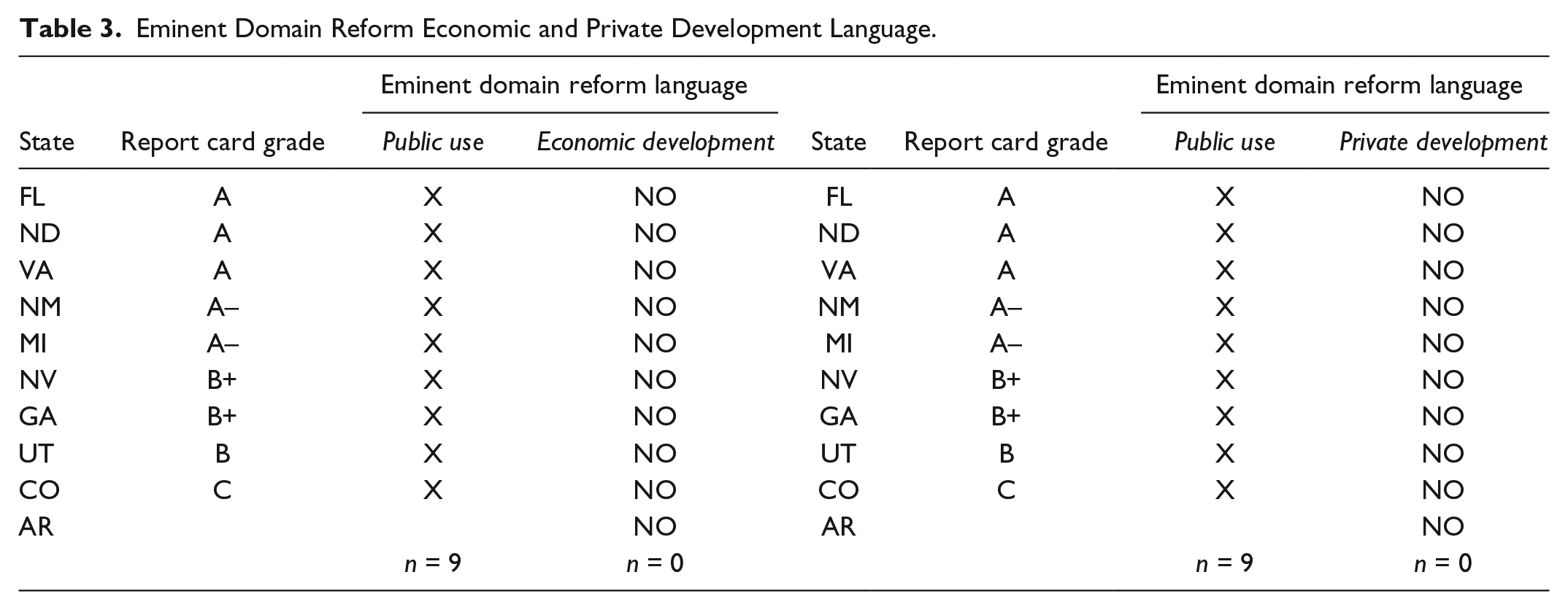
During the second stage of the content analysis, focus shifted toward identifying the phrases, and those relating to “economic development” and “private development.” Language within the reforms was evaluated in light of the scholarship on normative values to unpack how precise the private property protections via the analyses were, given the public use versus public purpose context creating implementation challenges for the field. Specifically, the qualitative analysis of key terminology and surrounding language here relies on property as a normative value, as expressed by Rohr’s (1989) work: focusing on administrators’ discretion via property values and economic and private development. This analysis required a substantial review of the surrounding text and amendments; it often resulted in reading the entire reform and linked statutes to grasp the context. For example, common carriers proved challenging as a classification hurdle in the beginning, until it became evident that they were a universal exception. Therefore, it would not fit with the spirit of the project to classify a state as permitting private development takings if it made an exception for common carriers. It was a similar judgment call regarding regional exceptions like those discussed under private takings below (pipelines, coal, technology parks). Distinctions established in the takings scholarship guided classifications (Boudreaux, 2005; Cohen, 2006; Farjad, 2007; Han, 2008; Salkin & Lucero, 2005). From a macro perspective, the project’s goal is to understand the bigger picture of economic and private development takings post-Kelo. Collecting quantitative data on the number of states, out of 46, that permit economic and private development takings in the reforms was the aim (shown in Tables 2 and 3). As these findings show, practical implications for the field center around both the reforms themselves and also how administrators implement them in the context of regime values. The four states excluded from this study had eminent domain policies pre-Kelo and did not pass reforms. Excluding states from the data-set for the above reasons may result in an artificially lower number of states permitting economic or private development takings, but the findings are the same: states RSVP’d to the Court’s invitation, and left grandma (public use) at home and brought their rich aunt and uncle (economic and private development).
Eminent Domain Reform Economic and Private Development Language.
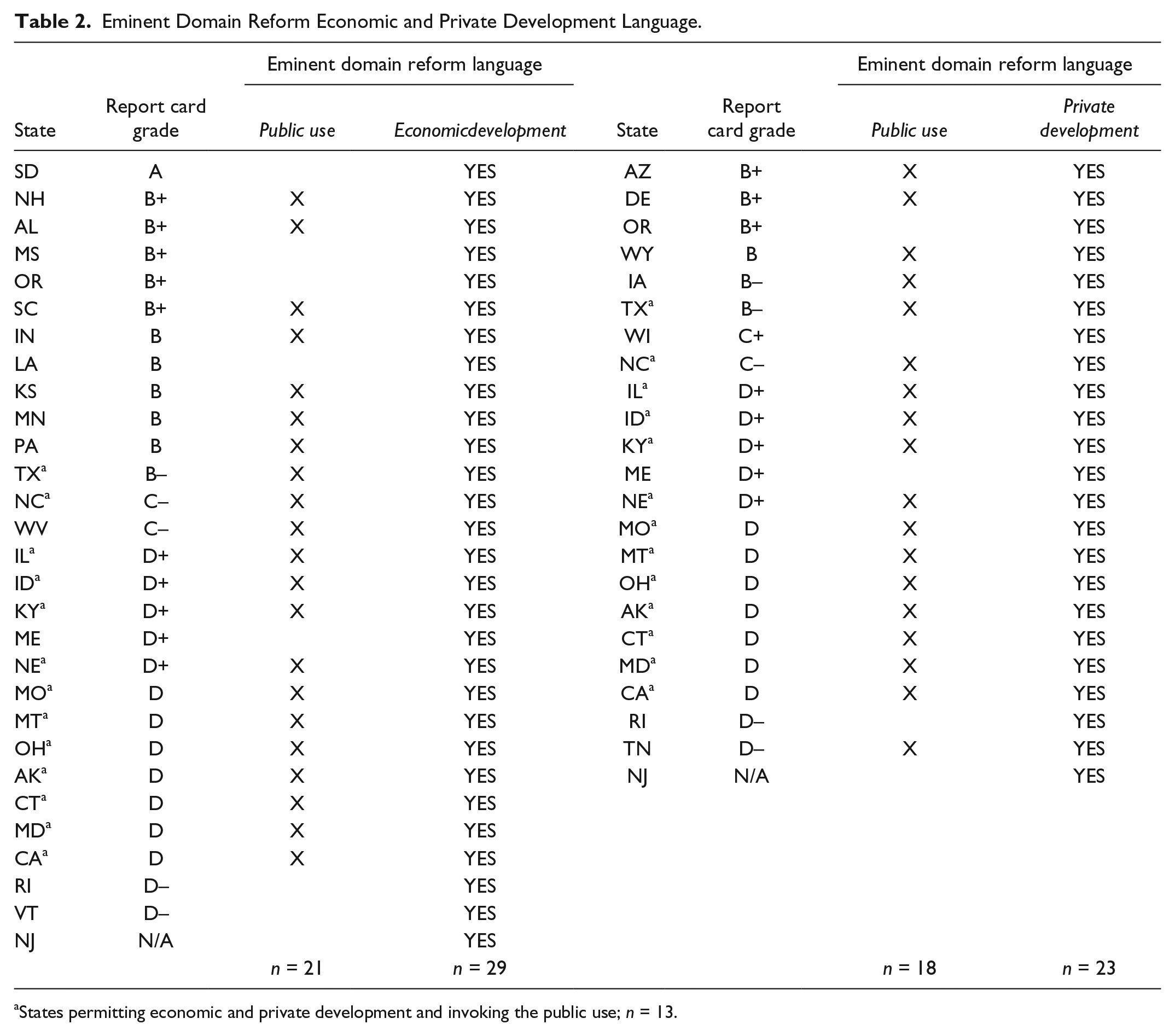
States permitting economic and private development and invoking the public use; n = 13.
Eminent Domain Reform Economic and Private Development Language.
Prevalence of Public Use in Takings Reforms
This research shows that “public use” continues to be ever-present in eminent domain reforms, though in name only, as the later findings will explain. It remains the dominant language choice, relative to the Court’s promulgation of “public purpose.” A majority of states, 35 out of 46 (76%) included public use language, compared with 21 out of 46 (46%) using public purpose language, shown in Table 1. The appendix shows that “public interest” and “public good” pale in comparison. The data also show that state reforms include conflicting language regarding the inclusion of public use and public purpose within the same state, demonstrating the challenges noted in policy-design-implementation scholarship: Pressman and Wildavsky’s (1984) fatal separation, O’Toole’s (2000) neglect of implementation, and an administration responsive to Lindblom’s (1959) muddling through (Cook, 1998; deLeon & deLeon, 2002; Gooden, 2004; Krislov, 1974; Meier & Bohte, 2006).
These findings support earlier aforementioned takings studies (Hudson, 2010; Olejarski, 2011) and speak to the implementation challenge facing administrators: takings that are required to serve a broader public purpose, while also being in the public use, facilitating a heightened consideration of regime values during implementation. Controversies arise when once of these conditions fails, typically the public use requirement, because it does not legally mean direct use by the public. Literature on symbolic policy (Matland, 1995) points to the role of political conflict during implementation.
Examining the data in Table 1 into upper and lower halves at the C+ grade, or that which might be cause for concern in MPA courses, there are roughly double the number of occurrences of public purposes in the upper half. While this is problematic from an implementation perspective, directly conflicting with public use, there may be a positive side. It may be an indication of what some of the takings reform studies noted in terms of broader public awareness (Somin, 2009).
Irrelevance of Public Use in Takings Reforms
Despite the widespread dependence on public use in state takings reforms (see Table 1), authorizations for economic and private development takings have made the phrase irrelevant. Almost 30% of states (13 out of 46) that permit economic and private development takings also invoke the public use, shown in Table 2. Approximately one third of states that have responded to the Court’s invitation to pass stricter reforms have created a policy environment in which eminent domain should be simultaneously in the public use, while permitting private development and economic development. Moreover, 72% of states (21 out of 29) permit economic development takings and invoke the public use; for private development takings, it is 78% (18 out of 23 states).
Given the involvement of quasi-governmental organizations, public–private partnerships, and the like in eminent domain proceedings, these findings are an important starting point for understanding the policy landscape and normative decision-making. Public use has been rendered irrelevant, not only by the U.S. Supreme Court but also by state governments across the nation. Economic development takings produce gains for a community, like increased taxes and jobs, and private development takings produce gains for private individuals and organizations, like revenues; this distinction is critical. As the takings literature explains, economic and private takings may blur boundaries when public use is involved (Boudreaux, 2005; Cohen, 2006; Han, 2008). Post-Kelo reform studies find, however, that the majority of policies lack due process protections (Hudson, 2010) and have not undergone judicial scrutiny of the exceptions yet (Mihaly & Smith, 2011). This is at odds with the work of those scholars writing on implementing constitutional principles (Newbold, 2010; Newswander, 2015; Rohr, 1989; Rosenbloom, 2013).
Table 3 shows states that prohibit economic and private development takings (10 out of 46), approximately 22%. Nine states also require takings to be in the public use. There may be something to the type of reform being a constitutional amendment or citizen initiative (Florida, Nevada, North Dakota, Virginia).
Economic and Private Development Takings in Reforms
Eminent domain may be used to take private property in the form of a home, a business, a farm, vacant land, or any other private property. The 2005 Kelo decision centered around the use of the governmental takings power for economic development with some degree of private gain. In her dissenting opinion, Justice O’Conner aptly notes, “The specter of condemnation hangs over all property. Nothing is to prevent the state from replacing any Motel 6 with a Ritz-Carlton, any home with a shopping mall, or any farm with a factory” (p. 503).
Qualitative content analysis is discussed first for economic development takings, followed by private takings. Treatment of exclusionary reform language, either as an explicit exclusion in the direct language or as a perceived exclusion (which actually permits the taking), was the focus of this portion of the study. Here, the purpose was to explore the language used in the reforms, rather than to characterize the reforms as “strong” or “weak,” although that tendency is a natural outcome. Tables 2 and 3 regarding states’ permitting economic or private development takings is relevant here. Some language is crystal clear, prohibiting such takings as the examples below will show. Other language, however, is more subjective: secondary or primary purpose, merely a pretext, and governmental intent are generally characterized as permitting takings, depending on the context of the reform. The analysis considers governmental autonomy (Calfee, 2006; Serkin, 2007), accountability (Garnett, 2006; Han, 2008; Knapp, 2008), and the takings procedures (Farjad, 2007) to facilitate increased flexibility in characterizing states’ reforms as permitting economic or private development takings.
Economic development takings
Reform language that explicitly prohibits economic development takings does so in plain language. For example, North Dakota’s citizen initiative prohibits eminent domain for “an increase in tax base, tax revenues, employment, or general economic health”; the initiative specifies that this definition is inclusive of public use and public purpose. Michigan passed a series of statutory reforms, one of which excludes economic development takings from public use; the state’s language excludes the “enhancement of tax revenues.” Delaware prohibits the “generation of public revenues, increase in tax base, tax revenues, employment, or economic health.” Florida passed statutes and a constitutional amendment that prohibits the “enhancement of tax base.” Virginia’s constitutional amendment excludes “increasing jobs, increasing tax revenue or economic development.”
Counter to this exclusion is the perception that the state’s reform prohibits economic development takings, when such takings are still, in fact, permitted. Examples of this type of language are misleading because they appear to limit the takings power, which may actually strengthen it in those states: if property owners believe that economic development takings are prohibited in their state, they may not conduct due diligence and research the reform. In Texas, for example, economic development must be a “secondary purpose” of a taking; South Dakota uses similar language: “primarily for enhancement of tax revenue.” Idaho, for example, bans takings if economic development is “merely a pretext” for the taking. Likewise, Missouri prohibits eminent domain if it is for “solely economic development purposes.” From a legal/constitutional perspective, the notion of primary purpose or a pretext is not germane to takings law; however, it remains problematic because there is no way to call for the operation of the nongovernmental organization’s “mind” and no enforcement mechanism.
Further examples of exclusionary language that permits economic development takings take a more narrow form. In Alabama, the statute states that the taking cannot be “primarily for the enhancement of tax revenue.” Minnesota’s statutory language states, “the public benefits of economic development . . . do not by themselves constitute a public use or public purpose”; however, eminent domain was used to build the Minnesota Twins baseball stadium shortly after the statute was passed, thus using the takings power to build a private stadium. Maine’s statute says takings cannot be used “primarily for the enhancement of tax revenue.” As a response to Kelo, its birthplace, Connecticut, passed a statutory reform prohibiting takings in which increased taxes are the “primary purpose.”
Private development takings
Reform language on private development takings is more nuanced and complex than on economic development takings because of the context surrounding regional or geographic circumstances and time provisions for private land transfer. Public utilities, public utility corporations, and common carriers are, in essence, universal exceptions for private development takings; classifying states as permitting private developing takings misses the purpose of this project, to explore reform language for the thrust of economic and private takings landscape. Some nonexhaustive narrow examples include industries that provide the economic backbone of some states, such as technology parks (Indiana), pipelines (Utah), or coal (West Virginia), consistent with Morriss’s (2009) study. Balancing Exworthy and Powell’s (2004) policy windows regarding judicial decisions’ evolving into state and local takings reforms in here also produces a balancing of the constitutional norms of a taking and regulatory goals of states’ economic needs (Bamberger, 2008).
States expressly prohibiting private development takings include specific reform language. Florida’s statutes and constitutional amendment prohibit transferring private property to another private owner (or developer) for 10 years, absent a three-fifths majority of the state legislature. Mississippi’s constitutional amendment included a similar 10-year hold on property transfers. Georgia’s requirement is 20 years. In Virginia, the constitutional amendment states that eminent domain cannot be used for “private gain.” South Dakota’s statutory language prohibits takings that “transfer to any private person, non-governmental entity, or other public-private business entity” and also requires that property be offered back to the original property owner, prior to private transfer, for 7 years.
For private development takings, reform language frequently refers to the purpose or intentions of the agency or developer. This leads to misleading language that parallels the implementation challenges of economic development takings, echoing Olejarski’s (2011) findings. Oregon’s citizen initiative prohibits private development takings if “government intends to convey all or part” of the property to a private party; the judiciary determines intention, absent deference, per the measure. In Wisconsin, private development cannot be an “intended” purpose of the project involving eminent domain. Montana provides another example in which private development is permitted as long as it is not the “intent.” In Texas, private takings are prohibited if “public use is merely a pretext to confer a private benefit.” Nebraska’s statutory language prohibits private takings that do not “make all or a major portion of the property available for use by the general public.” In Connecticut, the reform language requirement for private takings is that “public benefits outweigh any private benefits.”
Other nuanced findings manifest in the states’ actions that are noteworthy. New Mexico removed the municipal takings power except for narrow uses, including road widening, storm drains, and waste site construction and maintenance. In Washington, the reform focused on the process for notifying property owners of eminent domain proceedings. California banned redevelopment agencies; many other states require municipalities to conduct takings proceedings through such an agency (Connecticut, for example). In Arkansas, the reform is narrowly tailored toward permitting municipal water and sewer utility takings. The analysis shows that state takings reforms vary widely regarding economic and private development takings; some states provide stronger protections for either or both economic or private development takings. A reading of the reform language reveals trends in the language employed: tightening language to enumerate prohibitions on economic and private development takings or seemingly limiting the takings, while continuing to permit them.
Implications for Research and Practice
Encouraging attention on the public use requirement will not diminish the governmental power of eminent domain, but it will strengthen it. Returning to an inclusive, traditional interpretation of public use for economic and private development takings improves good-faith efforts in the takings process. As some scholars have suggested (e.g., Cohen, 2006; Han, 2008; Olejarski, 2011), requiring public use in the eminent domain project aligns with the higher standards necessitated by taking private property. Consistent with Rohr’s (1989) regime values method, property is a normative value worthy of symbolic and practical meaning. Nearly three decades ago, he cautioned against educating tomorrow’s leaders with today’s answers if our study becomes too practical, absent normative foundations. Administrators’ work begins by bridging gaps between the Court’s majority and dissenting opinions and subsequent state reforms to implement takings by responsibly exercising their discretionary authority to do good in their communities.
Eroding the public use to the point of irrelevance in state eminent domain reforms has caused substantive problems for practitioners: increased litigation costs from property owners holding out, higher taxes for residents because of the court costs and compensation, decreased trust in the takings process, and diminishing sense of engagement and community. The public is braced when they hear “eminent domain.” Because of the minimal governmental accountability in protecting the public use requirement, takings reforms have resulted in some that are so strict as to limit governmental autonomy and flexibility and others that mislead language and distort the takings power.
Moreover, promulgating economic and private development takings reinforces the implementation challenges for administrators, magnifying the symbolic nature of public use. Nongovernmental actors’ growing presence in the takings political sphere dwarfs that of the public, and their governments as private developers and public–private partnerships are written into the reforms. Without action in our research and in practice, public distrust in the takings process will worsen, weakening a critical governmental power that state and local governments need to operate and build their communities.
Improve good-faith efforts via learning about takings reform: Results from the study show wide variations in treatment in how states responded in their eminent domain reforms. Accountability in the procedural matters of the takings process can be improved if administrators dig into the limitations of the state statute and/or municipal ordinance, if not already well-versed with legal requirements surrounding economic and private development takings. Beyond a cursory review, some suggest addition technical training (Hunter, 2004; Mawdsley, 2000). Where appropriate, practitioners should harness their expertise, resources, and political capital to tighten existing language to address obstructions to good-faith takings proceedings. This is likely the ugly part of governing that Newswander (2015) talks about when he calls for restoring statesmanship.
Correct design-implementation failures during implementation: Takings are implemented as a last resort, when friendly takings and pre-condemnation negotiations have been unsuccessful. This means that there is an opportunity for practitioners to prepare for initiating a taking, to prepare for the actual use of eminent domain. Incrementalism (Lindblom, 1959) calls for a good policy to be one that people agree on, but they do not have to agree that it is the best solution; that is usually the case with eminent domain because people agree with using it, but they do not agree that it is the best solution (e.g., using pre-condemnation and negotiation strategies instead). Practitioners would do well to keep this in mind as they work to correct defects of the design-implementation failure at the implementation stage of the takings process, balancing compliance with statues or ordinances with sound judgment (Bamberger, 2008; Eubanks, 2004; Garofalo, 2008). In their seminal work on implementation, Pressman and Wildavsky (1984) remind us that missing this disconnect is fatal to the process; excessive media attention on governmental takings abuses tells us they were right because of the strong anti-eminent domain sentiment. Practitioners on the frontlines of takings have an opportunity to build goodwill within the community, beyond only holding required public hearings (deLeon & deLeon, 2002; Olejarski & Farley, 2015).
Promote rigorous public use standards: Given these findings showing the uselessness of public use, practitioners should hold their communities to standards that conform with Newbold’s (2010) notion of the practice value of constitutional principles. Instead of supporting the erosion of public use, administrators should use their discretion to incorporate heightened standards. A responsible public administrator implements and makes public policy (Rosenbloom, 2013), mindful of his or her duties to advance or impede the takings process through discretionary authority (Rohr, 1989).
Conclusion
Approaching the post-Kelo takings environment from the perspective of regime values moderates implementation challenges resulting from the erosion of public use as a valuable constitutional protection. Although designated as one of two limitations on governmental power in the Takings Clause, public use has evolved into a mere constitutional artifact in the subsequent state reforms. This study shows that public use is no longer relevant for implementing eminent domain policies when the construct is viewed through the regime values approach. These findings show that scholars and practitioners should take the U.S. Constitution seriously because of recent statutory language at odds with public use and property protections in economic and private development takings.
Footnotes
Appendix
Eminent Domain Reform Public Interest Language.
| State | Report card grade | Eminent domain reform language |
State | Report card grade | Eminent domain reform language |
||
|---|---|---|---|---|---|---|---|
| Public interest | Public good | Public interest | Public good | ||||
| FL | A | X | WI | C+ | |||
| ND | A | CO | C | ||||
| SD | A | NC | C– | X | |||
| VA | A | X | WV | C– | X | ||
| NM | A– | X | WA | C– | |||
| MI | A– | IL | D+ | X | |||
| NV | B+ | X | X | ID | D+ | ||
| GA | B+ | X | KY | D+ | |||
| NH | B+ | X | ME | D+ | |||
| AL | B+ | NE | D+ | ||||
| AZ | B+ | MO | D | ||||
| DE | B+ | MT | D | X | |||
| MS | B+ | OH | D | ||||
| OR | B+ | AK | D | ||||
| SC | B+ | CT | D | ||||
| WY | B | X | MD | D | |||
| IN | B | CA | D | X | X | ||
| KS | B | RI | D– | ||||
| LA | B | TN | D– | ||||
| MN | B | X | VT | D– | |||
| UT | B | AR | |||||
| PA | B | NJ | N/A | X | |||
| IA | B– | X | |||||
| TX | B– | n = 14 | n = 3 | ||||
Acknowledgements
The author thanks the reviewers, Brian Cook, Kathy Webby Farley, Mike Kirby, John Morris, and Michelle Pautz for their helpful insights on earlier drafts of this manuscript.
Declaration of Conflicting Interests
The author(s) declared no potential conflicts of interest with respect to the research, authorship, and/or publication of this article.
Funding
The author(s) received no financial support for the research, authorship, and/or publication of this article.