



Abstract
The federal government utilizes diversity management and inclusive organizational practices as principal strategies to achieve higher retention of diverse employees. Child care programs are one of the most important diversity management initiatives to enhance employees’ work–life balance and achieve higher retention. However, existing literature suggests that due to gender norms, child care responsibilities and child care programs have different implications for mothers-in-workforce as compared with fathers-in-workforce. Therefore, using 2010 to 2015 federal agency-level longitudinal panel analysis, this study, focuses on a gender-based examination of the effect of satisfaction with child care programs on the retention of male and female federal employees. Also examined is the moderating effect of organizational inclusion on the relationship between satisfaction with child care programs and employee retention. Findings suggest that structural provisions such as satisfactory child care programs are not adequate in enhancing retention of either male or female employees. Satisfaction with child care programs is less likely to increase retention of female employees than male employees. However, as compared with male employees, female employees are more likely to be retained when satisfactory child care programs are combined with inclusive organizational practices. The article discusses implications of these findings for public strategic human resources management, diversity management and inclusion practices, and gender equity.
Introduction
The demographic trends in the United States show that after decades of decline, the United States is experiencing a rise in motherhood and fertility (Cilluffo & Cohn, 2018; Livingston, 2018). On average, in 2016, women had 2.07 children during their lives as compared with 1.86 children in 2006—which is the lowest number on record. As compared with the low number of 2.31 in 2008, mothers at the end of their childbearing years (ages 40-44) had about 2.42 children. Another important characteristic of current demographic trend is that, while there is a rise in motherhood and fertility, women across all races and ethnicities are delaying motherhood (Cilluffo & Cohn, 2018; Livingston, 2018). The biggest increases in motherhood in the United States has occurred among women with more education (Livingston, 2018). Furthermore, couples are attaching higher value to sharing caregiving responsibilities (Kaufman, 2013).
Significant societal developments have led to an increase in number of highly educated and highly skilled women and mothers-in-workforce, as well as higher attachment to the values of caregiving responsibilities by fathers-in-workforce. These developments reinforce the need for public organizations to respond strategically with internal structural and cultural changes to attract and retain the diverse talent in the public sector (Caillier, 2016; Carmichael, 2013; Kaufman, 2013; S. Y. Lee & Hong, 2011; Sabharwal, 2014). In the federal workforce context (which is the focus of this study), as of September 2014, women comprised 43.2% of all the federal employees, with one-third representation in the senior executive services (see “Demographics of Federal Workforce Summarized,” 2016; Guyot, 2018). Consequently, in response to the changing workforce demographics and aligned with its “model employer” role, the U.S. Office of Personnel Management’s recognizes work–life balance (henceforth, WLB) or family-friendly programs as critical management tools to meaningfully support ongoing efforts in developing and sustaining an excellent and engaged workforce (Cobert, 2016; Ezra & Deckman, 1996).
Child care programs are key components of the family-friendly initiatives. These help to achieve high priority organizational goals, such as increased employee productivity, high employee satisfaction and organizational commitment, reduced absenteeism, and increased employee retention, particularly, of female employees with child care responsibilities (Caillier, 2012, 2013, 2016; Feeney & Stritch, 2017; J. Kim & Wiggins, 2011; S. Y. Lee & Hong, 2011; S. Lewis & Taylor, 1996; Park, Joaquin, Min, & Ugaddan, 2018; Roberts, Gianakis, McCue, & Wang, 2004). However, past research shows that, as compared with fathers in the federal workforce, the utilization of family-friendly programs (including child care programs) was higher among mothers in the federal workforce. And, although utilization of family-friendly programs led to higher job satisfaction among both male and female employees; female employees, particularly those with child care responsibilities, expressed lower satisfaction with their work–life balance (Ezra & Deckman, 1996). Child care responsibilities persist to be a key factor associated with withdrawal of women from paid labor force (Bae & Goodman, 2014; Barth, Kerr, & Olivetti, 2017; Ezra & Deckman, 1996; Goldin, Kerr, Olivetti, & Barth, 2017; Konrad, 2006; C. C. Miller, 2017; Sicherman, 1996; Women’s Bureau, n.d.).
Because child care responsibilities have different implications for women-in-workforce as compared with men-in-workforce, it is important to empirically investigate an underresearched question of whether provision of satisfactory child care programs has a differential impact on retention of male and female employees. Based on feminist theories, such as Eagly’s (1987) social role theory of sex differences and Eagly and Karau’s (2002) role congruity theory of prejudice toward female employees, this article argues and empirically demonstrates that public human resource management strategies such as child care programs will have a differential impact on retention of employees based on their gender. Furthermore, past research shows that organizational inclusion is the key to achieving goals of diversity management (e.g., organizational performance; Sabharwal, 2014). This study extends the literature by examining the moderating role of organizational inclusion to strengthen the impact of child care programs on enhancing employee retention.
Thus, the present study aims to discuss two specific research questions:
The study utilizes the federal employees’ viewpoint survey (FEVS) data from 2010 to 2015 for an agency-level longitudinal panel analysis.
Child Care Programs and Retention of Male Employees: A Social Exchange Perspective
Regardless of the employment sector, the lack of quality child care arrangements is a major source of stress for working parents (particularly, for lower income families) who may find it difficult to effectively fulfill the demands of dependent care at home and high-performance expectations at work (Becerra, Gooden, Kim, Henderson, & Whitfield, 2002; ‘The U.S. Office of Personnel Management’s Work/Life Office’). Many federal agencies therefore provide child care support services to employees, including on-site child care, resource and referral services, and child care subsidy program. Federal agencies have discretionary power to use appropriated funds to help lower income employees with costs of child care. The Child Care Subsidy Program applies to employees whose children are younger than the age of 13, or disabled and younger than the age of 18, and are enrolled, or will be enrolled, in licensed family child care homes or center-based child care (Feeney & Stritch, 2017; ‘The U.S. Office of Personnel Management’s Work/Life Office’).
These child care programs are important constituents of work–life balance initiatives (Caillier, 2016; Cobert, 2016; Feeney & Stritch, 2017; S. Y. Lee & Hong, 2011). Long-term objectives of work–life initiatives focus on broader organizational culture change to create an inclusive environment. These are motivated by altruistic values such as improved quality of life, employee justice, child welfare, employee well-being, and gender equity (S. Lewis, 1996; S. Lewis & Taylor, 1996; Roberts et al., 2004). However, in the short term and from a utilitarian perspective, the objectives of work–life or family-friendly initiatives such as child care programs include reduction of absenteeism and increased employee retention, particularly, of female employees with child care responsibilities (S. Lewis & Taylor, 1996; Roberts et al., 2004).
Several studies have examined the impact of WLB initiatives, including child care programs on achieving organizational outcomes such as attracting high-quality employees, increased job satisfaction, organizational commitment, higher productivity, performance, and reduced turnover (Bae & Goodman, 2014; Bae & Yang, 2017; Caillier, 2013, 2016; Durst, 1999; Ezra & Deckman, 1996; Feeney & Stritch, 2017; S. Y. Lee & Hong, 2011). Findings of these studies indicate that child care programs have a positive impact on perceived organizational productivity (Bae & Goodman, 2014; Durst, 1999; Ezra & Deckman, 1996; S. Y. Lee & Hong, 2011) as well as in reducing employee turnover (Caillier, 2016; S. Y. Lee & Hong, 2011).
Public administration scholars have claimed that social exchange theory provides conventional wisdom and theoretical foundation to examine the effect of organizational support through child care programs on employee retention (Caillier, 2012, 2016; Ko & Hur, 2014; S. Y. Lee & Hong, 2011). Blau’s (1964) social exchange theory has been widely applied to explain the motivational sources of employee behaviors and positive work attitudes formed due to reciprocal exchanges between employees and their organizations and immediate supervisors (Caillier, 2016; Eisenberger, Armeli, Rexwinkel, Lynch, & Rhoades, 2001; Eisenberger, Huntington, Hutchison, & Sowa, 1986; Gould-Williams & Davies, 2005; Graen & Scandura, 1987; Ko & Hur, 2014; S. Y. Lee & Hong, 2011; Settoon, Bennett, & Liden, 1996; Wayne, Shore, & Liden, 1997). Existence of a reciprocal relationship between an organization and its employees is at the foundation of the social exchange theory. If employees perceive that their organization cares for them and benefits from positive actions directed toward them, a high-quality exchange relationship is likely to be established. And this, in turn, leads to employees’ reciprocation through positive work behaviors and attitudes toward the organization (Caillier, 2016; Gould-Williams & Davies, 2005; Ko & Hur, 2014; S. Y. Lee & Hong, 2011; Settoon et al., 1996).
Employees tend to anthropomorphize (i.e., personify) their organizations. More specifically, they view the actions taken by the agents of the organization as actions of the organization itself and engage in reciprocal exchange relationships with the organization (Eisenberger et al., 1986; Levinson, 1965). Perceived organizational support can lead to development of employees’ global beliefs about the extent to which personified organization values their contributions and cares about their well-being (Eisenberger et al., 1986).
Based on social exchange theory, it can be argued that child care programs to balance work and life responsibilities are a form of organizational support to the employees. It can be expected that employees utilizing these services will have a stronger exchange relationship with the organizations and will be more likely to be retained. Consistent with the past research (Caillier, 2016; Gullekson, Griffeth, Vancouver, Kovner, & Cohen, 2014; S. Y. Lee & Hong, 2011), it is therefore expected that satisfaction with child care programs will have a positive effect on the retention of male employees working in the federal government.
Child Care Programs and Challenges for Retention of Female Employees: A Feminist Perspective
While the social exchange theory is applied to explain the relationship between satisfaction with child care programs and retention of male employees, it may not be adequate to explain the retention behaviors of female employees. Scholars have highlighted that family and employment are gendered contexts (Guy, 2017; Mastracci, 2013; Sabattini & Crosby, 2009). Despite their employment status and financial contributions, women-in-workforce are still found to share larger responsibility of housework and child care than men (Mastracci, 2013; Sabattini & Crosby, 2009). Managing the demands of work and family, particularly, child care responsibilities has different implications for women than men (Sabattini & Crosby, 2009).
Eagly’s (1987) social role theory of sex differences and Eagly and Karau’s (2002) role congruity theory of prejudice toward female employees highlight the existence of societal prejudices against women, who strongly pursue their careers (in public and private sector contexts), as well as invisible barriers posed by gender role stereotypes—including women’s role in handling family responsibilities (Burgess & Borgida, 1999; Eagly, 1987; Eagly & Karau, 2002; Fiske & Stevens, 1993; Gill, 2004; Prentice & Carranza, 2002; Rudman & Phelan, 2008; Sabharwal, 2015). Gender stereotypes not only define desirable traits, behaviors, and roles for men and women, but they also have descriptive and prescriptive components (Burgess & Borgida, 1999; Fiske & Stevens, 1993; Rudman & Phelan, 2008). While the descriptive components represent typical perceptions about men and women; the prescriptive components reflect stereotypes about how men and women “should be” and even “should not be” (Burgess & Borgida, 1999; Eagly & Karau, 2002; Fiske & Stevens, 1993; Gill, 2004; Prentice & Carranza, 2002, p. 269; Rudman & Phelan, 2008).
Research indicates that although descriptive gender stereotypes (based on gender role perceptions) are losing their hold due to larger participation of women in the workforce and in leadership positions, prescriptive gender stereotypes continue to persist in societies and in organizations (Gill, 2004; Prentice & Carranza, 2002; Rudman & Phelan, 2008). Gender prescriptions, that is, desirable masculine traits (such as aggressive, ambitious, assertive, competitive, dominant, forceful) and feminine traits (such as affectionate, cheerful, childlike, shy, soft-spoken, yielding, sensitive to needs of others, gentle, loves children) measured by Bem Sex Role Inventory (BSRI) in the 1970s, continued to be ranked as most highly desirable for men and women, respectively, even almost 30 years later (Prentice & Carranza, 2002; Rudman & Phelan, 2008).
Another study found that the descriptive stereotypical traits associated with competence, such as intelligent, rational, and worldly were regarded to be equally typical for men and women; however, they were considered as less desirable for women than men (prescriptive stereotypes). Similarly, as compared with men, traits that are typically desired for leadership such as self-reliance, competitive, strong, forceful, assertive, and persuasive personality were considered less typical and less desirable for women (Prentice & Carranza, 2002; Rudman & Phelan, 2008).
Barriers posed by gender role stereotypes affect both women and men. But feminine stereotypes are found to be more problematic for women in workplace. Eagly and Karau’s (2002) role congruity theory of prejudice toward female leaders extends Eagly’s (1987) social role theory of sex differences and informs our understanding of conflict between expectations from leaders and gender role stereotypes. Whereas socially prescribed gender roles for men coincide with the expectations from organizational leaders, gender role prescriptions for women do not. There is abundant evidence indicating that disconformity with gender role expectations often puts women at the risk of social and economic reprisals (Fiske & Stevens, 1993; Heilman, Wallen, Fuchs, & Tamkins, 2004; Rudman & Glick, 2001; Rudman & Phelan, 2008).
One of the strongly prevalent gender role stereotypes is the expectation from men to compete in the workplace and for women to perform “wifely and maternal duties” and it has a significant impact on gender socialization and gender role confirming behaviors (Eagly, 1987; Eagly & Wood, 1988; Rudman & Phelan, 2008, p. 63). While most of these research studies are situated in general management in the United States, these theories and findings are expected to be relevant and applicable to women working in the U.S. public sector organizations (Guy, 2017; Mastracci, 2011; Sabharwal, 2015). Therefore, it is expected that structural provisions such as satisfactory child care programs, by themselves, may not be effective in producing higher retention of female employees working in the federal government.
Based on Hypotheses 1 and 2a, it follows that relationship between satisfaction with child care programs and retention will be weaker for female employees than male employees. In other words, the effect size for the relationship between satisfaction with child care programs and retention will be significantly smaller for the independent sample of female employees as compared with the independent sample of male employees.
Child Care Programs and Retention of Male and Female Employees: Moderating Effect of Organizational Inclusion
In the preceding discussion, it is argued that structural interventions such as satisfactory child care programs will positively affect the retention of male employees but may not be adequate to enhance the retention of female employees. Scholarship on workplace diversity, in both public and private sector contexts, emphasizes the vital role of organizational inclusion for the success of diversity initiatives (Broadnax, 2010; F. A. Miller, 1998; Riccucci, 2002; Sabharwal, 2014). Several studies have established that diversity and inclusion have a positive impact on organizational outcomes, such as improved innovation, performances, expansion of outreach to diverse client base or customer groups as well as higher employee job satisfaction, organizational commitment, and intentions to stay (Ferdman, Barrera, Allen, & Vuong, 2009; Meier, O’Toole, & Goerdel, 2006; Pitts, 2009; Shore et al., 2011; Vohra et al., 2015). Therefore, it is argued that, when structural interventions such as satisfactory child care programs interact with inclusive organizational practices, the retention of both male and female employees will increase.
Diversity management through structural changes such as provision of child care programs is the first step toward creating inclusive environments. However, inclusion extends beyond diversity management to create an organizational environment where individual differences are not only represented in organizational demographics but also are truly valued (Sabharwal, 2014). Diversity is defined as the “make-up of a group” (F. A. Miller, 1998, p. 151), and organizational inclusion is “the degree to which individuals feel part of critical organizational processes” and it is represented by involvement in the work group, access to information and resources, and participation in decision making (Mor-Barak & Cherin, 1998, p. 48). Organizational inclusion enables an environment that cultivates feelings of safety, value, and complete engagement among diverse employees. Employees are encouraged to bring their whole selves to the workplace and are recognized, honored, and appreciated for the complete extent of their social identities (Ferdman, Avigdor, Braun, Konkin, & Kuzmycz, 2010).
The understanding of organizational inclusion is guided by the social identity theory (Tajfel, 1978, 2010) and the optimal distinctiveness theory (Brewer, 1991; Nair & Vohra, 2015; Sabharwal, 2014; Shore et al., 2011). Tajfel’s (1978, 2010) social identity theory suggests that individuals become attached to one another through a common social group connection, in turn producing a feeling of social identification. The feeling of belonging acts as a source of an individual’s social identity and a source of self-esteem (Sabharwal, 2014; Tajfel, 1978, 2010). Employees’ feeling of belonging at a workplace often lies on the inclusion-exclusion continuum wherein individuals feel involved in the formal and informal processes of organizational decision making (Mor Barak, 2013), which influences their intention to stay (Nair & Vohra, 2015).
In addition to the social element, identity is also based on individual’s need for uniqueness (Brewer & Gardner, 1996). Brewer (1991) proposed the optimal distinctiveness theory that argues that individuals seek to balance the two countervailing needs for validation and likeness to their social groups (i.e., social identity) and the need for uniqueness (i.e., individuation) through an optimal level of inclusion in groups to which they belong. Research indicates that both needs of belongingness and uniqueness are important; however, the salience of one or the other need may vary depending on the context of an individual’s situation (Correll & Park, 2005; Pickett & Brewer, 2001; Shore et al., 2011).
The challenges faced by mothers-in-workforce include disproportionate responsibilities for child care, which in turn has consequences for their careers and even participation in the paid labor force (Konrad, 2006; Mastracci, 2011; Women’s Bureau, n.d.). Significant barriers to effective utilization of child care programs are represented by gender differences in usage of these structural benefits. Studies have shown that, as compared with women, the usage of child care and family and medical leave benefits remains modest among men even when they are made available by the law (Haas & Hwang, 1995; Kaufman, 2013; S. Lewis, 1996; Seward, Yeatts, Amin, & Dewitt, 2006).
Many of these reflect cultural challenges in achieving the goals of gender equality and equity in workplace. Feminist scholars have argued that the revolution in “gender egalitarianism” has been asymmetrical and stalled (England, 2010, p. 149). Even though a significant proportion of women have moved into traditionally paid “male” or “public” spheres, fewer men have entered traditionally unpaid “female” or “private” spheres of work (England, 2010; Hochschild, 1997; Kaufman, 2013; Mirchandani, 1999, p. 88). Scholars have shown that the lopsided development of the change in gender roles is influenced by society’s disparate valuation of public or male roles (e.g., government and war) and private or female roles (e.g., homemaking and child-rearing). In other words, traditionally masculine or public work is valued and feminine or private work is devalued (England, 2010; Kaufman, 2013).
Another crucial factor is the belief in gender essentialism that views men and women as fundamentally different in interests and skills (Charles & Bradley, 2009; England, 2010; Kaufman, 2013; Mirchandani, 1999). These gender-essentialist stereotypes are found to be consistent across space and time: Women are perceived to be naturally better at nurturance and interpersonal relations, and men are considered stronger and more analytical. These gender-essentialist stereotypes are deeply entrenched and institutionalized, leading to sex-segregated educational fields and labor markets, resulting into further reinforcement of gender stereotypes of men as stronger and analytical, and females as more suited for personal interaction and naturally nurturing (Charles & Bradley, 2009).
In addition to pervasive gender stereotypes about male and female roles, lack of structural and cultural reforms lead to gendered nature of child care programs, thereby creating an access and usage inequity. Despite progressive changes in values of couples with respect to sharing child care responsibilities, 1 inadequate structural and cultural changes to enable equitable access to child care programs create work–family conflict situations for women and men (Kaufman, 2013). As noted above, utilization of child care and family and medical leave benefits is lower among men than women (Haas & Hwang, 1995; Kaufman, 2013; S. Lewis, 1996; Seward et al., 2006). The negative consequences of access and usage inequity manifests in the form of dual burden of work for women and work–family conflict for both women and men (Carmichael, 2013; Kaufman, 2013; Mastracci, 2011).
An equity approach to work–life balance stresses the need for wider organizational cultural change to reap full benefits of child care program initiatives. Structural changes without addressing the need for cultural change to reflect the evolving nature of gender roles may have implications for organizational outcomes including lower retention of talented human resources, particularly females. As noted earlier, child care responsibilities continue to be an important factor related to withdrawal behaviors of female employees (Bae & Goodman, 2014; Barth et al., 2017; Ezra & Deckman, 1996; Goldin et al., 2017; Konrad, 2006; C. C. Miller, 2017; Sicherman, 1996; Women’s Bureau, n.d.).
Given the ongoing efforts to bridge disparities in career success and leadership representation of diverse groups, diversity and inclusion scholars have emphasized the significance of inclusive organizational environments as means for both individual and organizational learning and success (Chrobot-Mason & Thomas, 2002; Shore et al., 2011). Consistent with existing literature, the present study utilizes Brewer’s (1991) optimal distinctiveness theory (ODT) to argue that organizational inclusion represented by fairness, openness (to diversity), empowerment, supportiveness, and cooperativeness is expected to optimally satisfy needs of belongingness and uniqueness for both male and female employees with child care responsibilities (Daya, 2014; Detert & Burris, 2007; Nair & Vohra, 2015; Nembhard & Edmondson, 2006; Sabharwal, 2014; The U.S. Office of Personnel Management, 2015; Vohra et al., 2015).
An inclusive organizational environment is characterized by fair and equitable treatment of all social groups, with special focus on groups that are historically disadvantaged with fewer growth opportunities. Employees working in an inclusive climate characterized by fairness perceive that the organization values their contributions equally (Hayes, Bartle, & Major, 2002; Sabharwal, 2014; Shore et al., 2011; The U.S. Office of Personnel Management, 2015). Such an environment makes employees feel safe to speak up and share potentially valuable information (Daya, 2014; Detert & Burris, 2007; Mor-Barak & Cherin, 1998; Roberson, 2006; Sabharwal, 2014; The U.S. Office of Personnel Management, 2015).
An inclusive environment also shows openness to diversity, that is, a comprehensive management approach through leadership behaviors, policies, procedures, and structures to promote diversity in workplace. Employees of diverse backgrounds have a feeling of safety and openness about their identities. They express their opinions and communicate freely with other group members (Choi, 2011; Ferdman et al., 2010; Ferdman et al., 2009; The U.S. Office of Personnel Management, 2015). In an empowering environment, employees receive support to perform and excel in their job, have access to important information and resources, and can influence work processes (Daya, 2014; Mor-Barak & Cherin, 1998; Pelled, Ledford, & Mohrman, 1999; Sabharwal, 2014; The U.S. Office of Personnel Management, 2015).
The element of supportiveness ensures that supervisors support and value employees. Supportive management is reflected in interpersonal relations between supervisors and subordinates based on feeling of being valued, respect, acceptance, care, and recognition of employees’ ideas and contributions (Daya, 2014; Detert & Burris, 2007; Ferdman et al., 2010; Nembhard & Edmondson, 2006; Randel et al., 2016; The U.S. Office of Personnel Management, 2015). And, cooperativeness is concerned with encouraging communication and collaboration across work units to achieve work objectives (Daya, 2014; Ferdman et al., 2010; The U.S. Office of Personnel Management, 2015).
Based on existing literature, it is therefore expected that organizational inclusion characterized by fairness, openness (to diversity), support, cooperation, and empowerment will help to increase retention of both male and female employees by strengthening the impact of federal child care programs.
Data and Method
This study utilizes the Federal Employees Viewpoint Survey (FEVS) data from 2010 to 2015 for an agency-level longitudinal panel analysis. The regression models used in this study include multiplicative interaction terms. Studies examining differential impact of interactive effects on males and females frequently employ the strategy of testing the difference between two regression coefficients across independent samples (Paternoster, Brame, Mazerolle, & Piquero, 1998). Therefore, to improve the accuracy of inferences, individual-level FEVS data were separated to create independent samples of male and female federal employees.
Similar to past research using longitudinal panel approach for analyzing FEVS data (Fernandez et al., 2015; Oberfield, 2014), this study aggregated (i.e., averaged) the individual-level data to agency-level data. The data comprised of year-wise agency-specific mean values for study variables. To create a strongly balanced panel data set for longitudinal analysis, only those agencies were retained that had data for all 6 years (i.e., from 2010 to 2015). Thus, the final data sets for independent samples of male and female employees were strongly balanced and each comprised of 26 agencies across 6 years (N = 156). Regression models with agency fixed effects were tested separately for male and female employees (Paternoster et al., 1998).
Measurements
Outcome Variable: Employee Retention
One of the key objectives of the organizations for utilizing family-friendly initiatives such as child care programs is to enhance employee retention (Caillier, 2016; Ko & Hur, 2014; S. Y. Lee & Hong, 2011; S. Lewis & Taylor, 1996; Roberts et al., 2004). This study focuses on the impact of satisfactory child care programs and inclusive organizational practices in achieving higher employee retention. A multiple item scale of employee retention was adopted from the 2015 Office of Personnel Management Report (The U.S. Office of Personnel Management, 2015).
Retention is measured based on positive attitudes reflecting employees’ motivation and commitment to stay with their organizations. The following three items are used to measure retention: “I recommend my organization as a good place to work” (coded as 5 = strongly agree, 1 = strongly disagree); “In my organization, (senior) leaders generate high levels of motivation and commitment in the workforce” (coded 5 = strongly agree, 1 = strongly disagree); and “Are you considering leaving your organization within the next year, and if so, why?” The item includes the following responses: (a) No; (b) Yes, to take another job within the federal government; (c) Yes, to take another job outside the federal government; and (d) Yes, other. The item is coded as 1 for the no responses and 0 for all three yes responses.
All three items loaded on one factor with an eigenvalue of 2.12 for the female sample and 2.18 for the male sample. For both male and female samples, the factor coefficients were 0.70 and above. The Cronbach’s alpha value was .87 for female sample and .88 for the male sample. Factor scores for retention were developed separately for each year using individual-level data and then averaged at agency level (see “Data and method” section for details). As all the agency-level data are mean values, the outcome variable retention and all the explanatory variables used in this study are continuous variables.
Explanatory Variables
Satisfaction with child care programs is measured by asking employees “How satisfied are you with the following Work/Life programs in your agency? Child Care Programs (e.g., day care, parenting classes, parenting support groups)” Responses were coded on a 5-point Likert-type scale with 5 = very satisfied and 1 = very dissatisfied. Employees to whom the question was not applicable could select the option of “no basis to judge,” which were then excluded from data as missing values.
Organization’s inclusion quotient is adopted from the 2015 Office of Personnel Management Report. The inclusion quotient consists of 20 items measuring organizational inclusion characterized by fairness, openness, cooperation, support, and empowerment (The U.S. Office of Personnel Management, 2015) and consistent with existing definitions of organizational inclusion (for more details see the above section on moderating effect of organizational inclusion; Ferdman et al., 2010; Mor-Barak & Cherin, 1998; Sabharwal, 2014). These 20 questions are described in the appendix. All items loaded on Factor 1, with an eigenvalue of 16.07 for the female sample and 15.64 for the male sample. For both male and female samples, the factor coefficients were 0.65 and above. The Cronbach’s alpha value was .98 for female and male samples. Factor scores for inclusion quotient were developed separately for each year using individual-level data and then averaged at agency level (see “Data and method” section for details).
This study controls for satisfaction with job, pay, and organization, which are expected to have a direct impact on employee retention. These are measured using the global satisfaction scale developed by the Office of Personnel Management. The following items were used to measure the global satisfaction: “Considering everything how satisfied are you with your job?”; “Considering everything how satisfied are you with your pay?”; and “Considering everything how satisfied are you with your organization?” (The U.S. Office of Personnel Management, 2015). All three items loaded on one factor with an eigenvalue of 2.40. The Cronbach’s alpha value was .90. The global satisfaction score was developed using factor regression score. Other controls included lagged dependent variable to account for omitted variables that are time invariant (Oberfield, 2014), employee’s age, and supervisory status. Employees who reported to be nonsupervisors or team leaders were coded as 0 and those reported to be supervisors, managers/executives, or senior leaders were coded as 1. Age was measured using ordinal variable for age groups (1 = younger than 40, 2 = 40-49, 3 = 50-59, and 4 = 60 and older). All three control variables were averaged at agency levels for the years 2010 to 2015. The squared term for agency-level average age group was used in the final panel data analysis.
Results
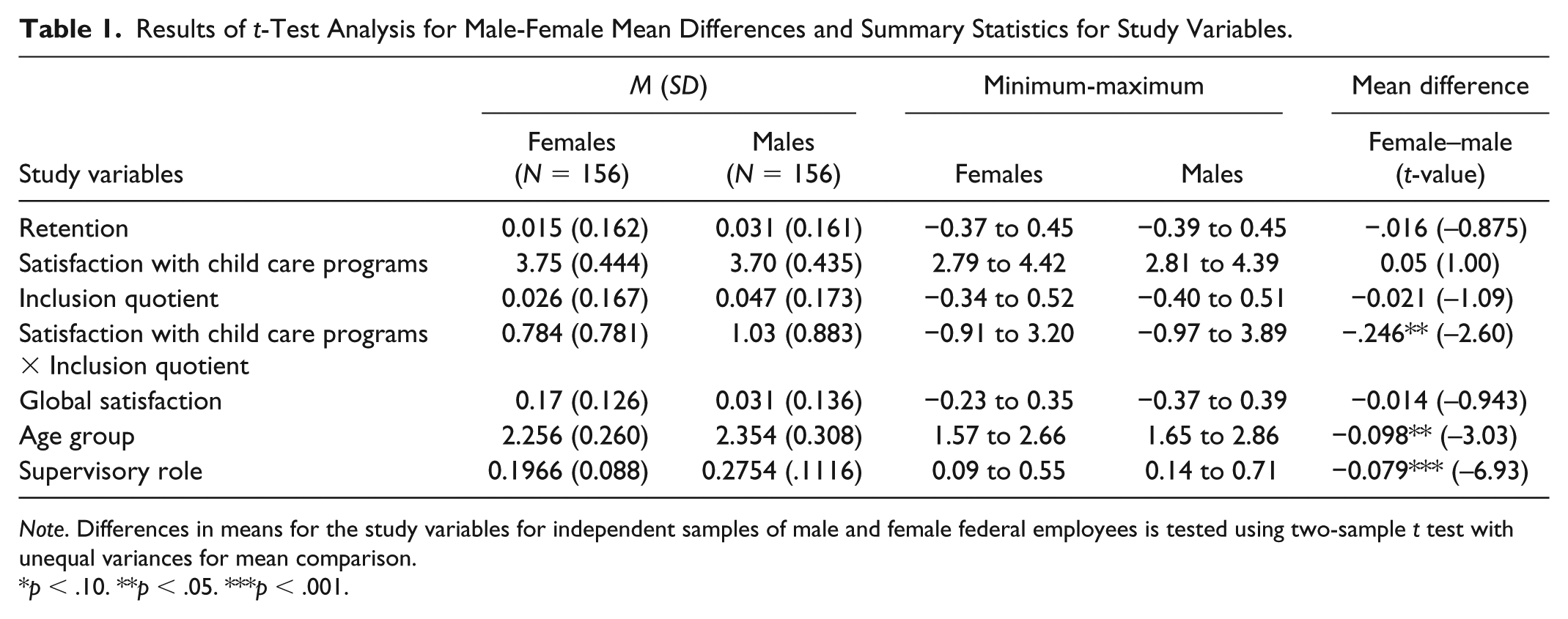
The summary statistics for study variables is provided in Table 1. Table 1 also reports the difference in mean values for study variables based on the t-test analysis for independent samples of male and female employees. Findings in Table 1 show that, at an agency level, the attitudes and behaviors of male and female federal employees do not differ significantly with respect to organizational inclusion, the global satisfaction (which measures satisfaction with organization, pay, and job), satisfaction with child care programs, and retention. However, it is important to note that at an agency level, as compared with male employees, female employees are significantly more likely to belong to lower age groups (mean difference = −0.098, p < .05) and are less likely to be in supervisory positions (mean difference = −0.0788, p < .001). As compared with their male counterparts, the mean values for interaction between organizational inclusion and satisfaction with child care programs is also significantly lower for female employees participating in child care programs (mean difference= −0.246, p < .05)
Results of t-Test Analysis for Male-Female Mean Differences and Summary Statistics for Study Variables.
Note. Differences in means for the study variables for independent samples of male and female federal employees is tested using two-sample t test with unequal variances for mean comparison.
p < .10. **p < .05. ***p < .001.
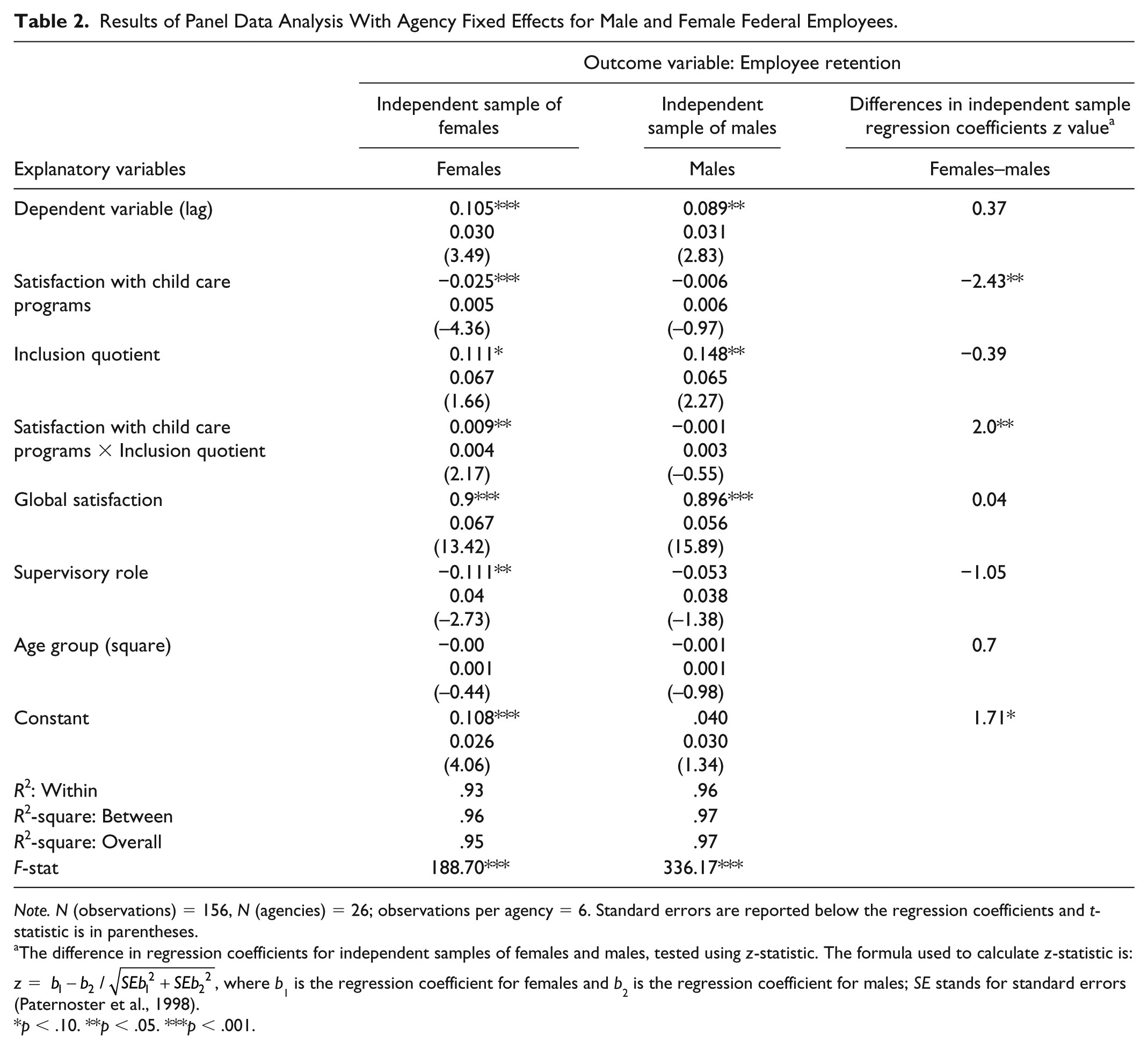
Table 2 presents results of panel data regression analysis with agency fixed effects for independent samples of male and female employees (Paternoster et al., 1998). A column in Table 2 reports the z-test results of differences in regression coefficients for independent samples of female and male employees. 2 The variables were tested for multicollinearity. The results of pairwise correlation analysis indicated that for independent samples of both female and male employees, the dependent variable retention had a statistically significant positive correlation with the lag of retention, global satisfaction score, satisfaction with child care programs, inclusion quotient, and the interaction between satisfaction with child care programs and the inclusion quotient. The variance inflation factors for study models were 4.41 and 4.32 for the independent samples of female and male employees, respectively.
Results of Panel Data Analysis With Agency Fixed Effects for Male and Female Federal Employees.
Note. N (observations) = 156, N (agencies) = 26; observations per agency = 6. Standard errors are reported below the regression coefficients and t-statistic is in parentheses.
The difference in regression coefficients for independent samples of females and males, tested using z-statistic. The formula used to calculate z-statistic is: z =
p < .10. **p < .05. ***p < .001.
Agency-level findings (depicted in Table 2) show that satisfaction with child care programs did not have a significant positive effect on retention of male employees. Thus, Hypothesis 1 was not supported. However, as expected in Hypothesis 2a, at an agency level, satisfaction with child care programs had a significant negative relationship (β = −.025, p < .001) with retention of female employees. And, the results of z test for differences in regression coefficients for independent sample of female and male employees (Paternoster et al., 1998) indicate that, as compared with their male counterparts, satisfaction with child care programs had a weaker relationship with retention of female employees (βdiff = −2.43, p <.05), thereby supporting Hypothesis 2b.
As expected in Hypothesis 3a, at an agency level, organization’s inclusion quotient had a significant positive moderating effect (β = .009, p < .001) on relationship between satisfaction with child care programs and the retention of female employees. However, the moderating effect of organizational inclusion was not significant for male employees. Thus, Hypothesis 3b was not supported. The results of z test for differences in regression coefficients for independent sample of female and male employees (Paternoster et al., 1998) indicate that, as compared with their male counterparts, moderating effect of organizational inclusion on the relationship between satisfaction with child care programs and retention was significantly higher for female employees (βdiff = 2.0, p < .05).
The regression models controlled for lagged dependent variable, organization’s inclusion quotient, global satisfaction (with organization, pay, and job), age, and supervisory position. At an agency level, for both male and female independent samples, the lagged dependent variable (i.e., lag of retention), organization’s inclusion quotient, and global satisfaction had a significant positive relationship with employee retention. Age did not have a significant effect on retention of either male or female employees. But, being in supervisory position had a significant negative impact on the retention of female employees.
Discussion and Conclusion
Attraction and retention of the best and brightest is a key challenge and a goal of strategic importance for public sector organizations (P. S. Kim, 2008; G. B. Lewis & Frank, 2002; Su, Li, & Curry, 2017; ‘The U.S. Office of Personnel Management’s Work/Life Office’). The U.S. Office of Personnel Management places a high value and emphasizes retention and honoring its diverse workforce as part of its vision and mission statement. Consequently, diversity management and inclusive organizational practices are utilized as principal strategies to achieve higher retention of diverse employees (‘The U.S. Office of Personnel Management’s Work/Life Office’). The broad objective of this study was to examine the effectiveness of diversity management initiatives such as child care programs and organizational inclusion on employee retention from a gendered perspective.
Child care programs are a form of organizational support that can produce a high social exchange relationship between employees and the organizations, and are expected to result in favorable reciprocal employee behaviors (Caillier, 2013, 2016; Gould-Williams & Davies, 2005; Ko & Hur, 2014; S. Y. Lee & Hong, 2011; Settoon et al., 1996). Therefore, based on social exchange theory, it is hypothesized that satisfaction with child care programs will positively affect the retention of male employees. However, in case of female employees, satisfactory child care programs by themselves were not expected to directly lead to higher retention.
Literature based on Eagly’s (1987) social role theory of sex differences and Eagly and Karau’s (2002) role congruity theory of prejudice toward female employees suggest that traditional societal gender norms and gender role stereotypes prescribe that men should compete in workplace and women should perform “wifely and maternal” duties, which in turn influences gender socialization and gender role confirming behaviors (Eagly, 1987; Eagly & Karau, 2002; Rudman & Phelan, 2008, p. 63). Women are more vulnerable to role conflict due to dual demands of work and family responsibilities (Ezra & Deckman, 1996; Hochschild, 1997; Hochschild & Machung, 2003; Mastracci, 2013; Ralston, 1990). Therefore, it is argued that despite structural access to satisfactory child care programs, female employees will exhibit lower retention.
In addition to the direct effect of satisfactory child care programs on employee retention, the moderating effect of organizational inclusion is also considered in this study. Based on Brewer’s (1991) optimal distinctiveness theory, it was expected that organizational inclusion—characterized by fairness, supportiveness, openness (to diversity), cooperativeness, and empowerment—will have a positive moderating effect on the relationship between satisfactory child care programs and the retention of male and female employees. These hypotheses are tested using the federal employee viewpoint survey data from year 2010 to 2015 and an agency-level longitudinal panel analysis.
An agency-level longitudinal panel analysis supports the hypothesis that satisfaction with child care programs does not directly lead to higher retention of female employees. And, as compared with their male counterparts, the relationship between satisfactory child care programs and employee retention was weaker (i.e., with a significantly lower effect size) for female employees. However, as proposed, organizational inclusion produced a statistically significant positive moderating effect on the relationship between satisfaction with child care programs and retention of female employees. As compared with their male counterparts, this moderating effect of organizational inclusion was higher for female employees. None of the proposed relationships were statistically significant for male employees.
Based on these findings, the following conclusions can be drawn: (a) Structural provisions such as satisfactory child care programs are not adequate in enhancing retention of either male or female employees. (b) Participation in satisfactory child care programs is less likely to increase retention of female employees than male employees. Lower retention of female employees is argued to exist based on gender norms and gender stereotypes, which may not only affect career decisions of women, but also affect their career opportunities within organizations (Barth et al., 2017; Eagly, 1987; Eagly & Karau, 2002; Ezra & Deckman, 1996; Goldin et al., 2017; Hochschild, 1997; Hochschild & Machung, 2003; C. C. Miller, 2017; Ralston, 1990; Rudman & Phelan, 2008). (c) These retention challenges can be overcome through organizational efforts. One approach examined in this study is that of organizational inclusion, which fulfills an employee’s fundamental need of belongingness and of being valued (Sabharwal, 2014). Organizational inclusion is found to strengthen the effects of satisfactory child care programs on retention, particularly for female employees. (d) Finally, it can also be concluded that although satisfactory child care programs do not have a direct positive effect on retention of female employees, female employees value the support received through child care programs and are more likely to be retained when their organizations have an inclusive environment.
Implications
These findings have several important implications for public strategic human resources management, diversity management and inclusion practices, and for gender equity. Retention of the best and brightest employees is a matter of urgent importance for public sector organizations from a strategic human resources management perspective (P. S. Kim, 2008; ‘The U.S. Office of Personnel Management’s Work/Life Office’). Scholars have argued that it has become increasingly challenging for public sector organizations to compete with the private businesses and nonprofits to attract and retain skilled and talented individuals (Guy, 1993; P. S. Kim, 2008; Y. Lee & Wilkins, 2011).
Retention of employees is also found to have financial implications for public organizations. Employee retention can lower investment in recruitment, selection, and training, and increase the return of this human capital investment, for preservation of institutional memory, which helps to achieve organizational goals (Cho & Lewis, 2012; Moynihan & Pandey, 2008). The U.S. Office of Personnel Management (2015) reported that the cost of bringing a new employee to satisfactory performance can vary between 90% and 200% of an employee’s annual salary based on his or her joining position level (Chordiya, Sabharwal, & Goodman, 2017).
In addition to financial costs, based on a gendered approach to strategic human resources management in public organizations, it can be argued that poor retention of women employees implies a loss of unique values they add for the success of public organizations and public service (D’Agostino, 2017; Guy, 2017; Guy & Newman, 2004; Meier et al., 2006; Neuse, 1978; Stivers, 1995, 2003). For instance, Neuse (1978) compared male and female state employees on professional commitments and perceptions of authority. The findings showed that women ranked higher on measures of professional commitments as well as on measures of responsibility toward nonhierarchical authorities, such as responsibility toward the profession and groups served by the organization.
Other scholars have argued that female employees and their management styles add a distinctive capital that improves the performance of public programs (D’Agostino, 2017; Guy, 2017; Meier et al., 2006). For instance, research shows that as compared with their male counterparts, women exhibit higher scores on various emotional intelligence capabilities such as change catalyst, achievement orientation, transparency, empathy, inspirational leadership, developing others, and service orientation (Young, 2016). Studies have also shown that as compared with their male counterparts, female managers are more democratic, less directive, less laissez faire, engage in contingent reward behaviors (transactional), and are found to be more transformational in their leadership styles (Eagly & Carli, 2003; Kanter, 1993; Meier et al., 2006; Rosener, 1990; Young, 2016). Viewed in the broader context of existing literature on women in public administration, findings of this study can be observed to imply that lower retention of women employees with child care responsibilities has repercussions in terms of lost human capital that adds distinct value to public organizations and public service.
There are also implications from the perspective of gender equity in workplace. Findings of this study should be viewed in the context of existing literature, which shows that gender norms are deeply entrenched in our societies (Guy, 2017), and that child care responsibilities and organizational support for child care are gendered in nature (Haas & Hwang, 1995; Kaufman, 2013; S. Lewis, 1996; Mastracci, 2013; Seward et al., 2006). For instance, gender gap in utilization of child care programs continues to exist (Ezra & Deckman, 1996; Sabattini & Crosby, 2009), and mothers-in-workforce are found to spend more hours in caregiving than fathers-in-workforce (Mastracci, 2013; Sabattini & Crosby, 2009). In addition to gender division of caregiving responsibilities, studies have also focused on economic implications of marriage and motherhood for women. Findings show that gender norms affect women’s employment and career decisions especially after marriage and motherhood, and significantly widens the differentials in earnings of women as compared with men (e.g., Barth et al., 2017; Goldin et al., 2017; C. C. Miller, 2017).
Therefore, it can be observed that child care responsibilities raise questions about gender inequity in workforce from human capital and economic perspective. And, retention of women employees with child care responsibilities through organizational support—that encompasses both structural provisions and a cultural change for inclusion—is an important factor for achieving gender equity in workplace (Barth et al., 2017; Goldin et al., 2017; Mastracci, 2013; C. C. Miller, 2017; Sabattini & Crosby, 2009). Moreover, it is crucial to enable utilization of the human capital (regardless of gender) to the fullest potential for public service (D’Agostino, 2017; Guy, 1993, 2017; Neuse, 1978).
The present study approaches this challenge from a diversity and inclusion perspective. Findings of this study imply that organizational support through structural provisions such as child care programs by themselves are inadequate in increasing retention of female employees. But, when structural provisions such as satisfactory child care programs interact with an inclusive organizational environment (that values fairness, openness [to diversity], empowerment, support, and cooperation), it leads to higher retention of female employees. Interestingly, such an interactive relationship between satisfactory child care programs and organizational inclusion was found to have a stronger effect on retention of female employees than their male counterparts (see Table 2). It implies that organizational inclusion acts as a buffer (moderator) to counteract the negative effects of child care responsibilities (which are often defined by gender norms) on women’s work experiences and enhances their retention.
Thus, one of the key takeaways from this study is that if structural provisions such as child care programs are implemented in isolation, they may not be as effective in retention of the target beneficiaries. An environment favoring inclusive organizational culture must complement and interact with diversity management policies and programs for child care to enhance retention, particularly for female employees. While this study broadly establishes the high potential of inclusive organizational practices for employee retention, these practices imply change and should be shaped by the evolving organizational context, demography, and needs of the employees. Developing an inclusive organization where both male and female employees can thrive needs an open-minded and proactive strategic human resources management approach.
While the present study argues and empirically shows that (a) satisfactory child care programs have differential impact on retention of male and female employees, and (b) that interaction between satisfactory child care programs and organizational inclusion is critical to the retention of female employees, future research is needed to examine specific reasons for lower retention of female employees with child care responsibilities in the federal workforce. Do these employees leave for better employment opportunities? Research should consider perspectives of females in leadership and nonleadership roles, as well as their supervisors and human resources managers. Future research should also focus on answering questions about the financial implications and those related to the loss of human capital due to child care responsibilities. Studies should compare experiences of female employees with their male counterparts. More research is required to study the attitudes and organizational experiences due to child care responsibilities for transgender employees and for employees of diverse sexual orientations, racial backgrounds, and abilities.
Limitations
Although this study has several important theoretical and practical implications, like past studies utilizing FEVS data for longitudinal panel analysis (Caillier, 2016; Oberfield, 2014), agency-level data is used as a unit of analysis instead of individual-level data. The absence of individual-level identification in the FEVS data does not allow for an individual-level panel data analysis and is an important limitation of this study. Another limitation is with respect to small sample size (N = 156), which limits the explanatory power. However, it is important to note that, despite small sample size, several key theoretical arguments made in this study were statistically supported.
Another limitation of this study may come from the omission of individual and demographic characteristics. Even though models control for important personal and demographic characteristics, such as supervisory role and age, the effect of some of the other factors such sexual orientation, marital status, parenthood status, number of children, the impact of work–family conflict, and gender role stereotypes may have been omitted due to data unavailability or inadequacy. Despite these limitations, this study extends existing research on impact of family-friendly programs (Caillier, 2016; Ezra & Deckman, 1996; S. Y. Lee & Hong, 2011) from a gendered perspective by highlighting gender differences in utilization and impact of federal child care programs and the role of organizational inclusion in enhancing employee retention.
Footnotes
Appendix
Acknowledgements
The author acknowledges and thanks her doctoral dissertation supervisor Dr. Meghna Sabharwal and committee members Dr. R. Paul Battaglio, Dr. Doug Goodman, Dr. L. Douglas Kiel, and Dr. Donald F. Kettl for their helpful comments and feedback. The author acknowledges and thanks Dr. James Harrington for his valuable help. The author would also like to acknowledge and thank the reviewers for their constructive and helpful comments.
Declaration of Conflicting Interests
The author(s) declared no potential conflicts of interest with respect to the research, authorship, and/or publication of this article.
Funding
The author(s) received no financial support for the research, authorship, and/or publication of this article.