




Abstract
The federal government lags behind in progressive civil rights policies in regard to universal workplace antidiscrimination laws for lesbian, gay, bisexual, and transgender (LGBT) Americans. The slow progress matters to inclusionary workplace practices and the theory and practice of public administration generally, as recognition of LGBT rights and protection are constitutive of representative bureaucracy and promoting social equity. This study examines the turnover intention rates of self-identified LGBT employees in the U.S. federal government. Using the Office of Personnel Management’s inclusion quotient (IQ), and 2015 Federal Employee Viewpoint Survey (FEVS), we identify links in the relationships between workplace inclusion and turnover outcomes among LGBT individuals. We also examine the impact of agency type on LGBT turnover rates based on Lowi’s agency classification type. Key findings suggest that LGBT employees express higher turnover intentions than those that identify as heterosexuals/straight, and LGBT employees who perceive their agencies as redistributive or communal are less likely to experience turnover intentions. However, an open and supportive workplace environment had a positive impact on turnover, suggesting that to implement effective structural change in an organization’s culture of inclusion, public sector managers must do more than merely “talk the talk.” This finding is also suggestive of LGBT employees’ desire to avoid the stigma of being LGBT and hide their identities. Institutions must heed the invisible and visible identities of their employees to be truly inclusive. Workplace practices that acknowledge the invisible and visible identities of their employees are a positive step toward real workplace inclusion.
Keywords
Introduction
The lesbian, gay, bisexual, and transgender (LGBT) population has historically been marginalized in the United States through the systematic denial of legal protections and benefits (Pizer, Sears, Mallory, & Hunter, 2012). Today, LGBT people continue to face discrimination as a result of homophobia and transphobia, and in many cases, face violence motivated by such beliefs about their sexual orientation and/or their gender identity (Herek, 1989; Riccucci & Gossett, 1996; Sears & Mallory, 2011; Tilcsik, 2011). Recent tragedies testify to this, such as the 2016 Orlando mass shooting, where 49, mainly Latino and Black LGBT attendees of a local gay club, were murdered and at least 53 were left injured.
Despite the U.S. Supreme Court deeming marriage a right of same-sex couples in the 2015 decision in Obergefell v. Hodges, the federal government lags behind in progressive civil rights policies, particularly in regard to universal workplace antidiscrimination laws for LGBT Americans. Although sexual orientation and gender identity remain unprotected categories under the Civil Rights Act of 1964, which prohibits employment discrimination based on race, color, religion, sex, and national origin, at the end of 2016, 20 states plus D.C. banned discrimination based on both sexual orientation and gender identity or expression in employment, housing, and public accommodations (American Civil Liberties Union, 2017). However, according to the Human Rights Campaign, these protections remain inconsistently derived through a patchwork of state and local law (Fidas & Cooper, 2014). This slow progress matters—not only to inclusionary workplace practices but also to the theory and practice of public administration more generally, as recognition of LGBT rights and protection are constitutive of representative bureaucracy and promoting social equity. Understanding differences between LGBT and comparable heterosexual employees is important to human resources professionals who must ensure that all employees are treated equitably (Lewis & Pitts, 2017). However, recognition of sexually diverse populations extends to a greater public policy agenda that moves away from a climate of homo-negativity, which implicitly normalizes and naturalizes heterosexuality, resulting in a circular process and continued invisibility of the needs of sexually diverse people (Mulé et al., 2009).
Although previous studies have documented that minority employees experience higher rates of voluntary turnover than majority employees (e.g., Hofhuis, Van der Zee, & Otten, 2014), this study examines the turnover intention rates of self-identified LGBT employees of the U.S. federal government. Using the Office of Personnel Management’s (OPM) inclusion quotient (IQ), and 2015 Federal Employee Viewpoint data (FEVS), including LGBT response item added in 2012, we refine existing measures of turnover and identify links in the relationships between workplace inclusion and turnover outcomes among LGBT individuals. Furthermore, we examine turnover intention of LGBT federal employees based on Lowi’s (1985) classification of agency type. We argue that LGBT-inclusive policies and practices affect workplace climates and lower turnover rates among LGBT employees.
Although the overarching theme of this research is LGBT turnover intention, the nature of the problem and scope of the present study are unique for several reasons. First, there is a projected increase in the number of people who openly identify as LGBT. According to a 2016 Gallup Daily tracking survey, the portion of American adults identifying as LGBT increased to 4.1% in 2016 from 3.5% in 2012 (Gates, 2017). These figures imply that more than nearly 10 million adults now identify as LGBT in the United States, approximately 1.75 million more compared with 2012.
However, we must take caution to these approximations as they may underestimate the population because of several reasons, including a respondent’s desire to avoid the stigma of being LGBT (Coffman, Coffman, & Ericson, 2017). Therefore, it is not surprising that despite a changing social and legal landscape for LGBT people, Fidas and Cooper (2014) revealed that over half (53%) of LGBT workers nationwide still hide who they are at work. In the public sector in particular, Cayer and Sabharwal (2013) report that LGBT employees may feel wary of accusations of bias if they openly express support for pro-LGBT civil rights, for as public servants they are expected to remain politically neutral.
Second, the costs of employees taking action on their expressed desire to leave their agencies are large for any organization, but especially pertinent for the federal government as they have complex hiring procedures and restricted budgets for hiring as compared with the private sector (Albucher, 2015). Third, the psychological toll of perceived discrimination manifests well before many LGBT people even enter the workforce, afflicting LGBT youth from their high school years with higher rates of depressive symptoms (Almeida, Johnson, Corliss, Molnar, & Azrael, 2009).
LGBT federal employees’ perceived discrepancy of equitable workplace treatment on so many fronts demands that the federal government as an employer change to become more fair, open, and supportive to all its employees. Past research has examined how policies have affected the inclusion of gay men and lesbians in federal government including how veteran’s preference affects the number of gay men that hold federal jobs (Lewis, 2013), and how policy has supported the denial of security clearance and the exclusion of gay men and lesbians from federal government (Colvin, 2004; Johnson, 1994, 2004; Lewis, 2001). Research has also explored whether LGBTs face employment discrimination (Cech & Pham, 2017; Federman & Elias, 2017; Lewis & Pitts, 2011, 2017).
The present study uses FEVS data to examine indicators of LGBT employees’ turnover intentions in the federal government workplace. It adds to the existing literature by including inclusion and agency type as moderating factors to explain turnover intentions among LGBT employees. Fostering an inclusive environment in the federal (and all levels of) government is and will be crucial to retaining employees and thereby reducing costs of replacing employees who turnover because “discrimination is not only morally unacceptable: it is inefficient” (McClure, 2014, p. 179). Turnover not only consumes time and money, it can also indicate a legitimate organizational problem (McElroy, Morrow, & Rude, 2001). LGBT employees’ intentions to turnover may signal key areas for improvement in the unequal treatment and inclusive practices implemented in the federal workplace (Lewis & Pitts, 2017). Literature providing background and supporting our hypotheses follow. Next, we discuss the variables and methods used in our study followed by discussion and suggestions for future research.
Literature Review and Hypotheses
LGBT Turnover Intentions
Studies in labor turnover intention owing to one’s gender (Grissom, Nicholson-Crotty, & Keiser, 2012) and minority status (Hofhuis et al., 2014) have indicated important implications to diversity management research and practice in both the public (Meier & Hicklin, 2008) and private sectors (Vitaliano, 2010). In the public sector, for example, works by Cox (1994) and Clair, Beatty, and Maclean (2005), document how women, racial minorities, older workers, and others bearing a stigmatized identity have suffered job loss, limited career advancement, difficulty finding a mentor, and isolation at work. Of particular importance to the success of these employees, (e.g., those who have been historically marginalized) are workplace inclusionary practices and policies (Shore et al., 2011). It has also been noted that these stigmatized social identities—particularly those workers who are identified as invisible, are not only common and increasing as a significant group in the U.S. workforce, but have been overlooked in much of the literature (Clair, Beatty, & MaClean, 2005). Surveys seeking national data on LGBT employment discrimination are also few (Sears & Mallory, 2011).
As the literature suggests, (e.g., Lewis & Pitts, 2017) the above referenced government policy decisions affect LGBT people in their places of employment in several ways. For instance, from their agency’s commitment to diversity and relationships with their supervisors, LGBT federal employees are overall less satisfied than non-LGBT employees with their workplace treatment. In addition, Ragins and Cornwell (2001) found when LGBT employees perceive greater workplace discrimination, their desire to turnover from their organization increases. According to Sears and Mallory (2011) people who openly identify as LGBT at their workplaces had higher odds of being discriminated against than those who hide their sexual orientation or gender identity at work. Lewis and Pitts (2017) also found differences between LGBT employees and heterosexual employees’ perceptions of fair treatment, which they equated to the differences based on race and ethnicity. LGBT employees were less satisfied than non-LGBT employees in all aspects examined, including performance appraisals, promotions, raises, prohibited personnel practices, commitment to diversity, agency leadership (Lewis & Pitts, 2017). Employees chiefly doubted whether actual work performance was the basis for receiving awards, promotions, and pay raises. There were larger differences between LGBT and non-LGBT employees’ perceptions of opportunities for advancement and whether their performance led to equitable rewards; additionally, they were more dissatisfied with their supervisors, peers, and leaders of their agency, plus employee empowerment (Lewis & Pitts, 2017). Using a national survey of 534 gay and lesbian employees, Ragins and Cornwell (2001) found that supportive workplace policies had a direct effect on their turnover intentions.
Pitts, Marvel, and Fernandez’s (2011) research supported significant indirect relationships between workplace satisfaction and a federal employee’s decision to turnover. In looking at the differences between LGBT federal and heterosexual employees, Lewis and Pitts (2017) found that LGBT federal employees were 10% more likely to express considering leaving various federal agencies including Commerce, Housing and Urban Development, Agriculture, Homeland Security, and various arms of the Department of Defense. We, therefore, offer the following hypothesis:
Inclusion Practices and LGBT Individuals
Despite the importance of inclusive practices in organizations (Gasorek, 2000; Mor Barak, 2016; Mor Barak & Cherin, 1998; Pelled, Ledford, & Mohrman, 1999), few have studied its impact on turnover (Hwang & Hopkins, 2012). There are, however, several common definitional elements of inclusion in organizations. For example, Gasorek (2000) suggests that inclusive organizations are those where employees are valued, ideas are taken into account and used, people partner successfully within and across departments, current employees feel that they belong and prospective employees are attracted to the organization. According to Gasorek (2000), when people feel connected to each other and to the organization and its goals, the organization continuously fosters flexibility and choice, and attends to diversity.
Many have suggested that the precursor to inclusion is diversity management (Choi, 2009; Choi & Rainey, 2014; Mor Barak, Cherin, & Berkman, 1998). For instance, Choi (2009) demonstrated that effective diversity management mediates the relation between race/ethnicity, age, and sex and turnover intentions of government employees. Not only must diversity be managed properly for an organization to be better at achieving its goals; managers must make a concerted effort to create harmony among differences between employees (Choi, 2009). In other words, inclusion requires action and conscious choices (Sabharwal, 2014).
In the context of diversity management, Shore et al. (2011) define the nature of an inclusive environment as: A climate of inclusion is one in which policies, procedures, and actions of organizational agents are consistent with fair treatment of all social groups, with particular attention to groups that have had fewer opportunities historically and that are stigmatized in the societies in which they live. (p. 1277)
Similar to Gasorek (2000) and Shore et al. (2011), Pless and Maak (2004) coined the term “culture of inclusion” suggesting that, differences are recognized, valued and engaged. Different voices are understood as being legitimate and as opening up new vistas; they are heard and integrated in decision making and problem solving processes; they have an active role in shaping culture and fostering creativity and innovation; and eventually in adding value to the company’s performance. (p. 130)
Although some models of inclusion focus on access to workplace resources and the ability to impact decision making (Mor Barak & Cherin, 1998; Pelled et al., 1999), a number of models have incorporated the identity and personhood of individuals when making an organization inclusive (Triana, García, & Colella, 2010). Mor Barak (2016) for example, who has done extensive research in the area of social work, developed the inclusion–exclusion framework. To be an inclusive workplace, Mor Barak (2016) explains, an institution must go beyond merely providing employees adequate resources. The emerging normative paradigm posits that an organization and its management must authentically and consciously demonstrate concern for their employees’ well-being and value what each individual has to offer as a result of his or her differing background. Based on the above models and emerging paradigm, Hypothesis 2 states:
With few exceptions, there has been limited research on LGBT inclusive practices and turnover intentions. Pichler, Ruggs, and Trau’s (2017) recent work on inclusive practices of organizational- and individual-level outcomes of LGBT-supportive policies suggest that among firms with LGBT-supportive policies and practices, all employees, including LGBT individuals, feel more supported and more fairly treated—and as a result, these feelings will be reciprocated. Munoz (2005) reported that LGBT-supportive workplace climates had significant and positive effects on job-related variables such as turnover intentions, which suggests an overall beneficial effect of LGBT-supportive workplace climates on the well-being of LGBT employees. Also, Choi (2009) found that racial/ethnic and sex diversity had a negative relationship to turnover intention, as there were a higher number of EEO (equal employment opportunity) complaints. We, therefore, extend Pichler et al. (2017), Munoz (2005), and Choi’s (2009) findings and develop the hypothesis that
Agency Type and LGBT Turnover
The literature on the distribution and integration of women and men in public-sector jobs provides evidence that women often face glass walls, especially in certain types of agencies. Lowi’s typology classifies government agency types as (a) regulatory, (b) distributive, (c) redistributive, and (d) constituent. Distributive agencies are typically “agentic” 1 whereas redistributive or “communal” 2 (Eagly, 2005; Eagly & Johannesen-Schmidt, 2001; Eagly, Johannesen Schmidt, & van Engen, 2003; Eagly & Johnson, 1990; Eagly & Karau, 2002) are typically those that require emotional labor (e.g., Department of Education, Department of Veteran Affairs, and Department of Housing and Development). Acker (1992) maintains that in a “gendered institution” “gender is present in the processes, practices, images and ideologies, and distributions of power in the various sectors of social life” (p. 567). Given the interplay between a public organization, its environment and the inner workings of the organization itself (Rainey, 2009), some agencies may be more conducive to welcoming minorities than others because of their respective workplace culture (Newman, 1994). According to Riccucci (2009) “redistributive” agency types have the greatest concentration of minorities—such as people of color.
Researchers have also looked at the different organizational cultures particular to each agency type and their respective influences on women’s employment opportunities and workplace experiences (Newman, 1994; Sabharwal, 2015). With regard to the influence of gendered bureaucracy on women, the discrepancy between women holding higher authority positions and men holding such positions includes a lesser involvement in policy making for women (Sabharwal, 2015). Because women are overrepresented in redistributive agencies, which are “most closely tied to entitlement expenditures in the federal budget, which is by and large automatic spending,” the opportunities for women to make discretionary decisions about spending are fewer than in a distributive agency (Sabharwal, 2015, p. 402).
In distributive agencies, there have been noted some obstacles for women who seek to advance their careers (Newman, 1994). Distributive agencies have the highest mean salaries, but also the greatest salary differential between women and men (Sneed, 2007). Newman (1994) found that for a female job candidate to obtain a higher position within an organization, she must conform to the agency’s concept of its ideal employee, which arises from the group culture established as a result of and influenced by the function that the agency plays in the government. If she is not perceived as fitting in, she may fail to get the position despite her qualifications. Therefore, “a lack of fit model of bias may be inherent in questions of equity in the workplace” (Newman, 1994, p. 281). By comparison, redistributive agencies have a greater likelihood of having women as department heads, therefore, a greater likelihood of administrators prioritizing women-focused policies (Saidel & Loscocco, 2005). The organizational culture and values of an organization have great sway over both women and men department heads in their priority setting (Saidel & Loscocco, 2005). Redistributive agencies also “unquestionably have the lowest levels of gender-based occupational segregation” (Sneed, 2007, p. 887).
In addition, some researchers have documented that gay employees are concentrated in female-dominated fields (Baumle, Compton, & Poston, 2009). In particular, using two nationally representative surveys in the United States for the period 2008-2010, Tilcsik, Anteby, and Knight (2015) report that lesbian and gay (LG) employees are found in artistic, service-oriented, and care-oriented fields and fields wherein one typically works independently. Confronted with stigma, these employees may even modify their behaviors over time, developing perceptiveness in social situations to gauge how their identity may be received if revealed and a desire to work independently (Tilcsik et al., 2015). Furthermore, LG employees have honed skills that adapt to their concealable stigma (e.g., an attribute that draws stigma when made public but can remain undisclosed without others’ knowledge) and may be drawn to occupations that engage this social perceptiveness (Tilcsik et al., 2015). Although several studies have examined the gendered nature of organizations, we expect this phenomenon to spillover to LGBT employees as well. Thus, based on past studies we hypothesize that:
Data and Methodology
Data for this study come from the 2015 FEVS, which is the most comprehensive data set of federal government employees in the United States made available by the OPM. A total of 421,748 employees responded to the survey. A total of 82 agencies, 37 large and 45 small/independent agencies are represented in the survey. The data are weighted to ensure accurate representation of the survey population and produce unbiased estimates of population statistics.
Measures
Dependent variable
The outcome variable, turnover intention has four possible responses: (a) no; (b) yes, to take another job within the federal government; (c) yes, to take another job outside the federal government; and (d) yes, other. The responses were recoded to no = 0 and yes = 1 (all other categories). Approximately 34% of the employees report their intentions to leave to take up another job within the federal government or outside the federal government. Research conducted by Fernandez et al. (2015) reported that only five different studies from 2000-2015 years focused on turnover as a primary outcome variable. In addition, no studies to our knowledge have examined the moderating relationship of inclusion with LGBT status and turnover.
Independent variables
LGBT status
The key independent variable is LGBT status; heterosexuals/straight were coded as 0 and those that identified at LGBT were coded as 1. Individuals who chose not to reveal their sexual/gender identity were excluded from the study. Only 3% of the sample identified as LGBT, 84% of the respondents identified as heterosexuals and the remaining 13% preferred not to disclose their sexual/gender orientation. 3
Inclusion
The OPM introduced its IQ to FEVS in 2014. The IQ assesses fair treatment, openness, empowerment, and cooperation among employees, and federal government supervisors’ supportiveness. OPM’s framework of the IQ suggests that making demonstrable improvement in the workplace environment for minorities requires more than just speciously claiming support. The IQ measures observable behaviors of workplace inclusion, which presupposes that practicing certain behaviors will foster changed habits and attitudes (Ajzen & Fishbein, 2005). OPM’s rationale for including IQ in FEVS is to track improvements in employee engagement, performance, and job satisfaction. We examine the relationship between inclusion and its individual subcomponents on LGBT federal employees’ likelihood to express a desire to turnover. Each component of the IQ captures a distinct and critical component of inclusion that scholars have developed across disciplines (Davidson & Ferdman, 2002; Gasorek, 2000; Holvino, Ferdman, & Merrill-Sands, 2004; Mor Barak & Cherin, 1998; Pelled et al., 1999; Sabharwal, 2014; Shore et al., 2011). Each of the five measures of IQ is comprised of items for a total of 20 questions. A list of all the questions along with individual Cronbach alpha scores is reported in the appendix section. The alpha scores of all the five IQ measures are 0.8 and above.
Agency type
Literature shows the impact of gendered bureaucracy on turnover (Lewis & Pitts, 2017; Sabharwal, 2015). Utilizing Lowi’s (1985) typology, we divided the agencies into four types: redistributive, distributive, regulatory, and constituent agencies. Redistributive agencies are dominated by women given the nature of the work that demands client interaction and emotional labor as opposed to other agencies that are male dominated and are mostly concerned with policy making and implementation (Sabharwal, 2015). We expect similar patterns of agency segregation to apply to LGBT employees.
Control variables
Minority status, supervisory role, and tenure were used as additional controls in the study. Minority status was recoded as 1 = minorities and 0 = nonminorities. More than one third (34.5%) identified as minorities. Respondents who identified as non/supervisory or team leader were coded as 0, and those that identified as supervisor, manager, and senior leader were coded as 1; approximately one fifth of the total sample (21%) identified as supervisors. Tenure was classified into three categories: 1 = fewer than 5 years, 2 = 6 to 14 years of experience, and 3 = 15 or more years of work experience in the federal government.
Given the binary nature of the dependent variable, turnover intention, a logistic regression is utilized. The model goodness of fit is also reported. Before the logistic model results are presented, Table 1 provides the descriptive statistics of the variables under study and Table 2 reports the correlations. As seen from Table 1, 18% of the sample has respondents from redistributive agencies, 26% from distributive, 31% from constituent, and 24% from regulatory agencies. The average tenure of respondents is between 6 and 14 years, and more than 20% report being in supervisory roles. No problem with multicollinearity is reported in the study.
Descriptive Statistics of LGBT, Inclusion, Agency Type, and Turnover Model.
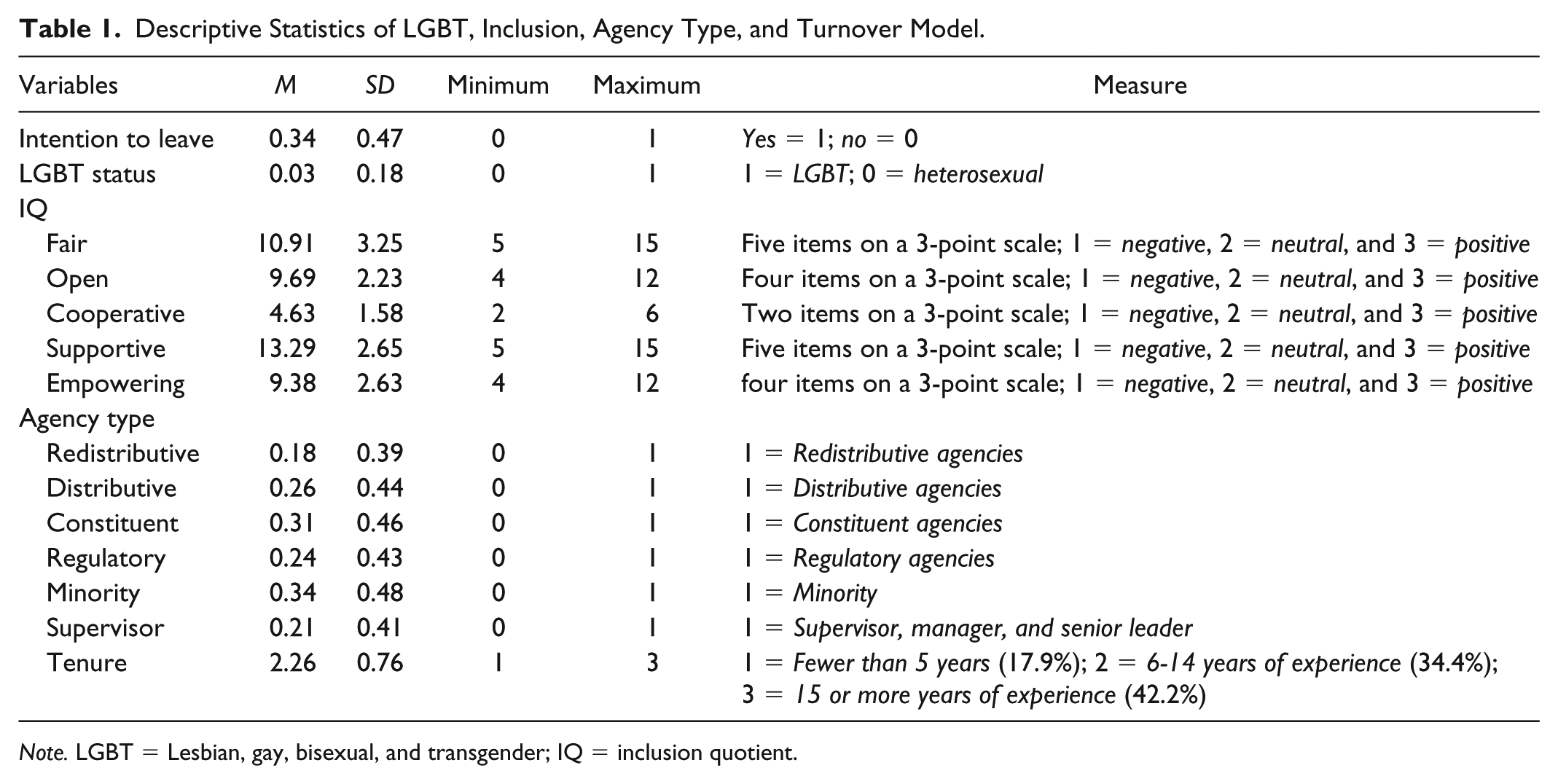
Note. LGBT = Lesbian, gay, bisexual, and transgender; IQ = inclusion quotient.
Correlation With Intention to Leave.

Note. LGBT = lesbian, gay, bisexual, and transgender; IQ = inclusion quotient.
p < .05. **p < .01.
Results
To examine how LGBT employees perceive inclusiveness in their work environment, an independent sample t test was performed across both groups of LGBT and heterosexuals. The results are presented in Table 3. Across all the 20 measures of inclusion, LGBT employees report lower levels of agreement. All of the results are statistically significant. The results of the t test indicate that LGBT employees perceive lower inclusive environment than their heterosexual counterparts in regard to their workplaces being fair, open, cooperative, supportive and empowering.
Mean Differences Across LGBT and Heterosexual Federal Employees Across the Measures of Inclusion Quotient.
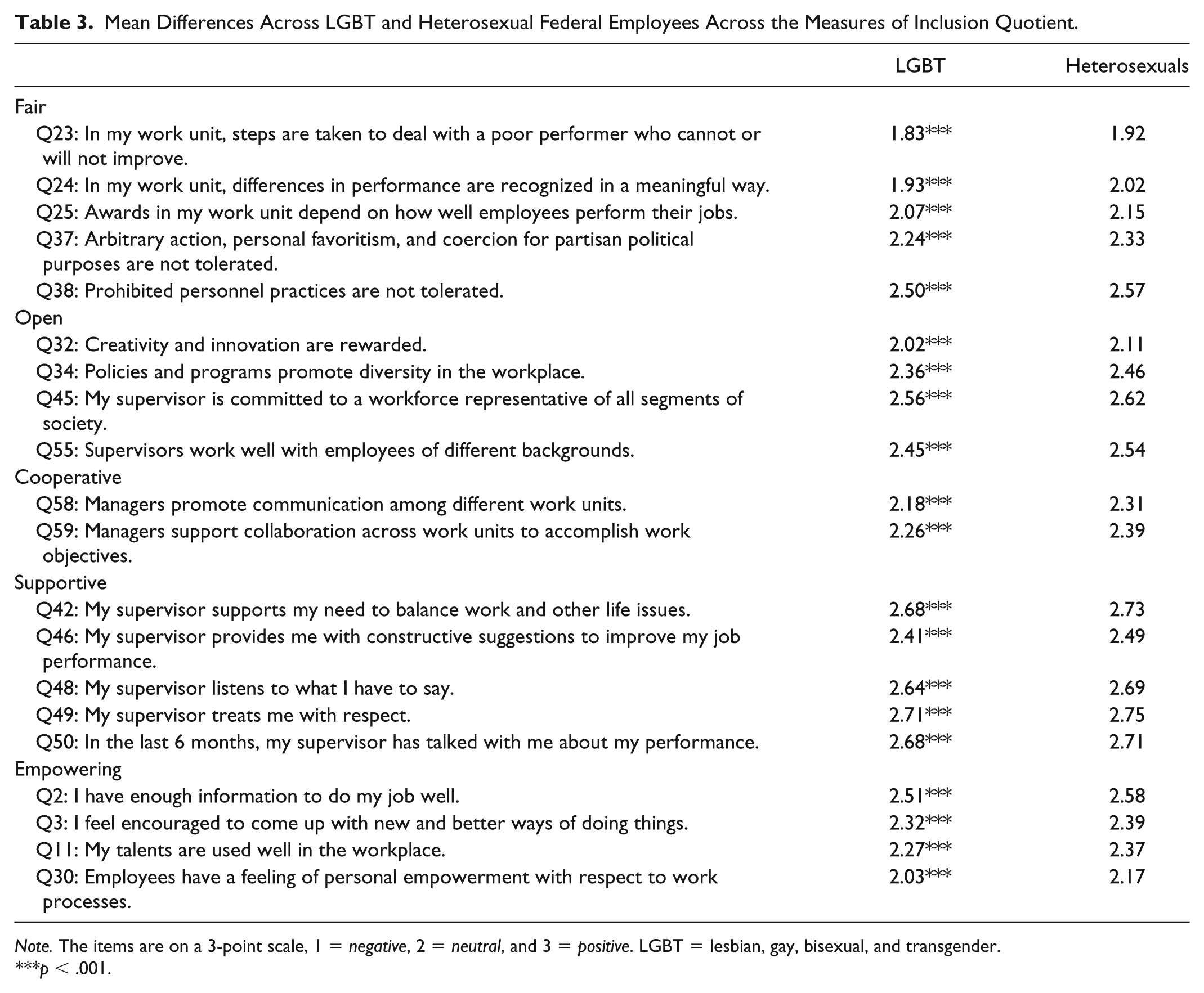
Note. The items are on a 3-point scale, 1 = negative, 2 = neutral, and 3 = positive. LGBT = lesbian, gay, bisexual, and transgender.
p < .001.
The results of the logistic regression are presented in Table 4, which examine the odds of federal employees’ intent to turnover, specifically those that identify as LGBT. We also examine how inclusionary environments and type of agencies (feminine vs. masculine) affect one’s intent to leave with a focus on LGBT group. To interpret the model using a logistic regression, it is easier to examine the effect sizes of the independent variables on turnover intention by observing the probability differences, using average marginal/partial effects. This was possible by running the margins command in STATA.
Logistic Regression With LGBT Status, Inclusion Quotient, and Agency Type on Turnover Intentions of Federal Employees.

Note. Margin is the marginal effect. LGBT = lesbian, gay, bisexual, and transgender; IQ = inclusion quotient.
p < .05. **p < .01. ***p < .001.
We ran four models—Models 1 and 2 are separate models for LGBT and heterosexual employees, Model 3 is without interactions, and Model 4 is the full model. LGBT employees who perceive their work environments as fair, open, supportive, and empowering are less likely to turnover. Although cooperativeness was not significant in the LGBT model, it had a significant impact on heterosexual employees to reduce turnover intentions. Empowerment was significant in reducing turnover intentions in both Models 1 and 2. Interestingly, turnover intentions among LGBT employees who worked in distributive and constituent agencies (male dominated) was higher than LGBT employees that worked in redistributive agencies (female dominated). The results were opposite in Model 2, that is, heterosexual employees working in distributive and regulatory agencies expressed lower intentions to turnover than those heterosexuals employed in redistributive agencies. Although heterosexuals employed in constituent agencies expressed the most likelihood to turnover across all types of agencies.
Model 3 examined the effect of LGBT and agency type on turnover intentions in the federal government without including any interaction terms. LGBT employees report 2.6% higher probability to turnover than heterosexuals. Similar results are reported in Model 4, which includes interaction terms. The results in Model 4 indicate that the probability of turnover is 1.8% higher for LGBT employees as compared with heterosexuals thus, confirming Hypothesis 1 that LGBT employees will express higher turnover intentions than those that identify as heterosexuals/straight. Across both Models 3 and 4, we found that inclusive practices (open, fair, supportive, cooperative and empowering environments) reduce turnover intentions among federal employees—thus confirming Hypothesis 2. Specifically, in the full-model, the probability of turnover reduced by 1.2% with a one unit increase in the perception of fairness index. Similarly, having a management that is open to new and diverse ideas and groups, is cooperative and supportive resulted in a significant decrease in an employees’ intent to leave the federal government. Empowerment was the most significant of all inclusion variables—the probability of turnover reduced by 3.6% with a one unit increase in the perception of empowerment index.
Agency type also affects turnover intentions of overall employees across Models 2, 3, and 4, thus verifying Hypothesis 4. Specifically, we find that compared to redistributive agencies, the odds of turnover in distributive and regulatory agencies is significantly lower, while the odds of turnover among constituent agency employees is significantly higher than redistributive agency employees. The results as noted in Models 2, 3, and 4 are different for Model 1 wherein LGBT employees in distributive and constituent agencies (perceived as masculine/agentic) are more likely to express their intentions to turnover than LGBT employed in redistributive agencies (perceived as more feminine/communal). Across all models, minorities were more likely to express intentions to turnover as were those with fewer than 5 years of experience in the federal government. In the full model, the probability of turnover reported among minorities was 2.5% greater than nonminorities. Likewise, the probability of turnover for federal employees with longer tenures (more than 15 years) was 2.7% lower than those employees with fewer than 15 years of experience. Being a supervisor increased the intent to turnover than those not in supervisory positions.
Moderating Effects of IQ and Agency Type on Intent to Turnover
The moderating effect of inclusion on turnover is depicted in Model 4, and was consistent only when LGBT employees perceived their work environment to be fair. When compared to non-LGBT employees, the probability of turnover among LGBT respondents who perceived their work practices to be fair, and felt that they were treated equally was lower by .7%. However, the effects of an open and supportive workplace environment as perceived by LGBT employees, had a positive impact on turnover, thus not completely supporting Hypothesis 3.
Furthermore, as hypothesized, the probability of turnover for LGBT employees working in distributive and regulatory agencies was 2.6% and 3.4% higher as compared with LGBT employees employed in redistributive (feminine) agencies. The turnover rates for LGBT in constituent agencies were nonsignificant, thus partially confirming Hypothesis 5. A list of study hypotheses and its verification are expanded in Table 5.
List of Hypotheses and Verification.
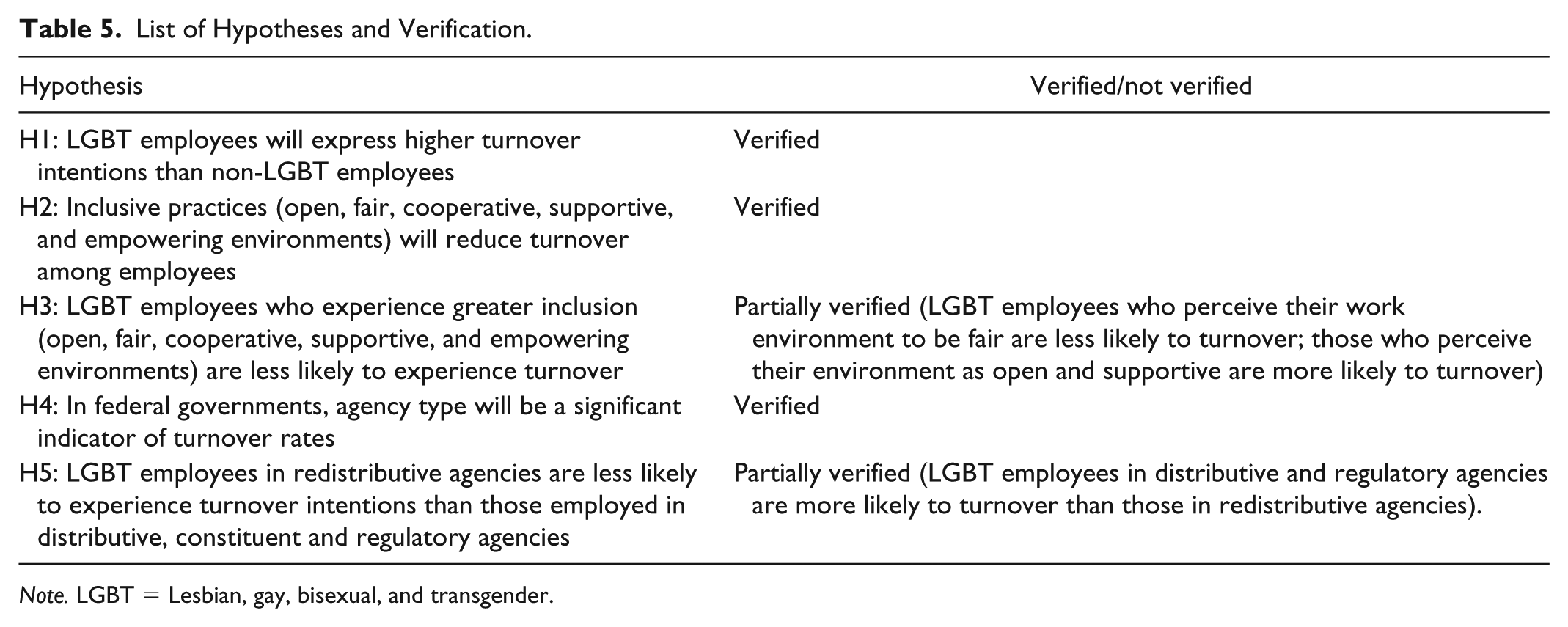
Note. LGBT = Lesbian, gay, bisexual, and transgender.
Conclusion and Discussion
This study examined the impact of inclusive practices and agency type on turnover intentions of LGBT employees in the federal workforce. Our findings show that LGBT employees who identify their workplace as more inclusive (e.g., fair, cooperative and empowering) are less likely to express their intent to turnover. Also, as workplaces bolster their LGBT-supportive policies, people may be more inclined to be open about one’s identity. For example, as OPM added the LGBT response item to the FEVS in 2012, the percent of federal government employees identifying as LGBT has increased; in 2012, 2.2% said they were LGBT—by 2014, 2.8% of 2014 FEVS respondents self-identified as LGBT. As government faces constricted budgets, the resources necessary after employee’s turnover (i.e., recruitment, training, and development of incoming employees), strain its capacity for higher performance. To mitigate the need to pick up the pieces once employees have left, government should focus on increasing its inclusivity, specifically of LGBT employees.
However, contrary to expectations, LGBT individuals who perceive their environment to be open and supportive are actually more likely to turnover. This result supports the view of LGBT employees’ desire to avoid the stigma of being LGBT by hiding their identities, which may result in under-reporting. This finding also suggests that to implement effective structural change in an organization’s culture of inclusion, public sector managers must do more than merely “talk the talk.” Therefore, while an employer can provide necessary resources, it must also give more and do more to make people feel included (Sabharwal, 2014). Institutions must heed the invisible and visible identities of their employees and constituents to truly be inclusive. Workplace practices that do acknowledge this concept of people’s interwoven identity, that is, the inseparability of one’s personal life and one’s work life, are a positive step toward real workplace inclusion.
The ideal of inclusion, as Yoshino and Smith (2013) discuss, has been to allow individuals to bring their authentic selves to work. However, the development into the idea of inclusion and identity particularly applies to LGBT employees who occupy a different public space in terms of the discrimination they experience, how they feel in and access to public spaces (Sanschagrin, 2011). They also bear a concealable stigma, that is, their sexual orientations and in some cases, their gender identities, can be hidden and undisclosed allowing them to evade stigmatization. Most inclusion efforts have not explicitly and rigorously addressed the pressure to conform that prevents individuals from realizing that ideal. One example is the provision of gender-neutral restrooms, and health care coverage.
Although Lowi’s (1985) typology was not developed to imply gendering of organizations it has been used by public administration scholars as a way to classify agencies based on occupational segregation (e.g., Mastracci & Bowman, 2015; Newman, 1994). Here, we used Lowi’s typology to look at the impact of agency classification on LGBT’s intent to turnover. We found that LGBT employees in redistributive agencies are less likely to express turnover intention than those working in distributive and regulatory agencies. To mitigate the need to pick up the pieces once employees have left, government should focus on increasing its inclusivity, specifically of LGBT employees. The literature maintains that redistributive agencies are more inclusive of minorities and gay individuals (Riccucci, 2009). Although not the intent of the study, future research can parse out differences across type of agencies to understand whether being a distributive agency is what makes DOD and Homeland Security much less welcoming than redistributive agencies or is it the military influence?
Although this study included LGBT response items recently added to the 2015 FEVS data set, limitations to this research exist. For one, LGBT individuals remain hesitant to identify themselves for research purposes. This also illustrates the challenges researchers’ face measuring sexual orientation and gender identity and gathering valid and reliable data for describing LGBT populations. Future research should hone in on the intersectionality of LGBT individuals. For example, Chung and Harmon (1994) caution that studying lesbians and gay men as a monolith yields inaccurate findings due to each population’s uniqueness. We also recommend researchers take a comparative look at LGBT inclusion efforts across different levels of government and sectors.
As millennials move away from identifying within traditional sex/gender binaries such as “man/woman” and “gay/straight” (Glaad.org, 2017), and are more likely to openly identify as LGBT than in prior generations, a younger and more diverse workforce that is accepting of the LGBT community will become the voice for nondiscrimination protection and inclusion. Regardless of these steps forward, present and future public sector managers must remain resolute in the face of possible political challenges that could reverse progress for equality. Given this potential undoing, a next phase to this research may be to understand how public organizations can further an inclusive and nondiscriminatory workforce agenda (e.g., skillset, best practices, and readiness) as the conflict over federal civil rights statutes and LGBT rights will no doubt continue in the years ahead.
Footnotes
Appendix
Declaration of Conflicting Interests
The author(s) declared no potential conflicts of interest with respect to the research, authorship, and/or publication of this article.
Funding
The author(s) received no financial support for the research, authorship, and/or publication of this article.
