




Abstract
This study examines the perceived effectiveness of neighborhood councils (NCs) in Los Angeles, a government-sanctioned and financed institutional innovation in urban governance. The study considers NC boards as a dynamic and open social system that interacts with NCs’ internal and external environment. We propose that three factors—internal capacity, external networking, and attention-action congruence—are related to perceived NC effectiveness. The findings from a questionnaire survey of 80 NCs show that NC leaders perceive their organizations to be moderately effective. While internal capacity contributes to all three dimensions of effectiveness, external networking enhances NCs’ effectiveness in solving community issues and advising about city policies. Attention-action congruence, which examines the correspondence between NC board members’ issue orientation and actual actions, is positively related to NCs’ effectiveness in advising about city policies. The study concludes with considerations for enhancing the effectiveness of neighborhood associations.
Urban governance refers to the institutional arrangements through which local governments, neighborhood associations, and residents make collective decisions and deliver public services in the urban setting (Cooper, Bryer, & Meek, 2006; Emerson, Nabatchi, & Balogh, 2012; Fung, 2009). It includes a wide array of major functions, including planning, coordinating, and implementing projects, allocating resources, organizing, and advocating (Chaskin & Garg, 1997). Urban governance establishes the conditions for citizens to channel their voices and participate in local policy issues. Neighborhood associations, which bridge the relationship between citizens and local government, are essential elements of neighborhood governance (Chaskin & Greenberg, 2015; Marwell, 2004; Musso, Weare, Bryer, & Cooper, 2011). Thus, the effectiveness of neighborhood associations determines, to a large extent, how urban governance functions.
Neighborhood associations have been characterized variously as grassroots neighborhood organizations, civic associations, community-based organizations, or city-sanctioned governing structures created at the community level by the people of each area. Scholars have been particularly interested in examining the effectiveness of neighborhood associations. For example, Berry, Portney, and Thomson (2002) have identified four conditions for success of neighborhood associations: a citywide system, adequate resources, political support, and empowerment innovations to encourage participation in city governance. Andrews, Ganz, Baggetta, Han, and Lim (2010) argued that political context and resources are important, but the existence of committed activists and interdependent leadership, who can turn resources into programs and support activities, is vital to the effectiveness of civic associations in coordinating collective action.
These studies have enriched our understanding of the various factors contributing to the effectiveness of neighborhood associations. However, few have examined the role of board members, who are the stewards of the organizations and act accordingly on behalf of the organizations they oversee. Organizational boards serve two important functions for organizations: monitoring management on behalf of stakeholders and providing resources (Hillman & Dalziel, 2003). As Pfeffer and Salancik (1978) note, “when an organization appoints an individual to a board, it expects the individual will come to support the organization, will concern himself with its problems, will variably present it to others, and will try to aid it” (p. 163). They assert that board members provide four primary benefits: (a) advice and counsel, (b) legitimacy, (c) channels for communicating information between the focal organization and its external environment, and (d) preferential access to commitments or support from important elements outside the organization. In civic associations, elected board members invest significant amounts of time, expertise, and resources so that the organizations they oversee have sufficient external support, adequate resources, a large pool of committed participants, and effective leadership to advance their missions. Therefore, the effectiveness of neighborhood associations depends heavily on the extent to which their boards can promote internal governance, navigate the external environment, and transform ideas into actions.
This study seeks to explain how board performance contributes to neighborhood associations’ effectiveness by revisiting the Los Angeles Neighborhood Council (hereafter NC) System, a government-sanctioned and financed governance structure established in 1999 that aims to promote citizen participation and connect citizens to the administrative systems of the City of Los Angeles. With financial, operational, and institutional support from the Los Angeles municipal government, the NC system assumes three principal functions—promoting citizen participation, resolving community issues, and advising about city policies—that are central to urban governance. A questionnaire survey addressing these three functions was, therefore, designed and distributed among NC leaders to examine their perceptions of effectiveness and factors contributing to these perceptions.
The findings show that despite the rosy expectations from both the public and the government, NCs can only be considered moderately effective. NC boards are dominated by relatively affluent, well-educated, White, and older men who are residents of the neighborhood. More notably, by integrating theories related to board performance, agenda setting, and neighborhood governance, the study develops a framework linking board performance factors to NC effectiveness. Internally, NCs with higher capacity to run meetings, recruit volunteers, set goals, sustain leadership, and manage conflicts—all basics of running civic associations—are likely to be more effective. Externally, NCs with board members who network more frequently with stakeholders, peer groups, elected officials, and agency officials are viewed as more effective in solving neighborhood issues and advising about city policies. In addition, we propose a new variable—attention-action congruence—to capture the transformational process from issues to actions. This variable consists of the extent to which espoused concerns are acted on. When an NC board acts on what it identifies as important, it is perceived to be more effective in advising about city policies.
Research Context
Since the 1970s, a series of secession movements had been developing in the city of Los Angeles’ San Fernando Valley, Hollywood, and the Harbor area, where residents felt that they were not receiving municipal services in proportion to their taxes and compared with the rest of the city. The secession efforts had threatened the geographic, financial, and political integrity of the city, which moved city officials to take neighborhood participation in governance seriously in the mid-1990s. Initially, members of the city council attempted to create a system of NCs through passing a city ordinance. However, a city charter reform was proposed in the late 1990s and finally adopted in 1999 to address numerous inadequacies in that very old document. According to the new charter, the goals of the NC system are to promote more citizen participation in government, enhance the responsiveness of government to local needs, and make NCs representative of “many diverse interests in communities.”
NCs are self-organized, voluntary associations that play an advisory role in the city’s public-policy process concerning the delivery of municipal services in their respective areas (Los Angeles City Charter, Article IX). Each NC must be certified before becoming eligible to represent the stakeholder interests in its proposed jurisdiction and garner resources from the city government to sustain daily operations. To be certified, the NC has to cover a minimum population of 20,000 residents within its boundary, collect 200 to 500 signatures from community stakeholders, write bylaws, and establish a financial accounting system. All NCs are certified (and decertified) by the Board of Neighborhood Commissioners (BONC), which serves as the policy board for the NC system. The commissioners are appointed by the mayor and confirmed by the city council.
The certification of each NC requires a governing board. The City Clerk administers elections to select boards to represent the interests of stakeholders. The Department of Neighborhood Empowerment (DONE), also known as Empower LA, subsequently assists certified NCs in organizing, learning to run meetings, and navigating the city bureaucracy. The agency also sets regulations to ensure that NCs follow all pertinent rules.
Once certified, NCs become eligible to apply for $37,000 in annual funding to support daily operations and hold special events. As suggested by Weare, Musso, and Jun (2009), NC boards, elected in accordance with bylaws set up by individual councils, “are the primary membership structure of the councils” (p. 154). NC boards hold regular meetings and are responsible for creating programs and events to respond to the unique needs of their community. They advocate on issues ranging from crime prevention, roads and streets maintenance, the creation of safe spaces for children, to economic development. They are also invited on occasion to meet with the Mayor or other city agencies to discuss budget priorities and policy issues.
The size of NC boards varies from seven to more than 30 individuals. While there are no head-count rules on the size of the board from above, each NC is asked to specify in its bylaws the methods employed to select/elect individuals serving on the board. These methods must be in concert with the following two principles: (a) reflecting the diversity of the NC’s stakeholders and (b) specifying a reasonable, total number of terms board members can serve. Considering that NC board members are legitimate representatives of their community stakeholders and are empowered to make decisions on behalf of their NCs, they are required by DONE to take and pass online training courses in ethics and public funding management, sign a code-of-conduct affidavit, and register personal profiles on the board roster before assuming duties.
During the 18 years since its inception, a citywide network of 96 NCs has been created, covering almost every neighborhood in the city. 1 A set of supporting institutions, such as an early notification system, the Budget Day, the regional alliances of NCs, and the Congress of NCs have been created to foster NC capacity building as well as facilitate interactions between NCs and city agencies.
Despite all these institutional innovations, the implementation of the reform has not been smooth. At the city level, NCs are susceptible to fluctuating political support and changing administrative leadership (Musso et al., 2011). Participatory institutions like NCs cannot function well if elected officials and agency officials do not have faith in citizens. At the organizational level, NC board members have been predominantly White, affluent, well-educated, and homeowners (Guo & Musso, 2007; Weare et al., 2009). The turnout rates of NC meetings have remained consistently low across jurisdictions and years. It is, thus, questionable whether NCs could represent the interests of stakeholders to policymakers.
NCs vary in effectiveness in achieving their expected goals. Some are effective in mobilizing residents to participate in local public affairs, whereas others are effective in solving community issues. Certain NCs may not be effective at all; some are dysfunctional and potentially vulnerable to an involuntary decertification procedure initiated by DONE. Our interest is in knowing why some NCs are more effective than others.
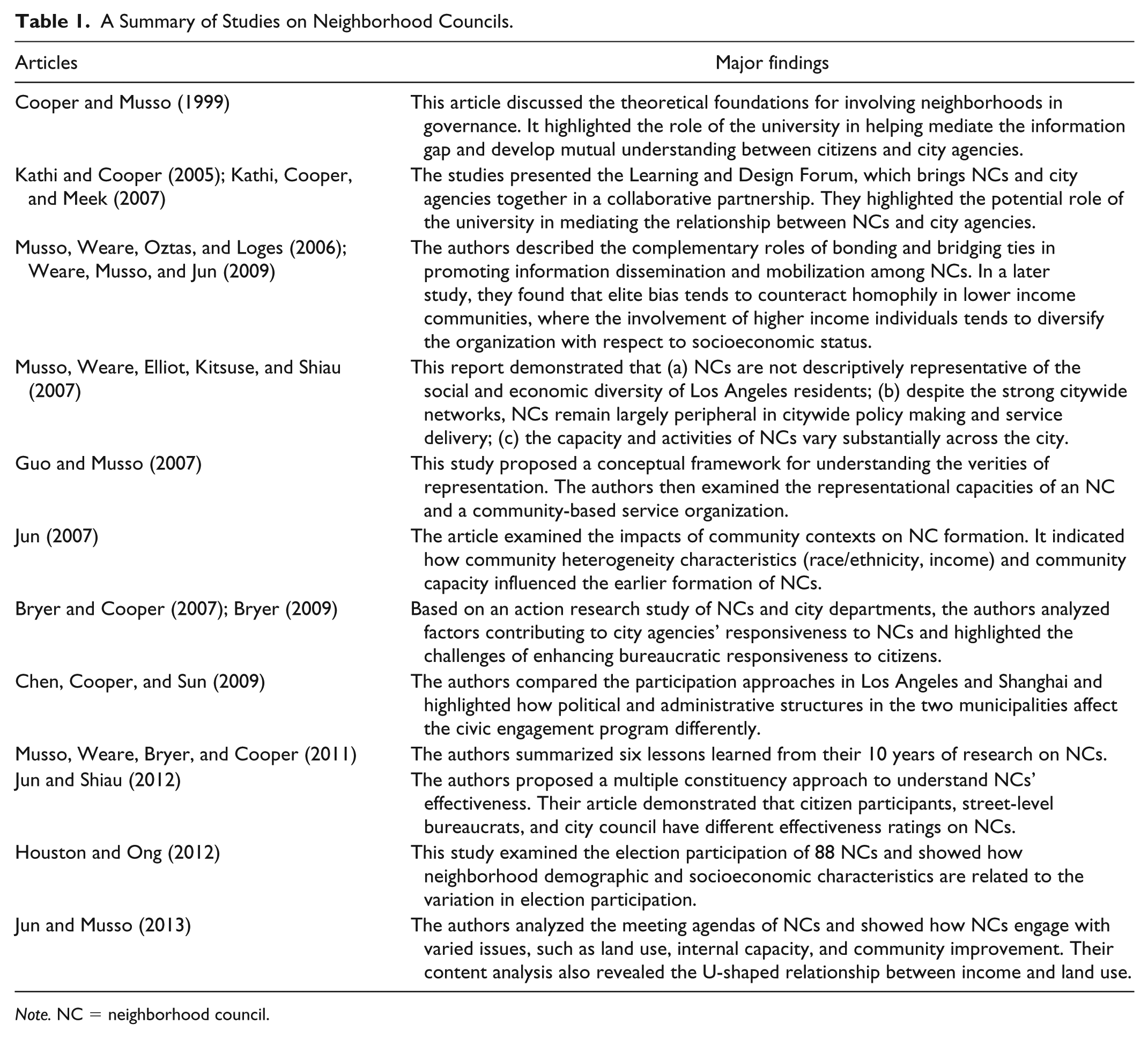
In previous research, there are two streams of studies on NCs (see Table 1 for a summary of studies on NCs). One stream focused on explaining the role of the NC system in urban democracy (e.g., Kathi & Cooper, 2005), whereas the other stream empirically examined NCs’ formation, networks, representation, and effectiveness. Jun and Shiau (2012), for example, examined NCs’ effectiveness from a multiple constituency perspective. Houston and Ong (2012) studied the determinants of voter participation in NC elections. Yet, the data used in these studies were mainly collected prior to 2007. The effectiveness of this institutional innovation from 2007 onward is, thus, unknown. In this regard, our “revisiting” effort is a meaningful update to existing studies on NCs. Below, we integrate theories related to board capacity, agenda setting, and neighborhood governance to explain differential effectiveness in NCs.
A Summary of Studies on Neighborhood Councils.
Note. NC = neighborhood council.
Framework and Hypotheses
Conceptualizing NC Effectiveness
Neighborhood associations like NCs exhibit distinctive characteristics. They differ from corporations or government agencies in that they depend heavily on elected board members’ voluntary efforts to facilitate their operations. Compared with formal social service nonprofits that focus on providing goods and services, the goals of NCs include mobilization, representation, and policy advocacy. Given these unique characteristics, it is difficult to directly measure their effectiveness (Sowa, Selden, & Sandfort, 2004).
Existing studies have used different approaches to study organizational effectiveness. Early literature mainly used unidimensional and framework-based approaches. The unidimensional approach focuses on one aspect of effectiveness. Goal attainment and system resource theories are two competing perspectives of this kind. The framework-based approach recognizes the multifaceted nature of the effectiveness construct. A variant of this approach is the multiple constituency framework which emphasizes that multiple constituencies have different understandings of organizational effectiveness. Jun and Shiau (2012), for instance, found that NCs’ levels of performance significantly vary, depending on who the evaluators are and what constituency groups they represent. For our project, we adopt a multidimensional approach to study the perceived effectiveness of NCs based on the distinct objectives they have, that is, (a) promoting civic engagement, (b) resolving community issues, and (c) advising about city policies. Promoting civic engagement refers to the extent to which NCs help encourage more citizen participation in government and include representatives of the many diverse interests in the neighborhood. By resolving community issues, we point to NCs’ effectiveness in working to solve various neighborhood problems, such as planning, land use, and garbage collection. The last dimension, advising about city policies, captures the degree to which NCs advise the city on citywide policies, local service needs, and land use.
Our approach has two key strengths. First, it is multidimensional in that it recognizes that NCs do not work to deliver tangible goods and services but to facilitate democratic processes and connect citizens to the administrative system of the city. Second, it is comparable across organizations because it focuses on organizational viability rather than on the success or failure of a specific campaign or project.
Explaining Differential Effectiveness
To explain factors associated with NC effectiveness, we propose a theoretical framework by drawing on literature from board capacity, agenda setting, and neighborhood governance (see Figure 1). We propose to view NC boards as dynamic and open social systems (Katz & Kahn, 1978) that interact with the NCs’ internal and external environments. NC boards’ internal capacity refers to the extent to which boards can effectively run meetings, recruit and manage volunteers, define goals, maintain leadership, and manage conflicts. External networking focuses on the extent to which board members contact other actors in their respective institutional environments (see also Musso, Weare, Oztas, & Loges, 2006; Weare et al., 2009). Attention-action congruence captures the transformational process that translates NC board members’ issue attention to actions. Below, we explain in detail how each dimension of NC board performance relates to perceived NC effectiveness.
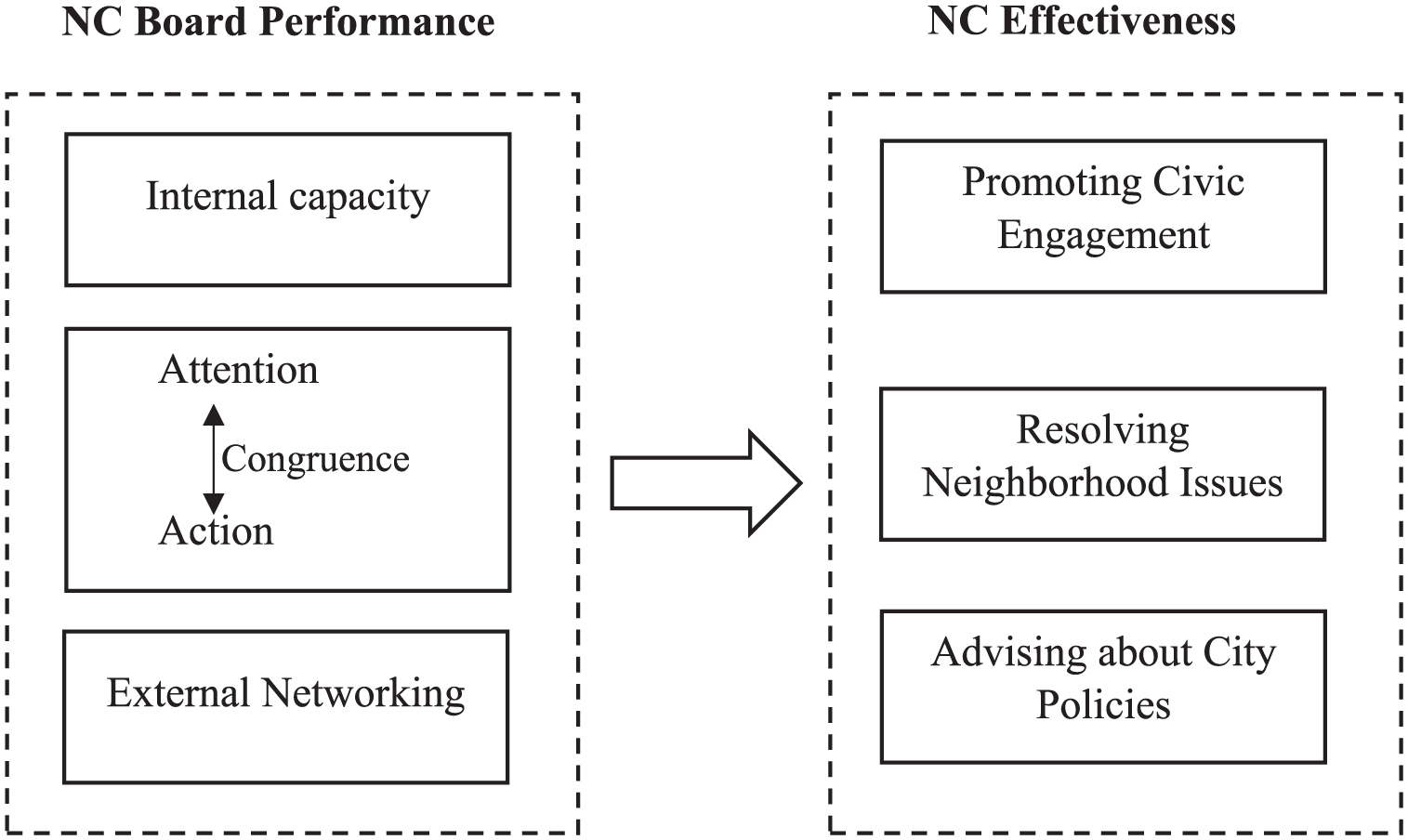
Theoretical framework.
Internal capacity
In conventional public administration literature, capacity is commonly regarded as an interchangeable term with “management,” deeply linked to the performance of organizations (e.g., T. L. Brown & Potoski, 2003; Christensen & Gazley, 2008; Eisinger, 2002; Meier & O’Toole, 2003). As a multidimensional construct, it encompasses resources, leadership, staff, and a certain level of institutionalization (Christensen & Gazley, 2008; Eisinger, 2002). In their study of community-based development agencies, Fredericksen and London (2000) contended that the internal management capacity provides the basis “upon which organizations can implement programs and achieve goals” (p. 233).
Neighborhood associations rely heavily on board members’ contributions of money, time, effort, and skill to the organizations’ cause (Andrews et al., 2010; Herman & Renz, 1997). As Rich (1980) succinctly put it, “the recruitment and maintenance of leaders is thought vital to the success of citizens’ action groups” (p. 570). For instance, Bradshaw, Murray, and Wolpin (1992) found that more than one third of the variance in organizational effectiveness can be explained by the levels of board involvement in strategic planning. Similarly, Green and Griesinger (1996) indicated that well-functioning boards, which unexceptionally embody mechanisms to constructively handle conflicts and regularize meetings, are the key to organizational success in terms of goal attainment. W. A. Brown (2005) argued that the strategic contributions from the board account for executive perceptions of organizational performance.
From these perspectives, the presence of an effective board in an NC, manifested through its capability to (a) run meetings smoothly, (b) recruit and manage volunteers effectively, (c) define goals clearly, (d) maintain leadership stability, and (e) reconcile internal conflicts constructively, enables the organization to be more effective (Cairns, Harris, & Young, 2005). Therefore, we are advancing the following hypotheses:
Attention-action congruence
Attention-action congruence examines the degree of congruence between NC board members’ issue orientation and their action, that is, the extent to which they contact respective city agencies to resolve the issues that they have discussed in their meetings. The concept of attention-action congruence was inspired by the theory of policy responsiveness, which examines the correspondence between citizens’ interests and policy outcomes. One way to look at this alignment, based on the responsiveness literature, is attitudinal concurrence, which reveals whether public officials concur with citizens on what the important issues are and how the government should respond (Hansen, 1975; Verba & Nie, 1987). The concurrence score is considered high when citizens form and convey their opinions about the problems that ought to be addressed by government to public officials, public officials hear these messages, and then make informed decisions which reflect citizens’ wants.
Similarly, attention-action congruence indicates the extent to which NC board members identify important issues in their neighborhood and then contact respective government agencies. Unlike the internal capacity construct, which focuses on the operational dimension of NC boards, attention-action congruence emphasizes the transformational process through which NC board members translate their identified problems into actions. While the attitudinal concurrence concept focuses on the alignment of attention from two distinct parties (citizens and government), attention-action congruence examines the agreement of attention and action of board members.
We draw on insights from Kingdon’s (1995) agenda-setting theory and hypothesize that NCs with higher attention-action congruence are more effective in advising about city policies. According to Kingdon, agendas are the result of a complex interaction among the politically salient issues, decision-making processes, and available policies. He distinguished three policy streams: problems, proposals, and politics. When a policy window emerges, the three streams converge, and policy agendas will be set. Kingdon also highlighted the role of policy entrepreneurs in pushing problems and proposals onto policy agendas. Likewise, NC board members serve as exactly what Kingdon called “policy entrepreneurs” who strive to push the convergence of issue orientations and actions (Purdue, 2001). They hold meetings to discuss local problems and issues waiting to be addressed. These meetings serve as a discussion platform on which board members collectively identify problems. After the problems are identified, board members set out to contact appropriate government agencies. This kind of contacting behavior helps NC leaders gain a more nuanced understanding of the issues that are important to them. They acquire political skills and become well-informed participants with a higher policy advocacy capability. As Lawton and Macaulay (2014) showed, through participation in local standards committees, local citizens became both expert citizens and everyday makers of their own local governance.
In urban politics, scholars have long been interested in whether and how community power is distributed and exercised in a democratic manner. Schumaker (1993), for example, distinguished three dimensions of power, where the first face of power concerns the direct causal impact of various actors (e.g., elected representatives, bureaucrats, group leaders, and citizens) on policy decisions, the second face of power examines the capacity of certain actors to control issue agendas, and the third face of power estimates the indirect impact that various actors have in shaping the preferences of those with direct power. The concept of attention-action congruence taps into these dimensions of power as it looks into the process through which NC leaders transform their issue attentions to specific actions to impact the behavior of administrative agencies in the city. Therefore,
External networking
External networking refers to board members’ efforts in building and using connections with other organizations to leverage resources and support (Hicklin, O’Toole, & Meier, 2008). Such networking helps foster connections with organizations’ external environment, bring in resources, and gain institutional efficiency and legitimacy (Isett & Provan, 2005). Johansen and LeRoux (2013), for example, distinguished two types of networking—community and political. They found that community networking increases nonprofits’ organizational effectiveness in making strategic decisions, increasing organizational funding, meeting funders’ performance expectations, and responding to client complaints. Political networking increases advocacy effectiveness by raising public awareness of the organization’s mission and by influencing local government’s priorities. Similarly, Sandfort (2013) examined how intermediary organizations and coalitions help nonprofits gain resources and garner public attention needed for effective advocacy. In this sense, external networking helps organizations exploit opportunities and protect against environmental threats (Brass, Galaskiewicz, Greve, & Tsai, 2004; Meier & O’Toole, 2003).
NCs network among themselves (i.e., bonding social capital), in the form of joining in regional and citywide alliances and coalitions as a means to generate a louder voice. They also network with others (i.e., bridging social capital), such as city elected officials and city agency officials, to garner sufficient attention. The respective bonding and bridging ties fostered through networking, according to Musso et al. (2006), play a mutually supporting role in promoting the sharing of innovative knowledge and trust among NCs. More specifically, from a micro perspective, networking helps build individual political skills, which, in turn, contribute to the collective action capacity of the NCs. Networking also helps improve information flows, aggregate political demands, and communicate the gathered feedback with city decision makers. This, as a whole, leads to NCs’ higher effectiveness in resolving neighborhood issues and advising about city policies. As Oztas (2004) argued, both bonding and bridging social capital matter for NC performance. Bonding social capital is conducive to internal discussions through which local concerns are crystallized, and bridging social capital “has a positive relation with NCs’ impact on both citywide and local decisions” (p. 155) as it helps fill structural holes concealed in the overall NC system and strengthen stakeholder engagement. Therefore,
Data and Method
Data Sources
To test the relationships between board performance factors and NC effectiveness, we collected data with a questionnaire survey in 2016. Key constructs and measurements in the survey were theoretically driven and drawn from a systematic review of the existing studies on neighborhood governance. We also invited scholars in the field to comment on the survey; we revised the survey based on their constructive input.
We obtained a list of all 96 NCs, including organization names, leadership team, and contact information (both email and telephone number) from the Los Angeles City DONE. We piloted the questionnaire with a few experienced NC members and improved it based on their feedback.
The questionnaire was then sent to all NC leaders, including the president and vice president of each council board via email, in which the purpose of the project was introduced and a link to the survey was provided. We sent three follow-up emails to NC leaders, reminding them to complete the survey. One of the authors also attended the Budget Day and Congress of Neighborhoods held by DONE at City Hall in July and September of 2016. In both events, we disseminated pamphlets and flyers to solicit participation in our project. Finally, we acquired a letter of support from DONE. This letter, along with the access to our survey, was incorporated in a monthly brochure, titled “NC Profile,” released on October 1, 2016, to all the NCs. Because of these outreach and legitimization attempts, we were able to collect valid responses from 80 different NCs, 2 yielding a response rate of 83%. In addition, we examined whether the 80 surveyed NCs and the 16 missing ones are significantly different in terms of the covered population, organization age and size, and the percent of household with income below $20,000. The results indicate that missing data are not a major concern.
We collected respondents’ demographic information at the end of the survey. The finding is consistent with previous studies that show that NC boards tend to be dominated by relatively affluent (while 18 cases are missing, 43.75% of the 80 have yearly household income above $100,000), well-educated (71.25% hold a bachelor, professional, or doctoral degree), White (65%), and middle-aged to older men (70% of the leaders are between the ages of 45 and 74; 60% are men) who are residents living in the neighborhood (76.25%). As Heikkila and Isett (2007) argued, people from dominant status groups (e.g., well educated, middle- to upper- income citizens) are more likely to get involved in public forums, leading disadvantaged groups underrepresented in public participation forums. Thus, the likelihood of truly representative “participation” may be a misnomer for forums such as advisory committees and public meetings. (pp. 246-247)
Measurement
The dependent variable is NC effectiveness. It is measured by asking NC leaders how their council has been performing in the past year in terms of six items. A 5-point Likert-type scale is used, where 1 = “Not at all effective” and 5 = “Extremely effective.” Guided by theory, we categorized the six items into three dimensions. The first is promoting civic engagement, which consists of two items: (1) promoting more citizen participation in government and (2) including diverse interests in the neighborhood (Cronbach’s α = .90). The second dimension is resolving community issues, which includes one item, working to solve problems in the neighborhood. The third dimension captures NCs’ advisory role in city policy making. It consists of three items, advising the city on (1) land use, (2) local service needs, and (3) citywide policies (Cronbach’s α = .91).
The first independent variable, internal capacity, is measured by the extent to which NC leaders agree with the following six items on a 5-point Likert-type scale, including our board is able to (a) Run meetings smoothly, (b) Recruit and manage volunteers effectively, (c) Define our goals clearly, (d) Maintain leadership stability, (e) Manage conflict constructively, (f) Form consensus effectively (Cronbach’s α = .92). Principal component factor analysis shows that one factor was retained, with an eigenvalue of 4.36, explaining 73% of the variance of the variable. The six items were averaged to create a variable for internal capacity.
Attention-action congruence examines the correspondence between board members’ issue attention and their action. The variable is calculated by averaging the distance between issues discussed in board meetings and the respective agencies the NC board contacted. We are well aware that attention-action congruence cannot be assessed on a single issue; rather, it must cover a sample of key community issues to reflect the dynamics and nuances of neighborhood affairs. Therefore, the attention component examines the extent to which board members have discussed the following issues over the past year, including (a) Public safety, (b) Land use, (c) Neighborhood beautification, (d) Parks and recreation, (e) Transportation and street maintenance, (f) Solid waste and garbage collection. In the survey, we asked NC leaders to report the extent to which they discussed the above issues on a scale of 1 to 5, where 1 = never, 2 = rarely, 3 = occasionally, 4 = frequently, and 5 = always. The action component examines how often NC boards have contacted the following government agencies: (a) Police Department, (b) Department of Planning, (c) Department of Public Works, (d) Department of Recreation and Parks, (e) Department of Transportation, and (f) Department of Public Works. 3 It is measured by a scale of 1 to 5, where 1 = not in contact and 5 = very frequent contact. We calculated the distance between the attention and action components. For example, if an NC reported that board members have always discussed public safety issues (coded as 5), but they have never contacted the police department (1), the distance between attention and action for the safety issue in this NC is 4, indicating a high discrepancy between board members’ attention and actual action in safety issues. We reverse coded the distance and obtained the congruence score for safety issues: 5 − 4 = 1. Similarly, the congruence scores between attention and action for the other five issues were calculated, and an overall congruence score for the NC was produced by averaging the six scores. The higher the score, the higher the congruence between attention and action on critical issues in the neighborhood.
External networking is measured by the extent to which NC leaders have contacted community stakeholders, elected officials, agency officials, and other NCs in the 2 weeks prior to the last board meeting. A 5-point Likert-type scale was used, where 1 = “Not in contact,” 2 = “1-2 times,” 3 = “3-5 times,” 4 = “6-10 times,” and 5 = “More than 10 times.” The items were averaged to create the networking variable.
Three control variables were included in the analysis. Organization age is measured by the number of years an NC has been in operation since certified. We expect that older NCs are likely to perform better because compared with younger ones, they often have experienced leaders, skilled volunteers, and established contacts and systems (Chambré & Fatt, 2002). Organization size is the number of members on a particular NC board. We expect that larger NCs are often more centrally located in the interorganizational networks and may have more resources and capacity to perform better (McPherson, 1983; Newton, 1982). These two questions were in the questionnaire but can also be found in each NC’s official website. We thus cross-checked the information provided by NC leaders with that listed online and found that they are consistent. This partially implies that the quality of the survey data is reliable. The last variable is stakeholder involvement, which asks the typical number of stakeholders who showed up at an NC’s board meetings in the past year. It is a categorical variable, in which 1 = “less than 10,” 2 = “11-20,” 3 = “21-30,” and 4 = “more than 30.” Engagement with stakeholders is a key task that most NCs focus on. It allows NCs to build strategic relevant relationships with diverse community stakeholders, bring in more voices, and stimulate new ways of approaching community problems. Thus, we expect that stakeholder engagement helps increase perceived effectiveness of NCs.
Analytic Strategy
The survey data are analyzed using ordinary least squares (OLS) regression. For each effectiveness measure, the model is built hierarchically in two major steps—the control variables are entered, followed by the main effects (i.e., three antecedents). Standard errors are weighted to avoid problems associated with heteroscedasticity (Newey & West, 1987). While we acknowledge that common source bias may be a problem when the independent and dependent variables are all from the same survey, we performed Harman’s single-factor test (Harman, 1976), and the analysis shows that the estimated variance for the three models is 38.8%, 39.54%, and 39.97%, which are below the 50% threshold, suggesting that common source bias is not a serious problem with the data set.
Findings
Table 2 presents the descriptive statistics for the variables of interest. The means for the three dimensions of NC effectiveness are 3.01, 3.29, and 3.10, respectively, suggesting that most NC leaders perceive their organizations to be moderately effective. Regarding the independent variables, NC board’s internal capacity is somewhere between moderately effective to effective. The mean congruence score between NC board members’ issue orientation and action is 1.48. In addition, NC board members communicate with other groups several times prior to the board meeting.
Descriptive Statistics.

Note. NC = neighborhood council.
The correlation table (Table 3) shows that the three dimensions of NC effectiveness are correlated at .81, .73, and .77, respectively, suggesting that they tap into different aspects of organizational effectiveness. The correlations between the explanatory variables are low.
Correlation Table.
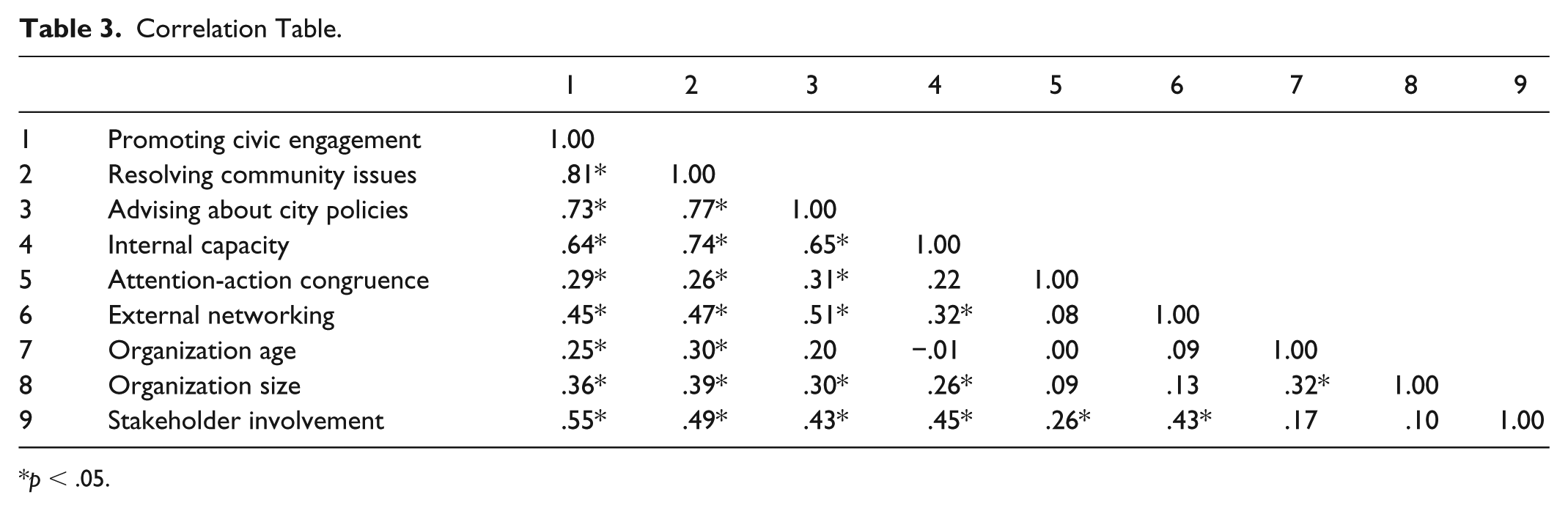
p < .05.
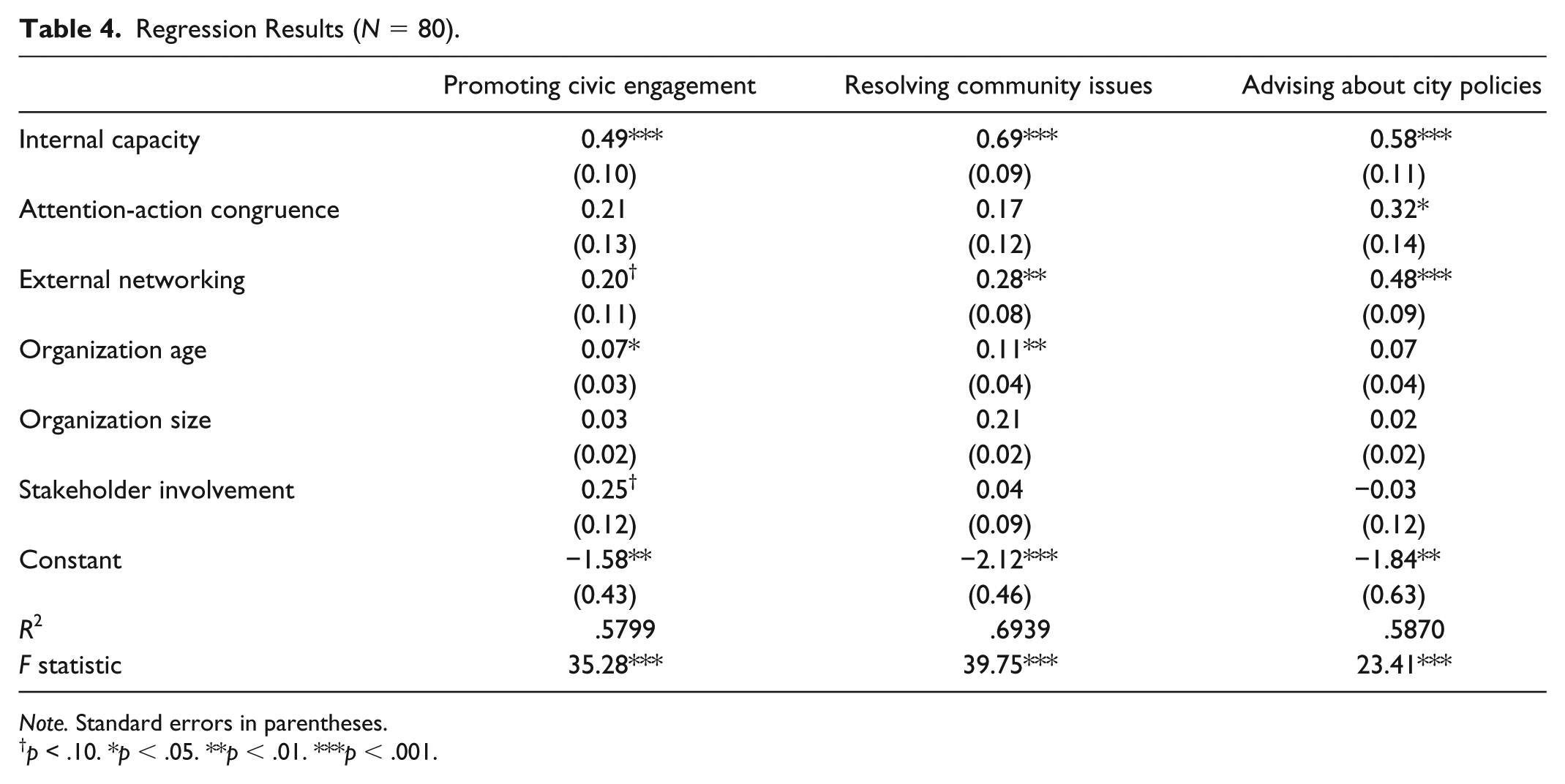
Three multivariate regression models with robust options were performed using Stata 12.0 (see Table 4). The first model examines factors associated with NCs’ effectiveness in promoting civic engagement. The three independent variables, together with the control variables, combine to explain 57.99% of the variance in NCs’ effectiveness in promoting civic engagement. NC boards’ internal capacity is positively associated with NCs’ effectiveness in promoting civic engagement (β = .49, p < .001). That is, when an NC board performs well internally, in terms of running meetings, managing volunteers, defining goals, maintaining leadership, and managing conflict, the NC as a whole is likely to be more effective in promoting citizen participation and representing diverse interests.
Regression Results (N = 80).
Note. Standard errors in parentheses.
p < .10. *p < .05. **p < .01. ***p < .001.
The second model focuses on NCs’ effectiveness in resolving neighborhood issues. The whole model is significant (F statistic = 39.75, p < .001), explaining 69.39% of the variance in the dependent variable. Consistent with the first model, NC boards’ internal capacity is positively related to NCs’ effectiveness in resolving community issues. In addition, if an NC is deemed active in connecting with external actors from the institutional environment, it is likely to be more effective in solving issues within the neighborhood (β = .28, p < .01).
The third model concerns NCs’ effectiveness in advising the city on citywide policies, local service needs, and land use. The full model explains 58.70% of the variance in NCs’ effectiveness in advising about city policies. Furthermore, NC boards’ internal capacity contributes positively to NCs’ capacity in playing the advisory role (β = .58, p < .001). External networking is positively related to NCs’ effectiveness in advising about city policies (β = .48, p < .001). The congruence between board members’ issue orientation and action is positively associated with the extent to which NCs can play an advisory role (β = .32, p < .05). In other words, when an NC board exhibits higher congruence between its attention and actions, it is likely to be more effective in policy advocacy.
Discussion and Conclusion
In “The Rebirth of Urban Democracy,” Berry, Portney, and Thomson (2002) considered the cultivation of citizenship as the fundamental step to revitalize urban democracy. Specifically, good citizens, who tend to believe that they are responsible for bettering the functionality of the government, are more willing to proactively participate in the governmental process, thus nourishing democracy in a practical manner. Following this line of reasoning, Kathi and Cooper (2005) urged academics and practitioners to clarify the nature of participation mechanisms through which authentic democracy can be attained. In their opinion, while representative democracy is widely adopted and entails citizen participation to a certain extent, its ability to represent the diversity of constituent interests in populated, multicultural states like the United States remains questionable (Roberts, 2004). Given that participatory mandates are historically incapable of allowing citizens to have the primary influence on government agenda setting relating to local governance and service delivery (Alford, 2002), Kathi and Cooper subsequently advocated for the creation of “bottom-up structures within a governmental framework” (p. 562). The NC system in Los Angeles is a typical example of such bottom-up structure.
This study contributes a much-needed empirical dimension to neighborhood governance by examining whether NCs in Los Angeles, a government-sanctioned and financed institutional innovation related to civic engagement at the neighborhood level, after its 18 years of operation, are effective in promoting civic engagement, resolving neighborhood issues, and advising about city policies. Drawing on literature from board capacity, agenda setting, and neighborhood governance, our study proposed a theoretical framework to explain NC effectiveness. We consider NC boards as a dynamic and open social system that interacts with NCs’ internal and external environment. Three factors, including internal capacity, external networking, and attention-action congruence, were related to NC effectiveness.
Admittedly, existing studies have examined the effectiveness of the NC system. Musso, Weare, Elliot, Kitsuse, and Shiau (2007), for example, conducted a comprehensive evaluation of the NC reform in 2007 and found that (a) NCs are not descriptively representative of the social and economic diversity of Los Angeles residents, (b) many NCs struggle with outreach and infighting, (c) NCs remain largely peripheral in citywide policy making and service delivery issues, and (d) the capacity and activities of NCs vary substantially across the city. Jun and Shiau (2012) found that NC board members, street-level bureaucrats, and city council staff evaluate NCs’ internal and external dimensions of effectiveness differently. While these studies are insightful, their data were collected in 2005 to 2006. Our study uses survey data collected in 2016 and provides a timely update as to how effective NCs have been performing. We find that most NC boards are dominated by relatively affluent, well-educated, White, and elderly men who are residents living in the neighborhood, and they perceive their organizations to be moderately effective.
The empirical results show that NCs’ internal capacity is positively associated with all three dimensions of organizational effectiveness, confirming H1a, H1b, and H1c. In other words, if an NC has an effective board that runs meetings smoothly, recruits and manages volunteers effectively, defines goals clearly, maintains leadership stability, and reconciles internal conflicts constructively, it is likely to be more effective in promoting civic engagement, resolving neighborhood issues, and advising about city policies. This finding contributes to the discussion of the relationship between board internal capacity and organizational effectiveness. While existing studies posit that nonprofit and voluntary boards make a difference in organizational effectiveness, few specify how they do it. As Herman and Renz (2008) propose, “Future research is necessary . . . to determine what board member, board process, and organizational factors are important in affecting organizational performance” (p. 403). Our study shows that an effective board refers to one that performs well in running meetings, setting agendas, and resolving conflicts. These are all critical components of board process that contribute to effective neighborhood associations.
Our study also finds that when NC board members communicate more frequently with community stakeholders, other NCs, elected officials, and agency officials, they perceive their organizations to be more effective in solving community issues and advising about city policies (H3a and H3b). This is consistent with prior studies on managerial networking. While networking is costly in terms of time, efforts, and resources (Agranoff, 2006; Galaskiewicz et al., 2006), it is a critical managerial tool for nonprofit and civic organizations to gain resources and status to support organizational development and policy advocacy (Johansen & LeRoux 2013; Sandfort, 2014). For NCs, networking is essentially a process of relationship building and outreach through which NCs cultivate ties with community stakeholders and outside members (including peer NCs, the city, and elected officials). These ties help develop board members’ political skills, improve information dissemination, and collective mobilization for bigger voices and impact, within the neighborhood and beyond. Thus, NCs’ external networking efforts lead to higher effectiveness in resolving neighborhood issues and advising about city policies.
In addition, we proposed a new variable—attention-action congruence—to capture the degree of congruence between NC board members’ issue orientation and their action, that is, the extent to which they contact appropriate city agencies to resolve the issues they attend to. The findings show that NCs with a higher congruence score between issue attention and actions are likely to be more effective in playing the advisory role in local policy making. Put differently, when board members in an NC can collectively identify the important issues in the neighborhood and contact government agencies to solve those problems, that NC exhibits a higher level of effectiveness in policy advocacy. This speaks to Kingdon’s agenda-setting theory, which suggests that setting policy agendas is an art that requires knowledge, skills, and political savviness to identify problems, grasp windows of opportunity, and leverage political support. The congruence of issue and action within board members epitomizes this kind of art. NC board members deliberate, identify, and act. This process helps them gain a more nuanced understanding of the issues that are important to them (Carpini, Cook, & Jacobs, 2004). They acquire political skills and become knowledgeable participants in the policy process. While existing studies examine attitudinal concurrence between citizens and government officials, our study follows a similar logic but proposes a new variable to measure the congruence of board members’ attention and action in neighborhood associations. It shows that this variable is a critical predictor of these organizations’ effectiveness in policy advocacy. Future studies may include this variable and examine the processes through which attention-action congruence predicts organizational effectiveness in other contexts.
This study has several limitations. To start with, data were gathered from individuals leading their respective NC boards. Nonetheless, as Musso et al. (2007) and our study explicitly pointed out, one of the most regrettable shortcomings of the NC system is that NCs fail to adequately reflect the racial, socioeconomic, and cultural diversity of the community. NC board members, in particular, are “substantially more likely than neighborhood residents to be white, wealthy, highly educated, and homeowners” (p. 7). The extent to which their expressed perceptions represent the majority opinion of community stakeholders remains unknown. In future study, one might want to conduct a more inclusive analysis of NC effectiveness. In addition, our article may be limited by the mono-method bias. Echoing Morrison (2002), “single-source bias is most problematic when both independent and dependent variables are measured on similar types of scales” (p. 1159). Although we found that it is not a serious issue in our study, we believe that qualitative components, mainly in the forms of semi-structured interviews or focus group discussions, can be incorporated in future research to give our findings “an added lift.”
Our study carries practical implications. The need to adapt administrative structures to embody democratic legitimacy and procedural justice exists in other continents and metropolises around the world. In Europe, for instance, neighborhoods have been recognized as proper sites for innovation in service delivery and local governance (Lowndes & Sullivan, 2008). In Denmark, citizens and public officials worked together in the form of NCs to deal with problems of public safety, crime, and neighborhood decline (Wagenaar, 2007). In the United Kingdom, the government introduced the Localism Act in 2011, which promotes the transfer of power from above to neighborhoods and individual citizens as well as the development of new exemplars of neighborhood governance and community empowerment (Lawton & Macaulay, 2014). While the sociodemographic contours of Los Angeles might not be found elsewhere, its NC system represents and subsequently demonstrates the promise of local governance reform which strives to productively “mediate between communities and core decision-making institutions” (Musso et al., 2006, p. 92). Key elements of the NC system and the relationships between board performance and NC effectiveness can stand up to scrutiny in other contexts. By understanding issues related to underperforming boards, the discrepancies between attention and action, and networking difficulties, this article might help devise appropriate approaches to not only increase the operating effectiveness of Los Angeles NCs but also enhance the sustainability of participatory democracy in broader urban contexts.
Footnotes
Declaration of Conflicting Interests
The author(s) declared no potential conflicts of interest with respect to the research, authorship, and/or publication of this article.
Funding
The author(s) disclosed receipt of the following financial support for the research, authorship and/or publication of this article: The project was funded by the Bedrosian Center on Governance and the Sol Price Center for Social Innovation at the University of Southern California.
