



Abstract
Municipal government dissolution used to be a rare occurrence in American history and has thus far received little attention in the literature. More than 300 of municipal governments, however, have dissolved since the mid-1990s. To understand this emerging momentum in practice and to fill the gap in literature, this article focuses on the increasing trend of village dissolution in New York, builds an analytical framework, and investigates the driving forces behind the possibility of dissolution, which is measured either by the presence of any dissolution-related activity or by the passage of a dissolution referendum. Based on a representative survey sample and a rich set of secondary data, this article consistently finds that dissolution does not randomly occur. Rather, dissolution is more likely to be considered and approved in a village where the economy struggles, the population declines, political trust undermines, and fiscal health deteriorates. In other words, the research suggests dissolution may not be as appealing or take place in economically strong and politically dynamic areas.
Keywords
Introduction
Over the past several decades, two contrasting institutional trends have jointly determined the local landscape of American federalism: government formation and death. These two trends have strongly shaped both special-purpose and general-purpose governments. On the one hand, a dramatic decrease in the number of school districts has been coupled with an astonishing increase in the use of special districts (Berry, 2009; Duncombe & Yinger, 2007; Foster, 1997; Zhang, 2018). On the other hand, the general-purpose municipal government system, though seeming stable on the surface, has undergone great changes as well, especially since the turn of the millennium. To be specific, more than 200 new cities have been formed after 2000 (Patrick & Mothorpe, 2017), while at least 373 municipal governments have dissolved between 1995 and 2012 (Anderson, 2012a).
Municipal government dissolution, as compared with other government restructuring efforts such as the aforementioned special district creation, school district consolidation, and city formation, has not been well understood, though dissolution activities have occurred in 39 states. A primary reason for the lack of sound understanding may be that the phenomenon has not occurred as frequently until very recently. As suggested in Anderson (2012a), more municipal governments dissolved in the past 20 years than did in the 100 years prior. In other words, more municipalities have ceased to exist than in the past, and it seems that continued dissolution efforts may come to challenge the common perception that local general-purpose governments are generally immortal or rarely die.
If municipal government formation signals prosperity and growth in terms of population and the economy, municipal dissolution then indicates decline. However, it would be naïve to treat dissolution simply as a symmetric reversal of founding a new organization (Anderson, 2012b; Bauroth, 2010). Furthermore, dissolution may not randomly occur, or put differently, not every village is a suitable candidate for dissolution. The existing literature offers little insight into what constitutes dissolution and when dissolution is likely to take place, other than a handful of pioneering legal analyses (Anderson, 2012a, 2012b, 2015). To fill this big gap in public administration literature, this article studies village government dissolution events in the state of New York. New York is of particular interest as more than 50 villages, approximately 10% of all 554 villages, have unprecedentedly voted on dissolution, with 22 of them having successfully passed such a referendum in the past 10 years. The state government has also been very active in advancing the elimination of village governments, offering both legal and financial incentives to do so. This top-down support, coupled with bottom-up efforts, has driven New York to be the pioneer in terms of restructuring villages, relative to Michigan, New Jersey, Iowa, Illinois, and other states where strong advocacy for reducing the number of local governments can also be found. As a unique contribution to the literature, the author builds a complete inventory of dissolution referendum cases in New York to the end of 2017, which includes both successfully dissolved villages and those that put the matter to a vote but were unsuccessful. Detailed voting information is also collected and provided in the inventory (see Tables 1 and 2).
Voted-to-Dissolve Villages in New York, 2000-2017.
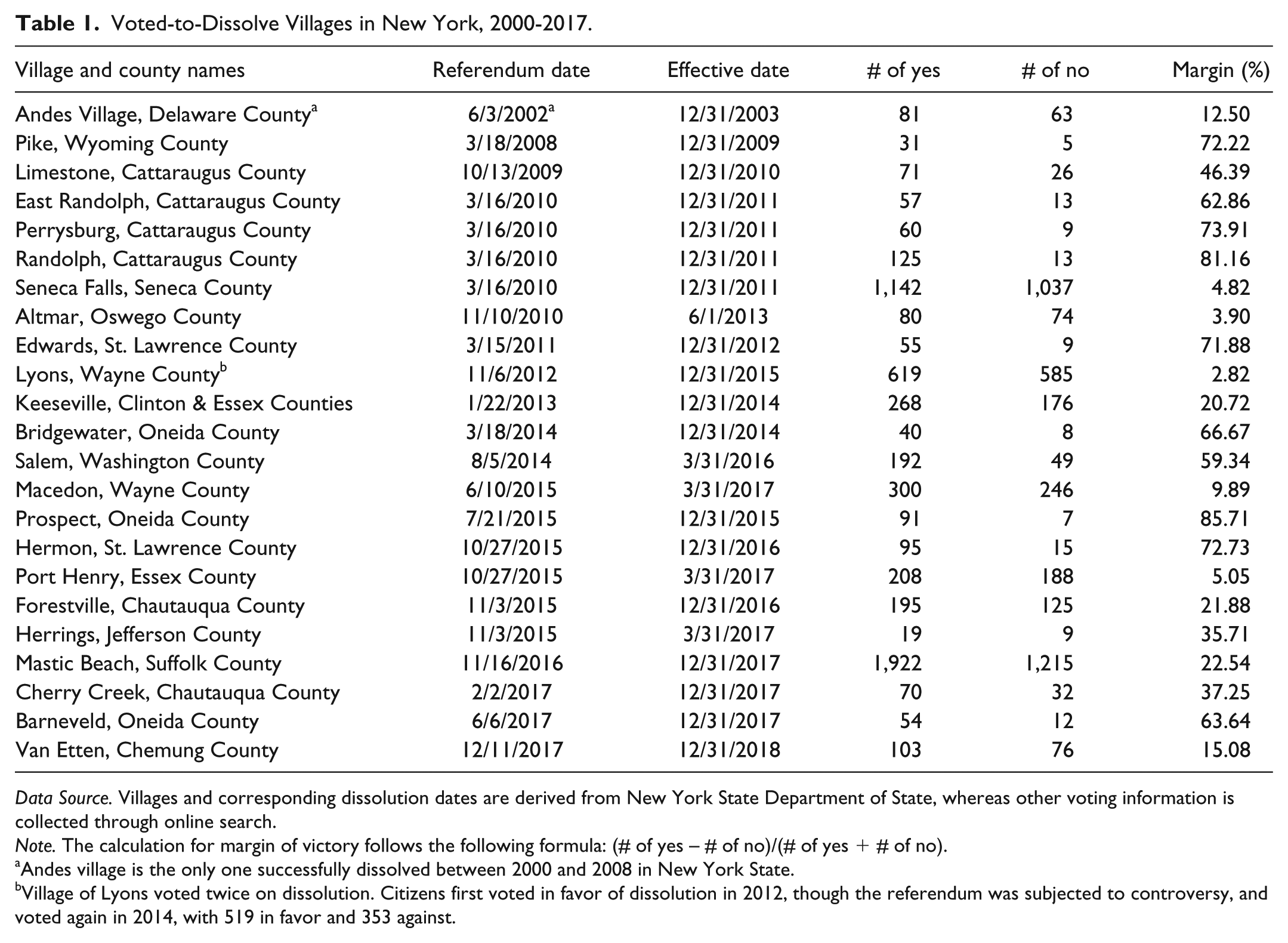
Data Source. Villages and corresponding dissolution dates are derived from New York State Department of State, whereas other voting information is collected through online search.
Note. The calculation for margin of victory follows the following formula: (# of yes – # of no)/(# of yes + # of no).
Andes village is the only one successfully dissolved between 2000 and 2008 in New York State.
Village of Lyons voted twice on dissolution. Citizens first voted in favor of dissolution in 2012, though the referendum was subjected to controversy, and voted again in 2014, with 519 in favor and 353 against.
Voted-Down Villages in New York, 2008-2017.
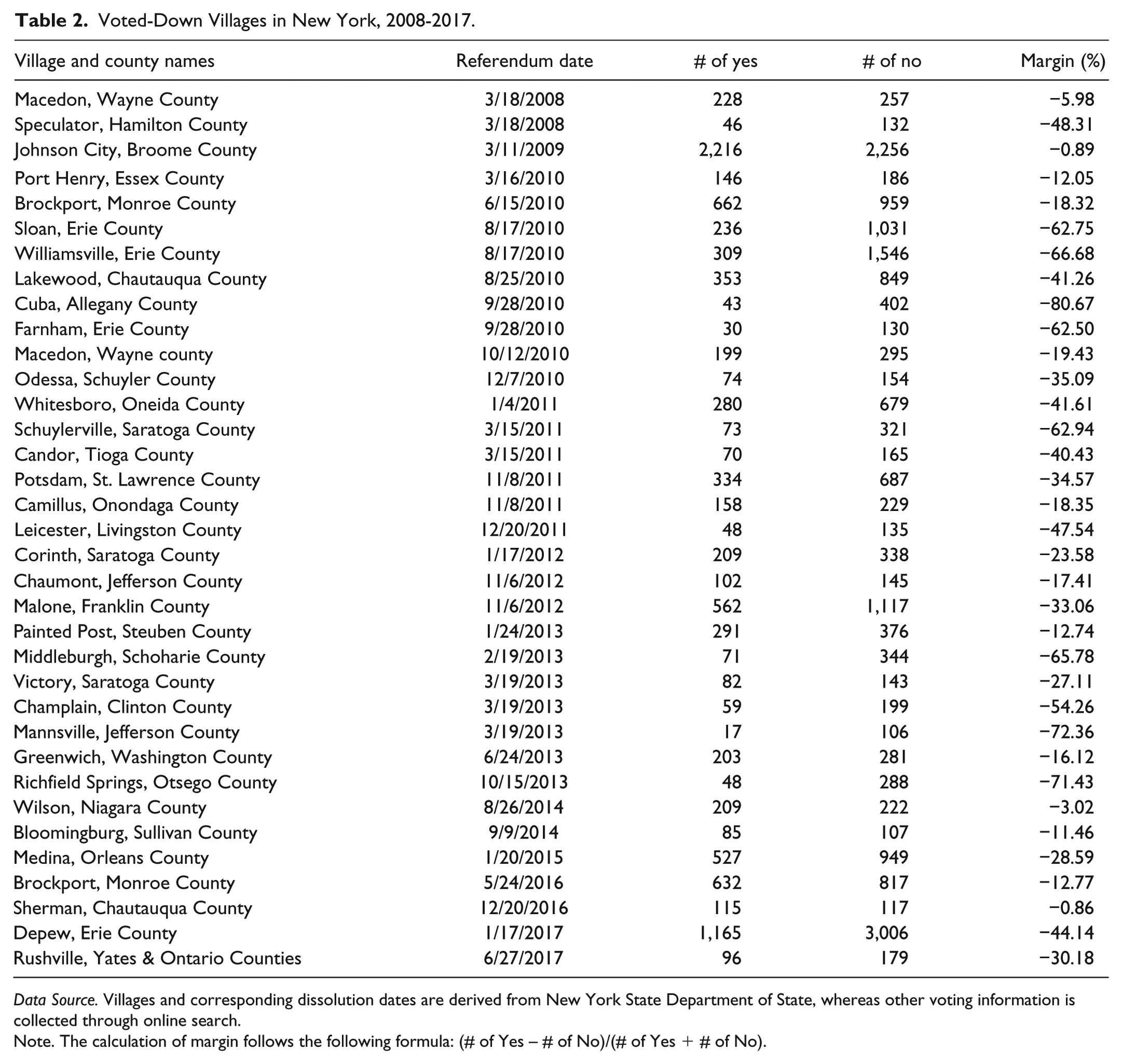
Data Source. Villages and corresponding dissolution dates are derived from New York State Department of State, whereas other voting information is collected through online search.
Note. The calculation of margin follows the following formula: (# of Yes – # of No)/(# of Yes + # of No).
This article synthesizes the literature, describes the legal framework of municipal dissolution in New York, develops an analytical framework, and seeks to identify whether there exists any pattern or powerful driving forces behind the emerging trend of village government dissolutions. Specifically, it attempts to answer two empirical questions. First, what kinds of villages are more willing to consider dissolution? Willingness to consider dissolution, in the context of this study, refers to villages that seriously consider the possibility of dissolution by undertaking specific steps such as applying for a state government grant on dissolution, establishing a study group to analyze the consequence of dissolution, holding a referendum on dissolution, or other dissolution related activities. Thus, the willingness to consider dissolution includes, but is not limited to, holding a dissolution referendum. Without a single and comprehensive federal or state list of all of such dissolution activities, the author conducted a survey of all village mayors or financial managers in New York. The representative survey, with an approximate response rate of 42%, enables the author to comprehensively examine the determinants of dissolution possibility, regardless of the completion of a referendum process or the ultimate outcome. The survey responses are then combined with secondary demographic and government finance data provided by the Census Bureau and the New York State Comptroller’s Office, respectively, to identify what kind of villages are likely to consider dissolution in a cross-sectional setup.
Second, and perhaps more importantly, what kind of villages have eventually dissolved? Considering dissolution is one thing, but successfully doing so via referendum is another. In New York, village dissolution proposals must be put on a ballot and officially approved through a referendum. To answer this question, the author conducts a survival analysis based on a unique longitudinal village-level finance dataset with information from 1996 to 2017. A series of robustness checks are also conducted with different datasets and estimation methods.
In addition to making a contribution to local government restructuring studies, this article also adds fresh knowledge to the cutback management literature. Public administration studies on cutback management have extensively studied cutback strategies adopted in public organizations in the 1970s and 1980s (Levin, 1978). The relevant public management literature, however, fails to consider the life cycle organizational evolution of public organizations (Bozeman, 2010). An important reason for this may be that most general-purpose governments are assumed to be immortal. Thus, the recently unprecedented dissolution practice in New York provides a natural laboratory to examine the rise and fall of local governments from an organizational behavior perspective, both in this research and in future studies.
The article proceeds as follows. Section “Literature Review on Local Government Restructuring Reforms” reviews existing literature, which is followed by an introduction of institutional details of village dissolution in New York in Section “Village and Village Dissolution in New York.” Section “Village Dissolution: An Analytical Framework and Theoretical Hypotheses” builds an analytical framework, and Section “Empirical Methods and Data” discusses data, empirical challenges, and strategies. Section “Empirical Results” presents empirical results of both cross-sectional data analysis and longitudinal survival analysis. It ends with discussions and conclusions in Section “Discussion and Conclusion.”
Literature Review on Local Government Restructuring Reforms
To optimize the design of local government systems, institutional designers are often confronted with a trade-off between factors that favor larger size and others that support smaller units. The most relevant factors discussed in the literature include economies of scale, spillover effects, allocative efficiency, administration cost, and accountability concerns (Hindriks & Myles, 2013; Hooghe & Marks, 2009; Oates, 1972, 1993; Ostrom, Parks, & Whitaker, 1978; Treisman, 2007). The debate reflects a perennial dispute between regionalists and localists (Foster, 1997; Jimenez & Hendrick, 2010). In reviewing the existing literature, Blom-Hansen et al. (2014, 2016) argue that the aforementioned theoretical debate fails to provide any clear and specific guidance over the optimal size of local jurisdictions. First, each public service has a unique production technology and characteristics, leading to the possibility that there is not one optimal size but many, one for each service that a municipality provides. Second, what matters most is the scale effect at plant level rather than those at firm level in local government. Thus, the perennial debate inappropriately focuses primarily on municipality rather than the direct service providers under municipal governments. Regardless of the debate between the two schools, most scholars agree that the search for the optimal size of political jurisdiction is not a random event, and the focus of this paper is to explore the non-randomness feature of government reorganization.
Several empirical studies examine the non-randomness feature embedded in local government restructuring movements, including school district consolidation, city–county consolidation, and special district dissolution. 1 Kenny and Schmidt (1994) focus on the “death” of school districts between 1950 and 1980, finding that the trend toward consolidation could be explained by the increase in population density, the increased importance of state aid, and the increased prominence of teacher unions. In the context of Ohio, Brasington (1999) employs a bivariate Probit model and argues that school districts of different sizes are more likely to consolidate with each other, while neither racial heterogeneity nor income levels appear as significant contributors to the consolidation decision. Gordon and Knight (2009) develop a spatial merger estimator and apply it to the wave of school district consolidation in Iowa during the 1990s. They find the likelihood of consolidating may be related to the presence of state financial incentives for mergers, economies of scale, and a variety of heterogeneity measures in education and income across potential consolidation partners.
Compared to the large scale of school district consolidation, consolidation among local general-purpose governments, such as city–county consolidation, has a much higher failure rate. Actually, there were only five successful passages of city–county consolidation between 1990 and 2004 (Leland & Thurmaier, 2005) in America. 2 Rosenbaum and Kammerer’s (R-K; 1974) model and Leland and Thurmaier’s (2000) City–County Consolidation (C3) model are the two predominant analytical models of government consolidation in public administration literature. The classic R-K model has three basic elements, including the development of crisis climate, the failure of local government’s response to the crisis, and a catalytic event. Though informative, the R-K model goes with several limitations. For instance, it fails to extend beyond the referendums stage (Johnson & Feiock, 1999), ignores the role of civic elites (Feiock & Carr, 2000), and neglects the fundamental institutional context (Leland & Thurmaier, 2005). By emphasizing the importance of legal framework, incorporating the function of voter alienation and civic elites, and appending a referendum campaign stage, Leland and Thumaier (2000) propose the C3 model. They examine the single consolidation case between Kansas City and Wyandotte County, arguing that the deciding factor favoring this merger was the issue of accountability. In 2005, based on 12 consolidation attempts, they argue that a consolidation case is more likely to fail when focusing on the increased efficiency or increased equity to be gained from redistribution of revenues among consolidating candidates. Instead, an economic development vision for the whole community after consolidation is the key to successfully gaining support from both consolidating candidates. Feiock, Carr, and Johnson (2006) disagree with this view and argue what makes consolidation arguments strong or weak is how the issue is framed, rather than the substantive focus of policy debates. Despite the unresolved debate, 3 it suggests that legal context, political dynamics, economic and population climates, civic elites, and accelerator events should be considered in understanding significant government structural changes.
Differing from consolidation, which requires the approval of two or more parties, the transaction cost, legal foundation, and political economy of a single government dissolution are arguably distinctive. Using Census data from 1987 to 2002, Bauroth (2010) finds that special district disappearances are driven by the change in local service demand, state home-rule and fiscal policies, the actions of public entrepreneurs, a special district’s revenue-generating capacity, and whether a special district is overseen by elected or appointed officials. Based on information from Texas Water District Database between 1971 and 2016, Moldogaziev, Scott, and Greer (2019) employ an event history model to evaluate how internal and external factors are associated with the mortality of water districts. They find that population, tax rates, and debt services are important explanatory covariates, while functional fragmentation or competition among water districts have no significant impact on dissolutions.
Village and Village Dissolution in New York
Each state has a unique institutional framework for what constitutes a village and other types of localities. In New York, legally, a village is a municipality which, at the time of incorporation, meets statutory population and area requirements. According to the Village Law, a territory containing a population of at least 500 persons, but not containing more than five square miles, may be incorporated as a village. Most of the villages in the state were, however, established prior to 1920 and the municipal designation—whether a locality is designed as a village, a town, or a city—is arguably outdated, as more than 70 villages have populations below 500 as of the 2000 Census (Office of The New York State Comptroller, 2006). 4 Geographically, a village usually exists within the scope of a single underlying town, and that is the case for about 88% of villages in New York. Politically and fiscally, when a village is incorporated, its residents continue to be the residents and taxpayers of that underlying town. In New York, a village can either be formed or dissolved at the full discretion of village residents.
According to the Village Law, dissolution of a village is defined as “a process whereby a village ceases to exist as a governmental entity.” The dissolution process can be initiated either by the village board of trustees on its own motion or through an appropriate voter petition to the board of trustees. In either case, the dissolution decision is ultimately determined by the voters of the village through referendum. Once a village is effectively dissolved, the underlying town government will assume service responsibilities of the former village areas. It is noteworthy that the decision-making process of dissolution does not require the consent of the town in which the village is located, even though town residents are very likely to be affected. Alternatively, one may interpret village dissolution as a consolidating process whereby a village consolidates with its corresponding town. Following the Village Law and Anderson (2012a), this article interprets the dissolution as a process that permanently removes a layer of village government and returns a population to its town’s jurisdiction. 5
To fully understand the motivation and possible consequence of village dissolution, it is important to be aware of the distinction between villages and towns, which have different approaches to governing in New York. Traditionally, a village is a populated area of a town where its government, like a city government, is expected to provide a variety of public services, such as fire protection, police, water, sewer, sanitation, and transportation. In contrast, a town government usually taxes and serves people with an “ala carte menu” approach. Namely, town governments often choose to create special districts to align service benefits and costs for a particular group of residents in an area within the town. Several rationales underlie the “ala carte menu” approach, including the following: (a) to provide services when the tax base is not sufficient to support town-wide services and (b) to compensate in the situation that service needs are not broad enough to generate voter support for town-wide provision. According to a report by the Office of the New York State Comptroller (2007), 6 there are more than 6,900 town special districts in New York, most of which are administered by town governments and funded through the collection of property taxes and own-source user fees.
Compared to other states, the New York state government plays an important role in eliminating village governments. Institutionally, New York passed the “New N.Y. Government Reorganization and Citizen Empowerment Act” (the Act hereafter) in June 2009. The Act, effective on March 21, 2010, largely eased the dissolution process by permitting a vote without the completion of a dissolution study when the dissolution is originally initiated by citizens. The Act also lowered the threshold of the number of signatures for a dissolution petition. In addition to simplifying the legal process, the New York Department of State (DOS) also provides both financial and technical support to encourage localities to consider dissolution. There are at least two explicit types of grants offered by the DOS to assist local officials in developing projects that reduce government expenses and facilitate the restructuring of local governments: the Local Government Efficiency Grant (LGEG) and the Local Government Citizens Reorganization Empowerment Grant (LGCREG). Around 50 villages have applied for local government efficiency program grants in the last several years to study the feasibility of dissolution or possible consolidation of public services with other jurisdictions. 7 According to the annual report on the administration of the local government efficiency program, the New York State Legislature appropriated $35,000,000 for LGCREG and the related Citizens Reorganization and Tax Credit Program. 8
Village Dissolution: An Analytical Framework and Theoretical Hypotheses
The existing literature suggests that government formation or dissolution is not random in most cases (Blom-Hansen et al., 2016). If not random, then specifically, what factors might explain the “death” of a village government, which provide multiple public services to village residents?
Legal scholars have pioneered the qualitative research on village dissolution in the United States. Anderson (2012a) assembles a list of dissolved municipal governments and makes the first attempt to establish a “graveyard” of American municipalities from 1857 to 2010. She argues that dissolution is not a mirror image of incorporation and that the dissolution law is immature and thin, though dissolution activities could be found in 39 states. Based on her pioneering study which qualitatively identified possible causes of dissolution, and the aforementioned general literature on local government restructuring movements, especially the C3 model, as well as the relevant management and policy debates in New York, this section builds an analytical framework of village dissolution (i.e., Figure 1) and develops several testable research hypotheses.
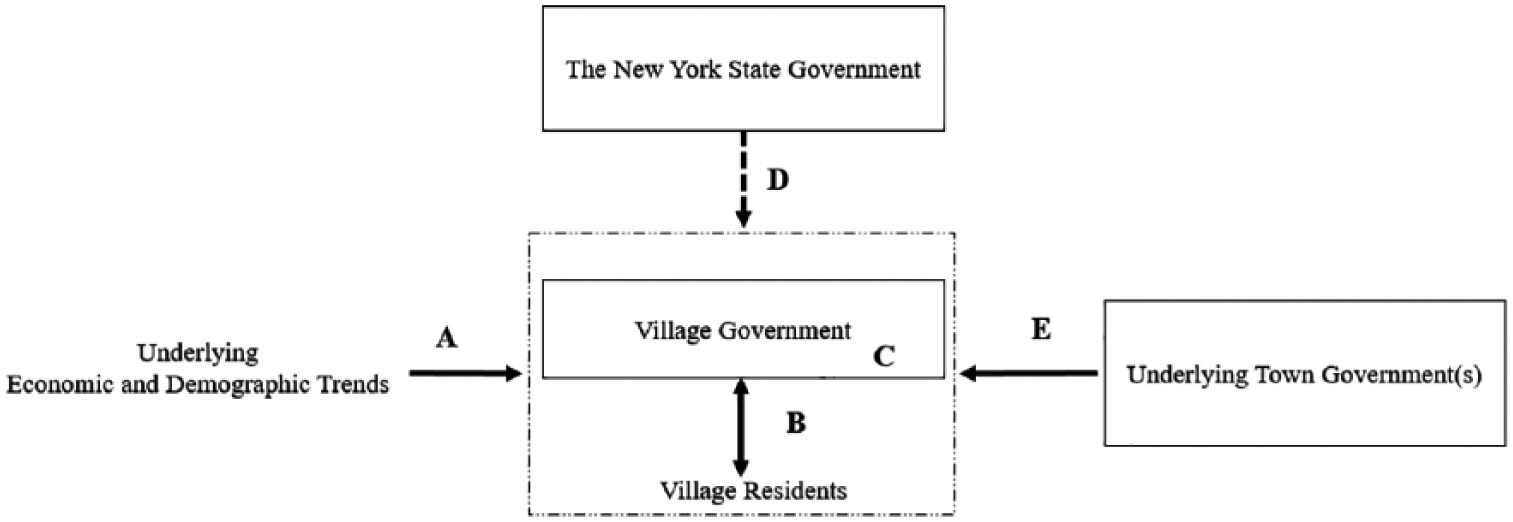
A simple analytical framework of village dissolution.
The simple analytical framework consists of three layers of governments, village residents, and underlying demographic and economic trends, as depicted in Figure 1. Letters A through E represent different streams of factors influencing the survival or organizational sustainability of a village government. Among all possible explanatory variables, the first and most prominent factors are changes in economic and demographic trends (i.e., A in Figure 1). Based on Wagner’s Law, a classic theory of public sector growth, many of public services have a higher elasticity of demand, implying that, as income goes up, there will be an increase in demand for those public services (Hindriks & Myles, 2013). Reversely, economic decline and the economic shift away from a manufacturing-oriented economy to one dominated by service could pose a fundamental threat to its tax base, in turn negatively affecting its survival. Although the transition from a manufacturing-based economy to a service-based economy occurred primarily before the 1980s, the modern era still warrants this same perspective given the compounding effects of globalization and the recent financial crisis. In fact, public economists argue that those underlying or structural factors play an important role in shaping local fiscal sustainability (Bradbury, 1982, 1983, 1984; Ladd & Yinger, 1989). These underlying factors also include demographic patterns and trends, which could be measured by population size, population density, age distribution, ethnic heterogeneity, and income heterogeneity. The C3 model and the classic trade-off between economies of scale and allocative efficiency in the literature suggest us consider these factors as well. For example, based on data from 1960 to 1990, Alesina, Reza, and Hoxby (2004) find that counties with higher levels of racial and income heterogeneities are likely to have more school districts. These considerations lead to the first two hypotheses:
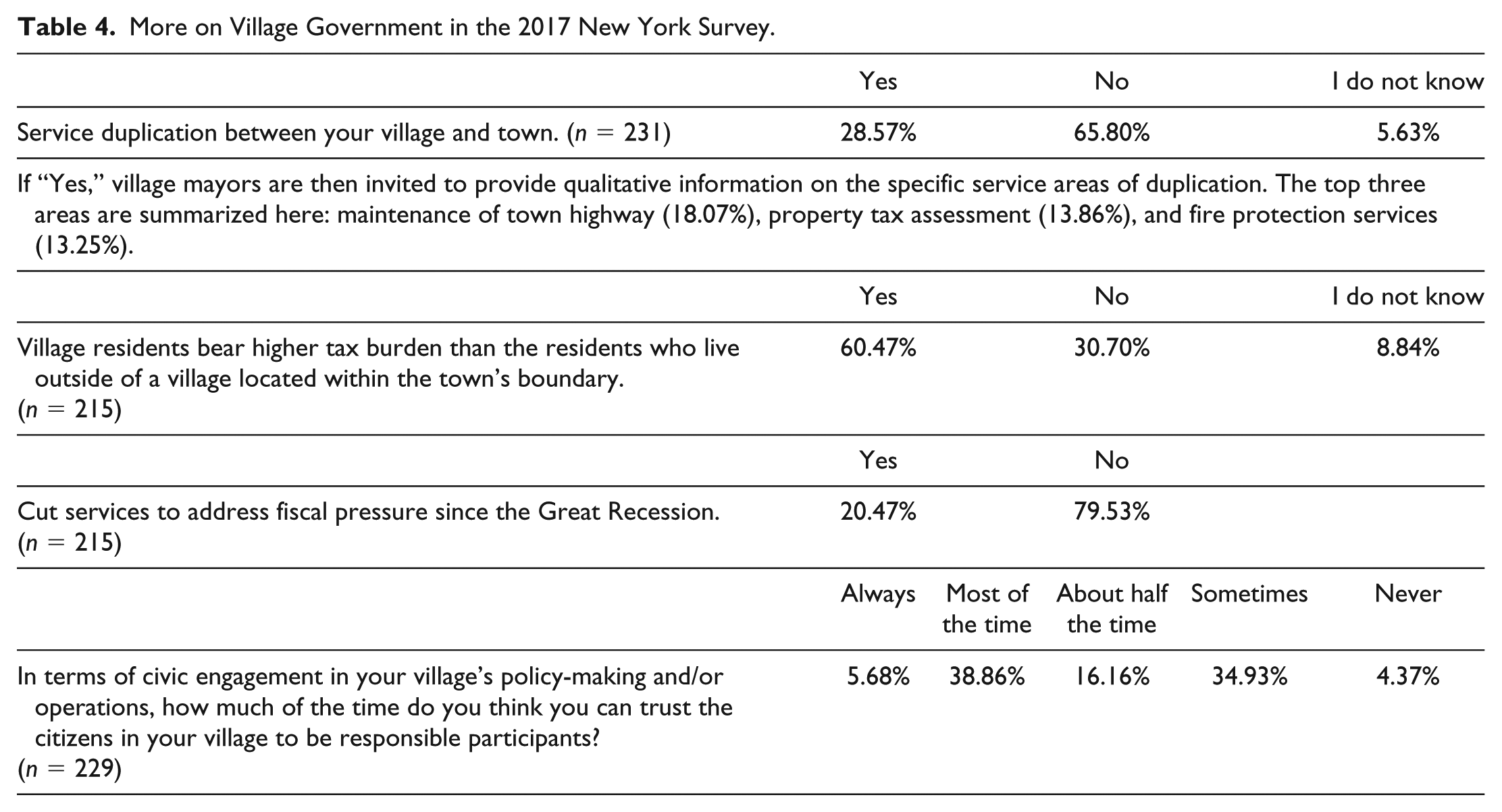
The second strand of factors driving dissolution possibility is related to the political trust and civic engagement between residents and village governments (i.e., B in Figure 1). As mentioned before, a dissolution petition is initiated either by village board of trustees or by local residents. As a result, the mutual political trust is crucial. On the one hand, when village residents desire for more efficiency in government and do not trust their current and future representatives, they are very likely to turn to dissolution as a last resort. On the other hand, when a village government board loses confidence in citizens in civic affairs, it will pose a threat to the continuity of village government as well. As such, the civic engagement experience and political trust between village residents and their government should be taken into consideration. This is also warranted by the R-K model and the C3 model in literature. Given that the data is not readily available on how much citizens trust their village government mayors or board members, we instead surveyed mayors’ trust in their citizens (see Table 4) and developed the following hypothesis:
Third, from a public management perspective, a village government’s internal management capacity and the way it addresses external pressure (i.e., C in Figure 1) may affect its survival and effectiveness (Pfeffer, 1978). There are numerous meaningful management measures, but the framework here considers primarily some extreme management behaviors as dissolution itself is a radical governance approach. Cutting services, for instance—as compared to employee layoffs, furloughs, contracting-out, or service-sharing strategies—could be a dangerous response to external pressure. As implied in the R-K model, service cut may signal to citizens that their village government is no longer able to operate in a responsible way or produce public value. When a village government cannot produce public value to the satisfaction of its residents, it may lose political support. Of course, other common financial management strategies are incorporated into the framework as dissolution is inevitably associated with fiscal concerns in New York.
Fourth, the New York State government and its policies could affect the organizational sustainability of local village governments (i.e., D in Figure 1). One of the most dramatic changes in the fiscal federalism landscape during the postwar period has been the greater role of state governments (Baicker, Clemens, & Singhal, 2012). When state governments reduce support to localities or when too many unfunded mandates are imposed downward, local governments may face increased fiscal pressure and therefore be more vulnerable to dissolution. Existing research does suggest that the increase of unfunded mandates is a big concern in New York (Aldag, Warner, & Kim, 2017; Zhang, 2018). As a case study involving the legal framework regarding dissolution only in a single state, this study cannot quantify the importance of the role a state government might play on the likelihood of village dissolution. That being said, we elaborate the macro legal and institutional context in New York in Section “Literature Review on Local Government Restructuring Reforms.” Future qualitative or comparative quantitative studies may serve to identify how the state government has influenced the local government landscape in the context of New York as compared with other states.
Finally, the tension between a village and its underlying town(s) and duplicative service burdens (i.e., E in Figure 1) may also stimulate local residents to turn to dissolution as a radical approach to taming the local “Leviathan.” 9 According to the Local Government Handbook in New York (2009), village residents are liable for payment of taxes to the village in which they reside, as well as to the town in which their village is located. When residents are taxed for town services they do not receive or when they do not want to pay the village governments for local services, they may doubt the legitimacy of the overlapping system and the corresponding village–town government structure. Anecdotally, in some towns, village residents are required by town boards to bear the costs of highway equipment and snow removal on town roads, although the State Highway Law exempts them from paying the costs of repair and improvement of town highways. In addition, a redundant and fragmented property tax assessment system may also disappoint residents of villages. According to the New York State Department of Taxation and Finance, there are 1,116 property tax assessing units in the state, including 2 counties, 61 cities, 920 towns, and 133 villages. As such, it is likely that some village assessors operate in overlapping areas and that some village residents may be receiving two different assessments for taxes levied by different units of their local government (Yinger, 2012). Thus,
Empirical Method and Data
Guided by the analytical framework described above, this study seeks to address two related empirical questions: (a) what kind of villages are willing to consider dissolution, as measured by engaging in any type of dissolution-related activities and (b) in fact, what kind of villages ultimately dissolve. Conceptually, the analytical framework above is applicable to both analyses, as engaging in a dissolution-related activity and successfully passing a dissolution referendum are essentially just different stages of the same institutional process or continuum. Answering these two research questions, however, requires different datasets and addressing different methodological challenges. This section separately elaborates on these respective empirical challenges, outlines strategies for overcoming them, and presents the findings.
What Kind of Villages are Willing to Consider Dissolution?
The primary methodological challenge to investigating the determinants of dissolution willingness is the lack of a single but comprehensive list of all dissolution activities (Anderson, 2012a). Although it is feasible to develop a list of all villages which have officially put dissolution to a referendum in New York (as presented in Tables 1 and 2), it is difficult to document all dissolution-related activities, as some villages might not have reached the final step holding a referendum on the matter. Without an existing and reliable data source containing this information, the author conducted a dissolution survey targeting all village mayors in New York in the Fall of 2017. 10
The survey was tailored to village governments in New York and includes a few of questions regarding dissolution, as well as those inquiring about the background of each village and each respondent. More than 96% of respondents classified themselves as White and 58% of them had at least a Bachelor’s degree. In addition, on average, respondents have served in their positions for approximately 10 years. Thus, it is reasonable to assume that these respondents have sufficient experience and knowledge to provide accurate information about their respective villages. Two key questions are asked about dissolution willingness or possibility. The first asks about a village’s recent dissolution experience, and the other about dissolution willingness in the near future. These read as follows:
“Has your village government seriously considered the possibility of village dissolution (e.g., studied the feasibility of village dissolution, applied for a grant to study dissolution, had a referendum on dissolution, etc.) recently?”
If ‘No,” do you think your village is likely to consider the possibility of dissolution in the near future?
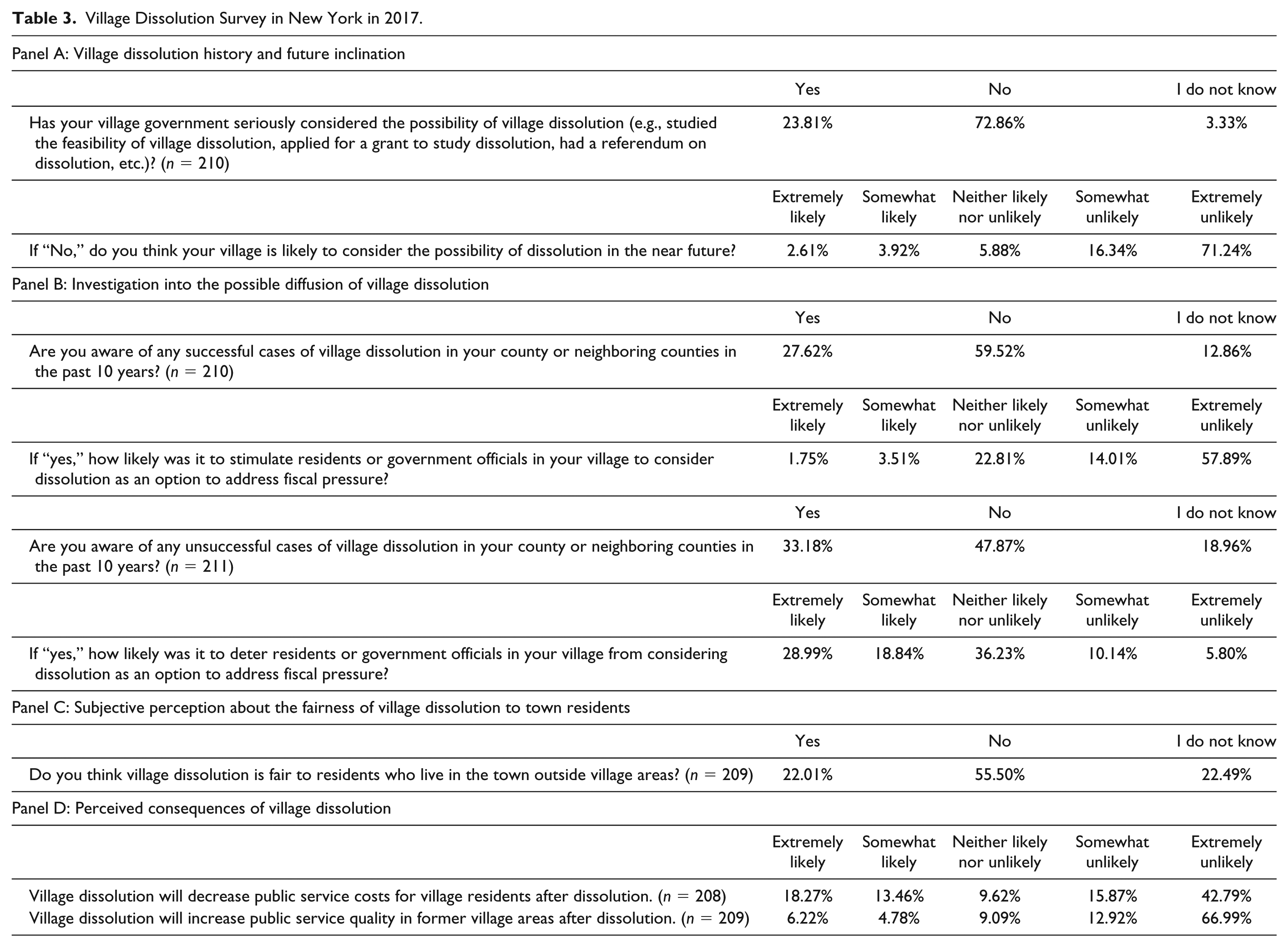
Panel A of Table 3 reveals that, among the 210 respondents who answered the first question, 23.81% of them answered “yes.” Of those who responded “no,” 6.53% selected “extremely likely” or “somewhat likely” to consider dissolution in the near future. In the analysis, these villages are coded as willing to dissolve and the remainder as not, and this variable serves as the outcome of interest. The survey also asked respondents related questions on diffusion (Panel B), legitimacy (Panel C), and their own subjective evaluation regarding dissolutions (Panel D). These questions are discussed at the end of this article.
Village Dissolution Survey in New York in 2017.
In addition to this information, the survey also collected data on potential explanatory variables which the analytical framework above suggests might be important but are usually difficult to find in secondary data. Table 4 demonstrates that, institutionally, 28.57% of village mayors report service duplication between the village and the town governments, and the top three service areas of redundancy are maintenance of town highways, property tax assessment, and fire protections services, in that order. Of respondents, 60.47% believe that their residents bear a higher tax burden than those living outside of the village but also located within the same town. As a response to the fiscal pressure caused by the Great Recession, service cuts have been used in roughly one fifth of villages in New York. Finally, politically, the survey finds that just less than half of village leaders think they can trust their village citizens to be responsible participants when it comes to civic engagement.
More on Village Government in the 2017 New York Survey.
The second methodological challenge involves the temporal relationship of the independent variables. One may simply merge the survey data with existing 2017 American Community Survey (ACS) data on economic and demographic variables, but, as shown in Table 1, 22 out of 23 dissolution cases since the millennium occurred between 2010 and 2017. Given the independent variables must precede the dependent variable, this approach would be problematic. To resolve this issue, detailed demographic and economic data for each village are obtained from the 2010 ACS 5-year estimates and merged with the information on dissolutions collected from the survey. In addition, village government financial statistics were retrieved from the Local Government Data provided by the New York State Comptroller Office. 11
The third methodological challenge is sample selection and representativeness. There are 542 villages in New York, yet only 232 of them responded to the survey, constituting a 42% response rate. 12 Although not low, the response rate still raises a fundamental concern that the survey sample could reflect a unique subset of the total population. To check the sample representativeness of the overall population of villages in New York, responding villages are compared to non-responding ones across a rich set of economic, demographic, and fiscal variables. As shown in Table 5, there appear to be no statistically significant differences along any of the characteristics across the two groups. While the discrepancy in age may imply the presence of some systematic difference, it is statistically significant at only the 10% level. This analysis suggests that the survey sample is arguably representative and can be used to identify factors associated with dissolution willingness more generally.
Sample Representativeness of the Village Survey Data, 2010.
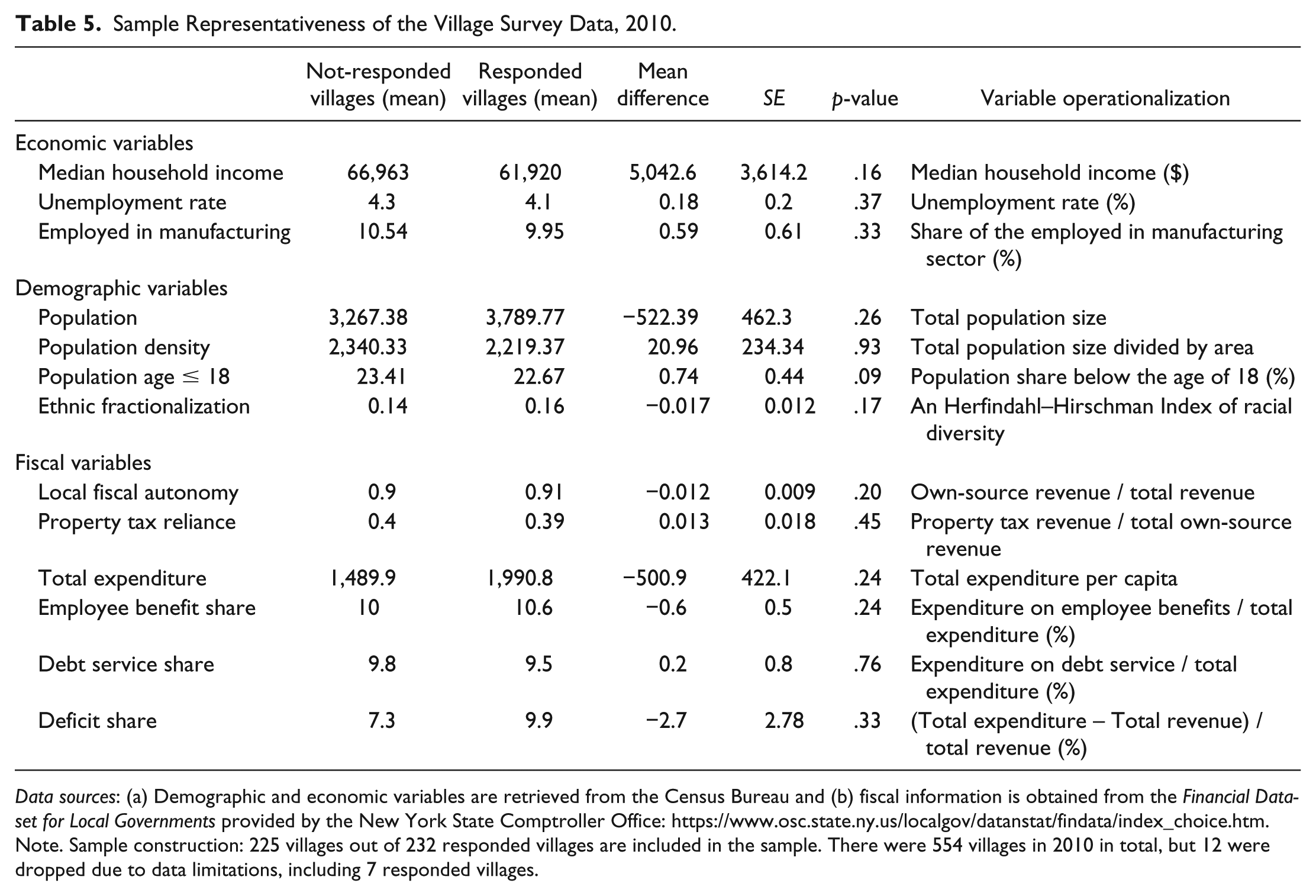
Data sources: (a) Demographic and economic variables are retrieved from the Census Bureau and (b) fiscal information is obtained from the Financial Dataset for Local Governments provided by the New York State Comptroller Office: https://www.osc.state.ny.us/localgov/datanstat/findata/index_choice.htm.
Note. Sample construction: 225 villages out of 232 responded villages are included in the sample. There were 554 villages in 2010 in total, but 12 were dropped due to data limitations, including 7 responded villages.
The construction of the dependent variable from a representative survey and its merging with independent variables of interest from secondary data sources facilitates a cross-sectional regression analysis identifying the determinants of dissolution willingness. Following the analytical framework, the independent variables are grouped into five clusters: economic, demographic, political, institutional tension between village and town, and fiscal.
To accommodate the binary nature of the dependent variable, both Probit and ordinary least squares (OLS) models are estimated, as each has its own merits and weakness. On the one hand, the statistical rationale behind a linear probability model (LPM) is intuitive and the results are interpretable. But LPM is plagued with the violation of homoskedasticity assumption and the possibility that predicted values of an outcome variable could be greater than 1 or less than 0. On the other hand, although being able to constrain predicted values strictly between 0 and 1 and being able to automatically account for heteroskedasticity through maximum likelihood estimation (MLE), a Probit model has problems of its own, including underestimation of the probability of rare events (King & Zeng, 2001) and difficulties in interpreting coefficients, due to the non-linear functional form. Thus, both LPM and Probit models are employed, the latter of which is coupled with estimates of marginal effects for interpretation purposes. The empirical findings are summarized in Table 6.
Dissolution Possibility Analysis, 2010.
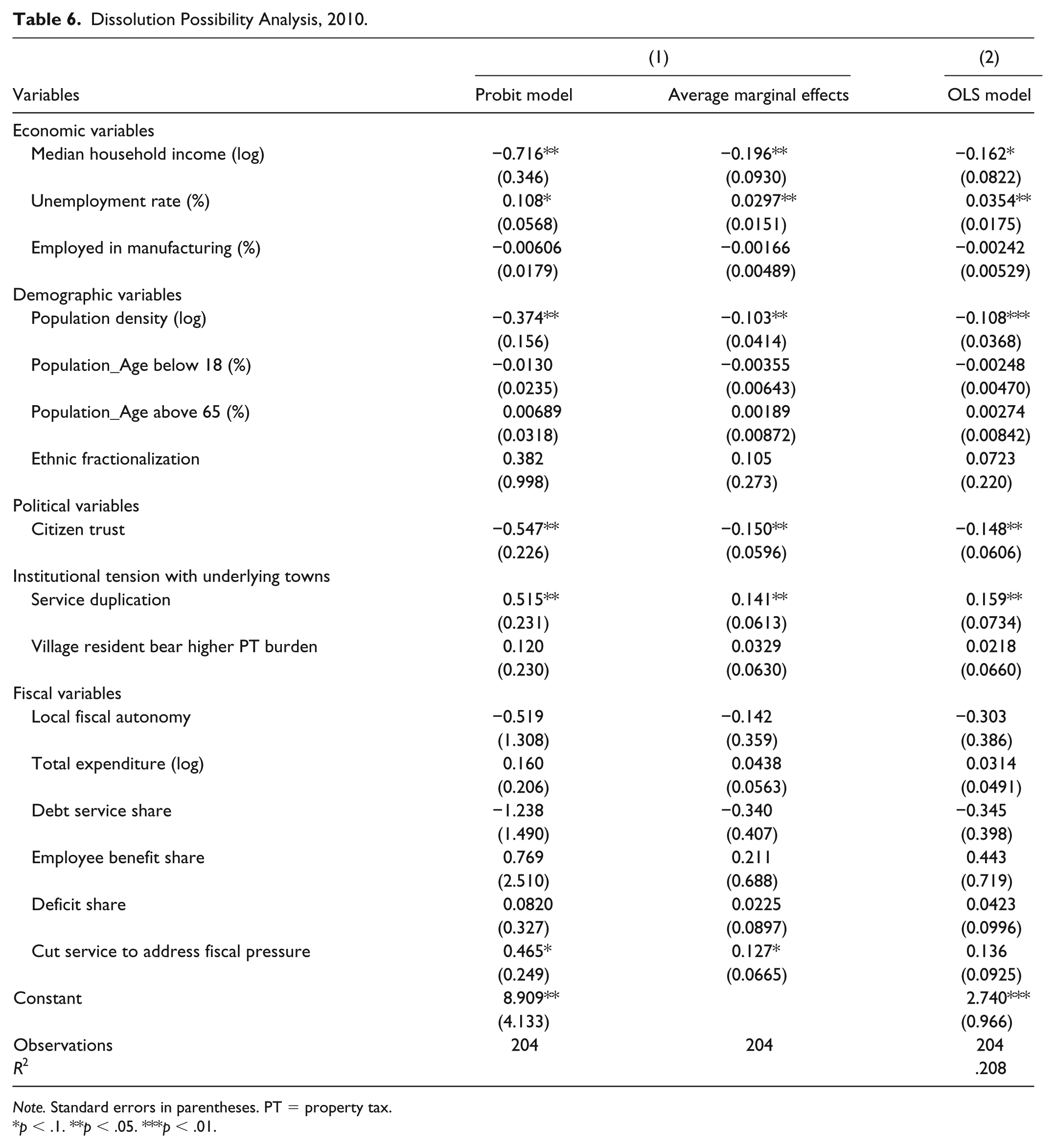
Note. Standard errors in parentheses. PT = property tax.
p < .1. **p < .05. ***p < .01.
What Kind of Villages Ultimately Dissolve?
The second related empirical question of interest is to investigate what kinds of villages ultimately dissolved. There are two methodological challenges ahead. First, only a small sample of 23 villages have dissolved since the turn of the millennium, rendering standard regression methods unsuitable for identifying any significant pattern. Second, and more fundamentally, villages disappear from the sample once dissolved. Similar to how the death of a patient implies an end of a life, dissolution translates to the end of a village government’s existence. But dissolution has yet occurred to a substantial proportion of the sample. As a result, statistically, the duration to dissolution occurrence is right censored for most villages. These two features preclude the use of standard OLS methods. An alternative approach is to adopt a Probit/Logit model, which solely focuses on the dichotomous nature of dissolution referendum results. This approach, however, is not desirable, neither, because it simply assumes away time dependence and ignores all useful information about timing. As such, this analysis borrows from studies on health and enterprise decline and conducts a survival analysis of village governments. In contrast to OLS methods and Logit/Probit models, a survival analysis utilizes the information of survival time until the last point of observation and effectively accounts for “censoring” issues.
Before elaborating on the survival analysis mechanism, a descriptive overview of the difference across voting and non-voting villages, as well as of those that voted to dissolve and in which dissolution was voted down, is warranted. Fist, a set of simple t-tests, reveals that villages with a dissolution referendum history are systematically characterized by very poor economic situations. On average, the median household income of voting-villages is $44,209, which is only two thirds of that of non-voting villages. Voting-villages also experience, on average, unemployment rates of 5.06%, significantly more than the 4.17% rate in other villages. Voting-villages also have more of their residents employed in manufacturing (13.49% compared with 9.97%). While there is no statistically significant difference in absolute level of population size, the population density of voting-villages (i.e., 1,421.5 persons per square mile) is only 61.5% of that of non-voting villages (i.e., 2,314 persons per square mile). Voting-villages tend to be more ethnically homogeneous, as the ethnic fractionalization Herfindahl–Hirschman Index (HHI) across these localities averages only 0.097, much smaller than the 0.16 of other villages. The results reveal that the age structure of the population is quite similar among the two types of villages. Fiscally, voting-villages generate less revenues from property taxes, spend significantly less, and incur significantly higher deficits. Compared with those villages which tried but failed to pass a referendum, villages that voted to dissolve are even less populous, have access to fewer own-source revenues, generate less from property taxes, and incur higher deficits, as shown in Table 7. In sum, compared with all other villages, voted-to-dissolve villages are less populous, more economically disadvantaged, and fiscally stressed.
A Comparison Among Villages With Different Dissolution Status, 2010.
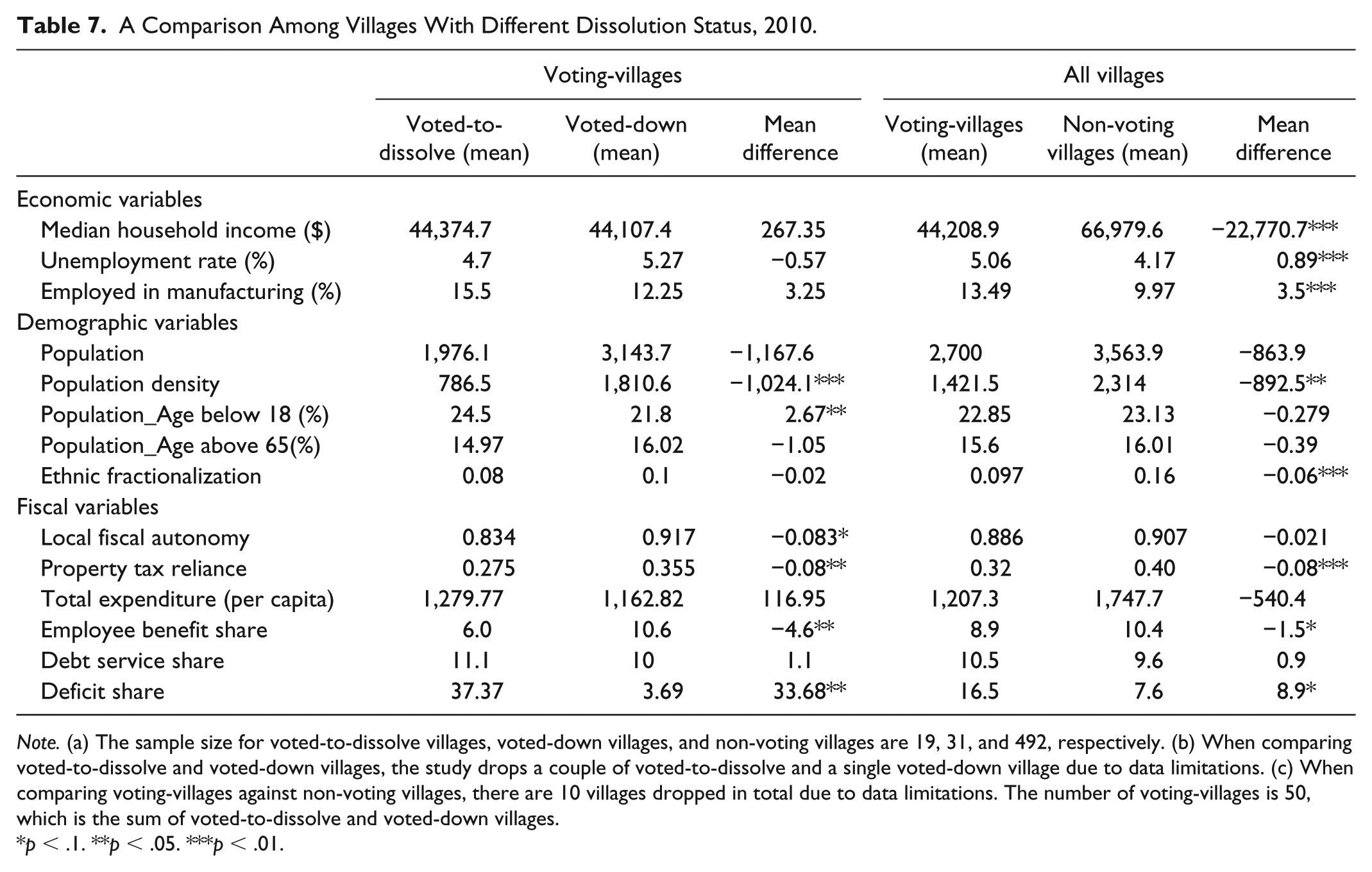
Note. (a) The sample size for voted-to-dissolve villages, voted-down villages, and non-voting villages are 19, 31, and 492, respectively. (b) When comparing voted-to-dissolve and voted-down villages, the study drops a couple of voted-to-dissolve and a single voted-down village due to data limitations. (c) When comparing voting-villages against non-voting villages, there are 10 villages dropped in total due to data limitations. The number of voting-villages is 50, which is the sum of voted-to-dissolve and voted-down villages.
p < .1. **p < .05. ***p < .01.
The precise timing of events is a central component to survival analysis. As such, Census data, which do not provide annual demographic and economic information for each village prior to 2009, cannot be used. Fortunately, the Office of the New York State Comptroller keeps track of annual village information from 1996 to 2017. 13 Thus, the following analysis is completed based on that data source.
The fundamental concept in survival analysis is hazard rate, which refers to the probability of the occurrence of a failure event in a year, given that the event has not yet occurred to a unit in previous years. The failure event in this study is defined as passing a referendum event after which a village government is doomed. To understand how explanatory factors might contribute to a village governments life span, one has to decide whether it is appropriate to use a parametric model or not for the survival analysis. In principle, without knowing the nature of the specific relationship between hazard rates and the time-varying characteristics of interest, it could be problematic to impose a particular structure on the hazard function, as any results may simply be an artifact of the model specification. As such, this analysis employs a semi-parametric Cox proportional hazards (PH) model, which parameterizes the hazard rate as a function of covariates, but does not require any restrictions on the shape of the baseline hazard function (Box-Steffensmeier & Jones, 2004; Jones & Branton, 2005).
Empirical Results
What Kind of Villages are Willing to Consider Dissolution?
The Probit model performs well in prediction accuracy, with 79.41% cases correctly classified. The results are consistent across the two approaches. Economically, a more favorable situation, as indicated by a higher level of household income and a lower unemployment rate, is associated with a decrease in the likelihood of dissolution willingness in both models. The significant association between economic conditions and dissolution possibility explains why dissolution activities rarely occurred in Mid-Hudson, New York City (NYC), NYC Northern Suburbs, and Nassau-Suffolk regions of the state, where not even a single dissolution referendum has taken place, as shown in Tables 1 and 2. To give an intuitive interpretation, the average marginal effect suggests that 1% increase in median household income decreases the probability of the occurrence of any dissolution activity by 0.196%. Population density is also negatively and significantly associated with the probability of any dissolution activity, suggesting that a higher population density decreases dissolution willingness. Together, these results support hypothesis H1a and corroborate Anderson’s (2012a) argument that depopulation and economic decline could be prime contributors to village dissolution. The negative effect of population density also corroborates the existing perspective that economies of scale may be an appealing argument for government reorganization.
Ethnic heterogeneity, as measured by an ethnic fractionalization HHI, and age distribution are not found to be significant in explaining dissolution willingness, thereby providing no evidence for hypothesis H1b. Given that the mean of ethnic HHI is low—0.14 in the sample—and that villages are not as populous as larger cities in upstate New York, these results are not surprising. Nevertheless, allocative efficiency and the age composition of the population may still play a role in the local government formation process (Alesina et al., 2004; Patrick & Mothorpe, 2017).
Village residents are decisive in the dissolution process and it is therefore important to examine how political trust affects dissolution willingness. To measure political trust, the survey asks whether village officials trust their citizens to be responsible participants in civic engagement. 14 The results demonstrate that village dissolution willingness is negatively associated with government official’s perceptions of citizen’s civic engagement capacity or reliability. Put differently, villages which are more likely to dissolve are those where government officials do not trust their citizens very much. These findings support hypothesis H2.
Financial management strategies such as incurring deficits, issuing debt, or spending money on employee benefits do not significantly increase the likelihood of dissolution. Data limitation prevents controlling for village service quality measures in the models. As such, care should be taken so as to not over-interpret these findings without a better understanding of the connection between service cost and service quality. Regardless, if a village government cuts services to absorb external fiscal pressure, it clearly sends negative signals that the village government may not be sustainable, and therefore residents or government officials may be more likely to resort to dissolution.
The empirical analysis also takes into account how institutional tension between a village and its underlying towns affect the organizational sustainability of a village government. As hypothesized in H4, the analysis finds that service duplication between the two may challenge the fundamental legitimacy of village governments. Of course, it may also serve as a challenge to the legitimacy of the village-nested-in-town system, as service redundancy could be the product of either villages or towns. However, consistent with the public finance literature, residents do not necessarily view a higher property tax burden as a bad thing, as higher service quality usually comes at a higher cost. This may be why a higher tax burden does not significantly lead a village to consider dissolution.
Overall, the Probit and OLS models consistently show that economic decline and depopulation could be primary determinants of dissolution willingness. Institutional friction—service duplication between the village and the underlying towns, radical governance strategies such as service cuts, and lower political trust between residents and village governments—may also drive a village toward that possibility. Ethnic and age heterogeneities are not found to be significantly correlated with general dissolution activities.
What Kind of Villages Ultimately Dissolve?
Table 8 presents the Cox PH model estimates using two different functional forms, one including only demographic and economic information and the other also taking into account several fiscal variables. The coefficient estimates indicate that villages with a lower population density or property values will have lower hazard rates, ceteris paribus. In other words, a populous and wealthy village is likely to have a longer life span. Among the five fiscal variables, villages with more own-source revenue (i.e., higher local fiscal autonomy) experience lower hazard rates, or a lower risk of dissolution. In addition, borrowing too much significantly increases the hazard rate for a village, making it more likely that it will be dissolved, holding all other factors constant. Finally, excessive spending on employee benefit significantly increases the probability of dissolution as well.
Survival Analysis of Village Dissolution, 1996-2017 (Voted-to-Dissolve Villages Versus All Other Villages).
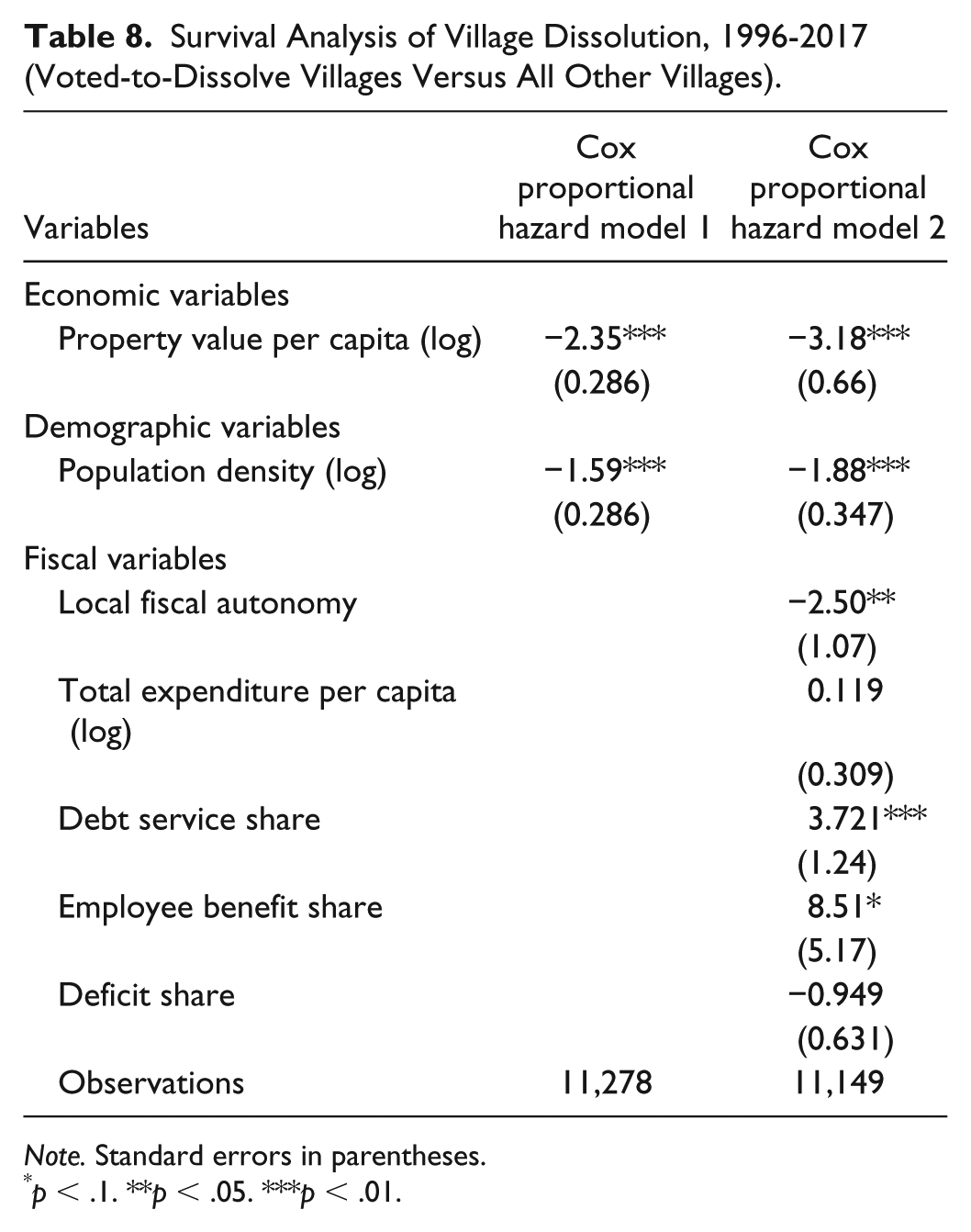
Note. Standard errors in parentheses.
p < .1. **p < .05. ***p < .01.
Discussion and Conclusion
From the perspective of a decentralization framework, a village is the place where residents’ voices could be heard loud and a village government is thought to serve as a clear expression of residents’ preferences. Unprecedentedly, more than 50 villages have voted on dissolution in the past 10 years in New York alone. Surprisingly, this emerging trend has received little attention from public administration scholars. To fill this gap in the literature, this article synthesizes the literature, builds an analytical framework, and attempts to answer two empirical research questions of particular interest in the context of New York.
First, this study seeks to identify the village characteristics associated with whether dissolution is considered or not, as measured by undertaking any dissolution related activity. Without a comprehensive list of all dissolution activities, this study relies on information collected via surveying village mayors (response rate of 42%). After examining the sample’s representativeness, the author combines the survey data with secondary data from the Census Bureau and the New York State Comptroller Office. Both the Probit model and the LPM consistently suggest that villages in sound economic, institutional, political, and demographic—in terms of population density—position are less likely to consider dissolution. Instead, villages experiencing bad economic conditions, service duplication, institutional friction, and population decline are more likely to become candidates for dissolution.
Second, the study narrows the analytical scope to provide insights on the factors related to actual dissolution. Both simple t-tests and Cox PH models demonstrate that, as before, unfavorable economic conditions and depopulation are significant drivers of dissolution. The 21-year-long longitudinal survival time analysis also suggests that dissolved villages are often fiscally struggling, reinforcing the perception that village dissolution is less likely to take place in areas with sound structural conditions.
Municipal dissolution activities have also been documented in many other states. For example, approximately 40 townships have disincorporated after the turn of millennium in Nebraska, and at least 10 municipal disincorporation cases are found in Missouri and Oklahoma during the same time period, based on the Boundary and Annexation Survey (BAS) by the Census Bureau. It is plausible that municipal dissolution does not randomly occur in those states, either. However, given that each state has a distinctive village-town institutional relationship, a different legal procedure of dissolving municipalities and a different set of economic and demographic conditions, our results should not be extrapolated to other states without caution. More empirical studies are certainly needed so as to identify whether there are common dissolution patterns and driving forces across states
There are also many other questions that require further investigation about dissolution. Importantly, little is known about the broader political implications of dissolution. For example, the dissolution of a village transfers the responsibilities of public service provisions to town governments, the residents of whom, though fiscally and politically affected, are not involved in the dissolution process. The survey used in the analysis attempts to shed some light on this question. Over half of respondents, 55.5%, believe that the dissolution process is unfair to those residing within the town but outside of the village (Panel C of Table 3). Another interesting question is how village government officials perceive the diffusion of dissolution events which take place in nearby villages. The survey also provides some insights on this matter. Village government officials, whose attitudes and interests are not necessarily aligned with those of village residents, believe that the influence of voted-down cases to be stronger than that of voted-to-dissolve ones. To be specific, voted-down events may be much more likely to deter potential followers, whereas voted-to-dissolve cases are not very likely to stimulate peers to do the same (Panel B of Table 3).
Finally, it is worth investigating whether dissolution makes fiscal sense. A primary argument for village dissolution is that it may facilitate the possible reduction of property taxes. It is not known, however, whether dissolution actually serves to save money or results in service improvement. The dissolution study plan by the Village of Seneca Falls (2009) claimed that dissolution would significantly decrease property tax incidence. However, based on a review of more dissolution study plans, the New York State Conference of Mayors concludes that “efficiencies resulting from village dissolution run in the area of 2% to 5% of the total and town village expenses,” because both towns and villages already run relatively efficient operations (p. 2). 15 The survey results from this study suggest that 31.73% village leaders think dissolution would be “extremely likely” or “somewhat likely” to decrease public service costs, whereas 66.99% think dissolution would be “extremely unlikely” to increase public service quality in former village areas (Panel D of Table 3). In addition to the uncertainty associated with cost savings and service quality improvements, dissolution may involve other costs in the form of changes to a community’s culture and the loss of control over the policy agenda as a village is absorbed into a larger town. Thus, many government officials and residents are skeptical that any projected property tax savings constitute fair compensation for the great uncertainty and potential loss that may come with dissolution. Whether dissolution is warranted on this basis is a fruitful area for further research.
Footnotes
Acknowledgements
The author is very grateful for the helpful comments from Larry Schroeder, John Yinger, Yilin Hou, Jiahuan Lu, four anonymous reviewers, and editors of this journal, Dr. Stephanie Newbold and Dr. Marc Holzer. All errors are the sole responsibility of the author.
Declaration of Conflicting Interests
The author(s) declared no potential conflicts of interest with respect to the research, authorship, and/or publication of this article.
Funding
The author(s) disclosed receipt of the following financial support for the research, authorship and/or publication of this article: The author is supported on this study by the Faculty Research Funds at the School of Public Affairs and Administration, Rutgers University, Newark.
