



Abstract
Although the full impact of the novel coronavirus (COVID-19) pandemic is yet to be realized, New Zealand has suffered comparatively less than other countries, and there were no active cases in the country by June 8, 2020. Building from best practices in emergency management research, several preliminary lessons emerge from the country’s response to the crisis that could be adapted for other settings. In particular, the government acted early and decisively, developed national unity to combat the virus, communicated effectively with the public, and adapted to changing circumstances, especially to address shortcomings in the response. These preliminary lessons provide some guidance in how to effectively respond to the virus through proactive, evidence-based, well-communicated policies.
We must go hard, and go early, and do everything we can to protect New Zealanders’ health.
Although the full impact of the novel coronavirus (COVID-19) pandemic is yet to be realized, it has already caused over 400,000 deaths, infected millions of people, and affected the lives of people around the world (Dong et al., 2020). Unsurprisingly, leaders and public officials have struggled to respond to the threat of the virus and weigh the costs and benefits of policies that could save lives but also lead to surging unemployment, economic depression, and sustained disruption to local, national, and global economies.
From the start, Jacinda Ardern prioritized public health, seeking to deliver on her pledge to protect all New Zealanders from the effects of COVID-19 (Vowles, 2020). While the virus’ final implications are yet to be determined, New Zealand appears to have suffered comparatively less than other countries. By June 11, it had been 3 weeks since the last new case and there were no active cases remaining in the country (New Zealand Ministry of Health, 2020).
While New Zealand enjoys some advantages, such as geographical isolation, a civil political environment, strong central government, recent experience with crises and disasters, and a small population, several preliminary lessons emerge from the country’s response to the crisis that could be adapted in other settings. In particular, the government acted early and decisively, developed national unity to combat the virus, communicated effectively with the public, and adapted changing circumstances, especially to address shortcomings in the response. In short, other states could replicate New Zealand’s approach to reduce the threat of COVID-19 and future pandemics.
This article provides a brief overview of the New Zealand government’s response to COVID-19 before discussing specific aspects of their response that can be adopted elsewhere in accordance with best practices from emergency management research. These preliminary lessons provide some guidance in how to effectively respond to the virus through proactive, evidence-based, well-communicated policies.
New Zealand’s Response to COVID-19
The New Zealand response to COVID-19 is led by Jacinda Ardern, her Cabinet, and their Ministries; the Director-General of Health Ashley Bloomfield; Director of Civil Defence and Emergency Management Sarah Stuart-Black; Chief Science Advisor Juliet Gerrard; Police Commissioner Mike Bush; and businessman Rob Fyfe, among others (Strongman, 2020b). A group of 11 experts also advise the Minister of Health about COVID-19 (Morton, 2020). In consultation with the Ministry of Health and their advisory group, Jacinda Ardern adopted an “elimination strategy” to the virus (Cave, 2020).
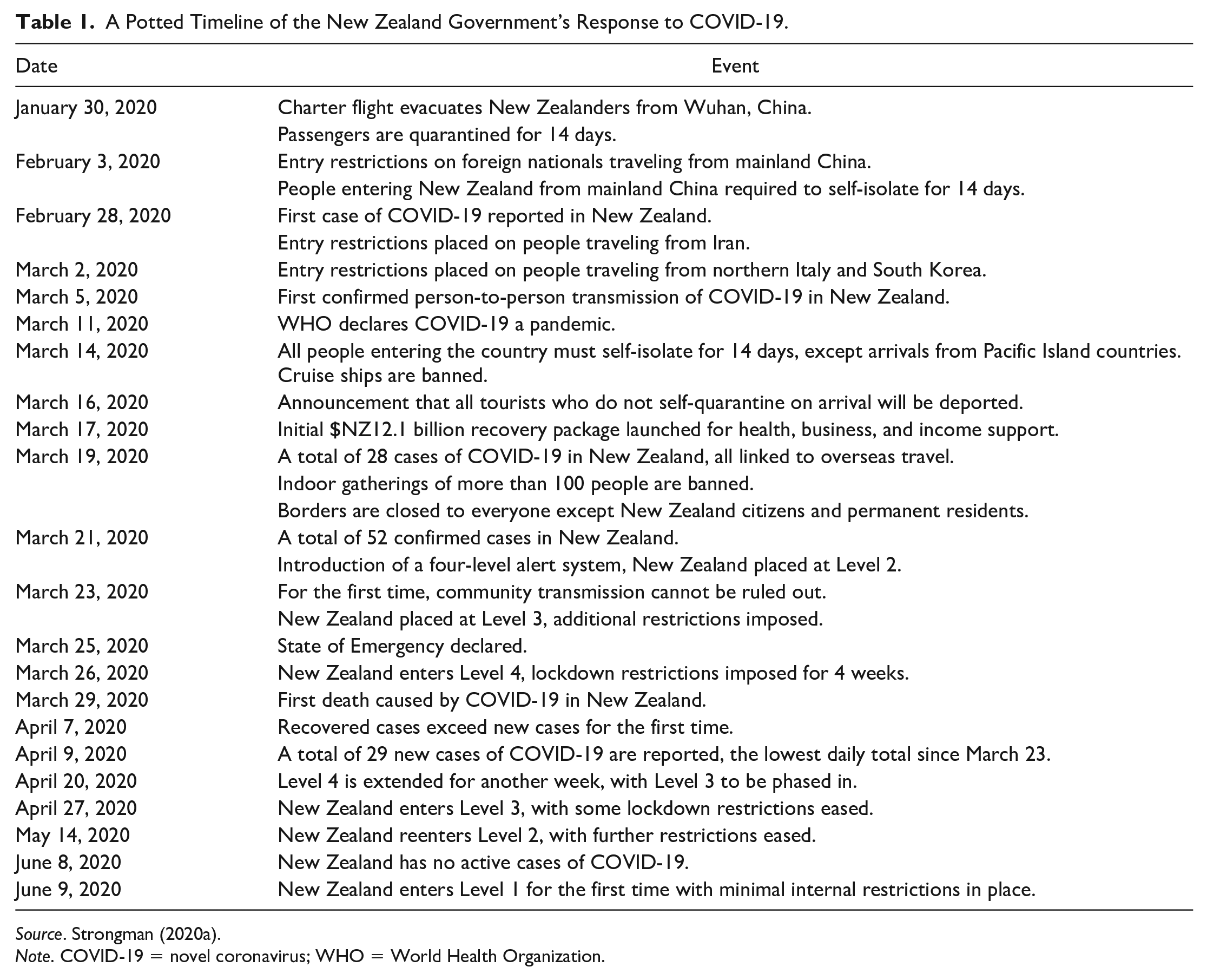
The New Zealand response initially involved monitoring the situation in China and evacuating New Zealanders from affected regions. However, as the virus rapidly spread, the government had to make consequential decisions about the best response to the pandemic. To hold the government accountable for its response, they formed an Epidemic Response Committee led by Simon Bridges, then leader of the opposition. Table 1 presents a potted summary of the country’s response.
A Potted Timeline of the New Zealand Government’s Response to COVID-19.
Source. Strongman (2020a).
Note. COVID-19 = novel coronavirus; WHO = World Health Organization.
In early February, foreign nationals were prevented from traveling from mainland China, and this was subsequently extended to cover travelers from Iran, northern Italy, and South Korea as cases emerged in those regions. In mid-March these restrictions were increased again, before the unprecedented step was taken to close the borders for everyone but New Zealand citizens and permanent residents from March 19 after 28 cases had emerged. Any travelers from affected regions were required to self-isolate, but there was little enforcement initially, and the government later declared they would deport noncompliant visitors.
On March 21, the New Zealand government introduced the four-level alert system, and they placed the country in Level 2. 1 Risk assessment and corresponding social distancing measures are outlined in Figure 1. After community transmission could not be ruled out, the government raised the country to Level 3 on March 23, and 3 days later, lockdown restrictions were imposed for a 4-week period, which was then extended until April 27. The country then reentered Level 3, and on May 14 reentered Level 2. After no active cases remained on June 8, New Zealand moved to Level 1 for the first time on June 9.

New Zealand COVID-19 alert levels summary (updated May 25, 2020).
The Treasury announced a $NZ12.1 billion recovery package on March 17, and subsequent initiatives have increased this figure up to $NZ52 billion in wage subsidies, leave and self-isolation support, business tax changes, financial guarantees for small and medium-sized businesses, and support for vulnerable populations, among others (Robertson, 2020). To put this in context, the latter figure constitutes almost half the government’s entire 2019 annual budget expenditure.
Testing for COVID-19 improved substantially over time. From just 12 tests conducted on March 9, the average daily number of tests was 3,870 in April and 4,571 in May (New Zealand Ministry of Health, 2020). By June 10, a total of 301,882 tests had been conducted (New Zealand Ministry of Health, 2020).
To date, New Zealand has contained the spread of the virus in the country. As of June 11, New Zealand had a total of 1,504 cases of the virus, of which 1,154 cases are confirmed and 350 are considered probable cases (New Zealand Ministry of Health, 2020). 22 people have died as a result of COVID-19, 1,482 people have recovered from COVID-19, and no cases remain active (New Zealand Ministry of Health, 2020).
Figure 2 shows the number of deaths, active cases (including confirmed and probable cases), and recovered cases, demonstrating the relative success of social distancing in New Zealand. First, the figure illustrates that New Zealand entered the Level 4 lockdown before the first COVID-19 fatality. Second, the figure shows that after an initial peak in early April, the number of active cases steadily decreased, whereas recovered cases increased. Third, by the middle of May, there were considerably fewer active cases than there were at the beginning of the Level 4 lockdown, demonstrating the effectiveness of the containment measures. Finally, the figure shows that by June 8, there were no remaining active cases.
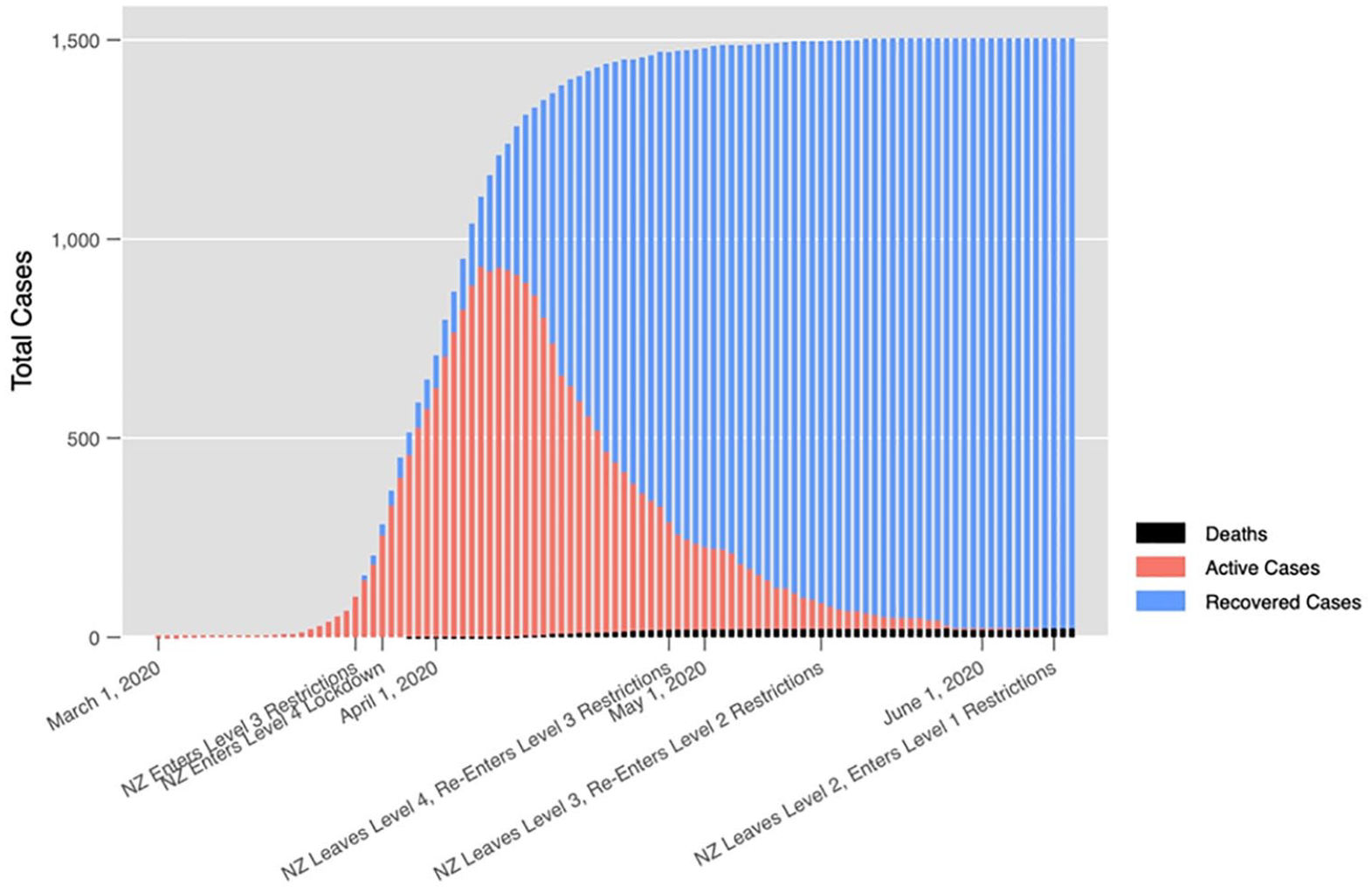
Deaths, active cases, and recovered cases in New Zealand, March 1–June 11, 2020.
Preliminary Lessons From New Zealand’s Response
New Zealand’s response to COVID-19 has been successful in flattening the curve and reducing the spread of the virus. From the emergency management literature, there are several key lessons from its response that could be adopted elsewhere.
Go Hard, Go Early
First, investing in prevention is much more efficient and cost-effective than responding to a crisis (Healy & Malhotra, 2009; Perry et al., 2001). Like most states, New Zealand was not fully prepared for a pandemic (Cameron et al., 2019), but when COVID-19 cases emerged in the country, the Ardern government acted quickly to contain the virus despite the immediate impact on the agricultural, hospitality, and tourism industries especially.
This included unprecedented actions like requiring almost all arrivals to self-isolate for 14 days upon arrival on March 14 when the country had just six active cases; closing the borders to everyone but New Zealand citizens and permanent residents on March 19, when there were 28 active cases; and imposing a strict lockdown on March 26 when there were 283 cases but no deaths (New Zealand Government, 2020a). Furthermore, the government stayed the course, with Level 3 restrictions remaining in place until May 14, and Level 2 restrictions remaining in place until no active cases remained, despite considerable political pressure from members of their governing coalition and the opposition to ease restrictions (Graham-McLay, 2020), and the looming general election in September.
The response suggests that “Go hard, go early” was not just a sound bite, but it encapsulated the government’s approach to reduce the spread of the virus from the start. Although it may no longer be possible for many governments to act early, they could adopt similarly stringent social distancing measures to contain the spread of COVID-19 and replicate these policies in future pandemics.
Unite Against COVID-19
Second, despite the continuing prevalence of “disaster myths,” societies frequently rally together during disasters and crises (Johnson, 1987; Quarantelli & Dynes, 1977). The Ardern government harnessed this knowledge by creating a campaign built upon “uniting against COVID-19,” where the public bind together to defeat the virus, especially when it required sacrificing personal freedoms for the greater good during lockdown.
As the success of social distancing is contingent on compliance with government instructions, it was critical that people bought into the task. The “Unite Against COVID-19” campaign helped develop a collective sense of purpose (Duncan, 2020), and public opinion polls consistently showed more than 80% support for the government’s actions including the lockdown (Cooke, 2020; Cooke & Malpass, 2020; Coughlan, 2020; Manhire, 2020).
Beyond supporting lockdown measures, location trend data suggest that New Zealanders also complied with them. By April 17, the data suggested reductions of 90% in retail and recreation, 81% in parks, 87% in transit stations, and 72% in workplaces compared with the baseline (Google, 2020).
Collectively, the unifying campaign helped secure support for lockdown measures that would not otherwise be tolerated, given their impact on civil liberties (Edwards, 2020; Gillespie, 2020). As attention turns to the long-term economic recovery from the considerable effects on the national economy, New Zealanders are now asked to “unite for the recovery” (New Zealand Government, 2020b). Governments in other countries could pursue similar campaigns to help create the collective will to temporarily suspend regular life to reduce the spread of the virus, and recover from its effects once it is contained.
Effective Communication
A third lesson for other governments is the importance of effective risk communication, ensuring people understand and trust the messages conveyed by the government to keep the public safe. Previous research demonstrates the importance of warning messages that reach their intended targets, especially in diverse populations (Mileti, 1999; Mitchell, 2003; Perry et al., 2001; Phillips & Morrow, 2007). The New Zealand response featured effective communication in a variety of settings.
First, Ardern has communicated policy initiatives well, helping the public understand their goals and their obligations to reduce the spread of the disease in daily briefings and social media posts (Wilson, 2020). For example, Ardern asked New Zealanders to stay in their household “bubble” as part of social distancing, and she asked people to stay home, stay safe, and to act as though they already have COVID-19 to reduce the spread of the disease (Fifield, 2020; Wilson, 2020). For the duration of the lockdown she was joined by the Director-General of Health Ashley Bloomfield, who developed an earnest following for his competence and knowledge (Fifield, 2020).
Second, official communications also appear to be designed to be clear and concise. For example, the different levels of the alert system in Figure 1 are presented so that their different motivations and implications can be understood. Similarly, rules for the lockdown were shared through an emergency alert prior to entering Level 4 that combined both clear instructions and unifying messages (Fifield, 2020).
Third, the government created a COVID-19-dedicated website so people could find information without having to find the right government department for the best information. The website describes the alert system and provides information relating to individuals, businesses, and communities. Information is also provided in 28 languages in an attempt to reach diverse linguistic communities within New Zealand and many translations also included accompanying videos (Mitchell, 2003; Phillips & Morrow, 2007).
Finally, government efforts were aided by excellent science communication in the public sphere. Alongside public and private efforts to assist the government’s response (Morton, 2020; Murdoch et al., 2020), scientists communicated best practices to the public to help contain the spread of COVID-19. Among others, an outstanding example is the collaboration of Dr. Siouxsie Wiles and illustrator Toby Morris in a series of articles explaining risk, hygiene practices, and how to reduce the spread of COVID-19 (see The Spinoff, 2020).
Although effective communication and consistent messaging is arguably easier in small countries with a strong central government, these efforts to communicate government policy effectively across all groups in the country can be replicated in other settings to reduce the spread of COVID-19. Given the importance of social distancing, it is vital this information is conveyed to the public with the right tone and tenor to generate public buy-in.
Adapting to an Evolving Situation
Finally, the New Zealand government has been adept at responding to a rapidly evolving situation. Prior research demonstrates that the best leadership during crises involves changing plans to adapt to the situation rather than rigidly enforcing existing plans (Dynes, 1994; Neal & Phillips, 1995; Webb & Chevreau, 2006).
Like other countries, New Zealand was unprepared for the pandemic, and the government made mistakes in their handling of the crisis. For example, there were too few tests available in March, there was insufficient engagement and coordination with Māori communities (Parahi, 2020), and there was some confusion about the requirements of self-isolation upon arrival into the country. Initial containment measures proved insufficient to prevent COVID-19 from spreading in New Zealand.
However, the Ardern government has generally responded to errors and oversights by correcting them. For example, tests are now widely available across the country after the slow start (New Zealand Ministry of Health, 2020), the government released a Māori COVID-19 response plan including the formation of a Māori Touchstone Group and almost $NZ50 million in assistance for Māori health providers (Johnsen, 2020), and arrival documentation was changed so that arrivals became aware of social distancing requirements before the borders were closed.
Furthermore, decisions about the appropriate level have been based on scientific expertise and expert advice. For example, after 4 weeks of Level 4 lockdown conditions, Jacinda Ardern extended it for another week to increase the chances of eliminating the virus. Rather than prejudging when to ease restrictions, each decision has been made on evidence available at the time.
There remain important areas for improvement in the New Zealand response, including the provision of personal protective equipment (PPE), the long-term implications of the lockdown on civil liberties, and ongoing concerns about the disproportionate impact of COVID-19 on Māori and Pasifika communities. These issues need to be satisfactorily addressed in the near future to continue an effective approach as the country emerges from lockdown.
However, the Ardern government has largely adapted to changing conditions to respond effectively. Other states and local governments could adopt similar approaches by reacting to changing conditions and responding to up-to-date evidence to contain COVID-19 and protect their communities.
Conclusion
Although New Zealand has circumstances that are different from a lot of other countries, it is also true that local and national governments learn from others as a matter of course. Not every policy might be viable in every other context, but generalizable lessons from New Zealand include launching preventive action early, actively encouraging public compliance with social distancing by uniting the country together, effectively communicating with all groups in the population through a combination of inspiring rhetoric and clear instructions, and adapting to the changing situation and making decisions based on conditions at the time. Above all, the Ardern government prioritized keeping the public safe, and the relative success of their efforts reflect this emphasis on public health.
Given the persistence of COVID-19, it is not clear that New Zealand will ultimately succeed in its elimination strategy despite having no active cases in June 2020. Furthermore, the long-term economic implications of stringent lockdowns are not yet known, and the costs could be especially burdensome on an economy reliant on agriculture, tourism, and hospitality.
However, at this point, the government’s response provides a model of what is possible if leaders act early and decisively (Sridhar, 2020). Given the global news coverage of New Zealand’s success, leaders might be able to adapt policies for their community that might not otherwise be possible, especially if the public supports similar policies (Jamieson & Van Belle, 2018, 2019).
Around the world, governments and public officials are forced to make difficult decisions about public health, which will likely have lasting consequences regardless of the outcome. As New Zealand has contained COVID-19 thus far, it makes sense to look south for some direction through this crisis.
Footnotes
Declaration of Conflicting Interests
The author(s) declared no potential conflicts of interest with respect to the research, authorship, and/or publication of this article.
Funding
The author(s) received no financial support for the research, authorship, and/or publication of this article.