



Abstract
Organizational scholars employing the theory of representative bureaucracy in their research have found that when public school teacher demographics mirror those of their students, teachers positively affect student performance. Little is known, however, about how organizational socialization affects positive representational effects on student outcomes. Teachers, however, are socialized differently into the organizational structure, largely through organizational social norms based on various professional aspects. This article analyzes the impact of professional socialization on representativeness by teachers’ credentials, employment status, and education levels. Using Los Angeles Unified School District (LAUSD) elementary school data during the 2012–2014 school years, results show that representational effects differ depending on dimensions of student outcomes, and socialization moderating effects vary on the relationship between teacher representation and performance outcomes. Socialization positively moderates the teacher’s representational effect on student outcomes in terms of teachers with advanced degrees, full credentials, and tenure, which depend on the type of school. Charter schools exhibit the positive socialization effect of tenure status, whereas traditional schools show the positive effect of advanced degrees and full credentials. This research enhances our knowledge of the different socialization aspects and how they differ between charter and traditional schools as well as its impact on representation in highly diverse urban elementary schools, contributing to both theory and practice.
Introduction
Much of the prevalent work on race and representation in the field of public administration has centered upon the theory of representative bureaucracy. One area where the representativeness issue is becoming increasingly prevalent is in public schools. Many urban schools across the country have endeavored to recruit and retain minority teachers to better mirror their student populations (Gottlieb, 2015). Educators and researchers believe that having teachers whose racial composition reflects the student body can positively affect students and schools (Gottlieb, 2015), as detailed in the theory of representative bureaucracy.
Representative bureaucracy indicates that individuals with similar characteristics, such as race, gender, and socioeconomic status, are likely to hold similar values and beliefs about the role of government (Kingsley, 1944). When the individuals who work in a bureaucracy mirror the demographic characteristics of those they represent, shared values or beliefs promote benefits for the represented group, leading from passive to active representation (Bradbury & Kellough, 2008; Krislov, 1974). Studies find that minority bureaucrats are more likely to promote social equity, because their shared backgrounds with clients of color facilitate effective communication and will help ensure that interests of all groups are considered in decision-making processes (Bradbury & Kellough, 2011; Hindera, 1993; Lim, 2006). Similarly, representativeness results in more culturally sensitive teaching in school settings (Lim, 2006). Thus, minority bureaucrats can help organizations better understand clients’ needs and improve service quality. Studies of the impact of racial and ethnic representation in school settings have shown the following representational effects of teachers on minority students’ achievements: (a) a higher number of minority students in gifted programs, (b) a lower number of minority students in special education programs, (c) fewer harsh disciplinary penalties, and (d) higher scores on state exams (Grissom et al., 2015).
Despite the substantial impact of teacher representation on minority student performance, little is known about how organizational socialization of teachers affects this relationship. Meier and Nigro (1976) find that socialization predicts individual attitudes better than social backgrounds, and thus, a better understanding of socialization would provide critical insights of representative outcomes (Gade & Wilkins, 2013). The examination of socialization in this study has a twofold purpose: (a) to elucidate and better understand differences between the public and nonprofit sectors and (b) to better understand the influence of professionalism in bureaucratic structures.
The socialization process can introduce and reinforce professional identities and norms. One’s profession combined with organizational goals guide individual behavior and preferences through the socialization process. As a result, an individual’s personal values on bureaucratic behavior is susceptible to modification. The focus on professionalism allows the study of the effect of multiple identities or intersectionality on representational outcomes as opposed to the traditional study of demographic characteristics such as race and gender (Gade & Wilkins, 2013).
This raises the question of how socialization affects the teacher’s representational effects on student performance. Analyzing the moderating effect of the socialization of teachers, this study provides a better understanding of the impact of teachers’ socialization on their representativeness for students by addressing the following question:
This study is organized into three sections. The following section briefly reviews some of the scholarship on representative bureaucracy in public schools and discusses the effect of socialization on teachers’ representativeness. The “Method” section describes methods, data, and analysis. The “Findings” section discusses findings, followed by the discussion and conclusion.
Representative Bureaucracy
According to Kingsley (1944), “representative bureaucracy” enshrines the notion that bureaucrats in a democratic government can be representative of a diverse population (p. 185). Mosher (1968) noted that there are two ways in which representative bureaucracy comes to fruition—passively and actively. Passive representation occurs when bureaucracies are staffed by public servants who match clients’ demographic characteristics in a manner that is proportionate to the population being served. Active representation occurs when minority bureaucrats make decisions and exert authority or bureaucratic discretion that benefits groups with similar backgrounds to the minority bureaucrats. That is, active representation occurs when a bureaucrat, either consciously or unconsciously, advocates “for the interests and desires of those whom he is presumed to represent,” and as such will not allow the interests of the represented to go overlooked (Bradbury & Kellough, 2011; Mosher, 1968, p. 11). Bradbury and Kellough (2011) further assert that these bureaucrats share “core attitudes, values, and beliefs with the social groups from which they are drawn. Their views are the product of common socialization experiences shaped in . . . racial, ethnic, and gender identities” (p. 158).
Meier and Nigro (1976) contended that attitudes within the realm of representation are determined by an individual’s social environment and that attitudes vary by demographic origins. This is to say that bureaucrats’ socialization experiences largely depend on their social backgrounds, which then influence their political attitudes and, in turn, their actions. Thus, in the absence of any additional external influences that mediate the transition from passive to active representation, bureaucrats are likely to make decisions in favor of constituents they represent. Their similar social origins and characteristics result in similar socialization experiences, which generally lead to common values and attitudes (Meier, 1993b; Meier & Nigro, 1976). Atkins et al. (2014) illustrate that several studies on representative bureaucracy are conducted in the context of public schools in the United States, and suggest that representation matters in terms of performance on tests for minority students (Meier et al., 1999), improved academic achievement for female students (Keiser et al., 2002), and in the reduction of dropouts (Pitts, 2005). The following section further details representative bureaucracy in schools.
Representative Bureaucracy in Schools
Through active representation in public school settings, the needs of a diverse student population are met most effectively by having diverse teachers and principals. Whereas administrators play a role at the management level, teachers are regarded as the street-level bureaucrats within schools and districts. In the public administration literature, schools have been arenas to study representative bureaucracy, especially to understand dynamics around gender, race, and ethnicity (Grissom et al., 2015). Grissom et al. (2015) identified four main areas in educational policy to which public administration scholars have applied representative bureaucracy theory to understand the outcomes of racial representation. They found that passive representation seemed to influence the following proxy measures of active representation: (a) student discipline, (b) special education service assignment, (c) gifted and talented program assignment, and (d) student academic performance. The following summarizes discussions of these four areas.
The literature on student discipline reveals a correlation between greater teacher representativeness and a lower possibility of the use of harsh discipline among minority students (see Grissom et al., 2009; Meier, 1984, 1993a; Meier & Stewart, 1992; Roch & Pitts, 2012). Also, disciplinary problems have been found to motivate initial teacher referrals of students to special education programs (Grissom et al., 2015), and greater representation by minority teachers is associated with a lower number of minority students being placed in these programs (see Fraga et al., 1986; Meier, 1984, 1993a; Meier & Stewart, 1992; Rocha & Hawes, 2009). Moreover, studies in gifted programs have discovered representational effects of teachers in the referral process. A teacher’s referral is often a necessary condition to receive gifted services (Donovan & Cross, 2002), and researchers find evidence of critical impacts of representation for gifted program assignments for minority students (see Donovan & Cross, 2002; Grissom et al., 2009, 2015; Grissom & Redding, 2014; Meier & Stewart, 1992; Nicholson-Crotty et al., 2011; Rocha & Hawes, 2009). Lastly, studies find positive representational effects of teachers on student academic performance (see Meier, 1993a; Meier & Bohte, 2001; Meier et al., 1999; Pitts, 2005; Roch & Pitts, 2012; Weiher, 2000).
Despite many representative bureaucracy studies in schools, however, the impact of socialization remains uncertain. Van Maanen and Schein (1977) defined organizational socialization as “the process by which an individual acquires the social knowledge and skills necessary to assume an organizational role” (p. 3), and that the process is one infused with an exchange of information and values, and as such is “fundamentally a cultural matter” (p. 1). Although the charge of teachers in educational settings is relatively straightforward in terms of teacher–student relationships, organizational settings, norms, politics, and teacher–peer relationships, among other things, may influence or affect the way teachers carry out their organizational role (Chao et al., 1994).
Professionalism as a part of the process of socialization is defined as internalization and development of a professional identity (Wolf, 2007). Using Cohen’s (1981) perspective of socialization provides the foundation of professional socialization that involves the process of gaining diverse dimensions that constitute a professional role. Those dimensions constituting a professional role include skills, required knowledge, behaviors, attitudes, and intellectual and emotional comfort (Brief et al., 1979; Cohen, 1981). Professional education and experience in the working environment shape professional socialization (Nesler et al., 2001).
Some representative bureaucracy studies examine the impact of professionalism on representativeness. Professionalism has appeared to negatively moderate representational outcomes. For example, in policing, Wilkins and Williams (2008, 2009) find that African American and Latino police officers are associated with an increase in stops of African American and Latino drivers, respectively. These studies conclude a stronger occupational identity than racial identity. Research in education shows that strong professionalism may result in weaker representational impacts among administrators but offers little insight into those impacts among teachers (Roch & Pitts, 2012). Nevertheless, this work leads us to assume that teachers are also less likely to represent their students, instead acting more like professionals who are alike regardless their own background. In school settings, professionalism can include tenure status, licensure credentials, and education (Darling-Hammond, 1990; Talbert & McLaughlin, 1994). Taken together, the effect of teachers’ representation on student performance and the impact of a charter status on student performance can be hypothesized as follows:
Method
These two hypotheses are tested to evaluate the passive-to-active transition of teachers’ representation and the moderating effects of socialization at the school (organizational) level. Thus, the unit of analysis is schools, and the population of the study is public elementary schools in the Los Angeles Unified School District (LAUSD). This section explains the details of the population, variables and data resources, and results. Table 1 summarizes the hypotheses and key concepts.
Summary Statistics of All Variables.
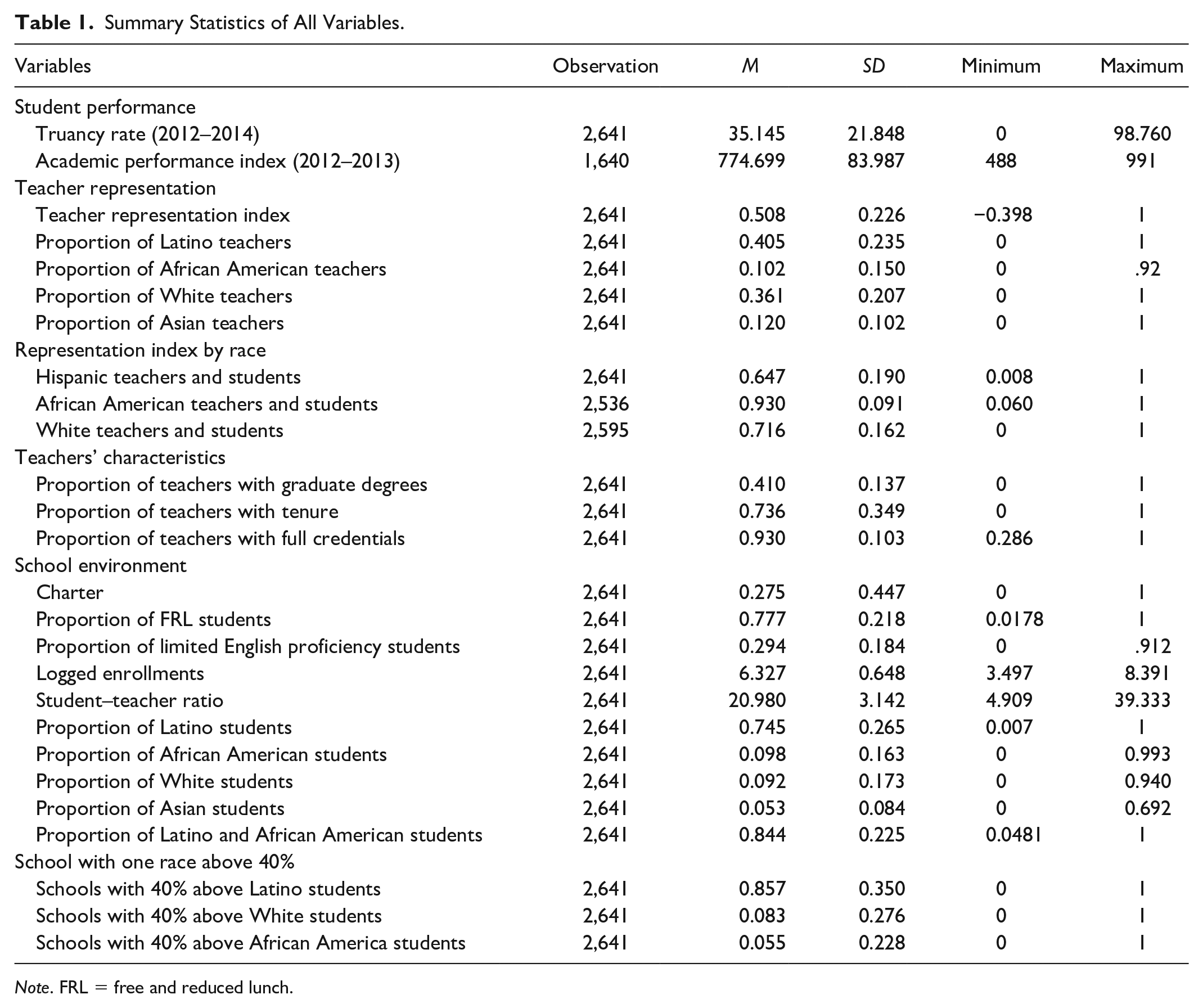
Note. FRL = free and reduced lunch.
Data
To test the hypotheses, data from the California Department of Education (CDE) were employed to analyze 2,641 public K–12 LAUSD schools from the academic years of 2012–2013, 2013–2014, and 2014–2015. Although the available data do not identify the exact number of nonprofit and private charter schools, the majority (97%) of charter schools included are nonprofit (Zinshteyn, 2017). As of fall 2017, California has 1,275 charter schools. Of all charter schools included in the data, 34 are for-profit charter schools, whereas the rest are nonprofit (Zinshteyn, 2017). LAUSD is the largest public school district based on the number of students in the state of California (and the largest with elected directors), and the second largest public school district in the United States (LAUSD, 2017).
In LAUSD, on average, minority students account for 90% of all students, whereas minority teachers make up 56% of the teaching faculty with a gap of 34 percentage points (Appendices A and B). Other than English, 94 other languages are spoken by students in the district, and as of 2017, 141,490 students were learning to speak English proficiently. Seventy-four percent of district students are identified as Latino, 8.4% identified as African American, 9.8% as White, and 6% as Asian. The representation gap in LAUSD is similar to that of California as a whole on average. The California statewide averages are 70% minority students and 29% minority teachers with a gap of 41 percentage points (Appendices C and D).
The demographic misalignment between teachers and students matters in various ways for LAUSD, in particular, the large population of minority students demonstrating a clear racial gap in student performance. For example, more than half of African American and Latino students are not ready for college in terms of English and Math proficiency compared with less than 20% of Asian students and 30% of White students according to the college readiness exam of 2015, which is part of California’s 11th-grade Smarter Balanced Assessment (Brighouse et al., 2018).
Dependent Variable (DV): Performance
The DV employed in this study is student performance within a school. The DV is operationalized through measures of both truancy and academic performance to incorporate different dimensions of overall performance.
Truancy
In the highly diverse, urban school district setting within LAUSD, composed of about 90% minority students, teachers’ race impacts might be weaker than in settings with more balanced or diverse student characteristics for testing outcomes. Also, the high emphasis on minority student academic growth in urban school districts might be more influential than teachers’ identity. Thus, to discuss representational effects in LAUSD, this research uses a behavior-oriented performance measure—truancy—as a DV. Expulsion and suspension as more traditional behavior-focused measures can be considered, but they do not vary much across the elementary and middle school levels and thus truancy is the preferable option across schools. Student performance is operationalized by the truancy rates for all school levels. Truancy is measured by the number of students “missing more than 30 minutes of instruction without an excuse three times during the school year” divided by the number of students enrolled.
The truancy rate is an important school performance indicator as it affects not only the student but also the family and the community. Dekalb (1999) states that in Los Angeles County, the truancy rate provides the strongest predictor of delinquency. At the student level, being absent in school during regular hours negatively affects “students’ achievement, promotion, graduation, self-esteem, and employment potential” (p. 1). Truant students tend to fall behind their peers in the classroom (Dekalb, 1999). Dekalb (1999) also summarizes a student survey on causes of truancy that include the lack of interest in school, courses deemed as irrelevant, suspensions, and bad relationships with teachers, whereas a teacher survey shows teachers’ perception of truancy as being related to family and peer issues.
Academic performance
In addition to truancy, the academic performance of students is also included as part of the DV. Student academic performance is operationalized as the academic performance index (API) developed by CDE. The index ranges from 200 to 1,000 with the state goal being 800. API is a weighted average of multiple statewide assessments of student proficiency in math and English-language art (ELA) and other exams including the California Standards Tests (CSTs), California Modified Assessment (CMA), and California Alternate Performance Assessment (CAPA). The data availability allows only a 2-year period including the 2012 and 2013 school years.
Key Independent Variable (IV)
Teacher representation
The key IVs come from the concept of teacher representation, which is defined as how closely teachers mirror a diverse student population. This study uses the teacher representation index of Roch and Pitts (2012) as follows:
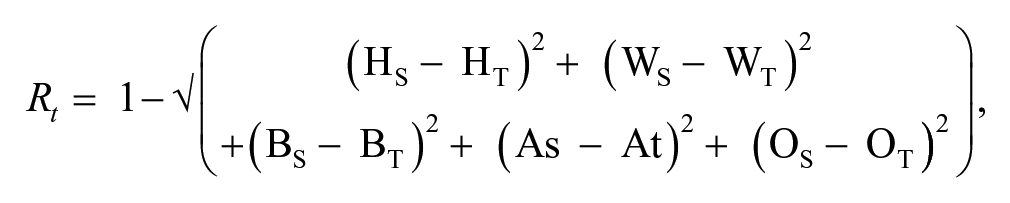
where teacher representation consists of the proportional distance between teachers (T) and students (S) by race: Hispanic (H), White (W), Black (B), Asian (A), and Other (O). The four races explicitly identified in the index (i.e., Hispanic, White, Black, and Asian) are the major races present in LAUSD public schools (Appendix A). The advantage of this operationalization is that it models a “zero-sum game” of representational impacts. This is useful, because some researchers find that better performance of minority students occurs at the expense of other students (Nielsen & Wolf, 2001; Pitts, 2007), whereas other researchers imply that teacher representation provides benefits to all students (Meier et al., 1999). Thus, this operationalization allows an examination of whether representation positively affects the academic performance of all students.
The second set of IVs measures professional socialization of teachers, including (a) the proportion of teachers with advanced degrees (%), (b) the proportion of teachers with tenure status, and (c) the presence of teachers with full credentials or emergency certified teachers.
Key elements of the professional model in the context of public schools include salary and credentialing (Evans, 2002). In the absence of salary data at the teacher level in California, higher education and tenure are an appropriate proxy of salary as the salary scale mainly depends on higher education and tenure (Ingersoll, 2001). A more professionalized occupation follows a more competitive salary, and a professional’s income is the result of the time required to “learn the skill, the training, and the complexity of knowledge needed to recruit and retain practitioners” (Evans, 2002, p. 316).
Credentialing at an earlier stage or entry of a teaching profession is used to prove—in this case—teachers have the essential set of skills and knowledge to practice (Etzioni, 1969; Hall, 1968; Hughes, 1965). Various requirements in the credentialing process can likely enhance the boundaries of the profession (Abbott, 1988). In California, credentialed teachers are defined as those teachers who “completed a teacher preparation program and hold a preliminary, clear, professional clear, or life credential” (CDE, 2017). It is important to consider whether schools hire only teachers with full credentials or tend to replace fully certified teachers with emergency certified teachers. Because teachers are considered to be most influential to students’ academic performance these qualification-related characteristics of teachers should logically increase student performance (Darling-Hammond, 2000; Fuller et al., 2010; Goldhaber, 2002; Goldhaber & Anthony, 2007; Stronge et al., 2006),.
Using the aforementioned formal credentialing is one way to measure professionalism. Tenure status, for example, does not measure the entire essence of a profession, but “a teacher’s reasoned commitment to the education profession” over time can be used to decide who receives tenure (Marshall et al., 1998, p. 303). However, formal credentials such as tenure have been positively associated with teacher professionalism (Burden, 1982; Burke et al., 1984; Goodson, 1992; Sikes et al., 1985; Wardoyo et al., 2017). Thus, these formal credentials are used as a proxy of professional socialization as well as tenure status and higher education achievement.
Control variables
The following controls include those used by Roch and Pitts (2012), along with others that are common in education literature (see, for example, Meier & Toole, 2006). All of the control variables are measured at the school level. First is a set of variables of school environments, including the percent of students identified as free and reduced lunch (FRL) eligible and percent of students with limited English proficiency. The total number of students enrolled and the student and teacher ratio are also included. The percent of students with disabilities is omitted due to the absence of data available through the CDE.
Moderating variables
The moderating variables look at teacher socialization at schools that include the interaction variables between teacher representation and socialization including tenure status, licensing credentials, and higher education.
Analysis
This study uses ordinary least squares (OLS) regression with year and school fixed effects (FE) to examine the effect of socialization on the relationship between teachers’ racial representation and student performance in public elementary schools in LAUSD. The analysis is conducted at the school level employing student performance of truancy rates, the API, and teacher representation. Furthermore, the test of the second hypothesis includes interaction terms between the teacher representation index and teacher socialization. The interaction term is employed to analyze the moderating impact of socialization on the relationship between teacher representation and students’ academic performance. Due to serial correlation and heteroskedasticity concerns typical of time-series data, standard errors are clustered by school. Year FE are included in all models to control for trends experienced by all schools in a given year.
Although school FE controls for unobserved time-invariant factors, including them causes models to be a poor fit when API is a DV because the data exhibit little variation during the 2-year period from 2012 to 2013. Thus, truancy models use both year FE and school FE, whereas API models utilize year FE only.
Findings
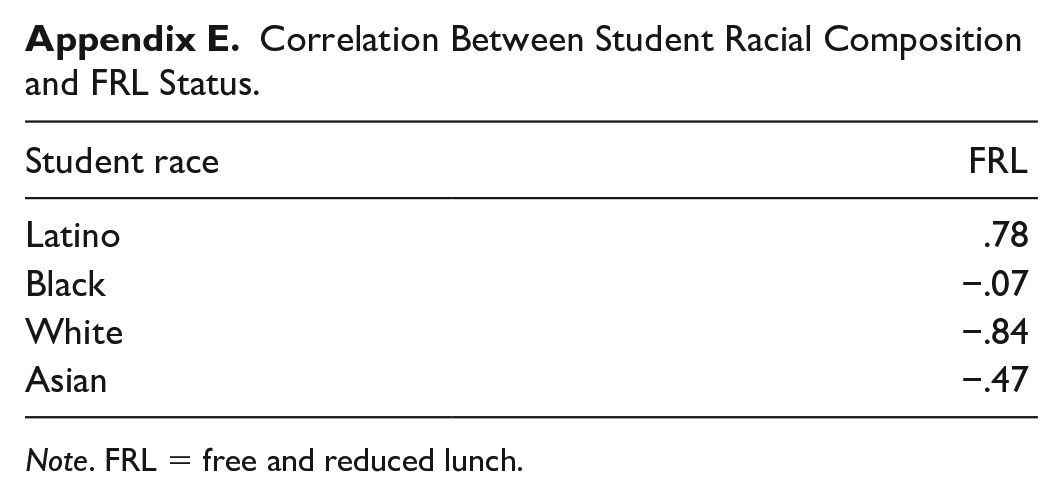
Table 1 displays descriptive statistics. The average truancy rate is 35% and the mean API is 775. About 28% of schools are charter schools, and the majority group of students in all schools are identified as Latinos (75%) and FRL students (78%). The majority of teachers are Latino (41%) followed by those who are White (36%). About 80% schools have more than 40% Latino student enrollment. African American teachers have the highest number in the representation index with the mean of 0.93 out of 1 that indicates a perfect racial match between teachers and students. In the correlation tests, the FRL rate is highly correlated with the proportion of Latino students (.78) and negatively with White students (−.84; see Appendix E).
The regression tables below include four models with year and school FE to examine representational effects of teachers on student truancy and academic performance, including the moderating impact of teacher socialization. There was no severe multicollinearity issue found in the models. First, for the representational effects on truancy rates, based on year FE models (Model 1) in Table 2, the representation index has a statistically significant impact on reducing student truancy rates. This confirms the first hypothesis. For the test of socialization’s moderating impact on teachers’ positive representational effects on truancy rates, in Model 2, the representation index becomes insignificant, whereas some of the teacher’s socialization variables are significant.
FE Models of Representational Index and Truancy.

Note. Year FE are included, but not reported. Robust standard errors in parentheses. FE = fixed effects; FRL = free and reduced lunch.
p < .10. **p < .05. ***p < .01.
The negative sign of the interaction between tenure status and the representational index indicates teachers who are tenured and representative and positively moderate the negative impact of tenure on student performance. As the rate of teachers with tenure increases by 1%, teacher representation increases the truancy rate by 7.63 percentage points (24.995% increase by tenure status in the truancy rate minus 17.361% decrease by racial representation of teachers with tenure). Thus, the net impact of tenure remains negative. Consistent in school FE (Model 4), tenure status also increases truancy rates, but a 1% increase in the rate of teachers with tenure decreases truancy rates by 12.453 percentage points. In other words, having tenure increases the truancy rate, but teachers with more racial representativeness decreases the truancy rate when they have job security.
A similar result is found in credential status. The negative impact of having teachers with credentials is positively moderated by racial representation. Racially representative teachers with full credentials are more likely to decrease truancy rates by 0.05 percentage point than those teachers without full credentials. Such an impact of full credentials is not found in school FE model (Model 4).
For the impact of graduate degrees, in the year FE model (Model 2), although holding graduate degrees negatively affects truancy rates, a moderating effect of socialization is not found. In the school FE model (Model 4), there is no significant impact of graduate degrees.
For the teacher’s representational effect on student truancy that is consistent in both year and school FE models (Models 2 and 4), socialization by being tenured has a positive moderating impact, whereas holding graduate degrees and emergency credentials has no effect on teacher representation on student truancy.
Second, in the analysis of representational effects on academic performance (API) with year FE, in Table 3, the representation index has a positive impact on API (Model 1), which also confirms the first hypothesis of the positive representational effects. However, in Model 3, the inclusion of the socialization–representation index interactions flips the positive sign of the index to negative although the interactions themselves are positive, showing the opposite of the first hypothesis. A 1-point increase in the representation index is associated with a 118.46-point decrease in API. The flipped sign indicates a possible positive impact of socialization of advanced degrees and tenure status, whereas there is no socialization moderating effect of emergency credentials on API.
FE Models of Representational Index and API.
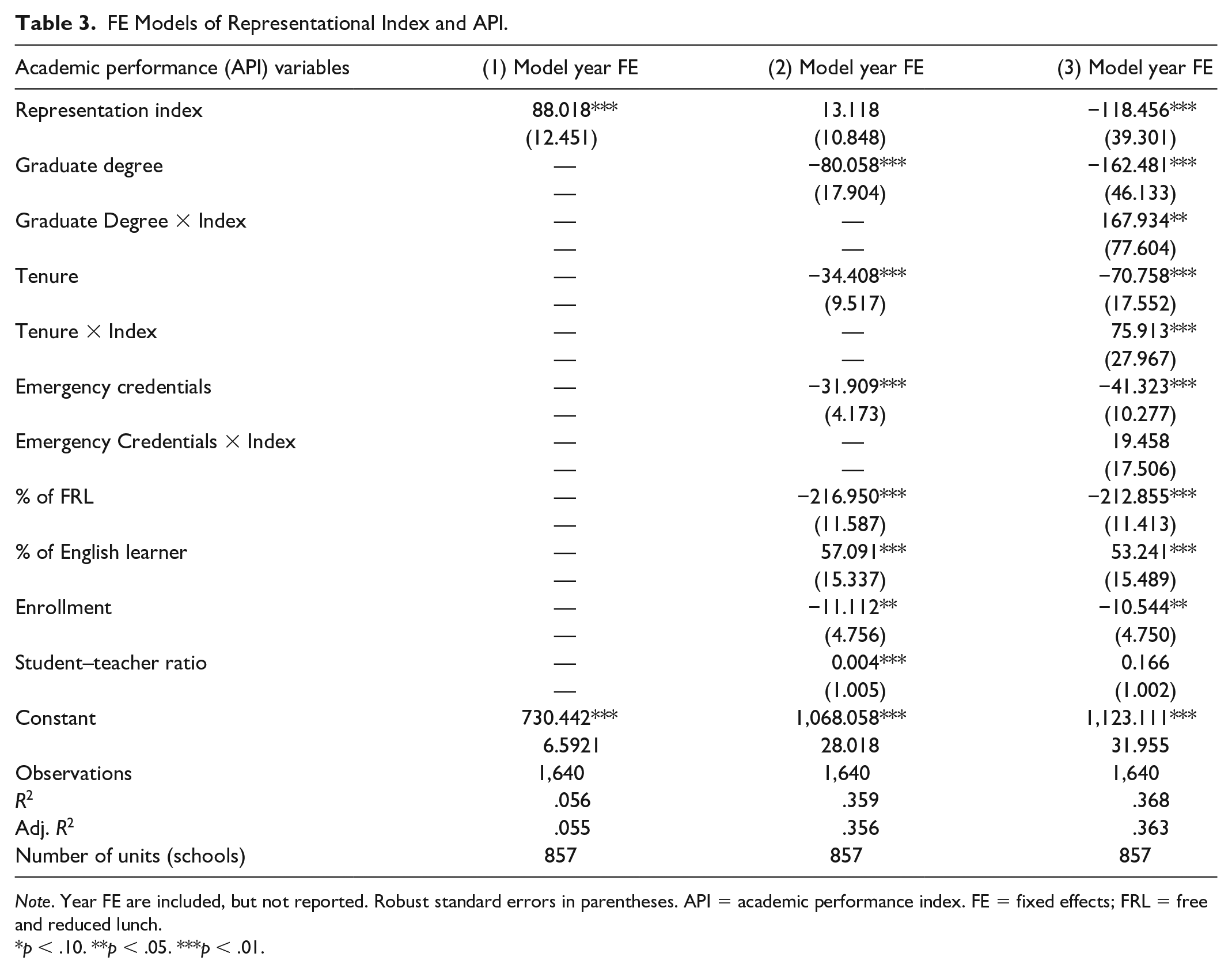
Note. Year FE are included, but not reported. Robust standard errors in parentheses. API = academic performance index. FE = fixed effects; FRL = free and reduced lunch.
p < .10. **p < .05. ***p < .01.
For the significant effects of socialization, first, a 1% increase in the percent of tenured teachers is associated with a decrease in API by 70.76 points. However, teachers who are racially representative and tenured increase API by 5.16 points. Also, the positive net effect of socialization exists among teachers who hold graduate degrees. Racially representative teachers with advanced degrees increase student’s API by 5.45 points.
In sum, professionalization in the form of tenure increases truancy rates. But when teachers are racially representative, truancy rates decrease with tenure. In the case of academic performance, the professionalization by higher education, tenure status, and credentials decrease the academic performance of students, but when racially representative teachers hold graduate degrees and are tenured, they positively affect student academic outcomes.
Discussion
Despite the many representative bureaucracy studies conducted with school-level data, the impact of socialization remains uncertain. Teachers are socialized in many ways and in this study, socialization includes the possession of an advanced degree, tenure status, and full credentials while exploring these elements of socialization as they relate to various aspects of student performance. The findings indicate that socialization moderates a teacher’s representational effect on student performance based on truancy and academic performance. Socialization varies across organizations but considering the different environments that may be perceived between charter schools and traditional schools, it is worthwhile to check the robustness of the moderating effect of socialization in the different environments of teachers.
In terms of governance, charter schools tend to differ from traditional school settings, and thus the investigation of charter schools is useful and important to understand the effects of socialization on representation. These differences are often based on four key characteristics: (a) anyone can propose to establish a charter school; (b) if granted a charter, they have autonomy in their operations free from most state and local regulations including certain aspects of teacher qualifications; (c) in some cases, families pursue admissions that are determined by teachers and staff; (d) the public authority (e.g., LAUSD) who authorized them can close them if they fail to produce satisfactory results (Manno et al., 2000). These features also render charter schools to look like private schools in two ways. First, a charter school’s independence allows them to bring about the outcomes as they think are best. They act as self-governing institutions with control over their “own curriculum, instruction, staffing, budgeting, internal organization, and much more” (Manno et al., 2000, p. 737). Second, school choice can be viewed as another similarity. Charter schools are schools of choice, in that, both students and teachers choose to be in a charter school. Thus, the distinction between charter schools and traditional schools offers an appropriate setting to understand socialization of different teacher environments.
In addition, the analysis of differences between charter and traditional schools in LAUSD is particularly important because of the large share of charter schools relative to traditional schools. According to the National Alliance for Public Charter Schools (2015), LAUSD had the largest charter enrollment (151,311) in the nation in 2014. Charter school enrollment in LAUSD doubled from about 10% in 2009 to about 21% in 2013. The charter school enrollment share of 21% in 2013 is much higher than the national average of about 6% in 2014 (National Alliance for Public Charter Schools, 2015).
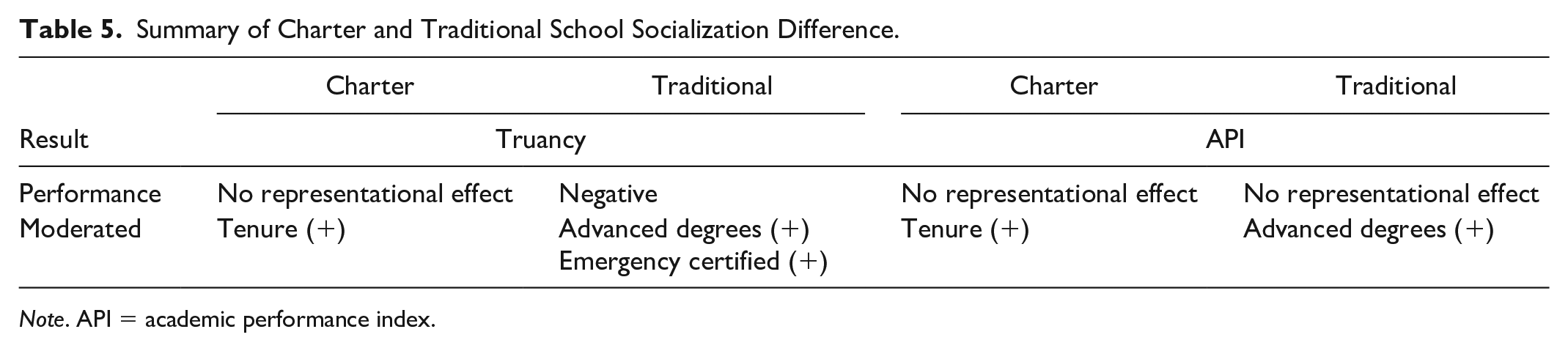
The analysis in Table 4 confirms the different representational effect and socialization existing in charter schools and traditional schools in LAUSD (see Table 5 for the findings summary). First, in the analysis of truancy, teacher representation in traditional schools negatively affects the truancy rate, whereas there is no representational effect in charter schools. Socialization also differs. In traditional schools, there is a positive socialization impact of holding graduate degrees and credentials on student truancy. In charter schools, tenure has a positive moderating impact on student truancy, although the negative impact of tenure is not entirely offset by tenured teachers who are racially representative.
Charter and Traditional School Comparison.

Note. Year FE are included, but not reported. Robust standard errors in parentheses. API = academic performance; FE = fixed effects; FRL = free and reduced lunch.
p < .10. **p < .05. ***p < .01.
Summary of Charter and Traditional School Socialization Difference.
Note. API = academic performance index.
In the relationship between teacher representation and student academic performance, first, there is no representational effect found in either charter or traditional schools controlling for professional socialization and student characteristics. Socialization via tenure status positively moderates the negative impact of tenure status when teachers are representative in charter schools, which is not found in traditional schools. Instead, in traditional schools, socialization by means of holding advanced degrees positively moderates the negative effect of holding a graduate degree when teachers are racially representative. In both charter schools and traditional schools, fully credentialed teachers when they are racially representative have no impact on API.
One study to measure the different representational impacts of charter and traditional schools is that of Roch and Pitts’ (2012). They studied 1,263 elementary schools in Georgia during the school years spanning from 2005 to 2008. They found the representational impact of teachers on lowering out-of-school suspensions and increasing reading and math scores in charter schools was either weak or absent, whereas positive effects were evident in traditional schools. They suggest the weaker or absent representational effects might be because of charter schools’ clearly specified norms and values about education. These norms and values have the potential to “encourage educators to make decisions on the basis of a consistent and coherent educational philosophy, not on the basis of whether the teacher and student come from the same racial and ethnic background” (Roch & Pitts, 2012, p. 285).
In the case of LAUSD, when looking at student truancy and academic performance, the link between representation and performance is not significant in charter schools, whereas the link is negative in traditional schools for truancy, and there is no such link for academic performance. This study offers, by analyzing multiple dimensions of socialization, a demonstration of which dimension of socialization affects the relationship. The negative relationship between teacher representation and truancy in traditional schools becomes positive when teachers hold advanced degrees and credentials. In charter schools, racially representative teachers with tenure positively affect both truancy and academic performance of students. In sum, across the two dimensions of performance, the consistent results show that in charter schools, tenured teachers have a positive impact on both dimensions of student performance, whereas in traditional schools, teachers with advanced degrees have a positive impact.
Conclusion
This study examines the moderating impact of socialization on the representational effect of teachers on student academic performance. This study provides an additional understanding of the theory of representative bureaucracy in education by extending the discussion to the effects of professional socialization on representativeness.
Overall, results suggest the possible moderating effect of professional socialization on representative bureaucracy in schools, which varies among different professional identities and between charter schools and traditional schools. In LAUSD K–12 schools during the 2012 to 2014 school years, when controlling for unobserved school characteristics, statistical analyses find no impact of teachers’ racial representation on truancy rates, but do find a negative impact on academic performance.
For the professionalism effects on truancy rates, Table 2 shows the sign of the impact on truancy rates referring to Models 2 and 4. In sum, tenure has a negative impact on truancy rates, but when racially representative teachers are tenured, teachers have a positive impact on truancy rates, which is consistently significant in both year FE model and year and school FE model. For the effect of professionalism on academic performance, graduate degrees, tenure status, and credentials have a negative impact. However, when teachers are racially representative, their graduate degrees and tenure status moderate such a negative impact positively. Tenure status matters for improving student performance of both truancy and academic performance in charter schools, whereas graduate degrees have positive moderating effects in traditional schools.
These findings also have limitations, and the first is omitted variable bias. The data omissions include a lack of school characteristics such as school policies or missions related to racial, diversity, or equity issues. The second limitation is the measure of representation, which is the inability to directly link teachers to their students. Previous literature has cautioned that studies conducted at an organizational level cannot draw inferences about the effect of individual behavior (e.g., Atkins et al., 2014; Bradbury & Kellough, 2011). From the data employed in this study, it is uncertain to what extent the teacher demographics in the data represent actual teachers who taught the students presented in the data. Individual-level data would address this, but they are unfortunately unavailable. The third limitation is the lack of immediate data with regard to how charter schools originate. That is, although LAUSD grants the charters classifying them as public schools, there are a number of schools that originate under the auspices of other, often nonprofit organizations. The final limitation is the inability to include variations in teacher–student interaction and disciplinary outcomes depending on school levels.
Despite these limitations, these findings offer important implications for theory and practice. First, some types of professionalization such as tenure and graduate degrees might help racial representativeness in education, which is the opposite of our second hypothesis and previous studies in policing by Wilkins and Williams (2008, 2009). This positive relationship might be derived from the higher level of discretion with professionalized teachers. Discretion is one of the key elements to translate passive representation to active representation (Meier, 1993a; Meier & Bohte, 2001), and more professionalized teachers hold more discretion as found in one of the three conditions to be a professional in the educational literature: (a) possession of a large degree of talent and skill, (b) the use of knowledge that supports their teaching, and (c) possession of the autonomy in decision-making that combines skills with knowledge (Goodlad et al., 1990). Previous education studies also found that greater teacher professionalization leads to a greater level of teacher commitment, retention, motivation, and satisfaction (Baker & Smith, 1997; Darling-Hammond, 1997; Ingersoll, 2001). Thus, principals, superintendents, and education policy makers might consider the incentives of the professionalization of minority teachers, in particular, considering struggles to hire and retain minority teachers in urban school districts.
This study raises important questions that should be further addressed in research, in particular on representative bureaucracy in public schools, but more specifically for the increasingly expanding and diversifying research streams within the field of public administration. Public schools have often been employed to study various dimensions of “publicness” and have contributed to our knowledge in numerous ways as to how or why organizations are considered public. Based on the present inquiry, public schools, regardless of charter status, tend to have either negative representational effects or no significant representational effects at all. Professional socialization can provide both positive and negative results. Urban school districts concerned about racial parity issues may consider that certain elements of professionalism can provide benefits to student performance when racially representative teachers have advanced degrees, tenure, and full credentials. Although the relationship between teachers and students does not represent other public administrator–citizen relationships, this research still offers insights into public service more broadly. It highlights the importance of moderating factors of the representation of public administrators and provides potential moderating factors applicable to other public service organizations, including tenure status, job security, and education level. Despite the unknown direction of the impact of these factors, job security could enhance discretion among public administrators that in turn leads to an increase in representation.
In this specific context, and considering the large minority student and teacher population in LAUSD, future analyses may build on perceived relationships between professionalism and the number of minority teachers and how the relationship affects student performance and how it might provide a better understanding of the linkage between the passive and active representation, especially as it pertains to growing literatures in representative bureaucracy and social equity. Future studies may also want to further address differences between charter schools and traditional schools on the issue of organizational socialization. Some of the literature in this area states that organizational socialization occurs by adopting behaviors and preferences based on organizational goals, so that if organizations have cultures with particular norms and values, employees are likelier to socialize to those norms and values than to pursue prior-held values based on their racial and ethnic identity (e.g., Wilkins & Williams, 2008, 2009). This can provide insights to the role of school missions and rules and governance in representativeness both across types of schools and within schools.
The present research has presented but a portion of the broader picture of some of the managerial issues related to race and representation and may present a scenario where organizational effectiveness, as it pertains to goals and objectives (i.e., reducing truancy or increasing academic performance, in this case), intersects with normative public values such as equity and equality of opportunity. Varying assumptions that representation alone can improve societal and organizational outcomes when organizational norms and socialization have the potential to influence these goals and outcomes still present ample opportunities to further expand research and knowledge on representation.
Footnotes
Appendix
Correlation Between Student Racial Composition and FRL Status.
| Student race | FRL |
|---|---|
| Latino | .78 |
| Black | −.07 |
| White | −.84 |
| Asian | −.47 |
Note. FRL = free and reduced lunch.
Authors’ Note
Jihye Jung is now affiliated with Rutgers University–Newark, USA.
Declaration of Conflicting Interests
The author(s) declared no potential conflicts of interest with respect to the research, authorship, and/or publication of this article.
Funding
The author(s) received no financial support for the research, authorship, and/or publication of this article.
