



Abstract
Public service work and public-serving institutions are evolving by incorporating neoliberal modes of working more and more. Contemporary research oftentimes neglects to account for these changes in how we understand public service work, however. This article draws on the meaningfulness in work and public service motivation literature to explore how public service workers are making sense of their work and work environments to create meaningful work experiences under evolving conditions. The findings from 45 interviews with public and nonprofit managers are presented and compared. The changing world of work has implications for how public and nonprofit workers narrate and find meaningfulness in work but not what they find meaningful about their work. The findings suggest that both public and nonprofit workers create positive meaningfulness in work but in dissimilar ways. The findings also suggest that organizational leaders play a substantial part in workers’ meaningfulness-making process. The findings hold theoretical and practical implications for understanding the role workplaces and organizational leaders play in workers’ experience of meaningful public service work.
Introduction
Public service workers are oftentimes viewed as different from their for-profit counterparts (Holt, 2018; Ritz et al., 2016). More pointedly, individuals who choose to work in public and nonprofit organizations despite low pay and long hours have been viewed as distinctive among all workers in that they are driven in work by a commitment to service and a desire to be part of something larger than themselves (Perry et al., 2010). Numerous studies support this perspective: the workers who populate public and nonprofit organizations are indeed different in the values they bring to work and in the sense of meaning they draw from work (e.g., Light, 2002; Ritz et al., 2016; Schott et al., 2015). Scholars have sought to understand why public service workers are unique in their work motivations. The result has been a robust scholarship that spans public administration and nonprofit studies and includes literature on Public Service Motivation (PSM) (e.g., Cunningham, 2010; Lapworth et al., 2018; Perry et al., 2010; Word & Carpenter, 2013), callings in work (e.g., Schabram & Maitlis, 2017; Thompson & Christensen, 2018), and a voluntary sector ethos (Cunningham, 2010). Collectively, this body of work sheds substantial light on the factors that contribute to one’s choice of public service work.
Yet, such scholarship often neglects to follow public service workers into their organizations to investigate their experiences of work, leaving us with an incomplete picture of public service work and workers. We understand why someone might be motivated to seek out public service work, but we understand little about how those motivations (and the values that inform them) play out for workers as they engage in work in public and nonprofit organizations. This line of inquiry is worth pursuing for two reasons. First, recent studies suggest that public service workers experience decreased satisfaction in their work long term (Moynihan & Pandey, 2007) and are at risk of burnout (Bakker, 2015). Second (and perhaps relatedly), the nature of public service work is changing. Public and nonprofit organizations are becoming increasingly neoliberal by assuming, in some measure, the values and practices associated with New Public Management (NPM) (Kaboolian, 1998; Peters & Pierre, 2016), managerialism (Hvenmark, 2016), and marketization (Eikenberry & Kluver, 2004). Such that these organizations are more competitive, data-driven, and performance minded (Sandberg et al., 2020; Terry, 1998). Studies indicate that this evolving work environment can negatively impact public service workers and their experience of work (Catlaw & Marshall, 2018; Dempsey & Sanders, 2010; Petersen & Willig, 2013). Considering this, it is difficult to presume that service-minded individuals will continue to seek to enact their values through paid work in public and nonprofit organizations and that these organizations will further motivate them to perform public service work. Rather, this state of affairs invites us to further examine the role the contemporary public service workplace plays in shaping workers’ experience of work.
This article takes up this invitation by exploring how public service managers make sense of their work and their work environments. Specifically, this article examines public service managers’ meaningfulness-making process (Vuori et al., 2012)—the process by which workers make sense of their work and work environments to make their work meaningful. Finding meaningfulness in work, while subjective and innate to individual experiences, is fostered or discouraged by organizational settings and management (Bailey et al., 2017; Lips-Wiersma & Morris, 2009). Here, the influence of neoliberal modes of working on managers’ meaningfulness-making process is explicitly accounted for. This article contributes to the literature by shedding light on how public and nonprofit managers narrate and craft meaningfulness in public service work during a neoliberal age.
The article unfolds as follows. First, the article discusses the meaningfulness in work literature and compares it with the public and nonprofit motivation-related literatures. Then, the article provides an overview of the neoliberal workplace and how it relates to contemporary public service workplaces. Next, the article outlines the study’s methods and data. The article then presents findings from interviews with 45 public and nonprofit managers across the United States. The article concludes by discussing the findings in relation to the literature on meaningfulness in work, neoliberalism, and public and nonprofit work motivation and by discussing the study’s implications for understanding public service work theoretically and practically.
Meaningfulness in Work
The scholarship on meaningfulness in work explores the significance of work for individuals’ sense of meaningfulness while underscoring the ongoing relationship between the worker, the worker’s work environment, and one’s experience of meaningfulness. Researchers and practitioners alike have a growing interest in exploring and capitalizing on how workers’ ability to find meaningfulness in work leads to positive individual and organizational outcomes, ranging from improved worker well-being, job satisfaction, retention, and productivity (Bailey et al., 2017; Lips-Wiersma & Morris, 2009; Rosso et al., 2010). Meaningfulness in work refers to the “amount of perceived or felt significance [work] holds for an individual” and its “positive valence” cognitively and affectively (Rosso et al., 2010, p. 95; see also Wrzesnieski et al., 1997). In their comprehensive review of the literature, Rosso et al. (2010) find four primary sources of individual’s meaningfulness in work: (a) personal values, motivations, and beliefs; (b) relationships with others; (c) the organizational, personal, and cultural context of work environment in which the work takes place; and, (d) a belief-orientated connection to divine guidance. Meaningfulness involves significance but not necessarily positivity. People may view negative or traumatic work experiences as meaningful: wellsprings of the person they are today. Workers make sense of both positive and negative experiences in their work so that they construct meaningfulness in work for themselves (Vuori et al., 2012).
In making sense of their work and work environments, workers draw upon the four central sources of meaningfulness (i.e., the self, others, work context, and spirituality) and relate their experiences of work to them. Moreover, they emphasize their contributions to their organization’s mission as well as the benefits they receive from their work, to create positive order and cognitive harmony (Vuori et al., 2012). Meaningful work, therefore, is not guaranteed by the type of work alone, rather it is created through one’s relationship with work (Wrzensiewki & Dutton, 2001). According to Vuori and colleagues (2012), workers actively engage in both sensemaking and crafting of their work and its context as part of a dynamic meaningfulness-making process. Aiming to make sense of work, individuals extract and interpret cues to understand “what is going on” and “what should I do now” (p. 234). These “cues” are interpreted positively (e.g., I am making an effective contribution and personally benefiting or feeling pleasure from the work) or negatively (e.g., I am not making an effective contribution nor benefiting or feeling pleasure from the work). Worker who more positively interprets work cues experiences higher levels of meaningfulness. In contrast, workers with more negative interpretations of work cues may find their work as meaningless, nothing more than a means to an end (Vuori et al., 2012).
Regardless of whether one has a generally meaningful or meaningless experience of work, all workers engage in job crafting: “the actions employees take to shape, mold, and redefine their jobs” physically, relationally, and cognitively (Wrzesniewski & Dutton, 2001, p. 180) to change their work situation to enhance their experience of meaningfulness and emphasize its meaningful aspects (Vuori et al., 2012). Specifically, workers employ meaningfulness-making techniques to accent positive work qualities, develop needed skills to improve competency, and even seek to change work itself (Vuori et al., 2012). This is accomplished in regard to their personal preferences, values, and motivations. When workers succeed in constructing meaningfulness in work, they are more likely to commit to the organizational mission and be motivated to do work their well (Chalofsky & Krishna, 2009). This meaningfulness-making process has been noted in a variety of occupations and across sectors (Bailey & Madden, 2016). We expect to find what gives public service workers meaningfulness in work will also be influenced by how interviewees positively and negatively interpret cues from their evolving work environments.
Meaningfulness in Public Service Work
Although not labeled as “meaningfulness in work,” both public administration and nonprofit studies do explore this element. For the past 30 years, PSM research has developed substantial insights into our thinking on why people choose to work in public and nonprofit organizations and how these motivations affect perceptions of work as meaningful (Perry et al., 2010). The motives of those seeking public service careers include attraction to policymaking, commitment to the public interest, compassion, and self-sacrifice (Perry et al., 2010). Later, Brewer and Selden (1998) conceptualized PSM beyond public institutions as “the motivational force that induces individuals to perform meaningful public service (i.e., public, community, and social service)” (p. 417, italics added). The premise of PSM scholarship is that people who are driven by doing good and by “other-regarding motives, not only by self-concern and self-interest,” will choose to work in public-serving institutions (Perry et al., 2010, p. 687).
When applied to nonprofit work, scholars have found the prosocial behaviors associated with PSM present among nonprofit workers (Esteve et al., 2016; Lee & Wilkins, 2011; Moynihan, 2008a; Rose, 2012; Word & Carpenter, 2013) but have also noted some limitations to the PSM model in a nonprofit context (Cunningham, 2010; Lapworth et al., 2018). For example, nonprofit workers are more likely to see their work as a calling to contribute to something greater than themselves (see Bassous, 2015; Light, 2002). Pursuing a calling through work describes how people find fulfillment and purpose in work by employing their talents to serve others across sectors (Thompson & Christensen, 2018). A calling becomes an avenue for individuals to cultivate work that is socially, morally, and personally significant (Schabram & Maitlis, 2017; Wrzesniewski et al., 1997). Some public workers, such as police officers and teachers, feel called to a specific type of work because their idiosyncratic talents are put to good use (see Thompson & Christensen, 2018). For nonprofit workers, their work may become regarded as a “moral imperative to serve” (Bassous, 2015, p. 366). Furthermore, Lapworth et al. (2018) argue nonprofit workers identify with “a belief in a specific cause, a holistic understanding of their surrounding social environment, and an oppositional perspective or identity [being different from others]” (p. 1676). Feeling committed to a cause while also seeing oneself as unique among all workers evokes Cunningham’s (2010) concept of a voluntary sector ethos whereby nonprofit employees have “philosophical or religious commitment(s) to promote social change, and a desire to have autonomy in work and participation in decision-making” (p. 701). Identifying with nonprofit values and purposes can manifest in managers who are more likely to prioritize mission (Robichau & Fernandez, 2017).
These literatures presume that individuals pursue public service work as an avenue for meaningfulness based on individual characteristics and motivations. This allows us to envision how the four sources of meaningfulness in work—beliefs and values, relationships with others, work context, or connection with something larger than themselves—manifest within a service-oriented work setting. Although there are some subtle but noteworthy differences among them, public and nonprofit workers seem to find their workplaces inviting. Individuals pursue meaningful work where their service-oriented values can be enacted as organizational performance needs are satisfied. However, these literatures overlook the extent to which organizational structures and processes shape workers’ experiences once employed and whether workers continue to make meaningfulness in their workplaces. We cannot assume that service-oriented employment is the end rather than the means of finding meaningfulness in work. Evidence suggests that PSM levels decrease with tenure in public organizations (Moynihan & Pandey, 2007) and that public service workers experience burnout and exhaustion when job demands are high with few resources (Bakker, 2015). Further, even when service workers are engaging in work they find deeply meaningful, their commitment to the organization and work takes a toll on personal relationships, pay, and time (Bunderson & Thompson, 2009; Oelberger, 2019). There appears to be a “dark side” of deeply meaningful work that needs further attention (Oelberger, 2019).
Sociocultural forces wrought by neoliberalism are also complicating these matters. Expecting public and nonprofit organizations to be immune from changes in the nature and design of work is untenable. We can no longer presume service-minded individuals will stay committed to public and nonprofit employment solely because these institutions are public serving (Jin & McDonald, 2017). Thus, we expect that while workers narrate meaningfulness in public service work like workers in other sectors, the changing organizational landscape will also shape their experiences.
Neoliberalized Work Environments
Broadly speaking, neoliberalism seeks to extend the rationality of the marketplace to all corners of human existence (Foucault, 2008). The processes of neoliberalization serve that goal by using myriad discourses and technologies to disperse the values and logic of the marketplace throughout the social order (Peck & Tickell, 2002) to build and maintain an enterprise culture (du Gay, 1996) devoted to the advocation of free market principles and a “business-like” ethos. Globally, neoliberalism is shaping public policy formation and reforms in a myriad of ways (see Peters & Pierre, 2016).
In public-serving institutions, neoliberalization manifests under the guise of NPM, a movement and set of practices that emphasize productivity and efficiency to overcome bureaucratic unresponsiveness (Kaboolian, 1998), and managerialism, an ideology devoted to the ascension of “business-like” practices (Hvenmark, 2016). The New Public Service paradigm also hints at neoliberalism’s assimilation into practice. For example, scholars note the adoption of marketized language and practices around the “citizen-customer approach” to improving public service quality and measuring “customer” satisfaction as further evidence of neoliberalism influences (Haddad et al., 2020). Nonprofits are aligning their organizational practices to conform to market and governmental reforms neoliberal evolution. Embracing higher degrees of professionalization in the nonprofit workforce and practices (Bromley & Meyer, 2017; King, 2017) as well as marketizing organizational goals and language in regard to performance management (Maier et al., 2016) illustrate how neoliberalism produces more homogeneous organizations across sectors (see Bromely & Meyer, 2017). In short, these neoliberal workplace practices seek to create public-serving institutions that operate more like for-profit businesses that respond to market forces. Such practices now include predominantly flexible work arrangements, performance regimes, and financial incentives (Beck, 2014).
Flexible work arrangements, or flexibilization, include the use of contract, temporary, and other contingent forms of labor and the reduction in full-time work. This involves outsourcing or contracting, privatization, and/or down- or right-sizing of work as well as organizational and policy tools that streamline the hiring and firing of “unproductive” workers such as changes to civil service protections (Näswall, 2004). Performance regimes involve the use of quantitative data-driven performance management tools (e.g., benchmarking, cost–benefit analyses, 360-degree employee evaluations, etc.) to assess the productivity and efficiency of workers and organizational processes to guide efficient use of resources. The use of these tools in public-serving institutions is done with a view toward enhancing accountability and transparency (Moynihan, 2008b). Financial incentives include such practices as pay-for-performance and rest on the premise that workers are extrinsically motivated. It is argued that pecuniary and other extrinsic rewards will lead to greater productivity and better organizational outcomes.
Neoliberal work practices pose a paradox to the future of public service work. On one hand, a more business-like orientation produces efficiencies for public-serving institutions (see Eikenberrry & Kluver, 2004; Moynihan, 2008b) and affords local governments and their partners increased flexibility when working to placate a plurality of public preferences (Heinrich, 2011). These efficiency gains come in many forms such as greater economies of scale through partnerships and reduction of costs (see Peters & Pierre, 2016; Moynihan, 2008b). Employing a more professionalized workforce, along with implementing more rationalized management practices, leads to perceptions of legitimacy among nonprofit stakeholders (Bromley & Orchard, 2016; Hwang & Powell, 2009). This in turn helps with fund development (Suárez & Hwang, 2013) and service delivery that produces greater client and employee satisfaction (see Maier et al., 2016).
On the other hand, neoliberal practices also engender a range of unintended, sometimes negative consequences for workers. In neoliberalized work environments, workers are subject to new forms of managerial controls beyond the customary bureaucratic ones (Karreman & Alvesson, 2004) some of which blur work and nonwork boundaries so completely that workers believe they must bring a total commitment of their full selves to their work to meet the organization’s mission (Fleming, 2014). Such an environment can lead to poor work–life balance and sense of well-being (Dempsey & Sanders, 2010; Oelberger, 2019) as well as high levels of self-criticism (Petersen & Willig, 2013) and a pervasive sense of inadequacy leading to fatigue and depression (Catlaw & Marshall, 2018). There seems little doubt that neoliberalization is impacting public and nonprofit work environments and, in turn, how workers are experiencing public service work. This study explores how the workers themselves are making sense of this contemporary state.
Methods and Data
Research Design and Sampling Strategy
This study employs a qualitative research design, drawing on in-depth interviews, which suits its exploratory nature. A qualitative approach offers rich, detailed accounts of individuals’ experiences with a multifaced phenomenon, such as meaningfulness in public service work, and provides insights into practitioners’ lived experiences by magnifying their voices during the conduct of the research (Creswell & Poth, 2018; Ospina et al., 2018). We conducted semistructured interviews with 45 public service and nonprofit managers representing an array of characteristics (see Table 1). Managers were chosen as informants due to a likely commitment to service work, internalization of service values, and ability to see their work broadly (see Johnson & Ng, 2016). Managers are also familiar with the broader external work environment and how this shapes internal organizational goals, performance, and values (see Jin & McDonald, 2017). Managers from an array of public and nonprofit organizational settings participated in the study, helping ensure that a range of “person-environment configurations,” were represented (see Englert et al., 2020, p. 339). Although the research on meaningful work indicates that individuals across myriad occupations and work settings all engage in a meaningfulness-making process at work (see Bailey & Madden, 2016), emerging research suggests that the increasing influence of market-based ideologies can affect individuals’ sense of meaningful work and identity across professional and organizational settings, including public service settings, in unique ways (e.g., Florian et al., 2019; Hendrikx, 2021; Meyer & Hammerschmid, 2006; Shams, 2019). This study explores some of these differences as well as similarities along the broad lines of public and nonprofit organizations. As previously discussed, public service and nonprofit workers share a public service ethos that animates their pursuit of meaningful work in public agencies and nonprofit organizations, but subtle differences exist between them.
Individual and Organizational Profiles.
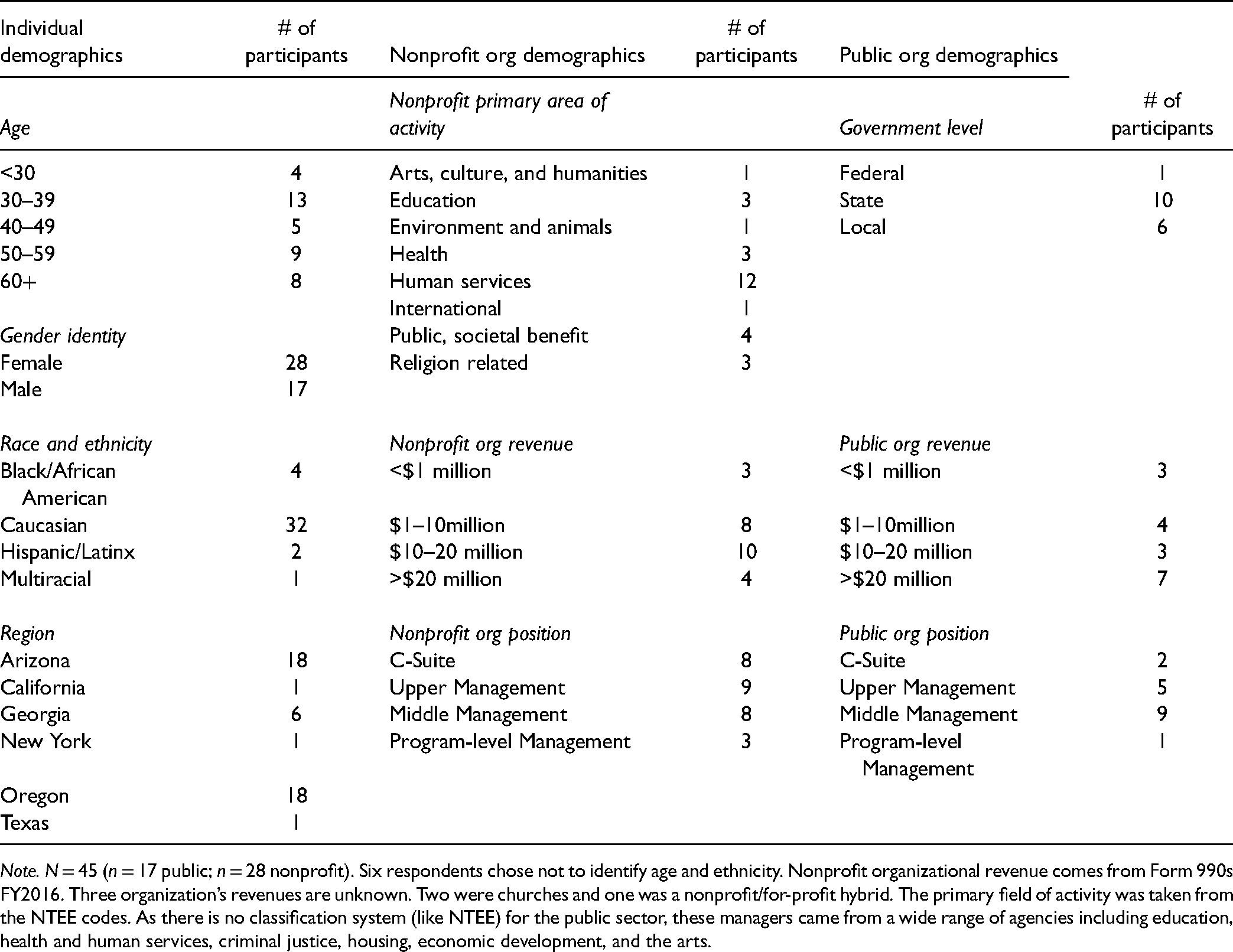
Note. N = 45 (n = 17 public; n = 28 nonprofit). Six respondents chose not to identify age and ethnicity. Nonprofit organizational revenue comes from Form 990s FY2016. Three organization’s revenues are unknown. Two were churches and one was a nonprofit/for-profit hybrid. The primary field of activity was taken from the NTEE codes. As there is no classification system (like NTEE) for the public sector, these managers came from a wide range of agencies including education, health and human services, criminal justice, housing, economic development, and the arts.
We utilized a snowball nonprobability sampling strategy because we sought a variety of experiences of meaningful work across a range of public and nonprofit organizational settings. Snowball sampling allowed us to engage with information-rich practitioners who are not easily accessible using more rigorous sampling approaches (i.e., there is no centralized database of public service and nonprofit workers from which to sample) while establishing an open and trusting environment that benefits exploratory research on personal topics (Creswell & Poth, 2018; see also Englert et al., 2020; Cohen, 2018) such as meaningfulness in work. Furthermore, snowball sampling is a suitable sampling strategy in qualitative studies if it is done with a purposive reason, that is, because subsequent informants can yield new or additional information on the phenomenon under study (Yin, 2011). We applied a three-part sampling strategy to provide greater depth and some breadth to our understanding of meaningful public service work (see Moser & Jorstjens, 2018). First, we used a purposeful sampling strategy by which initial participants were selected based on the researcher’s judgment regarding their knowledge and expertise and who met the sampling criteria outlined above—they were management-level employees in a public service agency or nonprofit organization. Second, participants were included in the sample when they met our predetermined criterion of managerial experience in the public service field broadly. Finally, we relied on parallel sampling where initial participants were selected in multiple regions of the United States to ensure that our findings reflected multiple rather than a single snowball sample network (For review see, Moser & Korstjens, 2018; Cohen & Arieli, 2011). Upon conclusion of each interview, interviewees were asked to identify contacts who met the same criteria whom they would recommend for interviews (see Yin, 2011). Interviews were conducted until no new information was obtained, that is, “data adequacy” or “saturation” was achieved (Morse, 1995). In addition to the above snowball sampling criteria, we purposely sought participants from a range of organizational types and sizes, professional backgrounds, gender, and level of experience in an aim to diversify our sample. Participants predominantly came from Northwest, Southwest, and Southeast regions of the United States. Participants and their organizations vary along with age, ethnicity, gender, and organizational revenue and service area. The limitations of this sampling strategy are discussed below.
Data Collection
This study employs data from 45 semistructured interviews conducted with mid- and executive-level public and nonprofit managers between April 2015 and September 2016. The interviews averaged 60 min and ranged between 27 and 108 min. All but three interviews were conducted in-person; three interviews were conducted by telephone. Hermeneutical phenomenology informs this study and frames interpretation of the data. This approach focuses on understanding the subjective “lived experiences” of individuals to locate common experiences and meaning of some phenomenon through interviews (Creswell & Poth, 2018). Studies using a phenomenological approach frequently rely upon a criterion sampling strategy with the goal of recruiting participants who have a shared experience of the phenomenon despite having different individual characteristics or workplace characteristics (Moser & Korstjens, 2018). As such, managers were asked to describe their lived experiences around meaningfulness in work, offering insight into public and nonprofit work in a neoliberal age (see Online Appendix 1). Participants were asked to elaborate on the meaningful aspects of their work and how work shapes their sense of well-being and relationships with others. The authors also inquired about aspects of work that detract from their experiences of meaningfulness and how they cope with them. Finally, questions were posed on the salient neoliberalizing work practices described previously.
Data Analysis and Rigor
The interviews were recorded, de-identified, and then transcribed verbatim using an online service. The transcripts were reviewed by the research team for accuracy, then uploaded into Dedoose, a cloud-based qualitative data analysis software. A codebook was developed based on a synthesis of the literature on meaningfulness in work and neoliberalism. Codes were primarily deductive; however, inductive patterns and relationships emerged with the use of an emergent indicator code (see Online Appendix 2). In total, there were 806 pages of coded data to analyze.
Several strategies were employed to ensure the quality and rigor of our findings. To enhance the validity of the analytic and interpretive process, a double-blind coding and reconciliation process were employed. The two authors and a third colleague, along with three trained graduate students, coded the data line by line using a decision tree and codebook (Online Appendix 2). The research team then identified themes in and across the data through review, discussion, and consensus (Tracy, 2010). Statements found to be contrary to prevailing themes and patterns were further discussed, and on a few occasions, were recoded and analyzed. Coded excerpts were converted into data matrices in Excel capturing categories that could be filtered by the amount of content, subcodes, themes, and individual and organizational characteristics. For example, we could compare public versus nonprofit managers’ statement by codes (e.g., aspects of meaningful work, performance management). Data matrices encourage rigor during the analysis because they visually represent the data behind themes and patterns (Miles et al., 2014). Quotes were incorporated from as many different participants as possible to offer readers the ability to extrapolate the findings to multiple contexts (Creswell & Poth, 2018). To further establish the credibility of the results, the team employed crystallization techniques (Tracy, 2010). Crystallization is the practice of examining patterns and themes from the perspective of a prism where numerous explanations and angles coexist and simultaneously help with our understanding of the complex phenomenon (Richardson, 2000).
Limitations
This study is subject to some limitations primarily its research design and sampling strategy. Thus, our findings should be interpreted cautiously in terms of generalizability. As Yin (2011) states, “by its very nature, qualitative research is particularistic” and thus generalizing the findings from this study to a broader set of circumstances is difficult (p. 98). As well, the snowball sampling strategy employed in this study limits the representativeness and randomness of our sample. Low representations of people of color, managers in federal government agencies, managers in environmental and arts nonprofits, among other characteristics, limits our understanding of these managers’ experiences. Indeed, we realize that the small number of managers within certain organizational settings as well as the fact that a single representative of each organization was interviewed weakly represents a larger group of interest (see Stake, 2005). That is, the findings from this study cannot represent the experiences of all federal managers, all managers working in human service nonprofits, and so on. Rather, the experiences detailed in our findings may be found across diverse groups of public and nonprofit managers working in a variety of organizational settings. The broad diversity of participants across organization type, management level, gender, race and ethnicity, and region suggests that we can increase our understanding about the shared experiences of meaningful public service work across organizational settings. In general, the findings from this study should be considered not with the aim of generalizability but rather as an opportunity to learn about the meaningfulness of work for public service managers under increasingly neoliberalized conditions (see Stake, 2005, p. 451 original emphasis). Subsequent qualitative and mixed-methods research could assess how well these findings are substantiated within certain organizational settings (e.g., federal agencies, arts and culture nonprofits, etc.) and among certain managers (e.g., women managers, managers who are people of color, etc.) furthering the generalizability of the study.
Considering these limitations, we sought transparency and rigor throughout this study. Although we recognize the drawbacks of employing a snowball sampling strategy, proper planning and the use of strategies such as parallel and criterion sampling can increase the representativeness of the research somewhat (Cohen & Arieli, 2011). Additionally, given the lack of agreement as to what is considered a “right” or “adequate” sample size in qualitative studies (see Yin, 2011 for discussion), we drew on applicable scholarship and applied multiple approaches to substantiate our methods (see Cohen, 2018, pp. 897–898 for review). First, we followed an accepted rule regarding qualitative sample sizes varying between 30 and 50 participants; second, we included participants until the research team agreed data saturation was reached; and finally, we drew on studies relevant to meaningfulness and often focusing on public servants that are qualitative in nature and which employ similar sample sizes (e.g., Cunningham, 2010; Hendrikx, 2021; Schabram & Maitlis, 2017; Vuori et al., 2012). Finally, we adhered to Ospina et al.’s (2018) recommendations to improve the robustness and rigor of qualitative studies that include clarifying sampling strategy; ensuring transparency in how the data are collected, analyzed, and interpreted; discussing our epistemological and theoretical assumptions; and noting limitations of the study.
Findings
We present these findings establishing how public service workers' experiences align with the broad meaningfulness in work literature, and then, we move on to a more nuanced discussion of interviewees’ understandings of meaningfulness making in the public service context. 1 Next, we present findings on how neoliberalism is shaping interviewees’ experiences of meaningful work. Finally, we discuss work relative to their overall sense of meaningfulness.
Meaningful Public and Nonprofit Work
To understand how neoliberalism influences workers’ experience of meaningful work, it is helpful to first appreciate how interviewees themselves view the meaningfulness of their work. As expected, interviewees described the aspects of work as meaningful to them in ways that mirror the primary sources of meaningfulness described by Rosso et al. (2010); they all described personal values and beliefs, relationships with others, work context, and a sense of connection with something larger than themselves, as sources of meaningfulness in work. The aspects of meaningful work interviewees described also mirror the values set forth in the public and nonprofit motivation-related literatures. Collectively, the sources of meaningfulness described were juxtaposed with one another and emphasized a value for service to others, to form composites of meaningfulness in work. Many interviewees could not, for example, disentangle their dedication to serving others as a personal value from their dedication to the mission of their organization or from their dedication to their clients or coworkers. Public and nonprofit workers also emphasized different aspects within these composites of meaningfulness. Nonprofit workers placed greater emphasis on relationships (Stater & Stater, 2019), whereas public workers seemed to find greater meaning in opportunities to apply their expertise to facilitating systems-level change (e.g., Rose, 2012). These aspects of meaningfulness manifested through interviewees’ discussions of their organization’s culture and its mission/mandate.
Organizational Culture
Public and nonprofit workers shared some commonalities in the aspects of organizational culture they found meaningful, primarily around relationships. Both groups of workers emphasized the importance of relationships with colleagues and of feeling part of a collective enterprise (e.g., Boyd et al., 2018). However, nonprofit workers were more likely to describe relationships as a “family” rather than as a team which was the preferred nomenclature of public workers. Likewise, both public and nonprofit workers asserted the importance of receiving positive affirmation from colleagues, but each sought a particular manifestation of this affirmation. Public workers valued the expression of respect and appreciation from their supervisors for their work efforts, whereas nonprofit workers valued freedom and flexibility in the execution of their work as a sign of trust. As Cunningham (2010) suggests nonprofit workers found flexible, autonomous work environments in which they were empowered to make decisions to be meaningful.
Organizational Mission/Mandate
An attachment to organizational mission/mandate was often juxtaposed with personal values, emphasizing service to others as a salient value for them, as this quotation demonstrates: The arts [are] something that can help moderate poverty…[and] hopelessness in the lives of young people…The arts make an impact… The arts give kids that opportunity to feel proud of themselves, to feel proud of their cultures. The arts are the best tool for helping erase bigotry. [Director, Public Arts Commission, June 17, 2016]
Relatedly, others saw themselves as able to help others through their organization’s work, which was powerfully meaningful to them: The meaningful piece to me is when I see the success of our mission. When I see someone get promoted who, four years ago, was living under a bridge. Someone who has faced all these barriers and got to a place where they knew what they needed to do and they did it. [HR Director, Human Service Nonprofit, August 31, 2015]
Where public and nonprofit workers differed in their sense of meaningfulness in relation to the organization’s work is in its scale. Although public and nonprofit workers saw the mission/mandate of the organization as a way of being part of something bigger than oneself, nonprofit workers were more likely to describe this sentiment in a localized way, as having an impact on the community or in the life of a client. Indeed, nonprofit workers were more likely to describe their work as a “calling” to serve others. As one individual, serving as a pastor and nonprofit director puts it, “this [work] is about the community, this is about a higher spiritual calling.” Public workers, on the other hand, were more likely to view meaningful work beyond singular relationships or situations and more frequently discussed their role in creating systems-level change, as this quotation indicates: I was doing good work and I wanted to try and bring that to a larger scale. … I felt it was a good opportunity to show my skills and what I’ve learned over the years to help others in my position…I obviously care about kids … but I’m more intrigued by … how to improve the system. It wasn’t me just spending time with kids, it was more how do we make … our society better for kids and their families. [Program Manager, Department of Child Welfare, June 27, 2016]
Public workers narrated a sense of meaning for themselves more so as a sense of duty or obligation to serve the public through the policy process. The differences between public and nonprofit workers noted here align with some of the differences in work motivations discussed in the public and nonprofit motivation-related literatures.
Distractions and Detractors From Meaningfulness
All interviewees described phenomena that distracted them from their experience of meaningfulness that would be familiar to anyone working today. These include the so-called “administrivia” (e.g., paperwork, email, meetings, etc.), repetition of “boring” tasks, lack of innovative thinking, and little control over decision-making. Sometimes these distractions moved beyond the internal organization and manifested through external influences. These factors include having to quantify complex needs for funding to a funder; feeling forced to “answer to uninformed” stakeholders such as funding agencies, policymakers, and community members; and, dealing with external stakeholders’ unrealistic expectations for immediate solutions to systemic issues. For public workers, the internally based distractions were more bothersome than anything originating outside their agency. The opposite was true for nonprofit workers who frequently described situations in which they felt powerless to make progress on meeting the organization’s mission because of external distractions.
Many interviewees in both sectors described these distractions in a resigned manner that these phenomena were annoyances expected of public service work. However, some phenomena rose to such a level of annoyance that they consumed the meaningful aspects of one’s work and thus detracted from one’s experience of meaningfulness. This interviewee sums up this sentiment: It turns my insides off. … When those kinds of things happen to me, it was like the gears … are [grinding]. I could feel myself emotionally turning off, winding down, losing desire, and becoming a pessimist. [Program Director, Faith-based Nonprofit, May 26, 2016]
These detractors often involved systemic work/life balance issues. For example, some interviewees described management strategies that “burned out” workers, including a sense that their dedication to their work was being manipulated into working longer hours and accepting a systemic lack of resources, as this quotation indicates: [My boss] would text at 11:00 at night. …We have never been like, “Oh, I’ll get to you at 9:05 when I get in the office.” That doesn’t happen. …We were terrible about that. … When [my boss] would be on vacation, she would text and email and ask about work. Now I do the same. [Manager, Community Council, June 23, 2016]
Relatedly, some interviewees described a painful inability to “turn work off” so that they did not burn out. It is important to note that while many interviewees admitted that their work could be emotional, simply by its nature, it was organizational leadership’s manipulation of the emotional connection with one’s work that led one to experience diminished meaningfulness in work.
Neoliberalism and Public and Nonprofit Workers’ Experience of Meaningfulness
Flexibilization
The contingent forms of labor that define flexibilization have been part of public service work since the advent of neoliberalism in the 1970s (Grönbjerg & Salamon, 2016). The question here is to what extent flexible work arrangements impact public and nonprofit workers’ sense of meaningfulness in work. It seems generally insignificant to them.
When asked about flexible work arrangements in their organizations, interviewees emphasized contracting services (rather than reduction of full-time work, etc.) with a substantial number indicating that their organizations contract out or are contracted with to perform services. For interviewees in public agencies, contracting out of services is simply how work gets done. Many public workers indicated that some of their agency’s work is contracted out to third parties including nonprofits and that this arrangement is generally viewed positively: The services [we provide] are a continuum, and we need a full toolbox of services. … For me, it doesn't [detract from meaningfulness]. It actually increases meaning to have a variety of services provided by different sectors. [Program Director, City Housing Agency, August 31, 2016]
On the flip side of this arrangement, nonprofit interviewees were generally the “receivers” of more flexible work arrangements in that they are recipients of public contracts. There seems little angst about these arrangements—again, it is simply how work gets done—save for when the contracting relationship becomes unstable due to funding cuts or policy mandates that require public agencies to “bid out” contracts in a competitive format—a product of a neoliberalized policymaking field (Dean, 2010). One of the hallmarks of flexibilization is its impact on workers’ sense of job (in)security (Näswall, 2004). Interviewees generally felt secure in their positions and any insecurity they felt had little to do with contract work arrangements. This may be because people in leadership positions were interviewed rather than frontline workers.
Where contracting became problematic relative to public and nonprofit workers’ the experience of meaningfulness involved the disturbance of organizational relationships. For example, a substantial number of interviewees described a trend in which the organization hired consultants to provide flexibility around expertise that did not exist internally. Some interviewees viewed this arrangement positively: There’s more flexibility as to how you can accomplish your goals without meaning you have to go and hire more staff because you don’t have the funds for that and then just be like, “Oh, we cannot do that because we don’t have the capacity.” [Program Director, Nonprofit Funding Agency, April 11, 2016]
Others, however, viewed these arrangements as a “people come, people go” mentality that disrupts the relationships that are perceived as integral to the creation of a meaningful work environment, as this quotation demonstrates: Just by the nature of what contractors do, they sweep in. They do what they do, and they sweep out. …They don’t feel like a part of our community … [Therapist, Disability Services Nonprofit, June 14, 2016]
Perhaps nonprofit workers who placed value on the relational aspects of their work also found flexible work arrangements to be problematic in how they perceive meaningful work.
Performance Regimes
When asked about the nature of performance assessments and their experience of meaningfulness in work, interviewees indicated a paradoxical view. On one hand, most interviewees indicated they wanted—welcomed, even—the opportunity to review their work and receive feedback on it from their supervisor and their peers (through the so-called 360 reviews). They seemed to genuinely desire receiving feedback on what they could do to further the mission of the organization, as this quotation indicates: I’m one who always loves criticism. I believe in constructive criticism. I believe in constructive conflict. I know other people hate it. … I enjoy it. [Director, Nonprofit Funding Agency, June 16, 2016]
Both public and nonprofit workers seemed to enjoy having their work assessed as well as assessing their own contributions and failings and always with an eye toward “doing better.”
On the other hand, the manner and process by which that assessment was conducted mattered substantially in terms of how managers believed it contributed to their sense of meaningfulness in work. Specifically, few interviewees in either sector believed that annual performance reviews contributed to either their sense of meaningfulness in work or to their experience of work generally. They viewed annual performance reviews as rote exercises that wasted time and contributed little actionable feedback. Rather, public and nonprofit workers alike desired continuous, ongoing feedback about their performance. But the value each group of workers placed on this process differed. For public workers, ongoing feedback provided a mechanism for updating goals and recognizing good work in a timely fashion. Many nonprofit workers framed the process of receiving ongoing feedback on work performance in a relational way. Providing feedback on one’s work in an authentic way (i.e., providing constructive feedback) demonstrated that one’s supervisor “cared” about them as an individual and about their personal and professional growth. No one wanted to hear just, “you’re doing a good job, keep it up.”
Leadership seems to play an important role in one’s experience of meaningfulness in work relating to performance assessment. Although the relational aspect of performance management was more pronounced with nonprofit workers, both public and nonprofit workers felt positively toward what they perceived as authentic feedback from supervisors. People wanted to do better and saw their supervisors as an important source of information for doing so (see Jensen & Bro, 2018). Moreover, workers looked to leadership to set a clear signal for the organization that continuous improvement mattered: Leaders … have to create a culture that sends clear signals that good effort, and people that are working hard to do their job well, take feedback well, are trying to constantly improve, are curious, ask questions … there are rewards there. [Director, University Institute, June 2, 2015]
If this standard did not exist and if interviewees felt their assessments were inauthentic—that they were overly positive and did not provide suggestions for improvement—they tended to reject the assessment process as meaningless.
Financial Incentives
Of the three salient neoliberalizing practices examined, wage-based financial compensation seemed to cause the most cognitive dissonance among interviewees, particularly nonprofit workers. Some nonprofit interviewees felt that financial rewards were only important to “pay the bills”; however, the “true reward” was emotional or spiritual coming from the work itself.
In this kind of work, you go where your values are aligned … and if the financial part can align, then it all works. If the money goes away, the other part doesn’t go away. It just always continues because it’s part of you. [Program Manager, Latinx Serving Nonprofit, April 18, 2016]
This viewpoint aligns well with the notion that nonprofit workers seem to find the organization’s mission most meaningful when it aligns with their personal values. Additionally, there was some consciousness around the choice they made to work in the nonprofit sector. One interviewee put it succinctly: “I’ll take less pay to have some kind of purpose and completeness in my life.” For public workers, these sentiments existed but less so. For them, incentives such as health benefits and personal recognition mattered in equal measure with pay and with the purpose of the organization’s mandate.
Yet some interviewees discussed beginning to view their value in relation to their organization’s work, in monetary terms. As has been discussed, there was substantial discussion among interviewees regarding the perception that their organizations were taking advantage of their commitment to their work. As the following quote conveys, this sense of manipulation may contribute to ascension of value for monetary rewards: Money has never been a primary motivating factor for me. But there’s a certain respect and prestige and feeling like I’ve made it, that’s combined with money. It’s a little different in city government because what you’re making is tied to your place in the organization. [Inclusion Specialist, City Government, September 29, 2016]
In addition, some interviewees who supervised others spoke at length about desiring to pay their subordinates what they “deserved” for their work: I’ve come to understand my value that I probably didn’t know beforehand. That’s one of the coaching things I do now [with my employees]. They’re like, “This is nonprofit. So, it’s all about the love for the work.” I’m like, “You are also a skilled professional doing work that other people cannot do and there is a value for that. You need to [be] compensated, because if not, you’re going to get burned out and … go make money somewhere else… Where you’re going to make a shit-ton of money.” [Director, Nonprofit Funding Agency, June 16, 2016]
No one discussed the robust compensation packages they received or wanted to receive, but some interviewees talked about their desire for a “living wage” commensurate with the public value they were creating so employees could care for themselves and their family. In sum, while monetary rewards did not seem to motivate employees to work harder or perform better, there is a growing sense that money matters. Fair compensation is integral to meaningful work (Bailey et al., 2017). Workers are drawing on the concept of monetary rewards as an expectation that paid work should allow a certain level of stability and comfort.
Work and Meaningfulness
When asked to summarize the role of work in their overall sense of meaningfulness, public and nonprofit workers provided mixed answers. For public workers, the view was ambiguous. Although they felt the nature of the work they performed and the role that work played in public governance was important and meaningful, the work was not necessarily more meaningful to them than, for example, family time. Nonprofit workers, on the other hand, narrated a perspective on work and meaningfulness that emphasized the role work plays in their identity as demonstrated below: I’m not just here to collect a paycheck. I’m here to make a contribution and have value. [Work is] a part of my identity, it’s a part of how I engage with the world … Some people might construe that as having poor life work balance but honestly I don’t believe that if you’re a nonprofit leader or any sort of community leader, that you can be totally off [Executive Director, Nonprofit Health & Housing Agency, August 13, 2016]
Although there was some discussion of work/life balance issues and the evolving importance of work in one’s life as priorities changed over time (e.g., raising children, preparing for retirement), nonprofit workers described a more personal connection with their work as it relates to a sense of meaningfulness than did public workers. Although this might lead one to conclude that nonprofit workers find their work more meaningful than public workers do that would be inaccurate. Rather, it seems that nonprofit workers are more likely to view their work as something of a natural embodiment of their personal values; for public managers, the relationship between work, values, and meaningfulness seems a more rational one.
Public managers narrative meaningful work in a more balanced way, where work and the tasks associated with it are just one, of several, meaningful aspects of their life that brings fulfillment. Those in the nonprofit sphere seem to struggle with unpacking the importance of meaningful work from other meaningful aspects of their lives, making professional and personal distinctions between work and nonwork life more challenging concept.
Discussion
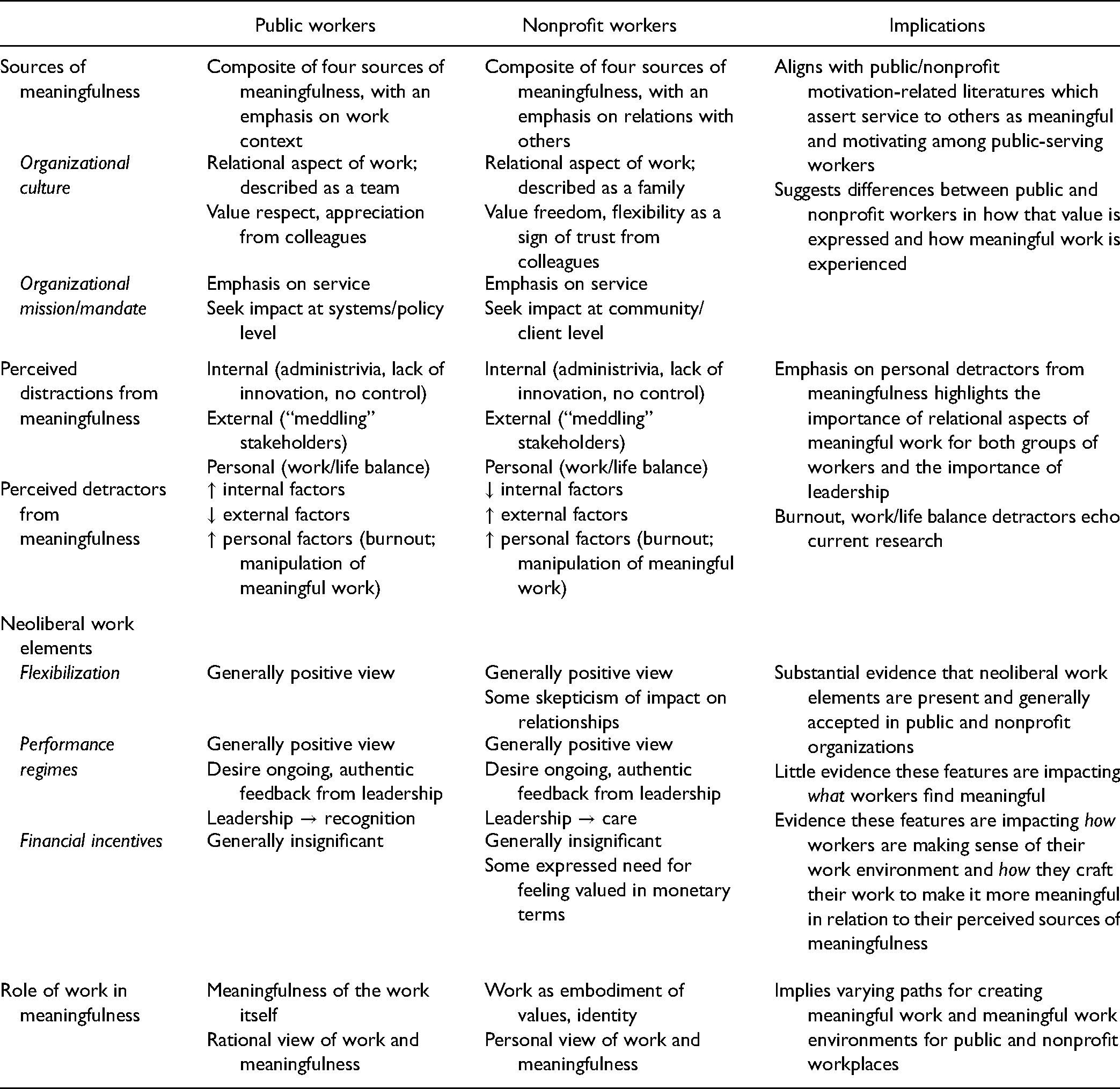
This article explores the process by which public service workers make sense of their work and work environments to make their work meaningful under evolving conditions. The findings both supported and extended the research on public service work motivation and the experience of public service work. Interviewees largely affirmed that they are motivated by and find meaningfulness in service to others and that public and nonprofit organizations remain the ideal institutional settings in which to enact service-oriented values. Yet the findings indicate that public service workers—like all workers—engage in a dynamic, ongoing meaningfulness-making process (Bailey & Madden, 2016) in which they juxtapose their personal preferences for meaningful work with their evolving work environment (Vuori et al., 2012). That is, both internal personal and external organizational factors influence the meaningfulness-making process for workers. Within this milieu, there are some subtle differences between public and nonprofit workers’ experience of work (see Table 2). For example, while public and nonprofit workers shared commonalities regarding the values that drive them in public service work, they differed in how they preferred those values be expressed in their work and how they narrated their experience of meaningful work. For public workers, the connections between work, values, and meaningfulness seemed more rational in that they sought to use their expertise to drive systems-level change. For nonprofit workers, these connections seemed more localized, more personal, and inherently relational (Stater & Stater, 2019). Understanding and affirming that these differences exist despite shared values adds to the growing discourse around nonprofit identity as distinct from a generic public service identity (see Cunningham, 2010; Lapworth et al., 2018; Lee & Wilkins, 2011). It also extends thinking on how PSM and a voluntary ethos inform public service work.
Summary of Findings and Implications.
The findings further indicate that public workers’ experience of work is affected by aspects of their work and work environments (see Boyd et al., 2018). It is not newsworthy that public and nonprofit workers must navigate the machinations of internal bureaucratic structures as well as mercurial stakeholders to get through their workdays. What is noteworthy is the cognitive processes workers undertake to make sense of this challenging—and sometimes demotivating—work environment to create a positive sense of meaningfulness in work that aligns with their service-oriented values and motivations. Their meaningfulness-making process is itself, at times, hard (cognitive) work. As Chalofsky and Krishna (2009) indicate, when workers can make a positive sense of their work and work environments, they are more likely to dedicate themselves to their work and perform well (see also, Bailey et al., 2017). If this line of thinking is extended, then it can be posited that workers who prove unable to bear the cognitive burden of difficult, sometimes demotivating work environments to generate a positive sense of meaningfulness in their work (despite being initially motivated to do so) are likely to experience burnout and detachment from work. The challenging meaningfulness-making process that some interviewees described may help explain why some public service workers experience burnout and exhaustion as a result of their work (Bakker, 2015) and why PSM declines among workers over time (Moynihan & Pandey, 2007). In short, these insights indicate that understanding workers’ experience of public service work does not involve simply acknowledging the difficult nature of the work. It also involves understanding how workers process and make sense of it considering their PSM or voluntary ethos.
As we layer on the changes to the public service work environment wrought by neoliberalism—flexible work arrangements, performance regimes, and financial incentives—the complexity of the picture of contemporary public service work increases. Interviewees in both public and nonprofit organizations seem to be taking in stride the influence of a more neoliberalized work environment. They have made peace with contracting for the most part. They seek feedback on performance, and many enjoy the feedback process. And for the moment, financial incentives remain the least of the motivators when compared with emotional and experiential rewards. Yet neoliberal modes of work are affecting how public and nonprofit workers experience their work even if they are not influencing what they find meaningful (see Table 2). Some interviewees indicated worrisome issues with work/life balance and burnout that relate to neoliberal modes of working and which exacerbate already emotionally difficult and sometimes demotivating work environments. These findings support current research in this area (Catlaw & Marshall, 2018; Dempsey & Sanders, 2010; Petersen & Willig, 2013) but also extend it by signaling that organizational leaders play a substantial role in workers’ ability to navigate a neoliberalized work environment.
Numerous interviewees indicated that organizational leaders and direct managers were influential in helping them make positive sense of their work environment and craft their jobs so they could emphasize the meaningful aspects of their work (see Bailey et al., 2017; Vuori et al., 2012). Interviewees elaborated on these sentiments when discussing aspects of the neoliberal work environment. Successful leaders helped workers navigate the difficulties posed by, for example, the contracting of services. Moreover, they amplified the positive aspects of elements of performance regimes to enhance workers’ experience of work. They achieved this in large part by delivering substantive feedback in a caring, authentic manner that helped workers make the best of their work efforts. Unsuccessful leaders, on the other hand, were inauthentic and manipulated workers’ sense of meaningfulness in their work for their own gain or solely for organizational ends rather than to meet workers’ expectations for meaningful work. This situation exacerbated workers’ sense of imbalance between their work and nonwork lives and sometimes led to resentment and burnout. The mismanagement of workers’ sense of meaningfulness reflects the “dark side” of meaningful work with exploitive behaviors already shown to have been adopted by some businesses to induce desired performance from workers (see Bailey et al., 2017).
Of the detractors to meaningful work that interviewees noted, imbalanced work/life obligations and burnout wrought by leaders’ manipulation of workers’ commitment to the organizational mission/mandate are the most concerning. They are troublesome for what they symbolize: a seemingly inauthentic concern for workers’ well-being at the expense of organizational performance or, perhaps more to the point, viewing workers’ sense of meaningful work as another input into the organizational performance machine. When scholars decry the influence of neoliberalism on public service work and workplaces (see Terry, 1998; Eikenberry & Kluver, 2004), it is issues such as these that are raised. Although one can label these manipulative leaders as simply bad at their jobs or bad at leadership, these findings also provide an opportunity to further interrogate the nature of public service leadership under increasingly neoliberal conditions that emphasize entrepreneurialism, competition, and performance. As Fleming (2014) and Beck (2014) contend, a distinctive feature of contemporary management practice is the attempt to mobilize the whole person for organizational ends. In addition to technical and experiential abilities, one’s values and sense of meaningfulness become critical resources for management. Considering the findings of this study, the question must be raised: how can organizational leaders harness these human resources without wounding the worker—and the values and motivations that drew them to public service—in the process?
Conclusion
The results of this study hold theoretical and practical implications. First, the findings add nuance to the theoretical conceptions of meaningful public service work in a neoliberal age. Public and nonprofit motivation-related literatures tend to emphasize individual values and aspirations to such an extent that they can neglect the important role workplaces play in workers’ enactment of those values and aspirations through paid work. Similarly, studies that explore the impact of neoliberalism’s creeping influence on public service workers tend to marginalize the motivations, passions, and predilections of workers such that they are denied agency in their experience of work. Workers become simple objects of neoliberalism’s whims. By highlighting what workers find meaningful and how workers create meaningfulness in their work, this study demonstrates that individual motivations and values as well as the context of public service workplaces must be accounted for, if we are to fully understand the evolving nature of public service work. The finding that public and nonprofit managers experience meaningfulness in work differently suggests further exploration is needed on how organizational leadership can enhance meaningfulness in work for different types of workers authentically (Bailey et al., 2017). It may be worthwhile to take Bailey and Madden’s (2016) perspective and view workers’ experience of work through a holistic lens such that one’s workplace, tasks, relationships with others, personal values, and organizational purpose are all considered in a “meaningfulness ecosystem.”
Second, in practical terms, these findings prove both heartening and worrisome. Public and nonprofit workers are who we thought they were. They are uniquely dedicated to public service work. Moreover, they find meaningfulness in their work even under difficult and demotivating work environments. Yet as public and nonprofit organizations increasingly take on the values and modes of working associated with neoliberalism, some organizational leaders are proving less adept than others in helping workers successfully navigate this evolving work environment so that they can craft meaningful work experiences. If public and nonprofit leaders wish to keep these uniquely motivated people working in public-serving institutions, then it behooves them to not only understand their values and motivations but also the kinds of organizational cultural elements and workplace practices that support a meaningful work experience for them. Managers, particularly those in human resources, have a direct role to play in helping workers experience all four areas of meaningfulness in work (see Bailey et al., 2017). This may be accomplished by encouraging cultures that emphasize the values workers care most about (e.g., respect vs. freedom) and then link these values to one’s work context to show agency impact. More generally, leaders who genuinely and authentically care that workers find meaningfulness in their work can facilitate more positive outcomes for their workers that also benefit organizational outcomes (Bailey et al., 2017; Rosso et al., 2010). This includes focusing on relational aspects of work to provide meaningful ongoing feedback, increasing worker retention by reducing detractors, and emphasizing their relationship to impacts at the system level or community level.
The significance of these findings is heightened under current conditions of civil and racial unrest, economic recession, and the pandemic. Changes in public service workplaces due to the COVID-19 pandemic will shape how workers engage (or not) in the meaningfulness-making process. Remote and teleworkers experience both physical and cultural isolation requiring more leadership support and efficient communication (Dahlstrom, 2013). The extent that managers can respond to workers’ needs for support, especially for relationships within and outside of organizations, may impact how public servants experience meaningfulness. These environmental changes, combined with neoliberalism, imply leaders may have more on their proverbial plates than is possible to control. A more nuanced understanding of the effects of individual considerations, such as gender and organizational position, on one’s experience of meaningfulness could assist managers in creating more meaningful workplace tasks and cultures for their workers that combat detractors and enhance engagement. Scholars interested in furthering PSM literatures can explore these and other questions regarding how frontline workers create meaningful workplace at home and abroad through adopting meaningfulness in work survey instruments (e.g. Steger et al., 2012) and furthering qualitative studies that examine the nexus of public service work and neoliberalism in varying contexts.
Supplemental Material
sj-docx-1-arpa-10.1177_02750740211050363 - Supplemental material for Creating Meaningfulness in Public Service Work: A Qualitative Comparative Analysis of Public and Nonprofit Managers’ Experience of Work
Supplemental material, sj-docx-1-arpa-10.1177_02750740211050363 for Creating Meaningfulness in Public Service Work: A Qualitative Comparative Analysis of Public and Nonprofit Managers’ Experience of Work by Robbie W. Robichau and Billie Sandberg in The American Review of Public Administration
Supplemental Material
sj-docx-2-arpa-10.1177_02750740211050363 - Supplemental material for Creating Meaningfulness in Public Service Work: A Qualitative Comparative Analysis of Public and Nonprofit Managers’ Experience of Work
Supplemental material, sj-docx-2-arpa-10.1177_02750740211050363 for Creating Meaningfulness in Public Service Work: A Qualitative Comparative Analysis of Public and Nonprofit Managers’ Experience of Work by Robbie W. Robichau and Billie Sandberg in The American Review of Public Administration
Supplemental Material
sj-docx-3-arpa-10.1177_02750740211050363 - Supplemental material for Creating Meaningfulness in Public Service Work: A Qualitative Comparative Analysis of Public and Nonprofit Managers’ Experience of Work
Supplemental material, sj-docx-3-arpa-10.1177_02750740211050363 for Creating Meaningfulness in Public Service Work: A Qualitative Comparative Analysis of Public and Nonprofit Managers’ Experience of Work by Robbie W. Robichau and Billie Sandberg in The American Review of Public Administration
Footnotes
Declaration of Conflicting Interests
The author(s) declared no potential conflicts of interest with respect to the research, authorship, and/or publication of this article.
Funding
The author(s) received no financial support for the research, authorship and/or publication of this article.

Supplemental Material
Supplemental material for this article is available online.
Notes
Author Biographies
References
Supplementary Material
Please find the following supplemental material available below.
For Open Access articles published under a Creative Commons License, all supplemental material carries the same license as the article it is associated with.
For non-Open Access articles published, all supplemental material carries a non-exclusive license, and permission requests for re-use of supplemental material or any part of supplemental material shall be sent directly to the copyright owner as specified in the copyright notice associated with the article.
