




Abstract
Many employers, including the federal government, have introduced or extended their telework arrangements because of the associated advantages, which include cost-efficiency, personnel pool enlargement, and employee well-being and motivation. Despite the continued interest from both academics and practitioners, little understanding has emerged about this work arrangement, with scant studies in public administration and organization literature. Among those studies, consensus has not been formed as to the organizational benefits, especially on performance or employee motivation. Previous studies have also overlooked the heterogeneous characteristics of teleworkers, the dynamics between teleworkers and nonteleworkers, and especially, the role of supervisors in managing telework to achieve proposed benefits. This study adds to previous literature by empirically examining the role of supervisors in managing/motivating teleworkers toward improving organizational performance, using data from the 2011 Merit Systems Protection Board (MSPB) Telework study. Findings suggest that supervision which includes results-based management and trust-building efforts improves performance of organizations that have telework arrangements.
Introduction
Telework is one of the common flexible work arrangements that afford employees the opportunity to work remotely from the traditional office setting, by using information and communication technologies (Caillier, 2012, 2013a; Martínez Sánchez et al., 2007). More specifically, telework is defined as “virtual working whereby employees are allowed to work a few hours a week or full time at a location other than the traditional office,” (Caillier, 2013a, p. 73). Passage of the Telework Enhancement Act of 2010 encourages federal agencies to maximize the use of telework. Considering a ratio of telework eligible employees to the ones actually teleworking was 10.4% in 2009, there has been an increase in the number of eligible employees actually teleworking, and as of the fiscal year 2017, 49% (469,810 from 89 agencies) of eligible employees reported their use of telework (U.S. Office of Personnel Management [OPM], 2019). Despite the continued interest in teleworking arrangements, from both academics and practitioners, telework has been relatively less examined compared with other family-friendly policies such as childcare or alternative work schedule.
Studies on public sector experiences are appearing more frequently in relevant journals (Bae & Kim, 2016; Caillier, 2012, 2013a, 2013b, 2014; de Vries et al., 2018; Green & Roberts, 2010; Kim & Wiggins, 2011; Kwon & Jeon, 2017; Lee & Kim, 2018; Mahler, 2012). The earliest studies are papers developed based on practitioners’ observations, some anecdotal observations, or case studies (Bailey & Kurland, 2002; Golden & Veiga, 2008). A few recent empirical studies start to address questions about the effectiveness of the telework arrangement on individual and organizational outcomes (Bae & Kim, 2016; Caillier, 2012, 2013a, 2013b, 2014; de Vries et al., 2018; Green & Roberts, 2010; Kim & Wiggins, 2011; Lee & Hong, 2011) and have produced mixed findings.
Recent studies on telework have reared inconclusive or mixed results, which may be attributable to the flawed assumption that teleworkers are homogeneous in terms of their job characteristics. Social isolation or communication blocks, which are commonly addressed challenges in telework practices, may not be salient issues for part-time teleworkers (Bailey & Kurland, 2002; Duxbury & Neufeld, 1999). Moreover, less attention has been given to the work and organizational conditions, an understanding of which may be necessary to ensure positive outcomes of telework (Dimitrova, 2003, p. 183). In particular, the literature fails to consider all parties, especially the immediate supervisor who would oversee teleworkers and manage their performance. In addition, recent telework abuse cases reported in the federal government direct attention from its adoption/implementation to its management (Rein, 2014; Weinbaum et al., 2018). The cases of work hour overreporting found in the Patent and Trademark Office in 2011 and the Office of Workers’ Compensation Program in 2017 lead us to think about how we can optimize supervision of teleworkers to enhance their performance, while curbing potential for employee’s abuse of telework arrangements. However, there has especially been little systematic inquiry into supervisors’ roles or other structural factors, except for a few studies (e.g., Raghuram et al., 2001), even though “the positive effects of telework are more likely to be realized when these arrangements are effectively implemented and supported in organizations by supervisors” (Lautsch & Kossek, 2011, p. 10).
This necessitates further research on how to effectively manage teleworkers, with consideration of their heterogeneous characteristics and how to make organizational conditions conducive to increasing the efficacy of telework arrangements. To fill the gaps within the literature of human resources and public administration in relation to teleworking in the public sector, this article suggests the need to address supervision of teleworking employees by the immediate supervisor to ensure optimal outcomes. Using the data from the 2011 Telework Study conducted by the U.S. Merit Systems Protection Board (MSPB), this article empirically examines the role of supervisors’ effectiveness, defined as managing for results, social integration as well as trust-building efforts in improving teleworking employee’s perception of job performance and organizational performance.
Literature Review
Importance of Effective Supervision
Most previous studies on work–life or family policies or specifically telework tend to use the psychological contract framework as a tool to explain informal relationships formed between individual employees and their employing organizations. The framework suggests when employees receive such benefits, recognition, or rewards that have been promised by their organizations, they are expected to reciprocate with more favorable work outcomes such as job performance, or commitment, as implied by organizational support theory (Eisenberger et al., 1997) and social exchange theory (Blau, 1964). The psychological contract theory assumes that the individual’s belief about mutually understood economic and social obligations exists between employees and the entity holding the contract with the employee (Kotter, 1973; Rousseau, 1995). Psychological contracts as a form of employment-related social exchange can be developed, and fulfillment of commitments of their psychological contracts matters for establishing high-quality exchange relationships between the parties; it also predicts employees’ positive attitudinal or behavioral responses in the workplace (Setton et al., 1996).
This theory is especially pertinent to the topic of telework as the immediate supervisor is the primary point of contact for the teleworker, and establishes reciprocal expectations and obligations, through communication and negotiation, as an agent of the organization (Herriot & Pemberton, 1996). That is, employee’s immediate supervisor can be one of the important sources of information that would greatly shape how employees interpret their psychological contract with the employer. The immediate supervisor would deliver the message from the organization via the organization’s HR practices or explain mutual obligations by employing the notion of psychological contracts about the nature of their employment relations (Rousseau, 1998). That is, through socialization and interaction with their immediate supervisor, employees may be able to have a clear understanding about a mutual obligation, and thus, they are less likely to experience a contract breach). As Lester et al. (2002, p. 40) noted, “it becomes the responsibility of the employee’s supervisor (acting as an agent on behalf of the organization) to see that the psychological contract is fulfilled.”
In addition, the literature on perceived supervisor support (PSS) also emphasizes the role of supervisors as agents of the organization in reducing the incidents of a perceived psychological contract breach between employees and their employing organizations and in turn encouraging employees’ extra-role performance in a reciprocal manner (Eisenberger et al., 2002). The immediate supervisor who is in charge of evaluating individual employee’s job performance and communicating organizational goals and vision is viewed as a representative of the organization, and thus, the favorable treatment by their supervisor would be viewed by employees as an indication of positive organizational voluntary actions, which in return helps build employee’s perception of organizational support; thus, employees develop a sense of obligation to help the organization succeed (Eisenberger et al., 2001).
When it comes to telework, the role of supervisors becomes much more critical because they have discretion over whether to approve their subordinates’ request for telework, just as they do with other work–life programs (Pearlson & Saunders, 2001). In addition, they need to affectively address the perceived divide between teleworkers and nonteleworkers to maintain the teamwork spirit within the work group. The way a supervisor manages telework arrangements would affect individual perception of justice. On one hand, employees may view the option to telework as a reward, which they deserve to receive, and their perception of distributional justice and interactional justice can be enhanced when opportunities to participate in telework are granted fairly and equitably to employees whose job fits well with the eligibility criteria. On the other hand, employees may be afraid of possible negative consequences on HR decisions resulting from the physical isolation from the organization. It may result in negatively shaping their perception of justice, if due to participation in teleworking, their future distribution of rewards can be compromised (Kurland & Egan, 1999).
As Powell and Mainiero (1999, p. 43) noted, providing alternative work arrangements such as telework, “make(s) managers’ jobs more complex and difficult by placing demands on them that are above and beyond the demands traditionally associated with the supervision of subordinates.” Previous studies suggest that the organization can benefit from telework when they help employees successfully adjust themselves to the new work mode by effectively managing the distance created by the virtual work (Nelson, 1990; Raghuram et al., 2001) and the literature offers suggestions to build the bridge (see Kurland & Egan, 1999; Pearlson & Saunders, 2001; Raghuram et al., 2001). In particular, Raghuram and colleagues (2001) propose the virtual work adjustment framework arguing that the distance created by the virtual work arrangement needs to be addressed, and to do that, structural mechanisms such as performance appraisal criteria or work design and relational mechanism such as trust building need to be in place. Applying this virtual work adjustment framework suggested by Raghuram et al. (2001), this article examines the role of supervisor as the keys to realizing the link between telework arrangements and teleworkers’ job performance that include (a) managing for results, (b) helping social inclusion of teleworkers, and (c) building trusting relationship with subordinates.
Structural Factors: Managing for Results
With regard to managing teleworkers, the shift from “traditional behavior-observation based supervision” to “results (outputs or outcomes)-based supervision” and at most, “assigning teleworkers to project(s) whose outcomes are easily measured” have been suggested (Kurland & Egan, 1999). Here, output-based (or outcomes) controls refer to supervisor’s evaluation of the teleworker’s performance “on the basis of the evaluation of output, products, or deliverables of work, not on the process or behaviors involved in producing the output” (Gajendran & Harrison, 2007, p. 1527). Similar suggestions have appeared in the literature on agency theory and organizational control. In controlling the work of subordinates, the agency theory holds that in the relationship between the principal and the agent, due to the information asymmetry between those two parties, the so-called agency problems such as shirking behaviors arise when “(a) the desires or goals of the principal and agent conflict” and “(b) it is difficult or expensive for the principal to verify what the agent is actually doing” (Eisenhardt, 1989, p.58). In a relationship between supervisor as principal and employees who participate in telework as the agents, employees’ shirking behaviors might be more frequent, given the impossibility of direct supervision. In addressing those agency problems, two types of contracts governing the relationship have been suggested: behavior- and outcome-based contracts (Jensen & Meckling, 1976; Raghuram et al., 2001). Eisenhardt (1989) suggests that when tasks are difficult to be programmable in advance, outcome-based contracts may be preferred over behavior-based contracts (for more detailed information on organizational control theory, see Ouchi, 1979 and for more on behavior- and outcome-based control, see Anderson & Oliver, 1987; Banker et al., 1996).
Considering that most public sector jobs are not programmable like ones of mass-production-style service, but more like customer-focused service which is hard to be prespecified and the remoteness of teleworkers make “behavior-based control” (e.g., time sitting in a desk) impractical, “output/outcomes-based control” may be appropriate for managing teleworkers with the condition that metrics for assessing employees’ job performance in terms of its outputs or outcomes are available (Lautsch et al., 2009; Major et al., 2008). Performance-orientation is emphasized in the Telework Enhancement Act of 2010, Section 6502(b)(3) at the federal level describing that “an employee may not be authorized to telework if the employee’s performance does not comply with the terms of the telework agreement.” Also, as in the official guide to telework in the federal government (OPM, 2011), it states that setting the same performance standards for both teleworkers and on-site workers matters for successful telework practices. Yet, it is unclear about what it means by supervisors (or managers) using good performance management practices. As Lautsch et al. (2009, p. 797) noted, “supervisors should adjust their behaviors to ensure positive performance for telecommuters.” The micro management style that emphasizes employees’ physical presence at work as a precondition to effective supervision may not be effective when working with teleworkers and nonteleworkers; rather, it may increase management’s resistance to implementing telework (Mirchandani, 1998) as well as the emotional or work-related conflict between teleworkers and nonteleworkers (Seron & Ferris, 1995).
Major et al. (2008, p. 87) suggest that employing management by results for managing teleworkers is suitable considering the behaviors of teleworkers are not observable, and “focusing on expected performance results is a method for reducing emphasis on employee ‘face time.’” Some studies even observe that when behavior-based monitoring is prevalent, telework employees may be pressured to be “endless(ly) available” to fulfill organizational needs (Seron & Ferris, 1995, p. 23), such as being called back to the office for unscheduled meetings out of normal working hours (Duxbury et al., 1998). This, in turn, causes teleworkers to be overworked, which can increase their work–life conflicts and job stress. Taken together, it is plausible to assume that when supervisors (or managers) are more attentive to job performance of employees who participate in telework; assess their performance using the same standard as the one for on-site workers; and in consequence, create a performance-oriented culture where telework participation is perceived as “another way to get work done” not workplace privilege (Major et al., 2008, p. 66), telework-participating employees perceive less pressure for visibility and commit their given flexible work hours to boosting their productivity. However, if telework is available and granted, but the supervisors persist their use of behavior-controlling management practices that regulate the work hours and schedules (e.g., by requiring teleworkers to check into a time-log system when working), especially ones that equate longer working hours with performance, it would conflict with the employees’ perceived autonomy to restructure work, and telework practices may be seen as merely “symbolic actions” by management that only exist on paper (Lautsch et al., 2009). The study of Konradt and his colleagues (2003) found that when employing management by objectives for teleworkers, it results in their job satisfaction. In a case study of a large computer-manufacturing firm, Pearlson and Saunders (2001) also found that focusing on workers’ task outputs rather than managers’ personal observations of the work processes works successfully. Therefore, the following hypotheses are proposed:
When managing employees’ job performance, the degree to which both teleworkers and nonteleworkers are provided with consistent job descriptions and feedback may affect employees’ sense of equity, which could affect their outcomes. In this regard, Lautsch et al. (2009) found that when supervisors employ a similar approach to managing both teleworkers and nonteleworkers, it positively but modestly is related to reducing employees’ work-to-family conflicts, but this same monitoring behavior of supervisors greatly affects nonteleworkers’ work-to-family conflicts. Employing the same monitoring also significantly and positively affects employees’ perceived job performance. In their interviews, it was found that whether teleworkers are being supervised differently was the most sensitive issue among nonteleworkers. Also, if supervisors treat teleworkers differently from the ones in traditional work schedules, it would harm their equity concerns. Therefore, the following hypotheses are proposed:
Relational Factor: Social Inclusion Through Communication and Building Trusting Relationship With Employees
Perceived social isolation of teleworkers from workgroups has been one of the challenges for both teleworkers and management (Schmidt & Duenas, 2002). It has been widely observed among teleworkers that “out of sight, out of mind” may negatively affect their career advancement. Some studies found that nontelework colleagues perceive their telework counterparts are not working hard because “they do their paid work in the sphere traditionally associated with leisure” (Mirchandani, 1998, p. 179). In addition, by participating in telework arrangements, especially when they are “full-time teleworkers,” they may miss many social gathering or interaction opportunities that take place in the workplace, such as lunch with coworkers, or periodic meetings with management that may involve important discussion about their work and future direction. Those are the activities that may help develop a trusting relationship with supervisors. Employees who participate in telework may also experience professional isolation, meaning that they believe they may be “out of mind” when their supervisor (or manager) makes decisions on promotion or other rewards, shaping their perceived procedural or distributional injustice (Kurland & Egan, 1999). Some studies even note that while nontelework counterparts receive permission to stop working and go home earlier, teleworkers may miss this cue and work more hours (Hill et al., 1998; Steward, 1999, p. 65). Therefore, considering those circumstances and their expected negative impacts on employees’ morale, as well as performance, supervisors are required to communicate with teleworkers so that they can be successfully and fully integrated into workgroups (Cascio, 2000). This effort includes frequently communicating with teleworkers to update their work status or any changes made when they are absent, and providing necessary communication channels where teleworkers and nonteleworkers can easily share information and receive help from each other. Raghuram et al. (2001) found that when employees are aware of company issues, specific opportunities, social events, or work-related meetings, their perceived virtual adjustment in terms of their satisfaction with virtual work, their performance, work–life balance, and productivity significantly improved. This result also implies the importance of the supervisors’ role in effectively communicating with teleworkers so that they can be connected to the organization, as well as their work colleagues (Lautsch & Kossek, 2011). Lautsch et al. (2009) also found the frequency of management and subordinate contact, which is measured by the number of times supervisors are in contact with the telecommuting employees per week, positively affects employees’ helping behavior, which is often considered extra-role performance. Thus, we expect that when supervisors make efforts to communicate with their subordinates about their work status, and to connect them to coworkers and the organization, subordinates will perceive “out of sight but not out of mind” (Lautsch & Kossek, 2011, p. 13) and perform better.
Building Trusting Relationship With Employees
In virtual work settings, garnering interpersonal trust matters for making telework beneficial to both employer and employees. Any lack of trust on both sides may be detrimental to the success of virtual work arrangements (Cascio, 2000). Raghuram et al. (2001, 387) also noted, “physical distance creates uncertainties regarding whether supervisors’ or coworkers’ actions will be beneficial or favorable.” In this regard, supervisors may approve the requests to participate in telework arrangements only for employees whom they trust (Kaplan et al., 2018; Kurland & Egan, 1999).
Taken together, there must exist a trusting relationship between supervisors and employees who participate in telework in order for it to be successful (Kurland & Egan, 1999). Previous studies also emphasize trust built between supervisor and employees as one of the important antecedents to successful implementation and management of telework arrangements (Cascio, 2000; Kowalski & Swanson, 2005; Kurland & Egan, 1999). Harrington and Ruppel (1999) also observe that perception of trust existing in an organization is one of the factors that facilitates the adoption and diffusion of telework arrangements. Moreover, a supervisor’s behavior is critical to building the sense of fairness, which in turn, determines the relationship between supervisors and subordinates (Potter, 2003). Given the consensus of the important role of supervisors in shaping the interpersonal trust with their subordinates, the question is how supervisors can build trusting relationships involved in telework. In this regard, Butler (1991) suggested 11 supervisors’ trust-building behaviors including supervisor availability, competence, consistency, discreetness, fairness, integrity, loyalty, openness, promise fulfillment, receptivity, and overall trust. Nyhan (2000) also suggests participatory management, empowerment, and feedback sharing as factors predictive of interpersonal trust between supervisors and employees. Podsakoff et al. (1990, p. 112) suggest that respect and concern greatly shape interpersonal trust between supervisors and employees. In the context of telework, interpersonal trust will be an outcome when supervisors are attentive to individual teleworkers’ needs (e.g., work–life balance, or eager to listen to their ideas); when they treat teleworkers in a fair manner (fairness); when they grant autonomy to perform (empowerment, promise fulfillment); when they help their employees have confidence in their supervision capacity; and so on. Previous studies report the positive link between the trusting relationship and organizational positive outcomes such as performance and commitment (Kurland & Egan, 1999; Nyhan, 2000). Therefore, it is plausible to suspect the positive link between supervisors’ trust-building behavior and the positive outcomes of telework.
Method
Telework at the Federal Government
The use of telework in the federal government began in 1990 when the OPM initiated the Federal Flexible Workplace Pilot Project in collaboration with the General Services Administration (GSA). The finding of this project revealed that even though it contributed to both employees’ work productivity and work–life balance, its level of utility remained low. In response to this finding, continuous efforts to encourage and expand flexible work arrangements have been made, including a policy memorandum entitled “Implementing Federal Family Friendly Work Arrangements” by President Clinton (Newman & Mathews, 1999), and various legislative initiatives, such as Public Law 106-346 in 2000, and Public Law 108-199 and Public Law 108-447 in 2004, that required federal agencies to establish telework policies. The Telework Enhancement Act of 2010 requires all federal executive agencies to expand telecommuting opportunities for their employees and designate a Telework Managing Officer within an agency (OPM, 2011). According to the OPM (2011), as of September 2011, about one third of all federal employees (684,589) are eligible for telework, and about 25% of eligible employees are reported to use telework, indicating that the use of telework has increased in the federal government, not to mention, since COVID-19, teleworking has become a more regular occurrence for federal employees.
Data
This study used the data from the 2011 U.S. MSPB Telework Study (2011), “the most recent, comprehensive data set exclusively about telework at the federal level,” which was administered by MSPB in 2009 to federal employees, except for ones who work at law enforcement organizations in the Department of Defense and the Department of Justice, whose work requires employees’ physical presence. Among 18,406 invited individuals, 9,773 employees participated, resulting in a response rate of 53.1. This data set is useful for several reasons. 2 First, this survey explores employees’ perception on telework practice at the federal government, which has a relatively long history of implementation and also gains recognition as a model employer. Second, this study distinguishes teleworkers between ad hoc teleworkers and routine teleworkers that can be attributed to differently shaping individual teleworkers’ experiences and perceptions that may also affect their actual job behavior. Here, ad hoc teleworkers means “individuals telework on an ad hoc basis from their home or from a telework center,” which is also called situational teleworkers assigned to complete short-term assignments, whereas routine teleworkers means “individuals who participate in telework as part of an ongoing, regular schedule.”
Different sets of principal component analyses (PCAs) with orthogonal varimax were performed to create variables of interest in this article and to confirm the latent constructs. The results of factor analysis show that all the measures loaded onto a single factor, in support of using the survey items for each index variable. Because this study is focused on looking at individual teleworkers’ perspectives, we limited our study sample to employees who hold nonsupervisory positions. Among 9,773 observations, a total of 9,399 remained in the process of data cleaning. Among them, the nonsupervisory group, which is our research target, is 6,951, which consist of 73.95% of overall observations. The sample has 2,594 nonteleworkers, 2,149 ad hoc teleworkers, and 2,197 routine teleworkers. For more detailed analysis, this study divided routine teleworkers into two groups: (a) 1- to 3-day teleworker, a group who regularly engages in telework 1 to 3 days per week, is 1,846 and (b) 4- to 5-day teleworker, a group who uses telework regularly and most frequently (4–5 days a week), is 351.
Measures
Dependent variables
This study has two dependent variables: (a) organizational performance and (b) job performance. Organizational performance is adapted from previous studies (Brewer & Selden, 2000; Chun & Rainey, 2005) and measured with two items, 5-point Likert-type scale (1 “very dissatisfied,” 2 “dissatisfied,” 3 “fair,” 4 “satisfied,” and 5 “very satisfied”), which include (a) my agency is successful at accomplishing its mission and (b) my work unit produces high-quality products and services. The coefficient alpha for this scale is .74. 3
Job performance is measured with one item by using Williams and Anderson’s (1991) perceived performance measure: I am held accountable for achieving the results expected of me (5-point Likert-type scale; 1 “strongly disagree,” 2 “disagree,” 3 “neither agree nor disagree,” 4 “agree,” and 5 “strongly agree”). 4
Independent variables
We examine effective supervision in four dimensions: managing for results, the same monitoring, social integration, and trust building. Managing for Results: Adapted from Ouchi (1979) and Kurland and Egan (1999), employees’ perception of their supervisor’s use of employees’ performance outcomes to monitor and control their work and behavior is defined using three survey items: (a) my supervisor has a good understanding of my job performance and accomplishments; (b) appropriate, objective measures or metrics are used to evaluate my achievement of my performance goals; and (c) recognition and rewards are based on performance in my work unit (α: .83). Same Monitoring: Adapted from Lautsch et al. (2009), the extent to which similar monitoring is employed for teleworkers and nonteleworkers was measured using a single item, asking whether they perceive “Employees that telework have similar work assignments and work expectations as employee that do not telework.” About 62% of employees perceived the existence of the similar monitoring practice.
Social Integration: Supervisor’s communication quality for establishing the sense of cohesion is defined using one question, adapted from the study of Raghuram et al. (2001, p. 1) My supervisor likes frequent updates about my work. Trust Building: Adapted from the study of Deluga (1994), supervisor’s trust-building behavior is defined as the extent to which employees believe that their supervisor makes efforts to build a trusting relationship with them, such as by recognizing the permeable boundaries between work and family, recognizing and respecting the given autonomy under telework, and behaving in a satisfactory manner, and it was measured using two items including (a) my supervisor supports my need to balance work and family issues and (b) my supervisor gives me autonomy to accomplish my work (α: .78).
Control variables
Aside from the role of supervisors, we employed several control variables to control the effect of other telework-related factors and individual employees’ demographic and work attributes that may affect organizational performance as well as telework effectiveness. As for telework-related factors, the existence of telework policy, management support for telework, and availability of resources for telework, such as hardware or software, are included. Also, it is plausible that the employees’ perception of coworker support and levels of social isolation, while being alienated from the physical workplace, might influence their perceptions of a supervisor’s social integration effort. To control for the effect of relationship quality with coworkers under telework arrangements, we also included employees’ helping behavior adapted from Lambert (2000) and Lautsch et al. (2009), which is defined as the extent to which employees are willing to help their coworkers when needed, and measured this using three survey items including (a) my colleagues routinely pitch in to help me when needed; (b) I routinely pitch in to help my colleagues when needed; and (c) a spirit of cooperation and teamwork exists in my work unit (α: .77). In addition, employee demographics and work attributes are included as control variables including their age, gender, education, salary, and tenure in agency. Finally, to control for the effect of the level of interference from family to work, employees’ dependent responsibility (caring for child and elder or disabled adults) was included. The information on variable measurement is presented in Appendix A.
Model Specification
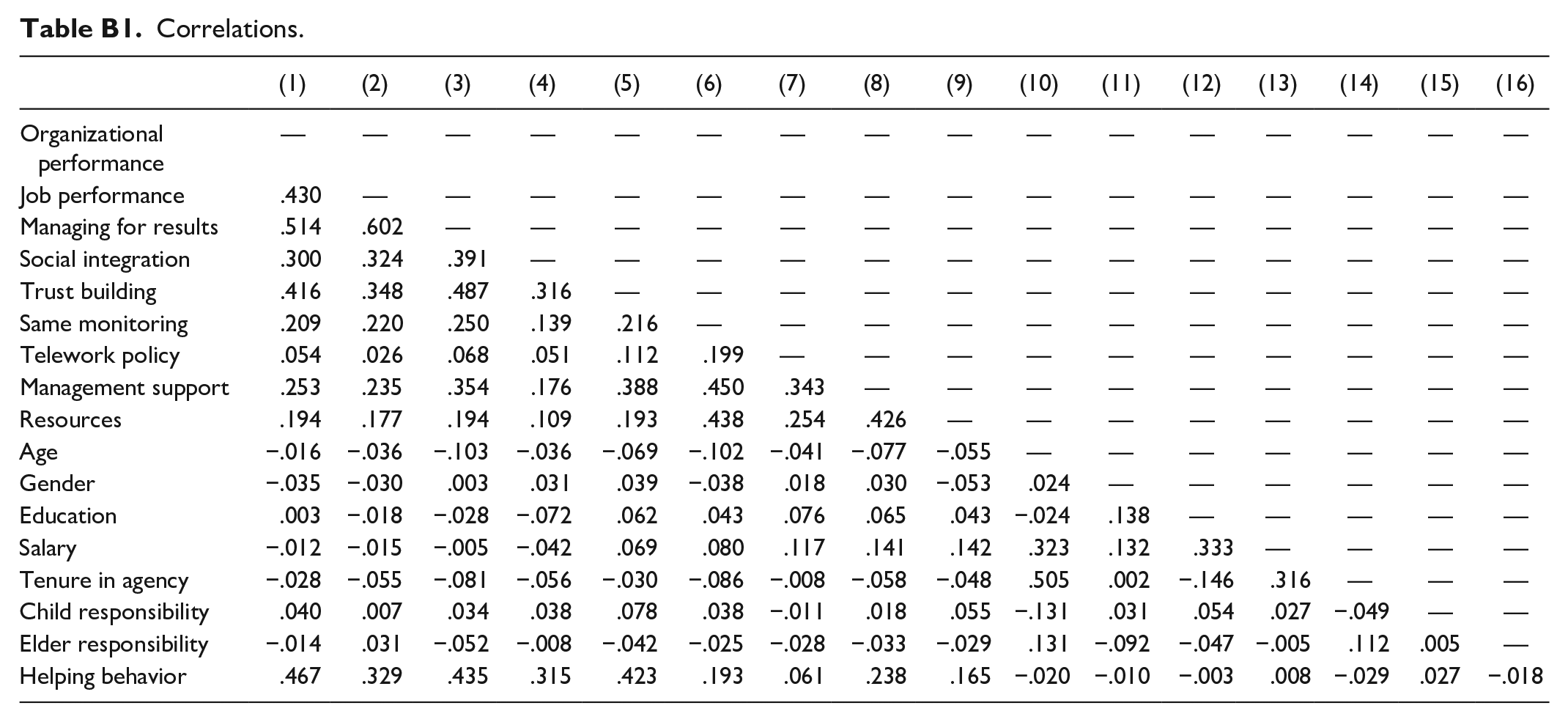
Each four ordinary least squares (OLS) regressions and ordered logic regressions with robust standard errors were employed to analyze the impact of supervisors effectively managing their teleworkers in increasing organizational performance and job performance. To consider the effect of telework frequency, we categorized our research sample into four groups: (a) nonteleworkers who report no telework use; (b) teleworkers who report their use of telework on an ad hoc basis; (c) teleworkers who report their use of telework as routines (more than 1 day per week); and (d) teleworkers who report the most use of telework such as 4 to 5 days per week) as routines. Breusch-Pagan/Cook-Weisberg test results indicate that there is an issue of heteroscedasticity in the model. To correct for heteroscedasticity, multiple regressions with robust standard errors were performed. Some of the correlations are high, so to make sure that the multicollinearity is not an issue in our models, we calculated variance inflation factors (VIFs). The bivariate correlation table is attached in Appendix B. The test results revealed that the average was 1.36 (the model with nonteleworkers), 1.28 (the model with ad hoc teleworkers), 1.29 (the model with routine teleworkers), and 1.41 (the model with the most frequent routine teleworkers), respectively, with no VIF values of any variable above 2.0, indicating they do not have a problem of multicollinearity.
Findings and Discussion
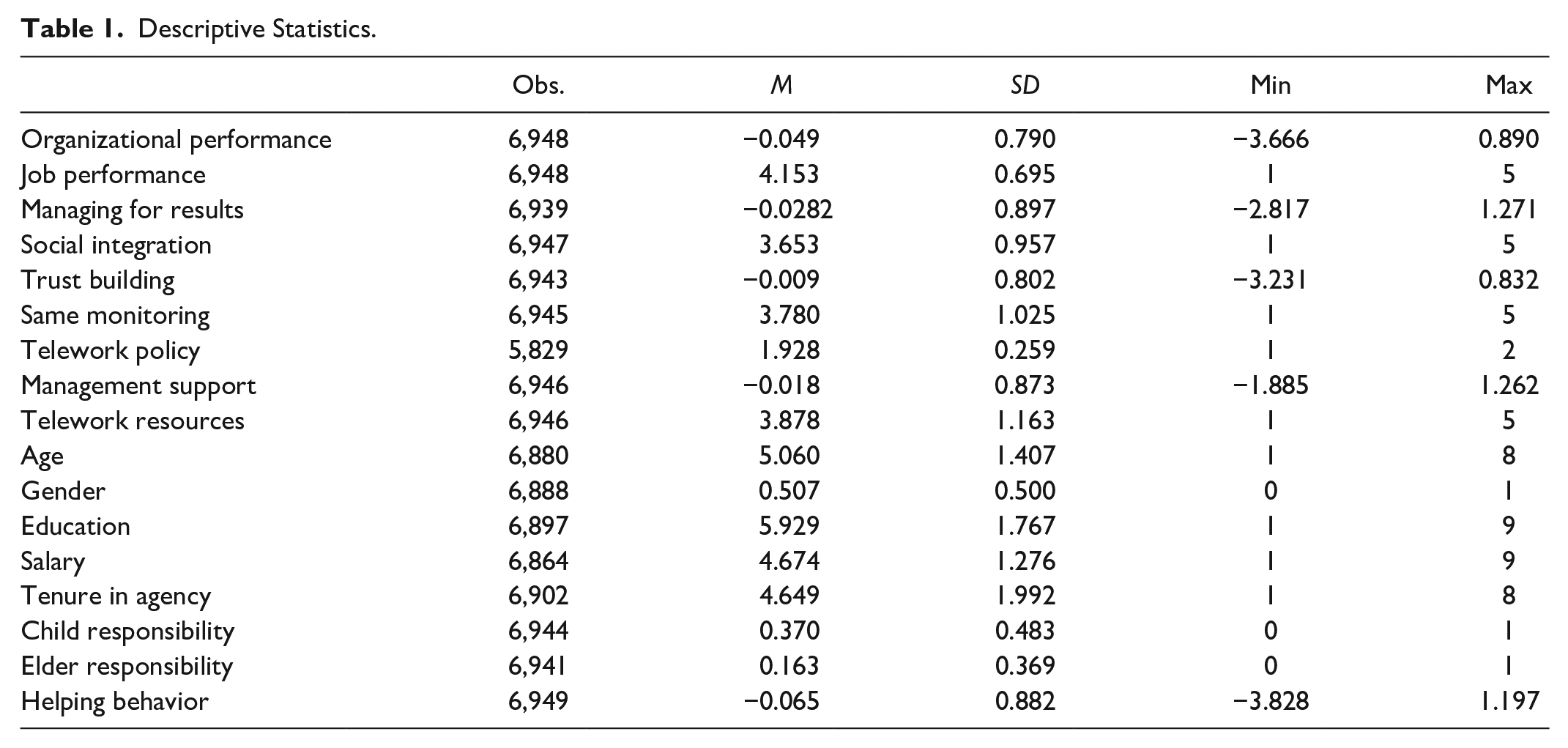
Descriptive statistics of all study variables are presented in Table 1, and the regression results are reported in Tables 2 and 3. For comparison purposes, we prepared a table that reports the beta coefficients of four groups: (a) nonteleworkers; (b) ad hoc teleworkers; (c) routine teleworkers (1–3 days); and (d) the most frequent routine teleworkers (4–5 days) (See Table 4).
Descriptive Statistics.
Regression Results Predicting Organizational Performance.
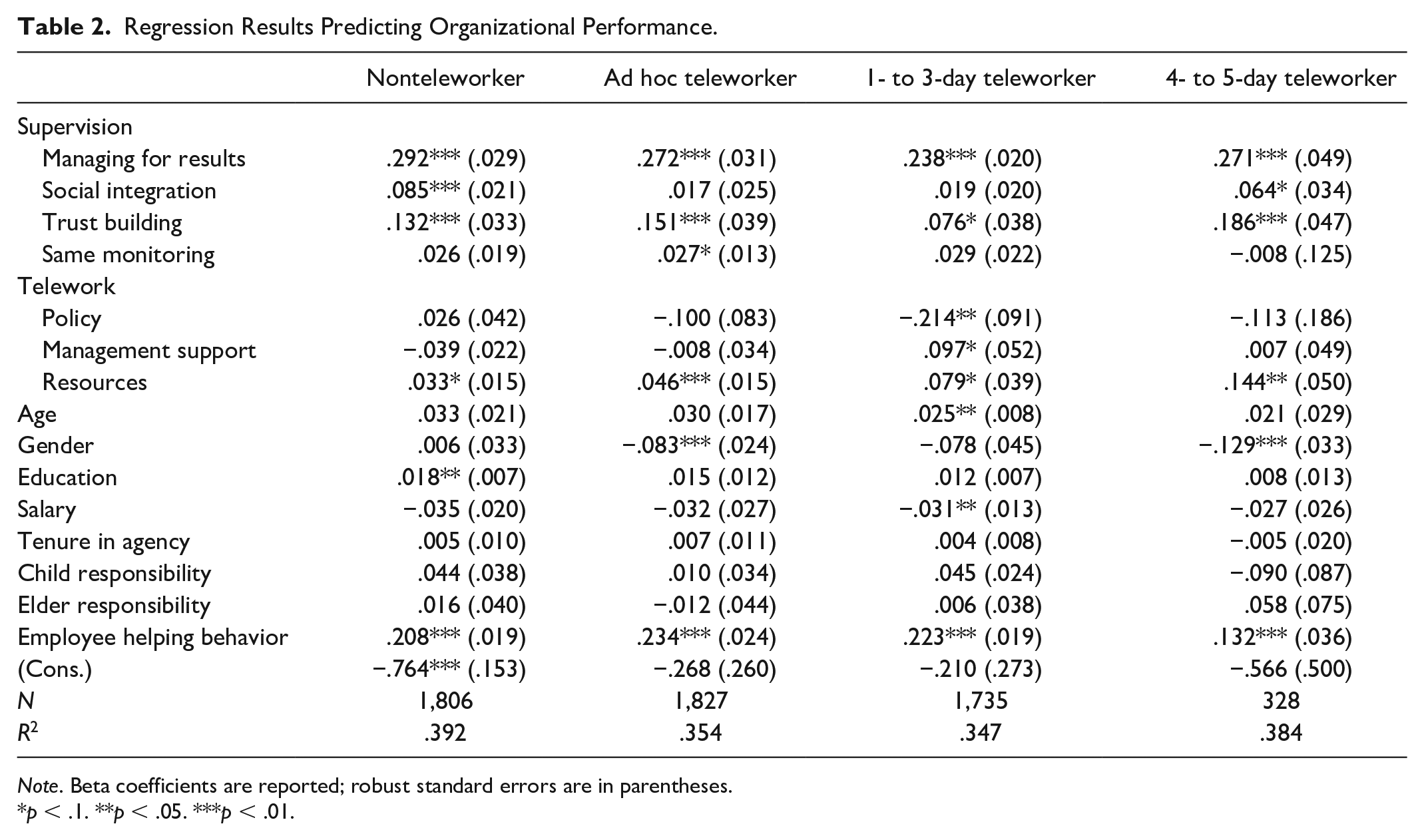
Note. Beta coefficients are reported; robust standard errors are in parentheses.
p < .1. **p < .05. ***p < .01.
Ordered Logit Results Predicting Perception of Individual Job Performance.
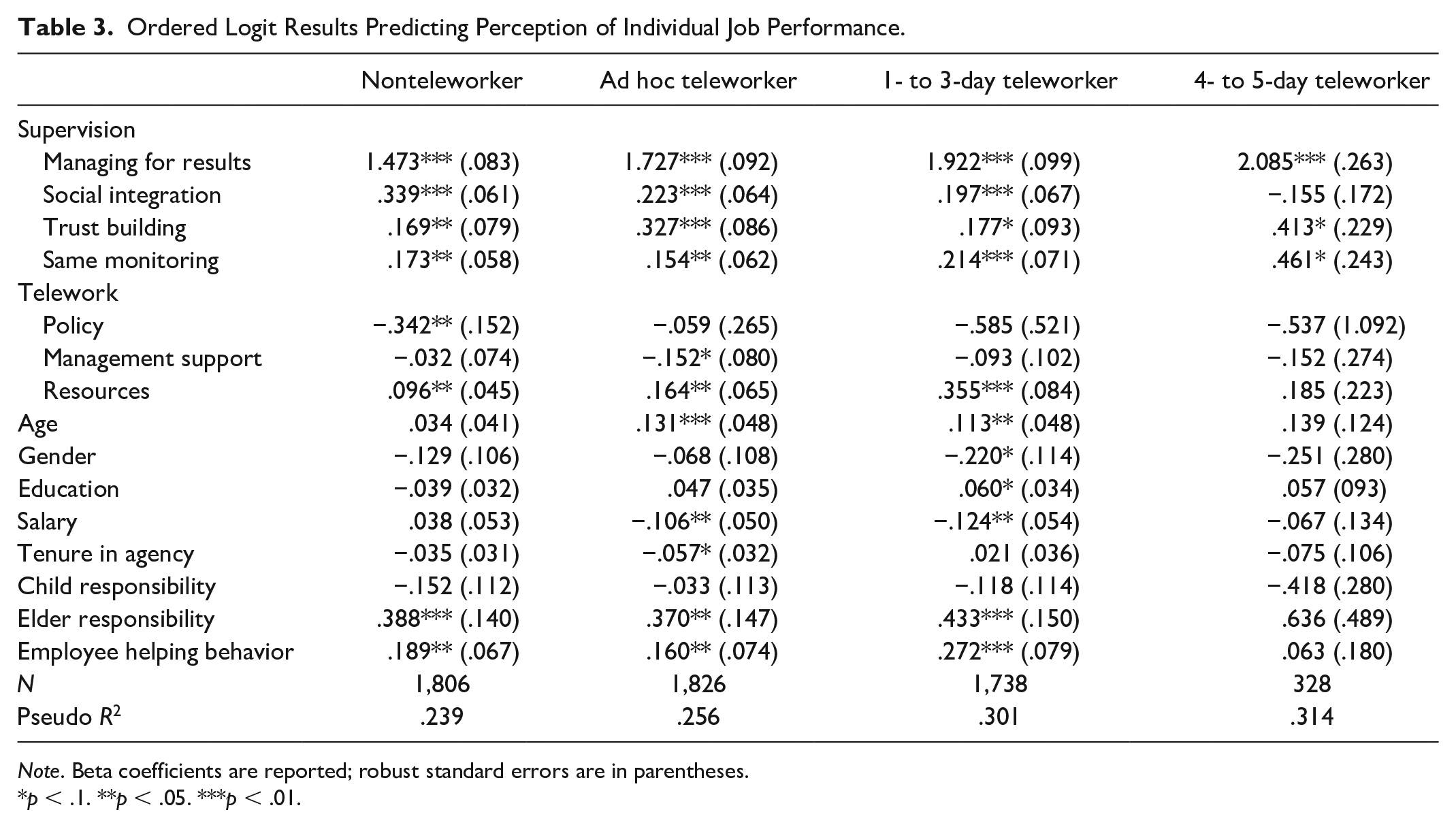
Note. Beta coefficients are reported; robust standard errors are in parentheses.
p < .1. **p < .05. ***p < .01.
Summarized Findings.
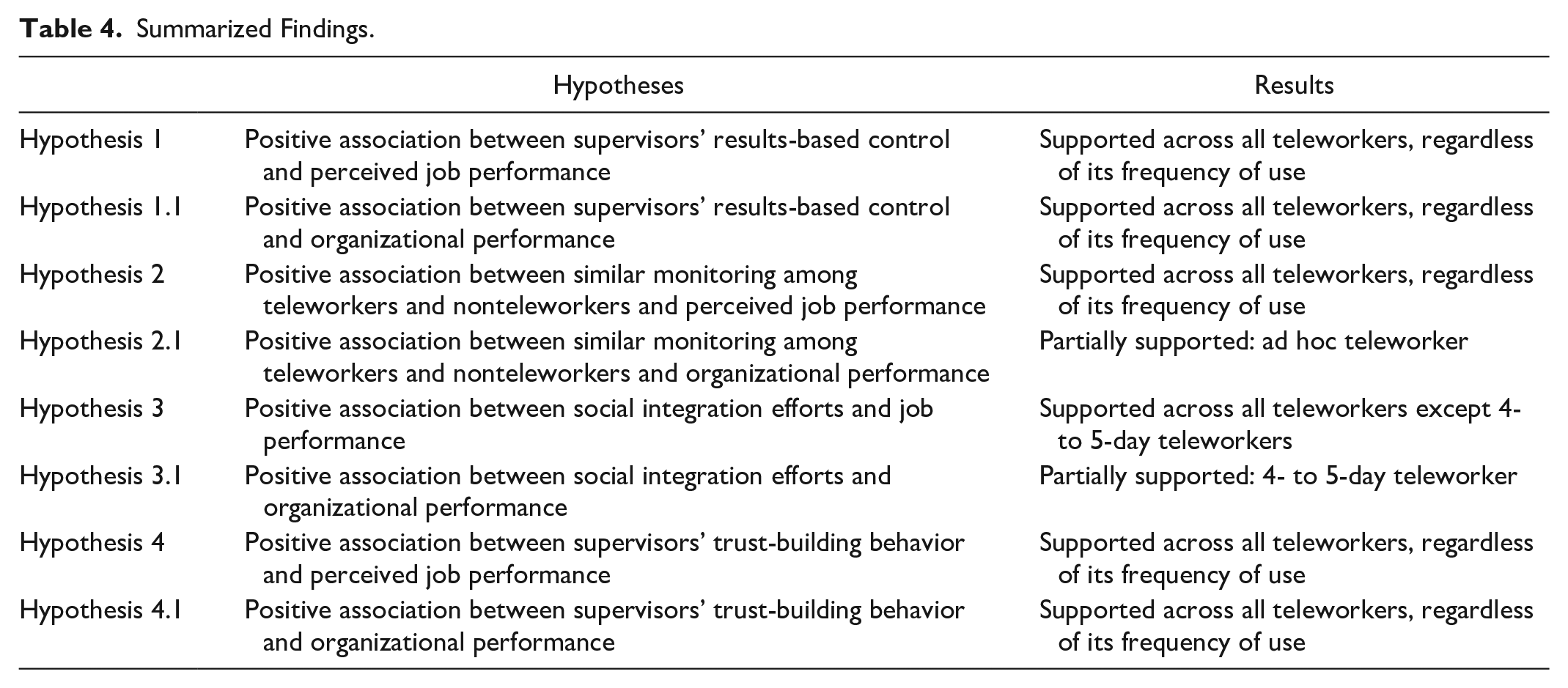
When limiting the research sample to employees who report their telework status as ad hoc basis, and hold nonsupervisory positions, supervisors’ results-based management (managing for results) and trust-building efforts are supported for both organizational performance and employee’s job performance (see Table 2 and 3), when controlling for other related factors specified above. Supervisor’s managing for results behavior is particularly found to be a strong predictor of organizational performance as well as individual job performance. This relationship was also supported when limiting the sample to routine and the most frequent routine holding nonsupervisory employees, which are all supported by the outcome-based contract (Eisenhardt, 1989) and organizational control theory. These findings provide empirical evidence for the argument that when employing virtual work arrangements, supervisors need to learn to make the transition from managing face time to managing performance; also it signals that when deciding whether to implement telework arrangements, one of the key criteria is the existence of objective and reliable performance measures and the existence of supervisors who are properly trained and effective at being attentive to regularly assessing and managing their employees’ performance outcomes. This may be supplementary to the findings of Lee and Hong (2011), who found in their study that employees’ satisfaction with telework was negatively related to their employing agency’s performance, and they suggest one of the reasons for this negative result is release from direct supervision. That is, when supervisors (or managers) are committed to assessing and managing telework, employees’ job performance not their nonobservable work activity on-site, it may encourage employees to use the given discretion and flexibility under telework to maximize job performance and reduce their shirking behaviors (Cascio, 2000; Mahler, 2012). Moreover, as Bailey and Kurland (2002) observed, the assumption that all teleworkers are working remotely on a full-time basis may lead to wrong conclusions about the effectiveness of telework. Even in the MPBS’s study, about 35% of respondents report they participate in telework on an ad hoc basis, whereas only 4% of employees report they use telework as routinely as 4 to 5 days per week. Without regard to the telework frequency, supervisors’ emphasis on performance over visibility was found to be strongly predictive of organizational performance under telework arrangements. This may imply that as Cascio (2000, p. 89) also noted, “managers who are committed to virtual-work environments will understand that basic principles of management are not different in virtual-work environments.”
Contrary to our expectation in Hypothesis 3, the supervisors’ social integration efforts were not found to predict organizational performance, except for the 4- to 5-day telework group. Interestingly, social integration efforts by supervisors significantly and positively affect nonteleworker’s work unit performance. Perhaps this can be attributed to the fact that social integration may be easier to implement for those who are on-site in terms of working toward work unit performance goals.
However, in the case of perception of individual job performance, a positive and significant relationship was found for nontelework, ad hoc telework, and 1- to 3-day teleworkers (see Table 3). Given the relatively small number of employees who report their routine and almost full-time telework practice, it may be plausible to argue that they are not socially isolated long enough for the isolation to influence their communication quality with supervisors or colleagues or their performance. Bailey and Kurland (2002, p. 391) also noted, “individual teleworkers are away from the office so infrequently that they do not become invisible, miss out on gossip, or in any other way become isolated.”
The result found in social integration implies the different intent and interest among teleworker users and its relationship with frequency. Employees’ ad hoc telework use may be more likely to be perceived to either their supervisors or colleagues as a “day off” rather than a required work arrangement (Whitehouse et al., 2002), resulting in facing resentment or jealousy from office-bound colleagues. Previous studies also noted that employees might occasionally take advantage of part-time telework to avoid possible interruptions (Duxbury & Neufeld, 1999), whereas routine, high-intensity teleworkers seek telework arrangements to balance their work and life (Konradt et al., 2003). They noted this difference in telework intensity causes different patterns of communication. As Gajendran and Harrison (2007) suggested, high-intensity telecommuters may enjoy more discretion in completing their tasks while being away from direct supervision and as a result, may rely more on “accessing appropriate virtual technologies (e.g., knowledge management systems, intranet databases) instead of relying on relational sources for task support, such as supervisors and coworkers.” Raghuram et al. (2001) also found that teleworkers tend to rely on their self-efficacy to perform tasks in facing the challenges that remoteness from work poses and the effect of self-efficacy is more salient for routine teleworkers compared with low-frequency teleworkers.
Moreover, in the workplace, the social inclusion or exclusion may matter more for the relationship with colleagues in the work unit, considering more frequent interaction happens among colleagues rather than between employees and supervisors. In this regard, the significant and positive relationship between colleagues’ helping behavior and organizational performance in all four models may signal the importance of organization’s or supervisor’s commitment to creating a team work–oriented organizational culture or value, although this is not considered in this article.
Another possible explanation for this finding is that the teleworkers may not perceive supervisors as engaging in social integration efforts if the organizational culture is inherently socially integrated, and therefore, the effect of supervisors’ efforts may be less noticeable. Furthermore, it is possible that teleworkers are less in tune with measuring their supervisors’ level of social integration efforts or are less concerned with them because they assume they will enjoy less social integration by the mere nature of a remote working arrangement, even if it is part-time. In other words, if you have very low expectations of your supervisor to help you with social integration, you may not even notice social integration efforts as they occur. There are also possible socialization implications to consider for future research, such as exploring how perceptions of communication and socialization could differ generationally, and whether it is more difficult to measure perception of social integration efforts by a supervisor if one is teleworking, as opposed to working face-to-face with employees.
As for trust-building efforts, its positive and significant support for organizational performance and individual job performance was found in all four models. Our finding appears to be consistent with those arguments that supervisors’ trust-building behavior is found to be a significant and positive predictor of organizational performance. This may raise questions about how we measure organizational performance, and whether it should be measured in different ways for routine teleworkers. It may also suggest that supervisors’ trust-building behavior is less important for routine teleworkers, which could be due to the fact that often teleworking employees having been granted a telework arrangement because there is already a trusting relationship established with their supervisor and thus, less need for trust-building behavior of the supervisor. Future research should further explore the relationship between supervisors’ trust-building behavior and routine teleworkers.
Finally, with regard to the same monitoring behavior variable, it was found to be modestly significant and positive for individual job performance in the case of nonteleworkers and routine teleworkers, but it was not supported in other groups. In other words, the degree to which supervisors employ the same monitoring behavior such as job formalization and job performance goals was found to be a salient issue for the nonteleworkers’ and routine teleworkers’ perspective when linking to individual job performance. However, it does not affect perception of organizational performance, except for the case of ad hoc teleworkers. This is an interesting finding because it suggests the organization stands to benefit from high-frequency routine teleworkers in terms of better performance when supervisors display the same monitoring behavior.
Concluding Discussion
This study examines the degree to which effective supervision (defined as managing for results, social inclusion efforts through communication and building trusting relationships with employees) explains the link between telework arrangements and organizational performance. Specifically, this study sheds light on factors predictive of the effectiveness of telework arrangement by adding empirical evidence to the current public management literature, especially the one that examines federal human resource management, as well as previous studies about the impacts of telework arrangements on organizational performance, by addressing the importance of the supervisor’s role and the extent to which heterogeneous characteristics of teleworkers play a role. This study has, however, some limitations.
First, the cross-sectional nature of the data used in this study does not allow us to examine the extent to which effective supervision brings out the positive link between telework arrangements and organizational performance over time. It is difficult to infer the direction of causation among the variables of interest. The use of longitudinal data by examining responses of the same individual over time on the studied dimensions would merit future study. Second, this study used the available survey items from the secondary data source; the measurement of variables is not perfect. This is especially an issue regarding organizational performance being measured using individual employees’ self-assessment of their organization’s performance. Although perceptional measure of organizational performance is not as desirable as an objective measure when evaluating organizational performance, previous research noted the high correlation between objective measures and perceptual measures and agreed on the use of perceptual measure as an alternative, especially when the objective measures are not available (Chun & Rainey, 2005; Dess & Robinson, 1984). Because all the measures come from the same survey responses, this study cannot avoid the potential for common source bias. However, as Moynihan and Pandey (2010, 428) noted, the effect of common source biases is “not to invalidate relationships uncovered in studies employing self-reported data but to perhaps marginally attenuate the strength of the findings.”
Given those limitations of using quantitative survey data, it would be helpful to collect qualitative date to capture the particularities of exactly why employees choose to use telework arrangements, why supervisors are unsupportive or supportive of telework arrangements, what challenges supervisors have in managing teleworkers, and so on.
Implications and Recommendations
One contribution of this study to the literature is that the analysis was done after separating out types of teleworkers based on telework frequency, so as to not group all teleworkers together as one homogeneous group. Findings show that this separation is important because the results of this study differed across frequency groups. Future research should explore other differences among teleworkers, such as whether these factors differ depending on whether a worker started out as a teleworker or transitioned into teleworking, their reason for teleworking (whether it was part of the original job description due to nature of job or organizational priorities, or because of personal reasons such as a need or desire for better work–life flexibility or balancing work–family responsibilities), and their expectations about telework. Qualitative data collection would be helpful in exploring these possible variations. Other studies that would be useful would explore other abuses of telework that have become common such as teleworkers doing non-work-related tasks online and chores at home, instead of working. It would also be interesting to take a closer look at the optimal ways for supervisors to obtain accurate performance evidence from their teleworkers, in addition to exploring whether supervisors show any favoritism to teleworkers. These questions are beyond the scope of this article, but fruitful future research.
A second contribution of this study is further evidence of supervisor support being linked to teleworker performance. Furthermore, the idea that a certain factor’s relation to supervision can link telework to performance underscores the importance of training and overseeing supervision, as well as measuring performance accurately with precise and appropriate measures, that are linked to organizational goals, and processing performance measures in a way that can fuel further fine-tuning and improvement. By consistently and precisely measuring performance of teleworkers, over time, we might continue to see improved performance, which builds support for allowing and encouraging telework. This will also require properly training supervisors about the best ways to measure performance of teleworkers, and to make sure teleworkers are not held to different levels of scrutiny than nonteleworkers, even if the performance measures are inherently different.
It would be helpful for organizations to encourage an orientation session to describe how the supervisors integrate teleworkers in terms of communication and trust, and how their performance will be measured differently due to the nature of their work, but they should also be reassured that they will not be more extensively or deeply scrutinized due to the nature of their telework arrangement. Also, channels of communication should be spelled out so teleworkers know what to expect in terms of how often their supervisor will reach out to them, as well as expectations of them as teleworkers. Perhaps getting teleworkers in touch with one another through virtual discussion forums and linking teleworkers to telework mentors who have been teleworking for longer or are at a higher organizational level, might provide more support to teleworkers. It may also be beneficial for telework supervisors to share best practices that work well within their organizations in terms of encouraging trust building, social integration, and ultimately better performance of teleworkers.
Another future research inquiry would be to explore whether telework is more effective than other work–life benefits in improving performance as well as a study of the best ways to measure performance of teleworkers, so as to establish best practices within this context.
Footnotes
Appendix A
Appendix B
Correlations.
| (1) | (2) | (3) | (4) | (5) | (6) | (7) | (8) | (9) | (10) | (11) | (12) | (13) | (14) | (15) | (16) | |
|---|---|---|---|---|---|---|---|---|---|---|---|---|---|---|---|---|
| Organizational performance | — | — | — | — | — | — | — | — | — | — | — | — | — | — | — | — |
| Job performance | .430 | — | — | — | — | — | — | — | — | — | — | — | — | — | — | — |
| Managing for results | .514 | .602 | — | — | — | — | — | — | — | — | — | — | — | — | — | — |
| Social integration | .300 | .324 | .391 | — | — | — | — | — | — | — | — | — | — | — | — | — |
| Trust building | .416 | .348 | .487 | .316 | — | — | — | — | — | — | — | — | — | — | — | — |
| Same monitoring | .209 | .220 | .250 | .139 | .216 | — | — | — | — | — | — | — | — | — | — | — |
| Telework policy | .054 | .026 | .068 | .051 | .112 | .199 | — | — | — | — | — | — | — | — | — | — |
| Management support | .253 | .235 | .354 | .176 | .388 | .450 | .343 | — | — | — | — | — | — | — | — | — |
| Resources | .194 | .177 | .194 | .109 | .193 | .438 | .254 | .426 | — | — | — | — | — | — | — | — |
| Age | −.016 | −.036 | −.103 | −.036 | −.069 | −.102 | −.041 | −.077 | −.055 | — | — | — | — | — | — | — |
| Gender | −.035 | −.030 | .003 | .031 | .039 | −.038 | .018 | .030 | −.053 | .024 | — | — | — | — | — | — |
| Education | .003 | −.018 | −.028 | −.072 | .062 | .043 | .076 | .065 | .043 | −.024 | .138 | — | — | — | — | — |
| Salary | −.012 | −.015 | −.005 | −.042 | .069 | .080 | .117 | .141 | .142 | .323 | .132 | .333 | — | — | — | — |
| Tenure in agency | −.028 | −.055 | −.081 | −.056 | −.030 | −.086 | −.008 | −.058 | −.048 | .505 | .002 | −.146 | .316 | — | — | — |
| Child responsibility | .040 | .007 | .034 | .038 | .078 | .038 | −.011 | .018 | .055 | −.131 | .031 | .054 | .027 | −.049 | — | — |
| Elder responsibility | −.014 | .031 | −.052 | −.008 | −.042 | −.025 | −.028 | −.033 | −.029 | .131 | −.092 | −.047 | −.005 | .112 | .005 | — |
| Helping behavior | .467 | .329 | .435 | .315 | .423 | .193 | .061 | .238 | .165 | −.020 | −.010 | −.003 | .008 | −.029 | .027 | −.018 |
Declaration of Conflicting Interests
The author(s) declared no potential conflicts of interest with respect to the research, authorship, and/or publication of this article.
Funding
The author(s) received no financial support for the research, authorship, and/or publication of this article.
