




Abstract
The use of information and communication technologies (ICTs) by local governments is widespread and meant to improve managerial effectiveness and public engagement. ICTs are commonly used by governments to collaborate and communicate with stakeholders. Yet, the use of ICTs increases local governments exposure to cyberthreats. Cyberthreats are increasing and local governments are often under-resourced and underprepared for them. While many organizations combat cyberthreats with technological solutions, it is well known that social aspects—including manager vigilance and buy-in—are critical in reducing cyber incidents. Thus, governments require both social and technical solutions to cyberthreats. This research takes a sociotechnical perspective to examine the relationships between social (e.g., values and perceptions) and technical factors (e.g., design and capacity) and cyber incidents in local government. We use data from a 2018 national survey of public managers in 500 U.S. cities, data from city government websites, and the U.S. Census. The results indicate that manager buy-in and perceptions interact with technical aspects to explain reported cyber incidents in government. The findings expand our understanding of how social and technical factors are associated with cyberthreats in government, particularly manager.
Introduction
Local governments use information and communication technologies (ICTs) to enhance government performance by improving managerial effectiveness and public service delivery. Many governments have successfully adopted ICTs to improve service delivery, transparency, and trust. Governments face the challenge of using ICTs to actively engage the public and stakeholders, enhance internal collaboration and coordination efforts, and advance open data initiatives while ensuring the protection of individual rights, privacy, and data security. Technology adoption does not happen in a vacuum. Managers and their organizations adopt and use technologies to advance their goals and interests and in turn technologies shape and alter their individual and organizational practices (Orlikowski, 2000). For example, public organizations have adopted ICTs to advance organizational efficiencies and the achievement of public outcomes, but those same technologies bring increased exposure to cyberthreats. Therefore, governments must balance opportunities with threats and have sufficient manager buy-in to be successful.
According to an Accenture (2016) study, the public sector experiences around 50 times more cybersecurity threats as compared to other industries, leaving governments vulnerable and often lacking the technological capacity and confidence to monitor and limit the threats. Cyberattacks are a growing threat especially for state and city governments who are typically less prepared to combat them. Ransomware attacks have shut down school systems, pipelines, large city governments, and water treatment facilities resulting in excessive government payments to deal with economic fallout and regain control over digital systems and infrastructure (Muggah & Goodman, 2019; Tong & Perlroth, 2021). Nearly 70% of reported ransomware attacks are against state and local governments and result in financial loss, reputational damage, and loss of trust (Muggah & Goodman, 2019). U.S. local governments are particularly vulnerable targets because their digital infrastructures are weak and outdated, they typically do not have strong political support to address cybersecurity, and staff often lack the skills to prepare, prevent, and respond to cyberattacks. Additionally, compared to other nations, the United States lacks a systematic national policy, legislation, and funding to guide cities toward cybersecurity.
Cybersecurity is a key challenge to the success of digital government (Grubmüller et al., 2013) and relates to both individual and organizational factors as technology uptake, use, and effectiveness are inextricably interwoven with social factors, individual perceptions, and organizational capacity (Orlikowski, 2000). Sociotechnical theory notes that technology adoption and use have both social and technical aspects. When organizations adopt technologies, the success, failure, and conditions of that adoption are connected to technology characteristics and organizational features, including social structure. From a sociotechnical perspective, technologies intertwine with individual agency, perceptions, behavior, and social structure (Appelbaum, 1997; Leonardi, 2012).
Empirical research finds that technologies are not always applied how they were originally intended, and their adoption impacts the social structure of organizations (Rice, 1953; Trist & Bamforth, 1951). Individual and organizational use of ICTs expose governments to cyberthreats because they expand digital entry points to the system and the use of third-party applications limit the control agencies have over data protection and privacy (Feeney & Porumbescu, 2020; Mergel, 2013, 2015). Meijer (2015) notes that a lack of technical and financial capacity in government organizations exacerbates digital security and privacy challenges, limiting the success of the ICT and other e-government initiatives. Drawing on socio-technical theory and building on Meijer’s work, we investigate the following research question: how are managerial perceptions of social media, managerial perceptions of open data initiatives, and organizational capacity related to local government managers’ reports of privacy and security threats? We focus on managerial perceptions because public managers often lead social media use in city government and are responsible for regulating and monitoring technical problems (Fusi & Feeney, 2018; Picazo-Vela et al., 2012).
We examine the relationships between social and technical factors and two types of cyber incidents in local government: unauthorized disclosures and disruptive cyberattacks. Unauthorized disclosures include the unauthorized access or misuse of information and the stripping away of the confidentiality of personal data (Bertot et al., 2012; Layne & Lee, 2001; Picazo-Vela et al., 2012; Zavattaro & Sementelli, 2014). Disruptive cyberattacks, as outlined by Simmons et al. (2014), refer to any insertion of malware that disrupts the agency activities, including ransoms or breaches (Bertot et al., 2012). We analyze variation in reports of unauthorized disclosures and disruptive cyberattacks as related to social aspects (e.g., managerial perceptions of social media and open data initiatives) and technology capacity (e.g., social media use, open data efforts, and ICT use for collaborative work purposes). We use data from a 2018 representative survey of U.S. local government managers merged with data from city government websites and the U.S. Census. The findings include that both managerial support for social media use and open data initiatives, and organizational technical capacity are related to cyber incidents in local government.
The paper is organized as follows. We begin with a review of the literature on local government cyberattacks applying a sociotechnical theory lens. Drawing from that literature, we present our hypotheses on the relationships between social and technical factors and cyberthreats. Then, we describe the data and methods. Third, we present the results. We conclude with a discussion of the results and their implications for research and practice.
Literature Review and Hypotheses
E-government initiatives including e-services, social media, and open data efforts offer many benefits such as improving efficiency, public outreach, citizen engagement, transparency, and credibility of public organizations. Yet, there are social and technical challenges to effective ICT adoption and use, especially in the case of interactive social media and open data platforms. Social challenges include convincing leadership and employees to support the adoption of these platforms and initiatives, ensuring electronic tools are used responsibly for their intended purposes, and training staff to effectively monitor, thwart, and report cyber threats and breaches. Technical challenges include building the capacity to adopt, use, and monitor technology and to effectively prepare for and respond to cyberattacks. With each technology (e.g., social media platform, open data portal, internal collaboration tools), there are new opportunities, threats, and capacity demands.
Sociotechnical theory offers a useful lens for considering ICT adoption in public organizations because it recognizes the ever-changing and reinforcing roles of social structures, technological capacity, and technology characteristics in organizational technology use and adoption (Appelbaum, 1997; Leonardi, 2021). Technical aspects can be automated, while social practices such as perceptions, culture, and norms are varied and changing. Managing the social and technical aspects of ICT adoption is particularly challenging for medium and small city governments, which often lack the financial and technical capacity to effectively prepare for and respond to cyberthreats. For example, social media management is a complex task and poor adoption and use can harm work environments and expose organizations to threats (Feeney & Porumbescu, 2020; Mergel, 2014; Zavattaro & Sementelli, 2014). Social media platforms, owned and operated by third parties, introduce potential threats such as accidental private data disclosure, misinformation spread, and hacks. Similarly, open data initiatives—while promising to increase transparency and accountability—require maintaining confidential citizen information, securing original data integrity, and limiting opportunities for data misuse (Beno et al., 2017; Safarov et al., 2017).
Because of their widespread use and the potential to spread misinformation or accidently release personal data, social media platforms and open data portals present challenges for governments where accountability requirements are high (Bertot et al., 2012; Campbell et al., 2014; Fusi & Feeney, 2018; Picazo-Vela et al., 2012; Webber et al., 2012). Additionally, while governments seek to advance open data initiatives, there are challenges of how to produce, share, and protect high volumes of government and citizen data while advancing transparency and accountability goals (Ruijer et al., 2020).
Responding to privacy and security challenges when using technology in government requires advanced technological capacity (Grubmüller et al., 2013). Empirical evidence shows that privacy and security concerns increase when the government is directly involved with e-government tools (Grubmüller et al., 2013). Ensuring privacy and security means that the government protects information, data, and systems against disclosure of personal information and carefully controls access to information (Alshehri & Drew, 2011). Data breaches, ransom, and cyberattacks are costly to governments due to the financial costs, reputational damage, loss of trust, legal and compliance issues, and other negative consequences (Kim, 2017; Webber et al., 2012). Preparing for and addressing these cyberthreats requires technical capacity and managerial awareness of the benefits and threats that come with technology use in the workplace.
We focus on the social and technical factors related to unauthorized disclosures and disruptive cyberattacks. Manager perceptions of both types of cyberthreats are important to understand how technologies can support or hinder government activities (Ngai et al., 2015). Successful implementation of social media tools in government is largely determined by managers and their perceptions of the technology and cyberthreats (Fusi & Feeney, 2018; Karahanna & Straub, 1999). It is the role of the public managers to introduce the technology as well as monitor and understand the risks and possible threats (Picazo-Vela et al., 2012). Yet, many city government leaders undervalue ICT use and are unprepared to effectively respond to cyber incidents.
Social Factors: Managerial Perceptions and Cyber Incidents
Managerial use and perceptions of technology are important predictors of uptake and effective use of technology in the workplace. Technology use, adoption of new technologies, and successful integration of technology in the workplace rely on buy-in from leadership, implementers, and end users. Research indicates that managers play a key role in the success of new technology, as they influence organizations’ policies and practices and can provide a favorable climate by encouraging others to uptake the technology (Damanpour & Schneider, 2009; Fusi & Feeney, 2018; Jeyaraj et al., 2006; Kiron et al., 2012). Technology adoption brings new opportunities but also threats to organizations including concerns about increased workload, nervousness about operating tools, and threats of unknown consequences (Bertot et al., 2012; Fusi & Feeney, 2018). Research shows that effective technology implementation is mainly determined by managers and managerial capacity (Fusi & Feeney, 2018; Horst et al., 2007; Karahanna & Straub, 1999).
Governments are continually under pressure to adopt technologies to increase organizational efficiencies and improve stakeholder engagement. With the advancement of e-government and widespread use of e-services, technologies are improving service delivery, information access, stakeholder interaction, and open data initiatives. Research finds manager perceptions of technology, risk awareness, and cybersecurity are critical to prepare for and prevent cyberattacks in the public sector (Wirtz & Weyerer, 2017). Cybersecurity is not only a function of the IT department or team; employees are crucial to ensuring safe and secure practices on digital platforms and when using personal devices in the workplace (Kim, 2017). In this section, we outline the ways managerial perceptions of social media and open data are related to organizational cybersecurity and outcomes.
Social media technologies are interactive platforms that are typically owned and operated by third parties (e.g., Facebook, Instagram, YouTube). These platforms are somewhat malleable by users—both government agencies and the public (Bertot et al., 2012; Feeney & Welch, 2016). For example, governments use social media to post information, send emergency alerts, or track and identify individuals, while citizens can use them to gather information, request and access services, organize protests, or engage in subversive activities (like hacks or unauthorized data releases). The interactive nature of social media platforms offers governments new opportunities to share information and communicate with communities. Yet, with opportunities come challenges. Widely available interactive features and content, obscured user identities, third party ownership, and questions of data security make social media platforms especially challenging for local governments with low capacity (Feeney & Porumbescu, 2020; Mergel, 2015; Zavattaro & Sementelli, 2014). Social media platforms such as Facebook, Twitter, Instagram, and WhatsApp are third-party platforms that give private owners full knowledge and control over the algorithms, data collected, and activity oversight. While governments often use social media platforms, they do not own or control the platforms and content, limiting their ability to ensure privacy and reduce security risks. Additionally, it may be hard for users to know the difference between advertising, misinformation, and a government source of information on social media platforms (Magro, 2012; Mergel, 2013), thus increasing potential threats.
In addition to the threat of social media platforms being hacked, there is often false information spread through these platforms increasing risks of users disclosing personal information on third party platforms they mistakenly perceive to be government owned and operated (Benson et al., 2015; Kumar & Shah, 2018). These concerns tied to social media platforms are less relevant for other government operated e-government tools (e.g., bills payment) that are more clearly marked and easily associated with the government agency. Decentralizing communication and activities through these third-party platforms increase the risk of leaking protected information (Mergel, 2015). Research finds that the high risk of online network exposure is a key barrier to government social media use (Kavanaugh et al., 2012; Khan et al., 2014).
Given the many challenges facing local governments adopting and effectively using social media platforms and the key role social structures play in technology adoption and successful use, we expect that high levels of support and buy-in among government managers will be critical for the successful use of these initiatives resulting in fewer cyber incidents. Additionally, social trends suggest that individuals are more distrustful of these tools over time, heightening the privacy and security problems (Edmiston, 2003; Putnam, 2000). Based on the previous research, our first hypothesis is:
H1: Positive managerial
Open data initiatives offer governments a platform for being more transparent and accountable by increasing access to public sector information and opportunities for citizens to follow and participate in the governance process (Virkar & Viale Pereira, 2018). Making government data accessible freely or at minimal cost, promises many benefits to governments including increased accountability and transparency, economic and social value, improved public service delivery and good governance, and increased citizen participation and trust (Safarov et al., 2017; Virkar & Viale Pereira, 2018).
Open government data requires making data available, freely accessible, and convenient and reusable (e.g., machine-readable). Open data initiatives require extensive resources and technical expertise. They offer the promise of increased accountability, transparency, public service, and citizen participation. There is extensive research on the barriers to open data initiatives. The most common barriers are social factors such as a lack of political support or clear regulatory and legal guidance, and lack of bureaucratic support because of the high costs, lack of data maintenance resources, concerns about low quality data, and potential privacy and security threats (Gonzalez-Zapata & Heeks, 2015; Janssen et al., 2012; Ruijer et al., 2020). Beno et al. (2017) note that many providers have concerns about misrepresentation of data, data exposure, loss of privacy, loss of control, data corruption and falsification, and other security threats. Organizations may fear that by providing access to data they are losing control over information and giving up some responsibility, while creating opportunities for others to manipulate and disclose information (Barry & Bannister, 2014; Ruijer et al., 2020).
Given the limited policy guidance and resources provided to governments building and using open data portals and the role social preferences play in their adoption, we expect that high levels of support and buy-in among government managers will be critical for the successful use of these initiatives resulting in fewer cyber incidents. We hypothesize:
H2: Positive managerial
Technical Factors: Organizational Technology Use and Capacity
As compared to other types of ICTs, social media tools bring a distinct set of privacy and security challenges because the government has little influence over the technological features, operations, and other application characteristics (Feeney & Porumbescu, 2020; Mergel, 2013). Third parties design the tools for targeted purposes, which can change quickly and without notice or input from users and governments. Social media tools increase the risk of unintended consequences due to amplified attention to government operations and decisions (Mergel, 2013) and weak or opaque processes for protecting free speech and limiting harassment (Mondal et al., 2018). Social media platforms expand challenges of managing data ownership and protection; the sheer volume of data and the fast moving, dynamic nature of virtual environments challenge the traditional structural boundaries of government (Bertot et al., 2012; Feeney & Welch, 2016). Public managers face a high degree of uncertainty when using social media platforms, as privacy and security concerns increase management complexity (Fusi & Feeney, 2018).
Public administration researchers are increasingly interested in understanding the implications of social media use for government (Bertot et al., 2012; Fusi & Feeney, 2018; Magro, 2012; Mergel, 2013; Picazo-Vela et al., 2012). Research has focused on the types of social media (Feeney & Welch, 2012), the frequency of their use (Fusi & Feeney, 2018), their intended purposes and outcomes (Feeney & Welch, 2016), and the capacity required for governments to effectively use social media tools (Goldfinch, 2007; Oliveira & Welch, 2013).
The number and frequency of social media use is related to government outcomes. On the one hand, using many platforms can be an indicator of a government with high capacity for technology management. On the other hand, using multiple tools intensely can have negative outcomes including increased complexity, confusion, and perceived overload (Feeney & Welch, 2012). Extensive use of social media platforms increases the need for oversight and monitoring to prevent unintended disclosures, the misuse of data, and other privacy and security threats (Meijer & Torenvlied, 2016).
To prevent cybersecurity problems such as unauthorized disclosure of information, organizations synthesize and monitor digital platforms and information (Goldfinch, 2007; Layne & Lee, 2001). The more active the social media accounts, the more information that requires monitoring and oversight. Increased frequency of social media use can overwhelm a public organization’s monitoring and synthesizing capabilities, thus increasing the threat of cyber incidents. Based on this, our third hypothesis:
H3: Increased
Social media use in government is typically described as having three purposes: push, pull, and interact. These purposes range from the most basic, one-way uses of electronic platforms (e.g., posting information) to two-way communication and eventually full interaction with the citizenry (Zheng & Zheng, 2014). Push refers to using social media tools to disseminate information. For example, posting city council meetings and agendas to Facebook or voter registration information on Twitter. Disseminating information on social media platforms increases accessibility, outreach, and transparency (Zheng & Zheng, 2014) and presents few privacy and security threats. Pull refers to receiving input and pulling information from external stakeholders, for example, soliciting comments and input on planning and policies or feedback on service quality. Using social media to pull input has the advantage of more efficient information gathering and potentially tapping audiences not reached by more traditional media (e.g., younger community members, those unable to provide input in person). However, using the platforms for two-way communication can muddle decision-making processes, increasing the amount of time and effort the organization spends to sort information and limit potential security threats (Kavanaugh et al., 2012; Li & Feeney, 2014). The large volume of social data governments must shift through creates excessive noise, which can obscure useful information and increase the amount of time officials spend on any given issue (Kavanaugh et al., 2012).
Interaction refers to using social media to engage in back-and-forth communications with stakeholders, for example, facilitating participation. Increased interactions through social media can further citizen engagement, but also has risks including more complex challenges for local governments (Bertot et al., 2012; Haro-de-Rosario et al., 2018; Li & Feeney, 2014). Compared to push and pull, interaction requires government employees to manage, respond to, and actively work with stakeholders, which increases the overall complexity and can make the operations harder to monitor for any security breaches (Bertot et al., 2012; Feeney & Welch, 2012). Welch et al. (2005) find citizens are generally more demanding of interactive e-government services. If citizens have higher expectations and demands when tools are used for interaction purposes, managers will need more resources and expertise. Governments are using social media platforms differently for push, pull, and interaction purposes, and achieving different outcomes, managerial expectations, and potential threats and benefits (Feeney & Welch, 2016; Oliveira & Welch, 2013).
Social media platforms require varying amounts of resources in terms of personnel and time can carry different security and privacy threats. Pushing out information (e.g., disseminating information to the public) requires fewer resources and presents lower security threats as compared to facilitating stakeholder participation. We expect that social media used for different purposes—push, pull, and interaction—will be differently related to cyber incidents, thus we hypothesize:
H4: Cyber incidents will vary by social media purpose (
While e-government is often viewed as using digital tools to improve citizen experiences, digital tools also create efficiencies in the workplace, both within and across government agencies. Electronic tools help to increase collaboration, coordination, and information sharing resulting in improved efficiencies and performance (Moon, 2002). Research indicates that city governments are increasingly relying on collaboration tools (e.g., Google Docs), sharing platforms (e.g., DropBox, GoogleDrive), and coordination tools (e.g., shared calendars) and that adoption and use varies by department type and technology capacity (Feeney et al., 2020). While electronic collaboration tools improve work efficiency and communications, using third-party platforms, storing documents in the cloud, and sharing data creates more opportunities for cyberattacks. Growing reliance on technological systems increases vulnerabilities and risks (Wirtz & Weyerer, 2017) and research indicates that a substantial number of cybersecurity incidents are the result of internal failures (Yixin, 2011). Drawing from previous research, our fifth hypothesis is:
H5: Increased use of
Governments can provide access to public sector data through open data portals (e.g., data.gov) to provide public value and improve decision-making by increasing transparency and citizen involvement. Open access to public sector information allows citizens and other agencies to use data to improve their systems but can also lead to privacy and security violations (Virkar & Viale Pereira, 2018; Wang & Shepherd, 2020). Public sector data often contains personally identifiable information and other sensitive information that can be used and manipulated once it is in the public domain (Meijer et al., 2014; Safarov et al., 2017; Virkar & Viale Pereira, 2018). Research finds that during the first phase of data preparation for an open data portal, failing to eliminate all sensitive data can cause security breaches including unintended disclosures (Meijer et al., 2014; Safarov et al., 2017). In general, the data anonymizing process and determining which parts of the data can be released causes managers concerns about data privacy, confidentiality, and misuse (Safarov et al., 2017). Many stakeholders, including managers, perceive open data and the use of open data portals as potential causes of privacy breaches due to the lack of well-defined barriers between public and private information (Toots et al., 2017). Given the social and technical challenges with operating open data portals, we expect that having a data portal will be related to more cyberattacks in local governments and hypothesize that:
H6: Having an
Technology capacity is an important organizational aspect that can facilitate or hinder effective government digitization. Technical capacity refers to the lack of tools, resources, and knowhow to operate technological solutions. A lack of resources can result in outdated, inappropriate, or no software, limited personnel training, and other infrastructure and technological limitations (Eynon & Margetts, 2007). Campbell et al. (2014) find that a lack of technical capacity and expertise causes serious barriers to the use of social media platforms for both public and nonprofit organizations. In their literature review of open data research, Beno et al. (2017) find that for some organizations, ensuring privacy and security takes effort and resources that many providers do not have or are unwilling to undertake.
Generally, monitoring digital activities, especially in complex social media environments, is a resource-intensive task (Campbell et al., 2014; Fusi & Feeney, 2018). Similarly, preparing data for sharing and public access requires additional resources to reduce data vulnerabilities (Beno et al., 2017; Janssen et al., 2012) and there can be challenges to monitoring and securing the output when department resources are insufficient (Beno et al., 2017; Toots et al., 2017). Thus, organizations with higher levels of technology capacity should be able to better ensure the protection of data and security of their social media and open data platforms resulting in fewer cyberattacks in local governments. We hypothesize:
H7:
Data and Method
We analyze data from a 2018 national survey with a sample frame of 2,500 public managers in 500 U.S. cities, city government websites, and the U.S. Census. The survey was conducted by the Center for Science, Technology and Environmental Policy Studies (CSTEPS) at Arizona State University. The survey was emailed to public managers in local governments with populations ranging between 25,000 and 250,000. The survey is an appropriate method for this study because we are interested in examining public managers’ perceptions of challenges to using social media. The nationally representative sample was drawn from the census of larger cities (populations between 100,000 and 250,000) and a random sample of smaller cities (populations between 25,000 and 99,999). Lead managers from five departments in each city were asked to participate in the study. After removing bad addresses, retired individuals, and open positions, the final sampling frame was reduced to 2,475 public managers. The online survey was administered using Sawtooth Software® from April 18, 2018, to August 7, 2018. A total of 621 managers responded to the survey, which includes partial responses, and 243 were uncontactable. We have a 24.4% response rate, adjusted for ineligible contacts. To test for nonresponse bias, we compared the demographic characteristics (gender, city size, department, and type of government) of the respondents and non-respondents. The results show that there are significant differences in response rates by city size and department. There are significantly more respondents from the Department of Community Development, Parks and Recreation and Police than from the Mayor's office and Finance department. We control for the department to correct for this bias and weighted the data by city population, based on the sampling procedure.
Dependent Variables
We use two dependent variables: perceived
Independent Variables
Social Factors
We include three measures from the survey that capture individual managerial views and comfort with social media and open data initiatives. Social Media views refers to the manager’s views on how social media platforms are used by the organizations. The variable
Technical Factors
We include nine variables to capture government agency technology use and capacity. Four variables capture organizational social media use. The first variable measures the intensity of social media use. The survey asked respondents to rate how often people in the organization use Twitter, Facebook, YouTube, LinkedIn, and Instagram for work purposes (Respondents that did not indicate using social media tools in their organization were coded as zero). Response categories included (1) daily or almost daily, (2) several times a week, (3) about once per week, (4) about once every two weeks, (5) about monthly, and (6) less often or never. Frequency responses were averaged across the five platforms for each respondent to create the variable,
We also measure how organizations use social media with a survey item that asks: for what purpose does your organization use the types of tools you named? Response categories included for information dissemination, to receive input on planning and policies or feedback on service quality, and to facilitate citizen participation. These three purposes represent push, pull, and interaction uses of social media.
We capture technology use at the organization with three measures of electronic tools and one index for overall capacity from the survey.
Control Variables
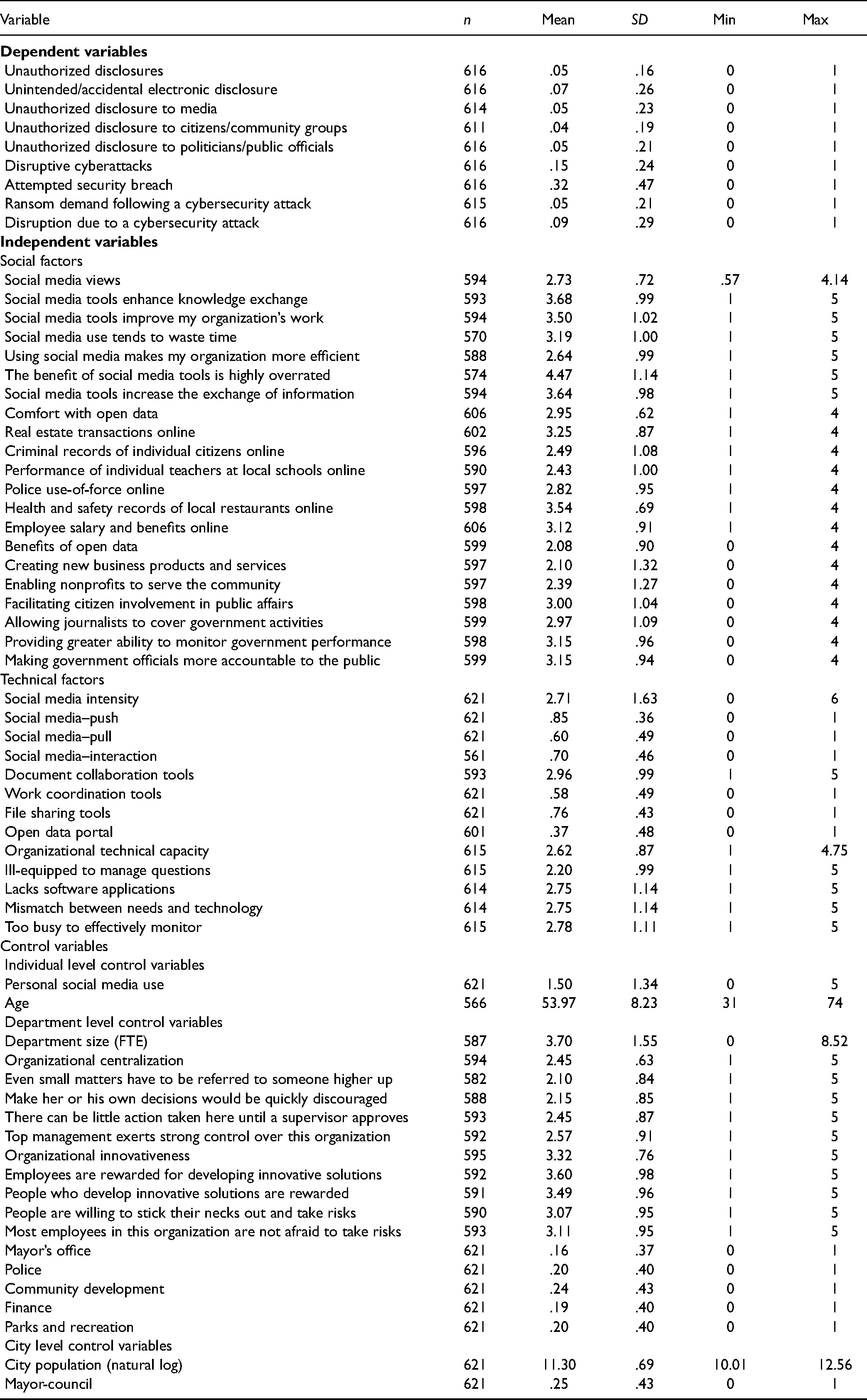
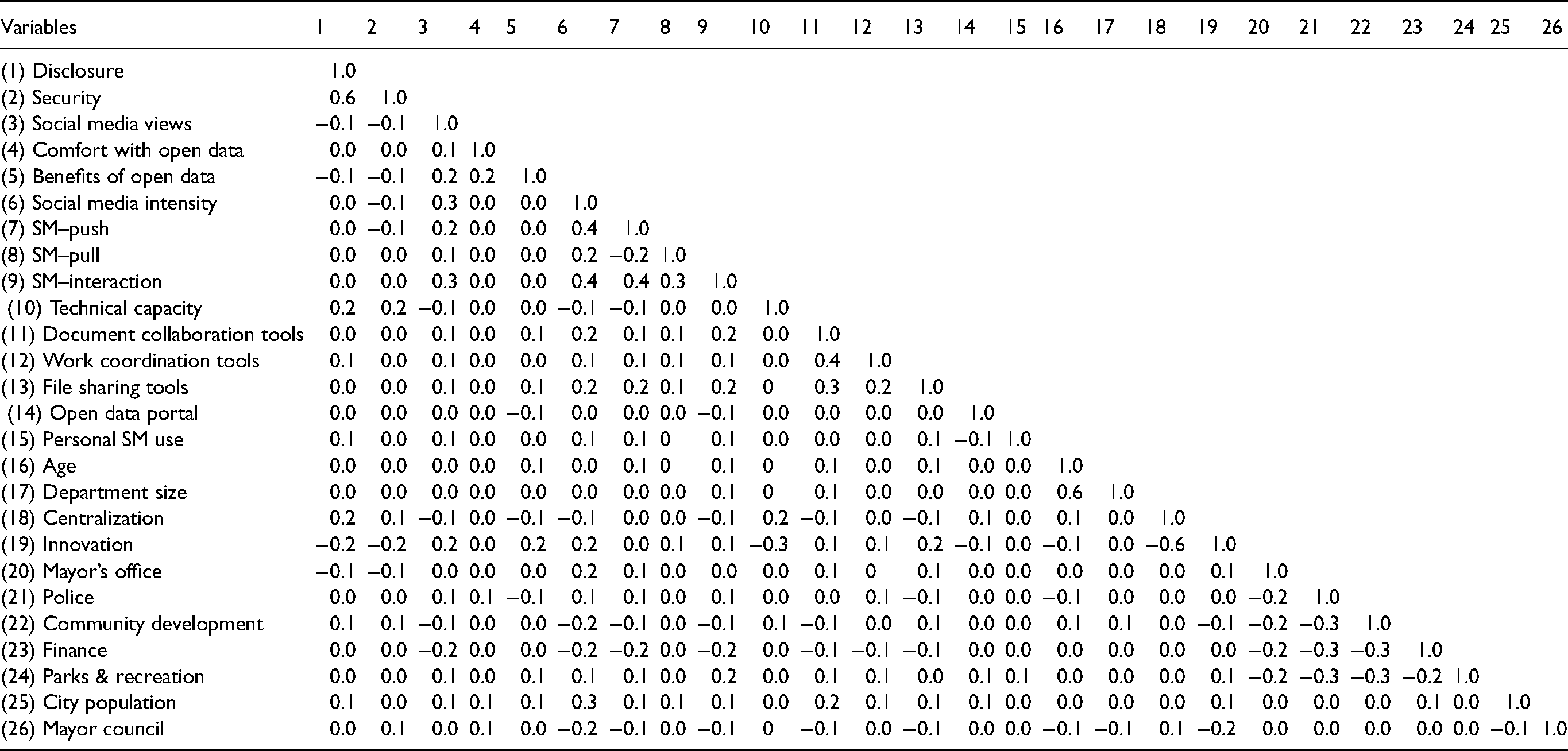
We include control variables at the individual, department, and city level. At the individual level, we use survey data to control for personal social media use and age. We control for the department size, culture, and type, all measures from the survey. At the city level, we control for the natural log of city population and form of government using data from the U.S. Census and city websites. Table 1 shows the descriptive statistics for all variables in the models and Table 2 reports the correlations.
Descriptive Statistics for Study Variables.
Matrix of Correlations.
Methodology
Correct model identification is key to accurately analyzing a complicated phenomenon. There are three requirements to ascertain an appropriate structural equation model (SEM) (Kline, 2010). First, the degrees of freedom of the model should be greater than zero. Second, the latent variables must have a scale and the variance of one latent variable should be fixed to one. Third, all latent variables should have a minimum of two indicators. Our specified model meets all three criteria resulting in more robust results. We performed SEM on correlation matrices using Mplus with a sample of 547 public managers. We present three progressing models: the first model contains only the social factors; the second model contains only the technical factors; and the final model has the social and technical factors and control variables. The models contain both measurement and structural components. The measurement component looks at how well the exogenous variables measure the latent variable constructs while the structural component models the relationships of the latent variables (Mainul Islam & Faniran, 2005). The final model integrates the latent constructs with their corresponding measures into the structural equation model (SEM) based on the exploratory factor analysis and theoretical expectations.
We tested the overall fit of the hypothesized model. The comparative fit index (CFI = 0.73) and the Tucker-Lewis Index (TLI = 0.709) are incremental fit indices that are close but lower than the recommended value of 0.90. The root-mean-square error of approximation (RMSEA = 0.030) shows evidence of good model fit because the result is lower than 0.05. Even though the Chi-square statistic (p-value = .00) shows a significant difference between a perfect model and the hypothesized model, the results of the other fit indices indicate that the hypothesized model fits the data relatively well.
Results
We present the results for each hypothesis, discussing the relationships between the predictors and the two cyber incident dependent variables: unauthorized disclosures and disruptive cyberattacks. The results for the three models are shown in Table 3. Our discussion of the results focuses on the final models containing the social factors, technical factors, and control variables.
Results of the Structural Equation Models (SEM) Predicting Cyber Incidents.
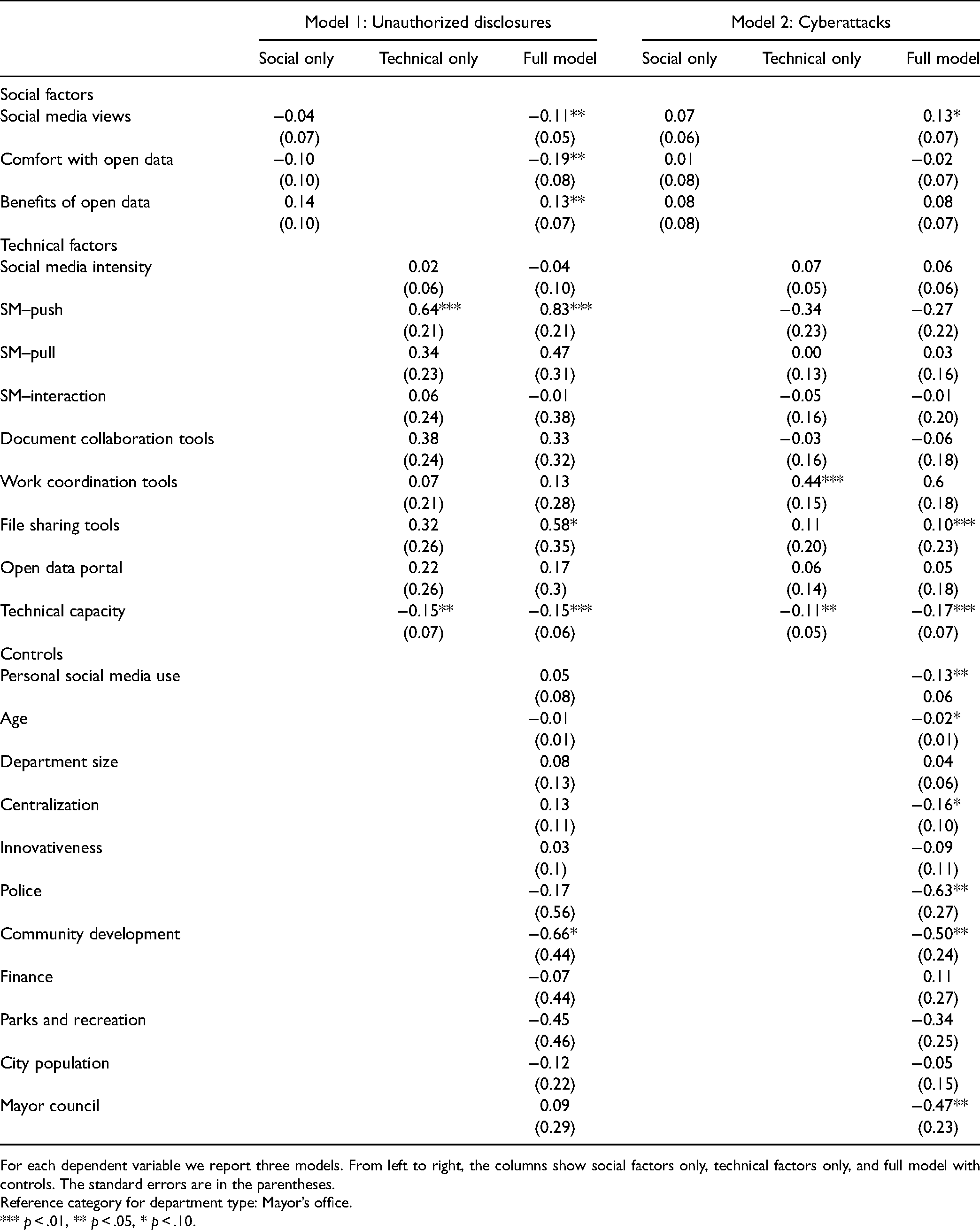
For each dependent variable we report three models. From left to right, the columns show social factors only, technical factors only, and full model with controls. The standard errors are in the parentheses.
Reference category for department type: Mayor’s office.
*** p < .01, ** p < .05, * p < .10.
We find partial support for Hypothesis 1. Positive managerial views of social media are negatively associated with unauthorized disclosures (β = −0.11, p-value = .040). In contrast, positive views of social media are positively associated with cyberattacks (β = 0.13, p-value = .098), which is opposite of our expectations.
We find mixed results for Hypothesis 2, which expected positive managerial views of open data would be negatively associated with cyber incidents. Public managers’ comfort with open data is negatively associated with reports of unauthorized disclosures (β = −0.19, p-value = .017), but positive views on the benefits of open data are positively associated with reports of unauthorized disclosures (β = 0.13, p-value = .015). Managerial views of open data are not significantly related to cyberattacks.
We do not find support for Hypothesis 3, the intensity of social media use in the organization is not related to cyber incidents. There is limited support for Hypothesis 4, which expected cyber incidents would vary by social media purpose (push, pull, and interaction). The use of social media for push purposes is positively related to unauthorized disclosures (β = 0.83, p-value = .003). The other measures are not significant.
We find limited support for Hypothesis 5. The use of file sharing tools is positively associated with unauthorized disclosures (β = 0.58, p-value = .098) and cyberattacks (β = 0.10, p-value = .002), but coordination and collaboration tools are not significantly related to cyber incidents. We do not find support for Hypothesis 6, which we expected a positive relationship between having an open data portal and cyber incidents. We find support for Hypothesis 7. Technology capacity is negatively related to unauthorized disclosures (β = −0.15, p-value = .002) and cyberattacks (β = −0.17, p-value = .004). All significant results from the hypotheses are shown in Figure 1.
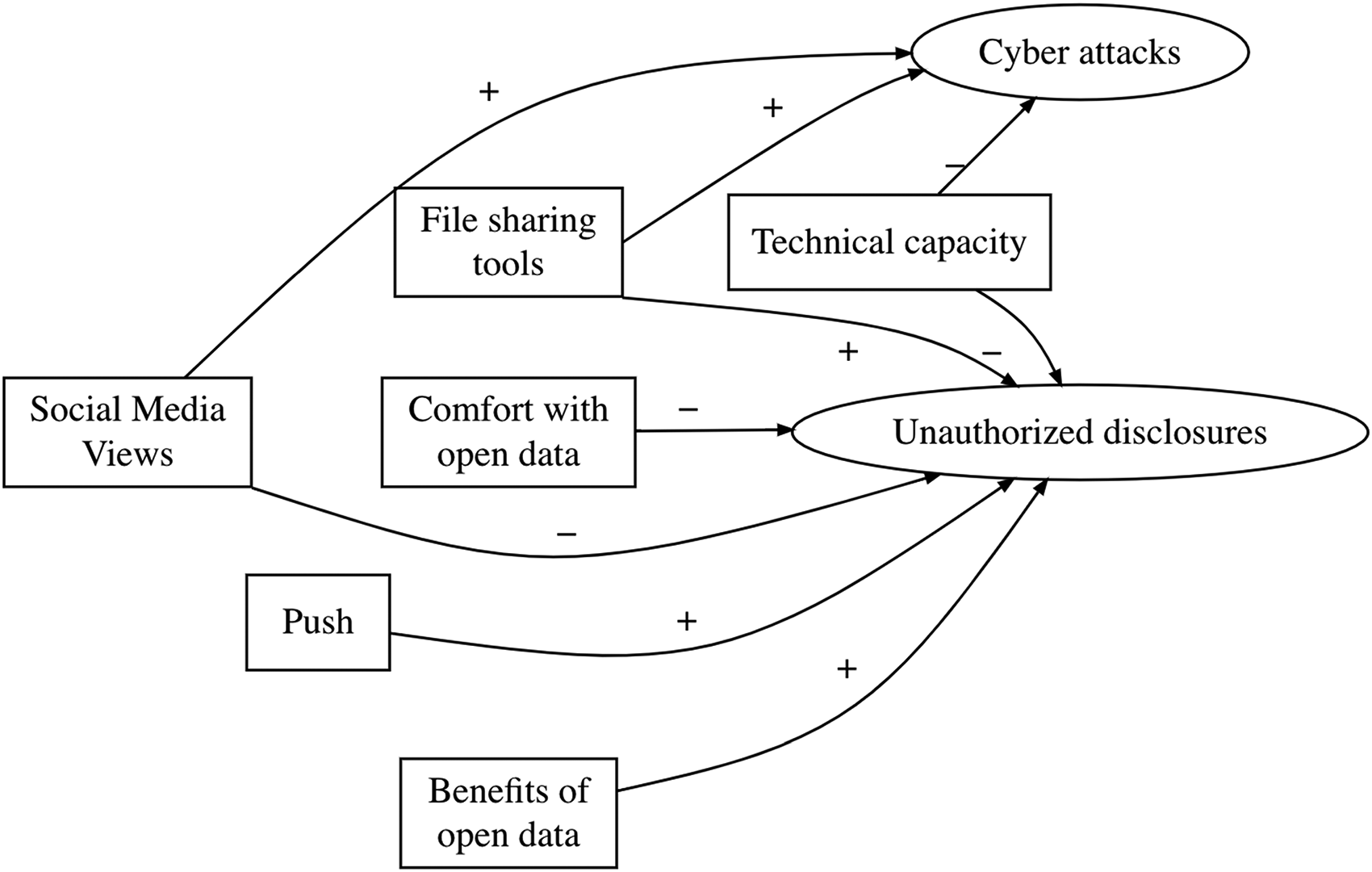
Significant results for model predicting cyber incidents.
Five of the control variables are significantly and negatively related to cyberattacks: managers’ personal social media use, age, having an organizational culture of centralization, department type, and form of government.
Before discussing the implications for theory, research, and practice, it is important to note the limitations to this study. Our models use self-reported survey data, which is limited to respondent recall. Due to the cross-sectional structure of the data, we cannot make causal claims about the relationships. Additionally, these data are particularly vulnerable to endogeneity, which is when an explanatory variable correlates with the error term and not accounting for it can bias the estimates (Sande & Ghosh, 2018). However, theory indicates that the relationships are in the direction we have placed them in the model and the empirical results support the theory. We combat the threats of common source bias by including measures that are not reported by survey respondents (e.g., measures drawn from city websites, and the U.S. Census), but this can still be an issue as the dependent and independent variables are measured using the same survey.
Omitted variable bias remains a concern. Other possible important independent variables that we were not able to include in the models include IT specific budgets for each department and objective data about cyberattacks. Research shows IT budgets impact e-government innovation and barriers. Unfortunately, IT specific budget data is not readily available in the financial reports across city departments. Additionally, there is no public data on the frequency of cyberattacks in city governments. Finally, the findings are only generalizable to small and medium sizes U.S. city governments.
Discussion
Sociotechnical theory leads us to expect that technology management and use is a function of social structures in the organization and technical aspects. We capture social factors related to reported cyber incidents with measures of managerial views and perceptions of technology adoption and use. This is consistent with our expectation from the literature that manager buy-in and know-how reduces negative technology outcomes (Wirtz & Weyerer, 2017). Managerial views of social media and comfort with open data are negatively related to reporting unauthorized disclosures. Positive managerial views of social media and the benefits of open data are positively related to reporting cyber incidents. Additionally, an organizational culture of centralization is a social factor negatively related to cyberattacks. Centralized organizations may be better prepared to prevent and respond to cyber incidents, which confirm the findings of past research (Feeney & Welch, 2016; Fusi & Feeney, 2018). The mixed results in the relationships between managerial perceptions of social media and open data, organization culture, and cyber incidents illustrate the complex relationships between organizational social systems and technology security.
Organizational technology use related to intensity and type of social media use and having an open data portal are not significantly related to reporting cyber incidents. Most of the measures of technology use for internal work purposes are also unrelated to reporting cyber incidents. The use of file sharing applications in the organization is significantly related to both unauthorized disclosures and cyberattacks, which is consistent with the past research (Wirtz & Weyerer, 2017; Yixin, 2011) that high reliance on technological tools can lead to more vulnerabilities, risks, and cybersecurity incidents for the department. Aligning with sociotechnical theory, we find that some technologies have characteristics that make them easier to use for their intended purposes and thus reduce likelihood of cyber incidents. In contrast, other platforms, for example, file sharing applications, have more complex technical features that require active user interaction and know-how, thus increasing social practices that produce more varied and unpredictable outcomes (Appelbaum, 1997; Leonardi, 2021) and in turn increasing vulnerabilities and risks (Wirtz & Weyerer, 2017). The control variable measuring respondent personal use of social media is another example of social practices shaping technical aspects and outcomes (Feeney & Welch, 2016); technical uptake and success is shaped by the respondent's behavior and attitudes towards social media including know-how, which reduces learning costs, workload, and unpredicted or varied outcomes when ICT platforms are used in the workplace (Picazo-Vela et al., 2012).
The findings lend support to the growing evidence that department technical capacity is a key predictor of e-government challenges and success. Effectively and securely using ICTs requires active work and attention as discussed by Bertot et al. (2012), but city departments have finite resources. Technical capacity is critical to reducing cyber incidents especially in the case of the insertion of malware and other attack agents, the department’s capacity in terms of resources, time, and knowledge are critical. Departments that report higher technical capacity report fewer unintended disclosures of data and cyberattacks. These findings align with much of the literature that finds technical capacity and experience using technology in the workplace are key predictors of e-government adoption, use, and success (Campbell et al., 2014; Feeney & Welch, 2016; Fusi & Feeney, 2018).
Conclusions
This paper has assessed the relationships between social and technical factors in city government and two types of cyber incidents: unauthorized disclosures and disruptive cyberattacks. The theoretical and practical implications of the study are important as they contribute to sociotechnical theory by expanding our understanding of how social structures in organizations and technical aspects are related to cyberthreats. The results indicate that cyber incidents in local government are weakly related to managerial support for social media use and open data initiatives and strongly related to organizational technical capacity. These findings show the critical importance of organizational technical capacity and the mixed results for managerial perceptions indicate that manager buy-in and behavior shape and are shaped by technical aspects and cyberthreats in government.
Practical implications from these findings include increased training for managers, understanding the core security and privacy threats associated with social media, open data initiatives, and technology use at work and better preparing digital infrastructure and managerial skill sets to ensure ease of use while maintaining security. These results indicate that investment in resources and technical capacity are important for reducing unintended information disclosures and disruptive cyberattacks. This research shows that social factors such as managerial perceptions and frequency of use may not be as important as the technical capacity of the organization. Future research would benefit from diving deeper into the relationship between technical capacity and cyber incidents and the factors not included in this research that might explain the frequency of digital security breaches in local government.
Footnotes
Declaration of Conflicting Interests
The authors declared no potential conflicts of interest with respect to the research, authorship, and/or publication of this article.
Funding
The authors received no financial support for the research, authorship, and/or publication of this article.
