




Abstract
Informal and formal collaborative mechanisms are distinctive self-governing strategies that local governments use to mitigate intergovernmental collaboration risks. Studies on local governance have long argued that both mechanisms tend to co-occur and appear mutually complementary. However, extant research drawing on the transaction cost perspective provides a more nuanced and different explanation that as intergovernmental competition increases, local governments lean toward the choice of a formal mechanism over an informal mechanism to effectively address higher collaboration risks. Through a network lens, this study empirically tests the latter view. Using the Orlando metropolitan area as a testbed, Multiple Regression Quadratic Assignment Procedure tests reveal that the use of both collaborative mechanisms is positively associated with the level of intergovernmental competition. However, different from the initial expectation, local governments are more likely to engage in the informal mechanism rather than the formal mechanism as the competition level increases. In doing so, this study developed a new measurement strategy for intergovernmental competition to test the dyadic network-related research hypotheses. The measurement strategy and the research findings should inform future research on intergovernmental relations and local government network management.
Keywords
Introduction
Competition between local governments is easily observed especially in the economic development policy arena (Hawkins, 2010; Johnson & Nieman, 2004; Lee et al., 2012; McGinnis, 1999; Ostrom et al., 1961; Peterson, 1981; Schneider, 1986, 1989). Such competition may foster intergovernmental learning between local governments (Gordon, 2007; Smith & Beazley, 2000) and thus possibly improve the business environment and quality of service. However, municipalities do not always view such competition as beneficial (Goetz & Kayser, 1993). The interlocal economic competition often creates institutional collective action problems that result in inferior policy outcomes for the entire region (Post, 2004).
Nevertheless, local governments are often required to regularly collaborate with regional competitors through diverse economic development policy actions designed to achieve economies of scale and address issues such as economic spillover, avoiding duplication of services, and income disparity, which cannot be easily achieved or solved by a single organization (Agranoff & McGuire, 2003, 2004; Carr et al., 2009). Collaboration and competition are not incompatible, though it may sound ironic; in fact, studies found that intergovernmental competition is positively associated with collaborations among local governments (Lee et al., 2012; Minkoff, 2013; Rubado, 2022). In a similar vein, Benton (2018) also characterized intergovernmental relations (the 1990s to present) as “Kaleidoscopic,” the co-existence and emergence of diverse interactions.
In this regard, a subsequent question that must be answered for both practitioners and scholars is how local governments should collaborate with their regional competitors addressing collaboration risks such as coordination, division, and defection risks. Several self-governing mechanisms for how local governments mitigate such risks have been offered (Kim et al., 2020; LeRoux et al., 2010; Post, 2004). Among the mechanisms advanced, two distinctive voluntary alternatives have garnered scholarly attention: informal (e.g., policy advice, information sharing, discussion, etc.) and formal (e.g., joint venture, service delivery contract, etc.) collaboration mechanisms (Terman et al., 2020; Hawkins et al., 2016; Hawkins, 2010).
Studies have long argued that both informal and formal collaborations co-occur and appear mutually complementary rather than as substitutes (Hawkins et al., 2016; Isett et al., 2011; Minkoff, 2013; Scott, 1995). However, local governments and their officials are often limited in time and resources; they may not always be able to fully invest in all possible collaborative strategies simultaneously to coordinate and/or cooperate with all the potential partners (Ki et al., 2020). Under this circumstance, they need to prioritize different collaboration mechanisms with their respective regional partners given the importance of intergovernmental relationships in managing complex problems (Agranoff & McGuire, 2004; Ki et al., 2020), thus possibly resulting in a trade-off between informal and formal collaboration choices.
The latter view is supported by the literature drawing on the transaction cost perspective (Andersen & Pierre, 2010; Carr et al., 2009; Hawkins, 2010; Ki and Park, 2019; Rodrigues et al., 2012; Rubado, 2021; Terman et al., 2020) that local governments’ choice of either collaborative mechanism is a function of the level of intergovernmental competition and collaboration risks (Terman et al. 2020; Yi et al. 2018). Addressing the gap between those two views (i.e., substituting vs. complementing roles of both mechanisms) promises to bring new insight into the risk hypotheses (Berardo & Scholz 2010) for intergovernmental collaborations and will provide advice for practitioners as to how to manage regional intergovernmental networks.
This study begins to fill this gap by testing the relationship between the level of dyadic intergovernmental competition and local government's respective choice of informal policy and/or formal contract networks with their regional competitors, analyzing dyadic network relationships among 26 cities within the Orlando metropolitan area. Deviating from this study's initial expectation, the analytic results suggest that the use of both informal and formal collaboration mechanisms is not subject to a zero-sum game; local governments would increasingly adopt both collaborative mechanisms with the respective regional partner as their partner-specific competition level increases; both informal and formal collaboration mechanisms would be simultaneously employed by local governments. Another departure from the expectation is that informal collaboration mechanisms would be more likely adopted than formal collaboration ones as the interlocal competition level increases.
Another important contribution of this article is the measurement design for dyadic inter-city competitions in economic development. The issue of how to measure dyadic intergovernmental competition has been a great concern within the collaborative governance and intergovernmental relations literature (Minkoff, 2013). Using the trade-offs in business attraction/retention between cities as a proxy for inter-city economic competition, this study constructs a 26 × 26 dyadic economic competition adjacency matrix for each pair of 26 cities in the area. This study illustrates specific procedures to construct a reliable measure for dyadic economic competition in the local governance context and assesses its validity to test this study's hypotheses. This approach can guide future research on governance and intergovernmental relations to measure intergovernmental competition with applications across policy arenas and disciplines.
Interlocal Economic Development Competition Through the Lens of Business Attraction/Retention Competition
In the area of economic development, local governments compete against one another for various reasons that are well established in the extant literature such as resident attraction, local tax base, job creation, high-quality life, etc. Accordingly, how to view the interlocal economic development competition (EDC) is mixed; the subject of EDC means different things to different people.
Nevertheless, regarding interlocal EDC, extant literature indicates that business attraction or retention is the most common goal of local governments (Bradshaw & Blakely, 1999; Christopherson & Clark, 2007; Olberding, 2002; Peterson, 1981; Stokan, 2013). The new business investment enhances the local government's property tax base and results in lower unemployment, the inflow of new residents, increased income, and local economic diversification (Blakely & Bradshaw, 2002; Zheng & Warner, 2010). Each city government competes against one another by diversifying and increasing subsidies and tax exemptions to attract more businesses as well as to capture the tax benefits from diverse industries by locating them in their jurisdiction (Zheng & Warner, 2010).
In addition, according to ICMA's (the International City/County Management Association) recent report about local government definitions of economic development in 2018, more than 30% of project advisers answered that “creating and retaining jobs” is the best response to the challenges of a growing economy, which is followed by growing tax base (second), and new and expanding businesses (third). 1 Business attraction and retention are directly related to the first and third ranked tools, which will also help grow the local tax base (second-ranked tool). Taken together, this study posits that business attraction is a relevant lens as both a cause and a consequence of intergovernmental competition through which one can comprehensively understand the EDC phenomenon.
The occurrence of this type of interlocal competition raises questions about how local governments can cope with their regional competitors for economic development. As aforementioned, local governments are often required to work together, collaborating with competitors. Under this circumstance, local governments should consider how to minimize collaboration risks, which is at the heart of successful regional governance and collective action. In the following section, the current study will explain how collaboration risks can be understood from a transaction cost perspective and build research hypotheses as to how local governments would attempt to minimize these risks through the development of informal and formal networks.
Theory and Hypotheses
Transaction Costs and Regional Collaboration
The reduction of transaction costs is a widely accepted approach for the successful implementation of collaborative governance (Bianchi, Nasi, & Rivenbark, 2021). This is also a core principle of institutional rational choice theory (Lubell, 2003; Lubell et al., 2010; Weber, 1998), which helps to understand the institutions and their cooperation (Moe, 2005). The application of this approach to institutional actors (North, 1990) assumes that institutions should evolve to minimize transaction costs (Lubell, 2003; Lubell et al., 2010). In the context of cooperation, organizations assess the cost–benefit of collaboration, and transaction costs play a critical role in the decision-making process (Minkoff, 2013).
In the case of regional cooperation, collaboration risks such as coordination, division, and defection risks (Song et al., 2020; Terman et al., 2020) are major factors in determining transaction costs. The collaboration risks increase as the level of competition among actors (e.g., regional collaboration partners) since regional competitors may attempt to reduce commitment costs in a cooperation game, resulting in increased costs for activities such as searching, bargaining, monitoring, and enforcement (Lubell et al., 2010, 2014).
To address collaboration risks and minimize transaction costs in local governance and interlocal collaboration, particularly when these risks are unavoidable, various informal and formal collaboration mechanisms have been proposed and extensively studied (e.g., Terman et al., 2020; Hawkins et al., 2016; Feiock, 2013; Hawkins, 2010).
Interlocal Competition and Local Government's Informal Collaboration
Scholars suggest that the informal collaborative mechanism provides the greatest local autonomy and flexibility (Hawkins et al., 2016; Schneider et al., 2003; Terman et al., 2020). For example, the establishment of informal policy networks (Heclo, 1978) or policy advice networks (Zeemering, 2021) can reduce governing costs for collective actions. The formal collaboration such as service delivery contracts and joint ventures, on the other hand, links local governments in legally binding agreements. It offers less flexibility and autonomy compared to informal collaboration but has been shown to more effectively reduce the ability of partners to defect or shirk responsibilities (Hawkins, 2010).
More specifically, first, the informal collaborative mechanism, embedded within social, economic, as well as political relations (Granovetter, 1985), protects local autonomy and reduces governing and monitoring costs through fostering norms of trust and reciprocity among institutional actors (Andrew, 2009; Berardo & Scholz, 2010; Carr & Hawkins, 2013; Gerber & Gibson, 2005; Shrestha, 2013). It can be manifested in the forms of, for instance, information sharing (Hawkins et al., 2016; Lee et al., 2012), policy advice (Zeemering, 2021), and discussions between organizations. In the local economic development context, informal interaction allows institutional actors to coordinate on a course of economic development actions, which helps avoid political conflicts and enhances the search for a mutually advantageous resolution to conflict (Hawkins et al., 2016).
Furthermore, unlike the private sector where companies desire to protect knowledge for strategic purposes, the public sector is known to have less of such a motive (Ammons & Roenigk, 2015). Thus, establishing informal networks such as sharing knowledge and policy advice between regional competitors is advantageous and even encouraged since it can provide participants with the opportunity for mutual learning (Rashman et al., 2009). In a similar vein, studies argue that even risk-averse political actors share information with their counterparts in another government not to be left out of neighbors’ successful collaborative economic development activities (Lee et al., 2012). In addition, Lee and Dodge (2019) in “Keeping Your Enemies Close” also emphasized the role of distrust among stakeholders in building policy network structures (e.g., reciprocating, bridging, and/or bonding).
However, as the level of interlocal competition escalates beyond some point, the expected gains from informal networks would decrease (Hawkins, 2010) due to the substantially higher cost of building, maintaining, and monitoring the relationships and the significant increase of defection risks stemming from rancorous competitions (Andersen & Pierre, 2010; Kim et al., 2020; Rodrigues et al., 2012). Under extremely competitive circumstances where the short-run benefit from defection well-exceeds the cost of breaking trust and reciprocity, informal relationships cannot effectively deter partners’ temptation to defect, cheat, or free-ride (Kim et al., 2020; Terman & Feiock, 2015). Then, local governments would seek another venue that can reduce transaction costs (Lubell et al., 2010).
Thus, the return of investing time and resources in informal networks would diminish, and, thus, local actors would be less willing to forge and maintain informal network ties with their regional competitors beyond a certain level of competition. Thus, the relationship between interlocal competition and informal networks can be represented as an inverted U-shaped curve; first positive and then negative.
Interlocal Competition and Local Government's Formal Collaboration
The formal collaborative mechanism includes joint ventures, interlocal agreements, and service contracts that require legal consent for the dyadic relationship between local actors (Andrew, 2009; Kwon & Feiock, 2010; Shrestha, 2010; Zeemering, 2012). It still preserves the autonomy of local actors, albeit less than the informal network, and provides a formalized mechanism for resolving externality issues of concern to the parties. As competition and thus defection risk increases, local actors will be advantaged by entering into mutual binding contracts with one another as a formal collaboration mechanism to reduce the higher collaboration risks of partners’ defection or noncooperation.
Thus, when the level of interlocal competition is high, a formal network can be preferred to an informal network as a collaborative mechanism because it legally binds dyadic local actors to each other and discourages defection or free riding with specific and detailed sanctions and guidelines in a documented form (Terman et al., 2020). Many empirical studies support the notion in that local governments’ participation in a joint venture significantly increases as competition and related transaction costs between local actors increase (Hawkins, 2009, 2010; Hawkins & Andrew, 2011; Hawkins & Feiock, 2011; Terman et al., 2020).
Formal relationships, however, require generally more effort and resources to establish than engaging in informal agreements and interactions. Such efforts impose search costs to identify the best partners and to assess whether the benefits of a formal contract justify its costs. Furthermore, additional coordination costs are often incurred to reach a consensus among participants on terms and conditions, sometimes on even a single line of a document (Terman & Yang, 2010; Terman & Feiock, 2015). Thus, local governments may be reluctant to use formal networks if the intergovernmental competition is relatively low when informal networks offer a more efficient option.
Hence, with low competition and, therefore, low levels of collaboration risks, formal contracts are anticipated to be sparse. However, once collaboration risk increases from low through medium or high, the number of formal contracts is anticipated to grow rapidly as it would be increasingly demanded between competitors.
Interlocal Competition and Local Government's Choice Between Informal and Formal Collaboration
As illustrated above, this study posits that transaction cost relating to the level of dyadic intergovernmental competition shifts local government's preference over either network strategy (i.e., informal or formal network). This draws on the perspective that there exists a uniform presence of growth mechanisms across cities as well as across formal and informal ties (Logan & Molotch, 1987). In other words, informal networks are preferred when competitors’ defection risk is low while formal contracts would be preferred as the risk only further increases beyond some point. Although such mechanism choices are also a function of service types determined by, for instance, transaction cost characteristics of goods and services (Brown & Potoski, 2003) rather than merely the level of intergovernmental competition, this study assumes that local governments’ exposure to various formal contracts in light of different service types for economic development is normally distributed in the sample of governments.
Thus, holding both conditions illustrated in H1 and H2, as the dyadic intergovernmental competition increases, the use of an informal network would initially be preferred to a formal network. However, after some point, a formal network would be the preferred collaborative mechanism. Figure 1 offers a visual depiction of H1, H2, and H3.
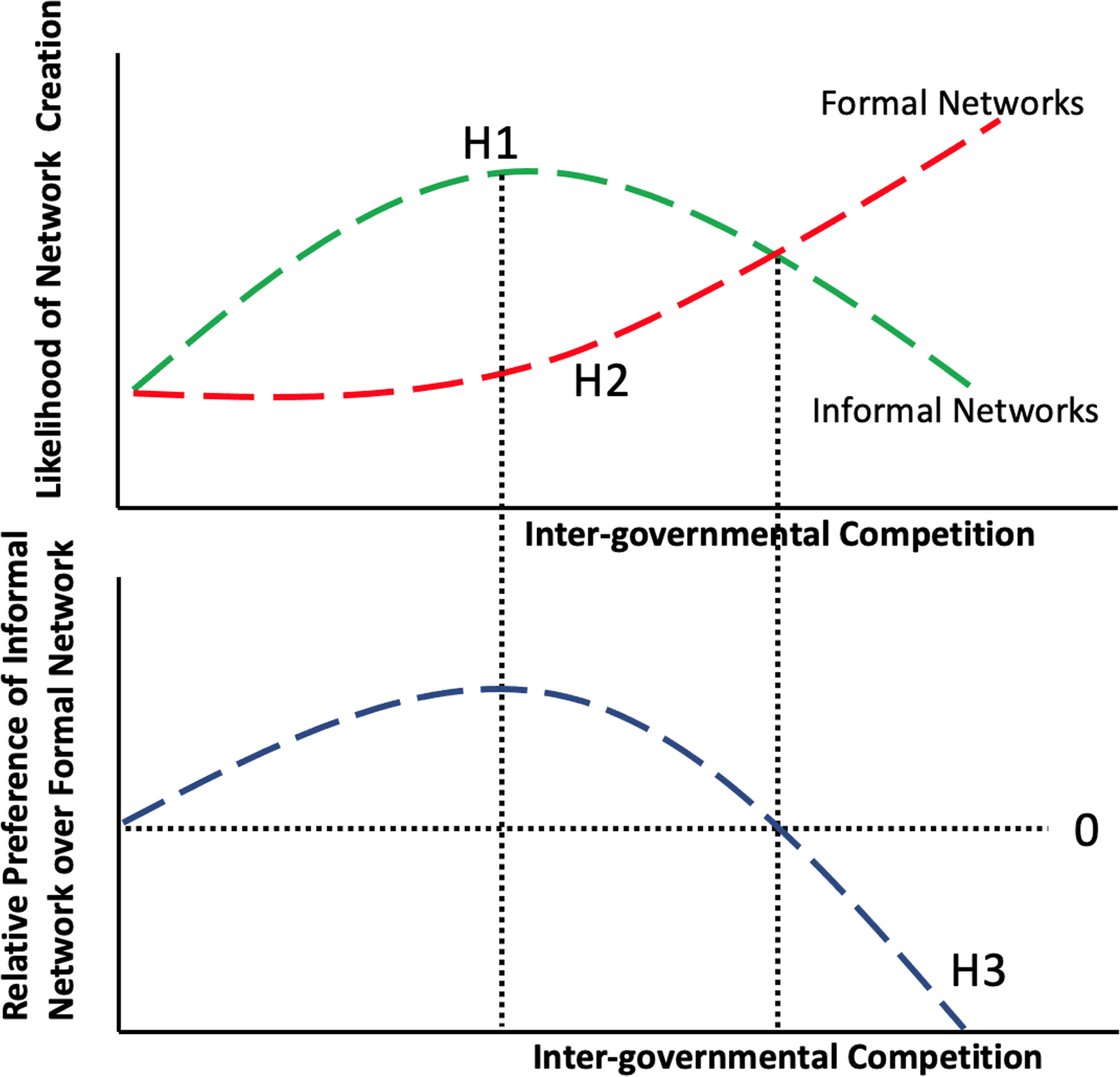
Research hypotheses.
Intercity Economic Development Competition and Business Trade-Offs
Measurement Strategy for Dyadic Interlocal Economic Development Competition
Positing that the establishment of businesses represents what local governments most commonly compete for, this study attempts to measure dyadic intergovernmental EDC through the extent to which a city was successful in attracting and retaining businesses relative not only to another specific city but also to the rest of cities within the metropolitan area. Specifically, this study measures the trade-offs between two cities found in the change in the number of businesses between two-time points and then standardizes it across all the possible pairs of cities in the area.
While new to the interlocal competition context, using the trade-offs found in desirable outcomes to measure competition between institutional actors is not an entirely novel approach. For several decades political scientists have employed budgetary trade-offs between two agencies (e.g., Berry & Lowery, 1990, Domke et al., 1983; Fordham, 2002, Philips et al., 2016, Russett, 1969, 1982) to measure the degree of competition between them (e.g., guns vs. butter). However, this study adds substantial methodological modifications combining exploratory factor analysis (EFA) and confirmatory factor analysis (CFA) to make it fit into the dyadic intergovernmental competition context for the following reasons.
First, there are various business industries subject to business attraction competitions in each locality, and it is not clear which industry is the best or should be more weighted in measuring the trade-offs of businesses between paired cities. Second, relatedly, cities compete against each other for different subsets of industries and different configurations of priorities depending on their relationship-specific characteristics. Third, the competition level of a pair of cities should be determined in a relative manner with other competitions found in the rest of all possibly paired cities in the region.
To address these, first, it is necessary to extract a latent factor for interlocal EDC by identifying which industries are most relevant and common to focus on. This, in turn, enables us to measure of dyadic intercity competition in economic development by standardizing the trade-offs across the identified industries giving relative weights to each industry and across different pairs of cities in the region.
For that purpose, in the next section, EFA is first employed to identify those industries as well as to extract the latent variable of interlocal competition across all pairs of sample cities in the Orlando metropolitan area. Next, an additional CFA is used to assess the validity of the EFA result and to construct a standardized competition index (i.e., factor scores of the CFA) for all dyadic interlocal relationships. The specific procedures are illustrated in the next section.
Using the Trade-Offs of Business Attraction to Estimate Dyadic EDC
Berry and Lowery (1990) proposed a difference-based measure to understand budgetary trade-offs between agencies during two time points, which is like below:

The only difference from Berry and Lowery (1990) is that this study initially used the absolute different value of |DIFF(A:B)| because DIFF(A:B) and DIFF(B:A) are seen as indifferent in terms of interlocal competition between two cities (i.e., A and B) from researcher's perspective viewing the dyadic competition as a single observable phenomenon. Without the absolute value symbol, the DIFF(A:B) measure would capture the respective gains and losses between paired cities as the consequence of competition, which is for a directed network. This measure might be another interest of future network governance studies.
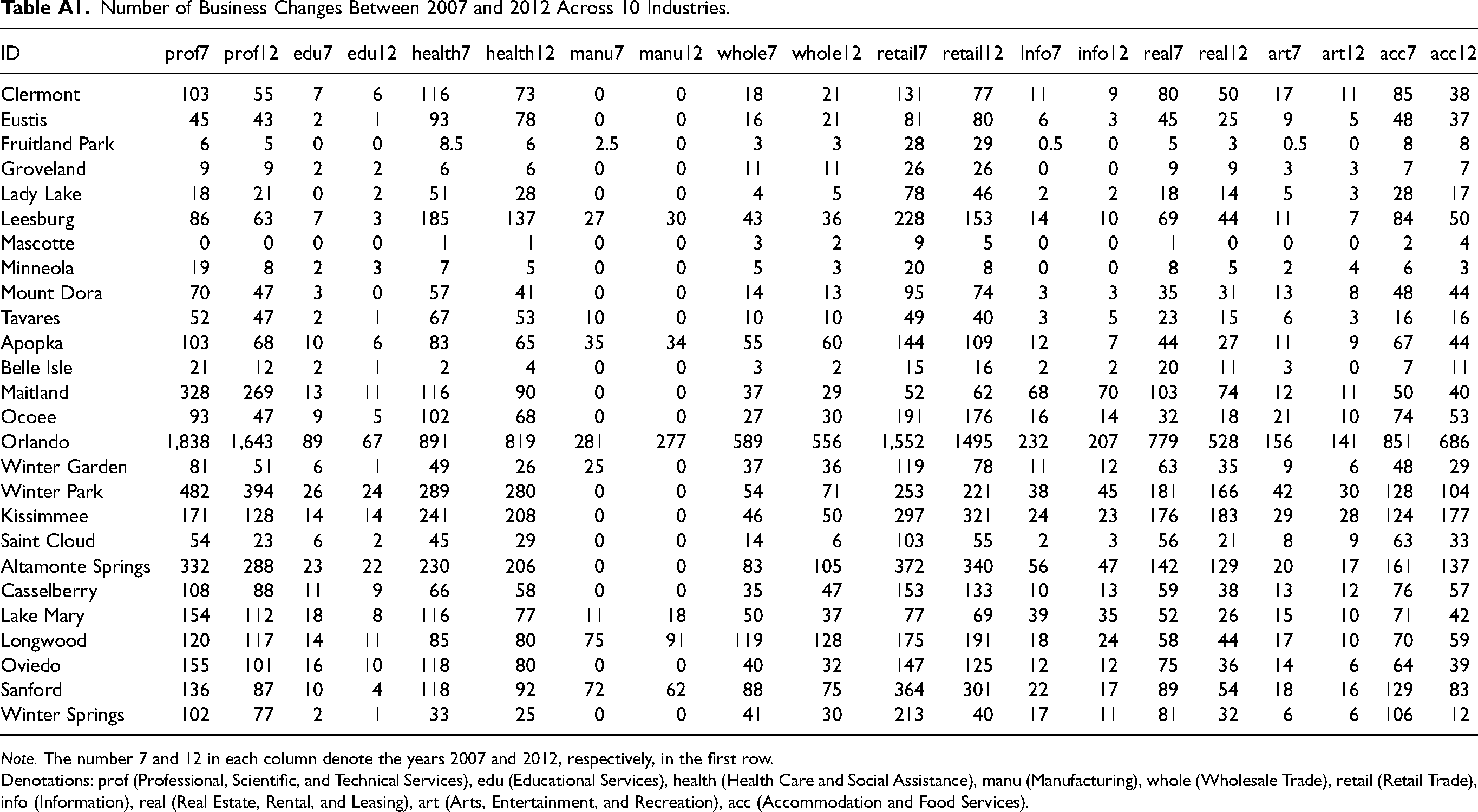
The change in the number of businesses between 2007 and 2012 is calculated across 10 different industries, which can be found in Appendix A. The data is only available for the 10 industries for the years 2002, 2007, and 2012 from the U.S. Census Bureau. Note that the number of business changes in a city between 2007 and 2012 means the simple number of changes between the two time points. 2
Next, to make the competition scores comparable across different combinations of all the paired cities for 10 different industries, this study additionally standardized the trade-offs as seen below through z-score calculation. This measure provides comparable 650 (i.e., 26 × 26 − 26) dyadic EDC measures between 26 cities across 10 industries during the same analytic period (i.e., 2007–2012). Formal definitions are below.
When city

Constructing a Dyadic Interlocal Competition Index
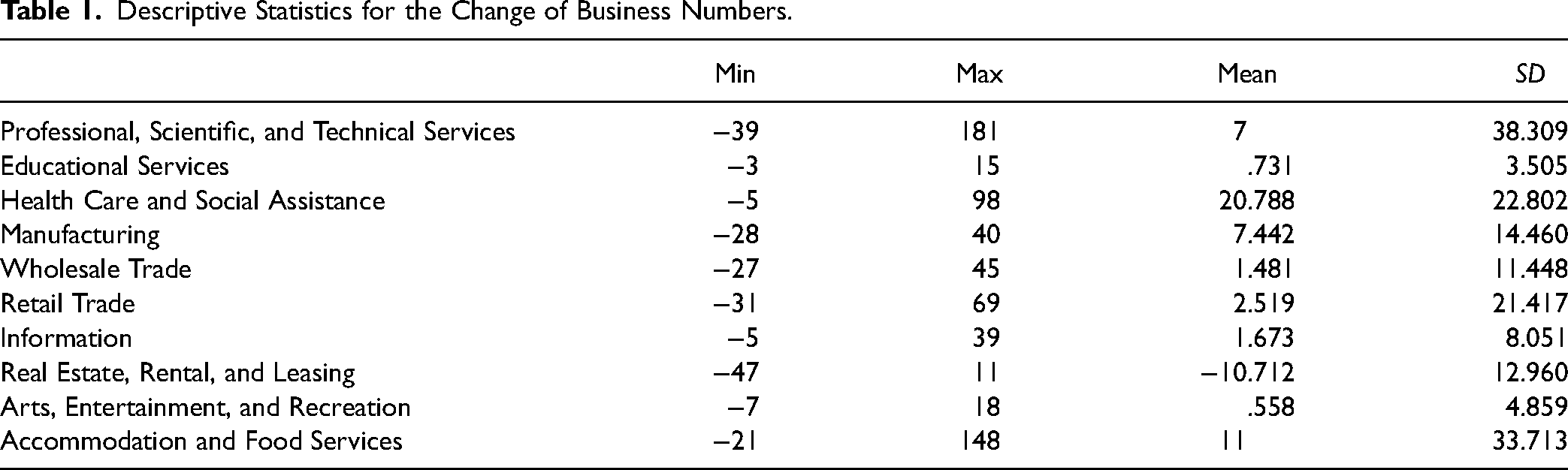
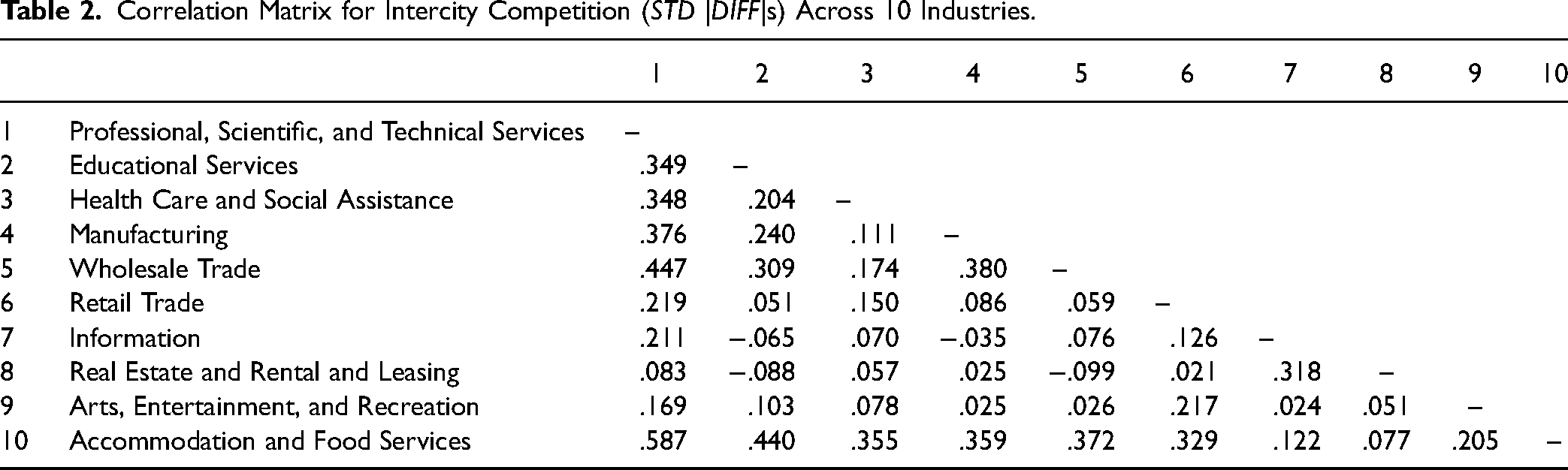
Using the formula above, this study first calculates the STD |DIFF|s between all cities across 10 industries and constructed 10 different STD |DIFF| matrixes (i.e., 10 of 26 × 26 matrixes). Descriptive statistics for the number of business changes are reported in Table 1, and the correlations between the STD |DIFF|s across 10 industries are reported in Table 2. 3
Descriptive Statistics for the Change of Business Numbers.
Correlation Matrix for Intercity Competition (STD |DIFF|s) Across 10 Industries.
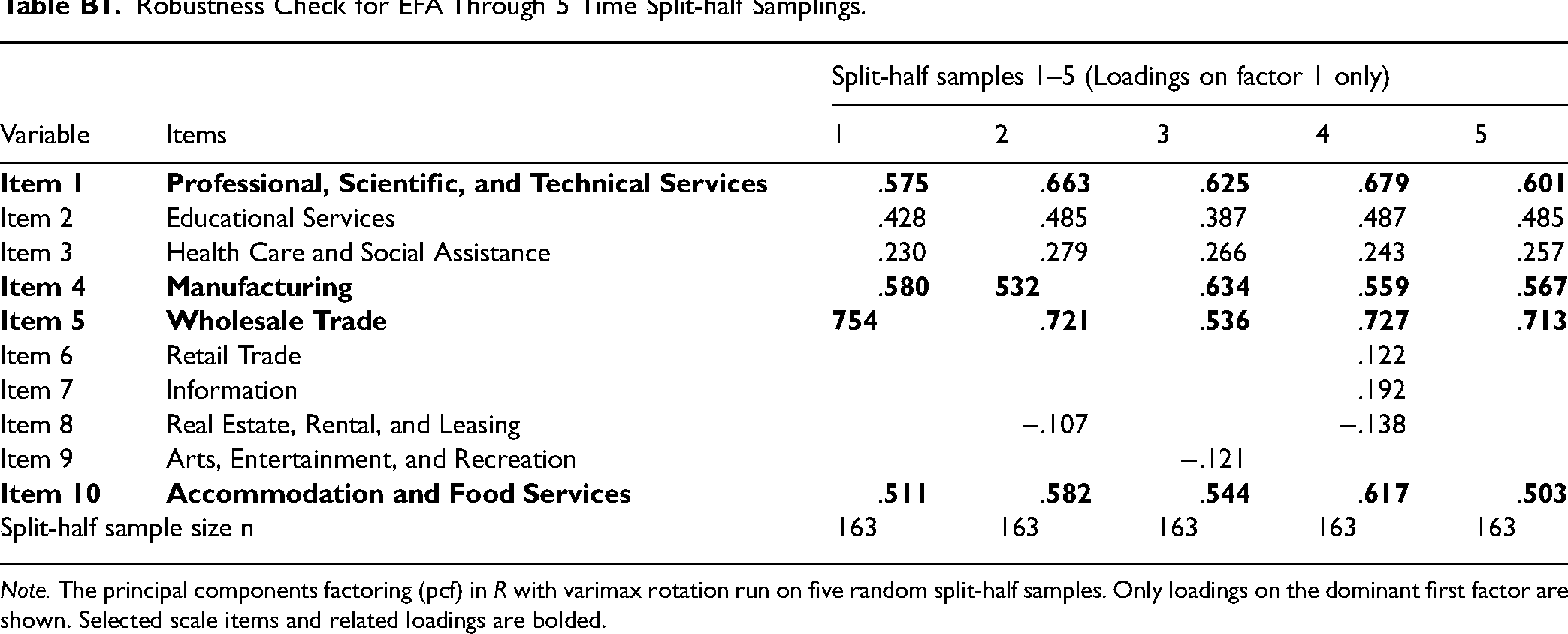
Next, this study posits that there is a single latent factor, interlocal EDC as the primary cause for the interlocal business trade-offs, that can be inferred from the relative trade-offs in the number of business changes across all the paired sample cities as well as across the various industries. To extract the factor, EFA is employed with principal component factoring and varimax rotation 4 for the trade-offs in the business establishments of all 10 industries (i.e., STD |DIFF|s) between all paired cities. This approach helps identify what industries in common best indicate the existence of intercity competition in attracting businesses in the metropolitan area (see Appendix B). The result suggests that four items (i.e., industries) are robust indicators of the latent construct of intercity competition: (1) Professional, Scientific, and Technical Services, (2) Manufacturing, (3) Wholesale Trade, and (4) Accommodation and Food Services.
Next, to construct standardized measures for intercity competition in economic development across the four industries, this study additionally used a CFA with the four items identified in the EFA above. The CFA result for the four items is reported in Appendix C. 5 Using this CFA model and, specifically, the factor scores from the CFA, this study constructed a single 26 × 26 dyadic EDC matrix in the Orlando metropolitan area in 2012.
Lastly, this study additionally checked the relevance of the current measure to see the extent to which the current measure is valid and reliable to subsequently test the research hypotheses (see Appendix D). The results show that this measure is generally well aligned with traditional theoretical expectations and fits well into the Orlando metropolitan area context during the analytic period.
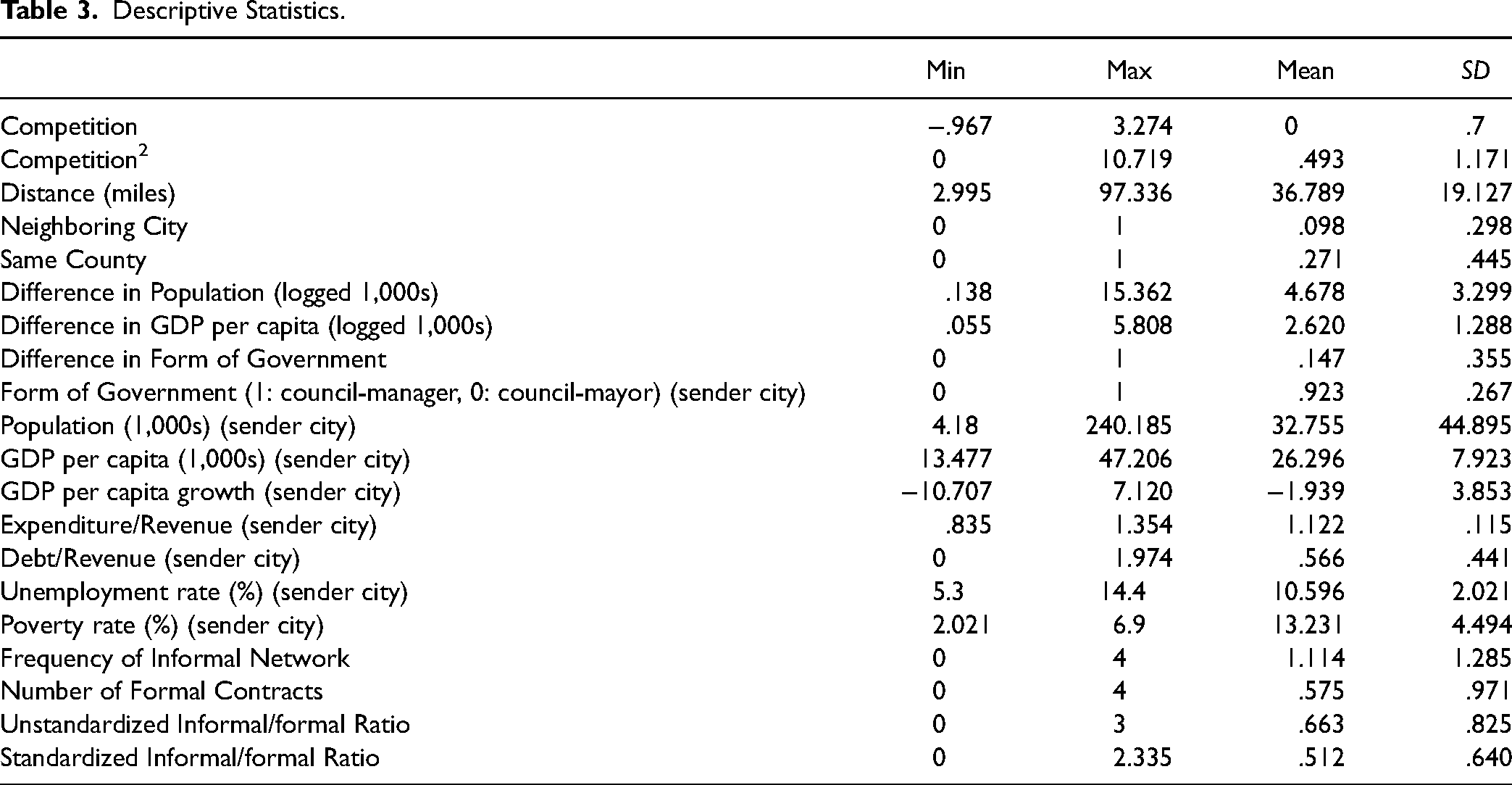
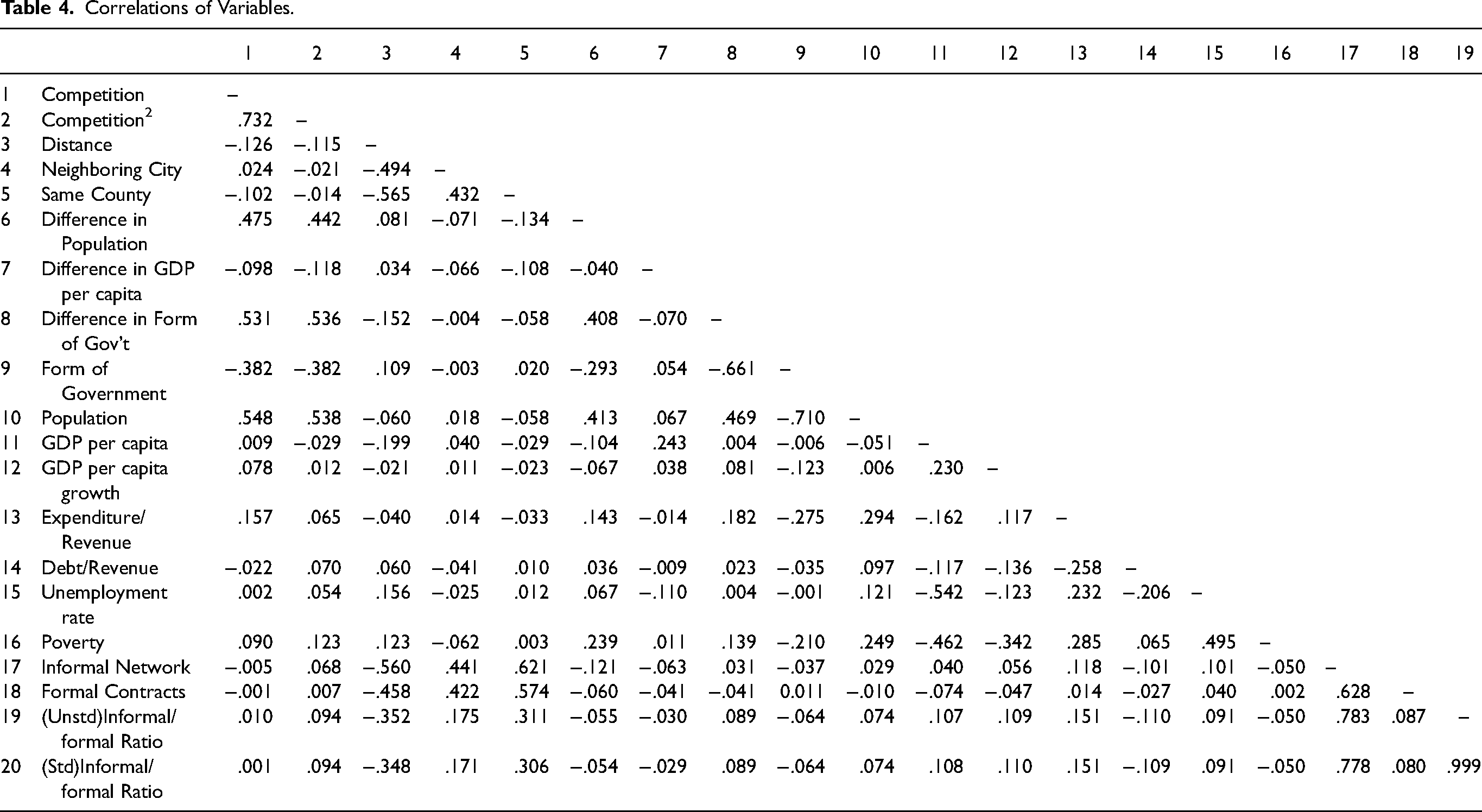
Descriptive statistics for the dyadic interlocal EDC measure and other variables for analytic models are reported in Table 3. Table 4 additionally reports product–moment correlations for the variables. This is just a front-end to the standard correlation method but uses two adjacent matrices of graphs instead.
Descriptive Statistics.
Correlations of Variables.
Methods and Data
Research Site
The Orlando metropolitan area in 2012 provides a nice test bed with which to measure intercity competition through the trade-offs in business attraction and to check the reliability and validity of the measure by testing this study's main questions. In 2012, the intercity competition was prevalent within U.S. metropolitan areas, and, in particular, the lagged effect of the recession led to intense competition for capturing private investment to make up for the budget shortfalls experienced over several years following the recession (Hawkins et al., 2016).
Furthermore, although cities in the Orlando metropolitan area have a diverse economic composition, they commonly targeted industries such as manufacturing, aviation, aerospace & defense, corporate headquarters & regional offices, innovative technologies, and life sciences & healthcare. 6 All those industries can be characterized as high-value-added and/or being capable of creating a greater number of jobs relative to others. Thus, the condition for the competition in pursuing a common goal is fulfilled. Besides, the size of the area is relatively small (i.e., 4,012 square miles), so most of the cities within relatively small geography can be simultaneously considered for new firm locations or relocation accentuating trade-offs in business attraction between cities, fulfilling the other primary condition of competition, trade-offs of the desired outcome.
Another merit of the Orlando area as the research site is that this area is not an extreme outlier in comparison to the population of Metropolitan Statistical Areas (MSAs). Despite its compact geography, the Orlando metropolitan area is the 23rd largest in the United States by population and ranked 481 among the 917 metros in 2014 per-capita income. Like most MSAs (i.e., 282 out of the total 381), this area also experienced an increase in real Gross Domestic Product (GDP) between 2009 and 2014.
Method
A multiple regression extension of the quadratic assignment procedure (MRQAP) is used to test a local actor's propensity to form informal and formal networks for its competitors. MRQAP tests are permutation tests for multiple linear regression model coefficients for dyadic network data. Autocorrelation and standard errors can be addressed with this approach to analyzing network data (Dekker et al., 2007; Krackhardt, 1988).
An MRQAP approach tests the null hypothesis that two network variables are uncorrelated. “By generating all correlations that result from permuting the rows and columns of one of the structural matrices, one can determine the distribution of all possible correlations given the structures of the two matrices. Thus, it builds into the test statistic the kind of row/column interdependence that is assumed in network data” (Krackhardt, 1988, p. 363). This study tests the correlation between network variables: how dyadic interlocal competition affects the establishment of dyadic informal and formal networks between city governments in the Orlando metropolitan area. Thus, MRQAP is an appropriate method to test the hypotheses.
Note that the coefficients of the test results can be interpreted the same as in ordinary least squares regression analysis, which is another advantage of MRQAP. For example, one can interpret the result as the marginal change of an independent variable (IV) would result in its coefficient-amount change in the dependent variable (DV) controlling for other factors. Using R software, three thousand permutations were generated to test the statistical significance.
Measures and Data
Competition (IV).
Interlocal EDC measure constructed in the previous section is the primary IV in this study—dyadic competitions across all paired cities in the analysis (e.g., city i – city j ). Note that its squared term (i.e., competition2) is also used in analyses to test the nonlinearity hypothesis (H2).
Informal and Formal Collaboration (DVs)
Data were collected in 2013 through a survey mailed to the chief executive (i.e., manager or mayor) of each city in the Orlando metropolitan area. All 34 cities in the metropolitan area were surveyed, yielding 30 replies for an overall response rate of 88%. Respondents were provided two specific questions concerning, first, the frequency of informal networking with other governments (i.e., 0 = none, 1 = annually, 2 = quarterly, 3 = weekly, 4 = daily) for advice, information sharing, and discussion on economic development issues (i.e., “Which governments and organizations have your organizations [informally] interacted with (including discussion, advice, and information sharing) on economic development issues during the previous year)?” and, second, the number of mutually binding formal agreements on economic development with any cities in the area regarding the economic development issues. The responses were used as the primary dependent variables to test H1 and H2.
A list of all cities within the metropolitan area was provided, thus, potentially a city could identify up to all 34 cities as having an informal economic development relationship. However, only 26 cities out of available responses from 30 cities were selected because data for the established businesses for eight cities was not available for the years 2007 and 2012. 7 Using the 26 cities, this study identified 650 ties (i.e., (26*26) − 26) across all pairs of cities for subsequent empirical analyses.
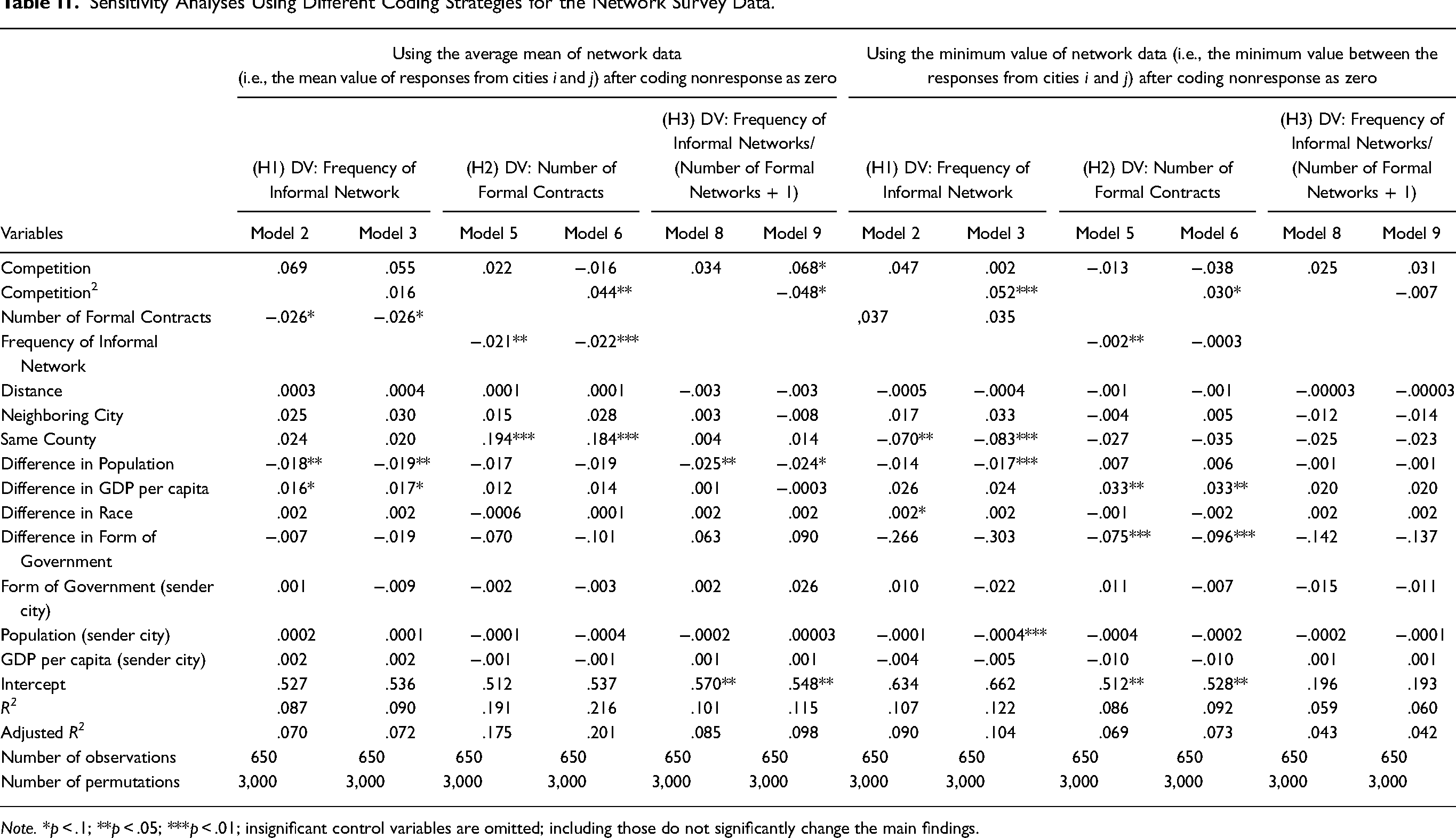
Note that the informal (i.e., information sharing on economic development issues) and formal collaborative network data collected was initially directed (e.g., A city indicates that the city shares economic development information with city B while city B does not indicate city A), but it was translated into undirected for empirical analyses. Specifically, the values are coded as the maximum value reported by either of the two cities in each pair. For example, if city A reported that it discussed economic development issues with city B “annually” and had “3 mutual contracts,” and city B reported that it had “weekly” discussions with city A and had “2 mutual contracts,” this study coded that city A and city B had “weekly” discussions and “3 mutual contracts” in 2012. Additional considerations and rationales for selecting this coding strategy can be found in Appendix H, and sensitivity analysis results using different coding strategies are reported in Appendix I. Note that this study chooses the current coding scheme although the use of average means of the response values from pairs of cities as DV produced more favorable outcomes for the research hypotheses (see Appendices H and I for more detail).
Two ratios of informal to formal collaboration networks between a pair of cities are additionally constructed as another DV to test H3 in separate models. The first version of the informal/formal networks ratio is coded as the frequency of informal networks divided by the number of formal contract networks plus one. 8 This captures the relative preference of informal networks over formal networks.
However, the informal networks and the formal networks would be different in their natures as to their marginal changes with respect to the increase of interlocal competition. To make comparable these two distinctive measures, this study first standardized each measure using z-score calculation. Then, the minimum values of the z-scores for each network measure were added to their respective z-scores (e.g., informal network z-score for cities ij + the minimum of informal network z-score found among all pairs of cities), not to have any negative values for the following step. Next, the scores were used to calculate the relative preference of informal networks over the formal networks in the same manner as the unstandardized informal/formal networks ratio described above (i.e., inflated z-score for informal network/[inflated z-score for formal network + 1]). This measure approximately captures the variation of marginal standard deviation change of the frequency of informal networks as one standard deviation of formal networks increases.
Actor-based attribute (Control Variables)
Demographic data such as population, GDP per capita, and form of government were collected from the U.S. Census Bureau to control homophily effects for robust estimation, which can facilitate interlocal collaborative mechanisms (Song et al., 2018). Also, to additionally control the complex political motivations (Wolman & Spitzley, 1996) for local government's economic development and collaboration, this study included the form of government, GDP per capita, the recent GDP per capita growth (2011–2012), expenditure/revenue, debt/revenue, unemployment rate, and poverty rate as node's attributes in the models. These can help further isolate the relationship between IV and DVs from other possible associations between various economic development issues and DVs in analyses (e.g., use of informal network and form of government, poverty rate, and related informal discussions, etc.).
All the actor-based attribute data are for the year 2012. Note that this study also initially tried to add control variables for incentives, tax rates, and prestige for new and existing businesses across the cities. However, those are largely coordinated at the county-level. Furthermore, more detailed information on those is too city- or case-specific to be incorporated into single variables such as different labels as well as diverse configurations of differing types and degrees of incentives and regulations. Thus, this study included a dyadic variable as to if a pair of cities are located in the same county as well as the geographical distances (miles) between cities.
Results
Table 5 reports estimates from six MRQAP models. Models 1 through 3 test H1, while Models 4–6 test H2. Models 1 and 4 are baseline models, and Models 2 & 3 and 5 & 6 test linear and nonlinear relationships between intergovernmental competition and the use of informal/formal networks respectively. Note that the unit of analysis is the dyadic relationship (i.e., each pair of cities), and the results show how dyadic competition affected the informal and formal networks of each dyad.
Intergovernmental Competition and Informal Network & Formal Network (MRQAP)—H1 & H2.
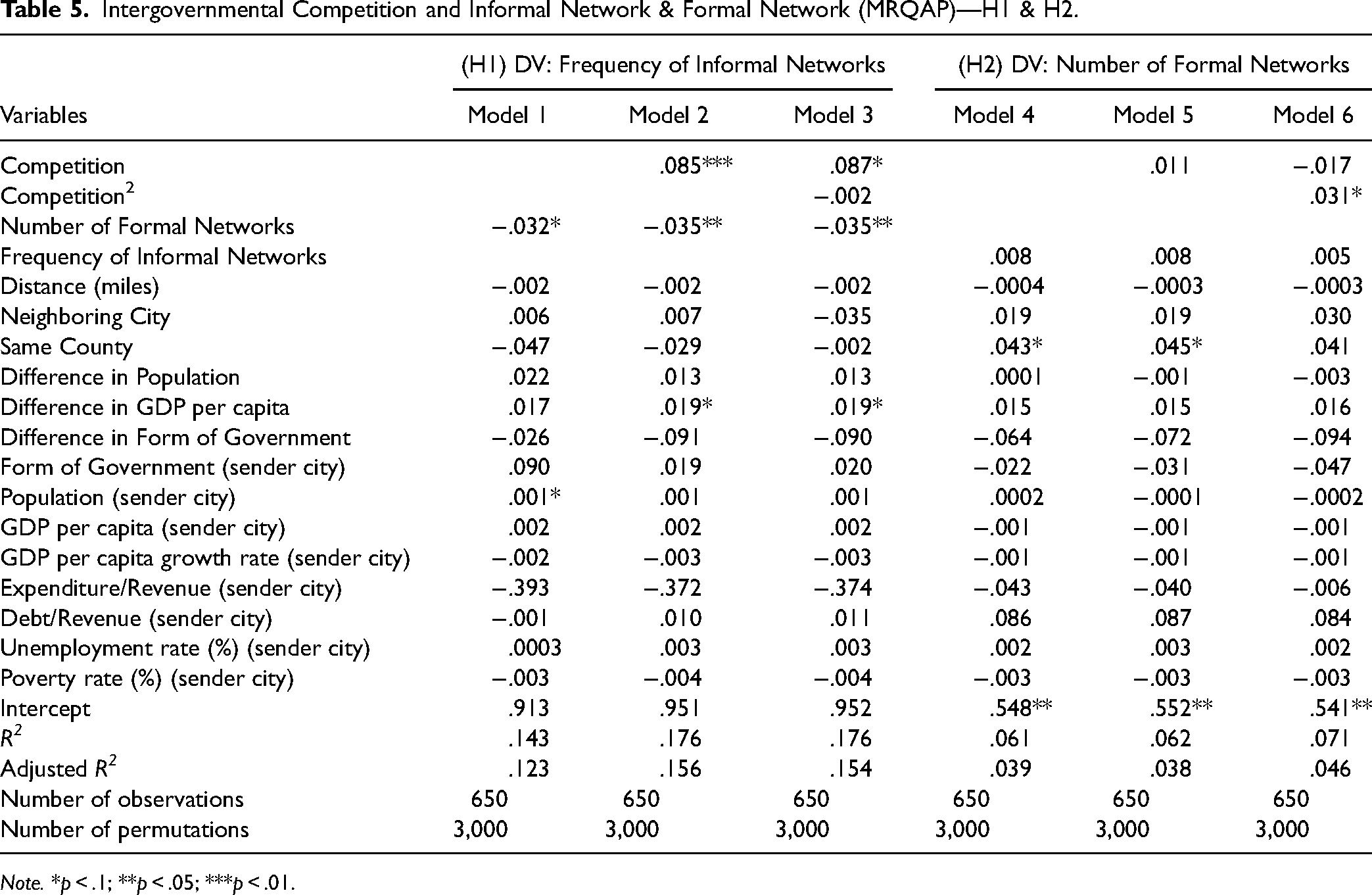
Note. *p < .1; **p < .05; ***p < .01.
Across all the models, the geographical distance variable turns out to have a negative relationship with the likelihood of forging both informal networks and formal contracts between local governments although its effect is not significant. This suggests that distance does not significantly matter for forging both informal and formal networks within the relatively small metropolitan area when controlling for other factors. The impacts of neighboring and same county variables are mixed. It provides only modest support for the conjecture that there would be county-level coordinating efforts to promote intergovernmental collaboration through formal contracts (see Appendix D). The homophily effect of socio-economic and political motivation-related factors is neither largely consistent nor statistically significant.
Turning to the variables of main interest, the results reveal that intergovernmental competition has a positive linear relationship with the frequency of informal network relationships, which is evidenced in Model 2 of Table 5. However, this study did not find statistical significance for the hypothesized inverted U-shaped relationship (H1), first positive and then negative, as seen in Model 3 with a lower adjusted R2 than in Model 2. The sign for the squared term is even opposite to the initial expectation. This implies that city governments in the Orlando metropolitan area would more frequently contact their regional partners when the competition level between them increases, and they do not stop making such informal interactions even when the competition level becomes extremely high.
Nevertheless, the test result provides some evidence for part of the main assumption that formal contracts can function as an alternative to informal policy networks since the number of formal contracts variable turns out to have a significantly negative impact on the frequency of informal networks in Models 1 through 3. This implies that formal contracts can reduce the need for the use of more informal networks to alleviate collaboration risks. However, as reported in Model 3 (i.e., insignificant squared competition variable), the substituting role of the formal contract for an informal network does not significantly convert the positive relationship between competition and frequency of informal network into negative at high levels of competition. This result will be further discussed later in this section.
In Models 4–6, this study confirmed hypothesis 2 that the number of formal contracts between two governments increases exponentially as their intergovernmental competition level increases through the significantly positive squared competition variable. 9 This exponential growth pattern is evident in that the single competition variable is not significant in Models 5 and 6. 10 This suggests that we are more likely to observe a significantly increased number of formal contracts when the competition reaches a very high level, but not low to moderate levels. However, statistical evidence for the alternative functioning mechanism of formal contracts in place of the informal network is not found in Models 4 through 6, unlike the results from Models 1 to 3. Interpreting this, when controlling other variables, the number of formal contracts between two city governments does not significantly change upon the increase in frequency of informal interaction between them.
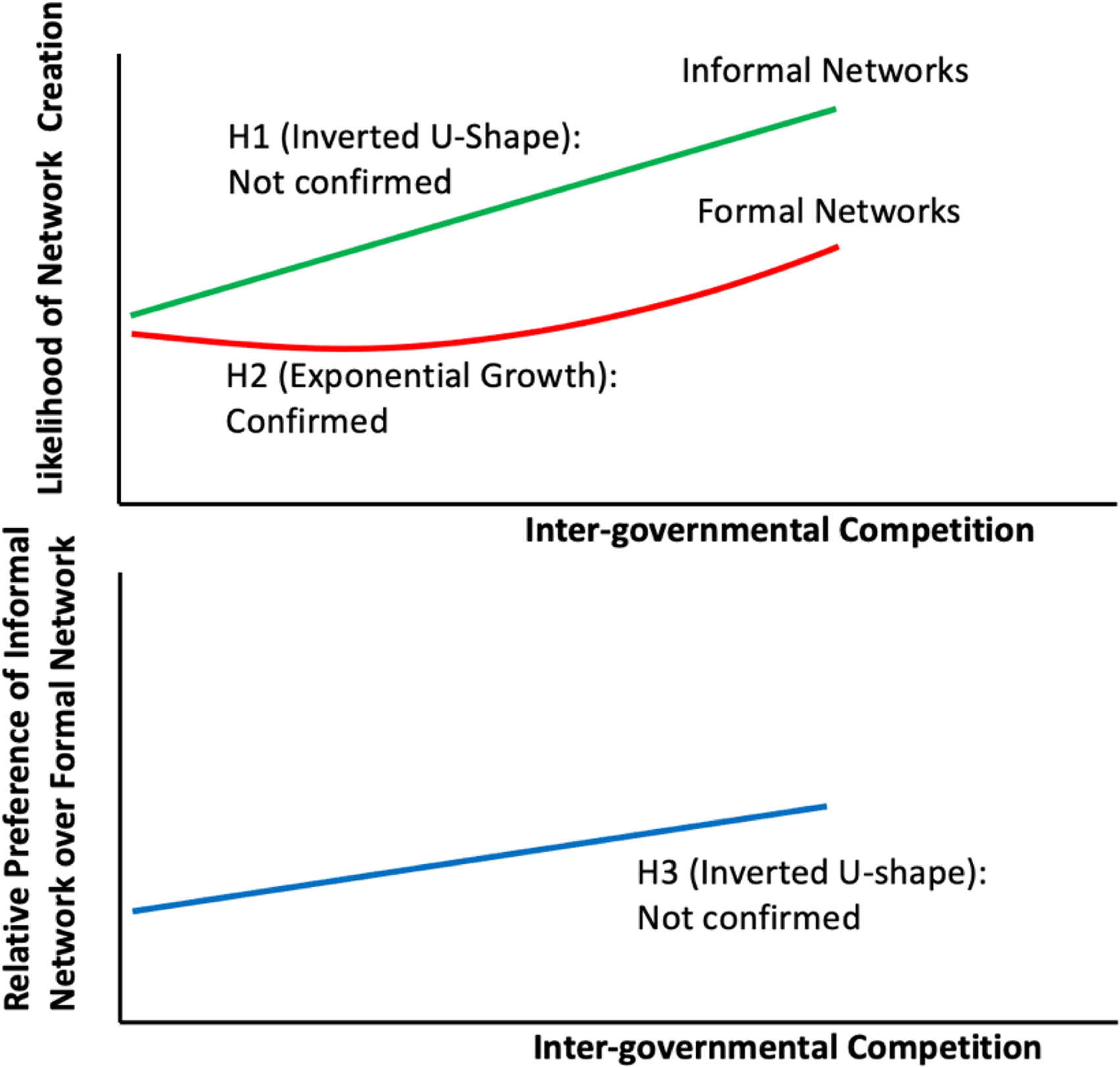
Summary of result.
This inconsistent result regarding whether informal and formal networks function as alternatives to each other suggests a need for further investigation of the causal mechanism between formal and informal networks. The current MRQAP models using cross-sectional network data are limited to making a robust inference on this causal mechanism. This study instead calls for future studies to investigate this issue in a longitudinal manner while accounting for potential simultaneity bias.
Table 6 reports the MRQAP test result for hypothesis 3 about an inverted U-shaped relationship between city governments’ preference for informal networks over formal networks along with the increase of intergovernmental competition. The DV for Models 7 through 9 is the unstandardized relative preference of the informal networks over the formal networks. Model 7 is the baseline model while Models 8 and 9, respectively, test a potential linear and the hypothetical nonlinear relationships (H3). Different from the initial expectation described in hypothesis 3, the result suggests that the use of informal networks would still be preferred over establishing additional formal networks as dyadic intergovernmental competition increases and even reaches an extremely high level of competition.
Intergovernmental Competition and Local Governments’ Preference of Informal Networks Over Formal Networks (MRQAP)—H3.
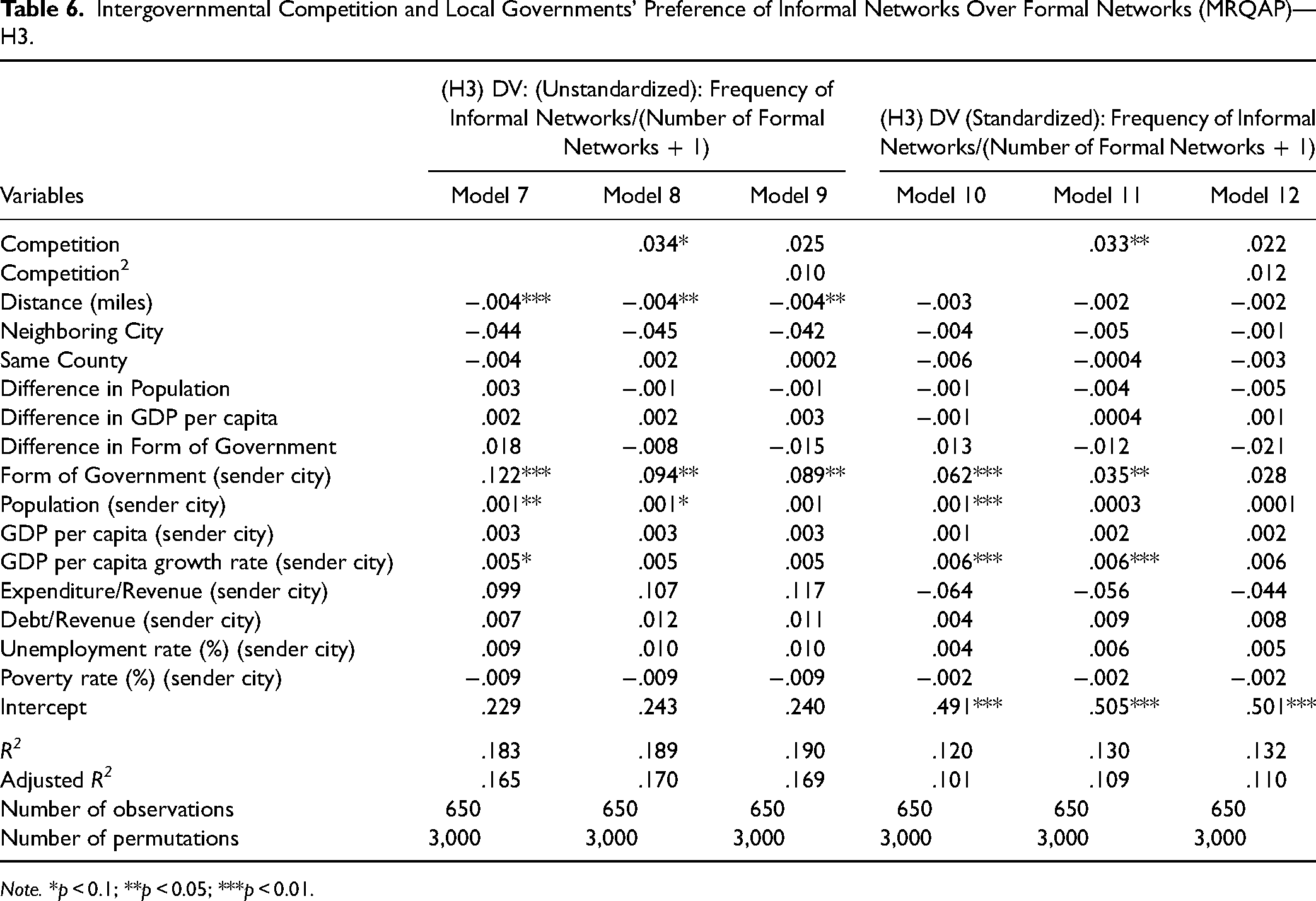
Note. *p < 0.1; **p < 0.05; ***p < 0.01.
The DV for Models 10 through 12 is the standardized network preference measure, which treats the use of both networks in a more comparable manner. Models 10 through 12 are equivalent to Models 7 through 9 only except for the DV. The results are still consistent regarding the variables of this study's main interest.
Regarding other significant variables in the models of Table 6, the distance variable turns out to have a negative association with the relative use of informal networks over the formal networks although they are not statistically significant when using the standardized measure as the DV. This can be interpreted as formal contracts can be viewed as a more efficient alternative collaborative mechanism when continual effort for establishing and maintaining informal ties (i.e., interactions) seem to be less likely to function or to be considered costly due to the distance barrier.
The summary of the empirical results of the main findings is visualized in Figure 2.
Discussion and Conclusion
Previous studies tend to focus on each mechanism in isolation (e.g., Hawkins, 2010; Hawkins & Andrew, 2011; Hawkins & Feiock, 2011; Lee et al., 2012; Minkoff, 2013) regarding the intergovernmental competition. Studies argue that the use of both formal and informal collaborative mechanisms increases as the level of competition heightens. However, another strand of research drawing on the transaction cost perspective provides a different and more nuanced theoretical explanation that local governments’ preference for either mechanism can change along with the increase in the level of competition. Through measuring dyadic intergovernmental EDCs and empirical assessments, this study attempted to address the gap.
First, this study reports evidence of a positive association between the level of competition and the establishment of informal policy networks among local governments (Gordon, 2007; Lee et al., 2012; Smith & Beazley, 2000). Second, this study found that establishing formal contract networks has a positive association with the level of intergovernmental competition in economic development (Hawkins, 2010; Hawkins & Andrew, 2011; Hawkins & Feiock, 2011), but the effect would become only significantly large when the level of competition becomes extremely high.
However, this study cannot find compelling evidence to support the initial expectation drawing on the transaction cost perspective that local governments become more favorable to formal mechanisms over informal ones as the level of dyadic competition increases. Rather, this study found that when competition increases, local governments, still, are more likely to invest time in establishing informal linkages with their competitors than forging more mutual formal contracts.
It suggests that rather than being seen as alternative options, regional competitors add more binding agreements while continuing to expand informal relationships. This is consistent with the argument that sharing information and discussions with and getting advice from competitors may not be that harmful but mutually beneficial (Hartley & Benington, 2006; Lee et al., 2012; Smith & Beazley, 2000) so that local governments would continue to engage with even their most direct regional competitors. This confirms the traditional view that each type of network would rather be a mutual complement to the other (e.g., Granovetter, 1985; Minkoff, 2013; Scott, 1995). Informal interactions positively affect the chance to form more formal types of collaboration (Hawkins et al., 2016; Isett & Provan, 2005; Isett et al., 2011) and vice versa.
In fairness to those who take the transaction cost approach that this study also initially took in developing the hypotheses, informal networks might be much easier to be forged and, thus, more cost-effective to alleviate collaboration risks than making more formal contracts that would require more time and effort of two governments. Even if there exists a tendency in local government's preferences between informal and formal networks with respect to competition level, local governments, and their officials would not necessarily reduce their efforts in developing informal networks simply to make more formal contracts even under an extremely competitive environment; the marginal cost for fortifying informal networks would not be as significantly substantive as this study posited.
These findings also have important practical implications for how local governments and their managers cope with their regional competitors. Even in an extremely competitive environment, hiding economic development information or avoiding making mutually binding contracts for strategic purposes can never be a dominant strategy of any government. It will only result in being isolated from various ongoing activities among neighbors and would leave local governments behind (Lee et al., 2012).
This implication should also apply to other policy domains. Regarding the current pandemic, for example, Shipan and Volden (2020) indicated that state and local government policy choices look more like harmful competition than learning and innovation. They compete with one another to obtain necessary equipment in the open marketplace to fight COVID-19, which might place pressure on others. To address this issue stemming from too much competition and related strategic choices, they suggested more informal and formal coordinating efforts across governments that are being hit by different burdens at different times. In fact, Benton (2020) also found substantially increased interstate, interlocal, and even state-local collaboration (e.g., informal and formal alliances) during the COVID-19 pandemic. Regarding this study's findings, particularly, he found that local government informal collaboration (e.g., virtual meetings and consultation) has grown exponentially to formulate their jurisdictions’ emergency policies and coordinate enforcement practices during the pandemic.
This study, however, is not without limitations. First, the measure of intergovernmental competition in the economic development domain may not fully capture the detailed nature of EDC between cities. Cities indeed significantly differ from one another in their sub-goals, potentials, preferences of venues for collaboration, exit probability, invitation selection strategy, and specific strategic plans for collaboration, which affect their subsequent network agreements (Scott et al., 2019). The actual practice of power-sharing between cities in the area would be another consideration as well (Ran & Qi, 2018) in the economic development context. The current trade-off measure may miss some of these important aspects of interlocal EDC although combining CFA and EFA for diverse industries to measure the concept and including in the models the current control variables for various political motives for economic development can possibly assuage this concern to an important degree.
Second, this study's informal and formal network survey questions may not be detailed enough. For instance, informal collaboration varies in its forms. Depending on its nature (e.g., virtual meeting, phone call, email, etc.), there could be different tendencies, at least, in its frequency. Likewise, formal contracts in economic development issues can also vary in its size and history (e.g., auto renewal). The current question as to the number of interlocal formal contracts may not fully capture the complete picture of formal networks between cities in the area. These must be the limitations of this study, which deserves theoretical discussions with empirical assessments.
Third, this research used cross-sectional network data for each collaborative mechanism and, thus, the analysis cannot fully capture the longitudinal and evolutionary aspects of the network features reflecting collaborative evolution (Bell & Olivier 2022). For example, 2012s informal or formal networks can significantly result from 2011s. Although this study found significant associations between intergovernmental competition and formal/informal network establishments, of which causal mechanisms can be supported by theories, future longitudinal data analyses should be able to directly claim for this causality.
Despite the limitations, this study is meaningful in that it sheds light on whether interlocal competition affects the trade-offs in the use of either formal or informal networks in a substituting manner. Although the result is not in favor of this study's initial theoretical expectations, it provides a new forum to ask subsequent questions such as the marginal costs for building or maintaining formal and informal networks and the local government's use of each collaboration mechanism upon the change of interlocal competition level. In addition, this study introduces a tradeoff-based dyadic intergovernmental competition measure in the EDC domain and demonstrates its reliability and validity. This can fortify network-based studies when it is too costly or hard to measure the dyadic competition among governments or other organizations. The measurement strategy advanced here can be applied to network studies across various policy arenas.
Footnotes
Appendix A
Number of Business Changes Between 2007 and 2012 Across 10 Industries.
| ID | prof7 | prof12 | edu7 | edu12 | health7 | health12 | manu7 | manu12 | whole7 | whole12 | retail7 | retail12 | Info7 | info12 | real7 | real12 | art7 | art12 | acc7 | acc12 |
|---|---|---|---|---|---|---|---|---|---|---|---|---|---|---|---|---|---|---|---|---|
| Clermont | 103 | 55 | 7 | 6 | 116 | 73 | 0 | 0 | 18 | 21 | 131 | 77 | 11 | 9 | 80 | 50 | 17 | 11 | 85 | 38 |
| Eustis | 45 | 43 | 2 | 1 | 93 | 78 | 0 | 0 | 16 | 21 | 81 | 80 | 6 | 3 | 45 | 25 | 9 | 5 | 48 | 37 |
| Fruitland Park | 6 | 5 | 0 | 0 | 8.5 | 6 | 2.5 | 0 | 3 | 3 | 28 | 29 | 0.5 | 0 | 5 | 3 | 0.5 | 0 | 8 | 8 |
| Groveland | 9 | 9 | 2 | 2 | 6 | 6 | 0 | 0 | 11 | 11 | 26 | 26 | 0 | 0 | 9 | 9 | 3 | 3 | 7 | 7 |
| Lady Lake | 18 | 21 | 0 | 2 | 51 | 28 | 0 | 0 | 4 | 5 | 78 | 46 | 2 | 2 | 18 | 14 | 5 | 3 | 28 | 17 |
| Leesburg | 86 | 63 | 7 | 3 | 185 | 137 | 27 | 30 | 43 | 36 | 228 | 153 | 14 | 10 | 69 | 44 | 11 | 7 | 84 | 50 |
| Mascotte | 0 | 0 | 0 | 0 | 1 | 1 | 0 | 0 | 3 | 2 | 9 | 5 | 0 | 0 | 1 | 0 | 0 | 0 | 2 | 4 |
| Minneola | 19 | 8 | 2 | 3 | 7 | 5 | 0 | 0 | 5 | 3 | 20 | 8 | 0 | 0 | 8 | 5 | 2 | 4 | 6 | 3 |
| Mount Dora | 70 | 47 | 3 | 0 | 57 | 41 | 0 | 0 | 14 | 13 | 95 | 74 | 3 | 3 | 35 | 31 | 13 | 8 | 48 | 44 |
| Tavares | 52 | 47 | 2 | 1 | 67 | 53 | 10 | 0 | 10 | 10 | 49 | 40 | 3 | 5 | 23 | 15 | 6 | 3 | 16 | 16 |
| Apopka | 103 | 68 | 10 | 6 | 83 | 65 | 35 | 34 | 55 | 60 | 144 | 109 | 12 | 7 | 44 | 27 | 11 | 9 | 67 | 44 |
| Belle Isle | 21 | 12 | 2 | 1 | 2 | 4 | 0 | 0 | 3 | 2 | 15 | 16 | 2 | 2 | 20 | 11 | 3 | 0 | 7 | 11 |
| Maitland | 328 | 269 | 13 | 11 | 116 | 90 | 0 | 0 | 37 | 29 | 52 | 62 | 68 | 70 | 103 | 74 | 12 | 11 | 50 | 40 |
| Ocoee | 93 | 47 | 9 | 5 | 102 | 68 | 0 | 0 | 27 | 30 | 191 | 176 | 16 | 14 | 32 | 18 | 21 | 10 | 74 | 53 |
| Orlando | 1,838 | 1,643 | 89 | 67 | 891 | 819 | 281 | 277 | 589 | 556 | 1,552 | 1495 | 232 | 207 | 779 | 528 | 156 | 141 | 851 | 686 |
| Winter Garden | 81 | 51 | 6 | 1 | 49 | 26 | 25 | 0 | 37 | 36 | 119 | 78 | 11 | 12 | 63 | 35 | 9 | 6 | 48 | 29 |
| Winter Park | 482 | 394 | 26 | 24 | 289 | 280 | 0 | 0 | 54 | 71 | 253 | 221 | 38 | 45 | 181 | 166 | 42 | 30 | 128 | 104 |
| Kissimmee | 171 | 128 | 14 | 14 | 241 | 208 | 0 | 0 | 46 | 50 | 297 | 321 | 24 | 23 | 176 | 183 | 29 | 28 | 124 | 177 |
| Saint Cloud | 54 | 23 | 6 | 2 | 45 | 29 | 0 | 0 | 14 | 6 | 103 | 55 | 2 | 3 | 56 | 21 | 8 | 9 | 63 | 33 |
| Altamonte Springs | 332 | 288 | 23 | 22 | 230 | 206 | 0 | 0 | 83 | 105 | 372 | 340 | 56 | 47 | 142 | 129 | 20 | 17 | 161 | 137 |
| Casselberry | 108 | 88 | 11 | 9 | 66 | 58 | 0 | 0 | 35 | 47 | 153 | 133 | 10 | 13 | 59 | 38 | 13 | 12 | 76 | 57 |
| Lake Mary | 154 | 112 | 18 | 8 | 116 | 77 | 11 | 18 | 50 | 37 | 77 | 69 | 39 | 35 | 52 | 26 | 15 | 10 | 71 | 42 |
| Longwood | 120 | 117 | 14 | 11 | 85 | 80 | 75 | 91 | 119 | 128 | 175 | 191 | 18 | 24 | 58 | 44 | 17 | 10 | 70 | 59 |
| Oviedo | 155 | 101 | 16 | 10 | 118 | 80 | 0 | 0 | 40 | 32 | 147 | 125 | 12 | 12 | 75 | 36 | 14 | 6 | 64 | 39 |
| Sanford | 136 | 87 | 10 | 4 | 118 | 92 | 72 | 62 | 88 | 75 | 364 | 301 | 22 | 17 | 89 | 54 | 18 | 16 | 129 | 83 |
| Winter Springs | 102 | 77 | 2 | 1 | 33 | 25 | 0 | 0 | 41 | 30 | 213 | 40 | 17 | 11 | 81 | 32 | 6 | 6 | 106 | 12 |
Note. The number 7 and 12 in each column denote the years 2007 and 2012, respectively, in the first row.
Denotations: prof (Professional, Scientific, and Technical Services), edu (Educational Services), health (Health Care and Social Assistance), manu (Manufacturing), whole (Wholesale Trade), retail (Retail Trade), info (Information), real (Real Estate, Rental, and Leasing), art (Arts, Entertainment, and Recreation), acc (Accommodation and Food Services).
Appendix B
Robustness Check for EFA Through 5 Time Split-half Samplings.
| Split-half samples 1–5 (Loadings on factor 1 only) | ||||||
|---|---|---|---|---|---|---|
| Variable | Items | 1 | 2 | 3 | 4 | 5 |
|
|
|
. |
. |
. |
. |
. |
| Item 2 | Educational Services | .428 | .485 | .387 | .487 | .485 |
| Item 3 | Health Care and Social Assistance | .230 | .279 | .266 | .243 | .257 |
|
|
|
. |
|
. |
. |
. |
|
|
|
|
. |
. |
. |
. |
| Item 6 | Retail Trade | .122 | ||||
| Item 7 | Information | .192 | ||||
| Item 8 | Real Estate, Rental, and Leasing | −.107 | −.138 | |||
| Item 9 | Arts, Entertainment, and Recreation | −.121 | ||||
|
|
|
. |
. |
. |
. |
. |
| Split-half sample size n | 163 | 163 | 163 | 163 | 163 | |
Note. The principal components factoring (pcf) in R with varimax rotation run on five random split-half samples. Only loadings on the dominant first factor are shown. Selected scale items and related loadings are bolded.
Appendix C. Confirmatory Factor Analysis Result (Standardized)
RMSEA = .097, CFI = .979, TLI = .937, SRMR = .032, and chi-square: p-value = .018.
Note. All items loading on the latent variable are significant at the .01 level.
Abbreviations: RMSEA = root mean square error of approximation; CFI = comparative fit index; SRMR = standardized root mean square residual; TLI = Tucker-Lewis index.
Appendix D. The Validity of Dyadic Interlocal EDC Measure
To check further the validity of the measure, this study examines if the descriptive statistics of the EDC measure are well-aligned with theoretical predictions in the literature on the intergovernmental competition. This study then further examines the extent to which the intergovernmental competition network structure reflects the reality of economic development in the Orlando metropolitan area in the period of study.
Additional analyses found that the correlation between interlocal competition and city governments’ being located in the same county is −0.102 (p = .079), which shows that the level of EDC is lower if the cities are located in the same county. At first glance, this seems to contradict the traditional view that interlocal competition between the members of the same county is higher; competition could be more likely observed between local governments in the same jurisdiction because of their homophilous industrial structures, similar labor force composition, and geographical proximity often shapes a competitive environment (Goetz & Kayser, 1993).
Although some readers might question the validity of the competition measure regarding this result, it is too early to draw a conclusion. Another test found that the average mean of dyadic interlocal competition between neighboring cities is .024 (p = .737), although falling short of statistical significance, which is slightly higher than the total average of the measure and consistent with predictions in the literature (e.g., Bowman, 1988; Goetz & Kayser, 1993). Also, in Table 4, the distance variable has a negative correlation with the competition measure, supporting a traditional argument that geographical proximity has a negative association with the intergovernmental competition.
Another point is that a simple univariate analysis of the relationship between the same county location and intergovernmental competition might produce an inaccurate interpretation due to spatial confounding factors related to this study's intergovernmental competition measure. Another possible explanation for the lower level of intergovernmental competition within the same county is that county-level coordination efforts could alleviate intergovernmental competition within the county jurisdiction. If so, intergovernmental competition within the same county and even between neighboring cities can be somewhat overestimated in extant theories.
Ki and his associates (2020) argued that city governments in the same county jurisdiction are more strongly tied to one another than neighboring cities in different counties. They demonstrated how necessary information can be more frequently demanded and provided within the same county jurisdiction, which then serves as a vehicle to alleviate rancorous intergovernmental competition. In fact, counties in the Orlando metropolitan area (e.g., Lake County, Seminole County, Orange County, and Osceola County) at times coordinate various city-specific agendas, share infrastructures, and enact common tax/incentive policies to attract businesses within their jurisdictions. 11
The figure below presents a network sociogram of dyadic intergovernmental competition in the Orlando metropolitan area. The shapes of the nodes (i.e., cities) identify which county they belong to (e.g., rectangle: Osceola, circle: Lake, square: Orange, and none: Seminole), and the width of edges represents the degree of competition (e.g., the wider, the more competitive). The more central the node is located in the network figure, the more exposed the cities are to EDC with other local actors. This study additionally visualized the dyadic intergovernmental competition in the figure on the map for readers’ intuitive understanding, which is reported in Appendix E.
Interlocal Competition Sociogram in Economic Development of the Orlando Metropolitan Area.
This study's proposition about county-level coordinating efforts is illuminated by the informal collaboration network figure for the Orlando metropolitan area in Appendix F; the formal collaboration network figure is in Appendix G. Informal interactions between city governments are more often observed in a clustered manner within the same county jurisdictions while formal contracts are more likely to be observed across the jurisdictions. The figure in Appendix E also illustrates that intergovernmental competition is more likely found between pairs of cities crossing county jurisdiction boundaries.
Besides, this study found that the intergovernmental competition network structure fits well with observed relationships among cities in the Orlando area during this study's analytic period. As seen in the figure above, Orlando, Kissimmee, Sanford, and Longwood 12 are located in the center of the network sociogram above suggesting they were exposed to extensive competition for business attraction from other governments. In fact, during this study's analytic period, Orlando, Kissimmee, and Sanford were indicated as principal cities regarding economic development according to U.S. OMB. 13 Based on the competition measure, the average competition among all paired cities is 0, but the average means of the competition measures between those three cities were significantly higher than 0 (i.e., 2.17 (Orlando-Sanford), 1.04 (Orlando-Kissimmee), and 0.84 (Sanford-Kissimmee)).
Appendix E. Intergovernmental EDC Network
Note. In the figure, the circle (i.e., node) denotes each local government, and the size reflects the level of this study's hypothetical EDC that each government experiences against all the city governments in the Orlando metropolitan area. The color of the circles denotes which county each city belongs to (e.g., red for Lake, yellow for Orange, green for Osceola, and blue for Seminole County). The edge (i.e., red line) indicates intergovernmental competition and depicts when the intergovernmental competition between two cities is greater than 1/3 standard deviation of the measure. Thus, the lines are only for the cities that are identified as having relatively high intergovernmental competition in terms of business attraction. The thicker lines denote more severe competition.
Appendix F. Informal Collaboration Network
Note. The nodes and the color denote the same as the figure in Appendix E. The only differences are the node sizes and edges. The node size denotes the extent to which each city government shared economic development information with other governments in 2012. The edge denotes the existence of informal information sharing on economic development issues between two cities. The thicker the edge, the more frequent the information sharing. The contours (from white to red) in the figure represent the density of information exchanges over a 2D space by adding polygonal density layers over the map. The density layers are filled depending on their density level (i.e., low (white) to high (red)).
Appendix G. Formal Collaboration Network
Note. The node and its color denote the same as the previous figures in Appendix E. However, the edge, here, denotes the existence of any formal contract between two city governments. The width of the edge means how many formal contracts exist between two cities (i.e., the thicker, the greater number of contracts on economic development activities). The contours reflect the density of formal contracts existing in a region.
Appendix H. Network Data Translation
There are at least three reasons for the translation (i.e., from directed to undirected). First, the survey question asks the respondents to recall which organizations their governments interacted with (i.e., name-generators) on a given list. One problem with this kind of question relates to the cognitive limitation of the respondents—forgetting (Brewer & Webster, 2000). This study assumes that responses from the respondents of two cities can mutually complement the possible cognitive limitations of the other. Assuming that the respondents from those two cities are exposed to the same risks of being exposed to false memories (Brewer & Webster, 2000), a higher value of response can complement the other response which is likely to suffer from the cognitive limitation of recalling. Another consideration is social desirability bias, but this study posits that reporting the existence of more formal/informal networks with other governments is not necessarily perceived as desirable for survey respondents.
Second, it helps account for personnel transition. For instance, if a survey respondent who interacted with another government and its officials left her/his position at any time point during 2012, and someone else took the position from outside the city government, the survey would not capture the whole complete list of interactions during the year. This would lead to an underestimation of the frequency and the number of informal/formal interactions between cities.
Third, the issue related to the treatment of missing responses is another consideration, which is one of the typical problems in research on collaborative governance (Berardo et al., 2020). Although the network survey yielded a relatively high response rate of 88%, simply coding the missing responses as “0” and using the minimum value of reported responses from either side (i.e., the case that city i did not respond and city j responded, and thus the value coded will be “0”) or average value of them (i.e., coding nonresponse as “0” and then calculating the average value by simply dividing the other response by two) would create serious distortion of the response distribution.
Note that this study also conducted sensitivity analyses using different approaches: counting the minimum value between two responses respectively reported by each pair of cities and using the average value of the responses while coding nonresponse as zero. The results are reported in Appendix I. The main findings are largely consistent across the models although statistical significances for the variables of interest somewhat vary.
Appendix I
Sensitivity Analyses Using Different Coding Strategies for the Network Survey Data.
| Using the average mean of network data (i.e., the mean value of responses from cities i and j) after coding nonresponse as zero | Using the minimum value of network data (i.e., the minimum value between the responses from cities i and j) after coding nonresponse as zero | |||||||||||
|---|---|---|---|---|---|---|---|---|---|---|---|---|
| (H1) DV: Frequency of Informal Network | (H2) DV: Number of Formal Contracts | (H3) DV: Frequency of Informal Networks/(Number of Formal Networks + 1) | (H1) DV: Frequency of Informal Network | (H2) DV: Number of Formal Contracts | (H3) DV: Frequency of Informal Networks/(Number of Formal Networks + 1) | |||||||
| Variables | Model 2 | Model 3 | Model 5 | Model 6 | Model 8 | Model 9 | Model 2 | Model 3 | Model 5 | Model 6 | Model 8 | Model 9 |
| Competition | .069 | .055 | .022 | −.016 | .034 | .068* | .047 | .002 | −.013 | −.038 | .025 | .031 |
| Competition2 | .016 | .044** | −.048* | .052*** | .030* | −.007 | ||||||
| Number of Formal Contracts | −.026* | −.026* | ,037 | .035 | ||||||||
| Frequency of Informal Network | −.021** | −.022*** | −.002** | −.0003 | ||||||||
| Distance | .0003 | .0004 | .0001 | .0001 | −.003 | −.003 | −.0005 | −.0004 | −.001 | −.001 | −.00003 | −.00003 |
| Neighboring City | .025 | .030 | .015 | .028 | .003 | −.008 | .017 | .033 | −.004 | .005 | −.012 | −.014 |
| Same County | .024 | .020 | .194*** | .184*** | .004 | .014 | −.070** | −.083*** | −.027 | −.035 | −.025 | −.023 |
| Difference in Population | −.018** | −.019** | −.017 | −.019 | −.025** | −.024* | −.014 | −.017*** | .007 | .006 | −.001 | −.001 |
| Difference in GDP per capita | .016* | .017* | .012 | .014 | .001 | −.0003 | .026 | .024 | .033** | .033** | .020 | .020 |
| Difference in Race | .002 | .002 | −.0006 | .0001 | .002 | .002 | .002* | .002 | −.001 | −.002 | .002 | .002 |
| Difference in Form of Government | −.007 | −.019 | −.070 | −.101 | .063 | .090 | −.266 | −.303 | −.075*** | −.096*** | −.142 | −.137 |
| Form of Government (sender city) | .001 | −.009 | −.002 | −.003 | .002 | .026 | .010 | −.022 | .011 | −.007 | −.015 | −.011 |
| Population (sender city) | .0002 | .0001 | −.0001 | −.0004 | −.0002 | .00003 | −.0001 | −.0004*** | −.0004 | −.0002 | −.0002 | −.0001 |
| GDP per capita (sender city) | .002 | .002 | −.001 | −.001 | .001 | .001 | −.004 | −.005 | −.010 | −.010 | .001 | .001 |
| Intercept | .527 | .536 | .512 | .537 | .570** | .548** | .634 | .662 | .512** | .528** | .196 | .193 |
| R2 | .087 | .090 | .191 | .216 | .101 | .115 | .107 | .122 | .086 | .092 | .059 | .060 |
| Adjusted R2 | .070 | .072 | .175 | .201 | .085 | .098 | .090 | .104 | .069 | .073 | .043 | .042 |
| Number of observations | 650 | 650 | 650 | 650 | 650 | 650 | 650 | 650 | 650 | 650 | 650 | 650 |
| Number of permutations | 3,000 | 3,000 | 3,000 | 3,000 | 3,000 | 3,000 | 3,000 | 3,000 | 3,000 | 3,000 | 3,000 | 3,000 |
Note. *p < .1; **p < .05; ***p < .01; insignificant control variables are omitted; including those do not significantly change the main findings.
Acknowledgments
I would like to thank three anonymous reviewers for their comments, which greatly improved the manuscript. I would also like to express my gratitude to Cali Curley and Jennifer Connolly for their comments on the earlier version of this manuscript.
Declaration of Conflicting Interests
The author(s) declared no potential conflicts of interest with respect to the research, authorship, and/or publication of this article.
Funding
The author(s) received no financial support for the research, authorship, and/or publication of this article.
