



Abstract
Despite the clear benefits volunteers can bring to public service organizations, their involvement may also create or exacerbate challenges for managers in ensuring clear roles for professionals staffing such organizations. We argue that simple, strategic communication messages can clarify the relative roles of volunteers and professionals. We test this assertion with a low-cost experimental communication experiment embedded in a survey of 240 professionals employed at nursing homes in Denmark. Our results show that strategic communication to clarify volunteer roles reduces professionals’ perceived ambiguity about volunteer roles and the relative roles of volunteers and professional staff. These results are encouraging as many public service organizations seek to involve more volunteers, and managers can implement the kind of strategic communication studied in this article straightforwardly without high costs.
Involving nonprofessionals such as volunteers, service users, and citizens in assisting service professionals with the production of public services—also termed coproduction—is often associated with benefits to public organizations such as increased efficiency and higher service quality (Brudney, 1993; Brudney & Gazley, 2002; Jakobsen & Andersen, 2013; Percy, 1983; Zambrano-Gutiérrez et al., 2017). These benefits are particularly important in times of fiscal constraints and staffing shortages. Despite the many benefits volunteers may bring to public organizations, their involvement can also cause or exacerbate several challenges for public managers.
We suggest that one particularly salient challenge public managers face is that coproduction might spark uncertainty among service professionals about the role of volunteers: What tasks are volunteers supposed to solve? And how does it affect the tasks solved by service professionals? As noted by Nesbit et al. (2016), ambiguity about the relative roles of volunteers and paid staff is one of the causes of poor volunteer–staff relations. Failure to articulate volunteer roles and differentiate their tasks and responsibilities from those of the professional staff can instigate a sense of role ambiguity and be costly if negative relationships between volunteers and service professionals produce dissatisfaction, frustration, or turnover among the professional staff (Nesbit et al., 2016).
Managers thus face an inconvenient paradox: Involving volunteers in coproduction efforts might create ambiguity among service professionals about volunteer roles and undermine some of the positive contributions volunteers are supposed to bring to public organizations and service users in the first place. We focus on managerial communication as a tool for reducing role ambiguity as it promises a low-cost, straightforward way for public managers to differentiate and articulate volunteers’ and service professionals’ roles in coproduction processes and is recognized more broadly as a condition for improving coproduction initiatives (Li, 2020a, 2020b). Whereas it would be a truism to simply suggest that poor managerial communication is bad or clear communication is good, surprisingly, little research investigates whether and under what circumstances managerial communication reduces role ambiguity in public organizations. This gap is unfortunate since communication is an inevitable part of organizations (Andersen & Jakobsen, 2017), and studies have long recognized the importance of managers’ ability to structure tasks, roles, and division of labor (Kahn et al., 1964). It is therefore critical for scholars and managers alike—and the focus of this study—to examine the question: Can managerial communication reduce ambiguity among service professionals about volunteer roles in coproduction processes?
Our article makes two contributions. First, we combine insights from role theory, studies on managerial communication, coproduction literature, and the job demands–resources (JD–R) model to explain how managerial communication can reduce ambiguity among service professionals about volunteer roles in coproduction processes. Using the lens of the JD–R model (Demerouti & Bakker, 2011), role ambiguity reflects a job demand placing emotional strain (stress) on employees by creating uncertain expectations about tasks and job performance (Bakker, 2015). On the other hand, managerial communication is a resource offering structure to tasks and clarification of responsibilities. Job demands (or stressors) may “initiate a health impairment process and may lead to fatigue…” while job resources “are the initiators of a motivational process” (Bakker, 2015, p. 724). A balanced mix of the two, therefore, yields engaged employees. We extend this argument to contend that managerial communication, to be a job resource, must address the involvement of volunteers and specify volunteer duties in the organization.
Our second contribution is empirical, as we conduct a first-order test of our theoretical proposition. Our study focuses on health assistants employed at nursing homes in one of the largest municipalities in Denmark. We choose this case because nursing homes draw extensively on volunteers to assist with service tasks (FOA, 2016), which makes it reasonable to expect some ambiguity about volunteer roles. Two hundred forty nursing home professionals in Denmark were randomly assigned to one of two vignettes embedded in an electronic survey. We then asked the professionals to rate perceived role ambiguity along two dimensions: ambiguity surrounding volunteer roles and ambiguity surrounding the relative roles of service professionals and volunteers. The baseline vignette communicated a short message from a nursing home manager introducing two new volunteers to the staff but did not specify volunteer duties in the organization. The second vignette contained the same information but specified volunteer duties by briefly describing the tasks volunteers should assist with. Despite the low intensity of our treatment—which is low-cost and very easy to implement in practice—we find substantial and statistically significant effects of managerial communication on the two measures of perceived role ambiguity, with effect sizes ranging between approximately 0.3 and 0.4 of a standard deviation.
In the next section, we introduce the management challenges arising from the increased involvement of volunteers in public service production. We pay particular attention to how coproduction efforts might spark ambiguity among service professionals about the roles of volunteers in public organizations. We then conceptualize role ambiguity and outline our argument for how managerial communication can reduce such ambiguity among service professionals. Next, we discuss our research design, including our experiment, measurement instruments, and data collection, before presenting our empirical findings. The article concludes with a discussion of key results, limitations of our design, and lessons for theory and practice.
Management Challenges in Coproduction Processes
Since the development of the coproduction concept in the late 1970s and early 1980s, how to define coproduction has been disputed. One of the first studies defined coproduction as “involving a mixing of the productive efforts of regular and consumers producers” (Parks et al., 1981, p. 1002). According to this definition, coproduction involves mixing inputs from public employees and service users to produce public services. In later definitions, other scholars argue that volunteers and community groups may also provide inputs to public service production (Alford, 2009; Bovaird, 2007; Brandsen & Honingh, 2016). Thus, many coproduction scholars agree that one type of coproduction involves volunteers as coproducers of public services, which is the focus of our study. Brandsen and Honingh (2016) further distinguish between volunteers assisting with complementary and core tasks, where core tasks are part of an organization's core services. For instance, when volunteers arrange social events at a nursing home, they assist with a complementary task. If volunteers instead help with feeding elderly residents at a nursing home, they assist with a core task.
Volunteer coproduction undoubtedly holds many advantages for public organizations and their service users (Brudney, 1993; Brudney & Gazley, 2002; Jakobsen & Andersen, 2013; Percy, 1983). However, it also presents several organizational and managerial challenges. As noted by Torfing et al. (2019, p. 815), “public managers and employees are often uncertain about how to exercise such a leadership [toward volunteers]. Telling volunteers what to do might turn them away, and giving them pecuniary rewards means that they are no longer volunteers.” Much existing research has focused on this dilemma, exploring the challenges of managing volunteers based on their unique characteristics (Studer, 2016) or using generic human resource management tools or leadership strategies toward volunteers (Hager & Brudney, 2015; Mayr, 2017; Rogers et al., 2016).
Volunteer coproduction, however, also raises managerial challenges beyond those directly aimed at leading volunteers. As noted by Nesbit et al. (2016, p. 169), “senior management officials … do not always adequately communicate to employees … the rationale for using volunteers, and what volunteers are intended to accomplish.” As a result, service professionals and volunteers may be uncertain about the role of volunteers and the relative roles of volunteers and service professionals. Public managers, therefore, play an important part in implementing successful volunteer management strategies and ensuring that volunteer coproduction does not create or exacerbate role ambiguity in public organizations. Before we elaborate on this issue and outline our theoretical argument for how managerial communication can reduce role ambiguity in coproduction processes, we first discuss what we understand by role ambiguity.
Role Ambiguity: What Is It? What Are the Consequences?
The ambiguity of a role is a product of (a deficiency in) the necessary information on the demands and constraints placed on behaviors or an organizational position (Kahn et al., 1964; Rizzo et al., 1970). Classical organizational theory prescribes a specified set of tasks and position responsibilities. These responsibilities define the role assigned to individual employees, clarify the expectations of the individual, and allow management to hold the individual accountable for their performance. Role ambiguity thus occurs when the necessary information about a role's domain, methods of fulfillment, and objectives are not conveyed or articulated (Hassan, 2013, p. 717).
Role ambiguity among service professionals about the roles of volunteers in coproduction processes can take on different manifestations. First, ambiguity can surround the roles of volunteers: What is the purpose of involving volunteers? What are the responsibilities of volunteers, and what tasks are volunteers supposed to solve? Second, ambiguity can arise concerning the relative roles of volunteers and employees (Nesbit et al., 2016, 2018): What is the division of labor between volunteers and employees? Are volunteers’ responsibilities and tasks separated from employees’ work? Is there a clear differentiation between tasks solved by volunteers and employees? These questions inextricably link to many frontline workers’ professional roles in public service organizations. Members of a profession share knowledge that is specialized and theoretical, acquired through formal educational training, and guiding behaviors through a set of norms about appropriate actions (Andersen & Pedersen, 2012; Friedson, 2001). Whereas professionals share common understandings of concepts and causal relationships particular to a given domain (e.g., how to care for older people with Alzheimer's disease), this knowledge is codified, making it inaccessible to outsiders such as volunteers who do not share the same professional background. Bringing in volunteers can thus create role ambiguity among professional staff as it raises questions about task allocation and professionals’ monopoly on certain tasks if volunteer duties are not articulated and communicated in the organization. Ambiguities among service professionals concerning volunteer roles and the relative roles of volunteers and professionals sometimes coincide in coproduction processes, but this is not always the case. For example, service professionals may express high ambiguity about volunteer roles but no ambiguity concerning the relative roles of volunteers and service professionals.
While subtle, this distinction is important conceptually and empirically for studies of role ambiguity in contexts of coproduction. Ambiguity among service professionals about the roles of volunteers can lead to inefficient use of volunteers in the organization (Nesbit et al., 2016). While this form of ambiguity can be an obstacle to the efficient use of human resources, it does not necessarily directly impact service professionals and their experiences of their role in the organization. On the other hand, ambiguity among service professionals about the relative roles of volunteers and professional staff directly targets the quality of interaction between volunteers and professionals. If volunteers and professionals engage in the same activity, each organization member must know what to expect of themselves and each other. Positive coordination of activities can become highly problematic and challenging without a clear and specific division of labor and likely lead to conflict between volunteers and professional staff if neither knows what role to assume. Indeed, Nesbit et al. (2016, p. 170) cautioned against this scenario, warning that ambiguity about the relative roles of volunteers and professionals is “one of the causes of poor volunteer-staff relation” and can be costly because “negative relationships between staff and volunteer lead to dissatisfaction, frustration, and turnover…” For this reason, it is important to focus not only on ambiguity related to volunteer roles but also on the relative roles of volunteers and professional staff and how this manifests in clear or unclear divisions of labor. In the next section, we outline our argument for how managerial communication is a low-cost tool to achieve this objective.
The Impact of Managerial Communication on Perceived Role Ambiguity
Research from the field of organizational psychology suggests that all work environments and organizational positions consist of some combination of job demands—that is, stressors or strains placed on the individual—and job resources—that is, inputs to the work context that enable the individual to cope with or eliminate these stressors. Formalized in JD–R theory (Demerouti & Bakker, 2011), job demands and resources initiate different psychological processes. Job demands are stressors that cost energy and can “initiate a health impairment process” (Bakker, 2015, p. 724). As such, high demands might lead to fatigue, accelerate burnout processes, and cause health problems. On the other hand, job resources are “the initiators of motivational processes” that can help buffer and alleviate the strain imposed by high demands (Bakker, 2015, pp. 724–725). Resources such as positive feedback or social support might satisfy the need to feel competent or related in one's job, stimulating intrinsic motivation (Jensen & Bro, 2018) and engagement (Bakker et al., 2014).
While job demands and resources thus might counteract each other, JD–R theory predicts that they can also amplify each other's effects on work outcomes. High job demands manifesting as challenges might strengthen the positive impact of job resources and vice versa (Bakker, 2015, pp. 724–725). This squares with research demonstrating how challenging goals can motivate individuals in organizational contexts (Locke & Latham, 2002; Wright, 2004) but also highlights why the same literature warns against the detrimental impacts of overly ambitious or unrealistic goals (Shalley & Oldham, 1985). Both job demands and resources are dynamic characteristics of work environments. This dynamic feature means that changes in organizational contexts, such as an influx of volunteers, might increase the job demands experienced by service professionals in terms of greater uncertainty about the division of labor, what tasks they should perform, and areas of responsibility. Service professionals enter a loss cycle if the necessary resources do not complement these demands, gradually accelerating mental impairment processes. Given that the involvement of volunteers may create ambiguity among service professionals about volunteer roles and the relative roles of volunteers and service professionals, public managers must accompany coproduction efforts with the necessary resources to help service professionals remove these stressors (Hassan, 2013).
Yet, providing resources is not simply a question of communicating with employees or not. Role theory argues that roles evolve from a “dynamic process involving an employee and his or her direct supervisor whereby the employee acquires knowledge about the demands and constraints placed on his or her behavior, receives feedback regarding his or her behavior in the role, accepts a pattern of behavior, and modifies it over time” (Hassan, 2013, p. 717). It is, therefore, not surprising that poor communication between a sender (the manager) and a receiver (the service professional) complicates the definition of a role. To be a resource and potentially counteract increased role ambiguity in coproduction processes, we must theorize what “good” communication means in this context.
Organization scholars have long recognized the centrality of managerial communication (House & Mitchell, 1974; House & Rizzo, 1972; Lyons, 1971). Simply stating that managerial communication is good would be a truism and false. In their early work, Kahn et al. (1964, pp. 206–208), for example, noted a pattern of higher role ambiguity in cases of frequent communication. This observation suggests that the frequency of managerial communication does not fully explain effectiveness in reducing role ambiguity. As noted by Kahn et al. (1964, p. 208), “…when communications are vehicles of conflicting role pressures, more communication conveys greater uncertainty and confusion.” Later studies on organizational communication also suggest that the content of communication (Greenbaum, 1974; Schuler, 1979) and the mode of communication are other important communication characteristics that may impact role ambiguity (Johlke & Duhan, 2001; Schuler, 1979). Turning back to Kahn et al.’s (1964) early observation, we need to focus not only on managerial communication as merely present or absent, its frequency, or its mode but also on whether it embeds content that targets the source of ambiguity among service professionals: uncertainty about the roles of volunteers and the relative roles of volunteers and service professionals. Thus, it is critical that public managers, in their communication with service professionals, specify volunteer duties in the organization. This argument leads to our main hypothesis:
Managerial communication that specifies volunteer duties in the organization will reduce ambiguity among public service professionals about volunteer roles in coproduction processes.
Research Design and Data
Testing the effect of managerial communication on the perception of role ambiguity among service professionals is not easy. For instance, studies that rely solely on observational (nonexperimental) data may suffer from problems with reverse causality if managerial communication is targeted at workplaces where role ambiguity exists. Moreover, it may also be difficult to isolate the effect of one type of managerial communication from another on the same issue. To overcome these methodological challenges, we employ experimental vignettes embedded in a survey and randomly assign respondents to different versions of a vignette text containing managerial communication about the role of volunteers in public organizations. Afterward, we ask the respondents (service professionals) to rate role ambiguity. If we observe differences in perception of role ambiguity across experimental groups, these are caused by differences in the vignette text and represent a causal effect. The following sections describe our empirical case, data collection, vignette experiment, and outcome measures.
Empirical Case and Data Collection
To test our hypothesis, we need a case in which (1) organizations and their regular staff draw on volunteers to help assist with different service tasks and where (2) we reasonably can expect some ambiguity about volunteer roles to exist. The case of service professionals employed at nursing homes in Denmark meets these two criteria. First, a survey among health assistants by the Danish labor union, FOA, shows that volunteers assist with different tasks at 80% of Danish nursing homes, and this number greatly exceeds that of other large welfare service areas such as preschool and primary school (FOA, 2016). Furthermore, Danish nursing homes have seen a large influx of volunteers over the past few years (FOA, 2016), increasing the likelihood that ambiguities might arise concerning the roles of volunteers and bring about challenges and uncertainties about the traditional roles of permanent staff. These characteristics and developments can create or exacerbate ambiguity about the role of volunteers and their relative roles to professional staff.
We collected data among service professionals employed at public nursing homes in one of Denmark's largest municipalities. Around 85% of all nursing homes in Denmark are public organizations and thus owned, financed, and regulated by local municipalities (Hjelmer et al., 2016; Rostgaard et al., 2016). Nursing homes in Denmark mainly employ health assistants, nurses, pedagogues, and therapists. The largest group of employees is health assistants (Ministry of Health, 2016) with a short education (1 year and 7 months of practical training and education) and long education (3 years and 3 months of practical training and education). Our study included 24 public nursing homes employing 1,070 employees, representing the four previously mentioned professions. We distributed an online survey to the employees via their work e-mail or a letter delivered to their workplace in May–July 2018. We could not deliver the survey to 35 employees due to sickness, maternal/parental leave, or job change. Consequently, our sample dropped to 1,035 employees. Three hundred seven employees completed or partially completed the survey (response rate = 29.7%). The total number included in our empirical study is 240 employees because of nonresponse on at least one outcome item. The average age is 44 years; most respondents are females (93%) and health assistants with a short or long education (71%).
Vignette Experiment
To test the effect of managerial communication that varies in terms of specifying volunteer duties in the organization, we designed experimental survey vignettes, which were part of the online survey distributed to the respondents. Respondents were randomly assigned to one of two vignettes. In both vignettes, we asked the respondents to imagine that they received managerial communication introducing two volunteers, “Johanne” and “Sofie,” who should assist during mealtime at their workplace. In the first vignette, which serves as a baseline vignette, the managerial communication introduced the two new volunteers but did not specify the duties of the new volunteers during mealtime. In the second vignette, our treatment vignette, respondents received the same introductory message and brief information specifying that the volunteers should chat with the elderly residents and help create a cozy atmosphere during mealtime. The message also specified that the volunteers should not assist with practical tasks currently solved by the service professionals. Thus, in both vignettes, the volunteers assist with tasks during mealtime—an example of volunteer coproduction, that is, volunteers assisting service professionals with service production at nursing homes—but in the treatment vignette, the manager specified volunteer duties related to mealtime. We chose that volunteers should chat with the residents and create a cozy atmosphere because these are examples of prototypical complementary tasks often solved by volunteers in a Danish setting (Danish Health Authority, 2016). However, volunteers in our study and at Danish nursing homes, in general, solve various types of tasks—for example, serving food and assisting with eating; assisting with personal care; accompanying to the hairdresser, hospital, etc.; and arranging social gatherings—where the two first tasks represent core tasks by professionals (Thomsen & Jensen, 2018, 2020). Figure 1 reports the exact wording of the two vignettes. The bold text illustrates the difference between the two vignettes.
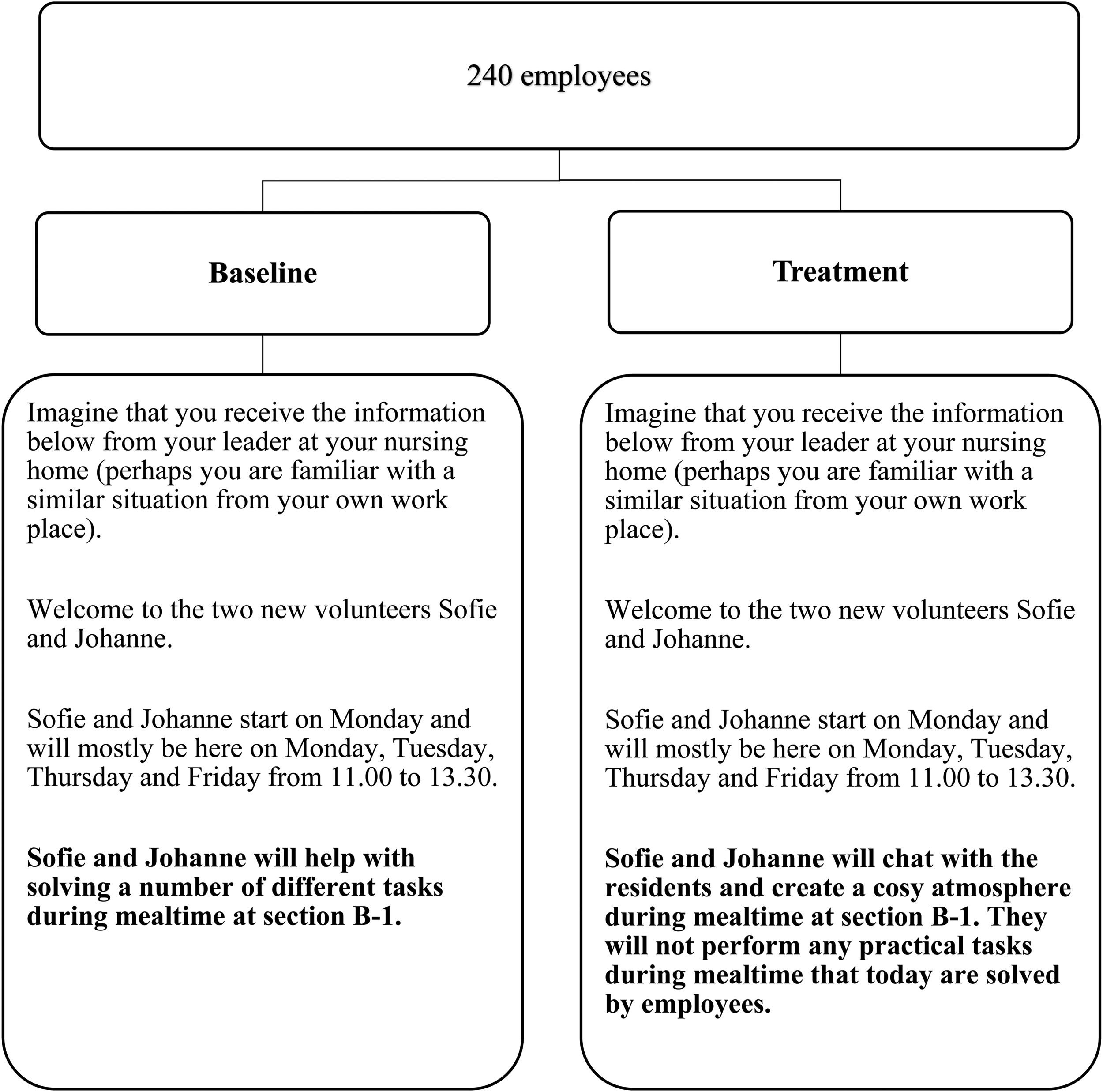
Experimental design: Baseline and treatment vignettes.
A critique of vignette experiments is that they can have low ecological validity due to a lack of mundane realism, which makes it hard to generalize results to the real world. We used a real-world example of managerial communication from a Danish nursing home to construct the two vignettes and remedy this potential critique (Danish Health Authority, 2016, p. 54). This real-life managerial communication also introduced two new volunteers to assist with tasks at the nursing home. Like in our treatment vignette, the managerial communication also provided information about volunteer duties in the organization. However, the mode of delivery of the communication differed between our study and the real-life example. In the latter case, employees received the communication via a whiteboard. To test the mundane realism of our vignette experiments, we conducted three interviews with health assistants employed at nursing homes in April 2018. During the interviews, the respondents were asked to give feedback on the realism of the two vignettes but also asked about the role ambiguity of volunteers in the two scenarios. The respondents consistently found both vignettes to be realistic but also the role of volunteers to be more ambiguous in the baseline vignette.
Despite this reassuring evidence of the mundane realism of our vignettes, another potentially problematic issue related to our vignette experiment is the issue of pretreatment contamination (Druckman & Leeper, 2012). In studies on communication effects, an often-raised concern is that if the study explores a communication that (often) occurs in the real world, the reaction to the experiment may be contaminated by communication that happened before the experiment, potentially resulting in a null effect of the experiment. To gauge potential pretreatment contamination problems in our study, we asked the respondents, before the vignette experiment, the following question: “Do you or your colleagues receive any information in one of the following ways when new volunteers enter your workplace?” Twenty-three percent answered “no,” whereas 77% answered “yes.” Of those 77% that replied “yes,” only 15% reported they received information about volunteer duties in the organization, similar to the content in our treatment vignette. These data suggest that pretreatment contamination may be a minor concern in our study. If pretreatment is present, it is important to stress that the estimated treatment effects will be conservative. Finally, these numbers also reassure us that the baseline vignette is realistic since many respondents receive information about new volunteers entering their workplace, but few get information about volunteer duties.
An important precondition for interpreting the experimental results as causal is that groups do not differ on unobserved and observed covariates. Table 1 presents a balance test between baseline and treatment vignette group respondents. The table reveals no significant differences between the two experimental groups on observed covariates.
Balance Test. Group Means.
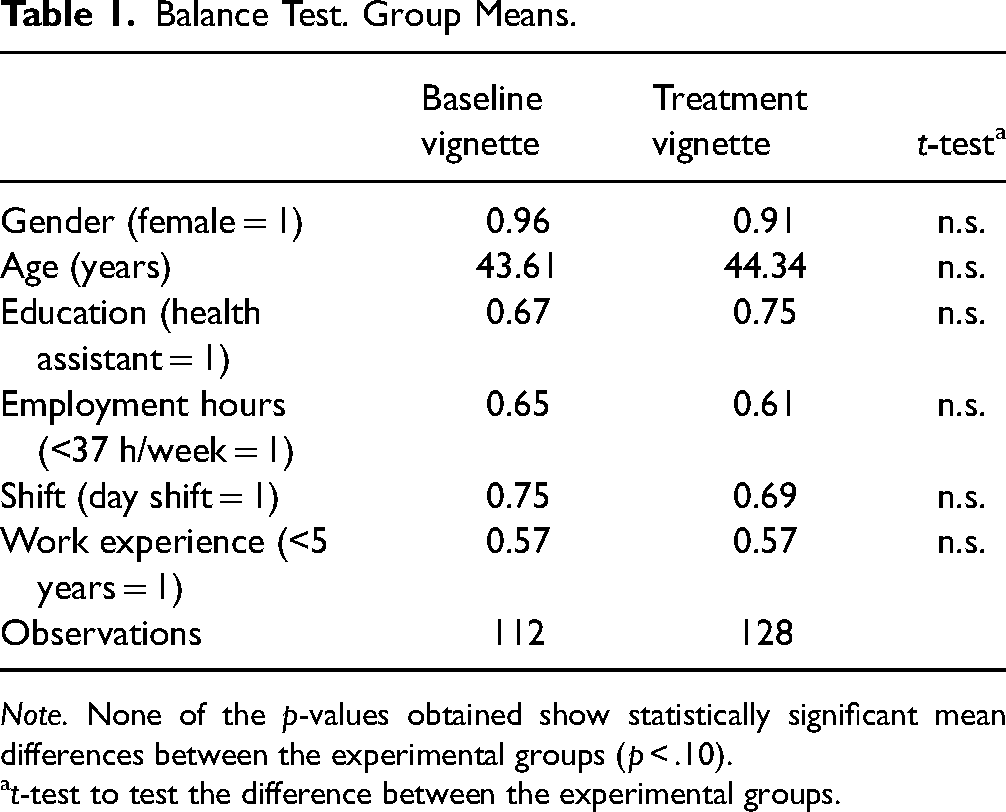
Note. None of the p-values obtained show statistically significant mean differences between the experimental groups (p < .10).
at-test to test the difference between the experimental groups.
Outcome Measures
Following our theoretical argumentation, we developed items to measure ambiguity among nursing home employees: (1) ambiguity about volunteer roles and (2) ambiguity about the relative roles of volunteers and service professionals.
Table 2 shows the results from an exploratory factor analysis for the three items measuring ambiguity among service professionals about volunteer roles. Previous measures of role ambiguity by Rizzo et al. (1970) and Hassan (2013) inspired these items on responsibilities, purpose, and expectation. The third item (“I know exactly which tasks I can expect volunteers to solve”) asks respondents to rate ambiguity concerning the expectations of volunteers. In contrast, the second item (“I understand fully what the responsibilities of volunteers are”) asks respondents to rate ambiguity considering the responsibilities of volunteers. The first item asks respondents to rate the ambiguity in the overall purpose of volunteers’ work (“The objective of volunteers’ work is clear for me”). All three items are measured using a 5-point Likert scale, ranging from “strongly disagree,” “disagree,” “neither disagree nor agree,” “agree,” to “strongly agree.” Table 2 reveals high loadings for all three items (>0.80) and one factor with eigenvalue > 1, suggesting a one-factor solution including all three items. The three-item index demonstrates high internal consistency with a 0.94 Cronbach's alpha score. We, therefore, construct an unweighted index adding the three items together and rescaling the index to range from 0 to 10, with 10 expressing the lowest level of role ambiguity.
Factor Analysis: Items for Ambiguity About Volunteer Roles.
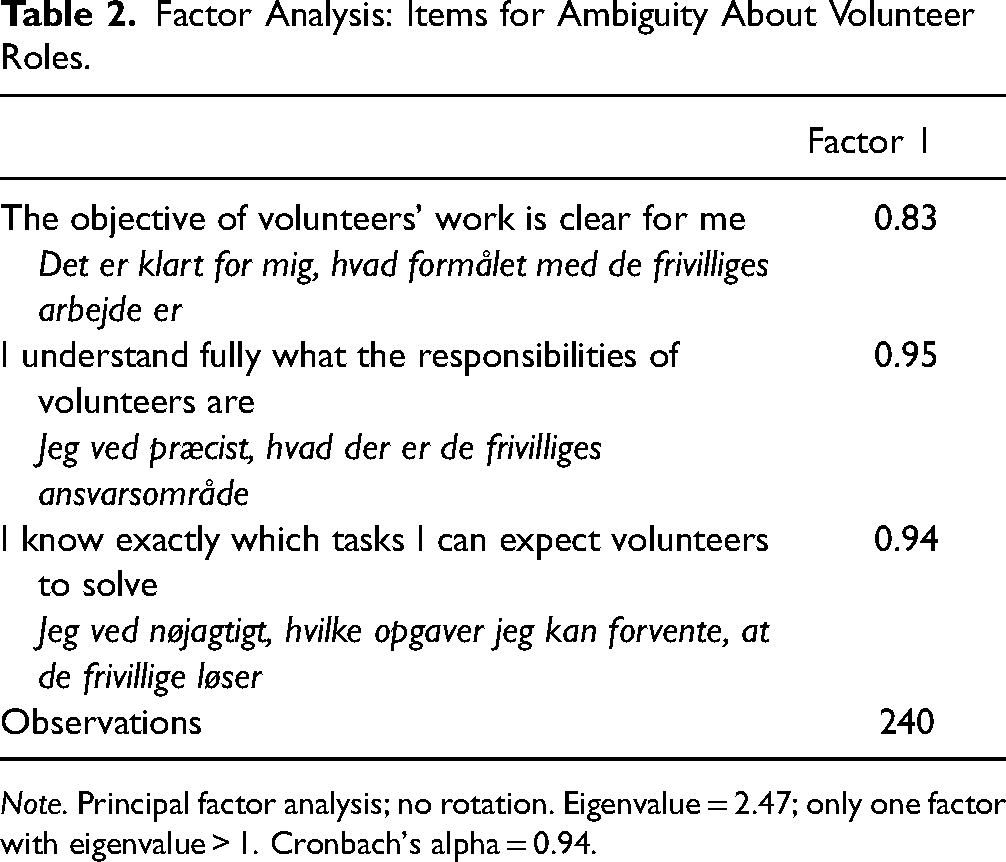
Note. Principal factor analysis; no rotation. Eigenvalue = 2.47; only one factor with eigenvalue > 1. Cronbach's alpha = 0.94.
Table 3 shows the results from an exploratory factor analysis for the three items measuring role ambiguity among nursing home employees about the relative roles of volunteers and service professionals. We use the same 5-point Likert scale, ranging from “strongly disagree,” “disagree,” “neither disagree nor agree,” “agree,” to “strongly agree.” Again, the factor analysis reveals a one-factor solution including all three items. The three-item index demonstrates high internal consistency with a 0.92 Cronbach's alpha score. We, therefore, construct an unweighted index adding the three items together and rescaling the index to range from 0 to 10, with 10 expressing the lowest level of role ambiguity. In the next section, we present our empirical results.
Factor Analysis: Items for Ambiguity About the Relative Roles of Volunteers and Professional Staff.
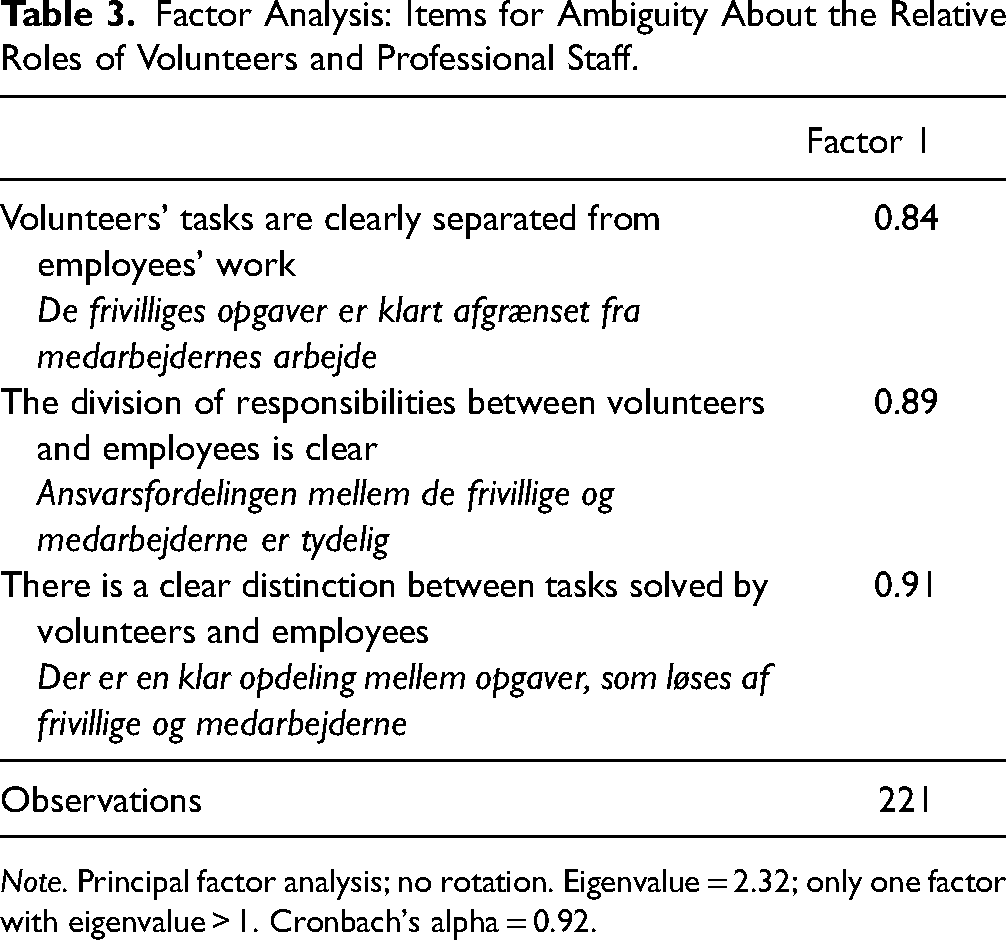
Note. Principal factor analysis; no rotation. Eigenvalue = 2.32; only one factor with eigenvalue > 1. Cronbach's alpha = 0.92.
Results
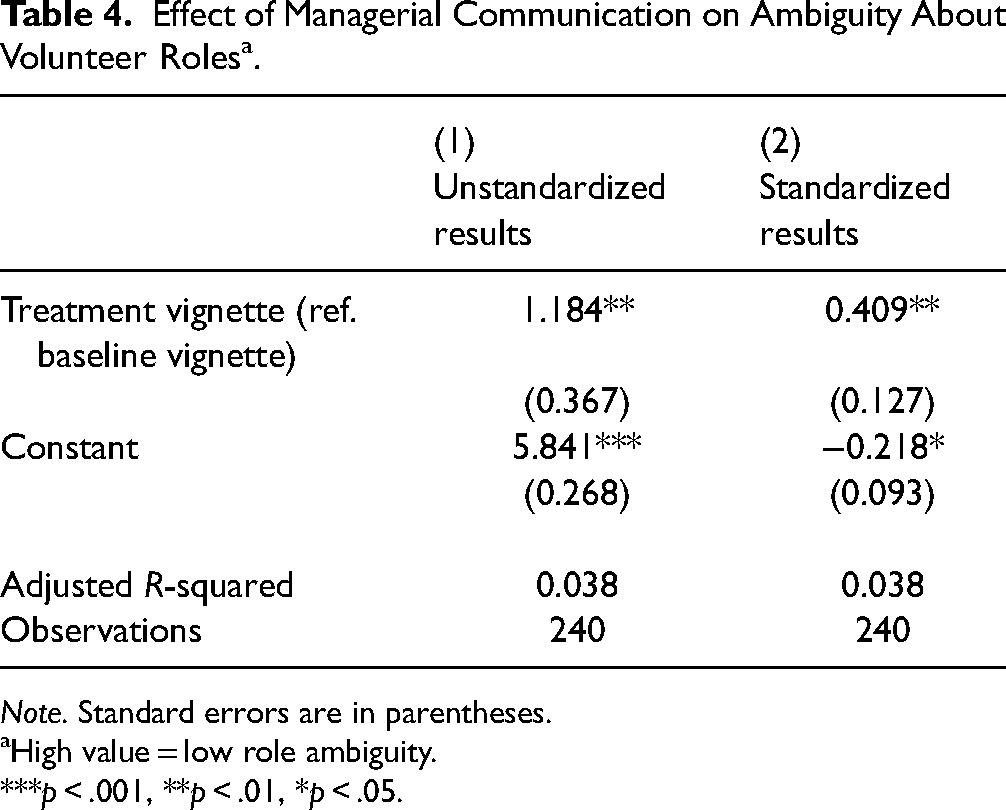
We test the effect of the managerial communication intervention on our two outcome measures of role ambiguity: (1) ambiguity about volunteer roles and (2) ambiguity about the relative roles of volunteers and service professionals. Our models are estimated using OLS regression. We regress our outcome measures on a dummy variable (1 = treatment vignette; 0 = baseline vignette). As a robustness check, we also estimate models including covariates. In Table 4, we analyze the effect on role ambiguity among nursing home employees regarding volunteer roles. We analyze the effect of the vignette specifying volunteer duties (1 = treatment vignette) against the vignette not specifying volunteer duties (0 = baseline vignette). In Model 1, Table 4, we find a positive and statistically significant effect. This result suggests that respondents are less likely to express role ambiguity about volunteer roles when public managers specify the duties of volunteers in contrast to a scenario in which public managers do not specify the duties (high value is equal to low ambiguity). The treatment effect corresponds to an effect size of 0.41 of a standard deviation (see Model 2), and the result is robust to alternative specifications that adjust for covariates (not shown).
Effect of Managerial Communication on Ambiguity About Volunteer Rolesa.
Note. Standard errors are in parentheses.
aHigh value = low role ambiguity.
***p < .001, **p < .01, *p < .05.
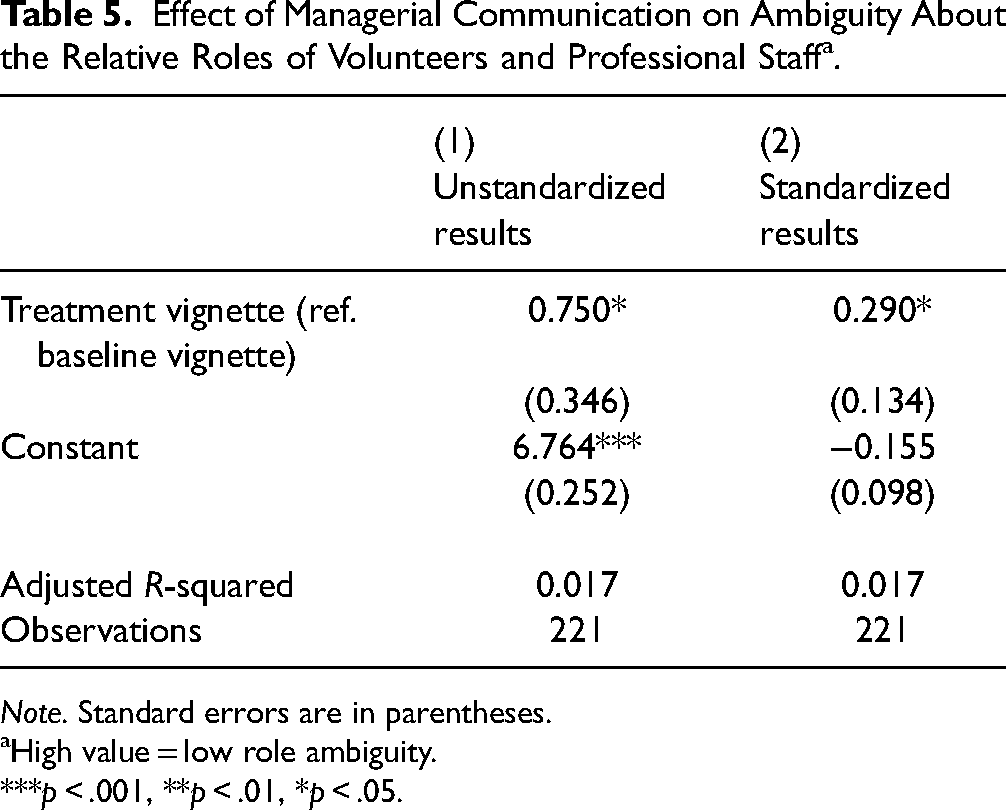
In Table 5, we analyze the effect on role ambiguity among nursing home employees regarding the relative roles of volunteers and service professionals. We find a positive and statistically significant effect (Model 1)—suggesting that respondents are less likely to express role ambiguity about the relative roles when public managers specify the duties of volunteers in contrast to a scenario in which public managers do not specify volunteer duties (high value is equal to low ambiguity). The effect size is 0.29 of a standard deviation (Model 2). Again, the empirical findings are robust when we adjust for covariates (not shown). 1 Taken together, our empirical results support our hypothesis, stating that managerial communication specifying volunteer duties in the organization reduces ambiguity among service professionals about the role of volunteers.
Effect of Managerial Communication on Ambiguity About the Relative Roles of Volunteers and Professional Staffa.
Note. Standard errors are in parentheses.
aHigh value = low role ambiguity.
***p < .001, **p < .01, *p < .05.
Discussion and Conclusion
Influxes of volunteers in public organizations as part of efforts to stimulate and harness the many positive aspects of the coproduction of public services create a peculiar paradox for many managers across the public sector: Volunteers bring with them effort and information that can generate greater service quality (Brudney, 1993; Brudney & Gazley, 2002; Percy, 1983) but simultaneously create or exacerbate ambiguities over the relative roles of volunteers vis-à-vis professional staff. This conundrum is a nontrivial challenge for public managers as role ambiguity not only has been linked to detrimental individual-level outcomes such as lower job satisfaction, frustration, and turnover behaviors but also poses a risk to healthy volunteer–staff relationships (Nesbit et al., 2016). A critical but often overlooked management challenge in coproduction processes is thus to ensure sufficient clarity of the roles of volunteers and the relative roles of volunteers and professional staff. Volunteers engage in coproduction efforts because they are motivated and eager to contribute to public service production and make a difference in the lives of the people public organizations serve. Yet, these good intentions might not always translate into benefits to the organization and its activities if volunteer influxes spur ambiguity about the relative roles of volunteers and public service professionals (Nesbit et al., 2016).
We investigate whether public managers can reduce ambiguity among public service professionals about the roles of volunteers in coproduction processes with a simple, low-cost communication intervention, which would be easy to implement in practice. Based on a survey experimental vignette design among 240 nursing home professionals in Denmark, we show that managerial communication specifying volunteer duties in the organization reduces ambiguity among service professionals about (1) volunteer roles and (2) the relative roles of volunteers and service professionals. Our study contributes to a long-standing literature on role ambiguity in organizational contexts. While much of this literature focuses on the consequences of unclear and ambiguous roles for other job-related attitudes, mental well-being, turnover, and job performance (Hassan, 2013), less attention has been paid to interventions for reducing role ambiguity in general and in coproduction processes. Early contributions by Kahn et al. (1964) asserted that managerial communication constitutes one of the core organizational factors affecting role ambiguity. Yet, little empirical work followed to assess the relative importance of modality, frequency, and content for the effectiveness of managerial communication in reducing role ambiguity. Our results stress the importance of public managers’ communication efforts and demonstrate how actively specifying volunteer duties in the organization can substantially reduce perceived role ambiguity among service professionals about volunteer roles in coproduction processes.
Generalizability
Given that managerial communication practices in line with the one tested in our study are available to managers across the public sector, a natural question is to what extent the findings of this article generalize to other contexts. The first consideration is whether the conclusions extend to the coproduction of other types of duties than the complementary task described in our vignette scenario (Thomsen & Jensen, 2018). According to Brandsen and Honingh (2016), core tasks represent another type of task in public organizations that volunteers can assist with. These tasks tie to the mission of public service organizations, such as assisting with care in nursing homes or education in schools. Given that core tasks often are professionalized and central to the professional identity of permanent staff in public service organizations, we would expect a smaller effect of a similar communication intervention. Communication specifying that volunteers should assist with core tasks directly targets professionals’ role in the organization, putting into question their monopoly on providing certain professionalized services. The communication could even go beyond canceling out the positive information effect to exacerbate the baseline level of role ambiguity among service professionals, but this would be an empirical question for future research to test. Thus, if volunteers are supposed to assist with core tasks, we suggest that we properly call for additional and more comprehensive volunteer management practices besides the low-cost communication intervention tested in our study. Such additional practices could include screening and interviews with volunteers, job descriptions for volunteers, and training of volunteers (Hager & Brudney, 2004). While job descriptions for volunteers may be an additional tool to reduce role ambiguity among professionals, the two other management practices may ensure the recruitment of skilled volunteers and spur skill development, which is also important to ensure positive cooperation between volunteers and professionals.
A second consideration pertains to the issue of whether our results travel to other service areas than nursing homes and other geographical areas than Denmark. While managerial communication presumably has broad application for reducing role ambiguity across organizational contexts, role ambiguity in coproduction processes is likely to be particularly salient for service areas where volunteers are routinely and extensively involved in coproduction efforts and where lower levels of professionalism characterize paid staff. The latter point is important because the delineation between volunteers’ and professionals’ tasks and responsibilities is much more likely to be blurred when work tasks do not require high levels of specialized, theoretical knowledge. For example, it would be unimaginable to think of hospital volunteers subsuming tasks normally completed by physicians. As such, we see the core characteristics of the profession, work tasks, and nature of the service as crucial for thinking about the generalizability of our findings, not necessarily the geographical area of study. For example, we would expect the findings of our study to be generalizable to the frequently studied service area of public libraries (e.g., see Nesbit et al., 2016) regardless of the country of origin for these libraries and more so than we would expect the results to apply to, for instance, a hospital in Denmark. One fruitful avenue for future research would be to extend our design to other service or country contexts where volunteers are heavily involved in coproduction efforts and where the delineation of volunteer and professional tasks and responsibilities is blurred.
Limitations
It is also important for the reader to be attentive to some of the shortcomings of our study. First, our study reports the effects of a managerial communication intervention on perceived role ambiguity among service professionals. Still, it does not assess any proximal attitudinal or behavioral outcomes of role ambiguity. As noted by Nesbit et al. (2016), ambiguity about the relative roles of volunteers and professional staff can cause poor volunteer–staff relationships, and it would be interesting for future research to explore what that looks like. Does role ambiguity lead to less positive coordination between staff and volunteers or negative behaviors such as obstruction or sabotage? And if managerial communication can effectively reduce role ambiguity, can we trace positive effects on collaboration behaviors between volunteers and professional staff? Questions of this kind will be important for future research to better understand the potential of managerial communication for generating positive attitudes and behaviors among volunteers and professional staff.
Another shortcoming of our study is our inability to explore the mechanisms underlying the communication–role ambiguity relationship. Our intervention promises a low-cost, straightforward means for clarifying roles in the context of coproduction processes. Still, it does not allow us to explain the psychological process of how perceptions of role ambiguity come to diminished levels. To fully harness the potential of managerial communication, we need a better understanding of whether and how managerial communication can reduce role ambiguity in public organizations.
Implications
Finally, our study has several implications for practice. When public organizations wish to involve volunteers as coproducers of public services, it is vital that public managers actively articulate the purpose of volunteers’ work, including how volunteers contribute to service production. Proactively communicating volunteers’ purpose, expectations, and responsibilities not only clarifies what they are supposed to do but also helps reduce ambiguity about the relative roles of volunteers vis-à-vis the permanent professional staff.
The good news for public managers is that communication practices like the ones in this study are straightforward to implement without substantial costs to the organization. The ability to convey such information is within the realm of most public managers, and its successful execution requires only a small but worthwhile investment of time and effort.
Footnotes
Declaration of Conflicting Interests
The author(s) declared no potential conflicts of interest with respect to the research, authorship, and/or publication of this article.
Funding
The author(s) received no financial support for the research, authorship, and/or publication of this article.
