Abstract
Despite being touted as a game-changing technology, studies on the influence of body-worn cameras (BWCs) on policing outcomes have produced mixed results, with the underlying reasons for such findings unclear. Drawing on the sociology of culture and organizational theory, we argue that BWCs often have mixed impacts due to deeply ingrained, valued occupational assumptions and practices shaped by the structural and organizational context. These assumptions and practices, collectively known as the police métier, are not politically neutral and can lead to motivated decisions rather than accurate ones. We suggest that such motivated reasoning can be mitigated by changing the structural or organizational context, such as establishing a citizen oversight agency (COA), which could decrease racial disparities in policing outcomes. To test these arguments, we examined the impact of BWCs on racial disparities in two types of policing outcomes: police homicides of citizens and disorderly conduct arrests (DCAs). Our findings indicate that while the adoption of BWCs does not impact racial disparities in DCAs or police homicides of citizens, there is a significant decrease in racial disparity in DCAs when BWCs and COAs are used in conjunction. Additionally, while the racial disparity in police homicides of Blacks and Whites does not decrease when BWCs and COAs are used together, there is an overall decrease in police homicides across both racial groups. Overall, our study demonstrates that technology's impact on bureaucratic performance is influenced by occupational assumptions and practices, which can be altered by external accountability mechanisms such as COAs.
Keywords
Police agencies across America have come under renewed scrutiny amidst allegations of excessive force and racially disparate law enforcement. Moreover, in the aftermath of the killings of George Floyd and Breonna Taylor, policymakers have increasingly sought insight into the efficacy of a range of reforms intended to reduce the incidence of excessive force by police. Amidst this context, body-worn cameras (BWCs) represent a technology that has enjoyed rapid uptake in police agencies nationwide (e.g., Campeau, 2015; Manning, 2008, 2015; Terrill & Ingram, 2016). Heralded as a means of obtaining performance information of police interactions with citizens, BWCs were introduced with the expectation that they would have a civilizing effect on police officers as well as citizens during police-citizen encounters, which would reduce the likelihood of police encounters escalating and turning violent (Chapman, 2018).
However, recent studies and reviews of BWC offer mixed results (Lum et al., 2019; Wright & Headley, 2021). In a review of the studies examining BWC impacts, Lum et al. (2019) conclude that “…BWCs have not had statistically significant or consistent effects on most measures of officer and citizen behavior or citizens’ views of the police. Expectations and concerns surrounding BWCs among police leaders and citizens have not been realized by and large in the ways anticipated by each.” Furthermore, the reasons why BWCs cause behavioral change among officers under certain circumstances while having no impact under others are not well understood (Lum et al., 2019).
Given the above findings, we make two arguments in the current study. First, we argue that the findings on BWC impacts are mixed because the prior literature construes police agencies as politically neutral organizations that respond to accountability mechanisms in straightforward, predictable ways (Headley et al., 2017; Pyo, 2020). Such a view minimizes the role of valued practices, which are based on assumptions about the nature of the work; how it can be best performed; the resources required; and the risks and obstacles to performance. Anchored by the structural and organizational context, the preceding practices are constitutive of the occupational culture of patrol officers. They are meaningful insofar as officers assume them necessary for deterring crime, asserting autonomy, showing productivity, preserving safety, and avoiding supervisor scrutiny.
The above assumptions and practices—collectively termed the police métier—are essential for officers to organize social reality and navigate their work lives (Manning, 2010). We argue that absent changes in the structural and organizational context that shift the above métier, officers will tend to use technologies (such as BWCs) in ways that reproduce the above assumptions and practices. Thus, if technology is viewed as irrelevant to deterring crime, encroaching on officer autonomy, or interfering with the efficient enactment of duties, it will be resisted, turned off, seldom used, or perhaps even sabotaged (Manning, 2008). In essence, we suggest that the métier serves as a lens through which police officers engage in motivated reasoning, that is, reasoning that leads to desired rather than accurate decisions (Kunda, 1990).
Consequently, we argue that if the control of and authority to review BWC evidence is vested solely within police agencies, then the métier will lead police supervisors to adjudicate BWC evidence in ways that absolve officers alleged to have committed misconduct. For instance, supervisors may reason that an officer's actions cannot be easily judged because “You had to be there” to understand why the officer acted in a particular way in a specific situation (Manning, 2010). Alternatively, supervisors may reason that disciplining the officer might reflect poorly on police agency leadership or make the agency the target of unwanted media attention. Thus, motivated reasoning will tend to encourage self-serving decisions, thereby frustrating the intent of BWCs to inject alternative logics into policing practices.
On the other hand, we argue that if citizen oversight of BWC evidence exists, motivated reasoning will likely be mitigated. This is because citizen oversight would decrease the insularity necessary for members of the police agency to reproduce routinized practices and assumptions. Thus, if BWC evidence is subject to review by a citizen oversight agency (COA), officers would be more likely to adhere to constitutional standards when dealing with racialized minorities, which, in turn, would decrease the racial disparity in policing outcomes.
Second, we argue that even if a COA can review BWC evidence, the latter's impact on policing outcomes will depend on situational exigencies during citizen-police encounters, such as an officer's intuitive grasp of danger, and the consequent discretion officers can exercise (Lipsky, 1980; Manning, 2010). Thus, police behavior will be more susceptible to change during encounters that involve little danger (e.g., disorderly conduct arrests [DCAs]; Skolnick, 1966) because such encounters afford police officers broad discretion. On the other hand, officer behavior during encounters that are likely to involve danger (e.g., encounters that result in a police homicide of a citizen) would be less likely to change because such encounters afford relatively narrow discretion to police officers.
In this study, we examine whether BWCs are associated with a reduction in either racial disparities in DCAs or police homicides of citizens. In support of the argument above, we find that merely adopting BWCs does not impact either outcome. However, when a COA accompanies BWC adoption, racial disparity in DCAs decreases. Furthermore, while police homicides of Blacks and Whites decline when BWCs are accompanied by COAs, racial disparity in police homicides remains unchanged because the declines in police homicides of Blacks and Whites offset each other.
Literature Review
There have been several studies in recent years in which scholars have sought to highlight the phenomenon of motivated use of performance information and performance management systems more generally. These studies have demonstrated the phenomenon of motivated reasoning in experimental settings (Baekgaard & Serritzlew, 2016; Belardinelli et al., 2018), in policing (Campeau, 2015; Manning, 2008, 2010; Terrill & Ingram, 2016), medicine (Kerpershoek et al., 2016), and probation services (Sabbe et al., 2021). Building upon ideas whose pedigree can be traced back to the concept of bounded rationality (Simon, 1957), these studies suggest that despite the intent of introducing greater rationality in decision-making, technological innovations are not likely to be used in a politically neutral fashion. Instead, individuals’ use of technologies and interpretation of the information they produce will be driven by deeply ingrained, valued occupational assumptions and practices, which, in turn, are shaped by the structural and organizational context (also see Kraft et al., 2015). The upshot is that unless the structural or organizational context shifts which, in turn, leads to a change in the valued assumptions and practices, organizational routines and the outcomes they produce are not likely to change.
An illustration of the motivated use of technology is found in a study conducted by police organizational scholar Manning (2008), who assessed the implementation and operational impact of crime analysis and crime mapping (CA/CM) in three police agencies. While the three cities implemented CA/CM technology to encourage rational problem solving, adoption of best practices, and enhance accountability, Manning found that it “did not change any significant practice in the three organizations studied” (p. 251). There was minimal follow-up on the strategies proposed in CA/CM meetings; criminogenic characteristics of neighborhoods (e.g., unemployment, inequality) were ignored, and officers on the ground rarely, if ever, referred to maps from the CA/CM databases. Instead, officers persisted in situated decision-making in the here-and-now and referred to trusted information sources, such as other officers at the scene, databases to run vehicle plates, driving licenses, and outstanding warrants.
The above outcomes resulted because patrol officers were committed to practices that were assumed valuable for controlling crime in the short term—which officers viewed as their core function. These practices included random patrol, efficient disposition of calls for service, situated decision-making in the “here-and-now,” demonstration of productivity, and preservation of officer safety. By contrast, initiatives that aimed to reduce crime in the long term or encourage problem-solving had little purchase on shaping day-to-day practices because they were seen as interfering with the short-term focus or otherwise responding to structural problems of neighborhoods (e.g., unemployment, poverty, inequality), which patrol officers viewed as beyond their capacity to redress.
In effect, occupationally valued assumptions about efficient, responsive policing as providing the best way to deter crime in the short term precluded engagement with CA/CM among street-level police officers. In short, CA/CM was seen as inconsistent with the deep assumptions that give street-level policing practices meaning, thereby limiting the former's impact.
We argue that the valued assumptions and practices alluded to above constitute the occupational métier of patrol officers. The métier, in turn, is anchored by structural factors such as societal deference for professional decision-making and the mandate conferred on a profession by society. In addition, the organizational context, where such practices are negotiated and legitimated, also shapes the métier.
In the next section, we draw upon the theory of culture as “practice” to frame valued practices and assumptions constituting the occupational métier (Bourdieu, 1991; Hallett, 2003). We argue that the police métier serves as a lens for socially situated action and decision-making by street-level officers. We offer a description of the avenues through which the métier of street-level police officers can change and the factors that shape the extent of the above change. Finally, we apply this theoretical framework to introducing BWCs in police agencies and hypothesize their impact on policing outcomes with and without citizen oversight.
The Occupational Métier of Street Level Police Officers
Ethnographic studies of police confirm that the tactics and behaviors of police officers at the street level are indeed informed by enduring occupational assumptions and practices (Bittner, 1970; Manning, 2010; Moskos, 2008). One way to apprehend the police métier is via understanding their mandate (which, in turn, derives from the structural context); the conditions under which the mandate is carried out; how the meaning of the mandate is negotiated within the organizational context; the assumptions and practices it engenders; and the consequences of these efforts. We discuss these topics while drawing from the above studies, with an eye toward highlighting the implications of the métier for using BWC evidence. 1
The Structural Context of Policing
The police have been assigned the mandate of crime prevention and detection, apprehending criminals, and maintaining public order. While summarized pithily as “maintenance of law and order,” the mandate is exceptionally broad in practice. It includes tasks as diverse as being expected to calm down people having mental health episodes, directing traffic, to performing undercover drug sales, and investigating homicides. In essence, it encompasses a broad domain of activities that varies over time. It is defined mainly by the many publics that police serve, ranging from politicians, and businesses to the general citizenry.
A second aspect of the structural context of policing relates to the social conditions in which they perform their work. Police operate in a challenging structural context of political and economic inequality, race and class segregation, and long-standing racialized stereotypes about crime and disorder. While most police work is viewed by officers as mundane and does not involve danger, street-level officers encounter situations with citizens that are inherently ambiguous and unpredictable, and the potential for violence cannot be ruled out (Manning, 2015). Nevertheless, police officers are expected to treat citizens in a way that respects their civil rights.
Thus, the open-ended mandate and the conditions of work represent two salient aspects of the structural context of policing in the United States. Nevertheless, members rarely accept the mandate assigned to any occupation wholesale or passively. Instead, there is a dialectical tension between the mandate granted to an occupation by the public and the occupation's rendering of that mandate, that is, the delimited tasks and duties that the occupation sees as comprising the mandate (Manning, 2008). Specifically, occupations seek to assert control over the tasks, attitudes, and values that set them apart from other specialized occupational groups. They take advantage of the cultural legitimacy accorded to professions in the modern era to claim a body of theory and practice to justify their right to discover and define values, attitudes, and practices necessary for implementing the mandate. These values, attitudes, and practices are negotiated in the organizational context, where officers interact with each other and the external environment as the organizational context meets street-level reality.
Negotiation of Practices in the Police Organization
Given the array of contingencies for which citizens call for police assistance, it is inevitable that officers make simplifying assumptions (about the nature of their work, the public, crime and disorder, likely perpetrators, and locales) to define and control their work. These assumptions and associated practices are coping responses to structural and organizational demands and emerge as officers negotiate behaviors that are viewed as facilitating the attainment of valued organizational goals (Tummers et al., 2015). However, as noted by Tummers et al., these practices are not politically neutral but may potentially have deleterious effects on the rights of citizens. Street-level officers absorb these practices and the assumptions they are couched in from field-training officers and experienced officers who are regarded as having symbolic power and are conferred legitimacy by rookie officers.
Focus on Efficient, Productive, Crime-Fighting
A consequence of having an open-ended mandate formulated by external audiences is that it is challenging to demonstrate effectiveness, an institutional expectation in our result-oriented culture. The police have sought to cope with this tension by adopting practices deemed valuable for deterring crime and restoring order in the here-and-now (Manning 2015). These include random patrol, efficient disposition of calls for service, 2 investigating reported crimes, and making “good pinches,” that is, arrests likely to result in convictions (Manning, 2005). These practices are viewed as meaningful because they help police demonstrate efficiency, productivity, and responsiveness. The public's response, in turn, has been to equate the rate of arrests with how well the police deter crime, which further increases the demand for arrests. The emphasis on arrests has also legitimated its conversion into an organizational criterion for promotion, occupational prestige, and job security.
Nevertheless, the organization's (and the public's) legitimation of the above practices is problematic because it engenders the assumption that police ought to be efficient, productive crime fighters. To the extent that this assumption is emphasized, it is likely to hinder procedural goals of work (Behn, 2001), per which police are expected to be impartial and produce “justice through the fair, effective, and restrained use of authority” (National Research Council, 2004). Similarly, the institutionalization of the above assumption is likely to encourage the use of technologies that serve efficiency, productivity, and “crime-fighting ends.”
For instance, Manning (2008) found that even though police neglected the CA/CM technology, which they saw as incompatible with the here-and-now focus of street-level policing, they continued to query other databases valued for making arrests during traffic stops. These included databases to run number plates, driving licenses, outstanding warrants, criminal records, or other field stops. Similarly, Meehan (1998) found that technologies that increased monitoring and surveillance of officers (e.g., dashcams, transponders, and GPS devices used to track movements of units) tended to be resisted, turned off, damaged, or sabotaged (also see Bromberg & Charbonneau, 2021). These practices—acts of omission and commission—are meaningful because they allow officers to enhance their sense of self-efficacy and avoid accountability.
Rationalization of Illegal Force
As alluded to above, while most police work does not involve danger, the situations that street-level officers encounter in interactions with citizens are often viewed by the former as ambiguous, unpredictable, and potentially violent. Moreover, these suspicions and the distrust they engender are accentuated by working in contexts characterized by political and economic inequality, concentrated disadvantage, and racialized stereotypes of crime and disorder.
Thus, street-level cops often rationalize the necessity of illegal force when their authority is challenged, their safety is threatened, or when the officer does not believe that the suspect is likely to face some measure of “justice” unless the officer metes it out (Hunt, 1985; Manning, 2005; Skolnick, 1966; Wright, Gaozhao & Houston, 2022). While academy training emphasizes the use of legal force (i.e., coercion necessary to subdue, control, or restrain a suspect), officers on the street are acculturated (through interactions with field-training officers and experienced patrolmen) into accepting many forms of illegal force as “normal” and “necessary” to help officers gain compliance; preserve their safety during encounters with citizens (Hunt, 1985); and return home safely at the end of their shift (Moskos, 2008).
At the supervisory level, sergeants and commanders are cognizant of the uncertain situations that street-level officers encounter and rationalize the latter's use of force by overlooking the use of illegal force (Hunt, 1985), tolerating the mistreatment of people in “crime-ridden” areas (Moskos, 2008), or rationalizing that a street cop's decisions cannot be second-guessed because “You had to be there” (to understand why the police officer took certain decisions or acted in a certain way) (Manning, 2010). Such rationalizations are facilitated by the fact that officer actions are decisions that are rarely, if ever, subject to the scrutiny of oversight mechanisms outside the police agency.
To summarize, we have argued that the structural context of patrol officers offers an open-ended mandate and an environment where the likelihood of violence cannot be eliminated. Officers reconcile the tensions created by this context by negotiating practices that are absorbed from field training officers and experienced patrolmen and are encouraged by organizational rewards. These practices are meaning-laden because they are seen as leading to valued organizational goals. They are couched in assumptions taken for granted in the course of work, how it will be carried out, and why. The assumptions are reciprocally reinforcing, and the practices are validated by cross-referencing with other congruous assumptions that generate them (Manning & Raphael, n.d.). Nevertheless, the effects of these assumptions and practices are not neutral with respect to the race, class, and gender of the citizens that police serve.
The Impact of the Métier on the Use and Interpretation of BWC Evidence
The métier serves as a frame of reference that conditions bureaucrats’ sense of identity and self, as well as their choices. It functions as a lens or medium through which the use of technology is shaped or “refracted.” 3 The implication is that technologies ostensibly introduced to inject alternative institutional logics (e.g., accountability, transparency, equity) into bureaucratic routines are likely to be viewed in relation to the métier. Specifically, if bureaucrats judge a technology to conflict or interfere with the efficient enactment of valued practices, increase unvalued work, decrease autonomy, or other increase monitoring of bureaucratic practices, then it is likely to be ignored, neglected, or instrumentalized in ways that reproduce the logic of the métier.
In short, absent changes in the structural or organizational context that cause the assumptions and practices in the métier to change, technological innovations are likely to be neglected or used in ways that reproduce the métier, thus diluting the intended effect of the technology. In other words, technology is likely to be used in motivated ways, that is, to make desired rather than accurate decisions (Kunda, 1990).
Figure 1 shows a schematic representation of how valued occupational assumptions and practices induce decision-making concordant with the métier. It shows that bureaucrats (1) make sense of the structural and organizational demands that bear upon them; (2) negotiate the meaning of assumptions and practices that are deemed valuable for the attainment of organizational goals; and (3) make motivated decisions through the lens of the métier.

Bureaucratic decision-making in the presence of motivated reasoning.
Thus, we argue that if the police have the sole responsibility for reviewing and storing BWC evidence, there is a strong likelihood that rationalization of the métier will lead street-level officers to neglect BWCs (e.g., officers may “forget” to turn on their cameras, change the camera angle, record over previous recordings) or instrumentalize BWCs in ways that allow officers to avoid accountability. For instance, Bromberg and Charbonneau (2021, p. 74), in their research examining the circumstances under which police agencies release BWC evidence to the public, found that police chiefs often praised BWCs for their ability to hold citizens accountable for their behavior and that BWCs were primarily used to dismiss citizen complaints.
Rationalization of the métier is also likely to encourage supervisors to adjudicate BWC evidence in ways that absolve officers alleged to have committed misconduct. For instance, supervisors may reason that an officer's actions cannot be easily judged because “You had to be there” to understand why the officer acted in a particular way in a specific situation (Manning, 2010), that disciplining the officer might reflect poorly on the agency's leadership; make the agency the target of unwanted public or media attention (Manning, 2014).
Thus, if police agencies are the sole custodians and reviewers of BWC evidence, the police métier is likely to encourage motivated decisions vis-à-vis the above evidence, thereby frustrating the intent of BWCs to inject the logic of democratic accountability into policing practices. Thus, we hypothesize that the mere adoption of BWCs would not lead to any change in law enforcement outcomes, such as racial disparities of DCAs or homicides of citizens.
BWC adoption will not impact racial disparities in DCAs.
BWC adoption will not impact racial disparities in police homicides of citizens.
Citizen Oversight as an Institutional Mechanism for Mitigating Motivated Reasoning
We argue that a COA provides an institutional mechanism through which the practices of patrol officers and the supervisors who review BWC evidence may be questioned. Serving as an external accountability mechanism, the prospect of such questioning would create the possibility that supervisors would have to justify their decisions regarding the appropriateness of officer conduct captured on camera. We argue that this possibility would induce supervisors within police agencies to (a) review BWC evidence more deliberately (i.e., regularly and carefully) and (b) in an aboveboard manner so that it is justifiable to an external reviewer. In addition, citizen oversight of BWC evidence may encourage street-level officers to be more mindful of adhering to constitutional standards while interacting with citizens. In short, we argue that if a COA exists, it can plausibly mitigate the motivated interpretation of BWC evidence.
The above assertion is supported by abundant evidence from experimental and field studies, which demonstrate that when decision-makers expect to justify their judgment to others, they are likely to pursue accuracy goals. Specifically, when individuals expect to justify their judgments to others, they are likely to use more cognitive efforts on issue-related reasoning, attend to relevant information more, and process it more deeply, often using more complex and time-consuming strategies (Kunda, 1990). In addition, various experimental studies have demonstrated that manipulations designed to increase accuracy motives decrease the tendency to use ethnic stereotypes in evaluations (for instance, see Freund et al., 1985; Kruglanski & Freund, 1983).
Analogously, studies have also shown that citizen oversight of police is associated with greater rigor in internal affairs investigations into misconduct allegations. For instance, Terrill and Ingram (2016) assessed the extent to which different oversight models (i.e., internal affairs, command-level, or citizen oversight) were associated with whether citizen complaints against police were sustained. They found that when a COA could review internal affairs findings, the odds of a sustained disposition increased by 78%, compared to if they were investigated by internal affairs alone. Moreover, oversight models where complaints were investigated at the command level were 39% less likely to sustain complaints than when the internal affairs division solely investigated complaints. These findings suggest that review of complaint investigations by COAs results in a higher proportion of complaints being sustained.
Even if a COA does not have the authority to review BWC footage in a particular instance, there is the possibility that it may acquire it in the future. Given that COAs often have the authority to conduct retrospective reviews or audits of police practices and records (De Angelis et al., 2016; Walker & Archbold, 2019, Wright et al., 2023), it is possible that they could, at some point, gain access to BWC footage that was heretofore unavailable. 4 Police supervisors would consider this possibility and be induced into being more mindful of accuracy goals when evaluating BWC footage when a COA exists. Figure 2 offers a schematic representation of how the introduction of COA constitutes a change in the structural and organizational context of policing, which is likely to lead to a change in the assumptions and practices of the police métier. These changes are likely to mitigate the motivated interpretation of BWC evidence as officers shift their focus from performance to procedural demands of work. Said differently, while BWC evidence allows for the increased observability of police behavior, COA review of the above evidence increases the likelihood that police would be held accountable for the above behavior. The combinative effect of BWCs and COAs, in turn, mitigates the challenge of assessing policing outputs and outcomes that typify “coping” organizations (Wilson, 1991).
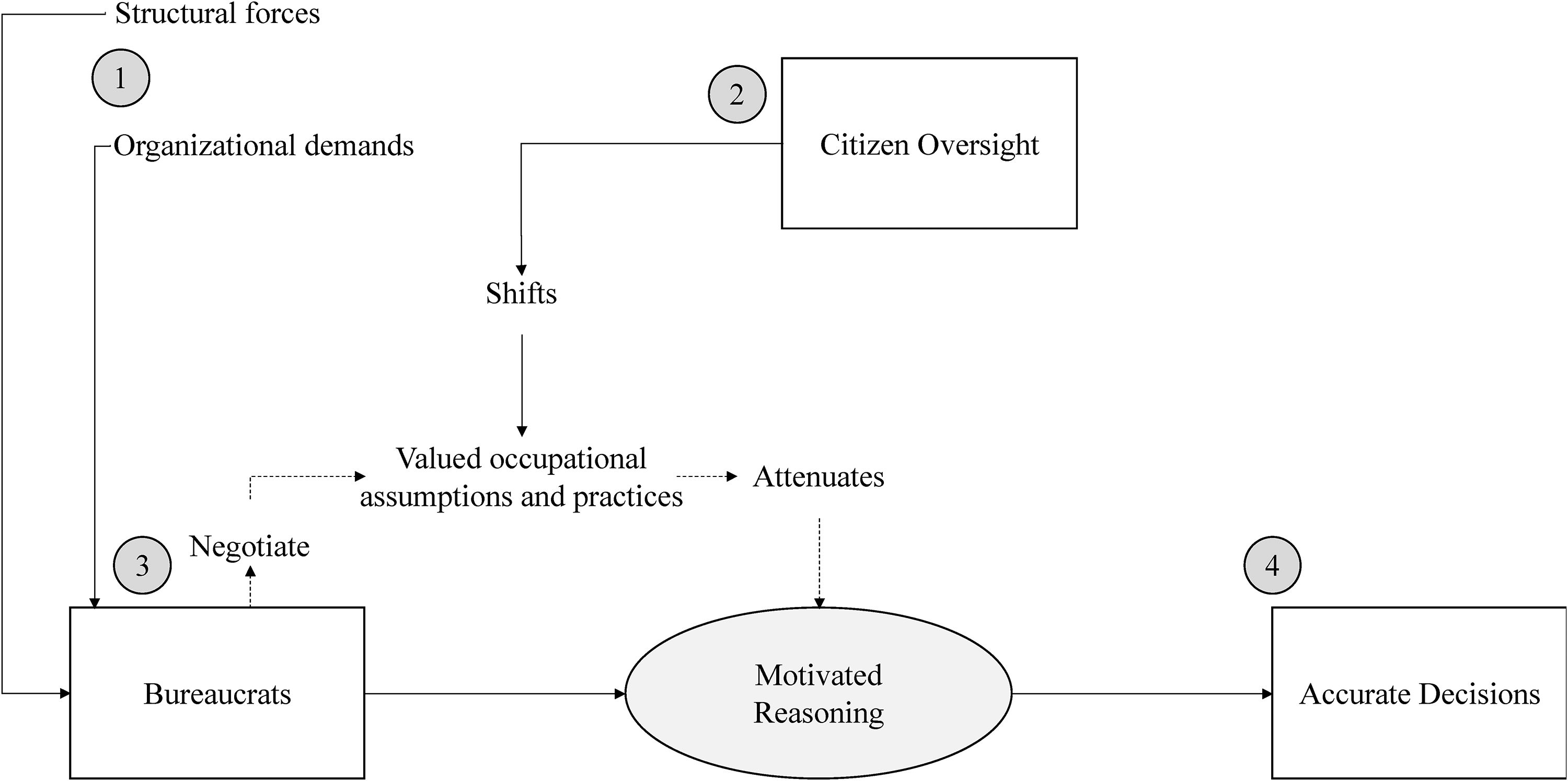
Bureaucratic decision-making in the presence of motivated reasoning, when citizen oversight is present.
Thus, we hypothesize the following:
Citizen oversight in conjunction with BWC adoption will reduce racial disparities in DCAs.
Citizen oversight in conjunction with BWC adoption will reduce racial disparities in police homicides of citizens.
The Impact of Scope of Discretion on the Combinative Effect of BWCs and COAs
While external oversight is likely to mitigate motivated reason in evaluating BWC evidence, we do not expect it to have uniform impacts on all law enforcement outcomes. Instead, we argue that the extent of change in law enforcement outcomes would be limited by the danger perceived by street-level officers during different types of enforcement actions. For example, given that DCAs are likely to pose little danger to officers, the latter would be more likely to change their behavior in response to the combinative effect of BWCs and citizen oversight. By contrast, we expect that enforcement actions that result in a police homicide of a citizen are, on average, likely to include encounters that involve a high level of danger and unpredictability. Thus, compared to DCAs, we expect police officers to be relatively less likely to change their behavior in response to heightened oversight of BWC footage in the case of police homicides of citizens.
The above arguments lead us to hypothesize the following:
The reduction in the racial disparities in police homicides of citizens due to the combinative effect of BWCs and citizen oversight will be less than the decrease in racial disparity in DCAs.
Empirical Strategy
To ensure that a potential reduction in racial disparities in the outcomes of interest is not driven by increased enforcement against Whites, we assessed the impact of BWCs on enforcement against Blacks and Whites individually and collectively. Thus, we examined the impact of BWCs and COAs on the following variables: (1) DCA rates among Blacks, (2) DCA rates among Whites, (3) racial disparity in DCAs, (4) police homicides of Blacks, (5) police homicides of Whites, (6) racial disparity in police homicides.
We chose DCAs and police homicides of citizens because they represent encounters that pose different levels of danger to police officers, which, as alluded to above, will impact the extent to which BWCs and COAs have a combinative effect. Furthermore, we chose to focus on racial disparities in the above outcomes because while fairness and constitutionality in policing were among the significant reasons behind the push for BWC, there has been scant research on the impact of BWCs on the above disparities (Lum et al., 2019). Similarly, there has been little to no theorization of the contingent impact of BWCs in relation to the institutional design of BWC implementation. Given that such research has been identified as a priority for policing scholars and because public administration scholarship can inform theory in this area, the current study seeks to address these gaps.
The period chosen for all the outcomes is from 2000 through 2015. Our sample consists of cities in the United States with a population greater than 100,000 persons as of 2010 (i.e., n = 261).
We model the impact of BWCs on the above outcomes through a two-way fixed effects model, which takes the following form:

Covariates are divided into organizational (i.e., police agency) and city-level covariates. Organizational covariates include an indicator for whether the police agency was under a consent decree or court-ordered agreement to reform policing practices, the police budget, and the number of sworn officers per 100,000 persons. Being under a consent decree or a court-ordered agreement for reform was included because these institutional checks can plausibly influence the fairness of policing practices in a jurisdiction (Davis et al., 2002; Stone et al., 2009) and hence the racial disparities in policing outcomes. The police budget and the number of sworn officers per 100,000 persons were included because an increase in these variables has been found to be correlated with more misdemeanor arrests which tend to be concentrated in poor neighborhoods and communities of color and which, tend to exacerbate the racial inequity of policing practices (Beck et al., 2022).
City-level covariates included the city population, percentage of the population that is Black, per capita income, unemployment rate, percentage of the population that is 25 + and has a bachelor's degree, and violent crime rate. Similar to agency-level covariates, city-level covariates were used because prior research has found them to be correlated with policing patterns over time across lines of class and race (Zhao et al., 2006, 2012).
The two-way fixed-effects model includes city-specific fixed effects, which control for unobservable, city-specific, time-invariant characteristics of individual cities, which may be correlated with the treatment. Additionally, year-specific fixed effects control for secular trends in the dependent variables. We used the Poisson fixed effects estimator to estimate the impact of BWC adoption on police homicides of citizens as it is a valid fixed effects estimator (as opposed to the negative binomial)—and has been found to reliably estimate the effects of regressors as well as establish statistical significance, even in the presence of over-dispersion (Wooldridge, 1999). All Poisson models we estimated accounted for unequal exposure to the risk of arrest or homicide by specifying the population of persons (18 + years of age) of each race in a city-year as the exposure variable. The impact of BWC adoption on DCA rates was estimated through a fixed-effects OLS regression. All estimated models account for intragroup correlation using robust standard errors clustered at the city level.
Data
Dependent Variables
Data on police homicides of citizens were obtained from the crowdsourced database, the Fatal Encounters (FE) Project, which is maintained and fact-checked by a nonprofit. This database catalogs every police-involved death since 2000. While the Federal Bureau of Investigation (FBI) does collect data on police-involved civilian deaths, these data are subject to substantial underreporting, the extent of which varies across jurisdictions (Barber et al., 2016). Several recent public administration studies studying police homicides of citizens have either directly used the FE database or have used it to cross-check data gathered from other crowdsourced databases (Jennings & Rubado, 2017; Menifield et al., 2018; Nicholson-Crotty et al., 2017). Appendix A details how the counts of police-involved civilian deaths from a firearm were ascertained.
Data on DCAs were obtained from the Uniform Crime Reports (UCR). We calculated the rate of DCAs for Blacks and Whites separately by dividing the number of arrests of Black and White adults by the total number of Black and White adults in the city and multiplying the result by 100,000. Ultimately, we were left with 2,634 police homicides of citizens and 1,777,798 DCAs from 2000 through 2015 across the cities in our sample.
Independent Variables
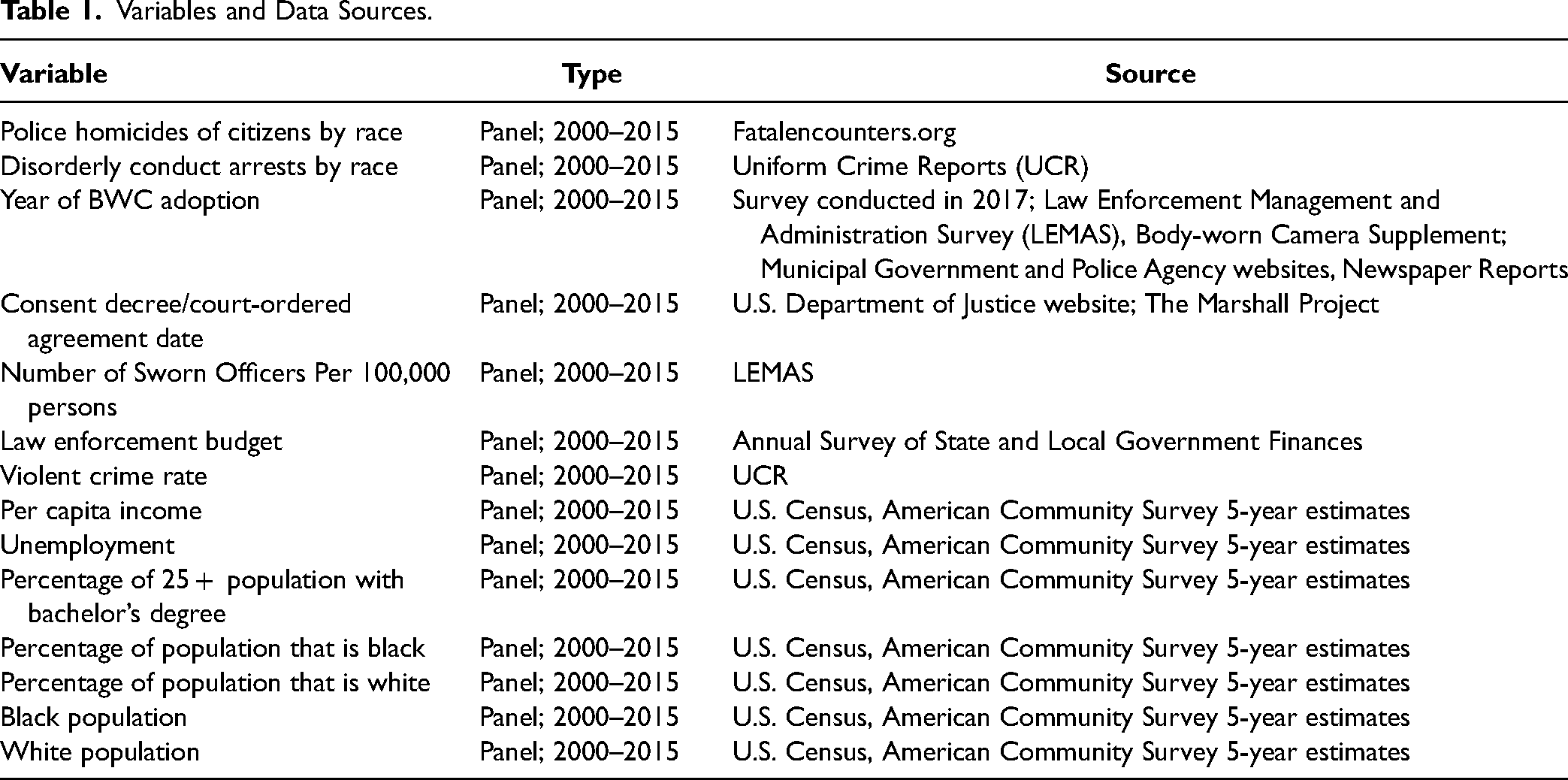
Table 1 summarizes the data sources utilized in this study. Per the 2010 U.S. Census, 263 cities had a population equal to or greater than 100,000 persons (U.S. Census Bureau, 2010). We sought to obtain data on the year of BWC adoption for these cities through the BWC supplement in the 2016 Law Enforcement Management and Administrative Statistics (LEMAS). Out of the 263 police agencies in these cities, 127 adopted BWCs at some point between 2000 and 2015, and 134 did not, while adoption status could not be determined for two cities through the LEMAS. This resulted in a potential sample of 261 cities.
Variables and Data Sources.
To determine the date of the establishment of COAs, we first developed a list of all cities in the country with an oversight agency. This list of cities was developed through online searches and the National Association for Citizen Oversight of Law Enforcement (NACOLE). NACOLE is a nonprofit organization that provides a platform for individuals and organizations to establish citizen oversight in the United States. The list of COAs was then corroborated and supplemented with information provided by scholars who have previously studied citizen oversight.
Through the above procedures, we determined 111 cities in the United States to have an oversight agency. We surveyed these agencies in mid-2017 to determine their dates of establishment. The director of each COA was first contacted through a letter sent via post, in which we introduced our study and requested their participation in an online survey whose link would be sent via email in about a week. Around two weeks after the initial email containing the link to the online survey was sent, non-respondents were reminded via phone to complete the survey. Survey responses received up to 2 months after sending the initial email were included in the data set for the current analysis.
Out of the 111 cities whose COA directors were surveyed, 88 jurisdictions responded to the survey, resulting in a response rate of around 79.27% (=88/111). Among the responding COAs, one had been created in 2016, so it was not used in our analysis. Another COA returned a survey that was only partially complete, and another four COAs were in cities with fewer than 100,000 persons as of 2010. Removing these six cities from our sample, we were left with 82 COAs that could be used in the analysis.
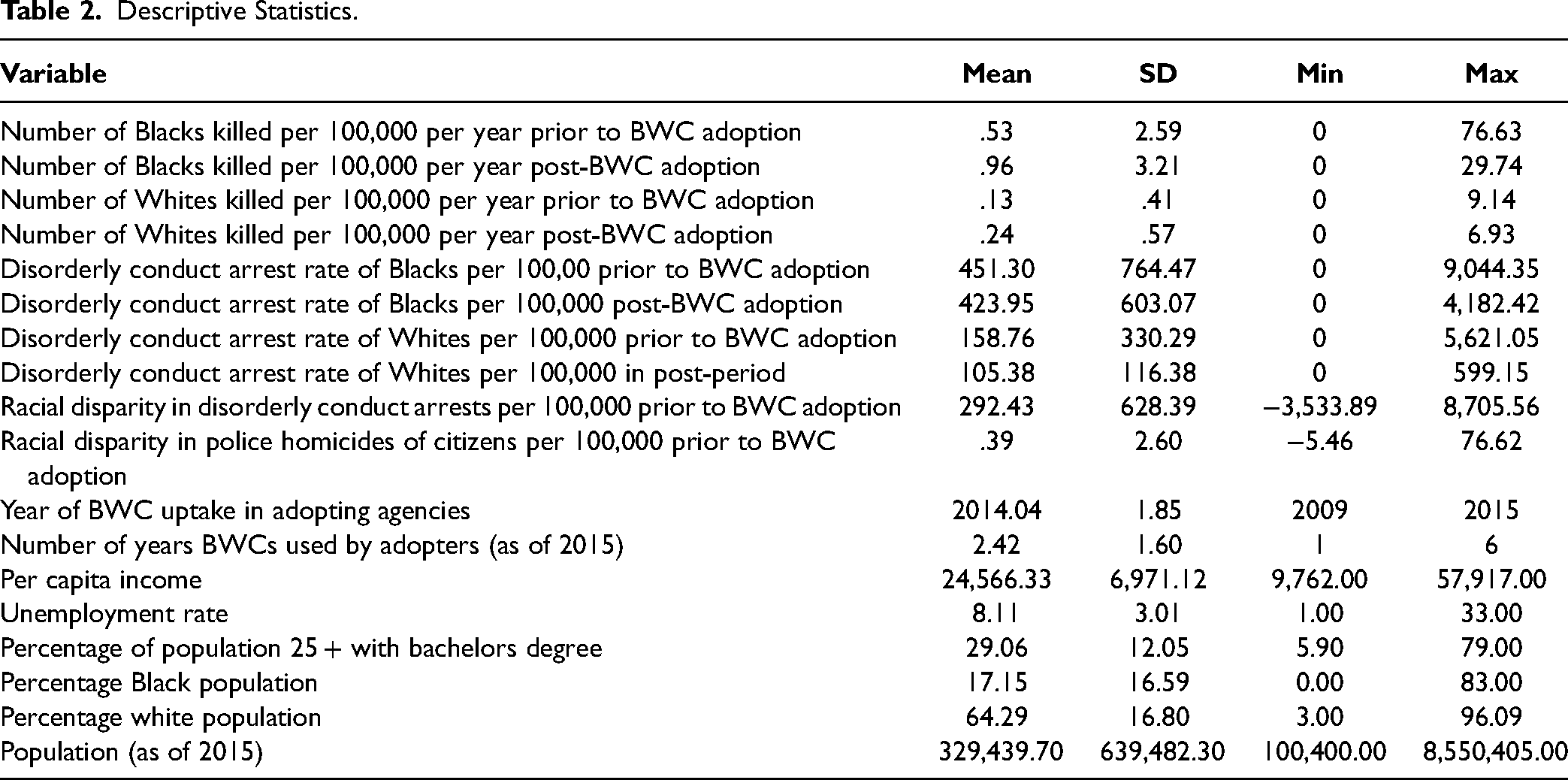
Thus, our sample consisted of 51 cities that had both BWCs and a COA; 76 cities that had BWCs but no COA; 31 cities with a COA but not BWCs; and 103 cities that had neither—for a sample of 261 cities spanning 16 years (i.e., 2000 through 2015). Figure 3 shows the geographical dispersion of the cities in the sample by BWC adoption status as of 2015. Table 2 shows the descriptive statistics for the variables used in the analysis.

Geographic dispersion of cities (with a 2010 population of 100,000 or more) by BWC adoption status.
Descriptive Statistics.
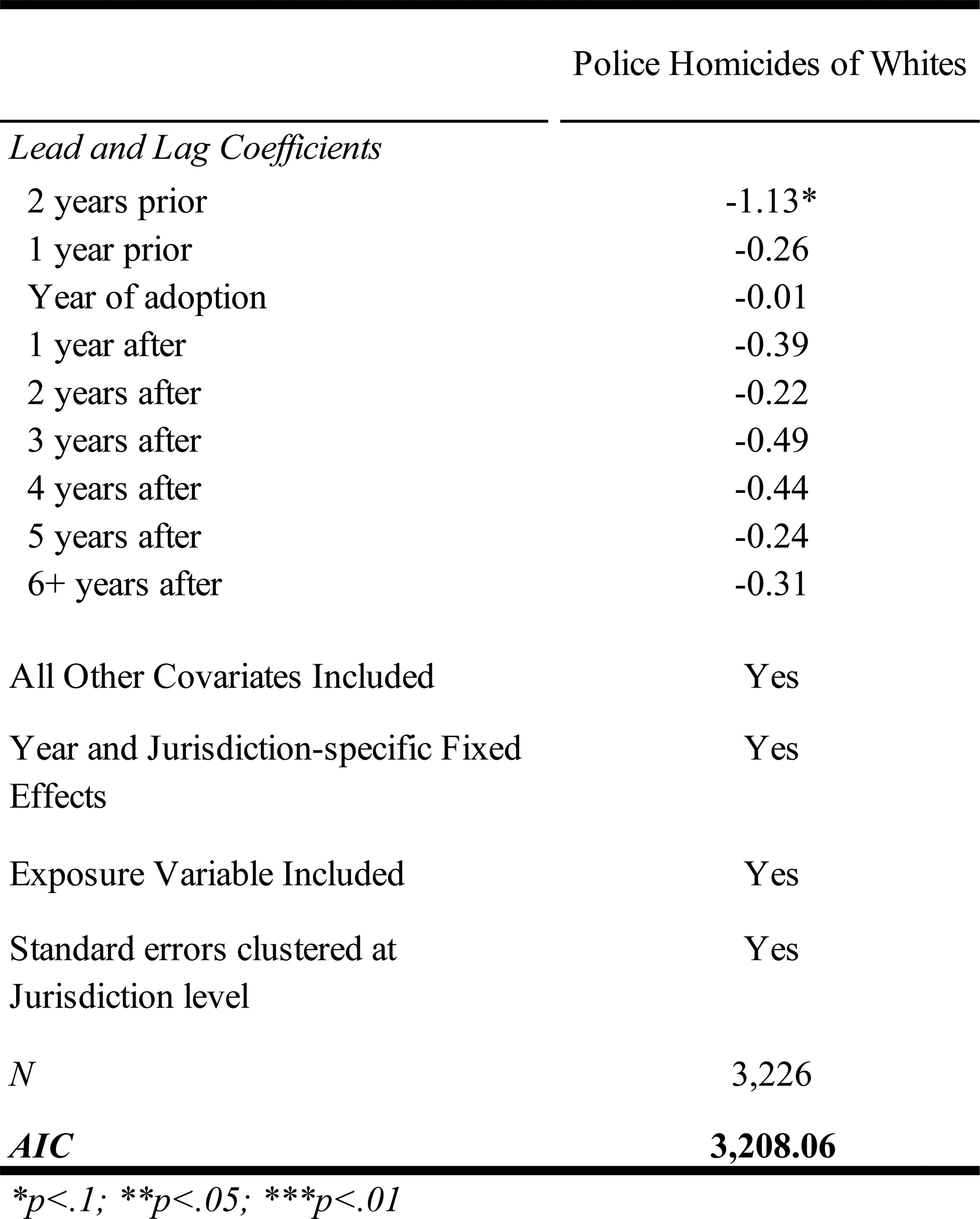
Regarding endogeneity, a concern is whether cities self-select into adopting BWCs or COAs due to changes in racial disparities in the enforcement actions we consider. We tested for this possibility by examining whether there were sudden changes in the dependent variables before adopting BWCs or COAs. Specifically, based on Autor (2003), we regressed each dependent variable on indicators for the two years preceding the adoption of BWCs or a COA, the year of adoption, five subsequent years, and an indicator for the sixth year and beyond. These regressions include a complete set of controls, year- and city-specific fixed effects, and clustered standard errors at the city level.
Appendix B shows estimates from the above models, as well as plots of the coefficients of the year indicators and their associated 95% confidence intervals. None of the year lead indicators are significant at the 5% level in any regressions, suggesting that the pre-treatment trend in the adopting cities did not exhibit sudden changes before adopting BWCs or a COA, thereby alleviating self-selection concerns.
Results
Difference-in-differences estimates for the impact of BWCs on DCAs and police homicides of citizens are shown in Tables 3–6, all of which indicate significance at 10% or lower. An advantage of these estimates is that they control for city-specific, time-invariant unobserved variables and secular trends in the dependent variables. Consequently, they offer a strong causal explanation of the effect of the independent variables of interest on the dependent variables (Angrist & Pischke, 2019).
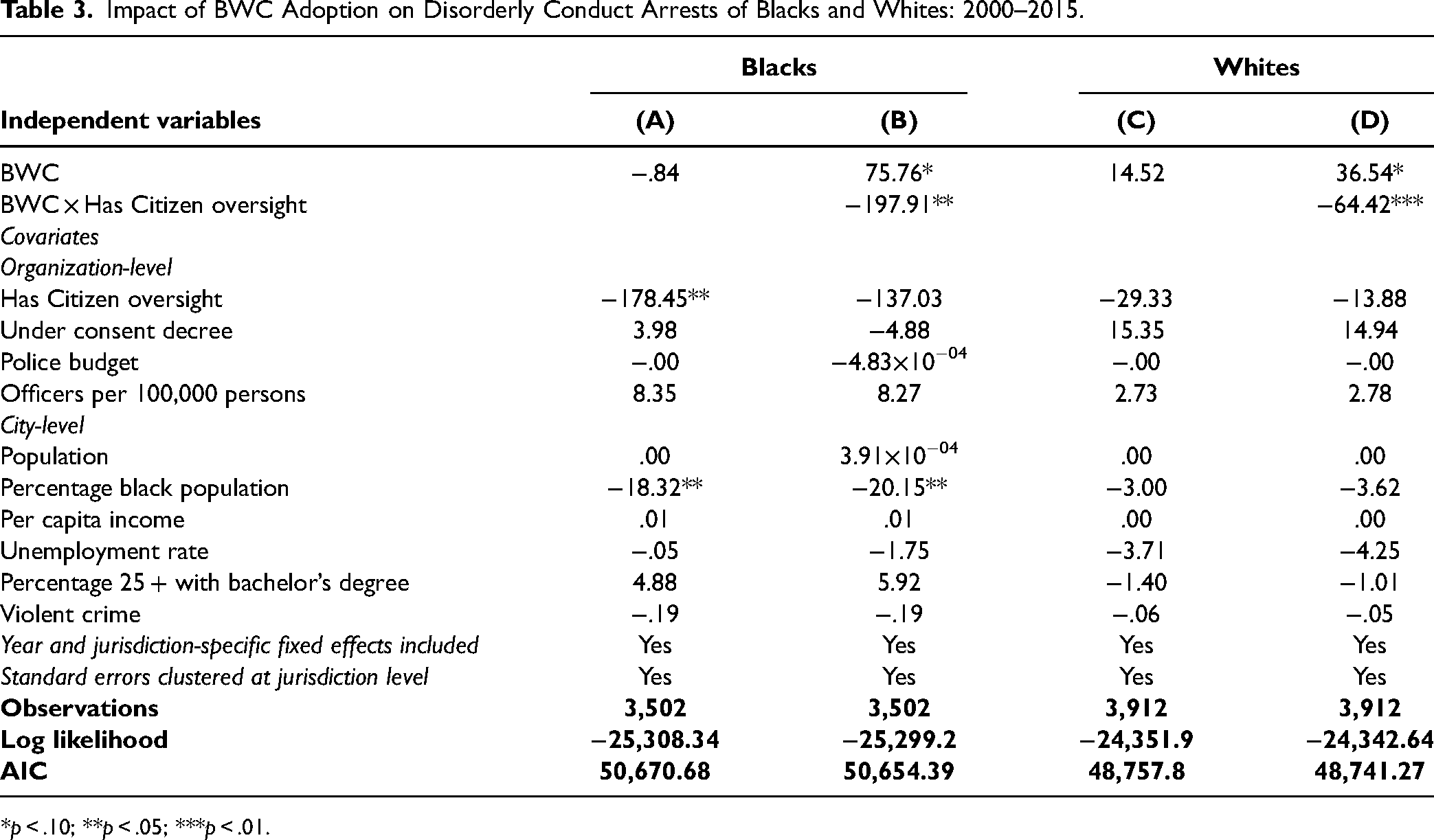
Impact of BWC Adoption on Disorderly Conduct Arrests of Blacks and Whites: 2000–2015.
*p < .10; **p < .05; ***p < .01.
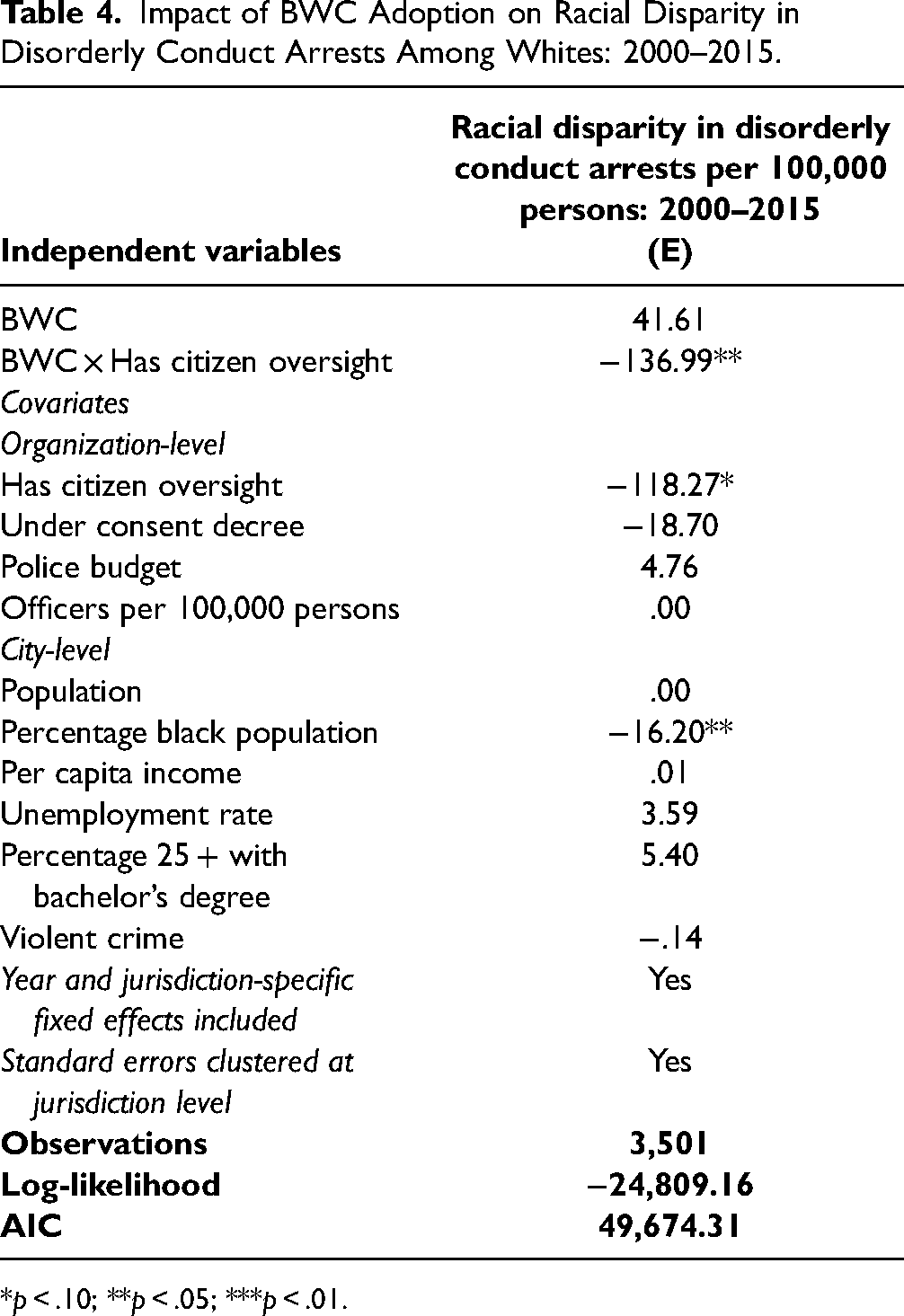
Impact of BWC Adoption on Racial Disparity in Disorderly Conduct Arrests Among Whites: 2000–2015.
*p < .10; **p < .05; ***p < .01.
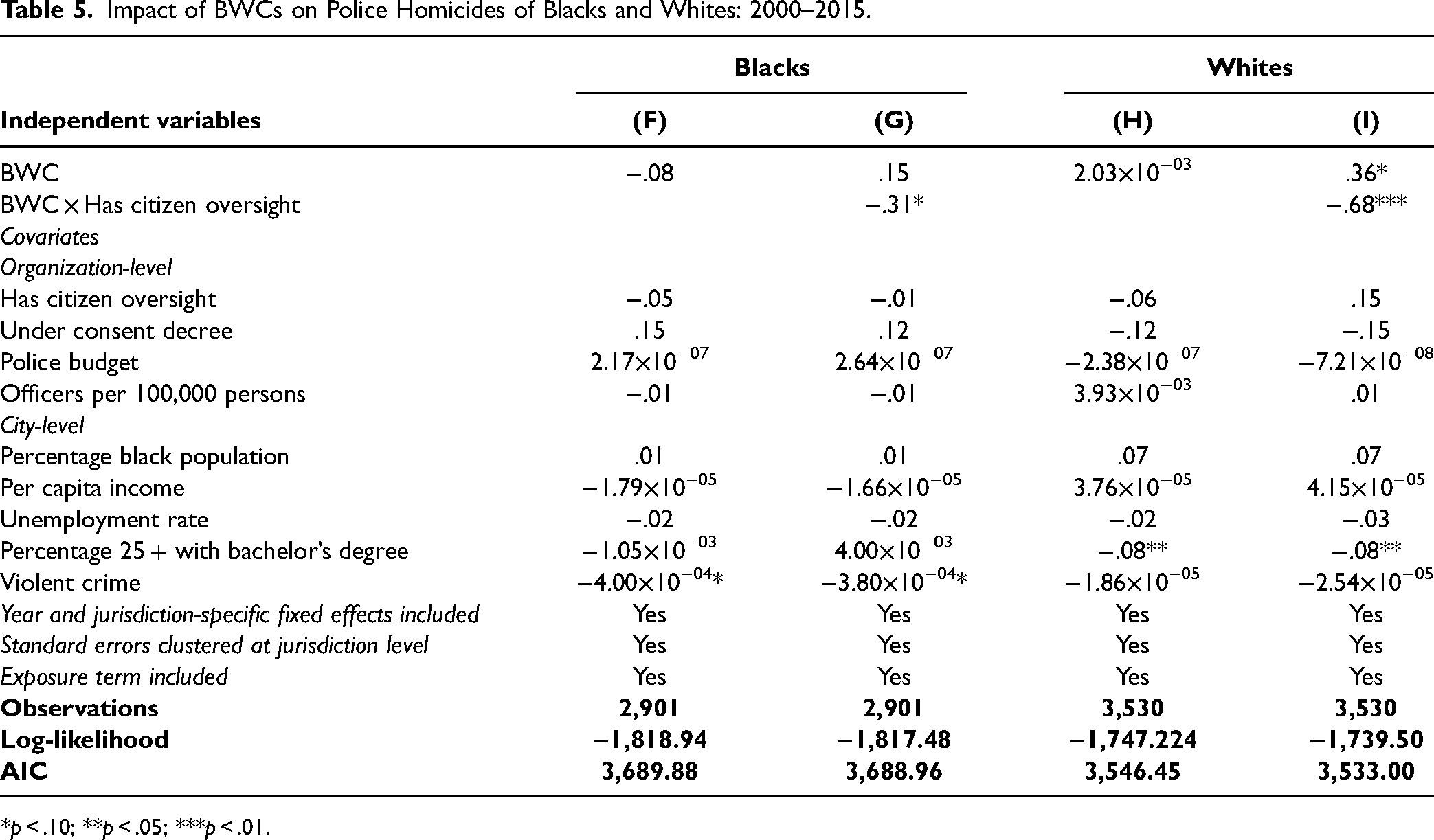
Impact of BWCs on Police Homicides of Blacks and Whites: 2000–2015.
*p < .10; **p < .05; ***p < .01.
Impact of BWCs on Racial Disparity in Police Homicides of Citizens: 2000–2015.

*p < .10; **p < .05; ***p < .01.
We began the modeling process by estimating the impact of BWC adoption on each outcome of interest while controlling for all covariates, year, and city-specific fixed effects. In the subsequent model, we added the interaction term
Racial Disparities in DCAs
Model A in Table 3 shows that the impact of BWCs on DCA rates among Blacks is not significant. Model B adds the
Columns C and D in Table 3 present estimates for the effect of BWCs on DCAs of Whites. The BWC coefficient in model C is not significant, suggesting that BWCs in and of themselves do not reduce DCAs among Whites. However, in model D, the interactive effect is negative and significant
While the above results demonstrate that DCA rates for both Blacks and Whites declined when BWC evidence was subject to review by a COA, they do not directly indicate whether the racial disparity in such arrests decreased. To address this question, we estimated an alternate model, which had the exact specification as in models B and D, but in which the dependent variable was the difference between the DCA rate of Blacks and whites. That is, the dependent variable was:
Given that the average racial disparity in our sample before adopting BWCs or COAs is 323.83 arrests per 100,000 persons, the abovementioned effect suggests a 42.2% (=136.9/323.83) decrease in racial disparity in DCAs. Furthermore, among the control variables, the coefficient for percentage Black population is negative and significant, showing that as the proportion of Blacks in the population increases, the racial disparity in DCA rates declines.
Figure 4 plots the marginal effect of BWCs on racial disparity in DCAs in the absence and presence of citizen oversight. A test of significance shows that the marginal effect of BWCs in the presence of citizen oversight is significantly different from their marginal effect in the absence of citizen oversight

Marginal effect of BWCs on racial disparity in disorderly conduct arrests per 100,000 persons over levels of citizen oversight.
Taken together, the fully specified models in Tables 3 and 4 show that the
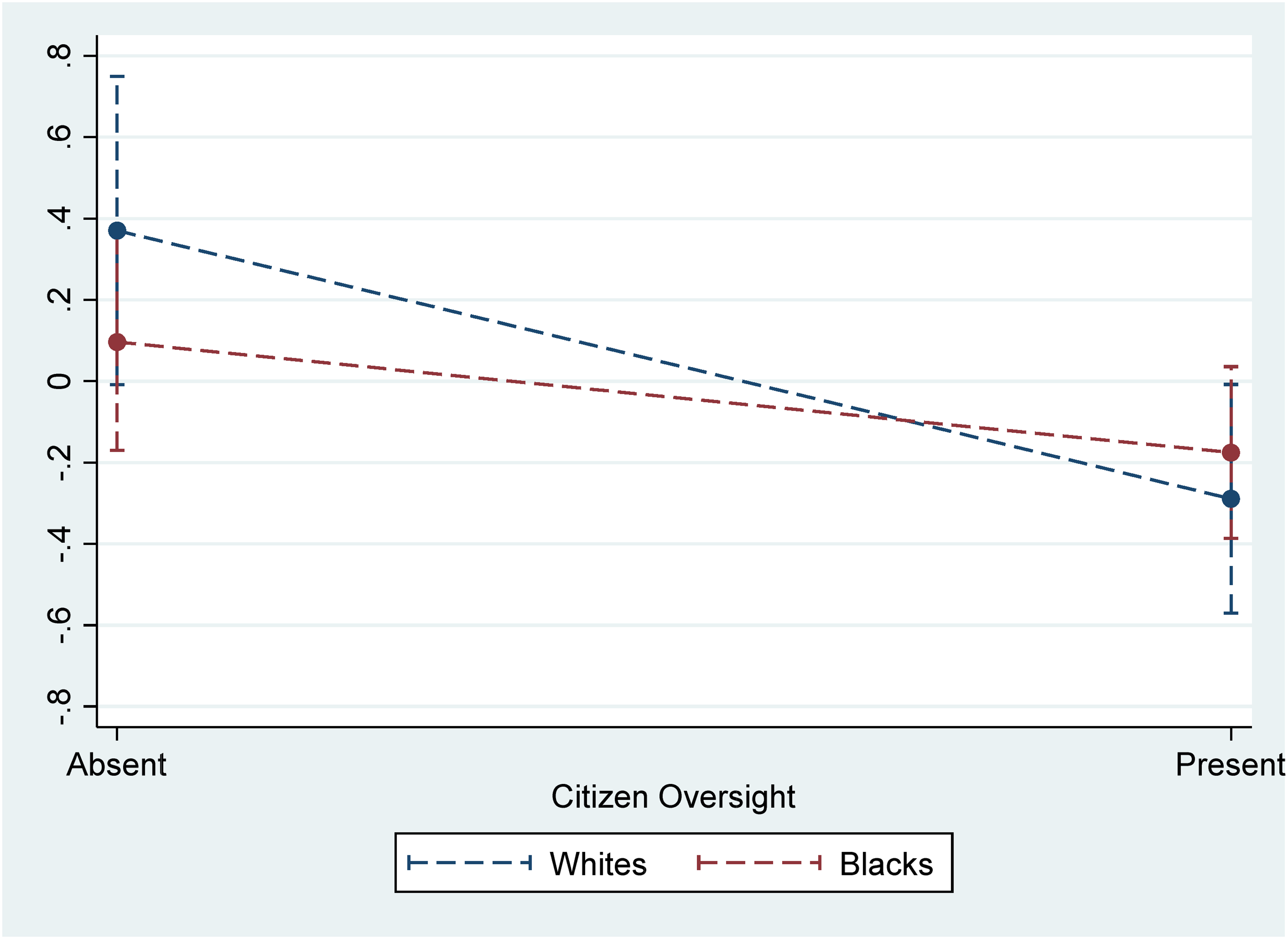
Marginal effect of BWCs on racial disparity in police homicides of citizens over levels of citizen oversight.
Racial Disparity in Police Homicides of Citizens
Model F in Table 5 shows that the impact of BWCs, in and of themselves, on police homicides of Blacks is not significant. However, in model G the
Model H in Table 5 shows the impact of BWCs on police homicides of Whites, which is non-significant. However, the interaction effect in model I is negative and significant
To address whether COAs combine with BWCs to decrease the racial disparity in police homicides between Blacks and Whites, we estimated a triple difference-in-differences model, with race-city-year as the unit of analysis. The form of the equation used to address this question is:
Finally,
We present the estimated coefficients for the three-way interaction, lower-order interactions, and the coefficients on individual variables. The BWC coefficient is not significant, demonstrating support for hypothesis 2. The coefficient on the indicator for Whites, which represents the baseline difference in the number of police homicides of Blacks and Whites, is large, negative, and significant
Second, the coefficient of the interaction term
Finally, the coefficient on the three-way interaction does not reach significance at conventional levels (
Thus, the above results suggest that while the combinative effect of BWCs and COAs leads to decreased police homicides of Blacks and Whites overall, these reductions appear to offset each other partially. Thus, BWCs are not useless for deterring police homicides of citizens. Instead, when BWCs are combined with citizen oversight, they are likely to decrease overall police homicides of Blacks and Whites while not impacting the disparity between police homicides of Blacks and Whites (showing a lack of support for hypothesis 4).
Finally, we find support for hypothesis 5, per which the combinative effect of BWCs and COAs on racial disparity in DCAs is more pronounced than their effect on racial disparity in police homicides of citizens. This finding affirms the expectation that the benefits of BWCs, with the appropriate oversight, are more likely to be realized in citizen-police encounters that pose less danger to police officers. In other words, the greater the potential for violence in an unfolding encounter, the lower the potential for BWCs to have a bearing on racial disparities in policing outcomes.
Discussion and Conclusion
In the current study, we argue that the impact of BWCs is mediated by occupational practices and assumptions, which, in turn, lead BWCs to be used in ways that reproduce racial disparities in policing outcomes. We argue that the above tendencies may be mitigated if there is an external accountability mechanism that can decrease the risk of BWC evidence being used in a motivated manner.
We highlight the above phenomenon by demonstrating that BWCs do not lead to a decrease in DCAs among Blacks or Whites, nor does it lead to a decrease in police homicides of Blacks or Whites. This finding supports the results of prior studies, which demonstrate that the use and consequent effects of technology are filtered through the valued occupational assumptions and practices held by bureaucrats (Baekgaard & Serritzlew, 2016; Bromberg & Charbonneau, 2021; Kerpershoek et al., 2016; Manning, 2008; Sabbe et al., 2021). Of course, merely implementing a new technological fix does not mean that the above assumptions and practices will necessarily change. Instead, new technologies will likely be assimilated into existing bureaucratic routines to attain existing, valued organizational objectives. Nevertheless, these routines can change if structural or organizational changes occur, shaping how technologies are used in the field. This, in turn, can lead to a shift in organizational outcomes.
We demonstrate that when BWC footage is subject to COA review, DCA rates among Blacks and Whites decreased by 43.8% and 40.6%, whereas police homicides of Blacks and Whites decreased by 26.73% and 49.4%, respectively. Our results also show that while the racial disparity in DCAs decreases by 42.2% when COAs and BWCs are used in unison, the decrease in racial disparity in police homicides of citizens is less pronounced at 23.6%.
The current study broadens understanding of BWC and COA impact on racial disparities in policing. To date, the studies examining BWC and COA impacts have sought to tease out the impact of the preceding technologies without necessarily focusing on their contingent effects (Ali & Nicholson-Crotty, 2020; Ali & Pirog, 2019; Headley, 2021; Hecker, 1996; Ray, 2020; Wright & Headley, 2020). However, given that cities and counties often adopt multiple policy initiatives to reduce racial disparities in policing, it makes sense to assess their contingent effects as we do in the current study.
These results confirm previous literature findings that BWCs alone do not affect racial disparities in policing outcomes (Pyo, 2020). Moreover, they support the findings of studies that have found COAs to have a pronounced impact on law enforcement outcomes (Headley, 2021), including racial disparities in law enforcement outcomes (Ali & Pirog, 2019). Our results build upon the work of Ali & Pirog (2019) because they first replicate their previous findings but also show how additional responsibilities for COAs can generate increased reductions in disparities. Ali & Pirog (2019, p. 422) note that COAs that reduce disparities can “classify the nature of a citizen-initiated complaint, conduct investigations of citizen complaints independent of the police agency, recommend/issue investigation findings to the police, recommend discipline to officers found guilty of misconduct, and have paid full-time staff.” Our results indicate that COA authority to review BWC footage is crucial to obtain the potential benefits of BWCs.
Our results also align with recent studies such as Hong et al. (2020), who found that performance information is positively associated with subsequent performance when there is a higher degree of accountability. Similarly, they echo the argument that while police agencies are typically “coping” organizations whose outputs and outcomes are difficult to assess (Wilson, 1991), oversight of BWC evidence by a COA tends to alleviate the above challenges, which in turn renders police more responsive to procedural demands of work. 6
Our findings suggest that supplementing BWCs with COAs may reduce racial disparities in law enforcement outcomes, but they do not eliminate such disparities. One reason for this is suggested by Belardinelli et al. (2018), who found that ex-post performance information (such as that obtained through BWC evidence) is not robust to framing bias. In the case of BWC evidence, framing bias is distinct from motivated reasoning in that the former relates to how an officer explains an incident in which they were involved. In contrast, the latter relates to how a reviewer (i.e., someone other than the officer involved) interprets BWC evidence. Since framing bias is likely to occur before a reviewer can even assess BWC evidence, it is likely to constitute another “medium” that could refract subsequent assessments of BWC evidence. Per Belardinelli et al. (2018), the non-robustness of ex-post performance information to framing bias could adversely “affect the fairness of evaluation processes, performance-related sanctions, and rewards.”
Framing bias in evaluating BWC footage may arise when, for instance, police officers are allowed to view BWC evidence before submitting incident reports 7 (The Leadership Conference on Civil and Human Rights & Upturn, 2017). This practice is problematic because it may allow officers to construct a narrative of events that justifies their actions. Thus, while citizen oversight is likely to decrease motivated reasoning in evaluating BWC evidence, we do not believe it will decrease the framing bias resulting from how officers explain an incident when police misconduct is alleged. Future studies should evaluate the impact of restricting officer access to BWC evidence on the outcomes we have examined in the current study.
Our study makes several other contributions. First, our findings speak to debates surrounding the degree of access COAs should have to information on bureaucratic performance (Porumbescu et al., 2021). Recent accounts by investigative journalists note that the New York Police Department (NYPD) withheld BWC footage as well as other records from New York City's Civilian Complaint Review Board (CCRB) despite legal obligations to share such evidence (Umansky & Simon, 2020). Aligning with our findings, a recent report submitted by the CCRB to the New York City Mayor reported that the percentage of substantiated complaints against officers more than doubles when CCRB investigators can view BWC footage from an incident (Civilian Complaint Review Board, 2020). Our findings echo the preceding insight and suggest that bureaucrats are more likely to treat minorities equitably if social accountability bodies have more, not less, voice in reviewing the performance of bureaucratic agencies.
Second, the extant literature on performance information use has used survey vignette experiments to demonstrate that performance information may be used in motivated ways. While vignette experiments are valuable in understanding the micro social-psychological processes underlying motivated reasoning (see, e.g., Baekgaard et al., 2020; Baekgaard & Serritzlew, 2016; Belardinelli et al., 2018; James & van Ryzin, 2017), they do not necessarily speak to whether their findings would be transferable to organizational outcomes and bureaucratic behavior in field settings. The current study pushes the envelope of performance information research by demonstrating how motivated reasoning may manifest in field settings. It affirms that experimental insights in the case of motivated reasoning are indeed transferable to the field.
More broadly, however, the results of the current study sound caution against the high modernity-inspired notion that solutions to sociopolitical problems, such as a lack of accountability, are to be found in technology (Scott, 1999). We hope the current study prompts policymakers and public administration scholars to reflect more deeply on how technocratic solutions to public sector problems can be frustrated if there is no incentive for changing preexisting occupational practices, assumptions, and norms.
Footnotes
Declaration of Conflicting Interests
The authors declared no potential conflicts of interest with respect to the research, authorship, and/or publication of this article.
Funding
The authors received no financial support for the research, authorship, and/or publication of this article.
Notes
Author Biographies
Appendix A
Following previous research utilizing the FE database (Jennings & Rubado, 2017), we only retained firearm-related deaths in our data while ignoring other types of deaths, for example, those involving tasers, vehicles, or asphyxiation, because they are less likely to be intentional. We also excluded deaths where more than one police agency was involved due to the difficulty of attributing such deaths to specific police agencies. Furthermore, as we were interested in cities, deaths involving state or federal agencies were eliminated.
Appendix B
Test for Leading Trends in Police Homicides of Whites Prior to Adoption of COAs.