




Abstract
Federal administrative agencies are one of the primary policymaking venues in the United States. One of the core features of U.S. administrative practice is the notice-and-comment process in which agencies solicit, collect, and respond to comments from the public before issuing new regulations. In this paper, we develop a model of commenting based on three motivations—litigation preservation; agency persuasion; and expression—and analyze public comments to determine how features of the political environment, and specifically the president in power, affect the pool of commenters. We focus on the 2017 presidential transition, when there was both a change in Presidents and the party in control of the White House. We find that there were greater differences in the pool of commenters between administrations than within administrations and that interest groups tended to participate more when they were more closely associated with the party in power. Our findings support the view that many commenters use the public comment process for persuasive purposes, and not only to preserve litigation opportunities or for purely expressive reasons.
Introduction
Informal “notice-and-comment” rulemaking by federal administrative agencies has become one of the most important policy-making forums in U.S. political life (Kagan, 2001). 1 Statutes such as the Clean Air Act and the Dodd-Frank Wall Street Reform and Consumer Protection Act grant agencies substantial discretionary authority to regulate in a wide range of policy domains. Heightened partisan polarization has also hampered policymaking in alternative venues, most crucially Congress (Lee, 2016), leaving agencies as policymakers of last resort on issues such as climate change and immigration (Livermore & Revesz, 2020).
Various actors attempt to influence the policy-making power exercised by agencies (Yackee, 2019). Presidents, Congress, and the courts all have oversight powers that they use to shape agency decision-making (Beerman, 2006; Moe, 1985; Stewart, 1975). A wide range of interest groups also use the means at their disposal—from litigation and lobbying to public pressure campaigns—to influence the choices made by agencies (Balla et al., 2022; Heclo, 1978). Nevertheless, despite these many competing pressures, agencies are also often able to maintain a measure of autonomy, shielded to some degree by insulating institutions and norms (Barkow, 2010; Bolton et al., 2015; Carpenter, 2010; Livermore, 2014; Vermeule, 2013).
As informal rulemaking has grown in importance, the public comments process has increasingly become a forum for public policy deliberation and political debate. The notice-and-comment process has long been an opportunity for knowledgeable and well-resourced insiders to shape agency decision-making (Wagner et al., 2011). In recent years, information technologies have also opened the notice-and-comment process to a broader group of potential commenters, creating greater opportunities for popular participation in the rulemaking process (Benjamin, 2006). It is now a routine occurrence for agencies to receive millions of comments on proposed regulations (Livermore et al., 2018). In this paper, we primarily focus on repeat players, such as trade associations, unions, and advocacy groups, who engage in a relatively large number of rulemakings. The dynamics that influence these actors are likely different from individual commenters who respond to mass comment campaigns.
The public comments collected by agencies are a rich set of data that can be explored to shed light on the relationship between agency decision-making and the public. The social scientific study of the public comment process is now over two decades old (Golden, 1998). Researchers have examined a wide range of questions, especially focusing on the extent of commenter influence on agency decision-making and the composition of the pool of commenters (Yackee, 2019).
We explore the relationship between presidents, administrative agencies, and public comments, and in particular, the factors that affect which groups tend to participate in the public comment process. Several distinct goals can be promoted by commenting, including preserving issues for litigation (Lubbers, 2018), persuading agencies to alter policy choices (Balla et al., 2022), and simply expressing policy preferences. Prospective commenters will only engage in the process when forwarding these goals provides sufficient benefit to offset the cost of commenting. Generally, factors that affect these costs and benefits fall into three categories: commenter characteristics, environmental features, and rule attributes. These influences interact with each other to generate commenting outcomes, both in terms of who comments and in the content of comments that are submitted.
In this study, we examine a particularly important environmental feature: control of the White House. When presidents transition, a host of changes follow, especially when accompanied by a shift in the party. Presidents bring along different personnel, policies, and managerial styles, all of which can filter down to agencies and their relationship with the public. For our analysis, we focus on the transition from President Barack Obama to President Donald Trump and examine how the pool of commenters differed between the administrations of the two. Specifically, we examine the pool of most frequent commenting organizations to determine whether there are between-administration shifts that are larger than variation within administrations, and we classify commenters according to organization type to examine whether there are important between-administration changes in the composition of commenters.
This work touches on two substantial research threads in public administration and political science. The first concerns the ability of presidents to exert influence over agencies and the ability of agencies to retain autonomy in the face of political pressure from the White House (Bolton et al., 2015). One potential means to measure the extent of presidential influence is via public comments: changes in public commenting behavior between presidential administrations are a sign that presidents influence how agencies interact with interest groups and the broader public.
The second related research thread concerns the role of the public comment process as a pathway for interested parties to influence agency decision-making. Prior research into public commenting has focused on the composition of the pool of commenters in part to illuminate questions concerning political power. To the extent that comments influence agencies’ policy choices, then power is distributed among the pool of commenters. Prior work has helped clarify the types of groups that attempt to use this channel of influence (Yackee, 2019), but the external forces that shape the pool of commenters have been underexplored. Examining the changing dynamics in this pool over time provides insight into the factors that affect who is availing themselves of the opportunity to influence rulemaking through the public comment process.
Overall, we find that there was a marked shift in the pool of commenters that occurred at the time of the Obama/Trump transition. Within the group of most frequent commenters, the organizations more closely affiliated with the party coalition in power tended to increase their level of participation compared to out-of-power groups. This finding is consistent both with presidents exerting substantial influence over agencies and persuasion being an important commenter motivation. In particular, the changing pool of commenters between administrations indicates that the president in the White House affects which interest groups view the commenting process as a valuable path toward influence (Cúellar, 2005; Yackee & Webb Yackee, 2006;).
In the following sections, we review some related prior work that highlights the value of studying the public commenting process, introduce a theoretical framework for commenting, describe our research questions, explain our data collection methods, and present the results of our analysis. We end with a brief discussion that places our findings in light of other regulatory developments during the Trump administration.
Why Study Public Comments
Presidential Influence
In the era of “presidential administration,” Presidents are understood by both scholars and more broadly within the political culture to exercise substantial power over the administrative state (Kagan, 2001; Livermore & Richardson, 2019). There is now a robust literature that examines questions related to administrative presidency, politicization of the executive branch, administrative responsiveness, and related administrative law questions (Bernstein & Rodríguez, 2023; Bressman, 2003; Bulman-Pozen, 2019; Coglianese, 2010; Galvin & Shogan, 2004; Lewis, 2009; Moe & Wilson, 1994; Moynihan & Roberts, 2010; Roberts, 2021; Rosenblum, 2023; Shapiro & Wright, 2011; Sunstein & Vermeule, 2021).
Presidential influence over agencies is largely inferred from the many structural levers that presidents can and do use to attempt to affect agency policymaking. For example, Moe (1985) drew attention to two tools used by presidents to affect bureaucratic decision-making: Centralizing power in the White House and screening senior appointees for political loyalty.
However, although there are good theoretical reasons to believe that the party in the White House matters a great deal for agency decision-making, and many anecdotes of agency decisions that seem to track the policy priorities of the party in power, more systematic supporting evidence is somewhat limited.
O’Connell (2011) examines agency regulatory decision-making over a several-decade-long period during which there were several presidential transitions. That work found that rules that were initiated under one administration but not completed were significantly more likely to be withdrawn than rules that were initiated and finalized without a transition. This finding implies that new administrations tend to use their power to shift regulatory direction, at least to some extent. However other studies have found more continuity between parties. Shapiro (2007) examined the regulatory process over the transition from Bill Clinton to George W. Bush and found that regulatory procedures remained consistent across administrations. The data examined by Furlong and Kerwin (2005) included a period of presidential transition, and commenter perceptions of the value of participating in the regulatory process remained quite consistent across administrations. Stiglitz (2014) examines rulemaking during periods of party transition—after an election in which the incumbent party lost the White House, but before the inauguration of a new president. That study found that rules adopted during this “midnight” period were more controversial, as measured by the extent of public commenting—a kind of inter-administration consistency that nonetheless indicates that presidential political imperatives drive agency decision-making to some degree.
Public comments provide a potential additional lens on the question of political influence over agencies. Tracking Furlong and Kerwin (2005), consistent perceptions of the value of commenting accords better with a model of relatively mild presidential influence, in that issues addressed by agencies and the perceived ability to influence outcomes would not be strongly affected by control of the White House. By contrast, if presidential party changes affect the relative access of different interest groups or the agenda of administrative agencies, then the pool of commenters is more likely to shift. Changes in these variables, then, provide at least indirect evidence of political influence over agency decision-making. One natural interpretation of such effects is that agencies pursue different regulatory agendas when their political incentives change, leading the public to engage in different commenting behaviors.
Analyzing public comments, then, provides a means for systematically examining classic questions related to the intersection of politics and administration. Livermore et al. (2018) examine the relationship between the content of public comments and agency ideology, finding that the further from the median ideology an agency sits, the more likely it is to receive comments that use negative language. Judge-Lord (2019) analyzes public comments in the 2005–2017 period and finds that “public comments tend to support Democratic policies and opposed Republican policies.” This paper builds on that work, focusing on the Obama–Trump transition as a window into the effect that control of the White House has on agency decision-making.
Commenter Influence
A second reason to study public comments is to better understand their influence over regulatory decision-making. Under the Administrative Procedure Act, before issuing a new regulation, agencies must generally “give interested persons an opportunity to participate in the rule making through submission of written data, views, or arguments” and may only proceed “[a]fter consideration of the relevant matter presented.” 2 Courts enforce this requirement and will strike down regulations when they find that agencies failed to appropriately consider comments. 3 Notwithstanding these legal requirements, there is the empirical question of whether comments have a meaningful impact on the choices made by agencies.
Several studies attempt to tackle the question of commenter influence. An early example is Golden (1998), which analyzes the comments received during eleven rulemakings from several agencies to examine the identities of commenters and the relative influence of organized interests and the general public. That study was based on an analysis of comments and rulemaking records for eleven randomly selected rules issued by the Environmental Protection Agency, the National Highway Traffic Safety Administration, and the Department of Housing and Urban Development. Golden (1998) finds that the comment process is dominated by organized interests, with almost no citizen participation. However, the study also found that agencies were no more inclined to change rules in the direction favored by any interest group type. Rather, it was only when there was widespread agreement among commenters that agencies responded in substantial ways to feedback in the comment process; when commenters disagreed, agencies tended to disregard most substantive comments and continue with their prior choices.
Cúellar (2005) focuses in particular on the content of public comments, the level of sophistication evidenced by that content, and the relationship between comment sophistication and agency responsiveness. That study examines a different set of agencies from Golden (1998), drawing on rulemakings from the Treasury Department, Federal Election Commission, and Nuclear Regulatory Commission. A set of rules was constructed based on the degree of discretion offered to the agency, both statutorily and in terms of congressional oversight, and one rule was randomly selected from that set for each agency. Comments were coded according to sophistication, concerns raised, and identity of the commenter. Changes between proposed and final rules were also coded. Contrary to Golden (1998), Cúellar (2005) finds that the lay public does indeed participate, in some cases outnumbering comments from organized interests. Unsurprisingly, Cúellar (2005) also finds that the level of sophistication varies considerably, with comments from the lay public exhibiting less sophistication than from groups. That study also found that sophistication tracked influence, with agencies more likely to respond to more sophisticated comments, even holding commenter type constant.
Yackee (2006) analyzed comments received for a substantially expanded pool of rules, constructing a data set of nearly 1,500 comments reacting to forty rules. This study focused on “low salience policies” adopted by federal agencies rather than high profile rulemakings. For these rules (proxied for by excluding rules with more than 200 comments), organized interest represented the lion's share of commenters. Analysis of the differences between final rules and proposed rules indicated that changes between the two tended to track the requested direction of interest group commenters. Additional analysis of this data showed that business interests in particular were able to influence regulatory choices (Yackee & Webb Yackee, 2006) and that agency responsiveness was more likely when commenter agreement was high (McKay & Yackee, 2007).
It is worth noting that studies of commenter influence face difficult challenges of causal inference because many unobserved variables could influence the pool of commenters, the content of comments, and regulatory decision-making (Rashin, 2019). Nevertheless, the thrust of prior research has been to confirm that some commenting patterns are associated with regulatory change, which points in the direction of the potential for some causal influence.
One way to augment attempts to directly study the effect of comments is to examine the views of participants in the notice and comment process. Scott Furlong and Cornelius Kerwin solicited feedback from two surveys sent in 1992 and 2002 to several interest groups to examine their perception of agency public participation processes (Furlong, 1997 Furlong & Kerwin, 2005;). They explored the types of groups that participated, the methods used (e.g., written comments, informal contacts, etc.), and the groups’ perceptions of the effectiveness of participation. The authors note that many changes occurred during the ten years between studies, including “presidential administration and parties in power” as well as congressional action that affected the regulatory process. Notwithstanding these changes, the authors found remarkable stability in responses concerning the types of participation used and perceptions of efficacy.
A survey approach was also used by Furlong (1998), which solicited officials within federal agencies about their perceptions of how public participation influences agency decision-making. That study found that agency officials believe that both the general public and interest groups can influence the rulemaking process, with interest groups somewhat better positioned to affect outcomes. Nelson and Yackee (2012) augment analysis of public comments with a survey of commenters and an examination of regulatory text. That study also focuses on the preproposal phase and examines both proposals that resulted in final rules as well as proposals that were ultimately withdrawn. The authors find that coalitions tend to have particular influence over regulatory decision-making, especially for coalitions with high levels of cohesion and expanded size and diversity. More recently, Dwidar (2021) similarly finds several factors that affect the success of coalitions in influencing regulatory text, including diversity of membership, coalition size and resources, and lower policy salience.
A subquestion related to commenter influence concerns the role of mass public comments. Krawiec (2013) examines preproposal comments in the context of the implementation of the Volker Rule from the Dodd-Frank Wall Street Reform and Consumer Protection Act. That study examines several thousand comments received by the Financial Stability Oversight Council during a 30-day public comment period in advance of a study issued by the agency on the Volcker Rule. Krawiec finds that the vast majority of comments received were from individuals rather than organizations, but over 90% of those were a “virtually identical form letter.” Among the nonform letter comments, the study finds a “stark” contrast between the “meticulously drafted, argued and researched” comments by financial institutions and the relatively unsophisticated remarks submitted by private citizens. Similarly, Boustead and Stanley (2015) examine public comments received by the National Highway Traffic and Safety Administration Advanced Notice of Proposed Rulemaking concerning vehicle-to-vehicle communication technology. That analysis reveals a large number of short comments by the general public and lengthier, more substantive submissions by regulated industry and advocacy organizations. Balla et al. (2022) focus on the Environmental Protection Agency and the period between 2012 and 2017. The authors examine response-to-comment documents issued by the agency for major rulemakings during that time frame to determine the extent to which these documents reference mass comments compared to references to other types of comments. The authors find that, although mass comment campaigns do garner references from the agency, they do so at a lower rate than other types of comments, especially those submitted by organizations, which tend to be more substantive.
Our work builds on scholarship on commenter influence by focusing on the factors that affect the pool of commenters. Several studies examine the types of entities that tend to participate in the notice-and-comment process (Cúellar, 2005; Golden, 1998; Yackee, 2019; Yackee & Webb Yackee, 2006). This question is interesting in part because comments are believed to affect regulatory decision-making. The composition of the pool of commenters describes the entities that have chosen to avail themselves of this opportunity to shape public policy. Studying the pool of commenters, thus, can provide insights into the distribution of power in society.
We examine the pool of commenters dynamically over time to help understand how external factors—and in particular a change of presidential administration—affect which groups decide to participate in the commenting process. It may be that the decision to comment is mostly determined by commenter characteristics alone, with certain entities having consistent incentives to comment because their interests are frequently affected by regulatory decisions. Alternatively, external factors, including presidential administration, may change those incentives, either due to changes in the substantive agenda of regulatory agencies or because potential commenters change their beliefs about their ability to effectively utilize the public comment process to promote their interests.
The analyses that follow do not directly take up the causal question of whether commenters influence regulatory decision-making. Our study is based on data contained in public comments, which, on their own, are insufficient to establish commenter influence. But in light of prior work, which has argued that commenters can affect the policy choices made by agencies, it is worth studying how changes in the political environment affect who decides to participate in this process.
Basic Model
Here we introduce a theoretical framework for commenting.
Commenter Decisions
To begin, comments are the product of two decision types. The first type of decision concerns whether to comment at all. The effect of these decisions, which are made at the commenter level, is the pool of commenters for a given agency action. In theory, anyone can comment on any action, but in practice, for most rules, there are a small number of commenters, and even for rules with substantial public participation, the pool of commenters is small relative to the total population of entities (both individuals and organizations) that could comment. Because potential commenters decide whether to comment or not, the pool of commenters is highly selected.
The second decision type concerns the content of comments. There are no formal rules that limit the type of content that commenters can submit to agencies, and in fact, there is substantial variation. Some comments are short-form letters; others are short non-form expressions of sentiment; still others are substantial substantive documents prepared by professionals and submitted on behalf of organizations. Collective decisions about the types of comments to submit and their content affect the substance of comments received.
Commenter Motivations
To further unpack the relationships between environmental features, rule attributes, and commenter characteristics and how they affect commenting behavior, it is useful to be more explicit about some of the major types of potential motivations for commenters.
The existing literature on the public comment process has identified three general goals: Litigation preservation; agency persuasion; and expression. Under the Administrative Procedure Act, there is a broad class of interests that typically have the right to litigate to challenge agency rulemaking decisions. These potential litigants can raise any number of arguments, but two common challenges are that an agency action exceeds the agency's authority under an authorizing statute and that an agency action was “arbitrary” or “capricious” in violation of Section 706(2)(A) of the APA. However, as noted in Lubbers (2018), there is a developing “issue exhaustion” administrative law doctrine that creates potential barriers to some claims that are based on arguments that are not first presented to an agency in the notice-and-comment process. To avoid this fate, potential litigants must submit comments to an agency with the full suite of arguments that could be raised in court. This litigation preservation motivation is likely limited to the most highly sophisticated commenters, who have the resources to participate in litigation and the know-how to act early to best position themselves for success in court.
A second goal of commenting may be agency persuasion: To convince an agency of the merits of some policy position. Agency rulemakings are diverse. Some major rules have billions of dollars of economic consequences and may be among a president's most lasting policy legacies; others affect only a small number of people or involve technical arcana with no ideological valiance; still others occupy a middle zone, with engaged interest groups and important policy stakes, but little public involvement. Especially for more technical rules, or smaller bore issues within broader scope rules, the position of the agency may be flexible and open to change based on information received during the public comment process. Sophisticated actors could therefore use their public comments as a way to nudge policy in a favored direction (English, 2016). One of the most consistent questions in the literature on the notice-and-comment process is the degree to which commenters are, or can be, successful in their influence-oriented goal (Balla et al., 2022; Cúellar, 2005; Golden, 1998; McKay & Yackee, 2007; Nelson & Yackee, 2012; Yackee, 2006; Yackee & Webb Yackee, 2006).
The first two motivations can be understood as largely technocratic, involving the ability to use sophisticated and technical arguments to convince courts or agencies. Another, arguably more broadly accessible goal for commenting is to vindicate an expressive motivation. The notice-and-comment process solicits feedback from the public on agencies’ decisions, and people can give their feedback free of any expectation of a change in the agency's course of action. Such public comments can simply be understood as a communication of views and values. The audience for this communication could be the administration or some other group, such as the members of an advocacy organization. 4 This expressive function of commenting is related to the “input legitimacy” of the administrative process (Scharpf, 1999) and more generally the perceived procedural justice of administrative decision-making (Bobocel & Gosse, 2015; Lind & Arndt, 2016; van den Bos et al., 2014). The expressive motivation that we describe here is distinct from the concept of “voice,” which can be understood as efficacy or perceived efficacy in terms of influencing regulatory outcomes, which is examined in Yackee (2015).
Against these three types of motivations, commenters must balance the cost of commenting. For certain low-sophistication comments, these costs may be quite minor and amount to little more than clicking through an email and filling out basic personal information alongside pregenerated comment text. However, for more sophisticated comments, these costs can be more substantial. Many comments involve detailed technical and legal arguments that must be generated by well-paid professionals. In addition, organizations may have reputational concerns that militate toward either commenting in a highly sophisticated (and costly) manner or not commenting at all.
Decisions along both the extensive margin (whether to comment) and the intensive margin (how much to invest in commenting) will reflect a balance of the benefits—in terms of litigation preservation, agency persuasion, and expression—with the costs. The following sub-section discusses some of the factors that can affect the balance of benefits and costs that determine the behavior of potential commenters.
Factors That Affect Commenting Decisions
For our model of commenting, we define three general types of factors that will affect these decisions. The first set of factors are commenter characteristics. Commenter characteristics include whether a potential commenter is an individual or an organization; the political/ideological views of a potential commenter; the personality characteristics of an individual who might comment; and social networks in which a potential commenter is embedded. Commenter characteristics can be expected to be correlated to some degree with the motivations discussed in the prior section; for example, individuals may be more likely to comment for expressive purposes, while organizations are more likely to pursue the technocratic ends of litigation preservation or agency persuasion. Even organizations devoted to ideological or identity goals have been assumed to comment for primarily technocratic purposes (English, 2016). Commenter characteristics also likely correlate with the perceived ability to influence agencies, and therefore the value of commenting (Furlong & Kerwin, 2005).
It is worth emphasizing that there are interactions between commenters that affect the decision to comment and comment content. An individual may receive a forwarded email from a friend, encouraging her to comment on a regulatory proposal. As mentioned above, Nelson and Yackee (2012) examine the effect of coalitional lobbying in the regulatory context. The willingness of one organization to comment may lower the costs, or increase the benefits, of another organization commenting, which affects the behavior and incentives of other actors. Coalitions may negotiate the content of their comments, creating dependencies between the coalition members and the messages that are ultimately delivered to the agency.
The second set of factors that affect commenting decisions are rule attributes. Rule attributes are the policy choices involved in a rule and can be imagined as the features that place a rule within some multidimensional policy space. This policy space may overlap to some degree with mainstream ideological space, as captured (for example) in party platforms, preferences of the electorate, or congressional voting behavior. However, the rule attributes discussed here extend beyond simple left/right dynamics. This may be especially the case for technical, less politically salient rules that nevertheless are of substantial importance to affected interest groups or other stakeholders.
The third set of factors are environmental features. These include every feature of the state of the world other than rule attributes and commenter characteristics. Some potentially relevant environmental features include the party in control of the White House and Congress; the state of the economy; whether the country is at war; and recent events such as disease outbreaks, oil spills, or terrorist attacks. Agency reputation (Carpenter, 2010) is considered an environmental feature in this model, because it is not directly instantiated in rule attributes, but rather serves as a backdrop against which rule attributes might be interpreted.
There is a complex, dynamic relationship between commenter characteristics, environmental features, and rule attributes. With respect to the first two factors, changes in environmental features will have differential effects on commenters, based on their characteristics. For example, a change in presidential administration that is accompanied by a shift in party will, presumably, increase the access of some interest groups at the expense of others. Such a change could in turn affect the value of commenting. As the expected ability to influence an agency increases, the forum of public commenting gains value. By contrast, if the overall agenda of an agency shifts in a way that is adverse to the interests of some group, the importance of preserving arguments for litigation could increase.
There are also strong potential relationships between environmental features and rule attributes. Several persistent characteristics of agencies, such as reputation (Carpenter, 2010) and ideological disposition (Lewis, 2003) can affect the rules they issue. These persistent characteristics would tend to produce relative stability in rule attributes. However, the party in control of the White House affects who is appointed to senior positions at agencies—these personnel decisions may ultimately shape the types of rules that are adopted. Strategic interactions between political appointees and career personnel may affect the dynamic between political influences and more persistent agency characteristics (Bolton et al., 2015; Potter, 2019). For example, rulemaking activity at some agencies may change on both extensive and intensive margins in response to a change in administration. In addition, agency rulemaking behavior can be affected by other environmental features, such as the state of the economy or recent events—either via political oversight or through the decisions of career personnel.
To drive home the complexity of the situation, it is worth emphasizing that the causal relationship can also run in the other direction when agency rulemakings affect environmental features. Many rulemakings are intended to have such effects, such as when the Securities and Exchange Commission issues rules that require financial disclosures—the purpose of such a rulemaking is to affect the functioning of financial markets. Rulemakings may also have political consequences, as a popular or unpopular rule influences the political fortunes of the party in power. The complex causal situation means that regulatory decisions influence the social, economic, and political environments that, in turn, affect future rulemakings.
Environmental features, rule attributes, and commenter characteristics interact with each other to generate commenting behavior (i.e., decisions over whether to comment and, if so, the content of comments). Environmental features can affect rule attributes, which in turn might spur, or not, comments from certain individuals or organizations. Some environmental features, such as the party in control of the White House, could affect commenting behavior directly, as might occur if an interest group believed that it had a higher probability of influencing an agency during the administration of one political party or another. Changes in the characteristics of potential commenters, such as might occur due to increased polarization within the electorate, could affect commenting behavior, even holding environmental features and rule attributes constant.
One simplifying feature of this model is that the identity of the individuals in the set of potential commenters is treated as though it remained consistent over time. This set can be understood in extremely broad terms, as representing every person or organization who could, in theory, submit comments on a regulatory proposal. Since there are no legal limits on who may comment, this is a very large and diverse group, but in reality, many individuals are only nominally potential commenters. (For example, infants are not legally prohibited from commenting, but are unlikely to do so.) Various shocks could affect not only the characteristics of potential commenters but also the identities of the individuals in that set. For example, a wave of bankruptcies in a given industry would reduce the number of entities who might comment; the growth of a particular type of community organization might increase the set of potential commenters. The model below represents this effect as a change in commenter characteristics (i.e., changes in the industrial sectors represented among the set of potential commenters), which does not fully capture the extent of these compositional changes.
Figure 1 illustrates the informal model discussed above. Overall, commenting is a complex, multistage process with a variety of inputs. Our informal model presents a simplified schema that is intended to help highlight some of the most important categories of influences and relationships. This model is quite abstracted, and many details are not included. Nevertheless, even in schematic form, this model of the basic generative process can help inform the analysis of the resulting comments to clarify the potential insights that can be gleaned from this data source, as well as some inherent limitations.

Influence on public commenting. Note: Commenter characteristics, environmental features, and rule attributes are the three classes of causal influences on commenting behavior. The characteristics of commenters may interact with each other, as might occur in the context of coalitional lobbying. This is denoted in the bi-directional arrow between C i and C j . Potential commenters must decide whether to comment and if so, what the content of their comments should be. Dynamically, comments received at earlier stages of the rulemaking process (i.e., in response to an Advanced Notice of Proposed Rulemaking or a Notice of Proposed Rulemaking) can affect rule attributes in future stages.
Applying this model to the case of a presidential transition, we categorize the president in the White House as an environmental feature. A change in this feature is very likely to affect rule attributes, given the importance of agency action as a lever for policy change in the contemporary administrative state (Kagan, 2001). When a new president brings along a new party, interest groups will gain or lose access and persuasive ability, based on their status vis-à-vis the governing party coalition. Attitudes in the electorate may also shift, as co-partisans of the governing president may be more positively disposed toward the administration's actions (Achen & Bartels, 2016). As a concrete example, the rules issued by the Labor Department under a Democratic president are likely to be more labor-friendly, reflecting the relative importance of labor to the Democratic coalition, and organizations and individuals will calibrate their commenting behavior in light of the substance of the policy, their perceived access to the administration, their general disposition to the president, and expectations about the commenting behavior of other actors.
The research questions pursued below focus on the high-level effects of presidential transitions on commenting behavior. Although presidents can be expected to have many important consequences for the relationship between agencies and the public, the effect of a presidential transition on macro-level phenomena related to commenting behavior is less clear. To follow the example in the previous paragraph, it is not clear whether labor will participate more, less, or the same in the public comment process under Democratic or Republican presidents. In the analyses that follow, we explore that question.
Research Questions
In the prior literature on the public comment process, significant attention is given to the question of commenter identity, and in particular to the types of entities that are likely to comment (Cúellar, 2005; Golden, 1998; Yackee, 2006). Studies of different agencies and sets of rules reveal that participating entities vary considerably by context. For example, the analysis in Golden (1998) for one set of rules finds that organized interests dominated the commenting process, while the different portfolio of rules examined by Cúellar (2005) finds greater public participation. It is natural to expect that regulatory subject matter will have a major influence on who comments, with participation on technical rules with low public salience dominated by insiders, and more salient, high-profile rules driving broader public participation.
Although variation in commenting behavior based on rulemaking context can be expected during a single presidential administration, it is less clear whether, in the aggregate, a change in control of the White House will result in substantial changes in the pool of commenters.
Cutting in favor of consistency across administrations, agencies tend to address a similar set of issues and affect a similar set of interests, regardless of the president. While the president in power may affect how an interest group is affected, it is less clear that differences in the president affect whether an interest is affected. For example, organized labor may expect more favorable treatment during a Democratic presidency, but agency action that is relevant in some way to the interests of labor is likely under presidents of both parties, which would lead to stable participation across administrations. Such a result would be consistent with Furlong and Kerwin (2005) and Furlong (1997), which find that interest groups expressed similar perceptions of the value of participation in the notice-and-comment process under both a Democratic and a Republican president.
There are, however, factors that cut against consistency in participation. Presidents may shape the regulatory agenda in ways that lead to more activity at some agencies than others, which would affect the pool of stakeholders interested in commenting. Interest groups may believe that they have more or less ability to persuade agencies based on the president in power. This would affect the benefit of participation. In addition, presidents encourage agencies to engage in more or fewer rulemakings with high salience, or may illicit stronger or weaker partisan responses, leading to a change in the share of participation from the public.
Given the conflicting predictions that are derivable from theory, it is useful to empirically explore changes in the pool of commenters. We perform several analyses to examine the relationship between presidential administration and the pool of commenters.
We first examine the continuity of top commenting organizations on an annual basis. We expect that there will be some year-to-year variation in the groups that engage in the most participation, based on differences in the regulatory agendas in a given year. However, it is not clear whether shifts between administrations will cause excess variation in the group of participants. A change in party in the White House could lead interest groups to perceive a gain or loss of access to the administration, which in turn could affect incentives to participate. Different administrations may also emphasize or deemphasize certain regulatory areas, leading different groups of stakeholders to engage in the commenting process.
We next examine the intensive commenting margin more carefully. The same overarching factors are at play: whether stabilizing factors lead to consistency in participation across years; or variation between presidents in access or issue emphasis leads to changes in participation. For this analysis, we identify all organizations that were among the top commenting organizations (according to the number of dockets) in any year in our data. We then construct a set of vectors that represent the degree of participation for each of these organizations and test how those vectors change over time.
There are two important limitations inherent to our focus on presidential transitions that should be noted. The first is that these transitions are, by definition, temporal, and therefore will be correlated with a vast number of political, social, and economic variables. Such correlations are not necessarily due to a causal relationship that runs from the presidential transition to these other variables. Given the complexity of this causal landscape, we do not attempt to untangle causal relationships, and instead, we focus explicitly on environmental features that are correlated with (but not necessarily causally due to) a presidential transition.
The second limitation is that, as noted above, environmental features can influence commenting behavior both directly and via a mediated pathway that runs through rule attributes. It is possible that the same rule, issued by different administrations or under different economic or social conditions, could generate a different set of comments. It is also the case that environmental factors can be expected to affect rule attributes—and this is especially true for a change of presidential administration given the many levers of influence the White House has over regulatory decision-making. Our study does not attempt to untangle the direct effect of environmental features associated with presidential transitions from those that are mediated through rule attributes. Instead, we aggregate these two pathways to examine a total relationship.
Data
For our analysis, we rely on the dataset of public comments compiled by FiscalNote, a Washington D.C.-based government analytics firm. FiscalNote scraped all publicly available comments from regulations.gov and fcc.gov/ecfs (the FCC has a distinct comment filing system). We identify a total of 160 federal entities (agencies, departments, offices, bureaus, et cetera), which are grouped into 51 parent departments. Many parent departments include only themselves (such as the Environmental Protection Agency) while others include many smaller entities (such as the Treasury Department, which includes 10 additional entities in our data). 5
Many comments take the form of separate attachments, and where necessary these were rendered in digital format via optical character recognition software. We associated all comments with the regulatory docket (a unique identifier found on regulations.gov) as well as the issuing agency. The docket identifier can be associated with a rulemaking or other administrative action for which comments from the public are solicited. Dockets are time-stamped according to the date of the last document associated with that docket. Our study period starts with the beginning of the Obama administration and runs to the end of the Trump administration. 6
Not all comments are publicly released, and many agencies release only a subset. 7 The ratio of comments released to comments received varied by agency. For example, EPA released less than 2% of the overall comments received, whereas the Department of Education released close to 97% of the comments in our data. During the study period, a total of 86 million public comments were received in response to solicitations by U.S. federal administrative agencies, and 37 million were released. The screening of comments by agencies creates a layer of selection between the comments received by the agency and those that are used in our analysis. This selection layer is oriented toward deduplication: where agencies hold back comments, it is to remove duplicate comments (Balla et al., 2021).
The deduplication issue is not problematic for purposes of our primary analyses, which are carried out at the docket level—an organization that submitted multiple comments to the same docket would only be counted once. In comparisons between organization and individual commenters, we treat agency deduplication efforts as a background fact, and so our conclusions concern comments released by agencies, rather than comments received by agencies. Deduplication decisions by agencies embed substantive judgments concerning how to weigh different types of comments. Analysis of comments released, therefore, reflects both commenter judgments about what to submit and agency judgments about which comments to attend to.
Commenter Identity
Regulations.gov contains a field that allows the comment submitter to self-identify as an organization or an individual submitter. Through manual analysis, we discovered that this field is not entirely reliable. There is a considerable amount of missing data for this field and a large number of instances in which individuals appear to have inputted information in error. To get a more accurate identity label, we created a rule-based system that uses that field in conjunction with the text of the comment. The process can be understood as a hand-labeling exercise based on expert knowledge, with an algorithm used to automate as much of the task as possible.
The process of identifying organizational commenters follows a bespoke algorithm that checks both the metadata of the comment as well as the comment text itself. Our process for generating the rules was iterative. First, we analyzed a sample of comments and generated rules that would correctly classify this sample. Second, we ran these rules over a larger corpus. Third, we took the new comments labeled as organizations and analyzed the top proper noun phrases in this set. If we saw that these phrases did not refer to organizations, then we added additional rules to try to correct these errors. This process was repeated several times. Some of the rules we used were:
Uses the first person singular. Is riddled with profanity or contains very little content. The author declares themself as merely a member of the organization. Contains known organization names in particular contexts. If the submitter information has an organization name as an appositive.
All the information above from the text and the metadata is taken into the algorithm, and the highest-scoring organization/individual is assigned. We also ranked organizations based on the number of dockets they participated in and identified the top 100 commenting organizations for each year, to analyze how presidential administration is related to the composition of top commenters.
Results
The change of administrations may also be associated with differences in the types of organizations that comment. To examine this possibility, we constructed a data set of organizations that were among the top one hundred participating organizations (by number of dockets participated in) in any year during our time period, with a total of 417 organizations. We hand label each organization according to one of nine organization types: Government; Higher Education; Industry; Labor Union; Other Interest Group; Professional Organization; Public Interest Group; Think Tank; and Trade Association. For each of these organizations, we determined the number of dockets that it participated in for each year, and then, on an annual basis, regularized that information, so that for organization i in year j, the entry ij is the percentage of total dockets participated in that year (by the organizations in our list) attributed to organization i.
Figure 2 presents a box plot of the percentage of dockets participated in for each of these organization types, grouped by the Obama years and the Trump years. At this relatively coarse-grained level of analysis, there are some clear differences between the commenter pools in the two administrations. Organizations tagged as Government, Higher Education, and Public Interest participated more during the Obama administration, while Industry, Other Interest Group, and Trade Association participated more during the Trump administration. The remaining organizations (Labor Union, Professional Organization, and Think Tank), by contrast, had quite consistent participation across administrations.
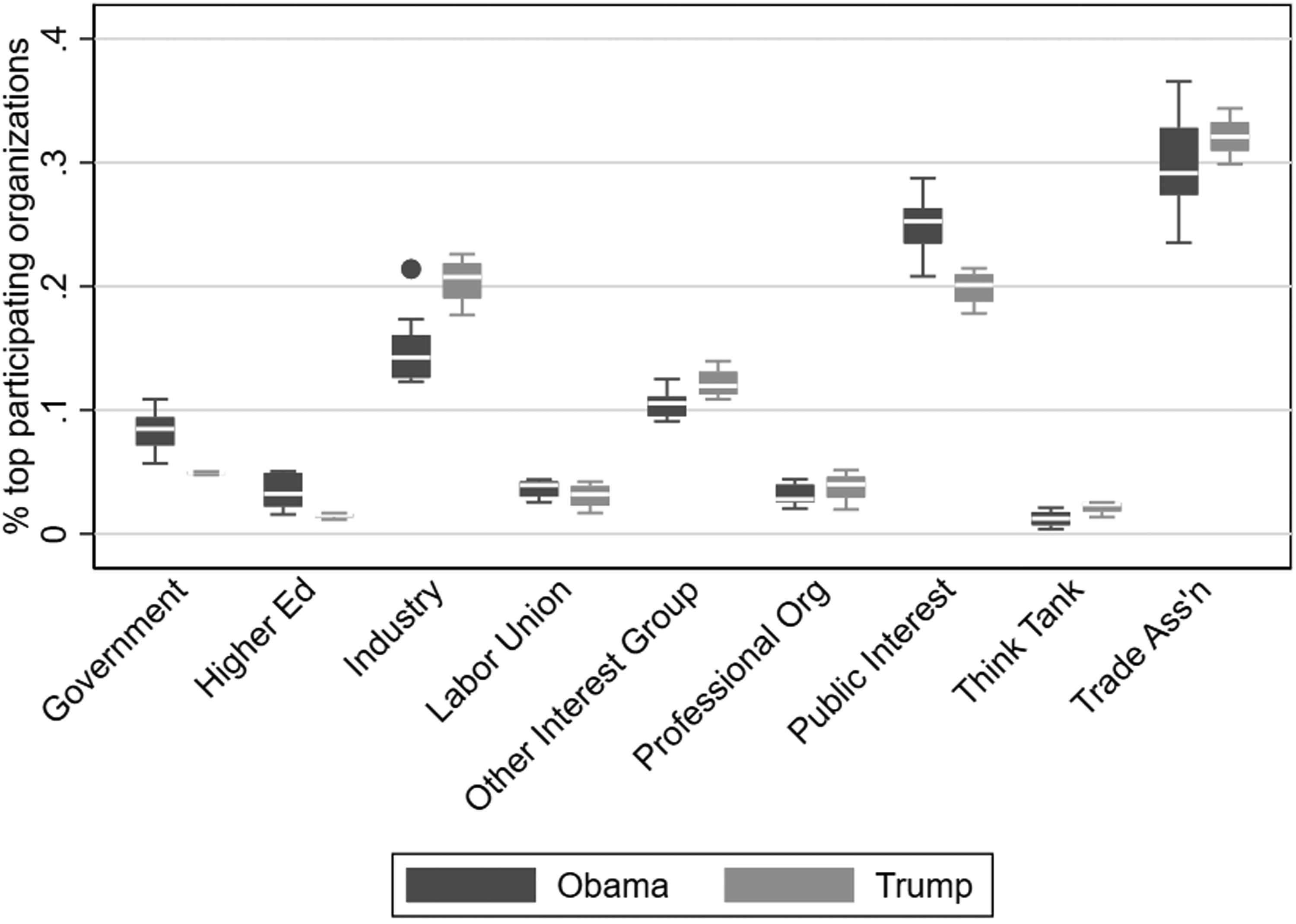
Top participating organizations by type. Note: Box plot of participation level by organization type. All organizations that were among the top one hundred participating for any year in the study period (i.e., the “top organizations”) were assigned a group type. Total participation was allocated each year, according to the number of dockets each organization participated in, divided by the total dockets participated in by all top organizations.
Our next analysis of the commenting pool approaches commenter identity and comment frequency in a more fine-grained fashion. For this, we treat each year in our data as a vector representing the distribution of participation over the selected organizations (a “participation vector”). To estimate the degree of difference between years, we calculate the Kullback–Leibler (KL) divergence between year pairs. KL divergence is a metric used to compare the mutual information content of distributions. For clustering tasks, KL divergence tends to achieve similar or superior performance compared to alternative similarity measures, such as cosine distance (Huang, 2008). KL divergence has a natural interpretation in this context as the amount of information that the distribution of comments in a particular year has with surrounding years. Stated another way, KL divergence can tell us how much observing commenting behavior in a single year provides information on comment behavior in adjoining years. If presidential administrations are an important influence, then transitions should reduce mutual information across the relevant years.
Equation 1 describes KL divergence between any two participation vectors Yi and Yj:

Figure 3 provides further evidence that the behavior of the pool of top participating organizations shifted with the change in presidential administrations. The divergence in the participation vectors is fairly steady throughout the Obama administration and then jumps considerably over the transition years 2016 to 2017, before immediately settling down again during the Trump years. The transition year is a clear outlier—it falls over seven standard deviations away from the mean of the other years (mean = 0.46; s.d. = 0.14). 9
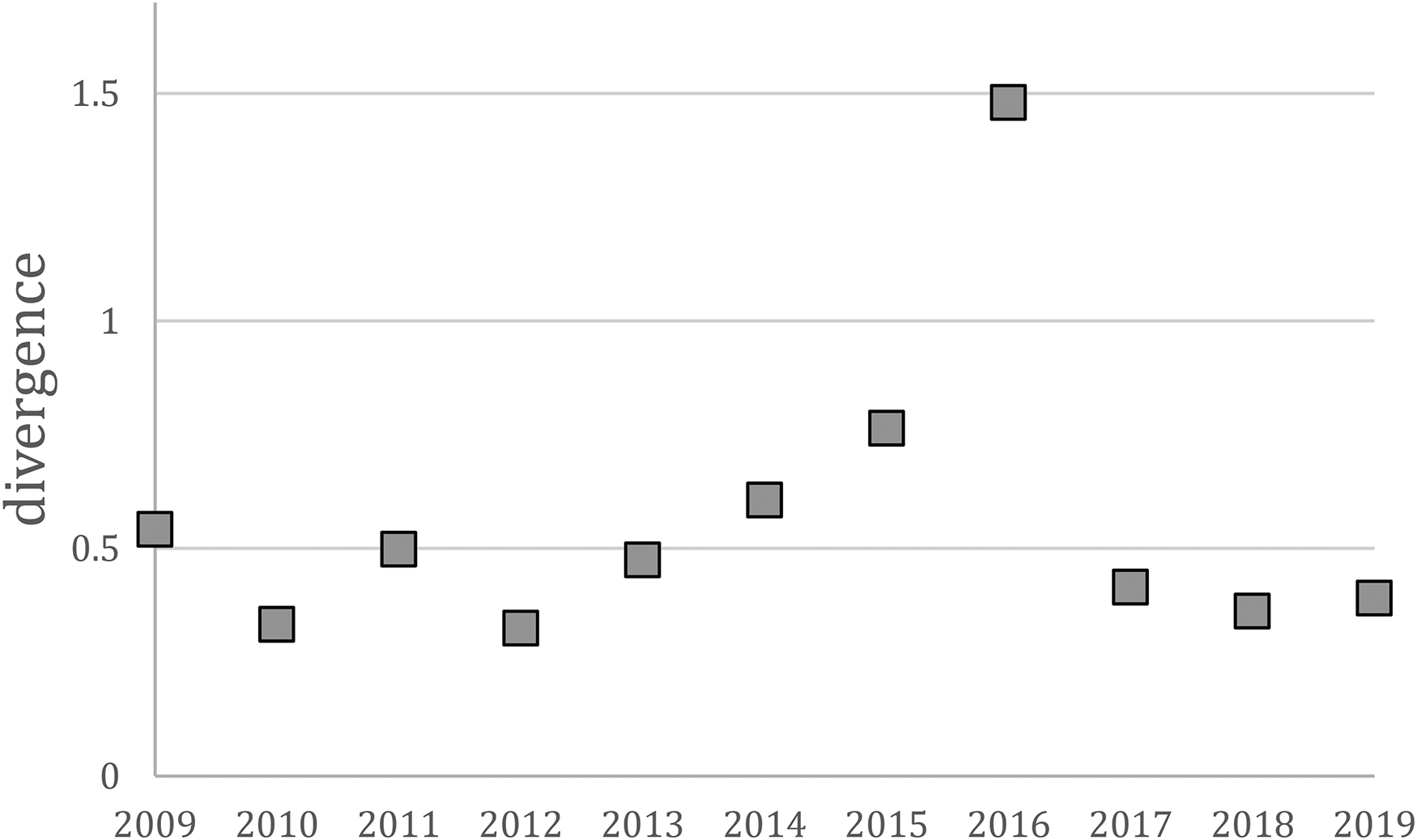
Kl divergence of participation vectors over time. Note: Each observation is the KL divergence between the participation vector in a year and the following year. The year 2016 represents the switch between the Obama administration and the Trump administration.
As an additional test, we estimate the KL divergence between all year pairs, not just subsequent years, to the compared year pairs within a single administration to cross-administration pairs. Figure 4 presents this data visually.

Kl divergence of participation vectors, heat map. Note: The left panel is a heat map. Each square is a year pair filled in according to their KL divergence. Year pair squares are outlined according to whether they are the same term (intra-term), across terms in the same administration (interterm), or across administrations (interadmin). The interadministration year pairs have substantially higher KL divergences than the within-administration year pairs. The right panel is a scatter plot comparing differences in years with KL divergence for each year-pair, separately labeling cross-administration year pairs (squares) and within-administration year pairs (marked with an X).
The left panel displays the divergences as a heat map. Each year-pair takes up a square, which is filled in according to the KL divergence for that year-pair. The heat map is divided into sections, depending on whether the year pairs represent within-administration or across-administration years. The Obama administration's two terms are also separately marked as interterm years. The heat map shows that the interadministration year pairs have considerably larger KL divergences, and also that years that are further apart tend to have larger divergences. 10 The right panel disaggregates these two effects. That graph is a scatter plot comparing the difference in years with KL divergence for each year-pair, separately labeling cross-administration year pairs (squares) and within-administration year pairs (marked with an X). The difference between cross-administration years and within-administration years is striking. We specify an OLS regression with divergence as the outcome variable and predictor variables of difference in years, an indicator for different administrations, and the interaction of these terms. All variables are highly significant (p < .001). The difference in years has a coefficient of 0.19; the cross-administration indicator has a coefficient of 1.03, and the interaction term has a coefficient of −0.12. The R-squared for the model is extremely high (0.95). 11
Prior work has established the importance of coalitional efforts to influence agency decision-making (Dwidar, 2021; Nelson & Yackee, 2012). The results reported in this section indicate that the party in control of the White House is associated with meaningful changes in the coalition of groups that appear before administrative agencies. Many potential mechanisms could lead to this effect, including differing regulatory agendas and the real or perceived influence of groups—which affects the benefits of commenting. Network effects, whereby changes in the incentive structure for some commenters affect the costs and benefits of commenting for others, are also an important potential pathway.
Discussion
Federal administrative agencies adopt policies with wide-ranging social and economic consequences, on issues that range from immigration to climate change to reproductive freedom. By law, when agencies issue new rules, they must solicit and consider comments on their regulatory proposals that are submitted by the public. Examining those comments provides a useful lens on the relationship between federal administrative bureaucracies and the public they are intended to serve.
In the preceding analyses, we compare public comments across presidential administrations to examine differences in the pool of commenters. Prior work is ambiguous about the degree to which presidents will affect agencies’ interactions with the public. Some lines of research emphasize the consistent incentives faced by agencies (Becker, 1983; Peltzman, 1976; Posner, 1974; Stigler, 1971), the institutional features and conventions that may limit presidential influence (Barkow, 2010; Bolton et al., 2015; Carpenter, 2010; Livermore, 2014; Vermeule, 2013), and the relatively constant ideological orientation of agencies over time (Lewis, 2003). Other work focuses on the tools available for presidents to exert influence (Moe, 1985) and their incentives to do so (Kagan, 2001). For the pool of commenters, Furlong and Kerwin (2005) find that there is fairly consistent perceived value to commenting across administrations, at least within the sophisticated organizations that they surveyed. On the other hand, Dwidar (2021) and Nelson and Yackee (2012) emphasize the importance of coalitions in influencing agency decision-making. It is possible that for different administrations, the costs and benefits affect which commenting coalitions form and which do not.
Our findings reinforce the view that presidents can profoundly affect the relationship between agencies and the public. Notwithstanding insulating institutional factors, consistency in agency ideology and incentives, and the stable perception among groups concerning the value of commenting, the president in the White House deeply conditions how agencies act and how the public responds. Although presidents certainly face limits and constraints, the presidential transition from Barack Obama and Donald Trump (which was characterized by different parties and interest group coalitions, different policies, and extreme contrasts in rhetoric and style) was associated with substantial changes in the relationship between agencies and the public.
Our findings also highlight the importance of the political environment in affecting the pool of organizations and individuals who avail themselves of the public commenting process. Several important papers attempt to tease out the influence of public comments on agency decision-making (Cúellar, 2005; Golden, 1998; McKay & Yackee, 2007; Yackee, 2006; Yackee & Webb Yackee, 2006), but the factors that affect who takes advantage of this participatory avenue remain underexplored. Inasmuch as commenters are influential, a better understanding of these factors sheds light on the allocation of political power. Even where comments serve a primarily expressive role, it is important to understand the influences of this type of civic participation. Our results indicate that, rather than a fixed pool of commenters that remains consistent over time, there are substantial fluctuations in the types of groups and the mix of individuals and organizations that choose to participate. The presidential administration is one important feature of the political environment, but future work can assess a broader range of factors that bear on participation in agency rulemaking.
The model illustrated in Figure 1 summarizes the factors that affect the decision of potential commenters on whether to comment and what to say. Commenters differ in their characteristics and motivations, and commenting decisions are affected by the attributes of the rule in question and features of the political environment. Our study period covers a substantial change in the political environment—the Obama to Trump transition—which has potential ripple effects through rule attributes and the political coalitions that have more or less access to political decision-makers. Our research questions focus on changes in the pool of commenters and we draw some conclusions about how changes in the political environment affected commenter motivations and the costs and benefits of commenting.
Focusing on organization type, we find that participation remained level across administrations for some types of organizations, which is consistent with the findings in Furlong and Kerwin (2005). The organizational categories of Labor Union, Professional Organization, and Think Tank all had fairly consistent participation across the Obama and Trump administrations. For other organizational categories, however, we find that there are substantial changes in the level of participation, with some participating more under Obama (Government, Higher Education, and Public Interest) and others participating more under Trump (Industry, Other Interest Group, and Trade Association). Examining the organizational types associated with each administration, one straightforward interpretation would be that groups that perceive themselves to be more closely in ideological alignment with the administration focus their efforts on commenting. Another related possibility is that agency actions tend to be oriented toward ideologically favored interests, which causes them to be more engaged in the regulatory process. Professional organizations and think tanks are less clearly associated with either party and therefore may have similar levels of business before agencies (and similar perceived influence), notwithstanding the president in power. The consistent participation of labor unions across administrations is somewhat difficult to reconcile with this ideological alignment account. However, given the labor movement's overall size and institutional inertia, it may be that it does not quickly reallocate its resources into or out of participation in the regulatory process, regardless of the inclinations of the administration.
At the more fine-grained scale, we find that the pool of commenters tends to drift over time, even within an administration, but that there was a much stronger shift that occurred during the transition year. This supports the claim that the changes noted in participation by organization type are not simply the result of gradual temporal changes, but rather reflect an underlying reality that the pool of commenters underwent an abrupt change when President Obama turned over the White House to his successor.
Our findings have implications for the likely motivations of commenters. Among the three classes of commenter motivations—litigation preservation; agency persuasion; and expression—the persuasion motivation is most consistent with increased participation during times of ideological alignment. Groups that are opposed to an agency's policies would have a greater need to engage in litigation preservation than supportive groups. In addition, there is no clear reason why groups would be more motivated to express support rather than opposition to an agency's policies. (If anything, negative expressive motivations may be more powerful.)
Conclusion
The public comment process is firmly entrenched as a feature of modern administrative governance in the United States. At the very least, comments provide a lens on stakeholder reactions to agency decision-making: Not of a random sample of Americans, but of a self-selected group that has chosen to participate in the administrative process. This group, and especially the most consistent interest group participants, also engage in other political activities, including lobbying elected officials and providing support for electoral campaigns. The views of these commenters may also track in some way those of other institutions, such as courts, through some channel of mutual influence. Investigating comments may provide a way of understanding these other actors as well.
Comments, especially those submitted by interest groups, do not necessarily represent the views of the broad American public. Nevertheless, at least on some accounts of the administrative state, the interplay between agencies and stakeholders that takes place through the public comment process helps provide democratic legitimacy for agency decision-making (Seidenfeld, 1992).
The analysis above suggests that presidential administration matters for how the public interacts with administrative agencies. In particular, the constellation of interest groups that participate in the notice and comment process changes between administrations, with groups participating more regularly when they are more closely aligned with the party in control of the White House. This result is consistent with at least a substantial number of commenters participating in the public comment process based on persuasive motivations.
Our study does not attempt to untangle the various causal mechanisms that could affect commenting behavior. Some of these differences may be due to commenter reactions to different substantive proposals. Others may be due to commenter perceptions that are unrelated to substance and arise from a complex nexus of incentives, ideology, and partisan alignment. Uncovering these different mechanisms is a potentially interesting subject for future work.
The Obama and Trump administrations were dissimilar on many different dimensions, and these differences ultimately affected how interest groups interacted with agencies through the notice-and-comment process. Just as Presidents bring new personnel and policy agendas to the White House, they also appear to bring along distinctive, although overlapping, pools of commenters. Changes in the pool of commenters in turn can affect the issues that are raised and discussed in the public comment process, which ultimately influences the information environment—and potentially the decisions—of agencies and, via the administrative record, reviewing courts. The shift in commenting behavior is a further underappreciated mechanism through which presidential elections have consequences that ripple out through the administrative state.
Supplemental Material
sj-docx-1-arp-10.1177_02750740241245362 - Supplemental material for Presidential Transitions and Interests Group Participation in the Notice and Comment Process
Supplemental material, sj-docx-1-arp-10.1177_02750740241245362 for Presidential Transitions and Interests Group Participation in the Notice and Comment Process by Michael Livermore, Vladimir Eidelman, Anastassia Kornilova and Onyi Lam in The American Review of Public Administration
Footnotes
Declaration of Conflicting Interests
The authors declared no potential conflicts of interest with respect to the research, authorship, and/or publication of this article.
Funding
The authors received no financial support for the research, authorship, and/or publication of this article.

Supplemental Material
Supplemental Information for this article is available online.
Notes
Correction (August 2024):
The biography of “Vladimir Eidelman” was published twice in the paper. The duplicate one has been replaced with the biography of “Anastassia Kornilova”.
Author Biographies
References
Supplementary Material
Please find the following supplemental material available below.
For Open Access articles published under a Creative Commons License, all supplemental material carries the same license as the article it is associated with.
For non-Open Access articles published, all supplemental material carries a non-exclusive license, and permission requests for re-use of supplemental material or any part of supplemental material shall be sent directly to the copyright owner as specified in the copyright notice associated with the article.
