




Abstract
In his book The Ever-Present Origin, Jean Gebser describes the new era of consciousness into which we are moving as we move from the era of rational consciousness into the an era of time-free transparency. This article describes in greater detail the meaning and nature of consciousness that is time-free and transparent. Both of these features are most apparent in night-time dreams and other altered states of consciousness, features that were and are available to the shamans of both ancient and contemporary hunting-gathering cultures. A direct way of experiencing these features of this new consciousness is through the altered state of ecstatic trance as researched by the anthropologist Felicitas Goodman as described in her book Where the Spirits Ride the Wind. The induction of this altered state of consciousness is then described.
Keywords
I have frequently quoted Jean Gebser in my writing because he shows us the way as we journey into the New Age. The New Age has been described in many ways. Gebser’s way is that it will show us a new dimension of consciousness, a fourth dimension of time-free transparency, a dimension that will take us beyond the five senses of our limited rational world and into the world that again offers us the sixth sense, the sense of intuition that was revealed to the ancients through their communion with the spirits.
As we mutated beyond the dream world of the archaic era, the era of our Ever-Present Origin, the title of Gebser’s (1985) book, we entered the magical world when the magical power of the shaman of the hunter-gatherers provided us with access to the spirits while in an altered state of consciousness, a dream-like state of trance passed on to them from the earlier era. During the following mythical era, special healing practitioners such as Asclepius of Melos continued to value and practice the power of dreaming in healing (Larsen & Verner, 2017). As we now enter the era of time-free transparency, this transparent and time-free state of consciousness will not be available to just the shaman of the community but to all of us as we again develop our skill of entering this altered state of consciousness, either through paying attention to and valuing our nighttime dreams or through hypnotic or ecstatic trance, trance that I have used in my practice of clinical psychology. What this altered state of consciousness offered the ancients was lost in our rational era of living in our world of five senses with the loss of our sixth sense, but it is being regained as we enter the four-dimensional era of time-free transparency.
Time Free
To begin, the time-free nature of altered states of consciousness is readily revealed in our nighttime dreams. In dreams, you often find your adult self back in your childhood home, relating to childhood friends, or reexperiencing other events from your past. These dreams demonstrate freedom from linear time.
Transparency—Extrasensory
The transparency available to us through these altered states of consciousness is recognized in the so-called primitive societies, the hunting and gathering societies that continue to exist on earth today. These societies provide us with considerable evidence of the magical power of their shamans, the power that we are now beginning to rediscover. Vine Deloria (2006), a Standing Rock Sioux, in his last book before his death in 2005, The World We Used to Live In, is a collection of the experiences of American Indian medicine men that demonstrate this very real power of healing, and of communicating and seeing over great distances that exist beyond our usual sensory ability that is restricted to the five senses. Whole clans seemed able to remain in touch with each other no matter where their members roamed. One of Deloria’s narratives is of the medicine man, White Shield. Siya’ka tells the story that he lost two horses. White Shield, using his way of knowing, tells Siya’ka that his horses were fifteen miles west of Porcupine Hills, at the fork of Porcupine Creek. He knew that a traveler was coming from that direction and would return the horses. This proved to be true—a neighbor of Siya’ka had been on his way home when he recognized the horses and brought them back. (p. 68)
I have been a psychologist for 47 years and used dreamwork and clinical hypnosis extensively in therapy. Ten years ago, I discovered and received the training to become an instructor of ecstatic trance at the Cuyamungue Institute that is near Santa Fe, New Mexico. From the experiences with these altered states of consciousness or forms of trance, I contend that time-free transparency is experienced in our nighttime dreams, hypnosis, or ecstatic trance, but it is especially in ecstatic trance that I will describe later.
Gebser (1985) contents that at least some extrasensory experiences are a manifestation of the four-dimensional time-free transparent era. He states that “the patent senselessness and worthlessness of the phenomena produced by such spiritistic and mediumistic means is clear evidence of their origin in the web of magic enmeshment, characterized by its fortuitousness and lack of directedness” (p. 368). Contrary to Gebser’s rejection, I find the use of these extrasensory trance experiences full of fortuitous direction and meaning in the process of healing emotional/psychological problems and in carrying us beyond. Before I continue with this quote from Gebser, I would like to offer one example of the healing power of these altered-state experiences, specifically ecstatic trance. Maria, one person in my ecstatic trance group, reported that she was struggling with quitting smoking and to this point in time had been unsuccessful. Although I did not know what specifically she was working on when she had the following ecstatic trance experience, the following week she returned to report that she had not smoked since this experience.
In October 2007, she reported that while in trance, I began in a womb-shaped, den-like cave of branches. I was trying to figure out what animal I was, and then I realized I was a very happy little girl, about eight years old. I was alone, but happy and free. I was in a city on a sidewalk. The city was gray and ugly, but I felt alive and happy. I walked up a road that turned into a wide bridge in a very industrial city setting. I stayed on the bridge a while feeling happy, young, and free. Then I began to cross the bridge and realized that it led into an enormous warehouse. I did not want to go in. I turned around. Behind me was city, ugly and gray but home. I became very, very sad. Then I became annoyed because I could not get off the bridge. I wanted to change visions but that did not work. I wanted to end the meditation but I was still on the bridge. So I let all emotion escape me and entered the warehouse. It was hell, a hellish landscape. I marched through and exited the other side. I was surprised to see the road continue with a beautiful and colorful landscape. I lie down in the grass. I knew it was beautiful, but I could not feel the same excitement. I was older now.
Maria knew it would be hell to quit smoking, but this ecstatic experience greatly abbreviated her time spent in hell. She has not had a cigarette since that experience. Her naive eight-year-old self, the part of her who was happy in the gray, polluted city of smoking, was sad and wanted off the bridge that led her through the hell of quitting, but her older self summoned the will to enter the warehouse and pass through to the other side, to a place of beauty in being a nonsmoker.
Gebser (1985) concludes his reflections on extrasensory experiences with the quote, “The procedure is unnatural because it contradicts the nature of the three-dimensional consciousness structure which is for the most part still proper to contemporary man” (p. 368). From my understanding of the shamanic magic of the hunter-gatherers, this procedure was very natural to them, a naturalness lost in the restricted nature of our three-dimensional consciousness, but now as we move into the fourth dimension, it is being regained.
To offer another example of this extrasensory perception, an example that changed my life, a number of years ago, I attended a workshop on Neurolinguistic Programming attended by about 50 people. One experience that was offered in this workshop occurred when we were instructed to breakup into groups of three. One person in the group was instructed to sequentially present six imagery experiences to a second person who was to imagine each of these six experiences while the third person was to carefully watch the second person, noting breathing rate, muscle tension, skin coloration, and so on. Then the second person was to select one image and reimagine it while the third person tried to identify which image of the six was being reimagined using what had been observed. I remember three of the six images. One was sitting in a comfortable chair after a big Thanksgiving Dinner, another was waiting for a plane that is an hour late, and a third was walking down the street in the evening while it is snowing. When it was my turn to observe, I automatically closed my eyes and experienced with the imager while in trance what she was experiencing without consciously watching for physiological clues. Later, when she selected an image to reimagine, I was immediately able to identify it and when she happened to switch images, I immediately recognized the change and the new image. Another person in the workshop, who was also experienced in using hypnosis, was able to also quickly identify the correct image being reimagined. This greatly increased my confidence in my ability to see beyond my five senses. Such extrasensory perception is one aspect of the transparency found in dreams and trance experiences.
Transparency—Integration of Dualistic Thinking
Another aspect of transparency is the integration of dualistic thinking. Again quoting Gebser (1985), Contemporary methods employ predominantly dualistic procedures that are not extended beyond simple subject-object relationships; they limit our understanding to what is commensurate with the Western mentality. To move beyond this limited understanding, an attempt at ‘diaphany’ or to render transparent is to move to a new relationship that is no longer dualistic, that does not threaten man with a loss of identity, or of being equated with an object. (p. 7)
In other words, what was a duality will become an integrated whole.
Considering the subject–object duality, what we consider rational logic breaks down in trance and dream (i.e., Raynor, 1981), In the rational world, if A causes B, then B cannot cause A, but in trance and dreams, B can also cause A, and thus the subject–object duality of rational thinking is lost. For example in a dream, I can be outraged in being attacked by someone, but I can at the same time be the attacker, that is, both the subject and the object of the experience.
But Gebser takes such dualities even further in considering other of life’s dualities—for example, he considers the nature of the soul in terms of both death and life. Whereas this duality to the rational person is clear in the distinction between life and death, as we move into the era of time-free transparency, this duality is lost. Both death and life are aspects of our new understanding of the soul. Gebser also examines the yin–yang symbol, with the pole of the yin within the yang and the pole of the yang within the yin. The meaning of this symbol goes even deeper than Gebser portrays when one realizes that arising from the very beginning, the state of emptiness or doing nothing, that is, wu-wei, the primordial yin and primordial yang arises, with taiyi being the separation of the duality of the yin–yang. The yin–yang again comes together in taiji, the effort to retort to wuji, the emptiness before creation. This effort to return to wuji is to return to our Ever-Present Origin, but now with a new understanding.
In considering another example of our dualistic or polyistic thinking, many years ago when I first read Frank Water’s (1963) Book of Hopi, I remember being unnerved by the fluidity of a symbol. A symbol could mean a number of different things, which collided with my own thinking, for example, green could mean “go,” “death,” “new life,” “money,” and so on, with more sides to its meaning than just a duality. Trying to find one meaning of the symbol, that is its common denominator, loses something in transparently understanding its meaning. I now find comfort in such diversity of a symbol. For example, thinking of the medicine wheel—“East” means spring, a new dawn, the rising sun, the beginning of life, the planting of our gardens. Trying to find a simple definition in this diversity such as “the beginning,” loses the depth of its meaning. The induction ritual for inducing ecstatic trance involves calling the spirits of each direction, and in this litany, this same diversity is found in spirits of each direction. As we continue around the medicine wheel and call the spirits of the south, we call the spirits of the warmth of midday, of summer, of growth of our children, and the growth of our gardens, again taking us beyond our dualistic thinking.
In working with dreams, or the metaphors within a dream, it can mean many things, and saying “Ah ha, That’s it!” with just one interpretation, the power of the dream is lost. Although it is important to work with a dream and its meaning, it is important to let it be what it is with its many meanings, to let the meanings be fluid or diaphanous.
I find the word “transparent” loses something and is limiting. That which is diaphanous is in motion, shimmering, fluttering, and continually changing in transparency, a fluid transparency like the gossamer gowns of the ancient goddesses.
Other writers support that same mutation of consciousness as we move into the new era of the loss of our sense of duality. Carl Johan Calleman (2004) describes the world that we now live in as one of dualistic thinking, automatic ways of thinking that have been our survival in this world of separation, separation so deep within us that it blocks our true connection to the Earth and the community of all life on earth. Unlearning that which separates us will bring us into the new world of harmony and peace. Charles Eisenstein (2013) describes in great detail the world of separation that keeps us tied to our dualistic thinking and what is needed for us to break free of it.
Ecstatic Trance
Let us now examine the nature of ecstatic trance. Research of this shamanic modality has been limited primarily to the field of anthropology including the research of anthropologist Felicitas Goodman (1990). The energy of shamanic or ecstatic trance is seen in the familiar images of the energetic dancing of indigenous tribes from around the world, dancing that is performed to the rapid beat of drums or other percussion instruments. Such dance celebrations, celebrating the spirits of the Earth and of the ancestors, may go on for many hours with some participants, often the shaman, falling into a deep trance. From this trance experience, much is to be learned from their calling upon spirits, the spirits that give direction to life, provide healing, answer questions, and open the door for seeing into distant places and into the future. The power offered by ecstatic trance and what can be learned from it, so valued by our hunting and gathering ancestors, has been forgotten or ignored during the current era of rational consciousness, but as we move into the new age, these trance visions will again become valued and called upon. I have found that this altered state of consciousness is exceptionally valuable in the process of healing and learning from the past as we move into the future (Brink, 2013, 2014, 2016, 2017).
The energy of ecstatic trance is very high and different from the quieting energy of hypnotic trance, trance that is induced through slowly spoken words, words of relaxation, quieting the mind, and slowing other bodily functions. Felicitis Goodman recognized that speaking in tongues as occurs in the Apostolic Church is akin to ecstatic trance. Her research in ecstatic trance thus began with her dissertation research on the speaking in tongues in the Spanish-speaking and Mayan-speaking Apostolic Churches of Mexico. This research led her to identify four necessary components for inducing the trance state that produced the speaking in tongues:
First, an open mind and relaxed body, along with the expectation of a pleasurable but nonordinary state of reality. Second, a sacred space, one separate from the activities of everyday life. Third, a meditative technique, such as counting one’s breath, to calm the analytic mind. Fourth, rhythmic stimulation of the nervous system through rattling or drumming.
These four components were evident in the worship services of the Apostolic Churches with the congregation’s expectation of speaking in tongues, the sacred space of the church, quieting the mind with prayer, and the rhythmic stimulation of hand clapping.
Goodman then designed a ritual with these four components that separated them from the context of the church. Her ritual begins with a discussion of what to expect from ecstatic trance and the answers to questions. The sacred space for this ritual was designated by smudging the space and each participant with the smoke of burning herbs, and by calling the spirits of the six directions, the litany that I briefly introduced earlier.
Following this litany, the meditative technique to quiet the mind is offered that entails sitting in silence in a comfortable position while counting one’s breath for five minutes. Then the stimulation of the nervous system with drumming or rattling commences and lasts for 15 minutes. The beat is approximately at the rate of 210 beats per minute.
After receiving her PhD from Ohio State University, Dr. Goodman took a position at Dennison University in Granville, Ohio. With her students, she experimented with this ritual and found that the students did go into a trance, though she concluded from this experimentation that the trance lacked direction or meaning.
She then read an article by the Canadian psychologist V. F. Emerson (1972) who, in his research with various meditative disciplines, found that different body postures had specific but different effects on such body functions as heartbeat, breathing, skin moisture, and bowel motility. With this discovery, Goodman searched ethnographic journals, books, and museums to find what she believed were the body postures used by both contemporary and ancient shamans, body postures that suggested religious ritual activity. She identified approximately 50 such postures that she used in her continued research. Following the ritual that she had already developed but adding to it these body postures, she had her students at Dennison sit, stand, or lie in one of these postures while she shook her rattle or beat her drum.
With this addition of a body posture which was held by the participants for the 15 minutes of drumming or rattling, she found the direction and meaning that was initially missing without the use of these body postures. What she found was that some specific body postures elicit the sensation of bringing a healing or strengthening energy into one’s body. Other postures are for divination, for seeking answers to questions or for looking into the future. Then there are those postures that bring about the sensation of shape-shifting or a metamorphosis in becoming some animal, other living being, or some inanimate substance or feature of the Earth. Some postures are for journeying into the underworld, others for journeying in the middle world, and some for journeying in the upperworld. Then there are the postures that bring about a death–rebirth experience of initiation.
The effect of these postures on the ecstatic experience makes considerable sense when they are examined for what they communicate nonverbally. In selecting an example for each, consider the Bear Spirit posture for healing. With one’s hands on the lower abdomen while breathing from the diaphragm, healing becomes evident with each breath as one inhaling a sense of healing energy and with the exhale the healing energy spreads throughout the body (Figure 1).
The Bear Spirit.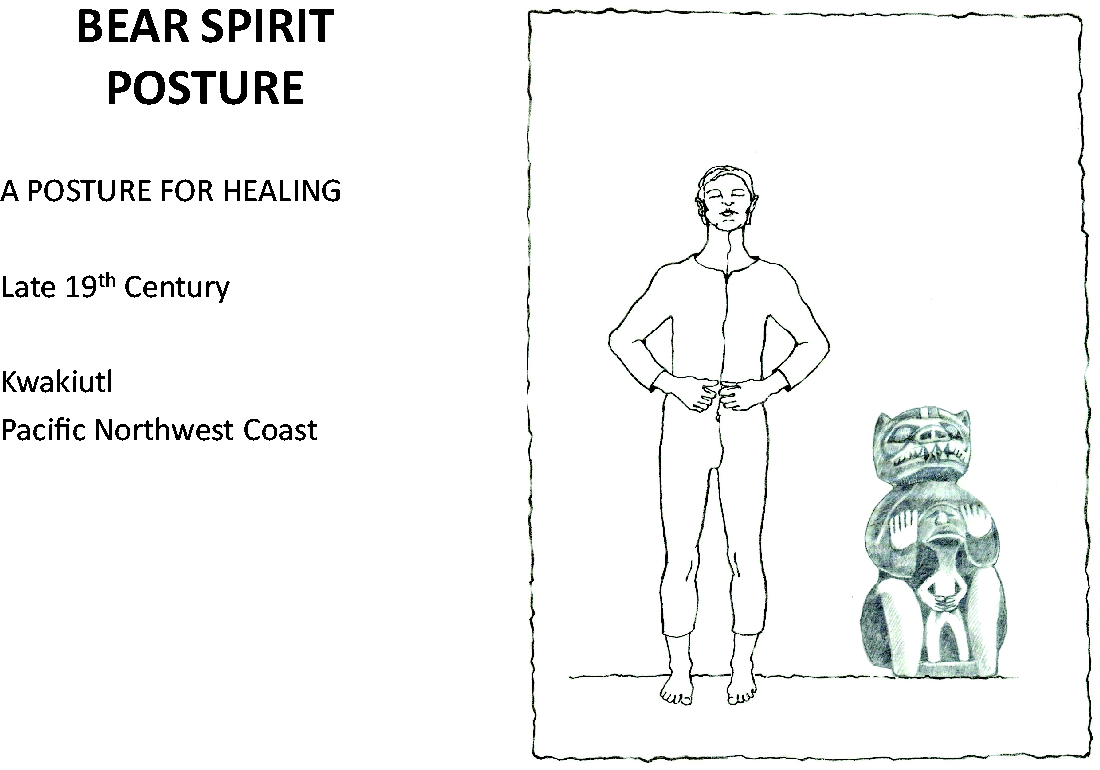
The Mayan Oracle posture for divination, with the left hand raised, is reminiscent of Rodin’s the Thinker of waiting for an answer to your question (Figure 2).
The Mayan Oracle.
The Olmec Prince, with the knuckles of both hands resting on the floor as the forelegs, suggests shape-shifting to some four-legged animal though this posture often shifts me to a bird or a snake without forelegs (Figure 3).
Olmec Prince.
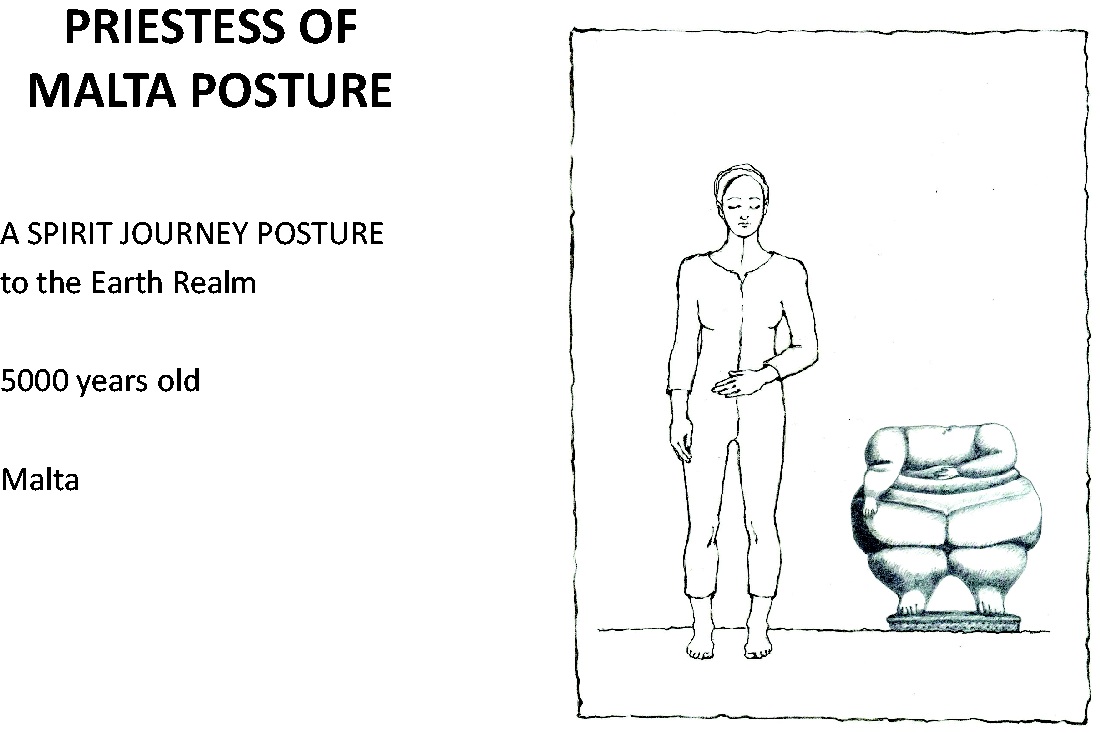
The Sami Lower World posture of lying prone, close to the Earth, takes a person into the underworld, whereas the Priestess of Malta with her rotund body and her right hand pointing to the Earth suggests, “I am planted here on the Earth” (Figures 4 and 5).
Sami Lower World. Priestess of Malta.
The Venus of Galgenburg, with her right hand point to the heavens as she looks upward in that direction suggests journeying into the upperworld (Figure 6).
Venus of Galgenberg.
Then the Feathered Serpent with hands on the waist suggests a sense of determination, of saying I am determined to give up my old way in favor of the new healthier way (Figure 7).
Feathered serpent.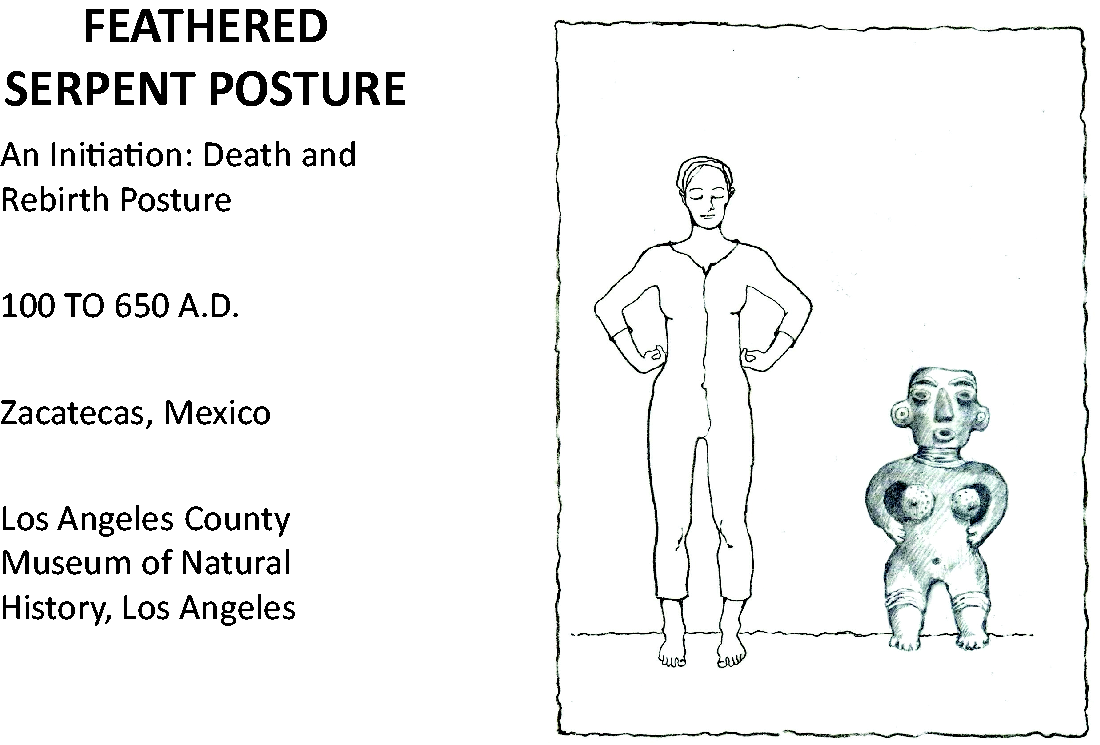
I was first introduced to ecstatic trance when I was president of the American Association for the Study of Mental Imagery. In the beginning stages of developing the program for our 2004 annual conference, Felicitas Goodman was invited to be a keynote speaker. Because of some problems out of our control, the conference did not happen, but I briefly talked with Felicitas on the telephone and read her book, Where the Spirits Ride the Wind. I was quite impressed with the outcome of her research such that in 2007, I offered a workshop at the annual conference of the International Association for the Study of Dreams. The mental imagery association has since become part of the dream association. The workshop was offered each of the four mornings of the conference and I had the opportunity of using eight of her ecstatic postures. Granted, the participants in the group were there because of their interest in dreams thus quite receptive to this altered state of consciousness, but I was astounded by the effect of the postures that matched the results as determined by Goodman. As a result, I returned home to start a group using the postures, a group that at first met weekly, but now meets monthly and has continued for 10 years. From the ecstatic experiences of the participants of these group sessions as well as a number of other workshops, I have offered around the country, I continue to be very impressed with the power of these ecstatic postures and the power of ecstatic trance. I have collected over 3000 ecstatic trance experiences that have been the core of my five books on ecstatic trance.
In our ecstatic trance group, when sharing our experiences, we have come to expect commonality. One example is my experience when I was standing across from Sarah. I saw her dissolve into a sea of colors that floated back and forth through the room before they exited the room through the door and formed a tree on the hillside beyond our house. In Sarah’s experience, she saw the top of my head pop open and a flock of colorful birds fly out and fly back and forth across the room before exiting through the door and outside they formed into a marble statue.
On another occasion, I was invited to do a six-session workshop with a group of senior citizens in our community. During our sixth session, I had the group divide up into pairs and instructed each pair only to be aware of their partner as they went into trance. Both my partner and I experienced a spiraling energy in our experiences. The commonality of the experiences of another pair was of abstract shapes and colors, and a third pair of flying as birds. With the fourth couple, a husband and wife, the husband experienced walking along the sand of a beach holding his wife’s left hand, while the wife experienced her left hand becoming very tired.
As a result of my many ecstatic trance experiences, I believe that each of these experiences show transparency, of seeing beyond our five senses again bringing alive our sixth sense that was so much part of the life of our ancient ancestors.
Footnotes
Declaration of Conflicting Interests
The author declared no potential conflicts of interest with respect to the research, authorship, and/or publication of this article.
Funding
The author received no financial support for the research, authorship, and/or publication of this article.