




Abstract
The present opinion questions the assessment of motor imagery (MI) ability with questionnaires, particularly for subjects with low MI ability. Strengths and limitations of implicit and explicit tests that can be associated to MI ability are highlighted. Creative solutions are claimed to handle the various dimensions of MI such as modality and perspective preferences. Although most of the proposed tasks promote visual MI, variations of the tasks may increase the kinesthetic aspects. Ideas and directions for future developments to assess MI ability are discussed.
Motor Imagery Ability
Motor imagery (MI) describes a mental representation of an action without actually executing the action (Jeannerod, 1995). MI is assumed to be based on similar mechanisms as motor execution (ME; Grush, 2004; Jeannerod, 1995) because it involves similar brain regions (Munzert, Lorey, & Zentgraf, 2009) and similar timing parameters (Guillot & Collet, 2005). MI includes imagining the effort as well as kinesthetic, tactile, visual, and acoustic information of the action. Visual MI may occur from a first person perspective (“through the own eyes”) or from a third person perspective (“from another viewpoint”). Moreover, MI includes the action consequences (Kilteni, Andersson, Houborg, & Ehrsson, 2018). In mental practice, MI is systematically used and repeated to enhance motor performance. Mental practice is applied in many domains such as surgery (Arora et al., 2011), aviation (Tokumaru, Mizumoto, Takada, & Ashida, 2003), music (Bernardi, De Buglio, Trimarchi, Chielli, & Bricolo, 2013), and sports (Di Rienzo et al., 2016). Subjects may, however, differ in their ability to imagine actions and may have distinct preferences in regard to perspectives and modalities. To predict performance enhancements after mental practice, MI ability is used.
In the first section, strengths and limitations of the existing MI questionnaires are outlined. It is the aim of the present article to critically reflect the assessment of MI ability. Moreover, new directions for future investigations shall be launched. Therefore, alternative assessments to test MI ability are discussed in the second section.
MI Questionnaires
Because of its covert nature, MI is not directly observable. Oftentimes, the quality of MI is assessed with questionnaires (Vividness of Movement Imagery Questionnaire [VMIQ]: Roberts, Callow, Hardy, Markland, & Bringer, 2008; Sport Imagery Ability Measure [SIAM]: Watt, 2003; Sport Imagery Ability Questionnaire [SIAQ]: Williams & Cumming, 2011; Movement Imagery Questionnaire [MIQ]: Williams et al., 2012) because they are easily accessible and relatively fast to assess (for an overview about imagery questionnaires see Pithan & Dahm, 2015). Questionnaires are effective and give a comprehensive overview on subjects’ attitude in regard to MI use (SIAQ: Williams & Cumming, 2011). Furthermore, questionnaires can give an estimate of subjects’ ease (MIQ-3: Williams et al., 2012) and vividness (VMIQ-2: Roberts et al., 2008) of MI. Some questionnaires claim to measure MI ability (SIAM: Watt, 2003; SIAQ: Williams & Cumming, 2011). However, the validity of such self-ratings to assess abilities may be sometimes exaggerated because they underlie the social desirability bias and the self-protecting bias (see also Gabbard & Lee, 2014). Assessing abilities with self-reports is like asking persons to report their intelligence. On intelligence, a broad and intensive theoretical debate on dimensions of intelligence has brought a variety of distinct intelligence tests that are based on correct or false answers (e.g., Beauducel, Brocke, & Liepmann, 2001; Eysenck & Stöhr, 1972; Wechsler, 2014). Possibly, MI ability needs to go a similar way. Still, questionnaires are valid and useful to investigate MI, but to detect interindividual differences in MI ability questionnaires are critical.
A frequent use of MI ability is to ascertain that participants are able to follow the experimental manipulations. Questionnaires are assessed at the beginning of experiments and a criterion is set to eventually exclude individuals with low MI ability. Some reviewers even consider it as a weakness of the study if this preselection criterion has not been implemented. However, especially in individuals with low MI abilities, methodological limitations of questionnaires (social desirability bias, self-protection bias, and tendencies to the mean) may result in an overestimation of actual abilities. Most likely, only self-aware and honest subjects indicate low abilities in questionnaires. As a consequence, individuals with low MI ability may not be discovered. Particularly, individuals with low MI ability may not use a mental simulation of the action to solve MI tasks but rather abstract strategies and tacit knowledge (Pylyshyn, 2002).
MI is supposed to be multimodal (Cumming & Eaves, 2018). 1 Some modalities (vision and kinesthesis) are integrated in the most recent versions of the questionnaires: MIQ-3 (Williams et al., 2012) and VMIQ-2 (Roberts et al., 2008). Nevertheless, other modalities (acoustics, smell, and taste) are seldom taken into account (SIAM: Watt, 2003). Particularly, acoustic imagery has gained support in recent years (e.g., Hubbard, 2010; Keller, Dalla Bella, & Koch, 2010; Schaefer, 2014). Further research might bring insights on whether the acoustic modality (and also smell and taste) is negligible in MI ability or not. For instance, future studies might investigate whether multimodal mental practice is more effective than single-modal mental practice. Possibly, the impact of acoustic MI is action dependent: Acoustic imagery may be more relevant in repetitive tasks that imply a rhythm (e.g., juggling) than in target aiming tasks (e.g., throwing).
Apart from modalities, MI ability has others dimensions. Image generation describes the ease and vividness of MI. Controllability describes the ability to intentionally manipulate tempo and precision of the imagined action. Maintenance describes the ability to focus on imagery over a period of time, which means not getting interrupted until the imagery process is finished. These dimensions should be taken into account in future measures of MI ability.
Up to now, it remains unclear to which extent preferences (e.g., first person perspective or third person perspective) impact MI ability. An imager who uses both perspectives moderately well may not have the same MI ability as an imager who uses the first person perspective perfectly and the third person perspective poorly. Usually, it is not necessary to use both perspectives simultaneously. Hence, the preferred perspective may give a better estimate for MI ability than an overall score. In tests, only some domains of MI ability are required to solve the task. Hence, this issue may account to a lesser degree for tests than for questionnaires.
Testing MI Ability
A single task may not sufficiently cover the various dimensions of MI ability. Possibly, a battery of assessments of MI ability is needed (Collet, Guillot, Lebon, MacIntyre, & Moran, 2011). Table 1 shows a collection of tasks that require MI ability, potential confounders, and associated MI dimensions. Note that this collection of tasks is not intended to be complete. Each task has its strengths and limitations which shall be discussed in the following.
Tasks Related to Motor Imagery Ability.
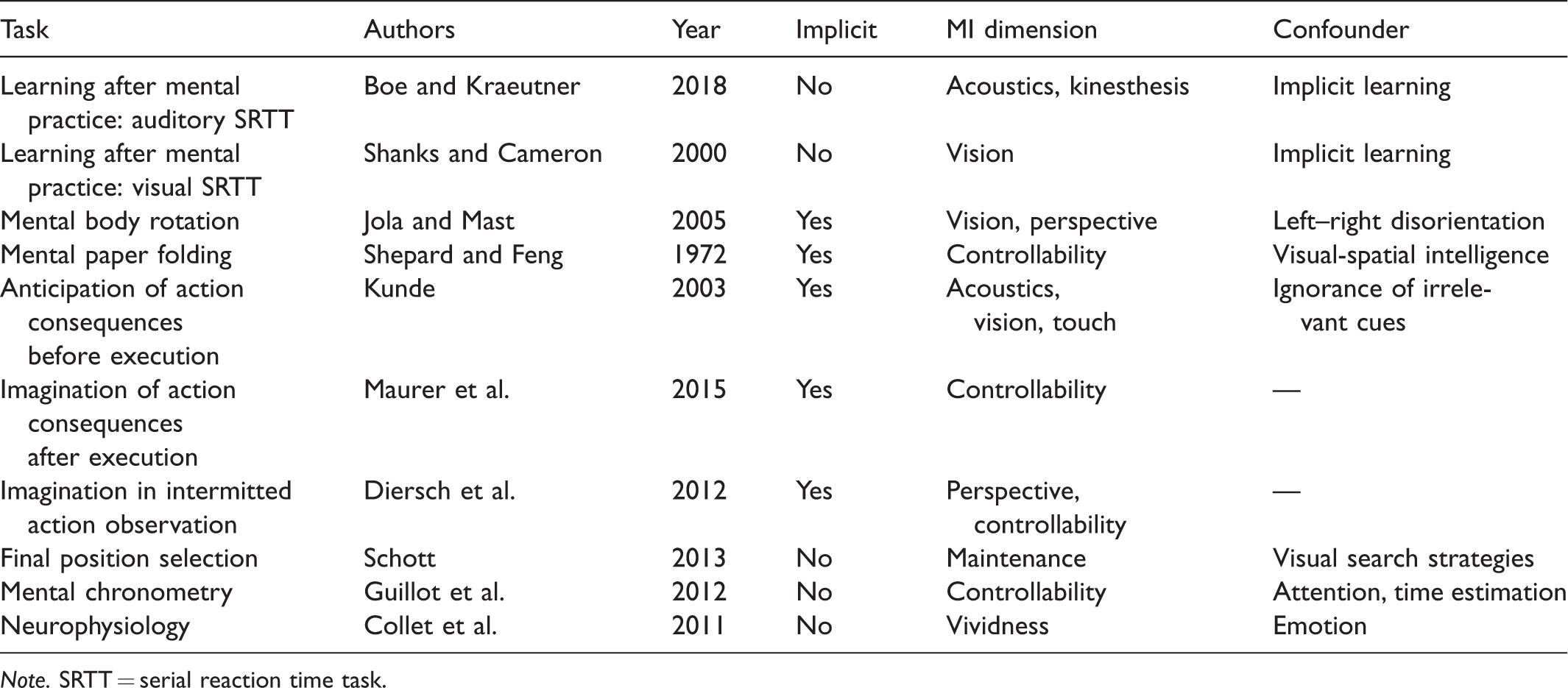
Note. SRTT = serial reaction time task.
MI may be provoked by an explicit plan (e.g., by instruction: “Imagine to do XY”) or implicitly by the characteristics of the task. It is tempting to assume that explicit and implicit MI is based on similar mechanisms (Osuagwu & Vuckovic, 2014). However, explicit MI may be more effortful than implicit MI because attention is put on imagery (Glover & Baran, 2017). This may affect the duration of the imagined actions being longer in explicit than in implicit MI. So, possibly these are two separate dimensions of MI ability. However, only some of the following tasks can be performed without explicit MI instructions (see Table 1).
Learning After Mental Practice
It has been proposed to use the increase of implicit sequence knowledge after mentally practicing a serial reaction time task as a measure of MI ability (Boe & Kraeutner, 2018). This task is not suited to use MI ability as a predictor of a subject’s improvements after mental practice. Of course learning after mental practice predicts learning after mental practice, but this is not attributable to MI ability. Moreover, there is not a direct relationship between sequence learning and MI. A lack of sequence learning does not necessarily result from missing (or low) MI ability. The participant may be a slow learner, a factor independent from MI ability. Besides its limitations, this tool may contribute to the assessment of MI ability because learning after mental practice indicates at least a minimum level of MI ability. Although learning after mental practice holds for any kind of actions, implicit sequence learning is particularly suited. Task familiarity has no impact because participants do not know the sequence beforehand. Visual MI can be measured with a sequence of visual stimuli (Shanks & Cameron, 2000). Kinesthetic and auditory MI can be measured with a sequence of auditory stimuli (Boe & Kraeutner, 2018).
Mental Body Rotation Task
In the mental body rotation task (MBRT), pictures (e.g., line drawings) of (parts of) the human body are presented on the screen. Participants take a left–right decision, for example, which arm is outstretched. There are several variations of the MBRT, with the most common using stimuli of the hands (Bläsing, Brugger, Weigelt, & Schack, 2013) and the whole body (Jola & Mast, 2005). Instructions may include a prompt to use MI (explicit) or not (implicit). In both cases, the MBRT requires an egocentric transformation of the image (Zacks, Mires, Tversky, & Hazeltine, 2000). The stimulus includes an image from third person perspective. The position of the camera may, however, facilitate switches toward the first person perspective. For instance, the egocentric transformation is easier for back view stimuli than for front view stimuli (Steggemann, Engbert, & Weigelt, 2011). The MBRT is particularly associated to MI ability (Tomasino, Rumiati, & Umiltà, 2003) because it requires imagining the own body (position) within external space. However, subjects do not necessarily need to imagine an action. Of course, one may imagine to move the own body to compare this image with the stimulus. But at the same time, one may imagine to rotate the stimulus and compare it with the own body. It is a disadvantage of the MBRT that left–right disorientation may strongly impair performance. The involvement of embodied cognition (Amorim, Isableu, & Jarraya, 2006) makes it a useful tool to assess MI ability, especially visual MI.
Mental Paper Folding
In mental paper folding, six squares are presented. Subjects are asked to decide whether two marked edges would combine if the squares were folded to a cube (Shepard & Feng, 1972). Most likely, subjects imagine how they fold the paper. However, mental paper folding does not only depend on MI ability but also on visual-spatial intelligence. To be critical, it is also possible to solve the task without an imagination of an own action. One may imagine the paper being folded without an actor, resulting in pure visual imagery. On that account, instructions should include a prompt to use MI. Nevertheless, even without imagining the motoric aspects, mental paper folding requires imagining and controlling the consequences of an action.
Anticipation of Action Consequences Before Execution
Participants react faster to stimuli when they expect congruent action consequences than when they expect incongruent action consequences (Kunde, 2003). Such response–consequence compatibility may serve as a measure for MI ability. It is assumed that the consequences that follow an action are anticipated. These anticipations are based on cognitive representations of the action consequences and the action (Hommel, Müsseler, Aschersleben, & Prinz, 2001). Hence, to execute an action, the action consequences are imagined. This imagination may (but does not necessarily) include the action itself. By changing the modality of the feedback, auditory MI, visual MI, and tactile MI could be measured. The difference between congruent and incongruent feedback may reflect temporal or spatial precision in MI. The ability to successfully ignore irrelevant cues may, however, bias the compatibility effect independent from MI ability.
Imagination of Action Consequences After Execution
After executed movement initiation, the action consequences can be manipulated or occluded (Maurer, Maurer, & Müller, 2015). For instance, a ball is kicked with a manipulandum and the ball trajectory is occluded. To detect bogus trajectories, predicted consequences are compared with actual consequences. Possibly, the movement consequences are predicted using imagination. Instructions may include a prompt to use MI (explicit) or not (implicit). Visual imagery may be more dominant if the trajectory is shown on screen than if the trajectory is occluded. A fixed trajectory (e.g., “indicate when you are able to catch the ball”) requires temporal precision of MI. In contrast, a free trajectory (e.g., “indicate where the ball ends up”) requires error prediction to precisely imagine the spatial position.
Imagination in Intermitted Action Observation
When an action is occluded in the middle of the action during action observation, it is assumed that the participant automatically imagines the missing part of the action to predict the time course of the action (Diersch, Cross, Stadler, Schütz-Bosbach, & Rieger, 2012). For instance, a movement exercise may be shown, occluded for 1 second at a critical point, and followed by either a temporally congruent or temporally incongruent continuation of the action. On continuation, participants are required to rate whether the video appeared too early or too late. The task requires temporal precision in MI. The perspective of the video may either enforce first person or third person MI. Instructions may include a prompt to use MI (explicit) or not (implicit). Alternatively, to avoid alternations between action observation and MI, participants may be instructed to simultaneously undertake MI during action observation (Vogt, Di Rienzo, Collet, Collins, & Guillot, 2013).
Final Position Selection Task
In final position selection tasks (Schott, 2013), acoustic instructions are given to imagine changes in one’s own body position, for example, “imagine to step backwards with your left foot.” After a sequence of several body changes, participants have to select their final position from visual target pictures. For exact timing, a computerized version of the task is preferable. One of the strength of this task is that it requires imagining one’s own action. The image of the own posture has to be modified and kept up for some time. The visual targets enforce visual MI, but visual search strategies may additionally benefit performance. To take kinesthesis into account, the targets may be replaced by muscles (e.g., triceps). Participants may be asked to decide which muscle is active in their imagined final position. Furthermore, a key press may be required each time the instructed body change is not feasible due to biomechanical restrictions of the former imagined posture.
Mental Chronometry
As a measure of MI ability, the difference between MI and ME durations is limited. The motor-cognitive model (Glover & Baran, 2017) states that more attention is needed in MI than in ME which results in longer MI durations than ME durations, particularly in complex tasks. In fact, absolute durations of MI and ME have often been different (Guillot, Hoyek, Louis, & Collet, 2012). However, the impact of constraints on durations has often been similar in MI and ME (Dahm & Rieger, 2016a, 2016b; Guillot et al., 2012). Therefore, the decrease in MI and ME durations caused by constraints may be related to MI ability (e.g., [ME constrained − ME]/ME – [MI constrained − MI]/MI).
Neurophysiological Measures
Neurophysiological measures during MI do not assess MI ability because there is no correct or wrong. A vivid imagination of an effortful action may increase the arousal level (heart rate, skin conductance, brain activity, etc.). However, an individual may always have less arousal than others, independent from imagination. Moreover, independent from imagination arousal levels may increase because of emotions and activity. Therefore, neurophysiological measures per se may not be helpful to assess MI ability. However, further insights may derive from comparing similarities in brain activity during MI and ME of two actions that have distinguishable neurophysiological outcome patterns (Zabicki et al., 2016).
Conclusion
Current MI questionnaires do not account for all dimensions of MI. To assess MI ability, several tasks are proposed which were not primarily developed to assess MI ability. The tasks may be adapted and systematically validated using existing questionnaires. It may be of great value to combine several tasks to a MI ability battery. Apart from MI ability, most tasks are influenced by action expertise, visual-spatial ability, and additional confounders. Future studies may investigate to which degree MI ability is action specific and depends on action expertise. Furthermore, the potential overlap of action-based MI and visual-spatial ability could be investigated.
Footnotes
Declaration of Conflicting Interests
The author declared no potential conflicts of interest with respect to the research, authorship, and/or publication of this article.
Funding
The author received no financial support for the research, authorship, and/or publication of this article.