



Abstract
People visit museums with differing motivations. We use Falk’s visitor identity model to examine visitors’ motivations to visit an art museum. We assess (1) the prevalence of different motivation types; (2) how visit motivations and outcomes relate to visit satisfaction and length; and (3) the relation between visit motivations and fulfillment of expectations. We found that (1) visitors most strongly endorsed motivations and visit outcomes related to exploration and least strongly to facilitating another’s visit; (2) visit outcomes predicted visit satisfaction and length more strongly than did visit motivations; and (3) visit outcomes largely met or exceeded the visitors’ pre-visit expectations. The present findings suggest that outcomes of the visit matter more than motivations for visiting. We suggest that examining the entirety of a visit—pre-visit motivation and post-visit outcomes—may provide new insights about art museum visits that may be obscured when focusing on just one of these aspects.
People visit museums with a seemingly infinite variety of motivations. Some wish to be entertained (Falk et al., 1998; Phelan et al., 2018), to check an Instagram-worthy experience off their list (Falk, 2006, 2008; Phelan et al., 2018), or to appease their partner and are dragged along (Brida et al., 2017). Others have learning goals (Falk et al., 1998; Pekarik & Schreiber, 2012; Phelan et al., 2018), pre-identified exhibits to view (Falk et al., 1998), or are simply curious about what a museum has to offer (Brida et al., 2017; Falk, 2006, 2008). These motivations shape our expectations for our museum experience and are vital to our understanding of the nature of museum visitation. In the present study, we used Falk’s Identity-Centered Approach (Falk, 2006, 2008) to organize these diverse motivations and to investigate visitor’s motivation in an art museum.
Falk’s (2006, 2008) approach proposes identity-related motivation types derived from a content analysis of visitor interviews in a science center (Falk & Storksdieck, 2004) that originally aimed to investigate contextual learning. Visitors were interviewed before and immediately after their visit (Falk & Storksdieck, 2004, 2009). These qualitative and quantitative interviews involved personal meaning mapping through brainstorming; open-ended and multiple-choice questions regarding the content of the exhibition; and ratings on general interest, visit motivation, and previous experience (Falk & Storksdieck, 2004). The analysis of these interviews led to the development of Falk’s Visitor Identity-Related Motivation Typology (Falk, 2006, 2008).
Falk’s visitor identity model (Falk, 2006, 2008) contains five visitor identities: Explorers, Facilitators, Professionals/Hobbyists, Experience seekers, and Spiritual pilgrims/Rechargers. Explorers are driven by curiosity with a general interest to know more about the topics offered by the museum. They want interesting content that captures their attention and makes them learn. They describe themselves as curious people, science lovers, learners, and discoverers. Facilitators are guided by social motivations. They want to spend time with those accompanying them on the visit and satisfy the needs of someone they care about, usually their significant other or children. They often visit because their companion initiated the visit and describe themselves as committed parents or partners. Professionals/Hobbyists follow their specific interest, so they select the institution as a destination where they can extend their background knowledge. They seek specific content and use the museum as a tool to fuel their interest. Often their main focus is not on the information itself but on how it is conveyed. Experience seekers have the desire to collect experiences, use the institution for recreational purposes, and to say they have “been there and done that.” They are motivated to fulfill expectations of others, and often their visit occurs because it was recommended by someone. They seek an enjoyable visit. Spiritual pilgrims (Falk, 2006, 2008) or Rechargers (Falk & Storksdieck, 2009) look for introspective, restorative experiences to reflect on themselves, rejuvenate, and experience awe. They are seeking a peaceful or inspiring visit. Their description of the museum is intertwined with respect or homage about the surrounding of the content or the place.
It is important to note that people may have other motivations for their visits. For instance, national shrines, memorials, or ethnic museums might attract Respectful pilgrims motivated by duty or an obligation to honor the memory (Bond & Falk, 2013; Falk, 2011) and Community seekers (Falk, 2011) or Affinity seekers (Bond & Falk, 2013) when the museum speaks to the heritage or personhood of the visitor. These visitor categories are flexible, and overlapping combinations of visit motivations may occur (Falk, 2006). Visitor identity-related motivations may vary between visits and can change over time but tend to be consistent with how visitors define themselves. Because visitors enter the museum with specific motivations and expectations, their satisfaction with the visit may depend upon whether these expectations are fulfilled. If the expectations and motivations of the visitor are well-suited to the offerings of the institution, people will be satisfied with their visit (Falk, 2016; Pekarik et al., 1999).
In the present study, we use Falk’s visitor identity model (Falk, 2006, 2008) to examine visitor motivations at the Weatherspoon Art Museum in Greensboro, North Carolina, US. This work is largely exploratory and has three aims. First, we will examine the prevalence of each motivation type in a sample of art museum visitors. Prior work using this model has found that different types of institutions (e.g., zoos, gardens, art museums) show different patterns of visitor motivation, with Explorers being the most prevalent motivation for art museum visitors (Trainer et al., 2012); the present study also provides the opportunity to replicate this finding in an institution with a different focus. Prior work examining visitor motivations in art museums (e.g., Phelan et al., 2018; Trainer et al., 2012) has typically been conducted in comprehensive art museums containing works from many time periods, styles, artists, and locations. Given the considerable variety in exhibits, it is unsurprising that Explorers would be attracted to such institutions as they present the opportunity to learn about and discover a range of art-related topics. But does the prevalence of Explorer motivations hold in an art museum with a more focused collection? The present research was conducted in a museum focusing on modern and contemporary art from the 20th century to the present day. Just as zoos, gardens, and art museums show different patterns of visitor motivations (Trainer et al., 2012), likely due to their differing focuses, art museums with different focuses may also attract visitors with different types of motivations. In studying visitor motivations in a different type of institution, we are able to assess whether previously observed patterns of visitor motivations may be a general property of art museum visitors or whether these patterns are specific to individual institutions.
Second, we will examine how visit motivation and visit outcomes relate to two common metrics associated with museum visits—visit satisfaction and length. Prior work has found associations between visit motivations and visit experiences, such as visit duration (Brida et al., 2017; Falk et al., 1998) and degree of learning from the visit (Falk et al., 1998), suggesting that motivations can influence engagement with museum offerings. Given that motivations and experiences do not always align (Kirchberg & Tröndle, 2015), however, looking at these aspects of a visit separately is necessary. The present research is also, to our knowledge, the first to look at the relation between visit satisfaction and length and both visit motivations and outcomes from Falk’s identity framework. Gaining greater understanding of how these factors may be differentially related to visit motivations and outcomes is crucial to our understanding of factors influencing visit satisfaction and length. This is especially important as visit satisfaction is associated with other museum behaviors, such as willingness to pay for a future visit and future visiting behaviors. For example, high satisfaction should promote loyalty to the museum and consequently promote future visit frequency and willingness to pay again (Preko et al., 2020). Furthermore, the more satisfied museum visitors are, the more likely that they will revisit and recommend the given place in their social circles (Forgas-Coll et al., 2017; Vesci et al., 2020). Therefore, it is beneficial to understand how museums can enhance visitor satisfaction to encourage their motivation to return and promulgate the experience to a wider audience.
Finally, we will examine whether people’s visit motivations and expectations are fulfilled. For much of the work using Falk’s framework, the emphasis has been on what motivations and expectations visitors bring with them (e.g., Falk, 2016; Trainer et al., 2012). Less work has examined the extent to which these expectations were ultimately met. One study found that often people’s expectations for their visit did not match their experiences in the museum (Kirchberg & Tröndle, 2015), suggesting that examining both expectations and experiences is necessary for a complete account of museum visitation. The present research allows for examination of whether people’s expectations were met, were exceeded, or were not met, and whether different types of expectations are more readily met than others.
Method
Participants and Procedure
One-hundred and sixty-three visitors to the Weatherspoon Art Museum agreed to take part in the study—four visitors were excluded from analyses due to having only completed the pre-visit survey. Visitors were, on average, 40.13 years old (SD = 19.64, range = 18–88) and predominantly female (55.97%, Male: 38.36%, Other: 1.26%). Most visitors (55.35%) had not previously visited the museum.
Data were collected on Saturday and Sunday afternoons because the museum tended to have the most visitors on weekends. Visitors were approached upon entering the museum, provided with a description of the study, and asked whether they would be willing to take part. Participants completed a short survey prior to beginning their visit and viewing any art. After completing the pre-visit survey, visitors were free to complete their visit in whatever manner they wished (e.g., viewing artwork in any order, viewing only some exhibits, staying as long as they wished). After completing their visit, visitors completed a second survey about their experience in the museum. Participants completed the survey electronically on 7” Android tablets (n = 95) or using paper forms (n = 64). As compensation, visitors were offered their choice of souvenirs (e.g., art notecards, stickers) donated by the museum gift shop.
Weatherspoon Art Museum
The Weatherspoon Art Museum, located in Greensboro, NC, USA, is an art museum with a focus on modern and contemporary American art from the 20th century to the present day. It is located on the corner of the campus of the University of North Carolina at Greensboro, and it is open to the public, with free parking and admission, six days a week. It serves over 35,000 visitors annually (Weatherspoon Art Museum, n.d.). 1 The museum has six galleries on two floors and an outdoor sculpture garden, all of which were open to visitors during the data collection period. In one gallery, the museum regularly has a temporary exhibit changing approximately every 3 months and exhibits their permanent collection in the remaining galleries. During the data collection period two galleries displayed prints about the African-American experience by Alison Saar, one gallery displayed newly acquired abstract works, one gallery displayed works around the theme of natural environments, and two galleries displayed a temporary exhibit of contemporary art about basketball. These exhibitions were present for the full duration of data collection, and no galleries were closed or underwent alterations during data collection.
Measures
Pre-Visit Survey
Prior to beginning their visit, participants completed a survey regarding the reasons why they chose to visit the museum in addition to providing demographic information (see Appendix). The visit motivation questionnaire contained 11 items—two items for each motivation category proposed by Falk (2006, 2008; Explorer, Facilitator, Experience-Seeker, Professional/Hobbyist, and Spiritual Pilgrim/Recharger) and one item asking whether their visit was related to someone else wanting to visit the museum. These items were developed for the present study to capture the core components of the categories proposed by Falk. All items were rated on a 4-point Likert scale (Not at all related to my motivation to visit to Completely related to my motivation to visit). Participants also completed other items unrelated to the present study’s aims. 2 The pre-visit survey took approximately five minutes to complete.
Post-Visit Survey
Upon completing their visit, participants completed a second questionnaire about their experience in the museum (see Appendix). Participants first rated their satisfaction with the visit on a 5-point Likert scale (Extremely dissatisfied to Extremely satisfied). Participants then responded to 9 items that mirrored the motivation items completed in the pre-visit survey. The items were worded to reflect whether outcomes related to the motivations were experienced during the visit. Note that there was only one outcome item related to the Facilitator motivation category and no item related to visiting due to another person’s interest as simply visiting the museum fulfills the motivation to visit due to another’s interest. Participants also completed items related to their emotional experiences that were unrelated to the present study’s aims and are not discussed further. 3 The post-visit survey took approximately 5 minutes to complete.
Visit Length
Visit length was recorded as the amount of time, in minutes, between completing the pre-visit survey and beginning the post-visit survey either through via the electronic survey on the tablets or manually by researchers. This eliminated any differences due to survey completion time.
Results
Descriptive Statistics and Correlations
Descriptive statistics and correlations for demographic variables and visit motivations, outcomes, satisfaction, and length are available in Table 1. Overall, people indicated high levels of satisfaction with their visit (M = 4.29, SD = 1.09) and spent, on average, 50.31 minutes in the museum (SD = 21.56, range = 14.00 to 102.00). Visit satisfaction and length were not correlated. Most participants (55.35%) had not previously visited the museum, and prior visitation to the museum was not associated with visit satisfaction or length.
Descriptive Statistics and Correlations.
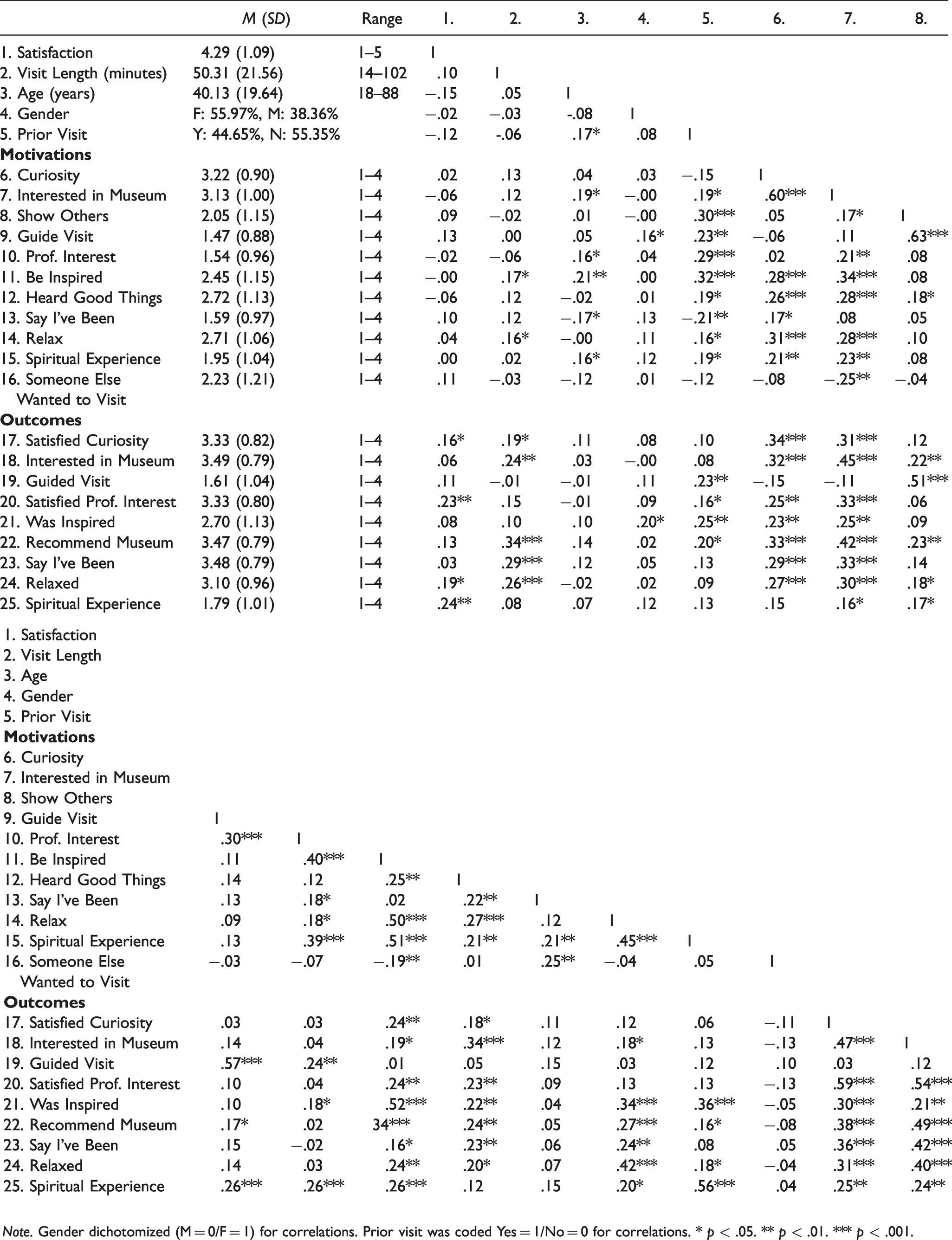
Note. Gender dichotomized (M = 0/F = 1) for correlations. Prior visit was coded Yes = 1/No = 0 for correlations. * p < .05. ** p < .01. *** p < .001.
People endorsed a variety of motivations for visiting the museum. Visitors most strongly endorsed motivations related to the Explorer category and least strongly endorsed motivations related to the Facilitator category. Sixty-six (approximately 40%) participants reported that their reason for visiting was not related to another person wishing to come to the museum. None of the motivations were correlated with visit satisfaction (see Table 1); the motivations to be inspired and to relax were weakly and positively correlated with visit length (rs = .17 and .16, respectively).
Similarly, people reported a variety of visit outcomes. Visitors more strongly endorsed outcomes related to the Explorer and Professional/Hobbyist categories and least strongly endorsed outcomes related to the Facilitator category. Four outcomes were positively correlated with visit satisfaction—satisfying curiosity, satisfying a professional interest, feeling relaxed, and having a spiritual experience—and visit length was positively related to all Explorer and Experience-Seeker outcome items and feeling relaxed. These patterns of correlations suggest that visit satisfaction and length are more closely associated with what people experience during their visit rather than the reasons that motivated the visit.
Predicting Visit Satisfaction and Length
Our second aim was to better understand the relationship between visit motivations and outcomes and visit satisfaction and length. To do so, we conducted a series of regression analyses using each pair of motivation–outcome items (see Tables 2 and 3 for full results). In each analysis, the motivation and outcome items and their interaction were used to predict visit satisfaction (Table 2) and visit length (Table 3). Responses were mean centered prior to analysis. The stats (R Core Team, 2020) lm() function for multiple regression, lm.beta (Behrendt, 2014) lm.beta() function to obtain standardized coefficients, and heplots (Fox et al., 2018) etasq() function to obtain effect sizes were used to complete analyses in R (R Core Team, 2020).
Visit Motivations and Outcomes Predicting Visit Satisfaction.

*p < .05. **p < .01.
Visit Motivations and Outcomes Predicting Visit Length.

*p < .05. **p < .01. ***p < .001.
Overall, visit satisfaction was better predicted by what people got from their visit than what their motivations were for visiting the museum. The degree to which people’s curiosity and professional interests were satisfied, felt relaxed after the visit, or had a spiritual experience positively predicted their satisfaction with the visit. Interestingly, the degree to which people’s motivation was to have a spiritual experience was a negative predictor of visit satisfaction. None of the interaction effects were statistically significant, and all significant relationships were small effects (
Visit length followed a similar pattern—people’s outcomes predicted visit length more consistently than visit motivations. The degree to which people satisfied a personal interest, would recommend the museum to others, will tell others they visited the museum, and felt relaxed were positive predictors of how long people spent in the museum. None of the visit motivations were statistically significant predictors of visit length. One of the interaction effects—guiding someone else’s visit—was significant (see Figure 1) and indicated that for people with above average levels of motivation to guide a visit, visit length increased as levels of guiding a visit increased; for people with average or below average levels of motivation to guide a visit, visit length decreased as levels of guiding a visit increased. In other words, people who were highly motivated to guide a visit stayed longer when guiding a visit was related to their museum experience. People who were not expecting to guide a visit had shorter visits when guiding a visit was related to their museum experience. All significant relationships were small effects (

Interaction for Guiding Visit Predicting Visit Length. Note. Both predictors were mean-centered.
Match Between Motivations and Outcomes
Our third aim was to examine the extent to which people’s motivations and expectations for their visit matched their experiences. One method to accomplish this is to examine the discrepancy between visitor’s pre-visit motivation ratings and their post-visit outcome ratings for each item pair. For visitors who gave the same ratings (e.g., indicating that relaxing was somewhat related to their visit motivation and somewhat related to their visit experience), it suggests the visitor got what they expected. For visitors whose motivation rating is less than their experience rating (e.g., indicating relaxing was not related to their visit motivation but that it was somewhat related to their visit experience), it suggests the visitor got more out of their visit than expected. For visitors whose motivation rating is greater than their experience rating (e.g., indicating relaxing was somewhat related to their visit motivation but that it was not related to their visit experience), it suggests the visitors got less out of their visit than expected.
Overall, people infrequently got less out of their visit than expected, and in a few domains many visitors got more out of their visit than expected (see Figure 2). Within the Explorer domain, most visitors got what they expected and in many cases more than they expected. For 26.58% of visitors, they were less able to satisfy their curiosity than they had expected. Within the Facilitator domain, the majority of visitors got what they expected (70.97%). Within the Professional/Hobbyist domain, a large majority (84.81%) of visitors were more able to satisfy a professional interest than anticipated, and most visitors were inspired to the level they expected, with many visitors (32.91%) being more inspired than expected. Within the Experience-Seeker domain, most participants got more out of their visit than expected; most notably, 84.18% of visitors indicated lower levels of intention to tell others they visited the museum prior to their visit than after having seen the museum’s exhibits. Finally, within the Recharger domain, many visitors were either more relaxed than expected (43.04%) or as relaxed as expected (39.87%), and most visitors had a spiritual experience to the degree expected (55.35%).

Alignment of Motivations and Outcomes. Note. Matched = Rating pre visit was same as rating post visit; Over = Rating pre visit was lower than rating post visit (i.e., got more than they expected); Under = Rating pre visit was higher than rating post visit (i.e., got less than they expected).
Discussion
The present study used Falk’s (2006, 2008) visitor identity model to investigate motivations of visitors to an art museum. Our exploratory work had three general aims: (1) to determine what types of motivations were most prevalent among visitors; (2) to see whether visitor motivations and visit outcomes predicted visit satisfaction and length; and (3) to examine the extent to which people’s visit motivations matched their visit outcomes.
Visitors endorsed the full range of visit motivations examined. People most strongly endorsed motivations related to exploration—curiosity and interest in the museum’s offerings—which replicates Trainer et al. (2012) findings that Explorer-related motivations are the most common type in art museum visitors, an important finding given the considerable difference in the art museums in the two studies (i.e., a large comprehensive art museum vs. a museum focused on modern and contemporary art). This also suggests that the prevalence of visit motivations related to exploration is common to different types of art museums, rather than specific to museums that exhibit a wide range of works. Visitors least strongly endorsed motivations related to facilitating another’s visit—showing others the museum and guiding a visit. Mirroring the motivations, people also reported greater Explorer-related visit outcomes and did not report high levels of Facilitator-related outcomes. The low level of Facilitator-oriented visitors in our art museum visitor sample is in contrast with studies of visitors in other leisure institutions such as zoos or botanical gardens that primarily attract people with Facilitator-related motivations (Falk et al., 2008; Trainer et al., 2012). Interestingly, aquarium visitors—similar to the art museum visitors in the present study—most frequently endorse Explorer-related motivations (Falk et al., 2008), suggesting that different types of leisure institutions attract different kinds of visitors. This Facilitator finding may be, in part, due to differences in the audience attracted to such institutions—Facilitator-oriented visitors who are interested in guiding another’s visit may be more prevalent in institutions in which children visitors or family visits are more common. This possibility should be further explored in future research.
The second focus of this work was examining how motivations and outcomes related to visit satisfaction and length. In general, outcomes were more predictive of visit satisfaction and length than people’s visit motivations. This may suggest that visitor motivations may be a greater influence in what brings people to visit a museum but that these factors are less important in shaping the nature of visits, in line with Falk et al.’s (1998) finding that people’s visit motivations were not associated with their strategies when visiting a museum. Falk et al. (1998) did, however, find that motivations were associated with learning-related outcomes, something not assessed in the present study. This may also indicate that it is more important that visitors feel they got something out of the visit (e.g., satisfying curiosity, were relaxed) or feel engaged with the exhibits (e.g., being interested in the art, wanting to tell others about the experience), even if their experiences diverged from their motivations.
The final focus of our project was to see how well people’s outcomes matched their initial visit motivations and expectations. For all motivation types, outcomes matched or exceeded their initial expectations for over 50% of visitors. Of the motivation types, Experience-Seeker motivations had the highest percentage of visitors who indicated their outcomes exceeded their expectations (67.88% on average). Recharger motivations had the highest percentage of visitors who indicated their outcomes were under their expectations (22.70% on average), but the majority of visitors with Recharger motivations indicated that their outcomes met or exceeded expectations (see Figure 2). Although in the present study, visitor’s expectations were generally met or exceeded, there were instances in which visitors did not get what they expected or intended for their visit. By applying Falk’s framework, we can obtain a more granular understanding of intentions for visits and their relation to visitor outcomes.
These findings have several implications for our understanding of art museum visitor motivations and experiences and can guide future examinations on this topic. Different types of institutions attract visitors with different motivations (Falk, 2016), with art museums tending to attract larger proportions of Explorers compared to other types of institutions (Falk, 2016; Trainer et al., 2012). Since Explorers are driven by curiosity and interest, the best ways to address their need for learning and cognitive engagement should be investigated in more detail. Since Explorer motivations are most common for art museum visitors, it is likely that people view art museums as institutions that allow visitors to satisfy their curiosities and interests; however, the ways in which art museums can appeal to people with other identity-related motivations may be less readily apparent. For example, the present findings suggest that visitors with Facilitator-related motivations were least prevalent in the museum—this may, in part, be due to people who hold these motivations being unsure whether they would be able to successfully facilitate another’s visit at the museum. To broaden interest in art museums among people with non-Explorer related motivations, future research should examine what museum programs, exhibits, or other offerings are appealing to people with different motivations. Museums would then be able to apply this research to inform their programming and to better target outreach to appeal to visitors with different motivations. Additionally, museums attract visitors with mixed motivations, something that is not often addressed. Therefore, this mixed audience should be more thoroughly examined so that the appropriate types of programming can be made available to satisfy their entry motivations and expectations (Falk, 2016).
Overall, the present findings indicate that people enter art museums with a variety of motivations and leave the museum experiencing a variety of outcomes. In much of Falk’s work, he has emphasized the reasons why people enter a museum, and suggested visitor type categories. But our work suggests a focus solely on the motivations does not tell the whole story—what people took away from their experience was more predictive of visit satisfaction and length than their motivations. Focusing on the entirety of a visit, rather than just what motivated people to visit or what they took away, will provide new insights about the psychology of art museums.
Appendix: Museum Visit Questionnaire
Pre-Visit Survey

Post-Visit Survey

Supplemental Material
sj-pdf-1-art-10.1177_02762374211011740 - Supplemental material for Why Do People Visit Art Museums? Examining Visitor Motivations and Visit Outcomes
Supplemental material, sj-pdf-1-art-10.1177_02762374211011740 for Why Do People Visit Art Museums? Examining Visitor Motivations and Visit Outcomes by Katherine N.Cotter Anna Fekete Paul J. Silvia in Empirical Studies of the Arts
Footnotes
Acknowledgment
We thank the Weatherspoon Art Museum, its staff, and its visitors for their assistance in this work.
Declaration of Conflicting Interests
The authors declared no potential conflicts of interest with respect to the research, authorship, and/or publication of this article.
Funding
The authors received no financial support for the research, authorship, and/or publication of this article.

Supplemental material
Supplemental material for this article is available online.
Notes
Author Biographies
References
Supplementary Material
Please find the following supplemental material available below.
For Open Access articles published under a Creative Commons License, all supplemental material carries the same license as the article it is associated with.
For non-Open Access articles published, all supplemental material carries a non-exclusive license, and permission requests for re-use of supplemental material or any part of supplemental material shall be sent directly to the copyright owner as specified in the copyright notice associated with the article.
