



Abstract
Background
Although transarterial embolization (TAE) can powerfully control postpartum hemorrhage (PPH), clinical failure of TAE is not uncommon.
Purpose
To discover whether any parameters could predict timely clinical failure of TAE, then whether a supplementary intervention could be promptly initiated.
Material and Methods
We retrospectively analyzed 118 TAE procedures in 113 patients with PPH performed at our institution between January 2012 and May 2015. The patients were divided into the following groups: clinically successful TAE and failed TAE. Successful TAE was defined as obviation of supplementary embolization or surgical intervention for hemostasis. Gestational conditions, angiographic factors, maternal vital signs, and laboratory data were compared between the two groups.
Results
In total, 100 (84.8%) TAEs were clinically successful. Multivariate logistic regression analyses revealed independent risk factors of TAE clinical failure, including the requirement for augmented embolic agents, placental retention, and international normalized ratio > 1.3 (P = 0.009, 0.001, and 0.005, respectively). The post-TAE shock index was significantly associated with TAE failure, using a cut-off value of 0.8.
Conclusion
The discovered independent risk factors of TAE clinical failure existed before or during the TAE procedure and could not reflect the post-TAE conditions. Although the post-TAE shock index was not an independent factor, it reflected the conditions after TAE and could indicate TAE clinical failure timely.
Keywords
Introduction
Postpartum hemorrhage (PPH) is the primary cause of maternal death (1). Transarterial embolization (TAE) is an alternative management approach to conventional surgery for controlling PPH (2,3), with the benefit of preserving fertility (3–5). TAE is a rapid minimally invasive method, which can be performed without general anesthesia (6). Repeated arterial embolization may be effective for patients with initial TAE failure (7–9) and do not preclude the possibility of surgery (7).
The clinical success rate is high, approximately 80−90% (6,10–12), but the failure rate is not low enough to be neglected. Although some risk factors associated with TAE clinical failure have been discussed (7–9,13,14), there are no absolute contraindications for TAE; by contrast, TAE is recommended when available (7). When TAE clinically fails, a higher incidence of morbidity ensues (7). This study therefore investigated if any factor could predict TAE clinical failure in a timely fashion; consequently, a supplementary intervention could be initiated promptly.
Material and Methods
Patients
Using the Picture Archiving and Communication System (PACS), we retrospectively analyzed 119 TAE procedures in 114 PPH patients treated at our institution between January 2012 and May 2015. The antepartum prophylactic TAE for abnormal placental implantation to control bleeding at delivery (15) was not evaluated. One patient was excluded due to immediate transfer to another institution after TAE at the request of the patient's family. Therefore, 113 patients who received a total of 118 TAE procedures were enrolled in this study for investigation. A flowchart is provided in Fig. 1. Our institution is a 3000-bed, tertiary referral hospital. This retrospective study was approved by our institutional review board (104-3904B).
Flowchart of the eligible patients and TAEs. ATH; abdominal total hysterectomy, HS; hemostatic surgery, RP; remove placenta, Med; medical treatment only.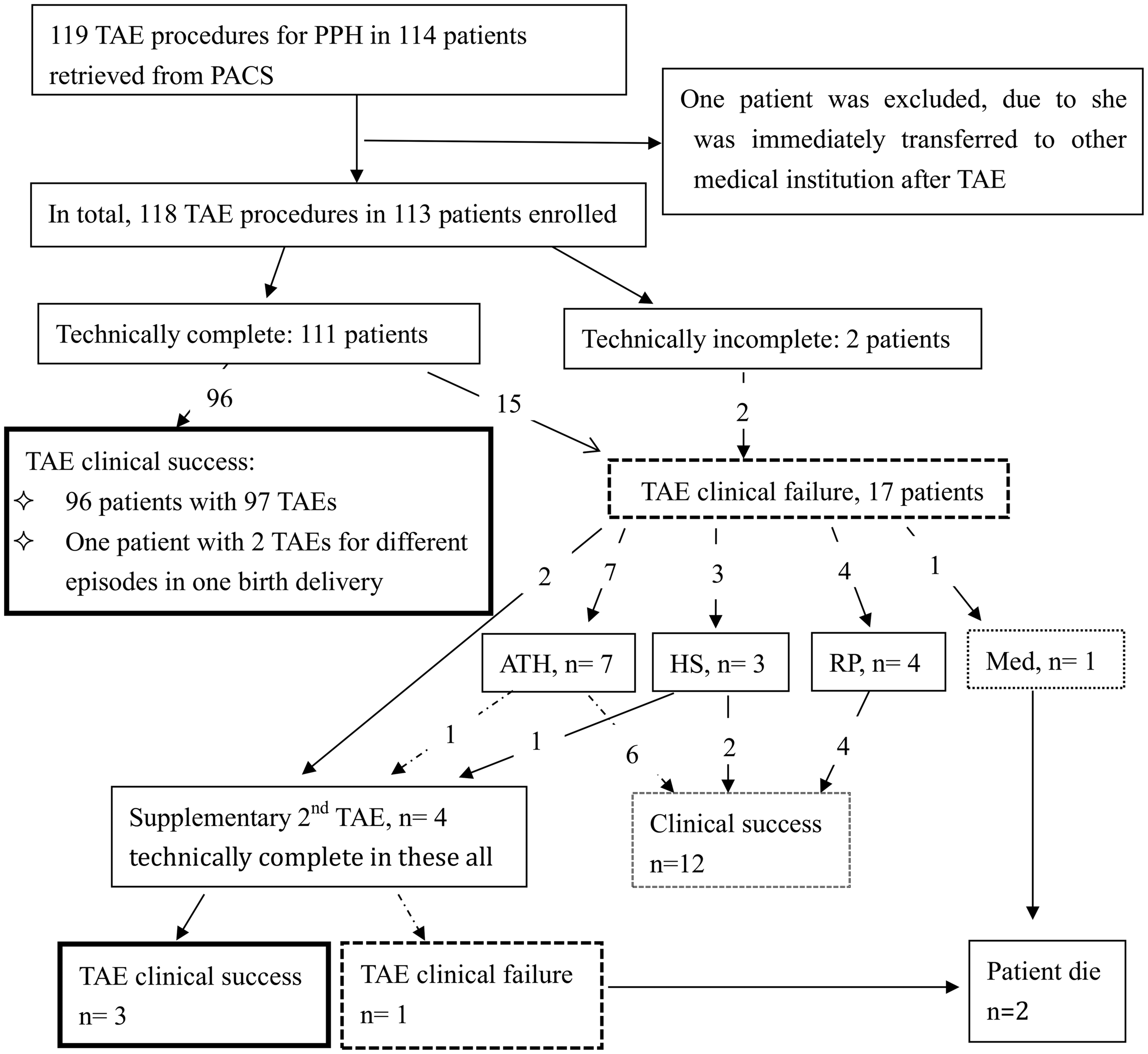
Embolization procedure
TAE was performed by a subspecialist team of radiologists with 1–26 years of experience in treating emergency conditions and using the recommended protocols. Initially, pelvic angiography was performed using a 5-Fr. pigtail catheter to provide vascular mapping and to detect arterial hemorrhage. The internal iliac artery was accessed using a catheter (4-F RC1; Terumo, Tokyo, Japan; or 5-F Roberts uterine curve; Cook, Bloomington, IN, USA); selective cannulation was performed for the bleeding vessels using a coaxial microcatheter (2.7-F Progreat; Terumo, Tokyo, Japan) for target embolization (Fig. 2), followed by prophylactic embolization at the anterior division of the internal iliac arteries to prevent collateral recruitment. If there were no positive angiographic findings, temporary devascularization of the bilateral internal iliac arteries at the anterior division was performed. An absorbable gelatin sponge (Spongostan; Ethicon, Somerville, NJ, USA) was routinely used as the embolic material. The gelatin sponge particles were mixed with diluted contrast medium to produce a slurry for injection into the arteries. In addition to the gelfoam slurry, augmented embolic agents such as metallic coils or N-butyl-2-cyanoacrylate (NBCA) were potentially used at the discretion of each radiologist in cases of arterial lesions, such as pseudoaneurysms and arterio-venous shunting or aggressive bleeding. A post-embolization pelvic angiogram was performed to confirm the devascularization of the internal iliac arteries and the absence of bleeding and arterial lesions.
A 35-year-old woman with a history of vaginal delivery was transferred to our institution for postpartum hemorrhage (PPH). (a) Active bleeding from the small branch of the left external iliac artery was identified (arrow). (b) Selective catheterization of the bleeder (arrow) with a micro-angiocatheter and target embolization with gelfoam slurry was performed, followed by prophylactic gelfoam embolization of the internal iliac arteries; cessation of the bleeding was achieved.
Data and definitions
The patients' gestational condition, angiographic findings, and physical and laboratory data are summarized in Suppl. Tables 1–3. PPH was categorized as primary when hemorrhage occurred within 24 h after delivery and as secondary otherwise (2). Clinically successful treatment was defined by the obviation of further TAE or surgery to control the bleeding within one month of TAE (16) or an uneventful hospital discharge. If PPH recurred after discharge, it was considered a new episode. Following these criteria, post-TAE patients were divided into two groups: clinically successful or failed TAE. The maternal gestational conditions, angiographic findings, maternal vital signs, and laboratory data were compared between the two groups.
Pre-TAE procedures were defined as interventions associated with the current PPH episode, either surgery or TAE, before the applied TAE. By this definition, Cesarean section was considered a pre-TAE surgery and antepartum prophylactic TAE to control delivery bleeding for abnormal placental implantation was also included in the pre-TAE category. The official radiologic reports and images on PACS were reviewed for findings such as contrast extravasation and vascular lesions, including pseudoaneurysms or abnormal arterio-venous shunting. “Selective catheterization” was defined as the catheter being advanced into the uterine artery or a specific bleeding artery for the target embolization. TAE was defined as technically complete when the post-embolization arteriogram demonstrated no active bleeding or vascular lesions. The length of the hospitalization was counted from the day of TAE to the day of discharge. The clinical factors of PPH were determined by reviewing the medical records. The relevant TAE laboratory data and the last records before and after TAE within three days were collected. The vital signs immediately before and after TAE were recorded. The shock index was defined as the heart rate (HR) divided by the systolic blood pressure (17).
Statistical analysis
Analysis of the association between clinically successful TAE and categorical variables was performed using a chi-square test or Fisher's exact test, and continuous variables were analyzed using a Mann–Whitney U test. Univariate logistic regression was applied for each variable and odds ratios (OR) were determined. Multivariate logistic regression was applied for the co-variables, using a forward elimination procedure that set the selection limit at 0.05. Since there were missing data, the sample size analyzed in the multivariate regression was smaller. The performance of the model was evaluated by a receiver operating characteristic (ROC) curve. The level of statistical significance was set at a two-sided P value ≤ 0.05. For these continuous data, the best cut-off point was defined by Youden's index.
Results
Patient characteristics and TAE outcomes
The mean patient age was 33 years (age range = 18−46 years). Overall, 100 (84.8%) TAE procedures were clinically successful. Five patients underwent two TAE treatments. Four patients had supplementary TAE and one received another individual TAE for a different episode. This latter patient first had TAE followed by a secondary PPH after 17 days and the patient was admitted again. Supplementary TAEs were performed in four cases and were technically complete in all. There were two cases with successful TAE alone (success rate = 50%); the other two cases received additional surgery before supplementary TAE and one ended in clinical failure.
Two patients (1.7%) had a technically incomplete intervention due to severe coagulopathy, an international normalized ratio (INR) > 12, and marked vasospasms during angiography. After gelfoam slurry injection into the bilateral internal iliac arteries followed by embolization using coils at each proximal internal iliac trunk, bleeding was persistent in the birth canal from the spastic external iliac artery (Fig. 3). The patient's condition deteriorated rapidly; angiography was not feasible at that time. However, a second TAE attempt was performed hours later and was technically completed, but the patient died. The second patient with technically incomplete TAE exhibited extravasation from the external iliac artery without an identifiable specific bleeding vessel on a post-embolization arteriogram (Fig. 4). Subsequently, supplementary successful surgery was performed.
A 32-year-old G4P1 woman was transferred to our institution for PPH after a vaginal delivery at gestational age (GA) 39 weeks, complicated with profound coagulopathy (INR > 12). (a) A pelvic arteriogram revealed multi-segmental spasm (arrow) of the bilateral iliac arteries and bleeding (arrowhead) at the birth canal from the distal branch of the right internal iliac artery. (b) Arterial obliteration was achieved by massive gelfoam slurry infusion followed by coils deployed at the trunk (arrow) in bilateral internal iliac arteries. However, slow bleeding persisted in the birth canal (star) from the spastic external iliac artery. Because the patient's condition deteriorated rapidly, angiography was discontinued. A 32-year-old G2P2 woman at GA 38 weeks was transferred for PPH after a vaginal delivery. (a) TAE with gelfoam slurry achieved obliteration of both internal iliac arterial territories. (b) Embolization was technically incomplete as there was still slow bleeding from the left external iliac arterial branches, without a specific feeder (arrow). The patient subsequently underwent a subtotal hysterectomy.

Only five TAEs were applied with augmented embolic agents and all adopted coils. Among them, four were classified as failed TAEs. The association between augmented embolic agents and TAE clinical failure was statistically significant, despite the limited data.
Complications of TAE
Two patients experienced TAE-associated sepsis. First, a woman delivering twins suffered from infection and shock upon arrival at our hospital. She was hospitalized after TAE, during which time she suffered a cardiac arrest as a complication of sepsis. She was resuscitated but developed hypoxic-ischemic encephalopathy from prolonged circulatory collapse. After one month of hospitalization, she was discharged in a stuporous state. The next patient had an INR markedly elevated to 5.5 and subsequently developed infective endometritis complicated with sepsis after TAE. Total hysterectomy was performed eight days later and uterine necrosis was diagnosed by pathological analysis. The patient was discharged smoothly after two months of hospitalization.
There were two deaths. Aside from the one with severe coagulopathy mentioned previously and shown in Fig. 3, the other patient was transferred to our institution with an intubated status and a Glasgow Coma Scale score of E1VtM1. Her condition deteriorated rapidly even after TAE and serial management, and she died in the emergency department.
Factors associated with clinically failed TAE
Upon univariate analysis, clinical failure of TAE was significantly associated with the requirement of augmented embolic agents (P = 0.002, OR = 28.29), whether TAE was technically complete (P = 0.022, OR = divergent), the length of the hospital stay (P < 0.001, OR = 1.19), placental retention (P = 0.002, OR = 12.44), pre-TAE HR (P = 0.022, OR = 1.03), INR (P = 0.002, OR = 3.40), post-TAE HR (P = 0.01, OR = 1.04), and shock index (P = 0.007, OR = 9.50). For these continuous data, the best cut-off points were pre-TAE HR = 136.5/min, INR = 1.3, post-TAE HR = 100.5/min, and shock index = 0.8.
Multivariate logistic regression revealed that augmented embolic agents, placental retention, and INR (P = 0.009, 0.001, 0.005, and OR = 37.50, 36.08, 4.97, respectively) were independently associated factors.
Discussion
The shock index has been reported to be useful in predicting maternal outcomes for PPH (18,19). The shock index better reflects the early hypovolemic status of a patient compared with HR or systolic blood pressure alone (17). In this study, the pre-TAE shock index was not statistically associated with TAE clinical failure, but post-TAE shock index was positively associated with TAE clinical failure. Although the post-TAE shock index was not an independent factor, it can be used in the clinical setting to truly reflect the patient's condition after TAE. A lower post-TAE shock index implied successful hemostasis, with a cut-off value of 0.8. On the other hand, pre- and post-TAE systolic blood pressure showed no association with TAE outcome, while HR was associated with TAE outcomes regardless of pre- or post-TAE status. The pre-TAE HR was associated with TAE outcome, implying an association that existed before the TAE, rather than reflecting the effectiveness of TAE.
Although augmented embolic agents, placental retention, and INR were independent risk factors of TAE clinical failure following multivariate logistic regression analysis, they existed before or during the TAE procedure. The use of augmented embolic agents is subjective and affected by each radiologist's experience and discretion. These factors were not absolute contraindications for TAE, and TAE might be recommended when available (7). Thus, they should be considered risk factors rather than preditors.
Embolization using a gelatin sponge is usually safe (7,20) in bilateral internal iliac arteries. When the bleeder was identified, target embolization was performed, because specific-site embolization is more effective. As the arterial collateral was crucial in recurrent hemorrhage after TAE (4,9,21), we embolized the bilateral internal iliac arteries. Rapid vascular recanalization from absorbable gelatin sponge packing occurred, as experienced by Kim et al. (7). Embolization using coils, NBCA, and microspheres might be applied in the case of arterial lesions, such as ruptures, pseudoaneurysms, and arterio-venous shuntings (3). The requirement of augmented embolic agents is an independent factor of TAE clinical failure, which may imply that augmented embolic agents are needed in addition to gelfoam for hemostasis in patients with aggressive bleeding.
Placental retention has been significantly correlated with TAE failure (22), as in our study. The residual placental tissue in the uterus may reduce uterine contractions by rending focal areas of the uterine myometrium (22). Although placenta accreta does play a pivotal role in placental retention (23,24), it is considered a risk factor for TAE clinical failure (8,9). This postulation was not supported by our study or by others (7).
In classifying PPH severity, laboratory data are inferior to clinical parameters (25); however, it is likely needed (26). Some studies have suggested that disseminated intravascular coagulation is strongly associated with TAE clinical failure (7,27). Although platelets, fibrinogen, and prothrombin play major roles in scoring disseminated intravascular coagulation (28), these data are usually not all available before TAE in the emergency setting. We found that platelets and fibrinogen were not associated with the TAE outcome. However, the INR was available before TAE and significantly correlated with the TAE outcome, which is consistent with other reports (27).
Transfer to a hospital where TAE is available is recommended for a patient with PPH (29). In this study, TAE for such transferred patients accounted for 72% of the cases (85/118) and had no statistical association with the outcome of TAE, which is in line with previous reports (7,8). Uterine atony was the most common cause of PPH in our study, which is consistent with the literature (7,30). In this study, we found that patients with TAE failure experienced longer hospitalization, which was significantly associated with TAE failure. Kim et al. (7) reported that patients with TAE clinical failure had a higher incidence of morbidity, possibly explaining why such patients required longer hospitalization in this study.
In our study, the clinical success rate of TAE was 84.8% (n = 100/118), which is comparable with other published reports (4,10). There was one event of uterine necrosis among 118 TAEs, at a rate of 0.85%. This might have been due to the massive embolization aimed to cease the profound bleeding (31). Uterine necrosis secondary to TAE may be encountered even when using absorbable embolic agents (32). The overall maternal death rate in this study was approximately 1.8% (n = 2/113), which is comparable with other reports (6).
This was a retrospective study with a limited number of patients; therefore, several limitations were inherent. First, some of the data required for this study were not available. Additionally, there was no available scoring system to classify the severity of PPH and no guideline for classifying patients into the TAE or surgery groups. The TAE procedures were performed by different interventional radiologists, who had different considerations and levels of experience.
In conclusion, independent risk factors of TAE clinical failure include augmented embolic agents, placental retention, and the INR > 1.3. They either existed before or during the TAE procedure and could not reflect the post-TAE condition. However, although the post-TAE shock index was not an independent factor, it denoted the condition after TAE and was statistically associated with TAE clinical failure using a cut-off value of 0.8. The higher post-TAE shock index indicated that PPH was not stopped and that a supplementary intervention should be initiated promptly.
Footnotes
Acknowledgments
The authors thank their radiological colleagues and all the staff involved in the management of these cases. They also appreciated the technical support with statistics from the Biostatistical Center for Clinical Research.
Declaration of Conflicting Interests
The author(s) declared no potential conflicts of interest with respect to the research, authorship, and/or publication of this article.
Funding
The author(s) received no financial support for the research, authorship, and/or publication of this article.